
If you're a real estate agent, you've probably spent years perfecting your SEO strategy to get to the top of Google. But what if I told you that the game has completely changed?
AI SEO is the new frontier. It’s no longer about simply ranking #1 for a keyword. It’s about optimizing your entire online footprint—your website, your listings, your local profiles—so that AI tools like Google's AI Overviews and ChatGPT recommend you directly. The goal is to be the answer when a buyer asks their AI assistant, "Who is the best agent in Austin for first-time homebuyers?"
How AI Is Rewriting Real Estate Marketing

The modern homebuyer's journey looks very different today. Instead of scrolling through endless blue links on a search results page, your potential clients are getting direct, summarized answers from AI. This is a massive opportunity for agents who get ahead of the curve and a real threat to those who don't.
Old-school SEO was a grind of keywords and backlinks. The new battlefield is about feeding AI systems the structured, authoritative information they crave to confidently recommend you and your listings.
The New Battlefield for Visibility
This isn't some far-off trend—it's happening right now. A staggering 40% of homebuyers are already using AI tools to kick off their property search, and that number is climbing fast.
These AI platforms don't just pick any random website. They're designed to find and prioritize content that is:
- Trustworthy: Pulled directly from your website and a well-maintained Google Business Profile.
- Structured: Uses a technical language called schema markup to clearly define property details, agent info, and local expertise.
- Authoritative: Backed up by a consistent stream of high-quality content like hyper-local market reports and in-depth neighborhood guides.
Think about it. When a potential client asks ChatGPT for "family-friendly neighborhoods in Denver with good schools," the AI scans the web to synthesize an answer. Your goal is to make sure your content is the most reliable, comprehensive source it finds.
The core of AI SEO for real estate agents is simple: build a digital footprint that makes you the undeniable local expert. When you consistently publish helpful, structured content, you're not just marketing—you're training AI to recognize your authority.
Comparing Traditional SEO and AI SEO for Real Estate
To really grasp this shift, it helps to see the old and new approaches side-by-side. This table breaks down the crucial differences between yesterday's SEO tactics and the AI-driven strategies required to win clients today.
| Strategy Element | Traditional SEO Approach | Modern AI SEO Approach |
|---|---|---|
| Primary Goal | Rank #1 on a search results page. | Become the AI's go-to source for recommendations. |
| Keyword Focus | Broad match keywords (e.g., "homes for sale Austin"). | Conversational, long-tail questions (e.g., "what is the best Austin neighborhood for young families?"). |
| Content Strategy | Blog posts targeting specific keywords. | Creating a web of interconnected, authoritative content (market reports, neighborhood guides, agent profiles). |
| Technical Focus | On-page SEO, backlinks, and site speed. | Schema markup, structured data, and entity-based optimization. |
| Source of Truth | Ranking algorithms based on links and keywords. | AI models synthesizing data from trusted, structured sources. |
| Lead Generation | Attract clicks from a list of search results. | Intercept buyers at the moment of inquiry with a direct AI-generated answer. |
As you can see, the new approach is far more holistic. It’s about building a brand that AI can understand and, more importantly, trust.
Why Portal Dependency Is a Losing Game
Relying on portals like Zillow and Realtor.com has always meant you were renting, not owning, your leads. Building an AI-optimized presence on your own website creates a sustainable lead pipeline that belongs to you. It's about positioning your brand to capture high-intent leads before they ever even think to visit a crowded portal.
The numbers don't lie. With AI Overviews now dominating a huge portion of search results, click-through rates to traditional websites are plummeting for agents who fail to adapt. But it's not all doom and gloom. Agents who are leaning into AI SEO are reporting a 68% improved ROI because they are showing up exactly where modern buyers are looking. You can dig into more of these AI SEO statistics and their impact to see the full picture.
Mastering AI SEO for real estate agents means building a marketing engine that works for you 24/7. It’s the key to becoming the definitive answer to a homebuyer's question, not just another name lost in the crowd.
Writing AI-Optimized Property Listings That Convert

Let's be honest, your property description has a new audience. It’s no longer just a sales pitch for a human buyer; it's a critical data source for AI search tools. This means every single word you write has to do double duty: entice a person and educate an algorithm. The old days of just cramming in generic keywords are long gone.
Today's winning strategy is all about entity-based SEO. This is a fancy way of saying you need to describe a property by its relationship to the world around it. You're not just selling four walls and a roof; you're selling a lifestyle, a community, a place. You need to connect the dots between the home and local entities like schools, parks, popular restaurants, and transit hubs.
When you do this, you turn a simple listing into a rich, contextual story. So when a potential buyer asks an AI, "Find me a three-bedroom house in Scottsdale near a good elementary school and a dog park," your listing is infinitely more likely to pop up if it clearly communicates those connections.
Moving Beyond Keywords to Entities
To really nail this for AI, think more like a storyteller than a salesperson. Instead of just listing "granite countertops," you need to describe the "chef’s kitchen with sleek granite countertops, perfect for entertaining." See the difference? That subtle shift adds context that both people and machines can easily understand.
This is the core of what makes AI SEO for real estate agents so effective. It’s all about providing clear, descriptive, and interconnected information.
Instead of: "big backyard"
Try: "a sprawling, fully-fenced backyard that’s ideal for summer barbecues."
Instead of: just the city name
Try: "nestled in the quiet, tree-lined streets of the historic Northwood district."
Instead of: a vague location
Try: "just a five-minute walk to the popular Oak Street Farmer's Market and steps from the entrance to Greenway Park."
This level of detail gives AI models like ChatGPT and Google's AI the precise data they need to match your listing with very specific buyer searches. Every connection you make to a local entity—a park, a school, a coffee shop—strengthens your listing's relevance.
Crafting Descriptions for Humans and AI
Your goal is to write copy that feels completely natural and compelling to a person while also being perfectly structured for a machine. This is where combining vivid, descriptive language with a few psychological triggers becomes a superpower.
Let’s walk through a real-world example. Say you've got a new listing and you've used a tool like ListingBooster.ai to generate the first draft. Here’s how you can polish it to hit both targets.
The Standard, Boring MLS Description:
“3 bed, 2 bath home in Austin. Updated kitchen, large yard. Close to downtown. Great for families. Must see.”
The AI-Optimized, Compelling Description:
“Discover your dream home in the heart of Austin’s vibrant Zilker neighborhood. This beautifully renovated 3-bedroom, 2-bathroom residence offers the perfect blend of modern comfort and urban convenience. The fully updated kitchen features stainless steel appliances and quartz countertops, flowing seamlessly into an open-concept living area bathed in natural light.
Step outside to a private, spacious backyard, perfect for weekend gatherings. Located just a 10-minute drive from downtown Austin and within the highly-rated Zilker Elementary school district, this home is an ideal choice for families. Enjoy being walking distance from Zilker Park and Barton Springs Pool. This opportunity won’t last long—schedule your private tour today.”
The difference is night and day, right? The second version is packed with local entities (Zilker neighborhood, Zilker Elementary, Zilker Park) and uses light psychological cues like "dream home" (tapping into aspiration) and "won’t last long" (creating scarcity).
A great AI-optimized listing tells a story that resonates with a buyer's aspirations while simultaneously feeding search engines a structured, fact-based summary of the property and its surrounding environment. The two goals aren't in conflict; they actually support each other.
A Practical Checklist for AI-Ready Listings
As you sit down to write your next property description, run through this mental checklist to make sure it's optimized for modern search.
- Lead with a Killer Hook: Start with a sentence that grabs attention and highlights the home's most unique selling point.
- Name Specific Entities: Don't be vague. Mention the actual names of neighborhoods, school districts, parks, key streets, and popular local businesses.
- Use Natural Language: Write like you talk. Ditch the jargon and awkward keyword-stuffing. Imagine you're describing the home to a client in person.
- Describe the Lifestyle: Paint a picture. What does it feel like to live there? Talk about morning coffee on the patio or weekend walks to the nearby cafe.
- Incorporate Urgency: Use phrases like "highly sought-after neighborhood" or "a rare find in this market" to create a little friendly urgency.
- Structure for Scannability: Keep your paragraphs short (just 2-3 sentences) and use bullet points for key features. This makes the description easy to read on any device.
By following this framework, you’ll create listings that not only shine on traditional portals like Zillow and Realtor.com but are also perfectly teed up to be recommended by the AI assistants that are quickly becoming a homebuyer's first stop.
Building the Digital Authority AI Recommends
Optimized listings get your properties seen, but building digital authority gets you recommended. It’s a crucial distinction. AI search engines like Perplexity and Google’s AI Overviews don’t just find houses; they find experts.
When a potential client asks their phone, "Who is the best real estate agent in Scottsdale?" the AI isn't just looking for keywords. It's scanning for signals of expertise, consistency, and trust across the web. Your job is to build that digital footprint so you're the undeniable answer.
This isn't about just having a blog. It’s about becoming the go-to online resource for your market. Think of every article you post as another brick in the foundation of your reputation, strengthening your authority one piece of content at a time.
The Content That Signals True Expertise
To be seen as an expert, you have to create content that answers the specific, nuanced questions your clients are actually asking. You need to get way beyond generic "tips for buyers" and dig deep into what makes your local market tick. This is how you prove your value long before the first phone call.
AI rewards content that is genuinely helpful and demonstrates firsthand knowledge. Here are the kinds of posts that build real authority:
- Hyper-Local Neighborhood Guides: Don't just list demographics. Talk about the lifestyle. Where's the best local coffee shop? What's the walkability score really like? What's the community vibe?
- Insightful Market Updates: Anyone can spit out MLS data. Your job is to provide expert analysis. What do rising interest rates actually mean for a first-time buyer in your specific city?
- Practical "How-To" Articles: Solve real-world problems for your audience. Think "How to Successfully Appeal Your Property Tax Assessment in Maricopa County" or "A First-Time Homebuyer's Complete Checklist for North Phoenix."
AI doesn't just index keywords; it understands concepts and recognizes genuine expertise. When you consistently publish content that answers the questions your clients have, you are actively training AI to recommend you as the most qualified professional in your area.
Creating a Consistent Digital Footprint
Consistency is everything when it comes to building authority. A single great blog post is a drop in the ocean. A steady stream of valuable content, on the other hand, creates a rising tide that lifts your entire online presence.
I get it—creating this content consistently is a massive challenge for busy agents. This is where having a smart system becomes a critical advantage, ensuring your digital presence grows without eating up all your time.
The reality is that AI search isn't replacing traditional search; it's layering right on top of it. And the agents who adapt to this new reality are the ones who will win. In fact, first-party sites and Google Business Profiles make up 86% of AI citations. That means the digital assets you directly control are what AI pulls from the most.
Automating your content creation with a tool like ListingBooster.ai helps you maintain that crucial consistency. Imagine generating a full 30-day calendar of market updates, agent profiles, and neighborhood spotlights in the time it takes to grab a cup of coffee. This systematic approach ensures your digital footprint is always active, relevant, and growing.
How Your Content Turns into AI Recommendations
So, how does a blog post about a local farmers market actually translate into a new lead from an AI search? The connection is more direct than you might think. AI models synthesize information from multiple sources to build a confident answer for the user.
Let's walk through a real-world scenario:
- A user asks Google's AI, "What are the best family-friendly neighborhoods in Scottsdale?"
- The AI scans the web for reliable content discussing Scottsdale, families, local schools, parks, and community events.
- It finds your in-depth guide to the "Top 5 Scottsdale Neighborhoods for Families," your article on the "Best Parks in North Scottsdale," and your latest market report mentioning specific school district ratings.
- Because your content is comprehensive, well-structured, and consistently published on your own website, the AI identifies you as a credible authority.
- In its response, it not only recommends the neighborhoods you wrote about but might also mention you as a knowledgeable local real estate expert, sending high-intent traffic right to your digital doorstep.
Every piece of high-value content is another data point proving your expertise. You're building a web of interconnected, authoritative information that makes it easy for AI to understand who you are and why you're the best choice. For a deeper dive into how this all works inside Google's world, check out our guide on how Google AI is changing real estate search. This is what separates the top agents in the age of AI.
Using Schema Markup to Speak Directly to AI
Think of your website as a beautifully designed brochure. Humans get it instantly. But to a search engine or an AI assistant, it’s just a jumble of text and images. They need a translator to know that "$500,000" is a price, "4" is the number of bedrooms, and "Jane Doe" is the agent.
That translator is called schema markup. It’s basically a special vocabulary you add to your website's code. It doesn't change a thing for human visitors, but it makes a world of difference to the machines by adding invisible labels to every piece of information.
Why Schema Is a Game-Changer for AI SEO
Without schema, an AI is left guessing what your content means. With it, you're spelling everything out: "This is a real estate listing, here's the address, this is the square footage, and that’s the agent’s contact info."
This structured data is the magic behind those rich, detailed search results you see on Google—the ones with photos, prices, and bed/bath counts right on the results page. For AI SEO for real estate agents, this is non-negotiable. AI systems love information they can understand with 100% certainty, and schema delivers exactly that.
Just look at this screenshot from Schema.org. It shows just a fraction of the specific fields you can define for a RealEstateListing.
As you can see, the code lets you label everything from the askingPrice to specific amenityFeature details. You're essentially handing search engines a perfectly organized summary of your property.
You Don't Need to Be a Coder Anymore
The best part? You don't need to be a web developer to pull this off. Ten years ago, adding schema was a tedious, manual slog. Today, modern real estate marketing platforms and website plugins can handle it all for you.
Think of it this way: schema markup turns your website's content into a perfectly organized database that AI can query directly. When you structure your data this way, you're not just hoping to rank—you're providing the direct answer to a machine's question.
Tools like ListingBooster.ai automatically embed the right schema for your properties and your agent profile. When you generate a property description or a bio, the platform is working behind the scenes to wrap that content in the appropriate code. This means every piece of content you create is ready for AI the moment you hit "publish."
The Most Important Schema Types for Agents
While there are hundreds of schema types out there, you only need to focus on a few key ones to get the biggest bang for your buck. Getting these right gives AI a complete picture of who you are, what you sell, and where you work.
- RealEstateListing: This is the big one. It covers all the property-specific details like price, address, number of rooms, and square footage.
- RealEstateAgent: This one is all about you. It includes your name, brokerage, contact info, and license number, proving your credentials.
- LocalBusiness: This helps ground your business in a physical location, connecting you to a specific town or neighborhood and giving your local search presence a serious boost.
- Review: This markup highlights client testimonials, turning your hard-won social proof into a structured signal of trust that both search engines and potential clients can see.
By implementing these, you're building a complete, machine-readable profile of your business. If you want to dive deeper into how this code can transform your listings, check out our detailed guide on using schema markup for real estate listings.
The key takeaway here is simple: what used to be a highly technical and expensive SEO task is now an essential—and completely accessible—part of your marketing toolkit. By making sure your digital footprint is properly structured, you make it incredibly easy for AI to find, understand, and recommend both you and your properties.
Your Actionable AI SEO Workflow for Listings
It's one thing to talk about theory, but it's another to actually put it into practice and get results. So let's connect all these ideas into a practical, repeatable workflow you can start using the second you land your next listing. The goal here isn't to add more work to your plate; it’s to use an AI-powered system to roll out a complete, optimized marketing campaign in just a few minutes.
Think about walking into your next listing presentation. Instead of just bringing a CMA, imagine showing up with a fully-realized digital marketing plan, ready to launch the moment they sign. That’s the kind of competitive edge this workflow gives you.
This process shows how raw listing data gets transformed into AI-friendly content that search engines and discovery platforms can instantly understand and serve up to potential buyers.
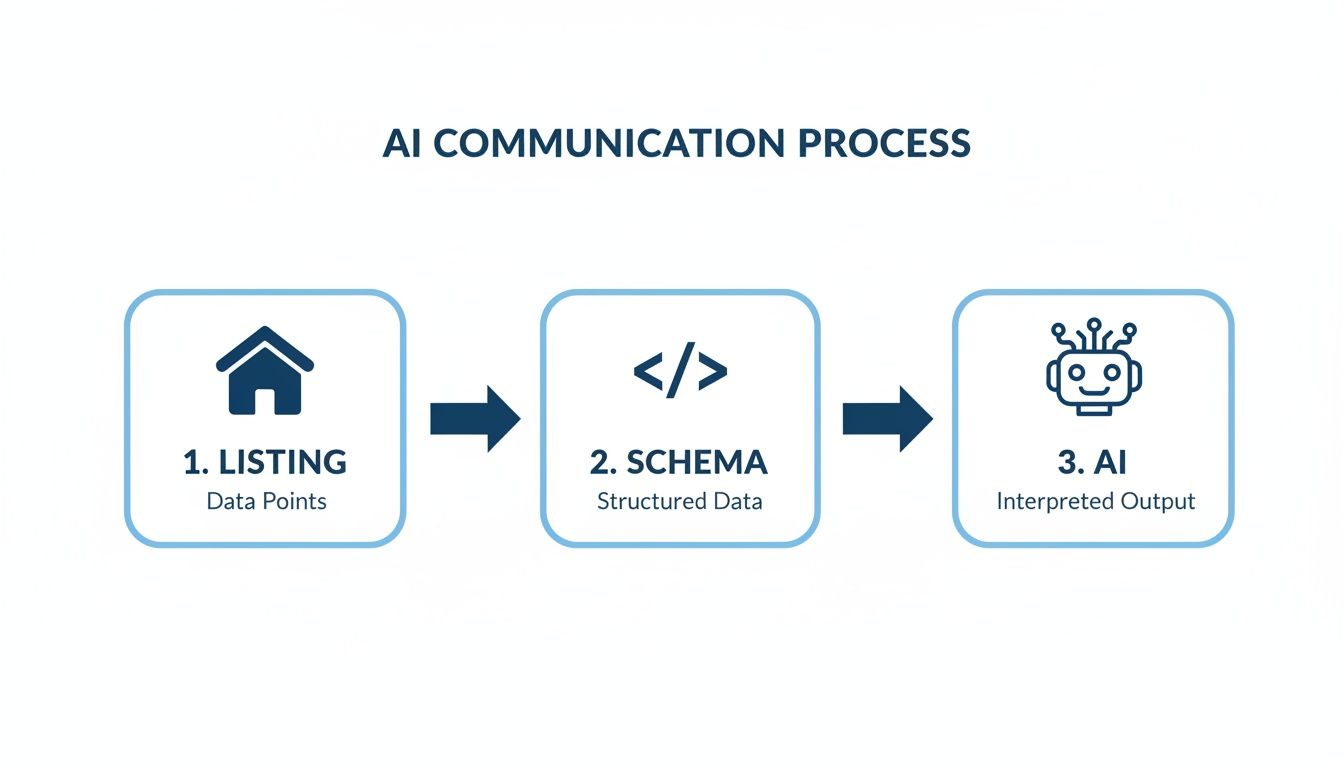
The big takeaway? AI is the translator. It takes basic property details and turns them into the structured, optimized assets you need to be visible online today.
The New Listing Launchpad
The clock starts ticking the moment that listing agreement is signed. Speed and precision are everything. Your mission is to get that property maximum exposure across every platform that matters—from your local MLS to social media—and to do it fast. Every single piece of content needs to be optimized for both human eyeballs and AI discovery right from the get-go.
Let's walk through a real-world scenario. You just listed a beautiful 4-bedroom home in a sought-after suburban neighborhood.
Instead of sitting there for hours trying to craft the perfect MLS description or wracking your brain for social media ideas, you turn to an AI platform like ListingBooster.ai. All you do is plug in the property's address or a few key details, and the system immediately gets to work.
Generating Core Assets in Minutes
In less time than it takes to make a cup of coffee, you have a full suite of marketing materials. And this isn't generic, cookie-cutter stuff. It’s all built on the principles of AI SEO for real estate agents, with each asset crafted for a specific channel and a specific purpose.
Here’s what you get, instantly:
- An AI-Optimized MLS Description: This isn't your standard bland description. It’s written in natural language, weaving in local landmarks (nearby parks, school districts) and using subtle phrasing that resonates with buyers. Of course, it’s fully editable and compliant with Fair Housing guidelines.
- A Full Month of Social Media Content: The system spits out a 30-day social media calendar. You get posts for every stage of the listing lifecycle: "Coming Soon," "Just Listed," "Open House," and even "Under Contract." Each one has a unique angle, smart image suggestions, and the right local hashtags.
- Print-Ready Materials: Need flyers for the open house? Done. Professional brochures are generated on the spot, bridging your digital efforts with high-quality physical handouts.
This isn't just a time-saver. It's about deploying a professional, multi-channel marketing campaign with a consistency and quality that, until recently, would have required a whole marketing team.
This immediate, comprehensive launch shows your sellers you’re on the ball. You aren't just promising great marketing; you're delivering it from day one.
From Listing Launch to Authority Building
But the workflow doesn't end when the listing goes live. The very same system that launched your property marketing can now pivot to build your long-term digital authority. This is where you connect the dots between your property-specific marketing and your brand as the go-to local expert.
After scheduling out all your social posts for the listing, you can start planning content that will keep working for you long after this home has sold.
This next phase is all about building your brand:
- Schedule Hyper-Local Market Updates: Generate and schedule a weekly or monthly market report for that specific neighborhood. This positions you as the agent who knows the numbers.
- Create Neighborhood Guides: Put together an in-depth guide to the community where your listing is. This becomes an evergreen piece of content that attracts future buyers and boosts your organic traffic.
- Answer Common Client Questions: Quickly create short, helpful articles answering questions like, "What are property taxes like in this area?" or "What are the best local restaurants?"
This smooth shift from property promotion to brand building is what creates a sustainable marketing engine. Each new listing becomes a new opportunity to strengthen your digital footprint, making it even easier for AI to recommend you for the next piece of business. For those wanting to dig deeper, there are many powerful AI tools for real estate agents that can be integrated into this process.
By adopting this systematic approach, you create a powerful feedback loop. Your optimized listings get immediate attention, and your authority content builds a foundation of trust that attracts future clients—all powered by one efficient workflow.
Common Questions About AI SEO in Real Estate
Even with all the benefits laid out, I get it—jumping into AI-driven marketing can feel like a big step. It’s natural to have questions. Let's walk through some of the most common ones I hear from agents, so you can feel confident making this shift.
Will AI SEO Replace My Website?
Absolutely not. In fact, it does the exact opposite. AI SEO makes your website more critical to your business than ever.
Think of your website as your digital storefront. It's the ultimate source of truth about you and your listings. AI search tools, like Google's AI Overviews and ChatGPT, are hungry for reliable, direct information, and they trust your website and Google Business Profile above all else. Why? Because the information comes straight from the source—you.
AI SEO is simply the process of fine-tuning your content so these AI systems can easily understand it, trust it, and recommend you. It's not a replacement for your site; it's a supercharger for it.
How Do I Measure the Success of AI SEO?
This is a great question. Success here isn't just about climbing to the #1 spot on a search results page. AI SEO for real estate agents is all about driving real business and cementing your reputation as the local expert.
You'll want to watch a mix of metrics to see the full picture:
- Direct Leads: Are you getting more form submissions through your website? Are more people clicking to call from your Google Business Profile? These are the clearest signs of a direct return on your investment.
- Organic Growth: Keep an eye on your website's organic traffic. You should see a steady climb. Also, just search for your own name and brokerage—are you showing up more prominently?
- AI Visibility: This is the new frontier. When your content starts appearing in Google's AI Overviews for local real estate questions, that's a huge win. It’s a clear signal your strategy is hitting the mark.
- Social Buzz: Pushing out consistent, high-quality content will naturally boost engagement on your social media. This isn't just vanity; it's a powerful indicator that your brand authority is growing.
Do I Need to Be a Tech Whiz to Implement This?
Not at all, and that’s the best part. Modern tools are built for agents, not developers. The whole point is to take these complex, once-inaccessible marketing strategies and make them simple.
Good platforms are designed to be intuitive and save you precious time. You typically just plug in a property address or a few details, and the AI takes over, handling the heavy lifting of writing great copy, crafting social posts, and even embedding the right code (schema markup) for you.
How Does AI Content Stay Compliant?
Compliance is non-negotiable, and any AI tool worth its salt in the real estate space knows this. These systems are specifically trained to steer clear of language that could get you in trouble with Fair Housing laws. They stick to objective property features and the lifestyle benefits of the community.
On top of that, a platform like ListingBooster.ai ensures all AI-generated content is completely editable. You always have the final say. This gives you total control to make sure every listing description and social post is 100% compliant with your local MLS rules and brand voice before it goes public.
Ready to stop being invisible in AI search? ListingBooster.ai is the command center that transforms your listings into a complete marketing suite and builds your digital authority automatically. Start your free 30-day trial today.
Leave a Reply