Author: gavin

  • The Top 12 Real Estate Agent Productivity Tools for 2026

    The Top 12 Real Estate Agent Productivity Tools for 2026

    In today's market, the most successful agents aren't just great at sales; they're masters of efficiency. Juggling leads, listings, marketing, and paperwork can feel like a dozen jobs in one. The right technology is not just a nice-to-have; it's the core of a scalable, profitable business. This guide cuts through the noise to reveal the definitive list of real estate agent productivity tools that high-performers are using to automate tasks, win more listings, and reclaim their time.

    We move beyond generic feature lists to provide real-world workflow examples, strategic tech stacks for different agent types, and honest assessments of where each tool shines and where it falls short. You will find practical guidance on building a technology ecosystem that actually works for you, not against you. Each recommendation is backed by screenshots and direct links, so you can see the platform in action.

    This is not another surface-level roundup. Instead, think of it as your blueprint for operational excellence in 2026. We will dive into specific platforms like ListingBooster.ai for marketing automation, Follow Up Boss for client relationship management, and SkySlope for transaction coordination. The goal is to help you select the precise software to solve your biggest operational bottlenecks. Whether you're a solo agent aiming for your first million in GCI or a team lead building an empire, the right tools are here. Let’s find the stack that will help you close more deals.

    1. ListingBooster.ai

    ListingBooster.ai stands out as a powerful AI marketing command center built for the new era of search. As home buyers increasingly turn to tools like ChatGPT for agent recommendations, this platform focuses on making you and your listings discoverable. It’s an essential addition to any agent’s toolkit, designed not just for marketing automation but for winning listings by demonstrating a clear, forward-thinking strategy.

    ListingBooster.ai

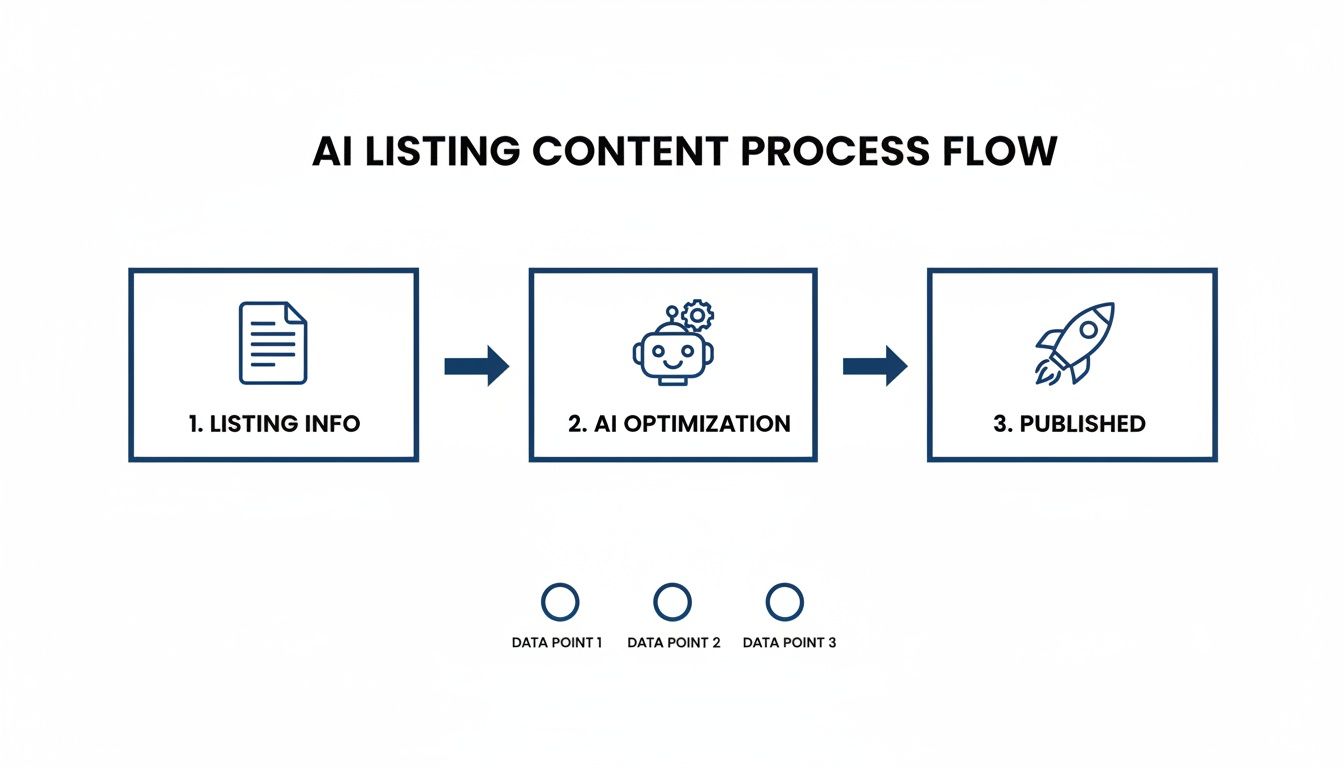
    The system operates on two core engines. Listing Commander ingests a property address and generates a complete, platform-ready marketing suite in minutes. This includes AI-optimized descriptions for MLS, Zillow, and Realtor.com, plus a 30-day social content calendar. Authority Builder works in parallel to produce market updates and neighborhood guides, positioning you as the go-to expert.

    Standout Features

    • AI Search Optimization: Generates content and schema markup specifically to improve visibility in AI search results, a critical differentiator from generic social media schedulers.
    • Presentation-Ready Assets: Creates print-ready materials and an "AI Search Strategy" document to show sellers exactly how you’ll market their home, giving you a tangible advantage in listing presentations.
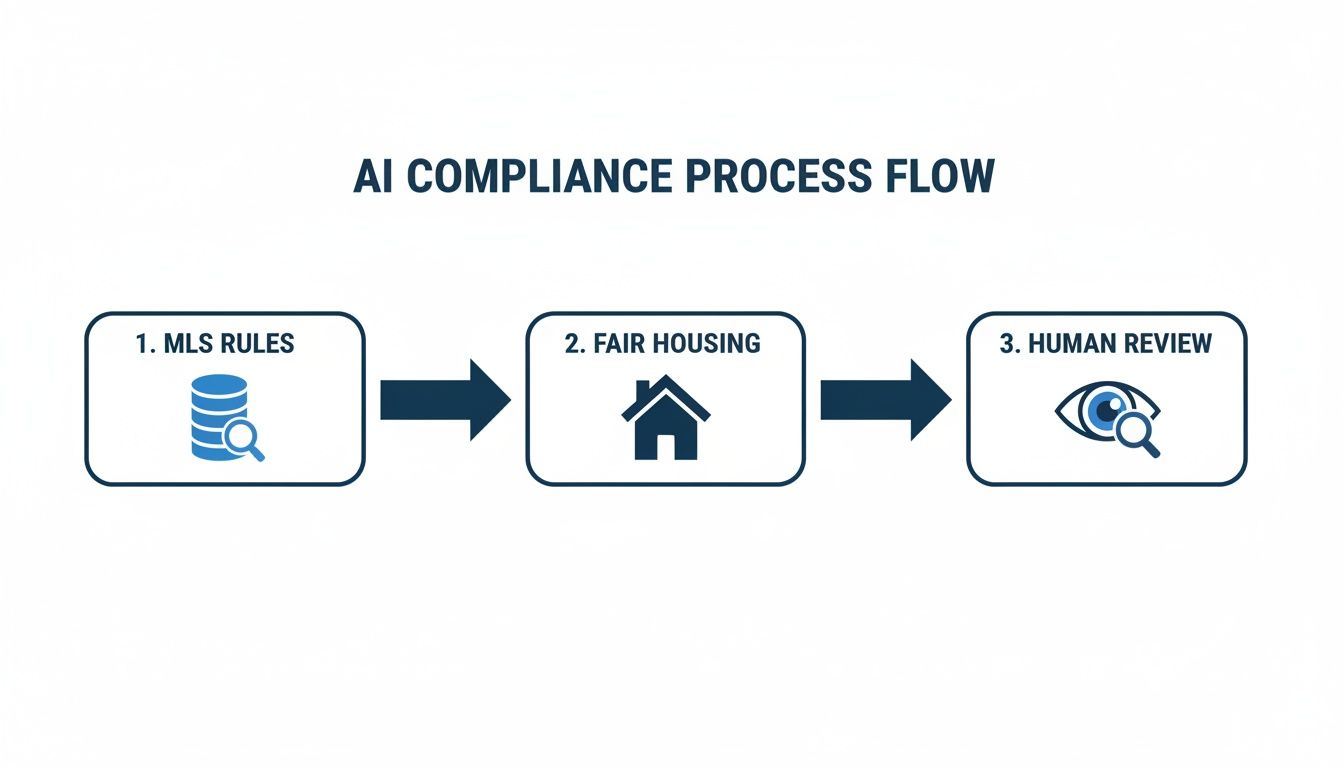
    • Built-in Compliance and Psychology: Scans content for potential Fair Housing issues and uses 23 psychological copy frameworks (like scarcity and social proof) to boost engagement.
    • Team and Brokerage Controls: Offers enterprise-level settings for brand consistency and scalable deployment across teams.

    Practical Use Case

    An agent preparing for a listing appointment can input the property address and generate a full marketing plan in under 10 minutes. They can walk into the meeting with a polished, AI-savvy strategy that includes social media mockups, platform-specific property descriptions, and a clear explanation of how the listing will surface in modern search engines. This preparation demonstrates a high level of professionalism and technical competence. The platform provides extensive details on how it works for agents, teams, and brokerages.

    • Pricing: Offers a 30-day free trial (no credit card needed). The Pro plan is $34.99/month, and the Enterprise plan is $119/month.
    • Pros: Huge time-saver, specifically built for AI search visibility, excellent for winning listings, built-in compliance scans.
    • Cons: Generated content always requires final agent review for local nuance and legal sign-off. The site lacks prominent third-party case studies to quantify results.

    2. Follow Up Boss

    Follow Up Boss is a powerful, real estate-specific CRM designed to centralize agent communication and supercharge lead response times. It distinguishes itself by being an open platform, meaning it integrates with over 250 different lead sources, websites, and tools rather than locking you into a proprietary, all-in-one system. This makes it a standout among real estate agent productivity tools for agents and teams who want to build a custom tech stack.

    Follow Up Boss CRM interface showing contact management for real estate agents

    The platform consolidates all texts, calls, and emails into a single inbox, providing a complete history of every client interaction. Its built-in AI assistant helps with tasks like summarizing long conversations, suggesting email replies, and prioritizing which leads to contact next, saving valuable minutes on every interaction.

    Key Features & User Experience

    Follow Up Boss is celebrated for its clean, intuitive interface that agents actually enjoy using, which drives higher adoption rates on teams. The "Smart Lists" feature automatically organizes contacts based on their recent activity, ensuring no opportunity falls through the cracks. The mobile app is robust, allowing agents to manage their entire pipeline from the field.

    • Pros: Exceptional ease-of-use, extensive integration capabilities, and top-tier 7-day-a-week customer support. The open platform provides flexibility without vendor lock-in.
    • Cons: It is not an all-in-one solution; you must bring your own website and lead generation tools. The integrated dialer costs extra on lower-tier plans.

    Pricing starts at $57 per user, per month (billed annually) for the "Grow" plan.

    Website: https://www.followupboss.com

    3. kvCORE (Inside Real Estate)

    kvCORE is an end-to-end platform often provided by brokerages, combining IDX websites, an AI-assisted Smart CRM, marketing automation, and lead generation into a single system. It stands out by offering a cohesive ecosystem where an agent's website, client management, and marketing efforts are deeply interconnected. This all-in-one approach makes it a common choice among real estate agent productivity tools, especially for agents who prefer a unified dashboard rather than managing separate services.

    The platform automates much of the lead follow-up process with its "Marketing Autopilot," sending relevant property alerts and behavioral-based messages to nurture contacts. Its Smart CRM uses AI to score leads and suggest daily actions, helping agents prioritize their time effectively. For agents looking to expand their toolkit, kvCORE's marketplace offers integrations for services like AI-powered listing description generation, with some tools having separate pricing structures for advanced features.

    Key Features & User Experience

    kvCORE's strength lies in its integration; everything from website traffic to client communication funnels into one place, providing agents with a holistic view of their business. The customizable IDX websites serve as the core lead capture mechanism, directly feeding new contacts into the CRM for automated nurturing campaigns. The system also includes robust mobile apps for managing business on the go.

    • Pros: A single login for website, CRM, and marketing simplifies an agent's tech stack. It's ubiquitous across many US brokerages and features a large integration ecosystem.
    • Cons: Pricing is not transparently listed for individual agents, as it's typically a brokerage-level purchase. The agent's experience can vary significantly based on their brokerage's implementation and level of support.

    Pricing is typically bundled into brokerage technology fees.

    Website: https://kvcore.com

    4. BoomTown

    BoomTown is an all-in-one real estate platform designed for growth-focused teams and brokerages who are serious about paid lead generation. It combines high-converting IDX websites, a powerful back-end CRM, and a sophisticated advertising engine for PPC and social media campaigns. The system is built around a proven model: attract high-intent traffic through paid ads, capture leads on the website, and nurture them through automated workflows and agent follow-up.

    BoomTown platform showing real estate CRM and lead management dashboards

    Unlike open-platform CRMs, BoomTown provides a complete, end-to-end system where the website, lead generation, and client management are deeply integrated. This creates a cohesive ecosystem where lead behavior on the website directly informs agent actions and automated "Action Plans" within the CRM, making it a powerful choice among real estate agent productivity tools for teams investing heavily in online advertising.

    Key Features & User Experience

    The platform's strength lies in its mature and structured workflows, which are designed to help teams scale predictably. The CRM includes predictive capabilities that suggest which leads are most likely to transact, helping agents prioritize their daily activities for maximum impact. Success coaching and extensive support resources are included to ensure teams implement the system effectively and get a return on their investment.

    • Pros: Offers a proven playbook for paid-lead generation with mature, team-oriented workflows. The platform scales effectively for large teams and entire brokerages.
    • Cons: Premium, quote-based pricing is not publicly available and represents a significant investment. A dedicated advertising budget is necessary to realize a positive ROI.

    Pricing is customized based on team size and market, available upon request.

    Website: https://boomtownroi.com

    5. Chime (Lofty)

    Chime, which has rebranded to Lofty, is an AI-powered, all-in-one platform built for real estate teams and brokerages that want their website, CRM, and marketing automation under a single roof. It stands out by integrating an IDX website directly with a powerful CRM and a suite of marketing tools, aiming to reduce the need for multiple, disconnected software subscriptions. This makes it one of the more robust real estate agent productivity tools for those who prefer a unified system.

    Chime (Lofty) AI assistant for real estate agents

    The system is designed to capture, nurture, and convert leads through a combination of its public-facing website and internal automation. Its AI assistant helps agents with lead qualification, appointment setting, and crafting communications, allowing them to focus on high-value tasks. Lofty provides a complete ecosystem from lead generation and advertising to transaction management integrations.

    Key Features & User Experience

    Lofty's platform is feature-rich, combining a power dialer, dynamic lead scoring, and automated "Smart Action Plans" within its CRM. Agents can send automated market reports and listing alerts directly from the system, keeping clients engaged with relevant information. The mobile app is designed to give agents full functionality while they are away from their desks.

    • Pros: Its broad feature set reduces vendor sprawl by providing a website, CRM, and marketing tools in one package. The platform has strong automation capabilities and team management controls.
    • Cons: Pricing is not public and is reported to be in the mid-to-high tier, which can be a significant investment. Some users have reported inconsistent customer support experiences.

    Pricing is available upon request through a personalized demo.

    Website: https://lofty.com

    6. Ylopo

    Ylopo is an AI-driven marketing and lead nurture engine that automates multi-channel ad campaigns and follow-up. It creates custom-branded home search websites and then uses behavioral data to send dynamic listing alerts. This platform stands out by deploying conversational AI to engage and qualify leads around the clock, making it one of the most powerful real estate agent productivity tools for teams looking to scale without hiring a large inside sales department.

    The system’s AI, named "Raiya," handles initial outreach and long-term nurture through both text and automated voice calls. This frees up agents to focus only on conversation-ready prospects that the AI has already qualified and can even live-transfer directly to an agent’s phone.

    Key Features & User Experience

    Ylopo's "Mission Control" dashboard provides a central hub for agents to monitor ad performance, lead activity, and AI conversations. Its deep integration with major CRMs, like its Follow Up Boss inbox app, allows agents to see the full context of AI interactions directly within their primary workflow. The user experience is geared toward automation, letting agents set the system and trust it to handle tedious nurture tasks.

    • Pros: Offloads time-intensive lead follow-up and provides sophisticated multi-channel ad management. It integrates seamlessly with leading real estate CRMs.
    • Cons: Requires both a subscription and a separate media spend. Pricing is not publicly listed and it works best when paired with disciplined CRM processes.

    Pricing is custom and requires a demo.

    Website: https://www.ylopo.com

    7. RealScout

    RealScout is a client-facing home search platform designed to boost engagement within an agent’s existing database. It acts as a powerful add-on to a CRM by providing a branded, MLS-backed search experience that tracks client activity and surfaces high-intent "heat" signals. By replacing generic portal alerts with a collaborative, intelligent system, it helps convert dormant contacts into active clients.

    RealScout's home search and alert platform for real estate agents

    The platform’s standout feature is its natural-language search, allowing clients to set up alerts for specific attributes like "house with a big backyard" or "kitchen with a breakfast bar." This creates a more personalized and effective property search, keeping buyers on the agent’s site instead of wandering to major portals. Its "Scout Score" algorithm analyzes user behavior to pinpoint which contacts are most likely to transact soon.

    Key Features & User Experience

    RealScout integrates directly with major CRMs, pushing detailed activity data back into your primary system so you can see who is actively searching. The user interface is clean for both the agent and the client, with a robust mobile app that encourages collaboration on the go. Agents can monitor buyer activity feeds and seller Home Value Alerts to identify timely opportunities for outreach.

    • Pros: Generates significantly higher client engagement than standard MLS or portal alerts. The "Scout Score" provides clear, actionable intent data. Pricing is transparent and published online.
    • Cons: It is not a standalone CRM and requires integration with another system to be fully effective. MLS availability is market-dependent and not nationwide.

    Pricing for solo agents starts at $39 per month for up to 500 contacts, with options to add more contacts and upgrade to team or enterprise plans.

    Website: https://www.realscout.com

    8. Homebot

    Homebot is a client-nurture and retention platform that keeps agents top-of-mind with their sphere of influence through automated, high-value content. It works by sending homeowners a monthly "Home Digest," a personalized report detailing their home's equity, market trends, and potential savings on their mortgage. This consistent, data-rich touchpoint generates repeat and referral business by proactively answering the financial questions homeowners have about their most significant asset.

    Homebot homeowner digest report example for real estate agent productivity tools

    The platform’s standout feature is its co-sponsorship model, which allows agents to partner with a mortgage lender. This partnership often reduces or even eliminates the agent's monthly cost, making it an incredibly accessible tool for building long-term client relationships. It bridges the gap between transactions, positioning the agent as a continuous home wealth advisor rather than just a one-time service provider.

    Key Features & User Experience

    Homebot is designed as a "set-and-forget" system that delivers consistent results with minimal ongoing effort. After the initial client import, the platform runs on autopilot, sparking conversations with past clients who may be ready to sell or refinance. Agents can customize reports with their branding, add video messages for a personal touch, and integrate with their CRM via Zapier to track engagement.

    • Pros: Set-and-forget nurture system that reliably sparks listing and refinance conversations. Very affordable entry-level options, especially with a co-sponsoring lender.
    • Cons: Primarily a nurture tool for an existing database, not a source for net-new lead generation. Adding clients beyond the base plan involves incremental costs.

    Pricing starts at $38 per month for up to 500 clients, with an additional $10 for every 500 contacts thereafter.

    Website: https://homebot.ai/pricing/agent

    9. Sisu

    Sisu is a real estate operating system designed to drive team performance by unifying key business functions into a single, data-driven platform. It excels at connecting CRM data, transaction management, and commission calculations to create powerful dashboards and leaderboards. This focus on gamification and accountability makes it one of the most effective real estate agent productivity tools for team leaders aiming to scale their operations and foster a competitive culture.

    Sisu dashboard showing real estate team performance metrics and leaderboards

    The platform pulls data from your existing CRM and transaction systems to track key performance indicators (KPIs) like conversations, appointments set, and contracts signed. By visualizing this activity on live TV dashboards and in contests, Sisu helps team members see exactly how their daily efforts contribute to overall goals, creating a transparent and motivating environment.

    Key Features & User Experience

    Sisu is built around accountability and clear operational insights. Its transaction management component includes a client portal and integrations with e-signature platforms, keeping everything organized from contract to close. The commission and P&L tracking features eliminate messy spreadsheets, providing brokers with instant visibility into their business's financial health.

    • Pros: Excellent for building a culture of accountability and scaling team operations. It reduces spreadsheet chaos by unifying scattered data into a single source of truth.
    • Cons: The platform offers the best ROI for teams; it may be overkill for many solo agents. It requires clean CRM data and disciplined processes to be effective.

    Pricing is customized based on team size and needs, requiring a consultation.

    Website: https://sisu.co

    10. SkySlope

    SkySlope is a dedicated transaction management platform designed to bring compliance, standardization, and efficiency to the contract-to-close process. It's particularly favored by brokerages and large teams aiming to create a single source of truth for all transaction documents. The system establishes a digital paper trail with clear audit logs, helping to ensure every file is complete and compliant before closing. This focus makes it a vital real estate agent productivity tool for maintaining operational excellence at scale.

    SkySlope transaction management interface showing compliance checklists for real estate agents

    The platform offers a suite of connected products, including SkySlope Forms for direct access to MLS and association documents, and DigiSign for e-signatures. For brokerages, SkySlope provides powerful oversight tools, allowing compliance officers to review and approve files based on customized checklists. This structured workflow significantly reduces the chance of errors and streamlines the administrative burden on agents, letting them focus more on client service and less on paperwork. As agents seek to master every aspect of their business, you can find more tips on our real estate marketing blog.

    Key Features & User Experience

    SkySlope is built around the concept of a "digital transaction file," where all documents, logs, and communications are stored. The user experience is straightforward, guiding agents through required tasks with checklists that update in real-time. The system's integration with tools like zipForm and Dotloop, plus its 24/7 support, are frequently cited as major benefits by its users.

    • Pros: Exceptional for brokerage-level compliance and auditing. Standardized checklists reduce errors and ensure consistency across a team. Broad forms coverage and award-winning support.
    • Cons: Pricing is often geared towards teams or brokerages, which may be costly for a solo agent. Some core features like e-signatures and accounting are add-on products.

    Pricing is customized based on brokerage or team size and feature set.

    Website: https://skyslope.com

    11. DocuSign for Real Estate

    DocuSign is the industry standard for electronic signatures, providing a secure and legally binding way to execute contracts from anywhere. Its real estate-specific offerings go beyond simple signing, providing agents with dedicated workspaces to manage all documents for a single transaction. This platform is a core component of modern real estate agent productivity tools, designed to accelerate the journey from offer to closing by removing the friction of in-person paperwork.

    DocuSign for Real Estate interface showing document management for a property transaction

    The platform’s strength lies in its ubiquity and reliability. Clients and cooperating agents are already familiar with the interface, which simplifies cross-broker transactions. For agents in supported states, DocuSign provides direct access to the latest association and MLS forms, pre-tagged and ready for use. This direct integration saves significant time and reduces the risk of using outdated documents, ensuring compliance throughout the deal.

    Key Features & User Experience

    DocuSign for Real Estate is known for its robust security and detailed audit trails, which provide a complete history of every document view, signature, and approval. Its mobile app allows agents and clients to sign and send documents on the go, a critical feature for time-sensitive negotiations. The ability to create reusable templates for frequently used documents like listing agreements or purchase offers further streamlines an agent's workflow.

    • Pros: Widespread adoption makes it easy for clients and other parties to use. Strong security, compliance features, and broad integrations with other real estate software. Special pricing for NAR members.
    • Cons: Lower-tier plans have limits on the number of documents ("envelopes") you can send. The full "Rooms" feature set may be more complex than a solo agent requires.

    Pricing for real estate agents, with special NAR member discounts, starts at $20 per month (billed annually).

    Website: https://www.docusign.com/solutions/industries/real-estate

    12. ShowingTime+ Appointment Center

    ShowingTime+ Appointment Center is a specialized service designed to completely offload the logistical burden of scheduling property showings. Instead of fielding endless calls and texts, listing agents can delegate the entire process to a team of 24/7 appointment specialists. This single-purpose focus makes it one of the most effective real estate agent productivity tools for agents and teams managing a high volume of listings, giving them back hours each week.

    ShowingTime+ Appointment Center

    The platform centralizes all requests, confirmations, and feedback, providing a clear dashboard for every listing. Beyond simple scheduling, its features extend to route planning for buyer's agents with ShowingCart and, in certain markets, an Offer Manager to neatly organize and compare offers. This turns a chaotic, manual process into a structured and efficient workflow.

    Key Features & User Experience

    The primary benefit is the significant time saved, allowing agents to focus on client relationships and income-producing activities rather than appointment coordination. The mobile app is straightforward, providing on-the-go access to schedules and feedback. Agents appreciate the professional front it presents to cooperating brokers, with a dedicated number and live specialists handling every request.

    • Pros: Massive time savings for busy listing agents, professional 24/7 live answering service, and centralized feedback collection. It's often very affordable on a per-listing or monthly basis.
    • Cons: The availability of advanced features like Offer Manager is market-dependent. While many MLSs include a basic version, the more powerful features usually require a paid upgrade.

    Pricing varies by MLS and region, but plans often start at a low monthly fee for an individual agent.

    Website: https://showingtimeplus.com/solutions/showings-and-offers/appointment-center

    Top 12 Real Estate Agent Productivity Tools — Comparison

    Product Core Features ✨ UX / Quality ★ Price / Value 💰 Target Audience 👥 Standout / USP 🏆
    ListingBooster.ai 🏆 AI-optimized MLS & portal descriptions, 30-day social calendar, schema markup, Fair Housing scan ★★★★★ — fast setup (5–10 min), editable, compliance checks 💰 Pro $34.99/mo · Enterprise $119/mo · 30‑day free trial; strong ROI claim 👥 Solo agents, teams, brokerages 🏆 Purpose-built for AI discovery; presentation-ready assets & Authority Builder
    Follow Up Boss Real-estate CRM, native calling/texting, 250+ integrations, AI summaries ★★★★ — simple UI, 7-day support, fast adoption 💰 Subscription (varies); open system avoids lock‑in 👥 Solo agents & teams focused on speed-to-lead 🏆 Speed-to-lead + team accountability with built-in AI
    kvCORE (Inside Real Estate) IDX websites, Smart CRM, marketing automations, analytics ★★★★ — single login, widely deployed by brokerages 💰 Quote-based / add-ons can raise cost 👥 Brokerages & large teams 🏆 End-to-end stack widely adopted across brokerages
    BoomTown IDX site + CRM, high-converting PPC/retargeting, nurture automations ★★★★ — proven paid-lead workflows, coaching resources 💰 Premium, quote-based + ad spend required 👥 Growth-minded teams & brokerages 🏆 Best-in-class paid-lead engine and conversion playbook
    Chime (Lofty) CRM, IDX websites, power dialer, automations & reporting ★★★ — broad feature set reduces vendor sprawl 💰 Mid–high tier (not public) 👥 Teams wanting all-in-one platform ✨ Strong automations & team controls
    Ylopo AI Text & Voice nurture, multi-channel ads, branded search sites ★★★★ — strong ad ops + conversational nurture 💰 Subscription + media spend; pricing varies 👥 Teams running paid ads & high-volume follow-up ✨ Conversational AI (SMS/voice) + ad integration
    RealScout Client-facing search, natural-language alerts, Scout Score intent ★★★★ — higher engagement, CRM integrations 💰 Published tiers by contact limits 👥 Agents/teams focusing on buyer engagement ✨ Intent signals & collaborative MLS search
    Homebot Monthly homeowner/buyer digests, valuation & market intel ★★★ — set-and-forget nurture for past clients 💰 Affordable entry; lender co-sponsorship option 👥 Agents nurturing past clients/referrals ✨ Financial digest that sparks listing/refi conversations
    Sisu Activity & goal tracking, transaction mgmt, commission P&L dashboards ★★★★ — builds accountability; dashboard-centric 💰 Team-oriented pricing; best ROI for teams 👥 High-performing teams with ISAs/TCs ✨ Unified ops for accountability & performance metrics
    SkySlope Transaction management, compliance workflows, forms, DigiSign add-on ★★★★ — compliance-first, audit trails 💰 Varies by size; add-ons available 👥 Teams & brokerages standardizing compliance ✨ Robust audit/compliance tools at scale
    DocuSign (Real Estate) E-sign Workspaces, templates, association forms, audit trails ★★★★★ — ubiquitous, secure, widely accepted 💰 Tiered plans; NAR discounts; envelope limits on low tiers 👥 All agents & brokerages 🏆 Industry-standard e-signature with strong integrations
    ShowingTime+ Appointment Center 24/7 appointment specialists, route planning, Offer Manager ★★★★ — major time saver for listing teams 💰 Low monthly entry in many markets; market-dependent 👥 Listing agents, teams managing high showings ✨ Live scheduling support + centralized feedback/offer org

    From Tools to Systems: The Future of Your Real Estate Business

    The journey through this guide of real estate agent productivity tools reveals a clear truth: technology is no longer an optional add-on for a successful real estate career. It has become the core operational framework that separates the agents who are merely busy from those who are truly productive and profitable. We've explored powerful platforms from CRMs like Follow Up Boss and Lofty (Chime) to specialized transaction management software like SkySlope and listing marketing engines like ListingBooster.ai.

    The key takeaway is not simply to acquire more software. The goal is to build an intelligent, interconnected system. A standalone tool might solve one problem, but a well-integrated tech stack solves for scale. It creates a seamless flow of information from lead capture, to nurturing, to contract, and finally to closing and beyond, minimizing manual data entry and freeing up your most valuable asset: your time.

    Shifting from Tactics to Strategy

    Many agents fall into the trap of adopting tools tactically to put out fires. A new lead source comes in, so you get a new CRM. Paperwork becomes overwhelming, so you find a transaction coordinator. This reactive approach leads to a disjointed, expensive, and often underused collection of subscriptions.

    A strategic approach, however, begins with a different question: "Where is my biggest bottleneck?"

    • Is it lead conversion? Your focus should be on a robust CRM with strong follow-up automation like Follow Up Boss or a comprehensive platform like kvCORE.
    • Is it creating compelling marketing? Tools like ListingBooster.ai are built to automate the creation of high-quality listing materials, saving you hours on every single property.
    • Is it transaction chaos? A dedicated system like SkySlope or DocuSign for Real Estate introduces order and compliance to your contract-to-close process.

    By identifying the most significant friction point in your business and selecting a single tool to address it first, you create a tangible return on your investment. Master that one platform, integrate it into your daily workflow, and only then identify the next bottleneck to solve. This methodical, one-step-at-a-time process prevents overwhelm and ensures each tool you add serves a distinct, critical purpose.

    Implementation Is Everything

    Remember, the most advanced software is useless if it's not implemented correctly and used consistently. As you select your tools, consider the practical realities of putting them to work. Factor in the onboarding process, the availability of customer support, and the learning curve for you and your team.

    Commit to the setup. Block out time on your calendar specifically for training and system configuration. A weekend dedicated to building out your CRM workflows or marketing templates will pay dividends for years to come. This initial investment of effort is what transforms a piece of software from a recurring expense into a revenue-generating asset.

    Ultimately, the right collection of real estate agent productivity tools allows you to build a business that works for you, not the other way around. It empowers you to deliver exceptional client service, not by working harder, but by working smarter. You transition from being a solo operator constantly juggling tasks to becoming the CEO of a streamlined, predictable, and scalable enterprise. The future of your business isn't about finding a single magic-bullet tool; it's about thoughtfully constructing the system that will carry you toward your biggest goals.


    Ready to eliminate your biggest marketing bottleneck? Start by automating your listing content with ListingBooster.ai. In just a few clicks, it generates everything you need to professionally market a property, freeing you to focus on what truly matters: your clients. Explore how it fits into your new productivity system at ListingBooster.ai.

  • Save Time on Listing Presentations with an AI-Powered Workflow

    Save Time on Listing Presentations with an AI-Powered Workflow

    The fastest way to save time on listing presentations is to get the heavy lifting done before you ever knock on the seller's door. By using an AI tool to pre-build everything from property descriptions and CMAs to print materials, you can slash hours of manual work and boil it down to just a few minutes.

    The End of Wasting Hours on Listing Presentation Prep

    A smiling man in a blue shirt uses a tablet, standing in a modern home, ready for a meeting.

    Let's be honest, the old way of prepping for a listing presentation is broken. Too many agents burn precious hours frantically pulling comps, writing property descriptions from a blank page, and fighting with clunky design software for every single appointment. That manual grind isn't just inefficient—it's a massive drain on your most valuable resource: time.

    This outdated process keeps you in a reactive loop. You spend the hours leading up to a meeting just building the basic foundation for the conversation. But what if you could completely flip that script?

    From Pitching Promises to Proving Value

    Imagine walking into a seller’s home not with a list of things you will do, but with a full marketing suite already in hand. This is the new gold standard. Instead of talking about how you’ll market their property, you show them it’s already happening. You can walk in with a portfolio of assets ready to go, including:

    • AI-generated property descriptions tailored for different platforms.
    • A complete 30-day social media content calendar.
    • Print-ready flyers and other marketing collateral.

    This modern workflow transforms your presentation from a sales pitch into a live demonstration of your expertise and immediate action. You’re no longer just another agent asking for the business; you're a marketing partner who has already hit the ground running. It’s a powerful way to immediately stand out from competitors who show up with nothing more than a generic folder and a canned speech.

    When an agent arrives fully prepared with marketing materials already complete, it doesn't just look impressive—it builds the kind of instant trust that gets contracts signed on the spot.

    This shift does more than just save time; it fundamentally changes your value proposition. You prove you're a forward-thinking expert ready to get the property maximum exposure from day one. In fact, agents who adopt a structured, pre-built presentation can get ready in under 30 minutes, a huge drop from the 2-3 hours typically spent on manual creation. That newfound efficiency often leads to higher win rates, with some agents reporting a jump from a 50% to a 75% close rate on signed listings. You can learn more about the impact of polished presentations on Highnote.

    Old vs. New: The Shift in Presentation Prep Time

    The difference between the traditional grind and an AI-powered workflow is stark. Here’s a quick breakdown of where your time goes—and how much you can get back.

    Task Traditional Method Time Spent AI-Powered Method Time Spent
    Market Research & Comps 60-90 minutes 5-10 minutes
    Writing Property Descriptions 30-45 minutes 2 minutes
    Creating Print/Digital Materials 45-60 minutes 5 minutes
    Social Media Planning 30 minutes 3 minutes
    Total Prep Time 2.5 – 3.5 hours ~15-20 minutes

    As you can see, the time savings aren't just marginal; they're monumental. This reclaimed time allows you to focus on what really matters: building rapport with your clients and winning more business.

    Build Your Pre-Appointment Arsenal with AI

    A professional desk setup with a laptop displaying a real estate website, printed marketing materials, and a smartphone.

    If you really want to save time on listing presentations, the secret is to shift your entire mindset. Stop thinking of the meeting as the starting line. The real work—and the real opportunity to impress—happens hours before you ever ring the doorbell.

    Picture this: you walk into a potential client's home not with a handful of promises, but with a complete, tangible marketing plan already built out for their specific property. This simple act immediately puts you leagues ahead of the competition, who are likely showing up with a standard CMA and a hopeful smile.

    Instead of burning precious hours trying to write clever property descriptions or wrestling with clunky design templates, a platform like ListingBooster.ai can generate everything you need from a single property address. This isn't about replacing your hard-earned expertise. It’s about automating the grunt work so you can dedicate your energy to the strategic, high-value conversation with the seller.

    Let AI Handle the Heavy Lifting

    The moment that appointment is confirmed, you can get a massive head start. Just by plugging in the property address, an AI engine kicks into gear, creating a full suite of marketing assets that would typically eat up half your day.

    Imagine the impact when you spread professionally crafted materials across the seller's dining room table. You're not just telling them you’ll list their home on the MLS; you're showing them the exact, SEO-optimized descriptions you've already written for it. You’re not just vaguely promising social media promotion; you’re handing them a printed, 30-day content calendar detailing every single post.

    This isn’t just about being prepared. It’s a powerful, practical demonstration that answers a seller's biggest unspoken question: "Are you the right person to market my most valuable asset?" Your pre-built arsenal screams "yes" before you even launch into your pitch.

    A Quick, Real-World Walkthrough

    Let's make this tangible. You've got a listing appointment at 4 PM for 123 Maple Street. It's now 10 AM. Instead of the usual mad dash to pull comps and materials together, your workflow looks like this:

    • You enter the address: "123 Maple Street" goes into the system.
    • The AI gets to work: It instantly pulls property data and starts generating a complete marketing package.
    • You review and download: Within minutes, a folder is ready for you, containing:
      • Multiple MLS description variants, each one highlighting different key selling points.
      • Optimized descriptions for major portals like Zillow and Realtor.com.
      • A full 30-day social media plan complete with captions and relevant hashtags.
      • Print-ready flyer designs that just need your logo and contact info.

    Just like that, you have the rest of the day to focus on your active clients, knowing you are completely prepared for your 4 PM meeting. When you arrive, you’re not just another agent; you're a marketing strategist who has already invested time and resources into their home.

    Arriving with a pre-built marketing kit changes the dynamic of the meeting. The conversation shifts from "Why should I hire you?" to "When can we start?"

    This level of preparation is what sets top agents apart. While your competitors talk about what they could do, you’re showing what you’ve already done. It positions you as an agent of action—an efficient, professional expert who is ready to get the best possible outcome for their client. This is how you win more listings and truly save time on listing presentations.

    Build Your Pitch Around Your Authority, Not Just the Property

    A person in a modern kitchen holds and reviews a document, with another paper and a plant on the wooden table.

    Handing a seller a slick marketing kit for their home is a great start. But the agents who consistently win the best listings take it one step further. They don't just prove they can market one property; they prove they're the undeniable local expert. This is where having a library of pre-built, high-value content becomes your ace in the hole.

    Instead of just telling sellers you know the market, you get to show them. This simple shift changes the entire feel of the conversation. You’re no longer just a salesperson trying to get a signature; you're a trusted advisor who’s already providing value to their community.

    Show, Don’t Just Tell

    Picture this: you're sitting at a seller's kitchen table, and you pull out a professionally written guide to their specific neighborhood. This isn't some flimsy flyer you whipped up an hour before the meeting. It's a polished, insightful piece that shows you're deeply invested and knowledgeable about their corner of the world. It’s a total game-changer.

    You can walk into any appointment with a portfolio that instantly builds trust.

    • Hyper-Local Market Updates: Not just city-wide stats, but real data and sales activity for their specific zip code.
    • Detailed Neighborhood Guides: Think local schools, hidden gem parks, the best new restaurants—the details that make a neighborhood a home.
    • Helpful Buyer-Focused Content: Blog posts or guides that demonstrate how you attract and educate the very people who will be interested in their property.

    This strategy essentially pre-sells your expertise before you even get to the part about your commission. It builds immediate credibility and showcases a consistent, professional online presence that most other agents can't dream of matching on the fly. It's a smart way to save time on listing presentations because you spend far less time trying to convince them and more time collaborating on a plan.

    Weave Your Content into the Conversation

    The idea isn't to just dump a pile of papers on the table and hope for the best. You need to seamlessly weave these assets into the story you're telling. For example, when you get to the part about your marketing plan, you can connect it directly to the online authority you've already built.

    "When someone starts looking for homes in this neighborhood online, they're going to find my articles on local market trends or my guide to the best schools. That means I’m not just waiting for buyers to find your listing on the MLS; I’m actively pulling them into this area before they even know your home is for sale."

    That kind of statement hits differently. It proves you understand how today's buyers think and search, and it positions you as the go-to resource they—and Google—already trust. You're not just another face on Zillow; you're the community expert. You can dig into more strategies for building this kind of digital footprint over on the ListingBooster.ai blog.

    Using a tool like ListingBooster.ai’s Authority Builder automates the heavy lifting, letting you build out a deep library of this content without spending your weekends writing. You can generate a new neighborhood guide or market report in a few minutes, so you always have something fresh and relevant for every appointment. This content does more than just fill your social media feed; it becomes one of your most powerful closing tools.

    Present Data That Closes Deals and Saves Time

    Sellers are looking for more than just a great price—they want a clear, predictable path to getting it. This is your chance to elevate the conversation beyond opinions and anchor it in solid data. When you can ground the entire discussion in hard numbers, you're not just a salesperson; you're a market strategist.

    Think of it this way: a data-driven approach is a huge time-saver. It cuts right through the endless back-and-forth about pricing and marketing. Instead of debating, you're demonstrating. You're not just saying your strategy works; you’re showing them the exact metrics that prove it and laying out how your plan is designed to hit those targets.

    The "Magic Numbers" That Get Homes Sold Fast

    In online real estate, some numbers are more than just stats—they're powerful predictors of a successful sale. These aren't vanity metrics for a report; they signal real buyer intent and market momentum. By focusing on these "magic numbers," you turn your marketing plan from a list of tasks into a results-driven machine.

    This completely reframes the listing presentation. Suddenly, it’s less about you and more about the measurable outcomes you can deliver for their property. And honestly, it saves you hours of manual research.

    For example, we know that listings hitting 250+ daily views often go under contract within a week. In fact, 75% of them sell in just two weeks. The number of "saves" is just as critical. Getting 5+ daily saves usually means offers are coming within seven days. If you can push that to 10+ daily saves, you're looking at offers above the list price, boosting the final sale by 2-5%. That could mean an extra $10,000 on a median-priced home. You can dig deeper into how these metrics impact listings on HousingWire.

    This changes the entire conversation. You're no longer asking, "So, what do you think we should price it at?" Instead, you’re confidently stating, "Here are the engagement numbers we need to hit to trigger offers over asking, and here’s my plan to get us there."

    Connect Staging Directly to Dollars and Days on Market

    Professional staging is another area where data can shut down debate instantly. Many sellers see it as an extra expense, but the numbers tell a different story. You can frame it as what it truly is: a crucial investment with a clear, impressive return.

    • Homes Sell Faster: It’s a fact. Professionally staged homes fly off the market. In many cases, we see them selling up to 88% faster than homes that aren't staged.
    • Offers Come in Higher: The data doesn't lie. Staging can boost the final sale price by anywhere from 1% to 10%. For a $500,000 home, that’s an extra $5,000 to $50,000 in your seller's pocket.

    When you can show a seller that a $3,000 investment in staging is statistically likely to bring in a $20,000 higher offer and cut their time on the market in half, the decision is no longer about taste—it's just smart business.

    This approach saves so much time in the listing presentation because your recommendations aren't just opinions; they're part of a proven formula. You position yourself as a strategic advisor who makes decisions based on what works, which builds trust and gets you to a signed agreement that much faster.

    The Modern Agent's Time-Saving Tech Stack

    Having the right tools is one thing, but making them work together without creating more busywork is the real secret to an efficient workflow. A powerful tech stack isn't about having a subscription for every new app that pops up. It's about finding one central hub that handles the grunt work, freeing you up to actually talk to clients.

    I've found that a platform like ListingBooster.ai can serve as that command center. It hooks directly into your MLS, pulls all the property data, and then automatically generates a whole suite of marketing materials. This means you can walk into a listing presentation fully armed with a concrete plan, without spending hours building it from scratch. That integration is what saves you so much time.

    The Core Components of Your Stack

    Keep your system simple and effective. The aim here is to build a repeatable process that kills the guesswork and manual data entry, letting you consistently save time on listing presentations.

    Here’s what I’ve found works best:

    • A Central AI Engine: This is your ground zero. You plug in a property address, and a tool like ListingBooster.ai spits out everything you need, from multiple MLS description options to a full social media campaign.
    • CRM Integration: All that great, AI-generated content needs to flow straight into your CRM. This helps you track leads and stay on top of client communication without having to copy and paste a dozen times a day.
    • Social Media Scheduler: Once your content is ready to go, a scheduler lets you map out your posts for the coming weeks in a single session. This ensures you're always visible online without the daily scramble.

    This simple diagram shows how the right online strategy—focusing on views and saves—directly impacts your ability to close the deal at the right price.

    Diagram illustrating a data-driven deal closing process with steps: Views, Saves, Price, leading to Deal Closed.

    It’s a clear path: get enough eyeballs on the listing (views), which encourages serious buyers to save it, and that activity builds the momentum you need to negotiate a higher sale price.

    Your New Pre-Presentation Checklist

    Forget the last-minute scramble. This is my go-to checklist for getting ready for any listing appointment in minutes, not hours. It turns chaos into a calm, controlled process every single time.

    1. Confirm the Appointment, Plug in the Address. As soon as that meeting is booked, your first and only real manual step is to enter the property address into your AI engine. This single action kicks everything else off.
    2. Generate All Your Core Marketing Assets. Let the AI do the heavy lifting. It will create several variations of the MLS description, a social media calendar for the first 30 days, and even tailored text for Zillow and Realtor.com.
    3. Review and Personalize (The 5-Minute Polish). Now, just spend five minutes looking everything over. This is your chance to inject your unique voice or tweak a headline to better reflect the seller's main priority. The hard work is done; this is just the finishing touch.
    4. Download and Print Your Key Materials. Pick the flyer design that best fits the home and print out the social media calendar. Handing a seller physical proof of your marketing plan is incredibly powerful—it makes your strategy feel real and tangible.
    5. Assemble Your Presentation Folder. Put your printouts, your CMA, and any other authority-building content (like a neighborhood guide) into a folder. You're now more prepared than 90% of the agents out there.

    This isn't just a checklist; it's a repeatable system that ensures nothing ever falls through the cracks. It delivers a professional, polished experience for every seller and instantly positions you as the agent who is always a step ahead.

    This entire workflow is built to scale, whether you're a solo agent or running a team. If you want to see how ListingBooster.ai can plug into your business, you can explore the different plans and features available. By making this your standard process, you’re basically building efficiency right into your business model.

    Common Questions About AI-Powered Presentations

    It's natural to have questions when you're changing up a core part of your business, especially something as important as your listing presentation. But trust me, shifting to an AI-assisted workflow isn't about adding complexity—it's about making you far more effective.

    Let's tackle some of the most common things agents ask when they start exploring how to save time on listing presentations. I'll give you straight-up answers to get you past any hesitation and into a smarter way of working.

    Will Using AI Make My Presentations Feel Impersonal?

    Absolutely not. It's actually the other way around. Think of it like this: the AI handles all the tedious, time-sucking tasks, which frees you up to be 100% human during the appointment. It builds a solid foundation of data, comps, and marketing assets for you.

    You then take that foundation and customize it. You infuse your local expertise, your personality, and your unique brand into the final product. Because you've saved 90% of the usual prep time, you walk in feeling prepared and relaxed, ready to listen and connect with the seller's real needs, fears, and goals. You're more present, not less.

    How Much Technical Skill Do I Need to Use These Tools?

    If you can type an address into Google Maps, you've got this. Seriously. Platforms like ListingBooster.ai are designed for real estate agents on the go, not for coders. The whole setup takes just a few minutes.

    You just plug in the property details, and the system does the heavy lifting—drafting Fair Housing-compliant social posts, writing compelling descriptions for the MLS and Zillow, and creating print materials. You get to focus on strategy and connecting with clients, not fiddling with software.

    The best technology feels invisible. It works in the background to make you more efficient and effective, letting you focus on what you do best: building relationships and closing deals.

    How Do I Explain AI-Powered Marketing to a Seller?

    Keep it simple and focus on what’s in it for them. You don't need to explain the "how"—you just need to show them the results. Frame it in terms of the value you deliver.

    Try saying something like this:

    • "To get your home in front of the most qualified buyers right away, I use a proprietary system that builds a comprehensive marketing campaign the second we decide to work together. This means we have professional social media posts, online ads, and property websites ready to launch instantly, ensuring we never miss a potential buyer."

    The proof is in the pudding. When you spread the print-ready flyers, the social media calendar, and the polished property descriptions across their kitchen table, they see the incredible value you’re bringing. The sheer amount of professional marketing you’ve prepared before they’ve even signed speaks for itself.


    Ready to stop wasting hours on prep and start winning more listings? With ListingBooster.ai, you can walk into every appointment with a full suite of AI-generated marketing assets already in hand. Try it free for 30 days and see the difference for yourself.

  • Real Estate Marketing in Minutes The Ultimate Agent Playbook

    Real Estate Marketing in Minutes The Ultimate Agent Playbook

    If you've ever felt like you've spent an entire afternoon staring at a blank page, just trying to write one property description, you're not alone. But those days are officially over. For agents who want to thrive, executing powerful real estate marketing in minutes isn't just a nice-to-have; it's a fundamental business strategy. Your success now hinges on speed, visibility, and using the right tools to connect with buyers where they spend their time—online.

    The New Reality of Real Estate Marketing

    The way people search for homes has completely changed. We're moving away from old-school search engines and into an era of AI assistants, and traditional marketing tactics are struggling to keep pace. This creates some serious headaches for agents: content burnout from constantly needing new material, inconsistent branding across different platforms, and the never-ending fight to stand out in a saturated market.

    This pressure comes directly from how buyers behave today. It’s no secret that between 96-100% of homebuyers start their search on the internet. And with 69% of those buyers using mobile devices to scroll through listings, your digital presence has to be instant and flawless.

    An AI-Powered Command Center Changes Everything

    Top-performing agents are getting ahead by adopting an AI-powered "marketing command center." Imagine turning a single property URL into a full-blown marketing campaign before your coffee even gets cold. It’s all about flipping a tedious, time-consuming process on its head and making it efficient and automated.

    The whole point is to generate high-quality, compliant, and platform-specific content without all the manual grunt work. This not only frees up dozens of hours but also ensures your brand looks polished and consistent, no matter where a potential buyer finds you.

    A man sips coffee while browsing real estate properties on his laptop at a desk.

    This is the new normal: a central dashboard where complete marketing packages are built with just a few clicks. This is the foundation for the practical, step-by-step strategies we’re about to dive into, showing you exactly how to put a system like this to work for your business.

    The biggest shift here isn't just about speed. It's about making your listings discoverable by the new AI search tools that are taking over. If your property data isn't structured for AI, it’s basically invisible to a huge and growing segment of the market. This move from basic online visibility to what we call AI discoverability is the core of modern real estate marketing. For more on this, check out our guide on how Google AI is changing real estate search.

    Let's look at what this shift actually means for your daily grind. The difference between the old way and the new way is staggering when you lay it all out.

    Old vs New Marketing Workflow for Real Estate Agents

    This table breaks down the time commitment for common marketing tasks, comparing the hours or even days you used to spend with the minutes it takes now.

    Marketing Task Traditional Method (Hours/Days) AI-Powered Method (Minutes)
    Writing portal property descriptions 2-4 hours < 2 minutes
    Creating a 30-day social media plan 8-12 hours < 5 minutes
    Researching competitor listings 3-5 hours < 3 minutes
    Designing a flyer or postcard 2-3 hours < 1 minute
    Preparing a client pitch presentation 1-2 hours < 2 minutes
    Checking for compliance language 1 hour Instant

    Seeing it laid out like this really puts things in perspective. What used to eat up an entire week can now be knocked out in a single morning. This isn't just about saving time; it's about reclaiming your schedule to focus on what truly matters—building relationships and closing deals.

    From Property URL to Full Marketing Suite

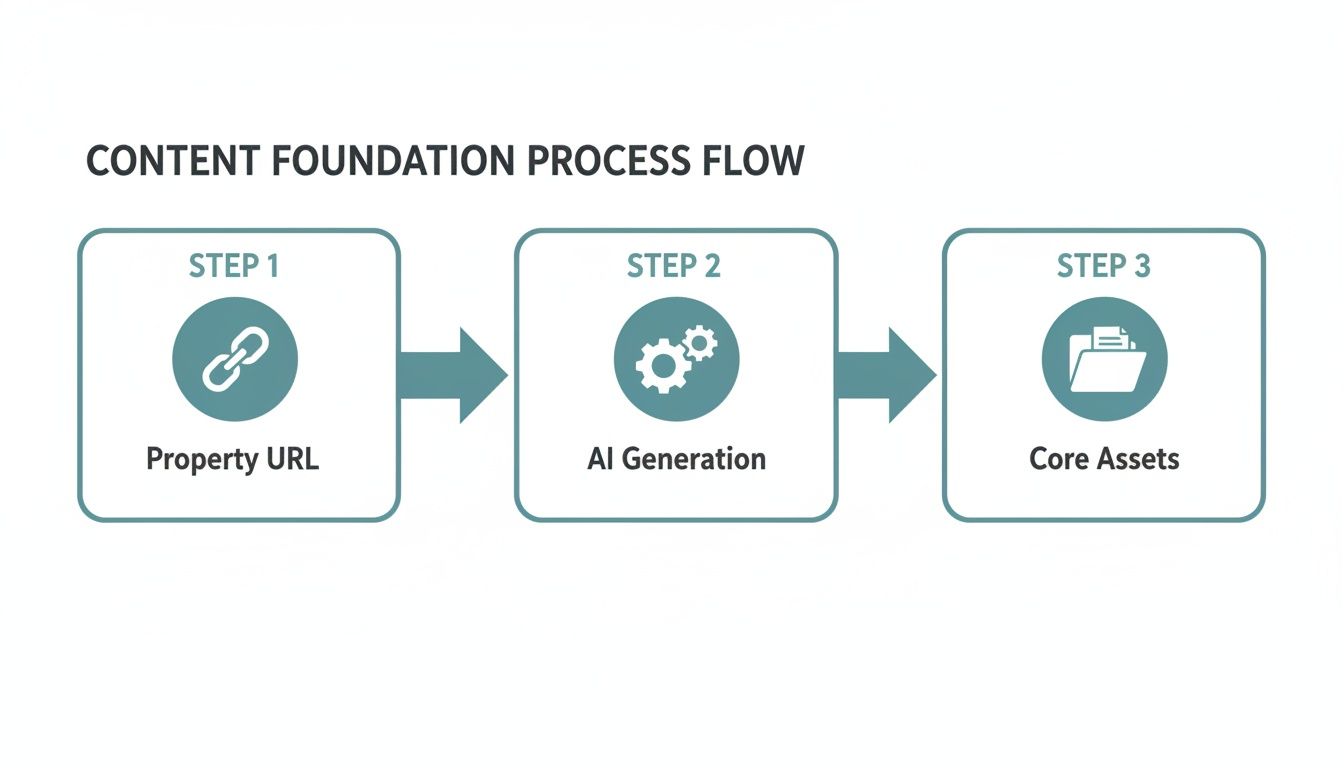
    Alright, let's get practical. This is where the theory ends and you start getting time back in your day. Forget staring at a blank screen, trying to find a fresh angle for that new listing. The entire modern workflow for real estate marketing in minutes kicks off with one thing you already have: the property's MLS link or even just the address.

    Think about a typical new listing—say, a 3-bedroom, 2-bathroom house in the suburbs with a killer backyard. The old way meant blocking out half your day to write descriptions, sketch out a social media plan, and maybe, if you were lucky, cobble together a flyer.

    The new way? You drop that property URL into a tool like ListingBooster.ai. That's it.

    A tablet on a wooden desk displays real estate listings with 'Instant Listing Suite' overlay.

    From there, the system doesn't just spit out one description; it creates a whole set of them. This is huge because the detailed, feature-heavy copy that wins on Zillow is the exact opposite of what you need for an Instagram post, which has to grab someone's attention with an emotional, story-driven hook.

    Platform-Specific Content That Actually Connects

    Trying to use the same marketing message everywhere is a surefire way to get scrolled past. A smart AI tool gets this, generating content that feels native to each platform and speaks to different types of buyers.

    For that 3-bed, 2-bath house, you’d instantly get options like these:

    • For the MLS: A compliant, detail-oriented description loaded with the right keywords—"updated kitchen," "spacious primary suite," "fenced-in yard"—to make sure you show up in agent and buyer searches.
    • For an Instagram Post: A short, punchy caption focused on the feeling of the home. Something like, "Picture your summer nights on this patio. The grill's going, friends are laughing… This is the suburban retreat you've been waiting for."
    • For a Facebook Ad: A direct, benefit-focused message aimed at families. It would call out the top-rated school district, the park just down the street, and the quiet, safe neighborhood.

    This isn't just about saving time; it's about being more effective. You're speaking the language of each platform, which drastically improves your odds of finding the right buyer. If you want to dig into the nuts and bolts of this, we've got a whole post on how to build a powerful real estate listing content generator.

    A Full Month of Social Media, Mapped Out

    What really changes the game, though, is getting an entire 30-day social media calendar generated on the spot. I’m not talking about a list of vague ideas. I mean a ready-to-post content plan.

    Your social calendar stops being a series of random "Just Listed" posts and becomes a strategic story. You're guiding potential buyers on a journey from their first glimpse of the property all the way to the closing table.

    The system will generate a schedule covering every phase of the sale. You get the captions, the right hashtags, and even ideas for what kind of photos or videos to pair with each post. It’s your marketing playbook for the next month, done in seconds.

    Typically, this calendar will include a full sequence of posts:

    • "Coming Soon" Teasers: To build some buzz and get people talking before you even go live.
    • The "Just Listed" Announcement: The big reveal with your best photos and a clear call-to-action to book a tour.
    • Open House Promotions: A few reminders leading up to the event, highlighting the date, time, and a unique feature they have to see in person.
    • Feature Spotlights: Individual posts that dive deep into specific selling points, like the renovated kitchen or that incredible backyard oasis.
    • The "Just Sold" Post: A crucial piece of content that celebrates the win and shows potential sellers in your area that you get results.

    What used to take a week of planning is now finished before your coffee gets cold. This is how you take one listing and turn it into a month's worth of smart, engaging marketing that keeps you and your properties top-of-mind.

    Deploying Visually Stunning and Compliant Content

    Okay, you've got a suite of killer copy ready to go. But let's be honest: even the most perfectly crafted property description is dead in the water without visuals that stop the scroll. Buyers make snap judgments in seconds, and that judgment is almost always based on what they see.

    This next step is where we bridge the gap between great words and eye-catching graphics to create a complete marketing package.

    The old way was a time sink. You'd hire a designer, cross your fingers, wait days for proofs, and hope the final product was what you had in mind. That's no longer the only option. Now, you can instantly generate an entire collection of branded, print-ready, and social-media-ready graphics. We’re talking everything from a classic "Just Listed" flyer to a carousel of images perfectly sized for an Instagram post.

    Visuals That Actually Drive Action

    It's about more than just a few pretty pictures. The best systems can help you think like a content creator, providing templates and even outlines for short-form videos—which are non-negotiable for grabbing attention these days. Imagine generating a shot list for a quick property tour or a concept for a 30-second Reel that shows off the neighborhood's best spots, all pulled from the same property data you entered earlier.

    Being able to create visual content this quickly is a massive advantage. Buyer habits have changed. We know that professional photography can help a property sell 32% faster. And with first-time buyers expected to account for 24% of all purchases in 2025, it's crystal clear they rely on visuals to help them picture their life in a new home.

    Creating this content used to feel like a full-time job. But tools like ListingBooster.ai are built on proven psychological triggers—from social proof to aspiration—to design impactful posts in the time it takes to make your morning coffee. You can dig deeper into global real estate market perspectives and buyer trends at JLL.com if you want to see the data for yourself.

    Your Automated Compliance Safety Net

    Making beautiful content fast is great, but protecting yourself, your team, and your brokerage is paramount. This is where a modern marketing platform becomes an absolute necessity: the built-in compliance check.

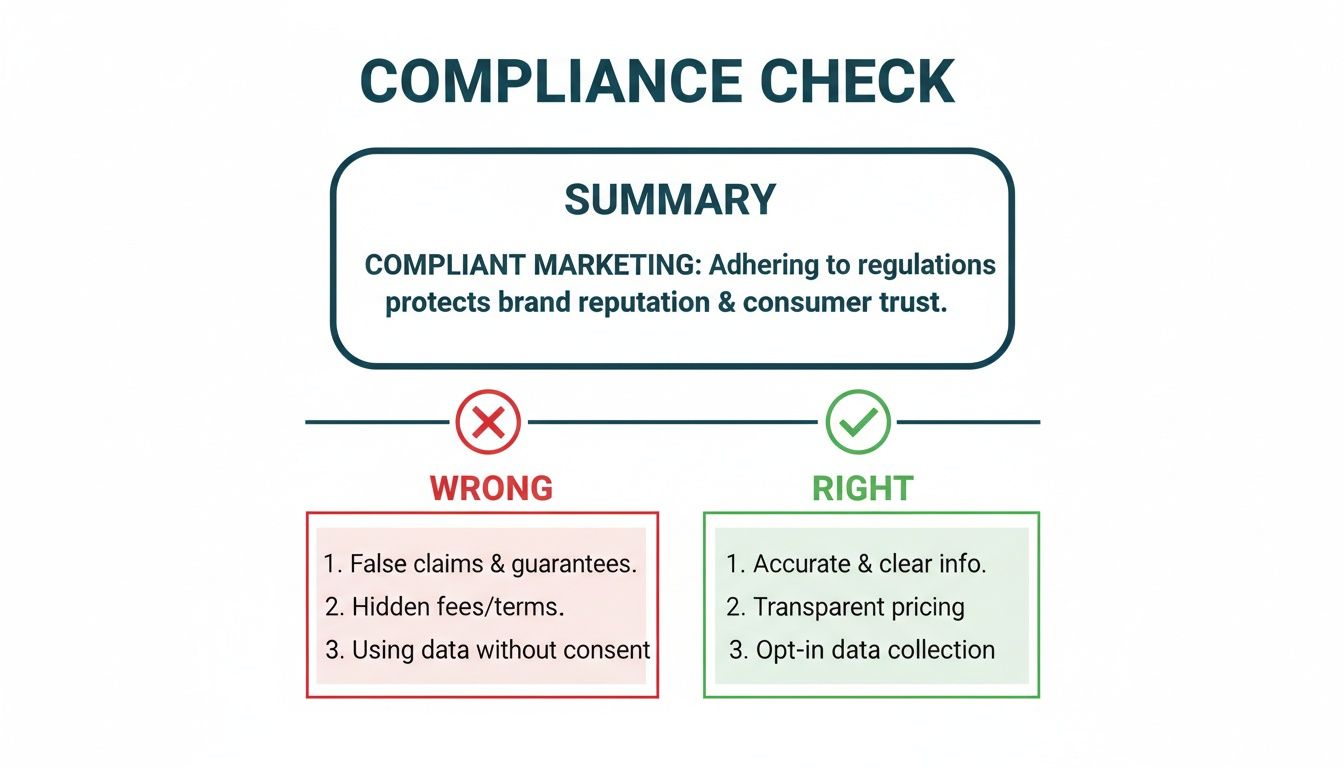
    Think about it. Every single piece of content, from the MLS description to a simple social media caption, can be automatically scanned for red-flag language that could get you in hot water with Fair Housing regulations. It's an indispensable safety net.

    Imagine you're a team leader with fifteen agents. Trying to make sure every single post from every agent is on-brand, high-quality, and legally sound is a logistical nightmare. An automated compliance scanner takes that entire headache away, giving you peace of mind without having to manually review hundreds of posts.

    This automated layer of protection is no longer a "nice-to-have." It flags potentially discriminatory words or descriptions before they ever see the light of day, giving you a chance to make corrections.

    This isn't just about dodging legal bullets; it's about upholding professional standards and building trust. It ensures your marketing isn't just effective, but also ethical and inclusive, which only strengthens your reputation. Consider it the final, crucial polish on content that's truly ready to launch.

    Winning the Listing with AI-Powered Preparation

    Marketing isn’t just about catching a buyer's eye anymore. It’s about proving your value to sellers before they even sign on the dotted line. This is where we shift gears from simply creating content to using it as a powerful tool to land more listings. It’s the ultimate payoff of having a system for real estate marketing in minutes, and it directly fuels your business growth.

    A smiling real estate agent in a suit shows a brochure to a client at an outdoor table.

    Think about this scenario: two agents are up for the same great listing. The first one comes in with a standard CMA and a friendly demeanor. They’re perfectly professional, but their pitch is all about what they promise they will do.

    Then you walk in. Armed with an AI-powered workflow, you arrive with a tangible, comprehensive marketing plan already built. You don't just talk about strategy—you show it.

    From Pitch to Proof

    Instead of making abstract promises, you can walk into that living room with a client-ready package that proves your expertise from minute one. This simple move immediately sets you apart, turning a generic sales pitch into a high-level strategic consultation.

    Bring physical printouts. It makes a huge difference. Your kit should include:

    • AI-Optimized Property Descriptions: Hand them several polished versions of their home’s story, already tweaked for Zillow, Realtor.com, and social media.
    • The 30-Day Social Media Calendar: Let them see a full month of posts mapped out, from the initial "Coming Soon" buzz to the "Just Sold" celebration.
    • A Competitive Analysis Snapshot: Give them a clear, one-page overview of how their property stacks up against other homes on the market right now.

    This level of preparation shows you're proactive and have already invested real thought into their specific property. You've done the work before even getting the job.

    The secret weapon in your arsenal? The 'Schema & AI Discoverability' sheet. This is a simple, one-page document that explains to the seller—in plain English—how you'll structure their listing's data so it shows up in new AI search results on platforms like ChatGPT. You're not just selling their home; you're future-proofing its visibility.

    The Power of Visuals and Speed

    Showing a seller a drone-ready video script or a virtual tour outline can be a true game-changer. The stats don't lie: listings with video get up to four times more inquiries, and 360° virtual tours can crank up views by a staggering 80-90%. And with 70% of buyers admitting they flat-out skip listings with bad photos, speed and quality are everything.

    This is where platforms like ListingBooster.ai give you a massive edge, generating entire visual packages—from social media clips to neighborhood guides—in minutes. You can learn more about how the global real estate market is evolving at Precedence Research.

    This kind of prep work does more than just impress sellers; it builds instant trust. You’re no longer just another agent asking for their business. You’re a marketing partner who has already started working for them, proving your worth with a clear, actionable plan that’s ready to go the second they say yes. This is how you stop competing on commission and start winning on competence.

    Building Your Authority Engine Beyond the Listing

    A killer personal brand is the gift that keeps on giving, even when you don't have a fresh property to market. This is where you pivot from simply promoting listings to proactively building your "Authority Engine." The whole point is to keep the momentum going and cement your status as the go-to local expert.

    You'll do this by creating a steady stream of valuable content that has nothing to do with a specific house for sale.

    This keeps you from going dark between sales. Instead, you're building a consistent digital presence that works for you 24/7. Think about how modern search is evolving; you want AI to recommend you when someone asks, "Who's the best agent in Austin?" This strategy essentially pre-sells your expertise, so when people finally reach out, they're already sold on you.

    Creating Expert Content in Minutes

    I know what you're thinking—who has time for this? But building out your authority content doesn't have to be a grind. The same principles of real estate marketing in minutes apply here. With the right workflow, you can batch a whole week's worth of insightful posts in less time than it takes to drive to a showing.

    You can instantly whip up content like:

    • Actionable Buyer Guides: A quick post on "3 Costly Mistakes First-Time Buyers Make in the 78704" is pure gold.
    • Hyper-Local Market Updates: Imagine a "Quarterly Market Wrap-Up for the Belmont Neighborhood." It instantly positions you as the data-driven pro.
    • Neighborhood Spotlights: Show some love to local businesses and highlight what makes a community truly special.
    • Answers to Common Questions: Short videos or posts answering FAQs like "What the heck are closing costs?" or "How do I prep my home for sale?" are always a hit.

    This isn't just about posting to post. Every piece of content you share becomes part of a growing library of proof that you know this market inside and out. It's a long game that shores up your reputation and makes every future client conversation that much easier.

    Turning Authority into Opportunity

    This steady flow of non-listing content does way more than just fill your social media calendar. It’s actively nurturing your entire audience, turning casual followers into future clients. When you consistently deliver value without always having your hand out, you build incredible trust.

    Let’s say a family that's a year away from buying starts following you for your neighborhood guides. When they're finally ready to make their move, who do you think they're going to call? You. You're the only agent they'll even consider. That's the power of playing the long game with your content.

    Essentially, this approach automates your lead nurturing. You’re building relationships at scale, so when it's time to talk business, the warm introduction has already been made. It’s the smartest way to build a pipeline of inbound leads, all fueled by the expertise you generously share every day.

    Your 5-Minute Marketing Machine

    Let’s get practical. This isn't about adding another dozen tasks to your already overflowing plate. It’s about being smarter, faster, and more effective with the time you have. Think of this as your new standard operating procedure—a repeatable playbook you can run every single time you land a listing.

    The old way meant spending hours, even days, cobbling together marketing materials. Now, the journey from a simple address to a full-blown campaign is a sprint, not a marathon. It's about using the right tools to get your time back, build a stronger brand, and flat-out win in your market.

    From Address to "Everything's Done" in 5 Steps

    This whole process is a loop. Each step naturally feeds into the next, building momentum until you have a complete, professional marketing package ready to go. No complex strategy, just a simple, powerful workflow built for action.

    Here’s what your new marketing day looks like:

    • Just Add the Address: Seriously, that's it. Start by plugging in the MLS link or the property address. This one tiny action is the trigger for everything that follows.

    • Get Your Full Content Suite: In less than 5 minutes, you’ll have a complete set of marketing assets. We're talking multiple, AI-optimized property descriptions for Zillow, Redfin, and your local MLS, plus a full 30-day social media calendar packed with captions and hashtags.

    • Create Visuals & Run a Compliance Check: Instantly generate print-ready flyers and sharp-looking social media graphics. And here’s the crucial part: every single piece of content is automatically scanned for Fair Housing compliance, giving you and your brokerage peace of mind before anything goes live.

    • Build the Perfect Listing Pitch: Imagine walking into your next listing appointment and not just telling the seller about your marketing plan, but showing them. You'll have the property descriptions, the social calendar, and even a unique "AI Discoverability" sheet that explains how you get more eyes on their home. This is how you close.

    • Schedule Your Authority Content: The system isn't just for active listings. Use it to generate and schedule market updates, homebuyer tips, and neighborhood deep dives. This is the engine that keeps your brand top-of-mind, positioning you as the local expert long after the sale is closed.

    This workflow isn't just about saving time. It fundamentally changes your role from a content creator constantly chasing the algorithm to a marketing director who's in complete control. You're making strategic moves, not just checking off a to-do list.

    Following a repeatable process like this ensures every single listing gets the same high-quality, consistent marketing. It’s a game-changer. If you want to explore this idea further, our guide on automating real estate content marketing dives even deeper.

    It’s time to stop letting your marketing run you. You now have a clear, actionable plan to produce top-tier campaigns on demand, freeing you up to do what you do best: build relationships and close deals.


    Ready to stop spending hours on marketing and start closing more deals? With ListingBooster.ai, you can generate a complete, compliant, and client-winning marketing suite in minutes. Start your 30-day free trial today and see the difference for yourself.

  • Mastering Real Estate Listing Copywriting AI

    Mastering Real Estate Listing Copywriting AI

    Let's be honest, writing compelling property descriptions is a grind. It’s that one task that always seems to take longer than it should, pulling you away from what really matters—your clients. This is where AI designed for real estate agents comes in, and it's quickly becoming the biggest efficiency boost you can give your marketing.

    These tools do more than just spit out generic text. They understand market data and buyer psychology to write copy that actually connects with people and gets found on portals like Zillow and Redfin.

    Why AI Is Your New Secret Weapon for Listings

    A man using a laptop for AI real estate listings, with framed house pictures on a blue wall.

    Let's face it: you're juggling calls, scheduling tours, and putting out fires. Finding an uninterrupted hour to write the perfect narrative for a new listing often feels impossible. This is exactly why top producers are moving from writing copy by hand to using AI-powered platforms.

    It's not just about getting it done faster; it’s about getting it done smarter. A good real estate AI becomes your secret weapon, giving you an immediate advantage in a packed market.

    Gain a Competitive Edge

    For a solo agent, this kind of tech is a game-changer. It puts you on a level playing field, letting you create marketing materials that look like they came from a big brokerage with a full-time marketing team.

    You can instantly generate multiple versions of a description tailored for different channels—one for the local MLS, another for Zillow, and punchy captions for social media—all from the same set of property details. This means your listings get online faster, catching that critical first wave of buyer attention.

    Scale Your Brand and Stay Compliant

    For brokers, the impact is even bigger. AI is a fantastic way to keep branding consistent across hundreds of listings and dozens of agents. No more odd phrasing or, more importantly, accidental Fair Housing violations. Some of the more advanced tools, like ListingBooster.ai, have compliance checkers built right in, which is a huge safety net for minimizing risk.

    The real power here isn't just the automation. It's about getting your time back. Every minute you're not stuck writing copy is a minute you can spend on dollar-productive activities that grow your business.

    The market is already reflecting this shift. In 2026, the AI in real estate market has ballooned to an incredible $404.9 billion, a huge jump from $301.58 billion in 2025. Agents are seeing real results, with some platforms helping them write psychology-driven listing descriptions 10x faster than they could manually, shrinking a 30-minute chore down to just three minutes. You can explore more of the real estate marketing statistics that are reshaping how we work.

    Manual Effort vs AI Efficiency in Listing Marketing

    See the dramatic time savings when creating a complete marketing package for a single listing using AI versus traditional manual methods.

    Marketing Task Manual Creation Time AI-Powered Creation Time
    MLS Property Description (Long Form) 45-60 Minutes 3-5 Minutes
    Portal-Optimized Copy (Zillow, etc.) 20-30 Minutes 2 Minutes
    Social Media Posts (3 Platforms) 30-45 Minutes 5 Minutes
    Email Announcement to Sphere 15-20 Minutes 2 Minutes
    Print-Ready Flyer Copy 20-30 Minutes 3 Minutes
    Total Time Investment 2.5 – 3.5 Hours 15 – 17 Minutes

    The numbers speak for themselves. The time reclaimed is substantial, allowing you to multiply your marketing efforts without multiplying your workload.

    Ultimately, bringing a real estate AI into your workflow is about getting out from behind the keyboard. It frees you up to do what you do best: build relationships and close deals.

    How to Write Prompts That Generate Winning Descriptions

    Hands typing on a laptop with 'Better AI Prompts' text overlay, next to an open notebook on a blue desk.

    If you treat a real estate copywriting AI like a simple text generator, you’re going to get boring, generic results. It's a common mistake. The real magic isn't in the AI itself—it's in how you talk to it. Think of it this way: the quality of your output is a direct reflection of the quality of your input. Your prompt is everything.

    A well-crafted prompt is more like a detailed creative brief for a junior copywriter. It goes way beyond just listing the number of bedrooms and baths. It provides critical context, defines the audience, and sets the emotional tone, turning the AI from a simple tool into a strategic partner that gets the unique story of your property.

    Nail Down Your Ideal Buyer Persona

    Before you type a single word into that prompt box, stop and ask: who am I actually talking to? The language that resonates with an urban professional hunting for a sleek, walkable condo is completely different from what a growing family needs to hear about a top-tier school district and a fenced-in yard.

    Defining this buyer persona is the absolute foundation of your prompt. It’s what guides the AI’s word choice, which features to emphasize, and the overall narrative. Instead of just rattling off facts, you’re telling the AI to frame those facts in a way that taps into a specific person's dreams and needs.

    Here’s what that looks like in the real world:

    • Vague Persona: "A buyer for a 3-bed, 2-bath house." (This will get you a generic, uninspired description.)
    • Specific Persona: "A young family, likely first-time homebuyers, moving from a cramped city apartment. They prioritize safety, a strong community feel, and a yard for the kids and a dog. Proximity to parks and good elementary schools is huge. They are budget-conscious but really value move-in ready condition."

    See the difference? This level of detail gives the AI a crystal-clear target, ensuring the copy it generates speaks directly to the people most likely to book a showing.

    Establish the Property's Tone and Vibe

    Every home has a personality. Is it a historic downtown loft that feels artistic and edgy? A suburban colonial that's warm, inviting, and traditional? Or maybe a modern farmhouse that’s all about sleek comfort and indoor-outdoor living?

    You have to explicitly tell the AI what kind of tone you want it to adopt. This single instruction has a massive impact on the adjectives, sentence structure, and emotional language it will use.

    A great prompt makes the AI your co-writer, not just a tool. By providing a clear persona and tone, you're giving it the creative direction it needs to move beyond simple description and into compelling storytelling.

    Try giving your AI specific tonal instructions like these:

    • For a downtown loft: "Adopt a sleek, luxurious, and sophisticated tone. Use language that appeals to an urban professional who values style, convenience, and an energetic lifestyle."
    • For a suburban family home: "Use a warm, inviting, and family-friendly tone. Emphasize comfort, community, and creating lasting memories. Make it sound like the perfect place to grow up."
    • For a rural farm property: "Write with a peaceful, rustic, and spacious tone. Highlight the tranquility, connection to nature, and the freedom of having open land."

    This one simple step is a game-changer for ensuring the final copy actually matches the character of the home you're selling.

    Highlight the “Money-Making” Features

    Sure, every feature is important, but let's be honest—not all features are created equal. Your prompt must guide the AI to focus on the unique selling propositions (USPs). These are the features that truly set this property apart and justify its price tag. This is where your expertise as an agent is absolutely crucial.

    Don't just give the AI a laundry list of amenities. Instead, structure your prompt to emphasize the highlights and, most importantly, explain why they matter to your target buyer. Always connect a feature to a benefit.

    For example, instead of just noting a "newly renovated kitchen," frame it as the star of the show:

    "Heavily feature the gourmet kitchen renovation completed in 2023. Be sure to mention the quartz countertops, high-end stainless steel appliances, and the large center island. Explain that it’s an entertainer’s dream, perfect for hosting holidays for our target 'growing family' buyer."

    The table below breaks this down into a simple checklist. Use it every time you write a prompt to make sure you're covering all your bases.

    Your Prompt-Writing Checklist for Perfect Listing Copy

    Use this checklist to ensure every AI prompt includes the key details needed to generate accurate, compelling, and brand-aligned property descriptions.

    Prompt Component Why It Matters Example Prompt Snippet
    Buyer Persona Narrows the focus and ensures the language resonates with the most likely buyers. "Write for a young professional couple, DINKS (dual income, no kids), who value walkability to restaurants…"
    Tone of Voice Sets the emotional feel of the description to match the property's character. "Use an upscale and sophisticated tone, but keep it approachable. Avoid overly formal language."
    Key Features (USPs) Tells the AI what to emphasize, focusing on what makes the home unique and desirable. "Highlight the brand-new saltwater pool (installed 2024) and the private, tree-lined backyard…"
    Property Details Provides the factual foundation: beds, baths, square footage, year built, etc. "Property is a 4-bed, 3.5-bath colonial, 3,200 sq ft, built in 1998 on a 0.75-acre lot."
    Call to Action Guides the reader on what to do next, turning interest into action. "End the description by encouraging buyers to schedule a private tour to experience the sunset views."
    Constraints Sets boundaries for length, compliance (e.g., Fair Housing), and keywords. "Keep the MLS public remarks under 1,000 characters. Do not mention family status. Include 'open concept' and 'natural light'."

    By structuring your prompts with these core elements—persona, tone, and highlighted features—you elevate the AI from a basic tool to a powerful copywriting partner. To see how these principles apply to broader content strategies, you can find more tips on our ListingBooster.ai blog.

    The difference in output is dramatic. A generic prompt yields a generic description. But a detailed, strategic prompt? That’s how you generate winning copy that captures attention, creates an emotional connection, and ultimately, drives more showings.

    Writing for Zillow, Redfin, and the MLS: A Three-Pronged Attack

    It's a huge mistake to just copy and paste the same listing description across every platform. I see it all the time, and it’s a massive missed opportunity. Your MLS copy, your Zillow copy, and your Redfin copy need to speak different languages because they're talking to different people.

    Think about it: the way an agent scours the MLS for a client is completely different from how a first-time buyer daydreams on Zillow. The goal isn't just to write one description. The real magic happens when you use AI to spin your core property details into unique, platform-specific versions that get results. This is how you get your listings seen, clicked on, and ultimately, get buyers through the door.

    Mastering the Multiple Listing Service

    First up, the MLS. This is your B2B channel. You're not talking to the public here; you're communicating with other agents who are short on time and need facts, fast. Forget the fluff. They need to know if your listing is a match for their buyer in about ten seconds flat.

    How do you search the MLS? You use shorthand, industry jargon, and specific terms like "primary suite" or "EIK" (eat-in kitchen). Your AI-generated copy has to mirror that behavior.

    • Load it with Agent-Friendly Keywords: Tell your AI to pepper the description with terms like "bonus room," "in-law suite," "updated mechanicals," and even specific brand names for appliances (think Sub-Zero or Wolf). These are the details that help another agent check the boxes for their client.
    • Nail the Character Count: Every MLS has its own character limits, and they can be brutal. This is a perfect task for AI. Feed it your full, detailed description and give it a simple command: "Shrink this to under 1,000 characters. Prioritize the most valuable features and use agent-focused language."
    • Facts Over Feelings: Save the flowery language for the consumer sites. On the MLS, agents want a scannable highlight reel. It’s all about efficiency.

    Your MLS description is a tool for your colleagues. Give them the data they need, no frills attached. A prompt like, "Create MLS public remarks under 1200 characters. Highlight the new roof (2023), the renovated primary bath, and the Northwood school district," will give you exactly what you need.

    Winning the Game on Zillow and Redfin

    When you turn your attention to portals like Zillow and Redfin, you have to completely flip the script. Now you’re talking directly to buyers, and your job is to make them fall in love. You need to spark an emotional connection and help them picture their future in that home.

    Let’s not forget that 70% of first-time homebuyers recently have been younger millennials. This is a group that responds to authentic storytelling, not just a list of specs. So, your AI needs to switch from a "just the facts" tone to a much more aspirational one.

    • Talk About the Lifestyle: Buyers on Zillow don't search for "granite countertops." They search for the feeling those features provide. Prompt your AI to describe a "gourmet kitchen built for entertaining friends" or to include popular consumer phrases like "private fenced-in yard," "dedicated home office," or "bright open concept."
    • Tell a Story That Sells: Use the AI to paint a vivid picture. A powerful prompt could be: "Write a Zillow description for 123 Main St. Focus on the experience of sipping coffee on the sun-drenched patio and hosting summer barbecues in the backyard. Use warm, inviting, and slightly aspirational language."
    • Format for a Fast Scroll: Nobody reads walls of text on their phone. Portal users are skimmers. Tell your AI to use very short paragraphs (one or two sentences is perfect), bullet points for key features, and an opening sentence that grabs them by the collar.

    By tweaking your approach for each platform, you’re meeting both agents and buyers right where they are. It’s a simple strategy to pull off with AI, but it makes a world of difference in how many eyes land on your listing.

    Staying on the Right Side of Fair Housing with AI

    Let's be honest: compliance is a major source of anxiety in real estate. One wrong word in a listing can spiral into serious legal and financial headaches for agents and brokers. This is where AI tools designed for real estate copywriting become more than just a time-saver—they become one of your most important safeguards.

    The Fair Housing Act is crystal clear about what we can't do: discriminate based on race, color, religion, national origin, sex, disability, or familial status. The tricky part is how easily innocent-sounding phrases can imply a preference. Trying to manually police every word across all your listings is a huge undertaking, and it's far too easy for something to slip through the cracks.

    A properly trained AI, on the other hand, can be a fantastic safety net. It can systematically scan for and flag problematic language, giving you a layer of protection that’s almost impossible to replicate by hand, especially when you're busy.

    Start with a Compliance-First Prompt

    The best approach is to be proactive from the very beginning. Instead of writing copy and then editing out mistakes, you can tell your AI to generate compliant copy right from the get-go. This means baking Fair Housing principles directly into your prompts. It’s a simple but powerful step that trains the AI to focus on the property, not a hypothetical buyer.

    For example, don't ask for a description that appeals to a specific type of person. Instead, frame your request around the home's objective features and its connection to the community.

    Here are a few examples of prompts that put compliance at the forefront:

    • "Describe the neighborhood's amenities, like the nearby parks, public transit options, and local shops, while strictly adhering to Fair Housing principles."
    • "Write a listing description highlighting the property's accessibility features, such as a no-step entry and wide hallways. Make sure to use neutral, descriptive language."
    • "Generate copy that focuses on the home's flexible living spaces, like the bonus room or finished basement, without suggesting who might use those spaces."

    By adding these kinds of guardrails to your instructions, you're guiding the AI to produce much safer, more inclusive marketing copy right out of the gate.

    Navigating the Problematic Phrase Minefield

    Even when you have the best intentions, certain phrases can get you into trouble. A good AI can be trained to spot and avoid these common pitfalls, but it’s still critical for you to know what to look for when you do your final read-through.

    The golden rule is to always describe the property, not the people you imagine living there. Stick to tangible features and neutral descriptions to create listings that are both compelling and compliant.

    This table shows some common but risky phrases next to safer alternatives. This is exactly the kind of logic a specialized AI tool uses to keep you protected.

    Potentially Problematic Phrase Why It's Risky Safer, Compliant Alternative
    "Family-friendly neighborhood" Implies a preference for families with children, potentially discriminating against individuals or couples. "Located near several public parks and community recreation centers."
    "Perfect for professionals" Suggests the property isn't a good fit for students, retirees, or others. "Conveniently located with easy access to the central business district and major commuter routes."
    "Walk to St. Mary's Church" Could be interpreted as a preference for a specific religion. "Situated a short distance from various community landmarks and places of worship."
    "No children allowed" This is a direct violation of familial status protection under the Fair Housing Act. "Describe the property features without mentioning occupancy rules (which are governed by law)."

    Automated Scanners: Your Final Check

    While a general-purpose AI like ChatGPT can follow your instructions, dedicated real estate platforms like ListingBooster.ai take compliance a step further. These tools often have automated scanners built right in, specifically trained on real estate language. They come pre-loaded with lists of words and phrases that have been flagged as potentially discriminatory.

    As your copy is generated, this built-in checker flags anything that might be misinterpreted as a Fair Housing violation. Think of it as a digital compliance officer working tirelessly in the background. It’s a powerful feature that turns a simple AI copywriter into a serious risk management tool for your business.

    Turning One Listing Into a Full Marketing Campaign

    A great listing description is powerful, but it's really just the tip of the iceberg. The sharpest agents I know have figured out how to take a single property address and spin it into an entire multi-channel marketing blitz. With a good real estate listing copywriting AI, you can take one set of property details and generate a complete content calendar in minutes, not hours.

    This isn't just a time-saver. It's about creating a polished, consistent marketing presence that genuinely impresses sellers and grabs the attention of buyers.

    Think about walking into your next listing presentation. Instead of just a CMA, you bring a fully-fleshed-out marketing plan. You can show the seller a complete 30-day social media schedule, blurbs for your email newsletter, and copy for the print flyers—all created from the details they just gave you. That kind of preparation and tech-savvy approach immediately sets you apart from the agent who walked out before you.

    From Property Data to Content Calendar

    The workflow here is actually pretty simple, but the results are huge. Forget tackling each marketing piece as a separate chore. Instead, you'll use AI to create everything from a single, central prompt.

    You start by feeding the AI the core property details—address, beds, baths, square footage, unique features, and maybe even a quick note on your ideal buyer. Then, you ask it to generate an entire suite of marketing assets based on that info.

    What's great about this is that your brand voice stays perfectly consistent across every channel. The tone you set in the MLS description will flow right into your Instagram captions and email announcements, making the whole campaign feel unified and professional.

    From just one property, you can realistically generate all of this:

    • Social Media Posts: A whole series for the listing's lifecycle: "Just Listed," "Open House," "Under Contract," and "Just Sold."
    • Email Newsletter Content: A compelling little paragraph for your next email blast to your sphere of influence.
    • Print-Ready Copy: Punchy, effective text ready for property brochures and flyers.
    • Video Script Outline: A simple shot-by-shot script for a property walkthrough video, making sure you hit all the key features in a logical order.

    This diagram breaks down how a modern AI tool handles this, turning your prompt into safe, compliant copy every time.

    A diagram illustrating the Fair Housing AI process flow with steps: Write Prompt, AI Scans, Safe Copy.

    As you can see, the best tools have critical safety checks built-in, so you can be confident your marketing materials are not just creative but also compliant right from the start.

    Building Your Authority and Automating Lead Nurture

    This kind of automated content creation does more than just sell one house—it builds your personal brand. Every single post, email, and flyer reinforces your expertise and solidifies your presence in the market. When you're consistently putting out high-quality, professional marketing, you're building the digital footprint that makes you the go-to agent in your area.

    The real goal is to build a system where your marketing works for you, even when you're out showing properties or at the closing table. An AI-powered workflow turns one listing into a content engine that fuels your entire brand.

    This systematic approach is already making a huge difference for agents. Those using AI for their listing marketing are booking 35% more qualified appointments thanks to smarter, faster content automation. Top performers are even setting up AI systems that can respond to online inquiries in under five minutes and nurture leads 24/7.

    The tools available today make this incredibly fast. Platforms like ListingBooster.ai are designed specifically for this. They help you systematize your marketing and turn a single property into a complete campaign. You can learn more about how these AI tools for real estate agents work.

    By putting a system like this in place, you unlock a new level of efficiency. You can deliver exceptional service without getting bogged down by the constant demand for content. It’s all about working smarter, proving your value, and dominating your market.

    How Do You Know If Your AI Copy Is Actually Working?

    So, you've started using AI to write your listing descriptions. That's a huge step, but how can you be sure it's actually making a difference? Forget getting lost in complicated analytics. The real proof is in a few key numbers that directly affect your business.

    You need to see tangible results that show this new approach is paying off. Let's move past vanity metrics like social media likes and zero in on what really matters to your bottom line. This is how you get clear, data-driven proof that the AI is worth it.

    The Numbers That Tell the Real Story

    To see the true impact, I always tell agents to focus on a handful of key performance indicators (KPIs). These numbers cut through the noise and show you exactly how your AI-enhanced copy is performing out in the wild.

    • Days on Market (DOM): This is the big one. Start tracking the average DOM for your listings using AI-generated copy. How does it stack up against your old listings or the local market average? If you see a consistent drop, you've found a winner.

    • Listing Saves and Favorites: On portals like Zillow, the number of "saves" a listing racks up in the first 72 hours is a huge tell. It's a direct signal of buyer interest. More saves mean your copy is hitting the mark and making people feel something.

    • Click-Through Rate (CTR): Check if your portal provides this data. Your CTR from email alerts to the full listing page shows whether your headline and opening line are strong enough to make someone stop scrolling and click. A higher rate is a fantastic sign.

    The whole point is to connect your copywriting directly to real-world results. When you see your AI-powered listings consistently selling faster than the market average, that's undeniable proof your new system is working.

    Want a quick way to see the difference? Try a simple A/B test.

    Take two similar properties and list them around the same time. Write the copy for one the old-fashioned way, and use your new AI workflow for the other. Then, just watch the engagement metrics for the first week.

    This head-to-head comparison is often the most powerful way to see the AI's impact, making it easy to show the value to your team or broker. As you start doing this more, you can explore the different ListingBooster.ai pricing plans to find one that fits your business as it grows.

    Got Questions About AI in Real Estate? Let's Talk.

    Jumping into new tech always brings up a few questions. I get it. It's totally normal to be a little hesitant about swapping a manual process you’ve perfected over the years for something driven by AI. Let’s tackle some of the most common concerns I hear from agents about using a real estate listing copywriting AI, so you can feel good about making the shift.

    A big one I hear all the time is the fear of sounding like a robot. It's a legitimate worry, but thankfully, one that's easy to get ahead of with the right strategy.

    Will My AI-Generated Listing Descriptions Sound Robotic?

    Honestly, they won’t if you know how to talk to the AI. The latest AI tools built for real estate are surprisingly good at picking up on different tones and styles. The trick is to give them more than just the basic property facts.

    You need to feed the AI a detailed prompt that paints a picture. Tell it about the ideal buyer you're trying to reach. Give it an emotional feel to aim for, like ‘cozy and inviting’ or ‘sleek and luxurious.’ Point out the features that truly make the home special.

    When you give it clear directions, you’ll be amazed at how human and engaging the copy sounds. Think of the AI as a junior copywriter—you provide the vision and the key details, it gets the first draft done, and you come in to add that final, expert polish.

    Is Using AI for Copywriting Compliant with Real Estate Laws?

    Yes, and here's something that might surprise you: in many ways, it can actually be safer. A general-purpose AI like ChatGPT doesn't know the first thing about Fair Housing laws and could easily spit out language that lands you in hot water.

    Specialized real estate tools, on the other hand, are built with compliance baked right in. They're specifically designed to avoid red-flag words and phrases from the get-go.

    Many of these platforms have built-in scanners that actively flag language that could violate Fair Housing guidelines. For a broker overseeing a team of agents, this is an incredible layer of protection that’s almost impossible to manage manually.

    This automated safety net provides some serious peace of mind, ensuring your marketing is not only effective but also compliant from the very first draft.

    How Much Time Will I Actually Save?

    The time savings are real, and they kick in immediately. Let's be honest, manually writing a great MLS description, a few different social media posts, and the copy for a property flyer can easily eat up more than an hour of your time for just one listing.

    With a dedicated real estate listing copywriting AI, you can generate that entire marketing package in less than ten minutes.

    Agents I know who have adopted these tools consistently report saving 15-20 hours a month. That's a huge chunk of your schedule freed up. It’s time you can pour back into the things that actually move the needle in your business—connecting with clients, generating new leads, and closing deals.


    Ready to get that time back and create marketing that truly connects with buyers? ListingBooster.ai can take any property and generate a full suite of marketing materials in minutes, all with compliant, psychology-driven copy designed to grab attention. Start your free trial today and feel the difference for yourself.

  • Your Guide to a Real Estate Listing Content Generator

    Your Guide to a Real Estate Listing Content Generator

    So, what exactly is a real estate listing content generator? Think of it as an AI-powered partner that takes on the heavy lifting of creating your marketing materials. From compelling MLS descriptions to a full month of social media posts, it automates the entire process in minutes. For agents looking to reclaim their time and get a serious edge, it’s no longer a novelty—it's essential.

    Why Your Manual Content Process Is Becoming Obsolete

    Let’s face it, the days of painstakingly writing every single listing description, social media update, and property flyer are fading fast. How buyers search for homes—and how they find agents—has completely changed. Staring at a blinking cursor, trying to find a new way to describe "open-concept living" for the fifth time this week, just doesn't cut it anymore. That manual grind isn't just slow; it's becoming a surefire way to get left behind.

    This isn't just a trend; it's a fundamental shift driven by artificial intelligence. Consider this: in 2024, the global AI real estate market was valued at a staggering USD 2.9 billion, and it's on track to hit USD 41.5 billion by 2033. Even more telling is that over 40% of homebuyers now start their property search using AI-powered platforms, skipping traditional search engines altogether. You can discover more insights about the impact of AI on real estate marketing, but the takeaway is clear: without smart, AI-optimized content, you risk becoming invisible to a massive chunk of the market.

    The True Cost of Manual Marketing

    Every hour you spend wrestling with words is an hour you aren’t spending with clients, closing deals, or drumming up new business. A single new listing can easily burn through hours of creative energy just to get the basic marketing assets in place. This creates a huge bottleneck, limiting the number of clients you can serve well at any given time.

    This is where a real estate listing content generator like ListingBooster.ai changes the game. It acts as your always-on marketing assistant. You feed it a few key details about a property, and in return, you get a full suite of marketing materials tailored to attract today’s buyers.

    But this is about more than just clawing back your time. It’s about elevating your entire brand. Imagine walking into your next listing presentation with a polished, data-driven marketing plan already prepared. While your competition is talking about what they will do, you're showing what you've already done. It’s an immediate demonstration of value that positions you as the forward-thinking expert sellers are looking for.

    The greatest advantage isn't just speed—it's strategy. An AI generator ensures every piece of content, from an MLS description to a Facebook post, is cohesive, professional, and optimized to perform from day one.

    So, what can you actually get done with this kind of tool? Here’s a quick look at the powerful assets you can generate in less time than it takes to drink your morning coffee.

    What You Can Generate in Under 10 Minutes

    A modern AI content generator instantly turns a few property details into a complete, ready-to-use marketing package. Here are the core assets you can create almost instantly.

    Asset Type Primary Use Key Benefit
    MLS Property Descriptions Attracting buyers on portals like Zillow and Redfin Creates compelling, compliant, and keyword-rich narratives.
    30-Day Social Calendars Engaging followers on platforms like Instagram & Facebook Automates a consistent stream of high-quality posts.
    Print-Ready Flyers Open houses and local marketing materials Delivers professional, on-brand assets without a designer.
    Competitive Analysis Informing your listing presentation and strategy Provides data-driven insights to show sellers your expertise.

    Having this entire toolkit at your fingertips from the get-go sets the stage for a much more efficient and impactful marketing strategy for every single listing.

    Generate A Perfect MLS Description In Minutes

    Forget the blank‐page dread. When it’s time to craft an MLS‐friendly description that truly resonates, ListingBooster.ai’s Listing Commander transforms a few key details into a polished, portal‐ready narrative in seconds.

    Flowchart illustrating the real estate marketing process, from manual effort to AI generation and marketing suite distribution.

    The interface speaks your language—no tech degree required. Just fill in fields like square footage, bedroom count, and standout amenities, then let the system handle the rest.

    Tailoring Your Input For Superior Output

    Great results start with granular, vivid details. Instead of “updated kitchen,” picture this:
    Gourmet kitchen with Carrara marble countertops
    • Six‐burner gas range and custom soft‐close cabinetry

    That specificity gives the AI the raw material it needs to weave a narrative that leaps off the page.

    Here are two real‐life examples:

    • Urban Loft Case Study
      • 14-foot exposed concrete ceilings
      • Floor-to-ceiling windows showcasing city views
      • Rooftop terrace, 24-hour concierge

    • Suburban Home Case Study
      • Fully fenced backyard with mature oak trees
      • Newly finished basement featuring a wet bar
      • Located in the top‐rated Northwood school district

    These kinds of inputs turn a generic description into a magnetic marketing asset. For more on crafting prompts that pass compliance checks, dive into our guide on creating MLS‐compliant AI content.

    Optimizing For Zillow, Redfin, And Beyond

    A standout description does more than sound good—it embeds the exact keywords buyers search for on Zillow, Redfin, Realtor.com, and other major portals. By analyzing thousands of high‐performing listings, the AI learns which phrases drive clicks and inquiries.

    The right phrasing can mean the difference between a quick scroll and a serious showings request.

    Key benefits include:

    • Strategic placement of location‐specific terms and popular features
    • Insights from top‐ranked listings across all major sites
    • A perfect balance of MLS compliance and marketing punch

    This approach isn’t optional anymore. The global real estate software market hit USD 12.22 billion in 2023 and is set to climb to USD 37.16 billion by 2032, with the residential sector capturing 54% of revenue. For a deep dive into these trends, see the full research on the real estate software market.

    At the end of the day, you want an MLS-approved description that grabs active buyers from the moment it goes live. With AI handling the heavy lifting, you reclaim hours to focus on what really matters—building relationships and closing deals.

    Build a Social Media Calendar That Actually Sells

    A killer MLS description is a great start, but it's only one piece of the puzzle. To get your listing in front of as many serious buyers as possible, you need a strong social media game. After all, a staggering 73% of real estate agents are finding new clients on these platforms.

    The problem? Consistently creating and posting high-quality content is a massive time sink. This is where a real estate listing content generator becomes your secret weapon, turning basic property details into a ready-to-go, 30-day social media calendar.

    A 'Social Media Plan' card, tablet showing a real estate listing, coffee, and pens on a desk.

    This isn't just about scheduling random posts. It’s about building a narrative around your listing. The AI generates the right content for every critical moment—from the initial launch to the final sale—turning sporadic updates into a smart campaign that builds momentum and drives genuine buyer interest.

    Automating Key Listing Milestones

    Your social media should tell the home's story. A good content generator automatically crafts the posts for you at each essential stage, complete with punchy captions, relevant hashtags, and clear calls to action.

    Here’s what that looks like in practice:

    • The "Just Listed" Announcement: This is the big reveal. Instead of a boring stock photo, the AI gives you an attention-grabbing post highlighting the top three features, using aspirational language that gets people excited and encourages them to click for details or tag a friend.
    • The "Open House" Invitation: Forget bland text reminders. The AI creates visually-driven posts that build a sense of urgency and make your open house feel like an unmissable event. It will often include questions to get your followers talking in the comments.
    • The Strategic "Price Improvement" Update: Announcing a price drop can be tricky. You want to avoid sounding desperate. The generator frames it as a fantastic new opportunity, focusing on the incredible value and pushing on-the-fence buyers to finally take action.
    • The Celebratory "Just Sold" Post: This is all about social proof. The AI crafts a post that celebrates the win for your clients while subtly showcasing your expertise. It's the perfect way to remind your network that you get results, attracting future sellers.

    By automating this sequence, you’re giving every listing a consistent, professional marketing push without chaining yourself to your desk. For a deeper dive into this, check out our guide on multi-platform real estate marketing strategies.

    Crafting Captions That Convert

    Here’s where an AI content generator really shines: it writes captions that tap into proven psychological triggers. It doesn't just list facts about the property; it weaves a story that connects with buyers on an emotional level.

    For an Instagram post, the AI might give you something like this:

    Instagram Example (Just Listed):
    Imagine waking up to coffee on this sun-drenched patio. ☀️ Your dream home at 123 Maple Avenue has officially hit the market! With a gourmet kitchen perfect for hosting and a backyard oasis you’ll never want to leave, this one won’t last long. ✨ DM me to schedule a private tour before the weekend rush! #NewListing #[YourCity]RealEstate #DreamHome

    See how it uses evocative language ("imagine waking up") and a touch of scarcity ("won’t last long")? That's what drives action.

    But on a more buttoned-up platform like LinkedIn, the tone shifts completely:

    LinkedIn Example (Just Sold):
    Thrilled to announce that 456 Oak Street is officially sold! It was a pleasure helping my clients navigate a competitive market to secure this fantastic result. This sale underscores the continued strength of the #[YourNeighborhood] market. If you're considering your next move, let’s connect to discuss how to position your property for similar success.

    This version positions you as a strategic expert, which is exactly what you want for attracting professional referrals and future clients.

    This kind of tailored content is what separates a generic social media presence from a true lead-generating machine. By using a real estate listing content generator, you make sure every single post is optimized not just to inform, but to persuade and convert.

    Make It Yours: Adding the Human Touch to AI Content

    An AI real estate listing content generator is a game-changer, no doubt. It delivers a full suite of nearly-finished marketing materials in the time it takes to brew a cup of coffee. But that last 10%—your personal touch—is where the magic really happens. That's what takes a solid piece of content and makes it connect with buyers, feel authentic, and truly represent your brand.

    Think of it this way: the AI gives you a beautifully drafted blueprint. Your job is to be the master builder, adding the custom finishes and unique details that turn a house into a home. This is where you bring your years of market knowledge to the table, call out the property’s special quirks the AI can't possibly know, and make sure every word sounds like you.

    This partnership between agents and AI is quickly becoming the new industry standard. The market for generative AI in real estate is set to skyrocket from USD 1.677 billion in 2024 to a staggering USD 1,558.82 billion by 2035. This explosive growth is happening because smart agents are using tools like ListingBooster.ai to work faster and smarter. You can dive into the full research on generative AI in real estate to see just how essential these tools are becoming.

    The Agent’s Final Polish Checklist

    Before you publish anything the AI generates, give it a quick once-over with this checklist. This isn't about rewriting everything; it’s about making small, impactful tweaks that elevate the final product. It takes just a few minutes but makes a world of difference.

    • Sprinkle in some local color. Does the AI mention the beloved coffee shop on the corner? What about the walking trail where everyone takes their dogs? Weave in those specific local gems that only a true neighborhood expert would know.
    • Highlight the unique quirks. The AI might describe a "charming reading nook." But you know the story behind it. You can add that it was "custom-built with reclaimed wood from the old town mill." That’s the kind of detail that creates an emotional connection.
    • Tune it to your voice. Read the text out loud. Does it sound like something you would say to a client? Adjust a few adjectives or rephrase a sentence to match your personal style, whether you’re more buttoned-up and professional or warm and conversational.
    • Final Fair Housing scan. Modern AI is trained on Fair Housing guidelines, but the ultimate responsibility is always yours. Give it one last read to ensure no language could possibly be seen as discriminatory or steering potential buyers.

    Pro Tip: Your goal isn't to start over. It's to layer your irreplaceable human expertise on top of a solid AI foundation. This makes the content uniquely yours and far more effective.

    Before & After: Real-World Examples

    Let’s see how a few simple edits can transform a decent AI-generated description into an unforgettable one.

    AI-Generated Version (Before):
    This beautiful 3-bedroom home features an updated kitchen with modern appliances and a spacious backyard perfect for entertaining. The open floor plan provides ample natural light. Located in a friendly neighborhood, it's a great place to live.

    It’s accurate. It’s fine. But it’s also forgettable. Now, let’s see what happens after a quick polish using our checklist.

    Agent-Edited Version (After):
    Step inside this sun-drenched 3-bedroom home where morning light pours through the open-concept living space. The kitchen, recently updated with sleek Bosch appliances, is ready for your culinary adventures. Imagine hosting summer barbecues in the spacious backyard, just a short stroll from Oakwood Park and the famous Miller's Bakery. This isn't just a house; it's your new beginning in the heart of the community.

    See the difference? The "after" version is alive. It uses evocative language ("sun-drenched," "culinary adventures"), adds specific details (Bosch appliances), and name-drops local landmarks (Oakwood Park, Miller's Bakery).

    It tells a story and helps a buyer picture themselves living there—something only you can do. This final polish is what makes a real estate listing content generator a powerful extension of your expertise, not a replacement for it.

    Win the Listing Before You Walk in the Door

    You've got a killer MLS description and a social media calendar ready to go. While these are fantastic for marketing a live listing, their real secret weapon might be helping you land your next one. Let's be honest, the days of walking into a listing appointment and just promising a great marketing plan are long gone. Today’s sellers want to see it, touch it, and understand it.

    A real estate listing content generator lets you completely flip the script. You're no longer just talking about your strategy; you're actually demonstrating it. Instead of telling a potential client what you plan to do, you can hand them a tangible, professional, and data-backed marketing package for their specific property. This isn't just a nice little extra—it’s a massive differentiator that proves your worth before you even sit down at their kitchen table.

    A flat lay of a real estate agent's desk with a tablet showing 'Pre-Listing Package 2-4', alongside documents and a plant.

    This simple shift immediately changes the entire conversation. Suddenly, you’re not just another agent they’re comparing on commission. You're a strategic marketing partner who has already put time and sophisticated tech to work for their home.

    Assembling Your Pre-Listing Power Package

    Your objective here is to create a sleek, professional kit that showcases the real depth of your marketing approach. It’s the physical proof of your commitment and savvy. This pre-listing package, which you can generate in just a few minutes, becomes the star of your presentation.

    For maximum impact, here’s what I recommend including:

    • The AI-Optimized Property Description: Print out a clean, polished version of the description. When you present it, explain that it’s not just well-written—it’s strategically loaded with keywords to boost visibility on Zillow, Redfin, and other major portals where an incredible 97% of buyers begin their search.
    • The 30-Day Social Media Calendar: Don’t just say you’ll post on social media. Hand them a printed grid showing the first few weeks of content. Include sample captions for the "Just Listed" announcement, an open house blitz, and a neighborhood feature. This visual makes your digital strategy feel real and concrete.
    • A Print-Ready Flyer or Brochure: Toss in a professionally designed flyer the AI created. This quickly shows you’re ready to hit both digital and traditional marketing channels hard—from online ads to the flyers you’ll have at the open house.

    This package completely transforms your value proposition. You instantly come across as more prepared, more professional, and way more tech-forward than the competition.

    The most powerful moment in any listing presentation is when you can slide a folder across the table and say, "I've already started marketing your home." It changes the entire dynamic of the meeting.

    From Pitch to Proof: The New Presentation

    Walking a seller through these materials is how you close the deal. The key is to frame each piece not as a separate item, but as part of one cohesive, modern strategy designed to attract today's buyers where they are.

    As you present, try saying things like:

    • "This description is engineered to stop buyers from scrolling on their phones. We're using the kind of language that search algorithms on the big portals are actively looking for."
    • "Here’s a look at our social media plan for the first two weeks. The goal is to build serious buzz before the open house so we get maximum foot traffic through the door."
    • "While most agents are just getting started on day one, my system allows us to launch with a full marketing suite ready to go."

    This approach does more than just impress sellers; it educates them on what modern real estate marketing actually involves. It shows them that getting top dollar is about so much more than a sign in the yard. For a deeper dive into structuring these conversations, check out our complete guide on building an AI-powered listing presentation that consistently wins business.

    The old way of pitching just doesn't stack up against this new, evidence-based approach. The difference is stark.

    Traditional Pitch vs. AI-Powered Presentation

    Presentation Element Traditional Agent Approach ListingBooster.ai Agent Approach
    Property Description "I'll write a great description for the MLS." "Here is the AI-optimized description for your home, ready to go."
    Social Media Plan "I will post your home on my social media pages." "Here is your custom 30-day social media content calendar."
    Print Marketing "We can create flyers for the open house." "And here's a professional flyer, already designed and print-ready."
    Overall Strategy Makes promises about future marketing efforts. Provides tangible proof of a marketing plan already in motion.

    By using a real estate listing content generator to get a head start on your marketing, you walk into every appointment from a position of undeniable strength. You’re not just asking for their business—you’re showing them you’ve already earned it.

    Common Questions About AI Content Generators

    It's smart to have questions when a new tool comes along, especially one that handles something as important as your listing content. Agents I talk to are usually curious about the same things: how it actually works day-to-day, if it's compliant, and how steep the learning curve is. Let's get right into those common concerns.

    A big one is whether MLS portals or even Google will penalize AI-generated content. The simple answer is no—not when you use a quality tool designed for real estate. These platforms create completely original content that easily passes plagiarism checks. It’s not copying and pasting; it’s structuring your property's data into compelling prose.

    Another question I hear a lot is about the time commitment. The AI does the heavy lifting in just a few seconds, but you'll still want to spend a few minutes polishing the final output. This isn't a bug; it's a crucial part of the process. That final touch is where you inject your unique brand voice and local market knowledge, making the content truly your own.

    Will My Content Sound Like a Robot?

    This is probably the number one fear for agents who’ve spent years cultivating a personal, authentic brand. No one wants to sound generic or soulless, especially when your voice is your biggest asset. Thankfully, the new wave of AI tools is built specifically to prevent that.

    A good real estate listing content generator doesn’t just list facts; it helps you find the right tone. You can guide it to write copy that sounds:

    • Luxurious and aspirational for that high-end waterfront property.
    • Warm and family-friendly for a home in a quiet suburban cul-de-sac.
    • Sleek and modern for a downtown loft with city views.

    The trick is to give it the right details upfront and then spend a minute or two making final tweaks. The AI gets you 90% of the way there, which is a lifesaver when you're staring at a blank page. Your final read-through adds the nuance and personality that ensures the description sounds like you.

    Is AI-Generated Content MLS and Fair Housing Compliant?

    This is where using a real estate-specific tool is non-negotiable. Compliance is everything. A general-purpose AI like ChatGPT has no built-in knowledge of the Fair Housing Act or the specific rules of your local MLS. A specialized real estate listing content generator, on the other hand, is built with those guardrails from the ground up.

    These platforms are programmed to avoid discriminatory language automatically. They know to describe the property’s features, not the kind of person who might live there.

    That said, the tool is your co-pilot, not the pilot. You, the agent, are always the final authority and are ultimately responsible for compliance. Always give every piece of content a final review before it goes live.

    This two-step process—the AI’s built-in screening followed by your expert review—is a far safer and more efficient way to work. It’s much easier to catch something in a quick review than it is to accidentally write a problematic phrase from scratch.

    Can I Use This for More Than Just Listings?

    Absolutely. This is where you can really start to see the ROI. Creating amazing listing descriptions is a huge time-saver, but the true power of these platforms is in building your authority across all your marketing channels. This is how you shift from just selling properties to marketing yourself as the go-to expert.

    Many tools now have features like an "Authority Builder" designed for exactly this. It allows you to produce a steady stream of high-value content that keeps you top-of-mind with past, present, and future clients.

    Instead of struggling to come up with ideas, you can generate content like:

    • Monthly Market Reports: Turn confusing market data into an easy-to-read summary your sphere will actually appreciate.
    • Neighborhood Spotlights: Create in-depth guides to the communities you serve, highlighting parks, schools, and local businesses.
    • First-Time Homebuyer Guides: Answer the most common questions you get from new buyers to attract and nurture leads.
    • Seller Tip Sheets: Offer actionable advice on staging, pricing strategies, or prepping a home for photos.

    This is the kind of content that fills your pipeline between closings. It attracts followers and prospects who begin to see you as a trusted advisor, not just another agent. When you consistently provide value, you build a brand people remember when it’s finally time for them to make a move. You stop chasing the next transaction and start building a sustainable, long-term business.


    Ready to see how a real estate listing content generator can transform your marketing and win you more business? With ListingBooster.ai, you can generate a complete marketing suite for your next property in under five minutes. Start your free trial today and experience the future of real estate marketing.

  • Master Your Real Estate Listing Syndication Strategy

    Master Your Real Estate Listing Syndication Strategy

    A modern real estate listing syndication strategy has to be about more than just distribution. It's a precise, AI-first game plan to make sure your properties actually get discovered by the next wave of homebuyers. This means structuring your listing data so that AI assistants and sophisticated search algorithms can understand, interpret, and ultimately recommend your properties. Just pushing listings to the portals and calling it a day isn't going to cut it anymore.

    Why Your Syndication Strategy Needs an AI-First Approach

    Person typing on a laptop displaying a 3D house model, with an 'AI-FIRST SYNDICATION' sign on the wall.

    Let’s be honest: just getting your listings onto Zillow isn’t a strategy. That’s the bare minimum. For years, the process was straightforward—enter a listing into the Multiple Listing Service (MLS) and let the syndication feeds do the rest, blasting that info out to a bunch of real estate portals.

    That old model was a game-changer back in the day, giving listings massive exposure. It’s a proven method; syndicated listings can pull in up to 50% more leads than those stuck on a single MLS. To really get a feel for its impact, it's worth digging into how syndication works and its key platforms.

    The Shift from Distribution to Discovery

    But the ground has shifted under our feet. The explosion of AI-powered search and conversational assistants means buyers are starting their home search in completely new ways. They aren't just typing "3-bedroom homes in Austin" into a search bar. They’re asking specific, conversational questions like, "Find me a home near a good elementary school with a fenced-in yard for my dog."

    If your listing data isn't structured to answer that kind of query, it's invisible. An AI assistant can't recommend a property it can't fully understand. This is where a modern real estate listing syndication strategy has to evolve from a simple distribution mindset to a strategic, AI-optimized placement model.

    The real challenge now isn't about where your listing appears, but how it appears to the algorithms that are the new gatekeepers for a growing chunk of the market.

    Structuring Listings for Machines, Not Just Humans

    This new reality requires us to think about listings as structured data sets, not just pretty sales pitches. Of course, compelling descriptions are still crucial for human buyers, but the data underneath has to be clean, tagged, and machine-readable.

    Here's how the mindset needs to change:

    • From Keywords to Concepts: Forget keyword stuffing. Instead, focus on clearly defining property features. An AI needs to know it’s a "fenced yard," not just pick that phrase out of a flowery sentence.
    • From Static Text to Dynamic Answers: Your listing should be built to answer a buyer's potential questions before they even ask. This means getting granular with details on school districts, commute times, and unique amenities.
    • From Manual Entry to Automated Optimization: Trying to manually tweak listings for every single portal and AI is a recipe for burnout. This is where modern tools are essential. Platforms like ListingBooster.ai automate the heavy lifting, ensuring your listings are structured correctly for maximum visibility everywhere they go.

    When you adopt an AI-first approach, you're not just getting ready for the future of real estate—you're getting a leg up on the competition today. This guide will walk you through building that strategy, step by step.

    Building Your Syndication Blueprint for Maximum Reach

    A truly effective syndication strategy isn’t about just blasting a listing out to every corner of the internet. That's the old "spray and pray" method, and frankly, it's a massive waste of time that just dilutes your message. A smarter approach is to think like a publisher, carefully selecting the right channels for the right property and then tailoring your content to fit each platform's unique audience.

    This means you have to ditch the copy-paste mentality for good. The super-detailed, technical description you crafted for the local MLS is going to get completely ignored in a fast-scrolling Instagram feed. To get real traction, you need to think in tiers, putting the most effort where you'll see the biggest return.

    Tier 1: The Heavy Hitters of Real Estate Search

    This is the bedrock of your entire syndication plan. Tier 1 is all about your local Multiple Listing Service (MLS) and the major national portals like Zillow, Realtor.com, and Redfin. These are the destinations where serious buyers live—they're actively searching, setting up alerts, and comparing properties.

    Getting seen here isn't optional. The audience on these platforms is hunting for hard data: price, square footage, bed/bath counts, and great photos. Your job is to deliver complete, accurate, and richly detailed information. A listing with missing fields or only a few low-quality photos feels unprofessional and often gets skipped by buyers and demoted by the platform’s own search algorithm.

    Success in Tier 1 isn't about creative writing; it's about data integrity. Make sure every single field in the MLS is filled out, your photo gallery is stacked with at least 25 high-resolution images, and your main description clearly spells out the key selling points in the first couple of sentences.

    Tier 2: Niche Portals for Pinpoint Targeting

    With your foundation firmly in place, it's time to get more surgical. Tier 2 channels are specialty websites that serve a very specific type of buyer. We're talking about platforms dedicated exclusively to luxury estates, historic homes, equestrian properties, or even eco-friendly new builds.

    Pushing a starter home to a luxury portal is just noise. But syndicating a multi-million dollar waterfront property there? That's essential. The buyers on these sites are highly qualified and are looking for specific features that mainstream portals might not highlight. Your content needs to reflect that—focus on telling the unique story of the property. Use more evocative language to call out the bespoke finishes, high-end appliance brands, and the architect's vision.

    Here are a few examples of niche categories to consider:

    • Luxury Properties: Sites that curate top-tier listings for high-net-worth individuals.
    • Vacation & Second Homes: Portals geared toward resort areas or properties with strong rental income potential.
    • Historic Real Estate: Platforms for buyers who are specifically looking for the charm and character of an older home.
    • Land & Farm: Sites dedicated to rural acreage, ranches, and agricultural operations.

    Tier 3: Social Platforms for Storytelling and Discovery

    Now we shift gears from a data-first approach to a story-first one. Platforms like Instagram, Facebook, and even LinkedIn aren't where people go to search for homes. They're there for discovery and entertainment. Your goal is to interrupt their endless scroll with something visually arresting that tells a compelling story.

    A simple "Just Listed" graphic with a link to the MLS just won't cut it anymore. Your content has to feel native to the platform. For Instagram, that means a dynamic video Reel walking through the front door, a beautiful carousel of twilight photos, or an interactive Story poll asking which kitchen feature is their favorite. On Facebook, you have more room to share a longer video tour and can engage directly with local community groups.

    The strategy here is to create content that sparks curiosity and drives conversation, ultimately leading people back to the more detailed Tier 1 listing. This is where a modern real estate listing syndication strategy really comes together, using each channel's strengths to build a complete marketing funnel for every single property.

    Real Estate Syndication Channel Comparison

    To really nail your blueprint, you have to understand the specific job of each channel. Not every platform is created equal, and knowing where to focus your energy is half the battle.

    This table breaks down the different tiers to help guide your content and optimization efforts.

    Channel Type Examples Primary Audience Key Optimization Tactic
    Tier 1 Powerhouses MLS, Zillow, Realtor.com High-intent buyers actively searching for homes. Maximize data completeness, use high-res photos, and write a clear, feature-focused description.
    Tier 2 Niche Portals LuxuryPortfolio.com, Land.com Highly qualified buyers seeking specific property types. Craft an elevated, narrative-driven description focusing on unique lifestyle benefits and premium features.
    Tier 3 Social Media Instagram, Facebook, LinkedIn Passive audience in discovery mode; local community. Create engaging, visual-first content (video reels, carousels) that tells a story and sparks conversation.

    By thinking in these three distinct tiers, you can move from a one-size-fits-all approach to a much more nuanced and powerful marketing plan that gives every listing the specific attention it deserves.

    Crafting Listing Content That AI and Buyers Love

    Once you've figured out where your listings are going, it’s time to focus on what you're sending. Just blasting the same generic MLS description everywhere is a recipe for being ignored. A truly effective real estate listing syndication strategy today means creating content that speaks to two completely different audiences at the same time: the emotional, story-seeking human buyer and the logical, data-hungry AI algorithm.

    Your job is to stop the scroll for a potential buyer while feeding clean, structured data to AI assistants so they can easily find and recommend your property. It’s not one or the other; you have to nail both to get maximum visibility. The listing has to be compelling to a person and crystal clear to a machine.

    Writing for Human Emotion and Aspiration

    Before we dive into the technical stuff, let's talk about people. Buyers don't buy houses; they buy a vision of their future life. They make decisions with their heart and then look for facts to back it up. That's why your property descriptions on big portals like Zillow and Realtor.com need to do more than list features.

    Instead of just stating "3 bedrooms, 2 bathrooms," you need to paint a picture. Try something like this: "Imagine waking up in a sun-drenched primary suite, with two additional bedrooms perfect for family, guests, or that home office you've always wanted." See the difference? You’re turning specs into lifestyle benefits.

    To make your descriptions really connect, think about:

    • Telling a Story: Every home has a vibe. Is it the ultimate spot for hosting game day? A quiet retreat from the city chaos? Frame your narrative around the life your ideal buyer wants to live.
    • Using Sensory Details: Go beyond what the house looks like. Talk about the "warmth of the original hardwood floors," the "quiet hum of the new energy-efficient HVAC," or the "aroma of coffee from the private balcony."
    • Solving a Problem: Hit on common buyer frustrations. Mention the "spacious mudroom that keeps clutter out of sight" or the "upstairs bonus room—a perfect escape for the kids."

    This is how you get potential buyers to mentally move in before they’ve even booked a showing.

    The best descriptions don't just list what a house has; they articulate what a buyer's life could be in that house. That’s the emotional hook that gets you the call.

    Optimizing for AI and Algorithmic Discovery

    While a great story wins over buyers, AI needs something entirely different: clean, organized, unambiguous data. AI assistants need to pull out facts like price, square footage, and amenities without having to guess. This is where the technical side of your content plan is so important.

    The single most powerful tool for this is schema markup. Think of schema as a set of tags you add to your listing's backend code. It doesn't change how the listing looks to a human, but it explicitly tells search engines and AI what each piece of information is. For example, it labels "123 Main St" as a street address and "$500,000" as the asking price.

    With proper schema, you make it incredibly easy for an AI to answer a user's query like, "Find me a four-bedroom home under $550,000 with a two-car garage." The AI can pull your listing with confidence because the data is clearly defined, not just buried somewhere in a descriptive paragraph. If you want to get really granular on this, we've put together a full guide where you can learn more about optimizing listings for AI search.

    From Standard Blurb to AI-Optimized Masterpiece

    Let's look at a real-world example. So many agents just copy and paste the character-limited MLS description everywhere. It’s a massive missed opportunity.

    Before (The Standard MLS Blurb):
    3BR/2BA home w/ updated kitchen. Granite counters, SS appliances. Fenced yard. Close to parks & schools. Motivated seller.

    It gets the basic facts across, but it’s completely uninspired. It does a poor job for humans and an even worse one for AI, offering no emotional connection and very little structured detail.

    Now, let’s see how we can transform this into a description that works hard for you on a major portal.

    After (The AI-Optimized Portal Description):
    Welcome to your serene retreat in the heart of the desirable Northwood neighborhood! This stunning 3-bedroom, 2-bathroom residence perfectly blends modern updates with timeless charm. Step inside to discover a bright, open-concept living area where warm hardwood floors guide you into a beautifully renovated kitchen. Here, you'll find gleaming granite countertops, a full suite of stainless steel appliances, and custom cabinetry—a true chef's dream.

    The spacious primary suite offers a private oasis, while two additional bedrooms provide flexible space for family, a home office, or a fitness room. Outside, the fully fenced backyard is your personal haven, perfect for weekend barbecues, gardening, or letting your furry friends roam free.

    Key Features for Your Search:

    • Bedrooms: 3
    • Bathrooms: 2 Full
    • Kitchen Features: Granite Countertops, Stainless Steel Appliances, Gas Range
    • Outdoor Space: Private Fenced Yard, Patio
    • Parking: Attached 2-Car Garage
    • Proximity: Walking distance to Northwood Park and top-rated Lincoln Elementary School.

    This updated version does it all. The narrative paragraphs draw the buyer in, while the clean, bulleted list of features gives AI the structured data it needs to match the property to highly specific searches. This dual-purpose approach is the heart of a modern real estate listing syndication strategy.

    Automating Your Syndication Workflow to Save Time

    Let's be honest: an agent's most precious resource is time. If you're manually pushing every new listing to every single portal, social media channel, and niche website, you're not just wasting hours—you're building a business model that can't scale. A truly effective real estate listing syndication strategy is all about creating a well-oiled machine that runs in the background. It ensures every property gets a powerful marketing launch without you having to manage every single detail, every single day.

    This isn't just about being more efficient; it's about delivering consistent, high-quality marketing for every client. When you automate, you're building a repeatable system. You guarantee that every listing, from a starter condo to a luxury estate, gets the same level of exposure from the day it's signed to the day it's sold. The real goal here is to set up a workflow that triggers the right actions at the right time, so you can get back to what you do best: serving your clients.

    Establishing Your Core Automation Hub

    Your entire automated workflow begins with the MLS. Think of it as the central nervous system for your listing data. Most modern MLS platforms have pretty solid syndication settings that let you control which portals automatically pull your listings. Getting this right is your first, most critical move.

    Start by making sure your feeds to the big players—Zillow, Realtor.com, and Redfin—are active and working correctly. This establishes the primary data pipeline that everything else will feed off of.

    Once that pipeline is flowing, you can add some serious horsepower with AI-powered tools. A platform like ListingBooster.ai can become your marketing command center. Instead of slaving away writing a dozen slightly different property descriptions, you just feed it the property URL. Within minutes, the AI generates all the content you need—from a keyword-rich, AI-friendly description for Zillow to a compelling, story-driven caption for an Instagram post.

    This diagram shows just how simple the process becomes when AI steps in, taking raw data and turning it into a published, optimized asset.

    A process flow diagram illustrates AI content optimization for listings, from listing information to publishing.

    What used to be a tedious manual task is now a quick, three-step automated sequence, cutting your content creation time down dramatically.

    Creating a Distribution Cadence for Key Events

    Automation shouldn't just be a one-and-done action when a listing goes live. A smart strategy includes pre-planned content pushes tied to the natural lifecycle of a property listing. This approach keeps the listing feeling fresh in the market and maintains buyer interest. When you have a defined cadence, you're never scrambling for content when something important happens.

    I recommend building automated content triggers around these four key milestones:

    • New Listing Launch: This is your big moment. Your system should automatically create and schedule a complete set of assets: the optimized MLS description, unique portal descriptions, a "Just Listed" social media carousel, a video reel, and a broadcast email to your database.
    • Open House Promotion: About three or four days before the event, a fresh wave of content should deploy. This could be social media posts with the date and time, another email blast, and maybe an Instagram story series counting down to the event.
    • Price Reduction Alert: A price change is a huge marketing opportunity. This trigger should instantly push "Price Improvement" graphics to social media, update all the listing portals, and send a targeted email to buyers who may have viewed or saved the property.
    • Just Sold Celebration: Once the deal is done, your final automated push is all about showcasing your success. Think "Just Sold" posts for social media that highlight a great result (e.g., "Sold in 7 days for 102% of asking price!"). This is powerful social proof for future sellers.

    By setting this cadence, you’re not just a marketer anymore. You're the conductor of a fully orchestrated campaign that runs flawlessly in the background, reacting intelligently to key events without you lifting a finger.

    For any agent looking to put a system like this in place, the next logical step is to explore real estate content marketing automation. It's a deeper look into the specific tools and tactics that turn this strategy into a time-saving reality, ensuring your marketing can keep up as your business grows.

    Measuring Performance to Prove Your Value

    A person's hands analyze data on a laptop screen displaying various charts and graphs.

    A top-tier real estate listing syndication strategy isn't just about broadcasting a listing far and wide; it's about proving that every single effort translates into real results. Let’s be honest, syndication without data is just guesswork. By getting a handle on the right performance metrics, you can stop hoping for the best and start making smart, data-driven decisions that sharpen your approach.

    More importantly, this is how you demonstrate your undeniable value to sellers.

    Walking into a listing presentation armed with hard data and a professional reporting system sets you miles apart from the competition. It instantly shows you’re not just another agent who plans to stick a sign in the yard. Instead, it positions you as a strategic marketing partner who knows precisely how to maximize a property's exposure—and can prove it with numbers.

    Defining Your Key Performance Indicators

    Before you can show off your success, you need to know what it actually looks like. While every platform has its own set of analytics, your focus should be on the numbers that directly signal genuine buyer interest. These are your Key Performance Indicators (KPIs).

    Here are the core KPIs you should be tracking:

    • Listing Views per Channel: This is your top-of-funnel metric. How many eyeballs did you get on Zillow versus Realtor.com or your own brokerage site? This tells you which channels are winning the awareness game.
    • Saves and Favorites: A "save" is a far more powerful signal than a simple view. Tracking this shows you which listings are compelling enough for buyers to bookmark, which is a clear indicator of serious interest.
    • Inquiries and Messages: This is the ultimate conversion. How many tour requests, direct messages, or emails did the listing generate from each portal? This metric pinpoints which platforms deliver the most qualified leads right to your inbox.
    • Click-Through Rate (CTR): For channels like social media or your own website, what percentage of people who saw the listing actually clicked to learn more? A high CTR means your photos and headlines are doing their job and grabbing attention.

    Once you start tracking these KPIs for every listing, you'll uncover patterns that will make your future strategy even stronger. You might find that luxury homes kill it on a specific niche portal, while starter homes get more action from targeted Facebook ads. That's the kind of insight that turns your marketing from a service into a science.

    Building Your Client Marketing Report

    The real magic happens when you package this data for your clients. A sharp, clear Client Marketing Report is one of the most powerful tools in your arsenal, whether you're at the initial listing presentation or providing weekly updates. It makes your marketing efforts tangible and professional.

    Your report needs to be simple, visual, and easy for any homeowner to grasp. The goal isn't to bury them in spreadsheets; it's to tell a compelling story of your marketing activity and its impact. And if you're looking to get even more eyes on your listings through search, our guide on AI-powered SEO for real estate agents can give you a serious competitive advantage.

    When you can show a seller their home received 1,200 views and 45 saves in the first week, you’re doing more than just giving an update. You are actively reinforcing their decision to hire you and building unshakable trust through transparency.

    Here’s what a simple weekly report summary might look like:

    Marketing Channel This Week's Views Total Saves Inquiries
    Zillow 750 28 3
    Realtor.com 450 12 1
    Facebook Campaign 1,500 Impressions 5 Clicks 0
    Your Website 110 5 1

    Presenting a clean table like this gives immediate proof of the massive exposure your real estate listing syndication strategy is generating. It justifies your commission by showcasing the hard work happening behind the scenes, turning your marketing plan from a promise into a documented success story.

    Answering the Tough Questions About Listing Syndication

    Even the most buttoned-up strategy runs into questions. A smart real estate syndication plan has a lot of moving pieces, and knowing how to handle the common hiccups is what separates the pros from the amateurs. It’s how you keep your marketing machine humming.

    Let’s dig into the questions that pop up most often. Think of this as your field guide for troubleshooting your syndication and handling those tricky seller conversations. The right answers build confidence, for you and for them.

    How Do I Keep Listing Information Accurate Everywhere?

    This is the classic syndication headache. You drop the price in the MLS, but an hour later, some third-party site is still showing the old number. Inaccurate data isn't just annoying; it kills buyer trust and can even get you into hot water with compliance.

    The culprit is usually the lag time. Different portals pull data from the MLS feed at their own pace. Some might update every 15 minutes, while others only refresh a couple of times a day.

    Here’s how I’ve learned to manage it:

    • Make the MLS Your Single Source of Truth: Your MLS is the master record. Period. Get every detail 100% correct there before it goes anywhere else. This prevents the vast majority of problems downstream.
    • Spot-Check the Big Players: After a major update like a price change, I'll manually check the listing on my top-tier portals like Zillow and Realtor.com within a few hours. If a discrepancy is still there after 24 hours, it's time to reach out to their support team.
    • Use Direct Feeds When Possible: Many modern brokerages and syndication platforms have direct data feeds to the major portals. These often bypass the middlemen aggregators, leading to much faster and more reliable updates.

    Are Niche Listing Sites Really Worth The Effort?

    It’s a fair question. When the giant portals get all the traffic, why bother manually posting a luxury lakefront home to a small, specialty site?

    Because you’re not after all the traffic. You’re after the right traffic.

    Think of it this way: you can cast a giant net in the ocean (Zillow) and see what you get, or you can drop the perfect lure into a pond you know is stocked with trophy fish (a niche site). The buyer looking at luxury-specific sites has already self-qualified. They’re there for a reason.

    Niche sites aren’t about volume; they’re about precision. You're trading mass exposure for laser-focused visibility in front of a high-intent audience that is already looking for exactly what you're selling.

    How Do I Explain Syndication Value to My Sellers?

    Sellers want to see exactly how you're earning that commission. "I'll put it on the internet" is a response that died with dial-up. You need to position your real estate listing syndication strategy as the comprehensive, multi-channel marketing campaign it is.

    Don't just give them a list of websites. Show them your tiered approach. Use a simple visual in your listing presentation that breaks it down:

    1. Tier 1 Portals: This is where we get maximum eyeballs from the biggest pool of active buyers.
    2. Tier 2 Niche Sites: Here's where we target specific, highly-qualified buyers looking for homes just like yours.
    3. Tier 3 Social Media: This is how we create a story around your home and build local buzz.

    When you can lay out a clear, strategic plan that covers all the bases—from data-driven portals to story-driven social posts—you’re no longer just another agent. You’re a sharp marketing expert who justifies their value with a professional strategy that leaves the competition looking dated.


    Stop wasting hours on manual marketing and start winning more listings. With ListingBooster.ai, you can generate a complete, AI-optimized marketing suite for any property in minutes. Transform your listings, prove your value, and dominate your market. Start your free trial of ListingBooster.ai today

  • Multi-platform real estate marketing: Master Local Domination with Proven Tactics

    Multi-platform real estate marketing: Master Local Domination with Proven Tactics

    Spreading the word about a new listing used to be so simple.An ad in the paper, a sign in the yard, and maybe a spot in the MLS. Today, a successful marketing strategy means showing up everywhere your clients are—all at once. This is what multi-platform marketing is all about: a unified push across MLS portals, social media, email campaigns, and paid ads to make sure your listings and your brand are impossible to miss.

    Your Marketing Playbook Needs a Major Overhaul

    Let's be real. The old "post and pray" approach on Facebook just doesn't cut it anymore. Your potential buyer’s journey is all over the place. They might start on Zillow, get distracted by a video tour on Instagram, and even ask an AI chatbot for agent recommendations in their area. If you're not visible at every one of those stops, you're effectively invisible.

    Trying to manage this with a scattered strategy—a random post here, a sporadic email there—is a recipe for a weak, forgettable brand. It fails to build the kind of momentum you need. To truly compete, you need a cohesive, multi-platform real estate marketing plan that delivers a consistent message at every single touchpoint.

    From Manual Chaos to an AI Command Center

    Instead of juggling a dozen different platforms and feeling constantly behind, top agents are shifting to a centralized "command center." This isn't just about saving time; it's about being more strategic. Imagine having a system that takes one property listing and instantly spins up a month's worth of compliant, engaging content for every channel you use. That's the power we're talking about.

    This is what a modern marketing hub looks like. Tools like ListingBooster.ai create a single dashboard to plan, launch, and track everything from social media posts to email blasts.

    A 'Command Center' desk setup with a computer showing real estate marketing options like social and email.

    The big win here is radical efficiency. You can manage your entire online presence from one spot, keeping your brand message tight and saving yourself dozens of hours every month. This isn't just about posting more; it's about moving from disjointed tasks to an automated, psychology-driven system that actually attracts and converts today's buyers and sellers. For a deeper dive, our complete guide on building a real estate agent content strategy is a great place to start.

    The industry is already pouring money into this approach. In fact, 54.2% of real estate agents' marketing budgets are now earmarked for digital channels. This isn't just about spending; it's about spending smarter. Consider that organic and paid search combined drive 57% of all website traffic, and organic search alone converts at a solid 3.2%.

    The goal is to create a seamless client journey. A potential buyer might discover your listing on Redfin, see an engaging video tour on your Instagram Story, and then receive a targeted email about an open house—all parts of a single, orchestrated campaign.

    This modern approach goes way beyond just being seen. It's about building an automated engine that establishes your authority, consistently generates leads, and ultimately frees you up to do what you do best: connect with clients and close deals.

    To stay competitive, agents need to master a diverse set of platforms, each with its own purpose and content style. The table below outlines the core components every modern real estate marketing strategy should include.

    Core Components of a Modern Real Estate Marketing Strategy

    Platform Primary Goal Key Content Type AI-Powered Advantage
    MLS Portals Maximum Visibility High-quality photos, detailed descriptions AI-generated, MLS-compliant property descriptions that highlight key features.
    Social Media Community Building Behind-the-scenes videos, client testimonials Automated post scheduling and generating platform-specific captions (e.g., Reels vs. LinkedIn).
    Email Marketing Nurture Leads Market updates, new listing alerts Personalized email sequences triggered by client behavior, like viewing a specific property.
    Paid Ads Targeted Reach Lead generation forms, video ads Optimizing ad spend by targeting audiences most likely to convert based on data analysis.

    By integrating these channels with a smart, AI-driven workflow, you create a marketing machine that works for you around the clock, ensuring no opportunity is missed.

    Building a Powerful Omnichannel Content Foundation

    Every great multi-platform marketing campaign starts with a solid foundation of core assets. Your property photos, videos, and descriptions aren't just details—they're the engine driving your entire strategy. Before you even think about posting on Instagram or sending an email blast, you need standout content that stops the scroll and holds attention.

    The good news? You don't need a full-time creative team for every new listing. Modern platforms can take a single property URL and spin up a whole suite of high-quality, AI-optimized marketing materials. This way, your visuals and descriptions are not only compelling but also perfectly formatted for every channel, from MLS portals to social media feeds.

    Non-Negotiable Visuals: Drone and Pro Photography

    Let's be blunt: grainy smartphone photos are a liability. In a market where buyers make snap judgments based on what they see, professional photography isn't an optional expense—it's a fundamental investment. High-resolution images that make a home’s best features pop are the absolute minimum to even compete on platforms like Zillow and Redfin, where listings are judged side-by-side in seconds.

    But to really stand out, you need to go a step further with aerial imagery. The data on this is crystal clear. Properties with professional photography already sell 32% faster than those without. The real kicker, though, comes from that bird's-eye view. Homes with drone or aerial images sell an astounding 68% faster than similar properties that skip them. These numbers tell a simple story about modern home buying: first impressions are everything. You can learn more about what's next by checking out the future trends in real estate marketing.

    The bottom line is this: if your visuals don't immediately stop the scroll, your perfectly crafted description and clever social media caption will never even get read. High-impact imagery is the gatekeeper to everything else.

    Crafting Descriptions That Speak to Humans and AI

    Once you've grabbed a buyer's attention with stunning visuals, the property description is what seals the deal. A great description pulls double duty: it tells a story that connects emotionally with a person, and it’s packed with the right keywords and structure for search algorithms to understand. This dual purpose is crucial for getting found on traditional search engines and the new AI-powered recommendation systems.

    This is where an AI-enhanced approach really shines. It can analyze a property's features and instantly weave them into a narrative that hits on proven psychological triggers—like scarcity, aspiration, or the desire for a specific lifestyle. It turns a boring list of features into a compelling vision of what life in that home could actually feel like. You can dive deeper into how this works in our guide on real estate content marketing automation.

    Let's look at a real-world comparison to see just how big the difference is.

    Generic vs. AI-Enhanced Property Descriptions

    Generic Description AI-Enhanced Description
    "3 bed, 2 bath home with a nice backyard. Updated kitchen with granite countertops. Good for a family. Close to schools." "Imagine hosting summer barbecues in your private, sun-drenched backyard. This beautifully renovated 3-bedroom, 2-bathroom home offers the perfect blend of comfort and style, just steps from top-rated schools. The chef's kitchen, complete with gleaming granite countertops, is ready for your next culinary adventure. This is more than a house; it’s the backdrop for your family's best memories."

    See the difference? The second example doesn't just list facts; it paints a picture. It uses evocative language ("sun-drenched," "culinary adventure") and connects features to real-life benefits ("backdrop for your family's best memories"). This is exactly the kind of powerful content that performs well everywhere, from a detailed MLS listing to a short-and-sweet Instagram caption. By starting with a strong, AI-optimized foundation, you're creating assets that can be effortlessly repurposed for every single stage of your campaign.

    Running Your Multi-Platform Content Calendar

    You've got the gorgeous photos and a killer property description. That's a great start, but those assets aren’t doing you any good just sitting in a Dropbox folder. The real trick is getting them out into the world strategically—without turning into a full-time social media manager. This is where a multi-platform content calendar stops you from just posting randomly and starts building a real, lead-generating campaign.

    A good calendar lets you tell a story about a listing over 30 days. Instead of just one "Just Listed" blast, you create a narrative that unfolds across different channels. Think daily Instagram Stories, in-depth Facebook posts, a professional breakdown on LinkedIn, and even quick, eye-catching TikToks.

    Getting this foundation in place used to be a massive time-sink, but it’s gotten a lot simpler. The process can now start with just a single property URL, which acts as the seed for all your core marketing materials.

    A three-step content foundation process flow showing Property URL, AI Generation, and Core Assets.

    This workflow shows how modern real estate marketing works: you take one piece of data, let AI amplify it, and end up with a full suite of assets ready to go.

    Smart Repurposing for Maximum Impact

    The secret to a manageable calendar that actually works is smart repurposing. You don’t need to create brand-new content for every single platform. The goal is to adapt your core assets to fit the vibe and audience of each channel.

    Take a professional drone video, for example. It can live as a full two-minute feature on your YouTube channel. But you can also chop that same video into a punchy 15-second Reel for Instagram, a vertical slice for a TikTok, or even a looping GIF for your next email newsletter. The original asset is the same, but you're presenting it in a way that feels native to each platform.

    The most successful agents don't work harder on content; they work smarter. They create one great piece of content and find five different ways to share it, ensuring their message reaches the widest possible audience with minimal extra effort.

    This mindset works just as well for your written content. That detailed, AI-generated property description for the MLS can be stripped down to a few compelling bullet points for a Facebook post, a single hooky sentence for an Instagram caption, and a professional summary for a LinkedIn article.

    Here's a quick look at how that repurposing strategy plays out for a single listing.

    Content Repurposing Workflow for a New Listing

    Platform Content Format Key Message / CTA Frequency
    MLS Long-form description, professional photos, virtual tour Full property details, agent contact info One-time upload
    Instagram High-quality photo carousel, short video Reel (15-30s) "Just Listed! ✨ Tour this dream kitchen…" DM for info. 2-3 posts/Reels first week
    Facebook Detailed post with multiple photos, event for Open House Highlight unique features, drive traffic to Open House 1-2 posts per week, plus event promo
    YouTube Full video walkthrough (2-3 min) In-depth virtual tour experience. Subscribe for more listings! One-time upload per listing
    Email Newsletter feature with hero image, key details, and link Exclusive first look for subscribers. Schedule a private tour! 1-2 emails (Just Listed, Open House)
    LinkedIn Professional update/article "Proud to represent this stunning property…" Market insight. 1 post at launch

    This table is just a starting point, but it shows how you can get so much mileage out of your initial set of assets by tailoring the format and message.

    Crafting Copy for Key Campaign Moments

    Your content calendar should map out the entire life of a listing, from "Coming Soon" to "Just Sold," with specific copy ready for each milestone. This keeps your messaging timely and relevant, pushing people toward the right action at the right time.

    This is another area where an AI tool like ListingBooster.ai is a game-changer. It can generate all of this platform-specific copy for you. Even more importantly, it ensures everything automatically adheres to Fair Housing guidelines—a critical compliance step that’s incredibly difficult and time-consuming to manage manually across dozens of posts.

    Here are a few real-world examples of what that platform-specific copy looks like:

    • Open House Announcement (Instagram Story): "Your weekend plans just got an upgrade! 🏡✨ Swipe up to see the tour times for 123 Maple Street and find out why this kitchen is a home chef's dream. See you Saturday!" (Uses interactive elements and a casual tone.)
    • Price Improvement (Facebook Post): "Great news for anyone watching 123 Maple Street! The sellers are motivated, and we have a new price that makes this stunning home an even better value. If you've been on the fence, now is the time to act. DM me for the new price and a private showing!" (Creates urgency and encourages direct engagement.)
    • Just Sold (LinkedIn Article): "Successfully closed on 123 Maple Street for my clients! This transaction was a perfect example of navigating a competitive market to secure a fantastic outcome. A big thank you to everyone involved. If you're considering your next move in this market, let's connect." (Positions you as a competent professional for your network.)

    When you plan these posts ahead of time, you're not just selling a house. You're building a consistent narrative that generates buzz and solidifies your reputation as the go-to agent in your market.

    Building Your Authority Beyond the Listing

    A person at an outdoor table with a map, coffee, and camera, using a tablet for travel or work.

    A truly powerful marketing strategy does more than just sell your current listings; it sells you. I’ve seen time and again that the top agents in any market understand their brand is their single most valuable asset. It needs to be nurtured long before a potential client is even thinking about a contract.

    The goal is simple: become the definitive, go-to expert in your market.

    This means you have to shift a portion of your content calendar away from just "Just Listed" or "Open House" posts. Yes, those are essential for attracting active buyers, but what about future sellers? To capture their business, you need to build authority by consistently providing real value to your community. You need to build a digital footprint that screams expertise.

    Think about the questions rattling around in a homeowner's head: Is now a good time to sell? What’s the market doing in my specific neighborhood? How do I even get my home ready for the market? Your content should be the answer to those questions before they even think to Google them.

    Automating Your Expert Voice

    Consistently creating insightful market updates, detailed neighborhood guides, and helpful tips for homeowners sounds like a full-time job in itself, right? This is where having the right systems gives you a massive advantage. Instead of spending hours digging through data and writing blog posts, you can use a tool that does the heavy lifting.

    This is exactly what the Authority Builder feature in ListingBooster.ai was designed for. It generates hyper-local, market-specific content that positions you as a knowledgeable guide, not just another salesperson. This automated content becomes the foundation of your authority-building campaigns.

    Your digital presence should be a resource, not just a highlight reel. When a homeowner thinks, "I wonder what my house is worth," your name and your content should be the first thing that comes to their mind.

    This approach builds trust over time. By freely offering valuable information, you create a real relationship with potential clients before they're actively looking for an agent. When the time comes for them to sell, you’re not a stranger—you’re the trusted expert they’ve been following for months.

    Content That Builds Your Brand

    So, what does this authority-building content actually look like? It's a healthy mix of different formats and topics, all designed to showcase your local expertise and genuine helpfulness.

    • Monthly Market Updates: A quick video or blog post breaking down the latest stats for your area is gold. Talk about the average sale price, days on market, and inventory levels. The key is to make it easy for people to understand what those numbers mean for them.
    • Neighborhood Spotlight Guides: Do a deep dive into the communities you serve. Talk about the best parks, the local schools, your favorite coffee shops, and unique community events. This shows you’re truly embedded in the area, not just working there.
    • Homeowner Maintenance Tips: This is such an easy win. Offer seasonal advice like "5 Tips to Winterize Your Home" or a "Spring Curb Appeal Checklist." It provides immediate, actionable value.
    • Buyer and Seller FAQs: Answer common questions you get all the time. "What's the difference between pre-qualified and pre-approved?" or "Common mistakes to avoid when selling your home."

    This kind of content is evergreen—it stays relevant for a long time. It also performs exceptionally well with search algorithms, both traditional search engines and newer AI assistants. When someone asks an AI, "Who is the best agent in my town?" the system looks for agents who have a rich history of creating helpful, locally-focused content.

    This strategy becomes even more crucial as markets heat up. With transaction volumes on the rise, agents who maintain a consistent, multi-platform presence will gain a huge advantage over those who only market when they have an active listing. The agents who will capture market share are the ones demonstrating professional authority across multiple channels at once. If you want to dive deeper, you can find more insights on global real estate investment trends and their impact on agents.

    By building your authority beyond the listing, you’re not just marketing for your next deal; you’re building a sustainable business that attracts clients directly to you.

    Optimizing for AI Search and Measuring What Matters

    Pushing a multi-platform marketing campaign out the door is a great start, but it’s only half the job. If you really want to make an impact, you have to make sure your content is actually being found by modern search tools and then rigorously track what’s working. This is the crucial pivot from just being a content creator to becoming a strategic marketer who makes decisions based on hard data.

    It's no longer enough to just have a website or a social media profile. Your online presence needs to be structured in a way that AI can understand. Think about platforms like ChatGPT or Google's AI Overviews—they are increasingly the first stop for buyers and sellers. If your content isn't "AI-ready," you're basically invisible to a huge and growing chunk of your potential audience.

    Making Your Content AI-Ready

    So, what does “AI-ready” even mean in practice? It really comes down to structure and clarity. Imagine giving a search engine a perfectly organized blueprint of your listing instead of just a pile of bricks. That's what we're aiming for.

    The secret weapon here is schema markup. It’s a bit of code you add to your website that acts like a set of labels, telling search engines exactly what each piece of information is—this is the price, this is the address, here are the bedrooms, and so on. It sounds technical, and doing it manually can be a headache, which is why platforms like ListingBooster.ai are so valuable. They automatically embed all the necessary schema into the property websites they create for you.

    It’s the difference-maker. When a user asks an AI assistant, "Find me a three-bedroom home with a pool under $500,000 in Austin," schema markup is what allows the AI to instantly see that your listing is a perfect match and serve it up.

    Beyond the code, being AI-ready is also about substance. Writing genuinely helpful, keyword-rich property descriptions and deep-dive neighborhood guides gives AI the context it needs to recognize you as a local authority. For a deeper look at this, check out our guide to real estate AI search optimization.

    Tracking the Metrics That Actually Drive Business

    Once your marketing is live, it’s time to see how it’s performing. It's incredibly easy to get distracted by "vanity metrics" like likes and follower counts. They feel good, but they don't pay the bills.

    Instead, you need to zero in on the numbers that signal real client interest and are tied directly to business growth. The goal is to shift your focus from broad, fuzzy awareness to specific, measurable actions. That’s how you create a feedback loop that makes every campaign better than the last.

    Here are the key metrics to watch on each platform:

    • Social Media:

      • Engagement Rate: Forget just likes. Look at comments, shares, and especially saves. This tells the algorithm your content is valuable, which means more organic reach.
      • Click-Through Rate (CTR): Of all the people who saw your post, how many actually clicked the link to your property website? This measures how compelling your content really is.
      • Direct Messages (DMs): In real estate, a DM is a hot lead. Keep a close eye on how many serious inquiries are coming through your inbox.
    • Email Marketing:

      • Open Rate: This is your first hurdle. It tells you how good your subject lines are and how much your audience trusts you.
      • Click-Through Rate (CTR): This is arguably the most important email metric. It shows who was interested enough to take the next step and click on your link.
      • Conversion Rate: Of those who clicked, how many actually scheduled a showing or downloaded your homebuyer guide? This is where the money is.

    Creating Your Performance Feedback Loop

    Data doesn't do you any good if you don't act on it. The final, critical step is to use these insights to constantly tweak and refine your strategy. This is how you build a powerful feedback loop where every campaign teaches you something for the next one.

    For example, you might notice that your Instagram Reels of video walkthroughs get double the engagement of static photo carousels. That’s a crystal-clear signal: make more video. Or maybe an email with the subject line "Price Update on 123 Maple Street" gets a whopping 45% open rate, while your generic monthly newsletter hovers around 15%. The lesson? Your audience craves urgency and specificity.

    This cycle of tracking, analyzing, and iterating is what separates the top producers from everyone else. When you optimize for AI search and measure what truly matters, you stop just "running campaigns" and start building a predictable, scalable marketing engine for your business.

    Your Questions, Answered

    Jumping into a multi-platform marketing strategy can feel overwhelming. Let's tackle some of the most common questions I hear from agents who are ready to ditch the scattershot approach for a smarter, more unified system. My goal here is to give you straight, practical answers and show how the right tools make these challenges disappear.

    How Can I Possibly Manage All These Platforms Without It Taking Over My Week?

    I get this one a lot. The secret is to stop thinking of yourself as a manual content creator and start acting like a campaign manager. You have to move away from the grind of creating every single post, email, and ad from scratch.

    Think about it: instead of spending hours brainstorming, writing, designing, and then triple-checking compliance for every platform, you need a system. A tool like ListingBooster.ai, for example, can take a single property's details and spin up a complete, compliant 30-day content calendar in minutes.

    This “create once, distribute everywhere” model is how top agents maintain a powerful, consistent presence across Instagram, Facebook, MLS, and more—often in the time it takes to finish their morning coffee. It frees you up to focus on what actually makes you money: talking to clients and closing deals.

    The real mindset shift is moving from a time-based model (how many hours did I spend on marketing?) to an outcome-based one (how many results did I get in minutes?). Let automation handle the grunt work so you can focus on strategy and relationships.

    What Exactly Is "AI-Ready" Content, and Why Should I Care?

    AI-ready content is simply information that's structured so that AI—think ChatGPT or Google's new AI-powered search—can easily understand and recommend it. For real estate agents, this is quickly becoming a must-have, not a nice-to-have.

    Here’s why it matters:

    First, it’s about schema markup. This is a bit of code that works like a label, telling search engines exactly what your data means (e.g., "this number is the price," "this is the square footage"). ListingBooster.ai automatically bakes this into your listings so AI can read them perfectly.

    Second, it’s about creating content that directly answers the questions buyers and sellers are now asking AI. When a potential client asks an AI, “Who is the best real estate agent in my neighborhood?” you want your content to be the reason your name pops up. If your marketing isn't AI-ready, you’re invisible to a huge and growing group of people starting their search with these new tools.

    How Do I Make Sure My Marketing Content Is Fair Housing Compliant?

    Staying on the right side of Fair Housing laws is a massive headache when you're creating content manually. This is especially true for teams and brokerages, where one agent’s innocent mistake on a social media post can create a serious legal mess. Manually reviewing every caption and ad is not only a drag, but it's also wide open to human error.

    The only truly reliable way to handle this is to use a system with built-in guardrails.

    • Automated Scanning: Platforms like ListingBooster.ai automatically scan every piece of generated copy against Fair Housing guidelines before it ever sees the light of day.
    • Uniform Standards: This ensures every single agent in a brokerage is working from the same compliant playbook, which dramatically lowers the company's risk.
    • Total Peace of Mind: It just removes the constant guesswork and legal anxiety from your workflow.

    This kind of automated check protects you from accidental slip-ups and lets brokers empower their teams with powerful marketing tools without taking on a huge compliance burden. It turns a major liability into a simple, automated step.

    Can I Still Sound Like "Me" If I'm Using an AI Tool?

    Absolutely. One of the biggest myths about AI is that it spits out generic, robotic content that makes every agent sound identical. The truth is, modern tools are designed to be a powerful launchpad, not a rigid template that erases your personality.

    While a tool like ListingBooster.ai generates content based on 23 proven psychological frameworks to get the best engagement, every single word it produces is fully editable. You have 100% control to tweak the tone, drop in a personal story, or change the call-to-action to sound exactly like you.

    The AI does the heavy lifting—the structuring, the optimization, the compliance check, and the first draft. It hands you a 90% finished, high-quality piece of content that you can then personalize in seconds, not hours. It’s the best of both worlds: the speed and power of AI, combined with the authenticity that only you can bring.


    Ready to stop juggling platforms and start dominating your market? ListingBooster.ai is the AI-powered command center that generates a complete, compliant 30-day marketing campaign from a single listing in minutes. See how top agents are saving time and winning more listings by visiting https://listingbooster.ai.

  • A Guide to Real Estate MLS Compliant Marketing

    A Guide to Real Estate MLS Compliant Marketing

    Real estate marketing that follows MLS and Fair Housing rules isn't just about checking boxes. It’s about making sure everything you publish—from your listing description and photos to your social media ads—is accurate, non-discriminatory, and totally transparent.

    Getting this right is fundamental to protecting your license, steering clear of hefty fines, and building the kind of professional reputation that brings in referrals.

    A man signs documents with a laptop and a model house nearby, displaying 'MLS COMPLIANCE'.

    Getting a Handle on MLS and Fair Housing Compliance

    Compliance can feel like a tangled web of rules designed to trip you up, but it’s actually much simpler than that. Think of it as the foundation for ethical, effective marketing, built to keep the marketplace fair for consumers and protect the data we all rely on as agents. Every single rule, from photo guidelines to wording restrictions, is there to ensure a level playing field for everyone involved.

    To get it right, you have to nail both sides of the coin: Fair Housing laws and your local MLS regulations. Let's break down what that really means for your day-to-day work.

    Core Pillars of MLS and Fair Housing Compliance

    This table simplifies the two main areas you need to focus on. On one hand, you have federal law (Fair Housing), and on the other, you have the hyper-local rules of your specific MLS.

    Compliance Pillar What It Means for You Common Violation Example
    Fair Housing Act Your marketing language must never discriminate or show a preference based on race, color, religion, sex, national origin, disability, or familial status. The focus is on the property, not the potential buyer. Describing a property as a “perfect family home,” which could imply it’s not suitable for individuals or couples without children.
    MLS Data Integrity The information you enter into the MLS must be 100% accurate and verifiable. This includes everything from square footage and the number of bedrooms to the photos and public remarks. Listing a 3-bedroom home as a 4-bedroom because a den "could be" a bedroom. All data must reflect the current, factual state of the property.
    MLS Photo & Branding Rules Photos and virtual tours must be free of any agent or brokerage branding, contact information, or external website links. They should be an honest representation of the property itself. Watermarking a listing photo with your name and phone number or adding a link to your personal website in the virtual tour.

    Ultimately, these pillars work together to create a trustworthy and reliable system for both the public and other real estate professionals.

    The Real Cost of Getting It Wrong

    Ignoring these guidelines can have serious consequences that go way beyond a slap on the wrist. Violations can lead to major fines, mandatory ethics courses, having your MLS access suspended, or even putting your real estate license on the line. The damage to your bank account and your reputation can be incredibly difficult to come back from.

    An agent’s reputation is their most valuable asset. Compliance isn’t just about following rules; it’s about proving your commitment to professionalism and ethical conduct that builds lasting trust with clients and colleagues.

    Common Pitfalls We All Need to Avoid

    Most compliance issues I see aren't intentional; they’re just simple mistakes or old habits that are hard to break. Being aware of the common slip-ups is the best way to avoid them in the first place.

    Here are a few of the most frequent errors agents make:

    • Using Discriminatory Language: Phrases like “quiet neighborhood” or “walking distance to churches” seem harmless, but they can unintentionally violate Fair Housing laws by suggesting a preference for a certain type of buyer.
    • Fudging Property Details: That office could maybe be a bedroom, but if it doesn't have a closet and a proper egress window, you can't list it as one. All data has to be factual and verifiable.
    • Misleading Photo Edits: It’s fine to brighten up a dark photo, but you can’t digitally remove a cell tower from the backyard view or photoshop a lush green lawn over a dirt patch. That's deception, plain and simple.
    • Sneaking in Branding: Your local MLS almost certainly has strict rules against putting your personal branding, phone number, or website links in the public remarks, photos, or virtual tours.

    The good news is that technology is catching up to help us manage all this. The market for MLS listing software is expected to jump from $5 billion in 2025 to a staggering $14 billion by 2033. This shows just how much brokerages and agents are investing in tools to keep their marketing compliant. You can read more about the growth of MLS software and see how it’s shaping the industry.

    By understanding these core principles, you can tackle every new listing with the confidence that your marketing is not just powerful, but perfectly compliant.

    Your Practical Checklist for Compliant Listings

    A person reviews a digital compliance checklist on a tablet, with a house model, keys, and laptop.

    Creating a compliant listing isn't about memorizing a massive rulebook. It's about building a solid, repeatable workflow. I've broken down the process into a simple checklist to make sure every listing you create is accurate, ethical, and effective right from the start.

    Think of this as your pre-flight check before launching a new property onto the market. Following these steps helps you sidestep common mistakes, minimize risk, and showcase your professionalism.

    Nail the Foundational Data First

    Before you even think about writing a single word of marketing copy, your first job is to be a fact-checker. Trust me, inaccurate data is one of the fastest ways to get a violation notice from your MLS, and it’s completely avoidable with a little due diligence.

    Start with the basics, and pull them directly from official sources like tax records and property deeds. Don't ever rely on the seller's memory or, worse, data from an old listing.

    Here's your data integrity checklist:

    • Square Footage: Is the number from an appraisal, tax records, or a professional measurement? Whatever it is, note your source in the private agent remarks.
    • Bedroom and Bathroom Counts: Make sure every room you call a bedroom meets local legal requirements (like having a closet and a proper egress window). A den is just a den until it’s a legal bedroom.
    • Lot Size and Dimensions: Pull this straight from the plat map or county records, not a guesstimate.
    • Tax Info and Parcel ID: Double-check these numbers. They're often used to auto-populate data across dozens of other platforms, so a mistake here can multiply quickly.

    The golden rule of real estate MLS compliant marketing is simple: if you can't prove it, don't publish it. Verifiable facts are your best defense against any compliance claim.

    Crafting Compelling and Compliant Copy

    Once your data is locked in, you can start telling the property's story. This is where you get to be creative, but your language has to stay objective and focused on the home's features—not on the potential buyer's identity.

    Your goal is to describe the home in a way that feels welcoming to everyone. This means steering clear of words that could be seen as discriminatory under the Fair Housing Act. Even phrases that seem harmless can land you in hot water.

    Here are a few quick swaps I use to keep my copy clean:

    • Instead of "Perfect family home," try "Spacious layout with multiple living areas."
    • Instead of "Quiet, safe neighborhood," describe the why: "Located on a low-traffic cul-de-sac."
    • Instead of "Walking distance to St. Mary's Church," go broader: "Conveniently located near places of worship, schools, and parks."
    • Instead of "Great for empty-nesters," highlight the features: "Offers a main-level primary suite and a low-maintenance yard."

    This shift in language does more than just keep you compliant. It actually strengthens your marketing by letting all potential buyers picture themselves in the home. You can also boost your listing's visibility by getting specific with its structural details, a technique we cover in our guide to schema markup for real estate listings.

    Scrutinizing Photos and Visuals

    Your photos and videos are a huge part of your marketing, and they're held to the same standards as your written descriptions. MLS rules are very clear: your visuals must be a "true picture" of the property.

    This means that while basic edits like adjusting brightness are fine, major alterations that misrepresent the property are a huge no-no. You're selling the property as it is today, not some idealized version of it.

    Review your visuals against these guidelines:

    • No Digital Deception: If you use virtual staging, you must disclose it. You can't digitally add a swimming pool or remove that power line from the backyard view.
    • Permanent Fixtures Stay Put: Never digitally erase permanent fixtures, like built-in shelving or an ugly light fixture, just to make a room look better.
    • Be Honest About Condition: Don't use editing to hide known problems, like photoshopping over a water stain on the ceiling.
    • Branding is Banned: Your photos, virtual tours, and videos must be completely free of any agent or brokerage branding. That means no logos, names, phone numbers, or websites.

    Finalizing Disclosures and Permissions

    The very last step before you hit that "submit" button is to triple-check that all your disclosures are in place. Transparency isn't just good ethics—it's a legal requirement.

    Confirm you have the seller's written permission to advertise their property. And make absolutely sure that all known material facts have been properly disclosed according to your state's laws. This includes things like lead-based paint, known foundation issues, or whether the property is in a flood zone.

    Running through this final review protects you, your client, and your brokerage. It turns compliance from a headache into a simple routine that proves you're a true professional.

    Real-World Scenarios: Putting Compliance Into Practice

    Theory is one thing, but seeing how compliance plays out in the real world is what really makes it click. The fine line between a great marketing piece and a Fair Housing violation can be subtle.

    Let’s walk through some everyday examples you’ll definitely recognize. We'll look at property descriptions, social media posts, and photos to see how a few small tweaks can make all the difference.

    The Art of the Compliant Property Description

    Your public remarks are where your salesmanship shines, but they're also a minefield for accidental Fair Housing violations. The golden rule? Describe the property, not the person. When you start painting a picture of who should live there, you’re walking on thin ice.

    Here’s a classic example I see all the time:

    Non-Compliant Example:

    "Welcome to this charming starter home in a quiet, family-friendly neighborhood. With a master bedroom perfect for a couple and two smaller rooms for the kids, this is the ideal spot for a young family to plant their roots. It's also a great fit for active professionals, with walking distance to the community center and local churches."

    Even with the best intentions, this description is loaded with red flags. It expresses clear preferences based on familial status ("family-friendly," "kids"), marital status ("couple"), and religion ("churches").

    Compliant Example:

    "Welcome to this charming home located on a peaceful, low-traffic street. The functional floor plan includes a spacious primary suite and two additional versatile rooms, offering flexible living options. Enjoy convenient access to the community center and a variety of local amenities."

    See the difference? We're selling the exact same features—a quiet street, three bedrooms, and nearby amenities—but we've shifted the focus entirely to the house itself. This version is not only compliant but also better marketing, because it invites everyone to imagine their life there.

    Keeping Your Social Media Posts Clean

    Social media feels casual, and that’s where agents get into trouble. It’s easy to forget that a quick Instagram post is still an advertisement, subject to the very same MLS and state licensing rules. And unlike a private email, mistakes on social media are out there for the whole world to see.

    Let's look at a common "Just Listed" post.

    Non-Compliant Post:
    A photo of the house with a caption that reads:

    "Just listed this beauty! Perfect for empty-nesters looking to downsize. Call me today before it's gone! John Smith, 555-123-4567. #realestate #newlisting"

    This post has two big problems. First, "empty-nesters" is a code word for age and familial status, which is a Fair Housing no-go. Second, it's missing the agent's brokerage name—a non-negotiable requirement in most states for all advertising.

    Compliant Post:
    The same photo, but with a much smarter caption:

    "Just Listed! This beautiful property offers single-level living and a low-maintenance yard, perfect for a simplified lifestyle. Featuring 2 bedrooms, 2 baths, and an updated kitchen. For more details, click the link in bio or send me a message! John Smith, Realtor® | ABC Realty | DRE #01234567"

    This version is professional and compliant. It swaps the problematic "empty-nesters" for descriptive features like "single-level living" and "low-maintenance yard." Crucially, it also includes the required brokerage affiliation and license number.

    Pro Tip: Your social media bio is your best friend. Make sure it contains your full brokerage name, license number, and any other state-required info. Then, you can keep your post captions cleaner while remaining compliant.

    Your Photos Must Tell the Truth

    Your listing photos and virtual tours are your most powerful tools for grabbing a buyer's attention. But with great power comes great responsibility. The images must be an honest representation of the property.

    Minor edits like brightening a dark room or correcting color are standard practice. But digitally altering permanent physical features of the property? That crosses the line into misrepresentation.

    Imagine a house with an otherwise great view, but there’s an electrical tower off in the distance.

    Non-Compliant Visuals:
    The agent tells the photographer to just Photoshop the electrical tower out of all the backyard photos. Now the listing showcases a perfect, uninterrupted view that simply doesn't exist. This isn't just unethical; it’s a material misrepresentation.

    Compliant Visuals:
    A skilled photographer knows how to handle this. They might use a different lens, shoot from a lower angle, or frame the shot with a beautiful tree in the foreground to minimize the tower's impact. The photos are still bright, crisp, and professional, but they don't lie. They accurately show the property, tower and all.

    Honesty in your visuals builds trust. When a buyer shows up and the property looks just like they expected, you’ve started the relationship off on the right foot. No one likes feeling duped the second they pull into the driveway.

    Navigating Syndication and Portal-Specific Rules

    Getting your listing live and compliant on the MLS is a huge win, but your job isn't done yet. In fact, it's just getting started. The moment you hit "publish," that carefully crafted listing begins its journey across the web, popping up on major portals like Zillow, Realtor.com, and Redfin. This is where things can get messy.

    Each of these sites is its own world with its own rules. They have different character limits, unique ways of displaying information, and their own data mapping protocols. What looked perfect on your MLS dashboard can suddenly appear broken, incomplete, or even non-compliant on the very sites where millions of buyers are looking. The only way to protect your listing—and your reputation—is to stay on top of it.

    The Syndication Data Gap

    Think of your MLS as the master copy, the source of truth. When third-party portals grab that data, they often have to translate it to fit their own system. This is an automated process, and it’s far from perfect.

    That beautiful, multi-paragraph property description you wrote? It might get chopped down to a couple of sentences on one portal, completely losing the story you were trying to tell. The custom fields you used to highlight "HOA details" or "Recent Upgrades" might not map correctly, leaving those sections blank. These aren’t just small glitches; they create a misleading picture of the property and can kill a buyer's interest before it even starts.

    This is the core of the problem: what looks good in one place can look terrible in another.

    Infographic illustrating marketing compliance best practices, distinguishing between right and wrong for brand trust.

    The bottom line is that true compliance means ensuring your listing is presented accurately and consistently everywhere a buyer might see it.

    Your Post-Launch Portal Audit Process

    Never assume the syndication feed worked perfectly. As soon as your listing is live, you need to do a quick manual audit. I know, it sounds like one more thing to do, but this 15-minute check can save you from a world of frustration and lost leads.

    Here’s a simple workflow I use every single time:

    • Check the Big Three: Pull up your listing on Zillow, Realtor.com, and whatever the dominant regional portal is in your market. Don't just glance—open them in separate tabs and compare them directly against your MLS entry.
    • Verify the Vitals: Make sure the price, address, bed/bath count, and square footage are 100% identical. An error here, though rare, is a deal-breaker.
    • Read Your Remarks: Did the full description make it over? I always scroll to the end to check if it got cut off. Also, look for weird formatting issues where bullet points or line breaks have turned into a block of jumbled text.
    • Scan the Photo Gallery: Are all your photos there? And are they in the right order? It’s amazing how often a syndication feed will drop an image or shuffle them around, burying that killer twilight shot at the end of the gallery.
    • Confirm Open House Info: If you added an open house, double-check that the dates and times are correct. A simple typo here could mean you’re sitting in an empty house on Sunday.

    A listing isn't truly "live" until you've verified its accuracy on the major consumer-facing portals. Your responsibility for the listing extends to every platform where it appears.

    This kind of hands-on management is more important than ever. Agents are putting real money into their marketing, with paid social media ad adoption now at 42%. The average ad budget is climbing to $201–$300 per listing, and that money is going toward high-quality assets like professional photography (98% adoption) and 3D tours (46%) that all originate from the MLS.

    Following this audit process ensures the beautiful assets you paid for are actually being seen by buyers, no matter where they find your listing. To dig deeper into how the structure of your data impacts visibility, check out our guide on how to optimize your listings for AI search.

    Using AI for Faster and Smarter Compliance

    Let's be honest: manually checking every single property description against a constantly growing list of Fair Housing trigger words is a drain on your time. It’s tedious, and it’s a process where one small slip-up can create a massive compliance headache. This is exactly where modern AI tools are making a real difference for agents in the trenches.

    These aren't just basic content spinners. Think of them more like an intelligent co-pilot for your compliance efforts, built from the ground up to help you create real estate MLS compliant marketing. They act as a powerful safety net, saving you hours of work while dramatically cutting down your risk.

    A laptop displaying an AI compliance software interface on a wooden desk with office supplies.

    This kind of technology is designed to take something as simple as a property address or a few key details and spin up a complete set of marketing materials—all pre-screened for compliance issues.

    How AI Works as a Compliance Engine

    The real magic of a dedicated real estate AI isn't just that it can edit your text; it’s that it acts as a proactive compliance engine. These systems are trained on huge amounts of data, including countless MLS rules and the full spectrum of Fair Housing guidelines. This allows them to spot potential red flags before your listing ever goes live.

    Here's how it works: the AI automatically scans the text it generates for any problematic words or phrases. When it finds a trigger word, it doesn't just delete it. It suggests a compliant alternative that keeps the spirit of your marketing message intact.

    For instance, it might catch things like:

    • "Family-friendly neighborhood" and instead suggest "Community with numerous amenities."
    • "Perfect for professionals" and recommend something like "Convenient commute to the business district."
    • "Exclusive community" and offer a more objective description like "Gated entry for added privacy."

    This built-in review process is an incredibly valuable first line of defense. It catches those subtle mistakes that even a seasoned agent might miss, especially when you're rushing to get a new listing on the market. The sheer complexity of these rules is a big reason the MLS software market is projected to grow at a 7.7% CAGR through 2031—agents need smarter tools. You can explore the MLS software market trends to get a better sense of how technology is evolving to meet these demands.

    Generating Compliant Marketing in Minutes

    Imagine taking a single property URL and turning it into an entire marketing package. That's the kind of efficiency we're talking about. Platforms like ListingBooster.ai can take a Zillow or Realtor.com link and, in moments, generate a full suite of ready-to-use assets.

    In less time than it takes to finish your morning coffee, you can have:

    • Multiple MLS Remarks: A few different options for both public descriptions and private agent remarks, all written to fit character limits and pass compliance checks.
    • Portal-Specific Descriptions: Copy that's already tailored for major sites like Zillow and Redfin, so your listing looks great everywhere.
    • Social Media Content: A whole calendar's worth of posts for your new listing, open houses, price adjustments, and "just sold" announcements.
    • Print-Ready Materials: Flyers and brochures you can have ready to go for your open house weekend.

    This completely changes the game, turning what used to be hours of careful, painstaking work into a quick and simple task. To see more on how this works under the hood, check out our deep dive on using AI for MLS compliant content generation.

    You Still Have the Final Say

    A common worry I hear about AI is that it will make marketing sound generic or robotic, stripping away the agent's personality. But the best way to use these tools is as a powerful assistant, not as a replacement for your own expertise. The goal is to get a high-quality, fully compliant first draft that's about 90% of the way there.

    AI should create the foundation, but you are the architect. Use AI-generated content as a starting point, then infuse it with your unique market insights, personal brand voice, and specific details only you would know.

    This hybrid approach gives you the best of both worlds. You get the speed and safety that comes from automation, but you combine it with the authentic, human touch that only you can provide. You always have complete editorial control, so you can refine the copy, add a personal story, or tweak the tone to perfectly match your brand. It’s simply a smarter, faster way to create marketing that not only sells but is also impeccably compliant.

    Answering Your Top Compliance Questions

    Even with the best systems in place, some tricky situations will always come up. Let's walk through a few of the most common questions I hear from agents about staying compliant in their day-to-day marketing.

    What's the Single Biggest MLS Mistake Agents Make?

    Hands down, the most frequent violation is advertising another agent's listing without getting their explicit permission first. It seems innocent enough, right? You see a great new listing from a colleague at your brokerage and want to share it on your Instagram. But doing so is a serious misstep.

    The NAR Code of Ethics is unambiguous on this in Standard of Practice 12-4: you absolutely must have authority to advertise a property. That authority is granted by the listing agreement. While the IDX feed lets you display other agents' listings on your website, that's where the permission ends. It doesn't give you a green light to create your own social posts, flyers, or other ads for that property.

    The bottom line is simple: always get permission in writing before you market a listing that isn't yours. A quick email to the listing agent is all it takes. This small professional courtesy protects you, the agent, and their client. It's a cornerstone of what real estate MLS compliant marketing is all about.

    Can I Actually Rely on AI for My Property Descriptions?

    Yes, you can, but think of it as a highly skilled assistant, not the final decision-maker. You are always the final checkpoint. AI tools are incredible for getting you past that dreaded blank page, producing a solid, compliant first draft in seconds. They can act as a great safety net, flagging potential Fair Housing trigger words and offering safer alternatives.

    But AI has its limits. It doesn't know the story behind the home, the feeling of the neighborhood, or the specific things that make it special. It can't confirm that the "brand-new roof" was actually installed last month. Your role is to take that AI-generated draft, verify every single fact, and then weave in your own local expertise and unique voice to make the listing truly compelling.

    • AI's job: Give you a well-structured, compliant starting point.
    • Your job: Fact-check everything, add personal and local insights, and polish the final copy.

    How Do I Talk About Schools Without Violating Fair Housing?

    This is a real tightrope walk. You know that school districts are a huge deal for many buyers, but the way you talk about them can easily drift into steering, which has serious discriminatory implications.

    The key is to stick to objective, verifiable facts and avoid subjective praise or quality ratings.

    • Don't say: "Zoned for the top-rated Northwood High School." This is a value judgment and can be interpreted as steering buyers toward a specific demographic.
    • Do this instead: "This home is located within the attendance boundaries for the public schools listed on the official district website. You can find more information here: [link to the school district's official site]."

    This approach empowers buyers to conduct their own research without you making any claims or judgments. You're being helpful and informative without crossing a critical legal line. The same logic applies to other amenities. Instead of saying "walking distance to churches," a more inclusive and compliant phrase would be "located near several places of worship."


    Ready to stop stressing over compliance and start creating powerful marketing in minutes? ListingBooster.ai takes any property URL and generates a complete marketing kit—including MLS-compliant descriptions, social media posts, and print materials—all pre-scanned for Fair Housing issues. Give it a try for free and see how simple compliant marketing can be.

  • Mastering MLS Compliant AI Content for Real Estate

    Mastering MLS Compliant AI Content for Real Estate

    When we talk about creating MLS-compliant AI content, we're talking about using artificial intelligence to write property descriptions and other marketing copy that plays by the rules—specifically, the rules of your Multiple Listing Service (MLS) and Fair Housing laws. It’s all about tapping into AI's incredible speed without sacrificing accuracy or integrity. Every word has to be right, non-discriminatory, and respectful of data privacy.

    The New Reality of Real Estate Marketing

    A person views real estate listings on a tablet, with 'Digital First Impression' text in a modern living room.

    The way people search for homes has fundamentally changed. Buyers aren't just scrolling through portals anymore. Many are now starting with conversational AI tools, asking for agent recommendations or quick summaries of available properties.

    This shift puts immense pressure on your digital first impression. For agents on the ground, the challenge is straightforward: how do you churn out compelling, high-volume marketing content without accidentally stepping over a legal or regulatory line?

    This is precisely where MLS-compliant AI content becomes a game-changer. It’s not just about grabbing any AI off the shelf; it's about using tools specifically built with the real estate industry's unique constraints in mind.

    Defining Compliance in an AI Context

    So, what separates a genuinely "compliant" AI tool from a generic one? It really boils down to a few core principles that a purpose-built platform will have baked into its DNA.

    A compliant tool absolutely must prioritize these three things:

    • Data Privacy and Integrity: The AI should never, ever be trained on proprietary MLS data. It needs to process your listing information without storing or learning from it, which is crucial for protecting the integrity of the MLS database and following IDX rules.
    • Fair Housing Adherence: The system needs built-in guardrails to actively prevent discriminatory language. This isn't just about blocking obvious no-no words; it's about flagging subtle phrases that could imply preferences related to family status, neighborhood demographics, or other protected classes.
    • Factual Accuracy: It has to stick to the script. The AI should only generate descriptions based on the specific, factual data you provide for a listing. This prevents it from making up "features" or embellishing details that could lead to misrepresentation.

    Key Takeaway: Using a generic AI for real estate is like driving without insurance. You might get away with it for a bit, but the risk of a costly compliance violation is always there. A specialized, compliant tool is your policy for marketing safely and effectively.

    The Surge in Agent Adoption

    The shift to AI isn't some far-off trend—it's happening right now. AI has quickly become a standard part of the real estate world. A staggering 97% of agents at major U.S. brokerages are now using AI tools in their daily work.

    This isn't a small change; it shows how AI has gone from a curiosity to an essential piece of an agent's toolkit, especially for writing content. You can see the full breakdown in this Delta Media Group survey analysis.

    What this massive adoption rate tells us is that agents who don't start integrating these tools risk getting left behind. The goal isn't to let AI run wild but to use it as a powerful, safe partner to stay competitive and give your clients the best service possible.

    Building Your Compliance-First AI Framework

    Before you let an AI write a single word of your marketing copy, you need a solid, compliance-first framework. This isn't about adding red tape; it's about building a smart, repeatable process that keeps you, your brokerage, and your clients out of hot water. Your entire strategy needs to be built on two pillars: protecting MLS data integrity and strictly adhering to Fair Housing laws.

    Think of your MLS database like a private, members-only library. Every member contributes their books (listing data) under a very specific set of rules. A generic AI tool, when given this data, might just treat it like any other information on the public internet, using it to train its own model. That's a huge problem.

    Unauthorized data scraping or letting an AI train on proprietary MLS feeds is a surefire way to get hit with fines or even lose your MLS access. The fundamental rule is simple: the data belongs to the cooperative, and its use is tightly controlled.

    Upholding MLS Data Integrity

    The gold standard for working with MLS data is something called stateless AI processing. It sounds technical, but the concept is critical: the AI uses your listing information for the specific task you give it and then immediately forgets it. It absolutely does not learn from, store, or share the proprietary data you provided.

    This approach is non-negotiable for maintaining the integrity of the MLS. In fact, MLS executives are adamant about creating "walled garden" architectures to prevent data leaks. According to industry analysis, MLSs require this kind of transient AI processing where tools guarantee no training occurs on their data. This is essential for upholding broker attribution and IDX rules. If you want to go deeper, this analysis on MLS data and AI risk management really breaks down the technical side.

    When you're vetting an AI partner, you need to ask some direct questions:

    • Is your processing stateless?
    • Do you train your models on my listing data?
    • How do you ensure compliance with our IDX rules?

    You're looking for clear, unequivocal answers: "No," "No," and "We have built-in safeguards." Anything less is a red flag. This due diligence protects the entire real estate ecosystem.

    Navigating Fair Housing Laws with AI

    The second pillar, Fair Housing, demands even more careful attention. AI models learn from scraping unimaginable amounts of text from the internet, a place that's unfortunately full of hidden biases. Without the right guardrails, an AI can easily spit out language that sounds great on the surface but is actually discriminatory.

    The danger isn't just about avoiding obviously illegal words. The real risk is in the subtle stuff—phrases that describe people instead of the property. For instance, calling a home's location a "quiet, family-friendly neighborhood" seems innocent enough. But it could be interpreted as discriminating against people without children, which is a violation of familial status protections.

    Expert Tip: The safest rule of thumb is to always describe the property, never the potential buyer or neighbor. Focus on tangible features like "a spacious, fenced-in backyard" instead of "a perfect yard for kids to play in." Let the features speak for themselves.

    Here are a few common areas where seemingly harmless phrases can land you in trouble:

    • Familial Status: Steer clear of terms like "family home," "perfect for singles," or "no kids."
    • Protected Classes: Any mention of nearby churches, specific cultural centers, or a neighborhood’s demographic makeup is off-limits.
    • Disability: While "walk-in closets" is perfectly fine, stating a property is "not handicap accessible" can be problematic. Focus on what the property has, not what it lacks.

    One of the smartest things you can do is create your own internal guardrails. Put together a simple checklist to run every piece of AI-generated copy through before it goes live. That final human review is your ultimate safety net, making sure every description is not only compelling but also completely above board. And if you're looking for more ways to up your marketing game, check out our guide on the top AI tools for real estate agents for some great ideas.

    Alright, let's get into the nitty-gritty of how you actually talk to an AI to get what you want. This is where the magic happens. Think of it less like barking an order and more like briefing a very talented, but extremely literal, assistant.

    Your goal is to get brilliant, compliant copy by being crystal clear about what you want—and just as clear about what you don't want.

    Tossing a generic prompt like "Write a description for 123 Main St" into the AI is a recipe for a bland, and potentially risky, result. A well-engineered prompt, on the other hand, builds a set of guardrails. It guides the AI to create MLS compliant AI content that’s both compelling and safe from the start.

    This whole process is about layering your instructions correctly. You start with the rules, add the property facts, and always, always end with a human check.

    AI compliance process flow outlining three steps: MLS rules, fair housing, and human review.

    As you can see, compliance isn't a one-and-done task. It's a structured workflow, and human oversight is the final, non-negotiable step.

    The Anatomy Of A Perfect Prompt

    So, what does a great prompt actually look like? It’s like a recipe—miss one key ingredient, and the whole thing can fall flat.

    Every solid real estate prompt needs these elements:

    • Set the Scene: Tell the AI its role and objective. "You are an expert real estate copywriter creating an engaging MLS description for a luxury property."
    • Feed it the Facts: This is the raw data. Address, square footage, bed/bath count, and a bulleted list of key features (e.g., Calacatta quartz countertops, new architectural shingle roof, saltwater pool).
    • Define the Vibe: Give the AI a clear direction on tone. Is it "elegant and sophisticated," "warm and inviting," or "modern and minimalist"?
    • Describe the Lifestyle, Not the Person: This is where agents get into trouble. Instead of saying it’s for "a family," describe the lifestyle the home supports, like "a home designed for entertaining and seamless indoor-outdoor living."
    • Build Your "Do Not" List: This is your most powerful compliance tool. Be explicit about what the AI cannot do.

    My best piece of advice: Your negative constraints are your first line of defense. I start nearly every prompt with a hard-and-fast set of rules like, "Strictly adhere to all Fair Housing guidelines. Do not mention family, children, race, religion, or any other protected class. Focus only on the property’s features and amenities, not who might live here."

    Effective vs Ineffective AI Prompts for Real Estate

    The difference between a prompt that gets you into hot water and one that gets you a great listing description is all in the details. A vague prompt invites the AI to fill in the blanks, often with stereotypes or problematic language. A specific, constrained prompt forces it to be creative within safe boundaries.

    Here's a look at how that plays out in the real world:

    Scenario Ineffective Prompt (High Risk) Effective Prompt (Low Risk & High Impact)
    Suburban Home "Write a fun description for this 4-bed house. It's in a great, family-friendly neighborhood with good schools." "You are a real estate copywriter. Write a warm, inviting description for the 4-bed, 3-bath home at 123 Maple Lane. Highlight the large, fenced-in yard, the bonus room over the garage, and its location just a short walk from community green spaces. CRITICAL: Do not use language that violates Fair Housing laws. Describe the home's features, not the potential buyer."
    Downtown Loft "Draft a description for a trendy downtown loft. Perfect for a single professional or a young couple." "Act as a copywriter for urban real estate. Create a modern, sophisticated description for Loft #5B at 45 Main St. Emphasize the 15-foot ceilings, exposed brick walls, and oversized industrial windows. Mention the building's rooftop deck and its Walk Score of 98. CRITICAL: Do not mention age, profession, or marital status."
    Luxury Waterfront "Write a luxury listing for this waterfront mansion. It's an exclusive community for elite buyers." "You are a luxury property specialist. Write an elegant and compelling description for the estate at 7 Ocean Drive. Focus on the direct ocean access from the private dock, the chef's kitchen with Sub-Zero and Wolf appliances, and the infinity-edge pool. Use a tone of understated luxury. CRITICAL: Avoid exclusionary or preferential language. Adhere to Fair Housing laws."

    As you can see, the effective prompts aren't just longer; they are fundamentally different. They guide the AI with precision, leaving no room for error while pushing for high-quality, descriptive language.

    Real-World Prompt Examples

    Let's walk through a couple of common scenarios to see how this works in practice.

    The Charming Starter Home

    A quick, thoughtless prompt might be: "Write a description for a 3 bed, 2 bath starter home. It's in a great neighborhood for families." This is a Fair Housing minefield.

    Here’s how to do it right:

    Prompt:
    "You are a real estate copywriter. Write a warm and inviting MLS description for the property at 456 Oak Avenue.

    Property Details:

    • 3 bedrooms, 2 bathrooms, 1,400 sq ft
    • Fenced-in backyard with a large deck
    • Updated kitchen with new stainless steel appliances
    • Located two blocks from a public park and community center

    Instructions:

    • Highlight the updated kitchen and the backyard deck as key selling points.
    • Focus on the property's features and its proximity to community amenities.
    • CRITICAL: Do not mention families, children, or describe the type of people who should live here. Adhere strictly to Fair Housing guidelines."

    This prompt steers the AI toward tangible assets, making it a perfect example of creating MLS compliant AI content that sells the space, not a discriminatory stereotype. If you're curious about how AI is changing property discovery, we have an article on ChatGPT's impact on real estate search visibility.

    The Sleek Downtown Condo

    A weak attempt: "Write about a cool 1-bed condo downtown. Perfect for a young professional." Again, we're describing a person, which is a major red flag.

    Here's the compliant, high-impact version:

    Prompt:
    "Act as a copywriter specializing in urban properties. Create a sophisticated and modern property description for Unit 702 at 789 City Plaza.

    Property Details:

    • 1 bedroom, 1 bathroom, 850 sq ft
    • Floor-to-ceiling windows with panoramic city views
    • Building amenities: rooftop terrace, 24-hour concierge, fitness center
    • Walk score of 95, steps from public transit and restaurants

    Instructions:

    • Emphasize the stunning city views and the convenience of a high walk score.
    • Use a tone that reflects a contemporary, upscale lifestyle.
    • CRITICAL: Do not use any discriminatory language. Focus only on the unit's features, building amenities, and location. Do not mention age, profession, or marital status."

    By engineering your prompts with this level of detail, you turn a generic AI into a specialized marketing partner—one that produces compelling copy that attracts buyers without attracting lawsuits.

    Your Most Important Step: The Human Review

    A person reviews property documents and a tablet, with a miniature house and 'HUMAN REVIEW' text.

    Think of your AI tool as a highly skilled assistant. It can draft content with incredible speed, but you’re still the one in charge. The final call, the critical checks, and the ultimate responsibility all land squarely on your shoulders.

    That’s why a final human review is the most vital, non-negotiable part of this entire process. Skipping it is a gamble you just can't afford to take in this business. A small mistake can lead to big problems.

    This isn't about rewriting everything from scratch. It’s a focused, five-minute audit to make sure every word is accurate, compliant, and genuinely sounds like it came from you. This quick check is what separates professional, risk-managed marketing from reckless automation.

    Your Three-Point Inspection Checklist

    A systematic approach makes this review fast and effective. Before you even think about hitting "publish," every single AI-generated draft needs to pass this simple three-point inspection. Consider it your final safety net.

    • Fact-Check the Details: Does the description perfectly match the listing data? Double-check the square footage, room counts, lot size, and specific features you fed the AI. No exceptions.
    • Scan for Compliance and Tone: Read through with an eye for Fair Housing and MLS rules. Is the language inclusive and appropriate? You’re also checking to see if the tone aligns with your brand or if it sounds too robotic.
    • Align with Your Brand Voice: Does this actually sound like you? AI can mimic a style, but it can't replicate your unique market insights or that personal touch your clients know and trust.

    A Real-World Example: I once saw an AI-generated description for a beautiful historic home that proudly mentioned a "newly installed oak staircase." One problem: the staircase was original, century-old pine. It was a small detail, but it was a material misrepresentation. The agent caught it during a quick two-minute review, avoiding a potentially serious issue.

    This AI-driven productivity boost is changing the game. With 91% of marketers already actively using AI, the efficiency gains are undeniable. The teams who adapt are seeing 2-3x returns, mostly from how fast they can now create content. This is mirrored in real estate, where 74% of agents use AI for social media and emails, cutting down tasks that once took hours to just minutes. You can dig deeper into how human-AI teams are scaling operations in recent industry reports.

    The Agent's Final Polish

    Once you've done the technical checks for accuracy and compliance, it’s time to make the content truly yours. This is where you shift from fact-checker to storyteller.

    An AI can’t capture the feeling of the morning sun hitting the kitchen island just right or the specific charm of the local coffee shop down the street. Adding just one sentence with a personal observation can elevate a good description into a great one.

    Here’s a quick guide to adding that final, human touch:

    1. Read It Out Loud: This is the fastest way to catch clunky phrasing or a robotic tone. If it sounds weird when you say it, it will feel weird when they read it.
    2. Swap One Generic Word: Find a boring adjective like "nice" or "great" and replace it with something more evocative, like "sun-drenched" or "meticulously maintained."
    3. Add a Local Gem: Mention the home's proximity to a beloved park, a popular farmer's market, or a key commuter route. This proves you have local expertise an AI can't fake.

    This final step does more than just improve the copy. It reinforces your value as an expert agent, blending the efficiency of technology with the irreplaceable nuance of human experience.

    Getting Your Listing Seen Everywhere That Matters

    You’ve done the hard work. You’ve crafted a fantastic, human-verified property description that’s fully MLS-compliant. But that’s only half the battle. Now, you have to make sure it actually gets in front of the right buyers.

    This isn’t just about posting to your local MLS anymore. Your listing’s journey takes it to major portals like Zillow and Realtor.com, and increasingly, it needs to be ready for the new wave of AI search from tools like Google’s AI Overviews and Perplexity. Each platform has its own quirks, and getting visibility means playing by their rules.

    Tweaking Your Copy for the Major Portals

    Think of each real estate portal as its own little world. They all have different character limits, display formats, and audience expectations. A one-size-fits-all approach just won’t cut it. What reads beautifully on your MLS feed might get awkwardly chopped off on Zillow, losing all its punch.

    I've seen it happen too many times: a perfectly good description becomes a jumbled mess because the agent didn't account for how a specific portal handles line breaks or character counts.

    Here's my quick-start guide for tailoring your copy:

    • Zillow: The first sentence is everything. Zillow often truncates the description preview, so your opening 50-75 words have to do the heavy lifting. Get the single most compelling feature in there immediately.
    • Realtor.com: Watch your formatting. This site can be notorious for stripping out line breaks and turning your nicely spaced feature list into a wall of text. Stick to simple paragraphs and always double-check the live listing.
    • Redfin: This portal loves scannable information. While it pulls from the MLS, its interface highlights bullet points and key features. Make sure your best assets are listed clearly so they stand out.

    The smartest move is to have a few variations of your description ready to go. You can easily ask your AI tool to create them for you. For example, a simple follow-up prompt like, "Now, create a concise, under-250-character version of this for Zillow," can save you a ton of time and headaches.

    Getting Ready for the Future of Search

    The next big thing in real estate marketing is optimizing for AI search. We're already seeing buyers ask their phones or AI assistants, "Find me a three-bedroom home with a new kitchen in Denver under $600k." You need your listing to be the answer.

    This goes way beyond simple keywords. The key is structured data.

    This is where schema markup comes into play. It's a bit of code you can add to your website that acts like a set of labels, telling search engines exactly what each piece of information is. For a listing, you can explicitly tag things like:

    • Number of bedrooms and bathrooms
    • Square footage
    • Amenities (e.g., "swimming pool," "granite countertops")
    • The exact address and price

    When you structure your data this way, you're basically speaking the language of AI. You're making it incredibly simple for a search engine to understand your listing's features and match them to a buyer's very specific query. It's a massive advantage. If you want to go deeper on this, we've put together a full breakdown on using schema markup for real estate listings to get more eyes on your properties.

    Why Meticulous Records Are Your Best Friend

    In a business where compliance and liability are always top of mind, your records are your safety net. It’s not enough to just publish great, compliant AI content—you have to be able to prove how you did it. Think of it as your get-out-of-jail-free card.

    Pro Tip: Treat your AI-generated content records with the same importance as a signed contract. They are a critical part of your compliance file for every listing and create a clear audit trail of your marketing efforts.

    For every single property you market with AI, you need to save three key things. No exceptions.

    1. The Final Prompt: Keep the exact prompt you used. This shows your intent and the guardrails you put in place, like your Fair Housing "do not say" list.
    2. The Raw AI Output: Save a copy of the first draft the AI gave you, before any edits. This is your "before" picture.
    3. The Final Published Version: Archive the final, edited copy that went live. This is your "after" picture, clearly showing your human oversight and review.

    This simple three-step documentation process provides undeniable proof that you followed a thoughtful, compliance-first workflow. If a complaint ever arises, you can instantly pull these records and show that you took deliberate steps to create fair, accurate, and responsible marketing. It's a small habit that lets you work with confidence, knowing you've got the receipts to back it up.

    Answering Your Biggest Questions About AI in Real Estate

    New tech always brings up new questions, and that’s a good thing. When you're dealing with something as important as compliance, asking the right questions is critical. I hear from agents all the time who are curious about AI but also pretty cautious, and for good reason. Let’s clear the air and tackle some of the most common concerns I hear.

    Can I Actually Get in Trouble for Using This Stuff?

    The short answer is yes, the risk is real. But it’s not about using AI—it’s about how you use it.

    If you grab a generic AI tool and it spits out a description using language that violates Fair Housing laws, you and your brokerage are on the hook. It’s that simple. For example, a phrase like "perfect for families" might seem harmless, but it can be flagged as discriminatory against people without kids. The same goes for copyrighted MLS data; if a general-purpose AI was trained on it improperly, you could be facing liability.

    The only way to do this safely is to use a platform built from the ground up for real estate compliance. These tools are designed to know the rules, with MLS guidelines and Fair Housing checks baked right in. At the end of the day, the agent who hits "publish" is the one responsible, which is why a compliance-focused tool is a must-have for your business.

    Let's be crystal clear: liability for AI-generated content falls squarely on you, the user. If you publish it, you own it—its accuracy and its compliance. This makes a specialized, compliant tool a non-negotiable part of your tech stack.

    How Do I Make AI Content Not Sound Like a Robot?

    This is where you come in. An AI can give you a solid draft, but you’re the one who gives it a soul and makes it sound like you. Getting this right is a two-part process that quickly becomes second nature.

    First, you have to guide the AI by baking your brand voice directly into your prompts. Don't just ask for a generic description. Tell it what kind of personality you're looking for.

    • Try prompting with terms like "luxurious and professional" for a high-end property.
    • Ask for a "warm and inviting" tone for a cozy family home.
    • For a downtown condo, you might specify "modern and minimalist."

    Second, and this is crucial, always treat the AI output as a strong first draft, not the final copy. Take a few minutes to polish it. Swap a boring word for a more powerful one, tweak a few key phrases, and add a little insider detail about the neighborhood that only a local expert like you would know. The best tools make this easy by giving you fully editable text.

    Is a Paid AI Tool Really Worth the Money?

    I get it, free tools are tempting. But for real estate pros, they're a huge gamble. A free, general-purpose AI has no concept of MLS rules or Fair Housing laws, which leaves you wide open to serious compliance risks.

    Think of a paid, industry-specific tool as an investment in protecting your business and buying back your time. You're not just paying for software; you're paying for peace of mind.

    Here’s what you get with a specialized subscription that you just won't find with a free tool:

    • Built-in Compliance Scans: These are automated checks that flag problematic language before you publish it.
    • Real Estate-Specific Prompts: You get templates and features designed by people who actually understand the nuances of our industry.
    • Data Protection: This is a big one. You get a guarantee that your private MLS data isn't being scraped to train a massive, public AI model.

    When you weigh the small monthly cost against the risk of thousands in potential fines—not to mention the hours of work it saves you—the return on investment is a no-brainer.

    What Else Can a Real Estate AI Do?

    A great real estate AI platform is so much more than a description writer; it's a full-on marketing command center. Once you have a tool that understands the compliance landscape, you can use it to create content for your entire digital presence.

    Beyond just the MLS remarks, it can help you generate all sorts of marketing materials:

    • Social Media Posts: Think engaging captions for Instagram, updates for Facebook, and professional posts for LinkedIn.
    • Listing Announcements: Need copy for a new listing, open house, price drop, or a "Just Sold" post? It’s done in seconds.
    • Authority-Building Content: You can quickly draft market updates, neighborhood guides, or even blog posts to establish yourself as the go-to expert.

    This shifts your whole content strategy from reactive to proactive. You can consistently build your brand everywhere online, all while knowing every word is compliant.


    Ready to generate a full month of compliant, scroll-stopping marketing content in minutes? ListingBooster.ai is the AI command center for agents who need to build authority without the burnout. Start your free 30-day trial and see the difference at https://listingbooster.ai.

  • A Modern Playbook for Real Estate Content Marketing Automation

    A Modern Playbook for Real Estate Content Marketing Automation

    Let's be honest, content marketing for real estate is a beast. You're trying to juggle client meetings, property showings, and endless paperwork, all while being told you need to be a social media guru, a prolific blogger, and a master copywriter. It's an impossible workload.

    This is where content marketing automation comes in—and it’s not about robotic, soulless posts. It's about using smart tools and AI to handle the repetitive, time-sucking tasks of creating, scheduling, and distributing your marketing materials. Think of it as your digital assistant, working 24/7 to build your brand so you can focus on what actually closes deals: your clients.

    Why You Can't Afford to Ignore Automation

    The game has changed. Buyers aren't just starting their search on Zillow anymore; they're asking AI tools like ChatGPT and Google's AI Overviews for agent recommendations. To even be in the running, you need a strong, consistent digital presence. Manually creating that much high-quality content while running a business is a recipe for burnout.

    This is exactly why real estate content marketing automation is no longer a "nice-to-have." It’s a core business strategy. It doesn't replace your expertise or your personal touch. It amplifies it by freeing you up to do more of what you do best—building relationships and guiding people home.

    A laptop shows real estate listings next to a house model, notebook, and smartphone on a desk, with 'Marketing on Autopilot' text.

    Solving the Real-World Marketing Headaches Agents Face

    Automation isn't some abstract concept; it provides a direct solution to the daily frustrations that hold agents back. Does any of this sound familiar?

    • The Consistency Trap: You post on Instagram three times one week, then go silent for two. Your brand presence feels unreliable because you only post when you have a rare free moment.
    • The Time Sink: Hours evaporate every week as you stare at a blank screen, trying to dream up new post ideas, write clever captions, and design halfway-decent graphics.
    • The Brand Dilemma: If you run a team or brokerage, keeping every agent's marketing on-brand and professional is a constant battle.
    • The Compliance Nightmare: Manually triple-checking every single post and description for Fair Housing and MLS compliance is tedious and leaves you open to costly mistakes.

    A well-oiled automation system tackles these problems head-on. Your marketing runs on a predictable schedule, your brand voice stays consistent, and critical compliance checks are built right into the workflow, giving you peace of mind.

    This Isn't Just a Trend, It's a Tidal Wave

    The shift toward automation is happening across every industry, and real estate is no exception. The marketing automation market rocketed to $6.65 billion in 2024 and is expected to hit an incredible $15.58 billion by 2030.

    Even more telling? A massive 79% of marketers already automate parts of their customer journeys. Businesses still relying on purely manual processes are quickly becoming the minority. You can discover more insights about this automation surge and see just how widespread this movement has become.

    Let's look at what this difference means in terms of your most valuable asset: time.

    Manual Effort vs Automated Workflow

    Marketing Task Manual Approach (Hours/Week) Automated Approach (Minutes/Week) Key Benefit of Automation
    Listing Descriptions 2-3 Hours 15 Minutes Instantly generate multiple unique, SEO-friendly descriptions.
    Social Media Calendar 3-5 Hours 20 Minutes Create and schedule a month's worth of content in one session.
    Blog/Authority Content 4-6 Hours 30 Minutes Draft well-researched articles quickly, focusing your time on editing.
    Compliance Checks 1-2 Hours 5 Minutes Built-in safeguards automatically check for Fair Housing and MLS rules.
    Total Time Investment 10-16 Hours/Week ~1-1.5 Hours/Week Reclaim over 90% of your marketing time.

    The numbers don't lie. Shifting to an automated workflow frees up an entire workday (or more) every single week.

    This is exactly why tools like ListingBooster.ai were created. They are designed to take a single property link and generate a complete marketing kit from it—from MLS descriptions to social media posts and even printable flyers. The entire goal is to move you from being a full-time content creator to a savvy marketer who gets better results in a fraction of the time.

    Building Your Authentic Automated Content Foundation

    Jumping straight into automation without a clear plan is like trying to build a house with no blueprint. Sure, you have all the latest power tools, but the end result will be a chaotic mess. Effective real–estate content marketing automation doesn’t start with software; it starts with strategy. The whole point is to make the technology an extension of your unique brand, not a generic replacement for it.

    Before you generate a single post, you need to know what you're trying to achieve. What does success actually look like for your business? Your goals are the North Star that will guide every piece of content you automate. Are you laser-focused on generating new buyer leads? Or maybe you want to become the undisputed expert in a specific neighborhood? Perhaps your main goal is nurturing past clients to keep those referrals rolling in.

    Each of these objectives requires a completely different type of content. A lead-gen strategy might mean pushing out posts about first-time homebuyer tips, while an authority-building play would lean heavily into hyper-local market analyses and trends.

    Defining Your Brand Voice and Value

    Your brand is so much more than a logo and a color palette—it's the personality your clients feel in every interaction. Automation platforms like ListingBooster.ai don't just spit out generic text; they’re designed to learn your specific voice and apply it consistently. But first, you have to tell the system who you are.

    Start by getting crystal clear on these core questions. Your answers will become the direct inputs for your automation engine.

    • Who is your ideal client? Think beyond broad strokes. Are they luxury sellers in gated communities, millennial first-time buyers scraping together a down payment, or military families on a tight timeline? Get specific.
    • What’s your unique selling proposition (USP)? Do you specialize in historic homes? Maybe you have a background in construction that gives you a unique edge, or you offer a guaranteed sale program. This is what sets you apart from the agent down the street.
    • What three words describe your professional vibe? Are you analytical and data-driven? Or are you warm, empathetic, and all about the community?
    • How do you talk? Do you prefer a formal, buttoned-up tone, or are you more casual and conversational, maybe even cracking a joke or using local slang?

    These aren't just fluffy branding exercises. Your answers directly feed the prompts and settings within your automation software, making sure the content it creates actually sounds like you. This is the critical human element that keeps your marketing from feeling robotic and disconnected.

    Key Takeaway: Great automation doesn't erase your personality; it scales it. When you clearly define your brand voice and value upfront, you give the AI the exact ingredients it needs to create content that builds real, human connections.

    Turning Your Brand Identity into Content Pillars

    Once you have a sharp picture of your brand, it's time to translate it into a few core content pillars. Think of these as the main themes or topics your audience can consistently expect from you. They become the bedrock of your entire automated content calendar.

    For instance, an agent positioning themselves as a "data-driven advisor" might build their strategy around these pillars:

    1. Weekly Market Stats: Automated posts that pull the latest local inventory numbers, median sale prices, and average days on market.
    2. Neighborhood Deep Dives: In-depth guides to specific communities, covering everything from schools and amenities to property trends and local secrets.
    3. Investment Insights: Content that breaks down complex topics like 1031 exchanges, cap rates, or how to spot an undervalued property.

    On the other hand, an agent whose brand is all about being a "community connector" would have a totally different set of pillars:

    1. Local Business Spotlights: A weekly feature on a new coffee shop, boutique, or popular local restaurant.
    2. Upcoming Community Events: Posts highlighting farmers' markets, local festivals, high school football games, and other happenings.
    3. Client Success Stories: Sharing testimonials and photos from happy new homeowners standing proudly in front of their new homes.

    By establishing this foundation first, you're not just automating a list of tasks—you're building a scalable system for authentic brand expression. This strategic groundwork ensures that when you finally hit "go," your real estate content marketing automation is perfectly aligned to build the exact reputation you want. For a deeper look at structuring these ideas, our guide on crafting a winning real estate agent content strategy is a fantastic place to start.

    Designing Your Core Automation Workflows

    This is where the rubber meets the road. Strategy is great, but the real magic in real estate content marketing automation happens when you build repeatable systems—or workflows—that take care of your most time-consuming marketing tasks. Instead of starting from scratch every time a new listing hits or you need to post on social media, you’ll have a proven process locked and loaded.

    Let's get practical and break this down into the two most important systems every agent needs: one for marketing specific properties and another for building your brand authority over the long haul. These two engines work hand-in-hand to create a powerful, automated content machine that runs for you.

    The Property Marketing Workflow: From Listing to Close

    Your busiest times are always tied to a property's lifecycle. There’s the initial excitement of a new listing, the buzz of an open house, and the celebration of a sale. An automated workflow ensures your marketing keeps up with the pace without piling on the stress.

    The goal is incredibly simple: take one piece of information, like an MLS link, and let the system spin up an entire marketing campaign from it.

    Imagine you just landed a new listing. Here’s what this process looks like in real time:

    1. The Trigger: You drop the property address or MLS link into a tool like ListingBooster.ai.

    2. Instant Content Creation: The platform immediately pulls property details and photos to generate a whole suite of marketing assets. We're not just talking about a single description; it creates multiple versions, each one fine-tuned for a different platform.
    3. Launch: With just a few clicks, you approve and schedule everything.

    That single action sets off a chain reaction, deploying perfectly-timed content for every stage of the listing’s journey.

    Just Listed Campaign Assets

    • MLS Descriptions: You'll get several compelling, SEO-friendly descriptions written to highlight the home's best features. In fact, 82% of agents are already using AI to craft listing descriptions that pop on the MLS, Zillow, and Redfin. This is critical as more buyers use AI-powered search to find their next home.
    • Social Media Posts: A complete series of posts for Instagram, Facebook, and LinkedIn is ready to go, complete with engaging captions, smart hashtags, and eye-catching graphics or video templates.
    • Printable Flyers: Need a professional, on-brand flyer for the sign box or the local coffee shop’s bulletin board? It's ready to download and print.

    Open House Promotion

    As the open house gets closer, the workflow automatically pivots. It can generate a fresh batch of content designed specifically to drive foot traffic:

    • Reminder posts for social media with the date, time, and a compelling call to action.
    • A "sneak peek" video reel stitched together from property photos.
    • Sharp, targeted ad copy ready for a small Facebook ad campaign.

    Just Sold Announcement

    Once the deal is closed, the final stage kicks in. The system produces "Just Sold" graphics and social posts, which are pure gold for social proof. Nothing attracts new seller leads in the neighborhood faster. Best of all, this entire process is managed from one central dashboard.

    The Evergreen Brand Authority Workflow

    While property-specific content generates immediate buzz, your brand-building content is what earns you long-term trust and cements your status as the local market expert. This workflow is all about creating and scheduling a steady drip of valuable, non-listing content that keeps you top-of-mind with your audience between transactions.

    Think of this system as your silent partner, working in the background to establish your expertise on autopilot. You can map out an entire month of high-quality, diverse content in less than an hour.

    Pro Tip: Your brand authority content should directly answer the questions your clients are already asking. Think back to your last five client conversations—what topics kept coming up? Turn those into your automated content pillars.

    Building Your Automated Content Calendar

    So, what does a month of automated content actually look like? You set the big-picture themes—your content pillars—and the automation tool fills in the calendar for you. You can find more deep-dive examples of these systems in our full guide to real estate marketing automation for agents.

    Here's a sample schedule for an agent who wants to be known as the go-to "local market advisor."

    Sample 30-Day Automated Content Calendar

    This table shows how an automation tool can build a diverse content mix based on pre-defined pillars, ensuring you're always providing value.

    Week Monday Tuesday Wednesday Thursday Friday
    Week 1 Market Update Monday Buyer Tip (Financing) Neighborhood Guide New Listing Post Client Testimonial
    Week 2 Market Update Monday Seller Tip (Staging) Local Event Spotlight Open House Post Agent Intro Post
    Week 3 Market Update Monday Buyer Tip (Inspections) Neighborhood Guide Price Improvement Fun Friday (Local Fun Fact)
    Week 4 Market Update Monday Seller Tip (Pricing) Local Business Feature Just Sold Post Q&A Session Post

    Every single one of these pieces can be generated automatically. The "Market Update" pulls recent sales data, "Buyer Tips" are created from a library of common questions, and "Neighborhood Guides" are built using local information. Your only job is to give it a quick review, approve it, and let the system take care of the rest.

    This is exactly how you turn marketing from a daily grind into a strategic, automated asset that grows your business.

    Nailing the Execution: Smart Scheduling and Staying Compliant

    You've got a stockpile of fantastic, on-brand content ready to go. That's a huge win. But here's the reality: amazing content is useless if it's posted when no one's listening, or worse, if it lands you in legal hot water. This is where the execution part of your automation playbook really starts to shine, handling the critical jobs of smart distribution and airtight compliance.

    The goal here is to shift your mindset from content creator to content strategist. Instead of scrambling to figure out what to post today, you can focus on the big picture. Your automated system is in the background, reliably pushing out the right message at the right time, every single time. It’s all about building consistency without burning yourself out.

    A simple new listing can trigger a cascade of content across all your channels—this is the core idea.

    A three-step listing automation process flow diagram showing listing, automation, and multi-platform content.

    This workflow shows the real magic of automation. You provide one input, and the system creates a powerful, diverse output that would have taken you hours to do by hand.

    Mastering Your Automated Content Calendar

    Timing is everything on social media. A post about an open house that goes out at 2 AM on a Tuesday might as well be invisible. Smart automation tools don't just post for you; they post at the optimal moments, when your content will actually get seen and engaged with.

    Modern platforms are smart. They look at your audience data to see when your followers are most active. This means your "Just Listed" announcement can hit Facebook during the peak evening scroll time, while your market analysis article pops up on LinkedIn during business hours when professionals are paying attention.

    Here are a few pointers for setting up your schedule:

    • Tailor Timing to the Platform: Don't just blast everything at once. Instagram engagement often spikes during lunch breaks and after work. LinkedIn, on the other hand, is a mid-week, workday platform.
    • Vary Your Cadence: It’s okay to post more frequently about timely things like new listings or open houses. For your evergreen content, like market updates or homeowner tips, space it out a bit to keep your audience from getting fatigued.
    • Batch and Approve: Set aside 30 minutes once a week (or once a month) to review and approve the entire content calendar. This puts you in the driver's seat, blending automated efficiency with your final human touch.

    From a Broker's Point of View: "For our brokerage, automated scheduling isn't just a time-saver; it's a brand management tool. We ensure every agent has a baseline of professional, well-timed content going out, which elevates the perception of our entire company."

    This "set it and forget it" strategy ensures your online presence stays active and professional, even when you’re swamped with clients, inspections, or closings.

    Navigating Compliance with Built-In Safeguards

    This might be the most valuable—and most overlooked—benefit of a good automation system: it's your first line of defense against compliance violations. Manually checking every single property description and social media caption for Fair Housing language and local MLS rules isn't just a pain—it's incredibly risky.

    The Fair Housing Act is very clear about prohibited language. Words that seem completely innocent can imply illegal discrimination based on protected classes like race, religion, or familial status. Think about it: calling a property a "perfect bachelor pad" or "great for a growing family" could easily get an agent into trouble.

    This is where automation gives you some much-needed peace of mind. Platforms like ListingBooster.ai build compliance checks right into the content creation process.

    • Fair Housing Scans: Before the content even gets finalized, the AI scans every description and caption for problematic keywords and phrases that could trigger a violation.
    • MLS Rule Adherence: The system is also programmed with specific MLS guidelines, making sure your property descriptions don't include prohibited info (like your phone number) and meet all the right formatting rules.

    This automated safety net takes compliance from a stressful manual checklist and makes it a seamless part of your workflow. For brokers, this is a game-changer for risk management. You can ensure every agent under your license is marketing properties both professionally and legally. This isn't just about marketing smarter; it's about marketing safer.

    Using Advanced Automation to Build Market Authority

    A man shows market authority charts on a tablet to two colleagues in a business meeting.

    Automating things like new listing announcements and open house reminders is a fantastic start—it’s a huge time-saver. But that’s just scratching the surface. Real market leadership isn't just about selling properties; it's about becoming the definitive source for local real estate knowledge. This is where real estate content marketing automation evolves from a simple productivity hack into a serious brand-building machine.

    The real goal here is to shift the conversation beyond the transaction. You want to be the expert people turn to for advice, even when they aren't actively buying or selling. When someone asks a search engine, "Who is the top real estate agent in my city?" your consistent stream of high-value, automated content is what gets your name to the top of that list.

    Generating Hyper-Local Insights on Autopilot

    One of the most powerful ways to cement your authority is by consistently publishing data-driven, hyper-local market analysis. Let's be honest, manually pulling comps, calculating absorption rates, and writing a coherent summary every single week is a grind. Automation makes it practically effortless.

    Imagine setting up workflows that automatically create content like:

    • Neighborhood Deep Dives: Detailed guides on specific subdivisions, complete with school ratings, recent sales data, and notes on unique local spots.
    • Monthly Market Recaps: A quick, easy-to-digest summary of the latest sales figures, inventory levels, and price movements in your key service areas.
    • Investor-Focused Content: Pieces that break down cap rates for local duplexes or shine a spotlight on up-and-coming zip codes with strong rental demand.

    This isn’t just filler content. It's specific, valuable information that positions you as an advisor, not just an agent. In today’s market, this is more critical than ever. A staggering 82% of agents now use AI for their listing descriptions, and 74% use it for creating social media, blogs, and emails. This allows top agents to produce tailored, authoritative content at a scale that was impossible just a few years ago.

    Weaving Psychology into Your Automated Content

    Good marketing informs, but great marketing persuades. Advanced platforms like ListingBooster.ai are built to bake proven psychological frameworks directly into the content they generate. This makes your automated posts far more effective at stopping the scroll and getting people to take action.

    Think about how your automated content can subtly tap into these principles:

    • Social Proof: Automatically generate social posts that highlight glowing client testimonials or "Just Sold" announcements in a coveted neighborhood.
    • Scarcity: Craft captions for a new listing that emphasize its one-of-a-kind features and the competitive market, creating a natural sense of urgency.
    • Aspiration: Write property descriptions that go beyond listing features and instead paint a vivid picture of the lifestyle the new owner will step into.

    This isn’t about being manipulative; it's about connecting with people on an emotional level. By automating this, you ensure every single piece of content you push out is not only informative but also psychologically compelling.

    The New Standard: Walking into a listing appointment with just a CMA is no longer enough. The modern authority figure arrives with a complete, AI-optimized marketing suite ready to launch, demonstrating undeniable preparation and expertise before the conversation even begins.

    From Agent to Unquestioned Market Leader

    This level of preparation completely changes the dynamic of your client meetings. Instead of just telling sellers you have a solid marketing plan, you show them. You can literally hand them an already-generated social media calendar, several MLS description options to choose from, and a draft of a blog post ready to go live.

    This demonstrates a level of professionalism and strategic foresight that most agents just can't compete with. It’s the ultimate proof that you’re not just another agent—you're a true marketing partner who knows exactly how to position their home for maximum exposure and impact. To dig deeper into this approach, check out our guide on how to build authority as a real estate agent using these strategies.

    Ultimately, this advanced use of automation is how you build a powerful, trusted brand that both clients and search engines will recommend without a second thought.

    Measuring Success and Tuning Your Automation Engine

    Getting your automated content system up and running is a huge win, but don't fall into the "set it and forget it" trap. The real magic happens when you treat it like a living, breathing part of your business—something you can tweak and refine to get even better results. This isn't just about clawing back a few hours in your week; it's about building a predictable, scalable way to grow your pipeline.

    To really nail this, you have to look beyond the vanity metrics. Sure, a post with 100 likes feels great, but likes don't sign listing agreements. The real proof is in the data that shows genuine client interest and brings you one step closer to the closing table.

    The Metrics That Actually Move the Needle

    Don't get lost in a sea of analytics. There are only a handful of numbers that truly tell you if your automated content is doing its job.

    When you sit down for your monthly review, these are the KPIs you should be laser-focused on:

    • Engagement Rate: This is way more valuable than a raw like count. It's the percentage of your audience that's actually stopping to comment, share, or save your posts. It’s a clear signal that your message is hitting home.
    • Link Clicks: Are people actually clicking through to your listing pages, your website, or your "What's My Home Worth?" landing page? This is a direct measure of someone raising their hand and showing intent.
    • Direct Message Inquiries: A DM that says, "Hey, can you tell me more about that property on Elm Street?" is a red-hot lead. Keep a running tally of how many of these your automated content generates.
    • Lead Form Submissions: When you offer something valuable like a neighborhood guide or a market update, are people willing to trade their email for it? This is a fantastic way to measure how much they trust your expertise.

    My Two Cents: Block out 30 minutes on your calendar at the end of every single month to go over these numbers. Don't just glance at them—look for the story they're telling. Did that video tour of the new listing get way more DMs than the static photos? Did the "Hidden Gems of Downtown" post drive a ton of clicks? That's gold.

    Creating Your Feedback Loop for Smarter Content

    This data isn't just a report card on your past performance; it's your roadmap for what to do next. Think of your monthly review as your chance to pop the hood and make small, strategic adjustments.

    Let's say you notice your "Tips for Sellers" posts are getting fantastic engagement, but your "First-Time Buyer" content is crickets. That's a clear signal to adjust your content mix for the coming month. Maybe you dive into ListingBooster.ai and tweak the brand voice prompts to sound a little less formal, making you more approachable to that buyer demographic.

    By embracing this cycle of measuring, learning, and adjusting, you turn your automation from a simple content scheduler into a powerful, responsive growth engine. You're constantly feeding it information about what works, ensuring your digital presence becomes an ever-more-reliable source of qualified leads and new business.

    Frequently Asked Questions

    Will My Automated Content Sound Like a Robot Wrote It?

    This is a big one, and a valid concern. The good news is, no, not if you're using the right tools. Modern AI platforms have come a long way from the old, clunky template fillers.

    The secret is in the setup. These systems are designed to learn your voice. You feed it examples of your writing, define your ideal client, and specify your tone—whether you're witty, professional, or more of a friendly neighborhood guide. The result is content that genuinely sounds like you, not a generic script.

    How Much Time Will This Actually Take to Set Up and Run?

    Getting started is quicker than you might think. Seriously. You can connect your accounts and dial in your brand preferences in about 5-10 minutes.

    After that initial setup, the real magic happens. Generating a full marketing package for a new listing or planning an entire month's worth of social media posts can be done in just a few clicks. The day-to-day work is mostly just reviewing and approving content, freeing you up for what really matters.

    The point of real estate content marketing automation isn't just about saving a few hours. It’s about getting back the time you need for the dollar-productive activities—the calls, appointments, and negotiations that actually move the needle.

    Is This Content Safe for MLS and Fair Housing Rules?

    Absolutely. Compliance is a non-negotiable, and the best platforms are built with that in mind from the ground up.

    They have safeguards baked right in. Think of it like a spell-checker, but for compliance. These tools automatically scan every property description and social media post for language that could violate Fair Housing laws. They also ensure your listings meet specific MLS character limits and guidelines, so you can publish with confidence.


    Ready to stop scrambling and start scaling your marketing? ListingBooster.ai turns a single property link into a complete, compliant, and on-brand marketing campaign in minutes. Start your 30-day free trial today.