Category: Real Estate SEO

  • A Guide to Content Marketing for Real Estate

    A Guide to Content Marketing for Real Estate

    Real estate content marketing is all about creating and sharing genuinely useful material online—think neighborhood guides, market updates, and property videos. It’s not about a hard sell. The goal is to build your reputation as a trusted expert, becoming the agent that both clients and new AI search tools want to recommend.

    Why Your Content Strategy Needs a Reboot

    Man in a blue shirt types on a laptop displaying real estate images, with 'CONTENT REBOOT' on a screen behind.

    The old playbook is officially dead. A simple website and the occasional Facebook post just don't cut it anymore. Your potential clients have changed how they search for information and agents. They're asking AI tools like ChatGPT and getting instant answers from Google's AI Overviews.

    This is a huge fork in the road. For agents who adapt, it's a massive opportunity. For those who don't, it’s a fast track to becoming invisible. If your online content isn't built for these new platforms, you're essentially hiding from a huge chunk of the market.

    The New Rules of Real Estate Visibility

    It's no longer just about ranking on Google. The real challenge now is being recommended by AI. These systems are designed to find the most helpful and authoritative expert on a given topic and present that information directly to the user.

    Without a consistent stream of high-quality, targeted content, AI simply won't see you as an authority. Your listings, your market knowledge, and your years of experience might as well not exist to this growing audience. This is why a smarter content marketing plan is no longer optional.

    The goal is to answer your clients' questions before they even know who you are. When AI scours the web for the best agent in your market, your content should provide undeniable proof that it's you.

    To stay relevant, your entire strategy has to evolve. Sticking with what worked five years ago means you're fighting for a smaller and smaller piece of the pie. The good news? Making the switch isn't as complicated as it sounds. You just need a better framework.

    Traditional vs AI-Optimized Content Marketing

    The first step is seeing the clear difference between the old way and the new way. The table below breaks down where the industry was versus where it's going. A modern, AI-optimized approach is all about structure, authority, and consistency—exactly what artificial intelligence is trained to look for.

    Aspect Traditional Content Marketing AI-Optimized Content Marketing
    Primary Goal Drive website traffic and leads. Become the definitive, recommended authority.
    Content Focus Property-centric posts and agent bios. Client-centric answers, market analysis, and guides.
    SEO Strategy Keyword stuffing and backlink acquisition. Question-based topics and structured data (schema).
    Success Metric Website visits and 'likes' or 'shares'. Direct AI recommendations and qualified inbound leads.
    Creation Process Manual, inconsistent, and time-consuming. Automated, consistent, and strategically planned.

    As you can see, the shift is from being loud to being the undeniable expert. It's less about working harder and much more about working smarter.

    It all comes down to building a system that consistently produces valuable content. This content serves two masters: the potential clients looking for help and the algorithms connecting them to you. This guide will give you that exact system, step-by-step, to establish you as the clear authority in your market.

    Building Your Content Foundation in Minutes

    A great real estate content strategy doesn't start with you staring at a blank page, wondering what to write. It starts with a solid foundation. The good news? You can build this entire core in the time it takes to drink your morning coffee.

    The whole idea is to create a repeatable system by quickly defining your essential brand elements. Forget about spending weeks agonizing over brand identity. We're going to nail down three things fast: your voice, your ideal client, and your market niche. Getting this right upfront means every single piece of content you create—from an Instagram Reel to a detailed market report—will feel authentic and hit home with the right audience.

    Define Your Unique Brand Voice

    Your brand voice is just your professional personality, captured on paper (or screen). It has to be consistent. So, who are you? Are you the analytical agent who geeks out on data and delivers sharp market insights? Or are you the friendly, boots-on-the-ground expert who knows every local coffee shop owner by name?

    There’s no right or wrong answer here, but you absolutely have to choose.

    Think about how you naturally talk to your clients. Are you more formal and reassuring, or do you bring a ton of energy and motivation to the table? That's the voice you need to bottle up. A tool like ListingBooster.ai actually lets you lock this in by selecting a few key attributes, instantly setting the tone for all the content it helps you create.

    Identify Your Ideal Client

    Who are you really talking to? If your content is aimed at "buyers and sellers," it's going to connect with precisely no one. You have to get specific. Your ideal client should feel like a real person with a name, a job, and a set of problems only you can solve.

    Let’s look at a few examples of client personas that actually work:

    • "First-Time Finn": He’s a millennial, probably in his early 30s with a partner, totally intimidated by the home-buying process. They need a guide to walk them through every single step, from pre-approval to closing.
    • "Luxury Lisa": A high-net-worth individual who demands privacy, discretion, and a white-glove experience for her multi-million dollar listing. She's not impressed by standard marketing.
    • "Downsizing Dave": An empty-nester who's ready to sell the big family home. He’s looking for a smaller, low-maintenance property, probably in a walkable neighborhood with great amenities.

    By focusing on a specific persona, your real estate content marketing becomes laser-focused. You're no longer just shouting into the void; you're having a direct conversation with someone who needs your exact expertise.

    This specificity is what makes your marketing work. You'll create content that directly answers Finn's anxieties about mortgages or highlights the exclusive, off-market strategies that appeal to Lisa.

    Specify Your Market Niche

    Just like you can't be the perfect agent for everyone, you can't be an expert everywhere. Your niche is your superpower. It’s that specific slice of the market—whether it's a geographic area, a school district, or a property type like historic homes or new construction condos—where your knowledge is undeniable.

    When you truly own a niche, you become the go-to authority. All of your content should reinforce this. Instead of a generic "Austin Market Update," you'll create a "South Congress Neighborhood Q3 Report." This hyper-local focus is exactly what search engines, including the new AI-powered ones, are looking for to identify a true local expert.

    With these three elements dialed in—your voice, client, and niche—you've officially built your brand foundation. The next step is to put it to work. When you feed this information into a smart platform, you can start generating high-quality, on-brand marketing materials almost instantly. To see this in action, check out our guide on how a real estate listing content generator uses these inputs to craft compelling property descriptions. This quick setup is the launchpad for a consistent and effective content system that won't burn you out.

    Alright, you've got your brand fundamentals sorted. Now comes the fun part: creating the actual content that pulls in clients and makes you the go-to agent in your market. This isn't about throwing random posts at the wall to see what sticks. We're going to build two distinct, powerful content engines that work together.

    Think of it this way: one engine is for the sprint, and the other is for the marathon.

    First, you have the Listing Commander. This is your rapid-fire system for turning a single new listing into a full-blown marketing blitz. The second is the Authority Builder, which is all about playing the long game—creating the kind of evergreen, valuable content that establishes you as a true market expert in the eyes of both clients and search engines.

    This approach means you're not just selling houses; you're building an unshakable brand.

    This whole process flows directly from the brand work you've already done. Your voice, your ideal client, and your market knowledge should be the DNA of every single thing you publish.

    A flowchart illustrating the brand setup process, detailing steps for voice, client, and market.

    It all comes back to this: great content marketing for real estate doesn't happen by accident. It starts with a solid foundation before you ever write a single word.

    The Listing Commander in Action

    The Listing Commander is your "go-button" for property marketing. When you get a new listing, you need to act fast. This strategy is designed to take a property's URL and spin up a whole suite of marketing materials in minutes, so you never miss that initial wave of buyer excitement.

    Let's say you just listed a 3-bed, 2-bath in a quiet suburb that's perfect for a young family. Instead of wrestling with writer's block, you can use a tool like ListingBooster.ai to instantly generate everything you need.

    Here’s what that looks like in the real world:

    • An AI-Optimized MLS Description: It won't just say "large backyard." It'll craft a story about "a sprawling backyard ready for summer barbecues and kids' soccer games." It’s written specifically to resonate with that "First-Time Finn" persona you identified earlier, speaking directly to their hopes and dreams.
    • A Full Social Media Campaign: You get a complete sequence of posts ready to go. It starts with a "Coming Soon" teaser to build buzz, moves to the "Just Listed" blast with a virtual tour, and finishes with a celebratory "Just Sold" post. Every caption has a clear purpose, whether it's "DM me for a private tour!" or "Tap the link to see all 25 photos."
    • A Print-Ready Flyer: A professional, on-brand property flyer gets created on the spot. It's perfect for printing out for the open house or dropping in neighborhood mailboxes.

    This isn't about being lazy; it's about being efficient. You save hours of tedious work and ensure every single listing gets the A-list marketing treatment.

    The Authority Builder Strategy

    While the Listing Commander handles the now, the Authority Builder is all about your future. This is the content that builds your reputation and makes you the agent that AI tools like ChatGPT recommend when someone asks, "Who's the best real estate agent in Scottsdale?"

    This engine is designed to automatically create the hyper-local, high-value content that answers your ideal client's biggest questions—often before they even ask them. It's about shifting from salesperson to indispensable resource.

    Your blog and long-form content are not just marketing tools; they are your digital library of expertise. This library is what AI search algorithms scan to determine who holds true authority in a market.

    Let's break down what this content actually looks like.

    Hyper-Local Market Updates

    Forget about quoting national housing news. The Authority Builder can help you create a detailed report for the specific neighborhood you serve. Imagine sending out a "Q3 Market Report for the Maplewood School District," packed with stats on average sale prices, days on market, and a short paragraph on what it all means for local buyers and sellers. That's how you prove you have your finger on the pulse of the community.

    In-Depth Neighborhood Guides

    This is where you can really set yourself apart. A great neighborhood guide isn't just a list of stores; it’s a story that sells a lifestyle. For instance, a guide to your city's "Downtown Arts District" could cover:

    • The Vibe: Describe the energy of the area. Is it bustling and creative, or quiet and historic?
    • Local Hotspots: Feature the best coffee shops, art galleries, and hidden-gem parks. Pro tip: Tag these local businesses when you share it on social media to build powerful community relationships.
    • Real Estate Snapshot: Give an overview of the housing stock. Are we talking historic lofts, new-build condos, or a mix of both?
    • The People: Briefly describe who lives there. This helps potential buyers instantly see if they'll feel at home.

    Practical Buyer and Seller Tips

    Finally, the Authority Builder creates content that solves real-world problems. Just think about the questions you get asked over and over again. Turn those expert answers into permanent assets on your website.

    • For Buyers: "5 Mistakes First-Time Homebuyers Are Making in This Market"
    • For Sellers: "My 60-Minute Checklist for Getting Your Home 'Showing Ready'"

    When you consistently produce these two types of content, something powerful happens. The Listing Commander creates immediate buzz for your properties, while the Authority Builder quietly establishes the deep trust and credibility that will fuel your business for years to come.

    Your Automated 30-Day Content Calendar

    A close-up of a wooden desk with an open calendar planner, pen, smartphone, and notebook.

    Let's be honest: the daily pressure to come up with fresh content ideas is exhausting. It's the number one reason agents post sporadically, failing to build any real momentum online. One week you're on fire, the next… crickets.

    Imagine taking all that guesswork and stress off your plate. That’s what a solid 30-day content calendar does. It’s not just a schedule—it’s your game plan for showing up consistently and purposefully, turning your social media from a chore into a lead-generating machine. You stop guessing and start executing.

    The Strategy Behind the Calendar

    A great content calendar isn't just a random list of post ideas. It's strategically designed to build relationships before asking for business. You might have heard Gary Vaynerchuk call it the "Jab, Jab, Jab, Right Hook" strategy. For us in real estate, it’s all about giving value and building connection before you ever drop a new listing.

    Your content mix should be heavily weighted toward giving, not taking.

    • Educational Content (60%): These are your "jabs." This is where you freely share your expertise—think local market stats, tips for first-time buyers, or explaining the closing process. This content establishes you as the go-to expert.
    • Personal & Community Content (30%): This is how people connect with you, not just your license. Share client success stories, behind-the-scenes moments, or spotlight a local business you love. It puts a human face to your brand.
    • Promotional Content (10%): This is your "right hook." These are your direct asks: new listings, open house invites, or a call for home valuations. Because you’ve already built so much trust and goodwill, these posts actually land with impact.

    This formula is what separates the agents who are seen as valuable community resources from the ones just shouting "Just Listed!" into the void.

    A Sample 30-Day Content Calendar

    So, what does this look like in practice? Here’s a simple, repeatable weekly structure you can use for the next month across platforms like Instagram, Facebook, and even LinkedIn.

    Day Theme Post Idea Example Psychological Trigger
    Monday Market Update Monday Create a simple graphic showing the average days on market in a key zip code. In the caption, explain what this means for sellers right now. Authority
    Tuesday Tip Tuesday Post a quick video or Reel: "3 Things Buyers Always Forget to Check During a Walkthrough." Reciprocity
    Wednesday Neighborhood Spotlight Feature a popular local park or new restaurant, tagging the business. Share why it adds so much value to the community. Community
    Thursday Listing Focus Post a "Coming Soon" teaser for a new property. Use a blurry photo or a single unique feature to build intrigue and ask people to DM you for the full details. Scarcity / FOMO
    Friday Client Success Friday With their permission, post a photo with your latest happy clients. Tell the short story of a hurdle you helped them overcome to close the deal. Social Proof
    Saturday Open House / BTS Go live from an open house, giving a quick tour. Or, post a "behind-the-scenes" photo of you prepping client folders for weekend showings. Aspiration
    Sunday Weekly Q&A Use the Instagram Stories question sticker: "Ask me anything about buying or selling this fall!" Answer the questions in your stories throughout the day. Engagement

    This framework gives you a reliable rhythm, and the themes are broad enough to keep your content fresh week after week. If you want to see how to put this on autopilot, our guide on real estate content marketing automation breaks down how tools can generate and schedule these posts for you.

    Make It Your Own

    Think of this calendar as a starting point, not a rigid rulebook. The real magic happens when you inject your personality and specific market knowledge into this framework.

    Your content calendar should be a living document. Pay attention to what your audience responds to. If your "Neighborhood Spotlight" posts get tons of engagement, consider doing them twice a week. The data will tell you what's working.

    For instance, if your niche is first-time homebuyers, your "Tip Tuesday" could be about different loan types. If you focus on luxury lakefront properties, your "Listing Focus" posts should use language that emphasizes exclusivity, privacy, and unique amenities.

    Ultimately, the goal is to shift your content from a reactive, stressful chore to a proactive, automated system. Every post will have a purpose, building your authority, fostering genuine connections, and driving the qualified leads your business needs.

    Getting Found by AI and Staying Out of Trouble

    You've put in the work to create some fantastic content. That's a huge step, but it doesn't guarantee anyone will actually see it. To make sure your efforts pay off, we need to tackle two final—and absolutely critical—layers: making your content discoverable by new AI search tools and ensuring it's 100% legally compliant.

    Getting this right is about more than just old-school SEO. We’re talking about structuring your content so that AI models, like the ones powering ChatGPT and Google’s AI Overviews, can instantly recognize you as a local expert. At the same time, you have to be vigilant about Fair Housing laws. One wrong phrase in a property description can put your license and reputation at serious risk.

    Making Your Content AI-Friendly

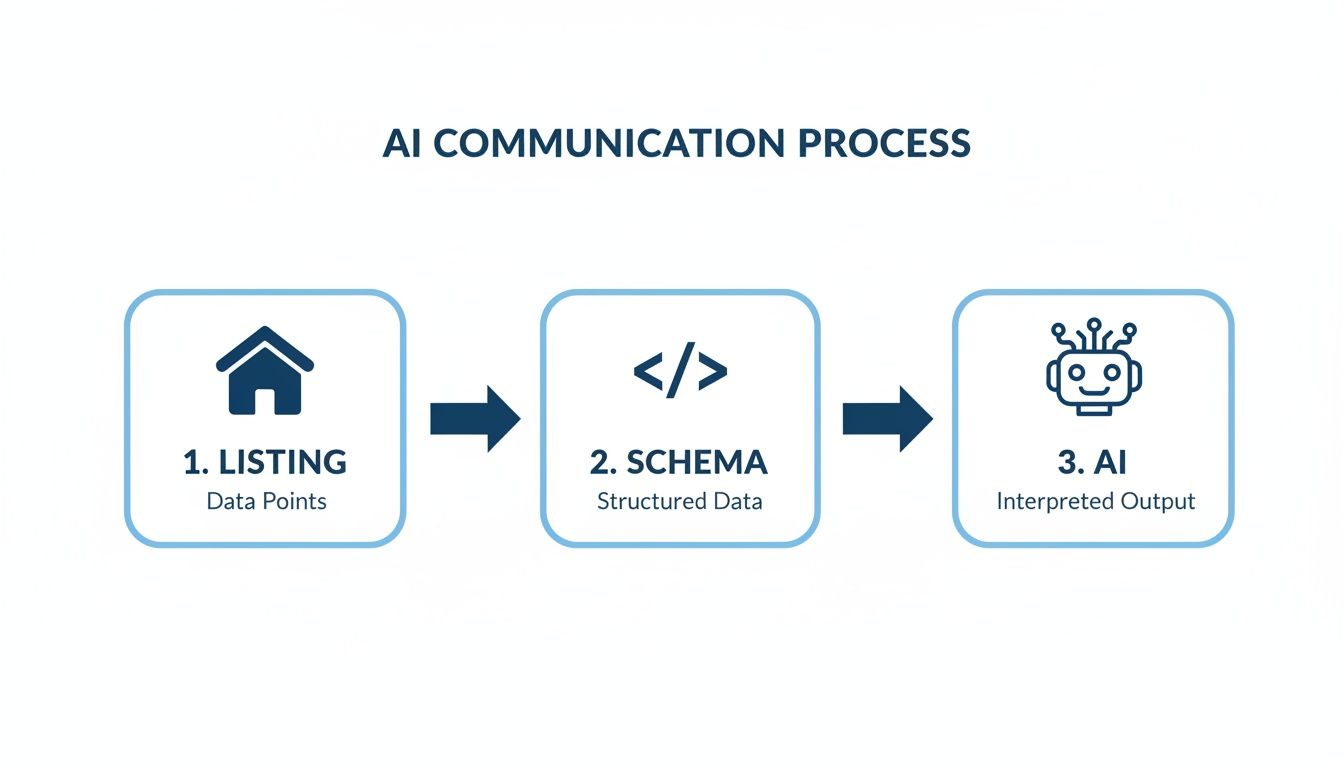
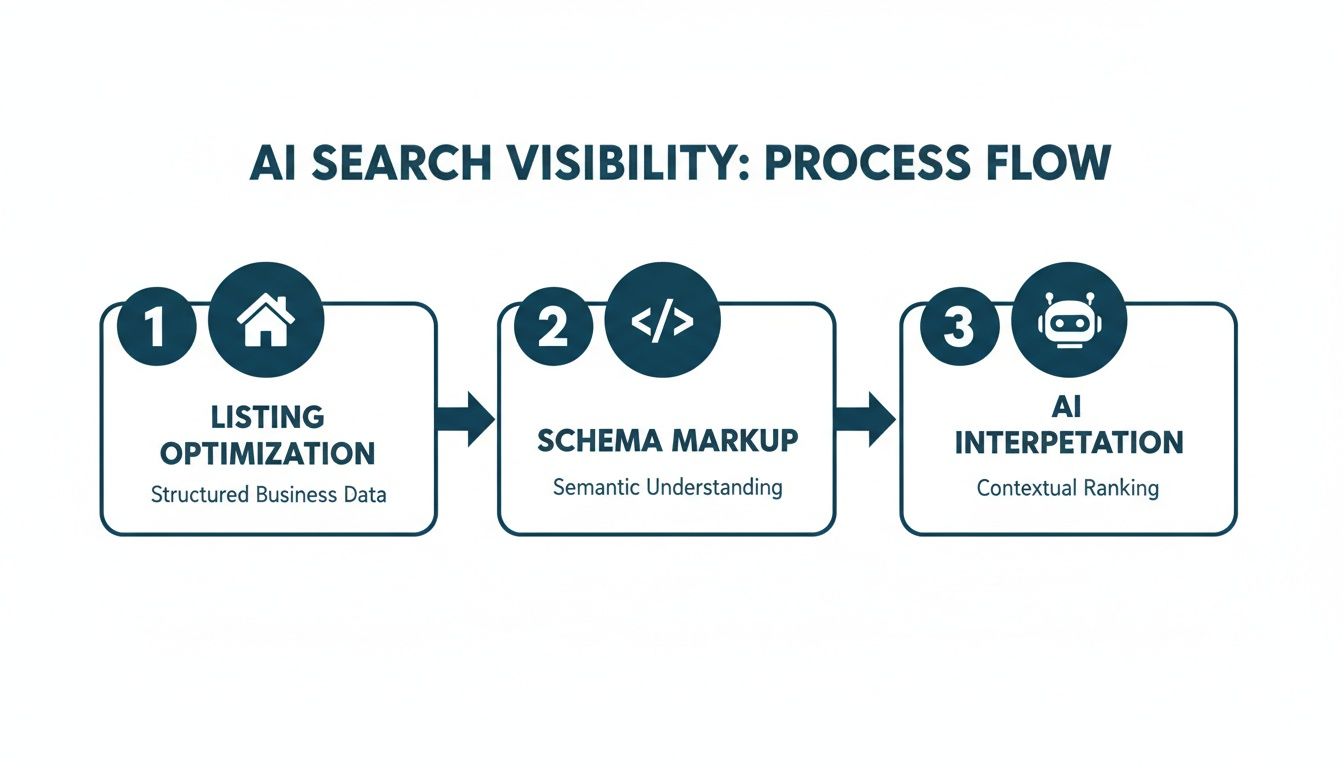
    Here’s the thing about AI: it doesn't "read" a website like a person does. It scans for structured data to find the most direct answer to a user's question, like, "Who's the best agent for waterfront properties in Miami Beach?" To be that answer, you have to speak the AI's language.

    That language is built on something called schema markup. Don't let the technical term scare you. Think of it as adding invisible "info tags" to the content on your website. These tags tell search engines precisely what each piece of information is, leaving no room for guesswork.

    Here are a few key types you'll want to have:

    • RealEstateAgent Schema: This tag clearly identifies you, telling AI, "This person is a real estate agent. Here is their name, brokerage, and the areas they serve."
    • RealEstateListing Schema: This breaks down your listings, clarifying, "This is the price, this is the bedroom count, and here are the specific amenities."
    • FAQPage Schema: This structures your Q&A content, making it incredibly easy for an AI to grab your expert answers and feature them directly in its search results.

    While you could learn to code this yourself, it's far easier to use a modern tool. Platforms like ListingBooster.ai are designed to automatically embed this schema into the content it generates, so every new listing or neighborhood guide is perfectly optimized for AI right out of the box.

    Your content's structure sends a powerful signal to AI. Clean, organized information with the right schema markup tells AI that you're an authority, making it far more likely to feature your content over unstructured text.

    Staying Compliant with Fair Housing Laws

    While you're wooing the algorithms, you can't lose sight of the legal and ethical lines. Fair Housing laws exist to prevent discrimination, and they apply to all of your marketing—from MLS descriptions and blog posts to your Instagram Reels. Even an unintentional slip-up can lead to massive fines and do lasting damage to your career.

    It’s a minefield. For instance, a seemingly harmless phrase like "a perfect family home" could be interpreted as discriminating against single people. Calling a neighborhood "quiet" might imply it's not welcoming to families with children.

    To keep your marketing both compelling and compliant, stick to these guidelines:

    • Describe the Property, Not the People. Always focus on the features of the home and community, not the type of person you imagine living there. Instead of "great for a young professional," try "a short walk to downtown and the light rail station."
    • Ditch Subjective and Exclusionary Words. Terms like "exclusive," "private," or "restricted" are major red flags. Stick to factual, objective descriptions.
    • Use Inclusive Imagery and Language. Make sure your photos and videos reflect the diversity of the community and don't signal a preference for any particular group.
    • Lean on an Automated Check. Manually checking every single post for compliance is not only a time-suck, but it's also easy to miss something. The smartest move is to use a tool that automatically scans your content for risky language before it goes live. Think of it as a critical safety net.

    When you understand the rules, you can create powerful marketing that is both effective and inclusive. For a more detailed breakdown, you can learn more about crafting MLS-compliant AI content and protecting your business. After all, the best content is the kind that gets seen by everyone and gets you in trouble with no one.

    Common Questions About Real Estate Content Marketing

    Even with a solid game plan, it's normal to have a few questions before diving into content marketing. It can feel like a big leap from the old-school methods we all know. Let's tackle the most common questions I hear from agents to clear things up and help you move forward with confidence.

    How Much Time Does This Really Take?

    This is the big one. I’ve heard from countless agents that they spend anywhere from 5-10 hours every single week just trying to keep up with content creation. That's a huge time-suck that pulls you away from clients and closing deals.

    The system we’re talking about here completely flips that script. By plugging into an AI-powered workflow, you can slash your active content creation time to just 15-30 minutes per week. Seriously. You feed it a single listing URL, and it generates a month’s worth of social media captions, blog ideas, and property descriptions. Your job shifts from being a stressed-out content creator to a savvy editor, giving you back hours to focus on what actually makes you money.

    Can I Still Sound Like Myself If I Use AI?

    Absolutely, and you should. This is probably the most important concern I hear, because a generic, robotic voice builds zero trust. Your personality is your brand.

    Good AI tools don't replace your voice; they learn it. During setup, you'll dial in your brand's personality. Are you all about the data and analytics? Or are you more warm, friendly, and community-focused? You define your tone and your ideal client, and the AI uses that as a blueprint.

    Think of the AI as your new assistant—an incredibly fast one. It handles the first draft, but you always have the final say. You give it that last polish to make sure it's 100% you, but all the heavy lifting is already done.

    This is a game-changer for brand consistency, especially for teams and brokerages that need everyone singing from the same song sheet.

    Should I Focus on a Blog or Social Media?

    The real answer? You need both. They play two very different, but equally crucial, roles. When they work together, they create a powerful lead-generation engine.

    • Your Blog is Your 'Authority Builder': This is your long-term asset. It's how search engines (and AI like ChatGPT) learn that you're the go-to expert on topics like "best family-friendly neighborhoods in Austin." This is where you build deep, lasting credibility that works for you 24/7.

    • Social Media is Your 'Listing Commander': This is all about speed and direct engagement. Use it to announce new listings, promote open houses, and build an active, engaged community. It’s perfect for creating urgency and getting immediate feedback.

    The magic happens when you integrate them. A single, in-depth blog post can be sliced and diced into five or six different social media updates. Then, you use those social posts to drive traffic right back to your blog, creating a feedback loop that constantly builds your authority.

    How Do I Know If My Content Is Actually Working?

    Likes and shares feel good, but they don’t pay the mortgage. To measure your real return on investment (ROI), you have to look past those vanity metrics and track what’s directly tied to your business.

    Here are the Key Performance Indicators (KPIs) that actually matter:

    1. Qualified Website Leads: How many people filled out your "Contact Me" or "Home Valuation" form after reading a blog post or neighborhood guide? That's a direct line from content to lead.
    2. Referral Traffic Sources: Check your website analytics. Are people clicking through from your Facebook, Instagram, or LinkedIn posts? This shows your social strategy is successfully driving traffic to your home base.
    3. AI Search Visibility: This is the new frontier. Every so often, ask an AI like ChatGPT to "recommend a top real estate agent in [your city]." Your goal is to see your name pop up because your content has established you as an authority.
    4. Direct Mentions: Simply ask new clients how they found you. When they start saying, "I saw your video about the new park," or "I read your blog post on staging," you know it’s working.

    Ultimately, the real ROI is a shorter sales cycle and a pipeline full of clients who already trust your expertise before they even give you a call.


    Ready to stop guessing and start building a content engine that does the work for you? ListingBooster.ai is the command center that turns your properties into authority-building content automatically. Start your free trial today and see the difference.

  • Real Estate AI vs ChatGPT Choosing Your Winning Tool in 2026

    Real Estate AI vs ChatGPT Choosing Your Winning Tool in 2026

    The real difference between a specialized real estate AI and a tool like ChatGPT boils down to one thing: specialization versus generalization.

    Think of it this way: ChatGPT is a brilliant, all-purpose assistant. It's fantastic for brainstorming blog post ideas or drafting a quick email. But a specialized real estate AI is a complete business system, engineered from the ground up to generate leads and secure listings. It works with industry-specific data, runs compliance checks, and automates marketing workflows that a general tool simply can't handle.

    The AI Decision Every Agent Must Make

    Choosing the right AI isn't some far-off consideration anymore—it's a critical business decision that affects your bottom line right now. The entire discovery process is being turned on its head. For years, Google was the undisputed starting point for clients. Today, AI-powered search is quickly becoming the new front door.

    This shift means your online brand needs to be built for AI recommendation engines, not just old-school search engines.

    Here’s a number that should get your attention: a staggering 40% of homebuyers now start their property searches using AI chat interfaces like ChatGPT, Perplexity, and Google AI. They're bypassing traditional search altogether. You can read more about this major shift in homebuyer habits and what it means for your business, but the takeaway is clear. The distinction between a general tool and a specialized one has never been more important.

    A person choosing between ChatGPT and Listingbooster.Ai on laptops, displaying different real estate houses.

    To make the right call for your business, you have to understand what these tools were fundamentally built to do. One is a creative partner for your day-to-day tasks; the other is a strategic asset designed for growth.

    Here’s a quick look at how they stack up.

    Real Estate AI vs ChatGPT At a Glance

    Criterion ChatGPT (General-Purpose AI) Specialized Real Estate AI (e.g., ListingBooster.ai)
    Primary Function General content creation and brainstorming. Automated, industry-specific marketing and lead generation.
    Data Source Broad internet data (often outdated). Real-time MLS data, local market trends, and property details.
    Compliance No built-in Fair Housing or industry compliance checks. Integrated compliance scanners for Fair Housing regulations.
    Workflow Requires manual prompting, editing, and fact-checking. End-to-end automated workflows from a single input (e.g., address).
    Business ROI Time savings on individual writing tasks. Measurable ROI through lead generation, time savings, and risk reduction.

    This table gives you the high-level view, but the core difference is in the results. A general AI saves you time on isolated tasks, while a specialized AI generates tangible business outcomes—more leads, faster sales, and a stronger market presence.

    Understanding Your Two AI Options

    Before you can decide between a general AI and a real estate-specific one, you need to understand what you're actually looking at. These aren't just two flavors of the same thing. They're entirely different tools, built for completely different jobs. One is a jack-of-all-trades, while the other is a precision instrument for your business.

    Think of ChatGPT as a brilliant, highly capable intern. It's a Large Language Model (LLM) that has learned from a staggering amount of text from across the internet. That training makes it fantastic for brainstorming, whipping up a quick email, or answering just about any general question you can throw at it.

    What is a General LLM Like ChatGPT?

    ChatGPT is essentially a creative partner. You give it a prompt, and it generates text that sounds remarkably human by recognizing and replicating patterns from its training data. For a real estate agent, this can be genuinely helpful for things like:

    • Drafting a quick social media post about what's happening in the local market.
    • Brainstorming a few topics for your next community newsletter.
    • Creating a basic outline for a blog post on home-staging tips.

    The key thing to remember is that its knowledge is a mile wide and an inch deep. ChatGPT has no connection to real-time MLS data, doesn't grasp the subtle nuances of your specific neighborhood, and certainly doesn't have any built-in safeguards for real estate compliance. It’s a powerful starting point, but every single thing it produces needs to be carefully fact-checked, edited, and guided by you to be safe and effective in a professional setting.

    At its core, ChatGPT is a text generator. A specialized real estate AI, on the other hand, is an outcome generator. It’s built not just to write words, but to produce tangible business results like qualified leads and compliant marketing campaigns.

    What is Specialized Real Estate AI?

    Purpose-built platforms like ListingBooster.ai are complete business systems. They aren't just a general-purpose language model with a real estate theme; they are engineered from the ground up with deep industry data, automated marketing workflows, and the compliance guardrails that agents absolutely need. They are designed to solve very specific real estate problems.

    Instead of just waiting for a prompt, these tools are built to run entire workflows. For instance, you give it a property address, and the system automatically gets to work. It:

    • Pulls the latest, most accurate data directly from the MLS.
    • Generates multiple listing descriptions, each optimized with marketing psychology in mind.
    • Builds out a complete social media campaign, complete with visuals.
    • Scans every piece of content for Fair Housing compliance before it ever goes live.

    This isn’t just about creating content; it’s a secure, automated marketing machine. This difference is critical for agents who need tools that directly build their business, not just tools that help with individual writing tasks. To see how this plays out for your online brand, check out our guide on improving ChatGPT real estate search visibility.

    Ultimately, it's the difference between having an assistant and having an entire marketing department on demand.

    How Do They Really Stack Up for Real Estate Agents?

    When you’re weighing a general tool against a specialized one, a simple feature list just doesn't cut it. The real difference in the real estate AI vs ChatGPT debate shows up when we look at them through the lens of an agent's daily grind and legal duties. To make a smart choice, we have to evaluate them on what actually impacts your business—from the data they use to the psychology behind the words they write.

    This approach helps us move past "what does it do?" and get to "what does it do for me?" It makes it crystal clear where a flexible tool like ChatGPT can lend a hand and where a purpose-built system like ListingBooster.ai is non-negotiable for growing your business safely.

    Data Relevance and Accuracy

    For any AI in real estate, the first and most critical point of failure is its data source. Great marketing lives and dies on timely, accurate, and hyper-local information.

    ChatGPT’s knowledge comes from a massive but frozen snapshot of the internet, often months or even years out of date. It has no live feed from your MLS, so it can’t see real-time pricing, property statuses, or specific neighborhood trends. Any market data it gives you is a rough guess at best and demands that you double-check everything.

    Specialized real estate AI, on the other hand, is built on a foundation of live data. Platforms like ListingBooster.ai plug directly into MLS feeds. This means every single piece of content, whether it's a listing description or a market update, is created using the most current and accurate property details available.

    The Takeaway: ChatGPT guesses based on old internet data; specialized AI knows based on live MLS data. For any task where accuracy is an absolute must, that direct data connection is everything.

    Compliance and Risk Mitigation

    In real estate, compliance isn’t just a good idea—it’s the law. The risk of accidentally violating Fair Housing laws with biased language is huge, and you can bet regulators are watching AI-generated content like a hawk.

    ChatGPT has zero built-in knowledge of the Fair Housing Act. If you ask it to write a listing description, it might spit out phrases that seem innocent but are potential violations, like "perfect for a growing family" or "walking distance to churches." You, the agent, are 100% responsible for catching and fixing these mistakes, which adds a ton of manual work and legal risk to your plate.

    In stark contrast, platforms like ListingBooster.ai are designed with compliance baked right in. They use automated scanners that actively check for and flag language that could get you in trouble with Fair Housing rules. This feature acts as a crucial safety net, turning AI from a potential liability into a compliance shield.

    Workflow Automation and Efficiency

    The whole point of AI is to save you time, but how it saves time is what really matters. The conversation around real estate AI vs ChatGPT often boils down to the difference between simple task help and true workflow automation.

    Using ChatGPT is a constant, manual, multi-step dance:

    1. Think up a detailed prompt.
    2. Generate the first draft.
    3. Fact-check every single data point and market claim.
    4. Edit it to match your tone, style, and brand.
    5. Review it with a fine-toothed comb for compliance.

    Specialized AI takes that entire process and shrinks it down to a single click. You type in a property address, and the system does the rest—pulling data, writing a complete set of marketing assets, and checking it all for compliance. It’s not just faster; it's a fundamentally smarter way to work, freeing you up to spend time with clients instead of a keyboard.

    Marketing Psychology and Persuasion

    At the end of the day, effective marketing isn't just about describing a house; it's about persuading someone to take the next step. This requires tapping into proven psychological triggers.

    ChatGPT can write a perfectly fine description. But it has no idea how to weave in principles like scarcity ("This one-of-a-kind view won't last long"), social proof ("Join the many new homeowners discovering this vibrant neighborhood"), or aspiration ("Imagine hosting summer gatherings on your private rooftop deck"). Its writing is often generic because it lacks a strategic marketing brain.

    Specialized tools come pre-loaded with these persuasive strategies. ListingBooster.ai, for instance, uses 23 different psychological frameworks to craft content that’s designed to stop the scroll and get people to engage. It turns a simple property announcement into a compelling call to action.

    It's no surprise that real estate AI adoption has exploded, and this strategic capability is a major reason why. A recent Delta Media survey revealed a massive shift, with 97% of brokerage leaders reporting their agents now use AI daily. You can read the full report in this top AI survey of real estate leaders. This really underscores the move away from just individual agent use toward building safe, powerful AI infrastructure for the whole brokerage.

    Choosing The Right Tool For The Right Task

    The real conversation around real estate AI versus ChatGPT isn't about which one is "better." It's about which tool is built for the specific job you need to do right now. When you start thinking in terms of "jobs-to-be-done," the choice becomes instantly clear. After all, you wouldn't use a screwdriver to hammer a nail, and the same practical logic applies to your AI toolkit.

    For certain tasks, a general-purpose tool like ChatGPT is a fantastic fit. It shines when it comes to broad, creative, and administrative functions where you don't need hyper-specific industry data or strict compliance.

    When To Use ChatGPT

    Think of ChatGPT as your creative brainstorming partner or a quick-start writing assistant. It's the perfect choice for open-ended, low-risk tasks that help you explore ideas or handle general communications.

    • Brainstorming Community Events: Need some fresh ideas for your next client appreciation party or a neighborhood sponsorship? ChatGPT can spit out dozens of creative concepts in seconds.
    • Drafting Internal Memos: It can quickly generate a first draft for a team update or an internal announcement about new office policies.
    • Writing a General LinkedIn Post: You can ask it to write a post about broad market trends, like the benefits of homeownership, that doesn't rely on hyper-local, real-time data.

    These are the kinds of tasks where speed and idea generation trump deep data accuracy or legal oversight. It gives you a solid starting point that you can then polish with your own expertise.

    The core principle is simple: use ChatGPT for tasks that require creative input but have low business risk. For core business operations that directly impact your income and liability, you need a specialized tool.

    When To Use Specialized Real Estate AI

    Your core business operations demand precision, compliance, and deep market knowledge. This is where a specialized system like ListingBooster.ai becomes not just a preference, but a necessity. These are high-stakes activities that directly generate revenue and carry significant legal responsibilities.

    For example, when your job is to "Generate a comprehensive marketing campaign for a new property," a specialized AI is the only logical choice. With just a property address, a platform like ListingBooster.ai can produce an entire suite of assets:

    • MLS-compliant and psychologically optimized listing descriptions.
    • A month's worth of hyper-local social media content, scheduled and ready to go.
    • Print-ready materials for your open house.
    • All content is automatically scanned for Fair Housing compliance.

    This flowchart breaks down the decision-making process, highlighting how critical compliance is in steering you toward the right tool.

    Flowchart for AI tool selection, considering data compliance, privacy, customization, and deployment options.

    The visual makes it obvious: if your task requires legally compliant and data-driven output, the path leads directly to a specialized solution. For any professional agent, this is a non-negotiable dividing line.

    To make this even more practical, let's look at some common daily tasks you might face and which AI tool makes the most sense.

    Choosing Your AI Tool: A Scenario-Based Guide

    Agent Task Recommended AI Tool Why It's the Right Choice
    Drafting a new property listing description. Specialized Real Estate AI Ensures Fair Housing compliance, uses market-specific keywords, and connects to MLS data for accuracy. High-risk task.
    Brainstorming blog post ideas. ChatGPT Great for generating creative topics and outlines quickly. No compliance risk.
    Creating a month of social media posts for a listing. Specialized Real Estate AI Pulls real property data, ensures compliant language, and creates hyper-local content tied to the listing's features.
    Writing an email to your team about a new CRM. ChatGPT Perfect for general internal communications where speed and clarity are the main goals.
    Generating a market update report for a client. Specialized Real Estate AI Pulls real-time, localized data and presents it accurately, building client trust. Using general data would be a mistake.
    Coming up with a clever tagline for your newsletter. ChatGPT Excellent for creative and marketing-focused idea generation.

    By matching the tool to the task, you build a workflow that's both efficient and safe. You can learn more about the different kinds of specialized platforms available in our complete guide to AI tools for real estate agents. This approach lets you tap into the creative power of general AI for low-stakes tasks while relying on the precision and safety of a purpose-built system for what matters most—growing your business.

    Unpacking the Real Cost and Return

    When you stack up real estate AI against a general tool like ChatGPT, looking at the monthly price tag is like judging a house by its curb appeal alone—it doesn't tell you what's going on inside. The real cost of any tool is a mix of the subscription fee, the time you sink into it, and the risks you take on. And the true return? That's measured in how much more efficient you become, how many more leads you generate, and whether it actually helps you grow your business.

    A "free" or cheap tool like ChatGPT often comes with a hefty price in hidden costs. The biggest one is your time. Every minute you spend trying to craft the perfect prompt, then editing, fact-checking, and scrubbing the output for compliance is a minute you're not on the phone or meeting with clients. This "time tax" piles up fast, turning that low-cost subscription into a major drag on your productivity.

    The Sneaky Costs of General-Purpose AI

    The drain on your resources goes beyond just lost hours. Getting your data ready is a huge roadblock. For most real estate pros using general AI, data bottlenecks and a lack of trust are constant problems, while specialized tools are already proving how efficient they can be. A staggering number of firms—over three-quarters—are struggling with data readiness, as fragmented systems cripple AI models that need clean, reliable information. In fact, only 8% report being fully ready. You can see the industry's full report on scaling AI to understand how deep these gaps run.

    These aren't just abstract problems. The hidden costs look like this:

    • You're the Compliance Officer: You have to manually scan every single sentence to make sure you're not accidentally violating Fair Housing laws.
    • Endless Fact-Checking: Every market stat, neighborhood detail, or property feature has to be double-checked against the live MLS.
    • Brand Voice Chaos: On a team, every agent ends up with their own way of prompting the AI, which completely erodes any sense of a consistent brand voice.

    The biggest expense of using a general AI is the opportunity cost. All that time spent wrestling with prompts and policing content is time that a specialized system could have turned into actual, client-facing work.

    The Value You Get from a Specialized Platform

    On the flip side, a platform built specifically for real estate, like ListingBooster.ai, is engineered from the ground up to give you a clear, measurable return on your investment. Its value isn't just about the tasks it checks off a list; it's about the tangible business results it creates. You're making an upfront investment in a system that pays you back over and over through massive time savings, automated lead gen, and—critically—risk reduction.

    This ROI gets even clearer as your business grows. For a solo agent, a tool like this acts as an always-on marketing assistant, handing you back hours every single week. For a team, it's the engine that keeps your brand consistent, making sure every agent's marketing hits the same high standard of quality and compliance.

    And for a brokerage? It provides a secure, scalable system that gives agents the tools they need to succeed while shielding the business from serious legal and reputational blowback. The cost shifts from being an expense to an investment in a predictable, efficient, and compliant way to grow.

    Why Specialized AI Is Your Competitive Edge

    Deciding between a general-purpose AI and a specialized platform isn't just a tech decision—it’s a major strategic choice for your real estate business. The whole "real estate AI vs. ChatGPT" debate really comes down to a single question: Do you need a simple writing assistant, or do you need a complete business-building system?

    ChatGPT is fantastic for quick, isolated tasks. But it just can't compete with the strategic depth a dedicated real estate platform brings to the table.

    Two professionals reviewing real estate documents with images, the man pointing at content while the woman listens.

    A specialized AI gives you a real, measurable advantage. Picture this: you walk into a listing presentation armed not just with comps, but with a complete, AI-generated marketing plan already built for that specific property. We're talking compliant listing descriptions, a full social media calendar, and even professional print materials, all ready to go.

    While your competition is stuck wrestling with ChatGPT prompts, you're showing sellers exactly how your marketing system will get their property seen in AI-powered search—where 40% of buyers now begin their home search.

    That’s the fundamental difference. Specialized systems like ListingBooster.ai are designed from the ground up with engines built for property marketing and agent branding. They pull in real-time MLS data and have compliance checks baked right in, delivering work that’s faster, safer, and far more effective. You can dig deeper into what a dedicated real estate AI platform includes and see how it directly impacts your bottom line.

    This proactive, data-fueled approach doesn't just save you time; it positions you as a modern market leader, giving you an undeniable edge before the listing agreement is even on the table.

    Common Questions Answered

    When deciding between a general AI like ChatGPT and a tool built just for real estate, a few key questions always come up. Here are the straight-up answers you need to make the right call for your business.

    Can I Just Use ChatGPT for All My Real Estate Marketing?

    You could, but you'd be taking on a lot of risk and extra work. Think of ChatGPT as a brilliant intern—great for brainstorming and getting a first draft, but it doesn't know the first thing about our industry's specific rules. It can't access live MLS data, has no concept of Fair Housing laws, and certainly doesn't know the subtle persuasive language that actually gets buyers off the fence.

    The bottom line is that ChatGPT is a generalist. It wasn’t built with the legal nuances, data requirements, and sales psychology of a real estate agent in mind. That puts all the responsibility for accuracy and compliance squarely on your shoulders.

    Are These Specialized Real Estate AI Tools Hard to Learn?

    Not at all. In fact, they're usually much easier. Platforms like ListingBooster.ai are designed for busy agents, not coders. The whole point is to save you time.

    Most of the time, all you have to do is drop in a property address. The system takes it from there, creating an entire marketing package for you. It's way faster than trying to write and refine the perfect series of prompts in a general tool like ChatGPT.

    How Does a Specialized AI Keep My Marketing Compliant?

    This is one of the biggest differentiators. A dedicated real estate AI has compliance baked right into its DNA. For example, ListingBooster.ai has built-in scanners that automatically check for words or phrases that could get you into trouble with Fair Housing regulations. It's an automated safety net that a general-purpose AI simply doesn't have.


    Ready to see what an AI built specifically for real estate can do for you? With ListingBooster.ai, you can turn a property address into a complete, compliant marketing campaign in just a few minutes. Start your free 30-day trial and feel the difference.
  • A Modern Playbook for Real Estate Content Marketing Automation

    A Modern Playbook for Real Estate Content Marketing Automation

    Let's be honest, content marketing for real estate is a beast. You're trying to juggle client meetings, property showings, and endless paperwork, all while being told you need to be a social media guru, a prolific blogger, and a master copywriter. It's an impossible workload.

    This is where content marketing automation comes in—and it’s not about robotic, soulless posts. It's about using smart tools and AI to handle the repetitive, time-sucking tasks of creating, scheduling, and distributing your marketing materials. Think of it as your digital assistant, working 24/7 to build your brand so you can focus on what actually closes deals: your clients.

    Why You Can't Afford to Ignore Automation

    The game has changed. Buyers aren't just starting their search on Zillow anymore; they're asking AI tools like ChatGPT and Google's AI Overviews for agent recommendations. To even be in the running, you need a strong, consistent digital presence. Manually creating that much high-quality content while running a business is a recipe for burnout.

    This is exactly why real estate content marketing automation is no longer a "nice-to-have." It’s a core business strategy. It doesn't replace your expertise or your personal touch. It amplifies it by freeing you up to do more of what you do best—building relationships and guiding people home.

    A laptop shows real estate listings next to a house model, notebook, and smartphone on a desk, with 'Marketing on Autopilot' text.

    Solving the Real-World Marketing Headaches Agents Face

    Automation isn't some abstract concept; it provides a direct solution to the daily frustrations that hold agents back. Does any of this sound familiar?

    • The Consistency Trap: You post on Instagram three times one week, then go silent for two. Your brand presence feels unreliable because you only post when you have a rare free moment.
    • The Time Sink: Hours evaporate every week as you stare at a blank screen, trying to dream up new post ideas, write clever captions, and design halfway-decent graphics.
    • The Brand Dilemma: If you run a team or brokerage, keeping every agent's marketing on-brand and professional is a constant battle.
    • The Compliance Nightmare: Manually triple-checking every single post and description for Fair Housing and MLS compliance is tedious and leaves you open to costly mistakes.

    A well-oiled automation system tackles these problems head-on. Your marketing runs on a predictable schedule, your brand voice stays consistent, and critical compliance checks are built right into the workflow, giving you peace of mind.

    This Isn't Just a Trend, It's a Tidal Wave

    The shift toward automation is happening across every industry, and real estate is no exception. The marketing automation market rocketed to $6.65 billion in 2024 and is expected to hit an incredible $15.58 billion by 2030.

    Even more telling? A massive 79% of marketers already automate parts of their customer journeys. Businesses still relying on purely manual processes are quickly becoming the minority. You can discover more insights about this automation surge and see just how widespread this movement has become.

    Let's look at what this difference means in terms of your most valuable asset: time.

    Manual Effort vs Automated Workflow

    Marketing Task Manual Approach (Hours/Week) Automated Approach (Minutes/Week) Key Benefit of Automation
    Listing Descriptions 2-3 Hours 15 Minutes Instantly generate multiple unique, SEO-friendly descriptions.
    Social Media Calendar 3-5 Hours 20 Minutes Create and schedule a month's worth of content in one session.
    Blog/Authority Content 4-6 Hours 30 Minutes Draft well-researched articles quickly, focusing your time on editing.
    Compliance Checks 1-2 Hours 5 Minutes Built-in safeguards automatically check for Fair Housing and MLS rules.
    Total Time Investment 10-16 Hours/Week ~1-1.5 Hours/Week Reclaim over 90% of your marketing time.

    The numbers don't lie. Shifting to an automated workflow frees up an entire workday (or more) every single week.

    This is exactly why tools like ListingBooster.ai were created. They are designed to take a single property link and generate a complete marketing kit from it—from MLS descriptions to social media posts and even printable flyers. The entire goal is to move you from being a full-time content creator to a savvy marketer who gets better results in a fraction of the time.

    Building Your Authentic Automated Content Foundation

    Jumping straight into automation without a clear plan is like trying to build a house with no blueprint. Sure, you have all the latest power tools, but the end result will be a chaotic mess. Effective real–estate content marketing automation doesn’t start with software; it starts with strategy. The whole point is to make the technology an extension of your unique brand, not a generic replacement for it.

    Before you generate a single post, you need to know what you're trying to achieve. What does success actually look like for your business? Your goals are the North Star that will guide every piece of content you automate. Are you laser-focused on generating new buyer leads? Or maybe you want to become the undisputed expert in a specific neighborhood? Perhaps your main goal is nurturing past clients to keep those referrals rolling in.

    Each of these objectives requires a completely different type of content. A lead-gen strategy might mean pushing out posts about first-time homebuyer tips, while an authority-building play would lean heavily into hyper-local market analyses and trends.

    Defining Your Brand Voice and Value

    Your brand is so much more than a logo and a color palette—it's the personality your clients feel in every interaction. Automation platforms like ListingBooster.ai don't just spit out generic text; they’re designed to learn your specific voice and apply it consistently. But first, you have to tell the system who you are.

    Start by getting crystal clear on these core questions. Your answers will become the direct inputs for your automation engine.

    • Who is your ideal client? Think beyond broad strokes. Are they luxury sellers in gated communities, millennial first-time buyers scraping together a down payment, or military families on a tight timeline? Get specific.
    • What’s your unique selling proposition (USP)? Do you specialize in historic homes? Maybe you have a background in construction that gives you a unique edge, or you offer a guaranteed sale program. This is what sets you apart from the agent down the street.
    • What three words describe your professional vibe? Are you analytical and data-driven? Or are you warm, empathetic, and all about the community?
    • How do you talk? Do you prefer a formal, buttoned-up tone, or are you more casual and conversational, maybe even cracking a joke or using local slang?

    These aren't just fluffy branding exercises. Your answers directly feed the prompts and settings within your automation software, making sure the content it creates actually sounds like you. This is the critical human element that keeps your marketing from feeling robotic and disconnected.

    Key Takeaway: Great automation doesn't erase your personality; it scales it. When you clearly define your brand voice and value upfront, you give the AI the exact ingredients it needs to create content that builds real, human connections.

    Turning Your Brand Identity into Content Pillars

    Once you have a sharp picture of your brand, it's time to translate it into a few core content pillars. Think of these as the main themes or topics your audience can consistently expect from you. They become the bedrock of your entire automated content calendar.

    For instance, an agent positioning themselves as a "data-driven advisor" might build their strategy around these pillars:

    1. Weekly Market Stats: Automated posts that pull the latest local inventory numbers, median sale prices, and average days on market.
    2. Neighborhood Deep Dives: In-depth guides to specific communities, covering everything from schools and amenities to property trends and local secrets.
    3. Investment Insights: Content that breaks down complex topics like 1031 exchanges, cap rates, or how to spot an undervalued property.

    On the other hand, an agent whose brand is all about being a "community connector" would have a totally different set of pillars:

    1. Local Business Spotlights: A weekly feature on a new coffee shop, boutique, or popular local restaurant.
    2. Upcoming Community Events: Posts highlighting farmers' markets, local festivals, high school football games, and other happenings.
    3. Client Success Stories: Sharing testimonials and photos from happy new homeowners standing proudly in front of their new homes.

    By establishing this foundation first, you're not just automating a list of tasks—you're building a scalable system for authentic brand expression. This strategic groundwork ensures that when you finally hit "go," your real estate content marketing automation is perfectly aligned to build the exact reputation you want. For a deeper look at structuring these ideas, our guide on crafting a winning real estate agent content strategy is a fantastic place to start.

    Designing Your Core Automation Workflows

    This is where the rubber meets the road. Strategy is great, but the real magic in real estate content marketing automation happens when you build repeatable systems—or workflows—that take care of your most time-consuming marketing tasks. Instead of starting from scratch every time a new listing hits or you need to post on social media, you’ll have a proven process locked and loaded.

    Let's get practical and break this down into the two most important systems every agent needs: one for marketing specific properties and another for building your brand authority over the long haul. These two engines work hand-in-hand to create a powerful, automated content machine that runs for you.

    The Property Marketing Workflow: From Listing to Close

    Your busiest times are always tied to a property's lifecycle. There’s the initial excitement of a new listing, the buzz of an open house, and the celebration of a sale. An automated workflow ensures your marketing keeps up with the pace without piling on the stress.

    The goal is incredibly simple: take one piece of information, like an MLS link, and let the system spin up an entire marketing campaign from it.

    Imagine you just landed a new listing. Here’s what this process looks like in real time:

    1. The Trigger: You drop the property address or MLS link into a tool like ListingBooster.ai.
    2. Instant Content Creation: The platform immediately pulls property details and photos to generate a whole suite of marketing assets. We're not just talking about a single description; it creates multiple versions, each one fine-tuned for a different platform.
    3. Launch: With just a few clicks, you approve and schedule everything.

    That single action sets off a chain reaction, deploying perfectly-timed content for every stage of the listing’s journey.

    Just Listed Campaign Assets

    • MLS Descriptions: You'll get several compelling, SEO-friendly descriptions written to highlight the home's best features. In fact, 82% of agents are already using AI to craft listing descriptions that pop on the MLS, Zillow, and Redfin. This is critical as more buyers use AI-powered search to find their next home.
    • Social Media Posts: A complete series of posts for Instagram, Facebook, and LinkedIn is ready to go, complete with engaging captions, smart hashtags, and eye-catching graphics or video templates.
    • Printable Flyers: Need a professional, on-brand flyer for the sign box or the local coffee shop’s bulletin board? It's ready to download and print.

    Open House Promotion

    As the open house gets closer, the workflow automatically pivots. It can generate a fresh batch of content designed specifically to drive foot traffic:

    • Reminder posts for social media with the date, time, and a compelling call to action.
    • A "sneak peek" video reel stitched together from property photos.
    • Sharp, targeted ad copy ready for a small Facebook ad campaign.

    Just Sold Announcement

    Once the deal is closed, the final stage kicks in. The system produces "Just Sold" graphics and social posts, which are pure gold for social proof. Nothing attracts new seller leads in the neighborhood faster. Best of all, this entire process is managed from one central dashboard.

    The Evergreen Brand Authority Workflow

    While property-specific content generates immediate buzz, your brand-building content is what earns you long-term trust and cements your status as the local market expert. This workflow is all about creating and scheduling a steady drip of valuable, non-listing content that keeps you top-of-mind with your audience between transactions.

    Think of this system as your silent partner, working in the background to establish your expertise on autopilot. You can map out an entire month of high-quality, diverse content in less than an hour.

    Pro Tip: Your brand authority content should directly answer the questions your clients are already asking. Think back to your last five client conversations—what topics kept coming up? Turn those into your automated content pillars.

    Building Your Automated Content Calendar

    So, what does a month of automated content actually look like? You set the big-picture themes—your content pillars—and the automation tool fills in the calendar for you. You can find more deep-dive examples of these systems in our full guide to real estate marketing automation for agents.

    Here's a sample schedule for an agent who wants to be known as the go-to "local market advisor."

    Sample 30-Day Automated Content Calendar

    This table shows how an automation tool can build a diverse content mix based on pre-defined pillars, ensuring you're always providing value.

    Week Monday Tuesday Wednesday Thursday Friday
    Week 1 Market Update Monday Buyer Tip (Financing) Neighborhood Guide New Listing Post Client Testimonial
    Week 2 Market Update Monday Seller Tip (Staging) Local Event Spotlight Open House Post Agent Intro Post
    Week 3 Market Update Monday Buyer Tip (Inspections) Neighborhood Guide Price Improvement Fun Friday (Local Fun Fact)
    Week 4 Market Update Monday Seller Tip (Pricing) Local Business Feature Just Sold Post Q&A Session Post

    Every single one of these pieces can be generated automatically. The "Market Update" pulls recent sales data, "Buyer Tips" are created from a library of common questions, and "Neighborhood Guides" are built using local information. Your only job is to give it a quick review, approve it, and let the system take care of the rest.

    This is exactly how you turn marketing from a daily grind into a strategic, automated asset that grows your business.

    Nailing the Execution: Smart Scheduling and Staying Compliant

    You've got a stockpile of fantastic, on-brand content ready to go. That's a huge win. But here's the reality: amazing content is useless if it's posted when no one's listening, or worse, if it lands you in legal hot water. This is where the execution part of your automation playbook really starts to shine, handling the critical jobs of smart distribution and airtight compliance.

    The goal here is to shift your mindset from content creator to content strategist. Instead of scrambling to figure out what to post today, you can focus on the big picture. Your automated system is in the background, reliably pushing out the right message at the right time, every single time. It’s all about building consistency without burning yourself out.

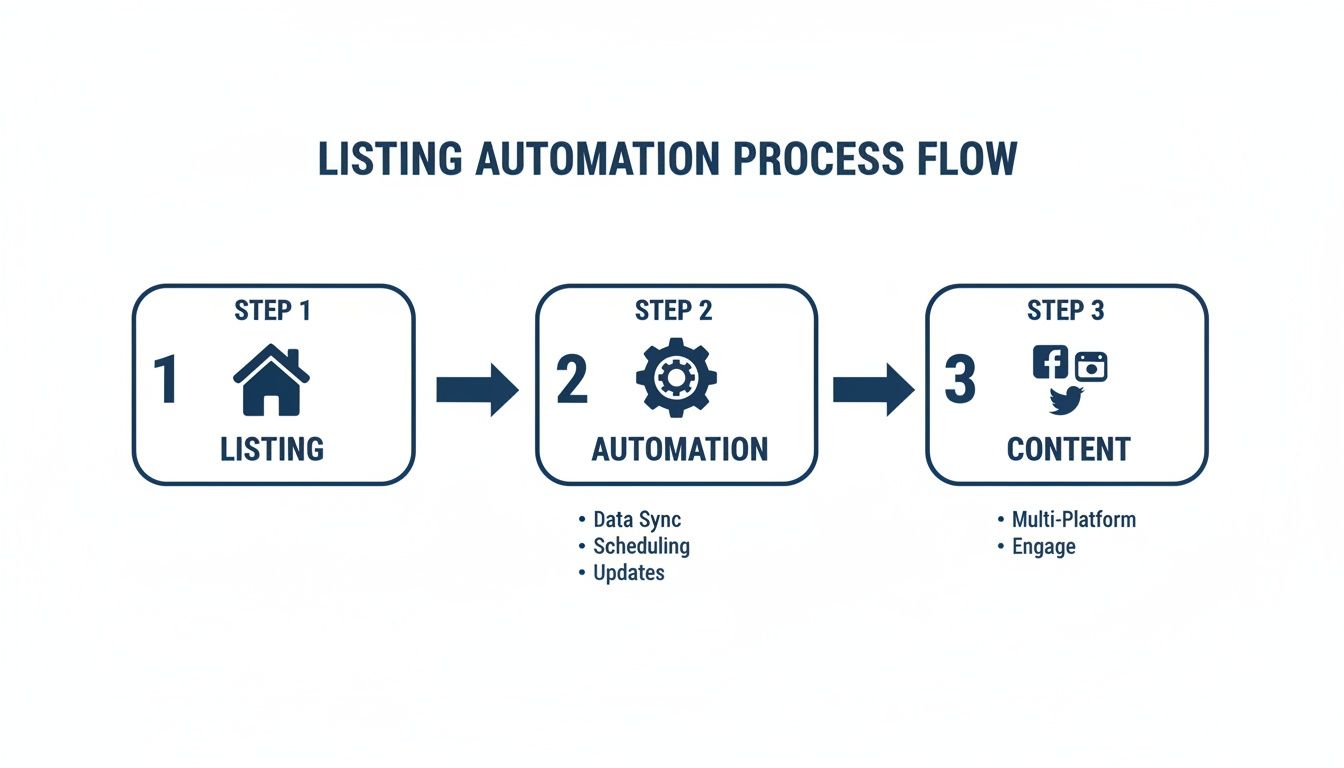
    A simple new listing can trigger a cascade of content across all your channels—this is the core idea.

    A three-step listing automation process flow diagram showing listing, automation, and multi-platform content.

    This workflow shows the real magic of automation. You provide one input, and the system creates a powerful, diverse output that would have taken you hours to do by hand.

    Mastering Your Automated Content Calendar

    Timing is everything on social media. A post about an open house that goes out at 2 AM on a Tuesday might as well be invisible. Smart automation tools don't just post for you; they post at the optimal moments, when your content will actually get seen and engaged with.

    Modern platforms are smart. They look at your audience data to see when your followers are most active. This means your "Just Listed" announcement can hit Facebook during the peak evening scroll time, while your market analysis article pops up on LinkedIn during business hours when professionals are paying attention.

    Here are a few pointers for setting up your schedule:

    • Tailor Timing to the Platform: Don't just blast everything at once. Instagram engagement often spikes during lunch breaks and after work. LinkedIn, on the other hand, is a mid-week, workday platform.
    • Vary Your Cadence: It’s okay to post more frequently about timely things like new listings or open houses. For your evergreen content, like market updates or homeowner tips, space it out a bit to keep your audience from getting fatigued.
    • Batch and Approve: Set aside 30 minutes once a week (or once a month) to review and approve the entire content calendar. This puts you in the driver's seat, blending automated efficiency with your final human touch.

    From a Broker's Point of View: "For our brokerage, automated scheduling isn't just a time-saver; it's a brand management tool. We ensure every agent has a baseline of professional, well-timed content going out, which elevates the perception of our entire company."

    This "set it and forget it" strategy ensures your online presence stays active and professional, even when you’re swamped with clients, inspections, or closings.

    Navigating Compliance with Built-In Safeguards

    This might be the most valuable—and most overlooked—benefit of a good automation system: it's your first line of defense against compliance violations. Manually checking every single property description and social media caption for Fair Housing language and local MLS rules isn't just a pain—it's incredibly risky.

    The Fair Housing Act is very clear about prohibited language. Words that seem completely innocent can imply illegal discrimination based on protected classes like race, religion, or familial status. Think about it: calling a property a "perfect bachelor pad" or "great for a growing family" could easily get an agent into trouble.

    This is where automation gives you some much-needed peace of mind. Platforms like ListingBooster.ai build compliance checks right into the content creation process.

    • Fair Housing Scans: Before the content even gets finalized, the AI scans every description and caption for problematic keywords and phrases that could trigger a violation.
    • MLS Rule Adherence: The system is also programmed with specific MLS guidelines, making sure your property descriptions don't include prohibited info (like your phone number) and meet all the right formatting rules.

    This automated safety net takes compliance from a stressful manual checklist and makes it a seamless part of your workflow. For brokers, this is a game-changer for risk management. You can ensure every agent under your license is marketing properties both professionally and legally. This isn't just about marketing smarter; it's about marketing safer.

    Using Advanced Automation to Build Market Authority

    A man shows market authority charts on a tablet to two colleagues in a business meeting.

    Automating things like new listing announcements and open house reminders is a fantastic start—it’s a huge time-saver. But that’s just scratching the surface. Real market leadership isn't just about selling properties; it's about becoming the definitive source for local real estate knowledge. This is where real estate content marketing automation evolves from a simple productivity hack into a serious brand-building machine.

    The real goal here is to shift the conversation beyond the transaction. You want to be the expert people turn to for advice, even when they aren't actively buying or selling. When someone asks a search engine, "Who is the top real estate agent in my city?" your consistent stream of high-value, automated content is what gets your name to the top of that list.

    Generating Hyper-Local Insights on Autopilot

    One of the most powerful ways to cement your authority is by consistently publishing data-driven, hyper-local market analysis. Let's be honest, manually pulling comps, calculating absorption rates, and writing a coherent summary every single week is a grind. Automation makes it practically effortless.

    Imagine setting up workflows that automatically create content like:

    • Neighborhood Deep Dives: Detailed guides on specific subdivisions, complete with school ratings, recent sales data, and notes on unique local spots.
    • Monthly Market Recaps: A quick, easy-to-digest summary of the latest sales figures, inventory levels, and price movements in your key service areas.
    • Investor-Focused Content: Pieces that break down cap rates for local duplexes or shine a spotlight on up-and-coming zip codes with strong rental demand.

    This isn’t just filler content. It's specific, valuable information that positions you as an advisor, not just an agent. In today’s market, this is more critical than ever. A staggering 82% of agents now use AI for their listing descriptions, and 74% use it for creating social media, blogs, and emails. This allows top agents to produce tailored, authoritative content at a scale that was impossible just a few years ago.

    Weaving Psychology into Your Automated Content

    Good marketing informs, but great marketing persuades. Advanced platforms like ListingBooster.ai are built to bake proven psychological frameworks directly into the content they generate. This makes your automated posts far more effective at stopping the scroll and getting people to take action.

    Think about how your automated content can subtly tap into these principles:

    • Social Proof: Automatically generate social posts that highlight glowing client testimonials or "Just Sold" announcements in a coveted neighborhood.
    • Scarcity: Craft captions for a new listing that emphasize its one-of-a-kind features and the competitive market, creating a natural sense of urgency.
    • Aspiration: Write property descriptions that go beyond listing features and instead paint a vivid picture of the lifestyle the new owner will step into.

    This isn’t about being manipulative; it's about connecting with people on an emotional level. By automating this, you ensure every single piece of content you push out is not only informative but also psychologically compelling.

    The New Standard: Walking into a listing appointment with just a CMA is no longer enough. The modern authority figure arrives with a complete, AI-optimized marketing suite ready to launch, demonstrating undeniable preparation and expertise before the conversation even begins.

    From Agent to Unquestioned Market Leader

    This level of preparation completely changes the dynamic of your client meetings. Instead of just telling sellers you have a solid marketing plan, you show them. You can literally hand them an already-generated social media calendar, several MLS description options to choose from, and a draft of a blog post ready to go live.

    This demonstrates a level of professionalism and strategic foresight that most agents just can't compete with. It’s the ultimate proof that you’re not just another agent—you're a true marketing partner who knows exactly how to position their home for maximum exposure and impact. To dig deeper into this approach, check out our guide on how to build authority as a real estate agent using these strategies.

    Ultimately, this advanced use of automation is how you build a powerful, trusted brand that both clients and search engines will recommend without a second thought.

    Measuring Success and Tuning Your Automation Engine

    Getting your automated content system up and running is a huge win, but don't fall into the "set it and forget it" trap. The real magic happens when you treat it like a living, breathing part of your business—something you can tweak and refine to get even better results. This isn't just about clawing back a few hours in your week; it's about building a predictable, scalable way to grow your pipeline.

    To really nail this, you have to look beyond the vanity metrics. Sure, a post with 100 likes feels great, but likes don't sign listing agreements. The real proof is in the data that shows genuine client interest and brings you one step closer to the closing table.

    The Metrics That Actually Move the Needle

    Don't get lost in a sea of analytics. There are only a handful of numbers that truly tell you if your automated content is doing its job.

    When you sit down for your monthly review, these are the KPIs you should be laser-focused on:

    • Engagement Rate: This is way more valuable than a raw like count. It's the percentage of your audience that's actually stopping to comment, share, or save your posts. It’s a clear signal that your message is hitting home.
    • Link Clicks: Are people actually clicking through to your listing pages, your website, or your "What's My Home Worth?" landing page? This is a direct measure of someone raising their hand and showing intent.
    • Direct Message Inquiries: A DM that says, "Hey, can you tell me more about that property on Elm Street?" is a red-hot lead. Keep a running tally of how many of these your automated content generates.
    • Lead Form Submissions: When you offer something valuable like a neighborhood guide or a market update, are people willing to trade their email for it? This is a fantastic way to measure how much they trust your expertise.

    My Two Cents: Block out 30 minutes on your calendar at the end of every single month to go over these numbers. Don't just glance at them—look for the story they're telling. Did that video tour of the new listing get way more DMs than the static photos? Did the "Hidden Gems of Downtown" post drive a ton of clicks? That's gold.

    Creating Your Feedback Loop for Smarter Content

    This data isn't just a report card on your past performance; it's your roadmap for what to do next. Think of your monthly review as your chance to pop the hood and make small, strategic adjustments.

    Let's say you notice your "Tips for Sellers" posts are getting fantastic engagement, but your "First-Time Buyer" content is crickets. That's a clear signal to adjust your content mix for the coming month. Maybe you dive into ListingBooster.ai and tweak the brand voice prompts to sound a little less formal, making you more approachable to that buyer demographic.

    By embracing this cycle of measuring, learning, and adjusting, you turn your automation from a simple content scheduler into a powerful, responsive growth engine. You're constantly feeding it information about what works, ensuring your digital presence becomes an ever-more-reliable source of qualified leads and new business.

    Frequently Asked Questions

    Will My Automated Content Sound Like a Robot Wrote It?

    This is a big one, and a valid concern. The good news is, no, not if you're using the right tools. Modern AI platforms have come a long way from the old, clunky template fillers.

    The secret is in the setup. These systems are designed to learn your voice. You feed it examples of your writing, define your ideal client, and specify your tone—whether you're witty, professional, or more of a friendly neighborhood guide. The result is content that genuinely sounds like you, not a generic script.

    How Much Time Will This Actually Take to Set Up and Run?

    Getting started is quicker than you might think. Seriously. You can connect your accounts and dial in your brand preferences in about 5-10 minutes.

    After that initial setup, the real magic happens. Generating a full marketing package for a new listing or planning an entire month's worth of social media posts can be done in just a few clicks. The day-to-day work is mostly just reviewing and approving content, freeing you up for what really matters.

    The point of real estate content marketing automation isn't just about saving a few hours. It’s about getting back the time you need for the dollar-productive activities—the calls, appointments, and negotiations that actually move the needle.

    Is This Content Safe for MLS and Fair Housing Rules?

    Absolutely. Compliance is a non-negotiable, and the best platforms are built with that in mind from the ground up.

    They have safeguards baked right in. Think of it like a spell-checker, but for compliance. These tools automatically scan every property description and social media post for language that could violate Fair Housing laws. They also ensure your listings meet specific MLS character limits and guidelines, so you can publish with confidence.


    Ready to stop scrambling and start scaling your marketing? ListingBooster.ai turns a single property link into a complete, compliant, and on-brand marketing campaign in minutes. Start your 30-day free trial today.

  • Build Authority as a Real Estate Agent with AI: A Proven Guide

    Build Authority as a Real Estate Agent with AI: A Proven Guide

    If you want to build authority as a real estate agent in today's market, you have to become the undisputed source of local knowledge online. This isn't just about posting listings. It's about consistently creating valuable, hyperlocal content that both potential clients and AI-powered search engines can find easily. It's how you prove your value long before the first handshake.

    Why Agent Authority Is Your New Competitive Edge

    The old playbook is officially outdated. Relying on mailers, billboards, or even a solid referral network just isn't enough to lock down your position in the market anymore. Here's a number that should get your attention: 43% of homebuyers start their search online. Their first impression of you is formed right there, long before they ever think about picking up the phone. They aren't just searching for any agent; they're looking for an expert they can trust.

    A professional man, likely a real estate agent, analyzes a map on his laptop screen.

    This fundamental shift in client behavior demands a new way of thinking. Building your authority as a real estate agent has moved from a "nice-to-have" marketing tactic to the absolute core of a sustainable business strategy.

    The Modern Definition of Real Estate Authority

    So, what does "authority" even mean in today's market? It’s a powerful mix of what you know and how consistently you share that knowledge. Think of it as your professional reputation, but scaled for the digital age. It boils down to three things:

    • Hyper-Local Expertise: This is so much more than just knowing the current inventory. It means being the go-to person for neighborhood market trends, school district ratings, upcoming zoning changes, and even the best local coffee shop.
    • A Consistent Online Presence: Posting once in a blue moon won't get you anywhere. True authority is built on a steady, reliable stream of valuable content across your website, blog, and social media channels.
    • Undeniable Social Proof: This is the proof in the pudding. It includes everything from glowing client testimonials and detailed case studies to impressive sales data and positive media mentions that back up your claims of expertise.

    For most agents I talk to, the biggest hurdle isn't a lack of knowledge. You know your market inside and out. The real struggle is finding the time and a cohesive strategy to broadcast that expertise effectively, day in and day out.

    The reality is that clients hire agents they trust, not just those who sell the most homes. Your content—from market updates to neighborhood spotlights—is your primary tool for building that trust at scale.

    A Framework for Building Your Authority

    To beat the overwhelm, you need a system. A scattershot approach of random posts and occasional emails leads to burnout and, frankly, minimal results. A modern framework, on the other hand, streamlines the entire process and ensures every single thing you do contributes to your larger goal. This guide is built on four essential pillars that work together to establish you as the go-to expert in your market.

    1. Positioning: Nailing down exactly who you serve and what makes you the only logical choice for them.
    2. Content: Creating a consistent flow of information that answers your ideal client's questions and showcases your deep expertise.
    3. SEO: Making sure your content actually gets found by the search engines and, more importantly, by the people who need it.
    4. Social Proof: Systematically capturing your wins and sharing them in a way that builds massive credibility.

    By weaving these four pillars into your business, you create a powerful, self-sustaining engine for growth. Tools designed to automate and organize this process, like those inside ListingBooster.ai, are built specifically to help agents put this framework into action efficiently. They turn a daunting task into a manageable—and profitable—workflow.

    This guide will walk you through each pillar, giving you actionable steps to build your authority and win more business. Let's get started.

    Defining Your Niche and Market Position

    Let’s be honest: you can’t be the go-to real estate agent for everyone. Trying to serve every buyer and seller in your city is a surefire way to get lost in the noise and burn yourself out. Real, lasting authority doesn't come from casting a wide net; it comes from having a sharp, strategic focus on a specific corner of the market where you can become the undisputed expert.

    A hand points at miniature houses on a map, analyzing real estate strategy with a tablet showing data.

    This is about more than just picking a neighborhood you like working in. It's about intentionally carving out a space where your unique skills, personality, and professional goals line up perfectly with a specific client’s needs. This focus is the very foundation you’ll use to build authority as a real estate agent.

    Pinpoint and Own Your Micro-Market

    A micro-market is a highly targeted segment you can absolutely dominate. Think about it: generalists compete with every agent in town, but specialists compete with almost no one. Your goal is to become so synonymous with your niche that when a potential client even thinks about that category, your name is the first one that comes to mind.

    Consider a few ways to slice the market:

    • Geographic Niche: This is the classic, but you need to go deeper than a city or zip code. Get specific. Think "historic homes in the Garden District" or "lakefront properties in the North Shore suburbs." The more granular, the better.
    • Property Type Niche: Are you passionate about a certain style of home? You could build a reputation specializing in mid-century modern restorations, new construction condos, or multi-family investment properties.
    • Client Demographic Niche: Serving a specific group of people allows you to tailor your entire message directly to their pain points and life stage. Great examples include first-time homebuyers, military relocations, downsizing empty-nesters, or luxury buyers.

    The trick is to find a niche that has enough business to be profitable but is specific enough that you can realistically become the #1 expert. This targeted approach makes every marketing dollar you spend and every piece of content you create infinitely more effective.

    Audit Your Personal Brand and Competitors

    Before you plant your flag in a niche, you need a clear-eyed view of your own strengths and who you’re up against.

    Start with some honest self-reflection. What deals have you truly enjoyed the most? What unique skills or background do you bring to the table? Maybe your previous career in finance makes you a natural for working with investors, or your background in design gives you an edge with historic properties.

    Next, get to know the agents already playing in the niches you're considering. Don't just look at their sales volume. Dig into their online presence.

    • What kind of content are they putting out?
    • What's their brand voice and visual style like?
    • Most importantly, where are the gaps in their strategy that you could fill?

    This isn't about copying them. It's about finding opportunities to differentiate yourself and craft a unique value proposition that nobody else is offering.

    Your brand isn’t just a logo or a headshot. It’s the promise you make to your clients. A well-defined niche makes that promise crystal clear and instantly recognizable to the right people.

    Translate Your Position into Automated Content

    Once you've defined your niche and brand position, you have to broadcast it. Consistently. This is where modern tools can give you a massive, almost unfair, advantage. Manually creating hyperlocal content day after day to reinforce your expertise is a major time-suck.

    This is the exact problem platforms like ListingBooster.ai were built to solve. For instance, with its 'Authority Builder' feature, you can define your niche—let's say, "first-time homebuyers in the Northwood neighborhood." The system then gets to work automatically generating content laser-focused on that audience, such as:

    • Guides on securing FHA loans for homes right there in Northwood.
    • Breakdowns of local school ratings and nearby park amenities.
    • Market updates focused specifically on entry-level home prices in that area.

    This automated approach ensures your online presence is constantly working for you, reinforcing your specialized expertise around the clock. It turns your defined position from a line on a business plan into a living, breathing digital footprint that attracts your ideal clients and solidifies your authority.

    Building Your Automated Content Engine

    If you want to build real authority, consistent, high-value content is the engine that gets you there. A smart content strategy does more than just fill your social media feed; it establishes you as an expert and essentially pre-sells your services long before a potential client ever picks up the phone. This isn't about posting generic advice—it's about building a practical, repeatable system.

    A modern desk setup with a laptop showing a calendar, a smartphone, and the text 'AUTOMATE CONTENT'.

    The entire goal is to become the go-to resource in your market by consistently answering the questions your ideal clients are asking online. By focusing on smart automation, you can maintain this powerful presence without sacrificing precious time you need for showings, negotiations, and closing deals.

    The Content That Actually Builds Trust

    To build authority as a real estate agent, your content has to go way beyond a simple stream of new listings. It needs to provide genuine, tangible value and prove you have a deep, nuanced understanding of the local market.

    I recommend focusing your energy on these three core content pillars:

    • Hyperlocal Market Updates: Don't just pull city-wide stats. Break down what's happening in specific neighborhoods you serve—from average days on market to new inventory trends. This is what shows you have your finger on the pulse of the micro-markets that matter.
    • Buyer and Seller Tip Series: Create content that actually guides people through the transaction process. Think short, punchy video tips on "3 Common Mistakes First-Time Buyers Make in Our City" or a simple checklist for "Getting Your Home Prepped to Sell This Spring."
    • Deep Dives into Neighborhood Amenities: This is where you truly shine. Showcase what makes a community special by featuring local businesses, reviewing new restaurants, or creating a guide to the best parks and schools in the area. This positions you as a true community insider, not just another salesperson.

    In a world where 88% of homebuyers turn to agents for guidance, a strong online presence is non-negotiable. This is why the sharpest agents are using tools to automate hyperlocal content that positions them as the go-to expert before a buyer even thinks about calling someone. In fact, one study showed that agents using structured educational content, like FAQs on financing, shortened their sales cycle by 27%. That’s powerful proof that authority is all about pre-selling trust.

    Automate Your Authority with a Content Calendar

    Let's be honest: the biggest killer of content consistency is a lack of time. Manually brainstorming and creating posts every single day is a direct path to burnout. This is where automation becomes your secret weapon.

    Tools like ListingBooster.ai were designed to solve this exact problem. Instead of staring at a blank screen wondering what to post, you can generate an entire 30-day content calendar that’s already tailored to your brand and niche—all in just a few minutes. These systems use proven psychological frameworks, like scarcity and social proof, to turn otherwise dry market data into social media posts that genuinely connect with your audience.

    The most successful agents don't have more hours in the day; they have better systems. An automated content calendar is the system that ensures your authority-building never stops, even when you're busy closing deals.

    This approach keeps your content mix perfectly balanced between educational, promotional, and community-focused posts, all without the daily grind. You can dive deeper into these strategies on the ListingBooster.ai blog.

    The Authority-Building Content Calendar

    To see how this works in the real world, here’s a sample weekly schedule. This structure ensures you’re hitting all the right notes to engage your audience, demonstrate your expertise, and ultimately, build your brand as the local authority.

    Day of the Week Content Theme Post Example (Generated by ListingBooster.ai) Authority Goal
    Monday Market Update "Good morning, [City]! The weekend saw 3 homes go under contract in the [Neighborhood] area, with an average list price of $450k. What does this mean for sellers? Scarcity is on your side." Demonstrate Data Expertise
    Tuesday Buyer/Seller Education "Quick Tip Tuesday: Before you start your home search, get pre-approved! It strengthens your offer and gives you a clear budget. DM me for my list of trusted local lenders." Build Trust
    Wednesday Neighborhood Spotlight "Mid-week shoutout to [Local Coffee Shop]! Their lattes are the best fuel for house hunting in [Neighborhood]. What’s your favorite local spot?" Showcase Local Knowledge
    Thursday Listing Promotion "Just Listed! This stunning 3-bed, 2-bath home in [Neighborhood] won't last long. With a brand-new kitchen and a huge backyard, it's perfect for a growing family. Click the link for a virtual tour!" Drive Leads
    Friday Client Success Story "So excited for my clients, the Smiths, who just closed on their dream home! Helping them navigate a competitive market to win this gem was an honor. Welcome to [Neighborhood]!" Provide Social Proof

    This kind of repeatable schedule transforms content creation from a daily chore into a strategic, automated process. It’s how you consistently build your reputation as the definitive real estate authority in your market.

    Making Sure AI Search Knows You're the Local Pro

    Having deep market knowledge is fantastic, but it’s completely useless if new search tools can't find you. If you want to build real authority as a real estate agent, you have to start thinking beyond old-school SEO and get your digital presence ready for AI search. Don't worry, this isn't about becoming a coder; it's about making your expertise easy for machines to understand.

    Think about it. When a potential client asks an AI assistant like ChatGPT or Perplexity, "Who is the best agent for first-time buyers in the Northwood neighborhood?" the AI isn't just skimming websites for keywords. It's actively looking for structured, organized data that screams "expert" on that specific topic. Your job is to hand-feed it that data.

    Translating Your Expertise for AI

    The basics of on-page SEO—using keywords in your website copy, blog posts, and property descriptions—still matter. That’s your foundation. But AI search needs another layer of detail. It needs to grasp not just what you're saying, but the context and relationships between all the bits of information you publish.

    For instance, it’s one thing to write that a property has three bedrooms. It’s another thing entirely for an AI to understand this is a "RealEstateListing" with a "numberOfBedrooms" value of "3," located in a specific "Neighborhood" that has a certain "publicSchool" rating. This is where a slightly technical idea called schema markup becomes an agent's secret weapon.

    Schema markup is basically a special vocabulary you add to your website's code. It helps search engines understand your content on a deeper level and give users much more helpful results. Think of it as creating a super-detailed digital business card for every single listing and blog post you create.

    This structured data is the native language of AI. Without it, you’re making the algorithms guess what you mean, and they'll either guess wrong or, even worse, just ignore you.

    Putting Schema on Autopilot

    Let’s be honest, manually adding schema markup to every listing, blog post, and market report is a nightmare. It's tedious, technical, and no agent has time for that. This is exactly why a platform like ListingBooster.ai can be such a game-changer for building your digital authority.

    The 'Listing Commander' feature, for example, takes care of all of this for you. When it generates marketing materials for your property, it's not just spitting out pretty text and photos. It's embedding all the right schema markup directly into the code of those digital assets.

    Here’s what that actually means for you:

    • For a New Listing: It automatically applies RealEstateListing schema, tagging the price, address, square footage, and number of rooms so AI can process it instantly.
    • For an Open House: It uses Event schema to clearly define the date, time, and location, which helps search engines feature it in local event searches.
    • For Your Agent Profile: It structures your contact info and service areas with RealEstateAgent schema, explicitly telling AI who you are, what you do, and where you work.

    This hands-off process ensures every piece of content you push out is perfectly tuned for the next generation of search. It's a huge leg up on the competition.

    What AI-Optimized Content Looks Like in the Wild

    So, let's get practical. You're writing a property description. The old way might be: "Charming 3-bed, 2-bath home in the sunny Glenwood neighborhood, perfect for families."

    An AI-optimized description, built with schema in mind, adds a ton of context behind the scenes. The buyer sees the same engaging text, but the AI sees clean, structured data points:

    Data Point Value Schema Tag
    Property Type SingleFamilyResidence @type
    Bedrooms 3 numberOfBedrooms
    Neighborhood Glenwood containedInPlace
    Key Feature Fenced Backyard amenityFeature

    This is exactly the kind of detail that lets an AI search engine confidently match your listing to a specific query like, "Find me a family-friendly home with a yard in Glenwood." Your listing doesn’t just show up—it's served up as a perfect, authoritative answer.

    The same logic applies to your blog. A post on local market trends is no longer just text; it's an Article with an author (you), a publisher (your brokerage), and a clear about topic (real estate in your city). Every piece of structured content builds on the last, creating a powerful web of data that solidifies your status as the go-to local expert in the eyes of the very algorithms connecting you with your next client.

    Using Social Proof to Build Unshakeable Trust

    Okay, so you've got your content and SEO firing on all cylinders. That's a great start, but it's not the whole picture. Nothing—and I mean nothing—builds credibility faster than cold, hard proof of your success. This is where social proof becomes your superpower. It's the tangible evidence that takes you from claiming you're an expert to proving it, giving potential clients that final nudge of confidence they need to pick up the phone and call you.

    To really make this work, you can't just wing it. You need a system for capturing and showcasing your wins. This isn't about just dropping a few text-based reviews on your website and calling it a day. We're talking about creating a living, breathing story of your success that's simply too compelling for prospects to ignore.

    Go Beyond Basic Testimonials

    Let's be honest, the old method of grabbing a quick, written blurb after a closing just doesn't cut it anymore. Today's clients are savvier than ever. They want to see the nitty-gritty details, the stories, and the hard data that prove you can actually deliver on your promises.

    Your mission is to build a central hub for all this proof—think of it as a digital trophy case or a "Results" page on your website. This page shouldn't just list your wins; it should sell your expertise with things like:

    • Detailed Case Studies: Don't just say you sold a house. Walk people through the story. What was the client's biggest challenge? What specific strategy did you use to solve it? And what was the incredible result? Use real numbers here, like "Sold in 7 days for 10% over the asking price."
    • Sales Volume Data: Telling people you're a top producer is one thing. Showing them is another. Simple charts or infographics displaying your sales volume, average sale price, or list-to-sale ratio can be incredibly powerful.
    • Client Success Stories: These are less about stats and more about the human element. They tell the story behind the transaction, which makes your success feel both relatable and real.

    Building true authority demands this level of transparency. In fact, agents who create these "proof pages"—showcasing sales data, in-depth stories, and market wins—build trust exponentially faster. This is critical when 50% of homebuyers are looking for an agent to guide them to the right home. One agent I know even cut their sales cycle by 27% just by using structured case studies to explain their process. If you want to dive deeper, you can read more about building an agent authority stack that helps you get more leads and close more deals.

    To really understand the shift, let's look at how modern social proof stacks up against yesterday's testimonials.

    Social Proof vs. Traditional Testimonials

    Method Traditional Testimonial Dynamic Social Proof (e.g., Case Study, Data) Impact on Authority
    Client Quote "Jane was great to work with!" "We were struggling to sell our unique property. Jane's staging and marketing plan brought in 5 offers." Moves from a generic compliment to a specific, problem-solving narrative that builds real-world credibility.
    Data & Results Mentioned vaguely, if at all. "Sold for $25,000 over asking price in just 4 days." Hard numbers are undeniable. They provide concrete, verifiable evidence of your skill and market knowledge.
    Visuals Usually just a block of text. Includes photos, charts showing market trends, or a short video clip of the happy client. Visual proof is more engaging and memorable, making the story stick with potential clients.
    Relatability for Leads Can feel generic and interchangeable with other agents. A detailed story allows future clients to see themselves in the situation and trust you to solve their problems. Creates a powerful connection by demonstrating that you understand and can overcome specific client challenges.

    As you can see, the difference is huge. One feels like a polite thank-you note, while the other is a powerful tool that actively sells your value.

    A Simple Framework for Powerful Video Testimonials

    A single, well-done video testimonial is worth its weight in gold. When a prospect can actually see and hear a genuinely thrilled client talk about their experience, it creates an instant emotional connection. That's a level of trust you just can't get from text alone.

    But you can't just hope for these to fall into your lap. You need a simple, repeatable process.

    1. Ask at the Peak of Happiness: The absolute best time to ask is right after a smooth closing or the moment you've delivered fantastic news. Their excitement is authentic and totally contagious.
    2. Give Them Simple Prompts: Don't put them on the spot by just saying, "Can you record a testimonial?" Guide them with easy questions like, "What was your biggest worry before we started working together?" or "Can you describe how you felt when we got that amazing offer?"
    3. Make It Insanely Easy: Tell them to just record a quick video on their smartphone. Stress that it doesn't need to be a Hollywood production. Authenticity beats polish every single time.

    Turn Every "Just Sold" into a Social Proof Event

    Every time you close a deal, it’s a golden marketing opportunity. Instead of just tossing up a static "Just Sold" graphic and moving on, you can use a tool like ListingBooster.ai to turn that single moment into a powerful, multi-channel social proof campaign.

    With a single closed listing, the platform can automatically create an entire suite of content for you, like:

    • An engaging social media post announcing the sale, complete with compelling copy and professional graphics.
    • A short video reel or story that highlights the property's best features and celebrates the great outcome.
    • An email template ready to be sent to your database, reinforcing your track record and proving you're active and successful in the market.

    This approach transforms one achievement into a dynamic story that reinforces your authority everywhere your audience is looking. It keeps your success consistently front and center, making you the obvious choice.

    Your Authority-First Workflow for Real Estate

    Pulling all these strategies together isn't about reinventing your entire business. It's about putting a simple, repeatable system in place that builds your authority on autopilot. Think of it as shifting from an agent who’s always chasing the next content idea to a market expert who operates with a clear, predictable plan.

    The process itself is surprisingly straightforward. You start by laying the groundwork with a tool like ListingBooster.ai's ‘Authority Builder’. This lets you generate and schedule a full 30 days of hyperlocal, niche-specific content in one go. It’s like putting your brand building on cruise control, freeing you up while consistently reinforcing your expertise across your social channels.

    This simple diagram breaks down the trust-building process your content powers.

    A three-step diagram outlining the 'Building Trust Process': Capture, Showcase, and Validate.

    This cycle—capturing your expertise, showcasing it through great content, and then validating it with real proof—is what creates that unshakable client confidence.

    Deploying Your Listing Marketing Suite

    Now for the fun part. Every time you get a new listing, you launch the ‘Listing Commander’. This is your tactical marketing engine. In just a few minutes, it generates an entire suite of AI-optimized assets for that specific property. We're talking everything from a compelling MLS description to social media posts and even print-ready flyers.

    This isn't just about marketing a house; it’s about demonstrating your value at every single turn.

    This shift in operations is profound. You no longer just show up to listing appointments; you arrive with a pre-built, professional marketing plan that proves your value from the very first minute.

    This workflow means you’re not just marketing differently—you’re operating like a true market authority. You're set up to win listings before the conversation even begins because you’ve already shown them a superior strategy. To see how these features empower agents, you can explore the tools available on ListingBooster.ai.

    Frequently Asked Questions

    Building your authority doesn't happen overnight, but with a smart, consistent strategy, you can definitely speed things up. Let's tackle some of the most common questions I hear from agents who are ready to get serious about establishing themselves as an expert.

    How Long Does It Take to Build Authority?

    You're not going to become the top agent in your city in a month, but you can see a real, tangible shift in as little as 90 days if you stick to the plan. Consistency is everything here.

    This is where a platform like ListingBooster.ai becomes a game-changer. It helps you hit the ground running with a constant flow of expert content and perfectly optimized listings. This consistent output helps AI search engines recognize your specific expertise much, much faster than you could ever achieve doing it all by hand.

    Can New Agents Build Authority Without Many Sales?

    Yes, one hundred percent. New agents can build authority by going deep, not wide. Forget about your sales history for a minute and focus on becoming the undeniable expert in a hyper-local niche. Your first goal is to be the go-to resource for a single neighborhood or a specific type of buyer.

    Don't wait for sales to prove your worth. Prove your worth with your knowledge, and the sales will follow. Your consistent content about local trends, businesses, and schools will build the trust that secures those first deals.

    Tools like the Authority Builder in ListingBooster.ai are perfect for this. You can instantly create genuinely helpful content about market stats, school districts, and community events in your target area. That deep knowledge, shared consistently, is what makes you a credible expert.

    What Is the Single Most Important Factor?

    If you take one thing away from this guide, let it be this: consistency. A single viral post is just a blip on the radar. What truly builds a lasting reputation is a steady, reliable stream of valuable content.

    This is what builds trust with potential clients and what gets you noticed by search algorithms. An automated content system is your secret weapon here. It ensures your digital presence is always active and reinforcing your expertise, even when you're completely swamped with showings and closings.


    Ready to stop chasing leads and start operating like a true market authority? ListingBooster.ai generates a complete suite of AI-optimized assets—from social media posts to compelling MLS descriptions—designed to help you win listings before you even walk in the door.

    Start building your authority today at https://listingbooster.ai.

  • AI SEO for real estate agents: Boost Listings and Attract Clients

    AI SEO for real estate agents: Boost Listings and Attract Clients

    If you're a real estate agent, you've probably spent years perfecting your SEO strategy to get to the top of Google. But what if I told you that the game has completely changed?

    AI SEO is the new frontier. It’s no longer about simply ranking #1 for a keyword. It’s about optimizing your entire online footprint—your website, your listings, your local profiles—so that AI tools like Google's AI Overviews and ChatGPT recommend you directly. The goal is to be the answer when a buyer asks their AI assistant, "Who is the best agent in Austin for first-time homebuyers?"

    How AI Is Rewriting Real Estate Marketing

    A hand holding a smartphone displaying an AI home search application in front of houses.

    The modern homebuyer's journey looks very different today. Instead of scrolling through endless blue links on a search results page, your potential clients are getting direct, summarized answers from AI. This is a massive opportunity for agents who get ahead of the curve and a real threat to those who don't.

    Old-school SEO was a grind of keywords and backlinks. The new battlefield is about feeding AI systems the structured, authoritative information they crave to confidently recommend you and your listings.

    The New Battlefield for Visibility

    This isn't some far-off trend—it's happening right now. A staggering 40% of homebuyers are already using AI tools to kick off their property search, and that number is climbing fast.

    These AI platforms don't just pick any random website. They're designed to find and prioritize content that is:

    • Trustworthy: Pulled directly from your website and a well-maintained Google Business Profile.
    • Structured: Uses a technical language called schema markup to clearly define property details, agent info, and local expertise.
    • Authoritative: Backed up by a consistent stream of high-quality content like hyper-local market reports and in-depth neighborhood guides.

    Think about it. When a potential client asks ChatGPT for "family-friendly neighborhoods in Denver with good schools," the AI scans the web to synthesize an answer. Your goal is to make sure your content is the most reliable, comprehensive source it finds.

    The core of AI SEO for real estate agents is simple: build a digital footprint that makes you the undeniable local expert. When you consistently publish helpful, structured content, you're not just marketing—you're training AI to recognize your authority.

    Comparing Traditional SEO and AI SEO for Real Estate

    To really grasp this shift, it helps to see the old and new approaches side-by-side. This table breaks down the crucial differences between yesterday's SEO tactics and the AI-driven strategies required to win clients today.

    Strategy Element Traditional SEO Approach Modern AI SEO Approach
    Primary Goal Rank #1 on a search results page. Become the AI's go-to source for recommendations.
    Keyword Focus Broad match keywords (e.g., "homes for sale Austin"). Conversational, long-tail questions (e.g., "what is the best Austin neighborhood for young families?").
    Content Strategy Blog posts targeting specific keywords. Creating a web of interconnected, authoritative content (market reports, neighborhood guides, agent profiles).
    Technical Focus On-page SEO, backlinks, and site speed. Schema markup, structured data, and entity-based optimization.
    Source of Truth Ranking algorithms based on links and keywords. AI models synthesizing data from trusted, structured sources.
    Lead Generation Attract clicks from a list of search results. Intercept buyers at the moment of inquiry with a direct AI-generated answer.

    As you can see, the new approach is far more holistic. It’s about building a brand that AI can understand and, more importantly, trust.

    Why Portal Dependency Is a Losing Game

    Relying on portals like Zillow and Realtor.com has always meant you were renting, not owning, your leads. Building an AI-optimized presence on your own website creates a sustainable lead pipeline that belongs to you. It's about positioning your brand to capture high-intent leads before they ever even think to visit a crowded portal.

    The numbers don't lie. With AI Overviews now dominating a huge portion of search results, click-through rates to traditional websites are plummeting for agents who fail to adapt. But it's not all doom and gloom. Agents who are leaning into AI SEO are reporting a 68% improved ROI because they are showing up exactly where modern buyers are looking. You can dig into more of these AI SEO statistics and their impact to see the full picture.

    Mastering AI SEO for real estate agents means building a marketing engine that works for you 24/7. It’s the key to becoming the definitive answer to a homebuyer's question, not just another name lost in the crowd.

    Writing AI-Optimized Property Listings That Convert

    Laptop displaying optimized real estate listings on a wooden desk with a notebook and a plant.

    Let's be honest, your property description has a new audience. It’s no longer just a sales pitch for a human buyer; it's a critical data source for AI search tools. This means every single word you write has to do double duty: entice a person and educate an algorithm. The old days of just cramming in generic keywords are long gone.

    Today's winning strategy is all about entity-based SEO. This is a fancy way of saying you need to describe a property by its relationship to the world around it. You're not just selling four walls and a roof; you're selling a lifestyle, a community, a place. You need to connect the dots between the home and local entities like schools, parks, popular restaurants, and transit hubs.

    When you do this, you turn a simple listing into a rich, contextual story. So when a potential buyer asks an AI, "Find me a three-bedroom house in Scottsdale near a good elementary school and a dog park," your listing is infinitely more likely to pop up if it clearly communicates those connections.

    Moving Beyond Keywords to Entities

    To really nail this for AI, think more like a storyteller than a salesperson. Instead of just listing "granite countertops," you need to describe the "chef’s kitchen with sleek granite countertops, perfect for entertaining." See the difference? That subtle shift adds context that both people and machines can easily understand.

    This is the core of what makes AI SEO for real estate agents so effective. It’s all about providing clear, descriptive, and interconnected information.

    • Instead of: "big backyard"

    • Try: "a sprawling, fully-fenced backyard that’s ideal for summer barbecues."

    • Instead of: just the city name

    • Try: "nestled in the quiet, tree-lined streets of the historic Northwood district."

    • Instead of: a vague location

    • Try: "just a five-minute walk to the popular Oak Street Farmer's Market and steps from the entrance to Greenway Park."

    This level of detail gives AI models like ChatGPT and Google's AI the precise data they need to match your listing with very specific buyer searches. Every connection you make to a local entity—a park, a school, a coffee shop—strengthens your listing's relevance.

    Crafting Descriptions for Humans and AI

    Your goal is to write copy that feels completely natural and compelling to a person while also being perfectly structured for a machine. This is where combining vivid, descriptive language with a few psychological triggers becomes a superpower.

    Let’s walk through a real-world example. Say you've got a new listing and you've used a tool like ListingBooster.ai to generate the first draft. Here’s how you can polish it to hit both targets.

    The Standard, Boring MLS Description:
    “3 bed, 2 bath home in Austin. Updated kitchen, large yard. Close to downtown. Great for families. Must see.”

    The AI-Optimized, Compelling Description:
    “Discover your dream home in the heart of Austin’s vibrant Zilker neighborhood. This beautifully renovated 3-bedroom, 2-bathroom residence offers the perfect blend of modern comfort and urban convenience. The fully updated kitchen features stainless steel appliances and quartz countertops, flowing seamlessly into an open-concept living area bathed in natural light.

    Step outside to a private, spacious backyard, perfect for weekend gatherings. Located just a 10-minute drive from downtown Austin and within the highly-rated Zilker Elementary school district, this home is an ideal choice for families. Enjoy being walking distance from Zilker Park and Barton Springs Pool. This opportunity won’t last long—schedule your private tour today.”

    The difference is night and day, right? The second version is packed with local entities (Zilker neighborhood, Zilker Elementary, Zilker Park) and uses light psychological cues like "dream home" (tapping into aspiration) and "won’t last long" (creating scarcity).

    A great AI-optimized listing tells a story that resonates with a buyer's aspirations while simultaneously feeding search engines a structured, fact-based summary of the property and its surrounding environment. The two goals aren't in conflict; they actually support each other.

    A Practical Checklist for AI-Ready Listings

    As you sit down to write your next property description, run through this mental checklist to make sure it's optimized for modern search.

    1. Lead with a Killer Hook: Start with a sentence that grabs attention and highlights the home's most unique selling point.
    2. Name Specific Entities: Don't be vague. Mention the actual names of neighborhoods, school districts, parks, key streets, and popular local businesses.
    3. Use Natural Language: Write like you talk. Ditch the jargon and awkward keyword-stuffing. Imagine you're describing the home to a client in person.
    4. Describe the Lifestyle: Paint a picture. What does it feel like to live there? Talk about morning coffee on the patio or weekend walks to the nearby cafe.
    5. Incorporate Urgency: Use phrases like "highly sought-after neighborhood" or "a rare find in this market" to create a little friendly urgency.
    6. Structure for Scannability: Keep your paragraphs short (just 2-3 sentences) and use bullet points for key features. This makes the description easy to read on any device.

    By following this framework, you’ll create listings that not only shine on traditional portals like Zillow and Realtor.com but are also perfectly teed up to be recommended by the AI assistants that are quickly becoming a homebuyer's first stop.

    Building the Digital Authority AI Recommends

    Optimized listings get your properties seen, but building digital authority gets you recommended. It’s a crucial distinction. AI search engines like Perplexity and Google’s AI Overviews don’t just find houses; they find experts.

    When a potential client asks their phone, "Who is the best real estate agent in Scottsdale?" the AI isn't just looking for keywords. It's scanning for signals of expertise, consistency, and trust across the web. Your job is to build that digital footprint so you're the undeniable answer.

    This isn't about just having a blog. It’s about becoming the go-to online resource for your market. Think of every article you post as another brick in the foundation of your reputation, strengthening your authority one piece of content at a time.

    The Content That Signals True Expertise

    To be seen as an expert, you have to create content that answers the specific, nuanced questions your clients are actually asking. You need to get way beyond generic "tips for buyers" and dig deep into what makes your local market tick. This is how you prove your value long before the first phone call.

    AI rewards content that is genuinely helpful and demonstrates firsthand knowledge. Here are the kinds of posts that build real authority:

    • Hyper-Local Neighborhood Guides: Don't just list demographics. Talk about the lifestyle. Where's the best local coffee shop? What's the walkability score really like? What's the community vibe?
    • Insightful Market Updates: Anyone can spit out MLS data. Your job is to provide expert analysis. What do rising interest rates actually mean for a first-time buyer in your specific city?
    • Practical "How-To" Articles: Solve real-world problems for your audience. Think "How to Successfully Appeal Your Property Tax Assessment in Maricopa County" or "A First-Time Homebuyer's Complete Checklist for North Phoenix."

    AI doesn't just index keywords; it understands concepts and recognizes genuine expertise. When you consistently publish content that answers the questions your clients have, you are actively training AI to recommend you as the most qualified professional in your area.

    Creating a Consistent Digital Footprint

    Consistency is everything when it comes to building authority. A single great blog post is a drop in the ocean. A steady stream of valuable content, on the other hand, creates a rising tide that lifts your entire online presence.

    I get it—creating this content consistently is a massive challenge for busy agents. This is where having a smart system becomes a critical advantage, ensuring your digital presence grows without eating up all your time.

    The reality is that AI search isn't replacing traditional search; it's layering right on top of it. And the agents who adapt to this new reality are the ones who will win. In fact, first-party sites and Google Business Profiles make up 86% of AI citations. That means the digital assets you directly control are what AI pulls from the most.

    Automating your content creation with a tool like ListingBooster.ai helps you maintain that crucial consistency. Imagine generating a full 30-day calendar of market updates, agent profiles, and neighborhood spotlights in the time it takes to grab a cup of coffee. This systematic approach ensures your digital footprint is always active, relevant, and growing.

    How Your Content Turns into AI Recommendations

    So, how does a blog post about a local farmers market actually translate into a new lead from an AI search? The connection is more direct than you might think. AI models synthesize information from multiple sources to build a confident answer for the user.

    Let's walk through a real-world scenario:

    1. A user asks Google's AI, "What are the best family-friendly neighborhoods in Scottsdale?"
    2. The AI scans the web for reliable content discussing Scottsdale, families, local schools, parks, and community events.
    3. It finds your in-depth guide to the "Top 5 Scottsdale Neighborhoods for Families," your article on the "Best Parks in North Scottsdale," and your latest market report mentioning specific school district ratings.
    4. Because your content is comprehensive, well-structured, and consistently published on your own website, the AI identifies you as a credible authority.
    5. In its response, it not only recommends the neighborhoods you wrote about but might also mention you as a knowledgeable local real estate expert, sending high-intent traffic right to your digital doorstep.

    Every piece of high-value content is another data point proving your expertise. You're building a web of interconnected, authoritative information that makes it easy for AI to understand who you are and why you're the best choice. For a deeper dive into how this all works inside Google's world, check out our guide on how Google AI is changing real estate search. This is what separates the top agents in the age of AI.

    Using Schema Markup to Speak Directly to AI

    Think of your website as a beautifully designed brochure. Humans get it instantly. But to a search engine or an AI assistant, it’s just a jumble of text and images. They need a translator to know that "$500,000" is a price, "4" is the number of bedrooms, and "Jane Doe" is the agent.

    That translator is called schema markup. It’s basically a special vocabulary you add to your website's code. It doesn't change a thing for human visitors, but it makes a world of difference to the machines by adding invisible labels to every piece of information.

    Why Schema Is a Game-Changer for AI SEO

    Without schema, an AI is left guessing what your content means. With it, you're spelling everything out: "This is a real estate listing, here's the address, this is the square footage, and that’s the agent’s contact info."

    This structured data is the magic behind those rich, detailed search results you see on Google—the ones with photos, prices, and bed/bath counts right on the results page. For AI SEO for real estate agents, this is non-negotiable. AI systems love information they can understand with 100% certainty, and schema delivers exactly that.

    Just look at this screenshot from Schema.org. It shows just a fraction of the specific fields you can define for a RealEstateListing.

    As you can see, the code lets you label everything from the askingPrice to specific amenityFeature details. You're essentially handing search engines a perfectly organized summary of your property.

    You Don't Need to Be a Coder Anymore

    The best part? You don't need to be a web developer to pull this off. Ten years ago, adding schema was a tedious, manual slog. Today, modern real estate marketing platforms and website plugins can handle it all for you.

    Think of it this way: schema markup turns your website's content into a perfectly organized database that AI can query directly. When you structure your data this way, you're not just hoping to rank—you're providing the direct answer to a machine's question.

    Tools like ListingBooster.ai automatically embed the right schema for your properties and your agent profile. When you generate a property description or a bio, the platform is working behind the scenes to wrap that content in the appropriate code. This means every piece of content you create is ready for AI the moment you hit "publish."

    The Most Important Schema Types for Agents

    While there are hundreds of schema types out there, you only need to focus on a few key ones to get the biggest bang for your buck. Getting these right gives AI a complete picture of who you are, what you sell, and where you work.

    • RealEstateListing: This is the big one. It covers all the property-specific details like price, address, number of rooms, and square footage.
    • RealEstateAgent: This one is all about you. It includes your name, brokerage, contact info, and license number, proving your credentials.
    • LocalBusiness: This helps ground your business in a physical location, connecting you to a specific town or neighborhood and giving your local search presence a serious boost.
    • Review: This markup highlights client testimonials, turning your hard-won social proof into a structured signal of trust that both search engines and potential clients can see.

    By implementing these, you're building a complete, machine-readable profile of your business. If you want to dive deeper into how this code can transform your listings, check out our detailed guide on using schema markup for real estate listings.

    The key takeaway here is simple: what used to be a highly technical and expensive SEO task is now an essential—and completely accessible—part of your marketing toolkit. By making sure your digital footprint is properly structured, you make it incredibly easy for AI to find, understand, and recommend both you and your properties.

    Your Actionable AI SEO Workflow for Listings

    It's one thing to talk about theory, but it's another to actually put it into practice and get results. So let's connect all these ideas into a practical, repeatable workflow you can start using the second you land your next listing. The goal here isn't to add more work to your plate; it’s to use an AI-powered system to roll out a complete, optimized marketing campaign in just a few minutes.

    Think about walking into your next listing presentation. Instead of just bringing a CMA, imagine showing up with a fully-realized digital marketing plan, ready to launch the moment they sign. That’s the kind of competitive edge this workflow gives you.

    This process shows how raw listing data gets transformed into AI-friendly content that search engines and discovery platforms can instantly understand and serve up to potential buyers.

    A diagram illustrates the AI communication process from listing data points to structured schema and AI output.

    The big takeaway? AI is the translator. It takes basic property details and turns them into the structured, optimized assets you need to be visible online today.

    The New Listing Launchpad

    The clock starts ticking the moment that listing agreement is signed. Speed and precision are everything. Your mission is to get that property maximum exposure across every platform that matters—from your local MLS to social media—and to do it fast. Every single piece of content needs to be optimized for both human eyeballs and AI discovery right from the get-go.

    Let's walk through a real-world scenario. You just listed a beautiful 4-bedroom home in a sought-after suburban neighborhood.

    Instead of sitting there for hours trying to craft the perfect MLS description or wracking your brain for social media ideas, you turn to an AI platform like ListingBooster.ai. All you do is plug in the property's address or a few key details, and the system immediately gets to work.

    Generating Core Assets in Minutes

    In less time than it takes to make a cup of coffee, you have a full suite of marketing materials. And this isn't generic, cookie-cutter stuff. It’s all built on the principles of AI SEO for real estate agents, with each asset crafted for a specific channel and a specific purpose.

    Here’s what you get, instantly:

    • An AI-Optimized MLS Description: This isn't your standard bland description. It’s written in natural language, weaving in local landmarks (nearby parks, school districts) and using subtle phrasing that resonates with buyers. Of course, it’s fully editable and compliant with Fair Housing guidelines.
    • A Full Month of Social Media Content: The system spits out a 30-day social media calendar. You get posts for every stage of the listing lifecycle: "Coming Soon," "Just Listed," "Open House," and even "Under Contract." Each one has a unique angle, smart image suggestions, and the right local hashtags.
    • Print-Ready Materials: Need flyers for the open house? Done. Professional brochures are generated on the spot, bridging your digital efforts with high-quality physical handouts.

    This isn't just a time-saver. It's about deploying a professional, multi-channel marketing campaign with a consistency and quality that, until recently, would have required a whole marketing team.

    This immediate, comprehensive launch shows your sellers you’re on the ball. You aren't just promising great marketing; you're delivering it from day one.

    From Listing Launch to Authority Building

    But the workflow doesn't end when the listing goes live. The very same system that launched your property marketing can now pivot to build your long-term digital authority. This is where you connect the dots between your property-specific marketing and your brand as the go-to local expert.

    After scheduling out all your social posts for the listing, you can start planning content that will keep working for you long after this home has sold.

    This next phase is all about building your brand:

    1. Schedule Hyper-Local Market Updates: Generate and schedule a weekly or monthly market report for that specific neighborhood. This positions you as the agent who knows the numbers.
    2. Create Neighborhood Guides: Put together an in-depth guide to the community where your listing is. This becomes an evergreen piece of content that attracts future buyers and boosts your organic traffic.
    3. Answer Common Client Questions: Quickly create short, helpful articles answering questions like, "What are property taxes like in this area?" or "What are the best local restaurants?"

    This smooth shift from property promotion to brand building is what creates a sustainable marketing engine. Each new listing becomes a new opportunity to strengthen your digital footprint, making it even easier for AI to recommend you for the next piece of business. For those wanting to dig deeper, there are many powerful AI tools for real estate agents that can be integrated into this process.

    By adopting this systematic approach, you create a powerful feedback loop. Your optimized listings get immediate attention, and your authority content builds a foundation of trust that attracts future clients—all powered by one efficient workflow.

    Common Questions About AI SEO in Real Estate

    Even with all the benefits laid out, I get it—jumping into AI-driven marketing can feel like a big step. It’s natural to have questions. Let's walk through some of the most common ones I hear from agents, so you can feel confident making this shift.

    Will AI SEO Replace My Website?

    Absolutely not. In fact, it does the exact opposite. AI SEO makes your website more critical to your business than ever.

    Think of your website as your digital storefront. It's the ultimate source of truth about you and your listings. AI search tools, like Google's AI Overviews and ChatGPT, are hungry for reliable, direct information, and they trust your website and Google Business Profile above all else. Why? Because the information comes straight from the source—you.

    AI SEO is simply the process of fine-tuning your content so these AI systems can easily understand it, trust it, and recommend you. It's not a replacement for your site; it's a supercharger for it.

    How Do I Measure the Success of AI SEO?

    This is a great question. Success here isn't just about climbing to the #1 spot on a search results page. AI SEO for real estate agents is all about driving real business and cementing your reputation as the local expert.

    You'll want to watch a mix of metrics to see the full picture:

    • Direct Leads: Are you getting more form submissions through your website? Are more people clicking to call from your Google Business Profile? These are the clearest signs of a direct return on your investment.
    • Organic Growth: Keep an eye on your website's organic traffic. You should see a steady climb. Also, just search for your own name and brokerage—are you showing up more prominently?
    • AI Visibility: This is the new frontier. When your content starts appearing in Google's AI Overviews for local real estate questions, that's a huge win. It’s a clear signal your strategy is hitting the mark.
    • Social Buzz: Pushing out consistent, high-quality content will naturally boost engagement on your social media. This isn't just vanity; it's a powerful indicator that your brand authority is growing.

    Do I Need to Be a Tech Whiz to Implement This?

    Not at all, and that’s the best part. Modern tools are built for agents, not developers. The whole point is to take these complex, once-inaccessible marketing strategies and make them simple.

    Good platforms are designed to be intuitive and save you precious time. You typically just plug in a property address or a few details, and the AI takes over, handling the heavy lifting of writing great copy, crafting social posts, and even embedding the right code (schema markup) for you.

    How Does AI Content Stay Compliant?

    Compliance is non-negotiable, and any AI tool worth its salt in the real estate space knows this. These systems are specifically trained to steer clear of language that could get you in trouble with Fair Housing laws. They stick to objective property features and the lifestyle benefits of the community.

    On top of that, a platform like ListingBooster.ai ensures all AI-generated content is completely editable. You always have the final say. This gives you total control to make sure every listing description and social post is 100% compliant with your local MLS rules and brand voice before it goes public.


    Ready to stop being invisible in AI search? ListingBooster.ai is the command center that transforms your listings into a complete marketing suite and builds your digital authority automatically. Start your free 30-day trial today.

  • Boost Visibility with schema markup for real estate listings: A practical guide

    Boost Visibility with schema markup for real estate listings: A practical guide

    Think of schema markup as a translator for your real estate listings. It's a special kind of code you add to your website that tells search engines like Google exactly what they're looking at—not just a page with words and numbers, but a specific property for sale or rent with a price, address, and number of bedrooms.

    This structured data is what powers those eye-catching rich results you see in Google search, where key details pop out right on the results page. It's a simple change that makes your listings impossible to ignore and grabs a buyer's attention before they even click.

    Why Schema Is a Game Changer for Real Estate Agents

    A laptop showing a house on screen, with a notebook, pen, and smartphone on a wooden desk. Text reads 'Boost Visibility'.

    In a digital marketplace overflowing with listings, just having a beautiful property isn't enough to get noticed. Schema markup has quickly evolved from a technical "nice-to-have" into a must-have tool for any serious real estate agent. It’s the invisible framework that gives search engines context.

    Here's a practical example: without schema, Google sees a webpage with text like "3 bedrooms," "$500,000," and "Miami." With schema, it understands that this is a SingleFamilyResidence with a numberOfRooms value of 3, available for sale under an Offer of $500,000, and located in the city of Miami. That level of clarity makes all the difference.

    Turning Data Into Your Competitive Edge

    This structured approach is what allows search engines to showcase your properties in much more compelling ways. When you implement the right schema, you unlock rich results that put the most important information front and center on the search results page.

    This isn't just theory; it has a real impact on your bottom line. We've seen from industry data that real estate websites using schema correctly can see their click-through rates (CTR) jump by 20-30% compared to listings without it. Why? Because rich results that highlight price, square footage, and availability are simply more enticing to a homebuyer scrolling through pages of links.

    Key Takeaway: Schema markup isn't just an SEO trick. It transforms a standard listing page into a dynamic marketing tool that answers a buyer's most pressing questions before they even visit your site.

    Connecting Schema to Real Business Goals

    At the end of the day, it's all about generating more qualified leads, and this is where schema truly delivers. By presenting clear, structured information right away, you attract buyers who are serious and have already self-qualified based on the details you provided.

    This translates directly into tangible business results:

    • Higher Click-Through Rates: Rich snippets are visually appealing and stand out, naturally earning more clicks from interested buyers.
    • Better Quality Leads: When a user clicks, they already know the key details, which means they are much further along in their journey.
    • Improved Search Visibility: Proper schema helps Google categorize your listings, boosting your chances of ranking for specific, high-intent searches like "three-bedroom house for sale in Miami."
    • Future-Proofing for AI: As AI tools and conversational search grow, they will rely on structured data to find and present real estate information. Schema makes your listings ready for that future.

    For agents looking to streamline this, platforms like ListingBooster.ai are built to automate much of the marketing work, including creating optimized content. But understanding the fundamentals is key, and this guide will walk you through exactly how to put schema to work for your own listings.

    Choosing the Right Schema for Your Properties

    Okay, let's get into the practical side of things. Simply knowing why you need schema is one thing, but knowing how to implement it is where you really start seeing results. The secret isn't just slapping some code on your property pages; it's about being incredibly specific and choosing the right structured data to describe what you're selling or renting.

    Think of it this way: you're creating a crystal-clear filing system for Google. The more precise your labels, the faster and more accurately it can pull up your listing for a genuinely interested buyer.

    At the very top, you have the RealEstateListing schema. This is your main container, the big bucket that tells search engines, "Heads up, this page is about a property on the market." It’s your starting point for all the transactional details—who the agent is, when the listing went live, and so on.

    But that's just the beginning. To really make your listing pop in search results, you have to layer in more detail. The RealEstateListing schema is most powerful when you nest more specific property types inside it. This is how you give Google the juicy details it loves to show off in those rich results.

    Get Specific: Matching Schema to Property Types

    Let's be honest, not all properties are created equal, and your schema needs to reflect that. Just using a generic Residence tag is fine, I guess, but it's a missed opportunity. If you're listing a classic suburban house, using SingleFamilyResidence sends a far stronger and more accurate signal.

    The same goes for a unit in a high-rise building. In that case, Apartment is the right call. These details really matter because they directly map to how people search. Someone typing "downtown apartment for rent" has a very different goal than someone looking for a "four-bedroom house for sale." Using the correct schema is your best bet for capturing that high-intent traffic.

    The official Schema.org page for RealEstateListing shows just how deep you can go.

    Just look at that list. From datePosted to leaseLength, you have everything you need to paint a complete picture for search engines.

    Real-World Scenarios: Putting it All Together

    So, how does this look in practice? The best schema combination depends entirely on the property and what you're trying to achieve.

    Here are a few common situations you probably deal with every week:

    1. The Suburban Home for Sale: Imagine a four-bedroom house in a nice, quiet neighborhood.

      • Primary Schema: RealEstateListing to set the stage for the transaction.
      • Nested Property Type: SingleFamilyResidence to clarify it's a standalone house.
      • Transaction Schema: Offer to state the asking price, like "$550,000".
    2. The Downtown Condo for Rent: A sleek two-bedroom unit in a modern building.

      • Primary Schema: RealEstateListing to frame it as a rental.
      • Nested Property Type: Apartment to define the unit.
      • Transaction Schema: Use Offer with priceSpecification to show it's a rental (e.g., "$2,800" per month) and include the leaseLength.
    3. An Upcoming Open House: You need to get the word out about a specific viewing time.

      • Primary Schema: Start with RealEstateListing and the right property type (SingleFamilyResidence, Apartment, etc.).
      • Event Schema: Nest an Event (specifically an OpenHouseEvent) inside the listing. This is where you'll announce the date, start time, and end time, which can trigger those special event-based snippets in search results.

    My Two Cents: Don't ever skip the Offer schema. A RealEstateListing describes what the property is, but the Offer tells people the price and availability—arguably the two most important details for anyone searching. Without it, your rich snippet is missing the whole point.

    By thoughtfully combining these schema types, you're essentially handing Google an unambiguous roadmap to your listing's data. That precision is what gives the search engine the confidence to feature your properties with those detailed, eye-catching rich snippets that bring in more qualified clicks and better leads.

    Building Your First JSON-LD Snippets from Scratch

    A laptop, open notebook, pen, and sticky notes on a desk, with a 'JSON-LD Template' banner.

    Alright, let's get our hands dirty and build the actual JSON-LD code that makes your listings stand out to search engines. The code might look a bit technical at first glance, but I promise it's more like filling out a form than writing software from scratch.

    Think of it like this: JSON-LD is just a way of organizing your listing's key details—address, price, bedrooms—into a neat, machine-readable format. By labeling each piece of information, you're essentially handing Google a perfect summary of your property, which it can then use to build those eye-catching rich results.

    My goal here is to give you a few solid, adaptable templates. You won't need to become a coding expert; you just need to know how to swap out the placeholder details with your own.

    The Classic Single-Family Home for Sale

    Let's start with the bread and butter of real estate: a single-family home for sale. Imagine you're listing a great three-bedroom house at 123 Main Street. The schema needs to clearly state its type, location, features, and sale price. To do this, we'll create a RealEstateListing that wraps two key components: a SingleFamilyResidence (the house itself) and an Offer (the sale details).

    Here’s a practical JSON-LD snippet you can use as your foundation:

    {
    "@context": "https://schema.org",
    "@type": "RealEstateListing",
    "name": "Charming Three-Bedroom Home in Sunnydale",
    "url": "https://www.yourownwebsite.com/listings/123-main-st",
    "datePosted": "2024-10-26",
    "itemOffered": {
    "@type": "SingleFamilyResidence",
    "name": "123 Main Street",
    "address": {
    "@type": "PostalAddress",
    "streetAddress": "123 Main Street",
    "addressLocality": "Sunnydale",
    "addressRegion": "CA",
    "postalCode": "90210",
    "addressCountry": "US"
    },
    "numberOfRooms": "3",
    "floorSize": {
    "@type": "QuantitativeValue",
    "value": "1800",
    "unitCode": "SQF"
    },
    "geo": {
    "@type": "GeoCoordinates",
    "latitude": "34.0522",
    "longitude": "-118.2437"
    }
    },
    "offers": {
    "@type": "Offer",
    "price": "750000",
    "priceCurrency": "USD",
    "availability": "https://schema.org/InStock"
    }
    }

    See how it works? The itemOffered section defines the physical house, while the offers part handles the money side of things. Pay special attention to the geo property—adding latitude and longitude coordinates is a fantastic way to nail down your location for local search and map-based queries.

    The Urban Apartment for Rent

    Now, let's switch gears to a rental. An apartment listing has a slightly different focus, especially when it comes to the lease terms. We'll use the Apartment schema type and tweak the Offer to show a monthly rent instead of a one-time sale price.

    Here's how you'd structure the JSON-LD for a two-bedroom apartment:

    {
    "@context": "https://schema.org",
    "@type": "RealEstateListing",
    "name": "Modern 2-Bedroom Apartment with City Views",
    "url": "https://www.yourownwebsite.com/rentals/456-high-tower-unit-10a",
    "datePosted": "2024-10-27",
    "itemOffered": {
    "@type": "Apartment",
    "name": "Unit 10A at High Tower",
    "address": {
    "@type": "PostalAddress",
    "streetAddress": "456 High Tower Way, Unit 10A",
    "addressLocality": "Metropolis",
    "addressRegion": "NY",
    "postalCode": "10001",
    "addressCountry": "US"
    },
    "numberOfRooms": "2",
    "amenityFeature": [
    {
    "@type": "LocationFeatureSpecification",
    "name": "Rooftop Pool",
    "value": "True"
    },
    {
    "@type": "LocationFeatureSpecification",
    "name": "24-Hour Security",
    "value": "True"
    }
    ]
    },
    "offers": {
    "@type": "Offer",
    "priceSpecification": {
    "@type": "UnitPriceSpecification",
    "price": "3200",
    "priceCurrency": "USD",
    "unitText": "month"
    },
    "leaseLength": {
    "@type": "QuantitativeValue",
    "value": "12",
    "unitText": "months"
    }
    }
    }

    Pro Tip: The amenityFeature property is your secret weapon. Don't just list amenities in your description; structure them with schema. This makes it easier for AI and advanced search filters to identify properties with specific features like a "Rooftop Pool" or "In-Unit Laundry."

    Mapping Your MLS Data to Schema Properties

    One of the biggest hang-ups for agents is figuring out which MLS field goes into which schema property. It’s actually a pretty direct translation once you see it laid out. Whether you're pulling from your MLS, Zillow, or Redfin, the logic is the same.

    Here's a quick cheat sheet to help you map your listing data.

    Mapping MLS Data to Schema Properties

    Common MLS/Portal Field Corresponding Schema.org Property Example Value
    Listing Title/Headline name "Spacious Family Home with Large Yard"
    Street Address streetAddress "789 Oak Avenue"
    Bedrooms numberOfRooms "4"
    Square Feet floorSize -> value "2200"
    Listing Price offers -> price "895000"
    Property Type @type (inside itemOffered) "SingleFamilyResidence" or "Apartment"
    Status availability "https://schema.org/InStock" (for sale)
    Listing Agent agent -> name "Jane Doe"

    This kind of direct translation is exactly what tools like ListingBooster.ai automate. They pull data straight from your listing and generate the right JSON-LD, saving you the headache of manually matching every field.

    Still, understanding how it works puts you in control, letting you fine-tune or troubleshoot your markup to ensure your schema markup for real estate listings is always accurate and effective.

    How Schema Gives You an Edge in Local and AI Search

    Structured data isn't just a technical SEO task anymore. It’s your direct line to the future of how people find homes, especially as searches become more local and conversational.

    Think about it. We’re moving beyond a simple list of blue links. The goal now is to make your listings the definitive source of information for AI assistants and local map searches. When a potential buyer asks an AI tool like Perplexity or gets a response from Google's AI Overviews for "three-bedroom houses with a pool in Austin," these systems are hunting for clean, unambiguous data. That data is your schema markup.

    Without structured data, your listing is just a block of text an AI has to interpret and potentially get wrong. But with it, your property becomes a factual, organized answer that can be served directly to a motivated buyer.

    Winning the "Near Me" Game with Place and LocalBusiness Schema

    In real estate, almost every search has a local intent. Nobody is just looking for a house; they're looking for a house in a specific neighborhood, a certain school district, or a particular city. This is where combining your property schema with local-focused markup becomes a game-changer.

    When you pair your RealEstateListing with Place and LocalBusiness schema, you're handing Google’s local algorithm everything it needs on a silver platter.

    • Place Schema: This is how you nail down the property's exact geographic location. Using geo coordinates is a powerful signal that reinforces the listing's relevance for anyone searching on a map.
    • LocalBusiness Schema: This one is for your brokerage or agency. It cements your physical presence, defines your service area, and lists your contact info, giving you a huge lift for all those "realtors near me" queries.

    This combination is a powerful one-two punch for climbing the ranks in Google's Local Pack and on Maps. You’re telling Google not just what you're selling, but also where it is and who is selling it. It builds a triangle of trust and relevance that pushes you ahead of competitors who are only using basic listing markup.

    From my experience: I’ve seen agents jump in local rankings just by making sure their office address in LocalBusiness schema was identical to their Google Business Profile, and that their listings used precise geo coordinates. It seems minor, but that kind of consistency is exactly what the local algorithm is designed to reward.

    Getting Your Listings Ready for AI-Powered Discovery

    The move to AI-powered search is happening a lot faster than most people think. As AI reshapes how properties are discovered, schema markup is the essential bridge that allows your listings to show up in these new generative answers. Here's a key insight: pages with valid schema are 2-4x more likely to be featured in Google's AI Overviews, Perplexity answers, and ChatGPT outputs. That’s critical, since over 40% of homebuyers now start their search on these platforms, skipping traditional search engines altogether. You can get more details on this in an insightful guide from DigitalApplied.com on how schema powers AI.

    This means your structured data is no longer just for getting fancy rich snippets. It's the core dataset that AI models use to compare properties, understand unique features, and even recommend agents. A well-marked-up listing with detailed amenityFeature schema, for instance, could be the perfect answer an AI needs for a very specific user query. For more tips on creating high-performing content, you can find other great strategies on the ListingBooster.ai blog.

    Ultimately, putting a solid schema strategy in place is about future-proofing your business. You aren't just optimizing for today's search results; you're making sure your properties are visible, understandable, and recommended by the AI tools that are quickly becoming the new normal for homebuyers everywhere.

    Getting Your Schema Markup Live and Working

    Crafting the perfect JSON-LD snippet is a great first step, but that code doesn't do you any good until it's live on your site—and more importantly, correct. A single misplaced comma or a typo can break your entire schema, making it completely invisible to search engines.

    This is why validation is your most crucial quality check before you publish anything. Think of it as proofreading a listing before it goes on the market. You'd never want a glaring typo in your property description, and you definitely don't want a syntax error crippling your code. Luckily, we have some powerful and free tools to catch these problems early.

    The process of turning raw listing data into something Google’s AI can understand and feature in search results looks a lot like this:

    AI search visibility process flow illustrating listing optimization, schema markup, and AI interpretation.

    This really drives home how schema acts as the essential bridge between your property data and its visibility in advanced, AI-driven search.

    Use Google’s Rich Results Test for Validation

    Your first and most important stop should always be Google’s own Rich Results Test. This is the official source of truth for checking if your page is even eligible for the rich results you’re after. You can either paste your code snippet directly into the tool or give it the URL of a page where the code is already live.

    The test gives you a clear answer on two fronts:

    • Is it valid? It checks for syntax errors, ensuring your code is structured correctly.
    • Is it eligible? It confirms if your page qualifies for rich results based on the schema you provided.

    A successful test will greet you with a green checkmark, giving you the green light to deploy. If the tool finds errors, it will pinpoint the exact line of code causing the issue. Most of the time, the fix is simple—a missing comma, a typo in a property name, or a misplaced bracket.

    The test might also show warnings. These aren't deal-breakers, but they are suggestions for recommended properties you’ve left out. Adding them can make your schema even more powerful, so it's worth paying attention to them.

    Deploying Your Schema Markup

    Once your code passes the test, it's time to get it onto your website. You generally have two ways to go about this.

    1. Direct Implementation: This is the most straightforward route. You just add the <script> tag containing your JSON-LD into the <head> section of your property listing’s HTML. If you use a CMS like WordPress, a plugin or a simple theme file edit can get this done quickly.
    2. Google Tag Manager (GTM): If you'd rather not touch your website's code directly, GTM is a fantastic alternative. You can create a new "Custom HTML" tag, paste in your JSON-LD script, and then set a trigger to fire that tag only on the specific listing pages where it belongs.

    A Quick Tip from Experience: Whichever method you choose, always test a single listing page first. Deploy the code, then run that specific URL through the Rich Results Test again to make sure it’s working live. Once you confirm it’s good, you can roll it out to your other properties.

    Keep an Eye on Performance

    Your work isn't finished just because the code is live. The final piece of the puzzle is monitoring its impact in Google Search Console. Head over to the "Enhancements" or "Shopping" section, where you’ll find reports specifically for your RealEstateListing schema. This dashboard shows you exactly which pages have valid schema, which have errors, and how many search impressions they are getting.

    This kind of ongoing monitoring is key. It helps you catch issues before they become major problems and lets you see the real-world results of your work. When you combine this with a smart local SEO strategy, the effects can be huge. For location-based searches so common in real estate, we’ve seen that optimized markup can improve local visibility by 3-5 positions.

    If handling all this sounds like a lot, you might be interested in an automated solution. You can check out the different plans ListingBooster.ai offers to handle the entire process for you.

    A Few Common Questions About Real Estate Schema

    Even after you get the hang of it, a few questions always seem to pop up when agents and brokers start implementing schema for their listings. Let's run through some of the most common ones I hear.

    Getting these details ironed out will help you move forward with confidence.
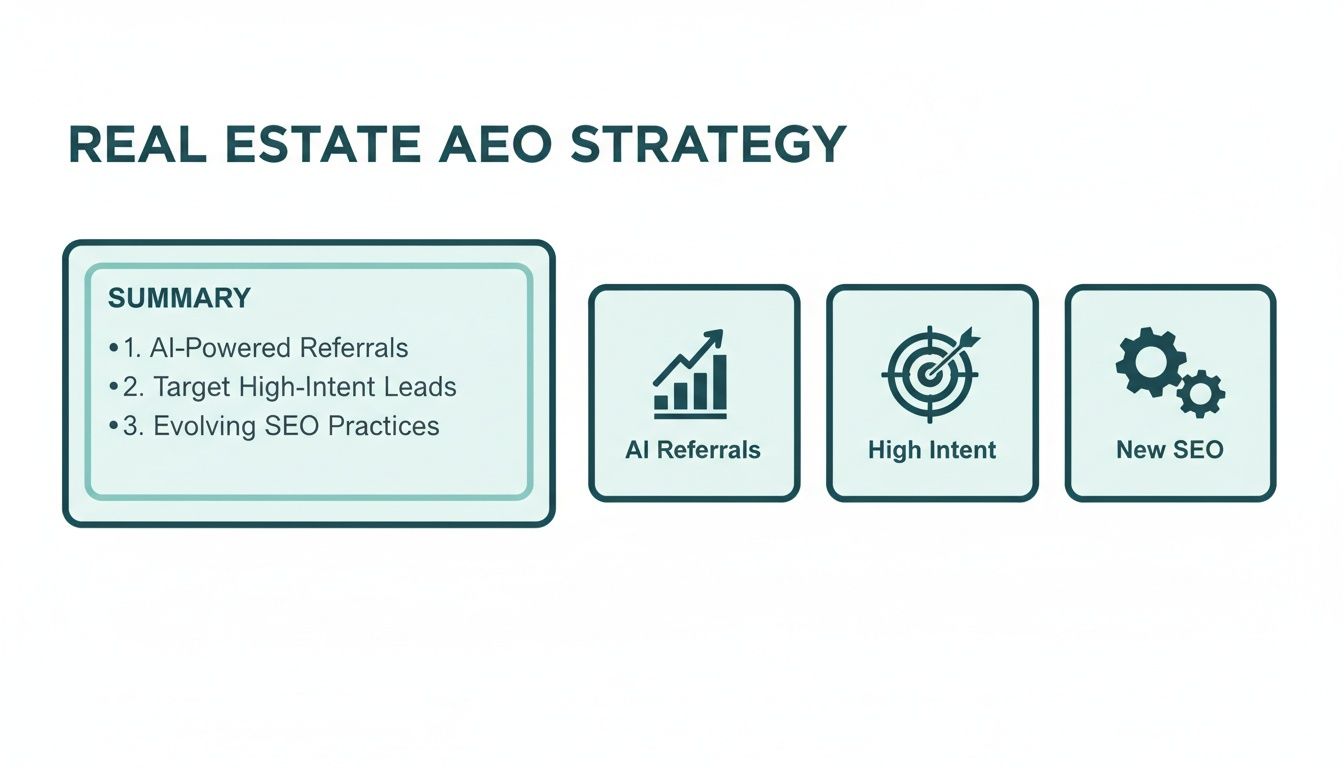
    Do I Need to Be a Programmer to Do This?

    Not at all. I get this question a lot, and the answer is a firm no. While schema is technically a form of code, you don’t need any programming background to put it to work. Think of JSON-LD less like writing software and more like filling out a highly detailed form.

    For most real estate professionals, it boils down to two simple approaches:

    • Copy-and-Paste Templates: The examples I've shared in this guide are your best friend. Just take the template, swap out the placeholder details with your property's information, and you're good to go. The structure is already done for you.
    • Use an Automated Tool: Many modern real estate website platforms and plugins handle schema generation behind the scenes. Tools built specifically for this, like ListingBooster.ai, take it a step further by pulling your listing data and creating the right code automatically.

    Your job is to understand what information needs to go into the schema, not to become a coder overnight.

    How Long Until I See Any Results?

    This is the million-dollar question, and the honest answer is: it depends. After you add the schema to your website, Google has to come back and crawl your pages to find it. That process can take anywhere from a few days to several weeks.

    You can give Google a nudge by requesting a re-index of your key listing pages through Google Search Console. Typically, you might start seeing rich results show up in search within two to four weeks. As for a real impact on your traffic and click-through rates, you'll see that story unfold in your performance reports over the next couple of months.

    My Two Cents: Be patient. Schema is a long-term play, not a quick hack. You're building a solid foundation of structured data that will consistently improve your visibility over time.

    Can I Add Schema to My Zillow or Realtor.com Listings?

    This one is a crucial distinction. You cannot add your own custom schema markup to listings on third-party sites like Zillow, Trulia, or Realtor.com. You simply don't have access to the back-end code of their websites.

    This is precisely why optimizing your own website is so critical. It's one of your most effective strategies for competing head-on with the big portals for search visibility. When you drive traffic to your own site, you control everything—the user experience, how you capture leads, and your brand's story. Your website is your digital storefront, and schema is the best sign you can hang out front.

    Should I Use RealEstateListing or Product Schema?

    For any home, apartment, or property you're marketing, RealEstateListing is the right tool for the job. It was specifically designed for properties and includes fields that the generic Product schema just doesn't have, like leaseLength or numberOfRooms.

    Some SEOs have played around with Product schema to try and get listings into product-style carousels, but that's really a workaround, not a best practice. Using RealEstateListing gives search engines the most accurate context about what you're actually offering. For long-term SEO health, always stick with the most specific schema type available.


    Ready to stop wrestling with code and start dominating local search? ListingBooster.ai transforms any property into a complete marketing suite, automatically generating the perfect schema markup to make your listings discoverable by AI and search engines. See the difference for yourself with a free trial at https://listingbooster.ai.

  • Real Estate Schema Markup: Boost Local SEO and Listings

    Real Estate Schema Markup: Boost Local SEO and Listings

    Think of real estate schema markup as a secret language you teach your website to speak directly to search engines. It's a specific type of code that takes the jumble of information on a property listing—the address, price, square footage—and neatly organizes it into a format that Google, Bing, and AI assistants can instantly understand.

    Instead of just seeing text, they see a structured RealEstateListing. This small change has a huge impact.

    Why Schema Markup Is Your New Competitive Edge

    A person with glasses types on a laptop displaying a modern blue house, near a 'Competitive Edge' sign.

    In a digital market overflowing with listings, just showing up in search results isn't enough. While your standard SEO efforts help you get found, schema markup is what helps you win the click. It's the technical secret sauce that transforms a boring blue link into an eye-catching rich snippet, often featuring a property photo, price, and availability right there on the results page.

    This structured data doesn't just make your listings more attractive to people scrolling by; it makes them perfectly digestible for the bots and AI systems that power modern search. And as homebuyer habits shift, that distinction is becoming everything.

    Boost Your Visibility and Attract Motivated Buyers

    When you add schema to your listings, you’re basically handing Google a perfectly organized spec sheet for each property. This clarity allows your listings to pop up in more relevant search carousels and specialized result types, giving your online presence a serious boost.

    The difference is staggering. We've seen that pages using schema can achieve a 40% higher click-through rate (CTR) than those without it. Even more telling, these visually appealing rich results snag 58% of all clicks, leaving standard results to fight over the remaining 41%. This isn't just a minor tweak; it's a fundamental advantage, especially as more buyers turn to AI for their initial research.

    Key Takeaway: By structuring your listing data with schema, you're answering a buyer's most pressing questions before they even click. This pre-qualifies your audience, driving higher-intent traffic and, ultimately, better leads.

    To give you a clearer picture, here's how schema changes the game for your property listings.

    The Immediate Impact of Schema on Your Listings

    Feature Without Schema Markup With Schema Markup
    Search Appearance A standard blue link with a basic title and description. A rich snippet with a photo, price, and bed/bath count.
    Click-Through Rate Relies solely on compelling copy to earn a click. Attracts more clicks with visual cues and key data.
    AI & Voice Search Invisible. AI cannot reliably parse the unstructured data. Prime candidate for being featured in AI-generated answers.
    Local SEO Address is just text; less likely to appear in map packs. Address is clearly defined, improving map and "near me" visibility.

    As you can see, the benefits go far beyond aesthetics. It's about making your data more useful and accessible to both humans and machines.

    Adapting to the Age of AI Search

    The home search process isn't what it used to be. Today, over 40% of homebuyers are starting their search with AI tools like ChatGPT or relying on Google's AI Overviews. These systems don't "read" websites like people do; they hunt for clean, structured data to give direct, confident answers. Without schema markup, your listings are practically invisible to this massive, growing audience.

    By implementing schema, you ensure your properties aren't just indexed but are deeply understood. This makes them the perfect source for an AI assistant to pull from when a user asks for "three-bedroom homes in downtown Austin under $700k."

    Here’s what that means for you in practical terms:

    • Enhanced Rich Snippets show off key details like price, bed/bath count, and square footage right in the search results.
    • Improved Local SEO Performance comes from clearly defining property addresses and coordinates, making you a stronger contender for map-based searches.
    • Future-Proofing Your Listings prepares your business for the next wave of voice search and AI-first real estate platforms that demand structured data.

    When you make your data easy for machines to process, you position yourself as an authoritative source of information. You can dig deeper into how Google's AI is transforming real estate search to see just how critical this is for staying relevant. At the end of the day, schema is the bridge connecting your MLS data to the future of how people find their next home.

    The Essential Schema Types Every Agent Should Know

    When you're trying to get a search engine's attention, you have to speak its language. For us, that language is schema markup. While there are hundreds of different schema "types," you really only need to master a few key ones to make your listings and your personal brand pop in search results.

    Think of it as building a digital dossier for each property. Every piece of schema you add is another layer of rich detail, creating a complete picture that both Google's algorithms and, more importantly, your potential clients can instantly understand. Let's dig into the core building blocks you'll be working with.

    The Foundation: RealEstateListing

    The absolute cornerstone of everything we're doing here is the RealEstateListing schema. This is the main bucket that holds all the juicy details about a property for sale or rent. It’s your way of telling Google, in no uncertain terms, "Hey, this page is about a specific property on the market."

    But you can get even more granular. Inside the main RealEstateListing type, you can specify exactly what kind of property it is—a SingleFamilyResidence, an Apartment, a House, or even an entire ApartmentComplex. This is huge. That little detail is what helps Google connect your listing with someone searching for "single-family homes for sale in Denver."

    Describing the Property and Location

    Once you've set the stage with the listing type, it's time to fill in the critical details. This is where you start "nesting" other schema types inside your main one to add layers of precision.

    • Place: This one is non-negotiable for local SEO. It pins down the physical location of the property—street address, city, state, postal code. Using the Place schema forges a direct link between your listing and a geographic area, which is exactly what you need to show up in map packs and "near me" searches.

    • GeoCoordinates: To really dial it in, you nest GeoCoordinates within the Place schema. This provides the exact latitude and longitude. For a search engine, this is the ultimate source of truth. It removes any and all guesswork about where the property is, ensuring it appears correctly on maps.

    These two work hand-in-hand to put your listing on a physical spot on the map. That's how you capture local buyers.

    When you combine RealEstateListing with specific location data like Place and GeoCoordinates, you're not just describing a house. You're pointing to this exact house at this exact location. That level of precision is what attracts high-intent local traffic.

    Detailing the Offer and Agent Information

    A listing is just a pretty picture without the price and a person to call. Two more schema types handle this essential information, giving buyers what they need to actually make a move.

    First up is the Offer schema. You nest this right inside your RealEstateListing to spell out the dollars and cents. The key fields here are:

    • price: The asking price for the property.
    • priceCurrency: The currency, like "USD".
    • availability: The current status, such as InStock (which means available) or SoldOut (sold).

    Keeping this info perfectly aligned with what's on your page is critical. If your schema says one price and your webpage says another, you'll confuse Google and could lose your chance at getting those valuable rich results.

    Finally, the RealEstateAgent schema is all about building your credibility and brand. This identifies you or your brokerage as the professional behind the listing. You can include your name, phone number, brokerage, and even links to your social profiles. By connecting this schema to a listing, you're telling Google, "This expert is representing this property," which boosts the authority of both the listing and your own online profile.

    How to Implement JSON-LD for Your Listings

    Alright, let's get into the nuts and bolts of putting this into practice. Implementing real estate schema might sound like a job for a developer, but it's really just about translating your property details into a language that search engines speak fluently. We'll be using JSON-LD, which is Google's preferred format because it's clean and doesn't interfere with your website's design code.


    Think of it like creating a universal spec sheet for your listing. You’re simply taking the information you already have—address, price, bedrooms from the MLS—and mapping it to standard schema properties. This structured data script then gets added to the page, making it instantly digestible for search crawlers and AI.

    This simple diagram shows how the core pieces of your schema come together, pulling in data about the agent, the property, and its location to create a unified profile.

    Diagram shows real estate essential schemas process flow: agent, property, location data integrates into unified model.

    This flow is key. It visualizes how all those separate data points are combined into a comprehensive, machine-readable story for each listing that search engines can process in a snap.

    Mapping Your MLS Data to Required Schema Fields

    First things first, you need to match your listing info to the correct schema fields. Some fields are non-negotiable—they're essential for your schema to even be considered valid. Others are highly recommended because they make your listings far more competitive and useful to buyers.

    Let's start with the must-haves.

    These properties are the absolute foundation of your RealEstateListing schema:

    • @type: This tells Google what kind of thing you're describing. You'll always use RealEstateListing.
    • name: A descriptive title for the property, like "Stunning 4-Bedroom Colonial in Westlake."
    • url: The direct, permanent URL of the listing page on your site.
    • offers: This is where you nest the pricing and availability details. It needs its own @type of Offer, along with the price, priceCurrency, and availability.

    To give you a practical idea of how this works, I've put together a quick mapping table. This shows you how to take common fields from your MLS data and plug them into the required JSON-LD properties.

    Mapping MLS Fields to Required JSON-LD Properties

    MLS Field JSON-LD Property Example Value
    Listing Title/Headline name "Charming 3-Bedroom Home with Modern Updates"
    Listing URL url "https://yourwebsite.com/listings/123-maple-ave"
    Listing Price price "350000"
    Currency priceCurrency "USD"
    Listing Status availability "https://schema.org/InStock" (for Active listings)

    Getting these basics right is the most critical part of the process. If you nail these, you're already ahead of the game.

    My Two Cents: Don't just dump the property address into the name field. This is prime real estate. Craft a descriptive, keyword-rich title that highlights a key feature, just like you would for a headline. It helps both users and search engines understand what makes the property special right away.

    It's amazing how many sites miss this. While over 45 million domains use some form of schema, industry data shows that only about 30% of all websites have implemented it correctly. When you consider that 72.6% of top-ranking pages on Google use schema, that gap represents a massive opportunity to outmaneuver your competition.

    Adding Highly Recommended and Optional Properties

    Once you have the essentials locked in, it’s time to add the details that make your listings truly shine. These "highly recommended" fields provide the rich context that powers those eye-catching search results and helps buyers make decisions before they even click.

    Think about what buyers are constantly asking about. These properties answer those questions preemptively.

    • address: A structured property using PostalAddress to clearly define the street, city, state, and zip.
    • geo: Nested inside address, the GeoCoordinates property uses latitude and longitude for perfect map placement.
    • image: A list of URLs for your best high-quality photos. Don't skimp here; visuals sell.
    • description: Your compelling property description, the same one you've already written.
    • floorSize: Uses a QuantitativeValue to specify square footage (e.g., "value": "2400", "unitCode": "SQFT").
    • numberOfBedrooms & numberOfBathroomsTotal: Simple, straightforward numbers.
    • amenityFeature: A fantastic property where you can list out all the good stuff like a pool, fireplace, or two-car garage.

    This is what helps you show up for those super-specific searches like "four-bedroom house with a pool in Austin." For a deeper dive into preparing for these new search patterns, check out our guide on how to optimize your listings for AI search.

    Putting It All Together: A Complete JSON-LD Example

    Let's see what this looks like when we combine everything into a complete, ready-to-use JSON-LD script for a single-family home. You can use this as a template—just swap out the example values with your own property data.

    {
    "@context": "https://schema.org",
    "@type": "RealEstateListing",
    "name": "Charming 3-Bedroom Home with Modern Updates",
    "url": "https://www.yourexamplerealestate.com/listings/123-maple-street",
    "description": "Discover this beautifully updated 3-bedroom, 2-bathroom home in the heart of Springfield. Features a newly renovated kitchen with granite countertops, a spacious backyard, and a two-car garage. Perfect for families!",
    "image": [
    "https://www.yourexamplerealestate.com/images/123-maple-1.jpg",
    "https://www.yourexamplerealestate.com/images/123-maple-2.jpg",
    "https://www.yourexamplerealestate.com/images/123-maple-3.jpg"
    ],
    "accommodationCategory": "SingleFamilyResidence",
    "numberOfBedrooms": 3,
    "numberOfBathroomsTotal": 2,
    "floorSize": {
    "@type": "QuantitativeValue",
    "value": "1800",
    "unitCode": "SQFT"
    },
    "address": {
    "@type": "PostalAddress",
    "streetAddress": "123 Maple Street",
    "addressLocality": "Springfield",
    "addressRegion": "IL",
    "postalCode": "62704",
    "addressCountry": "US"
    },
    "geo": {
    "@type": "GeoCoordinates",
    "latitude": "39.7817",
    "longitude": "-89.6501"
    },
    "offers": {
    "@type": "Offer",
    "price": "350000",
    "priceCurrency": "USD",
    "availability": "https://schema.org/InStock"
    }
    }

    Once you’ve filled this out with your listing’s details, you just need to place it on your website. The standard way to do this is to wrap the code in a <script type="application/ld+json"> tag and insert it within the <head> section of that specific property's page. If you're on a platform like WordPress, there are often plugins or theme settings that make this easy. This placement ensures search crawlers find and process your structured data right away.

    Making Sure Your Schema Actually Works

    You've done the hard work of creating your real estate schema markup, but don't pop the champagne just yet. That code is only useful if search engines can actually read it. A single misplaced comma or a missing quote can render the whole thing invisible, meaning all that effort was for nothing.

    This is why validation isn't just a "nice-to-have" final check; it's a non-negotiable step in the process. Think of it like a final walkthrough before closing a deal. You need to be certain that Google and other search engines can understand every last detail you've meticulously added to your JSON-LD script.

    The Right Tools for the Job

    The good news? You don't need a degree in computer science to do this. Google gives us a fantastic, free tool for this exact purpose: the Rich Results Test. This is your first and most important stop. It tells you directly whether Google sees your markup correctly and if your page is eligible for those valuable, eye-catching search features.

    For a second opinion, I also recommend the Schema Markup Validator from Schema.org. While Google's tool focuses on what it cares about for rich results, the Schema.org validator checks your code against the universal standard. Running your code through both gives you complete peace of mind.

    It’s simple to use. Just grab your property page URL or paste the JSON-LD code snippet directly into the tool. It will immediately scan everything and flag any issues that need fixing.

    Here's a look at the Rich Results Test tool before you plug in your URL or code.

    This clean interface is your gateway to confirming your schema is flawless and ready to be crawled.

    What Your Test Results Mean

    After running the test, you’ll get an instant verdict. A beautiful green checkmark is what you're aiming for, confirming your page is eligible for rich results. The report will break down the specific schema types it found, like RealEstateListing or BreadcrumbList, showing you that everything is being picked up correctly.

    But don't panic if you see red or orange. It happens to everyone, especially at first.

    • Errors are the deal-breakers. These are critical problems that stop your page from being eligible for rich results. You must fix these.
    • Warnings are more like strong suggestions. They point out recommended details you've left out. Your schema will still work, but adding this info can make your listing much more powerful.

    My Two Cents: Don't ignore the warnings. Seriously. That missing image or review field might seem small, but it could be the very thing that makes a buyer click on your competitor’s listing instead of yours.

    Fixing the Most Common Schema Mistakes

    Over the years, I've seen agents run into the same handful of hiccups when they first start with schema. Luckily, they're usually quick fixes once you know what to look for.

    Here are the most common culprits and how to sort them out:

    • Missing Required Fields: Forgetting a fundamental property like name or offers is a classic mistake that will always throw an error. Double-check your code to make sure all the essential RealEstateListing pieces are there.
    • Wrong Price Format: This one gets people all the time. The price needs to be just a number—no dollar signs, no commas. So, it should be "price": "495000", not "$495,000". You define the currency separately with the priceCurrency field.
    • Bad Availability URL: You can't just type "Available." The availability status needs a proper Schema.org link. For an active listing, that’s "https://schema.org/InStock". When it sells, you'll change it to "https://schema.org/SoldOut".
    • Simple Syntax Errors: A rogue bracket or a missing comma can bring the whole script down. These are the most frustrating but also the easiest to fix. Carefully scan your JSON-LD for typos, or use an online JSON validator to pinpoint the exact line causing the problem.

    By methodically testing your code and keeping an eye out for these common slip-ups, you can deploy your schema with confidence. You'll know it's perfectly tuned to grab the attention of both search engines and the buyers you want to attract.

    Automating Your Schema With ListingBooster.ai

    Digital tablet on a wooden table showing 'Automate Schema' with a house icon and 'ListingBooster.Ai'.

    While manually building your real estate schema gives you ultimate control, let's be honest—it's a meticulous and time-consuming job. I've seen it happen time and again: a single misplaced comma or a price that wasn't updated can undo all that hard work in an instant. This is where automation stops being a simple convenience and becomes a real strategic advantage.

    Think about it. Instead of spending hours matching MLS fields to schema properties and wrestling with JSON-LD code, you can use a tool built for the job. This approach practically eliminates the risk of human error and frees you up to focus on what actually moves the needle: serving clients and closing deals.

    How Automation Takes the Guesswork Out of It

    The biggest headache with manual schema is keeping everything current. Prices get reduced, a property goes from "For Sale" to "Pending," or new photos get uploaded. An automated system like ListingBooster.ai takes this entire burden off your shoulders by generating perfectly optimized JSON-LD for you.

    Our platform’s 'Listing Commander' engine was designed specifically for this. All you have to do is provide a property URL. It gets to work, intelligently pulling all the necessary data and structuring it into the exact schema format that search engines and AI platforms like Google and ChatGPT need to see.

    What takes hours of manual coding and validation can be accomplished in just a few minutes with the right tool. This isn’t just about saving time; it's about deploying a flawless, competitive SEO strategy at scale.

    This means every single property you're marketing is equipped with clean, error-free structured data from the moment it goes live. No need to become a part-time coder or cross your fingers when you hit "validate."

    The Strategic Advantage of Automated Schema

    In a market this competitive, speed and accuracy are non-negotiable. Automation gives you a clear edge by making sure your listings are instantly machine-readable, which dramatically increases their chances of showing up in rich snippets and AI-powered search results.

    Here’s a quick look at how it changes the game:

    • The Old Way: Hunt down a code template, painstakingly copy-paste property data, triple-check the JSON-LD for mistakes, inject it into your site's header, and then run it through multiple validation tools to find the inevitable error.
    • The Smart Way: Enter a listing URL into ListingBooster.ai, and the platform generates and embeds the correct schema for you. Done.

    This kind of efficiency is a lifesaver for agents, teams, and brokerages juggling multiple properties. Schema stops being a tedious chore and becomes a seamless, integrated part of your marketing machine. If you want to get ahead of the curve, it's worth learning more about how a dedicated real estate AI platform can future-proof your business.

    At the end of the day, automation turns a complex technical task into a simple, repeatable action. It’s the best way to guarantee your listings are always speaking the language of search engines, helping you attract more qualified buyers without getting bogged down in the code.

    Common Questions About Real Estate Schema

    Getting into the technical side of real estate marketing can feel daunting, but when it comes to schema, most of the hang-ups come from just a few common questions. Once you get these straightened out, you'll have the confidence to put this powerful tool to work.

    We've rounded up the questions we hear most often from agents and brokers to clear up any confusion and help you get started.

    Do I Need to Be a Coder to Use Real Estate Schema Markup?

    Not at all. This is probably the biggest misconception out there. While schema is technically code, you don't need to be a developer to make it work.

    The job isn't about writing code from scratch. It's about taking a proven template—like the ones in this guide—and simply plugging in your property's specific details. Think of it as filling out a form, not building an engine. You're just matching the address, price, and square footage to the right fields.

    A great analogy is driving a car. You don't need to be a mechanic to get where you're going. You just need to know how to operate it. Schema is the same; you just need to know what information to provide, not how to build the code itself.

    And if you want a completely hands-off approach, tools like ListingBooster.ai generate the code for you automatically. Your only job is to provide the listing info.

    Where Exactly Does the Schema Code Go on My Website?

    This is a fantastic and crucial question. The code needs to be in the right spot for search engines to find it quickly.

    The official best practice, recommended by Google, is to place your JSON-LD script inside the <head> section of your property listing's HTML. Putting it here ensures that when a search engine crawler visits your page, it sees and understands the structured data immediately.

    If you’re using a CMS like WordPress, you have a few options:

    • Theme Settings: Many modern themes have a dedicated section for adding scripts to the header.
    • Plugins: You can find dozens of simple plugins designed to inject code snippets into your site’s <head> or <body>.
    • Custom Fields: For more advanced setups, you can use custom fields to populate the schema template dynamically.

    Of course, platforms built for this, like ListingBooster.ai, handle this placement for you. The code gets put in the right place every time without you ever having to touch the website’s backend.

    Can I Use the Same Schema Code for Multiple Listings?

    Absolutely not. This is a critical mistake to avoid. Each schema script must be 100% unique to the specific property it describes.

    While the template remains the same, the data inside—the address, price, photos, description—must be changed for every single listing. Copying and pasting the exact same block of code across different property pages is a recipe for disaster.

    It sends confusing, contradictory signals to Google and can seriously hurt your SEO. It can even cause Google to distrust all the structured data on your site. Accuracy is everything.

    How Long Until I See Rich Snippets in Google Search?

    There’s no magic number here. When rich snippets appear depends entirely on Google's own schedule for crawling and indexing your site.

    Once you’ve added and validated your schema, you can give Google a nudge. Just head into Google Search Console and request a re-index of the page. This can sometimes speed things up.

    Generally, you could see results anywhere from a few days to several weeks later. The most important thing is consistency. When you implement correct schema across all your listings, you're signaling to Google that your site is a reliable source of property data. That builds trust, which is what ultimately earns you those valuable, eye-catching rich results.


    Ready to stop wrestling with code and start dominating AI search? ListingBooster.ai automates the entire real estate schema markup process, generating flawless, optimized JSON-LD for every property in minutes. Give your listings the competitive edge they deserve by making them instantly understandable to Google and ChatGPT. Try it free today at https://listingbooster.ai and see the difference automation makes.

  • Winning the Google AI Real Estate Search Game

    Winning the Google AI Real Estate Search Game

    For years, we've thought about real estate search as typing keywords into Google and sifting through the results. That's all changing. A Google AI real estate search is less like using a search engine and more like having a conversation with a highly informed assistant who gives you direct answers.

    Instead of just a list of websites, buyers get immediate, summarized property recommendations. This shift is fundamentally altering how homebuyers find properties and connect with agents online.

    The New Front Door to Real Estate

    A hand controls an AI smart front door of a modern house via a smartphone app.

    Picture this: a homebuyer bypasses the big portals like Zillow entirely. Instead, they just ask their phone, "Find me a four-bedroom house in Scottsdale with a pool and a modern kitchen for under $900k." The detailed, conversational answer they get back—packed with photos, property specifics, and even agent suggestions—is your new digital front door.

    Think of it like the switch from paper maps to GPS. A map shows you the roads, but a GPS tells you the best route. Google's AI doesn't just list websites; it pulls information together to actively recommend the specific properties and agents it believes are the most relevant and authoritative.

    How Property Search Is Changing

    This table breaks down the key differences between the old way of searching and what we're seeing now with AI. It's a fundamental shift in how information is found and presented.

    Attribute Traditional Google Search Google AI Search
    User Interaction Types keywords ("Scottsdale 4br pool") Asks natural questions
    Result Format A list of blue links to websites A direct, summarized answer with visuals
    Information Source Websites ranked by authority and relevance Synthesized information from multiple sources
    Agent's Goal Get a click to the listing page Be featured in the AI's answer

    The bottom line is that the game has changed. Your focus needs to shift from just ranking your website to becoming the primary source for the AI's answers.

    Understanding the Shift in Discovery

    At its core, Google’s AI is built to understand context and intent, not just isolated keywords. It connects concepts to deliver a single, comprehensive answer, and that has massive implications for how you get found.

    • From Clicks to Answers: The goal is no longer just to earn a click to your website. The new win is having your expertise, your listings, and your name featured directly within the AI-generated response.
    • Conversational Queries: Buyers are asking complex, detailed questions in plain English, the kind that traditional search engines often struggled to handle effectively.
    • Zero-Click Searches: The rise of AI answers is accelerating a trend that was already happening. Data now shows that over 60% of Google searches end without a click to any website. This is because the AI gives the user what they need right on the results page. You can dig into more stats about this behavior on The Voice SF.

    Your success now hinges on becoming the definitive 'answer' for your local market. When Google’s AI looks for an expert, your digital presence must send the clearest, most authoritative signals.

    This isn't just another marketing trend to watch—it’s a critical business pivot. Agents who adapt now will become the go-to resource for both the AI and the clients who rely on it. Those who don't risk becoming completely invisible online.

    How AI Is Rewriting Property Discovery

    Person uses a tablet for 'Visual Home Search', viewing a modern house on screen in a kitchen setting.

    Let’s get into the nuts and bolts of how this new home-buying journey actually works. It's no longer about a buyer just typing 'homes for sale in Austin' into a search bar. The property search of today is more like a conversation, where a buyer can fine-tune what they’re looking for in real-time with an AI assistant.

    This goes way beyond simple text searches. A potential buyer could upload a photo of a mid-century modern living room they clipped from a magazine and ask, "Find me homes for sale near me with this aesthetic." This isn't some far-off future concept; it's happening right now, and it’s completely changing how your listings get discovered.

    This shift from static searching to an interactive dialogue is being driven by platforms like Google’s AI Overviews, ChatGPT, and Perplexity. For many buyers, these tools are quickly becoming the first stop—acting less like a search bar and more like a personal concierge.

    From SEO to AEO: The New Standard

    For years, we've all been laser-focused on Search Engine Optimization (SEO). The entire game was about getting your website onto the first page of Google. Now, a new discipline is taking over: Answer Engine Optimization (AEO).

    AEO isn’t about ranking a link; it's about being the answer. When someone asks an AI a question, it pulls information from multiple sources it trusts and stitches together a direct response. Your goal is to make sure your listings and your expertise are woven into that response.

    The distinction is crucial. With AEO, winning isn't about getting a click. It's about being featured and recommended directly within the AI's summary, making you the implied authority on the subject.

    The Impact of Visual and Conversational Search

    Thanks to AI, finding a property is becoming far more intuitive. Buyers no longer have to contort their thinking to fit a search engine's rigid keyword rules. Instead, they can search the way they actually think and talk.

    We’re already seeing a massive behavioral shift. Recent data shows that over 40% of homebuyers now start their property search on AI platforms rather than on traditional search engines. People are uploading photos of architectural styles they like and asking the AI to 'find homes currently for sale that look like this.' It's a clear signal that visual search is becoming a primary tool for discovery.

    This trend isn't something you can ignore; it demands a strategic pivot. To stay relevant, your marketing now has to cater to these new, highly specific, and often visual questions.

    Answer Engine Optimization is about making your content so clear, authoritative, and well-structured that an AI has no choice but to recognize you as the expert and feature your information directly in its answer.

    Practical Implications for Real Estate Agents

    So, what does all this mean for your day-to-day business? It means the information you're putting online has to be structured in a way that AI can easily understand and trust.

    Think about these key changes:

    • Listing Descriptions Matter More: AI tools are reading your MLS descriptions for specific features. Vague, fluffy language gets ignored. Detailed, descriptive text that highlights unique selling points gets pulled into AI answers.
    • Hyperlocal Content Is King: Writing a blog post that answers "What are the best school districts in North Scottsdale?" or "What's the commute like from Chandler to Phoenix?" positions you as the local expert an AI will quote.
    • Your Digital Authority Is Your Lifeline: The AI is programmed to prioritize sources it deems trustworthy. That means a well-maintained Google Business Profile, a steady stream of positive reviews, and an active professional social media presence are no longer optional—they’re authority signals.

    Adapting to this new reality is non-negotiable if you want to be in business for the long haul. Getting a handle on the fundamentals of AI search optimization for real estate listings is the first step toward building a business that thrives in this new environment.

    Why Your Old SEO Playbook Is Making You Invisible

    For the better part of a decade, real estate marketing had a simple, clear-cut goal: get to the top of Google. The entire strategy was built around winning that precious click. But the ground has shifted beneath our feet. That old playbook, the one focused exclusively on ranking your website, is now a fast track to being completely overlooked.

    Traditional SEO was all about being the most attractive blue link on a page of search results. The new objective is worlds apart: you need your expertise and your listings featured directly within the AI's answer. This is a massive shift, and it makes a lot of old-school tactics useless.

    Let's put it another way. Old SEO was about convincing people to visit your digital storefront. The new model, which you can think of as Answer Engine Optimization (AEO), is about having the AI grab your best products and advice and present them to the customer on the digital sidewalk—long before they even consider visiting your store.

    The Problem With "Zero-Click" Searches

    The biggest challenge to the old way of doing things is the explosive growth of "zero-click searches." This is exactly what it sounds like: a user asks Google a question, gets the answer right there on the results page, and never clicks through to an actual website. Google’s AI Overviews are pouring fuel on this fire.

    Think about it from a homebuyer's perspective. Why would they bother clicking ten different links to piece together information on a neighborhood when an AI can summarize it all for them in one neat package? They won't. We're already seeing a huge chunk of all Google searches end without a single click, and that number is only going up.

    This means even a #1 ranking no longer guarantees you'll get seen, let alone get any traffic. If the AI scrapes the key details from your listing and presents them in its own summary, the user has absolutely no reason to visit your website. Your content gets used, but you don't get the credit or, more importantly, the lead.

    In this new AI-powered world, your goal isn't just to be found by users. It's to be understood and trusted by the AI itself. The AI is the new gatekeeper standing between you and your future clients.

    If your online presence doesn't send loud, clear signals of authority, the AI will simply pull its answers from a competitor who does.

    How Does an AI Decide Who to Feature?

    An AI doesn't "trust" like a person does. It builds confidence by analyzing data. It's looking for signals of authority, consistency, and expertise across the entire web, like a super-thorough researcher cross-referencing dozens of sources before they're confident in a fact.

    The AI is constantly scanning your entire digital footprint to see if you're the real deal. This includes:

    • Your Website: Is the content well-organized, rich with detail, and laser-focused on your specific local market?
    • Your Google Business Profile: Is it completely filled out, frequently updated, and stacked with recent, positive reviews?
    • Your Social Media: Are you consistently posting about the market and engaging with your audience?
    • Your Listings: Are the property descriptions packed with specific, meaningful details that an AI can easily understand?

    If this information is weak, outdated, or contradicts itself, the AI sees it as unreliable. For instance, if your website claims you're a luxury condo specialist but your Google Business Profile is a ghost town and you haven't posted on social media in six months, the AI will just pass you by. It will turn to another agent whose digital signals are strong and cohesive, making them the source for its answer.

    This is a critical wakeup call. Your old SEO strategy might still be trickling in some traffic, but it's making you invisible where it counts most—inside the answers of a Google AI real estate search. To win, you need a new strategy built from the ground up to make you the AI's most trusted expert in town.

    Becoming the AI's Top Recommended Agent

    Making the leap from being just another agent online to becoming the AI's go-to recommendation isn't about finding a single magic bullet. It's a deliberate strategy, a bit like building a case. You need to assemble a comprehensive digital identity that consistently signals you're the expert—the most authoritative and trustworthy voice in your market.

    I'm going to break this down into three core pillars: mastering your Google Business Profile, creating hyperlocal content that answers real-world questions, and using Schema Markup to speak the AI's language. Each piece builds on the last, creating a powerful presence that AI systems are designed to find and feature.

    Think of it like preparing a star witness for a trial. The AI is the judge, and your entire online footprint is the evidence. Your job is to present a clear, consistent, and compelling case that proves you are the definitive expert for your area.

    Pillar 1: Fortify Your Google Business Profile

    Your Google Business Profile (GBP) is way more than a digital business card now. For an AI, it's a primary source of truth. When someone asks Google, "Who's the best real estate agent in Scottsdale?" the first place the AI looks for clues is GBP data. It's scanning for completeness, recent activity, and what others are saying about you.

    An incomplete or dormant profile is a huge red flag for the system. To really dial it in for AI, you've got to focus on these key elements:

    • Fill Out Everything: I mean everything. Go through every single field available—services offered, specific service areas, and a detailed, keyword-rich business description. Don't leave any blanks.
    • Generate and Engage with Reviews: A steady stream of positive, recent reviews is probably the single most powerful trust signal you can have. Make it a habit to ask clients for them, and make sure you respond to every single one, good or bad.
    • Post Weekly with Google Posts: Use this feature to share market updates, new listings, and client success stories. It's a direct signal to Google that you are an active, engaged professional in your local market.

    Your GBP is the foundation. Without a strong, active profile, anything else you do to gain visibility will be fighting an uphill battle.

    The goalposts have completely moved for agents. Success isn't about traditional page one rankings anymore. It's about getting recommended by an AI when a potential client asks a specific, conversational question.

    For agents looking to stay competitive, real estate SEO in 2026 is less about ranking pages and more about being recommended by AI. The whole game is shifting to getting your expertise featured in Google AI Overviews or sourced by tools like ChatGPT, Gemini, and Perplexity. Buyer search behavior is changing fast, and you can dive deeper into these emerging home search trends to see what it means for agents who want to stay ahead.

    Pillar 2: Create Hyperlocal, Expertise-Driven Content

    AI is built to find answers to very specific questions, so it naturally prioritizes content that does the same. Generic blog posts like "5 Tips for Buying a Home" are now just noise. To get noticed, you have to become the undisputed source for hyperlocal information.

    This means you need to start creating content that answers the exact questions your ideal clients are asking before they even know who you are.

    For instance, instead of writing a broad article about your city, drill down and create a definitive guide to a single neighborhood. You could cover things like:

    1. School District Nitty-Gritty: Go beyond just ratings. Talk about specific programs, school culture, and zoning quirks.
    2. Real-World Commute Times: Provide realistic commute estimates from that neighborhood to major employment centers during rush hour.
    3. The Local Vibe: Detail the parks, hidden-gem restaurants, and shops that make that area unique.
    4. Housing Stock Deep Dive: Discuss the common architectural styles, typical lot sizes, and average price points.

    This is the kind of content that directly answers a conversational query like, "What's the best neighborhood in Chandler for a family with young kids and a $600k budget?" When an AI finds your detailed guide, it recognizes you as a true authority and is far more likely to feature your insights in its generated answer. We cover more ways to do this in our guide on improving real estate search visibility with ChatGPT.

    Pillar 3: Use Schema Markup as Your AI Translator

    Okay, this is the most powerful and criminally overlooked tool in an agent's arsenal: Schema Markup. The best way to think of Schema is as a secret language that lets you talk directly to search engines and AI. It's a bit of code you add to your website that explicitly labels your content, which means the AI doesn't have to guess what it's looking at.

    For example, without Schema, an AI sees "3 bed, 2 bath" as just a string of text. But with Schema, you can label it as numberOfBedrooms: 3 and numberOfBathroomsTotal: 2. This structured data is perfectly clear and incredibly valuable to an AI trying to match a property to a user's very specific request.

    By adding Schema to your property listings, you are essentially translating your property details into a format the AI understands perfectly. This dramatically increases the odds that your listings will get pulled directly into AI-generated answers for queries like, "show me three-bedroom townhomes with a two-car garage." It’s the ultimate way to make sure your data is clear, accurate, and ready for an AI recommendation.

    Using Technology to Automate Your AI Visibility

    Let's be realistic. Manually tackling every part of an Answer Engine Optimization (AEO) strategy—keeping your profile pristine, churning out hyperlocal content, and wrestling with Schema Markup—is a monumental task. While all these steps are crucial, the sheer effort can feel like taking on a second full-time job.

    This is exactly where technology shifts from being a simple convenience to a core part of your competitive strategy. The right platform can serve as the command center for your entire AI optimization plan. It handles the most repetitive, time-consuming tasks, takes the technical guesswork out of the equation, and makes sure every piece of content is perfectly structured for a Google AI real estate search.

    Essentially, it allows you to focus on what you do best—working with clients—while your digital foundation is expertly built for you in the background. This process all comes down to three core pillars: your digital profile, your content, and the technical schema that makes it all work.

    A process flow diagram detailing three steps: Profile, Content, and Schema, for becoming AI's top agent.

    As you can see, a winning AEO strategy isn't about just one thing. It's about integrating your personal brand (Profile), demonstrating your market expertise (Content), and speaking the technical language that AI systems understand (Schema).

    Streamlining Your Listing Marketing

    This is where a tool like ListingBooster.ai comes in. It was built to solve the core AEO challenges by automating the creation of AI-ready content and the technical markup that goes with it. It’s designed to connect the dots between your properties and AI visibility.

    Think of the platform as your dedicated AI marketing engine. For instance, its Listing Commander feature can take a single property and instantly generate a full suite of marketing materials. This isn't just about pulling in generic MLS text; it creates AI-optimized property descriptions written to be easily digested by language models, full of the specific details that answer conversational search queries.

    The biggest hurdle for agents isn't knowing what to do; it's finding the time to do it all consistently. Automation bridges that gap, turning strategy into execution without draining your most valuable resource—time.

    More importantly, the platform automatically embeds the necessary Schema Markup for you. This removes what is often the biggest technical roadblock for agents. You no longer have to learn code or stress about making a mistake; the system handles the translation, making your listings instantly understandable to Google's AI Overviews and other systems.

    For a deeper look into this, check out our guide on real estate marketing automation for agents.

    Building Your Authority on Autopilot

    Beyond marketing individual listings, you need to establish yourself as the local expert to get recommended by AI. This requires a steady flow of hyperlocal content that proves you know your stuff. This is where another key feature, Authority Builder, comes into play.

    Authority Builder automates the creation of the exact content we've been talking about—local market updates, neighborhood guides, and practical tips for buyers. It helps you build a digital footprint that screams "local specialist," which is precisely the kind of source an AI is programmed to trust and cite when someone asks, "Who's the best agent in my town?"

    By generating content that answers the specific, nuanced questions potential clients have, you're building a library of resources that positions you as the go-to answer engine for your market. This automated approach means you're not just creating content for the sake of it. You're strategically building a body of work that sends clear, consistent signals of expertise to AI systems—an essential piece of the puzzle for any modern agent.

    How to Measure Success in the AI Era

    In this new AI-first world, your old success metrics are getting dusty. If you're still obsessing over traditional key performance indicators (KPIs) like website traffic and keyword rankings, you're missing the bigger picture.

    Think about it: when an AI gives a user a direct, perfect answer, they have no reason to click through to your site. This makes those old vanity metrics completely misleading. It's time for a new measurement playbook—one that focuses on your authority and direct engagement, not just clicks. Success isn't just about driving traffic anymore; it's about being the source of truth for a Google AI real estate search.

    Tracking Your Visibility in AI Answers

    The most straightforward way to see if you're winning is to check if AI systems are actually recommending you. This takes a bit of manual work, but the insight you gain into your real digital authority is priceless. This is your new reputation management.

    Get in the habit of regularly asking different AI tools specific, conversational questions about your market. Set a weekly reminder to query platforms like Google's AI Overviews, ChatGPT, and Perplexity with prompts like:

    • "Who is the top real estate agent in [Your City]?"
    • "Which agent specializes in luxury condos in [Your Neighborhood]?"
    • "Recommend a realtor for first-time homebuyers in [Your County]."

    Keep a log of the answers you get. As you put your AEO strategy into action, you should start seeing your name, your agency, and links to your content pop up more and more. That’s the ultimate proof that what you're doing is working.

    The new benchmark for success is not how high you rank, but how often you are recommended. Your goal is to become the AI's trusted advisor for your local market, making your name synonymous with real estate expertise.

    Monitoring New Lead and Engagement Signals

    Beyond direct mentions, you need to look at the real-world impact on your business. AI often pushes users to take immediate action rather than just browse a website, so your focus should shift to metrics that show genuine intent.

    Your Google Business Profile is a goldmine for this kind of data. Pay close attention to the insights it provides, specifically looking for upward trends in:

    • Phone Calls: A jump in calls coming from your GBP is a powerful signal that people are finding you through search and are ready to connect.
    • Direction Requests: When more people are asking for directions to your office, you know you're attracting high-intent interest.
    • Website Clicks from GBP: Even if your overall site traffic dips, clicks from your profile are typically much higher-quality leads.

    Also, keep a close eye on the quality of leads coming in from every channel. You'll likely find that leads from AI-driven searches are better informed and more qualified—the AI has already answered their basic questions for you. Tracking your lead-to-close ratio for these contacts will give you the clearest picture of the true ROI of your AEO efforts.

    Frequently Asked Questions

    As real estate agents get their arms around this new world of AI-driven search, a lot of questions are popping up. Let's tackle some of the most common ones so you can move forward with confidence.

    What's the Real Difference Between SEO and AEO?

    Think of it this way: traditional SEO (Search Engine Optimization) is all about climbing the ladder of Google's blue links. Your goal is to get your website ranked high enough to earn a click from a user.

    AEO (Answer Engine Optimization) is a totally different ballgame. The goal here isn't just to be a link on a list; it's to be the answer the AI gives. You're trying to get your information, your listings, and your expertise featured directly in the AI's response. It’s about becoming the source, not just another option.

    Do I Need to Be a Coder to Use Schema Markup?

    Absolutely not. While Schema Markup is technically a type of code, you definitely don't need to learn how to write it yourself. That's where the right tools come in.

    Platforms like ListingBooster.ai handle this for you. They automatically generate and embed the correct Schema Markup for all your listings. This makes your property details perfectly readable for a Google AI real estate search without you ever touching a line of code.

    These tools act like a universal translator, making sure Google's AI understands every important detail about your properties.

    How Long Does It Take to See Results from AEO?

    Building true authority with an AI system is more of a marathon than a sprint, just like with old-school SEO. It's an ongoing process of consistently providing valuable content and proving you're a trusted source.

    That said, you can get some quick wins right out of the gate. The fastest results will come from two things:

    1. Dialing in your Google Business Profile: This is the lowest-hanging fruit. A complete and active profile is a massive trust signal for AI.
    2. Using Schema on every new listing: This immediately gives your properties a better shot at showing up in those specific, conversational searches.

    From there, consistently publishing great local content will build on that early momentum. Every blog post, market update, and neighborhood guide helps solidify your status as the go-to expert, eventually turning you into the agent the AI recommends most in your area.


    Stop letting AI ignore you and start getting recommended. ListingBooster.ai is your command center for creating AI-optimized property descriptions, hyperlocal content, and the Schema Markup you need to dominate this new era of search. Try it free and see how you can automate your authority.

  • ChatGPT Real Estate Search Visibility Your Ultimate Guide

    ChatGPT Real Estate Search Visibility Your Ultimate Guide

    The way people hunt for homes is undergoing a seismic shift. They're no longer just endlessly scrolling through Zillow. Instead, they’re firing up conversational AI like ChatGPT and asking, "Show me the best family-friendly neighborhoods in Austin under $700K." This is the single biggest evolution in real estate discovery, and yet, most agents are completely invisible on these new platforms.

    The New Frontier of Finding a Home

    A person uses a laptop to browse modern houses, utilizing AI home search technology.

    The gap between old-school search and this new AI-driven conversation is enormous. Think of a traditional search engine as a giant library card catalog. It points you to every book that might match your query, but you're left to do all the heavy lifting. Conversational AI, on the other hand, is like having an expert librarian who listens, understands your needs, and hands you the perfect book.

    This "librarian" doesn't just scan for keywords. It's built to understand context, quality, and authority. For real estate agents, this means your online presence can't just be a gallery of listings anymore. It has to be AI-readable—packed with clear, structured, and authoritative information that an AI can confidently recommend to a serious homebuyer.

    Why This Shift Matters Now

    The scale of this change isn't some far-off prediction; it's happening right now and growing every day. Real estate queries already make up 6% of all ChatGPT conversations, which translates to an eye-watering $66 billion in associated market value. That puts our industry in the top 15 most impacted by the platform. Homebuyers are simply skipping the old ways and asking AI direct questions about neighborhoods, property features, and even the top agents in their city. You can dive deeper into these usage stats and what they mean for the market.

    This guide is your roadmap to getting you and your properties found in this new arena. We're going to break down exactly how to earn top-tier ChatGPT real estate search visibility.

    The core problem is simple: if your listings and expertise aren't structured for AI, you don't exist in the most important new channel for buyer discovery.

    Understanding the Two Search Worlds

    To win here, you first have to grasp how differently buyers behave on these platforms. The user's mindset and what they expect are worlds apart, which demands a completely new strategy for how you present your expertise online.

    To see this clearly, let's compare the old way versus the new way side-by-side.

    Traditional Search vs AI Search At a Glance

    Feature Traditional Search (e.g., Google, Zillow) AI Search (e.g., ChatGPT, Perplexity)
    User Input Keywords like "3 bedroom homes Austin TX" Natural questions like "What are the pros and cons of living in Zilker?"
    User Goal Find a list of links to begin their own research Get a direct, synthesized recommendation or answer
    Result Type A ranked list of websites and portals to browse A conversational, trusted answer based on synthesized data
    Key to Visibility SEO keywords, backlinks, website authority Structured data, entity authority, and contextual relevance

    The table makes it obvious: one is a directory, the other is a concierge.

    This is precisely where a tool like ListingBooster.ai comes into play. It was designed from the ground up to translate your real estate expertise into the language AI understands, making sure you’re the agent that the "librarian" trusts and recommends.

    How AI Decides Which Listings to Recommend

    To get your listings noticed in a ChatGPT real estate search, you first need to get inside the AI's "head." It doesn't browse Zillow like a person. Think of it more like a brilliant, lightning-fast research assistant with a single mission: find the absolute best, most trustworthy real estate information on the internet.

    This AI assistant is constantly scanning the web, hunting for signals that scream "authority," "clarity," and "relevance." It's not just matching keywords anymore; it's piecing together a deep understanding of a property, a neighborhood, and even an agent's expertise. If your online presence sends weak or confusing signals, you might as well be invisible.

    To get recommended, your listings and website need to be structured in a way this AI assistant can instantly understand and trust. The goal is to make it incredibly easy for the AI to see not just what your listing is, but why it's the perfect fit for a specific buyer.

    The AI's Mental Checklist for Real Estate Content

    When ChatGPT looks at your listings or your professional website, it isn't wowed by the beautiful photography first. Instead, it runs a sophisticated analysis to verify the information it finds, much like a diligent researcher cross-referencing multiple sources. It gives top priority to data it can interpret with total confidence.

    This entire process is built on a few core pillars that act as its quality filter:

    • Structured Data: This is the AI's native language. It’s like putting digital labels on everything, telling the AI, "This number is the price," "This text is the street address," and "This is the square footage."
    • Narrative Quality: The AI actually reads your listing descriptions to grasp the story and unique appeal of a home. Vague, cookie-cutter copy gets tossed aside for rich, detailed narratives that paint a vivid picture.
    • Agent Authority: It actively looks for proof that you're a real expert in your market. This means finding consistent content about local areas, glowing client reviews, and a professional digital footprint.

    Basically, the AI is asking a simple question: "Is this information clear, descriptive, and from a credible source?" If the answer is "no" to any of these, it moves right on to a listing that provides stronger signals. This is a crucial concept to understand, and we dive deeper into it in our guide to AI search optimization for real estate listings.

    Turning Technical Jargon into Simple Ideas

    Let's break down one of the most important—and often misunderstood—signals: structured data, also known as schema markup. Don't let the technical name scare you off.

    Think of schema markup as a universal translator for your listing. Without it, an AI might see the number "750,000" and have no idea if it's the price, a zip code, or part of an address. With schema, you are explicitly telling the AI, "This is the price, in US dollars," which removes all the guesswork.

    This kind of clarity is everything. When an AI can understand your data with 100% certainty, it's far more likely to recommend your property. It’s the difference between handing that research assistant a messy pile of notes versus a neatly organized, labeled binder. The binder wins every time.

    Agents and teams who put in the effort to provide these clear signals are already seeing the rewards. Recent data shows that real estate domains received 0.47% of all referrals from ChatGPT Search, putting the industry at #15 among all categories. This confirms that AI is already sending motivated buyers to real estate websites that provide structured, authoritative information. You can discover more insights on ChatGPT's impact on web traffic and see why this is a channel you can't afford to ignore.

    By focusing on making your content "AI-friendly," you're directly influencing how these powerful new platforms see, understand, and ultimately rank your listings.

    The Six Pillars of AI-Powered Real Estate Visibility

    Getting your listings noticed by AI search tools like ChatGPT isn't about some single, magic-bullet tactic. It's much more like building a house. You need a solid foundation built on six interconnected pillars. Get these right, and you'll have a stable, impressive structure that AI algorithms will confidently recommend to potential homebuyers.

    Mastering these areas ensures your listings—and your professional brand—are not just seen, but deeply understood and valued by conversational AI. Let's break down the framework that will define your success in this new era of search.

    This is a great way to visualize how AI actually sifts through your digital footprint. It prioritizes the hard facts (structured data), the human element (your descriptions), and your credibility (your authority).

    A concept map illustrating how AI analysis processes structured data, interprets descriptions, and validates authority.

    The key takeaway here is that AI visibility is a blend of technical precision, emotional connection, and real-world credibility. You need all three to win.

    Pillar 1: Structured Data Markup

    Think of structured data, or schema, as the universal language for AI. It’s a set of standardized tags you add to your website's code to explicitly tell an AI what each piece of information means. Without it, the AI is just guessing.

    For example, schema can label a number as a listing price, a line of text as a street address, or a date as an open house event. This removes all ambiguity. It’s the difference between handing an AI a messy, handwritten note versus a perfectly organized spreadsheet; the AI will always trust the spreadsheet.

    Pillar 2: AI-Optimized Listing Descriptions

    The days of writing dry, feature-list descriptions are over. Today’s AI is smart enough to analyze the story and emotional pull of your property descriptions. It's actively looking for content that paints a compelling picture of what it’s like to live in the home.

    To get this right, you need to focus on:

    • Natural Language: Write for people, not robots. Use descriptive language that sparks emotion and helps a buyer imagine the lifestyle the home offers.
    • Hyper-Local Context: Mention the nearby park, that popular coffee shop down the street, or the well-regarded school district. This gives the AI valuable context to match your listing to specific prompts like, "Find me a home near a good elementary school."
    • Clear Feature-Benefit Connections: Don’t just list "granite countertops." Instead, explain the benefit: "durable and elegant granite countertops, perfect for entertaining guests."

    By enriching your descriptions with narrative detail, you're feeding the AI the exact kind of high-quality, contextual information it needs to make a confident recommendation.

    This approach creates copy that connects with both human buyers and the algorithms that are now guiding them.

    Pillar 3: Demonstrable Agent Authority

    The AI isn't just evaluating your listings; it's evaluating you. It actively scans the web for signals that prove you are a knowledgeable and trusted expert in your specific market. Building this digital authority is absolutely critical for achieving high ChatGPT real estate search visibility.

    This means you need to be consistently publishing content that shows off your local expertise. I'm talking about hyper-local neighborhood guides, detailed market analyses, or blog posts answering the questions you know buyers and sellers in your area are asking. This content acts as a digital resume, proving to the AI that you are a credible source.

    Pillar 4: Strategic Backlinks and Citations

    Think of backlinks as votes of confidence from other websites. When a reputable local news site, a neighborhood blog, or a mortgage broker’s website links to your agent profile or a listing, it sends a powerful signal to AI that your content is trustworthy.

    Similarly, consistent citations—mentions of your name, brokerage, and phone number across various online directories—help solidify your digital identity. This web of links and mentions validates your professional presence, making you a much more authoritative figure in the eyes of an AI.

    Pillar 5: Consistent Social Media Signals

    Your social media activity is a public record of your engagement and expertise. AI systems can and do crawl these platforms to gauge your relevance and influence. Consistently posting about new listings, open houses, market updates, and client testimonials builds a cohesive digital footprint.

    Every single post reinforces your specialization and activity in the market. This steady stream of relevant content adds another layer of proof, showing that you are an active and engaged professional who is worthy of being recommended.

    Pillar 6: Mastering User Prompts

    Finally, you have to understand how people are searching now. They don't just type keywords into ChatGPT; they ask detailed, conversational questions. Your entire content strategy should be designed to directly answer these kinds of prompts.

    For instance, instead of just optimizing for "Austin homes for sale," create content that answers, "What are the pros and cons of living in the Zilker neighborhood of Austin?" By anticipating these real-world queries, you position your content as the perfect answer, making it a no-brainer for AI to surface your expertise.

    This proactive approach is essential. Consider that a platform like ChatGPT.com attracts 5.6 billion monthly visits, with users who are highly engaged. It's a channel you can't afford to ignore. You can explore more detailed ChatGPT user statistics to get a better sense of the platform's incredible reach.

    Putting AI Visibility Strategies into Practice

    Knowing the six pillars is one thing, but actually putting them to work in your daily business is where you'll find your competitive edge. Theory is great, but a practical, well-executed strategy is what actually brings in clients. Let's break down how different real estate pros can use these ideas to get a real advantage and boost their ChatGPT real estate search visibility.

    These strategies aren't just for big, tech-forward brokerages. Whether you're a solo agent building a name in your neighborhood or a growing team aiming to lead the market, the core principles are the same. It's just the scale and focus that change. Each role offers a unique chance to turn AI visibility from a buzzword into a powerful lead-generation machine.

    The Solo Agent in a Competitive Suburb

    If you're a solo agent, your goal is to become the go-to expert for a specific community. You can't outspend the big teams, but you can absolutely out-expert them. Your strategy needs to be all about creating deep, hyper-local content that AI sees as the definitive source for your area.

    This means you’ll want to lean heavily into pillar three (Agent Authority) and pillar six (Mastering User Prompts).

    • Actionable Tactic: Create a series of blog posts or short videos that answer the exact questions people are asking about your suburb. Think things like, "What are the best parks in Northwood?" or "Is the public school system in Lakeview a good fit for young families?"
    • Implementation: A tool like ListingBooster.ai's Authority Builder can be a game-changer here. It can automatically draft these hyper-local guides for you. What normally takes hours of research and writing can be done in minutes, giving you a steady flow of content that proves you know your stuff.

    By consistently answering these specific, long-tail questions, you build a content library that establishes you as the resource, making it a no-brainer for ChatGPT to recommend you.

    The Growing Team in a Major Metro Area

    A growing team has a different puzzle to solve: how to scale brand consistency and content creation across multiple agents. Efficiency and a unified voice are everything. Your main focus should be on pillar two (AI-Optimized Descriptions) and pillar five (Consistent Social Signals) to make sure every listing and social media post meets the team's high standards.

    A scattered brand message is a weak signal to AI. When every agent on your team shares high-quality, consistently formatted, and AI-optimized content, it creates a powerful, unified digital footprint that AI algorithms can easily recognize and trust.

    The key here is automation and having a central hub for content. Manually writing unique, optimized descriptions and social posts for every new listing, open house, and sale across a dozen agents just isn't sustainable. You can get more insights on this by reading our guide on how to optimize listings for AI search.

    This is where a tool like ListingBooster.ai’s Listing Commander becomes essential. It takes a single property and generates a complete, on-brand marketing suite for every agent on the team, making sure every piece of content is optimized for AI visibility right from the start.

    The Forward-Thinking Brokerage

    For a brokerage, the mission is to give agents tools that give them a leg up on the competition. Providing a platform that automates AI optimization is a massive value-add that helps with both recruitment and keeping top talent. This means deploying all six pillars across the entire organization.

    The opportunity is huge. Recent data shows that ChatGPT now commands 17.1% of all digital queries globally. On top of that, users spend an average of 13 minutes and 9 seconds per session—more than double the time spent on Google. A brokerage that helps its agents tap into this highly engaged audience is setting them up for massive success. You can discover more insights about these user engagement statistics and what they mean for the market.

    By offering a tool like ListingBooster.ai, a brokerage instantly handles the technical headache of schema markup and the time-suck of content creation. It turns what would be weeks of manual work for an agent into a simple, 10-minute setup, creating a system for them to improve their ChatGPT real estate search visibility.

    How ListingBooster.ai Does the Heavy Lifting for You

    A hand interacts with a tablet displaying a data dashboard, emphasizing automated visibility and insights.

    It’s one thing to understand the six pillars of AI visibility, but it’s another thing entirely to put them into practice. Manually creating schema-marked content, writing psychologically compelling descriptions, and consistently publishing neighborhood guides is a full-time job. Let's be honest, who has that kind of time?

    This is exactly where ListingBooster.ai steps in. It’s designed to be the practical, hands-on application of everything we’ve talked about in this guide, turning what would be weeks of marketing grunt work into a simple, five-minute setup. The entire system is built to solve the core challenges of getting seen in ChatGPT real estate search without forcing you to become a coder or a content marketing guru.

    Instantly Master Your Listing Content

    The first hurdle every agent hits is creating genuinely great, AI-readable content for each listing. We're not talking about a few quick sentences for the MLS. This is about crafting unique stories for Zillow, social media, and your own website, all while weaving in the technical signals that AI engines need to see.

    ListingBooster.ai’s Listing Commander engine handles this for you instantly. Just feed it the basic property details, and it cranks out a complete marketing suite.

    • AI-Ready Descriptions: It writes compelling, emotionally engaging descriptions that capture the attention of both human buyers and AI algorithms.
    • Automatic Schema Markup: The platform takes care of all the technical mumbo-jumbo, embedding the right structured data so AI can understand your listing’s details with perfect clarity.
    • Multi-Platform Copy: You get tailored copy for the MLS, Zillow, and all your social media channels, making sure your message is consistent and powerful everywhere it appears.

    Think of it as your in-house marketing team that never sleeps. It makes sure every single property you list is perfectly positioned to be found and recommended by conversational search tools the moment it goes live.

    This system takes care of the first two pillars—Structured Data and AI-Optimized Descriptions—so you never have to touch a single line of code.

    Build Unshakeable Agent Authority

    The next big challenge is proving your local expertise, day in and day out. AI needs to see a constant flow of authoritative content that cements your status as the go-to expert for your market. But who has the bandwidth to write market updates and neighborhood guides every week?

    This is where ListingBooster.ai’s Authority Builder feature comes in. It automates this crucial part of your digital presence by creating a steady pipeline of high-quality, hyper-local content. It generates market updates, buyer tips, and detailed neighborhood guides that directly answer the kinds of questions your future clients are asking AI. You can explore how our broader real estate AI platform helps you build an even stronger brand.

    The speed at which people are adopting AI for search makes this kind of automation a necessity. In recent quarters, a staggering 14.68% of users turned to ChatGPT for search, which is a 7.73% jump from the previous year. This massive shift means that using a tool like ListingBooster.ai isn't just an advantage anymore—it's essential for reaching a huge and fast-growing audience of homebuyers. You can dig into more of these ChatGPT usage statistics to see the trend for yourself.

    To top it all off, the platform includes built-in Fair Housing compliance checks. This gives you peace of mind, knowing your automated content is not only effective but also completely professional and compliant. It’s simply the fastest, most efficient way to put an advanced AI visibility strategy to work for your business.

    Measuring Success in the New AI Search Era

    So, you've started optimizing for AI search. That's a huge step. But how do you know if any of it is actually working? Forget vanity metrics like social media likes or a general uptick in website traffic. To really see if you're making an impact in ChatGPT real estate search, you have to track the results that actually grow your business.

    The goal here is to look past the old SEO dashboards. We need a new set of key performance indicators (KPIs) built for this new, conversational world. This isn't just about counting clicks; it's about measuring your influence, your authority, and the quality of leads coming from places you've never gotten them from before.

    Shifting from Clicks to Conversations

    In the world of AI search, success looks different. It's less about being the #1 link for a keyword and more about being the definitive answer to a homebuyer's question. Your measurement strategy has to reflect that big change.

    Here are the modern metrics that truly matter:

    • Brand Mentions in AI Responses: This is the big one. Are you or your brokerage being mentioned by name when a user asks, "Who are the top real estate agents in Austin?" When an AI names you, that's the ultimate proof of your authority.
    • Referral Traffic from AI Platforms: Dig into your website analytics. Can you see visitors coming directly from platforms like ChatGPT? This is hard data showing the AI is sending potential clients right to your digital doorstep.
    • Visibility for Conversational Queries: Start tracking your presence for those long, question-based prompts. Are your listings and articles showing up for things like, "What are the best neighborhoods for families with young kids in Scottsdale?"
    • Lead Quality Analysis: Pay close attention to the leads that come from these AI-driven sources. Are they more informed? Do they seem more ready to transact? Higher-quality leads are a dead giveaway that your authoritative content is hitting the mark.

    The single most important metric in the AI era is how often your expertise is cited as the trusted source. When ChatGPT mentions you by name, you’ve won. It’s the digital equivalent of a powerful word-of-mouth referral, scaled.

    Proving ROI and Gaining Your Edge

    When you track these specific KPIs, you're no longer guessing. You're making smart, data-driven decisions about where to put your time and marketing dollars. This gives you clear proof of the return on investment from your AI optimization efforts, showing exactly how it’s feeding your sales pipeline.

    Everything in this guide has been a roadmap—from getting inside the "mind" of an AI to putting the six pillars of visibility into action. We've talked about how platforms like ListingBooster.ai can automate the most complex parts, turning what would normally be weeks of technical headaches into a simple, streamlined process.

    Now you have the framework to not only execute this strategy but also to measure its success. By focusing on these new metrics, you can definitively prove your growing influence and secure a dominant position in the new frontier of real estate. The agents who adapt—and measure what matters—are the ones who will lead the market tomorrow.

    Got Questions? We've Got Answers

    Let's tackle some of the most common questions agents ask about getting their listings found in AI-powered search.

    Is AI Going to Replace Me?

    Absolutely not. It's best to think of AI tools like ListingBooster.ai as a super-efficient assistant, not your replacement. It takes care of the tedious work—creating consistent, optimized, and compliant content for every listing.

    This frees you up to do what you do best: add your personal market insights, connect with clients, and build the relationships that are the bedrock of this business. The winning formula isn't AI or a human touch; it's AI efficiency plus your authentic expertise.

    How Fast Can I Expect to See Results in ChatGPT?

    It varies, but it's often much faster than traditional SEO, which can take months to show any movement. Since large language models are always hungry for new information, high-quality, well-structured content can get picked up and start appearing in search results pretty quickly.

    The speed really depends on how competitive your local market is and how consistently you're putting out optimized content. Using a tool like ListingBooster.ai gives you a head start by making sure your content is perfectly tuned for AI from the moment you publish it. This gives the AI clear, strong signals about your listings and your authority.

    The whole goal is to make it dead simple for AI to understand why you're the expert. The easier you make it for the AI to confirm your authority and the relevance of your listings, the faster you'll show up.

    Is It Hard to Add That Schema Markup Thing?

    If you try to do it by hand? Yes, it can be a real headache. It’s basically a coding task, which is a huge roadblock for most agents and a big reason why so many listings are completely invisible to AI search right now.

    This is exactly the problem platforms like ListingBooster.ai's 'Listing Commander' were built to fix. It generates all the correct schema markup for your properties automatically, behind the scenes. You just enter your listing details like you normally would, and the tool handles the technical heavy lifting, making sure your properties are formatted perfectly for AI without you ever having to touch a line of code.


    Ready to stop being invisible and start getting discovered? ListingBooster.ai automates the entire process, turning complex AI optimization into a simple, 5-minute task. Start your free trial and see the difference today.

  • Master Real Estate AI Search Optimization to Rank Higher

    Master Real Estate AI Search Optimization to Rank Higher

    Real estate AI search optimization is all about making sure AI-powered tools like ChatGPT and Google AI Overviews see you as the go-to expert. It’s a fundamental change in thinking. We're moving away from simply targeting keywords and instead focusing on building a rich, trustworthy digital presence that an AI can confidently recommend.

    The goal is to show up when a buyer asks a natural, conversational question, like, "Who is the best agent for first-time buyers in my city?"

    Why Your Old SEO Strategy Is Failing in AI Search

    For years, the game was simple: master Search Engine Optimization (SEO). If you could nail the right keywords, build some backlinks, and climb the search rankings, you were golden. But that playbook is quickly becoming a relic. The way people find real estate agents is changing right under our feet, and it's all because of conversational AI.

    This isn't just a minor tweak to the algorithm. It's a complete shift from what we knew as SEO to something new: Answer Engine Optimization (AEO). AI platforms don't just find websites anymore; they pull information from all over the web to give a direct, synthesized answer. They're looking for genuine authorities, not just pages stuffed with keywords.

    To put it simply, the strategies that got you here won't get you there. Let's look at the key differences.

    Factor Traditional SEO (What Used to Work) AI Search Optimization (What Works Now)
    Core Goal Ranking #1 on a search results page. Becoming the AI's recommended answer.
    Primary Tactic Keyword targeting and backlink building. Building a verifiable digital entity and authority.
    Content Focus Blog posts optimized for specific search terms. In-depth, helpful content that demonstrates real expertise.
    Technical Focus On-page SEO, site speed, mobile-friendliness. Structured data (schema), consistent information across platforms.
    Success Metric High search engine ranking and organic traffic. High-quality leads from direct AI recommendations.

    The table really drives home the point: what worked yesterday was about being findable. What works today is about being verifiable and recommendable.

    The New Search Landscape

    Picture a potential client asking their AI assistant, "Who is the best real estate agent for first-time buyers in Austin?" The AI isn't just looking for an agent who has "Austin first-time buyer agent" plastered all over their site. It's smarter than that. It scans and connects the dots across an agent's entire digital footprint to figure out who truly knows their stuff.

    The AI is looking for specific signals of expertise, like:

    • Helpful, Niche Content: Do you have articles or videos breaking down the home-buying process in specific Austin neighborhoods?
    • Structured Data: Is your professional profile and are your listings tagged with schema markup? This is the technical language that clearly tells an AI about your services, locations, and specialties.
    • Consistent Authority: Do your Google Business Profile, Zillow reviews, and personal website all paint the same picture of a successful, specialized agent?

    An agent whose online presence is robust, consistent, and built for this kind of deep, contextual understanding is the one who will get the AI's recommendation every time. Standing still is no longer an option if you want to stay visible.

    An infographic outlining a Real Estate AEO Strategy with AI-powered referrals, high-intent leads, and new SEO practices.

    This is about playing the long game. AEO is a holistic strategy designed to prove your authority to AI systems, which in turn delivers highly motivated clients right to your doorstep.

    The Growing Impact of AI Referrals

    This isn't just theory—it's already happening. We're seeing a measurable impact on website traffic. Across the real estate industry, AI referral traffic now accounts for 1.01% of all website traffic. That number might seem small, but it represents a powerful and rapidly growing source of high-intent leads.

    These aren't just casual browsers. These are people who have asked a specific question and been pointed directly to you. This is why optimizing with structured data and a clear, entity-based strategy is so critical. You can dig into more of the data on these AEO benchmarks to see just how much of an impact this is having.

    The goal isn't just to rank on a search results page anymore. The goal is to become the answer when a potential client asks a question. This requires a deeper level of content and data consistency than ever before.

    Ultimately, it comes down to this: Traditional SEO was about making your website findable. Real estate AI search optimization is about making your expertise verifiable and recommendable. The agents who get this and adapt now are the ones who will own the market in this new era of property search.

    How to Optimize Your Digital Assets for AI Discovery

    To get noticed in this new world of AI-driven search, your online presence needs a serious rethink. It's time to stop thinking of your website, business listings, and social profiles as static brochures. Instead, see them as dynamic data sources that AI can read, understand, and, most importantly, trust. The mission is to make every piece of your digital footprint so clear and authoritative that AI engines can't help but recommend you.

    This whole process starts by changing how you present information online. We're moving away from old-school keyword stuffing and toward building data-rich, structured assets that an AI can easily digest. Let's get tactical and break down how to make your digital presence AI-ready.

    A man in a suit jacket uses a tablet and laptop at a desk in a modern office.

    Speak the AI's Language with Structured Data

    Structured data, usually implemented using Schema.org's vocabulary, is essentially a Rosetta Stone for AI. It’s a way of labeling the information on your website so that search engines and AI models instantly know what everything means. Without it, you’re forcing the AI to guess. With it, you're handing over a perfectly organized file that says, "Here's exactly what this is."

    For real estate agents, this is a massive advantage. You can go way beyond just writing "3 beds, 2 baths" and use specific schema tags that an AI can parse in a heartbeat.

    Here’s where to start:

    • RealEstateListing Schema: Tag your properties with explicit details like numberOfRooms, floorSize, yearBuilt, and amenityFeature. This gives an AI the specific data points it needs to match a listing to a very specific user query.
    • LocalBusiness Schema: Use this on your contact and about pages. It clearly defines your business name, address, phone number (NAP), and the areas you serve, leaving no room for interpretation.
    • Person Schema: Apply this to your agent bio to cement your professional identity. You can include your affiliations, specialties, and years of experience—all in a format an AI understands.

    Think of schema as the behind-the-scenes work that makes your listings and profile incredibly easy for an AI to process and confidently recommend.

    Turn Your Google Business Profile into a Local Powerhouse

    Your Google Business Profile (GBP) is way more than just a map pin. It’s one of your most powerful tools for local real estate AI search optimization. AI models lean heavily on GBP for verified, local information. If you've been letting your profile gather dust, you're missing a huge opportunity.

    It's time to transform your GBP into a beacon of local authority.

    • Fill Out Everything: And I mean everything. Go through your business details, service areas, hours, Q&A, and services with a fine-toothed comb.
    • Get Hyper-Local: Don’t just say you serve a city. Naturally weave neighborhood names, local landmarks, and community-specific terms into your business description, updates, and Q&A responses.
    • Post Weekly Updates: Seriously, this is non-negotiable. Share new listings, open house schedules, local market stats, or community news. This constant activity signals to AI that you are an active, relevant expert.
    • Champion Your Reviews: Actively ask for reviews and respond to every single one. Reviews that mention local keywords (like "she was the best agent for finding our home in the Northwood neighborhood") are pure gold, providing social proof that an AI can easily interpret.

    You Are the Primary Source

    In this new landscape, you have far more control than you might think. Recent research analyzing millions of AI citations from tools like ChatGPT and Gemini found something fascinating: a business's own website and its business listings are the most dominant sources. In fact, first-party websites and business listings command 44% and 42% of citations, respectively. This gives you direct influence over what AI systems learn about you.

    You can read the full research about these AI and local search findings to see just how critical your own digital properties have become. The data is clear: by optimizing your own assets with consistent, authoritative information, you get to shape what AI recommends.

    By focusing on your own website and GBP, you are directly feeding AI the exact story you want it to tell about you. You become the source of truth for your brand and your market.

    Keep It Consistent Everywhere

    Inconsistency is the enemy of AI trust. If your business name, address, and phone number (what we call NAP) are different across your website, GBP, Zillow profile, and social media accounts, you're creating confusion. AI algorithms see this inconsistency as a red flag for reliability, which can tank your chances of getting recommended.

    Take the time to do a digital audit. Make sure your core business information is identical everywhere it lives online. It's a simple step, but this consistency builds a cohesive digital identity that AI can easily verify and trust. For agents looking to manage this more efficiently, exploring different AI tools for real estate agents can be a huge help in maintaining consistency and building authority.

    Ultimately, every platform you're on should reinforce the exact same message: you are the definitive expert for your market.

    Writing Content That AI Actually Understands and Promotes

    In the end, great content is what fuels any smart real estate AI search optimization strategy. If you want to show up in these new AI-powered search results, your property descriptions, market guides, and neighborhood deep dives need to do double duty. They have to grab the attention of human readers and make perfect sense to the algorithms recommending you.

    This means we have to move past the fluff. Vague, overused adjectives aren't going to cut it anymore. It's time to get descriptive and specific, focusing on the details that an AI can actually process. Your content needs to be the definitive answer when an AI looks for local expertise—not just listing features, but telling a story that an AI can easily break down and match to a buyer's real-life needs.

    A hand taps a tablet screen displaying an application with icons, text like 'AI Readers', and a banner 'AI-Readable Assets'.

    From Generic to Entity-Rich Descriptions

    The difference between a standard MLS description and one written for AI discovery is night and day. Most descriptions are full of empty phrases like "charming home" or "nice backyard." Honestly, these terms mean very little to an AI trying to answer a specific question like, "Find me a home with a large yard for kids in a good school district."

    AI thinks in terms of entities—concrete, definable things like school districts, park names, architectural styles, and even brand-name appliances. Your job is to feed it these details.

    Let's look at a real-world before-and-after.

    Before (The Standard MLS Description):

    • "Beautiful 3-bedroom home with an updated kitchen and a nice backyard. Great for a family. Close to schools and parks. Must see!"

    This is vague. It gives an AI almost nothing specific to work with, and frankly, it doesn't do much to excite a human buyer either.

    After (The AI-Optimized Description):

    • "Discover this stunning 3-bedroom, 2-bathroom Craftsman-style home in the highly sought-after Northwood school district. The completely remodeled kitchen features GE Monogram stainless steel appliances, quartz countertops, and a subway tile backsplash. Step outside to a spacious, fully-fenced backyard with a mature oak tree and a custom-built stone patio, perfect for summer entertaining. Located just a 5-minute walk from the popular Meadowbrook Park and its new playground."

    See the difference? This version is packed with entities. It doesn't just say "updated kitchen"; it specifies the appliance brand. It doesn't just say "nice backyard"; it describes its features and what you can do there. This is how you make your content not just discoverable, but truly persuasive.

    Answering Questions Before They're Even Asked

    Today’s buyers aren't just typing "homes for sale in [City]." They're asking conversational questions, and your content strategy needs to be built around answering them directly. Put yourself in their shoes and create content that solves their biggest problems and curiosities.

    This is the core idea behind Generative Engine Optimization (GEO)—creating content in a natural Q&A format that AI can easily pull from to build its answers.

    Think about creating blog posts or dedicated website pages that answer questions like:

    • What are the best neighborhoods in Miami for young professionals?
    • How are the public schools rated in Scottsdale, AZ?
    • What's the average commute time from the suburbs to downtown Seattle?

    When you use clear headings (like H2s and H3s) that actually pose these questions, you're making it incredibly easy for an AI to see your content as a valuable, authoritative source.

    Your goal is simple: Become the go-to source an AI references when it answers questions about your local market. When your content is clear, genuinely helpful, and written for people, AI tools are far more likely to trust and feature it.

    Weaving in Hyper-Local Details

    Long-tail keywords are just longer, more specific search phrases. In real estate, these are golden. They're often hyper-local and signal that a buyer knows what they want and is ready to act. AI algorithms love this level of detail because it helps them deliver much more accurate results.

    So, instead of only targeting a broad term like "Austin homes for sale," you need to get more granular. Weave these descriptive, local phrases naturally into your content.

    Here are a few examples of hyper-local entities you can work in:

    • Neighborhood Amenities: "a short walk to the Trader Joe's on 2nd Street"
    • Local Landmarks: "enjoying views of Camelback Mountain from the patio"
    • Community Features: "access to the community pool and tennis courts in the Glenwood HOA"
    • School Information: "zoned for the award-winning Lincoln High School"

    Sprinkling these specific, local details throughout your property descriptions, neighborhood guides, and blog posts shows deep local expertise. It proves to both potential clients and the AI systems they're using that you're the agent who truly knows the area. This is the heart of effective real estate AI search optimization.

    Building the Authority That AI Recommends

    AI doesn't just skim for keywords; it actively looks for trusted, authoritative sources to recommend. To really stand out today, you need to become the definitive expert in your market—so much so that when AI needs an answer, it points directly to you. This isn't about writing a few blog posts. It's about weaving together a rich tapestry of content that consistently proves your expertise.

    Think about the questions buyers are asking: "Who's the best agent for families moving to Austin?" or "What are the pros and cons of the Oak Hill neighborhood?" For an AI to recommend you, it needs to find more than your business name; it needs to find a history of you providing real value on those exact topics.

    A beige house with a tiled roof on a sunny day, with an open notebook and pen on the green lawn in the foreground.

    Go Hyper-Local with Your Content Strategy

    Let's be honest: generic content gets lost in the noise. To build real authority that AI can recognize, you have to own a niche. The most powerful niche you have is your own backyard. This means shifting from broad real estate advice to creating hyper-local deep dives that only a true local expert could write.

    Your content calendar should look less like a general real estate blog and more like a local community guide. Here are a few ideas to get you started:

    • Detailed Neighborhood Guides: Don't just list stats. Talk about the best local coffee shops, the parks with the best playgrounds, commute times to downtown, and what makes the architecture unique. Tell the story of the neighborhood.
    • Monthly Market Analyses: Grab data from your MLS and add your professional take. Explain what the numbers actually mean for someone trying to buy or sell in your town right now.
    • Genuine Buyer and Seller Guides: A "First-Time Homebuyer's Guide to Denver" is infinitely more useful—and more discoverable—than a generic one.

    Every piece of helpful, local content you create adds another brick to your foundation of digital authority. It's exactly what AI algorithms are built to find and reward.

    Consistency Is Your Greatest Asset

    Posting once in a while just won't work. Authority is built with a steady, consistent rhythm over time. This consistent drumbeat of valuable content sends a clear signal to AI that you're an active and reliable source of information.

    And it’s not just about how often you post. It's about maintaining a cohesive message everywhere you have a presence. Your blog, Google Business Profile, and social media should all tell the same story: you are the go-to expert for this market. This consistency is crucial for real estate AI search optimization because it makes your digital identity solid, verifiable, and trustworthy for algorithms.

    The real power of a consistent content strategy is that it pre-sells your expertise. By the time a potential client finds you through an AI recommendation, they already see you as the authority because your content has proven it.

    This approach has never been more critical. Data shows AI-driven search traffic has exploded by 527% year-over-year, completely changing the game. This high-intent traffic also leads to a 27% lower bounce rate and 38% longer sessions than non-AI visitors. You can dig into more of these AI SEO statistics on Elementor.com to see just how much this can impact your lead generation.

    Interlink Your Expertise

    Here's a small step that makes a huge difference: connect your content. When you publish a new neighborhood guide, link back to your recent market updates or active listings in that area. This internal linking strategy does two powerful things:

    1. It helps AI understand relationships. You're essentially drawing a map for the algorithms, showing them how different topics connect and creating a more complete picture of your expertise.
    2. It keeps users engaged. It naturally guides visitors to other relevant content on your site, which increases the time they spend there and signals to AI that you're providing real value.

    Think of each blog post or guide as a single point in a network. The more you connect them, the stronger your authority signal becomes. You can dive deeper into these strategies by exploring AI-powered real estate marketing tactics that help automate and scale these efforts.

    Ultimately, building authority is about proving your value long before a client ever picks up the phone. When you consistently create deep, hyper-local content, you're feeding AI the exact signals it needs to confidently recommend you as the answer.

    How to Optimize Your Listings on Zillow and Realtor.com

    Let's face it, your listings aren't just living on your personal website. They’re being sent out across a huge network of property portals. A massive number of buyers start their journey on sites like Zillow, Realtor.com, and Redfin, and each one has its own algorithm deciding who sees what. If you really want to master real estate AI search optimization, you have to get strategic about how you present your properties on these crucial third-party platforms.

    Simply treating each portal as a generic data dump from your MLS is a huge missed opportunity. Zillow's algorithm, for instance, goes nuts for rich media and incredibly detailed descriptions. Realtor.com, on the other hand, seems to put a lot of weight on how responsive an agent is and how complete their profile is. To get ahead, you have to play by their specific rules.

    Tailoring Your Strategy for the Big Portals

    Think of each portal as its own little search engine. It has its own quirks and preferences. A one-size-fits-all strategy is a surefire way to get your listings buried on page five. The goal is to spoon-feed each platform exactly the kind of content its algorithm loves, which gets you maximum visibility right where the buyers are looking.

    Here’s a look at how you can adapt your game for the two biggest players:

    • For Zillow: Go all-in on visuals and descriptive text. Zillow absolutely rewards listings that are loaded with high-resolution photos, 3D home tours, and detailed, story-driven descriptions. Their AI literally checks for completeness, so fill out every single field—from the type of flooring to the specific brand of the kitchen appliances.
    • For Realtor.com: Here, the focus shifts a bit towards professionalism and speed. Yes, great content matters, but their algorithm also cares a lot about your agent profile. Make sure your bio is complete, you have recent reviews, and your response time to inquiries is lightning-fast. They want to connect buyers with agents who are active and ready to engage.

    This kind of portal-specific tweaking is what separates the listings that get all the clicks from the ones that just sit there. It signals to the algorithms that your property is a high-quality, relevant result for their users.

    A classic mistake I see all the time is agents uploading the bare minimum from the MLS and just hoping for the best. To actually win on these sites, you have to go in and manually enhance each listing on every major portal. Treat each one as its own unique marketing campaign.

    The Anatomy of a Perfectly Optimized Portal Listing

    Getting a listing to perform well isn't just luck; it's a system. It’s about more than just snapping good photos. You need to provide structured, comprehensive data that both people and AI can digest easily. A simple checklist can be a lifesaver, ensuring you never miss a critical optimization step.

    Let's break down the essential pieces of a listing that’s truly ready for AI discovery.

    Portal Listing Optimization Checklist:

    1. Descriptive Photo Filenames: Before you even think about uploading, rename your image files. Ditch IMG_1234.jpg and use something like 123-main-street-kitchen-with-granite-island.jpg. This is pure metadata gold that the portal search engines can read and understand.
    2. Complete All Data Fields: I can't stress this enough. Fill in every single available field, no matter how tiny it seems. Name the brand of the Sub-Zero fridge, specify that the countertops are Carrara marble, and list the type of flooring in every room. AI feeds on this granular data.
    3. Embed a Video Tour: Listings with embedded video tours almost always rank higher. Seriously, even a simple, well-shot walkthrough you filmed on your phone is infinitely better than no video at all. It tells the platform's AI that this is a rich, informative listing.
    4. Write a Portal-Specific Description: Don’t just copy-paste from the MLS. Write a compelling narrative that sells the lifestyle. Mention local spots by name, like "just a short walk to Meadowbrook Park" or "zoned for the award-winning Northwood School District." If you need some help with this, you can learn more about how to optimize your listings for AI search with powerful, data-rich copy.
    5. Tag Rooms in Photos: Get into the portal's back-end tools and label each photo. Tag the "Primary Bedroom," the "Kitchen," and the "Living Room." This helps the AI categorize your visuals and show your listing in more specific search results.

    By running through this checklist for every single property, you're positioning your listings to grab the most attention on the platforms that matter. You’re effectively turning each portal into a powerful and consistent lead-generation machine.

    Seeing if Your AI Optimization Is Actually Working

    So, you've put in the work. You’ve tweaked your listings, beefed up your bio, and started creating content with AI search in mind. Great. But how do you know if any of it is actually making a difference?

    Flying blind is a recipe for wasted effort. You need to know what’s working and what isn’t. Tracking your performance isn’t about chasing vanity metrics; it’s about connecting your efforts to what really matters: your bottom line.

    This is how you ensure all that work translates into more qualified leads and, ultimately, more closed deals.

    What to Actually Keep an Eye On

    To see the real impact, you need to look at a few specific numbers. These metrics will paint a clear picture of whether your strategy is attracting the right kind of attention from both AI platforms and serious clients.

    Here’s what I recommend tracking in your analytics tools:

    • AI Referral Traffic: Get into your Google Analytics 4 (GA4) and create a segment to isolate visitors coming from known AI sources like Perplexity or ChatGPT. Is that number ticking up month over month? That’s your first sign you’re on the right track.

    • Conversational Query Rankings: You’ll need a good rank tracking tool for this. Are you starting to appear for those long, question-based searches? Think queries like, "what are the best school districts in North Austin?" or "how much are property taxes for a three-bedroom in Williamson County?" This shows you're answering the questions real people are asking.

    • Lead Quality from AI: This is the big one. Of the leads that come through an AI referral, how good are they? Do they close faster? Are they more serious buyers? If the answer is yes, you've hit the jackpot. This is the ultimate proof that your strategy is paying off.

    Turning Data Into Smarter Decisions

    Just looking at the numbers isn’t enough. The real magic happens when you use that data to refine what you’re doing.

    Did you notice that new neighborhood guide you wrote is bringing in a ton of AI traffic? That’s your cue. It’s a clear signal to double down and create more content just like it for other popular areas you serve.

    Think of your analytics as a direct line of feedback from the AI models. The data tells you exactly what content they see as authoritative and which queries you're winning. Listen to it.

    On the flip side, if a piece of content is a dud, don’t be afraid to change course. Maybe that market update was too bland, or a listing description was missing those crucial, entity-rich details. Use these insights to constantly tweak your approach. It’s a continuous cycle of test, measure, and refine that keeps you ahead of the game.

    Got Questions About AI Search? I've Got Answers.

    As an agent, you're probably hearing a lot about AI search. It's natural to have questions. Here are some straightforward answers to the most common ones I hear.

    What's the Real Difference Between SEO and AEO?

    It's a common point of confusion, but the distinction is critical.

    Think of traditional SEO as trying to get your website a top spot on a Google search results page. You're competing to be on the list.

    Answer Engine Optimization (AEO), sometimes called Generative Engine Optimization (GEO), is completely different. Your goal isn't just to be on a list; it's to have the AI point directly to you as the definitive answer. SEO helps people find you. AEO makes you the recommended authority.

    So, How Does This AI Stuff Actually Affect Me as an Agent?

    This is where it gets personal. AI search completely flips the script on how buyers and sellers find an agent.

    They aren't just typing "Austin realtor" anymore. They're asking their AI assistant conversational questions, like, "Who is the best agent for a young family moving to Austin, Texas?" The AI then scans the digital world for an agent who has consistently demonstrated expertise in that specific niche and location. If your online presence doesn't scream "family-focused Austin expert," you're simply not in the running. You'll be invisible.

    The big shift is this: You're no longer just competing for a ranking. You're competing to become the single, AI-verified answer for your slice of the market. The goal is to be referenced, not just listed.

    Okay, I'm In. What's the Single Most Important First Step?

    Don't overcomplicate it. Start with the two assets you control completely: your Google Business Profile (GBP) and your own website.

    Why these two? Because they are the primary sources AI models pull from to learn about who you are and what you do. In fact, they account for a combined 86% of citations.

    Your mission is to make these profiles airtight. Every detail needs to be complete, consistent across both platforms, and loaded with hyper-local keywords and content. This builds a rock-solid foundation of trust that AI algorithms can easily understand and rely on when they're deciding who to recommend. Honestly, it's the fastest path to building real authority.


    Ready to stop guessing and start dominating AI search? ListingBooster.ai is your command center for creating the authority-building content that gets you noticed. Generate a full month of AI-optimized social posts, property descriptions, and market updates in minutes. Start your 30-day free trial today.