Category: Uncategorized

  • Find a Real Estate Article Writer for Agents: A 2026 Guide

    Find a Real Estate Article Writer for Agents: A 2026 Guide

    More than 40% of homebuyers now begin their search in AI platforms like ChatGPT, Perplexity, and Google AI, not traditional search engines, according to the business context provided for ListingBooster and cited industry summaries in Jamil Academy's real estate agent statistics overview. That changes the job description of a real estate article writer for agents.

    A few years ago, “get a couple of blog posts up” was acceptable advice. It isn't now. If your writer produces content built only for old-school SEO, your site may still exist online while remaining absent from the places buyers increasingly use to choose local experts.

    The practical question isn't whether agents need content. They do. The actual question is what kind of writer, system, and publishing process create visibility that compounds into conversations, appointments, and signed business.

    Why Your Content Strategy Is Failing Before It Starts

    The first failure happens before a word gets written. Most agents still brief writers as if Google blue links are the entire game. They ask for “a market update,” “an SEO blog,” or “some social posts,” without deciding how that content will be understood by AI systems that summarize, recommend, and cite.

    A man in a green sweater uses a digital tablet while standing outside a suburban house.

    The market doesn't give you much margin for sloppy marketing. In real estate, roughly 1.49 million Realtors compete for about 4 million annual existing-home sales, and the average agent closes only about 2 transactions per year. At the same time, the top 20% produce 80% of total market production, according to Jon Brooks' analysis of agent production concentration. Agents who treat content as an occasional side task usually end up in the long tail of visibility.

    Why old blogging habits break down

    A weak content plan usually looks like this:

    • Random topics: one post about staging, another about mortgage tips, then nothing for weeks.
    • No AI-readability: articles aren't structured to help AI systems identify who you serve, where you work, and what expertise you own.
    • No conversion path: readers can consume the content without ever being pushed toward a useful next step.
    • No link to listings: the educational content sits apart from the actual inventory and services that generate revenue.

    That's why agents who only post ad hoc advice often feel like content “doesn't work.” The issue usually isn't content itself. The issue is that the content has no operating model behind it.

    What working content actually does

    A real estate article writer for agents should produce content that supports two outcomes at once. First, it helps buyers and sellers understand a market, neighborhood, or transaction question. Second, it gives machines enough context to connect your name with that expertise.

    That applies even at the listing level. If you want a strong baseline for property-level content, this guide on writing high-converting MLS property descriptions is useful because it shows how the wording of a listing can influence both engagement and clarity.

    Practical rule: If your content cannot tell a human prospect why you're credible and cannot tell an AI system what you're known for, it's not an asset. It's clutter.

    Define Your Content Mission Authority or Transactions

    Most agents make the same early mistake. They hire a writer before they choose a mission.

    That's backwards. A writer can only execute the strategy you hand them. If your brief is vague, your output will be generic, and generic content is easy to replace.

    The two missions are not the same

    There's a documented imbalance in real estate content. Most writers and services concentrate on transactional content such as listings and buyer tips, while industry analysis highlights that agents who build authority through market analysis and niche specialization are the ones who win higher-value clients, as discussed in HousingWire's piece on strategic shifts for agents.

    That means you need to choose which of these jobs your content engine is doing first.

    Content mission What it looks like What it's good for Where it falls short
    Transaction content listing writeups, buyer FAQs, open house posts, “homes near…” pages capturing in-market demand easy to commoditize
    Authority content neighborhood analysis, investor guides, local market commentary, niche expertise pieces building trust before the lead is active takes stronger planning and consistency

    When transaction content makes sense

    If you rely on active buyers and sellers already moving, transaction-focused content helps. A writer in this mode should be good at urgency, clarity, and search intent. They need to turn inventory and common objections into content that answers immediate questions.

    That work matters. It supports open houses, price changes, listing launches, and follow-up campaigns.

    But if that's all you publish, you sound like every other agent in your ZIP code.

    Why authority content creates separation

    Authority content works earlier in the decision cycle. It gives prospects a reason to remember your name before they ask for a showing or home valuation. It also creates more durable positioning.

    An easy way to consider the situation:

    • Transaction content says: “I can help you with this property or process.”
    • Authority content says: “I understand this market better than most agents talking about it.”

    If you need examples of how agents can shape that positioning, this article on real estate agent authority building with content is a useful reference.

    The strongest agent brands don't publish the most content. They publish the clearest point of view.

    A mission statement that keeps writers on track

    Before you hire anyone, write one sentence:

    We publish for [audience] so they see us as the trusted expert in [market, niche, or property type], and we move them toward [specific action].

    Examples:

    • first-time buyers in one neighborhood, toward consultation calls
    • move-up sellers in a school district, toward valuation requests
    • small multifamily investors, toward acquisition conversations
    • relocation buyers, toward neighborhood shortlist meetings

    That sentence will do more for your content ROI than an elaborate editorial calendar built on guesswork.

    The Two Paths to Content Production Human Writer vs AI Solution

    Once the mission is clear, the next decision is production. You have two primary paths. Hire a human writer, or use an AI solution built for real estate content operations.

    Neither path is automatically right. They solve different problems.

    A comparison infographic between human writers and AI solutions for content creation and marketing strategies.

    Where human writers still win

    A strong human writer is hard to beat when nuance matters. Luxury branding, difficult neighborhood narratives, investor commentary, and founder-level thought leadership often benefit from judgment that comes from interviews, context, and editorial restraint.

    Human writers are also useful when:

    • Your market is complex: micro-neighborhoods, sensitive local issues, distinctive buyer psychology
    • Your voice is unusually personal: founders, top producers, or teams with a strong public identity
    • You need original reporting: local business trends, zoning conversations, or market interpretation with a clear thesis

    The problem is scale. Most agents don't just need one polished article. They need an ongoing system that covers listings, authority content, repurposing, and cadence.

    Where AI systems pull ahead

    For agents, the ROI on content is tied to AI search visibility. Research summarized in My Real Estate Tutor's discussion of why agents fail argues that an authority content stack of market updates, neighborhood guides, and positioning content helps build the domain authority AI systems use for local expert recommendations. The same source notes that AI tools can reduce the time to create a 30-day content calendar from hours to under 10 minutes, which matters because consistency is what most agents fail to maintain.

    That's where AI has a practical edge. It handles repeatable production tasks quickly and keeps the publishing machine moving.

    A clean comparison

    Decision factor Human writer AI solution
    Voice depth stronger for nuanced storytelling improving, but depends on setup
    Speed slower, usually tied to interviews and revisions fast for drafts, variants, and repurposing
    Volume harder to scale across channels built for scale
    Consistency varies by freelancer or agency easier to standardize with prompts and templates
    Operational fit best for selective, high-value pieces best for ongoing content systems
    AI-search formatting only if the writer understands it easier when the platform is designed for it

    One practical middle ground is hybrid production. Use a human for flagship authority pieces and an AI workflow for listing support, local pages, social derivatives, and content calendar execution.

    One example of the AI path

    If you want to assess a category-specific tool, this breakdown of an AI blog writer for Realtor websites shows what to look for in a system built around real estate publishing rather than generic text generation. ListingBooster.ai is one example in that category. Its use case is operational rather than editorial prestige: generating listing content, authority articles, and related marketing assets in a format agents can edit and publish quickly.

    Choose the production model that matches your bottleneck. If your issue is insight, hire judgment. If your issue is consistency, install a system.

    How to Find and Properly Vet Your Content Partner

    Most agents ask weak hiring questions. They ask whether the writer knows SEO, whether they've worked in real estate, and whether they can write in a friendly tone. Those questions matter, but they miss the new problem.

    The right question is whether the partner knows how to make your content visible in AI search environments.

    A man in a green shirt sits at a desk looking intently at a laptop screen.

    As noted in Stellar Content's discussion of real estate writing, most guides on hiring real estate writers focus on traditional SEO while ignoring the AI-search visibility gap. Standard articles often lack the structured data and entity recognition needed for LLMs, which means a writer can produce content that looks polished to you and still disappears from the buyer journey that starts in AI.

    Where to look

    You can find capable writers in the usual freelance marketplaces, but I'd also look in narrower pools:

    • Real estate marketing specialists: writers who already understand MLS language, neighborhood positioning, and housing compliance boundaries
    • B2B content strategists with local search experience: often stronger at structure and editorial systems
    • Real estate tech vendors: some platforms include managed or semi-managed content workflows
    • Broker referral networks: other team leaders often know which freelancers can handle agent branding without constant hand-holding

    A generic content writer can absolutely work. But they need a real onboarding process and a test assignment before you commit.

    The interview questions that matter

    Use direct questions. If the writer or platform gives vague answers, keep moving.

    Ask this directly: How do you optimize content so ChatGPT, Perplexity, and Google AI can understand who the agent is, what market they serve, and what topics they should be associated with?

    Then follow with questions like these:

    • What real estate content have you written that goes beyond listings?
    • How do you structure a neighborhood guide so it signals expertise rather than reading like tourism copy?
    • What is your process for avoiding Fair Housing problems in descriptions and advice content?
    • How do you preserve brand voice across repeated content production?
    • What inputs do you need from the agent to make the output specific to one market?

    Good partners answer with process. Weak ones answer with slogans.

    What to check in samples

    Don't just ask for “writing samples.” Review them with a scorecard.

    • Specificity: does the article name local realities, or could it be pasted into any city?
    • Structure: are headings, summaries, bullets, and supporting context easy for both people and machines to parse?
    • Positioning: does the piece make the agent sound informed, or just active?
    • Compliance awareness: does the language avoid protected-class implications and loaded neighborhood framing?
    • Conversion logic: is there a next step that matches the reader's stage?

    Vetting an AI tool is different

    When you're evaluating a platform instead of a human writer, check product behavior:

    What to verify Why it matters
    Brand voice controls you don't want every agent sounding interchangeable
    Editable outputs raw automation always needs review
    Compliance safeguards real estate content can create avoidable risk
    Multi-format production articles should turn into social, listing, and email assets
    AI-search readiness structure and formatting should support discoverability

    A real estate article writer for agents can be a person, a platform, or a combination. What matters is whether that partner helps you become easier to discover, easier to trust, and easier to contact.

    Onboarding Managing and Measuring for Success

    Hiring the writer isn't the hard part. Running the relationship properly is where content either becomes a lead system or turns into another forgotten line item.

    The discipline is no different from prospecting. The National Association of Realtors indicates that 87% of agents fail within five years, primarily because they don't build a systematic lead generation infrastructure, according to the analysis summarized in Brandon Nelson's article on why agents fail. Content needs the same treatment. Clear inputs. Regular output. Measured results.

    Two women sitting in an office environment, discussing business data presented on a computer monitor.

    Use a brief that prevents rework

    Most bad content relationships are bad briefing relationships.

    Perfect content brief
    Goal: authority, lead capture, listing support, or nurture
    Audience: first-time buyers, downsizers, investors, relocation clients, luxury sellers, etc.
    Primary topic: one clear subject only
    Market focus: city, neighborhood, ZIP, or niche segment
    Search intent: what the reader is likely trying to solve
    Brand voice: direct, polished, analytical, warm, premium, plainspoken
    Must include: services, differentiators, local perspective, CTA
    Must avoid: compliance risks, overpromising, generic market clichés
    Supporting material: listing link, notes, CRM objections, recent client questions, internal pages to link
    Success measure: inquiry type, ranking target, AI citation check, time on page, assisted lead source

    A good brief speeds up both human writers and AI workflows. It also reveals when your strategy is fuzzy before publication exposes it.

    Build a simple review cadence

    Content gets expensive when feedback is inconsistent. Don't send scattered comments across email, text, and DMs. Use one review flow.

    A workable process looks like this:

    1. Monthly planning call to lock topics and priorities.
    2. First-draft review focused on accuracy, positioning, and compliance.
    3. Final edit pass for voice, CTA, and internal links.
    4. Post-publication check to see whether the piece is indexed, referenced, shared, and generating the right type of engagement.

    If you're still deciding whether you need a writer with editorial depth or a conversion-first specialist, this guide on finding the right creative for your team helps clarify the role.

    Measure what actually matters

    Most agents overvalue likes and under-measure business impact. A real content engine tracks leading indicators and commercial outcomes.

    Use a lightweight dashboard with fields such as:

    • Search presence: whether target pages appear for local intent terms
    • Lead attribution: whether calls, form fills, or replies mention an article or guide
    • Engagement quality: which pages hold attention and lead to deeper site activity
    • AI visibility: whether your content appears to inform AI-generated answers about your market or specialty
    • Sales enablement: whether agents are sending these articles in follow-up and listing presentations

    For a practical look at turning blog content into actual pipeline activity, this piece on how to generate leads from real estate blog content is a strong companion read.

    Content should answer one management question every month. Did this publishing work produce more qualified conversations than doing nothing would have?

    When the answer is unclear, the system needs tighter briefing, stronger topics, or better distribution.

    Becoming the Go-To Agent in the Age of AI

    Most agents won't lose because they lack hustle. They'll lose because they stay hard to find.

    A real estate article writer for agents isn't just a person who fills a blog with words. The role is bigger now. It's part market translator, part positioning strategist, part visibility operator. The output has to work for buyers, sellers, search systems, and your own follow-up process.

    The agents who keep treating content as optional admin work will stay in reaction mode. They'll post when they have time, chase trends late, and wonder why leads feel inconsistent. The agents who build a content engine will keep showing up. Their listing content will be cleaner. Their authority content will answer local questions before competitors do. Their name will surface more often when prospects ask AI tools who knows the market.

    If you want a broader view of that discoverability piece, this guide on how agents can rank in search results is worth reading alongside your content planning.

    The opportunity isn't to publish more noise. It's to become legible. To buyers. To sellers. To AI systems. To referral partners. To your own future clients who haven't decided they need you yet.


    If you want a practical way to build that system without managing every draft by hand, ListingBooster.ai helps agents, teams, and brokerages create AI-readable listing content, authority articles, and ongoing marketing assets built for the way buyers now search.

  • How to Generate Leads from Real Estate Blog Content in 2026

    How to Generate Leads from Real Estate Blog Content in 2026

    Homebuyers are increasingly using AI tools to start their research, and that changes what an agent blog needs to do to produce leads.

    If your posts are not clear enough for ChatGPT, Google AI, and Perplexity to interpret, summarize, and cite, they lose visibility before a prospect ever reaches your site. The old model of publishing market updates for Google traffic is weaker than it used to be. Today, a real estate blog has to function as a local knowledge base, a trust signal, and a conversion system.

    I see the same failure pattern over and over with agent websites. The content is scattered, the topics are too broad, and every post sends readers to the same generic contact page. Traffic without intent and a clear next step rarely turns into appointments.

    The fix is straightforward. Build content around buyer and seller questions, structure each post so AI systems can read it cleanly, and connect every article to a specific lead path. Surnex's AI-driven keyword analysis guide is a useful reference for spotting the local queries and intent patterns that belong in that system.

    Build Your Content Blueprint for Buyer and Seller Intent

    Agents who publish without a plan rarely get consistent leads. The sites that win in AI search usually have clear topic coverage around a narrow set of client questions, local areas, and transaction types.

    A content blueprint fixes that. It gives your blog a job beyond "posting regularly." It tells search engines, AI systems, and prospects exactly who you help, where you work, and what problems you solve better than the next agent.

    If one post covers closing costs, another covers staging, and a third covers rates with no clear connection, your site reads like a stack of isolated articles. That weakens topical authority and makes it harder for AI tools to understand when to cite you.

    A professional man sitting at a wooden desk writing notes while looking at business reports and documents.

    Start with the client, not the keyword

    The planning process starts with service lines and client scenarios, then maps content to search demand. Agents who reverse that process usually end up with traffic that looks decent in analytics and produces very few conversations.

    Set your blueprint around four filters:

    • Buyer profile: first-time buyer, move-up buyer, downsizer, investor, relocation buyer
    • Seller profile: condo seller, luxury homeowner, probate seller, landlord selling a rental
    • Geography: neighborhood, ZIP code, school zone, suburb, condo building cluster
    • Transaction stage: early research, active comparison, pre-approval phase, ready to book a consult

    That structure keeps the blog local and useful. A first-time buyer in Eastwood does not need another generic article about "how to buy a house." They need answers about budgets, block-by-block trade-offs, local lenders, commute patterns, and what goes wrong in that part of your market.

    I use a simple test with clients. If the same post could sit on 500 agent sites across the country with almost no edits, it probably will not drive strong local leads.

    Build clusters around decisions buyers and sellers actually make

    A cluster is a group of pages built around one core intent. It helps you cover a topic deeply enough that both Google and AI search systems can see the relationship between pages.

    A buyer cluster might include:

    • Core page: Buying a home in Eastwood
    • Support article: Best streets for first-time buyers in Eastwood
    • Support article: Condo vs. single-family in Eastwood
    • Support article: Eastwood commute times, schools, parks, and daily convenience
    • Support article: What different budget ranges usually get you in Eastwood

    A seller cluster should reflect seller-specific concerns, not recycled buyer topics:

    • Core page: Selling a condo in Downtown
    • Support article: Repairs Downtown condo buyers notice before they write offers
    • Support article: How pricing shifts when similar units hit the market at the same time
    • Support article: What sellers should know about HOA documents, timelines, and common delays
    • Support article: How to choose an agent for a Downtown condo sale

    Often, agent blogs fail by publishing one broad neighborhood page and stopping. That is not enough coverage to build authority. One strong cluster usually beats ten unrelated posts.

    Plan for AI search at the blueprint stage

    AI visibility starts before the writing starts. If your topic map is vague, the finished blog will be vague too.

    The practical shift is simple. Traditional SEO planning focused on keywords and rankings. AI search also rewards answer structure, topic relationships, and local specificity. If your site is going to show up in AI summaries, your blueprint needs clear content paths around repeatable questions. Our guide to AI search optimization for real estate agents breaks down how that visibility works in practice.

    That changes the topics worth prioritizing. Broad posts like "Tips for Home Sellers" are weak assets. Pages tied to a location, property type, and transaction moment are much more useful. Examples include "How to Sell a Townhome in North Phoenix" or "Best Condo Buildings for Remote Workers in Brickell."

    For topic discovery, Surnex's AI-driven keyword analysis guide is a practical way to turn repeated client questions into long-tail article ideas with local intent.

    Use a simple worksheet and finish the map before you publish

    Keep the first version tight. Three clusters are enough to build momentum and prove what your market responds to.

    Cluster Core page Buyer or seller questions Conversion asset
    Neighborhood buyers Buying in [Neighborhood] affordability, commute, schools, lifestyle home search or buyer consult
    Neighborhood sellers Selling in [Neighborhood] prep, timing, pricing concerns, agent selection valuation or seller consult
    Property-type niche Buying or selling [property type] in [City] condo rules, maintenance, resale, demand guide or consultation

    There is a trade-off here. A narrow blueprint limits topic variety at the start. It also makes your blog far more likely to produce qualified leads.

    That is the right trade for most agents. Finish the first clusters, connect them properly, and let authority compound inside a market you want to own.

    Create AI-Readable Blog Posts That Rank and Convert

    A lot of agent content still reads like it was written for a search engine from five years ago. Long intros. vague headlines. keyword repetition. generic advice. That format loses both human readers and AI systems looking for clean signals.

    The strongest blog posts in 2026 do two jobs at once. They answer a real question clearly, and they route the reader to the next logical action.

    Use a structure AI can parse quickly

    AI-readable content isn't mysterious. It's just well-organized content.

    Each post should include:

    1. A precise headline tied to one search intent
      Example: “How to Buy a Condo in North Loop” is stronger than “North Loop Real Estate Tips.”

    2. A direct opening answer
      The first paragraph should answer the main question, not warm up for six sentences.

    3. Clear H2 and H3 subheads
      These help humans scan and help AI tools identify topic boundaries.

    4. Short paragraphs
      Dense walls of text reduce comprehension and make extraction harder.

    5. Contextual internal links
      Link to the page that solves the next problem, not to a generic homepage.

    6. A visible CTA
      Every informational post needs a conversion path.

    Lead Craft's real estate lead generation methodology is unusually specific on this point. It says that implementing 180+ neighborhood and property-type pages targeting long-tail keywords paired with 2x weekly blogging generates approximately 62 organic leads monthly after an 18-month establishment period, and that each blog topic must direct to a dedicated, contextually relevant conversion page to achieve an 8.2% landing page conversion rate, in its guide to real estate SEO and blog conversion strategy.

    That second point matters more than most agents realize. The post and the destination page must match.

    Send a “how to price your condo” reader to a condo valuation or seller consultation page. Don't send them to your homepage and hope they'll figure it out.

    Match post types to intent

    Not every post should sound the same. Buyers and sellers ask different questions, and the headline should reflect that.

    Client Type Title Template Example
    First-time buyer How to buy in [Neighborhood] when you're worried about [pain point] How to buy in Brookside when you're worried about down payment costs
    Move-up buyer What to know before moving from [current area] to [target area] What to know before moving from Midtown to River Park
    Seller How to sell a [property type] in [location] without [common concern] How to sell a condo in Downtown without delaying your next move
    Relocation buyer A local guide to living in [area] for [buyer type] A local guide to living in North Hills for relocating families
    Investor What investors should know about [property type] in [market] What investors should know about small multifamily properties in West End

    Write for entities, not just keywords

    Search engines and AI models don't just look for repeated phrases. They look for entities and relationships. In plain English, that means your post should make it obvious what place, property type, client type, and process it covers.

    A strong neighborhood guide mentions the neighborhood, nearby amenities, buyer concerns, housing stock, commute patterns, and who the area tends to suit. A strong seller article explains property type, preparation steps, timing concerns, and next actions.

    If you want a deeper operational view of how this works, this AI search optimization guide for real estate agents is a useful companion resource.

    Don't skip schema and page labeling

    Schema markup sounds technical, but the job is simple. It helps machines understand what a page is about.

    For agents, that usually means making it easier for search systems to identify that a page is:

    • An article
    • A neighborhood guide
    • A local business feature
    • A service page
    • A FAQ or process explanation

    If your website platform supports schema, use it. If your SEO plugin offers article or FAQ schema, configure it correctly instead of leaving defaults in place. This is one of the clearest ways to improve machine readability without changing your writing style.

    Use a pre-publish checklist

    Before a post goes live, review it like an operator, not a writer.

    • Headline check: Does the title match one clear query?
    • Intent check: Is the post for a buyer, seller, or another audience segment?
    • Local signal check: Did you include the relevant neighborhood, city, or property type naturally?
    • Link check: Does the article point to a specific conversion page?
    • CTA check: Is there a visible next step above the fold or near the end?
    • Formatting check: Are headings, bullets, and paragraphs easy to scan?
    • Schema check: Is the page labeled correctly in your CMS or plugin?
    • Freshness check: Did you remove vague filler and outdated references?

    Good blog content doesn't need to sound robotic to be AI-readable. It needs to be organized, specific, and useful.

    Turn Readers into Leads with Irresistible Magnets and CTAs

    Traffic without capture is a branding exercise. It isn't a lead generation system.

    A reader who spends five minutes on your blog has already shown intent. They've told you what problem they care about. If your only ask is “Contact me,” you'll lose most of them because many aren't ready for a conversation yet. They are ready for help.

    That's where lead magnets and calls to action do the essential work.

    Why gated content works

    Realtor.com's content marketing guidance for real estate is clear on this. A successful lead generation strategy involves converting educational materials into downloadable eBooks or guides that require users to complete lead capture forms, and this approach has shown strong potential when promoted through both organic social media and paid campaigns, as described in Realtor.com's content marketing framework for lead generation.

    The logic is simple. A blog post gives away enough value to earn attention. A gated resource gives the reader something more practical and saves them time. In exchange, you get permission to continue the conversation.

    A conversion funnel infographic showing five steps to turn real estate blog readers into loyal clients.

    Build magnets tied to the article, not generic freebies

    The biggest mistake agents make is offering the same PDF on every page. “Free home buying guide” is too broad. It doesn't feel connected to the article the person is reading.

    A better match looks like this:

    • Neighborhood guide post: Offer a “Neighborhood Schools, Commute, and Amenities Checklist”
    • First-time buyer article: Offer a “First Offer Preparation Worksheet”
    • Seller prep article: Offer a “Pre-Listing Home Prep Checklist”
    • Condo seller post: Offer a “Condo Sale Document Checklist”
    • Relocation content: Offer a “Local Relocation Planning Guide”

    Specific magnets outperform vague ones because they continue the exact conversation the reader already started.

    A CTA should feel like the natural next step, not a pop-up ambush.

    Three CTA formulas that convert better

    You don't need cute copy. You need clarity and relevance.

    Embedded value CTA

    Use this inside the article after a useful section.

    • Template: Want the full [resource name]? Download the checklist and use it before you [take next action].
    • Example: Want the full pre-listing prep checklist? Download it before you schedule photography or invite contractors over.

    End-of-post action CTA

    Use this at the bottom when the reader has consumed the article.

    • Template: If you're planning to [buy or sell scenario], get the [guide/tool] and see the next steps clearly.
    • Example: If you're planning to sell a Downtown condo, get the seller prep guide and see what to handle before you list.

    Soft consultation CTA

    Use this for higher-intent posts.

    • Template: Need help applying this to your move? Request a no-pressure [consult type].
    • Example: Need help applying this to your timeline? Request a no-pressure seller planning consult.

    Keep forms short and friction low

    Agents often sabotage conversion with oversized forms. If the offer is a checklist, don't ask for their full moving timeline, current address, budget range, and preferred lender in the first step.

    For top-of-funnel content, keep the form lean. Name, email, and maybe one qualifying field is enough. You can learn the rest through follow-up.

    Put CTAs where intent is highest

    Strong placements usually include:

    • Near the top: For readers who already know they want help
    • Mid-article: Right after a pain point or actionable section
    • Bottom of the post: For readers who need the full article before deciding
    • Sidebar or sticky area: If your site design supports it without clutter

    Blog posts without lead capture can still attract traffic, but they waste buying and selling intent. If you want to know how to generate leads from real estate blog content consistently, the answer isn't “write more.” It's “capture demand when it appears.”

    Design an Automated Email Nurturing Funnel

    A blog lead almost never turns into a client because of one article alone. The article starts the relationship. Email deepens it.

    Think about a typical lead's behavior. They read a post on buying in a neighborhood, download a checklist, then disappear. That doesn't mean they're unqualified. It usually means their timeline is still forming. Agents who follow up once and stop leave money on the table. Agents who nurture without pressure stay in the frame when timing changes.

    A simple five-email sequence

    The sequence below is enough for most agents to get started.

    Email one delivers the promise.
    Send the download immediately. Keep the message short. Thank them, give them the resource, and remind them why it matters.

    Email two adds practical value.
    A day or two later, send a related article or a short explanation that helps them avoid a common mistake. No pitch yet. Just useful context.

    Email three builds credibility.
    This is a good place for a brief client story, written carefully and truthfully, or a process example based on situations you see often. Don't invent outcomes. Focus on how you guide people through complexity.

    Email four invites a reply.
    Ask one easy question. “Are you planning a move soon, or still researching options?” works because it's low pressure and easy to answer.

    Email five offers a soft next step.
    Offer a consultation, valuation conversation, or neighborhood planning call. Keep the tone calm. The sequence should feel helpful, not thirsty.

    What this looks like in practice

    A first-time buyer downloads your neighborhood guide. They receive the file right away. Two days later, they get an email with a short note about lender selection questions to ask early. A few days after that, they receive a message explaining how buyers often narrow down neighborhoods before touring homes.

    By the fourth email, they've seen that your communication style is useful, organized, and local. When you ask a simple question, a real prospect replies. Not because the sequence was clever, but because it matched their stage.

    Most blog leads don't need more persuasion first. They need more clarity.

    Keep the tech simple

    You don't need a complex automation stack to make this work. Most email tools can trigger a sequence when someone downloads a resource or submits a form.

    If you want practical ideas for lean execution, affordable real estate email strategies offers useful examples for agents who need something functional without unnecessary complexity. For a more AI-focused workflow, this guide to automated real estate email marketing with AI can help you think through personalization and sequencing.

    Avoid these nurture mistakes

    • Writing like a drip campaign robot: Use plain language. Sound like a professional, not software.
    • Sending only listings: Early-stage leads need guidance before inventory alerts.
    • Pitching too early: A hard ask in every email causes disengagement.
    • Ignoring replies: The whole point of nurture is to create conversations. When someone responds, move them into a real human exchange.

    A good nurture funnel scales trust. It keeps your blog from becoming a dead end.

    Amplify Your Content with Promotion and Repurposing

    A blog post that gets traffic but no distribution usually stalls after the first week. In AI search, that is an even bigger miss. ChatGPT, Google AI Overviews, and answer engines pull from content that gets cited, shared, and reinforced across channels. If an article lives on one URL and nowhere else, it has fewer chances to surface.

    Publishing is the start of distribution.

    Build every post for multi-channel use

    Strong real estate articles should be written with repurposing in mind from day one. A post on "How to Buy a Condo in Midtown" can become a short video, a neighborhood email, a Google Business Profile update, and several social posts built around the same core question.

    A digital mockup showing a website interface on a laptop, tablet, and smartphone for Amplify Reach real estate services.

    Use one article to create:

    • Instagram carousel: Five buyer mistakes, five condo fees to review, or five Midtown pros and cons
    • Short video: A 30 to 60 second answer to one question from the post
    • Email newsletter: One clear takeaway with a link back to the full article
    • LinkedIn post: Market guidance aimed at professionals, investors, or relocating executives
    • Facebook post: A local opinion or community prompt tied to the article topic
    • Google Business Profile update: A practical tip with a reason to click
    • Buyer or seller follow-up: A manual send to active prospects with a one-line explanation of why it matters

    The point is not channel volume. The point is extracting more reach, more authority signals, and more lead opportunities from a topic you already paid to create.

    Use local partnerships to expand reach and strengthen local authority

    Local business features work because they give people a reason to share your content. A neighborhood coffee shop, lender, stager, contractor, or gym owner is far more likely to repost an article that includes them than a generic market recap.

    This tactic also improves how your brand is understood. Instead of reading like another agent blog, your site starts to look like a local resource. That matters for traditional search, and it matters for AI search systems that look for clear local expertise and repeated topical relevance.

    The practical upside is straightforward:

    • Trust transfer: Your name appears next to established local businesses
    • Broader distribution: Their audience sees your article, video, or social post
    • Better local signals: Your content covers the people, places, and questions that define a neighborhood

    Keep the feature useful. Ask the owner one smart question. Include original photos if possible. Give readers a concrete takeaway, such as who the business is best for, what makes it different, or why locals recommend it.

    Create a promotion checklist for every post

    Agents who get consistent results do not rely on memory. They run the same promotion steps every time, then adjust based on response.

    A simple checklist works:

    1. Publish the article with the right CTA and internal links.
    2. Send it to your email list with a subject line tied to the reader's problem.
    3. Turn the strongest points into platform-specific social posts.
    4. Message any local businesses, vendors, or partners mentioned in the piece.
    5. Add the post to relevant neighborhood pages, resource hubs, or market roundups on your site.
    6. Pull one angle for short-form video and one angle for a future FAQ post.
    7. Review performance later using a real estate marketing ROI tracking framework so promotion decisions are based on leads, not vanity metrics.

    If video is part of your repurposing stack, the Framesurfer guide to property marketing is a useful reference for turning written ideas into visual content without rebuilding the message from scratch.

    Use content systems so promotion stays consistent

    Promotion breaks down when content is created one post at a time with no structure behind it. Systems fix that. They group neighborhood guides, market explainers, buyer questions, seller objections, and local business spotlights into a repeatable publishing plan.

    That makes repurposing easier because each article already fits a category, a search intent, and a distribution path.

    ListingBooster.ai is one example. Its Authority Builder is designed around hyper-local authority content and question-led topics that can be reused across blog posts, social content, and email. The product mention matters less than the principle. Consistent promotion comes from having an organized bank of useful local content, not from scrambling to invent fresh angles every week.

    One strong post can produce a few leads. A structured content system gives your market more chances to find you, trust you, and ask for help.

    Track Your Success and Optimize for Real ROI

    If you only track page views, you'll misread what the blog is doing.

    A post can attract traffic and generate no business. Another can have modest traffic and drive the exact kind of seller consults you want. Real ROI comes from following the path from article to lead to conversation to client.

    Track the metrics that matter

    Use a simple scorecard each month.

    Metric Why it matters What to look for
    Blog leads by post Shows which topics attract real inquiries Which articles produce form fills
    CTA conversion by page Reveals whether the offer matches the content Which lead magnets get downloaded
    Landing page path Confirms routing quality Whether readers reach the intended conversion page
    Email replies Signals lead quality and timing Which offers spark conversations
    Consultations booked Connects content to pipeline Which topics drive meetings
    Closed deals attributed to content Proves business value Which blog paths produce revenue

    Set up closed-loop attribution

    Lead Craft's methodology emphasizes closed-loop attribution tracking that tags each lead with the originating keyword or blog post so agents can calculate ROI per content piece, in the same real estate lead generation framework.

    The principle is what matters. When a lead downloads a guide from a condo article, your CRM should record that source. When they book a consult later, you should still know where they entered the system.

    You don't need perfect attribution to get useful answers. You need consistent source tracking. Use form tags, hidden fields, campaign naming, or CRM source labels. Pick one method and stick to it.

    Measurement lens: Ask “Which content creates conversations with the right clients?” not “Which post got the most clicks?”

    Run a monthly review

    Once a month, answer these questions:

    • Which post generated the most leads?
    • Which CTA had the strongest response?
    • Which topics brought in the wrong audience?
    • Which posts had traffic but weak conversion?
    • Which pieces influenced actual appointments or deals?

    Then act on it.

    If a neighborhood guide gets traffic but no form fills, the issue may be the CTA or destination page. If a seller prep checklist gets fewer visits but more replies, make more seller content around that problem set. Optimization gets easier when you stop guessing and start comparing intent, offer, and outcome.

    The agents who win with blogging don't just publish consistently. They audit consistently.

    Real Estate Blogging Lead Generation FAQs

    How much time should an agent spend each week on blogging?

    Enough to stay consistent, not enough to become a full-time publisher.

    A realistic operating model is to focus on one strong piece at a time, then repurpose it. If your process is chaotic, content will keep slipping behind closings, showings, and follow-up. If your topics, templates, and CTA assets are prepared in advance, publishing becomes much easier to sustain.

    Do I need a custom website to generate leads from blog content?

    No. You need a site that lets you publish articles, create conversion pages, add forms, and structure content clearly.

    A custom website can help, especially if you want tighter control over design and page architecture. But many agents can generate leads with a solid platform setup as long as the basics are in place: local content, dedicated landing pages, readable formatting, internal linking, and a follow-up system.

    What's the fastest quick win if I want my first lead from content?

    Create one practical post for one clearly defined audience, then attach one highly relevant lead magnet.

    For example, write a local article for first-time buyers in a target neighborhood, then offer a checklist tied to that exact scenario. Promote it through your email list, social channels, and direct one-to-one sharing with prospects already asking related questions. The fastest win usually comes from specificity, not volume.

    Should I write for buyers or sellers first?

    Start where your current business and confidence are strongest.

    If listing appointments are your priority, build seller clusters first. If you already work with more buyers, start there. The bigger mistake is trying to serve every audience at once and ending up with generic content that doesn't speak clearly to anyone.

    What blog topics actually attract qualified leads?

    Topics tied to immediate decisions tend to work best. Marq highlights practical themes like down payments, choosing lenders, listing homes, and understanding the agent selection process in its earlier-cited guidance on real estate blogging.

    That principle is more useful than any giant list of ideas. Write content around moments when people need help making a decision.

    How do I make blog content visible in AI search?

    Use clear topic targeting, strong page structure, local specificity, and machine-readable formatting. That means focused headlines, direct answers, logical headings, internal links, and correct page labeling. It also means publishing consistently enough that AI systems can recognize your site as a useful local authority source rather than a one-off article archive.

    What should I avoid?

    Avoid broad topics with no local angle. Avoid generic CTAs. Avoid sending every blog reader to your homepage. Avoid writing articles that answer a question but never offer the next step.

    Avoid treating blogging like a publishing hobby. Lead generation blogs are built with intent, routing, and follow-up in mind.


    If you want help turning neighborhood guides, market updates, and agent authority content into an AI-readable publishing system, ListingBooster.ai helps real estate agents create structured local content designed to support visibility, consistency, and lead generation.

  • Real Estate Agent Authority Building with Content: AI Guide

    Real Estate Agent Authority Building with Content: AI Guide

    More than 40% of homebuyers now start their search in AI systems like ChatGPT and Perplexity rather than traditional search engines, which changes what “visibility” means for every agent trying to build a pipeline today (Agent Elite). If your content only works on social feeds or only ranks in traditional search, you're missing a growing part of the market before the first conversation even happens.

    That's why real estate agent authority building with content needs a reset. The old playbook said to post often, sprinkle in local keywords, and hope your website gains traction. The current playbook is different. You need content that helps humans trust you and helps AI systems understand what you know, who you serve, and why you're relevant for a specific market.

    Authority isn't built by sounding polished. It's built by answering the right local questions, in the right formats, with enough consistency that buyers and sellers start seeing you as the obvious guide.

    The AI Search Revolution in Real Estate

    Most agents still assume that being “good at marketing” means posting on Instagram, running a few ads, and having a website with neighborhood pages. That assumption is already outdated.

    A conceptual graphic illustrating the impact of artificial intelligence on the real estate industry.

    A primary shift is discoverability inside AI search. A buyer no longer has to search “best Realtor in north Dallas” and click through ten websites. They can ask an AI assistant for an agent who understands first-time buyers, historic homes, or a specific school zone. If your content isn't structured clearly enough for those systems to interpret, you don't make the shortlist.

    Why old SEO advice isn't enough

    A lot of authority-building advice still points agents toward blogging for Google and publishing evergreen pages. That still matters. But it leaves a gap. As noted in this discussion of AI search optimization for real estate agents, the issue isn't just whether your content exists. It's whether your expertise is legible to AI systems.

    According to Sierra Interactive's analysis of real estate content strategy, existing authority-building frameworks focus on Google rankings and evergreen content, but don't explain how to structure content so AI systems cite and recommend agents. That's the problem. Many agents are publishing content that can rank in search but still fails to surface in AI-generated answers.

    Practical rule: If your content only makes sense after a human clicks around your site, it's too vague for AI discovery.

    AI systems look for clarity. They respond better to specific topics, explicit local context, clean formatting, and direct answers to buyer and seller questions. “Serving all your real estate needs” tells them almost nothing. “What to know before buying a condo in Uptown with HOA restrictions” is much stronger.

    The agents who disappear are usually the most generic

    Generic content fails twice. Human readers ignore it because it sounds like every other agent. AI systems ignore it because it lacks distinct signals.

    Here's what usually gets missed:

    • Broad positioning: “I help buyers and sellers in my market” doesn't create authority.
    • Weak local context: A city page without neighborhoods, property types, or client scenarios is thin.
    • No structured answers: Long, vague paragraphs don't help AI extract useful meaning.
    • Inconsistent publishing: Sporadic activity makes it harder to build a recognizable footprint.

    AI doesn't reward volume alone. It favors content that is specific, organized, and tied to clear entities like places, property types, and transaction situations.

    The agents who adapt fastest aren't necessarily better on camera or better writers. They're better at packaging expertise so both people and machines can understand it.

    Define Your Authority Blueprint

    Before you create content, define the footprint you want to own. Most agents skip this and go straight to posting. That's why their feeds look busy but their market position stays fuzzy.

    Authority works when people can describe you in one sentence. Not “a hardworking agent.” Something tighter. The downtown condo specialist. The family-move agent for the west side. The go-to advisor for relocation buyers who want strong school options and a shorter commute.

    Start with one market, one audience, one promise

    A useful authority blueprint begins with constraints. You do not need to cover every neighborhood, every client type, and every transaction scenario at once.

    Use this filter:

    1. Pick a hyperlocal market. Not just a metro. Think in terms of neighborhoods, ZIP codes, school zones, or property categories.
    2. Choose the audience you understand best. First-time buyers, move-up sellers, downsizers, relocations, investors, or luxury clients.
    3. Define the promise. What questions will your content answer better than anyone else nearby?

    That promise should be practical, not brand-heavy. “I help first-time buyers understand what each neighborhood feels like before they book a showing” is a real content promise. “I deliver unmatched service” is empty copy.

    A strong planning process also keeps your publishing focused. Tools built for this, such as the authority building content tool for realtors, can help turn a loose idea into a repeatable publishing map.

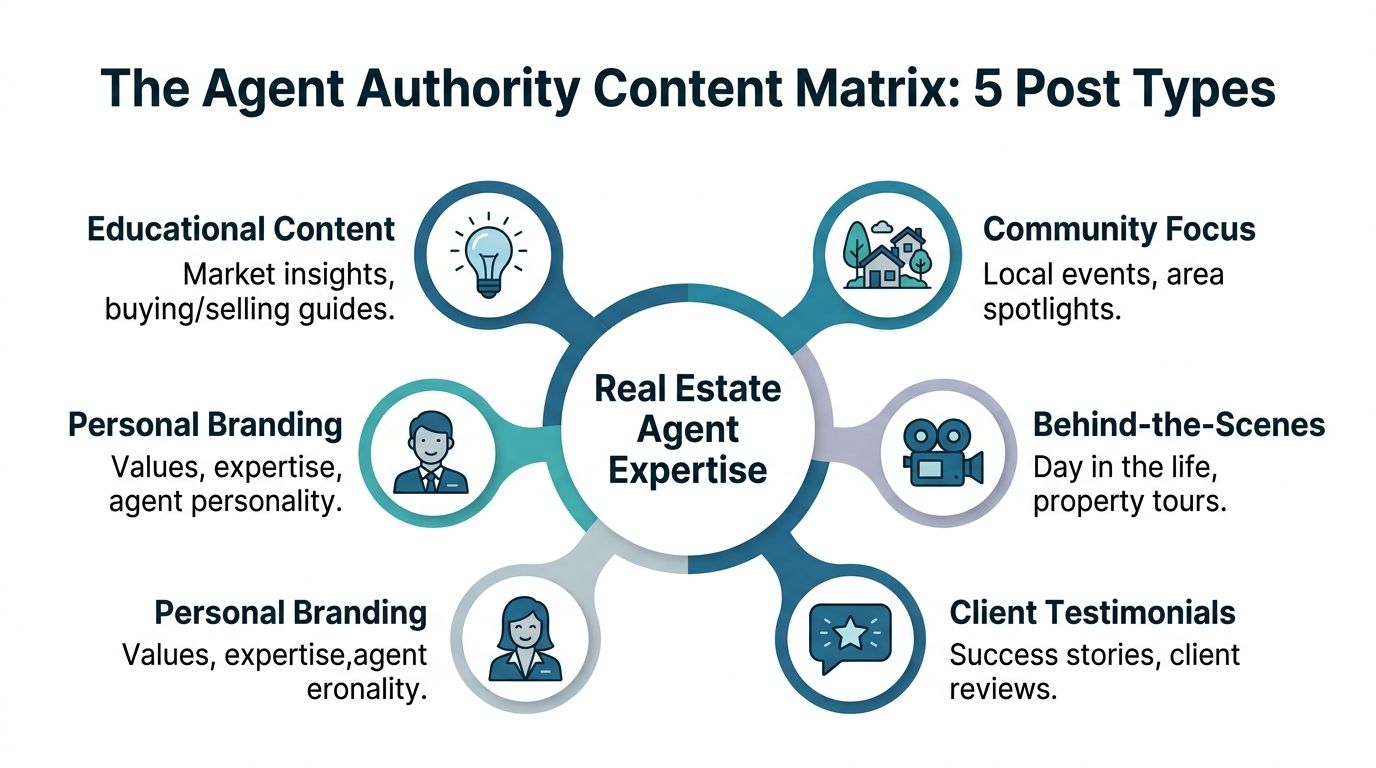
    Build your content pillars

    Most agents need three to five content pillars. Fewer than that and you become repetitive. More than that and you dilute your message.

    A practical setup looks like this:

    Pillar What it covers Why it builds authority
    Market interpretation price movement, inventory shifts, days on market, buyer leverage Shows you can explain conditions, not just report them
    Neighborhood depth block-by-block feel, housing stock, commute patterns, amenities Proves local knowledge buyers can't get from portal copy
    Process guidance inspections, financing prep, offer strategy, prep for listing Reduces anxiety and builds trust before the first call
    Property-specific education condos, historic homes, new construction, rental-to-own transitions Helps you own a niche conversation
    Local lifestyle schools, parks, restaurants, routines, community patterns Makes your brand feel lived-in, not transactional

    Each pillar needs recurring formats. Otherwise, you'll reinvent the wheel every week.

    Turn pillars into recurring content formats

    Many high-potential agents lose momentum at this stage. They understand their intended message but fail to establish a consistent method for delivering it.

    Use fixed formats inside each pillar:

    • Market interpretation: monthly market update, price trend breakdown, seller expectation reset
    • Neighborhood depth: neighborhood tour video, “who this area fits” post, local pros and trade-offs article
    • Process guidance: FAQ post, short video explainer, client mistake breakdown
    • Property-specific education: comparison post, buyer checklist, walkthrough narration
    • Local lifestyle: weekend guide, school-area explainer, commute-oriented post

    A blueprint should reduce decision fatigue. If you have to invent your strategy every Monday, you don't have a strategy.

    The actual trade-off is focus versus breadth. If you try to sound relevant to everyone, you'll sound memorable to no one. A smaller footprint gives your content a sharper edge. It also helps AI systems connect your name with specific local topics instead of a generic real estate label.

    Decide what not to post

    This matters as much as your pillars.

    Skip content that doesn't support your market position. That includes trend-chasing posts with no local angle, motivational filler, generic housing headlines without interpretation, and listing content with no educational value.

    A simple screen helps. Before publishing, ask:

    • Does this answer a real buyer or seller question?
    • Does this strengthen my local identity?
    • Would this help someone choose me over a more established agent?

    If the answer is no, don't post it just to stay active.

    Building Your Content Engine with AI Automation

    Most agents don't have a content problem. They have a production problem. They know what clients ask. They know what neighborhoods matter. What breaks is consistency. A few busy weeks hit, content stops, and authority stalls.

    That's why you need a content engine, not a burst of motivation.

    A six-step infographic showing the process of building a content engine using AI automation tools.

    Use a balanced content mix

    A content engine works best when it isn't overloaded with one format. Agents who rely only on short-form video often get attention but struggle to build durable authority. According to US Realty Training's benchmark guidance, agents should use a 30-30-30-10 content distribution model. That means 30% short-form video, 30% long-form authority content, 30% direct engagement, and 10% AI-optimized schema posts. The same source states that agents using balanced funnels see 25% higher lead nurturing conversion than those focused only on video.

    That mix forces discipline. It keeps you from becoming the agent who gets views but never builds a knowledge base.

    Here's the practical version:

    • Short-form video builds reach and familiarity.
    • Long-form authority content gives you searchable depth.
    • Direct engagement converts attention into conversations.
    • AI-optimized posts help machines understand your expertise.

    Build from source material, not from scratch

    The easiest way to stay consistent is to create one strong source asset and turn it into multiple outputs.

    A single neighborhood market update can become:

    1. A YouTube outline
    2. A blog post
    3. Three short social clips
    4. An email to your database
    5. A carousel post
    6. A schema-friendly FAQ page

    That workflow matters more than creativity. Most agents burn out because they treat every platform as a separate creative project.

    If you want a useful model for fast video repurposing, this short-form real estate content workflow shows how one property or market topic can feed multiple short-form assets without requiring full manual editing every time.

    The six-part production system

    A reliable engine usually follows six steps.

    Capture the raw material

    Start with what you already know from daily work. Pull from listing appointments, showing feedback, financing objections, appraisal surprises, inspection issues, neighborhood comparisons, and seller misconceptions.

    Raw prompts can be simple:

    • “Why buyers hesitate in this neighborhood”
    • “What sellers in this ZIP code misunderstand about pricing”
    • “What condo buyers need to ask before making an offer”

    This gives you content with real-world relevance. Not theory.

    Expand into authority assets

    Turn one prompt into a substantial piece first. A strong blog post, market brief, or YouTube script becomes the center of the system.

    AI tools can assist with operational efficiency in this area. For example, real estate agent content automation software for 2026 outlines how agents use systems to convert property details and local market topics into repeatable content workflows. In practice, platforms such as ListingBooster.ai combine listing-focused generation with authority content creation, including market updates, neighborhood guides, and buyer or seller education, while also scanning content for Fair Housing compliance.

    That matters because compliance mistakes usually happen when agents rush.

    Break into channel versions

    Once the core asset exists, split it by channel purpose.

    Channel Best use Format that fits
    YouTube search intent and depth tutorial, neighborhood explainer, market breakdown
    Instagram Reels fast attention and local familiarity one insight, one myth, one comparison
    LinkedIn professional interpretation market angle, relocation insight, policy implication
    Email nurturing warm leads short lesson, local update, next-step CTA
    Blog searchable authority structured answers, FAQs, local detail

    The same idea should not be copy-pasted everywhere. It should be reframed.

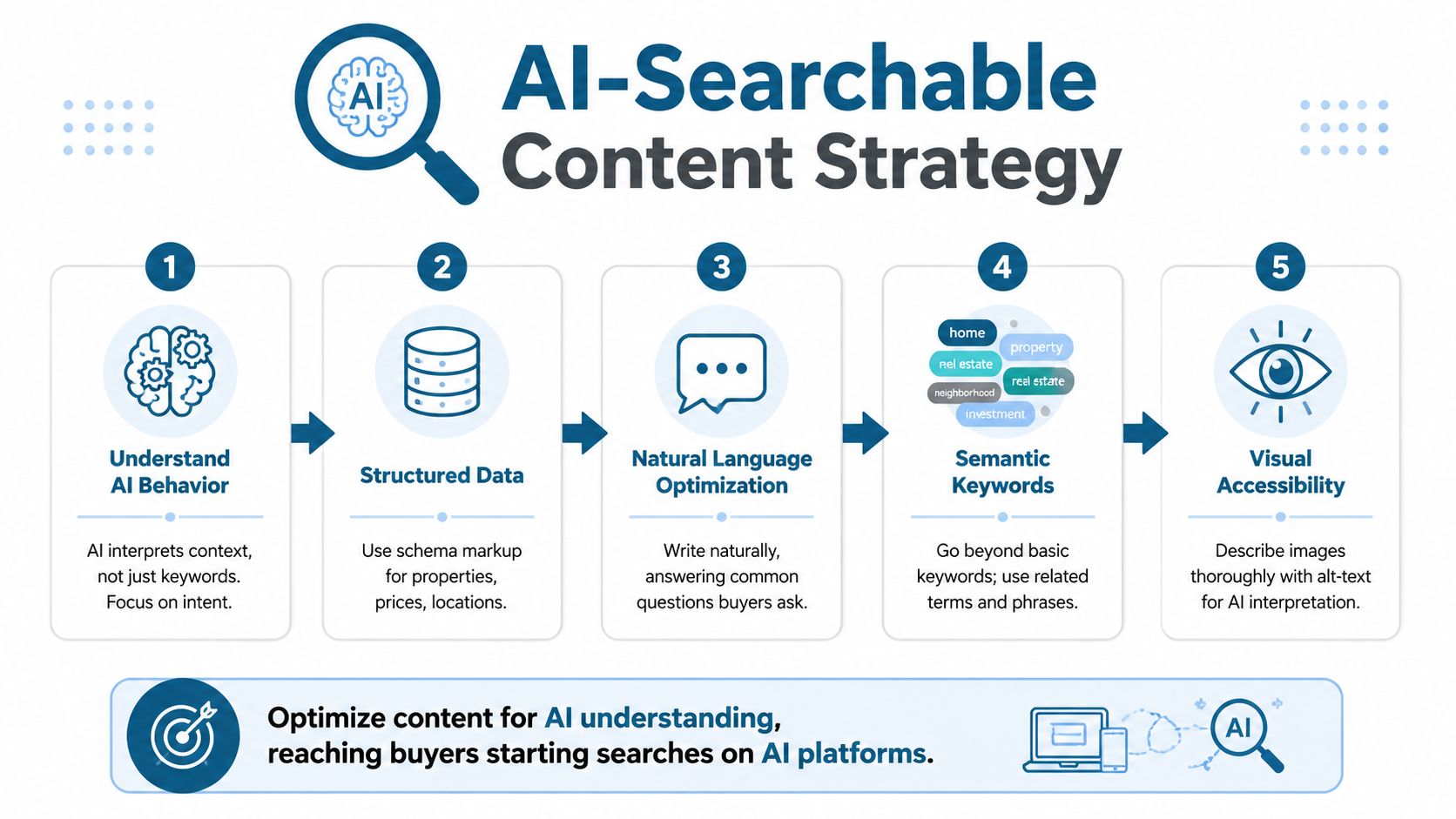
    Add AI-readable structure

    Many agents still lose visibility in this area. AI-readable content isn't mystical. It usually means your content is explicit, organized, and context-rich.

    Use:

    • clear titles tied to local queries
    • subheadings that match real questions
    • direct answers before storytelling
    • location names, property types, and transaction context
    • FAQ sections where useful
    • structured formatting instead of long opinion-heavy blocks

    Content built for AI search usually reads better for humans too. Clear beats clever.

    Schedule around operations

    Avoid publishing without a plan. Align your calendar with the actual needs of your business.

    A working rhythm might include:

    • one weekly authority video
    • one local long-form post
    • a few short-form clips cut from those assets
    • direct follow-up content triggered by actual lead activity
    • listing-event content when a property goes live, changes price, or closes

    This approach keeps content aligned with business development instead of turning it into a side hobby.

    Review and refine

    Every month, look at which topics generate the strongest conversations, not just the highest reach. Reach can flatter bad strategy. Useful authority content creates better questions from prospects.

    Good signs include:

    • prospects referencing a specific post or video
    • sellers repeating your language at appointments
    • buyers asking more advanced questions earlier
    • warmer inbound inquiries that need less education

    Optimizing for AI and Human Discovery

    Publishing content is only half the job. Discovery has split into two systems. Humans still scroll, click, save, and share. AI systems parse, summarize, and recommend. Your content has to perform in both.

    A split image representing the integration of human intelligence with AI technology for advanced scientific discovery.

    Human discovery needs packaging

    People rarely reward the most informative content if it's hard to consume. They reward the clearest framing.

    A market update for LinkedIn should sound different from a neighborhood reel on Instagram. The facts may overlap. The packaging should not.

    Use channel logic:

    • LinkedIn: lead with interpretation. Talk about what a trend means for buyers, sellers, or relocations.
    • Instagram: lead with one sharp local insight. Keep it visual and specific.
    • Facebook: make the post conversational and community-oriented.
    • Email: write for the person already watching you, not a stranger.
    • YouTube: answer the exact search intent clearly in the opening.

    If you're exhausted by constant creation, these strategies to stop the content treadmill are useful because they focus on getting more mileage from core content instead of chasing endless fresh topics.

    AI discovery needs clarity and structure

    AI systems surface content that is easier to interpret. They do not “feel” your brand positioning. They infer it from what you've published.

    A few habits improve discoverability:

    Name the topic directly

    Weak headline: “A few things to know before making your move”

    Stronger headline: “What first-time buyers should know before buying in East Nashville”

    The stronger version gives AI systems entities and context. It also gives humans a reason to click.

    Write in answer-first format

    Open with the answer. Then explain. This helps both skim readers and AI extraction.

    For example:

    • Bad approach: three paragraphs of setup before the takeaway
    • Better approach: “Condos in this neighborhood often attract first-time buyers because maintenance is lower, but HOA rules and monthly dues change affordability more than buyers expect.”

    Use local entities repeatedly and naturally

    Mention neighborhoods, property types, school areas, buyer situations, and transaction terms where relevant. This is how your content starts to form a recognizable semantic pattern.

    Keep pages scannable

    Subheadings, bullet points, short paragraphs, and FAQ sections do more than improve readability. They make it easier for systems to understand the relationships between ideas.

    The easiest way to become invisible in AI search is to publish polished vagueness.

    Why YouTube deserves a permanent place in the system

    Most agents underestimate YouTube because it feels slower than social media. That's exactly why it builds stronger authority.

    According to Housing.info's analysis of YouTube for new real estate agents, agents who publish one high-value, search-driven YouTube video per week can build local market authority and generate consistent inbound leads within their first 90 days. The same source notes that this works because YouTube videos function as long-shelf-life digital assets, and that listings with video receive 403% more inquiries.

    Those are two different wins. YouTube helps you build authority around questions, while listing video helps properties attract more response.

    What works better than generic posting

    A useful comparison makes this clearer.

    Weak approach Stronger approach
    “Just listed” with basic specs “What this listing tells buyers about inventory in this school zone”
    Generic market stats dump “Why sellers in this neighborhood are misreading buyer leverage”
    Lifestyle montage with no context “Who fits this neighborhood, and who probably doesn't”
    Broad buyer tips “Three mistakes condo buyers make in buildings with restrictive HOA rules”

    The stronger approach gives both people and machines enough detail to connect you with a specific expertise area.

    A practical publishing standard

    Before anything goes live, check for these five items:

    1. A clear local topic
    2. A defined audience
    3. A direct takeaway in the opening
    4. A format that matches the platform
    5. A reason someone would contact you after consuming it

    If one of those is missing, the content may still look active, but it won't compound into authority.

    Scaling Authority and Measuring What Matters

    Authority building falls apart when teams measure the wrong things. Likes are easy to track. Closed deals are what matter. The gap between those two is usually follow-up, systems, and consistency.

    A 3D graphic titled Scaling Authority displaying pillars representing key performance metrics like market impact and content engagement.

    The content-to-conversion view

    If you're running content seriously, treat it like a funnel. Content should attract, qualify, nurture, and prompt action. It should not just decorate your brand.

    According to Saleswise's guidance on real estate agent best practices, a multi-faceted content-to-conversion system uses psychology frameworks to target a 4.7% industry average conversion rate. The same source highlights automated CRM email sequences with 1.4% conversion, prompt social DM follow-ups that can deliver a 3x conversion boost, and warns that failing to follow up loses 70% of opportunities.

    That last point is the one many agents learn the hard way. Content can create demand, but poor follow-up wastes it.

    What to measure instead of vanity metrics

    A practical scoreboard looks like this:

    • Lead source quality: Did the lead come in warmer because they consumed educational content first?
    • Conversation readiness: Are prospects asking better questions and needing less basic education?
    • Appointment conversion: Do content leads book more easily than cold leads?
    • Pipeline movement: Which content themes produce actual consults, listings, or buyer agreements?
    • Follow-up speed: How quickly is every inbound message answered?

    Views can still be useful. They just aren't the main KPI.

    How teams scale without sounding fragmented

    Brokerages and teams face a different problem from solo agents. Their issue isn't starting. It's maintaining quality across multiple voices.

    A few standards help:

    Shared topic architecture

    Every agent doesn't need complete creative freedom. Teams work better when everyone publishes from the same approved categories, such as neighborhood expertise, market interpretation, process education, and property storytelling.

    That keeps the brand coherent while still allowing local personality.

    Templates with room for voice

    Rigid scripts make content lifeless. No standards make it messy. The middle ground is structured templates with editable sections for local observations, agent perspective, and client-specific nuance.

    Central compliance review

    This matters more at scale. When multiple agents are posting quickly across several channels, compliance risk increases. Central review processes or tools with built-in checks reduce the chance of rushed mistakes.

    A scalable authority system doesn't try to make every agent sound identical. It makes every agent sound reliably credible.

    Simple funnel design for authority-led agents

    You don't need a complicated dashboard to run this well. You need a clean path from content to contact.

    A basic model:

    Funnel stage What the prospect sees What your system should do
    Discovery video, blog, neighborhood post, listing story tag source and topic
    Interest profile visit, reply, site visit, video watch trigger relevant follow-up
    Nurture email sequence, helpful DM, local updates segment by buyer, seller, area, timing
    Conversion consult, valuation request, showing request assign owner and track response time
    Retention post-close education and check-ins request review and maintain relationship

    The trade-off here is simple. The more content you create, the more disciplined your backend needs to be. Without CRM triggers and response rules, scaling content just scales leakage.

    Authority should show up in appointments

    The clearest proof that your content is working is what happens in the room. Sellers arrive having watched your market updates. Buyers mention a video that clarified a neighborhood decision. Prospects treat you less like a stranger and more like a known advisor.

    That shortens the sales cycle in practical terms. You spend less time establishing baseline credibility and more time diagnosing the client's situation.

    Your Blueprint for Market Leadership

    The agents who win with content don't look frantic. Their marketing feels organized because it is. A seller asks how they'll market the home, and they don't improvise. They already have a property narrative, an educational angle, a local market perspective, and a follow-up plan.

    A buyer asks which neighborhood fits their lifestyle, and the answer doesn't come from a generic brochure. It comes from a library of neighborhood insight, process education, and market interpretation that has been built over time. The agent isn't trying to prove expertise in the moment. The proof is already public.

    That's the actual value of real estate agent authority building with content. It changes your role from option to default. Instead of chasing attention, you build a body of work that keeps introducing you, explaining your market, and filtering for fit before the inquiry arrives.

    There's also a clear contrast with agents who stay reactive. They post when they remember. They publish what everyone else is publishing. They lean on listing inventory for visibility, then disappear between transactions. That approach can create activity. It rarely creates authority.

    The better model is straightforward:

    • define the market you want to own
    • build a small set of repeatable content pillars
    • turn one strong idea into multiple useful formats
    • make every piece easier for humans and AI systems to understand
    • track conversations, follow-up, and conversion, not just reach

    Do that consistently and your content stops being marketing clutter. It becomes part of how your market knows you.


    If you want a practical way to turn listings, market knowledge, and local expertise into AI-readable marketing assets without building the workflow from scratch, ListingBooster.ai gives agents, teams, and brokerages a centralized system for producing listing content, authority posts, and compliant materials that support visibility in the age of AI search.

  • How to Optimize Listing Descriptions for AI Search: A Guide

    How to Optimize Listing Descriptions for AI Search: A Guide

    More buyers are starting their home search inside AI tools, not just on portals or Google. Over 40% of homebuyers now initiate searches on platforms where AI can extract and surface individual paragraphs from your content (Olive & Company). That changes the job of a listing description.

    The old model was simple. Stuff in the beds, baths, square footage, maybe a few adjectives, then hope the photos do the rest. That still fills a box in the MLS. It does not reliably help your listing get cited, summarized, or recommended by ChatGPT, Google AI, or Perplexity.

    If you want to know how to optimize listing descriptions for ai search, think less like a copywriter chasing flair and more like an operator building clean inputs for a recommendation engine. Your description has to do three things at once. It has to answer buyer intent, survive machine parsing, and stay compliant.

    The New Search Paradigm Your Listings Must Conquer

    AI recommendation engines reward listings that can be quoted cleanly. If a paragraph cannot stand on its own, it is less likely to be surfaced, summarized, or cited in tools like ChatGPT, Google AI, and Perplexity.

    A digital artistic representation of a neural network or neuron structure with a bright blue background.

    Why old listing copy disappears

    Agents still publish descriptions loaded with filler. “Welcome home.” “Stunning gem.” “Must see.” Those phrases waste the most valuable real estate in the listing, which is the first sentence and first paragraph.

    AI systems often evaluate content in chunks. A single extracted paragraph may be judged without the headline, photo gallery, or the rest of the description around it. If that paragraph opens with generic language and delays the actual value, the system has very little to work with.

    That changes how strong listing copy is built.

    Each paragraph should answer a buyer question directly. Each sentence should clarify a feature, a use case, or a location benefit. In practice, I treat every paragraph like a standalone response block that could be lifted into an AI-generated answer without needing cleanup.

    Practical rule: Copy one paragraph from the listing into ChatGPT by itself. If it still reads like a clear answer to a buyer need, the structure is working.

    Search has shifted from matching words to matching usable answers

    Traditional search indexed pages and matched phrases. AI search systems try to assemble the best answer from multiple sources, which means your description needs passages that are easy to extract and easy to trust.

    Agents who want the technical framing should understand how AEO differs from SEO. SEO helps a page rank. AEO helps a specific section of text get selected as an answer. Listing descriptions now have to do both.

    Here is the difference in day-to-day writing:

    Old listing mindset AI search mindset
    Write one flowing block of copy Write self-contained paragraphs
    Open with flair Open with the clearest buyer value
    List features Connect features to buyer outcomes
    Fill the MLS field Create text that AI can extract and reuse

    What strong AI-readable copy actually looks like

    The goal is not clever prose. The goal is explicit meaning.

    A flex room should not stay a flex room in the copy if the likely buyer intent is remote work, guests, hobbies, or a nursery. A covered patio should not sit there as a bare feature if it provides easy outdoor dining or low-maintenance hosting. Good AI-facing descriptions make that translation obvious.

    Here is a simple example:

    • Feature: south-facing backyard

    • Buyer meaning: more natural light and better daytime use

    • AI-readable phrasing: “The south-facing backyard offers a bright outdoor area that works well for gardening, casual dining, and weekend play.”

    • Feature: split-bedroom layout

    • Buyer meaning: more privacy between the primary suite and secondary rooms

    • AI-readable phrasing: “The split-bedroom layout places the primary suite away from the secondary bedrooms, which suits buyers who want added privacy or a quieter guest setup.”

    This is also where a system helps. I use ListingBooster.ai to structure copy into clean, buyer-intent-driven sections and keep the language compliant, especially when I want repeatable output across a full pipeline. If you want the specific real estate framework behind that process, review this guide on AI search optimization for real estate agents.

    The competitive gap is widening

    Agents who keep writing vague, flowery descriptions are making AI retrieval harder than it needs to be. The listing may still exist in the MLS, but it gives recommendation engines weak material to work with.

    Agents who write modular, specific, high-signal copy have an edge. Their listings are easier to quote, easier to summarize, and easier to recommend. That is the significant shift in search behavior, and it rewards agents who treat listing descriptions like structured inputs instead of filler text.

    Mapping Buyer Intent to AI-Readable Keywords

    Most agents start with property facts. That's fine, but facts alone don't create AI visibility. You need to map facts to the language buyers use when they ask conversational questions.

    Amazon's AI-driven search offers a useful clue here. In that environment, AI-generated content can include natural phrases like “ideal for outdoor activities in warm climates,” which may not show up in traditional keyword tools but still match real customer queries (Helium 10). Real estate works the same way.

    Build a concept library before you write

    Before drafting the description, create a simple concept library for the listing. This isn't a keyword dump. It's a translation sheet between the home and buyer intent.

    Use four columns:

    Property fact Buyer problem solved Natural-language query Phrase to use in copy
    Bonus room Needs workspace home with office space dedicated flex room for a home office
    Fenced yard Wants privacy for kids or dogs yard for pets or play fenced backyard with room for pets and play
    Walkable location Wants convenience home near shops and dining close to local dining, errands, and daily conveniences
    Covered patio Wants easy hosting home with outdoor entertaining covered patio for casual outdoor dining and entertaining

    This exercise changes how you write. Instead of listing features in isolation, you start framing them as answers.

    Think in buyer questions, not just keywords

    A lot of agents still optimize for phrases like “4 bedroom home in North Austin.” That's not wrong. It's incomplete. Buyers using AI ask layered questions that combine lifestyle, layout, budget sensitivity, commute, family needs, and emotional triggers.

    I like to pressure-test a listing with queries like these:

    • Lifestyle query: What kind of buyer would love this home?
    • Pain-point query: What problem does this floor plan solve?
    • Decision query: Why would someone choose this over similar homes nearby?
    • Neighborhood query: What daily routines does this location make easier?
    • Emotional query: What would it feel like to live here on a normal Tuesday?

    Those questions produce stronger raw material than a spreadsheet of search terms.

    If your description can't answer a buyer's spoken question, it's probably over-indexed on features and under-built for AI discovery.

    Separate head terms from intent phrases

    You still need core property language. Beds, baths, neighborhood, school district references where compliant, lot style, and major amenities all matter. But those are only one layer.

    A better system uses two buckets.

    Core discovery terms

    These are the obvious terms buyers and portals expect:

    • Location markers: neighborhood, city, nearby districts, landmark areas
    • Property type terms: condo, townhome, single-story, custom home
    • Structural features: primary suite, open-concept kitchen, guest room, updated bath

    Intent phrases

    These are the phrases buyers naturally use in AI prompts:

    • Daily-life language: easy commute, work-from-home setup, low-maintenance yard
    • Use-case language: space for hosting, room for multigenerational living, lock-and-leave convenience
    • Emotional framing: bright and calming, private retreat, flexible layout for changing needs

    One reason this works is that AI can match plain-language descriptions to broader queries more effectively than rigid keyword strings alone. If you've ever studied social content discovery, some of the same principles show up in 2024 carousel keyword strategies, where context and user intent matter as much as direct phrase matching.

    A field-ready framework agents can use fast

    When I build listing copy, I reduce the home to five intent layers:

    1. Who is this home for
      First-time buyers, move-up families, investors, downsizers, remote professionals, second-home buyers.

    2. What problem does it solve
      Lack of workspace, cramped entertaining, no private outdoor area, long commute friction, too much maintenance.

    3. What moments does it enable
      Quiet morning coffee, weekend hosting, easy school mornings, separate guest stays, simple lock-and-leave travel.

    4. What proof supports that claim
      Split floor plan, oversized island, fenced yard, dedicated office, attached garage, covered patio, walkability.

    5. What language would a buyer use
      Not “resort-style sanctuary.” More like “private backyard with room to relax and host friends.”

    This process gives you a bank of AI-readable phrases before writing starts. Once you've done it a few times, it becomes automatic.

    The Anatomy of a Perfect AI-Optimized Listing

    AI-ready descriptions win on structure. Length only helps when each section gives a recommendation engine a clear, self-contained answer it can quote, summarize, or rank.

    A diagram illustrating the five key elements required for creating an effective, AI-optimized product or service listing.

    Semrush’s analysis of AI search optimization patterns points in the same direction. Compact sections tend to perform better in AI-generated results than thin fragments or oversized blocks (Semrush). For agents, the practical takeaway is simple. Build short sections that fully explain one idea.

    Open with the clearest buyer match

    The first sentence has a job. It should tell AI and the buyer what kind of home this is, who it fits, and why it matters.

    Weak opening:
    “Welcome to this beautifully maintained home with charm and character.”

    Stronger opening:
    “This updated single-story home offers a flexible layout, private backyard, and dedicated office for buyers who want comfort, convenience, and work-from-home function.”

    That sentence gives AI usable signals immediately. Property type, layout benefit, outdoor value, workspace, and buyer fit.

    Add a tight summary that can stand alone

    The second block should work even if an AI system lifts only those two sentences into a recommendation. I write this section like a mini pitch, not a warm-up paragraph.

    A strong summary does three things:

    • Defines the fit: who is likely to care
    • Surfaces the main differentiators: what makes the home easier to remember
    • Connects the location to daily life: what convenience looks like in practice

    Example:
    “This home pairs an open main living area with a separated bedroom layout and quick access to shopping and commuter routes. Buyers looking for functional indoor-outdoor living will notice the covered patio, fenced yard, and kitchen that connects directly to the main gathering space.”

    That kind of paragraph holds up on its own. That matters because AI systems often extract and recombine sections instead of presenting the whole listing word for word.

    Build the body in complete thought units

    Many listing descriptions still fail for one reason. The copy either runs as one long paragraph or breaks into a pile of disconnected phrases. Neither format gives AI much confidence.

    Each paragraph should cover one topic completely.

    Layout and livability

    Explain how the floor plan works in real life.

    Example:
    “The split-bedroom layout gives the primary suite more privacy from the secondary bedrooms. A separate flex room near the front of the home works well as an office, study area, or guest overflow space, giving buyers options as needs change.”

    Kitchen and gathering space

    Connect finishes and layout to actual use.

    Example:
    “The kitchen opens to the main living and dining areas, making it easier to cook while staying connected to family or guests. An oversized island adds prep space, casual seating, and a natural center point for everyday routines.”

    Outdoor function

    State what the exterior enables.

    Example:
    “The fenced backyard creates usable space for pets, play, or weekend hosting. A covered patio adds shade and makes outdoor dining more practical during warmer months.”

    I use a simple standard here. If ChatGPT quoted one paragraph without the rest of the listing, that paragraph should still make sense.

    Use a scannable feature block after the prose

    Structured copy helps both readers and machines. After the narrative sections, add grouped bullets that separate major categories instead of dumping every feature into one line.

    • Interior highlights: open-concept living area, dedicated flex room, updated lighting, generous storage
    • Outdoor features: fenced yard, covered patio, low-maintenance landscaping
    • Location advantages: access to major routes, close to everyday shopping, convenient to dining and services

    This format creates cleaner boundaries between topics. It also makes the listing easier to reuse across MLS remarks, portal descriptions, brokerage sites, and AI summaries.

    Follow a repeatable template

    Here’s the format I use when I want descriptions to perform across search, recommendations, and portal scan behavior:

    Component Goal Writing note
    Opening sentence Match buyer intent fast Lead with the best-fit use case
    Summary block Explain value quickly Keep it specific and benefit-driven
    Paragraph 1 Clarify layout Complete one idea
    Paragraph 2 Explain kitchen and living flow Complete one idea
    Paragraph 3 Show outdoor and daily-life value Complete one idea
    Feature list Improve scan speed Group bullets by category

    If speed matters, use a structured drafting workflow instead of starting from zero. This guide to an AI property description writer for MLS listings shows how agents are turning property inputs into organized drafts they can edit for accuracy, positioning, and compliance.

    Cut the patterns that weaken AI extraction

    A few habits drag listing quality down fast:

    • Adjective stacking: “stunning, charming, beautiful, immaculate” adds fluff without meaning
    • Feature dumping: long upgrade lists with no buyer context
    • Dependent paragraphs: sections that only make sense if the previous paragraph was read first
    • Oversized blocks: dense copy lowers readability and weakens extraction
    • Generic luxury language: phrases like “must-see masterpiece” without specific proof

    The strongest AI-optimized listing reads clean because every sentence does a job. Clear structure improves generation, extraction, and measurement later. That is the difference between writing copy that sounds good and writing copy that gets surfaced.

    Leverage Advanced Tactics Schema Prompts and Compliance

    Once your copy structure is right, the technical layer starts to matter. Many agents, however, cease their efforts too soon. They think a polished paragraph is the whole game. It isn't.

    A conceptual graphic illustration of data streams converging into a central metallic sphere labeled Schema for AI.

    Schema markup completeness carries significant weight in AI recommendation systems. Authoritative list mentions account for about 41% of AI recommendation weight, and precise markup such as LocalBusiness and Organization performs better than generic schema (First Page Sage). For agents, the takeaway is simple. If AI can't confidently understand who you are, what the listing is, and how those entities connect, your visibility ceiling stays lower.

    Think of schema as an AI cheat sheet

    Schema tells machines what a page contains in an explicit, structured format. Instead of hoping an AI system infers that your site page is a listing, that you are the agent, and that your brokerage is the organization behind it, schema states those relationships directly.

    For a real estate marketing stack, the most practical schema categories are:

    • Organization schema: brokerage or team identity
    • LocalBusiness schema: local service presence and agent credibility signals
    • Article schema: neighborhood guides, market updates, and supporting content
    • HowTo schema: buyer guides, prep checklists, or local area walk-through content

    The key isn't just adding schema. It's using specific schema with clear relationships, unique identifiers, and consistent entity naming.

    Prompting matters more than most agents realize

    If you're using AI to draft listing descriptions, your prompt quality controls the output quality. Vague prompts produce vague copy. Good prompts produce modular, buyer-intent-rich descriptions you can use.

    Try prompt instructions like these:

    Generate a listing description in short standalone paragraphs. Each paragraph should answer one buyer concern clearly without relying on the previous paragraph. Translate features into benefits, use plain language, avoid clichés, and separate layout, kitchen, outdoor space, and location.

    Or this:

    Write MLS-safe copy for a single-family home. Lead with the strongest buyer use case. Include a scannable feature section. Avoid protected-class language, school quality claims, and vague luxury filler.

    That second instruction matters because AI can create compliance problems just as fast as it creates drafts.

    Compliance is part of optimization

    A description that gets attention but introduces Fair Housing risk is not optimized. It's a liability. Agents need to filter for both visibility and compliance.

    Watch for these common mistakes:

    • Protected-class implications: language that signals who should live there
    • School quality shortcuts: claims that imply educational superiority
    • Lifestyle exclusion language: wording that suggests a preferred buyer type in a discriminatory way
    • Over-personalized assumptions: copy that implies age, family status, religion, or similar characteristics

    A better pattern is to describe the property and its use cases without suggesting who belongs there. Focus on function, access, layout, and amenities.

    One practical way agents handle this is by using tools that combine generation with compliance review. For example, ListingBooster.ai is built to generate AI-optimized real estate marketing content and support schema-oriented visibility workflows for listings. The broader point is that whatever tool you use, it should help you structure content for AI search while reducing compliance risk before publication.

    Advanced execution beats pretty copy

    A polished paragraph helps. A well-structured entity footprint helps more. The agents who win this next cycle won't just write better descriptions. They'll publish clearer machine-readable content, connect that content to their brand identity, and avoid avoidable compliance mistakes.

    That's what separates an AI-friendly listing from one that sounds good on the page.

    How to Measure What Matters A/B Testing for AI Search

    Agents who treat listing descriptions like finished copy leave performance on the table. AI search rewards iteration. The winning workflow is closer to conversion testing than traditional listing marketing.

    A digital dashboard showing performance data charts for AI testing displayed on a car infotainment screen.

    Brevitas reports that AI visibility for real estate listings improves when agents keep refining copy based on whether listings appear in AI answers, how often that language gets reflected back, and which description formats produce stronger engagement (Brevitas). The useful takeaway is simple. Initial optimization gets you into the race. Measurement tells you what earns recommendation visibility.

    Track AI presence like a performance channel

    Page views and saves still matter, but they are incomplete. If the goal is AI discovery, track whether your listing and brand show up inside AI-generated responses for real buyer prompts.

    A simple operating dashboard should cover three areas:

    Metric bucket What to watch Why it matters
    AI presence whether the listing, brokerage, or agent brand appears in AI-generated answers Shows whether your copy is getting picked up in the recommendation layer
    Conversion behavior inquiry quality, saved listing behavior, showing requests Shows whether the visibility is attracting serious buyers
    Copy variation performance which version of the description produces stronger engagement after publication Gives you a repeatable basis for future edits

    “AI snippet share” is a practical internal label for this process. It means checking how often your wording or listing facts appear when buyers ask questions such as “best homes with office space near downtown” or “updated single-story homes with low-maintenance yard.”

    Test one variable at a time

    The fastest way to ruin an A/B test is to rewrite the entire listing at once. If you change the opener, reorder photos, swap the call to action, and rewrite the feature block together, you cannot isolate what improved performance.

    Keep the test narrow. Pick one variable and give it enough time to produce a signal.

    Useful tests include:

    • Opening angle: feature-first opening vs. problem-solution opening
    • Length: compact summary vs. expanded summary
    • Benefit framing: convenience language vs. flexibility language
    • Structure: paragraph-only format vs. paragraph plus grouped bullets

    Here is a clean example.

    Version A: “Updated home with open kitchen and fenced backyard.”

    Version B: “Flexible layout with indoor-outdoor flow, a fenced yard, and space that works well for remote work or guests.”

    That test shows whether AI systems and buyers respond better to plain feature labeling or to features paired with clear use cases.

    Good testing removes opinion from the process. The version that gets surfaced and gets inquiries wins.

    Build a review loop your team can actually maintain

    The process does not need to be complex. It needs to be consistent.

    1. Publish a baseline version
      Start with a structured description showcasing the home's strongest facts, likely buyer use cases, and neighborhood context.

    2. Run prompt checks manually
      Search relevant prompts in ChatGPT, Google AI results, and Perplexity. Use the kinds of questions buyers ask, not just MLS shorthand.

    3. Log appearance patterns
      Record whether the listing is cited, paraphrased, summarized accurately, or ignored. Track the specific phrases that seem to get picked up.

    4. Revise one element
      Update only the opener, one paragraph, or the feature grouping.

    5. Compare downstream results
      Review showing requests, lead quality, saved listing activity, and the language buyers use when they reach out.

    Agents with volume should formalize this. ListingBooster.ai helps by speeding up structured versioning, so teams can generate compliant variants, test them faster, and keep a cleaner record of what changed across listings.

    Measure response quality, not just response volume

    More inquiries do not always mean better copy. A description can attract clicks for the wrong reasons if it overemphasizes one feature or creates expectations the property cannot support.

    Watch for signals that the copy is matching buyer intent:

    • Buyers mention the same features or use cases highlighted in the description
    • Showing requests come from prospects who fit the likely price point and property type
    • Follow-up questions are specific, not confused
    • AI summaries reflect the home's strengths accurately instead of flattening it into generic portal language

    That is the benchmark. Good AI-facing copy improves discovery and sharpens fit.

    Use the results in your listing presentation

    Sellers do not need a lecture on retrieval models. They want proof that your marketing process adapts faster than the average agent's.

    Show them a system:

    • Versioned listing copy: different description angles tested against real buyer behavior
    • Prompt-based visibility checks: confirmation that the property can surface in AI-style search scenarios
    • Measured revisions: updates based on actual appearance and inquiry patterns, not gut feel

    That positions you as the agent who monitors performance after the listing goes live, not the one who writes a polished paragraph and hopes for the best. In the AI search era, that difference is real, measurable, and hard to copy.

    Frequently Asked Questions on AI Listing Optimization

    Do I need to rewrite every listing from scratch?

    No. You need to rewrite weak patterns from scratch. The reusable part is the structure. Once you have a reliable framework for openings, standalone paragraphs, and feature blocks, you can rebuild listing descriptions much faster without defaulting to generic phrasing.

    Should I prioritize MLS compliance or AI readability?

    MLS compliance comes first. Then you optimize within those boundaries. The good news is that clear, factual, plain-language copy usually helps both. Problems show up when agents try to sound clever, imply buyer identity, or overstate lifestyle claims.

    Are keyword tools still useful?

    Yes, but they aren't enough on their own. Use them for core discovery language, then expand into buyer-intent phrasing that reflects how people ask questions in AI tools. Technical terms help with indexing. Conversational phrasing helps with answer matching.

    How long should my description be?

    Long enough to fully explain the home's value, short enough that each section stays focused. Compact, self-contained paragraphs outperform bloated blocks. If a paragraph drifts into multiple topics, split it.

    Do bullet points help or hurt?

    They help when they organize information cleanly. A grouped feature section can improve scannability for people and clarity for AI. Just don't let the entire description become a lifeless inventory list. Use bullets to support the narrative, not replace it.

    Can AI write the description for me?

    It can draft it. You still need to guide it, edit it, and verify compliance. The strongest workflow is human-directed AI, not one-click publishing. Your edge comes from knowing the property, the buyer, and the market context better than a generic model does.

    What kinds of listing language should I cut immediately?

    Start with these:

    • Clichés: stunning, charming, must-see, won't last
    • Empty luxury filler: resort-style, masterpiece, dream home
    • Unclear benefits: upgraded finishes without saying why they matter
    • Dependent transitions: paragraphs that only make sense when read in sequence

    What should every AI-ready description include?

    At minimum:

    • A buyer-intent-led opening
    • Standalone paragraphs by subtopic
    • Feature-to-benefit translation
    • Scannable grouped highlights
    • Plain-language wording
    • A compliance review before publishing

    If you build around those elements consistently, you'll be ahead of the agents still writing for a portal field instead of an AI recommendation engine.


    If you want a faster way to turn raw property details into AI-readable, MLS-safe marketing content, ListingBooster.ai gives agents a workflow for generating structured listing descriptions, social assets, and supporting materials without starting from a blank page every time.

  • 10 Best AI Tools for Listing Agents in 2026

    10 Best AI Tools for Listing Agents in 2026

    It’s 8 PM on a Tuesday. You just got home from a showing, but your new listing goes live tomorrow. You still need to write the MLS description, create social posts, and get a postcard into something that doesn’t look homemade. That last-minute scramble is where a lot of listing agents live, and it can undermine both quality and consistency.

    The problem isn’t effort. It’s fragmentation. One tool writes copy, another resizes graphics, another handles floor plans, and another helps with pricing or prospecting. By the time you stitch it all together, the listing is live but the marketing engine is still half-built.

    That’s why the best ai tools for listing agents aren’t just “cool apps.” They’re workflow tools. They either remove bottlenecks or they create new ones. The ones worth paying for help you move from one property input to a full campaign without redoing the same work five times.

    AI adoption is already mainstream in the business. According to a National Association of REALTORS® survey on AI and digital tools, 58% of real estate agents have adopted ChatGPT by OpenAI as their primary AI tool, and 46% report using AI-generated content for listing descriptions. That tells you two things. Agents are using AI, and many are still piecing together generic tools instead of building a listing-specific stack.

    If you’re still working from scattered prompts and late-night Canva sessions, upgrade the system, not just the copy. If you want a broader look at your mobile and back-office stack too, this guide to best apps for real estate agents is worth bookmarking.

    1. ListingBooster.ai

    ListingBooster.ai

    ListingBooster.ai is the closest thing on this list to a true command center for listing agents. Most AI tools give you a caption, a paragraph, or a graphic. ListingBooster starts with the listing itself and turns that into a coordinated marketing package built for portals, social channels, and AI-driven discovery.

    That difference matters. Generic AI writing tools can produce decent copy, but they don’t naturally understand the operational reality of listings. Status changes, brokerage rules, Fair Housing sensitivity, MLS language, and the need to adapt copy across channels all create friction. ListingBooster is built around that friction.

    Why it stands out

    The strongest use case is speed with structure. Instead of prompting one asset at a time, you can generate MLS-ready descriptions, platform-adjusted portal copy, and social content tied to the listing lifecycle. That’s a much better fit for real working agents than bouncing between separate tools.

    It also addresses a problem a lot of agents still underestimate. Discoverability is shifting beyond search engines and portals. If you want a deeper look at that shift, their article on AI property description writing for MLS listings helps explain why structured, property-specific content matters more than generic marketing fluff.

    Practical rule: If your AI tool can write a caption but can’t manage listing status, compliance sensitivity, and cross-channel formatting, it’s a helper, not a system.

    There’s also a practical publishing angle here. Direct social publishing, editable output, and print-ready assets mean the content doesn’t die inside the generator. That sounds basic, but a lot of AI tools still stop right at “draft created.”

    What works in the field

    For solo agents, this is the kind of platform that can replace a pile of partial solutions. For teams and brokerages, the bigger value is consistency. Voice learning and centralized control help keep the brand coherent without forcing every post into the same sterile template.

    A few trade-offs are worth stating plainly:

    • Best fit: Agents who want one hub for listing content, social promotion, and AI-search visibility.
    • Main strength: It’s purpose-built for real estate marketing workflows, not retrofitted from general AI writing.
    • Watch-out: You’ll still want human review for neighborhood nuance, brokerage specifics, and any claim tied to property details.
    • Pricing note: The website presents a credit-based structure and current plan details should be confirmed directly before rollout, especially for high-volume teams.

    My view is simple. If you only buy one AI tool for listing-side marketing, buy the one that reduces context switching. That’s where ListingBooster earns its spot at the top.

    2. Realtors Property Resource RPR AI Market Trends ScriptWriter

    RPR doesn’t get talked about enough in AI tool roundups because it’s less flashy than some startup tools. For listing agents, that’s exactly why it matters. It’s grounded in seller conversations, market commentary, and pre-listing prep.

    The AI Market Trends ScriptWriter takes local stats and turns them into usable language for emails, presentation talking points, social captions, and video scripts. If you’ve ever stared at a market report knowing the data is useful but not wanting to spend an hour translating it into plain English, this solves that problem.

    Where it fits best

    This is a presentation and authority tool more than a pure marketing engine. It helps before you win the listing and while you’re justifying pricing strategy. In practice, that makes it more valuable than another generic caption writer.

    The output still needs editing. You’ll want to tighten tone, remove anything too canned, and make sure your disclosures and framing match your market. But the raw material is strong because it starts from local reporting, comps, and CMA-related workflows.

    A big plus is accessibility for REALTORS®. Since it’s tied to the RPR ecosystem, it can be a smart first AI win for agents who want utility without adding another paid subscription line item.

    Strong seller presentations don’t need more adjectives. They need cleaner explanation of pricing, timing, and buyer behavior.

    Use RPR when you need to sound informed fast. Don’t use it as your only outward-facing content engine. It’s best as the “market intelligence layer” in your stack, especially for pre-listing emails and appointment prep.

    3. Restb.ai

    Restb.ai – Photo and Document Compliance + Image Intelligence

    Restb.ai solves a different kind of problem. It’s not the sexy side of AI. It’s the side that keeps listings clean, compliant, and easier to distribute.

    For listing agents, its value comes from photo and document intelligence. It can scan for issues that commonly trigger MLS friction, and it can auto-tag rooms and property features so the listing carries richer metadata. That helps operations, and it can also improve how listing content gets categorized and surfaced across downstream systems.

    Why compliance tools matter more than most agents think

    Most agents focus on generation first. Write the description. Make the posts. Launch the campaign. But one rejected photo set, one policy issue, or one bad metadata handoff can slow down the whole listing.

    Restb.ai is particularly useful where MLSs and brokerages have integrated it extensively. That’s both its strength and its limitation. The platform is often experienced through an MLS or enterprise partner rather than as a direct agent purchase.

    There’s also a broader workflow context here. According to a real estate AI platform analysis from Dialzara, ListingAI and similar specialized platforms have emerged to combine listing descriptions, virtual staging, and market reports with MLS or IDX-connected data. That trend matters because it highlights what generic AI misses. Real estate workflows depend on structured property context, not just text generation.

    Who should care most

    • Brokerage leaders: If you oversee brand and compliance risk, this type of tool pulls real weight.
    • High-volume listing agents: Fewer upload issues and better metadata reduce administrative drag.
    • MLS-integrated users: The experience is best when your local system already supports it.

    If you’re shopping as an individual agent, check access first. Restb.ai is excellent at what it does, but it isn’t always sold like a simple self-serve SaaS tool.

    4. CubiCasa

    CubiCasa is one of those tools that feels almost too simple until you use it regularly. Then it becomes hard to imagine listing without it. Phone-scan floor plans remove a persistent bottleneck in listing prep, especially for agents who want a stronger marketing package without coordinating extra vendors every time.

    The workflow is straightforward. Scan with your phone, submit, and get back a floor plan that adds real utility to the listing. Buyers love photos, but floor plans answer questions photos can’t. Layout, flow, room relationships, and practical livability all show up better on a plan than in a carousel.

    Where CubiCasa earns its keep

    This tool shines on standard resale listings where you need speed and low friction. It’s also a strong add-on when you’re competing for listings and want to show sellers that your marketing package includes more than photos and a sign in the yard.

    A lot of MLS partnerships make the entry point easier, which is why CubiCasa has spread so widely among working agents. The important caveat is verification. Floor plans are useful marketing assets, but agents still need to treat any dimensional or square-footage-related output carefully and in line with local rules.

    Here’s the trade-off in plain language. CubiCasa is not a luxury presentation tool in the same category as Matterport. It’s a practical production tool. That’s why I like it.

    • Best for: Fast, accessible floor plans without specialized hardware.
    • Less ideal for: Agents expecting a full premium immersive media package from one scan.
    • Real advantage: Easy to build into a repeatable checklist for every listing.

    If your listing packet still goes live without a floor plan unless a seller insists on one, this is one of the easiest upgrades you can make.

    5. Matterport

    Matterport – Digital Twins, 3D Tours, and Marketing Cloud

    Matterport sits in the premium visual presentation category. It’s built for agents who want digital twins, immersive tours, centralized media assets, and a more polished seller-facing package.

    This isn’t necessary on every listing. That’s the first trade-off to understand. On the right property, Matterport helps justify your marketing plan and gives buyers a better way to experience the home remotely. On the wrong property, it can become a cost layer that doesn’t materially change demand.

    When Matterport is worth it

    Luxury listings, complex layouts, second-home markets, relocation-heavy buyer pools, and properties with strong design appeal are the sweet spot. Matterport can also help listing presentations because sellers understand immersive media instantly. You don’t have to explain why it feels premium.

    The platform’s broader asset and marketing ecosystem matters too. You’re not just getting a tour. You’re getting a central place to organize visual assets tied to the property. That’s valuable if your media process is already maturing beyond “photographer sends Dropbox link.”

    The best listing media stack matches the property. Not every home needs immersive tech, but every home needs a clear reason for the assets you choose.

    One operational note. The quality gap between a well-captured Matterport experience and a rushed one is big. If you adopt it, treat capture quality as part of the marketing standard, not an afterthought.

    Bottom line

    Matterport is a differentiator, not a universal default. It works best when you sell homes where space, flow, and finish need more than still photos to land. If that’s your inventory, it can become part of your signature listing package.

    6. BoxBrownie

    BoxBrownie – Virtual Staging, Photo Editing, Floor Plan Redraws

    BoxBrownie remains one of the most practical media vendors for listing agents because it blends AI-era expectations with human quality control. That mix matters. Fully automated image tools can be fast, but they can also produce awkward furniture placement, strange lighting, or edits that look synthetic enough to hurt trust.

    BoxBrownie is better thought of as a production shop than a novelty AI app. Virtual staging, day-to-dusk conversions, decluttering, object removal, and floor plan redraws are all useful because they solve common listing problems without requiring a full redesign of your process.

    What it does well

    The strongest use case is selective enhancement. One vacant condo. A few cluttered rooms. A gray exterior shot that would benefit from twilight treatment. BoxBrownie lets you improve the presentation where it counts without overcommitting to a bigger media package.

    That human review component is the reason many agents keep coming back. You’re less likely to get bizarre outputs than with one-click generators that prioritize speed over realism.

    A few honest limitations:

    • Costs can stack up: If you stage a large number of images per listing, per-image pricing adds up.
    • It isn’t instant: Turnaround is usually fast, but it’s still a service workflow, not immediate generation.
    • You still need judgment: Over-editing a listing can create expectation problems later.

    If your listings regularly suffer from “great home, weak visuals,” BoxBrownie is one of the easiest ways to tighten quality without hiring a full creative team.

    7. Styldod

    Styldod – AI-Aided Listing Media

    Styldod is a good fit for agents who want breadth without building a complicated vendor roster. It offers virtual staging, decluttering, floor plans, image enhancement, renovation visuals, and an AI property description generator. That menu approach makes it appealing for agents who want one provider handling multiple media tasks.

    The biggest advantage is testability. You can try it on one listing, one room, or one small enhancement pass without restructuring your whole workflow. That’s useful for newer agents and for established agents who want a lower-risk way to expand visual marketing.

    Where it beats more expensive setups

    Styldod makes sense when budget discipline matters more than boutique-level output. It’s often enough for bread-and-butter listings where polished presentation matters, but the economics don’t support a premium media stack.

    Its AI-written description feature is convenient, but it's important to be realistic about its capabilities. Description generators are only as good as the property inputs and market framing behind them. Without that, output tends to sound smooth but generic.

    Cheap media isn’t the goal. Efficient media is. If a lower-cost tool gets you to clean, credible marketing faster, that’s the win.

    Styldod works best as a flexible production partner. Use it for visual lift and quick-turn support. Don’t expect it to replace a central listing marketing platform or a strong pricing narrative.

    8. RealScout

    RealScout – Buyer Behavior + AI Search to Market Listings

    RealScout is one of the more strategically useful tools for listing agents because it connects buyer behavior to listing-side conversations. Most agents think of it as a search portal or client collaboration tool. That undersells it.

    If you want to win more listings, sellers need to believe you understand demand, not just supply. RealScout helps you show that with buyer-interest signals, reverse prospecting, branded search experiences, and “test the market” style positioning.

    Why this matters in listing presentations

    When you can explain who is likely to engage with a property and how buyers search, your listing pitch gets sharper. You stop sounding like an agent who only knows how to upload to the MLS. You sound like someone who understands demand generation and buyer matching.

    This is also where AI search behavior starts to overlap with listing marketing. If you’re thinking beyond portal exposure, the piece on real estate AI search optimization is useful context. It pairs well with RealScout because one side helps you understand buyer behavior and the other helps shape how your listings get discovered across newer search surfaces.

    For agents leaning hard into content and visual promotion, this guide to AI real estate video marketing can complement RealScout’s buyer engagement side with stronger outward promotion.

    Best use case

    • Great for: Agents with an active database and a seller presentation that needs more proof of buyer demand.
    • Less useful for: Agents who rarely nurture their database or don’t have consistent client portal usage.
    • Real payoff: Better listing conversations and stronger follow-up with both buyers and sellers.

    RealScout is not your all-in-one marketing engine. It’s a market signal tool. Used well, it gives your listing strategy more credibility.

    9. SmartZip SmartTargeting

    SmartZip (SmartTargeting) – Predictive Seller Lead Intelligence

    SmartZip belongs on any serious list of the best ai tools for listing agents because listings start with lead selection. If your pipeline is full of low-probability homeowners, better marketing won’t save you. SmartZip is built to narrow that top of funnel.

    According to HousingWire’s analysis of AI tools in real estate, SmartZip aggregates data from 25+ sources and has a documented 72% accuracy rate in identifying homeowners likely to move within 6 to 12 months. That’s the type of benchmark that changes how you think about farming and prospecting.

    What SmartZip changes

    Traditional prospecting often wastes effort because agents work broad geographies or generic lists. SmartZip pushes you toward prioritization. Not every homeowner in your farm deserves the same budget, sequence, or follow-up cadence.

    That doesn’t mean the platform does the work for you. Predictive seller data only pays off if your follow-up is disciplined and your brand is already present enough to convert familiarity into conversations.

    There’s also a useful adjacent concept in valuation and targeting. If you work heavily in pricing strategy, this article on improving property valuations with geospatial data gives a good sense of how smarter property intelligence can sharpen decisions upstream.

    Best for agents who farm on purpose

    • Strong fit: Geographic farming, move-up seller targeting, and long-horizon listing pipelines.
    • Weak fit: Agents looking for instant leads without follow-up infrastructure.
    • Real trade-off: Predictive tools make you more efficient, but they don’t replace relationships, repetition, or local credibility.

    If your business depends on listings, SmartZip can be more valuable than another content tool because it helps determine which homeowners you should market to in the first place.

    10. Canva Magic Studio

    Canva (Magic Studio: Magic Design, Magic Write) – Fast, On-Brand Listing Collateral

    Canva isn’t a real estate-specific AI platform, but it still deserves a slot because listing agents need speed on collateral. Flyers, postcards, story graphics, thumbnails, open house handouts, and seller presentation visuals all pile up fast. Canva’s Magic Design and Magic Write features make those tasks less painful.

    This is one of the few tools that works equally well for newer agents and top producers with assistants. The reason is simple. It reduces dependency. You don’t need a designer every time a listing date shifts or a just-listed graphic needs a quick revision.

    How it fits into a real stack

    Canva works best after the strategic content already exists. That’s why I don’t like using it as the primary thinking tool. It’s a design and formatting layer. When paired with a stronger real estate content engine, it becomes much more valuable.

    If you’re building that broader system, the article on AI for real estate agents is a useful primer on how Canva-style creation fits alongside property-specific AI tools rather than replacing them.

    A few realities to keep in mind:

    • Big strength: Brand kits and resize features keep assets consistent across channels.
    • Common weakness: AI-generated copy inside Canva can sound generic if you don’t feed it strong source material.
    • Best use: Fast production of polished collateral after your listing message is already clear.

    Canva won’t solve compliance, pricing strategy, or AI-search visibility by itself. But for last-mile execution, it’s hard to beat.

    Top 10 AI Tools for Listing Agents, Feature Comparison

    Product Core features ✨ Quality / Ease ★ Price & Value 💰 Target audience 👥 Standout USP 🏆
    ListingBooster.ai 🏆 ✨ MLS & portal‑optimized copy, 30‑day social calendar, OAuth publishing, Fair Housing checks, schema ★★★★☆, 5–10 min setup, editable outputs 💰 From $34.99/mo; Agent Edge $59.95 (400 credits) + 30‑day trial 👥 Solo agents, teams, brokerages ✨ AI‑search optimized + compliance‑first full marketing suite
    RPR – AI Market Trends ScriptWriter ✨ Auto market scripts, CMAs, branded reports, nationwide REALTOR data ★★★★☆, localized, trusted data 💰 Included with NAR membership 👥 REALTORS for listing presentations ✨ NAR data integrated market commentary
    Restb.ai ✨ Photo & document compliance, auto‑tagging, image metadata ★★★★☆, enterprise reliability 💰 Enterprise / MLS pricing (typically via MLS) 👥 MLSs, brokerages, high‑volume teams ✨ Reduces photo rejections; enriches discoverability
    CubiCasa ✨ Phone‑scan 2D floor plans with dimensions, iOS/Android ★★★☆☆, fast capture; verify sqft 💰 LITE often free via MLS; paid add‑ons 👥 Agents needing quick floor plans ✨ Low‑friction phone scans; MLS partnerships
    Matterport ✨ 3D digital twins, automatic floorplans, Marketing Cloud ★★★★☆, premium media; analytics 💰 Subscription + capture costs 👥 High‑end listings, photographers, teams ✨ Immersive 3D tours + centralized asset mgmt
    BoxBrownie ✨ Virtual staging, declutter, day‑to‑dusk, floor plan redraws ★★★★☆, human‑edited, consistent quality 💰 Per‑image pricing; fast turnaround 👥 Agents wanting polished listing photos ✨ Human QC for realistic virtual staging
    Styldod ✨ AI‑assisted staging, description generator, add‑ons (360, video) ★★★☆☆, fast, budget‑focused 💰 Aggressive per‑image pricing 👥 Cost‑sensitive agents/testing at scale ✨ Affordable AI + staging bundle options
    RealScout ✨ AI/neural search, reverse prospecting, branded portals ★★★★☆, actionable buyer signals 💰 Monthly subscription 👥 Listing agents focused on matching buyers ✨ Buyer‑interest signals + market testing tools
    SmartZip (SmartTargeting) ✨ Predictive seller scoring, automated multi‑channel nurture ★★★☆☆, effective with consistent follow‑up 💰 Territory pricing; contract terms 👥 Farmers, teams, brokerages ✨ Predictive leads prioritizing likely sellers
    Canva (Magic Studio) ✨ Magic Design/Write, Brand Kits, Magic Resize, templates ★★★★☆, very user‑friendly, collaborative 💰 Free tier; Pro/Teams paid plans 👥 Agents/teams needing on‑brand collateral ✨ Fast, on‑brand design + AI copy generation

    Building Your AI-Powered Listing Workflow

    Adopting AI doesn’t mean replacing your judgment. It means removing repetitive work so your judgment shows up where it matters most. The strongest agents I know don’t use AI to sound robotic. They use it to get to market faster, present more clearly, and keep every listing campaign more consistent than a human-only workflow usually allows.

    The mistake is buying tools one at a time without deciding what each tool’s job is. That creates the same chaos you were trying to escape. You end up with one app for captions, another for graphics, another for staging, another for prospecting, and no real operational flow tying them together. The result is more subscriptions and not much more control.

    A better approach is to build by job-to-be-done.

    Marketing stack

    Start with the engine that turns a listing into usable campaign assets. That’s where a platform like ListingBooster.ai makes sense. It handles the core outbound layer: listing descriptions, portal-ready variations, social content, and publishing workflows. For most agents, that’s the highest-friction part of listing marketing because it repeats on every property and it always seems to land on the calendar at the worst possible time.

    Then add design and visuals around that engine. Canva is your fast production layer for collateral. BoxBrownie and Styldod are your image enhancement and staging options when the property needs visual lift. Matterport steps in when the listing justifies an immersive media package instead of standard presentation.

    Presentation stack

    Winning listings requires more than pretty marketing. Sellers want evidence that you understand pricing, market timing, buyer demand, and how their home will be positioned. RPR helps on the market explanation side. RealScout helps on the buyer-interest side. CubiCasa adds a practical asset that improves the listing package and often makes presentations feel more complete.

    In this way, many agents gain a real edge. They stop pitching services in the abstract and start showing a repeatable system. Sellers respond well to that because it feels prepared, not improvised.

    A strong listing presentation doesn’t promise harder work. It shows a cleaner process.

    Compliance stack

    Compliance is where a lot of otherwise smart AI workflows break down. The copy sounds good, the visuals look sharp, and then something gets flagged or rejected. That’s why compliance can’t sit at the end as a quick skim before publishing. It has to be part of the pipeline.

    ListingBooster.ai’s compliance-first positioning matters here, and Restb.ai adds value on the photo and document intelligence side. If you operate in a team or brokerage setting, this category becomes even more important because one bad output doesn’t just affect one listing. It creates organizational risk.

    Prospecting stack

    Listing agents also need AI before the listing exists. SmartZip belongs here. It helps focus seller outreach where probability is stronger, which is often a better use of money than broadcasting to an undifferentiated farm. If listings are your growth engine, prospecting intelligence should sit upstream from your marketing engine.

    That’s the bigger point of this whole list. The best ai tools for listing agents aren’t “best” because they have the flashiest AI feature. They’re best when they fit into a system that improves speed, consistency, compliance, and seller confidence.

    Start with one hub. Add one specialized visual tool. Add one prospecting layer if listings are your growth priority. Get the workflow stable before you chase more features. The agents who benefit most from AI aren’t the ones using the most tools. They’re the ones using the right tools in the right order.


    If you want one platform to anchor that workflow, ListingBooster.ai is the strongest place to start. It helps you turn a single listing into compliant, AI-search-optimized marketing across portals and social channels without rebuilding the campaign from scratch every time. For solo agents, teams, and brokerages that want a repeatable listing marketing system instead of more content chaos, it’s a practical upgrade.

  • Real Estate Listing Marketing Automation Software 2026 Guide

    Real Estate Listing Marketing Automation Software 2026 Guide

    You’re probably doing this the hard way right now.

    A new listing goes live. You pull photos from one folder, write a description in another tab, resize images for Instagram, text your assistant about a flyer, copy details into the MLS, post to Facebook, forget LinkedIn, then remember you still haven’t followed up with the buyer lead who asked about a similar home yesterday. By the time the property is fully promoted, the first burst of attention is already fading.

    That’s the problem real estate listing marketing automation software solves. It doesn’t just “save time.” It turns scattered marketing tasks into a system that runs in the right order, with the right data, across the right channels, without depending on your memory.

    The shift matters because this category is growing fast. The global market for real estate marketing automation software was valued at USD 1.12 billion in 2024 and is projected to reach USD 4.26 billion by 2034, with a 14.3% CAGR during 2025 to 2034, according to Market.us research on the real estate marketing automation software market. That growth isn’t abstract. It reflects how agents work now, under pressure to market listings faster, respond quicker, and stay visible where buyers are searching.

    What Is Real Estate Marketing Automation

    Real estate listing marketing automation software acts as the operating system behind your listing promotion.

    You enter the property details once, or the platform pulls them in from your listing feed, then the software handles the repeatable work that usually gets scattered across tabs, tools, and reminders. That can include creating listing copy, formatting social posts, updating your website, sending alerts, routing leads into your CRM, assigning follow-up tasks, and tracking what gets attention.

    A diagram illustrating the core components and benefits of a real estate marketing automation software platform.

    The manual version versus the automated version

    Manual listing marketing behaves like a relay race where each baton pass depends on your memory. You write the listing description, shorten it for Instagram, adjust it again for email, upload photos to the website, check whether the open house details match everywhere, then search your CRM for buyers who might care. If the price changes, you repeat the whole routine in smaller pieces.

    Automation changes the job from repeating tasks to managing a system. The listing becomes the source record. From there, connected templates, publishing rules, and follow-up triggers carry the same property facts into each channel. One update can flow through multiple outputs without extra copying and pasting.

    Practical rule: If your listing launch depends on a checklist you carry in your head, you don't have a system yet.

    That distinction matters because busy agents usually do not have a work ethic problem. They have a coordination problem.

    What the software is really doing

    This software connects three moving parts that often live in separate places: property data, marketing content, and lead response.

    A simple analogy helps. Your listing data is the ingredient list. The software is the kitchen process that turns those ingredients into finished dishes. Your channels are the serving stations, your website, email, social platforms, ad audiences, and CRM. If the ingredient list changes, the finished output should change too. Good automation keeps those pieces synchronized.

    For agents, that solves a very specific pain. The same listing facts stop getting rewritten by hand in five formats by three different people. The software standardizes what can be standardized, so your brand sounds consistent and your updates stay accurate.

    For agents who want a broader playbook for bringing in traffic before automation kicks in, this guide on online real estate lead strategies is a solid companion resource because it helps connect lead generation with the follow-up system you build afterward.

    Why agents are adopting it now

    Buyer attention is fragmented. A prospect may first notice a home in a social post, visit your site later, sign up for alerts, ask an AI assistant about nearby schools or pricing, and return after seeing the listing again in search results. If your marketing exists in separate, unconnected pieces, those moments feel random. If your system is automated, they start to reinforce each other.

    That AI-assistant step is the new wrinkle many agents miss.

    Real estate marketing automation used to be discussed mostly as an efficiency tool. It still saves time, but the stronger reason to care now is visibility. The platforms you choose and the way they structure listing data, publish content, and keep details consistent can affect whether your properties and your brand are easy for ChatGPT, Google AI, and other answer engines to interpret. In other words, automation is no longer only about sending messages. It is also about making your listings machine-readable, reusable, and easier to surface in AI-driven search.

    If you want a focused look at how automation supports listing-specific content production, real estate content marketing automation is worth reading because it breaks down how listing assets turn into an ongoing content engine.

    The practical outcome

    A clear definition is this: real estate marketing automation turns each listing into a repeatable marketing process with cleaner data and faster response built in.

    That helps in three practical ways:

    • Launch faster. Listings reach your channels while attention is still fresh.
    • Stay consistent. Price changes, status updates, and branding are less likely to drift out of sync.
    • Build authority. Sellers see a professional system, and buyers encounter accurate information across more touchpoints, including AI-driven search experiences.

    Agents sometimes hear "automation" and picture generic, robotic marketing. Good software handles the repeatable production work so you can spend your time where judgment matters: advising sellers, answering objections, pricing correctly, and building trust.

    Key Features That Power Your Business

    Most platforms look complicated until you sort them into a few working parts. For agents, the easiest way to understand real estate listing marketing automation software is to think in terms of four engines: data, creative, distribution, and relationships.

    Each engine solves a different kind of daily friction.

    The data engine

    The data engine starts with MLS and IDX connections. This is the plumbing. Without it, the rest of the system is mostly manual work wearing nicer clothes.

    Real estate marketing automation platforms rely on direct MLS and IDX integration to enable automated new listing alerts, real-time market report generation, and property search functionality by pulling data directly from the MLS database, according to Saleswise on real estate marketing automation architecture. If that sounds technical, here’s the plain-English version: the software can’t market a listing well if it has to wait for you to copy and paste the listing details everywhere.

    When agents say, “I posted the wrong price on Facebook” or “the portal still showed the old status,” they’re usually describing a broken data engine.

    The creative engine

    Many agents either feel excitement or skepticism at this stage.

    The creative engine uses AI to turn listing facts into marketing assets. That can include listing descriptions, email subject lines, social posts, and visual content variations. The goal isn’t to replace judgment. The goal is to remove blank-page syndrome and repetitive rewriting.

    AI systems such as ChatGPT and specialized real estate AI tools can write listing descriptions, generate email subject lines, and create social content that saves agents hours weekly. Some platforms also deploy 23 psychology frameworks such as scarcity, social proof, and FOMO into generated captions, with Fair Housing compliance scanning before publication, as described in AgentPulse coverage of real estate marketing automation software.

    That last part matters more than many agents realize. A caption that gets attention but creates compliance risk is not a win.

    For a closer look at how these tools approach property copy, real estate listing content generator shows what agents should evaluate in AI-assisted listing writing tools.

    Strong AI copy isn't just faster. It should sound market-aware, match the property type, and avoid language your broker would have to fix later.

    The distribution engine

    Once the content exists, it has to move.

    Distribution features handle scheduling, channel formatting, posting calendars, and asset reuse. They transform one listing into multiple pieces of marketing instead of a single post that disappears by tomorrow morning.

    A practical distribution engine should help with things like:

    • Platform adaptation: It should turn one property story into versions that fit Instagram, Facebook, LinkedIn, email, and print.
    • Status-based publishing: It should trigger fresh content when a listing becomes active, has a price adjustment, adds an open house, goes under contract, or closes.
    • Central updates: It should reduce the need to edit each channel separately when listing details change.

    This engine solves a common seller complaint: “What exactly are you doing to market my home?” When you have a visible publishing system, that answer gets much clearer.

    The relationship engine

    The relationship engine is where marketing stops being broadcasting and starts becoming pipeline management.

    It connects listing activity with your CRM, lead capture forms, website behavior, and follow-up logic. If someone clicks a listing repeatedly, saves a property, or responds to an alert, the system should record that behavior and help you act on it.

    Here’s what to look for inside that engine:

    • Lead capture from multiple sources: Website forms, portals, social ads, and contact requests should flow into one place.
    • Behavior tracking: The software should notice which listings, neighborhoods, or price bands are getting attention from a specific contact.
    • Nurture triggers: Follow-ups should reflect what the person did, not just the date they entered your database.

    The relationship engine is what separates “content software” from an actual business system. A pretty flyer helps. A tracked buyer signal helps you close.

    How the engines work together

    These engines are most valuable when they’re connected. If your data lives in one tool, your copy in another, your scheduler in a third, and your leads in a fourth, you’re still stuck managing handoffs.

    That’s why the category works best when the software feels less like a toolkit and more like an operating system. Your listing enters once. The system creates, distributes, tracks, and updates from there.

    For ambitious agents, that’s the difference between posting more and building real marketing infrastructure.

    Automation Workflows in Action

    Friday at 2:15 p.m., the listing is finally live. Photos just arrived. The seller wants to see it on Instagram before the afternoon school pickup line. Three buyer inquiries are already sitting in email, and none are tagged to the property yet.

    That moment is where real estate listing marketing automation software proves whether it is a real operating system or just another content tool.

    A professional working at a desk using real estate listing marketing automation software on multiple computer monitors.

    A solo agent launches a new listing

    For a solo agent, listing launch day often feels like running a restaurant kitchen alone. You are cooking, plating, answering the phone, and taking payment at the same time. The work is not hard because any one task is complicated. It is hard because all of it lands at once.

    Without automation, the agent rewrites the same property five different ways. One version goes to the MLS. Another gets trimmed for Instagram. A third becomes a Facebook post. Then comes the open house graphic, the email announcement, and the property page update. Speed drops. Quality gets uneven. The seller sees the gaps.

    A better workflow starts with the listing record and builds outward from there.

    1. The property details enter once. Address, price, photos, features, and remarks populate the campaign workspace.
    2. Draft marketing assets appear quickly. The system prepares editable descriptions, captions, and email copy based on the listing details.
    3. Each asset is shaped for its channel. Social posts, website copy, and email announcements are formatted for where they will be published.
    4. Inquiries stay tied to the listing. New leads are connected to the property that triggered them, which makes follow-up more relevant.
    5. The campaign continues after launch day. Instead of one announcement, the agent gets a repeatable sequence for features, open houses, price changes, and status updates.

    That last step matters more than many agents expect. The primary value is not saving 20 minutes on launch copy. It is keeping the listing visible long enough to create search signals, audience engagement, and reusable content that can later surface in AI-generated answers. If you want to see how one property can become a full publishing sequence, this guide on turning one listing into 30 days of content shows the logic.

    A team lead protects brand consistency

    Teams usually do not have a volume problem. They have a variance problem.

    One agent writes clear, polished copy. Another posts cropped photos with weak calls to action. A third forgets seller milestones, so the team appears active on some listings and invisible on others. From the seller's point of view, that inconsistency reads as disorganization.

    Automation gives the team a shared production line. The goal is not to make every agent sound identical. The goal is to make every listing look intentional.

    A solid team workflow often includes approved templates for listing announcements, open house promotions, price improvements, under-contract updates, and just sold posts. Agents can still edit the copy for their own voice, but the structure stays consistent. Fonts, colors, disclosures, and core messaging remain in place. Team leads can review higher-risk content categories before anything goes live.

    That kind of consistency does more than protect the brand on social media. It creates cleaner, repeated patterns across the web. Over time, those patterns make the team's listing content easier for search engines and AI systems to interpret, quote, and connect back to the right agent and brokerage.

    A brokerage scales support without scaling risk

    Brokerages face the same pressure, just at a larger scale. They need agents to market listings quickly, but they also need controls around language, disclosures, and review.

    At that level, automation works like traffic control at a busy airport. Every plane still has a different destination, but the tower keeps departures organized and safe. In marketing terms, the brokerage sets the rules for what can be published, what requires review, and what should happen automatically when a listing changes status.

    That means agents do not need to build every campaign from scratch. The brokerage can predefine workflows for new listings, open houses, price changes, pending updates, and sold announcements. Compliance steps can be built into the process instead of handled later as cleanup.

    One option in this category is ListingBooster.ai, which generates MLS-compliant property descriptions, creates a 30-day social content calendar from listing details, and supports multi-channel posting workflows. At the brokerage level, software like this is usually judged by a practical standard: can it help many agents produce consistent listing marketing without creating more review work for staff?

    What these workflows have in common

    The pattern is simple.

    Automation removes the hand-copying, reformatting, chasing, and remembering that usually break listing marketing at the exact moment speed matters. Agents still choose the message. The system handles the repetition.

    That shift changes more than efficiency. It creates a reliable stream of structured listing content tied to real properties, real updates, and real buyer interest. In a market where AI search is becoming a discovery channel, that discipline gives agents something many competitors still lack: marketing that is not only published, but also organized well enough to be found, reused, and cited.

    The New Frontier of AI Search Readiness

    Most agents still think about visibility the old way. Website SEO. Social posting. Maybe Google Business Profile. Those still matter, but they no longer tell the whole story.

    A growing share of buyers now begin by asking AI tools direct questions. They aren’t typing only “homes for sale in Phoenix.” They’re asking things like “Which neighborhoods are best for first-time buyers?” or “Who are the top agents for downtown condos?” If your content isn’t readable and reusable by AI systems, you can be active online and still be invisible where search behavior is moving.

    A person using advanced AI real estate interface to analyze housing data and property listings digitally.

    Why this matters now

    The gap is larger than many agents realize. The AI search visibility gap for real estate agents remains largely unaddressed, and over 40% of homebuyers start searches in AI tools while major platforms such as kvCORE and BoomTown do not emphasize automation for building AI-readable content at scale, according to Birdeye's analysis of real estate marketing automation and AI discoverability.

    That changes the job of marketing automation software.

    It’s no longer enough for the tool to send drips and listing alerts. It also needs to help agents create a digital footprint that AI systems can interpret with confidence. That means consistent property information, repeated topic coverage, clear local authority signals, and content that exists beyond one disappearing social post.

    What AI-readable content actually looks like

    This phrase confuses people, so let’s make it practical.

    AI-readable content is content that makes your expertise easy to extract, summarize, and cite. It usually includes:

    • Clear property information: Accurate listing details and updates across channels
    • Local authority content: Neighborhood guides, market commentary, buyer tips, seller education
    • Consistent identity signals: Your name, brand, market, specialties, and service areas showing up the same way repeatedly
    • Structured publishing habits: Content that appears regularly enough to form a pattern, not a random burst

    A single great listing post won’t do much here. AI systems respond better to a body of consistent signals.

    If a seller asks, "How will you get my home found?" your answer now has to include both people and machines.

    Why automation is the missing layer

    Consequently, real estate listing marketing automation software becomes a strategic tool, not just a convenience tool.

    Without automation, building AI-search readiness is exhausting. You’d need to keep listing data current, publish local expertise content regularly, maintain consistency across your website and social channels, and keep producing fresh material whenever a listing changes status. Most agents can do some of that. Very few can do all of it every week.

    Automation makes it repeatable.

    A strong system can help you transform listing activity into a broader authority footprint. A new property can generate listing copy, neighborhood angles, buyer education posts, seller-facing proof of marketing execution, and searchable local content that supports future discovery. That’s the part many mainstream guides miss.

    The competitive implication

    The next competitive split in real estate won’t just be between agents who market and agents who don’t.

    It will be between agents who create enough structured, consistent digital evidence to become visible in AI answers, and agents whose expertise lives mostly in private conversations and sporadic posts. The second group may still be excellent at selling homes. They’ll just be harder for modern buyers to discover before the first conversation ever happens.

    That’s why AI-search readiness belongs in your software evaluation now. Not later.

    How to Choose Your Software and Calculate ROI

    Buying software is easy. Buying the right operating system for your listing workflow is harder.

    Most demos look polished. Most platforms promise speed, simplicity, and more leads. The better approach is to judge the software against the work you do every week: launch listings, update statuses, create content, route inquiries, and keep your pipeline moving without dropping details.

    Start with the buyer's checklist

    Use this as a practical scorecard when comparing options.

    Feature/Criteria What to Look For Why It Matters
    MLS and IDX connection Direct listing data flow, automatic updates, property-triggered workflows Prevents copy-paste errors and shortens launch time
    AI content quality Editable listing descriptions, social captions, email copy, tone control Removes blank-page friction without locking you into robotic language
    Compliance controls Fair Housing review, approval steps, brand guardrails Helps teams and brokerages scale marketing with less risk
    Multi-channel publishing Scheduling for social, email, and listing-related campaigns Keeps promotion consistent after the listing goes live
    CRM integration Lead capture, activity tracking, follow-up triggers Connects marketing to actual pipeline movement
    Team management Shared templates, role permissions, oversight tools Protects consistency across multiple agents
    Reporting clarity Clear views into posting activity, engagement signals, and lead actions Lets you improve the system instead of guessing
    Ease of editing Fast revisions, simple approvals, low-friction workflows Software only works if agents will actually use it
    AI-search support Content workflows that build local authority and consistent digital presence Prepares your brand for discovery in AI-driven search experiences
    Scalability Fits solo use today and team or brokerage use later Reduces the chance of another migration in a year

    If you want a broader market scan before narrowing your shortlist, this guide to best real estate marketing tools can help you compare categories around the software itself.

    Questions worth asking on a demo

    The fastest way to cut through sales language is to ask scenario-based questions.

    Try questions like these:

    • When a listing status changes, what updates happen automatically?
    • Can I approve templates centrally but let agents personalize final copy?
    • How does the system connect listing engagement to lead follow-up?
    • What parts of the content are editable before publishing?
    • How does the platform support ongoing authority content, not just listing promotion?

    These questions reveal whether the product is a real workflow tool or just a library of templates.

    How to think about ROI without overcomplicating it

    You don’t need a finance model. You need a simple before-and-after comparison.

    The clearest ROI comes from two buckets: time recovered and conversion improvement.

    Real estate firms using marketing automation achieve 20–40% faster lead response times, generate up to 50% more qualified pipeline opportunities, can increase closed deals by 20–35%, and help agents reclaim 10–15 hours per week, according to NextCTL on marketing automation for real estate lead generation and sales growth.

    That gives you a practical framework.

    A simple ROI model you can run yourself

    Start with time.

    If software gives you back even part of the 10–15 hours per week reported in the source above, ask what those hours are worth in your business. Not your hourly fantasy number. Your actual use of reclaimed time. Would you spend it on listing appointments, lead follow-up, client service, or prospecting?

    Then look at conversion.

    If your response time improves and your follow-up becomes more consistent, your pipeline quality usually improves before your closing numbers do. That’s important because many agents quit evaluating too early. They judge the tool by whether it generated a closing in a month, instead of whether it fixed the middle of the funnel first.

    Decision lens: Don't ask only, "Will this software get me more leads?" Ask, "Will this software help me do more with the leads and listings I already have?"

    Where agents miscalculate value

    Most agents undervalue software when they compare the monthly fee only against direct closings.

    That’s too narrow. Real estate listing marketing automation software also affects:

    • Seller confidence: Your listing presentation becomes more concrete when you can show an organized launch process.
    • Brand consistency: Your online presence starts to look planned instead of improvised.
    • Operational stamina: Busy months stop breaking your marketing rhythm.
    • Future discoverability: Your content footprint compounds instead of disappearing.

    The strongest ROI often comes from preventing missed opportunities that never show up on a report. A late response. An unposted listing update. A seller who chose another agent because your marketing felt thin. Those losses are real, even when they’re hard to count exactly.

    The best fit depends on your business shape

    A solo agent usually needs speed and ease of use. A team lead needs brand controls and visibility. A brokerage needs compliance, standardization, and scalable permissions.

    The right platform is the one that matches your operating reality and helps you publish consistently enough to matter. If the software is powerful but too clunky for daily use, it won’t produce ROI. If it’s easy to use but disconnected from your listing and lead systems, it won’t produce much value.

    Good software should reduce decisions, not add more.

    Your Implementation Plan Getting Started Fast

    Monday morning, a new listing agreement is signed. By noon, the photos are coming. By evening, the seller wants to know when the home will hit the market, what will be posted, and how buyers will find it online. Without a system, that pressure turns into tab-hopping, copy-pasting, and rushed decisions. With automation software, the goal is simpler. Build one repeatable path from listing details to published marketing, then refine it.

    Start small on purpose.

    Agents get into trouble when they treat setup like a full office renovation. Your first version should work like setting the foundation for a house. It does not need custom trim, advanced workflows, or every possible channel. It needs a clear frame that supports the next listing and helps search systems understand who you are, what you list, and where you work.

    Your first-hour setup

    Use this order to avoid wasted effort:

    1. Connect the systems that feed listing marketing
      Start with your MLS-connected source, website or CRM if you use one, and the social channels where you already publish. The goal is simple data flow. If listing facts live in one place and marketing lives in another, automation closes that gap.

    2. Load your brand rules once
      Add your logo, headshot, brokerage disclaimers, colors, contact details, and preferred formatting. This saves you from fixing the same branding issue every time a new property goes live.

    3. Pick one live listing as a test
      Use a single active or upcoming property. That makes the software easier to judge because you can compare the output against real marketing needs, not a hypothetical workflow.

    4. Create a small set of core assets
      Generate a listing description, a few social posts, an open house post if relevant, and a just-listed announcement. Then edit them as if you were preparing them for the public. Those edits teach the platform your tone and show you how much manual cleanup is still required.

    5. Schedule one week, not one month
      A week is enough to test timing, formatting, approval steps, and brand consistency. It also shows whether your content is structured clearly enough to support AI-search visibility, since organized, repeated publishing creates more indexable signals than random one-off posts.

    Keep version one boring

    Boring is good here. Boring means repeatable.

    A clean first workflow usually beats an ambitious one because your team can follow it under pressure. If a seller calls, a photographer is late, and you are prepping for two buyer showings, you need software that behaves like a checklist, not a science project.

    Avoid these early mistakes:

    • Starting on every channel at once: Begin with the places you already update consistently.
    • Building too many workflows: One reliable listing launch workflow creates more value than several unfinished automations.
    • Over-customizing templates: Use the default structure until you can see what needs to change.
    • Ignoring search structure: Name files clearly, keep property details accurate, and publish consistent descriptions across channels. That helps both traditional search engines and AI answer engines connect your brand to your listings and market area.

    If you want a broader view of how teams reduce repetitive publishing work while keeping editorial control, this overview of content marketing automation software is useful.

    What success looks like in week one

    By the end of the first week, you should have a working listing launch process, a small library of branded templates, and a short list of manual steps that still slow you down.

    That is enough.

    From there, you can improve one layer at a time. Add review checkpoints. Tighten your templates. Expand from listing posts into neighborhood content and seller education pages that strengthen your authority footprint. That last part matters more than many agents realize. Consistent, structured publishing does not just save time. It gives AI tools and search platforms more reliable material to surface when someone asks who knows your market.

    The manual version of your business depends on memory and spare energy. The automated version runs on process. New listings trigger action. Brand standards stay consistent. Your market presence grows asset by asset instead of post by post.

    If you want a platform built specifically around AI-search visibility for agents, teams, and brokerages, ListingBooster.ai focuses on turning listing details into MLS-ready descriptions, multi-channel content, and authority-building marketing that supports discoverability in AI-driven search.

  • How to Turn One Listing Into 30 Days of Content

    How to Turn One Listing Into 30 Days of Content

    A listing goes live, and most agents do the same thing. They post the hero shot, write “Just Listed,” maybe add the bed and bath count, and move on. By the next morning, they’re already behind again, trying to think up another post between showings, client calls, and contract work.

    That cycle kills consistency.

    The fix isn’t to work harder. It’s to stop treating every post like a separate task. One listing should not create one post. It should create a month of assets across short video, carousels, Stories, LinkedIn, email-style copy, and evergreen authority content. The property is the raw material. Your system is what turns it into attention, trust, and conversations.

    The agents who stay visible don’t rely on motivation. They build a repeatable machine. They know what gets published, where it goes, how it gets adapted by platform, and how every asset gets checked before it goes live. That last part is more critical than widely acknowledged. A lot of social content advice ignores the inherent risk in real estate marketing. If your content isn’t compliant, your efficiency doesn’t matter.

    From Overwhelmed Agent to Content Machine

    It’s 8:15 a.m. A new listing is live, your photographer just delivered the gallery, two clients are texting, and you still need something to post before noon. That pressure creates weak marketing. Agents grab the hero shot, write a generic caption, and call it done. By tomorrow, they are back at zero.

    The problem is production design.

    A listing already contains enough material to fill a real campaign. Photos, property facts, showing feedback, neighborhood context, seller motivations, financing angles, buyer objections, and the story behind the home all have content value. The gap is usually not ideas. The gap is a system that turns one source asset into many finished pieces without rewriting everything from scratch.

    That system starts with one anchor asset. In practice, I use a short walkthrough video, a strong listing narrative, or a structured property brief. From there, AI helps split the message into platform-specific formats, check each variation for Fair Housing risk, and match the framing to the psychology of the audience. General AI tools stop at speed. A serious real estate workflow has to handle compliance and persuasion at the same time.

    If you want a broader workflow model, this content marketing automation guide is a useful reference. It explains how to build repeatable publishing systems instead of treating every post as a fresh task. For agents, that matters because the cost is not just time spent writing. It is lost consistency, weaker positioning, and more avoidable risk.

    I also recommend pairing that workflow with a visual repurposing process. A tool built for turning listing photos into social post assets cuts production time, but speed only pays off if every asset still sounds like your brand and passes a compliance review before it goes live.

    What changes when the workflow is built correctly

    Three shifts happen fast.

    • You stop burning time on daily decisions. The question changes from “What do I post?” to “Which prepared asset goes out today?”
    • Your brand starts repeating the right signals. Buyers and sellers see the same expertise across reels, carousels, Stories, email copy, and text posts.
    • Your content gets safer to scale. AI can flag language tied to protected classes, coded lifestyle claims, and risky neighborhood descriptions before they become a problem.

    That last point gets ignored in almost every repurposing guide.

    A 30-day content engine is only useful if it can publish at volume without creating Fair Housing exposure. The fastest agents I work with do not post raw AI output. They use AI to draft, score, and revise content against compliance rules, then shape the final version around proven psychological triggers such as specificity, social proof, contrast, curiosity, and objection handling. That is how one listing creates trust instead of noise.

    What breaks the machine

    A few habits destroy output even when the listing itself is strong:

    • Treating photos as the whole campaign. Photos get attention. They do not explain value, fit, or buyer motivation.
    • Copying one caption across every platform. Each platform rewards different structure, pacing, and calls to action.
    • Publishing without a compliance pass. A post can look polished and still create risk if the wording implies who should live there.
    • Relying on daily improvisation. That keeps content reactive, shallow, and hard to sustain.

    The agents who look consistent usually are not creating more from scratch. They are using one listing as a production input, then running it through a system that handles adaptation, compliance, scheduling, and message psychology before the content ever reaches the calendar.

    Mine Your Listing for Content Gold

    A new listing hits the MLS on Thursday. By Friday, the agent has posted the hero shot, the just listed graphic, and a walkthrough clip. By Monday, the content well feels dry even though the property still has a week or two of selling power left.

    That usually means the listing was treated like media, not source material.

    A strong listing carries multiple layers of content. The first layer is obvious: beds, baths, finishes, lot size, updates. The second layer drives response: what makes the home different, what buyer problem it solves, what objections it answers, what daily routines it improves, and what local context makes the value easier to understand. That second layer is where good campaigns get built.

    A magnifying glass focusing on words like modern house and hillside view, representing real estate content marketing.

    If you want to convert image assets into post-ready drafts faster, this guide to a listing photo to social post AI generator shows one practical workflow. The larger point is strategic. Every listing should go through a content inventory process before anyone writes a caption.

    Start with four content buckets

    Every listing campaign needs raw material sorted before production starts. Four buckets usually cover it.

    Architectural details

    This is the visual attention layer. The mistake is stopping at generic features instead of identifying the exact detail that earns a pause in the feed.

    Look for specifics. A plaster range hood. An oversized island edge. Steel-framed doors. A vaulted ceiling line. Built-in shelving that frames a workspace well on camera.

    Those details can drive:

    • close-up Reel clips
    • carousel slides with annotations
    • caption hooks
    • Story polls around favorite features
    • short LinkedIn posts about design choices buyers notice

    Lifestyle features

    Features matter because of the friction they remove or the result they create.

    A bonus room can answer the work-from-home objection. A mudroom can speak to daily organization. A covered patio can support entertaining without forcing the post into vague lifestyle language that creates compliance risk. The right framing matters here. Tie the feature to use, convenience, flexibility, or function. Avoid coded identity language.

    A simple prompt helps: What job does this feature do for the buyer?

    That question also gives AI better inputs. It produces stronger copy when you feed it purpose, not just nouns.

    Neighborhood gems

    Area content gets wasted all the time. Agents either skip it or post empty praise that could describe any ZIP code.

    Useful neighborhood content is specific, observable, and compliant. Name the coffee shop, trail access, commute route, grocery run, weekend farmers market, or small business cluster. Then tie it to convenience, access, and routine. Do not drift into who belongs there.

    This bucket extends the life of the campaign because the house is no longer carrying every post by itself.

    The story

    The seller story is usually the most persuasive asset and the least documented.

    Ask better questions. Why did they buy this home? What changed after they moved in? What upgrades actually improved daily life? What concern did the home solve at the time they purchased? Those answers give you proof, contrast, specificity, and emotional memory. They also give AI enough context to build content that sounds grounded instead of generic.

    Run an asset audit before you write

    Do this before Canva, before scheduling, before short-form edits.

    Asset category What to extract from the listing
    Visual standouts Hero shots, unique rooms, best angles, before-and-after details
    Functional value Storage, layout, renovation choices, work-from-home usability
    Lifestyle moments Entertaining, privacy, outdoor use, daily convenience
    Market angle Price positioning, buyer fit, comparison points
    Local authority Nearby amenities, neighborhood identity, market commentary
    Seller story Why they bought, what they changed, what they’ll miss

    This step saves time because it turns one listing into a bank of usable inputs.

    It also improves quality control. Once the raw material is organized, AI can help classify each angle, flag risky phrasing, and rewrite weak claims into cleaner, Fair Housing-safe language before the draft reaches the calendar. General AI tools miss this unless you build the review step into the process.

    Turn the audit into content pillars

    After the audit, sort the material into repeatable pillars that support both the listing and your long-term brand.

    • Market Update: Use the property to explain pricing, demand, or buyer behavior in that area.
    • Buyer Tips: Show buyers what to notice in layout, finish quality, resale potential, or renovation choices.
    • Neighborhood Guide: Build local authority around places, access, and day-to-day convenience.
    • Agent Proof: Show the decisions behind prep, pricing, positioning, and launch strategy.

    This structure scales because it works beyond a single property. It also matches proven batching systems. Using authority-based pillars, you can record four 5-minute videos and repurpose them into over 30 distinct assets, including blog posts, social clips, and Pinterest pins, according to Systems and Workflow Magic’s batching framework. Tools that streamline content creation for businesses can speed up the repurposing side, but the inputs still need listing-specific angles, message psychology, and a compliance pass.

    What shallow mining misses

    Weak campaigns usually break in predictable places:

    • They list features without interpretation. Buyers need meaning, not inventory.
    • They rely on generic praise. “Beautiful” and “stunning” do not create distinction.
    • They skip psychology. Specificity, contrast, proof, curiosity, and objection handling give each post a job.
    • They ignore compliance at the idea stage. Fixing risky language after assets are designed wastes time.

    A listing becomes content gold when each feature is translated into value, each angle is screened for Fair Housing risk, and each piece is built to move the audience one step closer to trust.

    The 30-Day Content Repurposing Matrix

    Three days after a listing goes live, the usual pattern shows up. The hero post gets some attention, the walkthrough video gets posted, then the feed starts repeating itself. By week two, the agent is busy, the content loses shape, and the listing still has useful angles left on the table.

    A 30-day matrix fixes that by assigning each post a job. Curiosity comes first. Then education. Then context, proof, and decision support. That sequence matters because buyers and sellers do not respond to the same message at the same time.

    A 30-day content repurposing matrix infographic for real estate listings, organized by weekly themes and content formats.

    If you want a planning model to pair with this approach, this guide to a social media content calendar for listing agents is a useful reference. The goal is not volume. The goal is coverage across the full decision cycle, without creating duplicate posts that train your audience to scroll past.

    Use one weekly anchor and seven outputs

    The weekly production model is simple because simple systems get used. Record one strong anchor asset each week, usually a 5 to 7 minute video or audio-led walkthrough, then cut it into platform-specific pieces. A practical mix is one full-length YouTube video, three short-form clips, one carousel, one text post, and one Story sequence.

    That gets you to roughly a month of publishing from four anchor recordings, with far less context switching than making content from scratch every day.

    Teams that streamline content creation for businesses can speed up clipping, caption variations, and format changes. The trade-off is quality control. Repurposing software can save hours, but it will not choose the right angle, screen risky phrasing, or match the message to buyer psychology unless you build that into the workflow.

    That last part gets ignored too often. General AI can produce a caption. It usually will not catch Fair Housing risk in lifestyle copy or spot when a hook creates exclusionary implications. It also tends to miss persuasion structure. Every asset should use a framework on purpose, whether that is curiosity, contrast, proof, objection handling, specificity, or future pacing.

    A practical 30-day matrix

    I use a four-week structure because it keeps the campaign organized and gives each post a reason to exist.

    Week one: attention and signal

    Week one earns the click. Show the home, but do not unload every selling point immediately. Hold back enough detail to create a reason to return.

    • Day 1: Hero image with a clear hook tied to a buyer outcome
    • Day 2: Reel built around one visually strong detail
    • Day 3: Story poll that gets preference data from viewers
    • Day 4: Carousel with five details buyers often miss on first glance
    • Day 5: LinkedIn post translating the listing into a market takeaway
    • Day 6: Neighborhood micro-post with neutral, compliant local context
    • Day 7: Story recap with a direct CTA to tour, ask, or watch

    The risk in week one is overexposure. Agents often spend all their best footage in 48 hours, then spend the next three weeks reposting weaker versions of the same idea.

    Week two: explanation and objection handling

    Week two answers the questions a serious buyer has. Why does the layout work? Which upgrades matter? How does the pricing compare to realistic alternatives? What problem does this home solve better than the other options in its bracket?

    A good cadence looks like this:

    Day range Primary format Purpose
    Early week Carousel Explain features with a clear narrative
    Midweek Reel Spotlight the strongest visual proof point
    Midweek LinkedIn text post Turn the listing into market insight
    Late week Stories Handle objections and answer FAQs
    Weekend Long-form video Show the full property or explain the positioning strategy

    This is also the week to run copy through an AI compliance check before publishing. Lifestyle language, school references, family-coded phrasing, and community descriptors create avoidable Fair Housing risk fast. Catching that before scheduling is faster than cleaning it up after assets are designed.

    Week three: context and lifestyle, handled carefully

    Week three shifts from the property itself to the experience around it. The key is to describe access, convenience, routines, and use cases without drifting into protected-class language or coded positioning.

    Good topics include commuting options, nearby retail, park access, hosting potential, work-from-home setup, storage utility, and how the floor plan supports daily movement through the home. Poor topics include copy that implies who should live there.

    One sentence can make the difference. “Easy access to dining, trails, and transit” is useful. “Perfect for young families” is a compliance problem.

    Operator note: week three often produces the strongest saves and shares because the content helps people picture a routine, not just a room.

    Week four: proof, urgency, and authority

    Week four is where the campaign either compounds or fades out. Many agents get tired of the listing before the audience does. That is a mistake.

    Use the final stretch to publish:

    • open house reminders with a specific reason to attend
    • attendee feedback themes, without crossing into misleading claims
    • pricing context and market interpretation
    • buyer FAQ content
    • “what sellers can learn from this launch” posts
    • under contract or sold updates when available
    • behind-the-scenes strategy content that builds agent authority

    This week works best when each piece answers a practical question: Why act now? Why this home? Why trust this agent?

    Match format to platform

    Platform fit matters more than personal preference.

    • Instagram Reels and TikTok: hooks, motion, emotion, and fast pattern interruption
    • Instagram carousels: education, breakdowns, before-and-after logic, takeaways
    • LinkedIn: pricing analysis, positioning decisions, seller strategy, local market authority
    • Stories: urgency, interaction, polls, lightweight follow-up
    • YouTube: full explanations, searchable property tours, long-form authority

    Adapt the framing every time. The same listing angle can become a Reel built on curiosity, a carousel built on specificity, and a LinkedIn post built on proof. Same source material. Different job.

    What makes the matrix hold up

    A good matrix respects the agent’s actual week. Batch the anchor content. Batch the edits. Batch the approvals. Schedule the month. Then use daily time for comments, DMs, follow-up, and live market activity.

    That is how one listing starts acting like a brand asset instead of a one-week promotion.

    Your Daily AI-Powered Content Workflow

    A workable workflow matters on Tuesday at 7:15 a.m., when a showing request just came in, two leads need follow-up, and there’s still a blank content slot for the day. The agents who stay consistent do not create from scratch. They run a repeatable system that turns one approved listing angle into platform-ready assets fast, with persuasion built in and compliance checked before anything goes live.

    That is the difference between using AI as a toy and using it as production infrastructure.

    A laptop on a desk showing an AI workflow interface for market trend analysis with coffee.

    One example is a workflow cited in Authorify’s Listing Commander overview, which says agents can go from a property URL to a full content suite in 5 to 10 minutes, apply 23 psychological frameworks across multiple asset types, and reported a 3x engagement uplift plus a 40% boost in lead generation tied to AI-optimized content for a search environment where 40% of buyers now begin their journey.

    Those numbers are useful, but the bigger takeaway is operational. Speed only matters if the output is usable. Usable means on-brand, channel-specific, and screened for Fair Housing risk before scheduling. General AI tools usually stop at the draft. A real estate content engine has to go further.

    The workflow that holds up in a live business

    I use a five-step production flow because it keeps decisions tight and revisions low.

    1. Start with one listing angle
      Pick a single idea with a clear job. Price positioning. Floor plan logic. Backyard use case. Renovation quality. Commute convenience.

    2. Assign the right psychological framework
      Match the angle to buyer motivation. Scarcity fits low-inventory features. Social proof fits visible demand. Aspiration fits lifestyle visuals. Clarity fits complex pricing or layout decisions.

    3. Generate three draft assets
      Build one short-form video script, one caption-based post, and one swipeable or Story sequence. That gives you reach, depth, and interaction from the same source material.

    4. Rewrite by platform behavior
      Do not repost the same copy everywhere. Instagram needs speed and visual payoff. LinkedIn needs interpretation. Stories need interaction. TikTok needs movement and a strong first line.

    5. Run compliance review before scheduling
      Fair Housing review belongs inside the workflow, not after it. If you need a cleaner process for that step, this guide to MLS-compliant AI content for real estate marketing is a practical reference.

    That final step is where a lot of AI workflows fail. They generate faster, but they do not reduce risk. Real estate content needs both.

    Prompt templates that produce usable drafts

    Content Goal Platform Prompt Template
    Create a Reel hook Instagram Reels Write 3 short Reel hooks for a listing with [insert features]. Use a scarcity framework only if the feature is genuinely rare in this market. Keep each hook concise, natural, and safe for Fair Housing compliance.
    Build a carousel Instagram Turn this listing angle into a 7-slide carousel. Slide 1 needs a sharp hook. Slides 2 through 6 should explain the takeaway with specificity. Slide 7 should use a soft CTA. Avoid generic luxury language.
    Write a thought-leadership post LinkedIn Rewrite this listing insight as a LinkedIn post for local homeowners. Focus on what this property reveals about buyer demand, pricing expectations, or seller positioning in [market].
    Generate Story ideas Instagram Stories Create a 4-frame Story sequence for this listing. Include one teaser, one feature highlight, one audience poll, and one CTA. Keep the language conversational and compliant.
    Produce a neighborhood post Facebook or LinkedIn Write a neighborhood-focused post based on this property location. Keep it specific to convenience, amenities, and buyer relevance. Avoid coded language or broad lifestyle assumptions.
    Script a short-form video TikTok Write a 30 to 60 second video script for this listing using a FOMO angle only if timing and inventory support it. Open with a strong hook, highlight one standout feature, and end with a clear CTA.

    Prompt quality sets the ceiling. If the input is vague, the draft will be vague. If the input includes the audience, the angle, the framework, the platform, and the compliance guardrails, editing gets much faster.

    A lot of agents also need help turning scripts into usable visual output quickly. If short video is your bottleneck, an AI video generator app can help speed up rough cuts and visual assembly before you do your final edits.

    One angle, four executions

    Take a renovated kitchen.

    For Instagram Reels, the job is to stop the scroll fast. Lead with the strongest visual and a short line that creates curiosity. Keep the copy tight.

    For LinkedIn, the kitchen is not the story. Buyer expectations are the story. Use the same asset to explain why updated homes attract stronger attention in your market and what sellers should learn from that.

    For Stories, ask for a choice. Gas range or double oven. Open shelving or full-height cabinets. Interaction keeps the asset working harder.

    For TikTok, lead with motion. Walk in, show one standout detail in the first seconds, and speak like a person. Overproduced delivery usually loses.

    Use persuasion frameworks with discipline

    Psychology improves performance when it matches the asset’s job. It hurts performance when every post sounds forced.

    • Scarcity works for rare features, limited inventory, and timing-sensitive opportunities.
    • Social proof works when demand is visible and supportable.
    • Aspiration works for design, lifestyle, and future-state emotion.
    • Clarity works when buyers need help understanding value.
    • Authority works when the post is meant to build trust in your judgment.

    That framework layer is one of the biggest gaps in generic AI workflows. They can rewrite copy. They usually do not structure content around motivation, decision friction, and buyer psychology. They also do not reliably catch Fair Housing issues unless you set explicit rules and review steps.

    The business ROI of automation

    AI should remove production drag, not editorial judgment.

    Keep these tasks in human hands:

    • cut generic phrasing
    • add local market context
    • check that urgency is earned, not manufactured
    • confirm the CTA fits the stage of the funnel
    • remove any wording that creates compliance exposure

    The best daily workflow is simple. Feed the system one angle, one framework, one platform goal, and one compliance standard. Let AI build the draft. Then make the decisions that protect your brand and improve conversion.

    Automate Compliance Scheduling and Measurement

    Monday morning. The month’s content is drafted, the scheduler is open, and one careless phrase in a Reel caption can create a Fair Housing problem that no amount of engagement makes worth it.

    That is why automation has to cover more than production. It also has to catch risk before anything goes live and show you which content produces conversations, clicks, and appointments.

    A digital dashboard showing automated compliance metrics including data coverage, issue reports, and a compliance checklist.

    A strong starting point is this guide to MLS-compliant AI content, especially for agents who want one review standard across solo production, assistants, and team marketers.

    Build compliance into the publishing gate

    Compliance review is part of the content system, not a cleanup task at the end.

    According to Social Lady’s Fair Housing content planning analysis, 25% of all Fair Housing complaints in 2025 stemmed from online marketing, 68% of agents admitted they skip compliance checks because of time constraints, and fines can exceed $100,000 per violation. Those numbers explain why pre-publish scanning should be automated instead of left to memory and good intentions.

    General AI tools miss this because they are trained to make copy sound persuasive, not to flag housing language that creates exposure. That trade-off matters. Faster drafts help. Faster mistakes spread farther.

    A practical rule: every caption, Story frame, graphic overlay, and video script should pass through a compliance screen before it gets scheduled.

    What the system should check every time

    You do not need a lawyer reviewing every carousel. You need a repeatable filter that catches the common failure points.

    • Audience implication: Remove wording that suggests who belongs in the home or neighborhood.
    • Lifestyle claims: Review community language for coded preferences tied to protected classes.
    • School mentions: Keep references factual and avoid framing that implies exclusion.
    • On-screen text: Check text overlays, subtitles, and graphic callouts, not just the main caption.
    • Platform edits: Recheck shortened captions and rewritten hooks before reposting to another channel.

    This is also where psychology needs guardrails. Scarcity, aspiration, and social proof can improve response, but they have to stay inside compliance lines. “Rare corner lot” is different from language that signals who the property is for. Good systems account for both performance and policy.

    Schedule once. Measure what produces business.

    After the compliance pass, batch the month into your scheduler by platform, content angle, and funnel stage. One sitting is enough if the system is organized.

    Then track signals tied to revenue:

    Metric type Why it matters
    Engagement quality Shows whether the angle creates real interest instead of passive scrolling
    Link clicks Identifies which posts move prospects toward listing pages or lead forms
    Direct messages Surfaces buyer and seller intent early
    Saves and shares Highlights content with ongoing authority value
    Replies to Stories Captures low-friction, high-intent interaction

    Views can flatter weak content. Inquiries tell the truth.

    The payoff is operational and financial. Scheduled content keeps publishing steady during listing appointments, showings, and negotiation weeks. Automated compliance reduces preventable risk. Clean measurement shows which property angles, psychological triggers, and post formats deserve to be reused on the next listing. That is how one listing turns into a repeatable brand and lead system, instead of another month of posting without a clear return.

    Build Your Evergreen Authority Beyond the Listing

    A seller checks your Instagram two months after you sold the last property. If the feed went quiet when the sign came down, your marketing looked like a campaign. If the feed kept teaching, explaining, and showing judgment, your marketing looked like a business.

    That difference affects referrals, listing conversions, and pricing power.

    A listing should produce two outcomes. It should help sell the property now, and it should leave behind content assets that keep proving how you think. General AI tools usually stop at caption generation. A stronger system turns the transaction into authority content, runs Fair Housing checks before reuse, and applies proven psychological frameworks so each post earns attention without drifting into risky language.

    Turn listing proof into repeatable authority

    The property itself expires. The insight does not.

    A kitchen remodel post can become a short video on which updates buyers in your area pay for. Your pricing strategy can become a seller lesson on how to avoid testing the market at the wrong number. Showing patterns can turn into content about what buyers ignore, what they overvalue, and how presentation changes perceived value.

    That is the shift from promotion to authority.

    Authority content shows process. It explains judgment. It gives future clients a reason to trust your recommendations before the appointment starts. It also travels better than listing content because it stays useful after the property is gone.

    Use prospecting conversations to decide what stays evergreen

    Evergreen content should support the calls, follow-up, and listing presentations already driving revenue.

    According to REDX’s 30-day prospecting plan for new agents, a structured 30-day plan built around expireds, FSBOs, and sphere outreach can generate 10 new listings. Content built from one successful listing gives those conversations more credibility because prospects can see your market knowledge, your decision-making, and your consistency before they respond.

    That matters in real life. Expired sellers look you up. Past clients send your profile to friends. Warm referrals check whether your online presence matches the recommendation.

    If your content only says, “New listing” and “Just sold,” it does not help much. If it explains why homes sit, why pricing misses happen, how buyer objections show up, and what local demand is doing, it supports prospecting instead of sitting beside it.

    Keep the angles that compound

    After the listing-specific campaign ends, keep publishing the ideas with a longer shelf life:

    • Local expertise: What the property revealed about buyer demand, pricing pressure, or neighborhood perception
    • Seller education: The mistakes, objections, and decision points that came up during prep, launch, and negotiation
    • Buyer psychology: What features created urgency, hesitation, or stronger perceived value
    • Agent judgment: Why you chose the positioning, media, pricing strategy, or offer strategy you used

    The strongest evergreen posts use psychology with discipline. Scarcity, specificity, social proof, and risk reversal can all improve response. They also need compliance review before publication, especially when AI repurposes content at scale. A useful workflow checks every derivative post for Fair Housing risk, removes audience-coded language, and preserves the persuasive structure that makes the content work.

    That combination is what competing guides miss.

    What evergreen authority looks like in practice

    It is a feed that answers seller objections before a consultation.

    It is a library of posts you can resend when a lead asks whether to renovate, price high, wait for spring, or test a different neighborhood. It is content that keeps your name associated with a farm area even when you do not have active inventory there.

    Over time, this lowers the cost of staying visible because each listing produces reusable proof. It also improves lead quality. People come in with more context, more trust, and a better understanding of how you work.

    Agents who build this system stop treating content like weekly homework. They use each listing to create assets that keep selling their judgment long after the closing.

    The End of Content Chaos

    The old way is reactive. Post when you remember. Write captions from scratch. Reuse the same property photo too many times. Hope something lands.

    The better way is operational.

    When you know how to turn one listing into 30 days of content, marketing stops feeling like extra work and starts functioning like part of the listing strategy itself. You extract the right raw material. You assign each asset a purpose. You adapt by platform. You run compliance before publishing. You schedule in batches. Then you measure what creates conversation and use that insight on the next property.

    That’s how agents build a brand machine without becoming full-time creators.

    The payoff isn’t only more visible marketing. It’s more control. Less scrambling. Better use of the listing you already fought to win. And a digital presence that keeps working while you’re in appointments, showings, negotiations, and closings.


    If you want a faster way to turn a property into a month of usable marketing assets, ListingBooster.ai gives agents a way to generate listing content, authority content, and AI-ready campaign materials from basic property inputs while keeping compliance review part of the workflow.

  • AI Social Media Posts for Real Estate Listings: Boost Leads

    AI Social Media Posts for Real Estate Listings: Boost Leads

    You’ve got a new listing. Photos are back. The seller wants it everywhere today. You need an MLS description, an Instagram caption, a Facebook post, a Reel script, maybe a LinkedIn update, and you still have showing requests, calls, and paperwork waiting.

    That’s where most agents lose momentum. They either post something rushed that looks generic, or they delay promotion long enough to miss the first burst of attention a listing should get. I’ve seen both. Neither is a technology problem. It’s a workflow problem.

    AI fixes that only if you use it with a real strategy. Random prompts in a generic chatbot won’t give you consistent, compliant, high-performing marketing. But a structured AI workflow can turn one listing into a full set of polished, platform-specific assets that save time, protect your brand, and help buyers find you.

    Why Your Social Media Strategy Needs an AI Upgrade

    A lot of agents still treat social media like an add-on. Get the listing live, toss up a few photos, write a quick caption, and move on. That used to be good enough. It isn’t now.

    Buyer behavior has shifted hard. 82% of Americans now use AI tools for housing market information, and 90% rely on social media for real estate content, according to Realtor.com reporting shared by Pennsylvania Realtors. That means your content has to do two jobs at once. It has to earn attention inside the feed, and it has to be readable and useful enough to support discoverability in AI-driven search experiences.

    An agent might post a beautiful carousel on Instagram and still stay invisible when a buyer asks an AI tool for local recommendations. That’s the gap most marketing plans miss.

    The old posting habit breaks down fast

    The usual pattern looks like this:

    • A rushed launch: The first post goes up late because the caption took too long.
    • A weak middle stretch: Open house and price improvement posts never get written with the same care.
    • No discoverability plan: Nothing ties the listing content to broader authority in the market.

    That’s why ai social media posts for real estate listings matter. Not because AI writes faster, although it does. The main value is that AI can help you create consistent content at the speed modern listings require.

    Social media is no longer just where buyers scroll. It’s part of how AI systems learn who you are, what you sell, and whether you’re worth surfacing.

    One listing now needs a content system

    The agents getting traction aren’t posting more just for the sake of it. They’re building a repeatable system around every listing. They know the first caption, the second follow-up, the video version, the neighborhood angle, and the authority content all need to work together.

    That’s the practical shift. Your social content can’t just advertise a property. It has to reinforce that you understand the market, communicate clearly, and show up consistently where buyers and sellers are already looking.

    Building Your AI Content Foundation

    The agents who get useful output from AI usually do one thing differently. They don’t ask it to “write a post.” They build a content system first.

    A digital graphic depicting a futuristic wireframe structure resembling a tower with flowing data conduits representing AI foundations.

    If you want ai social media posts for real estate listings to produce leads instead of noise, split your strategy into two buckets: listing content and authority content. Most agents only do the first.

    Two content engines, two different jobs

    Listing content sells the property in front of you. It includes:

    • Just listed posts: The launch message, visual hooks, and first-round captions.
    • Open house promotion: Event-driven content that gives buyers a reason to act now.
    • Price improvement updates: Reframed value messaging without sounding desperate.
    • Pending and sold content: Social proof that reinforces momentum and competence.

    Authority content sells you. It includes:

    • Neighborhood guidance: Local insight buyers can’t get from a generic property portal.
    • Buyer and seller education: Posts that answer practical questions in plain English.
    • Market interpretation: Not raw stats without context, but what movement means for decisions.
    • Positioning content: The kind of posts that make someone think, “This agent knows the market.”

    That second bucket matters because social engagement and AI search visibility are not the same thing. Despite 82% of real estate agents using AI daily, luxury real estate shows just 0.14% visibility in AI Overviews, as noted by The AI Consulting Network. In practice, that means posting listings alone won’t make you easy to find in AI-driven discovery.

    Train the voice before you scale the volume

    AI gets sloppy when you skip brand guidance. Teams feel this first. One agent sounds polished, another sounds robotic, a third sounds like they copied a mortgage flyer. The fix is simple. Give the AI a voice profile before you ask for output.

    Use a short reference like this:

    • Brand tone: Clear, confident, helpful, local
    • Avoid: Hype, clichés, luxury fluff unless the property supports it
    • Include: Plain-English benefits, neighborhood relevance, strong CTA
    • Never do: Overpromise, use vague claims, or sound like a corporate brochure

    A practical tool for testing message variations is the AI Post Generator. It’s useful when you want to compare how the same listing angle reads with different tones before you commit to a full campaign.

    Don’t let social content do all the heavy lifting

    One specialized workflow can prove helpful. ListingBooster.ai is built around those two content tracks: property marketing and authority-building content for agents. That separation is smart because it matches how buyers discover listings and how AI systems interpret expertise.

    Practical rule: If every post you publish is about a current listing, your feed may look active, but your authority footprint stays thin.

    A strong foundation is boring in the best way. It gives you a repeatable method. New listing comes in. Your voice is already defined. Your content buckets already exist. AI becomes an operator inside a system, not a slot machine for random captions.

    Prompt Recipes for Scroll-Stopping Listing Posts

    Most bad AI output comes from bad instructions. Agents blame the tool, but the prompt is usually the problem. If you tell AI, “Write a social media post for my listing,” you’ll get generic copy every time.

    Use a simple prompt recipe instead: Task + Audience + Format + Tone + Key Details + Constraints.

    A structured AI prompt recipe framework infographic detailing five essential steps for creating effective real estate content.

    The six-part prompt recipe

    Here’s how each part works.

    1. Task
      Tell the AI exactly what to create. Caption, Reel script, carousel copy, open house post, price improvement update.

    2. Audience
      Define who the post is for. First-time buyers, move-up families, downsizers, investors, luxury buyers.

    3. Format
      Name the platform and structure. Instagram caption, Facebook post, LinkedIn update, TikTok voiceover script.

    4. Tone
      Choose how it should sound. Warm, polished, conversational, direct, local, confident.

    5. Key details
      Add property facts, features, neighborhood details, and the selling angle.

    6. Constraints
      Set limits. Keep it compliant. Avoid fair housing risk. Don’t use clichés. Keep under a certain length. End with a CTA.

    A stronger prompt gets a stronger post

    Compare these two instructions:

    • Weak prompt: Write a post for my new listing.
    • Stronger prompt: Write an Instagram caption for a just listed home aimed at young families looking for more outdoor space. Tone should be warm and confident. Highlight the large backyard, updated kitchen, and walkability to parks. Avoid hype and fair housing language. End with a CTA to DM for details.

    That one change usually turns generic filler into usable copy.

    For agents who want more examples specifically built around property captions, this guide on AI caption ideas for property listings is a useful companion.

    Copy-and-paste prompt examples

    Below are prompt frameworks I’d use in production.

    Just listed

    Prompt:

    Create an Instagram caption for a just listed post. Audience is buyers looking for a move-in-ready primary residence. Format is a short caption with a strong opening line, body copy, and CTA. Tone should be polished and inviting. Key details: updated kitchen, natural light, fenced yard, and close access to local dining. Constraints: avoid clichés, avoid exaggerated claims, keep it compliant, and include a CTA to schedule a tour.

    Open house

    Prompt:

    Write a Facebook post promoting an open house. Audience is local buyers and neighbors who may know someone looking to move into the area. Tone should be friendly and community-oriented. Key details: open layout, renovated primary bath, private patio, and Saturday open house. Constraints: emphasize attendance and curiosity, avoid pressure language, and include a simple RSVP or message CTA.

    Price improvement

    Prompt:

    Write a price improvement post for Instagram and Facebook. Audience is buyers who may have hesitated earlier. Format should be one caption that can be adapted to both platforms. Tone is confident and value-focused. Key details: reduced price, updated finishes, strong location, and flexible layout. Constraints: do not sound apologetic, do not say “won’t last,” and keep the message focused on opportunity.

    Under contract

    Prompt:

    Draft a LinkedIn post announcing a property is under contract. Audience is local homeowners considering selling. Tone should be professional and calm. Key details: strong buyer interest, strategic launch plan, and coordinated marketing execution. Constraints: avoid confidential deal details, avoid hype, and position the post as evidence of process and market knowledge.

    Just sold

    Prompt:

    Create a just sold caption for Instagram. Audience is future sellers in the same neighborhood. Tone is confident, grateful, and local. Key details: smooth transaction, seller preparation, strong presentation, and targeted marketing. Constraints: keep it concise, avoid exact numbers unless provided, avoid self-congratulatory language, and end with an invitation to ask about local market strategy.

    Add psychology without sounding manipulative

    You don’t need gimmicks. But you do need emotional framing. AI can help if you tell it what kind of buyer psychology to use.

    Try these prompt add-ons:

    • Scarcity: “Use a subtle scarcity angle tied to rare features, not fake urgency.”
    • Social proof: “Frame buyer interest in a natural, credible way.”
    • Aspiration: “Help the reader imagine daily life in the home.”
    • Relief: “Focus on what problem this property solves for the buyer.”
    • Curiosity: “Open with an unexpected feature that makes people keep reading.”

    Here’s what that looks like in practice:

    • Aspiration example: “Ask the reader to picture weekend mornings in the sunlit kitchen and summer evenings on the patio.”
    • Relief example: “Position the home as a move-in-ready option for buyers tired of renovation projects.”
    • Curiosity example: “Open by teasing the feature buyers won’t expect from the front exterior.”

    A good listing post doesn’t describe every room. It picks one angle, sharpens it, and gives people a reason to click, message, or save.

    What doesn’t work

    I see the same mistakes over and over:

    • Feature dumping: Too many details, no hierarchy.
    • Platform confusion: A LinkedIn-style paragraph pasted into Instagram.
    • AI voice leakage: Generic phrases that sound machine-written.
    • Weak openings: No hook in the first line.
    • No guardrails: Missing compliance instructions and tone limits.

    The fix is disciplined prompting. The better your recipe, the less time you’ll spend editing.

    Adapting AI Posts for Every Social Platform

    One source post should never be copied word-for-word across every platform. The listing stays the same. The packaging changes.

    That matters even more with video. Real estate listings with video receive 403% more inquiries than those without, and agents who use video marketing grow revenue 49% faster, according to Amplifiles real estate social media data. If you’re using AI to speed up content creation, video should be part of the workflow, not a bonus task for “when there’s time.”

    AI Content Format Guide by Platform

    Platform Best Content Format Caption Focus Key Tactic
    Instagram Carousel, Reel, Story sequence Lifestyle angle and visual hook Lead with the strongest feature in the first frame
    Facebook Listing post, open house event post, short video Community context and conversation Add a question that encourages comments or shares
    TikTok Short vertical video, voiceover walkthrough Curiosity and fast payoff Open with the unexpected feature or strongest buyer benefit
    LinkedIn Market-focused post, seller-facing insight Expertise and positioning Tie the listing to strategy, pricing, or presentation decisions

    Instagram wants a visual story

    Instagram is where polished presentation matters. A carousel works when each slide earns a swipe. A Reel works when the first seconds immediately show why the home is worth attention.

    Use AI to generate:

    • A first-slide hook: Something specific, not generic.
    • A caption that supports the visuals: Don’t repeat what the images already say.
    • Story frames: Polls, feature highlights, and Q&A prompts.

    If the listing has strong photos but no video, turn the images into a simple AI-assisted Reel script. Keep the pacing quick and the copy lean.

    Facebook still rewards local context

    Facebook works better when the post feels connected to the community, not just dropped into the feed like an ad. A listing post can perform well, but an open-house invite, local angle, or neighborhood mention often gives it more traction.

    AI should help you reshape the same listing into a conversation starter. Ask a practical question. Invite neighbors to share the post. Mention a nearby lifestyle benefit if it’s objective and relevant.

    Most Facebook listing posts fail because they read like flyers. The ones that work feel like local updates.

    TikTok needs speed and one clear angle

    TikTok isn’t the place for a full property summary. It’s where one angle wins. The hidden pantry. The dramatic before-and-after renovation. The backyard setup. The smart layout. Pick one.

    A useful AI prompt here is: write a 20 to 30 second voiceover script for a listing video that opens with surprise, keeps sentences short, and ends with a direct CTA.

    LinkedIn is where agents underuse listing content

    LinkedIn usually isn’t where you lead with “Just listed.” It’s where you explain decisions. Why the home was positioned this way. How presentation affects interest. What sellers can learn from the launch strategy.

    That attracts a different audience. Not just buyers, but future sellers, referral partners, and people evaluating your professionalism.

    The mistake is cross-posting an Instagram caption to LinkedIn. It looks lazy because it is lazy. AI can adapt the same listing into a market insight in minutes if you ask for the right format.

    Navigating AI Compliance and Fair Housing Risks

    Generic AI is fast. It is not automatically safe. That’s the part too many agents learn late.

    A glass dome protecting miniature wooden houses in front of a judicial scales icon, representing ethical AI.

    A 2025 NAR report noted a 15% increase in Fair Housing violations stemming from social media, and 35% of agents reported AI hallucinations creating biased descriptions, as discussed in this piece on using AI for real estate content at scale. That should change how you use AI immediately.

    Where agents get into trouble

    The risky language often sounds harmless at first. Words and phrases that imply a preferred type of buyer, family status, age, religion, or demographic profile can create exposure fast. So can neighborhood descriptions that lean into subjective assumptions.

    Common trouble spots include:

    • Audience assumptions: “Perfect for young families” or “ideal for retirees”
    • Lifestyle coding: Language that implies who belongs in the home or area
    • Neighborhood bias: Descriptions that drift into demographic stereotypes
    • Made-up facts: AI inventing local details or amenities you didn’t provide

    The safe alternative is simple. Stick to objective property features, verifiable location details, and factual marketing language.

    Build compliance into the prompt

    Your prompt should include instructions like these:

    • Focus on property features only
    • Do not describe the ideal buyer
    • Avoid protected-class language
    • Do not invent neighborhood facts
    • Keep copy aligned with MLS and Fair Housing standards

    That won’t catch everything, but it reduces bad output before it starts. A second review layer matters too. If you’re using AI to create listing content regularly, it helps to work from a compliance-oriented checklist like the one outlined in MLS compliant AI content guidance.

    Watch for this: The faster the AI writes, the easier it is to miss a subtle phrase that creates risk. Speed without review is expensive.

    What a smart review process looks like

    For solo agents, this means reading every line before publish. For teams and brokerages, it means creating an approval workflow. The person checking for grammar should not be the only person checking for compliance.

    I’d keep the review standard tight:

    1. Verify every feature against the listing
    2. Scan for prohibited or suggestive wording
    3. Remove demographic assumptions
    4. Check local MLS requirements
    5. Approve only after a human read-through

    If you treat AI like a first draft partner instead of a final publisher, you’ll avoid most of the mess agents create for themselves.

    Putting Your AI Content System on Autopilot

    The easiest way to waste AI is to use it one post at a time. You save a few minutes, then fall back into reactive marketing. A better move is to batch the whole listing cycle at once.

    Create the launch content, open house version, feature spotlights, a short video script, a price improvement draft, and one or two seller-facing authority posts in a single session. Then schedule them.

    A simple weekly operating rhythm

    Use a repeatable cadence:

    • Monday: Generate or refine content for current listings and evergreen authority posts.
    • Midweek: Review scheduled posts, swap out underperforming hooks, and prep any new property assets.
    • End of week: Check DMs, link clicks, saves, comments, and lead quality.

    At this point, AI starts acting like a system instead of a novelty. You stop asking, “What should I post today?” because the answer already exists.

    Test what changes behavior

    Likes are fine. They aren’t the metric that pays you. Watch for actions that indicate intent. Link clicks, direct messages, showing requests, and inquiries tied to a specific listing matter more.

    There’s also a real paid-media angle here. AI-driven advertising can improve conversion performance by up to 25% through automated A/B testing and precise targeting based on high-intent behaviors, according to Entry Education’s roundup of real estate social media statistics. That matters because testing different hooks, captions, and creative angles isn’t just a branding exercise. It affects conversion.

    For agents refining their posting process, this guide on how to boost real estate listings via social media offers a practical time-boxed framework. If you want to connect that kind of discipline to listing workflows, this resource on listing-to-social-media automation is also useful.

    Keep the machine simple

    Don’t overbuild this. One content day. One review pass. One scheduling block. One weekly check on actual lead indicators.

    That’s enough to turn ai social media posts for real estate listings into a repeatable lead system instead of another half-finished marketing project.

    Become the AI-Powered Agent in Your Market

    The agents winning with AI aren’t handing their marketing over to a robot. They’re using AI to package their expertise faster, more consistently, and with fewer gaps between listings, social content, and authority-building.

    That’s the opportunity. You can look more prepared, stay visible more often, and spend less time writing captions from scratch. More important, you can build content that works in two places at once: inside social feeds and inside the AI-driven discovery layer that’s changing how buyers and sellers find agents.

    If you want to sharpen that broader strategy, this playbook on how to enhance real estate marketing with AI is worth reviewing. The practical takeaway is simple. Random posting won’t carry you. Generic AI output won’t carry you either.

    A structured workflow will.

    The agents who adopt one now will look more professional, move faster on every listing, and be easier to find when the next client starts searching.


    If you want a simpler way to turn listing details into compliant, AI-ready social content and authority posts, take a look at ListingBooster.ai. It’s built for agents, teams, and brokerages that need a repeatable system for marketing listings across social channels while staying visible in the age of AI search.

  • Master Social Media Automation for Real Estate Agents

    Master Social Media Automation for Real Estate Agents

    Your phone has three unread DMs about a listing. An Instagram comment asks if the open house is still on. You meant to post a market update yesterday, but a showing ran long, then inspection issues took over the afternoon. By the time you sit down to write, you’re staring at a blank caption box and wondering whether social media is even worth the effort.

    That cycle is why so many agents stay inconsistent. Not because they don’t care, but because real estate work keeps interrupting marketing work. Social media automation for real estate agents fixes that only when it’s built as a system, not as a pile of scheduled posts.

    The agents getting results aren’t automating to look busy. They’re automating to stay visible, to keep listings in front of buyers, to build authority before a seller interview, and to make sure their content can still be found as search behavior shifts toward AI tools. The setup also has to protect you from compliance mistakes, because a faster workflow isn’t useful if it creates legal risk.

    Laying the Foundation for Automated Success

    Most agents start in the wrong place. They open Hootsuite, Buffer, Meta Business Suite, or Canva and start scheduling whatever they can think of. That feels productive for a week, then the system breaks because there was never a business goal behind it.

    A stressed real estate agent sits at a desk while managing automated social media posts and listings.

    A better approach is to treat automation like lead infrastructure. The business case is already strong. 60% of real estate agents say social media delivers their highest ROI of any marketing channel, and 39% cite social media as their top lead-generating technology, according to the NAR technology survey.

    Decide what automation is supposed to do

    If your answer is “save time,” that’s incomplete. Time savings matter, but they’re not the operating objective. Your stack should do one or more of these jobs:

    • Create listing visibility: Keep new listings, price changes, open houses, and sold properties moving across your channels without manual reposting every time.
    • Build authority before contact: Publish enough useful local and educational content that a prospect feels like they already know how you work.
    • Capture intent signals: Turn comments, DMs, profile visits, and clicks into actual follow-up opportunities.
    • Protect consistency: Make sure your brand still shows up during busy weeks, not just during slow ones.

    Practical rule: If a post type doesn't support a pipeline goal, a visibility goal, or a relationship goal, don't automate it.

    Set goals an agent can actually manage

    Good automation goals are tight and operational. “Grow my brand” isn’t useful. “Post more” isn’t much better. Give yourself targets you can review monthly.

    A practical setup usually includes goals like these:

    1. Lead goal
      Generate a set number of qualified buyer or seller inquiries from social channels each month.

    2. Visibility goal
      Increase exposure for listings inside your core zip codes by publishing every status change and open house automatically.

    3. Efficiency goal
      Reclaim a defined block of weekly time by batching content and using scheduling instead of daily manual posting.

    4. Reputation goal
      Build enough consistent authority content that prospects researching you see a professional, active, trustworthy presence.

    Build your operating rules before choosing software

    This is the part busy agents skip. It matters more than the tool.

    Use a one-page operating brief that answers:

    Decision area What to define
    Primary audience First-time buyers, move-up sellers, investors, relocation clients, luxury, or local niche
    Main platforms The channels you can realistically support with content and engagement
    Content mix Listing promotion, local authority, education, community, video, testimonials
    Response standard Who answers DMs and comments, and how quickly
    Brand voice Formal, conversational, local-expert, data-driven, upbeat
    Review process What gets auto-published and what requires approval first

    That voice piece matters more than many agents realize. If your listing posts sound polished but your educational posts sound generic, the feed starts to look outsourced. A simple set of social media brand guidelines for real estate keeps your tone, visual style, and calls to action aligned.

    Choose tools after the strategy is clear

    Once your goals and rules are set, then tool research becomes easier. You’ll know whether you need deep scheduling, listing sync, caption support, compliance review, or analytics. If you’re comparing platforms, this roundup of best social media automation tools is useful because it frames the differences in workflow, not just feature lists.

    What works is simple. Pick a system you’ll use every week. What doesn’t work is buying a complex stack that requires more maintenance than your current manual process.

    Building Your AI-Friendly Content Engine

    Automation falls apart when there’s nothing worth scheduling. The fix is to stop treating content as a daily invention problem and start treating it as a repeatable production system.

    For real estate, the strongest setup uses two content pillars. One sells properties. The other sells your judgment.

    A diagram illustrating a two-pillar strategy for building an AI-friendly content engine for real estate social media marketing.

    Use two pillars instead of one noisy feed

    Property-centric content moves inventory and attracts active buyers and future sellers. This includes new listings, open houses, price adjustments, walkthrough clips, neighborhood context, and sold stories.

    Authority-building content answers the question prospects ask before they ever message you: “Does this agent know my market?” This includes buyer tips, seller prep advice, local business features, market commentary, common mistakes, and behind-the-scenes process content.

    A feed with only listings gets ignored by anyone who isn’t ready to buy that exact home today. A feed with only generic advice may get attention but won’t help you market the inventory you have. You need both.

    Make the content readable by AI systems

    A lot of agents still think social media is just for humans scrolling Instagram. It isn’t anymore. Your content also needs to be understandable to AI-driven discovery systems.

    That means writing posts and profile content with enough context that a machine can connect you to a topic, location, and specialty. Instead of vague captions like “Just listed. DM me for details,” write with specifics. Mention the property type, neighborhood, city, buyer fit, and listing angle in plain language.

    Use this checklist when creating posts:

    • Name the market clearly: Include the city, neighborhood, or service area naturally.
    • Describe the topic directly: “First-time buyer closing costs” is more useful than “A few thoughts for today.”
    • Keep property details structured: Beds, baths, home style, location, and key features should be easy to parse.
    • Match captions to the asset: If the post is a reel tour, say that. If it’s a market update, label it that way.
    • Support discoverability: When your website or listing pages use schema markup, your content is easier for search systems to interpret.

    The agents who stay visible in AI search aren't the ones posting the most. They're the ones publishing specific, consistent, readable content about clear markets and clear expertise.

    Build a calendar you can sustain

    A good content engine is boring in the best way. It removes daily guesswork.

    The audience shift makes consistency more important than ever. 37% of millennials and 34% of Gen Z buyers start their home search on social platforms rather than traditional search engines, according to Amplifiles’ real estate social media statistics. If you go quiet for long stretches, you disappear before the conversation even starts.

    Here’s a simple weekly rhythm:

    Day Content focus Pillar
    Monday Local market insight or buyer tip Authority-building
    Tuesday New listing or property feature carousel Property-centric
    Wednesday Neighborhood or community spotlight Authority-building
    Thursday Video walkthrough, open house promo, or price update Property-centric
    Friday Seller advice, FAQ, or client education Authority-building
    Weekend Stories, live snippets, or event-based listing content Mixed

    This isn’t rigid. It’s a framework. What matters is that each week contains both inventory content and trust-building content.

    Let AI help, but don't let it flatten your voice

    AI is useful for first drafts, headline variations, hooks, and caption expansion. It’s not a substitute for local knowledge. If an AI tool writes a neighborhood post that could apply to any city in the country, it failed the assignment.

    The best use of AI is controlled assistance:

    • Draft three caption options for a new listing.
    • Turn a market note into a carousel outline.
    • Rewrite a long description into shorter platform-specific versions.
    • Generate multiple hooks for a reel or story sequence.

    If you need inspiration on the visual side, this guide to Roomstage AI for real estate marketing shows useful ways to turn listing assets into more engaging social posts without redesigning every piece from scratch.

    For agents who want a more structured planning process, a dedicated social media content calendar for listing agents can help tie property content and authority content into one repeatable schedule.

    Write captions that do one clear job

    Every post should have one main purpose. Not three.

    Use one of these objectives per post:

    • Get a DM
    • Drive a click
    • Increase local recognition
    • Educate a future client
    • Re-engage past clients
    • Move attention to a specific listing event

    When captions try to do everything, they usually do nothing. Clear intent makes automation stronger because your templates stay clean and repeatable.

    Configuring Your Automation Workflows

    Social media automation for real estate agents evolves into either a useful machine or a fragile mess. The difference is workflow design.

    A person using a laptop to design a social media content automation workflow for business platforms.

    The stack should move content from source to publish without forcing you to touch the same asset five times. The technical side matters here. According to the RealEstateContent.ai guide on social media automation, strong setups include API hooks to MLS, Zillow, and Realtor.com for auto-pulling listings, schema markup generation for Google AI and ChatGPT visibility, and video integration. The same source notes that 87% of agents use Facebook for business, and that video integration can lead to 49% faster revenue growth.

    Start with the source of truth

    Every automated system needs one place where the core information lives. For most agents, that’s your MLS data plus your approved media assets.

    If the listing details change in one place but not another, your automation starts pushing outdated information. That’s how you end up promoting the wrong price, the wrong open house time, or an already pending property.

    Your source-of-truth workflow should cover:

    • Listing data: Address, features, remarks, status, price, and event changes
    • Media assets: Photos, short video clips, reels, branded templates
    • Content notes: Key selling angle, likely buyer profile, neighborhood context
    • Approval status: Ready to publish, needs review, expired, sold

    Build three core workflows

    Scheduling workflow

    This is the base layer. Load your evergreen authority content, community posts, FAQs, and recurring educational material into a scheduler.

    The scheduler should let you:

    • Queue posts by platform
    • Adjust copy for Instagram, Facebook, LinkedIn, and other channels
    • Preview visuals before publishing
    • Space out similar posts so your feed doesn’t feel repetitive

    A common mistake is cross-posting identical copy everywhere. LinkedIn can handle a more professional, insight-heavy caption. Instagram usually needs a tighter hook and stronger visual lead. Facebook often performs best with practical context and a direct prompt.

    Listing syndication workflow

    The value of real estate-specific automation becomes clear. When a new listing is added, the system should pull approved property data, generate platform-specific post drafts, and push those assets into your content queue.

    It should also react to status changes:

    • new listing
    • open house
    • price improvement
    • pending
    • sold

    Some agents patch this together with separate tools for copy, graphics, scheduling, and analytics. That can work, but it creates more handoffs and more room for error. An integrated platform such as Hootsuite plus design tools plus a separate listing content workflow can be manageable for disciplined teams. A more unified option such as ListingBooster.ai combines AI content generation, Fair Housing scans, and multi-format listing output in one workflow, which reduces manual switching between tools.

    Lead-capture workflow

    Many “automated” systems fail in this regard. They publish content well but ignore what happens after a prospect responds.

    Set up basic response paths for:

    • Listing inquiry DMs
    • Open house questions
    • “Is this still available?” comments
    • Requests for seller valuation
    • Buyer consultation requests

    Keep these automations narrow. A simple acknowledgment with the next step works better than a robotic paragraph. The handoff to a real person should happen fast.

    Workflow rule: Automate the first touch and the routing. Don't automate the relationship.

    Decide between all-in-one and assembled stack

    This choice depends on your business size and tolerance for maintenance.

    Approach Works well for Trade-off
    All-in-one platform Solo agents, lean teams, brokerages that need control Less flexibility, simpler execution
    Assembled stack Agents with specialized needs and strong process discipline More moving parts, more setup and troubleshooting

    An assembled stack often looks like this: Canva or Adobe Express for creative, Hootsuite or Buffer for scheduling, native platform inboxes for DMs, Google Sheets or CRM tagging for lead tracking, and manual review for compliance. It’s workable, but each connection creates another place things can break.

    Keep a human checkpoint

    The biggest mistake in automation is removing review from sensitive content. Listing promotions, neighborhood copy, market commentary, and any post with audience targeting language should have a checkpoint before publication.

    That review doesn’t need to be heavy. It just needs to be consistent. Check facts, tone, calls to action, and compliance-sensitive phrasing before the content goes live.

    Ensuring Fair Housing Compliance in Every Post

    A lot of agents assume the legal risk sits in MLS remarks and ads, not in social posts. That assumption is dangerous. Automation can multiply a small wording mistake across every platform in minutes.

    The weak spot is usually generated copy. A tool pulls listing details, writes a polished caption, and includes language that sounds helpful but creates exposure. The bigger your content volume, the harder it is to catch manually.
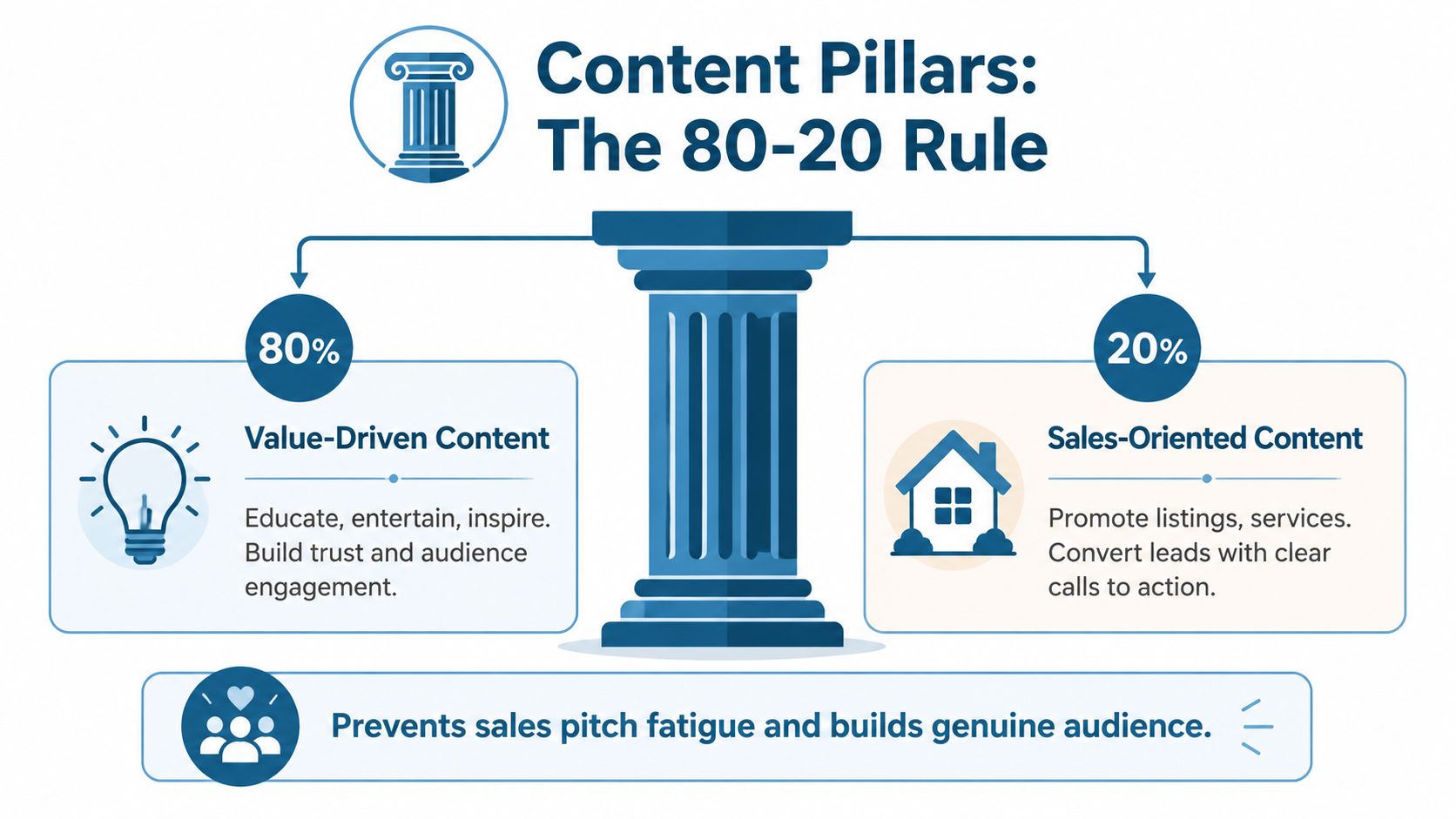
    The phrases that cause problems

    Most compliance issues don't start with obvious bad intent. They start with casual language that implies who a home is for, what kind of people belong in an area, or what life stage a buyer should be in.

    Examples of risky phrasing include:

    • “Perfect for families”
    • “Ideal for empty nesters”
    • “Safe neighborhood”
    • “Christian community”
    • “Great for young professionals”
    • “Close to top schools” if written in a way that signals preference rather than objective location context

    The problem is scale. An agent might catch one questionable caption when writing manually. With automation, dozens of posts can go out before anyone notices a pattern.

    Why review can't be optional

    Most guides on social automation focus on scheduling and consistency. They spend very little time on legal risk. Hootsuite’s discussion of the topic points to Fair Housing compliance as an underserved issue in social media automation, especially where automated content can generate discriminatory language, and notes the need for compliance-focused AI workflows in its real estate social media automation coverage.

    That’s the right concern. Fast publishing without screening is not operational maturity. It’s just faster exposure.

    A caption can be well written, on-brand, and still be noncompliant.

    Build compliance into the workflow itself

    The safest setup is one where compliance review happens before publishing, not as an afterthought.

    That workflow should include:

    • Pre-publish scanning: Flag language related to protected classes or implied preferences
    • Editable drafts: Let agents revise generated copy before approval
    • Template controls: Use prompts and templates that avoid risky audience descriptors
    • Broker review paths: For teams and brokerages, route flagged posts to a designated approver

    If you're evaluating how AI-generated property marketing should stay inside platform and MLS rules, this guide to MLS-compliant AI content for real estate is a practical reference point.

    The trade-off is simple. The faster you want to publish, the more disciplined your safeguards need to be. Automation should reduce repetitive work. It should never reduce judgment.

    Monitoring Performance and Optimizing for ROI

    Most agents either ignore analytics or drown in them. Neither helps. You don't need a giant reporting stack to improve your results. You need a short list of questions and a habit of checking the answers.

    A hand using a stylus on a tablet showing a social media analytics dashboard with engagement data.

    Separate vanity metrics from business metrics

    Follower count has some signaling value, but it won't tell you whether your system is producing business. Likes are encouraging, but they can also hide weak lead quality.

    Track metrics that connect to client conversations:

    • Qualified DMs: People asking about a specific listing, timing, financing, or next steps
    • Appointment clicks: Visits to your consult or showing booking link
    • Listing traffic: Clicks from social to property pages
    • Response-driven posts: Content that generates comments or messages with clear intent
    • Platform contribution: Which channels bring inquiries you can pursue

    Use a simple review cadence

    A monthly review is enough for most solo agents. Weekly can work for teams running higher volume, but only if someone owns the process.

    Review your content in three buckets.

    What attracted attention

    Start with reach, saves, shares, comments, and view duration on video. This tells you what stopped the scroll.

    Look for patterns:

    • Did listing walkthroughs hold attention better than static photos?
    • Did local commentary outperform generic tips?
    • Did short carousels get more saves than long captions?

    What created action

    This is the business layer. Which posts led to DMs, clicks, or inquiries? A post can have modest engagement and still be valuable if it starts real conversations.

    Create a simple spreadsheet or dashboard with:

    Content piece Platform Main objective Result
    Open house reel Instagram DM inquiries High / Medium / Low
    Market update post Facebook Listing traffic High / Medium / Low
    Buyer tips carousel LinkedIn Consultation clicks High / Medium / Low

    What deserves another version

    Optimization is achieved at this point. Don't just admire a strong post. Rebuild it.

    If a reel introducing a new listing gets strong response, make another version with a different opening shot or hook. If a seller tip carousel drives profile visits but not DMs, rewrite the final slide with a clearer call to action.

    Keep this test clean: Change one variable at a time. Hook, image order, post format, or CTA. If you change everything, you won't know what helped.

    Compare formats, not just topics

    Many agents test content ideas but never test delivery. That's a mistake. The same message can perform very differently as a reel, carousel, story sequence, or single image with a strong caption.

    A practical A/B workflow looks like this:

    1. Publish one listing as a short video walkthrough.
    2. Publish another comparable listing as a static carousel.
    3. Keep the call to action similar.
    4. Compare which one produces more meaningful inquiries.
    5. Apply that lesson to the next batch.

    The point isn't to chase every trend. It's to learn what format your audience responds to in your market.

    Cut what looks active but doesn't move business

    If a recurring post type gets views but never contributes to inquiry, visibility, or trust, demote it. If a platform takes time but produces no workable leads, narrow your effort there and redirect time to the channels that matter.

    Good automation creates a feedback loop. Strong posts get repeated in smarter versions. Weak posts get retired. Over time, your feed stops being a random collection of content and starts acting like a lead system.

    Your Automation Launch Checklist

    A working system is easier to build than most agents think. The hard part is doing the setup in the right order and resisting the urge to overcomplicate it. Start lean. Get the machine running. Improve from there.

    Real Estate Social Media Automation Launch Checklist

    Phase Task Status (To Do / Done)
    Strategy Define your primary audience and transaction focus To Do / Done
    Strategy Choose the social platforms you will actively support To Do / Done
    Strategy Set one lead goal, one visibility goal, and one efficiency goal To Do / Done
    Strategy Write a short brand voice guide for captions, comments, and CTAs To Do / Done
    Content Create two content pillars, property-centric and authority-building To Do / Done
    Content List your recurring post categories such as listings, buyer tips, neighborhood posts, and seller advice To Do / Done
    Content Build branded templates for each recurring post type To Do / Done
    Content Draft a monthly content calendar with a repeatable weekly rhythm To Do / Done
    AI visibility Rewrite bio, captions, and listing copy with clear local market language To Do / Done
    AI visibility Make sure property posts include structured details and location context To Do / Done
    AI visibility Confirm your website or listing pages support schema where available To Do / Done
    Tools Pick your scheduler and decide whether to use an all-in-one platform or assembled stack To Do / Done
    Tools Connect social accounts and verify publishing permissions To Do / Done
    Tools Connect listing sources or establish a process for importing approved listing content To Do / Done
    Tools Set up a simple analytics dashboard or tracking sheet To Do / Done
    Workflow Create queues for evergreen authority content and active listing content To Do / Done
    Workflow Set up automations for new listings, open houses, price changes, pending, and sold updates To Do / Done
    Workflow Create DM and comment response templates for common lead scenarios To Do / Done
    Compliance Add a pre-publish review step for listing and neighborhood content To Do / Done
    Compliance Review all templates for Fair Housing risk language To Do / Done
    Compliance Establish approval rules for solo use, team use, or brokerage oversight To Do / Done
    Launch Schedule your first month of posts To Do / Done
    Launch Test every link, lead form, and booking path before publishing To Do / Done
    Launch Assign a daily engagement block for comments and DMs To Do / Done
    Optimization Review results at the end of the first month and identify top-performing formats To Do / Done
    Optimization Retire weak post types and rebuild strong ones into repeatable series To Do / Done

    A few launch habits that make the system work

    The stack matters, but habits keep it alive.

    • Protect a short engagement window every day: Automation can publish for you, but replies still need your voice.
    • Approve high-risk content before it goes live: Listing and neighborhood posts deserve extra scrutiny.
    • Batch one month ahead when possible: The system feels much lighter when you’re not posting from zero each week.
    • Keep your content library organized: Save captions, reels, templates, and listing assets where you can reuse them quickly.
    • Review one lesson, not ten: After each month, identify one thing to improve first.

    Most agents don't need more content ideas. They need a cleaner operating system. Once your social presence is tied to real goals, AI-readable content, controlled workflows, and compliance checks, automation stops feeling like marketing busywork and starts acting like business infrastructure.


    If you want one platform that combines listing-based content generation, authority content, AI-readable outputs, and pre-publish Fair Housing scanning, ListingBooster.ai is built for that workflow. It’s a practical fit for solo agents who need speed, teams that need consistency, and brokerages that need more control without adding manual content production to every agent’s week.

  • How to Write SEO Articles for Real Estate Leads in 2026

    How to Write SEO Articles for Real Estate Leads in 2026

    More than 40% of homebuyers now start their search in AI tools rather than conventional search engines, according to Luxury Presence’s overview of AI-driven real estate search behavior. That changes the job of a real estate article.

    An article can’t just rank. It also has to be easy for ChatGPT, Perplexity, and Google AI Overviews to understand, extract, summarize, and cite. If your content is buried in long paragraphs, vague claims, and generic city pages, AI tools skip right past it. So do serious buyers and sellers.

    That’s why how to write seo articles for real estate leads now means something different than it did a few years ago. You still need keyword targeting, internal links, and useful local content. But you also need clean structure, extractable answers, compliance-safe wording, and technical signals that tell search engines what the page is.

    Agents who get this right create durable assets. The article keeps attracting search traffic, supports social content, feeds email nurture, and gives AI systems clear material to pull into answers. Agents who get it wrong keep publishing blog posts that look busy but don’t produce conversations.

    The New Reality of Real Estate Content in the Age of AI

    The old playbook treated search as a Google-only problem. Write a post, add a keyword, tweak the title tag, and hope it climbs. That’s no longer enough.

    Buyers and sellers are asking AI tools direct questions like “best neighborhoods for remote workers in Raleigh,” “what should I know before selling in North Scottsdale,” and “who’s a good listing agent near me?” If your site doesn’t contain direct, structured answers, you won’t show up in those recommendation paths.

    AI systems prefer content they can parse quickly. They look for clear headings, short answer blocks, FAQ-style sections, concrete local context, and a page structure that signals expertise without forcing the model to guess what matters. In practice, that means the agent who writes the clearest page often beats the agent who writes the flashiest one.

    Practical rule: Write every article so a human can skim it in under a minute and an AI model can extract key facts in seconds.

    A lot of agents still publish articles that sound like recycled MLS remarks. They’re full of broad claims, weak local detail, and keyword stuffing that signals “manufactured content.” AI tools don’t reward that. Neither does Google.

    A better approach is a hybrid one. You write for search rankings and for AI retrieval at the same time. If you want a useful outside framework for that shift, QuickSEO’s guide to hybrid strategy is worth reading because it maps the overlap between classic SEO signals and AI discoverability.

    What changed in practical terms

    Three writing habits matter more now than they used to:

    • Clear answer formatting: Put important answers directly under the heading where the question appears.
    • Local proof of expertise: Include observations only an active market participant would know how to explain.
    • Machine-readable structure: Use bullets, short sections, and schema-friendly organization so the page is easy to interpret.

    Agents don’t need to become technical SEOs to adapt. They need to stop writing blog posts like essays and start writing them like well-organized market resources.

    Finding Keywords That Attract Motivated Sellers and Buyers

    The fastest way to waste time in content marketing is to chase vanity keywords.

    “Miami real estate” looks attractive because it sounds broad and important. It’s also vague, competitive, and often disconnected from the exact moment a buyer or seller needs help. The terms that pull in stronger leads usually sound smaller, more specific, and more practical.

    The strategy behind one real estate SEO win that produced a 67% increase in organic traffic focused on long-tail, location-specific keywords, and those terms showed a 3-5% higher click-through rate than generic searches because they matched the intent of the 69% of home shoppers who begin with a local term, as summarized in The Marketing Agency’s case study roundup.

    An infographic showing a five-step real estate keyword strategy for attracting motivated buyers and sellers.

    Start with intent, not volume

    A useful keyword usually tells you four things:

    1. Who the person is
      First-time buyer, move-up seller, investor, relocating family, downsizer.

    2. What they need right now
      School guidance, pricing expectations, neighborhood comparison, prep before listing.

    3. Where they want it
      A city, ZIP, suburb, school district, or neighborhood.

    4. How close they are to action
      Curiosity, evaluation, shortlist building, or ready to contact.

    That’s why “best neighborhoods in Plano for families” is more valuable than “Plano real estate.” One shows research intent. The other often reflects casual browsing.

    A practical research workflow

    Use a mix of your own conversations, search results, and keyword tools. Don’t overcomplicate it.

    • Mine real client questions: Pull questions from listing appointments, buyer consults, DMs, and email replies. If people ask the same question in person, they’re likely searching for it too.
    • Use Google’s built-in prompts: Look at autocomplete, People Also Ask, and related searches for local phrases.
    • Check paid tools for validation: Ahrefs or Google Keyword Planner can help confirm whether the phrase has enough local demand to justify a page.
    • Review competitor gaps: Search your target phrase and note what current ranking pages miss. Often they’re thin, outdated, or generic.
    • Translate the phrase into article format: Turn “best condos in downtown Tampa for young professionals” into an article that directly matches that wording and intent.

    Separate money keywords from content filler

    A strong real estate content plan has both lead-intent topics and authority topics. But don’t confuse one for the other.

    Keyword type Example Why it matters
    High-intent buyer “homes for sale in [neighborhood]” Captures active search behavior
    High-intent seller “how to sell a house in [area]” Aligns with listing-side conversations
    Comparison “[neighborhood A] vs [neighborhood B]” Reaches buyers narrowing options
    Relocation “moving to [city]” Brings in out-of-area prospects
    Support topic “best coffee shops in [area]” Useful only if tied to a larger cluster

    If a keyword could realistically appear in a client text message before they hire you, it’s usually worth testing.

    What strong topics look like

    You don’t need hundreds of ideas. You need a shortlist that maps to real decisions.

    Here are the types of article topics that usually outperform broad city pages:

    • Neighborhood guides: Specific, detailed, and useful for both search and AI retrieval.
    • Neighborhood comparisons: Helpful when buyers are deciding between two short-listed areas.
    • Buyer and seller prep articles: Topics like what to know before listing, buying timelines, or local closing process expectations.
    • Market interpretation pieces: Not just “market update,” but “what current inventory conditions mean if you’re selling in [area].”

    For a deeper list of topic patterns that fit this model, ListingBooster’s long-tail keyword guide for real estate agents is a practical reference.

    What doesn’t work

    Three things consistently drag performance down:

    • Broad head terms: Too competitive and too unfocused.
    • One-off blogging: A random article about staging, then one about mortgages, then one about restaurants. No topical signal.
    • City copy with no local texture: If the article could apply to ten markets with only the city name swapped, it won’t build authority.

    The right keyword isn’t just searchable. It’s answerable in a way that shows you know the market better than a national portal.

    Crafting Your AI-Optimized Article Structure

    Once you’ve chosen the keyword, the structure decides whether the page becomes useful or forgettable.

    A lot of agents lose the opportunity here. They know the topic, but they bury the answer under long intros, generic lifestyle copy, and paragraphs that never resolve the reader’s question. AI tools struggle with that kind of page because the hierarchy is weak. Human readers leave for the same reason.

    A professional working on a tablet device to draft a strategic blueprint for content creation.

    A stronger article reads like a map. The title names the topic. The opening answers it directly. Each subheading handles one sub-question. The page includes skimmable facts, short sections, and obvious next steps.

    Build around content clusters

    Topical authority comes from publishing related pages that reinforce each other, not from trying to make one article do everything. A systematic cluster approach built around 12-15 detailed neighborhood guides and related supporting content can move a new site from unranked to top 5 positions and 10-15 leads per month within 12 months, with faster ranking movement after 15-20 guides, according to Jeff Lenney’s real estate SEO guide.

    That matters because AI systems also look for consistency. If your site has one thin page on a neighborhood, you look like a dabbler. If you have a guide, a comparison article, a market update, and a buyer prep piece all linked together, you look like a specialist.

    The article layout that works

    Here’s a structure that tends to perform well for both search and AI extraction:

    For a neighborhood guide

    • Direct intro: Answer what the area is known for and who it tends to fit.
    • Quick facts block: Commute feel, housing style, local amenities, buyer profile, price positioning described qualitatively unless you’re using verified local data.
    • Who this area fits: Buyers who value walkability, larger lots, new construction, lower-maintenance living, and so on.
    • What buyers should know before moving there: Traffic flow, lot sizes, HOA patterns, housing stock age, redevelopment activity.
    • FAQ section: Specific questions buyers ask.
    • CTA: Offer a next step tied to that neighborhood.

    For a market update

    Don’t write a diary entry about the market. Write an interpretation piece.

    Use subheads like:

    • What changed locally
    • What sellers should do now
    • What buyers should watch
    • Questions clients are asking this month

    That structure gives AI tools clean answer blocks and gives readers usable takeaways.

    For a moving-to article

    This format works well:

    Section What to include
    Opening answer Why people consider the move
    Neighborhood fit Which areas suit different lifestyles
    Home search realities Inventory feel, pace, trade-offs
    Local logistics Commute, amenities, schools, services
    Next step Invite a conversation or guide request

    A strong real estate article doesn’t try to sound impressive. It tries to make decisions easier.

    Make the page extractable

    Think in chunks, not pages. AI tools often pull a paragraph, a bullet list, or a short FAQ answer, not your full article.

    That means your outline should include:

    • Question-style H2s and H3s
    • Standalone bullet lists
    • Short definition-style paragraphs
    • FAQ blocks with direct answers
    • Internal links to closely related pages

    If you use an AI drafting workflow, your process should benefit here the most. Generating a strong first outline is efficient. The local observations, nuance, and final organization still need a human hand. That stage is where brokerage-grade content usually separates itself from generic AI output.

    Writing Content That Converts and Complies

    The strongest real estate article usually isn’t the one with the fanciest prose. It’s the one that sounds clear, grounded, and useful without crossing compliance lines.

    That balance matters more than agents think. Readers need confidence that you understand the market. They also need language that feels readable, not overproduced. According to Follow Up Boss’s SEO tactics for Realtors, the most effective lead-generation articles are written at a 6th-grade readability level, use short paragraphs and bullet points to drive average time-on-page above 3 minutes, and 60% of readers are inspired to contact an agent after reading a high-quality blog post.

    Write like an advisor, not a brochure

    Most underperforming agent content has one of two problems.

    It either sounds sterile and machine-written, or it sounds like sales copy trying too hard to create excitement. Neither builds trust. The better path is simple language paired with concrete market perspective.

    That means:

    • Use short sentences when the point is practical.
    • Cut filler introductions.
    • Replace buzzwords with specifics.
    • Explain trade-offs clearly.

    A line like “This neighborhood offers an exceptional lifestyle with something for everyone” says almost nothing. A line like “Buyers usually choose this area for lot size, newer renovations, and easier access to the highway corridor” gives the reader a reason to keep going.

    Your local expertise is the differentiator

    AI can draft. It can’t attend your listing consultations, hear recurring objections, or notice the subtle reasons one pocket of a neighborhood sells faster than another.

    Use that advantage in your writing:

    • Mention the questions buyers repeatedly ask.
    • Describe how locals use an area.
    • Explain trade-offs without overselling them.
    • Add context around inventory, renovation styles, commute patterns, and decision friction.

    Field note: The details that convert are usually the ones a portal won’t write. Why buyers hesitate, what sellers misunderstand, and what changes the conversation once they tour the area.

    Fair Housing compliance needs to be built into the draft

    Many agents often become careless in this particular area. They know compliance matters for ads and listings, but they forget blog content creates the same risk.

    Don’t describe who should live in an area. Describe the features, access points, housing stock, amenities, and use cases. Don’t imply protected classes. Don’t code language around age, religion, family status, or ethnicity. Don’t write in a way that filters people in or out.

    For a useful primer on how AI-generated copy intersects with MLS and compliance concerns, this article on MLS-compliant AI content covers the writing discipline agents need before publishing.

    Fair Housing-compliant content blocks for use with ListingBooster.ai

    Block Type Compliant Example Usage Note
    School section “Buyers often ask about school options in this area. Include neutral references to public information sources and encourage readers to verify current enrollment, boundaries, and program availability directly with the appropriate district.” Keep this informational. Avoid suggesting the area is ideal for a particular family type.
    Amenities section “Residents have access to parks, retail, dining, trails, and commuter routes nearby. The best fit depends on how you prioritize convenience, outdoor access, and daily routine.” Focus on features and access, not on who belongs there.
    Housing stock section “The neighborhood includes a mix of property styles, lot sizes, and renovation levels, which gives buyers several options depending on maintenance preferences and budget comfort.” Describe the homes, not the demographic profile of likely occupants.
    Market analysis section “Recent activity can help sellers understand positioning and help buyers assess competition, but pricing and timing still depend on condition, presentation, and current local demand.” Keep analysis educational and avoid unsupported predictions.
    Lifestyle summary “This area appeals to buyers for different reasons, including location, housing variety, and access to everyday amenities.” Use broad, inclusive phrasing.
    CTA block “If you want help comparing neighborhoods or preparing a pricing strategy, reach out for a customized plan based on your goals.” Invite action without pressure or exclusionary language.

    CTAs that create leads without sounding needy

    A weak article ends with “Contact me today for all your real estate needs.” That’s generic and easy to ignore.

    A stronger CTA matches the article topic:

    • Neighborhood guide CTA: Offer a shortlist of similar areas.
    • Seller article CTA: Offer a local pricing strategy review.
    • Buyer prep article CTA: Offer a timeline or next-step checklist.
    • Comparison article CTA: Offer help narrowing the best-fit option.

    The CTA should feel like the logical next move, not a hard pivot into self-promotion.

    Implementing Technical Signals for AI and Google Search

    Good writing helps your page get understood. Technical signals help platforms classify it correctly.

    The most useful of those signals for real estate content is schema markup. In simple terms, schema is structured data that tells search engines what the page contains. It removes guesswork. Instead of hoping Google interprets a page correctly, you label it.

    A person using a laptop to code Schema Markup for a real estate property listing online.

    What schema does for real estate articles

    For an agent site, schema can clarify whether a page is:

    • An Article
    • A FAQ page
    • A Real estate listing
    • A page tied to a local business or organization

    That matters because AI tools and search engines rely on clean signals. If your article is clearly marked as an expert guide and your listing page is clearly marked as a property page, your site becomes easier to interpret and more likely to qualify for enhanced visibility.

    A simple non-technical workflow

    You don’t need to hand-code everything from scratch.

    Step 1

    Choose the schema type that matches the page. For a blog post, start with Article. If the page includes a well-structured question section, FAQPage may also be relevant. For actual property pages, use a real-estate-specific schema format where available.

    Step 2

    Use a schema generator or Google’s structured data helper to build the markup. Fill in the basics accurately: headline, author, date published, page URL, and page description.

    Step 3

    Add the markup to the page through your CMS, SEO plugin, site builder, or developer workflow. Most modern website platforms make this manageable without touching complex code.

    Step 4

    Validate it. Run the page through a schema validation tool and fix obvious errors before publishing.

    Search engines can read prose. Schema helps them trust what they’re reading.

    The signals most agents miss

    Schema matters, but it isn’t the only technical cue that helps.

    Signal Why it matters
    Clean heading hierarchy Helps crawlers and AI systems understand page structure
    Internal links Shows relationship between your cluster pages
    Descriptive metadata Gives search engines concise page summaries
    Image alt text Adds context and accessibility
    FAQ formatting Improves extractability for answer engines

    Agents often think technical SEO means chasing obscure tricks. Usually, the bigger win comes from doing the fundamentals cleanly and consistently.

    If you want a real estate-specific primer, this guide to schema markup for real estate listings is a useful reference point for what to label and where it applies.

    Where tools fit

    This is one area where automation proves beneficial. An AI-assisted workflow can draft article structure, help format FAQs, and support schema implementation without forcing an agent to become a developer. ListingBooster.ai, for example, generates AI-optimized real estate content and supports schema-ready output for real estate marketing workflows. That doesn’t replace review, but it does reduce the manual setup work that usually keeps agents from publishing consistently.

    Your Post-Publish Checklist for Distribution and Measurement

    Publishing is the midpoint. The article only becomes a lead asset when you distribute it, repurpose it, and measure what happened next.

    Too many agents stop at “post went live.” That leaves most of the value on the table. One authority article should feed your social channels, email list, internal linking strategy, and client follow-up content.

    A person using a laptop to review an action checklist for publishing and distributing digital articles.

    Recent industry guidance summarized by Market Leader’s discussion of real estate SEO and repurposing notes that agents gain significantly more leads by turning one authority article into multiple compliant micro-assets, yet few guides explain how to break an article into Instagram, LinkedIn, and TikTok-ready snippets while preserving keyword intent and Fair Housing compliance.

    Turn one article into a content system

    A neighborhood guide can become:

    • An Instagram carousel: Key reasons buyers consider the area
    • A LinkedIn post: A market perspective angle
    • A short-form video script: Three things buyers should know before touring homes there
    • An email segment: A quick neighborhood spotlight to your database
    • A downloadable checklist: “Questions to ask before buying in [area]”
    • An FAQ page: Short answers extracted from the original article

    That’s where most agents increase output without creating new topics from scratch.

    A post-publish operating checklist

    Use this after every article goes live.

    Distribution

    • Share on social with angle changes: Don’t post the article link with the same caption everywhere. Reframe for each platform.
    • Send to your email list: Pull one strong takeaway into the email body and link to the full article.
    • Link from related pages: Add the new article to older neighborhood guides, buyer pages, and seller pages where relevant.
    • Send it in direct follow-up: If a prospect asks a question the article answers, use it in your reply.

    Measurement

    • Watch search queries: Check which phrases the article starts appearing for in Google Search Console.
    • Review engagement quality: Time on page, scroll behavior, and page path matter more than raw traffic alone.
    • Track lead actions: Measure form fills, calls, booked consults, and CRM source attribution.
    • Refresh based on behavior: If readers drop off before the FAQ or CTA, improve the structure and move key information higher.

    Repurposing discipline

    • Keep language compliant: Social snippets need the same Fair Housing care as the original article.
    • Preserve the core keyword intent: Don’t turn a seller article into generic lifestyle content when repurposing it.
    • Adjust CTA by channel: A blog CTA can ask for a consult. A social CTA might ask for a DM or comment.

    Most articles fail after publishing, not during writing. They never get distributed with enough intention to produce a compounding return.

    What good measurement looks like

    A strong article should answer three business questions:

    Question What to look for
    Is it getting found? Search impressions, ranking movement, discovery queries
    Is it being consumed? Time on page, scroll depth, click path to related pages
    Is it influencing leads? Form submissions, calls, replies, CRM attribution

    If the page gets traffic but no next-step behavior, the issue is usually fit, structure, or CTA. If it gets no traffic, the issue is usually topic selection, weak internal linking, or low topical authority.

    Content teams that win at SEO rarely treat an article as a finished product. They treat it as the first version of an asset that gets distributed, tested, and improved.

    Becoming the Go-To Agent in an AI-First World

    The agents who win organic visibility over the next few years won’t be the ones publishing the most content. They’ll be the ones publishing the clearest, most useful, most structured content in their market.

    That means choosing local-intent topics. It means building clusters instead of random blog posts. It means writing in plain language, formatting for extraction, and keeping every page compliant. It also means handling the technical layer well enough that Google and AI tools can classify your work without guessing.

    This is the larger shift behind how to write seo articles for real estate leads. You’re not just writing to rank for a keyword. You’re building a digital footprint that search engines and AI assistants can trust when someone asks for local real estate guidance.

    Agents who want a broader view of how content fits into the full online visibility picture can also review this guide to digital marketing for agents, which complements the search-focused approach with channel-level execution ideas.

    The payoff is durable authority. A good article keeps working after you log off. It supports your listing presentation, strengthens your brand, answers objections before a lead contacts you, and gives AI platforms a reason to surface your name when buyers and sellers ask who to trust locally.

    Stop publishing content that sounds finished but does nothing. Build pages that help people make decisions, and structure them so both humans and machines can use them.


    If you want a faster way to produce compliant, AI-readable real estate content at scale, ListingBooster.ai helps agents, teams, and brokerages generate neighborhood guides, market updates, and listing content designed for both search visibility and day-to-day marketing execution.