Blog

  • AI-powered real estate marketing: Boost Listings and Close More Deals

    AI-powered real estate marketing: Boost Listings and Close More Deals

    At its core, AI-powered real estate marketing is about using smart software to handle the repetitive, time-consuming tasks that bog agents down. Think about crafting property descriptions, scheduling a month's worth of social media posts, or digging through market data. AI automates and improves these jobs, freeing you up to focus on what truly matters: building client relationships and closing deals.

    It’s the key to gaining a real advantage in a market that waits for no one.

    Winning the First Click in an AI-Driven World

    A hand holds a 'WIN THE FIRST CLICK' sign in front of a modern house and a woman with a brochure.

    The old real estate marketing playbook is officially obsolete. For years, the formula was simple: get your website ranked on Google, throw some money at social media ads, and wait for the leads to trickle in. But that entire model is built on a foundation that's cracking, because the way clients search for homes has fundamentally changed.

    A huge chunk of the market isn't starting on Google anymore. They're asking conversational AI tools for recommendations. This is a massive shift. Traditional SEO was a game of matching keywords. The new game is about becoming such a trusted authority that an AI recommends you by name. If your marketing isn't built for AI to find and understand, you’re basically invisible to this growing group of buyers.

    The New Search Landscape

    Let this sink in: over 40% of homebuyers now begin their search using AI tools like ChatGPT, Perplexity, and Google's AI Overviews, not a standard search bar. This isn't a small trend—it’s a seismic shift that rewrites the rules of digital visibility. For agents sticking to the old ways, this means a huge portion of potential clients will never even see their listings. You can dive deeper into the numbers with these real estate marketing statistics to see just how fast this is happening.

    This is more than just a new tech fad; it's a completely different way for expertise to be discovered online. AI-powered real estate marketing isn't just a nice-to-have; it's the necessary response to meet modern buyers and sellers where they're actually looking for answers.

    Think of it like this: Traditional marketing was like putting a billboard on a busy highway. AI-powered marketing is like having a trusted local guide who personally recommends you to every traveler asking for the best place to live.

    Why Your Old Marketing Habits Are Failing

    The biggest problem with the old way is that manual marketing efforts just can't keep up anymore. The sheer volume of work—fresh social media content every day, perfectly optimized listing descriptions, and up-to-the-minute market analysis—is enough to burn out even the most dedicated agent.

    Take a look at how the daily grind of real estate marketing is being completely reshaped by AI. The table below contrasts the time-consuming tasks of yesterday with the intelligent, automated workflows available today.

    Old Marketing Habits vs New AI Strategies

    Marketing Task The Traditional Manual Approach The Modern AI-Powered Approach
    Listing Descriptions Spending hours writing and rewriting descriptions, trying to fit different portal requirements. Instantly generate multiple versions of a compelling description, each tailored for MLS, Zillow, social media, and more.
    Social Media Posting sporadically "when you have time," leading to an inconsistent and ineffective online presence. An automated calendar posts high-quality, relevant content for you daily, building a consistent and authoritative brand.
    Lead Nurturing Manually responding to every inquiry, often with a delay that costs you the lead. AI-driven chatbots provide instant, 24/7 responses to common questions, qualifying leads while you sleep.
    Market Analysis Spending days pulling comps and manually crunching numbers to understand local market trends. Generate in-depth, hyper-local market reports in minutes, positioning yourself as the neighborhood expert.
    Content Creation Struggling with writer's block to create blog posts or neighborhood guides to boost SEO. Produce well-researched, engaging articles and community content with a few clicks, establishing your digital authority.

    As you can see, the shift isn't just about saving time; it's about producing better, more consistent results that manual methods simply can't match.

    An AI-driven strategy positions you as an authority before you even get the listing. It builds your reputation as the go-to expert in your market, so when a user asks an AI, "Who is the best agent in Anytown, USA?"—your name is the one that comes up.

    Adopting AI-powered real estate marketing is more than an upgrade. It’s a strategic decision to stay relevant and win that all-important first click in this new digital arena.

    How AI Works as Your Marketing Co-Pilot

    Let's cut through the jargon. What is AI-powered real estate marketing, really? It’s not some complicated, futuristic robot taking over your job. It's much simpler and more practical than that.

    Think of it like having a dedicated marketing assistant—a co-pilot—sitting next to you. This co-pilot handles all the tedious, repetitive digital marketing tasks that eat up your day. You know the ones: writing property descriptions, scheduling social media posts, and formatting everything for different websites.

    This isn't about replacing your expertise; it's about amplifying it. The AI does the heavy lifting in the background, freeing you up to focus on what you do best: building relationships, negotiating deals, and being the trusted guide your clients need. It’s a force multiplier that takes one simple input—a property address—and spins it into a complete marketing campaign.

    Turning a Single Address into a Full Campaign

    The real magic happens when you see how an AI system connects the dots. When you give a tool like ListingBooster.ai a property address, it doesn't just see a pin on a map. It instantly dives into a sea of data to build a smart marketing plan from the ground up.

    Here’s a quick look under the hood:

    • It Gathers the Intel: The AI pulls from public records, MLS data, and current market trends tied to that specific property. It instantly identifies the key selling points, neighborhood perks, school districts, and recent comps.
    • It Writes the Story: Using all that data, it starts writing. It doesn't just spit out one generic description; it creates multiple versions tailored for different platforms—a detailed one for the MLS, a punchy one for Zillow, and a short, engaging one for an Instagram caption.
    • It Builds the Campaign: This goes way beyond just descriptions. The AI maps out an entire content plan for you. It designs social media posts for the new listing, graphics for the open house, "just sold" announcements, and even local market updates that establish you as the go-to expert.

    What used to take hours of painstaking work—or even days, if we're being honest—is now done in minutes. Every single one of your listings gets a professional, comprehensive marketing launch without you having to sacrifice your valuable time.

    The Core Jobs of Your AI Co-Pilot

    At its core, your AI co-pilot is built to handle three critical parts of your marketing: creating content, optimizing your listings on portals, and managing your social media. By taking these off your plate, it consistently builds your online presence, almost on autopilot.

    Your AI co-pilot doesn't just save you time—it builds a consistent, professional brand that works around the clock. It's the engine driving your digital reputation, making sure you’re always visible and authoritative online.

    Let's break down what this looks like day-to-day.

    • Compelling Listing Descriptions: No more writer's block. The AI crafts descriptions that are both factually accurate and emotionally resonant, using proven sales copy techniques to grab a buyer's attention and highlight a home's best features.
    • Automated Social Calendars: It actually plans out a full 30-day social media schedule based on your listings and the local market. This means you maintain a consistent, engaging presence on Facebook and Instagram without the daily stress of wondering what to post.
    • Property Portal Optimization: The AI knows that a listing description for your local MLS needs a different touch than one for a national portal like Zillow. It creates unique, optimized content for each one, helping your listings stand out and get seen by more potential buyers.

    By weaving these tasks together, AI-powered real estate marketing creates a self-sustaining system for your brand. Every new listing becomes another opportunity to reinforce your expertise, capture new leads, and solidify your reputation as the agent to know in your market. That consistent, high-quality output is exactly how you build a dominant digital footprint.

    Building Your Automated Content Engine

    Let's be honest, the daily grind of content planning is a huge time suck. That feeling of staring at a blank cursor, trying to figure out what to post on Instagram or how to word a new listing description—it’s exhausting. What if you could get rid of that stress for good? This is where an AI-powered real estate marketing engine comes in, and it's less science fiction and more practical magic.

    The whole idea is to take what used to be a week's worth of marketing prep and shrink it down to just a few minutes. You start with one simple piece of information, usually just the property address, and the system does the rest. It spits out a complete, ready-to-go marketing campaign. This isn't just about saving time; it's about giving every single one of your listings the top-tier, professional launch it deserves, without fail.

    This flow chart breaks it down perfectly. A single address goes in, the AI works its magic, and a full campaign comes out the other side.
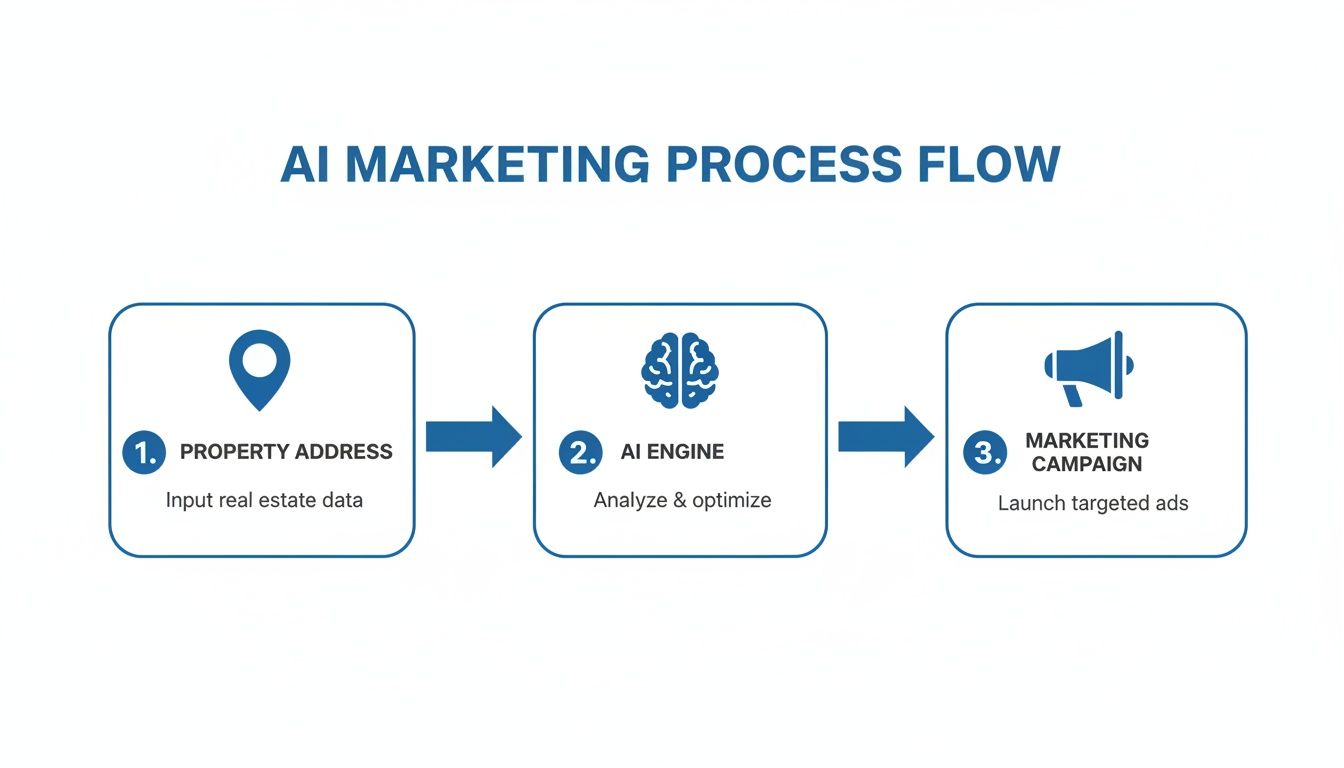
    AI marketing process flow for real estate, showing data input, AI analysis, and targeted ad campaigns.

    The real takeaway here is the straight line from a simple input to a sophisticated, multi-channel output. It pulls you out of the most tedious parts of marketing.

    Crafting a Diverse and Engaging Content Mix

    A smart AI tool knows that a successful social media feed isn't just an endless stream of "New Listing!" posts. That gets old, fast. To keep people genuinely interested, you need variety. The goal is to build a dynamic content calendar that tells the full story of a property and, just as importantly, reinforces your expertise.

    An automated engine will generate a whole mix of content, with each piece tailored for a specific moment in that listing's journey.

    • New Listing Announcements: These are your big, flashy first impressions, designed to grab attention with the property's best features.
    • Open House Promotions: Think engaging graphics and captions that create a little FOMO (fear of missing out) and drive people to your event.
    • Price Adjustment Updates: A good AI frames a price drop not as a failure, but as a fresh opportunity for motivated buyers.
    • "Just Sold" Celebrations: This is all about social proof. These posts show off your success and build trust in your local market.
    • Neighborhood Spotlights: You’re selling a lifestyle, not just four walls. This content highlights local parks, coffee shops, and schools to paint a bigger picture.

    With a platform like ListingBooster.ai, this entire suite of content gets created from a single property link. It helps you maintain a consistent, professional, and authoritative voice across Facebook, Instagram, TikTok, and wherever else you’re active. For more ideas on building your brand, you can find a ton of great tips on the ListingBooster.ai blog.

    The Psychology Behind Scroll-Stopping Captions

    The best AI marketing tools don't just state facts; they act like seasoned copywriters. They lean on proven psychological frameworks to write captions that actually stop people from scrolling and get them to engage.

    This has nothing to do with robotic, generic text. It’s about tapping into the very real human emotions that drive big decisions, like buying a home.

    By embedding proven sales psychology directly into the content, an AI engine transforms a simple property update into a compelling call to action. It ensures your marketing resonates on an emotional level, not just an informational one.

    These systems are trained on marketing principles that have worked for decades. They know how to strategically weave these concepts into every post to get the biggest impact and inspire people to take the next step.

    Key Psychological Triggers in AI Content

    Here’s a look at how these triggers work in practice:

    Trigger How It's Used in Real Estate Marketing Example AI-Generated Post
    Scarcity Creates a sense of urgency by highlighting that the property is unique or won't be available for long. "The only home in the district with a walk-out basement under $500k. This one-of-a-kind opportunity won't last long!"
    Social Proof Builds trust by showing that others are interested or have had a positive experience. "We had over 20 groups through our open house this weekend! Don't miss your chance to see what everyone is talking about."
    Aspiration Helps buyers envision themselves living a better life in the new home. "Imagine your summer evenings spent on this beautiful patio. Your dream lifestyle is waiting at 123 Maple Street."

    By automatically baking these persuasive techniques into your posts, AI-powered real estate marketing turns your content from simple announcements into strategic assets that actually produce results. This automated engine doesn't just fill your calendar; it fills it with content that is engineered to convert, helping you build a powerful brand and a healthy sales pipeline with a fraction of the effort.

    Optimizing Listings for Both AI and Human Buyers

    Person holds a tablet displaying a house image and 'AI Optimized Listings' text, promoting real estate.

    In today's market, every property listing has two jobs. First, it has to connect with people on an emotional level, helping them picture their future in that home. But just as importantly, it needs to speak the language of algorithms, making sure it gets found by the AI systems that now power so many property searches.

    This dual focus is where you can find a huge, often overlooked, advantage. Writing a beautiful description isn't enough anymore. You have to strategically build your listings to be discoverable by people and machines, turning every property you represent into a magnet for the right audience.

    Speaking Two Languages at Once

    Think of it like this: your listing description has two completely different audiences. A human buyer is searching for a story. They want to feel the warmth of the "sun-drenched breakfast nook" or imagine hosting game night in the "spacious, open-concept living area." They respond to evocative language that paints a vivid picture.

    An AI algorithm, on the other hand, is scanning for cold, hard facts. It’s looking for structured data and specific keywords like "quartz countertops," "fenced backyard," and "three-car garage." It uses these data points to categorize the property and match it precisely to a user’s search. A truly effective AI-powered real estate marketing strategy delivers both.

    The art of modern listing optimization is crafting a narrative that captivates a human buyer while simultaneously embedding the structured data that AI search engines need to understand and recommend your property.

    Tailoring Descriptions for Every Platform

    One of the most time-consuming parts of marketing a new listing is tweaking the description for every single platform. The MLS has one character limit, Zillow has another, and an Instagram caption needs to be way shorter and punchier. Doing this manually for every property is a grind, and it often results in bland, copy-pasted text that doesn't perform well.

    This is exactly the kind of task an AI co-pilot was built for.

    • For the MLS: The AI can generate a detailed, comprehensive description loaded with all the essential features and keywords that other agents and their automated search tools are programmed to find.
    • For Zillow and Realtor.com: It whips up a more consumer-friendly version, highlighting lifestyle benefits and emotional hooks that grab the attention of buyers scrolling through the portal.
    • For Social Media: It produces short, scroll-stopping captions—complete with emojis and strong calls to action—perfectly formatted for platforms like Facebook and Instagram.

    Tools like ListingBooster.ai handle all of this automatically, generating multiple optimized versions of your description in seconds. This ensures your property looks its best on every channel, maximizing its reach without you lifting a finger. You can see more on how this works for individual agents seeking a competitive edge.

    Making Your Listings AI-Readable

    Beyond just using the right keywords, making a listing truly "AI-readable" involves something called schema markup. That might sound technical, but the idea is simple. It’s like adding invisible tags to your listing data that tell search engines like Google and ChatGPT precisely what each piece of information is.

    For example, instead of just seeing the number "3," schema markup tells the AI, "This number represents the bedroom count." This clarity helps AI systems confidently understand a property's features and serve it up to users asking specific questions like, "Show me three-bedroom homes with a pool near downtown."

    This structured approach is becoming crucial as the real estate AI market is projected to surge from $222.65 billion in 2024 to $303.06 billion in 2025, with AI expected to automate around 37% of industry tasks. By making your listings AI-readable now, you're positioning them to be found in this new search environment, giving yourself a distinct and lasting advantage.

    How to Scale Your Brokerage and Stay Compliant with AI

    As a real estate team or brokerage grows, a huge challenge surfaces. How do you keep your brand voice consistent and your marketing legally buttoned-up when dozens—or even hundreds—of agents are all creating their own content? This is exactly where AI-powered real estate marketing stops being just a cool productivity hack and becomes a critical tool for running the business.

    Left to their own devices, individual agents will naturally develop their own styles. That can lead to off-brand social media posts, wildly different messaging, and visuals that just don't meet the brokerage's standards. Over time, this erodes the brand you've worked so hard to build, making the whole operation look fragmented and less professional.

    Creating One Unified Voice for Your Entire Team

    Think of an AI platform as your central brand guardian. It’s a place where brokerage leadership can set up pre-approved templates, lock in a specific tone of voice, and make sure every single piece of marketing—from a just-listed post to a quarterly market report—sticks to the company playbook.

    This solves a massive operational headache. Instead of a manager having to manually review every agent's content or clean up the mess from a bad graphic, you empower the entire team with a tool that builds quality in from the start. Agents get to use professional-grade marketing assets, and the brokerage protects its identity, no matter how big it gets.

    This isn't about stifling creativity. It’s about giving every agent a professional framework that makes all of their marketing better. It means every agent, no matter their design experience, represents the brokerage with polish and authority.

    Automated Compliance That Manages Your Risk

    Branding is one thing, but the most important job AI can do for a brokerage is automate compliance. The risk of an agent accidentally violating Fair Housing laws with a poorly worded ad is a massive legal and financial liability. For any growing brokerage, trying to manually police every single caption and property description is a fool's errand.

    A smart AI marketing engine has compliance built right into its DNA. Before any content ever sees the light of day, the system automatically scans it for words and phrases that could be flagged as discriminatory or violate Fair Housing rules.

    This built-in check is constantly on the lookout for language that might suggest a preference or limitation based on protected classes, such as:

    • Familial Status: Catching phrases like "perfect for singles" or "no kids allowed."
    • Race or National Origin: Flagging any descriptions of a neighborhood's demographics.
    • Religion: Making sure that mentioning a nearby church or temple doesn't imply a religious preference.
    • Disability: Avoiding problematic terms like "not handicap accessible" in public-facing copy.

    This automated safety net completely changes the game for risk management. It turns AI-powered real estate marketing from a simple content tool into a powerful compliance engine that protects the brokerage from expensive lawsuits and damage to its reputation.

    For any organization ready to give their agents these kinds of safeguards, checking out the team options in a ListingBooster.ai pricing plan is the clear next move. It’s how you get enterprise-level protection that actually works for teams of any size.

    What Comes Next: Predictive and Agentic AI

    The AI tools making waves in real estate right now are mostly about generation—they're fantastic at writing property descriptions, drafting social media posts, and building marketing plans. That’s a huge time-saver, but it's really just the first inning of a whole new ballgame. The next leap forward is moving from creating content to autonomously performing tasks.

    Welcome to the world of predictive and agentic AI. Don't think of this as just a smarter writing assistant. Think of it as a junior agent who works around the clock, 24/7, without ever needing a coffee break.

    The Shift from Reactive to Proactive Marketing

    This jump from generative to agentic AI completely flips the script on how we approach marketing. For decades, our marketing has been reactive: you get a new listing, so you create a campaign for it. Agentic AI makes marketing proactive by figuring out what you need before you even know you need it.

    Imagine an AI that doesn't just write a "Just Listed!" post. Instead, it analyzes local market data and predicts the exact price point that will attract the most qualified buyers before the listing even goes live. Better yet, it could scan your CRM, find potential buyers who’ve looked at similar homes in the past, and have a targeted email campaign ready for your approval.

    This is the future of AI-powered real estate marketing—it’s not just about announcing what’s for sale. It’s about predicting who wants it and automatically reaching out to them. You're always two steps ahead of the market.

    Meet Your Future AI Agent

    The "agentic" part of agentic AI means the system can handle complex, multi-step jobs all by itself. For a real estate agent, this means handing off those time-sucking workflows that bog you down every day.

    Research from Gartner suggests that by 2028, approximately 15% of day-to-day work decisions could be made by AI agents. What does that actually look like? An AI could have a text conversation with a new lead to qualify them, automatically update their profile in your CRM, and even schedule a showing on an open slot in your calendar—all without you lifting a finger. You can get a deeper look into how AI will reshape the industry and what it means for your business.

    This might sound like something out of a sci-fi movie, but it’s the logical next step from where we are today. Every time you use a tool like ListingBooster.ai to whip up a social media calendar or tweak an MLS description, you're building the skills and trust needed for this next phase. Getting comfortable with today's AI is how you prepare to take full advantage of tomorrow's truly autonomous assistants.

    Frequently Asked Questions

    Jumping into AI-powered marketing brings up a lot of good questions. Agents I talk to are usually curious about how authentic it feels, how hard it is to learn, and—let's be honest—what it means for their jobs. Let's tackle these head-on.

    Does AI-Generated Content Feel Authentic?

    It does, but only if you think of it as a creative partner, not a robot doing your job for you. A smart AI tool acts like a skilled assistant, giving you a solid first draft built on marketing principles that actually work.

    Your job is to take that draft and inject your personality and local market knowledge into it. This whole process takes seconds, not hours. You’re not replacing your voice; you’re just getting a massive head start and skipping the blank page altogether.

    How Long Does It Take to Get Started?

    You can be up and running in the time it takes to grab a coffee. Seriously. Today's best platforms are built for busy agents, not software developers. The initial setup usually takes just 5-10 minutes.

    Just paste in a property URL or a few details, and the system can generate everything from social media posts to compelling MLS descriptions almost instantly. The design is so intuitive that you’ll feel like a pro from day one.

    Will AI Marketing Replace Real Estate Agents?

    Nope. AI won't replace agents, but agents who use AI are absolutely going to have an edge over those who don't. Think about it: these tools automate the tedious, soul-crushing parts of marketing—writing endless social posts, analyzing data—so you can focus on what you’re truly great at.

    AI is here to make you a better agent, not an obsolete one. It frees up your time so you can be out there building relationships, negotiating deals, and being the go-to expert your clients need.

    This isn't about replacement; it's about elevation. You get to operate at a higher level, focusing on the high-impact activities that actually close deals and build your reputation.

    Is AI Marketing Technology Affordable?

    Absolutely. Top-tier AI marketing tools are surprisingly budget-friendly. Many platforms start at a price that’s a tiny fraction of what you’d pay for a virtual assistant or social media manager—some plans are as low as $35 per month.

    Most even offer a free trial, so you can see the results for yourself without any risk. This really levels the playing field, giving every agent access to the kind of powerful marketing technology that was once reserved for the biggest brokerages.


    Ready to stop wasting time on marketing and start focusing on what you do best? With ListingBooster.ai, you can generate a complete 30-day marketing campaign in minutes. Start your free trial today and see how easy it is to build your brand and win more listings.
  • Real estate agent marketing software: Win more listings with automation

    Real estate agent marketing software: Win more listings with automation

    Ever feel like you’re a professional juggler instead of a real estate agent? Between showing properties, negotiating deals, and managing clients, the last thing you have time for is playing graphic designer or copywriter.

    This is where specialized real estate agent marketing software comes in. Think of it as your dedicated marketing assistant, working behind the scenes 24/7 to build your brand and attract new clients, so you can focus on what you do best: closing deals.

    What Is Real Estate Agent Marketing Software, Anyway?

    Let's get real for a minute. How many hours do you actually spend writing property descriptions for Zillow, trying to come up with clever social media posts, or wrestling with a clunky design tool to create a decent-looking flyer?

    That manual grind isn't just a time-suck. It’s a major bottleneck that keeps you from high-value, dollar-producing activities. Real estate agent marketing software is built to smash that bottleneck. Instead of a messy collection of separate tools, this software acts as a central command center for all your listing marketing, helping you shift from being reactive to proactive.

    It's More Than Just a CRM

    A Customer Relationship Management (CRM) tool is fantastic for keeping your contacts and deals organized. But it doesn't create the actual marketing materials you need to win those deals in the first place. That’s the critical gap this software fills.

    Its core job is to handle tasks like:

    • Generating Content: Instantly writing compelling property descriptions, social media captions, and even blog posts.
    • Amplifying Listings: Creating a full suite of marketing assets to promote a new property across every important channel.
    • Building Your Authority: Establishing you as the go-to expert with data-driven reports and market analyses.

    This technology isn't just a passing trend; it represents a fundamental shift in how top agents compete. The global market for these tools is projected to hit USD 4.26 billion by 2034, which tells you just how essential they're becoming.

    At the end of the day, these platforms give solo agents and small teams the power to create marketing materials that look like they came from a big-budget brokerage. It completely levels the playing field. Imagine walking into your next listing appointment with a polished, tech-forward presentation that not only justifies your commission but proves your undeniable value.

    Choosing the right platform is one of the smartest moves for real estate agents looking to modernize their business and win more listings.
    Exploring Core Features Every Agent Needs

    Diving into the world of real-to-estate agent marketing software can feel like a lot. Every platform throws a long list of features at you, but what really matters? The key isn't about having the most bells and whistles; it's about finding tools that solve your two biggest headaches: winning more listings and building a brand that stands out.

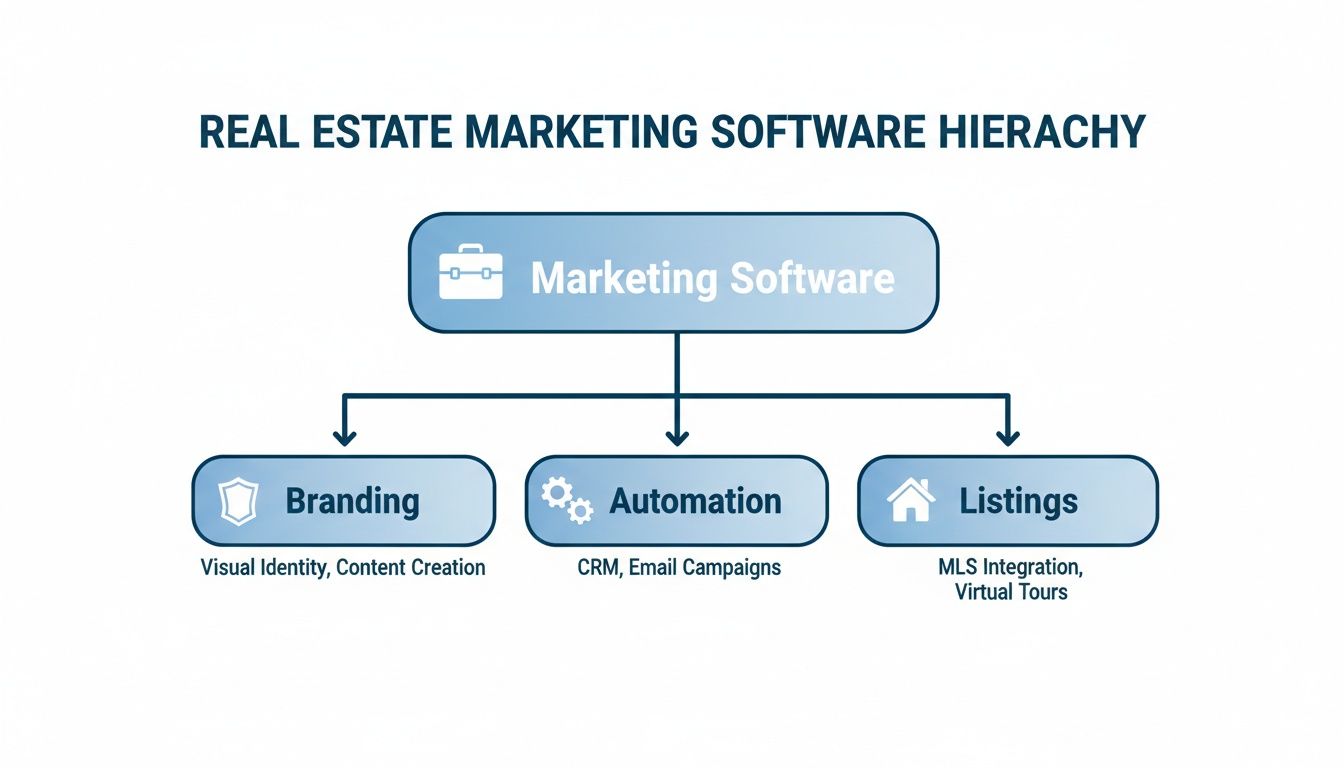
    Instead of just running down a checklist, let's look at these features in a way that actually makes sense for your daily grind. I like to group them into three core pillars: Branding, Automation, and Listings.

    A hierarchical diagram illustrating real estate marketing software categories: branding, automation, and listings with details.

    As you can see, these pillars don't exist in a vacuum. They work together, supporting a complete marketing strategy that takes you from building your reputation all the way to launching a killer property campaign. The whole point is to make each part work together, saving you time and getting you better results.

    Listing Amplification Tools

    This is where the rubber meets the road for your properties. Think of Listing Amplification features as your marketing launchpad. They're built to take a single property and, almost instantly, spin it into a full suite of marketing materials designed to grab attention from day one.

    The must-have tools here include:

    • AI-Powered Content Generation: We're talking about more than just a bland property description. Good software will write multiple versions of your listing copy, each one fine-tuned for the platform it's on—whether that's Zillow, Redfin, or your local MLS. It knows what works where.
    • Automated Social Media Calendars: Stop staring at a blank screen wondering what to post. The right platform can take a new listing and instantly generate a 30-day social media plan. It writes the captions, picks the best photos, and even schedules it all out for you. Consistent promotion, zero extra effort.

    Imagine this: you type in a property address, and a few minutes later, you have an entire marketing package ready to go. That's not the future; it's the new standard. In fact, industry analysis shows agents save up to 10 hours per week just by automating repetitive work like creating listing materials.

    Authority Building Features

    Winning over a new client doesn't start at the listing presentation. It starts weeks, or even months, before. Authority Building features are your behind-the-scenes engine for establishing yourself as the go-to expert in your market. When sellers in your area think "real estate," you want them to think of you first.

    A solid platform will give you:

    • Automated Market Reports: These tools let you create professional, data-packed reports for any neighborhood or zip code on the fly. They're perfect for your blog, email newsletters, or as a powerful leave-behind at an open house.
    • AI Blog and Content Ideas: Stuck on what to write about? Good software uses AI to serve up relevant blog topics and even outlines based on what's happening in your local market and what questions your clients are asking. This keeps your website fresh and helps you show up in search results.

    Presentation and Pitching Tools

    Alright, now it's time to close the deal. These features are all about walking into that listing appointment and blowing the competition out of the water. They give you tangible, impressive assets that prove you know how to market a home.

    Look for tools that can create:

    • Competitive Market Analyses (CMAs): Move beyond the boring, data-dump CMAs of the past. Modern tools create visually stunning, easy-to-digest reports that clearly show a seller where their home fits into the current market.
    • Print-Ready Marketing Plans: Walk into a meeting with a professionally designed flyer or brochure that lays out your entire digital marketing strategy for their home. It's a simple but powerful way to show sellers you have a concrete plan, justifying your commission and building trust from the first handshake.

    How to Win Listings with a Modern Pitch

    When you sit down at a listing appointment, it all boils down to one question brewing in the seller's mind: "Why should I hire you over everyone else?" In a crowded market, the old playbook—a generic CMA and a vague promise to "market the property aggressively"—just doesn't land anymore. This is exactly where real estate agent marketing software becomes your ace in the hole, turning your pitch from a simple conversation into a powerful demonstration of what you can deliver.

    Instead of just telling sellers what you'll do, you can actually show them. Picture this: you walk into an appointment with a complete, professionally designed marketing plan already built for their specific property. It's not a flimsy promise; it's tangible proof that you're already on the job.

    Shifting from Promise to Proof

    The traditional listing pitch is built on asking for trust based on past performance. The modern, tech-forward approach builds that trust right there on the spot by showcasing your superior marketing chops. You're no longer just an agent; you're a marketing strategist armed with a clear, data-driven plan to sell their home.

    This proactive method completely reframes the entire discussion. The focus immediately shifts from your commission rate to the undeniable value you bring to the table. Sellers can see with their own eyes that you've already invested time, effort, and strategy into their property before they've even signed on the dotted line.

    A well-prepared, tech-forward presentation instantly sets you apart from the 90% of agents who show up with the same tired materials. It directly addresses the seller's biggest unspoken fear: "Will my agent actually do enough to get me the best price?" By laying out a complete plan, you prove that you will.

    This is what readiness looks like. You're not just talking about launching a campaign; you're showing them it's ready to go in minutes, not days.

    Four real estate professionals discuss strategies, with one holding a tablet showing 'Win Listings'.

    With a platform like ListingBooster.ai, you can generate a full suite of marketing materials for a property instantly, demonstrating an ability to launch a comprehensive marketing campaign for a seller's home at a moment's notice.

    The Modern Pitch in Action

    Let's break down the difference. The old method involves a standard folder filled with comps. The new method uses real estate agent marketing software to create a compelling package that justifies your value from the second you walk in the door.

    The Traditional Pitch vs. The Modern Pitch

    Element The Traditional Approach The Modern, Software-Powered Approach
    Analysis A standard, data-heavy CMA printed straight from the MLS. A visually engaging, easy-to-understand competitive analysis.
    Marketing Plan A verbal promise of "social media posts and portal listings." A printed 30-day social media calendar and examples of AI-optimized portal descriptions.
    Materials A generic company brochure. Custom-branded flyers detailing your digital strategy specifically for their home.

    The best part? You can generate these assets in minutes before you even head to the appointment. For example, you can:

    • Create a Data-Driven Analysis: Generate a clean, modern competitive analysis that homeowners can actually understand.
    • Produce Tangible Marketing Assets: Print out a beautiful flyer that breaks down your multi-platform digital strategy, showing how you optimize for Zillow and social media algorithms.
    • Showcase Your AI Edge: Present AI-crafted property descriptions that tell a compelling story about the home, proving you know how to attract more qualified buyers.

    This level of preparation sends a clear message: you are not just another agent. You are a marketing powerhouse. It turns the listing appointment into a simple formality because you’ve already proven you're the only logical choice for the job.

    Automate Your Marketing and Reclaim Your Time

    If there’s one thing every real estate agent is short on, it’s time. Juggling client meetings, showings, and a mountain of paperwork means marketing often falls by the wayside. This is exactly where real estate agent marketing software becomes a game-changer, turning your marketing efforts from a constant time-suck into an automated engine that works for you around the clock.

    Imagine putting your social media posts and property flyers on autopilot. You can maintain a consistent, professional online presence without the daily grind, freeing you up to focus on what actually makes you money: closing deals.

    Person using a laptop with marketing automation software, holding a coffee cup, with a calendar and plant.

    This isn’t just about saving a few minutes. It's about clawing back huge chunks of your week. The entire industry is moving in this direction, with the market for these tools valued at USD 12.87 billion and growing fast. In fact, real estate agents are the fastest-growing professional group adopting this tech, all driven by the simple need to find and keep clients more effectively. You can dig deeper into the real estate software market on SkyQuestt.com to see the full picture.

    Two Pillars of Real Estate Automation

    When you break it down, effective marketing automation for agents really stands on two legs. Each one supports a critical part of your business, making sure your listings get seen and your personal brand gets built.

    These two pillars are:

    • Property-Specific Automation: This is all about the "now." It's the tactical marketing you need the second a new listing goes live.
    • Personal Brand Automation: This is the long game. It’s the strategic work of building your reputation as the go-to expert in your area.

    When you automate both, something powerful happens. Your property marketing creates immediate buzz, while your brand marketing builds a pipeline of future clients who already trust you before they've even met you.

    Automating for Listings and Authority

    Think about property automation like this: you land a new listing, and within minutes, the software generates a complete 30-day social media calendar with captions and images ready to post. It's a system that gives every single property the high-quality exposure it deserves across all your channels, without you having to block out hours to create the content yourself.

    At the same time, your personal brand automation is quietly working in the background to cement your authority. The software can create insightful market reports, neighborhood guides, or even just smart blog post ideas based on what's happening locally. By consistently putting out valuable information, you build trust with people long before they’re even thinking about moving. This consistent activity is also a huge factor in getting you to the top of Google, making sure you’re the first agent a seller finds.

    Choosing the Right Marketing Software for Your Business

    Picking the right real estate agent marketing software is a lot like choosing a business partner. It's not about being wowed by flashy features. It's about finding a platform that genuinely fits into your daily hustle and solves your biggest headaches. A little homework upfront ensures you invest in a tool that actually makes you money, not just another line item on your monthly credit card statement.

    The first thing to do is look under the hood. A slick design is nice, but the real power comes from what the software can actually do for a real estate agent. You want a tool built by people who get the day-to-day grind of listings, closings, and client calls.

    Your Essential Evaluation Checklist

    Before you even think about a free trial, sit down and make a list of your non-negotiables. This simple checklist will be your guide, helping you cut through the sales pitches and focus on what will truly boost your productivity and your bottom line.

    Think about these critical areas:

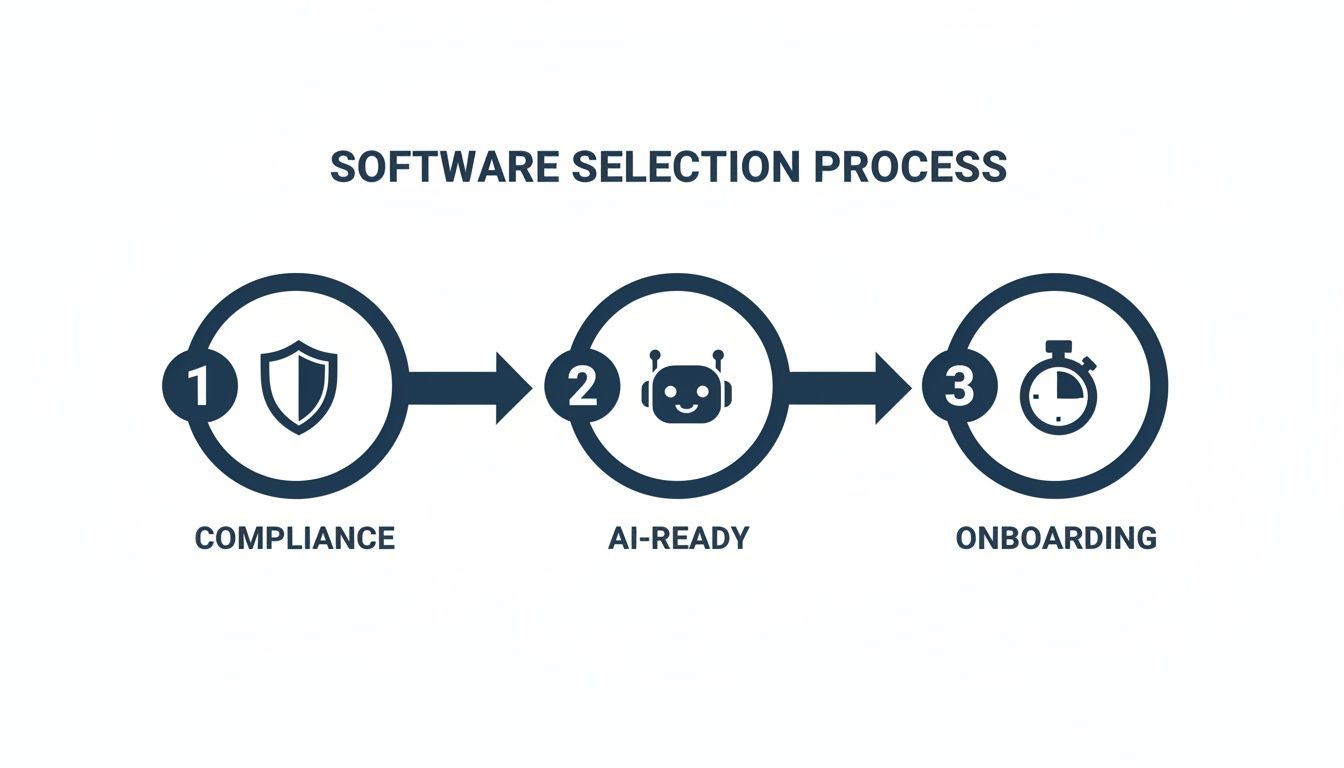
    • MLS Compliance and Fair Housing Alignment: This is the big one. The software absolutely must create content that follows Fair Housing laws and your local MLS rules to the letter. Getting this wrong isn't just a slip-up; it's a massive risk to your license and business.
    • Ease of Use and Onboarding: How fast can you go from zero to a full marketing kit for a new listing? The best tools are incredibly intuitive. You should be able to plug in an address and get to work immediately, without needing a week of training.
    • Quality of AI-Generated Content: Put the AI to the test. Read the property descriptions it writes. Do they sound like something you'd proudly present to a client? Is the social media copy catchy and smart? The AI should feel like a top-notch assistant, not a robot spitting out generic phrases you have to rewrite anyway.
    • Integration with Key Portals: Your listings need to look amazing on the platforms that matter. The software should format everything perfectly for major players like Zillow, Redfin, and Realtor.com. That's how you make sure your properties get seen by the most buyers.

    Test Driving for Real-World Results

    When you find a platform with a free trial, use it. But don't just poke around the dashboard. Grab one of your actual listings—a current one or even one you just sold—and run it through the system from start to finish. Generate the listing narrative, build the social media posts, and create the seller presentation.

    This is where the truth comes out. A hands-on test shows you exactly how much time you’ll save and whether the marketing materials are polished enough to land you that next listing.

    Finally, think about growth. The right tool needs to be just as effective for a solo agent as it is for a brokerage with a dozen agents. This is key because the entire industry, from property management to commercial sales, is going digital. As researched by Zion Market Research, the commercial real estate software market is expanding rapidly, and agents need marketing tools that can keep up.

    To help you organize your search, use a structured checklist to compare your options side-by-side.

    Software Evaluation Checklist for Real Estate Agents

    Evaluation Criteria Key Questions to Ask Why It Matters for Your Business
    Core Functionality Does it generate all the content I need (descriptions, social, ads)? Does it handle both pre-listing and active listing tasks? A comprehensive tool saves you from juggling multiple subscriptions and streamlines your entire marketing workflow from start to finish.
    Usability & Speed How many clicks does it take to create a full marketing package? Is the interface intuitive or confusing? Time is money. You need a tool that works at the speed of your business, not one that slows you down with a steep learning curve.
    Compliance & Accuracy Does the software have built-in checks for Fair Housing and MLS rules? Does it pull accurate data? This is your safety net. Automated compliance protects you from costly violations and ensures your marketing is professional and legally sound.
    Customization & Branding Can I easily add my own branding, logo, and headshot? Can I tweak the AI-generated content to match my voice? Your brand is your biggest asset. The software should enhance it, not force you into a generic template. It needs to sound like you.
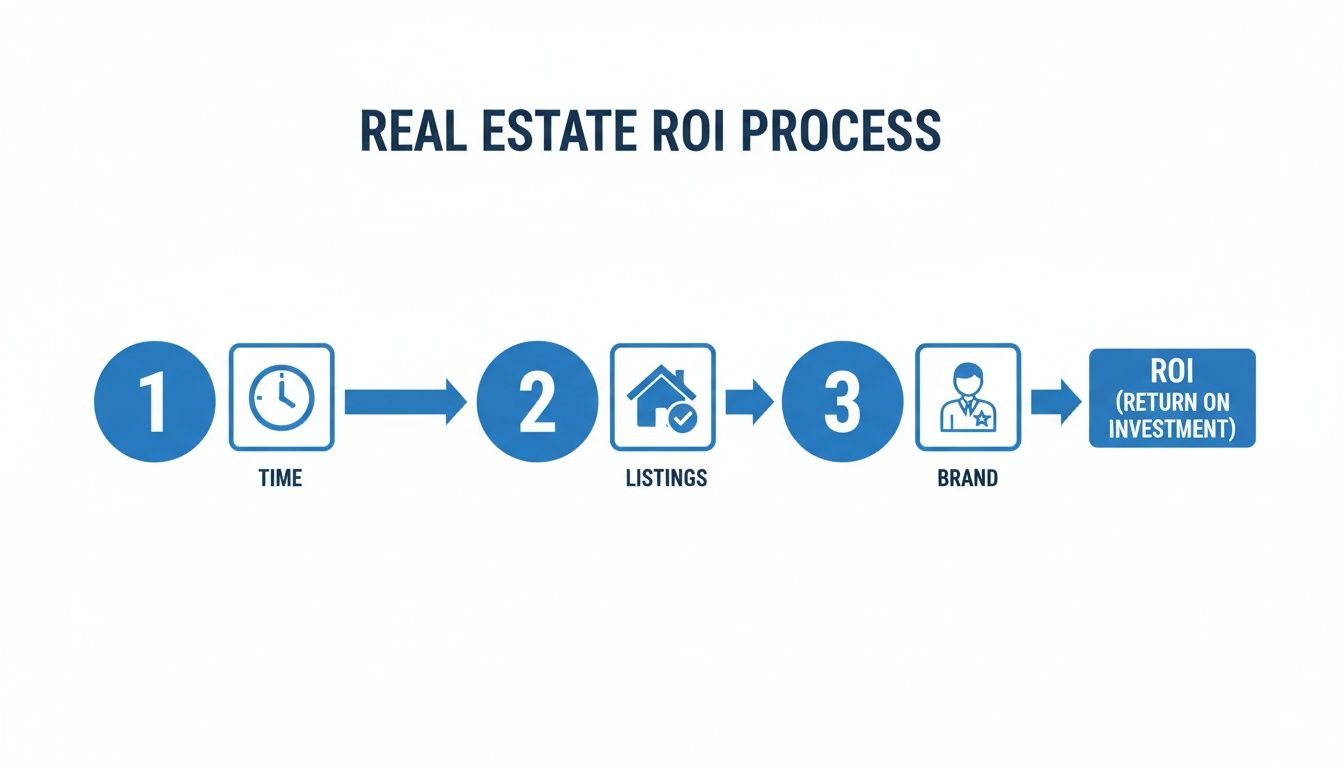
    Cost vs. Value (ROI) What is the total cost? How many hours will this save me per listing? How much is that time worth? Look beyond the price tag. If a tool saves you 5-10 hours per listing, it pays for itself almost immediately and frees you up for dollar-producing activities.
    Support & Training Is there a responsive support team? Are there helpful tutorials or onboarding guides available? When you're on a deadline, you need answers fast. Good support ensures you can overcome any technical hurdles and get the most out of the platform.

    By asking these questions, you move from just buying software to making a strategic investment in your business's future. Before making that final call, always compare the different plans available. A clear breakdown of features helps you pick a tier that fits where you are now and where you want to be. For a great example, check out ListingBooster.ai’s pricing plans to see how features and value scale together.

    Common Questions About Real Estate Marketing Software

    Bringing new tech into your business can feel like a big leap, especially when you’re already juggling a dozen other things. It's totally normal to have questions and maybe even a few doubts. Let's clear the air and tackle the most common concerns agents have about real estate agent marketing software. My goal is to help you see exactly how it fits into your workflow and why it's a game-changer.

    We'll walk through some straightforward answers to help you feel confident about the real-world value these platforms bring to the table.

    Is This Type of Software Difficult to Learn?

    Not at all. I get it—the last thing you need is another complicated tool with a steep learning curve. Modern platforms are built for busy agents, not tech gurus. The whole point is to make your life easier, not harder. You can literally get started in minutes just by plugging in a property address.

    The best software is all about a smooth user experience. It walks you through creating property descriptions, social media posts, and even listing presentations. And here’s the best part: the AI-generated content is completely editable. You can make quick tweaks to match your personal brand and voice while still saving yourself hours of writing. The focus is on you managing clients, not wrestling with software.

    How Is This Different from My CRM?

    This is a really important distinction to make. Your CRM is your command center for managing relationships and tracking your pipeline—it's essential. But real estate agent marketing software is a different beast entirely; it's a specialized tool focused purely on content creation and winning listings.

    Think of it like this:

    • Your CRM holds all your client data, but it won't write a killer, SEO-friendly Zillow description that gets people in the door.
    • A social media scheduler can push out posts, but it can't dream up an entire 30-day marketing campaign from a single property address.

    This is the gap this software fills. It’s the creative engine that produces the actual marketing materials you need to impress sellers and effectively promote your listings everywhere.

    Can AI-Generated Content Sound Authentic?

    Yes, and this is where the magic happens. The top platforms aren't using some generic chatbot AI. They are trained specifically on high-performing real estate copy—the kind of stuff that actually sells homes. The AI knows how to talk about a home’s features in a way that resonates with buyers, focusing on the lifestyle and benefits, not just the specs.

    But the most critical piece of the puzzle is compliance. Good software ensures every piece of content it generates is aligned with Fair Housing guidelines and your local MLS rules. You always have the final say, with full control to edit and refine the text to add your personal flair.

    It’s the best of both worlds: you get fast, compliant, and optimized content that you can easily polish to sound exactly like you.

    What Is the Real ROI of Using This Software?

    The return on your investment here is huge, and it shows up in a few key ways. This isn't just another monthly expense; it's a strategic investment in your business's growth.

    First, you get a massive amount of your time back. Writing property descriptions, creating social media calendars, building flyers—tasks that used to eat up hours can now be done in minutes. That’s more time for what really matters: lead follow-up, client meetings, and negotiating deals.

    Second, you'll see a direct impact on winning more listings. Imagine walking into a listing appointment with a polished, data-driven marketing plan already in hand. It immediately sets you apart from the competition and makes it easy to justify your commission. You're not just telling them you’re the best choice; you’re showing them.

    Third, it helps you build a consistent, high-quality brand presence. Better marketing attracts more inbound leads over time. Honestly, for a small monthly cost, winning just one extra listing a year delivers an incredible ROI. And that doesn't even count the compounding benefits of being more efficient every single day. If you want more ways to build your brand, check out some real estate blog topics to get your creative juices flowing.


    Ready to see how AI can transform your listing presentations and help you win more business? ListingBooster.ai gives you the tools to create stunning, compliant, and effective marketing materials in minutes. Start your free trial today and discover a smarter way to market your properties.

    https://listingbooster.ai

  • How an AI Listing Presentation Tool Can Win You More Listings

    How an AI Listing Presentation Tool Can Win You More Listings

    So, what exactly is an AI listing presentation tool? Think of it as your secret weapon for creating stunning, data-packed marketing proposals in minutes, not hours. All you need is a property address, and the software instantly generates a complete pitch package that's ready to win over sellers.

    Winning Listings in a Competitive Market

    Professional woman in business attire holding a tablet in a modern kitchen.

    In today’s lightning-fast real estate market, being quick and prepared is the name of the game. For decades, building a listing presentation was a grind. You’d spend hours digging for market data, fiddling with slide designs, and wrestling with property descriptions. It felt like a chef chopping every single vegetable by hand for every order—tedious and slow.

    Now, picture a new way of working. The modern agent has an AI presentation tool that acts like a fully stocked, professional kitchen. You’re not starting from scratch anymore; you have everything you need to assemble a five-star presentation on a moment's notice. This is the new standard for winning listings.

    The Shift to Speed and Strategy

    Sellers today are looking for more than a simple CMA. They want to see a clear, proactive marketing strategy that will get their home sold. An AI-powered tool delivers exactly that, right out of the box. It gives you the power to walk into any meeting showing you're leagues ahead of the competition, turning hesitant conversations into signed agreements.

    This isn't just a fleeting trend—it's quickly becoming a fundamental part of the business. The market for AI presentation tools, valued at $2 billion in 2025, is expected to skyrocket to $10 billion by 2033. That’s a compound annual growth rate of 25%. This boom is fueled by professionals in industries like real estate who need to move decisively and make a strong impression fast. You can dive deeper into these numbers in Data Insights Market's full report.

    The takeaway is simple: speed, data-driven insights, and a polished, tech-forward approach are no longer just nice-to-haves. They are essential ingredients for securing listings in a competitive environment.

    An AI listing presentation tool is your strategic edge. It allows you to prove you’re the most prepared agent in the room before your competitors have even had a chance to book their first meeting.

    So, What Exactly Is an AI Listing Presentation Tool?

    Let's cut through the tech-speak and get down to what this actually means for your business. An AI listing presentation tool isn't just another app on your phone; think of it as your personal, on-demand marketing director. You feed it one simple thing—a property address—and it instantly gets to work researching, writing, and designing a complete marketing plan for that home.

    Instead of you spending hours hunched over a laptop, manually pulling comps, writing property descriptions, and fumbling with design software, the AI does the heavy lifting. It takes that one address and, within minutes, produces a full suite of professional materials. We're not talking about generic, cookie-cutter slideshows here. This is about generating a comprehensive, data-backed strategy designed to win over a seller.

    It’s More Than Just Fancy Slides

    The real magic of a modern AI tool is the sheer depth and quality of what it creates. A platform like ListingBooster.ai doesn't just spit out a few presentation slides; it hands you an entire marketing arsenal, custom-built for that specific property. This is what separates it from the old-school template builders we've all used before.

    Here’s a quick look at the kind of assets you can get:

    • Compelling Property Descriptions: The AI crafts persuasive, engaging descriptions that are already optimized for Zillow and your local MLS. They’re written to grab a buyer's attention and hit all the right keywords.
    • Detailed Market Analysis: You get a sharp, data-driven competitive market analysis (CMA). This isn't just a list of comps; it’s a clear story that justifies your pricing strategy with solid numbers, which is crucial for building a seller’s trust right from the start.
    • A Ready-to-Go Social Media Plan: Imagine walking into a meeting with a complete 30-day social media calendar, complete with ready-to-post content. It shows sellers you’re not just going to list their home; you have a proactive plan to market it from day one.
    • Print-Ready Marketing Materials: The tool also designs professional flyers and brochures that are ready to print. No more waiting on a graphic designer or paying extra fees.

    In a nutshell, this technology takes a single input—the property address—and turns it into a multi-faceted, client-winning output. It’s the difference between showing up with a few ideas and walking in with a fully baked, actionable plan.

    This whole process, from a simple address to a rich marketing portfolio, is what makes an AI listing tool such a game-changer. It handles all the time-consuming grunt work, freeing you up to do what you do best: build relationships and close deals.

    Core Features That Create a Competitive Edge

    The real magic of an AI listing presentation tool isn't just a single gimmick; it's the combination of specific, powerful features that work together. These aren't just fancy add-ons. They're a modern agent's toolkit, built to give you a clear advantage in every single client meeting. Each feature is designed to solve a real-world problem in the listing process, swapping out hours of manual work for smart, fast automation.

    Think of these tools as having a whole team of specialists on call. You get a persuasive copywriter, a sharp market analyst, and a savvy marketing designer—all working at the same time. This frees you up to concentrate on what you do best: building relationships and closing deals.

    Automated Content and Data Analysis

    One of the first things you'll notice is the automated content generation. A good AI tool doesn't just plug words into a template. It crafts compelling, MLS-compliant property descriptions that are ready for platforms like Zillow and Realtor.com. On top of that, it can whip up a complete 30-day social media calendar with captions and post ideas, showing your seller a proactive marketing plan right from the start.

    While it's writing the content, the tool is also running an instant, data-driven competitive analysis. Forget spending hours digging through the MLS for comps. The AI pulls the most relevant ones, analyzes current market trends, and packages it all into a clean, easy-to-understand report for your client. This lets you back up your pricing strategy with solid data, building immediate trust and confidence.

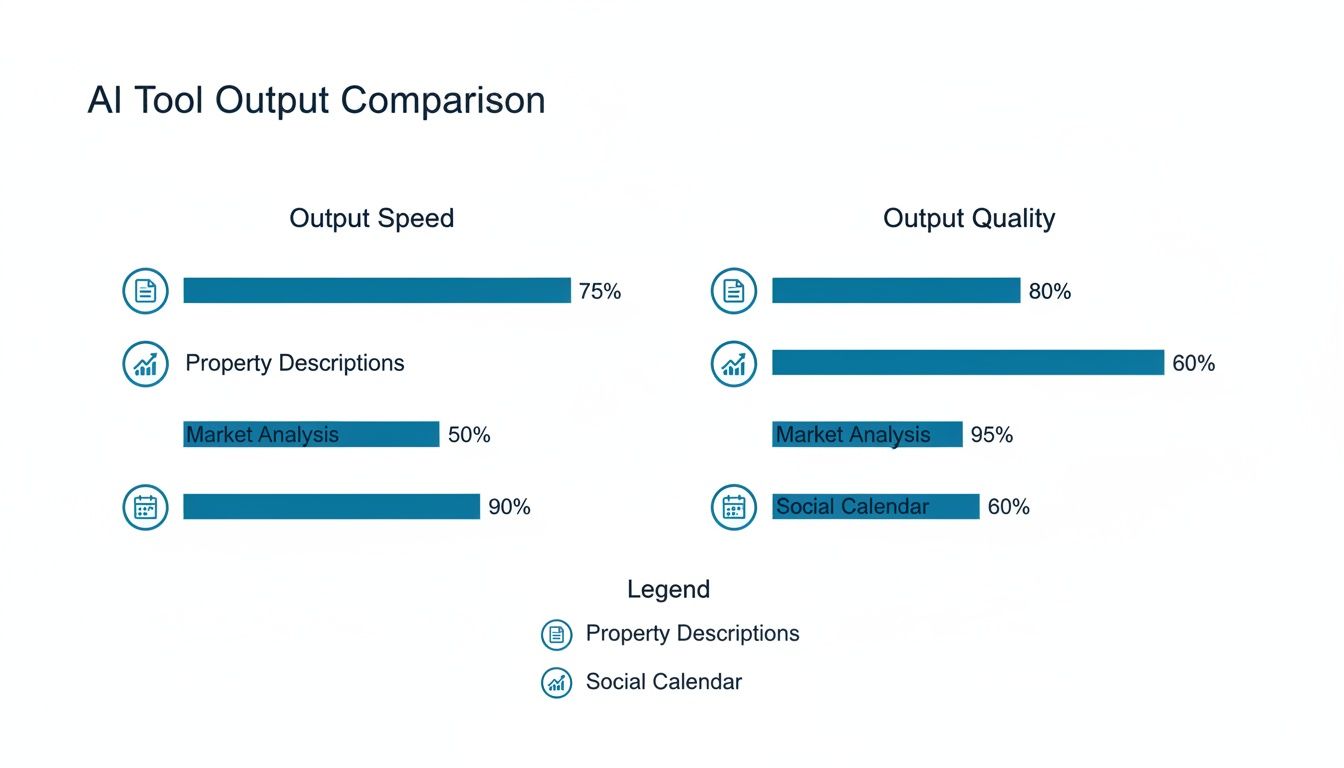
    The chart below shows just how much faster and better this process becomes.

    Bar chart comparing AI tool output speed and quality for property descriptions, market analysis, and social calendar tasks.

    As you can see, the AI turns hours of painstaking work on property descriptions, market analysis, and social media planning into a task that takes just a few minutes.

    Multi-Platform Optimization and Client Education

    A truly great AI tool also knows that marketing isn't a one-size-fits-all game. That's where multi-platform optimization comes in. The content it generates is automatically tailored for different channels. For instance, a property description for a luxury real estate blog needs a different tone and length than a concise MLS entry, and the AI handles these adjustments for you.

    These platforms also create materials that help you educate your clients on modern marketing. Some tools, for example, can generate a simple one-page summary explaining how a property will be optimized for AI-driven search on Google or in ChatGPT. This instantly positions you as a forward-thinking expert, not just another agent.

    To really see the difference, let’s compare the old way with the new way.

    The table below breaks down the massive difference in time and effort between the traditional grind and a new, AI-powered workflow.

    Traditional vs AI-Powered Listing Preparation

    Task Traditional Method (Manual) AI-Powered Method (Automated)
    Market Research 1-2 hours of pulling comps and analyzing data from MLS and other sources. Under 2 minutes of AI-driven analysis, generating a client-ready report.
    Property Descriptions 30-60 minutes of writing, editing, and optimizing for various platforms. Under 1 minute to generate multiple unique, optimized descriptions.
    Social Media Plan 1-3 hours of brainstorming, writing captions, and scheduling posts. Under 2 minutes for a complete 30-day content calendar with visuals.
    Presentation Design 1-2 hours of creating slides, formatting data, and ensuring brand consistency. Instant generation of a professional, branded presentation package.

    The takeaway is simple and striking. An AI-powered workflow cuts down your prep time by over 95%, taking what used to be a 4-8 hour marathon and turning it into a sprint that's over in less than 5 minutes. That efficiency isn't just about getting time back; it’s about redirecting your most valuable energy toward what really matters—winning that listing.

    From Property Address to Polished Pitch in Minutes

    A man types on a laptop, an alarm clock sits on a book 'PITCH IN MINUTES', next to a model house.

    The real magic of an AI listing presentation tool isn't just about the cool features—it’s about how much time you get back. Let’s walk through a scenario that every agent knows all too well.

    It’s 4 PM on a Tuesday. A hot lead calls you out of the blue. They're motivated and want you to come over tomorrow morning to talk about listing their home. Before AI, that phone call meant one thing: a late night spent digging for comps, writing copy, and fumbling with design templates.

    But with a modern AI tool, that whole frantic process is a thing of the past. Instead of scrambling, an agent—let's call him Alex—can open up a platform like ListingBooster.ai and go from just a property address to a full presentation package in less time than it takes to brew a pot of coffee. We're talking under five minutes.

    The Four-Step Workflow

    What makes this possible is a dead-simple, repeatable workflow. It's built for speed, turning what used to be hours of tedious work into a few clicks.

    1. Enter the Property Address: It all starts with one piece of information. Alex just types the address into the tool. No need to hunt down photos or manually plug in property specs; the AI taps into public records and data feeds to pull in everything it needs automatically.

    2. Let the AI Do the Work: Alex hits "generate," and the AI engine kicks into gear. This isn't just a mail merge into a tired template. It's actively creating a whole suite of custom marketing materials from scratch. In about 90 seconds, the dashboard fills up with a complete pitch arsenal.

    You get multiple drafts of property descriptions, a sharp competitive market analysis, print-ready flyers, and even a full 30-day social media plan.

    Review, Tweak, and Go

    The AI handles the heavy lifting, but the final polish comes from the expert in the room: the agent. Alex gives the generated materials a quick once-over, adding a personal anecdote about the neighborhood or adjusting a line to match his unique brand voice. This is where an agent’s local expertise really shines.

    Think of it this way: the AI delivers a 95% complete draft. The agent's job is to add the final 5%—the personal touch and local insight that builds trust and closes deals.

    Finally, with everything looking sharp, Alex exports the entire package. The digital presentation is ready for his iPad, the social media calendar is saved as a PDF, and the flyers are off to the printer.

    He checks the clock. Total time spent: four minutes and twenty-two seconds. Alex is walking into that meeting tomorrow with a data-rich, beautifully designed marketing plan that makes him look like a total pro. This isn't the future; it's the new standard for being prepared.

    How AI Helps You Win Over Modern Sellers

    A real estate agent presents market data on a tablet to a smiling couple in a modern home.

    Speed and features are great, but they don’t win listings by themselves. The real magic of an AI listing presentation tool is how it gives you a killer answer to the one question every modern seller asks: "How will you market my home better than anyone else?"

    Instead of just promising you'll get the job done, you can actually show them how. The AI-generated marketing materials become tangible proof of your strategy. This turns your pitch from a collection of claims into a concrete, undeniable action plan. That shift from telling to showing is what separates the good agents from the great ones.

    When a seller sees a complete marketing portfolio built just for their property—before they've even signed with you—it creates instant trust. It shows a level of preparation and strategic thinking that your competitors, who probably showed up with generic pamphlets, simply can't compete with.

    Turning AI Assets into a Winning Argument

    Every piece of content the AI creates for you is a powerful talking point that builds your case. You can walk sellers through your entire marketing plan, step-by-step, using the AI's output as the evidence.

    Here's how you can frame that conversation:

    • AI-Optimized Descriptions for Zillow: Don't just show them a property description; explain that it's a strategic tool designed to make their home rank higher on the big portals. You can say something like, "The AI studies the top-performing listings in our area to write descriptions that grab buyer attention and play nicely with Zillow's search algorithm."
    • A Proactive 30-Day Content Calendar: When you pull out the social media plan, it’s proof that you have a proactive marketing engine ready to go. Show them the ready-to-post content, and emphasize how you'll be creating buzz from day one instead of just waiting for buyers to stumble upon the listing.
    • Data-Backed Pricing Strategy: Use the AI-generated competitive analysis to back up your recommended list price. The clean, data-rich report makes your pricing logic transparent and easy to understand, taking the emotion out of a sometimes difficult conversation.

    The goal is to connect every AI-generated asset directly to a seller benefit. You're not just showing them a pretty flyer; you're showing them a smarter way to attract the right buyers and achieve a faster sale at the best possible price.

    Becoming the Forward-Thinking Expert

    Ultimately, what will set you apart is explaining why this modern approach is so effective. While other agents are still talking about the same old open houses and print ads, you can introduce concepts that prove you’re operating on a whole different level.

    Talk about how your marketing uses schema markup—a special kind of code that helps search engines like Google understand the specific details of their property. This isn't just tech-speak for the sake of it; it’s a real strategy to make their home more visible in next-generation search tools, including Google AI and ChatGPT.

    This instantly positions you as an expert who gets how buyers actually find homes today. By showcasing this sophisticated approach, you prove you're not just keeping up with the latest trends—you're ahead of them. Agents who want to build this kind of authority can learn more about AI marketing tools that give them a competitive edge.

    Choosing the Right AI Tool for Your Business

    Picking an AI listing presentation tool is a bit like choosing a new car. They all promise to get you where you need to go, but the ride, the features, and the reliability can vary wildly. The right one makes your job feel effortless, while the wrong one just adds another layer of complexity to your already busy schedule.

    You need a tool that fits into your existing workflow, not one that forces you to change everything. Start with the basics: if you can't figure it out in 10 minutes or less, it's probably not the right fit. The whole point of this technology is to save you time, not to give you a new full-time job as a software technician.

    Your Buyer's Checklist

    As you start looking at different options, keep these key points in mind. A genuinely helpful AI partner should tick all these boxes, giving you a real edge over the competition.

    • MLS and Fair Housing Compliance: This is your license on the line, so it's a deal-breaker. The tool absolutely must create content that follows all the rules. No exceptions.
    • Intuitive Ease of Use: Can you take a property address and have a full-blown presentation ready to go in just a few clicks? The best systems do the heavy lifting for you, turning a single piece of information into a polished, client-ready package.
    • Content Quality and Persuasiveness: Take a hard look at what the AI spits out. Does it sound like a compelling story about a home, or does it read like a robot describing a building? You want a strong first draft that just needs your personal touch, not a complete rewrite.
    • Authority-Building Features: A great tool sells you as much as it sells the house. Look for features that explain sophisticated marketing strategies, like how you'll get the listing noticed by Google's AI or ChatGPT. This shows sellers you’re not just another agent; you're a modern marketing expert.

    The best AI listing presentation tool acts as an extension of your expertise. It should handle the repetitive tasks, allowing your strategic insights and local knowledge to shine through during the client meeting.

    Test Before You Commit

    Finally, don't ever skip the free trial. It's the only way to know for sure if a tool lives up to its promises without putting any money down. Take a look at different AI tool pricing models to understand the investment, but use that trial period to create a few presentations for actual listings you're working on.

    Getting your hands dirty is the fastest way to see if a tool is a game-changer or just another gadget. This practical test run will tell you everything you need to know, ensuring you choose a solution that genuinely helps you win more listings.

    A Few Common Questions We Hear

    It's natural to have questions before diving into new technology. Most agents are curious, but they also want to be sure a tool will actually help their business without creating more work or sounding like a robot. Let's tackle a couple of the most common concerns.

    "Will the content sound generic or robotic?"

    This is probably the biggest worry we hear, and it's a valid one. Nobody wants to hand a seller a presentation that sounds like it was written by a machine.

    The good news is that the best AI platforms are designed to sound human from the start. Think of the AI as a brilliant creative assistant. It generates a polished, persuasive first draft that you can then easily tweak with your own local insights and personal touch. The goal is to save you hours of writing, not to replace your authentic voice.

    "Is this going to be hard to learn?"

    Not at all. These tools are built for busy real estate agents, not software engineers.

    From the moment you sign up to having your first complete, seller-ready presentation in hand, you're looking at maybe ten minutes, tops. Seriously. If you can copy and paste a property address from Zillow or your MLS, you already have all the tech skills you need.

    Your real advantage isn’t just having the tool; it’s how you use it. When other agents show up with a generic slide deck, you'll walk in with a comprehensive, data-backed marketing plan. The edge comes from using the AI's output to prove you’re the most prepared agent in the room.

    That's how you stand out, even if a competitor uses a similar tool. You can show sellers exactly how you'll get their home discovered by AI search algorithms or lay out a full 30-day social media marketing calendar. For more ideas on using tech to sharpen your pitch, check out the strategies on our ListingBooster.ai blog.

    Ultimately, the power isn't in the software itself, but in how you use it to tell a more compelling story about the value you bring to the table.


    Ready to see for yourself how you can turn hours of prep work into a five-minute win? Try ListingBooster.ai and walk into your next meeting with a complete, data-driven marketing plan that wows sellers. Start your 30-day free trial today!

  • Your Guide to Real Estate Listing Marketing Software

    Your Guide to Real Estate Listing Marketing Software

    If you’ve ever felt like you’re spending more time playing marketing coordinator than real estate agent, you’re not alone. The hours spent writing property descriptions, designing flyers, and mapping out a social media plan for each new listing add up fast.

    That’s where real estate listing marketing software comes in. Think of it as your dedicated marketing engine, built specifically to tackle the mountain of prep work that comes before a home hits the market. It’s a specialized toolkit that turns hours of tedious manual tasks into just a few clicks.

    Understanding Your New Marketing Engine

    A modern workspace with a laptop showing a house, a pen, notebook, phone, and 'LISTING TOOLKIT' text.

    So, what exactly is this software? While your CRM is all about managing your client relationships, listing marketing software is laser-focused on the property itself. Its entire purpose is to help you win the listing and then promote it effectively.

    Instead of staring at a blank screen trying to find the perfect words, you can generate a compelling, MLS-compliant property description in seconds. Rather than guessing what to post on Facebook, you get a complete content calendar tailored to your new listing. This completely flips the script, moving you from a content creator to a strategic director, freeing you up to do what you do best: serve your clients and close deals.

    From Manual Grind to Automated Edge

    The core idea is to give you speed, polish, and a serious competitive advantage. The software pulls together property data, market trends, and even your own branding to generate a full-blown marketing kit. Imagine walking into a listing appointment not just with a CMA, but with tangible, professional marketing assets that show sellers you mean business.

    This isn’t just a niche tool; it’s where the industry is heading. The global market for real estate marketing automation software hit USD 1.12 billion in 2024 and is on track to reach USD 4.26 billion by 2034. This explosive growth signals a massive shift towards platforms like ListingBooster.ai that empower agents to work smarter. You can dive deeper into the numbers in this full research report.

    The whole point is to turn hours of prep into minutes of production. It’s about spending less time behind a keyboard and more time in front of sellers, demonstrating your value.

    The shift from the old way of doing things to a software-powered approach is night and day. Let's break down the difference.

    Traditional vs Software-Powered Listing Prep

    Marketing Task Traditional Method (Time & Effort) Software-Powered Method (Time & Effort)
    Property Description 1-2 hours: Manual writing, editing, and ensuring MLS compliance. 5 minutes: AI-generated drafts, with options for different tones and lengths.
    Social Media Plan 2-3 hours: Brainstorming posts, finding images, scheduling for multiple platforms. 10 minutes: Auto-generated, multi-week content calendar with copy and images ready to go.
    Flyer/Brochure Design 1-3 hours: Fiddling with templates in Canva or hiring a designer. 5 minutes: Professionally designed, brand-consistent templates auto-filled with property info.
    Competitive Analysis 1 hour+: Manually pulling comps and summarizing market position. 15 minutes: Automated report showing how the property stacks up against the competition.

    As you can see, the time savings are massive, allowing agents to focus on high-value activities instead of getting bogged down in administrative work.

    How It Works in Practice

    At its core, this software is about two things: preparation and presentation. It gives you a structured workflow to make sure every listing you go after is backed by a solid, data-driven marketing plan.

    Here’s what’s happening under the hood:

    • Data Aggregation: It starts by pulling all the essential property details, photos, and local market data from just an address.
    • Content Generation: It uses AI to write unique property descriptions, engaging social media posts, and persuasive email copy.
    • Asset Creation: It instantly produces print-ready flyers, detailed reports, and polished digital presentations.
    • Strategic Planning: It helps you build out a competitive analysis and a week-by-week marketing timeline.

    Ultimately, real estate listing marketing software gives you a powerful, immediate answer to a seller’s most important question: "How will you market my home better than anyone else?" By arming you with impressive, customized marketing materials on the spot, it helps you win the listing before you even walk out the door.

    Core Features That Help You Win Listings

    Laptop displaying real estate listings with marketing cards and a 'Win More Listings' banner on a desk.

    The best real estate listing marketing software isn't just about shaving a few minutes off your day. It’s about walking into a listing appointment armed with an entire marketing arsenal designed to wow sellers and lock down the contract. These platforms are built to address a seller's biggest questions head-on: "How will you make my home stand out?" and "What's your plan?"

    At their core, these tools let you generate impressive, client-facing materials on the spot. You stop telling sellers what you’re going to do and start showing them exactly what your high-end marketing looks like, right then and there.

    AI Property Descriptions

    Let's face it: writing compelling property descriptions is a chore. It takes creativity, time, and a knack for storytelling. AI description generators completely change the game. In a matter of seconds, they can spin up captivating narratives that put a home’s best features in the spotlight.

    But it’s not just about speed. A good tool crafts multiple versions of the description, each one tailored for different platforms—one for the character-limited MLS, another for Zillow, and a different angle for Realtor.com. This ensures your listing's story resonates with buyers wherever they're looking, all while keeping the language compliant with Fair Housing laws.

    Deployable Social Media Calendars

    Imagine sitting down with a potential seller and handing them a complete, multi-week social media plan for their property. That’s the power of a built-in social media calendar feature.

    Instead of just promising to post on Facebook, you can present a detailed, day-by-day schedule showing exactly what you’ll do. This isn't a vague promise; it's a concrete plan.

    • "Just Listed" announcements ready to go with professional graphics.
    • Feature highlights that call out the renovated kitchen or the perfect backyard for entertaining.
    • "Open House" reminders and engaging follow-up posts.
    • Neighborhood spotlights that sell the lifestyle, not just the house.

    This simple feature transforms your entire pitch. You’re no longer just an agent who says they’ll market the home; you’re the agent who showed up with the marketing plan already done.

    You’re not just selling a service; you’re selling confidence. When you can hand a seller a detailed 30-day marketing plan, it proves you are prepared, professional, and ready to execute from day one.

    This is the kind of preparation that drives growth in the U.S. real estate software market, which was valued at USD 2.45 billion in 2022 and is expected to hit USD 5.10 billion by 2030. It's no surprise the agent segment is projected to grow fastest at a 10.9% CAGR, fueled by tools that make marketing and client service more efficient. You can dive deeper into these trends in this market report.

    Competitive Analysis Tools

    Gut feelings don't win listings, but solid data does. A competitive analysis feature is your secret weapon for pricing conversations. It pulls real-time, hyper-local market data to show sellers exactly how their property compares to others on the market right now.

    This isn't a clunky spreadsheet. It’s a clean, easy-to-read report that backs up your pricing strategy with hard evidence, instantly positioning you as the local market expert who came prepared.

    Print and Export Assets

    Finally, you never want to leave a listing appointment empty-handed. Top-tier real estate listing marketing software lets you instantly print or export professional-grade materials like property flyers, market reports, and your marketing plan summary.

    Leaving behind these tangible, high-quality documents keeps you and your modern approach top-of-mind long after you’ve walked out the door. It’s that final, professional touch that helps you stand out and win the business.

    How This Software Gives Agents and Teams an Unfair Advantage

    The real magic of real estate listing marketing software isn't just about the cool features—it's about the leverage it gives you. It turns a bunch of powerful tools into real-world advantages that change how you compete and win listings. It’s the difference between always playing catch-up and finally getting ahead of the game.

    For a solo agent, this kind of software is the great equalizer. Suddenly, you can churn out marketing materials that look like they came from a big brokerage with an entire marketing department. No more choosing between prepping for a listing presentation and actually being out there with clients. You can do both, and your marketing will look sharp every single time, which is huge for building trust.

    This levels the playing field completely. You can walk into any listing appointment with the same polished, data-backed assets that the top producers in your market use.

    Scaling Consistency for Teams

    For teams and boutique brokerages, the biggest win is consistency. When every agent is working from the same playbook—the same software—every single listing presentation, social media post, and flyer reflects your team's brand and quality standards. It kills the wild-west marketing approach where every agent does their own thing.

    This means a brand new agent can present just as professionally as a 20-year veteran. It makes training new hires a breeze and allows you to scale your team without sacrificing the quality of your marketing. As you grow, your marketing muscle grows right with you.

    The core advantage here is flipping the switch from reactive to proactive marketing. You can have a complete promotional campaign ready to launch the second a listing agreement is signed. This shows sellers you mean business and builds a reputation for getting things done—fast.

    The Differentiator for Top Producers

    In a cutthroat market, top producers stay on top by standing out. When every agent is promising the same great service, real estate listing marketing software is your proof. It lets you walk the walk with a modern, tech-savvy approach that your competitors can only talk about.

    This isn't just about saving a few hours. It’s about showing off a superior process. When you can pull up an AI-generated social media calendar or a deep-dive market analysis right in the living room, you instantly look leagues ahead of the agent who showed up with a printed Zillow estimate. You’re not just selling a house; you’re selling a sophisticated marketing engine.

    By exploring the benefits for agents in detail, you can see how this kind of tool helps at every stage of an agent's career. This proactive approach shows sellers you're ready to hit the ground running, making them confident they chose the right person for the job.

    Choosing the Right Listing Marketing Software

    Picking the right real estate listing marketing software isn't just about chasing the platform with the longest feature list. It’s more like choosing a key business partner. You’re looking for something that fits seamlessly into how you already work, protects your license, and gives you a real, measurable return.

    Get this decision right, and the software becomes a powerful secret weapon in your listing presentations. Get it wrong, and you're stuck with wasted time, subscription fees, and a tool that just gathers dust. The best software makes you faster and more effective right out of the box.

    Start with the Must-Haves: Compliance and Data Accuracy

    Before you get dazzled by AI features or fancy templates, your first filter should always be compliance. In our industry, a single mistake can have serious consequences. Your software needs to be your shield, not a liability.

    • MLS & Fair Housing Compliance: This is the big one. The platform absolutely must generate property descriptions and marketing materials that follow all MLS rules and Fair Housing laws to the letter. Any tool that spits out biased or non-compliant language is a direct threat to your license.

    • Accurate Data: The software's market analysis and property details have to be spot-on. If it pulls outdated or just plain wrong information, your credibility with sellers is shot before you even get started.

    Your software is more than a marketing gadget; it’s a direct reflection of your professional standards. If it doesn't bake in compliance with regulations like Fair Housing, it's not worth your time—no matter how cool its features seem.

    Is Your Marketing Ready for What's Next?

    Today's marketing needs to perform on more than just the Zillows and social media platforms of the world. Search is changing fast, and your software should be keeping up.

    This is where an AI & SEO readiness check comes in. You need a tool that creates listing content optimized for how people actually find homes now—which includes traditional search engines like Google and new AI-powered platforms like ChatGPT. Being able to explain this forward-thinking approach to sellers shows them you're not just another agent; you're ahead of the curve.

    A Quick Evaluation Checklist

    To help you cut through the noise, here's a quick checklist you can use when comparing different platforms. Think of it as your cheat sheet for making a smart decision.

    Evaluation Checklist for Listing Software

    Feature/Consideration Importance Level What to Look For
    MLS Compliance Critical Explicit guarantees that all generated content meets local MLS rules.
    Fair Housing Adherence Critical Built-in filters and AI training to avoid discriminatory language.
    AI/SEO Readiness High Content is optimized for both traditional and conversational search.
    Data Accuracy High Direct, reliable data feeds for comps and property details.
    Onboarding Time Medium Can you be up and running in minutes, not days? Is it intuitive?
    Transparent Pricing Medium Clear, flat-rate subscription models. Avoid confusing credit systems.
    Free Trial Availability High A "try before you buy" option to ensure it fits your workflow.

    This table isn't exhaustive, but it covers the non-negotiables. Nail these points, and you'll be well on your way to finding a tool that genuinely helps you win more listings.
    Don't Overlook Practicality and Price

    Finally, the most advanced tool in the world is useless if you never use it. A clunky interface or confusing pricing structure can stop you in your tracks.

    • Onboarding Time: How fast can you go from signing up to creating your first complete listing kit? The answer should be minutes. A great tool feels like an old friend from the moment you log in—it just makes sense.

    • Pricing Models: Look for simple, transparent subscription plans. Platforms with hidden fees or weird credit systems are an immediate red flag. A free trial is also a must, as it lets you see the value for yourself before you pull out your credit card. You should be able to look at a clear pricing page and immediately understand which plan works for your business.

    Putting Your Software Into Action

    Let's walk through what this looks like in the real world. Forget theory for a moment and imagine how real estate listing marketing software actually changes your day-to-day. The moment a potential seller calls you for a listing appointment, the race begins. The old way meant scrambling for hours—pulling comps, wrestling with a CMA, and maybe hastily designing a basic flyer.

    Now, with the right platform, that entire frantic process gets an upgrade. Picture this instead: you get the call, and your only job is to plug the property's address into your software. In that single step, you’re not just prepping for a meeting; you're building a complete, knockout presentation kit.

    From A Single Address To A Full Presentation

    In less than ten minutes, the software does the heavy lifting and hands you a full suite of marketing materials. This isn't just a simple data sheet. It’s a polished, professional package that instantly shows the seller you’re operating on a different level than your competition.

    So, what’s in this instant marketing kit?

    • A Hyper-Local Market Analysis: Think of it as a CMA on steroids. It goes deeper, showing exactly how their home compares to the active competition with compelling visuals and hard data.
    • A Detailed 30-Day Social Media Schedule: You’re not just promising to post on social media; you’re showing them a tangible, day-by-day plan to create buzz and get buyers excited.
    • Professionally Designed Handouts: These aren't your typical templates. They're print-ready materials that clearly explain your modern marketing strategy, including how you use AI to get their listing seen.

    This simple three-step infographic breaks down the essential criteria for choosing a platform that can deliver these kinds of results.

    Three-step software selection process infographic with icons for compliance, AI-ready, and onboarding.

    As you can see, the foundation is built on compliance and AI readiness—the core ingredients for a tool that truly works—before you even think about how quickly you can get it up and running.

    Changing the Conversation at the Listing Table

    When you walk into a listing appointment armed with this kit, your confidence is through the roof, and the entire vibe of the meeting changes. The conversation pivots away from a defensive haggle over commission and becomes an exciting discussion about the incredible value you bring. You’re not just telling them you have a killer marketing plan; you’re physically handing it to them.

    This simple act changes everything. You can confidently explain how your strategy will get their home maximum exposure, and you have the printed proof right there in their hands. It tells a powerful story that makes it incredibly easy for the seller to see you as the only logical choice.

    When you can show a seller a complete marketing plan before they’ve even signed the listing agreement, you’ve already won. You’re no longer just another agent; you are a marketing expert who came prepared to execute.

    This level of preparation is why so many agents are making the switch. In fact, 75% of pros who use these tools report higher client engagement. For team leads and broker-owners, it can slash pitch prep time by a staggering 80%. And as AI-driven search becomes the norm—with nearly 90% of home searches now happening on mobile or AI-powered platforms—having optimized content is non-negotiable. You can learn more about the commercial real estate software market and its explosive growth to see where things are headed.

    By demonstrating your modern approach right from the start, you effectively pre-sell your expertise and make the decision to hire you an easy one.

    Common Questions About Listing Marketing Software

    Whenever you're thinking about adding a new tool to your tech stack, it's natural to have a few questions. When it comes to real estate listing marketing software, most agents are wondering the same things: Will this really save me time? Is it compliant? And will it actually help me win more business?

    Let’s tackle some of the most common questions head-on so you can see if this kind of platform is right for you.

    One of the first things agents ask is about compliance. It’s a huge deal. "Will the AI get me in trouble?" is a question I hear all the time. A good platform is built from the ground up with compliance in mind. It’s not just a generic AI writer; it's trained specifically on Fair Housing laws and local MLS regulations to ensure every property description and ad it creates protects your license, not risks it.

    Another frequent question is whether this kind of software is meant to replace your CRM. The short answer is no—it's designed to work alongside it. Your CRM is your command center for client relationships and deal flow. Listing marketing software is a highly specialized tool for one critical part of your business: winning the listing and marketing the property effectively. Think of it as your pre-listing secret weapon.

    How Much Time Does It Really Save?

    This is where the rubber meets the road. Agents are rightfully skeptical if the time spent learning a new tool will outweigh the benefits. But a well-built platform can generate a full marketing plan from just a property address in less than 10 minutes.

    Let’s break down what you’re probably doing manually right now:

    • Writing Property Descriptions: At least 1-2 hours of agonizing over every word.
    • Creating a Social Media Plan: Another 2-3 hours of brainstorming posts and scheduling them.
    • Designing a "Just Listed" Flyer: 1+ hours wrestling with a clunky design program.

    This software takes those repetitive, time-sucking tasks off your plate entirely. You get back hours on every single listing, freeing you up to focus on what you do best—building relationships and closing deals.

    Is This Software Difficult to Learn?

    Nobody wants to spend weeks learning a complicated new system. The best listing marketing platforms are built for busy agents, not tech wizards. The whole point is to make your life easier, not harder.

    You should be able to log in and create your first complete, professional marketing presentation within minutes. It’s designed to be intuitive so you can get in, get what you need, and get back to your clients.

    For more deep dives into content strategy and winning listings, the ListingBooster.ai blog is packed with practical advice. It's a great spot to find new ideas.


    Ready to walk into every listing appointment with a marketing presentation that blows the competition away? ListingBooster.ai creates a complete, professional marketing kit in minutes, giving you the confidence and the edge you need to win. Start your 30-day free trial today!

  • How a Real Estate AI Platform Can Win You More Listings

    How a Real Estate AI Platform Can Win You More Listings

    So, what exactly is a real estate AI platform?

    Think of it as your own personal marketing department, working around the clock to handle the time-consuming tasks that used to eat up your schedule. It’s a specialized software tool built to automate things like writing property descriptions, creating social media posts, and even digging into market data. The whole point is to take the repetitive work off your plate so you can get back to what matters most: your clients and closing deals.

    What Is a Real Estate AI Platform Anyway?

    A person uses a laptop on a wooden desk next to a model house and marketing reports with charts.

    Let's get practical. Imagine having a marketing strategist, a brilliant copywriter, and a savvy social media manager all on your team, ready to go 24/7. That's essentially what a real estate AI platform brings to the table. It's not here to replace you; it's designed to be a powerful assistant, freeing you from the marketing grind that gets in the way of dollar-producing activities.

    Here’s a real-world scenario: while you're out showing homes or deep in negotiations, your AI platform can instantly analyze new market data. It can write a compelling, MLS-compliant property description and schedule an entire month of social media content for that listing, all from a single property address.

    From Manual Grind to Strategic Advantage

    We all remember the old way of marketing a property. It was a slow, manual marathon. You'd agonize over writing every listing description from scratch, coordinate with photographers and stagers, and then spend hours manually posting updates across a dozen different websites and social media profiles. Every single listing felt like starting from zero.

    Today, a modern real estate AI platform bundles all of that work into one streamlined system. These tools use sophisticated algorithms to analyze data, generate human-sounding content, and automate your entire marketing workflow. For you, this means creating a complete marketing kit for a new listing in minutes, not days.

    This isn't just a niche trend; it's a massive industry shift. The global AI in real estate market jumped from $222.65 billion to $301.58 billion in just one year, which is a staggering 35.5% growth rate. The market is speaking loud and clear.

    Redefining Your Day-To-Day Workflow

    This technology is completely changing how agents work. Forget spending Sunday night staring at a blinking cursor, trying to find the perfect words for a listing description. Now, you can generate several expertly written, optimized versions in a matter of seconds.

    To see just how much of a difference this makes, let's compare the old way with the new AI-powered approach.

    Traditional Marketing vs AI-Powered Marketing

    Marketing Task The Old Way (Manual Hours) The New Way (AI Minutes)
    Write Listing Description 1-2 hours of creative effort 2-3 minutes to generate & refine
    Create Social Media Posts 2-3 hours per listing (for a week) 5-10 minutes for a month's worth
    Design a Property Flyer 1 hour (fiddling with templates) <1 minute to auto-generate
    Analyze Local Comps 1-2 hours of MLS research 2-5 minutes for an instant report

    As you can see, the time savings are enormous. This isn't just about efficiency; it's about reclaiming your time to focus on what actually grows your business.

    The real power of an AI platform isn’t just doing things faster. It's about walking into every listing appointment more prepared than your competition with the data, content, and a full marketing plan ready to go.

    This shift lets you concentrate on what you excel at: building relationships, advising clients, and navigating complex transactions. The platform lays the marketing foundation, ensuring your online presence is always professional, consistent, and actively building your brand.

    Tools like ListingBooster.ai were built from the ground up to support this new reality, turning a simple property address into a complete suite of ready-to-use marketing materials. It’s all about moving from a reactive, "catch-up" marketing style to a proactive, data-driven strategy that wins over sellers and captivates buyers.

    The Core Features That Supercharge Your Listings

    Tablet and smartphone displaying real estate listings on a blue cover with 'SUPERCHARGE LISTINGS' text.

    It’s one thing to talk about having an “AI assistant,” but the real magic is in what it actually does for you day-to-day. A true real estate AI platform isn't just a single gadget; it's more like a Swiss Army knife of tools built specifically to solve the marketing headaches that agents deal with constantly. These core features are the engine of your business, handling the critical tasks that decide how fast and how well you can get a property in front of buyers.

    Let's dig into the essential functions that can take a simple property address and spin it into a complete marketing campaign. Think of these as your secret weapons, giving you an immediate advantage from the moment you land a new listing.

    Instant and Optimized Property Descriptions

    We've all been there—staring at a blank screen, trying to find a new, creative way to say "charming three-bedroom with a great backyard." This is where a good AI platform shines. Its standout feature is the ability to generate compelling, MLS-compliant, and portal-ready property descriptions in seconds.

    And I'm not talking about cookie-cutter, robotic text. The AI sifts through property details, analyzes the photos, and even considers local market trends to write a story that grabs a buyer's attention. It knows what works on Zillow versus the MLS and tailors the language accordingly.

    • MLS Compliance: The AI is trained on MLS regulations and Fair Housing laws, so it automatically steers clear of problematic language and respects character counts. This saves you from tedious edits and potential fines.
    • Portal Optimization: Descriptions are written to perform well on major sites like Zillow, Realtor.com, and Redfin, using keywords and a structure that hooks online shoppers.
    • Multiple Versions: Need a few different angles? Instantly generate one description that plays up the luxury details, another that focuses on the family-friendly vibe, and a third that highlights the investment potential. This lets you A/B test your marketing message with ease.

    This one feature can turn a two-hour writing session into a two-minute review process. That's time you get back to spend on clients and negotiations.

    Automated Social Media Content Calendars

    Staying active on social media is a must for agents today, but man, is it a time suck. A top-tier real estate AI platform tackles this by creating an entire social media calendar from a single property link.

    Imagine just dropping in a Zillow URL and getting back a 30-day plan filled with ready-to-use posts. We're talking engaging captions, smart hashtags, and even ideas for visuals. This ensures your new listing gets the steady drumbeat of promotion it needs, without you having to manually craft a post every single day. The content is diverse, from a "Just Listed" splash to neighborhood spotlights and open house reminders.

    The point is to graduate from random, sporadic posting to a consistent, professional online presence. AI makes that possible, even for a busy solo agent trying to do it all.

    Data-Driven Competitive Analysis

    Nothing builds confidence like walking into a listing appointment armed with solid data. Another core function of these platforms is the ability to run a quick but powerful competitive analysis, giving you the ammo you need to nail your listing presentation and pricing strategy.

    The AI scans the market for active, pending, and sold properties that are genuine comps for your listing. It then packages this data into a clean, simple report that highlights what makes your property stand out. This is more than just pulling comps; it's about crafting a data-backed story that shows sellers you've done your homework and know how to position their home to win.

    This instantly positions you as the local market expert. You’re no longer just sharing an opinion on price—you’re presenting a clear, data-driven plan for getting their home sold.

    How AI Actually Puts Money Back in Your Pocket

    When you're looking at any new tool for your business, it all boils down to one simple question: what’s the actual return? For a real estate AI platform, the value isn't about the shiny new features. It's about what that technology does for your time, your income, and your reputation. This isn't just another tech subscription; it’s a business decision that directly impacts your bottom line.

    The return on investment, or ROI, from AI really breaks down into three key areas: getting your time back, winning more listings, and building a powerful personal brand. Each one of these pillars helps you build a more profitable and sustainable business.

    Reclaiming Your Most Valuable Asset: Your Time

    The first, and most immediate, return you’ll feel is getting back all those hours you used to sink into tedious marketing tasks. Seriously, think about how much time you've spent wrestling with property descriptions, creating social media posts from scratch, or fiddling with flyer designs. An AI platform handles all of that in just a few minutes.

    This is where the financial gain really kicks in. Instead of being chained to your desk, you can put those hours back into the high-value, money-making activities that only you can do.

    • Lead Follow-Up: Actually having the time to nurture your pipeline and turn leads into clients.
    • Negotiations: Giving your full focus to getting the best possible deals for the people you represent.
    • Client Relationships: Building the strong connections that fuel repeat business and referrals for years to come.

    The efficiency gains agents are seeing aren't small, either. With AI adoption hitting a critical mass, 87% of brokerage leaders say their agents are actively using these tools. And those agents? They're reporting time savings between 70% to 90% and accuracy improvements over 95%. That's a clear path to a better work-life balance and a more focused business. You can dive deeper into these industry-wide trends on Rentana.io.

    Winning More Listings with Data-Backed Confidence

    Let's be honest: showing up to a listing presentation with a generic pitch and a standard CMA just doesn't cut it anymore. Today's sellers expect you to be a data-savvy market expert. A real estate AI platform gives you the firepower to not just meet that expectation, but blow it away.

    Imagine generating a detailed competitive analysis and a complete, professional marketing plan in minutes, before you even walk through their front door. You’re not just telling sellers what you’re going to do; you’re showing them.

    This screenshot shows how a platform like ListingBooster.ai can instantly generate a full suite of marketing materials.

    This isn't just a gimmick. It's the ability to create everything from compelling MLS descriptions to a month's worth of social media content, all from just a property address. You're presenting a complete, ready-to-launch strategy on day one.

    When you can show up with a data-backed pricing strategy and a fully-formed marketing campaign already in hand, you completely change the conversation. It stops being about your commission and starts being about the immense value you deliver. That level of confidence and preparation is how you win more listings.

    Building a Brand That Does the Selling for You

    The long-term ROI is all about building a professional brand that’s so solid, it pre-sells your expertise. We all know that consistency is the secret sauce to building authority, but it feels almost impossible to maintain when you're busy. AI fixes that.

    An automated 30-day social media calendar keeps your listings and your expertise in front of potential clients day in and day out. Better yet, AI-optimized content helps you rank higher in modern search engines and AI assistants like ChatGPT, positioning you as the go-to expert who's ahead of the curve.

    This consistent, high-quality output builds your reputation while you sleep. When a potential seller starts researching agents online, they find a polished, active, and knowledgeable professional. By the time they pick up the phone to call you, they're already sold.

    Putting AI to Work From Listing to Close

    It's one thing to talk about features, but what does using a real estate AI platform actually look like on a typical Tuesday? Let's walk through a real-world scenario to make this concrete. We'll follow a smart agent, Alex, who needs to prepare for a competitive listing appointment and wants to walk in more prepared than anyone else.

    The old way was a grind. It meant hours of pulling comps, wrestling with a slide deck, and maybe, if there was time, scratching out a basic marketing plan. Alex’s new process is a complete departure and starts just a few minutes before heading out the door.

    From Property Address to Presentation Ready

    Alex's entire prep now starts with a single action: typing the property's address into a real estate AI platform. In minutes, the system gets to work. It pulls public data, crunches the latest market numbers, and generates a whole suite of materials ready for the presentation. This isn't your standard CMA; it's a full-blown, professional marketing preview.

    Instead of a generic pitch, Alex now has:

    • A data-driven competitive analysis that visually maps out the property's position in the market.
    • A tangible preview of the marketing plan, complete with sample property descriptions and a social media content outline.
    • Print-ready handouts that explain how the listing will be optimized for AI search on platforms like Google and ChatGPT.

    By the time Alex arrives, they're armed with a specific, data-backed strategy. This instantly changes the tone of the meeting. The conversation isn't about commission; it's about the undeniable value and expertise Alex brings to the table. The seller is blown away, and Alex wins the listing.

    Activating the Campaign Instantly

    Once the listing agreement is signed, what used to be the start of a long slog is now a simple click. Alex just activates the marketing plan that was already built. The AI-generated property descriptions—already fine-tuned for the MLS and Zillow—are given a quick review and pushed live. No writer's block, no delays.

    Next up, Alex turns on the 30-day social media calendar. With that one click, a full month of engaging, professional-looking promotional content is scheduled across all of Alex’s social media channels. This guarantees consistent marketing without the daily grind, freeing up Alex to do what really matters: drumming up buyer interest and managing showings.

    This process is designed to deliver a clear return on your investment by giving you back your time, helping you secure more listings, and building your brand.

    Flowchart illustrating the real estate ROI process, showing time, listings, and brand leading to return on investment.

    As you can see, saving time directly translates into winning more listings. Winning more listings builds a stronger brand, which ultimately drives a much higher ROI.

    Your Blueprint for Modern Real Estate

    This story isn't just an example; it's a blueprint you can use in your own business. It shows how the right platform adds real value at every single stage of the listing lifecycle, from that first bit of prep to the ongoing promotion. You stop reacting and start operating with a proactive, repeatable system.

    This workflow isn't about replacing you. It's about amplifying your expertise. It transforms you from just another agent into a strategic marketing partner—which is exactly what sellers are looking for today.

    By handing off the repetitive tasks to the machine, agents like Alex can focus on high-level strategy and client service. The AI provides the tools to show up prepared, present a modern marketing game plan, and deliver an experience that builds a five-star reputation.

    This entire workflow, from prep to launch, can be run from a single dashboard. To see the kinds of tools that make this happen, you can check out the features available for agents on platforms like ListingBooster.ai. This isn't some futuristic fantasy; it’s a practical, accessible strategy for any agent who's ready to win in a tough market.

    How to Choose the Right AI Platform for Your Business

    Picking the right real estate AI platform can feel a lot like walking through a crowded open house. Everything looks promising at first glance, but you know the devil is in the details. Not every tool is created equal, and a slick interface doesn't mean much if the platform doesn't actually fit your business goals, your budget, or your legal duties.

    To make the right choice, you have to look past the marketing fluff and focus on what really matters. It’s a process of asking the right questions to find a tool that will accelerate your growth, not just create new headaches. It starts with the non-negotiables that protect your license and then moves on to the practical stuff—price, usability, and how fast you’ll actually see a return on your investment.

    First Things First: Prioritize Compliance and Data Integrity

    Before you even think about fancy features, your number one priority has to be compliance. In this business, one wrong move with Fair Housing laws or a simple MLS rule violation can lead to hefty fines, or worse, damage to the reputation you've worked so hard to build. The stakes are simply too high to gamble.

    A trustworthy AI platform isn't a generic content generator; it's trained specifically on the nuances of real estate regulations. This means it should automatically know how to avoid discriminatory language and work within the specific character limits and guidelines of your local MLS.

    • Fair Housing Guardrails: The platform absolutely must have built-in filters to prevent it from generating any language that could be seen as discriminatory. You should ask vendors directly how they train their models to recognize and sidestep problematic phrasing.
    • MLS Rule Adherence: A good AI tool gets that every MLS has its own strict rules. It should be smart enough to manage character counts and formatting on its own, saving you the frustrating back-and-forth of manual edits and rejections.

    The most powerful AI in the world is a liability if it puts your license at risk. Always confirm that the platform is designed with a "compliance-first" approach, making it an asset that protects you, not a tool you have to constantly police.

    Evaluate the Business and Financial Fit

    Once you’ve confirmed a platform is safe and compliant, the next step is making sure it makes sense for your bottom line. The perfect tool is one that fits seamlessly into your workflow and budget, delivering real value without adding unnecessary complexity or cost. One of the biggest factors here is what I call time-to-value—how quickly can you go from signing up to confidently using it in a listing presentation?

    Look for platforms built for speed. The best ones let you generate a complete marketing kit in just 5-10 minutes. For a busy agent, that kind of efficiency is a game-changer.

    Of course, the pricing structure is just as important. The models out there vary quite a bit, so you need to find one that aligns with your business volume and cash flow.

    • Subscription vs. Per-Listing Fees: A monthly subscription gives you predictable costs, which is great for active agents. A pay-per-listing model might look cheaper at first, but it can get surprisingly expensive during a busy season.
    • Integration with Existing Tools: Does the platform play nice with your current CRM or other systems? Smooth integration saves a ton of time and stops you from having to manually shuttle data between different apps.

    Taking a close look at the pricing and features of a real estate AI platform can give you a solid benchmark for what to expect in the market. This helps ensure you’re not overpaying for features you'll never use or getting locked into a plan that can't grow with you.

    Assess Usability and Agent Support

    Finally, a platform is only worth the investment if you and your team will actually use it. A clunky, complicated interface will be abandoned in a heartbeat, no matter how powerful its features are. The best systems are intuitive and feel natural from the get-go, requiring almost no training.

    When you're trying out a platform, ask yourself these simple questions:

    1. Is the interface clean and easy to navigate? You shouldn't have to hunt through confusing menus to find what you need.
    2. How responsive is their customer support? If you hit a snag, you need to know that a real person is there to help you—and quickly.
    3. Are the outputs easy to edit? AI should give you an amazing first draft, but you always need to have the final say to add your personal touch and unique local insights.

    By systematically walking through these key areas—compliance, business fit, and usability—you can cut through the noise and confidently choose a real estate AI platform that truly empowers your business and helps you win more listings.

    Below is a quick checklist you can use to keep these crucial factors top of mind as you compare your options.

    Evaluation Checklist for a Real Estate AI Platform

    This table summarizes the key factors to consider when selecting an AI marketing platform for your real estate business.

    Evaluation Criterion Why It Matters What to Look For
    MLS Compliance Prevents listing rejections and saves you from tedious manual edits. Protects your standing with the MLS. Automatic character counting, adherence to local MLS rules, and formatting specific to your board.
    Fair Housing Protects your license and reputation from serious legal and ethical violations. Built-in filters that block discriminatory language and phrasing related to protected classes.
    Integration Saves time by connecting seamlessly with the tools you already use, like your CRM or transaction manager. Direct integrations with major real estate software, or at least the ability to connect via tools like Zapier.
    Pricing Model Ensures the cost aligns with your business volume and financial strategy, avoiding surprise expenses. Clear, transparent pricing tiers. Look for options that scale with you, whether subscription or per-listing.
    Onboarding Time A fast setup means a quicker return on your investment. You need a tool, not a project. An intuitive interface that allows you to generate your first marketing kit in under 15 minutes.
    Return on Investment The platform should demonstrably save you time or help you win more listings, justifying its cost. Case studies, testimonials, or a clear value proposition showing how it improves efficiency or conversion rates.

    Using a structured approach like this ensures you're not just buying another piece of software, but investing in a genuine partner for your business's growth.

    Your Competitive Edge in the Age of AI

    We’re at a turning point in real estate. While the buzz around AI is everywhere, the reality on the ground is that most agents and brokerages are still just dipping their toes in the water. This creates a massive opportunity for anyone willing to jump in now.

    Putting a real estate AI platform to work isn't just a tech upgrade; it's a fundamental shift in how you operate. It’s about moving from a reactive to a proactive mindset, showing up to every appointment more prepared than anyone else, and using data to back up your every move.

    Seizing the First-Mover Advantage

    Picture this: you walk into a listing presentation with a complete, data-driven marketing plan already built. While other agents are making promises about what they could do, you’re showing the seller what you’ve already done for their specific property. That’s how you set a new standard and immediately prove your value.

    The gap between the early adopters and everyone else is huge right now. Projections show the real estate AI market is on track to hit an incredible $1.3 trillion by 2034. But get this—only about 5% of firms are actually using AI effectively today. The other 95% are still trying to figure it all out. You can read more about these market projections and the adoption gap to grasp just how big this opportunity is.

    This is your window. By getting comfortable with these tools now, you’re not just keeping up; you’re setting the pace.

    Adopting AI isn't a threat to your job. It's the single best way to prove your worth, win more listings, and build a real estate business that lasts.

    Building a Future-Proof Business

    At the end of the day, this is about more than just saving time. It’s about building a resilient, scalable business that can thrive no matter what the market is doing. When you automate the repetitive marketing tasks, you free yourself up for what truly matters: the high-touch, human side of the business that no machine can ever replace.

    You’re also building a consistent, professional brand that works for you 24/7, establishing you as an authority in your market. This doesn't just prepare you for your next deal; it sets you up for a long, successful career where you're always ahead of the curve. The agents who get this today will be the ones leading the market tomorrow.

    Frequently Asked Questions

    Jumping into new tech always comes with a few questions, and AI platforms for real estate are no exception. Agents are smart to ask about compliance, content quality, and how much time it'll take to get up and running. Let's tackle the big ones so you can feel confident moving forward.

    Is AI-Generated Content Compliant and Safe?

    This is the big one, and for good reason. The short answer is yes—the good platforms are built from the ground up with compliance in mind. They are specifically trained to avoid discriminatory language that would violate Fair Housing laws and are programmed to follow the technical rules and character limits of your local MLS.

    But remember, the buck always stops with you, the licensed agent. The best way to think about AI is as a highly skilled assistant who hands you a first draft. It’s still your job to give it a final look, ensuring everything is accurate, meets legal standards, and truly represents the property you're selling.

    Think of the AI as your first-draft specialist. It does the heavy lifting, giving you a strong, optimized, and compliant foundation that you then polish with your unique voice.

    Will My Marketing Feel Robotic or Impersonal?

    There's a natural fear that AI will make your marketing sound like it was written by a machine. In practice, it actually does the opposite. The platform's real job is to get you past that dreaded "blank page" feeling by creating a solid, well-structured starting point.

    From there, you get to do the fun part: sprinkle in your own local expertise and personal touch.

    • Add Local Flavor: Mention the amazing coffee shop around the corner or the annual neighborhood block party.
    • Share a Personal Insight: Add a sentence about what you, personally, love about the home's layout or the afternoon sun in the living room.
    • Refine the Tone: Easily tweak a few words to make sure it sounds exactly like you.

    This is the winning formula—blending AI's speed with the authentic, human connection that clients are looking for. Your marketing ends up being both incredibly effective and uniquely yours.

    How Long Does It Take to Learn These Platforms?

    Worried you'll be stuck in tutorials for weeks? Don't be. Modern AI tools are designed for busy agents, not tech gurus. The whole point is to deliver value almost instantly.

    With a well-designed real estate AI platform, you can realistically go from signing up to generating your first complete marketing package in just 5 to 10 minutes. The time it takes to see a real return on your investment is incredibly fast, getting you back to what you do best: building relationships and selling homes.


    Ready to see how an AI-powered marketing plan can help you win your next listing presentation? ListingBooster.ai generates a full suite of client-ready materials in minutes. Start your free trial today.

  • AI Marketing for Real Estate Agents: How It’s Used and Where It Fits

    AI Marketing for Real Estate Agents: How It’s Used and Where It Fits

    You've likely heard the buzz around "AI marketing for real estate agents," but what does it actually mean for your business? Forget the complex jargon. At its core, AI marketing is about using smart technology to automate and improve the repetitive, time-consuming parts of your job, allowing you to focus on client relationships and closing deals.

    Think about the hours spent writing property descriptions, creating social media posts, or preparing materials for a listing presentation. AI tools can handle much of that heavy lifting, providing a consistent and professional foundation for your marketing efforts. This guide explains what AI marketing means in practice, how agents are using it, and where it fits into a modern real estate workflow.

    What AI Marketing Means in Real Estate

    A laptop shows real estate listings next to a sign 'AI for Agents', a coffee, and a notebook.

    In plain language, AI marketing for real estate agents isn't about robots replacing agents. It’s about leveraging technology as an efficient assistant that handles critical marketing tasks with speed and consistency. Instead of staring at a blank page trying to find a new way to describe "natural light," you can input a property's key features and receive a polished, MLS-compliant description in seconds.

    The practical value of AI is how it streamlines day-to-day operations. It supports agents in several key areas:

    • Listing Descriptions and Property Content: Generate compelling property narratives that meet MLS guidelines and are optimized for different platforms.
    • Search Visibility: Structure listing content to improve how it appears on Google, major portals, and even in new AI-powered search tools.
    • Social Media Content at Scale: Create and schedule a consistent stream of posts, market updates, and property highlights without the daily grind.
    • Listing Presentation Preparation: Quickly assemble marketing plans and competitive analysis to present to potential sellers.
    • Time Savings and Consistency: Reclaim hours previously spent on manual content creation while ensuring every marketing piece maintains a professional tone.

    The goal isn't to replace your expertise—it's to amplify it. AI handles the grunt work, freeing you up to focus on strategy, building relationships, and negotiating deals.

    Common AI Marketing Use Cases for Agents

    Let’s move from theory to practice. Savvy agents are integrating AI into their workflows to work smarter, not just harder. This isn't a futuristic concept; it's a real advantage being used today. Here are the most common use cases, framed as workflow support rather than a magic solution.

    Content Creation for Listings

    The most immediate application is generating marketing content for new listings. Agents use AI to create multiple versions of property descriptions from a single set of details. This means getting a concise, MLS-compliant description while simultaneously producing a more detailed, story-driven narrative for a personal website or blog.
    Platform-Specific Optimization

    Different platforms have different rules and audiences. AI helps tailor content for specific channels like the local MLS, Zillow, and Realtor.com. This includes adjusting character counts, formatting, and highlighting features that perform best on each site, improving a listing’s visibility and appeal.

    Social Media Scheduling and Post Generation

    Consistency is key to social media, but it's incredibly time-consuming. Agents use AI to generate an entire month's worth of social media posts for a listing, including captions, image suggestions, and relevant hashtags. This ensures a steady online presence without the daily effort.

    Presentation and Pre-Listing Materials

    One of the most powerful uses is in preparing for listing appointments. Instead of scrambling to pull together examples of past work, an agent can use AI to generate a custom marketing preview for a prospective seller's property. This includes a draft listing description, a sample social media plan, and a competitive marketing analysis, demonstrating proactive expertise.

    Authority and Market Content

    Beyond individual listings, AI is used to establish local expertise. Agents can quickly draft insightful neighborhood guides, market trend analyses, and helpful blog posts. By consistently publishing valuable information, they build their brand and become a trusted resource in their community.

    Real Estate AI workflow diagram illustrating three steps: Win Listing, Market Property, and Build Authority.

    This isn't just a trend; it's a massive shift. Projections show that by 2026, AI will be a core part of real estate, with 70% of professionals adopting new tools annually. Morgan Stanley even estimates that automating just 37% of an agent's tasks could unlock $34 billion in efficiency gains. You can read the full 2026 State of AI in Real Estate Marketing report to dig deeper into the data.

    Tools Agents Use to Support AI-Driven Marketing

    Once agents understand the use cases, the natural next question is about the tools. It’s crucial to see these tools as assistants that execute a strategy, not as replacements for an agent’s judgment. They make tasks faster and more consistent.

    AI marketing for real estate agents typically combines content creation, distribution, and consistency. While some agents rely on general-purpose AI writing tools, others use real estate–specific platforms that account for MLS formatting, platform requirements, and presentation needs. Tools in this category include a mix of general AI assistants and industry-focused platforms such as ListingBooster.ai, depending on how structured an agent’s marketing workflow needs to be.

    Listing Content & Presentation Tools

    These tools focus on preparing listing descriptions, platform-specific content, and materials agents use during listing appointments. They are designed to streamline the pre-listing and active marketing phases.

    • ListingBooster.ai – A real estate–specific AI platform used by some agents to generate MLS-compliant listing descriptions, platform-specific marketing content, and presentation materials as part of their overall marketing workflow.
    • General AI Writers – Tools like ChatGPT can be used with specific prompts to draft property descriptions, blog posts, and other marketing copy. They require more detailed instruction to ensure real estate compliance.

    General AI Assistants and Schedulers

    Another common approach is pairing a general-purpose AI writer with a social media scheduling tool that has AI features.

    • AI-Powered Social Schedulers: Many popular social media management platforms now integrate AI to suggest optimal posting times, generate caption variations, or create simple graphics, helping agents maintain an active presence.

    The choice between a general tool and one built for real estate often comes down to workflow preference. Specialized platforms save time because they understand industry terminology and compliance from the start. General tools offer flexibility but require more effort to guide.

    Recent data shows the impact of these strategies: 60% of agents report their highest ROI is coming from social media marketing, often powered by AI, and 52% of leads generated through these efforts are higher quality. You can find more eye-opening AI agent statistics on warmly.ai to see how quickly the landscape is changing.

    How AI Shapes Your Brand and Puts You on the Map

    Laptop with marketing analytics dashboards and 'BOOST YOUR BRAND' text overlay, set against a blurred background of houses.

    Adopting AI into your marketing is more than a time-saver; it’s an upgrade to your brand's digital presence. Consistent, high-quality content is the foundation of online visibility. By using AI to produce polished, platform-specific content for every listing, you expand your digital footprint and improve your visibility on traditional search engines and emerging AI-powered search platforms.

    This consistency presents your brand as a sophisticated, modern marketing operation, which is increasingly important to potential sellers.

    Moving Beyond Automation to Build Real Authority

    The true value of AI marketing emerges when it helps you build authority at scale. By consistently publishing insightful market updates, neighborhood guides, and helpful content, you position yourself as the go-to local expert.

    Seller expectations are rising. They seek partners with a clear, tech-forward marketing strategy. The AI sector in real estate is projected to grow from $222.65 billion in 2024 to $303.06 billion in 2025, signaling a massive industry transformation. You can find more real estate marketing statistics here to understand the full scope.

    AI isn't about replacing what you do. It's about amplifying your expertise, building your reputation, and showing sellers you're equipped to win in a competitive market.

    Answering Your Questions About AI in Real Estate

    Adopting new technology naturally brings up questions. Here are answers to some of the most common inquiries from agents considering AI for their marketing.

    Do I Need to Be a Tech Whiz to Make This Work?

    Not at all. Modern real estate AI platforms are designed for agents, not developers. If you can enter a property address or copy and paste information, you have the necessary skills. The purpose of these tools is to simplify your job, not add another complex system to manage.

    What About Fair Housing Compliance?

    This is a critical consideration and a significant benefit of using a real estate-specific AI tool. The best platforms are trained on Fair Housing guidelines to help avoid discriminatory language. AI focuses objectively on a property's features—like granite countertops or a fenced yard—rather than making assumptions about potential residents. While you are always the final reviewer, the AI provides a compliant foundation to build upon.

    Can AI tools real estate agents use help me win more listings?

    Yes, by making you appear more prepared and professional. When you walk into a listing presentation with a complete, ready-to-launch marketing plan—including a sample MLS description and a 30-day social media calendar—you demonstrate a level of marketing savvy that builds immediate trust and sets you apart from the competition.

    Is This Going to Replace My Professional Copywriter?

    Think of AI as a powerful assistant, not a replacement for human expertise. It can get you 80% of the way to a finished piece of marketing content in seconds. Your role is to add the final 20%—the unique neighborhood insights, personal voice, and local details that only an expert can provide. The AI handles the heavy lifting, freeing you to focus on the high-value strategic touches.

    Conclusion

    AI marketing in real estate isn’t about replacing agents—it’s about reducing manual work and improving consistency. As expectations around digital presence and content quality increase, agents are experimenting with different ways to integrate AI into their marketing workflows. The specific tools matter less than understanding how AI fits into listing preparation, presentation, and ongoing visibility. To learn more, visit the real estate marketing blog.

  • AI Search Optimization for Real estate Listings: How It Works and Why It Matters

    AI Search Optimization for Real estate Listings: How It Works and Why It Matters

    The old way of thinking about online real estate marketing is officially over. It's no longer about just stuffing keywords into a listing. Instead, the focus is now on creating structured, descriptive, and consistent property information. This shift in strategy is a direct response to a fundamental change in how people find homes. As AI systems increasingly summarize information for buyers asking real, conversational questions, they need to clearly understand a home's features to surface it accurately. This guide explains the mechanics of AI search optimization for real estate listings and what actually affects visibility.

    What AI Search Means for Real Estate Listings

    A man uses his smartphone in front of a modern house with an 'AI HOME SEARCH' sign.

    The way people find their next home is changing. For years, it was a simple keyword game. A buyer would type "3 bed 2 bath Boston" into a search bar, and the system would pull up listings matching those exact terms. Success depended on having the right words in the right places.

    Today, AI-driven home search works on a different level. It’s about understanding what a buyer really wants, often expressed through natural language.

    Natural Language vs. Keyword Search

    Think about how people actually talk. A modern home search sounds less like a computer command and more like a conversation. A buyer might now ask, “Find me a home with a large backyard for entertaining near good schools.”

    This kind of query isn't just a string of keywords; it expresses a lifestyle, a specific need, and a set of priorities. This is where old search methods fall apart.

    • Traditional Keyword Search: This was about matching words. If a buyer searched for "fenced yard," a listing had to contain that exact phrase to appear.
    • AI-Driven Discovery: This is about interpreting natural language and context. An AI understands that a description mentioning "a perfect space for summer barbecues" and "fully enclosed for privacy" likely satisfies the buyer's need, even if the exact keywords are missing.

    AI Summarization vs. Traditional Ranking

    This evolution is happening because AI doesn't just deliver a list of links anymore. It aims to provide direct, synthesized answers. It pulls information from the MLS, major portals, your website, and neighborhood data to construct a complete, coherent summary of a property for the user.

    Why are listings increasingly discovered through questions? Because modern search tools are designed to provide immediate, comprehensive answers, not just links. Your goal is no longer just to rank in a list; it's to be understood so deeply that an AI can confidently summarize your listing as the perfect answer to a buyer's question. Vague or incomplete information simply gets lost in translation.

    How AI Systems Interpret Listing Information

    Hands typing on a laptop displaying a real estate listing of a modern house, with 'Listing Intelligence' text overlay.

    To make a listing visible to AI, you have to think like the machine. Modern AI search acts like a meticulous research assistant, pulling together every scrap of information it can find to build a complete profile of a property. Its purpose is to understand a listing so deeply that it can confidently recommend it as the perfect answer to a buyer's complex, conversational question.

    These systems are hungry for clarity and structure. If your information is jumbled—contradictory, vague, or incomplete—the AI can't form a clear picture, and the listing gets lost.

    The key idea is simple: AI systems summarize what they can clearly understand.

    Clarity and Structure of Listing Descriptions

    The public remarks in the MLS are the heart of a property’s story. AI doesn't just scan for "granite countertops." It analyzes sentence structure and how different ideas connect to paint a picture.

    • Old way: "3 bed, 2 bath, granite counters, new roof."
    • AI-friendly way: "Enjoy morning coffee at the spacious granite-topped kitchen island in this updated 3-bedroom home. With the peace of mind of a brand-new roof, this home is ready for its next chapter."

    The second example gives the AI context. It connects features with real-life activities and tangible benefits, which is gold for an AI trying to answer a query like, "find me a move-in ready home with an updated kitchen."

    Consistency Across Platforms

    An AI doesn't just look at the MLS. It’s a detective, cross-referencing information with what it finds on Zillow, Realtor.com, your own website, and anywhere else the listing appears. It’s searching for a single source of truth.

    When the price on one site doesn't match another, or the square footage is different, it creates data conflicts. To an AI, these inconsistencies are red flags signaling unreliable information. That confusion can cause the system to demote the listing in favor of one with clean, consistent data.

    Contextual Signals and Structured Data

    Beyond the words you write, AI systems analyze contextual information to understand the lifestyle a home offers.

    • Neighborhood Context: It cares about proximity to popular cafes, parks, and schools. Mentioning "a short walk to Elm Street Park" provides invaluable local context.
    • Lifestyle Qualities: Photos and descriptions that highlight specific uses are key. A "perfect home office with abundant natural light" or a "backyard designed for entertaining" gives the AI tangible data points.
    • Structured Data and Metadata: Behind the scenes, details like property type, year built, and specific amenity checkboxes provide structured data that AI systems can easily process and compare. Ensuring this information is complete and accurate is crucial.

    Ultimately, it’s not just about what you say about the property; it’s about how that information connects to a web of external data to create a compelling picture for a buyer.

    How Agents Are Adapting Their Listing Content for AI Search

    Flowchart illustrating the Agent AI Adaptation Process with manual audit, AI interpretation, and platform assist stages.

    The shift from simple keyword searches to AI-powered discovery is already changing real estate marketing. It’s no longer about just listing features; it’s about telling a story that an AI can easily understand, summarize, and recommend. Agents approach AI search optimization in different ways. Some manually audit and rewrite listing content to improve clarity and structure, while others rely on real estate–specific platforms to standardize descriptions and marketing materials. The common thread is improving how listing information is presented and understood, regardless of the tools used.

    As AI-driven search becomes more common, some agents are changing how they prepare listing content. Instead of relying only on traditional MLS descriptions, they focus on clearer structure, platform-specific wording, and consistency across channels. Industry-specific platforms such as ListingBooster.ai are sometimes used to help agents generate structured, MLS-compliant listing descriptions and supporting marketing materials designed to be more easily interpreted across search engines and AI-driven discovery tools.

    The goal is always better clarity and structure, whether you're doing it by hand or using a tool to help. For a deeper dive into these strategies, you can explore the ListingBooster.ai blog or learn more about how AI is reshaping real estate marketing. For agents ready to explore platform-driven solutions, information is available on services like ListingBooster.ai.

    Core Principles for Creating AI-Ready Real Estate Listings

    Getting your listings to show up in AI-powered search isn't about learning secret code. It’s about clarity, consistency, and great storytelling. This is your playbook for making a property’s story so clear that both buyers and AI pay attention.

    Ditch the Feature List, Tell a Story

    Today’s AI understands context and sentiment. A dry, fact-only description gives it little to work with when a potential buyer asks, "Find me a home with a great backyard for parties." Your job is to paint a picture with words, describing the experience of living there.

    • What we used to do: "Large backyard, deck, mature trees."
    • What we do now: "The expansive backyard is an entertainer's dream, featuring a multi-level deck perfect for summer barbecues. Mature oak trees provide ample shade for relaxing afternoons."

    The second example gives the AI contextual clues like "entertainer's dream" and "summer barbecues," directly connecting features to a buyer's desires.

    Your Data Must Be Consistent. Everywhere.

    AI constantly cross-references your listing details across the MLS, Zillow, and your own website. When it spots a discrepancy—a different price or square footage—it sees a red flag. This data conflict signals unreliability, which can cause an AI to push your listing down in favor of one with a clean data trail. Think of your MLS entry as the single source of truth.

    Go Hyperlocal to Add Authenticity

    A house is part of a community. AI looks for hyperlocal signals to build a complete lifestyle profile. Simply mentioning specific, named locations adds a powerful layer of verifiable detail.

    • Instead of "close to parks," try "just a five–minute walk to the Elm Street Park playground."
    • Instead of "near coffee shops," write "around the corner from The Daily Grind, a local favorite."

    These specific names are data points an AI can verify, allowing it to confidently recommend your listing.

    Structure for Scanners (Both Human and Robot)

    Nobody likes a wall of text. Both people and AI prefer information that is well-organized and easy to scan.

    • Short Paragraphs: Stick to 2-3 sentences per paragraph.
    • Bullet Points: Use bullets to call out key features or recent upgrades.
    • Subheadings: If your listing portal allows, break up your description with simple headings like "Gourmet Kitchen" or "Outdoor Oasis."

    Good structure helps an AI parse your listing efficiently, ensuring your property's best assets are instantly identifiable.

    The Future of AI Discovery for Real Estate Listings

    The future of getting your listings found by AI isn't about a secret tech hack; it's about going back to basics. The listings that will rise to the top are the ones that are structured, consistent, and full of rich detail. Why? Because that’s not only what an AI can easily understand and summarize, but it’s also what a human buyer finds most compelling.

    Adopting this mindset is about building a more trustworthy digital footprint for your entire business.

    • Better Conversations with Clients: When you can explain how AI finds property listings, you can articulate your marketing strategy to sellers in a new way, building confidence and setting yourself apart.
    • A Stronger Brand: Consistency across your website and major portals builds a brand that looks reliable and professional to both potential clients and AI systems.
    • Future-Proof Your Business: The core principles of clarity, structure, and consistency are timeless. Building them into your workflow now sets you up for success no matter what technology comes next.

    As AI-driven home search gets smarter, the agent's role becomes more important, not less. You're the human expert who makes sure the story of a home is told right. AI can crunch data, but it can't replicate your deep neighborhood knowledge.

    Conclusion: Clarity Is the New Optimization

    AI search optimization in real estate is less about gaming algorithms and more about clarity. As AI tools increasingly summarize information for buyers and sellers, listings that are structured, consistent, and descriptive are easier to understand and surface. Agents who understand how AI interprets listing information are better positioned to explain modern marketing strategies—regardless of which tools they choose to use. When you focus on making your listings easy to understand, you automatically make them more discoverable.

    Frequently Asked Questions

    Does this mean I need to write my listings for robots instead of people?

    Absolutely not. It's the opposite. These AI search tools are built to think more like humans. The best thing you can do is write clear, compelling, and well-organized descriptions that a real buyer would love. A description that paints a picture resonates with both people and the AI trying to understand them.

    What is the single most important thing I can do for AI search optimization for real estate listings right now?

    If you do only one thing, make it consistency. Go through your listings and make sure the core data—price, square footage, bed/bath count—is 100% identical everywhere it appears online. When an AI sees conflicting information, it raises a red flag that can hurt your listing's visibility.

    Do I need to be a tech whiz to do this?

    Not at all. This is about effective communication and organization—skills you already use every day. The foundation is built on things you control: writing high-quality copy, taking great photos, and ensuring your data is consistent. It’s about being more intentional with the content you’re already creating.

    Article created using Outrank

  • AI Tools for Real Estate Agents: What They Do and When to Use Them

    AI Tools for Real Estate Agents: What They Do and When to Use Them

    Artificial intelligence has become a practical asset for today's real estate market. For busy agents, the right ai tools for real estate agents can automate tedious tasks, generate compelling marketing content, and provide data-driven insights that win over clients. But with a crowded market of apps and platforms, knowing where to start can be overwhelming. This guide is designed to cut through the noise, helping you identify which tools are best suited for your specific business needs.

    This resource breaks down what AI tools do and how they fit into a modern agent's workflow. We will explore how AI helps with everything from writing listing descriptions and optimizing search visibility on major portals to creating engaging social media content and preparing for high-stakes listing presentations. The goal isn't just to save time; it's about leveraging technology to work smarter, deliver superior service, and maintain a competitive edge.

    What AI Tools Do for Real Estate Agents

    Artificial intelligence assists agents by handling repetitive, data-intensive, or creative tasks, freeing up time for client-facing activities. The primary applications fall into several key areas:

    • Generating Listing Descriptions: AI can take basic property details (bedrooms, baths, key features) and instantly draft compelling, well-structured descriptions for the MLS, Zillow, and other portals, often with an awareness of Fair Housing language.
    • Improving Search Visibility: Advanced tools can analyze listing content and suggest optimizations to improve how a property appears in portal searches and emerging AI-driven search engines.
    • Creating Social Content: AI can quickly generate ideas, captions, and even scripts for social media posts, videos, and blog content, helping agents maintain a consistent online presence.
    • Streamlining Presentation Prep: From generating market analysis talking points to creating presentation slides, AI helps agents prepare for listing appointments and client meetings more efficiently.
    • Saving Time on Administrative Tasks: Many AI-powered CRMs and platforms automate lead follow-up, email drafting, and other administrative duties that consume a significant portion of an agent's day.

    By offloading these tasks to specialized software, agents can focus on building relationships, negotiating deals, and providing strategic advice to their clients.

    Categories of AI Tools Real Estate Agents Use

    AI tools for real estate agents generally fall into distinct categories based on the problems they solve. Understanding these categories helps in choosing the right tool for a specific business need.

    • AI Writing & Content Tools: These are often general-purpose platforms (like ChatGPT) or specialized writers that help draft property descriptions, blog posts, emails, and social media captions.
    • Listing Optimization & Presentation Tools: These tools focus on preparing listing materials, platform-specific descriptions, and presentation assets agents use during listing appointments.
    • CRM & Lead Nurturing Platforms: Integrated systems that use AI to automate lead follow-up, predict client behavior, and manage marketing campaigns.
    • Visual & Media Enhancement Tools: This category includes software for virtual staging, photo editing, floor plan creation, and 3D tours, often using AI to automate the process.
    • Data & Market Analysis Tools: Platforms that leverage AI to analyze market data, generate comparative market analyses (CMAs), and provide property-specific insights.

    Agents often use a combination of these tools to create a comprehensive tech stack that supports their entire business workflow.

    AI Tools Real Estate Agents Commonly Use (By Category)

    Here is a list of commonly used tools, organized by their primary function.

    AI Writing & Content Tools

    • Canva: A design platform with AI "Magic" tools for generating text and images, ideal for creating social media posts, flyers, and marketing materials from templates.
    • OpenAI ChatGPT: A versatile, general-purpose AI assistant used for drafting listing descriptions, brainstorming marketing ideas, scripting videos, and composing client emails.
    • RPR (Realtors Property Resource): An NAR member benefit that includes an AI ScriptWriter to generate social media content and scripts directly from verified MLS and market data.

    Listing Optimization & Presentation Tools

    These tools focus on preparing listing materials, platform-specific descriptions, and presentation assets agents use during listing appointments.

    • ListingBooster.ai: A real estate–specific AI platform focused on generating MLS-compliant listing descriptions, platform-specific content, and presentation materials that agents use when preparing for listing appointments.

    CRM & Lead Nurturing Platforms

    • BoldTrail (formerly kvCORE): An enterprise-grade platform with an AI-powered Smart CRM that automates lead nurturing and triggers intelligent marketing campaigns based on user behavior.
    • Lofty (formerly Chime): An end-to-end real estate solution with a built-in AI Marketing Assistant for creating social media content, blog posts, and ad copy directly within the CRM.

    Visual & Media Enhancement Tools

    • BoxBrownie: A service for professional photo enhancements, including virtual staging, item removal, and day-to-dusk conversions, blending AI assistance with human editors.
    • CubiCasa: An AI-powered app that creates 2D and 3D floor plans from a simple smartphone video scan of a property.
    • Matterport: A platform for creating immersive 3D virtual tours ("digital twins") with AI features that automatically label rooms and provide measurements.
    • ReimagineHome: An AI design tool for virtual staging, decluttering, and visualizing renovations like new flooring or kitchen updates.
    • Virtual Staging AI: A self-serve platform that uses AI to instantly furnish photos of empty rooms, offering a subscription-based model.

    Data & Market Analysis Tools

    • Restb.ai: A computer-vision AI platform used by MLSs and large brokerages to automatically analyze and tag property photos for features, compliance, and enhanced search.

    Below are more detailed descriptions of some of the tools mentioned above.

    BoldTrail (formerly kvCORE)

    BoldTrail, the platform formerly known as kvCORE, is an enterprise-grade ecosystem from Inside Real Estate designed for brokerages and large teams. It centralizes an agent's entire workflow, integrating an IDX website, a powerful Smart CRM, and comprehensive marketing automation into a single front-office solution. This platform stands out by embedding AI not just as a feature, but as the connective tissue across its entire suite of tools, from lead follow-up to back-office management.

    BoldTrail (formerly kvCORE)

    Unlike standalone AI tools for real estate agents that solve a single problem, BoldTrail aims to be the all-in-one operating system. Its AI-powered Smart CRM automatically analyzes lead behavior, suggests optimal times for contact, and triggers intelligent marketing campaigns, saving agents significant manual effort. For brokerages, the integrated BackOffice and recruiting modules use data-driven insights to streamline operations and talent acquisition. The platform's extensive adoption, including a notable rollout with RE/MAX, speaks to its scalability and industry trust.

    Website: https://boldtrail.com/

    Lofty (formerly Chime)

    Lofty, the platform previously known as Chime, is an end-to-end real estate solution designed with a mobile-first workflow and a deeply integrated AI marketing assistant. It combines lead generation via IDX websites, a comprehensive CRM, and powerful marketing automation tools into a single ecosystem. Lofty distinguishes itself by embedding practical AI tools for real estate agents directly into their daily marketing and client management tasks, making advanced technology accessible on the go.

    Lofty (formerly Chime)

    Unlike platforms that bolt on AI as an afterthought, Lofty's AI Marketing Assistant is a core component used for creating social media content, blog posts, and ad copy. This allows agents to execute sophisticated digital marketing campaigns directly from their CRM. The system focuses on the entire lead lifecycle, from initial capture on a Lofty-powered website to long-term nurturing via automated, AI-driven communication, all manageable from its mature mobile app.

    Website: https://lofty.com/

    RPR (Realtors Property Resource)

    Realtors Property Resource (RPR) is a comprehensive data and reporting platform provided as an exclusive benefit to members of the National Association of REALTORS®. While known for its property data, RPR has integrated AI to streamline content creation for its members. The standout feature, an AI ScriptWriter, leverages RPR's vast repository of verified MLS and market data to instantly generate marketing assets, positioning it as a unique tool for data-driven agent promotion.

    Unlike general-purpose AI writing tools, RPR's AI works directly from hyper-local, trade-area-specific data that REALTORS® trust. This direct integration means agents can convert complex market trends and property details into ready-to-share social media videos, client presentations, and marketing cards in seconds. By grounding its AI outputs in proprietary, member-only data, RPR offers a level of market-specific accuracy and authority that third-party tools cannot replicate, making it an invaluable resource for NAR members.

    Website: https://www.narrpr.com/

    Restb.ai

    Restb.ai is a computer-vision platform designed specifically for the real estate industry, serving MLSs, portals, and large brokerages. Its core function is to analyze property photos, automatically identifying and tagging rooms, features, and overall property condition. This technology automates critical aspects of listing intake, compliance monitoring, and visual search capabilities, making it an essential back-end tool for data-heavy real estate operations.

    Restb.ai

    Unlike agent-facing AI tools for real estate agents, Restb.ai operates at an enterprise scale to enhance data quality and user experience across entire platforms. By auto-tagging images with details like "hardwood floors" or "natural light," it powers more granular, visual-based property searches. The platform also flags potential MLS and Fair Housing violations in photos, such as brand logos or people, which helps brokerages and MLSs maintain compliance automatically and reduce operational risk.

    Website: https://restb.ai/

    Matterport

    Matterport is the market-leading platform for creating and sharing immersive 3D virtual tours, often referred to as "digital twins." It allows agents to capture a property's complete layout and feel, offering prospective buyers an interactive walkthrough experience from anywhere in the world. The platform has evolved beyond simple tours by incorporating AI-enhanced "Property Intelligence" to automatically identify and label rooms, measure spaces, and generate photo galleries from the 3D scan.

    Matterport

    Unlike basic video tours, Matterport provides a true-to-life spatial model that buyers can navigate at their own pace. Its AI capabilities streamline the post-capture process, saving time on manual labeling and photo selection. With broad support across multiple capture devices, from professional cameras to smartphones, and wide adoption by major MLSs and real estate portals, Matterport has become a standard for modern listing presentations. The platform's tiered subscription model offers solutions for individual agents and large-scale enterprises.

    Website: https://matterport.com/

    CubiCasa

    CubiCasa transforms a standard smartphone into a powerful floor plan generator, leveraging AI to produce professional 2D and 3D layouts from a simple 5-minute video scan of a property. This tool automates what was once a time-consuming and expensive process, making floor plans an accessible and standard part of any listing package. Its primary value lies in its speed, simplicity, and direct integration with many MLS platforms across the U.S.

    What sets CubiCasa apart from other AI tools for real estate agents is its singular focus on a high-demand listing asset. Instead of tackling broad marketing or CRM functions, it solves one problem exceptionally well. Many agents gain access to its free "Lite" version directly through their MLS membership, removing any friction to adoption. For a small fee, agents can upgrade to receive detailed GLA (Gross Living Area) reports, furnished 3D plans, and other assets that elevate a listing's appeal to prospective buyers.

    Website: https://www.cubicasa.com/

    BoxBrownie

    BoxBrownie is a specialized media editing service that enhances listing photography using a blend of AI-assisted and human-touch-up processes. It offers a suite of a-la-carte services like virtual staging, day-to-dusk conversions, item removal, and virtual renovations, all designed to make property photos more appealing. The platform stands out by offering professional-grade edits with a simple, per-image pricing model and fast turnarounds, often within 24 hours.

    BoxBrownie

    Unlike fully automated AI photo editors that may produce inconsistent results, BoxBrownie provides a service-based solution where agents submit their images for specific enhancements. This model is ideal for agents who need high-quality, reliable results for critical marketing assets without committing to a monthly software subscription. Agents use it to digitally furnish empty rooms, clean up cluttered spaces by removing unwanted items, or showcase a property’s potential with a virtual renovation, directly addressing buyer visualization challenges.

    Website: https://www.boxbrownie.com/

    Virtual Staging AI

    Virtual Staging AI is a self-serve platform that uses artificial intelligence to digitally furnish photos of empty properties, transforming them into appealing, staged images. It offers a low-cost, predictable alternative to traditional staging or per-image virtual staging services. The platform is designed for rapid turnarounds, allowing agents to upload vacant room photos and receive staged versions in seconds, ready for MLS listings, social media, and marketing materials.

    Virtual Staging AI

    Unlike manual services that can take days, Virtual Staging AI delivers instant results through a subscription model, which is a key differentiator. Agents can choose from tiered monthly plans based on their typical listing volume, providing budget predictability. This makes it one of the more accessible AI tools for real estate agents who need to consistently market properties without incurring high, variable costs for each new listing.

    Website: https://www.virtualstagingai.app/

    ReimagineHome

    ReimagineHome is an AI-powered design studio built to enhance real estate listing media. It moves beyond simple virtual staging, offering a comprehensive suite of tools for agents to visually transform properties. This platform allows users to declutter rooms, redesign kitchens, swap out flooring, improve curb appeal with landscaping edits, and even add features like pools, all from a single interface. It’s designed for agents who want to help potential buyers visualize a home's full potential, not just its current state.

    ReimagineHome

    Unlike traditional staging services, ReimagineHome uses generative AI to create multiple design variations quickly. Agents can use its conversational AI to describe desired changes, making the creative process more intuitive. This makes it one of the more versatile ai tools for real estate agents looking to create compelling before-and-after marketing assets, show renovation possibilities, or simply present a vacant home in its best light. The platform provides a powerful way to address buyer objections about a home's cosmetic flaws directly within the listing photos.

    Website: https://www.reimaginehome.ai/

    Canva

    Canva has become the go-to design platform for agents who need professional-grade marketing materials without the steep learning curve of traditional graphic design software. While not a real estate-specific tool, its massive library of templates for flyers, postcards, social posts, and presentations makes it indispensable. The platform's "Magic" suite introduces AI tools for real estate agents, including text and image generators, to speed up content creation.

    Canva

    Unlike dedicated real estate marketing platforms, Canva's strength lies in its versatility and affordability. An agent can quickly create an entire suite of branded collateral for a new listing, from social media announcements to printed "just listed" mailers, all within a single interface. Features like Brand Kits ensure consistency across all assets, while Magic Resize instantly adapts a design for different platforms, saving hours of manual work. The optional print and fulfillment service further streamlines an agent's marketing workflow.

    Website: https://www.canva.com/

    OpenAI ChatGPT

    OpenAI's ChatGPT is a general-purpose AI assistant that has become one of the most widely adopted AI tools for real estate agents due to its versatility and accessibility. Unlike industry-specific platforms, ChatGPT acts as a flexible creative partner, capable of drafting compelling listing descriptions, scripting social media video content, brainstorming ad copy, and composing professional client emails. Its conversational interface allows agents to refine outputs with simple follow-up commands, making it an excellent tool for on-the-fly content creation and problem-solving.

    OpenAI ChatGPT

    The platform's power lies in its adaptability. An agent can start by generating a property description, then ask the AI to repurpose it into a short blog post, a series of tweets, and talking points for a client presentation, all within a single conversation. With paid plans like ChatGPT Plus, agents gain access to more advanced models (like GPT-4), web browsing for current market data, and the ability to upload files or images for analysis. This makes it a powerful, multi-functional asset for agents who are comfortable with prompt engineering.

    Website: https://openai.com/chatgpt

    Choosing the Right AI Tools for Your Real Estate Business

    The landscape of real estate is rapidly evolving, and the integration of artificial intelligence is no longer a futuristic concept but a present-day reality. Throughout this guide, we've explored a wide spectrum of AI tools for real estate agents, from comprehensive CRMs to specialized solutions for visual marketing. The common thread is clear: AI is not here to replace agents but to empower them, automating tedious tasks and unlocking new levels of efficiency and marketing sophistication.

    The key takeaway is that the right technology acts as a force multiplier, giving you back your most valuable asset: time. This reclaimed time can be reinvested into high-touch, relationship-building activities that AI cannot replicate, such as client consultations, negotiations, and community engagement.

    A Strategic Framework for AI Adoption

    Integrating AI into your business is fundamentally a strategic decision. The sheer number of options can feel overwhelming, but a methodical approach will ensure you invest in solutions that deliver a tangible return. Start by performing a simple audit of your daily and weekly workflow.

    Identify the biggest bottlenecks and points of friction.

    • Time-Consuming Tasks: Are you spending hours writing and rewriting property descriptions for different platforms?
    • Marketing Inconsistencies: Do you struggle to maintain a consistent, high-quality social media presence for your listings?
    • Preparation Overload: Is the process of preparing for a listing appointment a major time sink?
    • Lead Nurturing Gaps: Are potential leads falling through the cracks because you lack an automated follow-up system?

    Your answers to these questions will point you toward the right category of tools.

    Implementation and Evaluation: Start Small, Scale Smart

    The most effective approach to adopting new technology is incremental. Resist the temptation to overhaul your entire tech stack at once. Instead, select one or two AI tools that solve your most pressing, recurring problems.

    Consider these factors during your evaluation:

    • Ease of Use: How intuitive is the platform? A tool with a steep learning curve can create more friction than it resolves.
    • Integration Capabilities: How well does the tool play with your existing systems, such as your CRM, MLS, or social media scheduling tools?
    • Specific Use Case: Does the tool solve a niche problem exceptionally well, or is it a generalist platform? Agents evaluating AI tools for real estate often use a mix of general-purpose writing tools and industry-specific platforms. General AI tools can help with drafting, but real estate–specific platforms tend to focus on MLS formatting, platform-specific descriptions, and presentation materials. Tools in this category include options like ListingBooster.ai, which focuses on structured listing content and presentation prep, as well as broader marketing automation platforms agents use for social and content workflows.
    • Return on Investment (ROI): Your ROI isn't just financial. Measure it in hours saved, quality of marketing materials produced, and consistency achieved.

    The ultimate goal is to build a tech stack that supports your unique business objectives, enhances your professional brand, and allows you to focus on what you do best: building meaningful relationships and closing deals.

    Note: This article lists commonly used AI tools for real estate agents for informational purposes. Inclusion does not imply endorsement, and agents should evaluate tools based on their own workflow and market needs.

    Article created using Outrank

  • A Real Estate Listing Presentation Template That Wins Sellers

    A Real Estate Listing Presentation Template That Wins Sellers

    A great real estate listing presentation template isn't just a slide deck. Think of it as your most powerful tool for proving your value, justifying your commission, and walking out with a signed listing agreement. The best ones masterfully weave together hyper-local data, a marketing plan that stands out, and a story that cements you as the go-to expert in your market.

    Why Your Presentation Needs a Modern Overhaul

    A man uses a tablet to modernize a real estate listing presentation, with a model house nearby.

    Let's be honest, showing up with a generic Comparative Market Analysis (CMA) and a handshake just doesn't cut it anymore. Today's sellers have done their homework. They expect you to be a data-driven, tech-forward marketing pro, and your presentation is often your one and only shot to prove you're the right agent for the job.

    The competition is fierce. The North American listed real estate market is worth a mind-boggling $1.3 trillion USD. In a market that massive, especially when inventory is tight, your presentation is what separates you from the pack. You can dive deeper into this global market analysis to see how it shapes local competition.

    This is exactly why a modern, AI-enhanced template isn’t just a nice-to-have; it’s essential. It’s about moving beyond a passive report and creating an active, persuasive pitch that tells a compelling story.

    Moving Beyond Pretty Slides

    A truly modern presentation anticipates and answers the questions every seller is thinking but might not ask aloud:

    • How will you market my home differently than the agent down the street?
    • What specific data are you using to come up with that price?
    • How will your tech give my listing an advantage on sites like Zillow and Redfin?
    • Why should I pay your commission?

    Your goal is to turn a simple slideshow into a strategic narrative. It needs to showcase your marketing chops and make it crystal clear why you offer more value than agents who are stuck in the past.

    To see what this looks like in practice, here’s a quick comparison of how to upgrade your approach to meet modern seller expectations.

    Modern vs Traditional Presentation Elements

    Presentation Element The Traditional Approach The Modern AI-Powered Approach
    Market Data A printed CMA with recently sold comps. Dynamic, real-time market data, trend charts, and absorption rate analysis.
    Marketing Plan A checklist of standard marketing activities (MLS, yard sign, flyers). A detailed 30-day marketing calendar with specific digital ad campaigns and content examples.
    Property Description A basic description highlighting features like beds, baths, and square footage. AI-generated listing copy optimized for SEO and written to evoke an emotional connection.
    Pricing Strategy A suggested list price based on past sales. A multi-tiered pricing strategy supported by predictive analytics and competitor positioning.

    This table really highlights the shift. It’s about showing, not just telling.

    The AI-Powered Advantage

    This is where things get exciting. Weaving AI-driven insights into your presentation completely changes the game. It shows a level of preparation and strategic thinking that most agents simply can't match.

    Imagine walking in and using AI to analyze competing listings on the spot, generating an optimized property description right there, or even mapping out a 30-day social media plan before they’ve even signed.

    This isn't just about flashy tech. It demonstrates that you're not just a salesperson; you're a forward-thinking marketing partner. By showing that your strategy is built on hard data, not just gut feelings, you build incredible trust. Suddenly, justifying your commission becomes easy because you’ve already proven the superior return they’ll get from your modern approach.

    Win the Listing Before You Even Arrive

    The race for a new listing is often decided long before you’re sitting at the seller’s kitchen table. Think about it: your real presentation starts the moment they first hear your name or see your email. If you can establish yourself as a trusted authority from that very first digital handshake, you've already started to frame the entire conversation. You're no longer just another agent—you're a strategic partner.

    This is exactly why a digital pre-listing package is so powerful. I’m not talking about sending your entire slide deck and spoiling the big reveal. That’s a rookie mistake. Instead, this is a strategic preview—a carefully curated package that showcases your expertise and proactive mindset. It warms up the seller so when you do meet, you can skip the fluff and get right down to strategy.

    Ditch Generic Data for Hyper-Local Insights

    Anyone can pull city-wide stats from the MLS. It’s unimpressive and, frankly, lazy. What really makes a seller lean in is when you can demonstrate a deep, almost intimate, understanding of their specific pocket of the neighborhood. You need to tell a story with the data.

    Your report should directly answer the questions already swirling in their heads about their micro-market:

    • Absorption Rate: How fast are homes just like theirs actually selling? Break down what the current pace means for them. Are they in the driver's seat in their zip code?
    • Pricing Trends: A simple, clean chart showing the price per square foot shifts over the last 12-18 months in their subdivision is incredibly powerful. It visually grounds your future pricing strategy in solid evidence, not just opinion.
    • Neighborhood Intel: Did a new coffee shop just open? Are there whispers of school rezoning? Mentioning these details shows you’re not just an agent in their area; you’re embedded in the community.

    A truly great pre-listing report doesn't just dump data on a seller; it interprets it for them. You're effectively saying, "I see the unique market forces at play on your street, and here's how we're going to use them to your advantage."

    This level of detail instantly sets you apart from the competition, who will likely show up with a stack of generic MLS printouts. It proves you've already invested real thought into their home.

    Tell a Story with Your Successes

    Testimonials are nice, but well-structured case studies are absolute gold. A great case study lets a potential seller see their own success story in your past work. Forget the generic quotes. Instead, craft a compelling one-page summary that clearly lays out a problem, your solution, and the stellar result.

    Here's a simple framework that works every time:

    1. The Challenge: "The owners of 123 Maple Street had a tight timeline to relocate for a new job. They were worried because their home’s unconventional layout had sat on the market with a previous agent."
    2. Our Strategy: "We brought in a virtual stager to showcase the layout's potential for a home office and family room. Then, we launched a targeted social media campaign to buyers we knew were looking for those specific features."
    3. The Result: "We generated multiple offers within 72 hours of listing and sold for 103% of the asking price, getting the sellers to their new city right on schedule."

    See the difference? This narrative is far more convincing than a simple "They did a great job!" It provides tangible proof you're a problem-solver, which is a key part of any winning real estate listing presentation template.

    Polish Your Digital First Impression

    You can bet that before they meet you, every single seller is going to Google your name. What they find on Zillow, your personal blog, or social media channels needs to reinforce the expert image you’re building. Your digital footprint has to be clean, professional, and consistently providing value.

    Something as simple as a two-minute video on your blog explaining your marketing process or analyzing recent local sales trends can work wonders. Share a link to it in your pre-listing package. This invites sellers to get to know you and your expertise on their own terms, building a foundation of trust before you even walk through their door.

    Structuring Your Winning Presentation Slide by Slide

    Think of your listing presentation not as a collection of slides, but as a story. You're guiding a potential client from a place of uncertainty to one of absolute confidence in you. Forget the generic, one-size-fits-all approach. Every single slide needs to build on the last, creating undeniable momentum that leads straight to a signed agreement.

    I've put together a blueprint here that breaks down the essential slides you'll need. This isn't a rigid script, but a flexible framework. The goal is for you to inject your own personality and deep local knowledge into it, while making sure you hit all the critical points that matter to sellers today.

    The Foundation: Introduction and Agenda

    Your first few slides are crucial for setting the right tone. This isn't just about you; it's about showing the seller, right from the jump, that you understand them. I always start by briefly recapping their goals and what's driving their decision to sell. It's a simple move, but it immediately shows you were listening.

    Next, pop up a clear agenda slide. This small step does a lot of heavy lifting—it manages expectations, showcases your professionalism, and reassures the seller that you have a plan and you respect their time.

    • Slide 1: Personal Intro: Keep it clean. A professional headshot, your brokerage logo, and a single sentence that captures your value. That's it.
    • Slide 2: Understanding Your Goals: A quick recap of their "why." For instance, "My understanding is you're looking to upsize before the next school year starts, so our timeline is key."
    • Slide 3: Our Roadmap for Today: Just a simple outline of the meeting—market analysis, marketing plan, pricing, and next steps.

    Diving Deep into Hyper-Local Market Realities

    This is your first real chance to stand out. So many agents walk in with a generic CMA printout. You're going to do better. You’ll tell the story of their specific micro-market, positioning yourself less like a salesperson and more like a trusted market analyst.

    Go way beyond just showing comps. Your real estate listing presentation template needs visuals that make data easy to grasp. Think clean charts and simple graphs that illustrate local trends.

    Your market data isn't just a report; it's a strategic tool. Use it to build the case for your pricing and marketing strategy, showing the 'why' behind every single recommendation you're about to make.

    Key Data Points to Visualize:

    • Absorption Rate: Put this in plain English. "Right now, homes in your price range are selling at a rate of 2.5 per month. With only five active listings, we have a two-month supply of inventory, which tells us it's a strong seller's market."
    • List-to-Sale Price Ratio: A simple chart showing the average ratio in their neighborhood over the last six months is incredibly powerful for setting realistic expectations around negotiations.
    • Average Days on Market (DOM): This is my favorite. Show a visual comparison of the DOM for homes priced correctly versus those that needed a price drop. It’s a powerful way to get them on board with the right initial price.

    This data-driven approach builds massive credibility. You're not just sharing an opinion; you're presenting cold, hard facts about their market.

    Your Differentiated Marketing Blueprint

    Frankly, this is the most important part of your entire presentation. It directly answers the seller's biggest unspoken question: "What are you actually going to do to sell my home that's different from everyone else?" This is where you unveil a proactive, multi-channel strategy that goes miles beyond the old "3 Ps" (Put it on the MLS, Put a sign in the yard, and Pray).

    Get specific. Vague promises sound like every other agent. Provide tangible examples of what your marketing actually looks like in the real world.

    Example Marketing Plan Breakdown:

    1. Pre-Launch Buzz: "Our marketing actually starts before your home officially hits the MLS. We'll launch a 'coming soon' campaign to our agent network and run teaser ads on social media to build a list of interested buyers."
    2. Digital Dominance: "Your property gets the full treatment: professional photography and a cinematic video tour. We then push that content to Zillow, Redfin, and Realtor.com with AI-optimized descriptions designed to show up first in search results."
    3. Targeted Social Promotion: "We don't just post and hope. We run paid ad campaigns on Facebook and Instagram, targeting potential buyers based on their demographics, online behavior, and recent real estate interests in this specific area."
    4. Reporting and Feedback Loop: "Every week, you'll get a simple performance report from me showing online views, feedback from showings, and any strategic adjustments we should consider."

    A detailed plan like this shows you have a proven, repeatable system for getting results. It turns marketing from a fuzzy concept into a tangible, value-packed investment.

    Presenting a Data-Backed Pricing Strategy

    After you’ve established the market conditions and showcased your superior marketing, the pricing conversation becomes much smoother. You’ve already laid all the groundwork with data. Now you just need to connect the dots. The key is to present a logical strategy, not just a single number.

    I always frame it as a collaborative decision. A pricing pyramid or a tiered model works wonders here, as it shows the likely outcome at different price points.

    • Aggressive Price: "This price is designed to create a frenzy, likely generating multiple offers and selling above the asking price. The small risk is we might leave a little money on the table."
    • Market Value Price: "This is the sweet spot. The data suggests this price will attract the biggest pool of qualified buyers and get you sold within the average days on market for the neighborhood."
    • Aspirational Price: "We can start here to leave room for negotiation, but we run the risk of sitting on the market longer, which can sometimes result in lower offers later on."

    This approach empowers the seller. You're not telling them the price; you're the consultant, providing the expert analysis they need to make the best possible decision.

    Articulating Your Unique Value and Proof

    Finally, bring it all home. Clearly state what makes you different and back it up with undeniable proof. This is where you connect your skills and track record directly to their wallet. Data from Realtor.com PRO shows that agents who can make specific claims—like "my listings sell 12 days faster than the market average"—are far more effective. It shifts you from making promises to stating facts. If you want to dive deeper into market trends, learning more about global real estate market perspectives can show you just how powerful data is in building credibility.

    This visual shows how you can build authority before you even walk in the door.

    A visual representation of the pre-listing authority process with three steps: market reports, case studies, and online presence.

    When you move smoothly from data-driven market reports to compelling case studies and a polished online presence, you create a powerful story of expertise. It's a structured approach where every piece builds on the last, solidifying your position as the only logical choice for the job.

    Making Your Data Speak Volumes with Smart Visuals

    A laptop on a wooden desk displays various data visualizations, with a sign saying 'Visualize the Data' in the background.

    Let's be honest: a spreadsheet full of raw numbers is boring at best and completely overwhelming at worst. The top agents I know are part translator, part storyteller. Your job is to take all that dense market data and spin it into a clear, compelling story that a seller can actually understand and remember long after you've left their kitchen table.

    This is where data visualization is your secret weapon.

    Good visuals aren't just about looking professional; they're about building trust. When you show sellers the why behind your pricing and marketing strategy with a few clean charts, you shift the entire conversation. It’s no longer your opinion versus theirs. It’s a fact-based analysis. You’re not just telling them it's a seller's market—you’re showing them with a simple "Months of Inventory" chart that proves it.

    Turning Key Metrics into Persuasive Graphics

    Instead of just rattling off a list of comparable sales, you need to turn that information into a visual story. The whole point is to make complicated ideas like market velocity and pricing strategy feel simple and intuitive. A handful of powerful graphics will make a much bigger impact than pages of raw numbers ever could.

    Here are the essential metrics you absolutely should be visualizing:

    • List-to-Sale Price Ratio: A simple bar chart is perfect for this. Show the average ratio in their zip code right next to your personal average. This one visual instantly proves your ability to price homes correctly and negotiate effectively, which translates directly to more money in their pocket.
    • Average Days on Market (DOM): I love using a comparative graph here. Show the DOM for homes priced right from the start versus those that needed a price drop. It’s an incredibly powerful way to handle potential objections to your recommended list price before they even come up.
    • Absorption Rate Analysis: You can simplify this into a "Months of Supply" graphic. For instance, "Right now, there are 6 months of inventory in our area. Here’s how that’s changed over the last year." This one visual tells them everything they need to know about whether they're heading into a buyer's, seller's, or balanced market.

    A well-designed chart can make your most important point without you having to say a word. It lets the seller connect the dots and arrive at the conclusion you want them to reach on their own. That's always more powerful than just telling them.

    This approach elevates you from a sales agent to a trusted market analyst—and that’s how you win the listing.

    The Power of Professional Imagery and a Cohesive Brand

    While your data visuals build the logical case, it's the professional photography and videography that create that crucial emotional connection. Sellers are handing you the keys to one of their biggest assets. Your presentation must reflect the high-end marketing you're promising to deliver. Dropping in a few examples of stunning twilight photos or a cinematic property tour from a past listing shows them exactly the caliber of work they can expect.

    It's not enough to just say that 88% of agents use professional photography. You have to connect that to real-world results. Show them how professional shots lead to 61% more views online and an incredible 1,200% more shares on social media. This reframes your marketing plan from a simple cost into a smart investment designed to get them the highest possible return. For more data-backed ideas, you can check out some great strategies for crafting a winning real estate presentation on Bounti.ai.

    Beyond the photos, your entire presentation needs to feel connected and polished. This is a subtle detail, but it speaks volumes about your professionalism.

    Essential Branding Elements:

    1. Consistent Color Palette: Stick to your brokerage's colors or your personal brand colors on every single slide, chart, and graph. No exceptions.
    2. Uniform Fonts: Choose two, maybe three, complementary fonts and stick with them. A clean heading font and a readable body font are all you need to create a clear visual hierarchy.
    3. Clean Layouts: Embrace white space. Cluttered slides are a nightmare to read and just look amateurish. A more minimalist design forces the seller to focus on what truly matters on each slide.

    This level of detail shows you have a polished, repeatable system for success—not just for presentations, but for every step of selling their home.

    Bringing Your Presentation to Life and Handling Tough Questions

    Look, even the most stunning presentation is just a PDF until you, the agent, breathe life into it. Your confidence, how you connect with the seller, and the way you navigate the inevitable tough questions—that's what seals the deal. This isn't about memorizing a script; it's about leading a natural, strategic conversation.

    The only way to get that confidence is to practice. Seriously. Run through the whole thing a few times. Don't just read the slides. Get a feel for the rhythm and the flow between sections. You want to move smoothly from the market data into your marketing blitz and then land perfectly on your pricing strategy. When you practice, the slides become your visual backup, not a crutch.

    Reading the Room: Adjusting Your Delivery

    No two sellers are the same. Trying to use a one-size-fits-all pitch is a surefire way to lose the listing because it shows you aren't listening. The real magic happens when you identify who you're talking to and adjust your focus accordingly.

    • The Analytical Seller: This person lives for data. They want the numbers, the charts, the logic. Spend extra time on your CMA, really dig into the absorption rates, and show them your list-to-sale price ratios. When you talk marketing, frame it in terms of ROI and measurable results.
    • The Emotional Seller: For this seller, the home is full of memories, and this is a huge, emotional step. Acknowledge that. Show them your best photography and video examples. Talk about how you’ll honor the story of their home while finding the perfect buyer to start their own chapter there.
    • The Bottom-Line Seller: This client cares about two things: how much they'll walk away with and how fast it will happen. Be direct. Get straight to the point. This is where you highlight your negotiation stats, your average days on market, and how your commission isn't a cost—it's an investment in hitting their net number.

    When you tailor your presentation like this, you're not just a salesperson. You're a problem-solver who gets them.

    Turning Objections into Opportunities

    Let’s be real: objections are coming. But they aren't a "no." They're a request for more information, and you should be ready for them. The two big ones are always about your commission and the price you're recommending. Instead of getting defensive, see these as your chance to shine.

    When a seller pushes back on your commission, they aren't calling you expensive. They are asking you to demonstrate your value. This is where your marketing plan and negotiation track record do the talking for you.

    Here's how you can pivot back to the value you've already laid out in your presentation:

    • On Commission: "That's a completely fair question. The difference in my fee directly funds the comprehensive marketing plan we just went over. An agent who discounts their fee has to discount their marketing budget, too. That can mean fewer buyers seeing the home, which ultimately leaves money on the table. My entire strategy is designed to get you a higher sale price that more than covers the investment in my fee."
    • On Price: "I understand you want to get the absolute most for your home, and I want that for you too. If we look back at the 'Days on Market' data, you'll see that homes priced right from the start sell for a much higher percentage of their asking price. Starting too high and then dropping the price often makes buyers nervous. My approach is to create a sense of urgency right out of the gate to bring you the strongest offers possible."

    By using your own data to handle objections, you reinforce your expertise and keep the conversation moving forward.

    Nailing the Technical Details

    Finally, don't let a tech glitch kill your momentum. You might have a slick, interactive slideshow planned, but you absolutely must have a polished PDF version ready to go. Laptops die, Wi-Fi fails. Be prepared.

    Make sure your presentation looks fantastic on any screen, from a giant TV in the living room to an iPad at the kitchen table. A smooth, professional delivery—both in your words and your tech—shows the seller you're in control and ready for anything. That's the kind of confidence that wins listings.
    Common Questions (And My Straight-Up Answers)

    As you start putting these pieces together to build your own killer listing presentation, some questions will inevitably come up. It happens to everyone. Let's tackle some of the most common ones I hear from other agents so you can move forward with total confidence.

    Think of this as your personal cheat sheet. It’s here to iron out those last-minute wrinkles and get you focused on what you do best—connecting with sellers and winning their business.
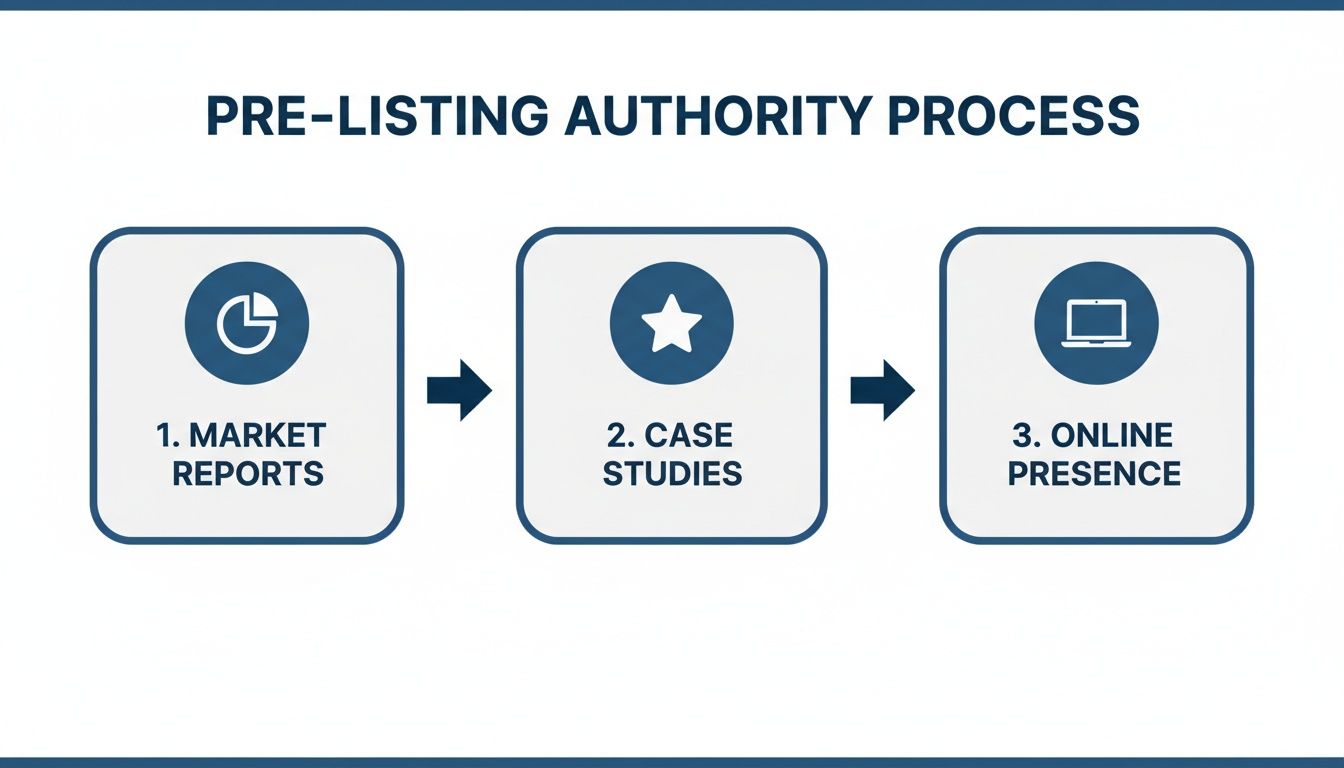
    How Long Should My Presentation Actually Be?

    Keep it tight. You're aiming for a 20-30 minute conversation, which usually means around 15-20 slides. Anything longer and you risk losing their attention completely. You'll see their eyes start to glaze over, and that's a sign you've lost them.

    Remember, this isn't a college lecture; it's the start of a partnership. Each slide needs to make a single, powerful point that moves the conversation forward. The goal is to leave ample time for their questions and for a real discussion to unfold. Honestly, that back-and-forth is where you build the most trust and often seal the deal.

    What's the Single Most Important Slide?

    If I had to pick just one, it’s the Differentiated Marketing Plan. This is your money slide. It’s where you prove you’re not just another agent who’s going to stick a sign in the yard, pop it on the MLS, and pray.

    This is your chance to show them exactly how you'll give their home an unfair advantage over the competition. Are you using AI to write compelling descriptions that rank higher on sites like Zillow? Are you running targeted social media campaigns to find buyers before they even know they're looking? This slide turns your commission from an expense into a smart investment for a better, faster sale.

    Don't just give them a bulleted list of tasks. Show them your system. When a seller sees you have a repeatable, proven process for getting results, it builds massive confidence and makes your fee a no-brainer.

    How Do I Make My CMA Not Look Like Everyone Else's?

    Stop just handing them a stack of comps and a number. You need to turn your Comparative Market Analysis (CMA) from a data dump into a compelling story about the market. Use visuals to make the numbers meaningful.

    Here's how to make your CMA truly stand out:

    • Absorption Rate Charts: A simple chart can show them exactly how fast (or slow) homes in their price bracket are selling. It’s a powerful reality check.
    • Sale Price vs. List Price Graphs: This is your best tool for setting realistic expectations from the get-go about offers and negotiations.
    • Days on Market Trends: Show them the difference in selling time between active and sold properties. This is the perfect way to underscore why pricing it right from day one is so critical.

    When you do this, you shift from being just another agent to becoming their trusted market analyst. That's a huge difference.

    Should I Send My Presentation Before the Meeting?

    Absolutely not. Send a pre-listing package, but never, ever email your full presentation ahead of time. Sending the slides first completely deflates the impact of your meeting. It robs you of the chance to guide them through your strategy, read their reactions, and answer their questions as they come up.

    Your pre-listing package is the teaser trailer, not the whole movie. It should have your bio, your best testimonials, a few case studies, and maybe a high-level market overview. Use it to build your authority and warm them up, so when you walk in that door, you're not a stranger—you're the expert they've been waiting for.


    Ready to stop building from scratch and start winning? ListingBooster.ai hands you the AI tools to craft a modern, data-backed pitch in minutes. You can generate everything from your competitive analysis to AI-written property descriptions and a complete 30-day marketing calendar. Give it a try for free and see what a difference a truly modern real estate listing presentation can make.

    Article created using Outrank