Tag: agent branding

  • 10 Real Estate Agent Differentiation Strategies to Dominate in 2026

    10 Real Estate Agent Differentiation Strategies to Dominate in 2026

    In a market saturated with look-alike agents, differentiation is not just a marketing tactic, it is a survival mechanism. The traditional playbook of prospecting, open houses, and generic mailers is no longer enough to secure your position as a top producer. Today’s clients are digitally savvy, starting their property journey not on traditional portals, but in AI-powered environments like ChatGPT and Google's AI Overviews. If your digital presence isn't optimized for these new search realities, you risk becoming invisible to the next generation of buyers and sellers.

    Blending in is the biggest risk to your career. Being another face in the crowd means competing on price, endlessly chasing cold leads, and struggling to build a sustainable business. True market leaders don't just participate in the market; they define it. They achieve this by establishing a unique value proposition that is impossible to ignore. This requires a deliberate, multi-faceted approach to standing out.

    This guide moves beyond generic advice like ‘be authentic’ or ‘find your niche.’ We are providing a deep dive into ten powerful, actionable real estate agent differentiation strategies designed to create a tangible competitive advantage. Each strategy is a complete roadmap, detailing not just what to do, but precisely how to implement it. You will find step-by-step instructions, methods for measuring success, and practical examples using tools like ListingBooster.ai to automate your growth. Prepare to move from being just another agent to becoming the undeniable authority in your market.

    1. AI-Powered Content Generation & Marketing Automation

    Consistently creating high-quality marketing content is a significant hurdle for most agents, often taking a backseat to client needs and transaction management. This is where AI-powered content generation emerges as one of the most effective real estate agent differentiation strategies. It’s not just about saving time; it's about deploying a systematic, scalable marketing engine that works for you 24/7.

    Platforms like ListingBooster.ai use artificial intelligence to instantly generate complete marketing suites from a simple property URL. This includes everything from psychologically-driven property descriptions and social media posts to blog articles and video scripts. The system automatically ensures Fair Housing compliance, removing a major point of friction and risk from your marketing efforts.

    Why This Strategy Works

    This approach directly addresses the primary bottleneck for agents: a lack of time and marketing expertise. Instead of spending hours staring at a blank screen, you can generate a week's worth of polished, engaging content in minutes. This allows you to maintain a powerful digital presence, build authority, and stay top-of-mind with your sphere of influence without sacrificing time spent on revenue-generating activities. For teams and brokerages, it ensures brand consistency and message control across dozens or even hundreds of agents.

    Key Insight: AI automation turns content creation from a daily chore into a one-time strategic task, allowing agents to focus on relationships and closings while their digital marketing runs on autopilot.

    How to Implement This Strategy

    1. Select Your AI Tool: Choose a real estate-specific platform like ListingBooster.ai designed to understand property marketing nuances.
    2. Start with a Single Listing: Use a tool like the Listing Commander to generate a full marketing kit for one of your current properties. Post the generated content across your social channels to see the immediate impact.
    3. Build Your Authority: Dedicate 15 minutes per week to the Authority Builder feature. Create and schedule content that answers common client questions, positioning you as the go-to expert before a seller even thinks of calling an agent.
    4. Batch and Customize: Set aside a small block of time each week to review the AI-generated content calendar. Add local flavor, market-specific statistics, or personal anecdotes to make the posts uniquely yours.

    By integrating this process, you create a sustainable marketing system that builds momentum over time. For more ideas on what to create, you can learn about real estate content marketing automation and how it frees up your schedule to focus on clients.

    2. AI Search Engine Visibility & Digital Footprint Optimization

    The way clients find agents is changing. Instead of starting with a traditional Google search, over 40% of homebuyers now begin their research on AI platforms like ChatGPT, Perplexity, and Google's AI Overviews. This shift makes AI search visibility one of the most important real estate agent differentiation strategies available today. It involves structuring your digital presence so that these AI algorithms recognize you as a topical authority and recommend you directly in their search results.

    This goes beyond traditional SEO. It's about creating a rich, interconnected digital footprint that AI can easily understand and trust. Agents who do this well appear as direct answers to queries like "best real estate agents in [city]" or "what is the property market like in [neighborhood]". This positions them as the default expert before a prospect ever visits a website.

    Why This Strategy Works

    This approach meets modern buyers and sellers where they are already looking for information. Securing a recommendation from an AI search engine builds instant credibility and authority in a way that a standard search result cannot. It bypasses the noise of paid ads and crowded search pages, putting your name and expertise directly in front of a high-intent audience at the exact moment they need a trusted professional.

    Key Insight: Optimizing for AI search isn't just about being found; it’s about being recommended. It turns your digital content into an automated referral engine powered by the world's most advanced technology.

    How to Implement This Strategy

    1. Establish Topical Authority: Consistently publish high-value content on your blog or website. Focus on weekly market updates, detailed neighborhood guides, and answers to common client questions to build a library of expert content.
    2. Optimize with Schema Markup: Implement real estate-specific schema markup on your agent bio pages, listings, and blog posts. This structured data helps AI engines quickly understand who you are, what you specialize in, and where you operate.
    3. Focus on E-E-A-T Signals: Structure all your content to demonstrate Experience, Expertise, Authoritativeness, and Trustworthiness. Include client testimonials, case studies, professional credentials, and links to reputable local sources.
    4. Maintain Your Digital Profiles: Keep your Google Business Profile and other professional directories completely updated with your correct name, address, phone number, and service areas. Consistency across platforms is a key trust signal for AI.

    By building a digital footprint designed for AI consumption, you create a powerful and sustainable client acquisition channel. You can discover more about this method by reading about real estate AI search optimization and how to make it work for your business.

    3. Personal Brand Authority Building Through Consistent Expert Positioning

    Most agents are seen as interchangeable service providers, waiting for clients to call. This strategy flips the model by turning you into a trusted authority figure that clients proactively seek out. This is one of the most powerful real estate agent differentiation strategies because it shifts the power dynamic; instead of chasing leads, you attract them by consistently demonstrating your deep market expertise.

    This involves the regular publication of original insights, hyper-local market analysis, and valuable buyer or seller education. By doing so, you build a library of content that proves your value long before a potential client is ready to transact, making you the only logical choice when the time comes.

    A smiling male real estate agent stands beside a large map displaying 'Local Market Expert'.

    Why This Strategy Works

    Authority building directly counters the commoditization of real estate agents. When sellers see you publishing weekly market updates with data they can't find on Zillow, or buyers read your detailed neighborhood guides, they perceive you as a genuine expert, not just a salesperson. This trust compounds over time, leading to higher-quality inbound leads and the ability to command premium commission rates because your value is self-evident.

    Key Insight: Becoming an authority figure means you stop competing on price and start competing on expertise. Your content becomes your most valuable asset, generating leads and building trust while you sleep.

    How to Implement This Strategy

    1. Choose Your Content Pillar: Don't try to be an expert on everything at once. Start by focusing on one core area: hyper-local market data, specific neighborhood profiles, or first-time homebuyer education.
    2. Commit to a Schedule: Consistency is non-negotiable for building authority. Commit to publishing at least one piece of core content weekly, whether it's a blog post, a video, or a detailed market report.
    3. Use Unique, Local Data: Go beyond generic national headlines. Provide specific statistics about a particular school district, the absorption rate in a single zip code, or an analysis of recent sales in a popular subdivision.
    4. Repurpose and Distribute: Turn one well-researched blog post into multiple pieces of micro-content. Create 4-6 social media posts, a short video script, and an email newsletter summary from that single piece of content to maximize your reach.

    By consistently delivering valuable, hard-to-find information, you establish an unshakeable position as a market leader. For a deeper dive into this topic, you can learn more about how to build authority as a real estate agent and make it a cornerstone of your business.

    4. Omnichannel Social Media Presence & Platform-Specific Optimization

    Simply posting the same content across every social media platform is a common but ineffective shortcut. A truly impactful digital footprint, one that serves as a powerful real estate agent differentiation strategy, requires an omnichannel approach. This means tailoring your content to the unique audience, algorithm, and format of each platform, from Instagram and Facebook to TikTok and LinkedIn.

    An agent who understands this will post a polished, professional market update on LinkedIn, a quick-paced "day in the life" video on TikTok, a visually stunning carousel of listing photos on Instagram, and a community-focused event announcement on Facebook. Instead of a one-size-fits-all broadcast, they create a cohesive brand experience where each channel offers distinct value, capturing different segments of their potential client base.

    Why This Strategy Works

    This method works because it meets consumers where they are and speaks their language. Users have different expectations for each app; they scroll TikTok for entertainment, LinkedIn for professional insights, and Instagram for visual inspiration. By optimizing for each platform, you increase engagement, signal to the algorithms that your content is high-value, and build deeper connections with niche audiences. Agents with massive TikTok followings, for example, often generate a steady stream of first-time homebuyer leads who would never have found them on LinkedIn.

    Key Insight: Platform-specific optimization transforms your social media from a simple megaphone into a network of targeted conversations, building authority and attracting the right clients from each distinct channel.

    How to Implement This Strategy

    1. Select Your Core Platforms: Don't try to be everywhere at once. Choose 2-3 platforms where your ideal clients spend the most time and commit to mastering them first.
    2. Create a Content Pillar: Start with a central idea (e.g., a new listing, a market update). Then, create platform-specific variations. A new listing might become a beautiful photo carousel for Instagram, a behind-the-scenes tour for TikTok, and a detailed post about the investment potential on Facebook.
    3. Engage Natively: Dedicate 15 minutes daily to interacting with your audience on each platform. Respond to comments with video replies on TikTok, answer DMs on Instagram, and participate in group discussions on Facebook. Engagement is a powerful signal to the algorithm.
    4. Batch and Schedule: Use a scheduling tool to plan your platform-specific content 2-3 weeks in advance. This ensures consistency even during busy periods and prevents you from defaulting to generic cross-posting.

    5. Data-Driven Market Intelligence & Competitive Advantage Positioning

    Any agent can claim to "know the market," but few can back it up with hard data. Using market intelligence as a core part of your value proposition is a powerful way to stand out. This approach moves your expertise from a vague assertion to a tangible, provable asset that clients can see and understand. It's about becoming the go-to economic advisor for their biggest investment.

    Instead of just presenting a standard CMA, you're providing a comprehensive analysis of price trends, absorption rates, neighborhood appreciation, and demographic shifts. This data-first method builds immense trust and positions you as a strategic partner, not just a transactional agent. It shows sellers why your pricing strategy is sound and gives buyers the confidence to make a strong offer.

    Hands analyzing market insights on a laptop displaying charts and graphs, pointing with a pen.

    Why This Strategy Works

    This strategy works because it directly counters the commoditization of real estate agents. When a client sees you presenting clear, insightful data that other agents aren't, you immediately establish a higher level of professionalism and expertise. It answers the client's unspoken question: "Why should I hire you?" with undeniable proof. This is one of the most effective real estate agent differentiation strategies because it shifts the conversation from commission to value, justifying your fee with concrete insights that lead to better financial outcomes for your clients.

    Key Insight: Data transforms your opinion into evidence. It provides the foundation for your advice, making your recommendations more credible and compelling than those of competitors who rely solely on gut feelings.

    How to Implement This Strategy

    1. Access Quality Data Sources: Subscribe to services that provide deeper insights than the standard MLS, such as CoreLogic, Altos Research, or local market-specific analytics platforms.
    2. Create Templated Reports: Develop a standardized, visually appealing market report template for both buyers and sellers. Create versions for specific neighborhoods or property types you specialize in.
    3. Integrate Data into Your Listing Presentation: Don't just show comps. Present charts on 5-year price appreciation, average days on market trends, and sale-to-list price ratios to justify your proposed listing price and marketing plan.
    4. Publish Monthly Insights: Release a monthly "Market Snapshot" via your blog, email newsletter, and social media. Consistently sharing this information will position you as the definitive local market authority.

    6. Niche Specialization & Vertical Market Expertise

    Attempting to serve every type of client in every neighborhood is a recipe for becoming a commodity. A powerful alternative is to adopt niche specialization, one of the most effective real estate agent differentiation strategies available. This involves concentrating your expertise and marketing efforts on a specific, well-defined market segment, such as luxury homes, first-time buyers, or relocating executives.

    Instead of being a generalist, you become "the" go-to expert for a particular type of client or property. An agent known for handling historic homes in a specific district will always have an advantage over a generalist when a seller with such a property is looking for representation. This focused expertise not only attracts your ideal clients but also often justifies premium pricing for your specialized knowledge.

    Why This Strategy Works

    This approach works by building deep authority and trust within a targeted community. Your marketing becomes more efficient and resonant because you are speaking directly to the unique needs and pain points of a single audience. General marketing messages get lost in the noise, but a message about navigating FHA loans for first-time buyers will capture the attention of that exact group. This focus creates a strong brand identity and a referral network that perpetuates itself within the niche.

    Key Insight: Specializing transforms you from a jack-of-all-trades into a master of one. Clients seek out and pay a premium for masters, not for generalists who can do a bit of everything.

    How to Implement This Strategy

    1. Identify a Viable Niche: Research your market to find a segment that is both interesting to you and large enough to sustain your business. Consider your personal passions, professional background, and local market opportunities.
    2. Invest in Specialized Knowledge: Pursue certifications relevant to your chosen niche, such as the Certified Luxury Home Marketing Specialist (CLHMS) or Accredited Buyer's Representative (ABR). Deepen your knowledge of niche-specific financing, contracts, and market trends.
    3. Tailor Your Marketing: All your branding, from your website to your social media content, must reflect your specialty. Create content that speaks directly to your niche, such as blog posts on "5 Common Mistakes First-Time Investors Make" or a market report on the local $2M+ property segment.
    4. Network Strategically: Immerse yourself in your niche community. Join investor meetups, build relationships with estate planners if you're in the luxury market, or connect with HR departments of large local companies if you focus on corporate relocations.

    7. Exceptional Client Experience & Relationship-Driven Differentiation

    In a market saturated with technology and automated outreach, providing a genuinely exceptional client experience stands out as one of the most powerful real estate agent differentiation strategies. This approach goes beyond standard service; it involves creating memorable, personalized interactions that exceed expectations at every single touchpoint, from the initial consultation to well after the closing table.

    This strategy is about transforming a transaction into a long-term relationship. Agents who master this build businesses where 80% or more of their work comes from repeat clients and direct referrals. They focus on superior communication, proactive problem-solving, and personal touches that make clients feel valued and cared for, not just like another commission check.

    Why This Strategy Works

    An exceptional client experience directly counteracts the commoditization of real estate services. While other agents compete on price or technology, you compete on trust and service quality. This builds an emotional connection, turning clients into enthusiastic advocates for your brand. This word-of-mouth marketing is more credible and effective than any paid advertisement, creating a sustainable business model that requires less prospecting over time.

    Key Insight: Delivering a five-star experience is not a cost; it's an investment in your most potent marketing asset: your past clients. Their referrals become the foundation of a predictable and profitable business.

    How to Implement This Strategy

    1. Develop Client Service SOPs: Create a checklist of non-negotiable service standards for every transaction. This should include communication frequency (e.g., a guaranteed weekly update call), key milestones, and post-closing follow-up plans to ensure consistency.
    2. Prepare Obsessively: Before any client meeting, do your homework. Research the property, the neighborhood, and review past notes on the client’s goals and personal details. Arriving prepared shows you respect their time and are serious about their success.
    3. Over-Communicate Proactively: Don't wait for clients to ask for an update. Provide information before they feel the need to ask, especially during periods of uncertainty like negotiations or inspection resolutions. A simple "just wanted to let you know we're still waiting on X, and I'll call you the moment I hear" can alleviate significant anxiety.
    4. Create a "Closing and Beyond" Plan: The relationship doesn't end at closing. Schedule follow-ups at one month, six months, and on their homeownership anniversary. Send a thoughtful, non-salesy gift or a valuable local market update that reinforces your role as their lifelong real estate advisor.

    8. Visual Content Excellence & Professional Photography/Videography Showcase

    In a market where buyers make snap judgments based on online listings, the quality of your visual content is no longer optional; it’s a critical component of your value proposition. Committing to professional-grade photography, videography, and immersive tours for every listing is one of the most impactful real estate agent differentiation strategies. This isn't just about making properties look good; it's about creating an emotional connection and conveying a standard of quality that reflects on you as an agent.

    A camera on a tripod capturing a professional photograph of a modern living room interior.

    This commitment extends beyond a single high-end listing. When you standardize excellence across your entire portfolio, from starter homes to luxury estates, you build a brand recognized for quality. Sellers see the superior marketing you provide for others and want that same level of service for their own property, making your listing presentation far more compelling than competitors who rely on smartphone photos.

    Why This Strategy Works

    This approach directly targets the buyer's decision-making process. Listings with professional photos receive significantly more views, sell faster, and often command higher prices. For sellers, this tangible result is a powerful reason to choose you over another agent. It demonstrates a serious investment in their success and positions you as a premium service provider who understands how to market a property effectively in a visually-driven world.

    Key Insight: Exceptional visual marketing is not an expense; it's an investment that pays for itself through faster sales, higher closing prices, and a powerful brand reputation that attracts future clients.

    How to Implement This Strategy

    1. Build a Professional Partnership: Find a reliable real estate photographer and videographer and build a long-term relationship. This ensures consistency in quality, style, and turnaround times for all your listings.
    2. Define Your Visual Package: Create a non-negotiable "standard package" for every listing. This should include professional HDR photography, a simple video walkthrough, and drone shots of the property and its surroundings.
    3. Prioritize Property Preparation: Always schedule a professional staging consultation or provide sellers with a detailed pre-shoot checklist. A well-prepared home is the foundation for stunning visuals.
    4. Incorporate 3D Tours: For every listing, invest in a Matterport or similar 3D virtual tour. This allows potential buyers to explore the property in-depth 24/7, qualifying leads and attracting out-of-town interest.
    5. Showcase Your Work: Create a dedicated "Our Marketing" page on your website featuring a gallery of your best property photos and videos. This serves as a powerful portfolio to win over prospective sellers.

    9. Technology Integration & Client-Facing Tools & Apps

    In a market where convenience is currency, the technology you provide to clients can be a powerful differentiator. This strategy moves beyond internal agent-focused software and centers on providing clients with modern, intuitive tools that simplify the complex buying or selling process. Adopting client-facing technology is a clear signal that you are a forward-thinking, organized professional dedicated to creating a seamless, transparent experience.

    This includes everything from client portals that show transaction progress in real-time to sophisticated mortgage calculators embedded on your website. When a seller can digitally sign documents from their phone at 10 PM or a buyer can track inspection deadlines through a shared app, you remove friction and anxiety from the process. This creates a high-touch feel through high-tech means, making you an indispensable part of their journey.

    Why This Strategy Works

    This approach directly addresses the modern consumer's expectation for on-demand information and digital convenience. By providing tools that empower clients and offer clarity, you reduce their reliance on constant phone calls and emails, freeing up your time while increasing their satisfaction. It establishes "switching costs"; once a client is integrated into your convenient digital ecosystem, the thought of moving to an agent who operates via scattered emails and phone calls becomes far less appealing. This makes your service "sticky" and memorable.

    Key Insight: Client-facing technology transforms the agent-client relationship from purely transactional to a collaborative partnership, building trust through transparency and exceptional user experience.

    How to Implement This Strategy

    1. Identify Client Pain Points: Start by mapping the client journey. Where do they express the most confusion or frustration? Common areas include understanding financing, tracking deadlines, and managing documents.
    2. Select User-Friendly Tools: Choose platforms with a clean, simple interface. A complex tool, no matter how powerful, will go unused. Look for transaction management systems like Follow Up Boss or dedicated client portals.
    3. Provide Clear Onboarding: Don't just send an invite link. Create a short video or a one-page guide explaining how to use the tool and highlighting its key benefits for them (e.g., "See every document and deadline in one place, 24/7").
    4. Integrate and Automate: Ensure your chosen tools work together. For example, your CRM should sync with your transaction management platform to avoid duplicate data entry and provide a single source of truth for your client's information.

    10. Strategic Partnerships & Network Leverage Differentiation

    Your value as an agent extends far beyond the transaction itself; it encompasses the entire ecosystem of services a client needs when buying or selling a home. Building a network of trusted, high-quality service providers is one of the most powerful real estate agent differentiation strategies. This approach transforms you from a transactional agent into a full-service concierge, offering clients a seamless experience from pre-approval to post-closing.

    This isn't just about having a list of names. It’s about creating formal and informal alliances with lenders, inspectors, contractors, designers, and movers who you have personally vetted. For example, an agent with a preferred lender can offer buyers a faster, more reliable pre-qualification process. A team with a dedicated network of contractors can help sellers execute pre-sale renovations that significantly increase a home's value, paid at closing.

    Why This Strategy Works

    This strategy works because it directly solves multiple client pain points simultaneously. Homebuyers and sellers are often overwhelmed by the sheer number of decisions and vendors they need to coordinate. By presenting a pre-vetted team of professionals, you remove immense stress and uncertainty from the process. It positions you as a deeply connected resource, building trust and demonstrating a level of care that goes far beyond simply opening doors or negotiating offers.

    Key Insight: A strong partner network turns your service from a single offering into a comprehensive solution, making you the indispensable hub for every client need and generating a powerful referral loop.

    How to Implement This Strategy

    1. Identify and Vet Partners: Start by auditing the vendors you already know and trust. For new categories, ask for recommendations and personally interview potential partners to ensure their service standards match your own.
    2. Formalize Key Relationships: Create simple referral agreements with your core partners (lender, title company, inspector). This clarifies expectations for communication, service levels, and any reciprocal benefits.
    3. Co-Create Marketing Content: Feature your partners in your marketing. Create a blog post titled "5 Things to Ask Your Home Inspector" featuring a Q&A with your preferred inspector, or film a short video with a staging expert on preparing a home for sale.
    4. Build a 'Preferred Partner' Package: Assemble a professional-looking guide or webpage that lists your network. Include this in your listing presentations and buyer consultation packets to showcase the extended value you provide from day one.

    10-Point Real Estate Agent Differentiation Comparison

    Strategy 🔄 Implementation complexity ⚡ Resource requirements 📊 Expected outcomes 💡 Ideal use cases ⭐ Key advantages
    AI-Powered Content Generation & Marketing Automation Medium — initial setup & voice tuning Low–Medium — subscription + quality inputs High volume, consistent compliant content quickly Solo agents, teams needing scale and consistency Time savings, compliance checks, multichannel reach
    AI Search Engine Visibility & Digital Footprint Optimization Medium–High — schema & technical setup Medium — content + technical implementation Improved discovery in AI platforms over weeks–months Agents targeting early-stage AI-driven buyers Long-term authority, lower ad spend, AI recommendations
    Personal Brand Authority Building Through Consistent Expert Positioning Medium — sustained content discipline Medium — time for research and publishing Increased inbound leads and premium positioning over months Agents aiming to become local market experts Trust, referrals, higher commissions
    Omnichannel Social Media Presence & Platform-Specific Optimization High — platform-specific strategies & workflows High — ongoing content creation and analytics Broader audience reach and higher engagement Agents targeting diverse demographics via social channels Higher engagement, diversified audience, algorithm advantage
    Data-Driven Market Intelligence & Competitive Advantage Positioning Medium — data collection and analysis Medium–High — data subscriptions and analyst time Defensible pricing, faster sales, stronger listing arguments Competitive markets and complex listings Objective pricing rationale, credibility, content fuel
    Niche Specialization & Vertical Market Expertise Medium — focused positioning and credentialing Medium — niche education, tools, network building Higher-value, targeted leads with premium pricing Luxury, investors, specific neighborhoods or verticals Premium pricing, efficient marketing, strong referrals
    Exceptional Client Experience & Relationship-Driven Differentiation Low–Medium — SOPs and service design High per-client — time and personalization High referral rates and lifetime client value Referral-focused agents and high-touch service models Strong referrals, client loyalty, reputation-based growth
    Visual Content Excellence & Professional Photography/Videography Showcase Medium — coordination & production standards High — professional photographers/videographers Better first impressions, increased inquiries, faster sales Luxury and visually competitive listings Higher inquiries, reduced DOM, justifies premium pricing
    Technology Integration & Client-Facing Tools & Apps High — integration, training, maintenance High — software, support, training costs Improved client experience and operational efficiency Teams scaling operations or offering remote transactions Convenience, retention, process automation
    Strategic Partnerships & Network Leverage Differentiation Medium — vetting and relationship management Low–Medium — time to build and formalize agreements Expanded services, co-marketing leads, referral flow Agents seeking service bundles and local networks One-stop client experience, partner-driven referrals

    From Strategy to Action: Your Differentiation Blueprint

    The journey through these ten real estate agent differentiation strategies reveals a powerful, unifying truth: success in modern real estate is about intentional action, not accidental discovery. We have moved far beyond the traditional playbook of open houses and yard signs. Your path forward is paved with a blend of intelligent technology, authentic branding, and a deep, unwavering commitment to client value. The strategies discussed are not a menu where you pick just one; they are interconnected components of a powerful business engine.

    The core message is a shift in mindset. Instead of being a passive participant waiting for the market to bring you clients, you must become the architect of your own demand. This means actively building a digital footprint that answers questions before they are asked, creating content that establishes you as a go-to expert, and designing a client experience so memorable it generates its own momentum through referrals and glowing reviews. Each strategy, from mastering AI-powered marketing to cultivating niche market authority, builds upon the others to create a formidable professional presence.

    Synthesizing Your Blueprint for Success

    To avoid feeling overwhelmed, it's crucial to distill these concepts into a manageable plan. Your next steps should not be to try everything at once. Instead, focus on a strategic, phased implementation that aligns with your current business needs and personal strengths.

    Here’s a simple framework to get started:

    • Audit Your Current Position: Where do you stand right now? Are you a tech-savvy agent who needs to build a personal brand, or a relationship expert who needs to improve your digital presence? A clear-eyed assessment will reveal your biggest opportunities.
    • Select Your "Power Duo": Choose one technology-focused strategy (like AI-Powered Content Generation) and one client-focused strategy (like Exceptional Client Experience). This balanced approach ensures you are improving both your efficiency and your service quality simultaneously.
    • Commit to Consistency: The most brilliant strategy fails without consistent execution. Whether it’s posting daily market insights generated by AI or implementing a new client onboarding system, commitment is what separates the high-performers from the rest. The key is to turn these advanced real estate agent differentiation strategies from abstract ideas into daily habits.

    The Lasting Impact of True Differentiation

    Ultimately, differentiation is not about being different for the sake of it. It's about being distinctly valuable. When you successfully implement these strategies, the benefits extend far beyond a single commission check. You build a brand that is resilient to market fluctuations, attracts a steady stream of ideal clients, and allows you to command your worth with confidence. You stop competing on price and start competing on expertise, service, and trust.

    This is your opportunity to construct a business that doesn't just survive, but thrives. By combining smart automation, a strong personal brand, and a genuine focus on client success, you create a competitive moat that is nearly impossible for others to replicate. The tools and tactics are here. The blueprint is laid out. Now is the time to build.


    Ready to put these strategies into action without the heavy lifting? ListingBooster.ai is the AI engine designed to execute your content and social media differentiation plan, creating expert-level posts, blogs, and marketing materials in seconds. See how you can build a standout brand with less effort at ListingBooster.ai.


  • Real Estate Agent Personal Branding AI Unlocked

    Real Estate Agent Personal Branding AI Unlocked

    Let's face it, talking about "AI personal branding" for real estate agents used to sound like something out of a sci-fi movie. But today, it's the new reality for staying top-of-mind with modern clients. It’s all about using smart technology to build, grow, and manage a consistent brand across all your digital channels—from social media to your own website.

    The real goal here? Making sure your expertise shows up when buyers and sellers turn to AI-powered search for help finding the right local agent.

    Why AI Is No Longer Optional For Agent Branding

    A smiling man in a blue shirt uses a tablet in a bright, modern home, with an 'AI-FIRST PRESENCE' graphic overlay.

    The days of just having a website and posting on Facebook every now and then are officially over. How clients find you has completely changed. Here’s a statistic that should make every agent pause: over 40% of homebuyers now start their journey on conversational AI platforms like ChatGPT, Perplexity, and Google's AI Overviews. They're not just "Googling" anymore.

    You can see more on how this shift is impacting agents at ListingBooster.ai.

    This seismic shift creates a massive blind spot for agents still stuck in the old way of doing things. If your online content isn't built for AI to easily find, understand, and recommend, you're essentially invisible to a huge chunk of potential clients. It’s no longer about simply having a digital presence; it's about having an AI-first presence.

    The Tale of Two Agents

    Think about two agents, Sarah and Mark, both working in the same busy suburban market.

    Mark is doing what's always worked. He posts new listings on his social channels when he can, and his website is pretty good, but it hasn't been updated in a while. His brand message is all over the place because, frankly, he’s too swamped closing deals to create consistent, valuable content.

    Sarah, on the other hand, has woven AI into her daily workflow. She uses a tool like ListingBooster.ai to stay ahead of the game. With it, she can:

    • Generate an entire month’s worth of hyper-local social media content in just a few minutes.
    • Create insightful market updates and neighborhood guides that position her as the go-to expert.
    • Optimize every single property description so that AI search tools not only understand it but are more likely to recommend it.

    Now, imagine a family moving to town asks ChatGPT, "Who is the best real estate agent for young families in [their suburb]?"

    The AI scans the digital world for answers. It finds Sarah’s library of helpful content about local schools, community parks, and market trends relevant to families. What about Mark? His profile, with its occasional "Just Listed" posts, doesn't even make the cut.

    The difference here isn't just about saving time. It's about being strategically visible where it matters most. AI doesn't replace your hard-earned expertise; it amplifies it, making sure your personal brand gets discovered by the next wave of clients.

    This simple story really drives home the urgency. Without an AI-powered branding strategy, you're not just falling behind—you risk becoming completely invisible online.

    Traditional Branding vs AI-Powered Personal Branding

    The gap between the old and new methods is widening. Here's a quick look at how the manual grind of yesterday compares to the intelligent, automated approach available today.

    Aspect Traditional Branding (Manual) AI-Powered Branding (e.g., ListingBooster.ai)
    Time Investment Hours per week manually writing posts, emails, and descriptions. Minutes to generate a month's worth of on-brand content.
    Consistency Often sporadic; posts are inconsistent in tone, frequency, and quality. Perfectly consistent; maintains brand voice and posting schedule effortlessly.
    Content Scope Limited to what one person can realistically produce; often just listings. Broad and deep; easily creates market reports, guides, and community content.
    AI Visibility Low. Standard content is not optimized for AI discovery tools. High. Content is specifically structured for AI search and recommendations.
    Market Reach Limited to existing social followers and traditional search traffic. Expands reach to the growing audience using conversational AI for discovery.
    Compliance Risk of manual errors and inconsistent disclaimer usage. Automated compliance checks and consistent inclusion of necessary disclosures.

    The choice is becoming clearer every day. Embracing these new tools isn't just about efficiency; it's a fundamental business decision for survival and growth in a rapidly changing industry.

    Defining an Authentic Brand Voice for AI to Learn

    A business person is writing notes with a house model and laptop on a desk, representing real estate work.

    Before you let an AI loose to build your brand, you have to give it a solid blueprint. AI is a fantastic mimic, but it can't invent a personality from scratch. Your first job is to define the authentic, human brand voice you want it to adopt.

    If you skip this foundational work, you’ll end up with generic content that sounds like every other agent out there.

    This whole process is about putting down on paper what makes you, well, you. Think of it as creating a "Brand DNA" document that your AI can study. The goal is simple: every piece of content the AI helps you create, from a quick social media post to a detailed market update, should sound like it came straight from you.

    Pinpointing Your Ideal Client

    You can't be everything to everyone, so the first step is getting crystal clear on who you want to reach. An agent targeting luxury downtown condo buyers is going to sound completely different from one who works with first-time homebuyers in the suburbs. You have to get specific.

    Ask yourself:

    • Demographics: What’s their age range, profession, or family situation?
    • Psychographics: What are their fears? Their motivations? How do they prefer to communicate—text, email, a phone call?
    • Pain Points: What keeps them up at night about the real estate process? Is it the fear of a bidding war, anxiety about school districts, or just navigating a complex sale?

    A detailed client persona is the cornerstone of your real estate agent personal branding AI strategy. The more nuance you add, the better your AI assistant can craft messages that truly connect with that specific audience.

    Articulating Your Unique Value

    Once you know who you're talking to, you need to decide what you're going to say. What makes you different from the dozens of other agents in your market? This is your unique value proposition (UVP), and it's the heart of your brand.

    Are you the tough-as-nails negotiator who lives for getting the best possible deal? Or maybe you're the empathetic guide who holds a client's hand through the emotional rollercoaster of buying or selling. Perhaps you’re the data geek who provides market insights no one else has.

    Your brand isn't just about what you do; it's about how you do it. This "how" is what makes you memorable. Your personality is your biggest asset, and it's exactly what an AI needs to learn to replicate effectively.

    Training Your AI with Brand Pillars

    Now, let's turn these ideas into something an AI can actually use. You'll create a set of core principles or "brand pillars" that will guide all the content it generates. Think of these as the non-negotiable rules your AI has to follow.

    Here’s a quick example of brand pillars for an agent targeting young families:

    Brand Pillar Description
    Tone of Voice Empathetic, educational, and reassuring. No stuffy, formal language.
    Core Topics Local schools, community events, family-friendly activities, market safety.
    Key Differentiator "Your partner in finding a community, not just a house."
    Forbidden Words "Luxury," "exclusive," "deal," "investment property." Stick to words like "home," "community," and "future."

    With these pillars defined, you're ready to create a master prompt that teaches your AI how to think and write like you. This initial setup is the most important step in creating a real estate agent personal branding AI system that feels genuine, connects with your audience, and ultimately, builds your authority at scale.

    Building Your Authority Content Engine with AI

    You’ve nailed down your brand voice—now it’s time to put it to work. Using AI to build your personal brand isn't just about saving a few hours. It’s about creating a consistent, high-value content engine that cements your reputation as the go-to expert in your market. This is the crucial shift from just posting listings to proactively proving your expertise.

    Forget the generic, cookie-cutter posts you see everywhere. We're talking about a steady stream of "Authority Builder" content. Think hyper-local market updates, genuinely insightful neighborhood guides, and compelling client success stories that do the selling for you before a prospect even thinks about picking up the phone.

    From Blank Calendar to Full Strategy

    Every agent knows the feeling: staring at a blank content calendar, wondering what on earth to post. What about today? This week? This indecision is a momentum-killer, leading to sporadic posts that don't build trust or authority.

    This is exactly where a dedicated AI tool completely changes the game. Instead of pulling ideas out of thin air, a platform like ListingBooster.ai can generate an entire 30-day content calendar in minutes. Just feed it your brand pillars and target audience, and it delivers a strategic mix of posts designed to educate and engage your ideal clients.

    This kind of system ensures your real estate agent personal branding AI strategy is always running in the background, building your visibility and credibility. It's the difference between showing up occasionally and truly owning the real estate conversation in your community.

    Creating Content That Pre-Sells Your Expertise

    Authority content is more than just staying active online; it’s about proving you know your stuff. The numbers don't lie. A massive 99% of buyers say an agent's thought leadership influences their decisions. On top of that, 73% are more likely to trust an agent who demonstrates expertise over one who just runs ads. This isn't just a hunch; it's backed by research from sources like LinkedIn on how expertise builds trust.

    Your content engine should be built on three core pillars:

    • Market Mastery: Share data-driven updates on local trends, inventory numbers, and pricing shifts. Show them you have your finger on the pulse.
    • Neighborhood Knowledge: Go deep. Create guides on specific communities that cover everything from school ratings to the best local coffee shop.
    • Client Success: Tell stories (with permission, of course!) that highlight the real problems you solved for past clients.

    This isn’t just content. It’s a growing library of proof that you're the most knowledgeable and effective agent for the job.

    Here are a few prompts you can adapt to get your AI partner generating high-quality content that sounds like you.

    AI Prompt Templates for Authority Content

    Content Type Example AI Prompt Template
    Local Market Update "Act as a real estate expert in [Your City]. My brand voice is [Adjective 1, Adjective 2]. Write a short, engaging Instagram post explaining what the latest [e.g., interest rate change, inventory numbers] means for local first-time homebuyers. End with a question."
    Neighborhood Spotlight "Generate a script for a 60-second TikTok video about the top 3 hidden gems in the [Neighborhood Name] area. My tone is [e.g., upbeat and friendly]. Include visuals I should capture for each spot."
    Client Success Story "I just helped a client [Describe the scenario, e.g., sell their home over asking price in a tough market]. My brand is [Your Brand Voice]. Write a compelling Facebook post that tells this story without revealing private details. Focus on the client's success and our strategy."
    Educational 'How-To' "Create a 5-slide Instagram carousel post explaining the 'contingency clause' in simple terms for someone who has never bought a home. My voice is [e.g., clear, reassuring, and professional]. Suggest a strong call-to-action for the last slide."

    These templates are your starting point. Tweak them with your specific niche, voice, and local details, and you'll quickly build a content machine that works for you.

    Expert Tip: Your One-Week Content Spark

    "Act as my social media strategist. I'm a real estate agent in [Your City] specializing in [Your Niche]. My brand voice is [Empathetic, data-driven]. Map out a 5-day content plan. Day 1: A 'Myth vs. Fact' about our local market. Day 2: A carousel highlighting 3 dog-friendly parks in [Neighborhood]. Day 3: A short video script explaining 'escrow.' Day 4: A client success story. Day 5: An 'Ask Me Anything' prompt to drive engagement."

    A simple prompt like this can turn your brand definition into a full week of strategic content. You'll go from being just another agent online to a genuine authority figure, making you the obvious choice for both clients and even AI search tools.

    Turning Property Listings into AI-Optimized Marketing Suites

    Your authority content is fantastic for building expertise, but let's be real—your property listings are where the rubber meets the road. This is where your personal brand directly engages with the market. AI is what takes a simple address and turns it into a full-blown, brand-aligned marketing campaign. It ensures every listing doesn't just sell a home, but also cements your reputation.

    Picture this: you take a single property URL and, in minutes, generate a complete suite of marketing assets. This isn't some far-off idea; it's a workflow that savvy agents are already using to get an edge. One simple input can spit out multiple MLS descriptions tweaked for Zillow or Redfin, plus an entire social media campaign ready to go for every stage—from 'Just Listed' to 'Just Sold'.

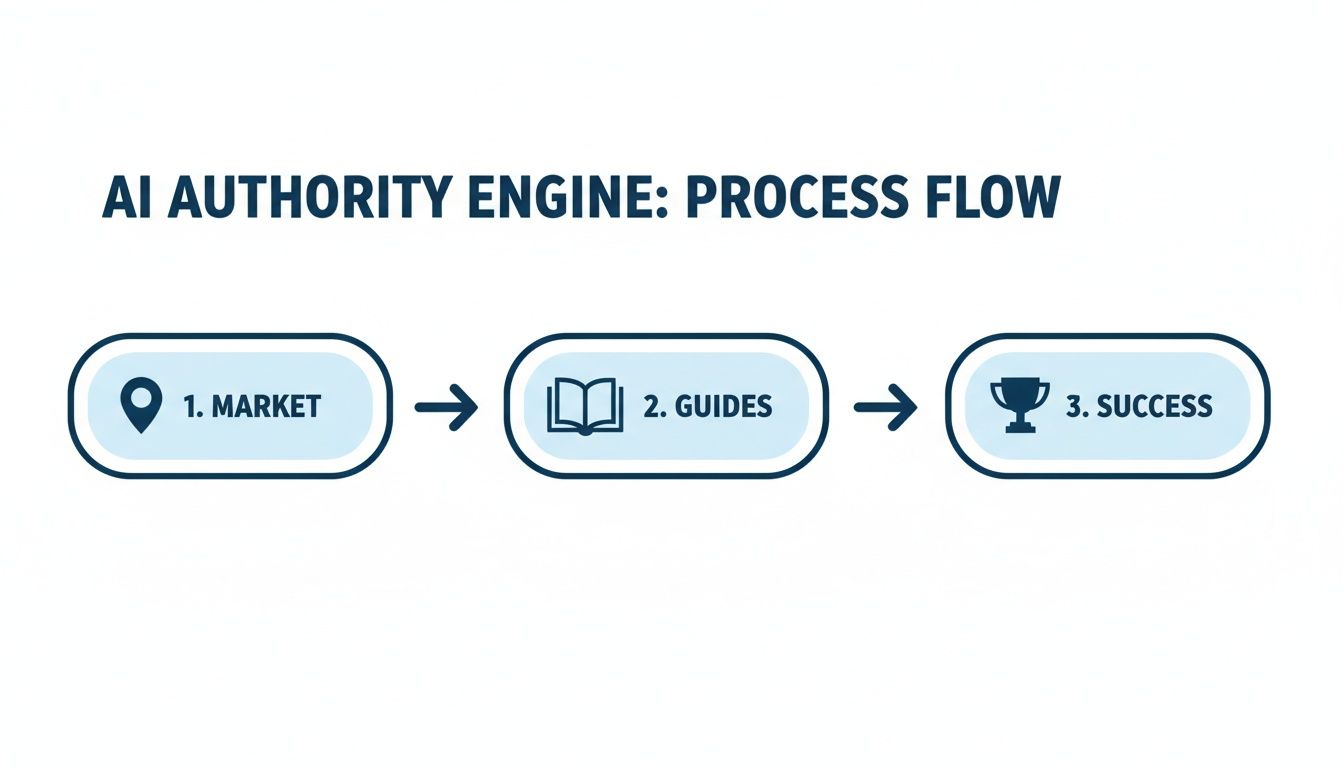
    This process shows exactly how AI can build your brand authority by turning raw market data and property details into compelling guides and success stories.

    Flowchart illustrating the AI Authority Engine process: Market, Guides, and Success.

    The big takeaway here is that AI isn’t just writing stuff for you. It's creating a connected ecosystem where your market knowledge, helpful guides, and client wins all feed into each other, amplifying your personal brand with every single listing.

    Beyond Pretty Pictures to Smart Data

    The real magic of using AI for your listings happens behind the scenes. It's not just about crafting catchy descriptions; it’s about making your properties machine-readable for what's coming next in search.

    When you use a sophisticated AI tool to create a listing, it can automatically embed schema markup. You can think of this as a hidden layer of code that talks directly to search engines and AI assistants like ChatGPT. This code tells them, in no uncertain terms:

    • This is a residential property.
    • Here is the precise address, price, and bedroom count.
    • This is the agent in charge of this listing.

    This small technical detail is a massive advantage. It takes all the guesswork out of it for AI, making your listings far more likely to pop up when a potential buyer asks an AI, "Show me three-bedroom homes for sale in downtown Austin."

    Your listings stop being just static web pages and become structured data points that AI can instantly understand, categorize, and recommend. This is the core of a modern real estate agent personal branding AI strategy.

    The AI Listing Commander in Action

    This is exactly the kind of heavy lifting that specialized platforms are designed to handle. A feature like the Listing Commander from ListingBooster.ai, for example, takes any property and explodes it into a complete marketing suite. It generates everything from social media posts to print-ready materials, all while embedding that crucial schema markup that dictates how the home will appear in ChatGPT and Google AI search.

    Ultimately, this approach fuses your property marketing directly with your personal brand. Every single home you list becomes another piece of your portfolio, showcasing your expertise, market insight, and modern approach. You’re not just selling a property; you're building a library of discoverable, AI-optimized assets that continuously reinforce your authority in the market.

    Staying Compliant and Consistent When You Scale

    Growing your personal brand from just you to a team of five, ten, or even a hundred agents is a huge undertaking. The real challenge? Making sure every single agent represents the brokerage’s standards perfectly, while still letting their own personality come through. This is where a lot of teams and brokerages get stuck.

    It’s not just about looking polished. Inconsistent messaging can create serious problems. Think about it: one agent fires off a quick social media post, and without meaning to, they’ve violated Fair Housing guidelines. That single post can lead to major legal headaches and financial penalties. For managing brokers, the constant supervision can feel like a full-time job in itself.

    Your AI Compliance Watchdog

    This is exactly why centralized real estate agent personal branding AI platforms are becoming mission-critical for operations, not just another marketing toy. Picture having an AI that works like a compliance officer, automatically scanning every piece of content—from a detailed listing description to a quick Facebook update—before it ever sees the light of day.

    You can train this system on your brokerage's specific brand rules, the language you want to use, and—most importantly—all the legal requirements you have to follow. It’s like having a built-in safety net that flags tricky phrases or things you might have missed.

    This isn't just about preventing mistakes. It's about giving every agent the freedom to create content with confidence, knowing a system has their back—and the brokerage's. You get all the creativity without the risk.

    Keeping the Brand Voice United

    Beyond the legal stuff, keeping your brand voice consistent across a big team is what builds real recognition in your market. You want a client to get the same amazing experience whether they’re working with a brand-new agent or a seasoned top producer. An AI platform can lock in that consistency without you having to micromanage everyone.

    It can automatically weave the brokerage’s core values and key messages into everything it helps create. A rookie agent’s market report will have the same professional polish as a veteran’s latest success story.

    • For Teams: It makes sure every agent sounds like they belong to the same cohesive, professional group.
    • For Brokerages: It offers a scalable way to generate Fair Housing-compliant content for everyone, knocking out both risk and branding challenges at once. You can see how platforms like ListingBooster.ai deliver these solutions for brokerages and solve this exact problem.

    This kind of automated quality control allows brokerages to maintain incredibly high standards as they grow. It turns the constant headache of brand management into a smooth, automated process, clearing the path for growth that’s both compliant and sustainable.

    Common Questions About AI in Real Estate Branding

    Jumping into AI can feel a little intimidating, I get it. Your personal brand is your most important asset, and the last thing you want is to mess it up with something that feels complex, sounds robotic, or just becomes another subscription you don't use.

    Let's cut through the noise and talk about the real concerns I hear from agents every day. The truth is, modern real estate agent personal branding AI isn't built for programmers; it's built for you. The fear of a massive learning curve is valid, but most of these platforms are designed to be up and running in just a few minutes.

    Will My Content Sound Inauthentic?

    This is the big one, isn't it? Your business is built on trust and human connection. The thought of putting out generic, soulless content is terrifying, and it should be.

    But here’s the thing: a good AI system doesn't create a voice for you. It learns to mimic yours.

    The initial work you do—defining your brand pillars, your ideal client, and what makes you different—is the most critical part of the whole process. When you teach the AI your specific tone, whether you're witty, super professional, or warm and empathetic, you’re setting the guardrails. From that point on, every piece of content it helps you create is just a reflection of the brand you already built. It’s a tool for amplification, not replacement.

    The goal isn't to sound like an AI. It's to sound like you, but at a scale you could never dream of achieving on your own. Think of it as cloning your best marketing ideas without having to clone yourself.

    Is the Investment Really Worth It?

    Let's be honest, time is your most valuable currency. Think about the hours you pour into brainstorming social posts, wrestling with listing descriptions, and just trying to keep up. An AI platform hands you those hours back. It automates the grunt work, freeing you up for the things that actually move the needle: connecting with clients and closing deals.

    The ROI isn't just about saving time; it's about creating opportunities. While one agent is scrambling to post something, anything, to Instagram, the agent with an AI-powered system is walking into a listing appointment with a fully optimized property description, a 30-day social media plan, and print-ready flyers already done. That’s not just efficient—it shows you're a market leader who comes prepared. You can see more about how this works on the ListingBooster.ai website.

    Do I Need to Be a Tech Expert?

    Absolutely not. If you can post on Facebook or send an email, you’ve got all the tech skills you need.

    The best AI tools are built for simplicity. You feed it the basic info—a property address, your brand voice notes—and the system does all the heavy lifting in the background. For a closer look at how simple this can be, check out our guide on how agents are using AI to save time.

    It’s all about making your workflow smarter, not harder.


    Ready to build a brand that works for you, even when you're not? ListingBooster.ai is your marketing command center, turning your expertise into discovery-ready content in minutes.

    Start your free trial of ListingBooster.ai today!

  • Build Authority as a Real Estate Agent with AI: A Proven Guide

    Build Authority as a Real Estate Agent with AI: A Proven Guide

    If you want to build authority as a real estate agent in today's market, you have to become the undisputed source of local knowledge online. This isn't just about posting listings. It's about consistently creating valuable, hyperlocal content that both potential clients and AI-powered search engines can find easily. It's how you prove your value long before the first handshake.

    Why Agent Authority Is Your New Competitive Edge

    The old playbook is officially outdated. Relying on mailers, billboards, or even a solid referral network just isn't enough to lock down your position in the market anymore. Here's a number that should get your attention: 43% of homebuyers start their search online. Their first impression of you is formed right there, long before they ever think about picking up the phone. They aren't just searching for any agent; they're looking for an expert they can trust.

    A professional man, likely a real estate agent, analyzes a map on his laptop screen.

    This fundamental shift in client behavior demands a new way of thinking. Building your authority as a real estate agent has moved from a "nice-to-have" marketing tactic to the absolute core of a sustainable business strategy.

    The Modern Definition of Real Estate Authority

    So, what does "authority" even mean in today's market? It’s a powerful mix of what you know and how consistently you share that knowledge. Think of it as your professional reputation, but scaled for the digital age. It boils down to three things:

    • Hyper-Local Expertise: This is so much more than just knowing the current inventory. It means being the go-to person for neighborhood market trends, school district ratings, upcoming zoning changes, and even the best local coffee shop.
    • A Consistent Online Presence: Posting once in a blue moon won't get you anywhere. True authority is built on a steady, reliable stream of valuable content across your website, blog, and social media channels.
    • Undeniable Social Proof: This is the proof in the pudding. It includes everything from glowing client testimonials and detailed case studies to impressive sales data and positive media mentions that back up your claims of expertise.

    For most agents I talk to, the biggest hurdle isn't a lack of knowledge. You know your market inside and out. The real struggle is finding the time and a cohesive strategy to broadcast that expertise effectively, day in and day out.

    The reality is that clients hire agents they trust, not just those who sell the most homes. Your content—from market updates to neighborhood spotlights—is your primary tool for building that trust at scale.

    A Framework for Building Your Authority

    To beat the overwhelm, you need a system. A scattershot approach of random posts and occasional emails leads to burnout and, frankly, minimal results. A modern framework, on the other hand, streamlines the entire process and ensures every single thing you do contributes to your larger goal. This guide is built on four essential pillars that work together to establish you as the go-to expert in your market.

    1. Positioning: Nailing down exactly who you serve and what makes you the only logical choice for them.
    2. Content: Creating a consistent flow of information that answers your ideal client's questions and showcases your deep expertise.
    3. SEO: Making sure your content actually gets found by the search engines and, more importantly, by the people who need it.
    4. Social Proof: Systematically capturing your wins and sharing them in a way that builds massive credibility.

    By weaving these four pillars into your business, you create a powerful, self-sustaining engine for growth. Tools designed to automate and organize this process, like those inside ListingBooster.ai, are built specifically to help agents put this framework into action efficiently. They turn a daunting task into a manageable—and profitable—workflow.

    This guide will walk you through each pillar, giving you actionable steps to build your authority and win more business. Let's get started.

    Defining Your Niche and Market Position

    Let’s be honest: you can’t be the go-to real estate agent for everyone. Trying to serve every buyer and seller in your city is a surefire way to get lost in the noise and burn yourself out. Real, lasting authority doesn't come from casting a wide net; it comes from having a sharp, strategic focus on a specific corner of the market where you can become the undisputed expert.

    A hand points at miniature houses on a map, analyzing real estate strategy with a tablet showing data.

    This is about more than just picking a neighborhood you like working in. It's about intentionally carving out a space where your unique skills, personality, and professional goals line up perfectly with a specific client’s needs. This focus is the very foundation you’ll use to build authority as a real estate agent.

    Pinpoint and Own Your Micro-Market

    A micro-market is a highly targeted segment you can absolutely dominate. Think about it: generalists compete with every agent in town, but specialists compete with almost no one. Your goal is to become so synonymous with your niche that when a potential client even thinks about that category, your name is the first one that comes to mind.

    Consider a few ways to slice the market:

    • Geographic Niche: This is the classic, but you need to go deeper than a city or zip code. Get specific. Think "historic homes in the Garden District" or "lakefront properties in the North Shore suburbs." The more granular, the better.
    • Property Type Niche: Are you passionate about a certain style of home? You could build a reputation specializing in mid-century modern restorations, new construction condos, or multi-family investment properties.
    • Client Demographic Niche: Serving a specific group of people allows you to tailor your entire message directly to their pain points and life stage. Great examples include first-time homebuyers, military relocations, downsizing empty-nesters, or luxury buyers.

    The trick is to find a niche that has enough business to be profitable but is specific enough that you can realistically become the #1 expert. This targeted approach makes every marketing dollar you spend and every piece of content you create infinitely more effective.

    Audit Your Personal Brand and Competitors

    Before you plant your flag in a niche, you need a clear-eyed view of your own strengths and who you’re up against.

    Start with some honest self-reflection. What deals have you truly enjoyed the most? What unique skills or background do you bring to the table? Maybe your previous career in finance makes you a natural for working with investors, or your background in design gives you an edge with historic properties.

    Next, get to know the agents already playing in the niches you're considering. Don't just look at their sales volume. Dig into their online presence.

    • What kind of content are they putting out?
    • What's their brand voice and visual style like?
    • Most importantly, where are the gaps in their strategy that you could fill?

    This isn't about copying them. It's about finding opportunities to differentiate yourself and craft a unique value proposition that nobody else is offering.

    Your brand isn’t just a logo or a headshot. It’s the promise you make to your clients. A well-defined niche makes that promise crystal clear and instantly recognizable to the right people.

    Translate Your Position into Automated Content

    Once you've defined your niche and brand position, you have to broadcast it. Consistently. This is where modern tools can give you a massive, almost unfair, advantage. Manually creating hyperlocal content day after day to reinforce your expertise is a major time-suck.

    This is the exact problem platforms like ListingBooster.ai were built to solve. For instance, with its 'Authority Builder' feature, you can define your niche—let's say, "first-time homebuyers in the Northwood neighborhood." The system then gets to work automatically generating content laser-focused on that audience, such as:

    • Guides on securing FHA loans for homes right there in Northwood.
    • Breakdowns of local school ratings and nearby park amenities.
    • Market updates focused specifically on entry-level home prices in that area.

    This automated approach ensures your online presence is constantly working for you, reinforcing your specialized expertise around the clock. It turns your defined position from a line on a business plan into a living, breathing digital footprint that attracts your ideal clients and solidifies your authority.

    Building Your Automated Content Engine

    If you want to build real authority, consistent, high-value content is the engine that gets you there. A smart content strategy does more than just fill your social media feed; it establishes you as an expert and essentially pre-sells your services long before a potential client ever picks up the phone. This isn't about posting generic advice—it's about building a practical, repeatable system.

    A modern desk setup with a laptop showing a calendar, a smartphone, and the text 'AUTOMATE CONTENT'.

    The entire goal is to become the go-to resource in your market by consistently answering the questions your ideal clients are asking online. By focusing on smart automation, you can maintain this powerful presence without sacrificing precious time you need for showings, negotiations, and closing deals.

    The Content That Actually Builds Trust

    To build authority as a real estate agent, your content has to go way beyond a simple stream of new listings. It needs to provide genuine, tangible value and prove you have a deep, nuanced understanding of the local market.

    I recommend focusing your energy on these three core content pillars:

    • Hyperlocal Market Updates: Don't just pull city-wide stats. Break down what's happening in specific neighborhoods you serve—from average days on market to new inventory trends. This is what shows you have your finger on the pulse of the micro-markets that matter.
    • Buyer and Seller Tip Series: Create content that actually guides people through the transaction process. Think short, punchy video tips on "3 Common Mistakes First-Time Buyers Make in Our City" or a simple checklist for "Getting Your Home Prepped to Sell This Spring."
    • Deep Dives into Neighborhood Amenities: This is where you truly shine. Showcase what makes a community special by featuring local businesses, reviewing new restaurants, or creating a guide to the best parks and schools in the area. This positions you as a true community insider, not just another salesperson.

    In a world where 88% of homebuyers turn to agents for guidance, a strong online presence is non-negotiable. This is why the sharpest agents are using tools to automate hyperlocal content that positions them as the go-to expert before a buyer even thinks about calling someone. In fact, one study showed that agents using structured educational content, like FAQs on financing, shortened their sales cycle by 27%. That’s powerful proof that authority is all about pre-selling trust.

    Automate Your Authority with a Content Calendar

    Let's be honest: the biggest killer of content consistency is a lack of time. Manually brainstorming and creating posts every single day is a direct path to burnout. This is where automation becomes your secret weapon.

    Tools like ListingBooster.ai were designed to solve this exact problem. Instead of staring at a blank screen wondering what to post, you can generate an entire 30-day content calendar that’s already tailored to your brand and niche—all in just a few minutes. These systems use proven psychological frameworks, like scarcity and social proof, to turn otherwise dry market data into social media posts that genuinely connect with your audience.

    The most successful agents don't have more hours in the day; they have better systems. An automated content calendar is the system that ensures your authority-building never stops, even when you're busy closing deals.

    This approach keeps your content mix perfectly balanced between educational, promotional, and community-focused posts, all without the daily grind. You can dive deeper into these strategies on the ListingBooster.ai blog.

    The Authority-Building Content Calendar

    To see how this works in the real world, here’s a sample weekly schedule. This structure ensures you’re hitting all the right notes to engage your audience, demonstrate your expertise, and ultimately, build your brand as the local authority.

    Day of the Week Content Theme Post Example (Generated by ListingBooster.ai) Authority Goal
    Monday Market Update "Good morning, [City]! The weekend saw 3 homes go under contract in the [Neighborhood] area, with an average list price of $450k. What does this mean for sellers? Scarcity is on your side." Demonstrate Data Expertise
    Tuesday Buyer/Seller Education "Quick Tip Tuesday: Before you start your home search, get pre-approved! It strengthens your offer and gives you a clear budget. DM me for my list of trusted local lenders." Build Trust
    Wednesday Neighborhood Spotlight "Mid-week shoutout to [Local Coffee Shop]! Their lattes are the best fuel for house hunting in [Neighborhood]. What’s your favorite local spot?" Showcase Local Knowledge
    Thursday Listing Promotion "Just Listed! This stunning 3-bed, 2-bath home in [Neighborhood] won't last long. With a brand-new kitchen and a huge backyard, it's perfect for a growing family. Click the link for a virtual tour!" Drive Leads
    Friday Client Success Story "So excited for my clients, the Smiths, who just closed on their dream home! Helping them navigate a competitive market to win this gem was an honor. Welcome to [Neighborhood]!" Provide Social Proof

    This kind of repeatable schedule transforms content creation from a daily chore into a strategic, automated process. It’s how you consistently build your reputation as the definitive real estate authority in your market.

    Making Sure AI Search Knows You're the Local Pro

    Having deep market knowledge is fantastic, but it’s completely useless if new search tools can't find you. If you want to build real authority as a real estate agent, you have to start thinking beyond old-school SEO and get your digital presence ready for AI search. Don't worry, this isn't about becoming a coder; it's about making your expertise easy for machines to understand.

    Think about it. When a potential client asks an AI assistant like ChatGPT or Perplexity, "Who is the best agent for first-time buyers in the Northwood neighborhood?" the AI isn't just skimming websites for keywords. It's actively looking for structured, organized data that screams "expert" on that specific topic. Your job is to hand-feed it that data.

    Translating Your Expertise for AI

    The basics of on-page SEO—using keywords in your website copy, blog posts, and property descriptions—still matter. That’s your foundation. But AI search needs another layer of detail. It needs to grasp not just what you're saying, but the context and relationships between all the bits of information you publish.

    For instance, it’s one thing to write that a property has three bedrooms. It’s another thing entirely for an AI to understand this is a "RealEstateListing" with a "numberOfBedrooms" value of "3," located in a specific "Neighborhood" that has a certain "publicSchool" rating. This is where a slightly technical idea called schema markup becomes an agent's secret weapon.

    Schema markup is basically a special vocabulary you add to your website's code. It helps search engines understand your content on a deeper level and give users much more helpful results. Think of it as creating a super-detailed digital business card for every single listing and blog post you create.

    This structured data is the native language of AI. Without it, you’re making the algorithms guess what you mean, and they'll either guess wrong or, even worse, just ignore you.

    Putting Schema on Autopilot

    Let’s be honest, manually adding schema markup to every listing, blog post, and market report is a nightmare. It's tedious, technical, and no agent has time for that. This is exactly why a platform like ListingBooster.ai can be such a game-changer for building your digital authority.

    The 'Listing Commander' feature, for example, takes care of all of this for you. When it generates marketing materials for your property, it's not just spitting out pretty text and photos. It's embedding all the right schema markup directly into the code of those digital assets.

    Here’s what that actually means for you:

    • For a New Listing: It automatically applies RealEstateListing schema, tagging the price, address, square footage, and number of rooms so AI can process it instantly.
    • For an Open House: It uses Event schema to clearly define the date, time, and location, which helps search engines feature it in local event searches.
    • For Your Agent Profile: It structures your contact info and service areas with RealEstateAgent schema, explicitly telling AI who you are, what you do, and where you work.

    This hands-off process ensures every piece of content you push out is perfectly tuned for the next generation of search. It's a huge leg up on the competition.

    What AI-Optimized Content Looks Like in the Wild

    So, let's get practical. You're writing a property description. The old way might be: "Charming 3-bed, 2-bath home in the sunny Glenwood neighborhood, perfect for families."

    An AI-optimized description, built with schema in mind, adds a ton of context behind the scenes. The buyer sees the same engaging text, but the AI sees clean, structured data points:

    Data Point Value Schema Tag
    Property Type SingleFamilyResidence @type
    Bedrooms 3 numberOfBedrooms
    Neighborhood Glenwood containedInPlace
    Key Feature Fenced Backyard amenityFeature

    This is exactly the kind of detail that lets an AI search engine confidently match your listing to a specific query like, "Find me a family-friendly home with a yard in Glenwood." Your listing doesn’t just show up—it's served up as a perfect, authoritative answer.

    The same logic applies to your blog. A post on local market trends is no longer just text; it's an Article with an author (you), a publisher (your brokerage), and a clear about topic (real estate in your city). Every piece of structured content builds on the last, creating a powerful web of data that solidifies your status as the go-to local expert in the eyes of the very algorithms connecting you with your next client.

    Using Social Proof to Build Unshakeable Trust

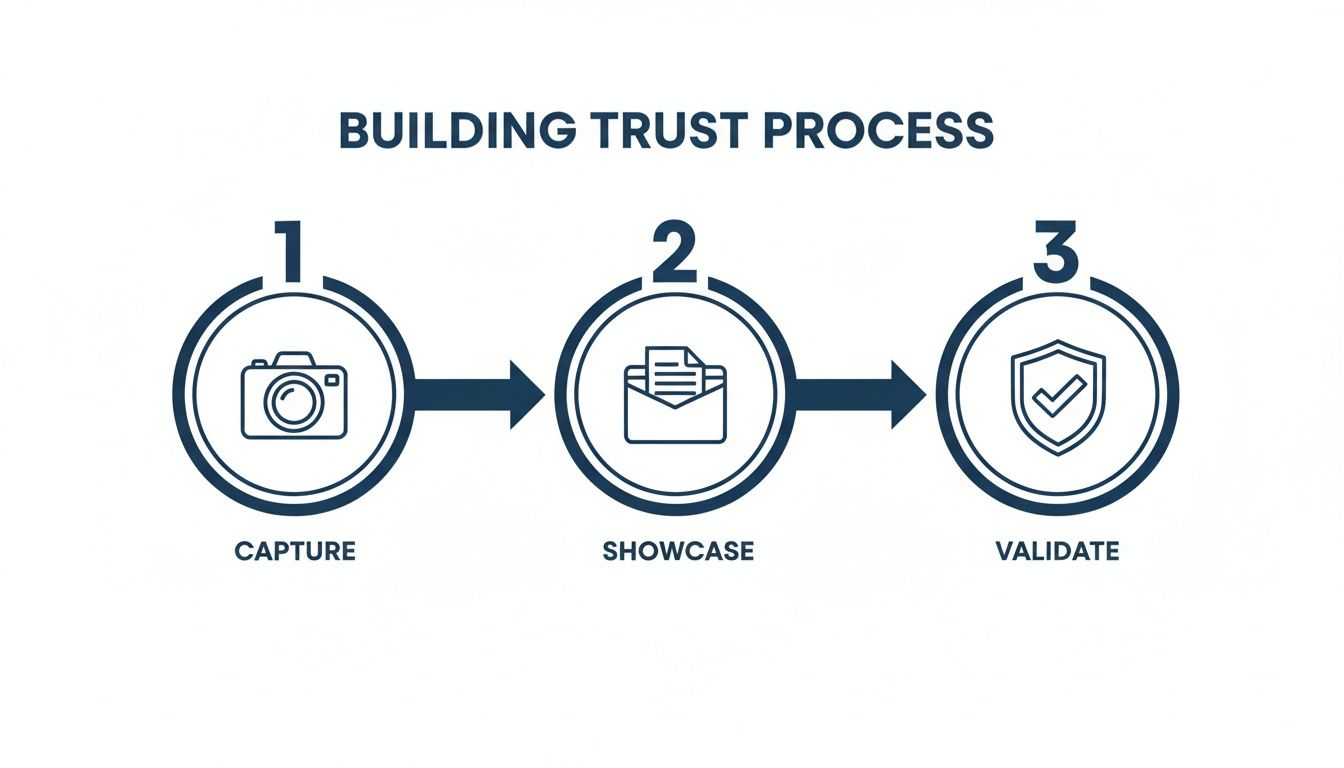
    Okay, so you've got your content and SEO firing on all cylinders. That's a great start, but it's not the whole picture. Nothing—and I mean nothing—builds credibility faster than cold, hard proof of your success. This is where social proof becomes your superpower. It's the tangible evidence that takes you from claiming you're an expert to proving it, giving potential clients that final nudge of confidence they need to pick up the phone and call you.

    To really make this work, you can't just wing it. You need a system for capturing and showcasing your wins. This isn't about just dropping a few text-based reviews on your website and calling it a day. We're talking about creating a living, breathing story of your success that's simply too compelling for prospects to ignore.

    Go Beyond Basic Testimonials

    Let's be honest, the old method of grabbing a quick, written blurb after a closing just doesn't cut it anymore. Today's clients are savvier than ever. They want to see the nitty-gritty details, the stories, and the hard data that prove you can actually deliver on your promises.

    Your mission is to build a central hub for all this proof—think of it as a digital trophy case or a "Results" page on your website. This page shouldn't just list your wins; it should sell your expertise with things like:

    • Detailed Case Studies: Don't just say you sold a house. Walk people through the story. What was the client's biggest challenge? What specific strategy did you use to solve it? And what was the incredible result? Use real numbers here, like "Sold in 7 days for 10% over the asking price."
    • Sales Volume Data: Telling people you're a top producer is one thing. Showing them is another. Simple charts or infographics displaying your sales volume, average sale price, or list-to-sale ratio can be incredibly powerful.
    • Client Success Stories: These are less about stats and more about the human element. They tell the story behind the transaction, which makes your success feel both relatable and real.

    Building true authority demands this level of transparency. In fact, agents who create these "proof pages"—showcasing sales data, in-depth stories, and market wins—build trust exponentially faster. This is critical when 50% of homebuyers are looking for an agent to guide them to the right home. One agent I know even cut their sales cycle by 27% just by using structured case studies to explain their process. If you want to dive deeper, you can read more about building an agent authority stack that helps you get more leads and close more deals.

    To really understand the shift, let's look at how modern social proof stacks up against yesterday's testimonials.

    Social Proof vs. Traditional Testimonials

    Method Traditional Testimonial Dynamic Social Proof (e.g., Case Study, Data) Impact on Authority
    Client Quote "Jane was great to work with!" "We were struggling to sell our unique property. Jane's staging and marketing plan brought in 5 offers." Moves from a generic compliment to a specific, problem-solving narrative that builds real-world credibility.
    Data & Results Mentioned vaguely, if at all. "Sold for $25,000 over asking price in just 4 days." Hard numbers are undeniable. They provide concrete, verifiable evidence of your skill and market knowledge.
    Visuals Usually just a block of text. Includes photos, charts showing market trends, or a short video clip of the happy client. Visual proof is more engaging and memorable, making the story stick with potential clients.
    Relatability for Leads Can feel generic and interchangeable with other agents. A detailed story allows future clients to see themselves in the situation and trust you to solve their problems. Creates a powerful connection by demonstrating that you understand and can overcome specific client challenges.

    As you can see, the difference is huge. One feels like a polite thank-you note, while the other is a powerful tool that actively sells your value.

    A Simple Framework for Powerful Video Testimonials

    A single, well-done video testimonial is worth its weight in gold. When a prospect can actually see and hear a genuinely thrilled client talk about their experience, it creates an instant emotional connection. That's a level of trust you just can't get from text alone.

    But you can't just hope for these to fall into your lap. You need a simple, repeatable process.

    1. Ask at the Peak of Happiness: The absolute best time to ask is right after a smooth closing or the moment you've delivered fantastic news. Their excitement is authentic and totally contagious.
    2. Give Them Simple Prompts: Don't put them on the spot by just saying, "Can you record a testimonial?" Guide them with easy questions like, "What was your biggest worry before we started working together?" or "Can you describe how you felt when we got that amazing offer?"
    3. Make It Insanely Easy: Tell them to just record a quick video on their smartphone. Stress that it doesn't need to be a Hollywood production. Authenticity beats polish every single time.

    Turn Every "Just Sold" into a Social Proof Event

    Every time you close a deal, it’s a golden marketing opportunity. Instead of just tossing up a static "Just Sold" graphic and moving on, you can use a tool like ListingBooster.ai to turn that single moment into a powerful, multi-channel social proof campaign.

    With a single closed listing, the platform can automatically create an entire suite of content for you, like:

    • An engaging social media post announcing the sale, complete with compelling copy and professional graphics.
    • A short video reel or story that highlights the property's best features and celebrates the great outcome.
    • An email template ready to be sent to your database, reinforcing your track record and proving you're active and successful in the market.

    This approach transforms one achievement into a dynamic story that reinforces your authority everywhere your audience is looking. It keeps your success consistently front and center, making you the obvious choice.

    Your Authority-First Workflow for Real Estate

    Pulling all these strategies together isn't about reinventing your entire business. It's about putting a simple, repeatable system in place that builds your authority on autopilot. Think of it as shifting from an agent who’s always chasing the next content idea to a market expert who operates with a clear, predictable plan.

    The process itself is surprisingly straightforward. You start by laying the groundwork with a tool like ListingBooster.ai's ‘Authority Builder’. This lets you generate and schedule a full 30 days of hyperlocal, niche-specific content in one go. It’s like putting your brand building on cruise control, freeing you up while consistently reinforcing your expertise across your social channels.

    This simple diagram breaks down the trust-building process your content powers.

    A three-step diagram outlining the 'Building Trust Process': Capture, Showcase, and Validate.

    This cycle—capturing your expertise, showcasing it through great content, and then validating it with real proof—is what creates that unshakable client confidence.

    Deploying Your Listing Marketing Suite

    Now for the fun part. Every time you get a new listing, you launch the ‘Listing Commander’. This is your tactical marketing engine. In just a few minutes, it generates an entire suite of AI-optimized assets for that specific property. We're talking everything from a compelling MLS description to social media posts and even print-ready flyers.

    This isn't just about marketing a house; it’s about demonstrating your value at every single turn.

    This shift in operations is profound. You no longer just show up to listing appointments; you arrive with a pre-built, professional marketing plan that proves your value from the very first minute.

    This workflow means you’re not just marketing differently—you’re operating like a true market authority. You're set up to win listings before the conversation even begins because you’ve already shown them a superior strategy. To see how these features empower agents, you can explore the tools available on ListingBooster.ai.

    Frequently Asked Questions

    Building your authority doesn't happen overnight, but with a smart, consistent strategy, you can definitely speed things up. Let's tackle some of the most common questions I hear from agents who are ready to get serious about establishing themselves as an expert.

    How Long Does It Take to Build Authority?

    You're not going to become the top agent in your city in a month, but you can see a real, tangible shift in as little as 90 days if you stick to the plan. Consistency is everything here.

    This is where a platform like ListingBooster.ai becomes a game-changer. It helps you hit the ground running with a constant flow of expert content and perfectly optimized listings. This consistent output helps AI search engines recognize your specific expertise much, much faster than you could ever achieve doing it all by hand.

    Can New Agents Build Authority Without Many Sales?

    Yes, one hundred percent. New agents can build authority by going deep, not wide. Forget about your sales history for a minute and focus on becoming the undeniable expert in a hyper-local niche. Your first goal is to be the go-to resource for a single neighborhood or a specific type of buyer.

    Don't wait for sales to prove your worth. Prove your worth with your knowledge, and the sales will follow. Your consistent content about local trends, businesses, and schools will build the trust that secures those first deals.

    Tools like the Authority Builder in ListingBooster.ai are perfect for this. You can instantly create genuinely helpful content about market stats, school districts, and community events in your target area. That deep knowledge, shared consistently, is what makes you a credible expert.

    What Is the Single Most Important Factor?

    If you take one thing away from this guide, let it be this: consistency. A single viral post is just a blip on the radar. What truly builds a lasting reputation is a steady, reliable stream of valuable content.

    This is what builds trust with potential clients and what gets you noticed by search algorithms. An automated content system is your secret weapon here. It ensures your digital presence is always active and reinforcing your expertise, even when you're completely swamped with showings and closings.


    Ready to stop chasing leads and start operating like a true market authority? ListingBooster.ai generates a complete suite of AI-optimized assets—from social media posts to compelling MLS descriptions—designed to help you win listings before you even walk in the door.

    Start building your authority today at https://listingbooster.ai.