If you're still relying on the old playbook to get listings in 2026, you're going to get left behind. It’s no longer just about who can make the most cold calls or knock on the most doors. The game has changed.
Your Foundational Shift: Become the Obvious Choice for Sellers
Think about it: before a modern homeowner ever thinks about calling an agent, they go online. They're researching their home's value, looking up market trends, and, most importantly, vetting local agents. This is where you need to win.
The secret isn't about chasing every lead; it's about building your digital authority so the best leads come directly to you.
This means you stop being a reactive salesperson and start becoming the go-to resource they find in their initial search. Your online presence—your website, your social media, your content—needs to do the heavy lifting for you, establishing your credibility long before you ever shake their hand. It all starts when you truly grasp what sellers expect from agents today.
This isn't just a minor tweak to your strategy. It's a fundamental shift that positions you not as another agent trying to get a listing, but as the trusted expert they were hoping to find all along.
Mastering High-Value Prospecting Channels
If you're serious about getting more real estate listings, you have to move beyond casting a wide, generic net. The real secret is a smart, multichannel prospecting plan that focuses your energy where it counts most. This means nurturing the relationships you already have in your Sphere of Influence (SOI) while also strategically pursuing frustrated For Sale By Owners (FSBOs) by showing them exactly how much value you bring to the table.
When it comes to expired listings, a modern, empathetic approach wins the day. Don't just promise you can sell their home; show them how your marketing plan is superior to the one that failed them before. This is especially important right now. With active for-sale listings projected to jump by 8.9% in 2026, the agents who can stand out will capture the lion's share of that new business. You can dive deeper into these numbers by checking out the full housing market forecast on Realtor.com.
The game isn't just about knowing where to find potential sellers. It's about how you connect with them and solve their specific problems, whether you're building a reputation in a geographic farm or responding to a lead from Zillow.
Not all prospecting channels are created equal. Some offer quick wins with high conversion rates, while others are a long-term play requiring consistent effort. To help you decide where to invest your time and money, here’s a breakdown of the most common channels.
Prospecting Channel Effectiveness Matrix
Channel
Typical Conversion Rate
Effort/Cost
Key Tactic/Tool
Sphere of Influence (SOI)
High (10-20%+)
Low Cost, High Effort
Consistent, value-add communication via a CRM like Follow Up Boss
For Sale By Owner (FSBO)
Medium (3-5%)
Medium Effort
Proving value with a killer pre-listing packet and market data
Expired/Withdrawn
Medium (4-6%)
Medium Effort
A superior marketing plan and empathy for their frustration
Geographic Farming
Low (1-2%)
High Cost/Effort
Hyper-local content, direct mail, and community events
Online Leads (PPC/Zillow)
Low (1-3%)
High Cost
Speed-to-lead and a long-term, automated follow-up cadence
As you can see, your SOI is often your most potent source of business because it's built on trust. However, a healthy mix of channels ensures you have a steady stream of opportunities, balancing high-effort farming with faster-turnaround leads from sources like FSBOs or expireds. The key is to pick a few and master them.
Get Found When Sellers Ask AI for Help
Think about this for a second: when a potential seller asks a tool like ChatGPT, "Who's the best real estate agent in my city?" does your name pop up? If the answer is no, you're already behind. This is the new battleground for winning listings before your competition even knows a seller exists.
So, how do you get on AI's radar? It’s all about what you publish online. These AI models are constantly reading everything to figure out who the real experts are. Every hyper-local market report, neighborhood guide, and seller-focused blog post you create acts as a piece of evidence, proving your authority in your specific market.
This shift in how sellers find agents couldn't come at a better time. We're seeing a healthy rebound in the market, with the JLL Global Real Estate Perspective report showing a 19% increase in global real estate investment volumes from 2024. That means more motivated sellers are out there, and they're starting their search online.
Creating all this content consistently can feel like a full-time job. That's where tools like ListingBooster.ai come into play. They can help generate the kind of expert content that AI is looking for, formatted in a way it can easily understand and recommend.
Want to learn exactly how to set this up? We've put together a full guide on Real Estate AI Search Optimization that breaks it all down.
How to Win the Listing Appointment Every Time
Getting your foot in the door is one thing; walking out with the signed listing agreement is another game entirely. The agents who consistently win don't just show up with a standard CMA. They present a complete, undeniable marketing plan that makes the seller feel like you're the only agent who can get the job done right.
This is where you can really shine and set yourself apart. Don't just tell them what you'll do—show them. Walk in with tangible, customized marketing materials already prepared for their specific property.
Imagine their reaction when you hand them:
An AI-powered, emotionally compelling property description written specifically for their home.
A sample 30-day social media calendar, mapping out exactly how you'll create buzz.
Professionally designed flyers and print assets, ready to go.
This isn't about promising results. It's about proving you're already working for them before they've even signed.
Think of it as building instant trust. When you come this prepared, you're not just another agent—you're the expert they were hoping to find. It demonstrates a level of commitment and sophistication that speaks for itself.
For a full playbook on everything to bring and say, check out our complete guide on how to win listing appointments and grab the free checklist to take with you.
Your Always-On Listing Attraction System
Imagine a world where potential listing leads come to you, day or night. That’s the goal here. We’re going to build a smart, automated workflow that attracts homeowners who are thinking about selling, gives them genuinely helpful information, and guides them toward booking an appointment with you—all without you having to manually chase every single lead.
Think of it as your own lead-generating engine that runs in the background. This frees you up to do what you do best: connect with clients and close deals.
This simple breakdown shows how it all comes together. When you have the right strategy, you can deliver a powerful presentation and walk away with a signed agreement.
This process isn't just theory; it's a proven path from first contact to a successful partnership.
Why is this so crucial right now? The current market is tight. Over 65% of homeowners are sitting on mortgage rates below 5%, making them hesitant to sell. Yet, with home values soaring, the temptation is real. You can get a deeper dive into these trends in the 2026 market outlook.
Answering Your Top Questions About Landing More Listings
Let's cut right to the chase and tackle some of the most common questions agents have when trying to build their listing pipeline. I hear these all the time, so let's get you some clear, actionable answers.
What's the Fastest Way to Get My First Real Estate Listing?
Your quickest path to that first "For Sale" sign in the yard is almost always through your Sphere of Influence (SOI). These are the people who already know you, trust you, and actually want to see you succeed.
Forget the hard sell. Start by having real conversations. Reach out and offer a complimentary home equity report or share some surprising local market stats. You're not asking for business; you're providing value. This builds on the trust you already have and gets results much faster. The proof is in the numbers—an estimated 40% of buyers find their agent through a friend or family referral, making your personal network an absolute goldmine.
How Many Hours a Week Should I Really Prospect for Listings?
The most successful listing agents I know consistently block out 10-15 hours per week just for prospecting. The secret ingredient here isn't the total number of hours, but the unwavering consistency.
Think of it this way: Two hours of focused, phone-off, door-closed prospecting every single day will yield far better results than one marathon eight-hour session once a week. You'll burn out. Treat that daily time block like a non-negotiable meeting with the CEO of your business—because that's exactly what it is.
Does Cold Calling Still Actually Work for Getting Listings?
Yes, it absolutely does, but you have to be smart about it. While it has a lower success rate than calling someone who knows you, targeted cold calling is incredibly effective for niche opportunities like For Sale By Owners (FSBOs) and Expired Listings.
The key is to drop the generic sales script and lead with a specific solution to their obvious problem. For an expired listing, you could open with, "I noticed your home just came off the market. I specialize in re-launching properties with a fresh marketing angle and have a few specific ideas for yours." For a FSBO, show them hard data on how agents in your MLS consistently secure a higher net price, even after commission. You're not a salesperson; you're a problem solver.
Ready to stop chasing leads and start attracting them? ListingBooster.ai builds your digital authority and automates your marketing so sellers find you. See how it works.
If you want to boost your social media engagement, the single most important shift you can make has nothing to do with hashtags or posting times. It’s about changing your entire approach from selling properties to serving your community.
This means moving away from a feed that looks like a digital billboard and toward one that provides valuable neighborhood insights and sparks genuine human connections. It's this fundamental change that stops the endless scroll and starts real conversations.
Why Your Real Estate Posts Are Falling Flat
Does this sound familiar? You share beautiful listing photos, announce your upcoming open houses, and celebrate recent closings, but all you hear back is… silence. It’s a frustratingly common experience for agents who feel like they're shouting into an empty digital room.
The problem isn't your listings; it's a disconnect between what you're posting and what your audience actually wants to see. Social media is a two-way conversation, not a one-way broadcast. Your followers hold all the power with a simple flick of their thumb.
The "Billboard" Mindset is Killing Your Engagement
Too many agents fall into the trap of treating their social profiles like digital billboards. Their feeds become a static stream of inventory—"Just Listed," "Price Reduced," "Just Sold." It’s an approach that’s a fast-track to being ignored.
Think about it from your audience's perspective. People don't jump on Instagram, Facebook, or TikTok to be sold to. They're looking for connection, entertainment, and useful information.
When every post is a sales pitch, you train your followers to tune you out. This creates audience fatigue, and even worse, it signals to the platform's algorithm that your content isn't very interesting. Before you know it, your posts stop showing up in their feeds altogether.
The new golden rule of real estate social media is simple: Serve, don't just sell. Your goal is to become the go-to digital mayor of your community, not just another agent with properties for sale.
To put this into perspective, let's compare the old way of thinking with a modern, engagement-focused strategy.
Old vs. New Social Media Engagement Tactics
Outdated Tactic (Low Engagement)
Modern Strategy (High Engagement)
Posting only listings and sales.
Sharing community news, events, and spotlights.
Using generic captions like "Beautiful 3-bed, 2-bath…"
Telling a story about the home or neighborhood.
Asking followers to "Click the link in bio" for everything.
Posing genuine questions to spark conversation in the comments.
Ignoring comments or giving one-word replies.
Replying to every comment with a thoughtful response or question.
Creating interactive content like polls, Q&As, and quizzes.
Focusing solely on the transaction.
Highlighting the lifestyle and experience of living in the area.
Adopting the strategies on the right is how you transition from being just another agent to becoming a valued community resource.
How Today's Buyers Are Finding You
The way clients discover and vet agents is changing dramatically. A growing number of buyers—especially younger ones—are starting their search on social media or even by asking AI assistants like ChatGPT for recommendations.
These modern clients are looking for proof of expertise and trustworthiness long before they’re ready to talk business. They're asking themselves:
What’s it really like to live in this town?
Who is the local expert on schools, new restaurants, and parks?
Which agent shares helpful advice without constantly pushing me to buy or sell?
Your content is the answer to these questions. By focusing on your community and providing real value, you build the social proof and authority that both people and algorithms reward. When you’re seen as a helpful guide rather than just an advertiser, the likes, comments, and shares will follow.
Build Your Content Foundation with Audience Insights
Before you ever draft a single social media post, you have to get crystal clear on who you're trying to reach. If your engagement is falling flat, it’s probably because you're creating content for a faceless "audience" instead of speaking directly to real people with specific problems and goals.
The truth is, generic content aimed at everyone ends up connecting with no one.
Most agents I see make the same initial mistake: they lump everyone into two giant buckets called "buyers" and "sellers." That's like trying to perform surgery with a sledgehammer. It’s far too clumsy. To create content that actually gets noticed and shared, you have to get much more specific about the real-world situations your clients are in.
Move Beyond Buyer and Seller Labels
It's time to stop thinking in broad categories and start building detailed audience profiles, or personas. Think of them as character sketches for the exact people you want to attract. This isn't just a fun marketing exercise; it's the bedrock of a strategy that works.
Give these personas names, jobs, and a bit of a backstory. What’s keeping them up at night? What are their biggest fears about the market? When you get this granular, your content creation shifts from guesswork to problem-solving.
Here are a few examples to get you started:
"First-Time Finn and Fiona": A couple in their late 20s, tired of renting in the city. They're watching interest rates climb and feel completely overwhelmed, terrified of making a bad investment on their first home.
"Downsizing Diane": She's in her late 50s, the kids have moved out, and that big family house now feels empty. Her main goal is to sell and find something smaller and low-maintenance so she can finally travel more.
"Luxury Leo": A busy executive who needs to upgrade. He's all about efficiency, data, and privacy. He isn't scrolling social media for fun; he’s looking for an agent who speaks his language with hard numbers and total discretion.
Once you have these profiles, the content ideas practically write themselves. You’re no longer staring at a blank screen wondering what to post. You’re simply answering the questions your ideal clients are already asking. For a deeper look at this process, our guide on developing a strong content marketing strategy for real estate is a great next step.
Match Your Audience to the Right Platform
One of the biggest mistakes agents make is trying to be everywhere at once. It’s a recipe for burnout and mediocre results. The smarter play is to go where your audience already is and absolutely dominate that space. Let your personas guide your platform choice, not the other way around.
Every social platform has its own vibe and user base. Understanding these nuances is a game-changer for getting real traction.
The goal isn't to have a profile on every platform. It's to build a commanding presence on the right platforms, where your ideal clients are looking for exactly what you offer.
Let's see where our personas would likely spend their time online:
Audience Persona
Primary Platform
Content Strategy
First-Time Finn and Fiona
Instagram & TikTok
Create short, punchy videos that break down the buying process. Think Reels on "3 Things to Know About Mortgages" or quick tours of starter homes. Host "Ask Me Anything" sessions to ease their fears.
Downsizing Diane
Facebook
Get active in local community groups. Share posts about great walkable neighborhoods, articles on decluttering for a move, or virtual tours of low-maintenance townhomes and condos.
Luxury Leo
LinkedIn & Instagram
Post in-depth market reports and analyses. Write articles on luxury real estate trends. Use high-end photography and video on Instagram to showcase exclusive listings, focusing on unique architecture and amenities.
This targeted approach means your message is hitting the right people at the right time. You stop just "posting content" and start strategically delivering value right into the hands of those who need it most. When you truly understand who you’re talking to, you lay the foundation for a social media presence that doesn't just get views—it builds trust and starts conversations.
Create Visuals and Videos That Stop the Scroll
Let’s be honest: in the world of social media, text just doesn't cut it anymore. If you want to grab someone's attention as they're flying through their feed, you need compelling visuals. High-quality images and—most importantly—video are your best tools for getting people to actually stop and listen.
Visuals connect on an emotional level in a way that words simply can't. Think about it. What’s more powerful? A standard "Just Sold" graphic, or a photo of a family bursting with joy as they unlock their new front door? Video takes this even further, building a real sense of connection and trust. It lets potential clients feel like they already know you, long before you ever meet.
Why Video Isn't Just an Option Anymore
If you only take one thing away from this guide, make it this: video is the present and future of real estate marketing. It’s the single biggest driver of engagement, and platforms like TikTok, Instagram, and YouTube are actively pushing short, engaging clips to the top of everyone's feeds.
The numbers don't lie. Real estate brands are seeing an average engagement rate of 3.1% on TikTok—a huge jump compared to Instagram's 0.3%. We're talking about a 26% increase in views, a 10% boost in reach, and a massive 68% surge in shares for video content. Even better, 52% of realtors now consider leads from social media video to be 'high quality.' That's double the 26% who say the same about leads from the MLS, and it's because video builds trust over time. You can read more about these real estate social media trends to see just how big the opportunity is.
This shift means agents who aren't on video are quickly becoming invisible. And you don't need a fancy production company to get in the game. Your smartphone is more than enough to create authentic content that people will actually want to watch.
Low-Budget Video Ideas Any Agent Can Film Today
The secret to great video is authenticity, not a big budget. People want to see the real you and get a genuine feel for the neighborhoods you work in. Forget the polished, stuffy ads and focus on creating content that’s genuinely helpful and shows off your personality.
Here are a few simple but powerful video ideas you can start filming right now:
15-Second Neighborhood Tours: Walk down a cool street in a sought-after area and just start talking. Point out the unique architecture, a hidden park, or your favorite local coffee shop. Keep it short and sweet.
"Day in the Life" Reels: This is gold for humanizing your brand. Show the real work—short clips of you prepping for a showing, grabbing coffee between appointments, or digging into market research.
Quick Tip Videos: Answer a common client question in 60 seconds. Think "Three things first-time buyers always forget" or "How to stage your entryway for a killer first impression."
Local Business Spotlights: Interview the owner of a new cafe, a popular boutique, or a neighborhood restaurant. This is fantastic content that also builds your local network and positions you as a community expert.
Authentic Client Testimonials: Instead of another written review, ask a happy client to record a quick, casual video on their phone talking about their experience. It’s incredibly powerful social proof.
I've seen agents get more shares and positive comments from a simple video about the best latte in town than they ever did from another perfect listing photo. It changes your role from "salesperson" to "trusted local guide."
Key Takeaway: Your audience is hungry for authenticity. A shaky, heartfelt video where you share a genuine tip will always do better than a polished but soulless corporate ad. Don't let the quest for perfection keep you from hitting "record."
Putting Your Visual Content on Autopilot
While creating your own authentic videos is essential, you still need a steady stream of high-quality visuals for all your listings. This can be a huge time-suck, but it's also where you can work smarter, not just harder.
This is where AI-powered tools are really changing the game for busy agents. Platforms like ListingBooster.ai have features specifically designed to do the heavy lifting for you. Its Listing Commander tool, for example, can take one of your properties and automatically generate a whole campaign's worth of marketing materials.
What does that look like in practice? It means getting:
Branded Videos: Automatically created for new listings, open houses, price changes, and "Just Sold" announcements.
Social Media Graphics: A whole library of eye-catching, ready-to-post graphics for Instagram, Facebook, and other platforms.
Compliance Checks: Every piece of AI-generated content is scanned to make sure it follows Fair Housing guidelines, which is a huge relief and protects you from making a costly mistake.
By bringing tools like this into your workflow, you guarantee a consistent flow of professional, on-brand content without spending hours in Canva. This frees you up to do what you actually do best: build relationships and engage with the leads your great content is bringing in. The best strategy is a mix—your personal, authentic videos combined with high-quality, automated visuals for maximum impact.
Design a High-Engagement Content Calendar That Works
If you're just posting on a whim, you're not really using social media—you're just shouting into the void and hoping for the best. The secret to real growth is consistency, and the only way to stay consistent without burning out is with a solid content calendar.
But think of it as more than a simple schedule. A good calendar is your strategic plan for organizing posts around themes that actually matter to your audience. This is where a technique called content batching becomes your superpower. You set aside a block of time to create a whole week's—or even a month's—worth of content at once. It saves an incredible amount of time and mental energy.
Build Your Calendar Around Content Pillars
The question "What should I post today?" is a creativity killer. A better approach is building your entire calendar on a foundation of content pillars. These are the core topics you’ll consistently cover, which helps solidify your brand and prove your expertise.
For real estate agents, a great starting point is to use four key pillars. This ensures you're delivering a well-rounded mix of content that educates, connects with your community, and, yes, showcases your listings.
Here are the four pillars I've seen work best:
Market Expertise: This is your chance to be the authority. Break down local market stats, explain tricky concepts like fluctuating interest rates in plain English, or offer genuinely helpful tips for buyers and sellers.
Community Insider: Position yourself as the person who knows the neighborhood inside and out. Spotlight a new coffee shop, share a weekend events calendar, or post a quick video from your favorite local park. You're not just selling houses; you're selling a lifestyle.
Behind the Scenes: This is how you build trust and let people connect with the real you. Show your home staging process, share a client's success story (with their permission, of course!), or post a "day-in-the-life" Reel. It humanizes your business.
Property Features: You absolutely still need to post your listings! But do it with a little flair. Instead of a generic photo gallery, craft a narrative around the home or film a video highlighting a unique feature that gets lost in still photos.
Following this framework is a game-changer for engagement because it guarantees you’re serving up varied, valuable content that speaks to different people for different reasons. For more on this, check out our guide to building a multi-platform real estate marketing strategy.
A Sample Weekly Content Schedule
With your pillars in place, planning your week becomes much simpler. This rhythm keeps your feed interesting and signals to the social media algorithms that your account is active and valuable, which can give your organic reach a nice little boost.
Here’s a quick look at what a week could be:
Day
Content Pillar
Example Post Idea
Monday
Market Expertise
A simple graphic showing the average days on market in a key neighborhood.
Tuesday
Property Feature
A Reel tour of a new listing, focusing on its incredible backyard oasis.
Wednesday
Community Insider
A photo and quick Q&A with the owner of that new local cafe.
Thursday
Behind the Scenes
An Instagram Story showing you setting up for an open house.
Friday
Community Insider
A post listing the "Top 3 Family-Friendly Events" happening this weekend.
Saturday
Property Feature
A "This or That" poll in your Stories: "Which kitchen do you prefer, A or B?"
Sunday
Behind the Scenes
A heartfelt post celebrating clients who just got the keys to their first home.
This kind of schedule prevents your feed from becoming an endless scroll of listings. You’re building a community, not just a lead list.
Automate and Systemize for Maximum Impact
I know, creating all this content sounds like a ton of work. But having good systems and the right tools makes all the difference. This simple three-step process for video is a great example.
You can apply this same "plan, create, share" workflow to all your content batching, not just video, to make your efforts far more efficient.
The secret sauce for skyrocketing engagement is a blend of consistent, frequent, and value-packed posts. Platform algorithms reward this activity, but finding the right balance is crucial to avoid audience fatigue.
Recent data really drives this home. For instance, large real estate brands with over 110,000 followers that post about eight times a week on TikTok are seeing 4.3% engagement rates—that's 1.5 times higher than smaller brands. And while 87% of agents are on Facebook, true success comes from balancing post frequency with genuine quality to keep people from hitting "unfollow." You can explore more data on real estate social media benchmarks to see how you stack up.
This is where AI-powered tools can be a huge asset. For example, the Authority Builder feature in ListingBooster.ai is designed specifically to pre-plan a month of content around these exact pillars. It helps you create content that answers the very questions buyers are typing into AI search tools, establishing your expertise on autopilot. This frees you up to handle the most important part of engagement: actually replying to comments and building real relationships.
Master the Art of Social Conversation and Community Building
Look, creating great content is only half the job. If your posts go up and all you hear are crickets, you’ve fundamentally missed the point of social media. The real magic happens in the conversation—the replies, the DMs, and the back-and-forth that builds the kind of trust that turns a passive follower into a future client.
True engagement isn't a monologue. It’s about moving beyond just posting and hoping for the best. You need a plan to spark dialogue, keep it going, and make every single person who interacts with you feel seen. This is how you stop being just another feed and start becoming a community hub.
From Captions to Conversations
Your captions are ground zero for starting a conversation. So many agents fall into the trap of writing captions that just state the obvious—"Beautiful 3-bed, 2-bath home for sale!"—which gives people absolutely no reason to reply. To get real engagement, you have to explicitly invite people into the discussion.
Think of every caption as a hook. It's your chance to ask a question, start a friendly debate, or just get people to take a small action. It doesn't need to be complex; in fact, the simplest prompts often work best to stop the scroll.
Here are a few tactics I’ve seen work wonders:
Ask Direct Questions: Go deeper than a generic "What do you think?" Get specific and make it easy to answer. Next to a photo of a gorgeous kitchen, try asking, "Dream kitchen feature: massive island or a walk-in pantry? Drop your pick below!"
Run "This or That" Polls: This is the definition of low-effort engagement for your audience. Post two different home styles—maybe a modern vs. a traditional exterior—and ask people to vote in the comments or a Story poll.
Use Fill-in-the-Blank Prompts: These are fun and almost impossible to ignore. A simple prompt like, "My absolute must-have in a new home is ______," can get your comments section buzzing.
These small shifts completely change the dynamic. You’re no longer just talking at your audience; you’re finally talking with them.
Encourage User-Generated Content
One of the most authentic ways to build engagement is to get your followers to create content for you. We call this user-generated content (UGC), and it's pure gold for building a community and establishing social proof. When followers share photos or stories related to your local area, it deepens their connection to you and gets your name in front of their network.
You can kick this off with a simple contest or prompt. For example: "What's your favorite local park? Share a photo and tag our page for a chance to be featured!"
This does more than just fill your content calendar. It cements your reputation as the go-to local expert who genuinely cares about the community's lifestyle, not just the houses in it.
The Power of Prompt and Authentic Replies
How you handle comments and DMs is just as crucial as the content you post. A quick, thoughtful reply is a clear signal that you're paying attention and you actually value what your audience has to say. It's a non-negotiable part of building a loyal following.
Responding to comments isn’t a chore; it’s a core business activity. Every comment is an opportunity to build a relationship, demonstrate your expertise, and show the algorithm that your content is valuable.
Your goal with every reply should be to keep the conversation going. If someone answers your question, thank them and ask a follow-up. This back-and-forth dialogue is exactly what social media algorithms love to see, and they'll reward you by showing your post to more people.
The data backs this up. With a staggering 92% of U.S. realtors on Facebook, you have to do more to stand out. And what works? Posts with great visuals and active, conversational comment threads. It’s no surprise that 52% of agents rate social media leads as 'high quality'—double the rating for MLS leads. That's because engaged followers have already started to trust you through these small, consistent interactions.
Building this kind of digital rapport is also fundamental to your personal brand. If you're looking to really dial in what makes you unique, you might want to check out our guide on building a personal brand as a real estate agent using AI. Mastering these conversational skills will absolutely set you apart and turn your social profiles into a reliable source of leads.
Common Questions on Improving Social Media Engagement
Even with the best game plan, you're bound to have questions once you start getting serious about your social media. Let's tackle some of the most common hurdles I see agents face time and time again.
How Often Should a Real Estate Agent Post on Social Media?
Everyone wants a magic number, but the truth is simpler: consistency is far more important than frequency. Posting three to five genuinely valuable updates each week on your main platform (like Facebook or Instagram) will do more for your business than posting seven generic ones ever could.
Think quality over quantity, always. A sporadic, inconsistent posting schedule just confuses your followers and the platform's algorithm. But when you establish a steady rhythm, you're teaching both when to expect new content from you, which can give your organic reach a serious, long-term boost.
Dive into your built-in analytics to find your golden hours. Every platform will show you exactly when your audience is scrolling. Post during those peak times to give your content the best possible shot at being seen.
I see so many agents burn out trying to post daily, and their content quality tanks. A sustainable schedule is your best friend. Your goal is to be a source of value, not just another source of noise.
Now, for faster-paced platforms like TikTok or Instagram Reels, a higher frequency can definitely pay off. If you’ve got a good system for creating content, aiming for one or two short-form videos a day can build momentum incredibly fast. Just never, ever sacrifice quality for a quota.
What Are the Most Important Social Media Metrics to Track?
To know if your social media is actually working, you have to look past the vanity metrics. Likes are nice for an ego boost, but they don't tell you if you're building real connections or driving actual business.
Instead, you need to measure the metrics that signal true interest and intent. These are the numbers that prove your strategy is paying off.
Here are the key performance indicators (KPIs) that truly matter for real estate agents:
Comments: This is a direct sign that your content hit a nerve and sparked a conversation. More comments signal to the algorithm that your post is valuable, which in turn boosts its visibility.
Shares & Saves: A share is a personal endorsement to that person's entire network. A save means your content was so helpful they want to come back to it later. These are two of the most powerful indicators of high-quality content.
Reach: This number shows you how many unique people saw your post. Tracking your reach over time is the best way to see if you're successfully expanding beyond your current followers and growing your audience.
Link Clicks: If your goal is to get people to your website or a listing page—and it should be—this metric is non-negotiable. It directly measures how well your calls to action are performing.
When you focus on these specific metrics, you get a crystal-clear picture of your content's real-world impact and its return on investment.
How Can a Busy Solo Agent Create Enough Content?
For a busy solo agent, the idea of creating a month's worth of content can feel completely overwhelming. The secret isn't to work harder; it's to get smart with your systems.
First, batch your content creation. Block off a few hours one day a week—or even one full day a month—to plan, shoot, write, and schedule everything. This is so much more efficient than frantically trying to come up with a post idea every single day.
Second, repurpose absolutely everything. One great piece of content can have many lives. For instance, that market update blog post you wrote can be sliced and diced into:
A series of five eye-catching graphics for Instagram.
A quick explainer video for Reels and TikTok.
A handful of talking points for an Instagram Live Q&A.
A summary for a Facebook post that links back to the full article.
Finally, put technology to work for you. Instead of staring at a blank screen, you can use AI to do the heavy lifting. This automates the most time-consuming parts of content creation, freeing you up to focus on the human side of social media—actually talking and engaging with people.
Ready to stop worrying about what to post and start building real authority? ListingBooster.ai can generate an entire 30-day, Fair Housing-compliant social media calendar from a single listing in minutes. See how it works at https://listingbooster.ai.
Think of schema markup as a translator for your real estate listings. It's a special kind of code you add to your website that tells search engines like Google exactly what they're looking at—not just a page with words and numbers, but a specific property for sale or rent with a price, address, and number of bedrooms.
This structured data is what powers those eye-catching rich results you see in Google search, where key details pop out right on the results page. It's a simple change that makes your listings impossible to ignore and grabs a buyer's attention before they even click.
Why Schema Is a Game Changer for Real Estate Agents
In a digital marketplace overflowing with listings, just having a beautiful property isn't enough to get noticed. Schema markup has quickly evolved from a technical "nice-to-have" into a must-have tool for any serious real estate agent. It’s the invisible framework that gives search engines context.
Here's a practical example: without schema, Google sees a webpage with text like "3 bedrooms," "$500,000," and "Miami." With schema, it understands that this is a SingleFamilyResidence with a numberOfRooms value of 3, available for sale under an Offer of $500,000, and located in the city of Miami. That level of clarity makes all the difference.
Turning Data Into Your Competitive Edge
This structured approach is what allows search engines to showcase your properties in much more compelling ways. When you implement the right schema, you unlock rich results that put the most important information front and center on the search results page.
This isn't just theory; it has a real impact on your bottom line. We've seen from industry data that real estate websites using schema correctly can see their click-through rates (CTR) jump by 20-30% compared to listings without it. Why? Because rich results that highlight price, square footage, and availability are simply more enticing to a homebuyer scrolling through pages of links.
Key Takeaway: Schema markup isn't just an SEO trick. It transforms a standard listing page into a dynamic marketing tool that answers a buyer's most pressing questions before they even visit your site.
Connecting Schema to Real Business Goals
At the end of the day, it's all about generating more qualified leads, and this is where schema truly delivers. By presenting clear, structured information right away, you attract buyers who are serious and have already self-qualified based on the details you provided.
This translates directly into tangible business results:
Higher Click-Through Rates: Rich snippets are visually appealing and stand out, naturally earning more clicks from interested buyers.
Better Quality Leads: When a user clicks, they already know the key details, which means they are much further along in their journey.
Improved Search Visibility: Proper schema helps Google categorize your listings, boosting your chances of ranking for specific, high-intent searches like "three-bedroom house for sale in Miami."
Future-Proofing for AI: As AI tools and conversational search grow, they will rely on structured data to find and present real estate information. Schema makes your listings ready for that future.
For agents looking to streamline this, platforms like ListingBooster.ai are built to automate much of the marketing work, including creating optimized content. But understanding the fundamentals is key, and this guide will walk you through exactly how to put schema to work for your own listings.
Choosing the Right Schema for Your Properties
Okay, let's get into the practical side of things. Simply knowing why you need schema is one thing, but knowing how to implement it is where you really start seeing results. The secret isn't just slapping some code on your property pages; it's about being incredibly specific and choosing the right structured data to describe what you're selling or renting.
Think of it this way: you're creating a crystal-clear filing system for Google. The more precise your labels, the faster and more accurately it can pull up your listing for a genuinely interested buyer.
At the very top, you have the RealEstateListing schema. This is your main container, the big bucket that tells search engines, "Heads up, this page is about a property on the market." It’s your starting point for all the transactional details—who the agent is, when the listing went live, and so on.
But that's just the beginning. To really make your listing pop in search results, you have to layer in more detail. The RealEstateListing schema is most powerful when you nest more specific property types inside it. This is how you give Google the juicy details it loves to show off in those rich results.
Get Specific: Matching Schema to Property Types
Let's be honest, not all properties are created equal, and your schema needs to reflect that. Just using a generic Residence tag is fine, I guess, but it's a missed opportunity. If you're listing a classic suburban house, using SingleFamilyResidence sends a far stronger and more accurate signal.
The same goes for a unit in a high-rise building. In that case, Apartment is the right call. These details really matter because they directly map to how people search. Someone typing "downtown apartment for rent" has a very different goal than someone looking for a "four-bedroom house for sale." Using the correct schema is your best bet for capturing that high-intent traffic.
Just look at that list. From datePosted to leaseLength, you have everything you need to paint a complete picture for search engines.
Real-World Scenarios: Putting it All Together
So, how does this look in practice? The best schema combination depends entirely on the property and what you're trying to achieve.
Here are a few common situations you probably deal with every week:
The Suburban Home for Sale: Imagine a four-bedroom house in a nice, quiet neighborhood.
Primary Schema:RealEstateListing to set the stage for the transaction.
Nested Property Type:SingleFamilyResidence to clarify it's a standalone house.
Transaction Schema:Offer to state the asking price, like "$550,000".
The Downtown Condo for Rent: A sleek two-bedroom unit in a modern building.
Primary Schema:RealEstateListing to frame it as a rental.
Nested Property Type:Apartment to define the unit.
Transaction Schema: Use Offer with priceSpecification to show it's a rental (e.g., "$2,800" per month) and include the leaseLength.
An Upcoming Open House: You need to get the word out about a specific viewing time.
Primary Schema: Start with RealEstateListing and the right property type (SingleFamilyResidence, Apartment, etc.).
Event Schema: Nest an Event (specifically an OpenHouseEvent) inside the listing. This is where you'll announce the date, start time, and end time, which can trigger those special event-based snippets in search results.
My Two Cents: Don't ever skip the Offer schema. A RealEstateListing describes what the property is, but the Offer tells people the price and availability—arguably the two most important details for anyone searching. Without it, your rich snippet is missing the whole point.
By thoughtfully combining these schema types, you're essentially handing Google an unambiguous roadmap to your listing's data. That precision is what gives the search engine the confidence to feature your properties with those detailed, eye-catching rich snippets that bring in more qualified clicks and better leads.
Building Your First JSON-LD Snippets from Scratch
Alright, let's get our hands dirty and build the actual JSON-LD code that makes your listings stand out to search engines. The code might look a bit technical at first glance, but I promise it's more like filling out a form than writing software from scratch.
Think of it like this: JSON-LD is just a way of organizing your listing's key details—address, price, bedrooms—into a neat, machine-readable format. By labeling each piece of information, you're essentially handing Google a perfect summary of your property, which it can then use to build those eye-catching rich results.
My goal here is to give you a few solid, adaptable templates. You won't need to become a coding expert; you just need to know how to swap out the placeholder details with your own.
The Classic Single-Family Home for Sale
Let's start with the bread and butter of real estate: a single-family home for sale. Imagine you're listing a great three-bedroom house at 123 Main Street. The schema needs to clearly state its type, location, features, and sale price. To do this, we'll create a RealEstateListing that wraps two key components: a SingleFamilyResidence (the house itself) and an Offer (the sale details).
Here’s a practical JSON-LD snippet you can use as your foundation:
See how it works? The itemOffered section defines the physical house, while the offers part handles the money side of things. Pay special attention to the geo property—adding latitude and longitude coordinates is a fantastic way to nail down your location for local search and map-based queries.
The Urban Apartment for Rent
Now, let's switch gears to a rental. An apartment listing has a slightly different focus, especially when it comes to the lease terms. We'll use the Apartment schema type and tweak the Offer to show a monthly rent instead of a one-time sale price.
Here's how you'd structure the JSON-LD for a two-bedroom apartment:
Pro Tip: The amenityFeature property is your secret weapon. Don't just list amenities in your description; structure them with schema. This makes it easier for AI and advanced search filters to identify properties with specific features like a "Rooftop Pool" or "In-Unit Laundry."
Mapping Your MLS Data to Schema Properties
One of the biggest hang-ups for agents is figuring out which MLS field goes into which schema property. It’s actually a pretty direct translation once you see it laid out. Whether you're pulling from your MLS, Zillow, or Redfin, the logic is the same.
Here's a quick cheat sheet to help you map your listing data.
This kind of direct translation is exactly what tools like ListingBooster.ai automate. They pull data straight from your listing and generate the right JSON-LD, saving you the headache of manually matching every field.
Still, understanding how it works puts you in control, letting you fine-tune or troubleshoot your markup to ensure your schema markup for real estate listings is always accurate and effective.
How Schema Gives You an Edge in Local and AI Search
Structured data isn't just a technical SEO task anymore. It’s your direct line to the future of how people find homes, especially as searches become more local and conversational.
Think about it. We’re moving beyond a simple list of blue links. The goal now is to make your listings the definitive source of information for AI assistants and local map searches. When a potential buyer asks an AI tool like Perplexity or gets a response from Google's AI Overviews for "three-bedroom houses with a pool in Austin," these systems are hunting for clean, unambiguous data. That data is your schema markup.
Without structured data, your listing is just a block of text an AI has to interpret and potentially get wrong. But with it, your property becomes a factual, organized answer that can be served directly to a motivated buyer.
Winning the "Near Me" Game with Place and LocalBusiness Schema
In real estate, almost every search has a local intent. Nobody is just looking for a house; they're looking for a house in a specific neighborhood, a certain school district, or a particular city. This is where combining your property schema with local-focused markup becomes a game-changer.
When you pair your RealEstateListing with Place and LocalBusiness schema, you're handing Google’s local algorithm everything it needs on a silver platter.
Place Schema: This is how you nail down the property's exact geographic location. Using geo coordinates is a powerful signal that reinforces the listing's relevance for anyone searching on a map.
LocalBusiness Schema: This one is for your brokerage or agency. It cements your physical presence, defines your service area, and lists your contact info, giving you a huge lift for all those "realtors near me" queries.
This combination is a powerful one-two punch for climbing the ranks in Google's Local Pack and on Maps. You’re telling Google not just what you're selling, but also where it is and who is selling it. It builds a triangle of trust and relevance that pushes you ahead of competitors who are only using basic listing markup.
From my experience: I’ve seen agents jump in local rankings just by making sure their office address in LocalBusiness schema was identical to their Google Business Profile, and that their listings used precise geo coordinates. It seems minor, but that kind of consistency is exactly what the local algorithm is designed to reward.
Getting Your Listings Ready for AI-Powered Discovery
The move to AI-powered search is happening a lot faster than most people think. As AI reshapes how properties are discovered, schema markup is the essential bridge that allows your listings to show up in these new generative answers. Here's a key insight: pages with valid schema are 2-4x more likely to be featured in Google's AI Overviews, Perplexity answers, and ChatGPT outputs. That’s critical, since over 40% of homebuyers now start their search on these platforms, skipping traditional search engines altogether. You can get more details on this in an insightful guide from DigitalApplied.com on how schema powers AI.
This means your structured data is no longer just for getting fancy rich snippets. It's the core dataset that AI models use to compare properties, understand unique features, and even recommend agents. A well-marked-up listing with detailed amenityFeature schema, for instance, could be the perfect answer an AI needs for a very specific user query. For more tips on creating high-performing content, you can find other great strategies on the ListingBooster.ai blog.
Ultimately, putting a solid schema strategy in place is about future-proofing your business. You aren't just optimizing for today's search results; you're making sure your properties are visible, understandable, and recommended by the AI tools that are quickly becoming the new normal for homebuyers everywhere.
Getting Your Schema Markup Live and Working
Crafting the perfect JSON-LD snippet is a great first step, but that code doesn't do you any good until it's live on your site—and more importantly, correct. A single misplaced comma or a typo can break your entire schema, making it completely invisible to search engines.
This is why validation is your most crucial quality check before you publish anything. Think of it as proofreading a listing before it goes on the market. You'd never want a glaring typo in your property description, and you definitely don't want a syntax error crippling your code. Luckily, we have some powerful and free tools to catch these problems early.
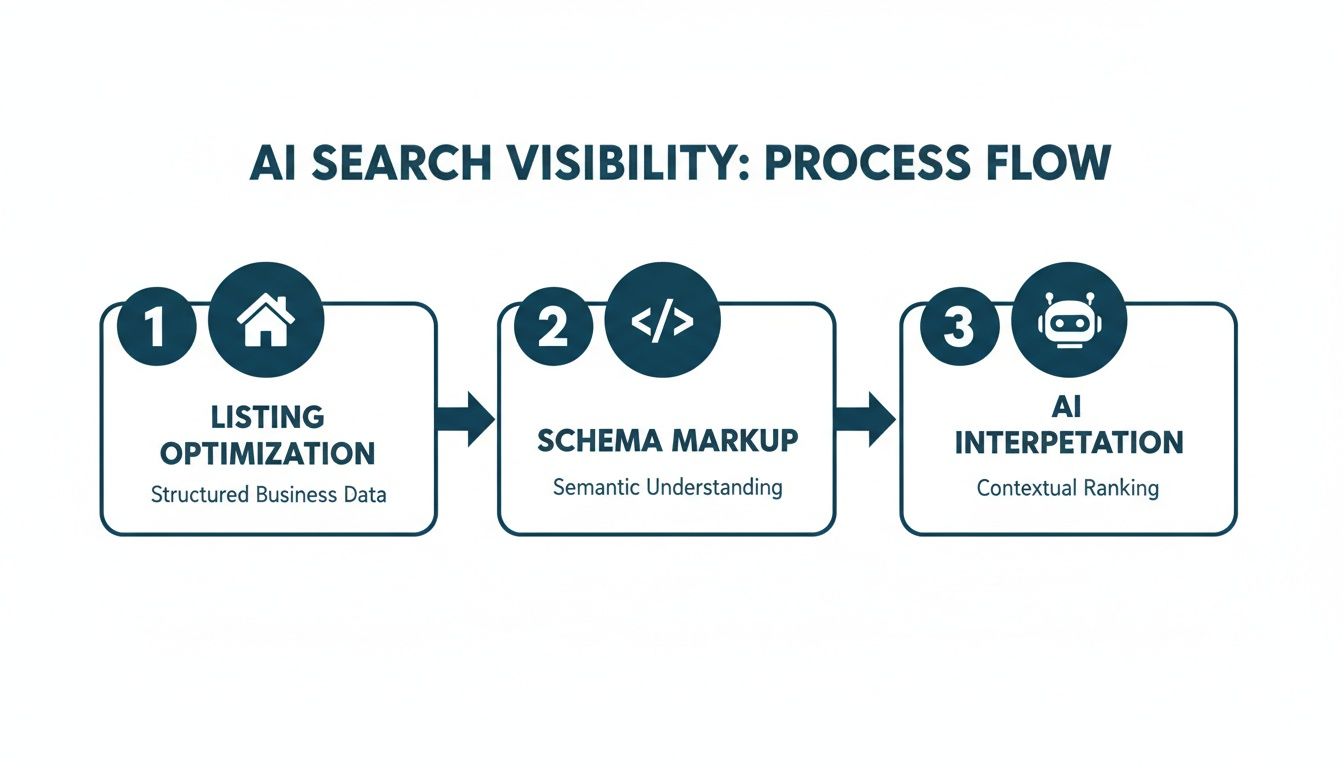
The process of turning raw listing data into something Google’s AI can understand and feature in search results looks a lot like this:
This really drives home how schema acts as the essential bridge between your property data and its visibility in advanced, AI-driven search.
Use Google’s Rich Results Test for Validation
Your first and most important stop should always be Google’s own Rich Results Test. This is the official source of truth for checking if your page is even eligible for the rich results you’re after. You can either paste your code snippet directly into the tool or give it the URL of a page where the code is already live.
The test gives you a clear answer on two fronts:
Is it valid? It checks for syntax errors, ensuring your code is structured correctly.
Is it eligible? It confirms if your page qualifies for rich results based on the schema you provided.
A successful test will greet you with a green checkmark, giving you the green light to deploy. If the tool finds errors, it will pinpoint the exact line of code causing the issue. Most of the time, the fix is simple—a missing comma, a typo in a property name, or a misplaced bracket.
The test might also show warnings. These aren't deal-breakers, but they are suggestions for recommended properties you’ve left out. Adding them can make your schema even more powerful, so it's worth paying attention to them.
Deploying Your Schema Markup
Once your code passes the test, it's time to get it onto your website. You generally have two ways to go about this.
Direct Implementation: This is the most straightforward route. You just add the <script> tag containing your JSON-LD into the <head> section of your property listing’s HTML. If you use a CMS like WordPress, a plugin or a simple theme file edit can get this done quickly.
Google Tag Manager (GTM): If you'd rather not touch your website's code directly, GTM is a fantastic alternative. You can create a new "Custom HTML" tag, paste in your JSON-LD script, and then set a trigger to fire that tag only on the specific listing pages where it belongs.
A Quick Tip from Experience: Whichever method you choose, always test a single listing page first. Deploy the code, then run that specific URL through the Rich Results Test again to make sure it’s working live. Once you confirm it’s good, you can roll it out to your other properties.
Keep an Eye on Performance
Your work isn't finished just because the code is live. The final piece of the puzzle is monitoring its impact in Google Search Console. Head over to the "Enhancements" or "Shopping" section, where you’ll find reports specifically for your RealEstateListing schema. This dashboard shows you exactly which pages have valid schema, which have errors, and how many search impressions they are getting.
This kind of ongoing monitoring is key. It helps you catch issues before they become major problems and lets you see the real-world results of your work. When you combine this with a smart local SEO strategy, the effects can be huge. For location-based searches so common in real estate, we’ve seen that optimized markup can improve local visibility by 3-5 positions.
If handling all this sounds like a lot, you might be interested in an automated solution. You can check out the different plans ListingBooster.ai offers to handle the entire process for you.
A Few Common Questions About Real Estate Schema
Even after you get the hang of it, a few questions always seem to pop up when agents and brokers start implementing schema for their listings. Let's run through some of the most common ones I hear.
Getting these details ironed out will help you move forward with confidence.
Do I Need to Be a Programmer to Do This?
Not at all. I get this question a lot, and the answer is a firm no. While schema is technically a form of code, you don’t need any programming background to put it to work. Think of JSON-LD less like writing software and more like filling out a highly detailed form.
For most real estate professionals, it boils down to two simple approaches:
Copy-and-Paste Templates: The examples I've shared in this guide are your best friend. Just take the template, swap out the placeholder details with your property's information, and you're good to go. The structure is already done for you.
Use an Automated Tool: Many modern real estate website platforms and plugins handle schema generation behind the scenes. Tools built specifically for this, like ListingBooster.ai, take it a step further by pulling your listing data and creating the right code automatically.
Your job is to understand what information needs to go into the schema, not to become a coder overnight.
How Long Until I See Any Results?
This is the million-dollar question, and the honest answer is: it depends. After you add the schema to your website, Google has to come back and crawl your pages to find it. That process can take anywhere from a few days to several weeks.
You can give Google a nudge by requesting a re-index of your key listing pages through Google Search Console. Typically, you might start seeing rich results show up in search within two to four weeks. As for a real impact on your traffic and click-through rates, you'll see that story unfold in your performance reports over the next couple of months.
My Two Cents: Be patient. Schema is a long-term play, not a quick hack. You're building a solid foundation of structured data that will consistently improve your visibility over time.
Can I Add Schema to My Zillow or Realtor.com Listings?
This one is a crucial distinction. You cannot add your own custom schema markup to listings on third-party sites like Zillow, Trulia, or Realtor.com. You simply don't have access to the back-end code of their websites.
This is precisely why optimizing your own website is so critical. It's one of your most effective strategies for competing head-on with the big portals for search visibility. When you drive traffic to your own site, you control everything—the user experience, how you capture leads, and your brand's story. Your website is your digital storefront, and schema is the best sign you can hang out front.
Should I Use RealEstateListing or Product Schema?
For any home, apartment, or property you're marketing, RealEstateListing is the right tool for the job. It was specifically designed for properties and includes fields that the generic Product schema just doesn't have, like leaseLength or numberOfRooms.
Some SEOs have played around with Product schema to try and get listings into product-style carousels, but that's really a workaround, not a best practice. Using RealEstateListing gives search engines the most accurate context about what you're actually offering. For long-term SEO health, always stick with the most specific schema type available.
Ready to stop wrestling with code and start dominating local search? ListingBooster.ai transforms any property into a complete marketing suite, automatically generating the perfect schema markup to make your listings discoverable by AI and search engines. See the difference for yourself with a free trial at https://listingbooster.ai.
The way people hunt for homes is undergoing a seismic shift. They're no longer just endlessly scrolling through Zillow. Instead, they’re firing up conversational AI like ChatGPT and asking, "Show me the best family-friendly neighborhoods in Austin under $700K." This is the single biggest evolution in real estate discovery, and yet, most agents are completely invisible on these new platforms.
The New Frontier of Finding a Home
The gap between old-school search and this new AI-driven conversation is enormous. Think of a traditional search engine as a giant library card catalog. It points you to every book that might match your query, but you're left to do all the heavy lifting. Conversational AI, on the other hand, is like having an expert librarian who listens, understands your needs, and hands you the perfect book.
This "librarian" doesn't just scan for keywords. It's built to understand context, quality, and authority. For real estate agents, this means your online presence can't just be a gallery of listings anymore. It has to be AI-readable—packed with clear, structured, and authoritative information that an AI can confidently recommend to a serious homebuyer.
Why This Shift Matters Now
The scale of this change isn't some far-off prediction; it's happening right now and growing every day. Real estate queries already make up 6% of all ChatGPT conversations, which translates to an eye-watering $66 billion in associated market value. That puts our industry in the top 15 most impacted by the platform. Homebuyers are simply skipping the old ways and asking AI direct questions about neighborhoods, property features, and even the top agents in their city. You can dive deeper into these usage stats and what they mean for the market.
This guide is your roadmap to getting you and your properties found in this new arena. We're going to break down exactly how to earn top-tier ChatGPT real estate search visibility.
The core problem is simple: if your listings and expertise aren't structured for AI, you don't exist in the most important new channel for buyer discovery.
Understanding the Two Search Worlds
To win here, you first have to grasp how differently buyers behave on these platforms. The user's mindset and what they expect are worlds apart, which demands a completely new strategy for how you present your expertise online.
To see this clearly, let's compare the old way versus the new way side-by-side.
Traditional Search vs AI Search At a Glance
Feature
Traditional Search (e.g., Google, Zillow)
AI Search (e.g., ChatGPT, Perplexity)
User Input
Keywords like "3 bedroom homes Austin TX"
Natural questions like "What are the pros and cons of living in Zilker?"
User Goal
Find a list of links to begin their own research
Get a direct, synthesized recommendation or answer
Result Type
A ranked list of websites and portals to browse
A conversational, trusted answer based on synthesized data
Key to Visibility
SEO keywords, backlinks, website authority
Structured data, entity authority, and contextual relevance
The table makes it obvious: one is a directory, the other is a concierge.
This is precisely where a tool like ListingBooster.ai comes into play. It was designed from the ground up to translate your real estate expertise into the language AI understands, making sure you’re the agent that the "librarian" trusts and recommends.
How AI Decides Which Listings to Recommend
To get your listings noticed in a ChatGPT real estate search, you first need to get inside the AI's "head." It doesn't browse Zillow like a person. Think of it more like a brilliant, lightning-fast research assistant with a single mission: find the absolute best, most trustworthy real estate information on the internet.
This AI assistant is constantly scanning the web, hunting for signals that scream "authority," "clarity," and "relevance." It's not just matching keywords anymore; it's piecing together a deep understanding of a property, a neighborhood, and even an agent's expertise. If your online presence sends weak or confusing signals, you might as well be invisible.
To get recommended, your listings and website need to be structured in a way this AI assistant can instantly understand and trust. The goal is to make it incredibly easy for the AI to see not just what your listing is, but why it's the perfect fit for a specific buyer.
The AI's Mental Checklist for Real Estate Content
When ChatGPT looks at your listings or your professional website, it isn't wowed by the beautiful photography first. Instead, it runs a sophisticated analysis to verify the information it finds, much like a diligent researcher cross-referencing multiple sources. It gives top priority to data it can interpret with total confidence.
This entire process is built on a few core pillars that act as its quality filter:
Structured Data: This is the AI's native language. It’s like putting digital labels on everything, telling the AI, "This number is the price," "This text is the street address," and "This is the square footage."
Narrative Quality: The AI actually reads your listing descriptions to grasp the story and unique appeal of a home. Vague, cookie-cutter copy gets tossed aside for rich, detailed narratives that paint a vivid picture.
Agent Authority: It actively looks for proof that you're a real expert in your market. This means finding consistent content about local areas, glowing client reviews, and a professional digital footprint.
Basically, the AI is asking a simple question: "Is this information clear, descriptive, and from a credible source?" If the answer is "no" to any of these, it moves right on to a listing that provides stronger signals. This is a crucial concept to understand, and we dive deeper into it in our guide to AI search optimization for real estate listings.
Turning Technical Jargon into Simple Ideas
Let's break down one of the most important—and often misunderstood—signals: structured data, also known as schema markup. Don't let the technical name scare you off.
Think of schema markup as a universal translator for your listing. Without it, an AI might see the number "750,000" and have no idea if it's the price, a zip code, or part of an address. With schema, you are explicitly telling the AI, "This is the price, in US dollars," which removes all the guesswork.
This kind of clarity is everything. When an AI can understand your data with 100% certainty, it's far more likely to recommend your property. It’s the difference between handing that research assistant a messy pile of notes versus a neatly organized, labeled binder. The binder wins every time.
Agents and teams who put in the effort to provide these clear signals are already seeing the rewards. Recent data shows that real estate domains received 0.47% of all referrals from ChatGPT Search, putting the industry at #15 among all categories. This confirms that AI is already sending motivated buyers to real estate websites that provide structured, authoritative information. You can discover more insights on ChatGPT's impact on web traffic and see why this is a channel you can't afford to ignore.
By focusing on making your content "AI-friendly," you're directly influencing how these powerful new platforms see, understand, and ultimately rank your listings.
The Six Pillars of AI-Powered Real Estate Visibility
Getting your listings noticed by AI search tools like ChatGPT isn't about some single, magic-bullet tactic. It's much more like building a house. You need a solid foundation built on six interconnected pillars. Get these right, and you'll have a stable, impressive structure that AI algorithms will confidently recommend to potential homebuyers.
Mastering these areas ensures your listings—and your professional brand—are not just seen, but deeply understood and valued by conversational AI. Let's break down the framework that will define your success in this new era of search.
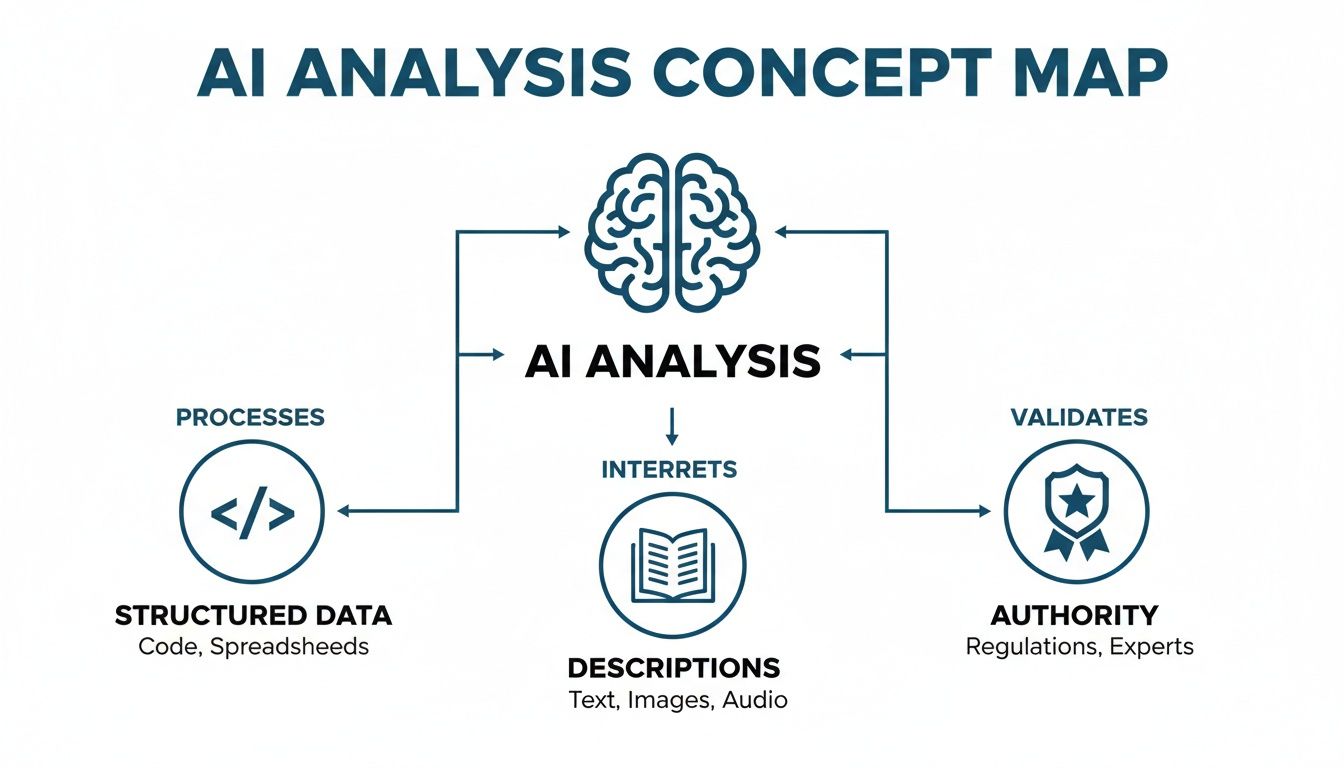
This is a great way to visualize how AI actually sifts through your digital footprint. It prioritizes the hard facts (structured data), the human element (your descriptions), and your credibility (your authority).
The key takeaway here is that AI visibility is a blend of technical precision, emotional connection, and real-world credibility. You need all three to win.
Pillar 1: Structured Data Markup
Think of structured data, or schema, as the universal language for AI. It’s a set of standardized tags you add to your website's code to explicitly tell an AI what each piece of information means. Without it, the AI is just guessing.
For example, schema can label a number as a listing price, a line of text as a street address, or a date as an open house event. This removes all ambiguity. It’s the difference between handing an AI a messy, handwritten note versus a perfectly organized spreadsheet; the AI will always trust the spreadsheet.
Pillar 2: AI-Optimized Listing Descriptions
The days of writing dry, feature-list descriptions are over. Today’s AI is smart enough to analyze the story and emotional pull of your property descriptions. It's actively looking for content that paints a compelling picture of what it’s like to live in the home.
To get this right, you need to focus on:
Natural Language: Write for people, not robots. Use descriptive language that sparks emotion and helps a buyer imagine the lifestyle the home offers.
Hyper-Local Context: Mention the nearby park, that popular coffee shop down the street, or the well-regarded school district. This gives the AI valuable context to match your listing to specific prompts like, "Find me a home near a good elementary school."
Clear Feature-Benefit Connections: Don’t just list "granite countertops." Instead, explain the benefit: "durable and elegant granite countertops, perfect for entertaining guests."
By enriching your descriptions with narrative detail, you're feeding the AI the exact kind of high-quality, contextual information it needs to make a confident recommendation.
This approach creates copy that connects with both human buyers and the algorithms that are now guiding them.
Pillar 3: Demonstrable Agent Authority
The AI isn't just evaluating your listings; it's evaluating you. It actively scans the web for signals that prove you are a knowledgeable and trusted expert in your specific market. Building this digital authority is absolutely critical for achieving high ChatGPT real estate search visibility.
This means you need to be consistently publishing content that shows off your local expertise. I'm talking about hyper-local neighborhood guides, detailed market analyses, or blog posts answering the questions you know buyers and sellers in your area are asking. This content acts as a digital resume, proving to the AI that you are a credible source.
Pillar 4: Strategic Backlinks and Citations
Think of backlinks as votes of confidence from other websites. When a reputable local news site, a neighborhood blog, or a mortgage broker’s website links to your agent profile or a listing, it sends a powerful signal to AI that your content is trustworthy.
Similarly, consistent citations—mentions of your name, brokerage, and phone number across various online directories—help solidify your digital identity. This web of links and mentions validates your professional presence, making you a much more authoritative figure in the eyes of an AI.
Pillar 5: Consistent Social Media Signals
Your social media activity is a public record of your engagement and expertise. AI systems can and do crawl these platforms to gauge your relevance and influence. Consistently posting about new listings, open houses, market updates, and client testimonials builds a cohesive digital footprint.
Every single post reinforces your specialization and activity in the market. This steady stream of relevant content adds another layer of proof, showing that you are an active and engaged professional who is worthy of being recommended.
Pillar 6: Mastering User Prompts
Finally, you have to understand how people are searching now. They don't just type keywords into ChatGPT; they ask detailed, conversational questions. Your entire content strategy should be designed to directly answer these kinds of prompts.
For instance, instead of just optimizing for "Austin homes for sale," create content that answers, "What are the pros and cons of living in the Zilker neighborhood of Austin?" By anticipating these real-world queries, you position your content as the perfect answer, making it a no-brainer for AI to surface your expertise.
This proactive approach is essential. Consider that a platform like ChatGPT.com attracts 5.6 billion monthly visits, with users who are highly engaged. It's a channel you can't afford to ignore. You can explore more detailed ChatGPT user statistics to get a better sense of the platform's incredible reach.
Putting AI Visibility Strategies into Practice
Knowing the six pillars is one thing, but actually putting them to work in your daily business is where you'll find your competitive edge. Theory is great, but a practical, well-executed strategy is what actually brings in clients. Let's break down how different real estate pros can use these ideas to get a real advantage and boost their ChatGPT real estate search visibility.
These strategies aren't just for big, tech-forward brokerages. Whether you're a solo agent building a name in your neighborhood or a growing team aiming to lead the market, the core principles are the same. It's just the scale and focus that change. Each role offers a unique chance to turn AI visibility from a buzzword into a powerful lead-generation machine.
The Solo Agent in a Competitive Suburb
If you're a solo agent, your goal is to become the go-to expert for a specific community. You can't outspend the big teams, but you can absolutely out-expert them. Your strategy needs to be all about creating deep, hyper-local content that AI sees as the definitive source for your area.
This means you’ll want to lean heavily into pillar three (Agent Authority) and pillar six (Mastering User Prompts).
Actionable Tactic: Create a series of blog posts or short videos that answer the exact questions people are asking about your suburb. Think things like, "What are the best parks in Northwood?" or "Is the public school system in Lakeview a good fit for young families?"
Implementation: A tool like ListingBooster.ai's Authority Builder can be a game-changer here. It can automatically draft these hyper-local guides for you. What normally takes hours of research and writing can be done in minutes, giving you a steady flow of content that proves you know your stuff.
By consistently answering these specific, long-tail questions, you build a content library that establishes you as the resource, making it a no-brainer for ChatGPT to recommend you.
The Growing Team in a Major Metro Area
A growing team has a different puzzle to solve: how to scale brand consistency and content creation across multiple agents. Efficiency and a unified voice are everything. Your main focus should be on pillar two (AI-Optimized Descriptions) and pillar five (Consistent Social Signals) to make sure every listing and social media post meets the team's high standards.
A scattered brand message is a weak signal to AI. When every agent on your team shares high-quality, consistently formatted, and AI-optimized content, it creates a powerful, unified digital footprint that AI algorithms can easily recognize and trust.
The key here is automation and having a central hub for content. Manually writing unique, optimized descriptions and social posts for every new listing, open house, and sale across a dozen agents just isn't sustainable. You can get more insights on this by reading our guide on how to optimize listings for AI search.
This is where a tool like ListingBooster.ai’s Listing Commander becomes essential. It takes a single property and generates a complete, on-brand marketing suite for every agent on the team, making sure every piece of content is optimized for AI visibility right from the start.
The Forward-Thinking Brokerage
For a brokerage, the mission is to give agents tools that give them a leg up on the competition. Providing a platform that automates AI optimization is a massive value-add that helps with both recruitment and keeping top talent. This means deploying all six pillars across the entire organization.
The opportunity is huge. Recent data shows that ChatGPT now commands 17.1% of all digital queries globally. On top of that, users spend an average of 13 minutes and 9 seconds per session—more than double the time spent on Google. A brokerage that helps its agents tap into this highly engaged audience is setting them up for massive success. You can discover more insights about these user engagement statistics and what they mean for the market.
By offering a tool like ListingBooster.ai, a brokerage instantly handles the technical headache of schema markup and the time-suck of content creation. It turns what would be weeks of manual work for an agent into a simple, 10-minute setup, creating a system for them to improve their ChatGPT real estate search visibility.
How ListingBooster.ai Does the Heavy Lifting for You
It’s one thing to understand the six pillars of AI visibility, but it’s another thing entirely to put them into practice. Manually creating schema-marked content, writing psychologically compelling descriptions, and consistently publishing neighborhood guides is a full-time job. Let's be honest, who has that kind of time?
This is exactly where ListingBooster.ai steps in. It’s designed to be the practical, hands-on application of everything we’ve talked about in this guide, turning what would be weeks of marketing grunt work into a simple, five-minute setup. The entire system is built to solve the core challenges of getting seen in ChatGPT real estate search without forcing you to become a coder or a content marketing guru.
Instantly Master Your Listing Content
The first hurdle every agent hits is creating genuinely great, AI-readable content for each listing. We're not talking about a few quick sentences for the MLS. This is about crafting unique stories for Zillow, social media, and your own website, all while weaving in the technical signals that AI engines need to see.
ListingBooster.ai’s Listing Commander engine handles this for you instantly. Just feed it the basic property details, and it cranks out a complete marketing suite.
AI-Ready Descriptions: It writes compelling, emotionally engaging descriptions that capture the attention of both human buyers and AI algorithms.
Automatic Schema Markup: The platform takes care of all the technical mumbo-jumbo, embedding the right structured data so AI can understand your listing’s details with perfect clarity.
Multi-Platform Copy: You get tailored copy for the MLS, Zillow, and all your social media channels, making sure your message is consistent and powerful everywhere it appears.
Think of it as your in-house marketing team that never sleeps. It makes sure every single property you list is perfectly positioned to be found and recommended by conversational search tools the moment it goes live.
This system takes care of the first two pillars—Structured Data and AI-Optimized Descriptions—so you never have to touch a single line of code.
Build Unshakeable Agent Authority
The next big challenge is proving your local expertise, day in and day out. AI needs to see a constant flow of authoritative content that cements your status as the go-to expert for your market. But who has the bandwidth to write market updates and neighborhood guides every week?
This is where ListingBooster.ai’s Authority Builder feature comes in. It automates this crucial part of your digital presence by creating a steady pipeline of high-quality, hyper-local content. It generates market updates, buyer tips, and detailed neighborhood guides that directly answer the kinds of questions your future clients are asking AI. You can explore how our broader real estate AI platform helps you build an even stronger brand.
The speed at which people are adopting AI for search makes this kind of automation a necessity. In recent quarters, a staggering 14.68% of users turned to ChatGPT for search, which is a 7.73% jump from the previous year. This massive shift means that using a tool like ListingBooster.ai isn't just an advantage anymore—it's essential for reaching a huge and fast-growing audience of homebuyers. You can dig into more of these ChatGPT usage statistics to see the trend for yourself.
To top it all off, the platform includes built-in Fair Housing compliance checks. This gives you peace of mind, knowing your automated content is not only effective but also completely professional and compliant. It’s simply the fastest, most efficient way to put an advanced AI visibility strategy to work for your business.
Measuring Success in the New AI Search Era
So, you've started optimizing for AI search. That's a huge step. But how do you know if any of it is actually working? Forget vanity metrics like social media likes or a general uptick in website traffic. To really see if you're making an impact in ChatGPT real estate search, you have to track the results that actually grow your business.
The goal here is to look past the old SEO dashboards. We need a new set of key performance indicators (KPIs) built for this new, conversational world. This isn't just about counting clicks; it's about measuring your influence, your authority, and the quality of leads coming from places you've never gotten them from before.
Shifting from Clicks to Conversations
In the world of AI search, success looks different. It's less about being the #1 link for a keyword and more about being the definitive answer to a homebuyer's question. Your measurement strategy has to reflect that big change.
Here are the modern metrics that truly matter:
Brand Mentions in AI Responses: This is the big one. Are you or your brokerage being mentioned by name when a user asks, "Who are the top real estate agents in Austin?" When an AI names you, that's the ultimate proof of your authority.
Referral Traffic from AI Platforms: Dig into your website analytics. Can you see visitors coming directly from platforms like ChatGPT? This is hard data showing the AI is sending potential clients right to your digital doorstep.
Visibility for Conversational Queries: Start tracking your presence for those long, question-based prompts. Are your listings and articles showing up for things like, "What are the best neighborhoods for families with young kids in Scottsdale?"
Lead Quality Analysis: Pay close attention to the leads that come from these AI-driven sources. Are they more informed? Do they seem more ready to transact? Higher-quality leads are a dead giveaway that your authoritative content is hitting the mark.
The single most important metric in the AI era is how often your expertise is cited as the trusted source. When ChatGPT mentions you by name, you’ve won. It’s the digital equivalent of a powerful word-of-mouth referral, scaled.
Proving ROI and Gaining Your Edge
When you track these specific KPIs, you're no longer guessing. You're making smart, data-driven decisions about where to put your time and marketing dollars. This gives you clear proof of the return on investment from your AI optimization efforts, showing exactly how it’s feeding your sales pipeline.
Everything in this guide has been a roadmap—from getting inside the "mind" of an AI to putting the six pillars of visibility into action. We've talked about how platforms like ListingBooster.ai can automate the most complex parts, turning what would normally be weeks of technical headaches into a simple, streamlined process.
Now you have the framework to not only execute this strategy but also to measure its success. By focusing on these new metrics, you can definitively prove your growing influence and secure a dominant position in the new frontier of real estate. The agents who adapt—and measure what matters—are the ones who will lead the market tomorrow.
Got Questions? We've Got Answers
Let's tackle some of the most common questions agents ask about getting their listings found in AI-powered search.
Is AI Going to Replace Me?
Absolutely not. It's best to think of AI tools like ListingBooster.ai as a super-efficient assistant, not your replacement. It takes care of the tedious work—creating consistent, optimized, and compliant content for every listing.
This frees you up to do what you do best: add your personal market insights, connect with clients, and build the relationships that are the bedrock of this business. The winning formula isn't AI or a human touch; it's AI efficiency plus your authentic expertise.
How Fast Can I Expect to See Results in ChatGPT?
It varies, but it's often much faster than traditional SEO, which can take months to show any movement. Since large language models are always hungry for new information, high-quality, well-structured content can get picked up and start appearing in search results pretty quickly.
The speed really depends on how competitive your local market is and how consistently you're putting out optimized content. Using a tool like ListingBooster.ai gives you a head start by making sure your content is perfectly tuned for AI from the moment you publish it. This gives the AI clear, strong signals about your listings and your authority.
The whole goal is to make it dead simple for AI to understand why you're the expert. The easier you make it for the AI to confirm your authority and the relevance of your listings, the faster you'll show up.
Is It Hard to Add That Schema Markup Thing?
If you try to do it by hand? Yes, it can be a real headache. It’s basically a coding task, which is a huge roadblock for most agents and a big reason why so many listings are completely invisible to AI search right now.
This is exactly the problem platforms like ListingBooster.ai's 'Listing Commander' were built to fix. It generates all the correct schema markup for your properties automatically, behind the scenes. You just enter your listing details like you normally would, and the tool handles the technical heavy lifting, making sure your properties are formatted perfectly for AI without you ever having to touch a line of code.
Ready to stop being invisible and start getting discovered? ListingBooster.ai automates the entire process, turning complex AI optimization into a simple, 5-minute task. Start your free trial and see the difference today.