A solid listing presentation marketing strategy is your digital-first game plan. It’s how you prove your value before you even walk in the door, showing a seller exactly how you'll market their home online to get the best buyers in the door. It’s less about a binder full of comps and more about a tangible, tech-forward marketing blueprint.
Why The Old Way of Pitching Listings Is Failing Agents
Let's get real for a minute: the old-school approach to listing presentations is completely broken. Showing up with a printed CMA and a binder of your past sales just doesn't cut it anymore with today's homeowners. They expect more. They don't just want to know what you’ve done in the past; they need to see precisely what you will do to sell their home.

This isn't just a trend; it's a fundamental shift in how people find and buy homes. Buyer behavior has been completely reshaped by digital marketing. Consider this: 99% of millennials and Gen X shoppers kick off their home search online. Even 97% of baby boomers are starting their research on a screen.
This simple fact makes your online marketing skill the single most important part of your pitch. If you're interested in the data behind this, you can find more insights about this digital shift and how it affects who sellers choose to hire.
The New Player: AI in Home Discovery
Just when you thought you had digital figured out, the game is changing again. AI is here. Potential sellers are literally asking tools like ChatGPT, "Who is the best real estate agent in my area?" or "How should I market my three-bedroom home?"
If your marketing strategy doesn't have an answer for AI visibility, you're already playing catch-up.
A modern listing presentation needs to tackle this head-on. It's not a pitch; it's a demonstration. You show up with a fully baked marketing plan ready to go. Imagine walking in with:
- AI-optimized property descriptions ready for Zillow, Redfin, and Realtor.com.
- A complete 30-day social media calendar, mapped out and ready to execute.
- A data-driven competitive analysis showing how you'll position their home against others on the market.
This is exactly what a forward-thinking, modern strategy delivers. Tools like ListingBooster.ai are built for this, letting you generate an entire marketing suite in minutes. You're no longer making abstract promises; you're handing them a concrete plan they can see and touch.
The goal is to completely shift the conversation. You want to go from "Why should I hire you?" to "When can we get started?" You do that by proving your marketing expertise from the very first contact, making the decision to list with you feel like the only logical choice.
The difference between the old way and the new way is stark. Let's break it down.
Traditional vs Modern Listing Presentation Marketing Strategy
This table clearly shows the evolution from outdated tactics to the modern, tech-driven strategies that are winning listings today.
| Component | The Traditional Approach | The Modern AI-Powered Strategy |
|---|---|---|
| Pre-Appointment | Send a generic "about me" email or mailer. | Send a "pre-sell" package with a custom marketing plan and digital presence audit. |
| Property Marketing | A basic description and a "just listed" social post. | AI-generated, portal-optimized descriptions and a full 30-day social media calendar. |
| Competitive Analysis | A printed CMA with sold properties from the last 6 months. | A live, data-backed analysis of current competing listings and their marketing. |
| Presentation Assets | A physical binder with paper printouts. | A digital-first presentation with interactive elements, videos, and a website mockup. |
| Technology | Relying on the MLS and a syndicated feed. | Actively positioning the listing for AI and search engines using schema markup. |
| Follow-Up | A thank you email and a phone call. | A shared dashboard to track marketing performance and campaign results in real-time. |
As you can see, the modern approach is proactive, transparent, and built around tangible proof. It’s about showing, not just telling, and giving homeowners the confidence that you have the skills to market their most valuable asset effectively in today's world.
Build Authority Before The First Handshake
Imagine walking into a listing appointment where the seller is already sold on you. That’s the entire game. A killer listing presentation strategy doesn't start at their kitchen table; it begins weeks, even months, earlier in the digital world where your future clients are already looking for answers.
This is all about pre-selling your expertise. It’s the art of shaping a seller's perspective so that when you finally meet, they don't see another salesperson. They see the market expert. You get there by becoming their go-to source for valuable, hyper-local information.
Become The Go-To Local Expert
Your mission is to build a digital "Authority Engine" that works for you around the clock. This isn’t about posting generic real estate tips. It’s about owning a specific conversation in your market. Your content needs to answer the questions sellers are asking themselves before they even know who to ask.
This means consistently creating content that proves you have your finger on the pulse of the community. Forget another "5 Tips for Staging." You need to create stuff they can't find anywhere else.
- Deep-Dive Neighborhood Guides: Go way beyond school ratings. Talk about the new coffee shop on the corner, the best dog park for sunny afternoons, or that annual block party everyone loves.
- Market Updates with a Twist: Don't just spit out the median sales price. Explain why it changed. Was it a couple of big luxury sales? New construction finally hitting the market? Or maybe a shortage of homes in a specific price range?
- Property Tax Breakdowns: Demystify the local millage rates. Show homeowners how their bottom line is impacted compared to the next town over.
When you provide this kind of specific, genuinely useful information, you build incredible trust. You become an indispensable resource. When a seller has a question, your name should be the first one that pops into their head.
Automate Your Expertise for AI Visibility
Here’s something most agents miss: your audience isn't just human anymore. AI assistants like ChatGPT are now the first stop for a lot of initial research. When a potential seller asks, "Who is the best real estate agent in [Your Town]?", the AI scours the web for signals of true expertise and authority.
Guess who gets recommended? The agent with a massive library of localized, expert content. This is where automation is no longer a "nice-to-have"—it's a critical part of your strategy. You need a system that can consistently pump out high-quality, relevant content without you having to spend all day writing. This is where tools built for agents give you a massive leg up. You can learn more about AI marketing tools for real estate agents to see how automation makes building authority manageable.
The key is consistency. One great blog post is a drop in the bucket. But a steady stream of valuable, hyper-local content creates a digital footprint that both sellers and AI algorithms will recognize as the real deal.
All this work fundamentally changes the dynamic of your listing presentation. You're no longer walking in cold, trying to prove your worth from a standing start. Instead, you’re simply confirming what the seller has already decided: that you are the clear expert with the best plan.
Think of it this way: your digital content is the opening act. It warms up the crowd, builds the hype, and sets the stage for your main performance. When you finally walk through their door, you’re not just an agent; you’re the trusted advisor they already know and respect. This flips your entire listing presentation on its head, turning a sales pitch into a collaborative strategy session for getting their home sold.
Craft a Property Marketing Blueprint That Sells Itself
Any agent can walk into a listing presentation and promise to market a home. Promises are cheap. The agents who win are the ones who walk in and show the seller exactly how it’s going to be done.
This is where a tangible, fully realized marketing blueprint for their specific property becomes your secret weapon. This isn't some generic checklist. It's a suite of custom-built marketing assets that prove your value before they even think about signing. You're not just talking about what you will do; you're handing them the finished product upfront. That's how you stand out.
Generate AI-Optimized Portal Descriptions
Think of your property description as the digital curb appeal. It's the first thing serious buyers read, and a generic, fluffy paragraph just won't cut it. To really get noticed, your descriptions need to be optimized for the big portals where buyers live: Zillow, Redfin, Realtor.com, and your local MLS.
Here's something most agents miss: each of these platforms is a little different. Zillow’s search algorithm loves scannable, feature-rich text packed with specific keywords like "quartz countertops" or "fenced-in yard." The MLS, on the other hand, often has tight character limits and needs a more direct, to-the-point tone for other agents.
Using AI, you can quickly generate several versions of the description, each one tuned for the specific platform it will live on. This isn't just about showing off; it's about showing the seller you know how to play the game on every field to get their home maximum exposure.
Pro Tip: Don't just write one description and call it a day. Walk into the presentation with three or four distinct, optimized versions. Explain why the Zillow version is different from the MLS version. This demonstrates a strategic depth that builds instant confidence and trust.
Develop a Compelling Video Marketing Angle
Let's be clear: video is no longer a "nice-to-have." It’s an absolute necessity. Listings with video get a staggering 403% more inquiries than those without. On top of that, 73% of homeowners say they are more likely to list with an agent who uses video. If you need more convincing, you can dig into the numbers and learn about the impact of video in real estate marketing.
But a simple, shaky walkthrough video shot on your phone isn't going to impress anyone. Your marketing blueprint needs to include a creative angle—a real concept or a brief script that tells the home's unique story.
- For the entertainer's dream home: "Our video will open with a sweeping sunset shot from the back patio, then flow into the open-concept kitchen. We'll stage it to feel like a lively gathering, showcasing how perfect the space is for hosting family and friends."
- For the quiet, private sanctuary: "The video will focus on tranquility. We'll start in the master suite, highlighting the spa-like bathroom and private balcony. The whole feel will be about creating a sense of escape from the daily grind."
When you present a clear video concept, you prove you see more than just four walls and a roof—you see the story their home has to tell.
The infographic below breaks down the simple but powerful process I use to create content, automate its delivery, and rank it to build digital authority for every listing.
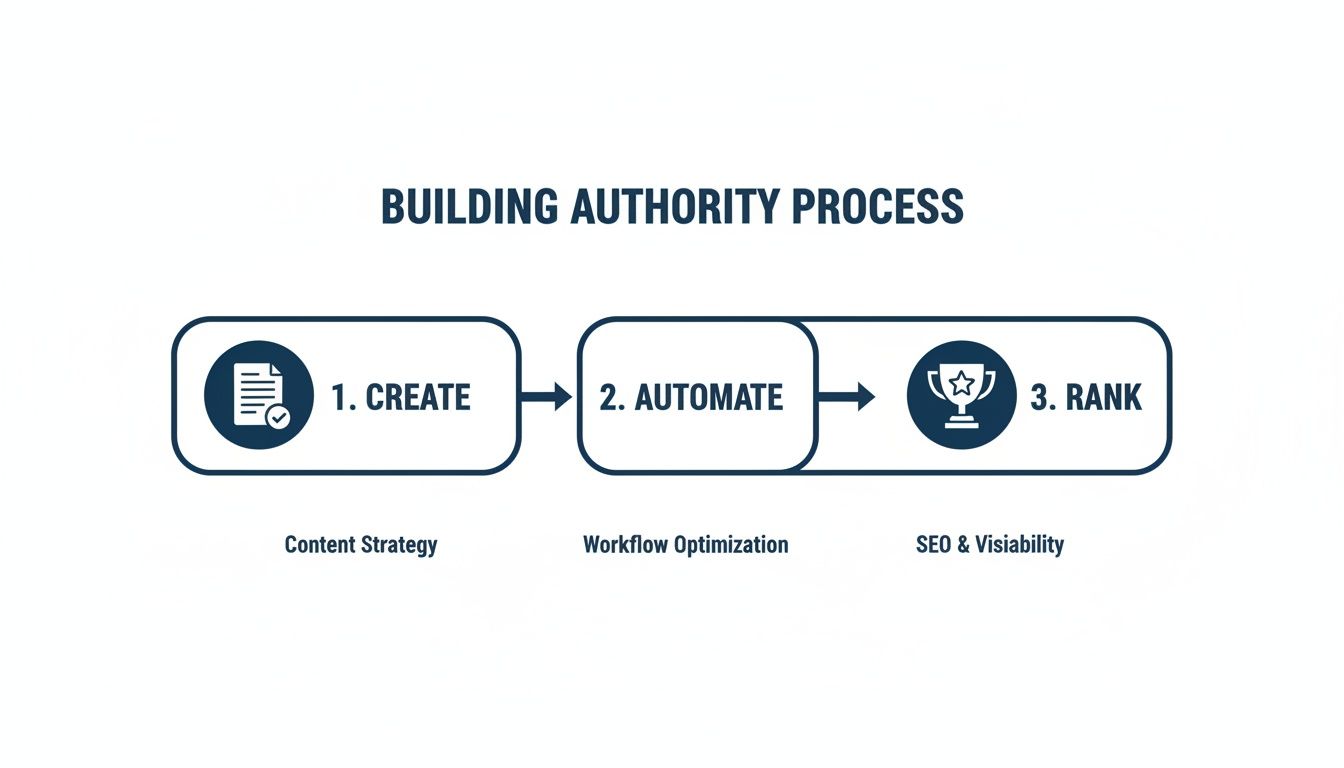
This visual shows exactly how targeted content creation and smart automation lead directly to better search visibility and a stronger market presence.
Map Out a 30-Day Social Media Calendar
Want to really blow your potential clients away? Bring a pre-built, 30-day social media calendar to the listing appointment. This single document turns the vague promise of "social media marketing" into a concrete, week-by-week action plan. It shows an incredible amount of preparation and strategic thinking.
This isn't just about posting "Just Listed" a few times. A truly effective social calendar tells a story, building excitement from the pre-launch phase all the way to the closing table.
Here's a sample of what that looks like in practice. Presenting this shows sellers you have a sophisticated plan to create buzz at every stage.
Sample 30-Day AI-Powered Social Media Calendar
| Week | Post Type | Platform Focus | Key Marketing Angle |
|---|---|---|---|
| Week 1 | Coming Soon Teasers & Sneak Peeks | Instagram Stories & Reels | Build curiosity by showing off unique features (the custom tile, the backyard view) without giving it all away. Create a sense of anticipation. |
| Week 2 | Grand "Just Listed" Launch & Video Tour | Facebook & Instagram Feed | Go live with the best photos and the full video tour. The goal here is maximum impact and a clear call-to-action to schedule a showing. |
| Week 3 | Open House Push & Neighborhood Spotlight | Facebook Events & Local Groups | Drive foot traffic for the open house. We'll also highlight the lifestyle—the local coffee shop, the nearby park, the great schools. |
| Week 4 | Feature Deep Dive & Behind-the-Scenes | LinkedIn & Instagram Stories | Focus on one standout feature, like the chef's kitchen or the home office. Keep the conversation going with behind-the-scenes content. |
Walking into a meeting with this calendar in hand is a total power move. It proves you're not just thinking about getting the listing—you're already executing the plan to get it sold for top dollar. It makes your commission feel earned before the ink on the contract is even dry.
Present Your Competitive Edge with Data
Let's be honest. Sellers are numb to the same old pitch. Every agent walks in promising the "best service" and "top dollar." To actually get noticed, you have to stop telling them you're better and start showing them with cold, hard proof.
This is where a sharp competitive analysis becomes your secret weapon. It’s the tool that shifts your entire listing presentation from a pile of opinions to a fact-based argument for why your marketing strategy will smoke the competition.

The classic CMA is useful, but it only looks in the rearview mirror—it shows what’s already sold. A modern competitive analysis, on the other hand, puts a spotlight on the active competition. You'll evaluate how their current marketing stacks up against the killer plan you've already built for your client.
Suddenly, the conversation isn't just about price. It's about marketing effectiveness, which is exactly where you can prove your undeniable value.
Analyze Your Competitors' Digital Footprint
Your mission is to create a crystal-clear "Us vs. Them" story backed by evidence. Start by pinpointing the top three to five comparable homes currently for sale in the seller’s immediate area. Don't just stop at square footage and bed/bath counts. You’re going to run a full digital marketing audit on each one.
Keep the analysis simple and visual. You want a homeowner to glance at it and immediately see the difference. You're essentially grading the competition's online presence to expose the weak spots you're about to exploit.
- Photo and Video Quality: Are the photos crisp and professional, or are they dark, blurry shots from an iPhone? Did they invest in a real video tour, or is it just a cheesy slideshow set to elevator music?
- Property Description Persuasiveness: Does the description read like a laundry list of features ("3bd, 2ba, granite…"), or does it paint a picture of the lifestyle? Is it written to catch a buyer’s eye on Zillow?
- Portal Optimization: Check out the listing on the big portals. Is the agent taking advantage of all the bells and whistles, like 3D tours and interactive floor plans? Or is it a bare-bones effort?
- Social Media Presence: Did the agent even bother to post the home on social media? If they did, is it a sad "Just Listed" graphic with two likes (one from their mom), or is there actual engagement?
When you document these marketing gaps, you create a powerful visual contrast. You're no longer just another agent promising to do a good job; you're a marketing strategist who has already identified the flaws in the competition's playbook and is ready to execute a superior one.
The most powerful moment in a listing presentation is when you can slide a one-sheet across the table that visually compares your multi-platform, AI-optimized marketing plan against a competitor’s single, weak MLS photo and generic description. That single piece of paper makes your value tangible.
Build a Simple Competitive Analysis One-Sheet
Don't bury the seller in a 20-page report they'll never read. You need a single, clean document that tells the story in a few seconds. Think of it as a report card for the competition where you’ve already secured the A+.
This one-sheet should be something you can physically leave behind. It will keep selling for you long after you’ve left the kitchen table.
Here’s a dead-simple way to frame that "Us vs. Them" comparison:
| Marketing Component | Their Approach (Competitor Listing) | Our Strategy (Your Plan) |
|---|---|---|
| Photography | 12 dark, phone-quality photos | 35+ professional HDR photos & drone shots |
| Video Tour | None provided | A 90-second cinematic lifestyle video |
| Property Description | A generic, 3-sentence paragraph | AI-optimized descriptions for Zillow & MLS |
| Social Media | One "Just Listed" post on Facebook | Full 30-day calendar with daily content |
| AI Visibility | Not optimized for modern search | Schema markup for Google & ChatGPT |
This simple chart does more to justify your commission than any script you could memorize. It proves you don't just stick a sign in the yard and pray. You execute a sophisticated marketing campaign designed to make every other property on the block look like an amateur effort.
When you present your edge with clear, compelling data, the decision to hire you becomes less of a choice and more of an obvious conclusion.
Assemble Your High-Impact Presentation Assets
Your digital strategy is solid, but sellers are still human. To truly grasp the power of your plan, they need to see it, touch it, and feel it. This is where you bring your entire marketing blueprint to life with a collection of high-impact assets that make your value impossible to ignore.
Think about it: while other agents are talking about what they'll do, you'll be handing it over. This simple act gives you a massive psychological edge. It instantly shifts the dynamic from a sales pitch to a working session, proving you’re not just prepared—you’re already invested in their success.
From Digital Concept to Tangible Proof
The goal here is to leave behind a professional package that keeps selling for you long after you’ve left the kitchen table. These aren’t just printouts; they’re physical evidence of your superior marketing machine. They show you’ve put real time and strategic thought into their specific property before even asking for the listing.
Your package should include a few key items that perfectly mirror the digital plan you've built. Each piece serves as a powerful, physical reminder of the expertise you bring.
- The 30-Day Social Media Calendar: Don’t just show this on your iPad. Print it out on high-quality paper. When a seller can actually hold a detailed, week-by-week marketing schedule, the vague idea of "social media promotion" becomes a concrete and seriously impressive reality.
- AI-Crafted Property Descriptions: Bring printed copies of the different property descriptions you generated, each one tuned for a specific platform. Have one for Zillow, another for the MLS, and maybe a third for a luxury portal if it fits the property.
- The Competitive Analysis One-Sheet: This is your knockout punch. A single, clean page that visually stacks your comprehensive marketing plan against the lackluster efforts of competing listings.
When a seller sees a detailed, multi-platform plan laid out in front of them, it builds immediate and lasting trust. It’s no longer just your word against another agent's; it's your tangible, documented strategy against their vague promises.
Translating Tech into Tangible Benefits
A lot of agents get nervous talking about AI or search visibility, worrying it will go over a seller's head. The secret is to ditch the jargon and focus entirely on the benefit to them. You don't need to explain how the car's engine works—just that it will get them where they want to go, faster.
It all comes down to simple, benefit-driven language. Frame every technical piece of your listing presentation marketing strategy around the outcomes that matter most to a seller: more qualified buyers, a faster sale, and a better final price.
Here’s a simple way to explain these powerful features so they land with maximum impact:
| Technical Feature | What to Say to the Seller |
|---|---|
| AI-Optimized Descriptions | "We write descriptions specifically for how sites like Zillow show homes to buyers. This helps us attract more qualified people who are actively searching for a home just like yours." |
| Schema Markup for AI | "We add a special layer of code to your listing that helps tools like Google and ChatGPT understand its best features. This means when someone asks AI for homes with a great backyard in this area, yours is more likely to be recommended." |
| Portal-Specific Strategy | "Buyers behave differently on Zillow than they do on Realtor.com. We create a slightly different marketing angle for each platform to make sure your home gets noticed everywhere." |
By translating tech features into clear benefits, you demystify the process and turn your advanced methods into a powerful selling point. You can find more ideas for building a compelling story in our other guides, like the one on improving your real estate marketing blog.
The Final Package
Assemble these documents in a clean, professional folder. This isn't just a pile of papers; it's a physical representation of your commitment and expertise. When you walk into that appointment, you’re not just bringing your laptop and a smile. You’re bringing a fully-formed, tangible marketing campaign ready for deployment.
This level of preparation is what separates the true marketers from the average agent. It proves to homeowners that you’re not just there to get a listing—you’re there to execute a winning strategy designed specifically for them.
From Presentation to Performance: Execute and Measure
Winning the listing is a fantastic feeling, but it’s really just the starting line. Now, it's time to execute the very listing presentation marketing strategy that got you the job. Your reputation is officially on the line, and flawlessly delivering on that 30-day plan is how you build the trust that turns one client into five.
This isn't just about going through the motions. You need to keep your seller in the loop with simple, consistent updates on how the marketing is performing. That transparency is everything—it proves you’re not just talk and reinforces that they made the right call in hiring you. They need to see that the powerful marketing engine you described is fired up and working hard.
Show, Don't Just Tell: Tracking What Matters
You don't need to drown your clients in a sea of analytics. The key is to focus on a handful of high-impact metrics that clearly demonstrate momentum. These data points are the proof in the pudding, showing that your strategy is getting eyeballs on their home.
Here's what I always share with my clients:
- Portal Views & Saves: A simple weekly screenshot from Zillow or your MLS dashboard showing total views and saves is powerful. It’s the digital version of foot traffic, and it’s a number sellers easily understand.
- Social Media Buzz: Give them the highlights. How many people did the "Just Listed" post reach? How many likes and comments did the video tour get? Make sure to point out any direct messages or inquiries that came from platforms like Facebook or Instagram.
- Website Clicks: If you built a dedicated property website, share the number of unique visitors and, more importantly, how long they stuck around. This shows real, dedicated interest.
Your marketing plan shouldn't be a "set it and forget it" document. It’s a dynamic roadmap. When you show a seller how you track performance, you prove you're an agent who measures, adapts, and holds yourself accountable. That's what builds unshakable confidence and turns them into your biggest fans.
This feedback loop is your secret weapon. By seeing what’s resonating—and what’s falling flat—you can make smart, agile adjustments.
For example, maybe that Instagram Reel you posted of the backyard got way more engagement than you expected. Great. That’s a clear signal to put a small ad spend behind it to amplify its reach even further.
This whole process of executing, measuring, and refining your plan brings your presentation full circle. It validates everything you promised, cementing your status as a data-savvy marketer who delivers on their word. That’s how a successful sale becomes the seed for your next wave of business.
Your Questions, Answered
Jumping into a new way of marketing your listings is bound to bring up a few questions. Let's tackle some of the most common ones so you can feel confident putting this strategy to work.
How Tech-Savvy Do I Really Need to Be?
Honestly, not very. That’s the whole point of these new tools. You don't need a computer science degree or any knowledge of coding to make this work for you.
Platforms like ListingBooster.ai were built specifically for real estate agents, not developers. If you can type in a property address and click a button, you're golden. The system handles all the heavy lifting, generating everything from portal-ready descriptions to social media plans and competitor reports. The focus is on your strategy, not your technical abilities.
Think of this technology as your marketing assistant. It takes care of the tedious, time-consuming tasks so you can get back to what you do best: connecting with clients and closing deals.
How Do I Talk About AI With a Seller and Not Sound Like a Robot?
Great question. The key is to keep it simple and laser-focused on the benefits for them. Homeowners don't care about the intricacies of schema markup or natural language processing. They just want to know you have a plan to sell their home faster and for more money.
Translate the tech into tangible results.
- Instead of: "We use AI to optimize for search algorithms."
- Try this: "Our marketing tools ensure that when serious buyers search for homes like yours online, your property is front and center."
- Instead of: "Our content is optimized for ChatGPT."
- Try this: "When people use new AI assistants to ask about homes in the area, our strategy helps make sure your property is one of the first they see."
Frame every feature as a direct advantage for the seller: more eyes on their listing, more qualified buyers through the door, and a stronger edge over competing properties. When you’re ready to see how these tools can fit into your business, you can explore the different pricing and feature options available.
How Much Time Does It Take to Put Together an AI-Powered Presentation?
This is where it gets really exciting. The tasks that used to eat up hours—writing compelling listing descriptions, digging up comps, and creating a social media schedule—can now be done in minutes.
Using the right platform, you can generate an entire suite of custom marketing materials for a specific property in about 5 to 10 minutes. That’s it. This incredible efficiency means you can build a personalized, data-driven marketing plan for every single listing appointment, not just the luxury ones. It’s a total game-changer, allowing you to walk into every meeting better prepared than anyone else.
Ready to build a listing presentation marketing strategy that wins before you even walk in the door? ListingBooster.ai generates a complete, AI-powered marketing suite in minutes. Start your free trial today and see the difference preparation makes. Visit us at https://listingbooster.ai.