Tag: AI for agents

  • A Guide to Content Marketing for Real Estate

    A Guide to Content Marketing for Real Estate

    Real estate content marketing is all about creating and sharing genuinely useful material online—think neighborhood guides, market updates, and property videos. It’s not about a hard sell. The goal is to build your reputation as a trusted expert, becoming the agent that both clients and new AI search tools want to recommend.

    Why Your Content Strategy Needs a Reboot

    Man in a blue shirt types on a laptop displaying real estate images, with 'CONTENT REBOOT' on a screen behind.

    The old playbook is officially dead. A simple website and the occasional Facebook post just don't cut it anymore. Your potential clients have changed how they search for information and agents. They're asking AI tools like ChatGPT and getting instant answers from Google's AI Overviews.

    This is a huge fork in the road. For agents who adapt, it's a massive opportunity. For those who don't, it’s a fast track to becoming invisible. If your online content isn't built for these new platforms, you're essentially hiding from a huge chunk of the market.

    The New Rules of Real Estate Visibility

    It's no longer just about ranking on Google. The real challenge now is being recommended by AI. These systems are designed to find the most helpful and authoritative expert on a given topic and present that information directly to the user.

    Without a consistent stream of high-quality, targeted content, AI simply won't see you as an authority. Your listings, your market knowledge, and your years of experience might as well not exist to this growing audience. This is why a smarter content marketing plan is no longer optional.

    The goal is to answer your clients' questions before they even know who you are. When AI scours the web for the best agent in your market, your content should provide undeniable proof that it's you.

    To stay relevant, your entire strategy has to evolve. Sticking with what worked five years ago means you're fighting for a smaller and smaller piece of the pie. The good news? Making the switch isn't as complicated as it sounds. You just need a better framework.

    Traditional vs AI-Optimized Content Marketing

    The first step is seeing the clear difference between the old way and the new way. The table below breaks down where the industry was versus where it's going. A modern, AI-optimized approach is all about structure, authority, and consistency—exactly what artificial intelligence is trained to look for.

    Aspect Traditional Content Marketing AI-Optimized Content Marketing
    Primary Goal Drive website traffic and leads. Become the definitive, recommended authority.
    Content Focus Property-centric posts and agent bios. Client-centric answers, market analysis, and guides.
    SEO Strategy Keyword stuffing and backlink acquisition. Question-based topics and structured data (schema).
    Success Metric Website visits and 'likes' or 'shares'. Direct AI recommendations and qualified inbound leads.
    Creation Process Manual, inconsistent, and time-consuming. Automated, consistent, and strategically planned.

    As you can see, the shift is from being loud to being the undeniable expert. It's less about working harder and much more about working smarter.

    It all comes down to building a system that consistently produces valuable content. This content serves two masters: the potential clients looking for help and the algorithms connecting them to you. This guide will give you that exact system, step-by-step, to establish you as the clear authority in your market.

    Building Your Content Foundation in Minutes

    A great real estate content strategy doesn't start with you staring at a blank page, wondering what to write. It starts with a solid foundation. The good news? You can build this entire core in the time it takes to drink your morning coffee.

    The whole idea is to create a repeatable system by quickly defining your essential brand elements. Forget about spending weeks agonizing over brand identity. We're going to nail down three things fast: your voice, your ideal client, and your market niche. Getting this right upfront means every single piece of content you create—from an Instagram Reel to a detailed market report—will feel authentic and hit home with the right audience.

    Define Your Unique Brand Voice

    Your brand voice is just your professional personality, captured on paper (or screen). It has to be consistent. So, who are you? Are you the analytical agent who geeks out on data and delivers sharp market insights? Or are you the friendly, boots-on-the-ground expert who knows every local coffee shop owner by name?

    There’s no right or wrong answer here, but you absolutely have to choose.

    Think about how you naturally talk to your clients. Are you more formal and reassuring, or do you bring a ton of energy and motivation to the table? That's the voice you need to bottle up. A tool like ListingBooster.ai actually lets you lock this in by selecting a few key attributes, instantly setting the tone for all the content it helps you create.

    Identify Your Ideal Client

    Who are you really talking to? If your content is aimed at "buyers and sellers," it's going to connect with precisely no one. You have to get specific. Your ideal client should feel like a real person with a name, a job, and a set of problems only you can solve.

    Let’s look at a few examples of client personas that actually work:

    • "First-Time Finn": He’s a millennial, probably in his early 30s with a partner, totally intimidated by the home-buying process. They need a guide to walk them through every single step, from pre-approval to closing.
    • "Luxury Lisa": A high-net-worth individual who demands privacy, discretion, and a white-glove experience for her multi-million dollar listing. She's not impressed by standard marketing.
    • "Downsizing Dave": An empty-nester who's ready to sell the big family home. He’s looking for a smaller, low-maintenance property, probably in a walkable neighborhood with great amenities.

    By focusing on a specific persona, your real estate content marketing becomes laser-focused. You're no longer just shouting into the void; you're having a direct conversation with someone who needs your exact expertise.

    This specificity is what makes your marketing work. You'll create content that directly answers Finn's anxieties about mortgages or highlights the exclusive, off-market strategies that appeal to Lisa.

    Specify Your Market Niche

    Just like you can't be the perfect agent for everyone, you can't be an expert everywhere. Your niche is your superpower. It’s that specific slice of the market—whether it's a geographic area, a school district, or a property type like historic homes or new construction condos—where your knowledge is undeniable.

    When you truly own a niche, you become the go-to authority. All of your content should reinforce this. Instead of a generic "Austin Market Update," you'll create a "South Congress Neighborhood Q3 Report." This hyper-local focus is exactly what search engines, including the new AI-powered ones, are looking for to identify a true local expert.

    With these three elements dialed in—your voice, client, and niche—you've officially built your brand foundation. The next step is to put it to work. When you feed this information into a smart platform, you can start generating high-quality, on-brand marketing materials almost instantly. To see this in action, check out our guide on how a real estate listing content generator uses these inputs to craft compelling property descriptions. This quick setup is the launchpad for a consistent and effective content system that won't burn you out.

    Alright, you've got your brand fundamentals sorted. Now comes the fun part: creating the actual content that pulls in clients and makes you the go-to agent in your market. This isn't about throwing random posts at the wall to see what sticks. We're going to build two distinct, powerful content engines that work together.

    Think of it this way: one engine is for the sprint, and the other is for the marathon.

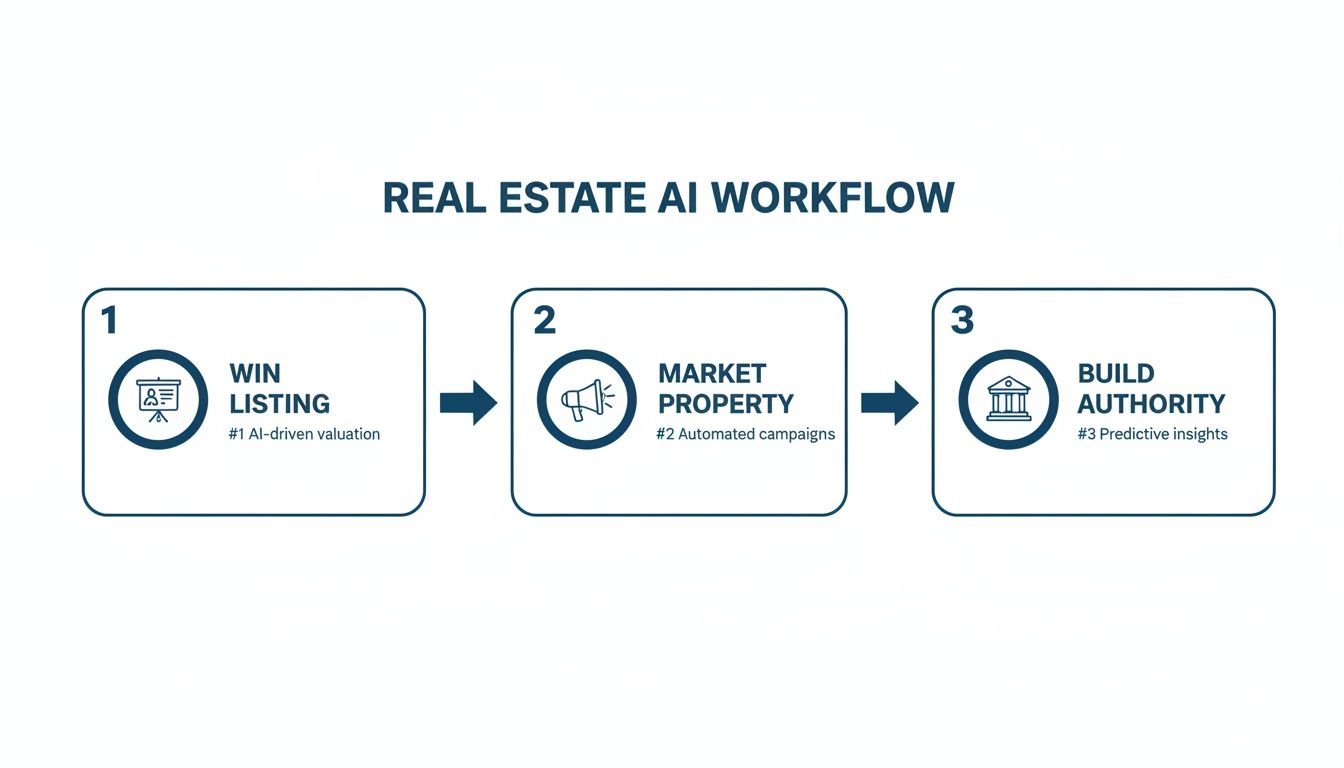
    First, you have the Listing Commander. This is your rapid-fire system for turning a single new listing into a full-blown marketing blitz. The second is the Authority Builder, which is all about playing the long game—creating the kind of evergreen, valuable content that establishes you as a true market expert in the eyes of both clients and search engines.

    This approach means you're not just selling houses; you're building an unshakable brand.

    This whole process flows directly from the brand work you've already done. Your voice, your ideal client, and your market knowledge should be the DNA of every single thing you publish.

    A flowchart illustrating the brand setup process, detailing steps for voice, client, and market.

    It all comes back to this: great content marketing for real estate doesn't happen by accident. It starts with a solid foundation before you ever write a single word.

    The Listing Commander in Action

    The Listing Commander is your "go-button" for property marketing. When you get a new listing, you need to act fast. This strategy is designed to take a property's URL and spin up a whole suite of marketing materials in minutes, so you never miss that initial wave of buyer excitement.

    Let's say you just listed a 3-bed, 2-bath in a quiet suburb that's perfect for a young family. Instead of wrestling with writer's block, you can use a tool like ListingBooster.ai to instantly generate everything you need.

    Here’s what that looks like in the real world:

    • An AI-Optimized MLS Description: It won't just say "large backyard." It'll craft a story about "a sprawling backyard ready for summer barbecues and kids' soccer games." It’s written specifically to resonate with that "First-Time Finn" persona you identified earlier, speaking directly to their hopes and dreams.
    • A Full Social Media Campaign: You get a complete sequence of posts ready to go. It starts with a "Coming Soon" teaser to build buzz, moves to the "Just Listed" blast with a virtual tour, and finishes with a celebratory "Just Sold" post. Every caption has a clear purpose, whether it's "DM me for a private tour!" or "Tap the link to see all 25 photos."
    • A Print-Ready Flyer: A professional, on-brand property flyer gets created on the spot. It's perfect for printing out for the open house or dropping in neighborhood mailboxes.

    This isn't about being lazy; it's about being efficient. You save hours of tedious work and ensure every single listing gets the A-list marketing treatment.

    The Authority Builder Strategy

    While the Listing Commander handles the now, the Authority Builder is all about your future. This is the content that builds your reputation and makes you the agent that AI tools like ChatGPT recommend when someone asks, "Who's the best real estate agent in Scottsdale?"

    This engine is designed to automatically create the hyper-local, high-value content that answers your ideal client's biggest questions—often before they even ask them. It's about shifting from salesperson to indispensable resource.

    Your blog and long-form content are not just marketing tools; they are your digital library of expertise. This library is what AI search algorithms scan to determine who holds true authority in a market.

    Let's break down what this content actually looks like.

    Hyper-Local Market Updates

    Forget about quoting national housing news. The Authority Builder can help you create a detailed report for the specific neighborhood you serve. Imagine sending out a "Q3 Market Report for the Maplewood School District," packed with stats on average sale prices, days on market, and a short paragraph on what it all means for local buyers and sellers. That's how you prove you have your finger on the pulse of the community.

    In-Depth Neighborhood Guides

    This is where you can really set yourself apart. A great neighborhood guide isn't just a list of stores; it’s a story that sells a lifestyle. For instance, a guide to your city's "Downtown Arts District" could cover:

    • The Vibe: Describe the energy of the area. Is it bustling and creative, or quiet and historic?
    • Local Hotspots: Feature the best coffee shops, art galleries, and hidden-gem parks. Pro tip: Tag these local businesses when you share it on social media to build powerful community relationships.
    • Real Estate Snapshot: Give an overview of the housing stock. Are we talking historic lofts, new-build condos, or a mix of both?
    • The People: Briefly describe who lives there. This helps potential buyers instantly see if they'll feel at home.

    Practical Buyer and Seller Tips

    Finally, the Authority Builder creates content that solves real-world problems. Just think about the questions you get asked over and over again. Turn those expert answers into permanent assets on your website.

    • For Buyers: "5 Mistakes First-Time Homebuyers Are Making in This Market"
    • For Sellers: "My 60-Minute Checklist for Getting Your Home 'Showing Ready'"

    When you consistently produce these two types of content, something powerful happens. The Listing Commander creates immediate buzz for your properties, while the Authority Builder quietly establishes the deep trust and credibility that will fuel your business for years to come.

    Your Automated 30-Day Content Calendar

    A close-up of a wooden desk with an open calendar planner, pen, smartphone, and notebook.

    Let's be honest: the daily pressure to come up with fresh content ideas is exhausting. It's the number one reason agents post sporadically, failing to build any real momentum online. One week you're on fire, the next… crickets.

    Imagine taking all that guesswork and stress off your plate. That’s what a solid 30-day content calendar does. It’s not just a schedule—it’s your game plan for showing up consistently and purposefully, turning your social media from a chore into a lead-generating machine. You stop guessing and start executing.

    The Strategy Behind the Calendar

    A great content calendar isn't just a random list of post ideas. It's strategically designed to build relationships before asking for business. You might have heard Gary Vaynerchuk call it the "Jab, Jab, Jab, Right Hook" strategy. For us in real estate, it’s all about giving value and building connection before you ever drop a new listing.

    Your content mix should be heavily weighted toward giving, not taking.

    • Educational Content (60%): These are your "jabs." This is where you freely share your expertise—think local market stats, tips for first-time buyers, or explaining the closing process. This content establishes you as the go-to expert.
    • Personal & Community Content (30%): This is how people connect with you, not just your license. Share client success stories, behind-the-scenes moments, or spotlight a local business you love. It puts a human face to your brand.
    • Promotional Content (10%): This is your "right hook." These are your direct asks: new listings, open house invites, or a call for home valuations. Because you’ve already built so much trust and goodwill, these posts actually land with impact.

    This formula is what separates the agents who are seen as valuable community resources from the ones just shouting "Just Listed!" into the void.

    A Sample 30-Day Content Calendar

    So, what does this look like in practice? Here’s a simple, repeatable weekly structure you can use for the next month across platforms like Instagram, Facebook, and even LinkedIn.

    Day Theme Post Idea Example Psychological Trigger
    Monday Market Update Monday Create a simple graphic showing the average days on market in a key zip code. In the caption, explain what this means for sellers right now. Authority
    Tuesday Tip Tuesday Post a quick video or Reel: "3 Things Buyers Always Forget to Check During a Walkthrough." Reciprocity
    Wednesday Neighborhood Spotlight Feature a popular local park or new restaurant, tagging the business. Share why it adds so much value to the community. Community
    Thursday Listing Focus Post a "Coming Soon" teaser for a new property. Use a blurry photo or a single unique feature to build intrigue and ask people to DM you for the full details. Scarcity / FOMO
    Friday Client Success Friday With their permission, post a photo with your latest happy clients. Tell the short story of a hurdle you helped them overcome to close the deal. Social Proof
    Saturday Open House / BTS Go live from an open house, giving a quick tour. Or, post a "behind-the-scenes" photo of you prepping client folders for weekend showings. Aspiration
    Sunday Weekly Q&A Use the Instagram Stories question sticker: "Ask me anything about buying or selling this fall!" Answer the questions in your stories throughout the day. Engagement

    This framework gives you a reliable rhythm, and the themes are broad enough to keep your content fresh week after week. If you want to see how to put this on autopilot, our guide on real estate content marketing automation breaks down how tools can generate and schedule these posts for you.

    Make It Your Own

    Think of this calendar as a starting point, not a rigid rulebook. The real magic happens when you inject your personality and specific market knowledge into this framework.

    Your content calendar should be a living document. Pay attention to what your audience responds to. If your "Neighborhood Spotlight" posts get tons of engagement, consider doing them twice a week. The data will tell you what's working.

    For instance, if your niche is first-time homebuyers, your "Tip Tuesday" could be about different loan types. If you focus on luxury lakefront properties, your "Listing Focus" posts should use language that emphasizes exclusivity, privacy, and unique amenities.

    Ultimately, the goal is to shift your content from a reactive, stressful chore to a proactive, automated system. Every post will have a purpose, building your authority, fostering genuine connections, and driving the qualified leads your business needs.

    Getting Found by AI and Staying Out of Trouble

    You've put in the work to create some fantastic content. That's a huge step, but it doesn't guarantee anyone will actually see it. To make sure your efforts pay off, we need to tackle two final—and absolutely critical—layers: making your content discoverable by new AI search tools and ensuring it's 100% legally compliant.

    Getting this right is about more than just old-school SEO. We’re talking about structuring your content so that AI models, like the ones powering ChatGPT and Google’s AI Overviews, can instantly recognize you as a local expert. At the same time, you have to be vigilant about Fair Housing laws. One wrong phrase in a property description can put your license and reputation at serious risk.

    Making Your Content AI-Friendly

    Here’s the thing about AI: it doesn't "read" a website like a person does. It scans for structured data to find the most direct answer to a user's question, like, "Who's the best agent for waterfront properties in Miami Beach?" To be that answer, you have to speak the AI's language.

    That language is built on something called schema markup. Don't let the technical term scare you. Think of it as adding invisible "info tags" to the content on your website. These tags tell search engines precisely what each piece of information is, leaving no room for guesswork.

    Here are a few key types you'll want to have:

    • RealEstateAgent Schema: This tag clearly identifies you, telling AI, "This person is a real estate agent. Here is their name, brokerage, and the areas they serve."
    • RealEstateListing Schema: This breaks down your listings, clarifying, "This is the price, this is the bedroom count, and here are the specific amenities."
    • FAQPage Schema: This structures your Q&A content, making it incredibly easy for an AI to grab your expert answers and feature them directly in its search results.

    While you could learn to code this yourself, it's far easier to use a modern tool. Platforms like ListingBooster.ai are designed to automatically embed this schema into the content it generates, so every new listing or neighborhood guide is perfectly optimized for AI right out of the box.

    Your content's structure sends a powerful signal to AI. Clean, organized information with the right schema markup tells AI that you're an authority, making it far more likely to feature your content over unstructured text.

    Staying Compliant with Fair Housing Laws

    While you're wooing the algorithms, you can't lose sight of the legal and ethical lines. Fair Housing laws exist to prevent discrimination, and they apply to all of your marketing—from MLS descriptions and blog posts to your Instagram Reels. Even an unintentional slip-up can lead to massive fines and do lasting damage to your career.

    It’s a minefield. For instance, a seemingly harmless phrase like "a perfect family home" could be interpreted as discriminating against single people. Calling a neighborhood "quiet" might imply it's not welcoming to families with children.

    To keep your marketing both compelling and compliant, stick to these guidelines:

    • Describe the Property, Not the People. Always focus on the features of the home and community, not the type of person you imagine living there. Instead of "great for a young professional," try "a short walk to downtown and the light rail station."
    • Ditch Subjective and Exclusionary Words. Terms like "exclusive," "private," or "restricted" are major red flags. Stick to factual, objective descriptions.
    • Use Inclusive Imagery and Language. Make sure your photos and videos reflect the diversity of the community and don't signal a preference for any particular group.
    • Lean on an Automated Check. Manually checking every single post for compliance is not only a time-suck, but it's also easy to miss something. The smartest move is to use a tool that automatically scans your content for risky language before it goes live. Think of it as a critical safety net.

    When you understand the rules, you can create powerful marketing that is both effective and inclusive. For a more detailed breakdown, you can learn more about crafting MLS-compliant AI content and protecting your business. After all, the best content is the kind that gets seen by everyone and gets you in trouble with no one.

    Common Questions About Real Estate Content Marketing

    Even with a solid game plan, it's normal to have a few questions before diving into content marketing. It can feel like a big leap from the old-school methods we all know. Let's tackle the most common questions I hear from agents to clear things up and help you move forward with confidence.

    How Much Time Does This Really Take?

    This is the big one. I’ve heard from countless agents that they spend anywhere from 5-10 hours every single week just trying to keep up with content creation. That's a huge time-suck that pulls you away from clients and closing deals.

    The system we’re talking about here completely flips that script. By plugging into an AI-powered workflow, you can slash your active content creation time to just 15-30 minutes per week. Seriously. You feed it a single listing URL, and it generates a month’s worth of social media captions, blog ideas, and property descriptions. Your job shifts from being a stressed-out content creator to a savvy editor, giving you back hours to focus on what actually makes you money.

    Can I Still Sound Like Myself If I Use AI?

    Absolutely, and you should. This is probably the most important concern I hear, because a generic, robotic voice builds zero trust. Your personality is your brand.

    Good AI tools don't replace your voice; they learn it. During setup, you'll dial in your brand's personality. Are you all about the data and analytics? Or are you more warm, friendly, and community-focused? You define your tone and your ideal client, and the AI uses that as a blueprint.

    Think of the AI as your new assistant—an incredibly fast one. It handles the first draft, but you always have the final say. You give it that last polish to make sure it's 100% you, but all the heavy lifting is already done.

    This is a game-changer for brand consistency, especially for teams and brokerages that need everyone singing from the same song sheet.

    Should I Focus on a Blog or Social Media?

    The real answer? You need both. They play two very different, but equally crucial, roles. When they work together, they create a powerful lead-generation engine.

    • Your Blog is Your 'Authority Builder': This is your long-term asset. It's how search engines (and AI like ChatGPT) learn that you're the go-to expert on topics like "best family-friendly neighborhoods in Austin." This is where you build deep, lasting credibility that works for you 24/7.

    • Social Media is Your 'Listing Commander': This is all about speed and direct engagement. Use it to announce new listings, promote open houses, and build an active, engaged community. It’s perfect for creating urgency and getting immediate feedback.

    The magic happens when you integrate them. A single, in-depth blog post can be sliced and diced into five or six different social media updates. Then, you use those social posts to drive traffic right back to your blog, creating a feedback loop that constantly builds your authority.

    How Do I Know If My Content Is Actually Working?

    Likes and shares feel good, but they don’t pay the mortgage. To measure your real return on investment (ROI), you have to look past those vanity metrics and track what’s directly tied to your business.

    Here are the Key Performance Indicators (KPIs) that actually matter:

    1. Qualified Website Leads: How many people filled out your "Contact Me" or "Home Valuation" form after reading a blog post or neighborhood guide? That's a direct line from content to lead.
    2. Referral Traffic Sources: Check your website analytics. Are people clicking through from your Facebook, Instagram, or LinkedIn posts? This shows your social strategy is successfully driving traffic to your home base.
    3. AI Search Visibility: This is the new frontier. Every so often, ask an AI like ChatGPT to "recommend a top real estate agent in [your city]." Your goal is to see your name pop up because your content has established you as an authority.
    4. Direct Mentions: Simply ask new clients how they found you. When they start saying, "I saw your video about the new park," or "I read your blog post on staging," you know it’s working.

    Ultimately, the real ROI is a shorter sales cycle and a pipeline full of clients who already trust your expertise before they even give you a call.


    Ready to stop guessing and start building a content engine that does the work for you? ListingBooster.ai is the command center that turns your properties into authority-building content automatically. Start your free trial today and see the difference.

  • The 12 Best AI Tools for Real Estate Agents in 2026

    The 12 Best AI Tools for Real Estate Agents in 2026

    The way buyers and sellers find agents is fundamentally changing. A significant number now begin their search in AI-powered environments like ChatGPT, Perplexity, and Google's AI Overviews, asking direct questions such as, 'Who is the top real estate agent in Austin for first-time homebuyers?' If your business lacks a consistent, AI-readable digital footprint, you risk becoming invisible in this new search reality.

    This shift is about more than just efficiency; it's about being discoverable. While traditional real estate software helps you manage your existing business, modern artificial intelligence helps you get found in the first place. Sticking to old methods means missing out on a growing pool of high-intent clients who are turning to AI for their initial research and recommendations.

    We've moved past surface-level reviews to deliver a practical analysis of the 12 best AI tools for real estate agents. Our evaluation focuses on concrete, agent-centric applications, from automating listing descriptions and social media content to qualifying leads and generating CMAs instantly. We also examine the real-world limitations of each platform and show you how to integrate them into a powerful, cohesive workflow.

    This guide is built to help you make informed decisions quickly. You will learn not only which tools to adopt but also how to combine them effectively. For instance, you’ll see how platforms laser-focused on AI discovery and marketing, like ListingBooster.ai, are becoming critical for staying relevant and securing listings. We provide direct links and screenshots for each tool, giving you a clear path to building a more intelligent, automated, and visible real estate business.

    1. ListingBooster.ai

    ListingBooster.ai secures the top spot as one of the best AI tools for real estate agents by acting as a complete marketing command center. It is specifically designed to make agents and their properties discoverable in the new era of AI-powered search, where tools like ChatGPT and Google AI are becoming primary sources for homebuyer research. By automatically building an AI-readable digital footprint, it positions you to be the agent these systems recommend.

    ListingBooster.ai dashboard showing marketing materials generated for a property

    The platform operates through two core engines, Listing Commander and Authority Builder, that turn a simple property URL into a full-scale marketing campaign in under ten minutes. The output is extensive and presentation-ready, saving agents dozens of hours per listing.

    Key Features & Agent Use Cases

    ListingBooster generates an impressive suite of assets tailored for maximum impact:

    • AI-Optimized Property Descriptions: It creates distinct, compelling descriptions for the MLS, Zillow, Redfin, and Realtor.com, optimized for both human readers and search algorithms.
    • 30-Day Social Media Calendar: You receive a complete content plan with platform-specific captions for Instagram, Facebook, TikTok, and LinkedIn, all designed to engage your audience.
    • Authority-Building Content: The tool automates the creation of market updates and neighborhood guides, positioning you as a local expert and pre-selling your value to potential clients.
    • Listing Appointment Tools: It produces competitive analysis documents and strategy guides that you can bring directly to a listing presentation to demonstrate your marketing prowess.

    Why It Stands Out: ListingBooster incorporates 23 proven psychological frameworks (like scarcity and social proof) into its content to capture attention. It also scans captions for potential Fair Housing issues and produces MLS-compliant materials, providing a critical layer of oversight for teams and brokerages.

    Pricing, Pros & Cons

    ListingBooster offers a straightforward value proposition. Plans start at $34.99/month for the Pro tier, with a 30-day free trial that doesn't require a credit card. An Enterprise plan at $119/month is available for brokerages. You can find more details about their pricing plans on their website.

    Pros Cons
    Speed & Quality: Delivers a full, high-quality marketing toolkit in 5–10 minutes. Requires Agent Oversight: Outputs must be reviewed for personal voice and local compliance; it's an assistant, not a replacement.
    Future-Proof Marketing: Optimizes your online presence for emerging AI search and recommendation engines. Variable Results: Visibility gains depend on evolving AI algorithms and effective agent implementation.
    Built for Compliance & Teams: Includes Fair Housing scans and ensures a consistent brand voice for brokerages. Limited Public Accolades: The website lacks third-party awards or extensive user testimonials.

    Best for: Solo agents needing a powerful content machine, teams requiring brand consistency, and brokerages looking for a scalable, compliance-aware marketing solution.

    Visit Website: https://listingbooster.ai

    2. Structurely

    Structurely acts as a dedicated AI inside sales agent (ISA), qualifying leads 24/7 through human-like text and voice conversations. Its primary function is to engage new leads instantly, nurture older contacts over extended periods, and either book qualified appointments directly onto an agent's calendar or perform a live transfer for hot prospects. This automated persistence ensures no opportunity is missed, especially from after-hours Zillow, Realtor.com, or social media inquiries.

    Structurely AI Sales Assistant for Real Estate Agents

    The platform integrates directly with most major real estate CRMs, pulling in leads and pushing conversation transcripts back for a complete history. Unlike basic chatbots, its AI assistant, "Aisa," uses local presence numbers and custom scripts to manage conversations for over 12 months, effectively reviving cold leads that agents often don't have time to pursue. While a tool like Listing Booster helps generate initial interest for your listings, Structurely excels at capturing and converting that interest into tangible appointments.

    Core Features & Use Cases

    • AI Conversations: Employs AI for both text and voice calls to qualify inbound leads from any source.
    • Appointment Setting: Automatically books meetings or initiates live call transfers when a lead shows high intent.
    • Long-Term Nurturing: Follows up with leads for 12+ months, ensuring dormant contacts are re-engaged.
    • CRM Integration: Works seamlessly with Follow Up Boss, LionDesk, Chime, and other industry CRMs.

    Pricing & Drawbacks

    Structurely's pricing is geared more toward teams and brokerages, with plans often starting in the hundreds of dollars per month, making it a significant investment for a solo agent. Additional telecom pass-through fees may also apply depending on usage.

    Our Takeaway: Structurely is one of the best AI tools for real estate agents focused on lead conversion at scale. It's a powerful force multiplier for teams struggling to keep up with lead volume, directly translating to more qualified appointments and a higher ROI on marketing spend.

    Website: https://www.structurely.com/

    3. Roof AI

    Roof AI is a conversational AI platform built specifically for real estate brokerages and large teams. It integrates directly with your website and MLS/IDX data, acting as an intelligent chatbot that understands property details, qualifies visitors 24/7, and intelligently routes high-intent leads to the correct agent based on team rules. Its main purpose is to capture and convert website traffic that might otherwise leave without engagement.

    Roof AI

    Unlike generic chatbots, Roof AI’s deep real estate context allows it to answer specific questions about listings and neighborhoods, creating a far more useful user experience. The system also automates follow-up by sending behavior-driven, MLS-powered listing alerts to nurture prospects over time. This functionality keeps your brand top-of-mind with potential clients by delivering relevant properties directly to their inboxes, all without manual agent intervention.

    Core Features & Use Cases

    • Intelligent Lead Routing: Automatically assigns leads to agents based on custom rules like round-robin, location, or performance.
    • MLS-Powered Nurturing: Sends automated property alerts to prospects based on their demonstrated search behavior and interests.
    • Deep CRM & IDX Integration: Connects directly with your MLS feed and CRM for seamless data flow and lead management.
    • Brokerage-Level Analytics: Provides detailed reporting on lead sources, agent performance, and conversation effectiveness.

    Pricing & Drawbacks

    Roof AI operates on a custom pricing model designed for multi-agent organizations, making it less accessible for individual agents. Realizing its full potential requires a dedicated integration and onboarding process, so it is not a plug-and-play solution.

    Our Takeaway: For brokerages and high-volume teams, Roof AI is one of the best AI tools for real estate agents to maximize website lead conversion. Its ability to understand listings and route leads intelligently provides a significant advantage over basic chat widgets, turning your website into a much more effective lead generation engine.

    Website: https://www.roofai.com/

    4. Ylopo

    Ylopo is an end-to-end digital marketing system that combines AI-driven lead engagement with powerful lead generation and advertising tools. Its AI assistant, RAIYA, instantly texts, calls, and qualifies new leads from sources like social media or pay-per-click ads, ensuring no opportunity is missed. This immediate, human-like interaction is designed to secure an appointment or execute a live transfer to an agent the moment a lead shows genuine interest.

    Unlike standalone AI chatbots, Ylopo connects its engagement AI directly to its own lead generation engine, which includes dynamic Facebook ads and branded IDX websites. This creates a cohesive ecosystem from initial ad click to final conversation. The platform also offers a "Database Ignite" feature that uses AI to call and re-engage dormant leads in an agent’s CRM, operating on a pay-per-successful-transfer model. While a tool like Structurely focuses purely on AI conversation, Ylopo provides the full funnel, from traffic generation to conversion.

    Core Features & Use Cases

    • RAIYA AI: Provides instant AI text and voice engagement to qualify leads and book appointments 24/7.
    • Dynamic Advertising: Creates and manages targeted PPC and social media ad campaigns linked to an agent’s IDX site.
    • Database Reactivation: "Database Ignite" feature uses AI to call cold leads and revive old opportunities.
    • Integrated Platform: Combines lead generation, a branded website, and AI follow-up into one system.

    Pricing & Drawbacks

    Ylopo’s pricing is customized and requires a consultation, as costs depend on the package, ad spend, and specific add-ons chosen. It represents a significant commitment and works best when agents are prepared to manage a consistent ad budget and have solid CRM processes in place to handle the qualified handoffs.

    Our Takeaway: Ylopo is one of the best AI tools for real estate agents who want a complete marketing and conversion system, not just a single-function tool. It’s ideal for teams and brokerages looking to outsource their entire top-of-funnel process, from generating traffic to handing off conversation-ready leads.

    Website: https://www.ylopo.com/

    5. kvCORE by Inside Real Estate

    kvCORE is a comprehensive, all-in-one platform combining a CRM, IDX website, and marketing automation. Its AI component shines through its behavioral automation, which tracks consumer activity on an agent's site and triggers intelligent communication based on their actions, such as viewing a property multiple times or saving a search. This system is designed to identify and engage prospects showing signs of intent, ensuring timely and relevant agent follow-up.

    kvCORE by Inside Real Estate

    The platform functions as a complete business ecosystem, supporting everything from lead capture and automated nurturing campaigns to long-term client retention through its CORE Home consumer app. Because it is often deployed at the brokerage level, it offers a standardized, powerful toolset for entire organizations. Unlike standalone AI tools that handle one specific task, kvCORE’s AI is embedded throughout its marketing and CRM workflows, making it a foundational piece of technology rather than a supplementary one.

    Core Features & Use Cases

    • AI Behavioral Automation: Automatically sends texts, emails, and tasks to agents based on a contact's website activity, ensuring no high-intent action is missed.
    • Smart CRM: Organizes and prioritizes contacts, suggesting daily call lists based on who is most active or likely to transact.
    • Integrated IDX Websites: Provides consumer-facing property search sites that serve as the primary data source for the behavioral AI.
    • CORE Home App: A branded mobile app for consumers that keeps agents connected with clients post-transaction, encouraging repeat and referral business.

    Pricing & Drawbacks

    kvCORE's pricing is typically geared toward teams and brokerages, with costs often bundled into company tech fees. Pricing is not transparently listed and generally involves contracts and setup fees. Some users have reported issues with customer support and contract terms, so it is important to clarify all commitments upfront.

    Our Takeaway: kvCORE is one of the best AI tools for real estate agents who want an integrated, "all-in-one" solution managed at the team or brokerage level. Its AI is less about conversational chat and more about intelligent, data-driven automation that works behind the scenes to surface the most promising opportunities in your database.

    Website: https://www.insiderealestate.com/kvcore/

    6. Chime (aka Lofty)

    Chime, also known as Lofty, is an all-in-one platform built specifically for real estate teams that combines a CRM with IDX websites and AI-powered marketing. Its core strength lies in its ability to manage the entire client lifecycle, from initial lead capture via its integrated websites to long-term nurturing through automated "Smart Plans." The platform's AI analyzes lead behavior to predict which contacts are most likely to transact, helping agents prioritize their daily outreach.

    Chime (aka Lofty)

    This system provides a single source of truth for teams, connecting lead generation, client communication, and transaction management in one place. Unlike standalone tools that require complex connections, Chime’s native integrations with sources like Zillow and platforms like Dotloop create a smoother operational workflow. Its AI assistant can handle initial lead conversations, freeing up agents to focus on high-intent clients and income-producing activities.

    Core Features & Use Cases

    • AI-Driven CRM: Uses behavioral analysis to score leads and suggest follow-up actions.
    • Smart Plans: Automates multi-channel communication (email, text) to nurture leads over time.
    • IDX Websites: Provides lead-generating websites that feed directly into the CRM.
    • Pipeline Forecasting: Offers dashboards to track team performance and predict future commissions.

    Pricing & Drawbacks

    Chime is designed for teams and brokerages, with pricing that reflects its extensive feature set, often starting at several hundred dollars per month plus setup fees. This makes it a substantial investment for solo agents. Some users have reported that customer support quality can be inconsistent and that the cost of add-on features can increase the total price significantly.

    Our Takeaway: Chime is one of the best AI tools for real estate agents who lead or are part of a growing team needing a unified system for lead generation, nurturing, and management. It's a powerful operational hub that can replace multiple disparate software subscriptions.

    Website: https://chime.me/

    7. Restb.ai

    Restb.ai applies computer vision to the most time-consuming part of creating a listing: managing photos and data entry. The platform analyzes property images to automatically identify room types, architectural styles, and key features like granite countertops or stainless steel appliances. This AI-driven tagging populates listing details in the MLS, saving agents hours of manual work and ensuring accuracy.

    Restb.ai AI for Real Estate Listing Photos

    Beyond simple tagging, Restb.ai is a powerful compliance tool. It can scan photos to flag potential Fair Housing violations, such as family portraits or religious symbols, and detect branding or watermarks that violate MLS rules. It also generates ADA and WCAG-compliant alt-text for all images, improving web accessibility and SEO. While it operates mostly in the background through MLS or brokerage integrations, its impact on efficiency and risk reduction is significant. You can learn more about effective listing marketing strategies by checking out our real estate marketing blog.

    Core Features & Use Cases

    • AI Photo Tagging: Automatically identifies and tags rooms, features, and home styles to auto-populate MLS fields.
    • Compliance Monitoring: Flags images for Fair Housing risks, branding violations, and other MLS rule infringements.
    • ADA/WCAG Compliance: Generates descriptive alt-text for all listing photos to meet accessibility standards.
    • Data Verification: Cross-references photos with listing descriptions to catch inconsistencies before they go live.

    Pricing & Drawbacks

    Restb.ai is not typically a direct-to-agent tool. It's an enterprise-level solution sold to MLS providers, large brokerages, and real estate portals. Therefore, pricing is custom and agents will experience its benefits through their existing platforms rather than a separate subscription.

    Our Takeaway: Restb.ai is one of the best AI tools for real estate agents working behind the scenes to enforce compliance and dramatically speed up the listing input process. It’s a foundational technology that reduces liability and frees up valuable agent time for client-facing activities.

    Website: https://restb.ai/

    8. Realtors Property Resource (RPR)

    Included as a benefit for National Association of REALTORS® members, RPR provides extensive nationwide property data and powerful reporting tools. Its standout AI feature, ScriptWriter, automatically generates social media content, video scripts, and presentation notes based on authoritative local market trends. This allows agents to create insightful, data-driven marketing materials in seconds without needing a separate subscription.

    Realtors Property Resource (RPR) AI ScriptWriter

    The platform’s AI pulls directly from RPR's vast database, ensuring the content is timely, accurate, and hyper-local. An agent can instantly produce a script explaining market trends in a specific zip code or create talking points for a listing presentation. This direct data connection separates it from general AI writing assistants, which lack access to real-time, proprietary real estate analytics. It’s a powerful way to position yourself as a local market expert.

    Core Features & Use Cases

    • AI ScriptWriter: Instantly generates social media copy, short video scripts, and market update content from local data.
    • Nationwide Property Data: Access to comprehensive property information, valuation tools (RVM®), and market analytics.
    • Branded Client Reports: Create and share professional, branded reports for CMAs, property flyers, and neighborhood profiles.
    • Mobile Accessibility: Full-featured mobile app allows for on-the-go property research and report generation.

    Pricing & Drawbacks

    RPR is available at no additional cost to REALTORS® as part of their NAR membership dues. The primary drawback is its exclusivity; non-NAR members cannot access the platform. Additionally, while the AI-generated scripts are a great starting point, they often require manual polishing to match an agent's unique brand voice and tone.

    Our Takeaway: For NAR members, RPR is an unbeatable value and one of the best AI tools for real estate agents wanting to produce data-backed content without extra cost. It’s perfect for quickly establishing market authority on social media and educating clients with reliable, localized insights.

    Website: https://blog.narrpr.com/support/rpr-app-ai-scriptwriter-market-trends/

    9. Folio by Amitree

    Folio by Amitree is an AI-powered email and transaction assistant that plugs directly into a real estate agent’s Gmail or Google Workspace. Its primary role is to bring order to the chaos of a transaction-heavy inbox by automatically organizing emails, files, and contacts into dedicated "Smart Folders" for each client. This ensures that every piece of communication related to a specific deal is instantly accessible, saving agents from manually searching and sorting.

    Folio by Amitree

    Beyond simple organization, the platform intelligently scans communications to create professional, branded timelines for each transaction. It identifies key dates like inspection deadlines and closing dates, automatically syncing them to your Google Calendar. This client-facing timeline can be shared with a simple link, keeping all parties informed without requiring them to log into another system. It’s a practical tool for agents who live in their inbox and need a way to manage transaction details without a complex, standalone platform.

    Core Features & Use Cases

    • AI Email Organization: Automatically sorts emails, files, and contacts into transaction-specific smart folders within Gmail.
    • Automated Timelines: Creates shareable, branded timelines of key transaction dates that sync with Google Calendar.
    • Document Management: Surfaces important documents and attachments related to each transaction in one place.
    • Key Integrations: Connects directly with Google Workspace, including Drive, and integrates with services like DocuSign.

    Pricing & Drawbacks

    Folio offers a free tier with basic organizational features, but its more powerful capabilities like advanced timeline branding and team controls are reserved for paid Pro and Team plans, which are billed per user. Its biggest limitation is its platform dependency; it is built exclusively for Gmail and Google Workspace, making it unsuitable for agents who primarily use Outlook or other email providers.

    Our Takeaway: Folio is one of the best AI tools for real estate agents who are deeply embedded in the Google ecosystem. It excels at reducing administrative overhead by automating inbox management and transaction tracking, directly translating to hours saved per week and a more professional client experience.

    Website: https://www.amitree.com/

    10. Matterport

    Matterport is the industry standard for creating immersive 3D and VR property tours, allowing potential buyers to walk through a home virtually. Its platform uses AI to stitch together scans from a 3D camera or even a modern smartphone, generating a dimensionally accurate "digital twin" of the property. This technology provides much more than a simple video, giving users control to explore every angle at their own pace.

    Matterport AI-Enhanced 3D and VR Tours

    The platform’s AI extends beyond tour creation. Its Property Intelligence feature can automatically generate measurements, create floor plans, and produce shareable marketing assets. A standout tool is the AI-powered Defurnish feature, which can digitally empty a furnished room, helping buyers visualize the potential of a space without the seller's belongings. This combination of immersive tours and intelligent data extraction makes Matterport a powerful tool for marketing a listing and providing valuable property insights.

    Core Features & Use Cases

    • AI-Generated 3D Tours: Creates interactive virtual walkthroughs and "dollhouse" views from scans.
    • Property Intelligence: Automatically extracts room dimensions, generates floor plans, and provides property data reports.
    • AI Defurnish: Digitally removes furniture from scans to showcase an empty, versatile space for buyers.
    • MLS & Social Media Integration: Easily syndicates tours to Zillow, Realtor.com, and other platforms.

    Pricing & Drawbacks

    Matterport's pricing is based on the number of "active spaces" (tours) you host, with plans scaling from a free tier for a single property to business plans supporting hundreds. The cost can increase significantly with add-ons like schematic floor plans or detailed property reports, and professional-grade 3D cameras represent a separate, substantial investment.

    Our Takeaway: Matterport is one of the best AI tools for real estate agents who want to elevate their listing presentations and offer a premium viewing experience. While it requires an investment in time or equipment, the resulting professional tours drastically increase online engagement and help listings stand out in a crowded market.

    Website: https://buy.matterport.com/plans

    11. CubiCasa

    CubiCasa makes creating professional, accurate floor plans as simple as taking a 5-minute video on your smartphone. The platform uses AI to process a scan of a property’s interior and automatically generates a detailed 2D floor plan, complete with room dimensions and total square footage. This eliminates the need for manual measurements or expensive drafting services, making it an essential tool for every new listing. The speed and accessibility of the tool are its core strengths, turning a once-tedious task into a quick, value-added service for clients.

    What sets CubiCasa apart is its widespread integration with MLS systems across the United States, often providing agents with free floor plans as a member benefit. Beyond the basic layout, agents can upgrade to receive a Gross Living Area (GLA) report that is compliant with ANSI Z765 standards, a critical feature for ensuring appraisal accuracy and mitigating liability risks associated with incorrect square footage reporting. This combination of free access and professional-grade reporting makes CubiCasa one of the most practical AI tools for real estate agents.

    Core Features & Use Cases

    • AI Floor Plan Generation: Create 2D floor plans from a simple smartphone scan in minutes.
    • MLS Integration: Many MLSs offer free scans, making it a no-cost addition to listing packages.
    • GLA Reporting: Optional ANSI-compliant reports provide appraiser-ready area calculations.
    • Digital & Print Outputs: Exports plans as JPG, PNG, and SVG files for use in marketing materials and on listing sites.

    Pricing & Drawbacks

    While the basic floor plan is often free through MLS partnerships, scans for properties over 5,000 sq ft incur a fee. Add-ons like 3D models, rush delivery, and the ANSI-compliant GLA report also come at an additional cost, which can add up if used for every listing.

    Our Takeaway: CubiCasa is a must-have for any agent looking to add professional floor plans to their listings without the cost or hassle. Its ability to produce appraiser-grade GLA reports offers a layer of accuracy and professionalism that both sellers and buyers appreciate.

    Website: https://www.cubi.casa/

    12. BoxBrownie

    BoxBrownie provides an on-demand, AI-assisted media editing service designed to elevate property marketing visuals. Instead of a complex software platform, it functions as a fast and reliable production house for agents who need professional photo enhancement, virtual staging, item removal, or floor plan redraws. Agents simply upload their images or plans, select the services they need, and receive professionally edited assets, typically within 24 hours.

    BoxBrownie

    The service is especially powerful for transforming vacant or cluttered spaces into appealing, move-in-ready visuals without the expense of physical staging. Its day-to-dusk conversion can create stunning twilight hero shots from standard daytime photos, while its virtual renovation service helps buyers visualize a property's potential. This à la carte approach allows agents to purchase exactly what they need for a specific listing, making it a flexible tool for visual marketing.

    Core Features & Use Cases

    • Virtual Staging: Digitally furnishes empty rooms with stylish furniture to help buyers envision living in the space.
    • Photo Enhancement & Item Removal: Includes sky replacement, color correction, and AI-powered removal of clutter or personal items.
    • Day-to-Dusk Edits: Converts standard daytime exterior photos into dramatic twilight images.
    • Floor Plan Redraws: Creates professional 2D or 3D floor plans from sketches or old blueprints.

    Pricing & Drawbacks

    BoxBrownie operates on a pay-per-edit model with no subscriptions, making it accessible for one-off projects. Photo enhancements start at just a few dollars, while virtual staging is priced per photo. The main drawback is that costs can accumulate quickly for agents with high listing volumes, as there are no bulk discounts or flat-rate plans.

    Our Takeaway: BoxBrownie is an essential resource for perfecting listing visuals on a per-project basis. It's one of the best AI tools for real estate agents who need to quickly and affordably stage a vacant home, clean up listing photos, or create professional floor plans without committing to a monthly subscription.

    Website: https://www.boxbrownie.com/

    Top 12 AI Tools for Real Estate Agents — Comparison

    Product Core features Quality ★ Price & Value 💰 Target 👥 Standout ✨/🏆
    ListingBooster.ai 🏆 AI-optimized MLS descriptions, 30-day social calendar, schema markup, authority content ★★★★★ $34.99/mo Pro · $119/mo Enterprise · 30‑day free trial 👥 Solo agents, teams, brokerages 🏆 AI-search visibility, 23 psychology frameworks, Fair Housing scans ✨
    Structurely AI text & voice outreach, live transfers, 12+mo follow-up, scripts ★★★★☆ 💰 Team-focused pricing · possible telecom fees 👥 Teams & brokerages handling high lead volume ✨ Humanlike lead conversations, appointment setting
    Roof AI MLS/IDX-aware chat, lead routing, MLS-powered alerts, analytics ★★★★☆ 💰 Custom / enterprise 👥 Brokerages & high-volume teams ✨ MLS/IDX integration, behavior-driven nurture
    Ylopo AI Text/Voice (RAIYA), IDX sites, dynamic ads, database revival ★★★★☆ 💰 Package-based; consult + ad-spend 👥 Teams/agencies running paid funnels ✨ End-to-end funnel + pay-per-transfer model
    kvCORE (Inside Real Estate) CRM, IDX, AI behavioral automation, CORE Home app ★★★★☆ 💰 Custom/contract pricing; setup commitments possible 👥 Brokerages & enterprise teams ✨ Mature ecosystem, enterprise integrations
    Chime (Lofty) CRM, AI marketing, IDX websites, smart plans & forecasting ★★★★☆ 💰 Tiered packages; can be costly for solos 👥 Scaling teams & lead-gen operations ✨ Smart plans, pipeline forecasting
    Restb.ai Photo auto-tagging, condition ratings, compliance checks, ADA captions ★★★★☆ 💰 Enterprise / MLS integrations 👥 MLSs, brokerages, listing vendors ✨ Vision-driven tagging, compliance risk reduction
    RPR (Realtors Property Resource) Nationwide data, AI ScriptWriter, RVM valuations, branded reports ★★★★☆ 💰 Free to NAR members 👥 REALTORS (NAR members) ✨ Authoritative local data + free member tools
    Folio by Amitree Gmail transaction assistant, smart folders, branded timelines, calendar sync ★★★★☆ 💰 Freemium → paid tiers 👥 Agents using Gmail/Google Workspace ✨ Auto-organize transactions, client timelines
    Matterport 3D/VR tours, Defurnish, measurements, Property Intelligence ★★★★★ 💰 Plans per active space; add-ons for reports 👥 Agents, photographers, brokerages ✨ Industry-standard immersive tours, AI media tools
    CubiCasa Phone-based 2D floorplans, ANSI GLA reports, CAD/3D add-ons ★★★★☆ 💰 MLS-lite free tiers; paid add-ons 👥 Agents needing quick floorplans & appraisers ✨ Fast phone scans, appraisal-grade area reports
    BoxBrownie Virtual staging, photo enhancement, day→dusk, floorplan redraws ★★★★☆ 💰 Per-asset pricing · no subscription 👥 Agents & photographers with ad-hoc needs ✨ Predictable per-image pricing, quick turnaround

    Your Next Move: From Reading About AI to Implementing It

    Navigating the extensive list of AI tools for real estate agents can feel overwhelming, but the goal isn't to master every single platform. The real objective is to strategically select and implement the right technology to solve your most pressing business challenges, freeing you up to focus on high-value, client-facing activities. We've explored everything from comprehensive platforms like kvCORE and Chime to specialized solutions like Restb.ai for image analysis and Folio for transaction coordination.

    The fundamental takeaway is that artificial intelligence is no longer a distant concept; it's a practical, accessible asset. The gap between the average agent and the top producer is widening, and strategic tech adoption is the key factor driving that separation. These tools are designed to automate repetitive tasks, provide deeper market insights, and create marketing materials that attract and convert modern clients.

    How to Choose Your Starting Point

    To avoid getting bogged down, resist the urge to adopt multiple new systems at once. Instead, identify the single biggest bottleneck in your business right now and find the tool that directly addresses it.

    • If you struggle with lead qualification and follow-up, a conversational AI like Structurely or Roof AI is your best first step. It ensures no lead goes cold, even when you're in a closing.
    • If creating compelling listing descriptions and marketing is a time sink, a specialized content generator is a clear winner. This is where you can see an immediate return on your investment.
    • If transaction management feels chaotic, a tool like Folio can bring order to your workflow, improving your client experience and preventing critical details from slipping through the cracks.
    • If you need to win more listings in a competitive market, your focus should be on presenting yourself as the most prepared, tech-forward agent. This means automating marketing preparation and demonstrating superior market knowledge from the first meeting.

    A Practical Implementation Strategy

    Once you've identified your starting point, commit to a simple adoption process. Begin with the highest-leverage activity in any agent's business: winning listings. This is the single action that generates all other business opportunities.

    A tool like ListingBooster.ai is built specifically for this purpose. It prepares you to walk into any listing presentation with a full suite of AI-generated marketing materials already complete. This not only saves you hours of prep time but also positions you as an agent who is ahead of the curve. By starting here, you solve a core problem and generate the momentum (and income) needed to explore other tools for lead nurturing or CRM management down the road.

    The best AI tools for real estate agents are the ones you actually use. Don't just read about this technology; pick one area of your business to improve, select the right tool from this list, and commit to integrating it into your daily operations. Your future self will thank you for it.


    Ready to take the first and most impactful step? Start by automating your listing marketing to win more clients. With ListingBooster.ai, you can generate a complete, professional marketing kit in seconds, positioning you as the clear choice in any listing appointment. See how it works at ListingBooster.ai.

  • Winning the Google AI Real Estate Search Game

    Winning the Google AI Real Estate Search Game

    For years, we've thought about real estate search as typing keywords into Google and sifting through the results. That's all changing. A Google AI real estate search is less like using a search engine and more like having a conversation with a highly informed assistant who gives you direct answers.

    Instead of just a list of websites, buyers get immediate, summarized property recommendations. This shift is fundamentally altering how homebuyers find properties and connect with agents online.

    The New Front Door to Real Estate

    A hand controls an AI smart front door of a modern house via a smartphone app.

    Picture this: a homebuyer bypasses the big portals like Zillow entirely. Instead, they just ask their phone, "Find me a four-bedroom house in Scottsdale with a pool and a modern kitchen for under $900k." The detailed, conversational answer they get back—packed with photos, property specifics, and even agent suggestions—is your new digital front door.

    Think of it like the switch from paper maps to GPS. A map shows you the roads, but a GPS tells you the best route. Google's AI doesn't just list websites; it pulls information together to actively recommend the specific properties and agents it believes are the most relevant and authoritative.

    How Property Search Is Changing

    This table breaks down the key differences between the old way of searching and what we're seeing now with AI. It's a fundamental shift in how information is found and presented.

    Attribute Traditional Google Search Google AI Search
    User Interaction Types keywords ("Scottsdale 4br pool") Asks natural questions
    Result Format A list of blue links to websites A direct, summarized answer with visuals
    Information Source Websites ranked by authority and relevance Synthesized information from multiple sources
    Agent's Goal Get a click to the listing page Be featured in the AI's answer

    The bottom line is that the game has changed. Your focus needs to shift from just ranking your website to becoming the primary source for the AI's answers.

    Understanding the Shift in Discovery

    At its core, Google’s AI is built to understand context and intent, not just isolated keywords. It connects concepts to deliver a single, comprehensive answer, and that has massive implications for how you get found.

    • From Clicks to Answers: The goal is no longer just to earn a click to your website. The new win is having your expertise, your listings, and your name featured directly within the AI-generated response.
    • Conversational Queries: Buyers are asking complex, detailed questions in plain English, the kind that traditional search engines often struggled to handle effectively.
    • Zero-Click Searches: The rise of AI answers is accelerating a trend that was already happening. Data now shows that over 60% of Google searches end without a click to any website. This is because the AI gives the user what they need right on the results page. You can dig into more stats about this behavior on The Voice SF.

    Your success now hinges on becoming the definitive 'answer' for your local market. When Google’s AI looks for an expert, your digital presence must send the clearest, most authoritative signals.

    This isn't just another marketing trend to watch—it’s a critical business pivot. Agents who adapt now will become the go-to resource for both the AI and the clients who rely on it. Those who don't risk becoming completely invisible online.

    How AI Is Rewriting Property Discovery

    Person uses a tablet for 'Visual Home Search', viewing a modern house on screen in a kitchen setting.

    Let’s get into the nuts and bolts of how this new home-buying journey actually works. It's no longer about a buyer just typing 'homes for sale in Austin' into a search bar. The property search of today is more like a conversation, where a buyer can fine-tune what they’re looking for in real-time with an AI assistant.

    This goes way beyond simple text searches. A potential buyer could upload a photo of a mid-century modern living room they clipped from a magazine and ask, "Find me homes for sale near me with this aesthetic." This isn't some far-off future concept; it's happening right now, and it’s completely changing how your listings get discovered.

    This shift from static searching to an interactive dialogue is being driven by platforms like Google’s AI Overviews, ChatGPT, and Perplexity. For many buyers, these tools are quickly becoming the first stop—acting less like a search bar and more like a personal concierge.

    From SEO to AEO: The New Standard

    For years, we've all been laser-focused on Search Engine Optimization (SEO). The entire game was about getting your website onto the first page of Google. Now, a new discipline is taking over: Answer Engine Optimization (AEO).

    AEO isn’t about ranking a link; it's about being the answer. When someone asks an AI a question, it pulls information from multiple sources it trusts and stitches together a direct response. Your goal is to make sure your listings and your expertise are woven into that response.

    The distinction is crucial. With AEO, winning isn't about getting a click. It's about being featured and recommended directly within the AI's summary, making you the implied authority on the subject.

    The Impact of Visual and Conversational Search

    Thanks to AI, finding a property is becoming far more intuitive. Buyers no longer have to contort their thinking to fit a search engine's rigid keyword rules. Instead, they can search the way they actually think and talk.

    We’re already seeing a massive behavioral shift. Recent data shows that over 40% of homebuyers now start their property search on AI platforms rather than on traditional search engines. People are uploading photos of architectural styles they like and asking the AI to 'find homes currently for sale that look like this.' It's a clear signal that visual search is becoming a primary tool for discovery.

    This trend isn't something you can ignore; it demands a strategic pivot. To stay relevant, your marketing now has to cater to these new, highly specific, and often visual questions.

    Answer Engine Optimization is about making your content so clear, authoritative, and well-structured that an AI has no choice but to recognize you as the expert and feature your information directly in its answer.

    Practical Implications for Real Estate Agents

    So, what does all this mean for your day-to-day business? It means the information you're putting online has to be structured in a way that AI can easily understand and trust.

    Think about these key changes:

    • Listing Descriptions Matter More: AI tools are reading your MLS descriptions for specific features. Vague, fluffy language gets ignored. Detailed, descriptive text that highlights unique selling points gets pulled into AI answers.
    • Hyperlocal Content Is King: Writing a blog post that answers "What are the best school districts in North Scottsdale?" or "What's the commute like from Chandler to Phoenix?" positions you as the local expert an AI will quote.
    • Your Digital Authority Is Your Lifeline: The AI is programmed to prioritize sources it deems trustworthy. That means a well-maintained Google Business Profile, a steady stream of positive reviews, and an active professional social media presence are no longer optional—they’re authority signals.

    Adapting to this new reality is non-negotiable if you want to be in business for the long haul. Getting a handle on the fundamentals of AI search optimization for real estate listings is the first step toward building a business that thrives in this new environment.

    Why Your Old SEO Playbook Is Making You Invisible

    For the better part of a decade, real estate marketing had a simple, clear-cut goal: get to the top of Google. The entire strategy was built around winning that precious click. But the ground has shifted beneath our feet. That old playbook, the one focused exclusively on ranking your website, is now a fast track to being completely overlooked.

    Traditional SEO was all about being the most attractive blue link on a page of search results. The new objective is worlds apart: you need your expertise and your listings featured directly within the AI's answer. This is a massive shift, and it makes a lot of old-school tactics useless.

    Let's put it another way. Old SEO was about convincing people to visit your digital storefront. The new model, which you can think of as Answer Engine Optimization (AEO), is about having the AI grab your best products and advice and present them to the customer on the digital sidewalk—long before they even consider visiting your store.

    The Problem With "Zero-Click" Searches

    The biggest challenge to the old way of doing things is the explosive growth of "zero-click searches." This is exactly what it sounds like: a user asks Google a question, gets the answer right there on the results page, and never clicks through to an actual website. Google’s AI Overviews are pouring fuel on this fire.

    Think about it from a homebuyer's perspective. Why would they bother clicking ten different links to piece together information on a neighborhood when an AI can summarize it all for them in one neat package? They won't. We're already seeing a huge chunk of all Google searches end without a single click, and that number is only going up.

    This means even a #1 ranking no longer guarantees you'll get seen, let alone get any traffic. If the AI scrapes the key details from your listing and presents them in its own summary, the user has absolutely no reason to visit your website. Your content gets used, but you don't get the credit or, more importantly, the lead.

    In this new AI-powered world, your goal isn't just to be found by users. It's to be understood and trusted by the AI itself. The AI is the new gatekeeper standing between you and your future clients.

    If your online presence doesn't send loud, clear signals of authority, the AI will simply pull its answers from a competitor who does.

    How Does an AI Decide Who to Feature?

    An AI doesn't "trust" like a person does. It builds confidence by analyzing data. It's looking for signals of authority, consistency, and expertise across the entire web, like a super-thorough researcher cross-referencing dozens of sources before they're confident in a fact.

    The AI is constantly scanning your entire digital footprint to see if you're the real deal. This includes:

    • Your Website: Is the content well-organized, rich with detail, and laser-focused on your specific local market?
    • Your Google Business Profile: Is it completely filled out, frequently updated, and stacked with recent, positive reviews?
    • Your Social Media: Are you consistently posting about the market and engaging with your audience?
    • Your Listings: Are the property descriptions packed with specific, meaningful details that an AI can easily understand?

    If this information is weak, outdated, or contradicts itself, the AI sees it as unreliable. For instance, if your website claims you're a luxury condo specialist but your Google Business Profile is a ghost town and you haven't posted on social media in six months, the AI will just pass you by. It will turn to another agent whose digital signals are strong and cohesive, making them the source for its answer.

    This is a critical wakeup call. Your old SEO strategy might still be trickling in some traffic, but it's making you invisible where it counts most—inside the answers of a Google AI real estate search. To win, you need a new strategy built from the ground up to make you the AI's most trusted expert in town.

    Becoming the AI's Top Recommended Agent

    Making the leap from being just another agent online to becoming the AI's go-to recommendation isn't about finding a single magic bullet. It's a deliberate strategy, a bit like building a case. You need to assemble a comprehensive digital identity that consistently signals you're the expert—the most authoritative and trustworthy voice in your market.

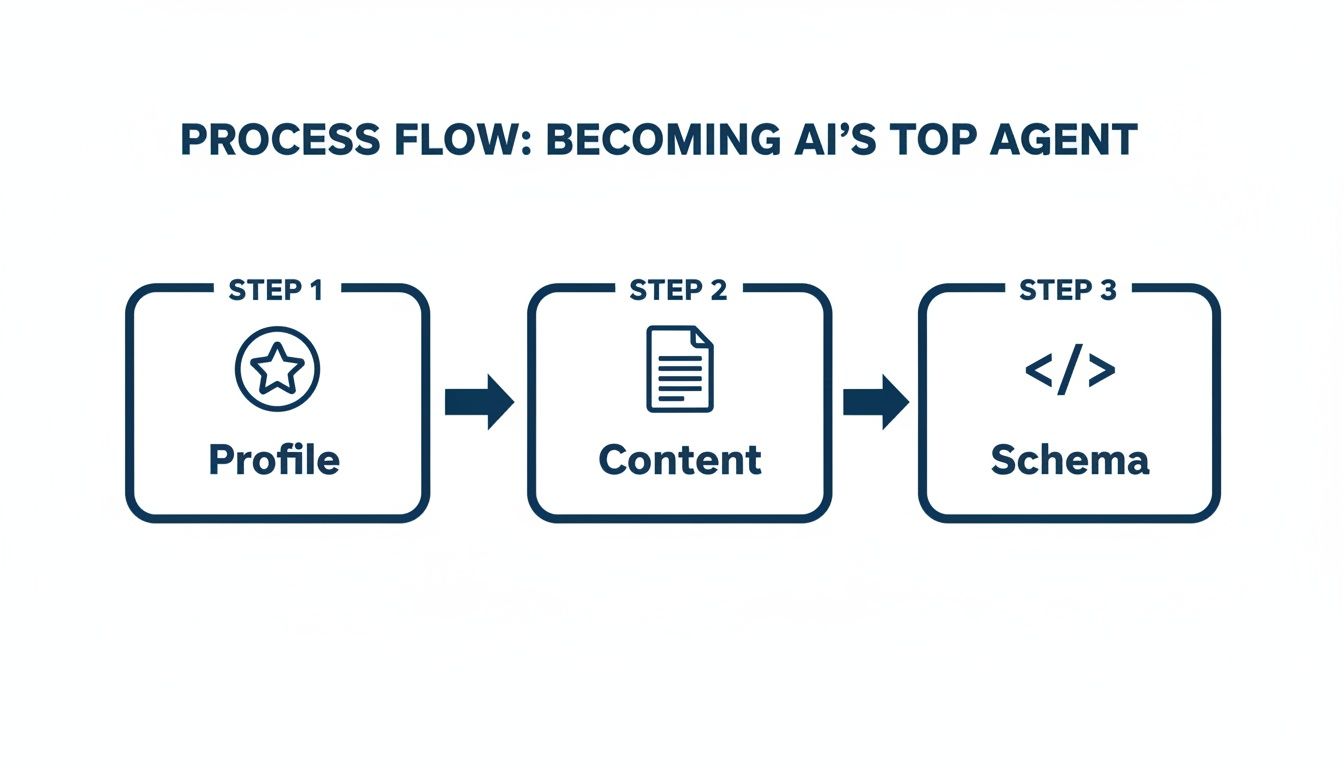
    I'm going to break this down into three core pillars: mastering your Google Business Profile, creating hyperlocal content that answers real-world questions, and using Schema Markup to speak the AI's language. Each piece builds on the last, creating a powerful presence that AI systems are designed to find and feature.

    Think of it like preparing a star witness for a trial. The AI is the judge, and your entire online footprint is the evidence. Your job is to present a clear, consistent, and compelling case that proves you are the definitive expert for your area.

    Pillar 1: Fortify Your Google Business Profile

    Your Google Business Profile (GBP) is way more than a digital business card now. For an AI, it's a primary source of truth. When someone asks Google, "Who's the best real estate agent in Scottsdale?" the first place the AI looks for clues is GBP data. It's scanning for completeness, recent activity, and what others are saying about you.

    An incomplete or dormant profile is a huge red flag for the system. To really dial it in for AI, you've got to focus on these key elements:

    • Fill Out Everything: I mean everything. Go through every single field available—services offered, specific service areas, and a detailed, keyword-rich business description. Don't leave any blanks.
    • Generate and Engage with Reviews: A steady stream of positive, recent reviews is probably the single most powerful trust signal you can have. Make it a habit to ask clients for them, and make sure you respond to every single one, good or bad.
    • Post Weekly with Google Posts: Use this feature to share market updates, new listings, and client success stories. It's a direct signal to Google that you are an active, engaged professional in your local market.

    Your GBP is the foundation. Without a strong, active profile, anything else you do to gain visibility will be fighting an uphill battle.

    The goalposts have completely moved for agents. Success isn't about traditional page one rankings anymore. It's about getting recommended by an AI when a potential client asks a specific, conversational question.

    For agents looking to stay competitive, real estate SEO in 2026 is less about ranking pages and more about being recommended by AI. The whole game is shifting to getting your expertise featured in Google AI Overviews or sourced by tools like ChatGPT, Gemini, and Perplexity. Buyer search behavior is changing fast, and you can dive deeper into these emerging home search trends to see what it means for agents who want to stay ahead.

    Pillar 2: Create Hyperlocal, Expertise-Driven Content

    AI is built to find answers to very specific questions, so it naturally prioritizes content that does the same. Generic blog posts like "5 Tips for Buying a Home" are now just noise. To get noticed, you have to become the undisputed source for hyperlocal information.

    This means you need to start creating content that answers the exact questions your ideal clients are asking before they even know who you are.

    For instance, instead of writing a broad article about your city, drill down and create a definitive guide to a single neighborhood. You could cover things like:

    1. School District Nitty-Gritty: Go beyond just ratings. Talk about specific programs, school culture, and zoning quirks.
    2. Real-World Commute Times: Provide realistic commute estimates from that neighborhood to major employment centers during rush hour.
    3. The Local Vibe: Detail the parks, hidden-gem restaurants, and shops that make that area unique.
    4. Housing Stock Deep Dive: Discuss the common architectural styles, typical lot sizes, and average price points.

    This is the kind of content that directly answers a conversational query like, "What's the best neighborhood in Chandler for a family with young kids and a $600k budget?" When an AI finds your detailed guide, it recognizes you as a true authority and is far more likely to feature your insights in its generated answer. We cover more ways to do this in our guide on improving real estate search visibility with ChatGPT.

    Pillar 3: Use Schema Markup as Your AI Translator

    Okay, this is the most powerful and criminally overlooked tool in an agent's arsenal: Schema Markup. The best way to think of Schema is as a secret language that lets you talk directly to search engines and AI. It's a bit of code you add to your website that explicitly labels your content, which means the AI doesn't have to guess what it's looking at.

    For example, without Schema, an AI sees "3 bed, 2 bath" as just a string of text. But with Schema, you can label it as numberOfBedrooms: 3 and numberOfBathroomsTotal: 2. This structured data is perfectly clear and incredibly valuable to an AI trying to match a property to a user's very specific request.

    By adding Schema to your property listings, you are essentially translating your property details into a format the AI understands perfectly. This dramatically increases the odds that your listings will get pulled directly into AI-generated answers for queries like, "show me three-bedroom townhomes with a two-car garage." It’s the ultimate way to make sure your data is clear, accurate, and ready for an AI recommendation.

    Using Technology to Automate Your AI Visibility

    Let's be realistic. Manually tackling every part of an Answer Engine Optimization (AEO) strategy—keeping your profile pristine, churning out hyperlocal content, and wrestling with Schema Markup—is a monumental task. While all these steps are crucial, the sheer effort can feel like taking on a second full-time job.

    This is exactly where technology shifts from being a simple convenience to a core part of your competitive strategy. The right platform can serve as the command center for your entire AI optimization plan. It handles the most repetitive, time-consuming tasks, takes the technical guesswork out of the equation, and makes sure every piece of content is perfectly structured for a Google AI real estate search.

    Essentially, it allows you to focus on what you do best—working with clients—while your digital foundation is expertly built for you in the background. This process all comes down to three core pillars: your digital profile, your content, and the technical schema that makes it all work.

    A process flow diagram detailing three steps: Profile, Content, and Schema, for becoming AI's top agent.

    As you can see, a winning AEO strategy isn't about just one thing. It's about integrating your personal brand (Profile), demonstrating your market expertise (Content), and speaking the technical language that AI systems understand (Schema).

    Streamlining Your Listing Marketing

    This is where a tool like ListingBooster.ai comes in. It was built to solve the core AEO challenges by automating the creation of AI-ready content and the technical markup that goes with it. It’s designed to connect the dots between your properties and AI visibility.

    Think of the platform as your dedicated AI marketing engine. For instance, its Listing Commander feature can take a single property and instantly generate a full suite of marketing materials. This isn't just about pulling in generic MLS text; it creates AI-optimized property descriptions written to be easily digested by language models, full of the specific details that answer conversational search queries.

    The biggest hurdle for agents isn't knowing what to do; it's finding the time to do it all consistently. Automation bridges that gap, turning strategy into execution without draining your most valuable resource—time.

    More importantly, the platform automatically embeds the necessary Schema Markup for you. This removes what is often the biggest technical roadblock for agents. You no longer have to learn code or stress about making a mistake; the system handles the translation, making your listings instantly understandable to Google's AI Overviews and other systems.

    For a deeper look into this, check out our guide on real estate marketing automation for agents.

    Building Your Authority on Autopilot

    Beyond marketing individual listings, you need to establish yourself as the local expert to get recommended by AI. This requires a steady flow of hyperlocal content that proves you know your stuff. This is where another key feature, Authority Builder, comes into play.

    Authority Builder automates the creation of the exact content we've been talking about—local market updates, neighborhood guides, and practical tips for buyers. It helps you build a digital footprint that screams "local specialist," which is precisely the kind of source an AI is programmed to trust and cite when someone asks, "Who's the best agent in my town?"

    By generating content that answers the specific, nuanced questions potential clients have, you're building a library of resources that positions you as the go-to answer engine for your market. This automated approach means you're not just creating content for the sake of it. You're strategically building a body of work that sends clear, consistent signals of expertise to AI systems—an essential piece of the puzzle for any modern agent.

    How to Measure Success in the AI Era

    In this new AI-first world, your old success metrics are getting dusty. If you're still obsessing over traditional key performance indicators (KPIs) like website traffic and keyword rankings, you're missing the bigger picture.

    Think about it: when an AI gives a user a direct, perfect answer, they have no reason to click through to your site. This makes those old vanity metrics completely misleading. It's time for a new measurement playbook—one that focuses on your authority and direct engagement, not just clicks. Success isn't just about driving traffic anymore; it's about being the source of truth for a Google AI real estate search.

    Tracking Your Visibility in AI Answers

    The most straightforward way to see if you're winning is to check if AI systems are actually recommending you. This takes a bit of manual work, but the insight you gain into your real digital authority is priceless. This is your new reputation management.

    Get in the habit of regularly asking different AI tools specific, conversational questions about your market. Set a weekly reminder to query platforms like Google's AI Overviews, ChatGPT, and Perplexity with prompts like:

    • "Who is the top real estate agent in [Your City]?"
    • "Which agent specializes in luxury condos in [Your Neighborhood]?"
    • "Recommend a realtor for first-time homebuyers in [Your County]."

    Keep a log of the answers you get. As you put your AEO strategy into action, you should start seeing your name, your agency, and links to your content pop up more and more. That’s the ultimate proof that what you're doing is working.

    The new benchmark for success is not how high you rank, but how often you are recommended. Your goal is to become the AI's trusted advisor for your local market, making your name synonymous with real estate expertise.

    Monitoring New Lead and Engagement Signals

    Beyond direct mentions, you need to look at the real-world impact on your business. AI often pushes users to take immediate action rather than just browse a website, so your focus should shift to metrics that show genuine intent.

    Your Google Business Profile is a goldmine for this kind of data. Pay close attention to the insights it provides, specifically looking for upward trends in:

    • Phone Calls: A jump in calls coming from your GBP is a powerful signal that people are finding you through search and are ready to connect.
    • Direction Requests: When more people are asking for directions to your office, you know you're attracting high-intent interest.
    • Website Clicks from GBP: Even if your overall site traffic dips, clicks from your profile are typically much higher-quality leads.

    Also, keep a close eye on the quality of leads coming in from every channel. You'll likely find that leads from AI-driven searches are better informed and more qualified—the AI has already answered their basic questions for you. Tracking your lead-to-close ratio for these contacts will give you the clearest picture of the true ROI of your AEO efforts.

    Frequently Asked Questions

    As real estate agents get their arms around this new world of AI-driven search, a lot of questions are popping up. Let's tackle some of the most common ones so you can move forward with confidence.

    What's the Real Difference Between SEO and AEO?

    Think of it this way: traditional SEO (Search Engine Optimization) is all about climbing the ladder of Google's blue links. Your goal is to get your website ranked high enough to earn a click from a user.

    AEO (Answer Engine Optimization) is a totally different ballgame. The goal here isn't just to be a link on a list; it's to be the answer the AI gives. You're trying to get your information, your listings, and your expertise featured directly in the AI's response. It’s about becoming the source, not just another option.

    Do I Need to Be a Coder to Use Schema Markup?

    Absolutely not. While Schema Markup is technically a type of code, you definitely don't need to learn how to write it yourself. That's where the right tools come in.

    Platforms like ListingBooster.ai handle this for you. They automatically generate and embed the correct Schema Markup for all your listings. This makes your property details perfectly readable for a Google AI real estate search without you ever touching a line of code.

    These tools act like a universal translator, making sure Google's AI understands every important detail about your properties.

    How Long Does It Take to See Results from AEO?

    Building true authority with an AI system is more of a marathon than a sprint, just like with old-school SEO. It's an ongoing process of consistently providing valuable content and proving you're a trusted source.

    That said, you can get some quick wins right out of the gate. The fastest results will come from two things:

    1. Dialing in your Google Business Profile: This is the lowest-hanging fruit. A complete and active profile is a massive trust signal for AI.
    2. Using Schema on every new listing: This immediately gives your properties a better shot at showing up in those specific, conversational searches.

    From there, consistently publishing great local content will build on that early momentum. Every blog post, market update, and neighborhood guide helps solidify your status as the go-to expert, eventually turning you into the agent the AI recommends most in your area.


    Stop letting AI ignore you and start getting recommended. ListingBooster.ai is your command center for creating AI-optimized property descriptions, hyperlocal content, and the Schema Markup you need to dominate this new era of search. Try it free and see how you can automate your authority.

  • AI Marketing for Real Estate Agents: How It’s Used and Where It Fits

    AI Marketing for Real Estate Agents: How It’s Used and Where It Fits

    You've likely heard the buzz around "AI marketing for real estate agents," but what does it actually mean for your business? Forget the complex jargon. At its core, AI marketing is about using smart technology to automate and improve the repetitive, time-consuming parts of your job, allowing you to focus on client relationships and closing deals.

    Think about the hours spent writing property descriptions, creating social media posts, or preparing materials for a listing presentation. AI tools can handle much of that heavy lifting, providing a consistent and professional foundation for your marketing efforts. This guide explains what AI marketing means in practice, how agents are using it, and where it fits into a modern real estate workflow.

    What AI Marketing Means in Real Estate

    A laptop shows real estate listings next to a sign 'AI for Agents', a coffee, and a notebook.

    In plain language, AI marketing for real estate agents isn't about robots replacing agents. It’s about leveraging technology as an efficient assistant that handles critical marketing tasks with speed and consistency. Instead of staring at a blank page trying to find a new way to describe "natural light," you can input a property's key features and receive a polished, MLS-compliant description in seconds.

    The practical value of AI is how it streamlines day-to-day operations. It supports agents in several key areas:

    • Listing Descriptions and Property Content: Generate compelling property narratives that meet MLS guidelines and are optimized for different platforms.
    • Search Visibility: Structure listing content to improve how it appears on Google, major portals, and even in new AI-powered search tools.
    • Social Media Content at Scale: Create and schedule a consistent stream of posts, market updates, and property highlights without the daily grind.
    • Listing Presentation Preparation: Quickly assemble marketing plans and competitive analysis to present to potential sellers.
    • Time Savings and Consistency: Reclaim hours previously spent on manual content creation while ensuring every marketing piece maintains a professional tone.

    The goal isn't to replace your expertise—it's to amplify it. AI handles the grunt work, freeing you up to focus on strategy, building relationships, and negotiating deals.

    Common AI Marketing Use Cases for Agents

    Let’s move from theory to practice. Savvy agents are integrating AI into their workflows to work smarter, not just harder. This isn't a futuristic concept; it's a real advantage being used today. Here are the most common use cases, framed as workflow support rather than a magic solution.

    Content Creation for Listings

    The most immediate application is generating marketing content for new listings. Agents use AI to create multiple versions of property descriptions from a single set of details. This means getting a concise, MLS-compliant description while simultaneously producing a more detailed, story-driven narrative for a personal website or blog.

    Platform-Specific Optimization

    Different platforms have different rules and audiences. AI helps tailor content for specific channels like the local MLS, Zillow, and Realtor.com. This includes adjusting character counts, formatting, and highlighting features that perform best on each site, improving a listing’s visibility and appeal.

    Social Media Scheduling and Post Generation

    Consistency is key to social media, but it's incredibly time-consuming. Agents use AI to generate an entire month's worth of social media posts for a listing, including captions, image suggestions, and relevant hashtags. This ensures a steady online presence without the daily effort.

    Presentation and Pre-Listing Materials

    One of the most powerful uses is in preparing for listing appointments. Instead of scrambling to pull together examples of past work, an agent can use AI to generate a custom marketing preview for a prospective seller's property. This includes a draft listing description, a sample social media plan, and a competitive marketing analysis, demonstrating proactive expertise.

    Authority and Market Content

    Beyond individual listings, AI is used to establish local expertise. Agents can quickly draft insightful neighborhood guides, market trend analyses, and helpful blog posts. By consistently publishing valuable information, they build their brand and become a trusted resource in their community.

    Real Estate AI workflow diagram illustrating three steps: Win Listing, Market Property, and Build Authority.

    This isn't just a trend; it's a massive shift. Projections show that by 2026, AI will be a core part of real estate, with 70% of professionals adopting new tools annually. Morgan Stanley even estimates that automating just 37% of an agent's tasks could unlock $34 billion in efficiency gains. You can read the full 2026 State of AI in Real Estate Marketing report to dig deeper into the data.

    Tools Agents Use to Support AI-Driven Marketing

    Once agents understand the use cases, the natural next question is about the tools. It’s crucial to see these tools as assistants that execute a strategy, not as replacements for an agent’s judgment. They make tasks faster and more consistent.

    AI marketing for real estate agents typically combines content creation, distribution, and consistency. While some agents rely on general-purpose AI writing tools, others use real estate–specific platforms that account for MLS formatting, platform requirements, and presentation needs. Tools in this category include a mix of general AI assistants and industry-focused platforms such as ListingBooster.ai, depending on how structured an agent’s marketing workflow needs to be.

    Listing Content & Presentation Tools

    These tools focus on preparing listing descriptions, platform-specific content, and materials agents use during listing appointments. They are designed to streamline the pre-listing and active marketing phases.

    • ListingBooster.ai – A real estate–specific AI platform used by some agents to generate MLS-compliant listing descriptions, platform-specific marketing content, and presentation materials as part of their overall marketing workflow.
    • General AI Writers – Tools like ChatGPT can be used with specific prompts to draft property descriptions, blog posts, and other marketing copy. They require more detailed instruction to ensure real estate compliance.

    General AI Assistants and Schedulers

    Another common approach is pairing a general-purpose AI writer with a social media scheduling tool that has AI features.

    • AI-Powered Social Schedulers: Many popular social media management platforms now integrate AI to suggest optimal posting times, generate caption variations, or create simple graphics, helping agents maintain an active presence.

    The choice between a general tool and one built for real estate often comes down to workflow preference. Specialized platforms save time because they understand industry terminology and compliance from the start. General tools offer flexibility but require more effort to guide.

    Recent data shows the impact of these strategies: 60% of agents report their highest ROI is coming from social media marketing, often powered by AI, and 52% of leads generated through these efforts are higher quality. You can find more eye-opening AI agent statistics on warmly.ai to see how quickly the landscape is changing.

    How AI Shapes Your Brand and Puts You on the Map

    Laptop with marketing analytics dashboards and 'BOOST YOUR BRAND' text overlay, set against a blurred background of houses.

    Adopting AI into your marketing is more than a time-saver; it’s an upgrade to your brand's digital presence. Consistent, high-quality content is the foundation of online visibility. By using AI to produce polished, platform-specific content for every listing, you expand your digital footprint and improve your visibility on traditional search engines and emerging AI-powered search platforms.

    This consistency presents your brand as a sophisticated, modern marketing operation, which is increasingly important to potential sellers.

    Moving Beyond Automation to Build Real Authority

    The true value of AI marketing emerges when it helps you build authority at scale. By consistently publishing insightful market updates, neighborhood guides, and helpful content, you position yourself as the go-to local expert.

    Seller expectations are rising. They seek partners with a clear, tech-forward marketing strategy. The AI sector in real estate is projected to grow from $222.65 billion in 2024 to $303.06 billion in 2025, signaling a massive industry transformation. You can find more real estate marketing statistics here to understand the full scope.

    AI isn't about replacing what you do. It's about amplifying your expertise, building your reputation, and showing sellers you're equipped to win in a competitive market.

    Answering Your Questions About AI in Real Estate

    Adopting new technology naturally brings up questions. Here are answers to some of the most common inquiries from agents considering AI for their marketing.

    Do I Need to Be a Tech Whiz to Make This Work?

    Not at all. Modern real estate AI platforms are designed for agents, not developers. If you can enter a property address or copy and paste information, you have the necessary skills. The purpose of these tools is to simplify your job, not add another complex system to manage.

    What About Fair Housing Compliance?

    This is a critical consideration and a significant benefit of using a real estate-specific AI tool. The best platforms are trained on Fair Housing guidelines to help avoid discriminatory language. AI focuses objectively on a property's features—like granite countertops or a fenced yard—rather than making assumptions about potential residents. While you are always the final reviewer, the AI provides a compliant foundation to build upon.

    Can AI tools real estate agents use help me win more listings?

    Yes, by making you appear more prepared and professional. When you walk into a listing presentation with a complete, ready-to-launch marketing plan—including a sample MLS description and a 30-day social media calendar—you demonstrate a level of marketing savvy that builds immediate trust and sets you apart from the competition.

    Is This Going to Replace My Professional Copywriter?

    Think of AI as a powerful assistant, not a replacement for human expertise. It can get you 80% of the way to a finished piece of marketing content in seconds. Your role is to add the final 20%—the unique neighborhood insights, personal voice, and local details that only an expert can provide. The AI handles the heavy lifting, freeing you to focus on the high-value strategic touches.

    Conclusion

    AI marketing in real estate isn’t about replacing agents—it’s about reducing manual work and improving consistency. As expectations around digital presence and content quality increase, agents are experimenting with different ways to integrate AI into their marketing workflows. The specific tools matter less than understanding how AI fits into listing preparation, presentation, and ongoing visibility. To learn more, visit the real estate marketing blog.