Tag: ai for realtors

  • AI search optimization for real estate: Boost Listings & Attract Buyers

    AI search optimization for real estate: Boost Listings & Attract Buyers

    Optimizing for AI search is all about structuring your online presence—everything from your property listings to your agent bio—so that conversational AI like ChatGPT and Google’s AI Overviews can find you, understand what you do, and recommend you to buyers and sellers. It's a fundamental shift. Instead of just targeting keywords, you're positioning yourself to be the definitive answer when people ask AI for help.

    Why AI Is the New Front Door for Homebuyers

    The way your next client finds you has changed, and it happened faster than most agents realize. For years, the path was simple. A potential buyer would head to Google and type in something like "homes for sale in Denver." That's not the starting point for a lot of people anymore.

    A huge and growing number of buyers are skipping that old-school search bar entirely.

    They're starting their home search by having a conversation with an AI. They're not using clunky keywords; they're asking detailed, natural questions.

    • "Find me a real estate agent who specializes in historic downtown condos under $800k."
    • "What are the best family-friendly neighborhoods with top-rated schools near the tech corridor?"
    • "Show me three-bedroom homes with a large backyard and a recently remodeled kitchen."

    This isn’t some far-off trend—it’s happening right now. Traditional SEO is still part of the puzzle, but it’s not enough on its own. It was built for a world of blue links. AI search is different; it’s designed to deliver a single, confident answer. If your digital presence isn't built in a way that AI can easily understand, you're completely invisible in these critical conversations.

    The Shift to Conversational Discovery

    What’s really happening here is a move from keywords to intent. An AI doesn't just look for "Denver homes." It pulls together information from all over the web—your website, your Zillow reviews, neighborhood blogs, local business directories—to figure out who is the most credible and relevant expert for a very specific, nuanced request.

    The goal of AI search optimization for real estate isn't to rank #1. It's to be the answer. You need to build a digital identity so clear and trustworthy that an AI has no doubt about presenting you as the go-to local expert.

    This change is picking up speed like you wouldn't believe. By 2026, the real estate industry saw a massive surge in AI adoption, with 92% of corporate real estate firms running AI pilots—a huge jump from just 5% three years earlier. This is happening because consumer behavior is changing. We're already seeing over 40% of homebuyers starting their property search right inside an AI chat, bypassing Google completely. You can explore more data on this AI-driven pivot in real estate search for a deeper dive.

    Your Advantage in This New Landscape

    For any agent ready to adapt, this is a golden opportunity. Big brokerages are still trying to figure it all out, running tests and forming committees. But individual agents and small teams can be nimble and move fast. By focusing on creating a rich, interconnected, and machine-readable online footprint, you can become the source that AI models learn to trust and recommend.

    This means looking at every single one of your digital assets with a new lens:

    • Your Listings: The descriptions can't just be a list of features. They need to tell a compelling story about the lifestyle a buyer gets with the home.
    • Your Profile: It has to be crystal clear about your niche, the specific areas you serve, and your proven track record.
    • Your Content: Your blog posts and social media need to directly answer the questions your ideal clients are asking every day.

    The agents who get this right aren't just going to keep up; they're going to grab a serious competitive edge. They’re building a brand that's discoverable not just by people, but by the AI assistants that are quickly becoming the main gateway to the real estate market.

    Building an AI-Readable Digital Footprint

    To show up in the new world of AI search, you have to start thinking less like a marketer and more like a data scientist. AI engines like Google's and ChatGPT aren't just "browsing" your website; they're consuming and connecting data points. They're looking for clear, consistent signals that define who you are, what you specialize in, and where you work.

    The whole game is about making it incredibly easy for these systems to understand and trust your expertise. An AI builds its picture of you by piecing together information from your website, your Google Business Profile, client reviews, and your Zillow profile. If those sources tell different stories, your authority gets watered down, and you become invisible.

    This is a fundamental shift away from just chasing keywords. We're moving toward becoming the direct, authoritative answer to a person's question.

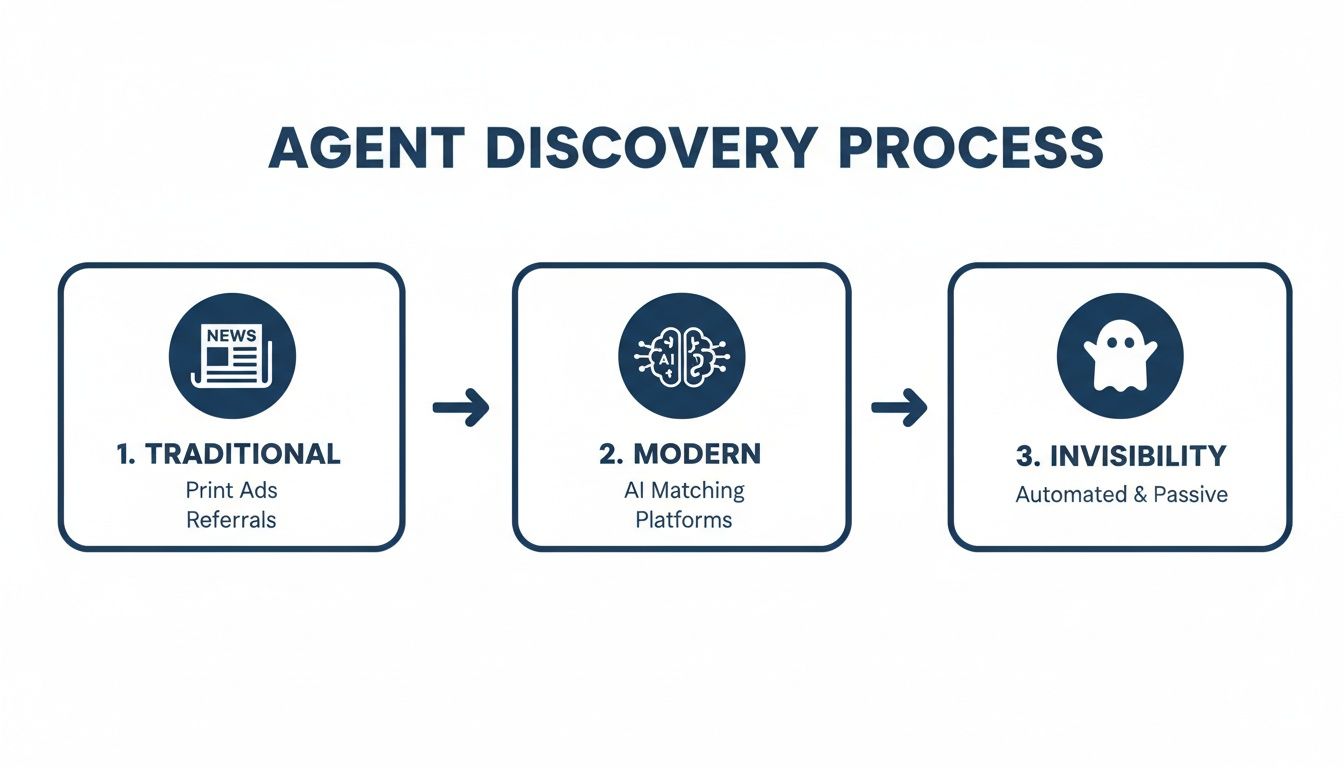
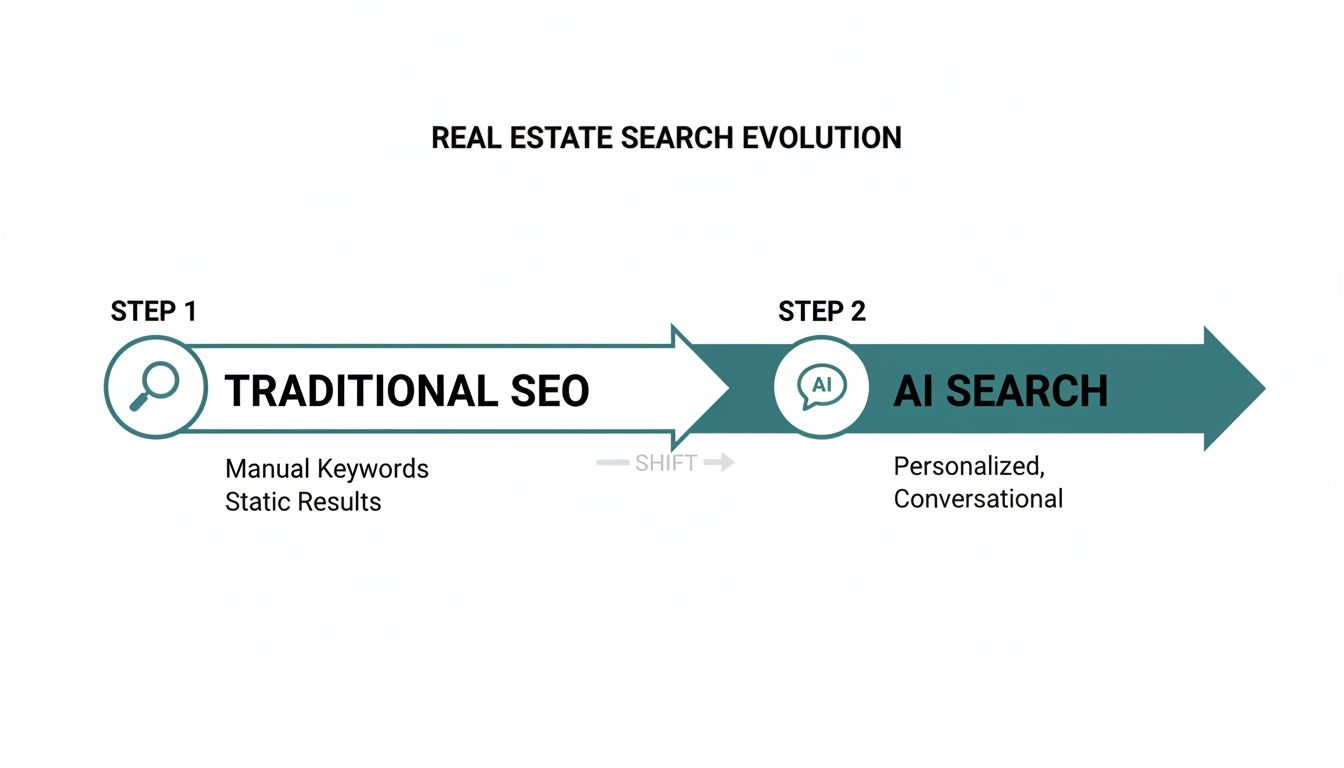
    Infographic showing the evolution of real estate search from traditional SEO to AI search, highlighting key features.

    As you can see, the old model was about ranking. The new model is about being the source of truth for a conversational query.

    The Secret Language: Structured Data and Schema

    The most powerful tool in your technical arsenal for AI search optimization for real estate is structured data, specifically using Schema.org markup.

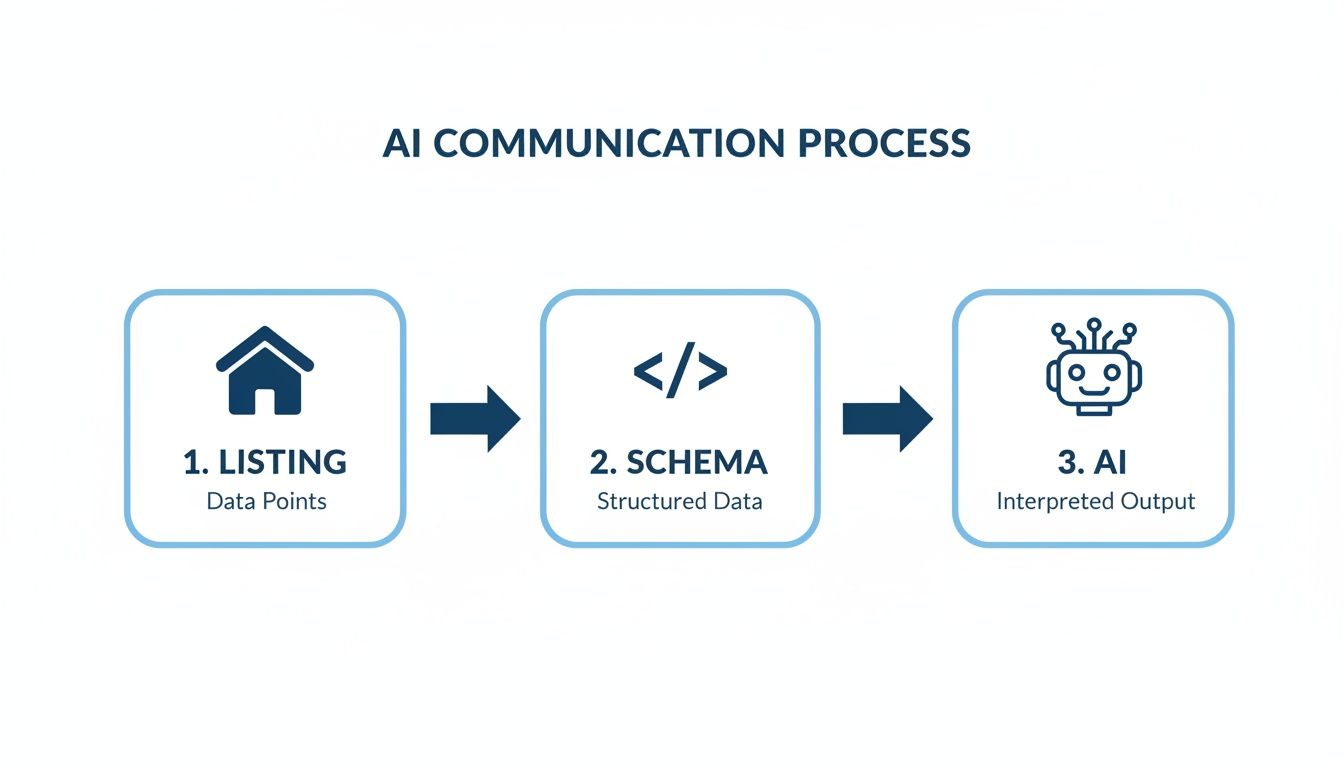
    Think of schema as a set of secret instructions you add to your website's code. It doesn’t change how your site looks to a human visitor, but it speaks directly to machines, telling them precisely what your content is about. It removes all the guesswork.

    Instead of an AI trying to figure out if you're a real estate agent from the text on your "About" page, you use RealEstateAgent schema to declare it explicitly. That's a huge signal of clarity and authority.

    An AI is like a librarian trying to organize the world's information. Schema markup is the Dewey Decimal System for your business—it tells the AI exactly where you belong on the shelf, making sure you get recommended for the right queries.

    For a property listing, you can use schema like SingleFamilyResidence to tag details like the number of bedrooms (numberOfRooms), square footage (floorSize), and unique features (amenityFeature). That structured data is infinitely more valuable to an AI than a simple paragraph of text it has to parse.

    Essential Schema Markup for Real Estate Agents

    Here’s a quick-reference table of the most critical schema types to get implemented on your website. This is the bedrock of your AI-readable footprint.

    Schema Type Key Properties to Include Why It Matters for AI
    RealEstateAgent name, address, telephone, areaServed, knowsAbout Directly tells AI your profession, location, and areas of expertise.
    SingleFamilyResidence address, floorSize, numberOfRooms, amenityFeature, geo Provides structured, unambiguous details about a specific property.
    Review reviewRating, author, reviewBody, itemReviewed Feeds AI trust signals directly from your clients' experiences.
    RealEstateListing datePosted, price, itemOffered (linked to the property) Clearly defines the transactional nature of the page for an AI.
    LocalBusiness openingHours, paymentAccepted, hasMap, department Solidifies your status as a legitimate, local service provider.

    Putting this schema in place is non-negotiable. It’s the single biggest technical step you can take to make your website more visible to AI.

    Your Google Business Profile Is Your AI Anchor

    When an AI model wants to understand a local business, your Google Business Profile (GBP) is one of the first and most trusted sources it checks. It's the anchor for your local identity. An incomplete or inconsistent profile is a major red flag that tells an AI you might not be a credible source.

    Optimizing your GBP for AI is more than just filling in the blanks. It’s about strategically proving your local dominance.

    • Be Hyper-Specific with Service Areas: Don't just put "Phoenix." List the specific neighborhoods and zip codes you dominate, like "Arcadia (85018)" or "Biltmore Area (85016)." This is how you capture "near me" and hyper-local searches.
    • Lock Down Your NAP: Your Name, Address, and Phone number (NAP) must be 100% identical everywhere—your website footer, social media, and all real estate portals. A simple variation like "St." vs. "Street" can create confusion for an AI.
    • Use Google Posts Like a Local Blogger: Share market updates, new listings, open house announcements, and community news. This feeds Google’s AI a constant stream of fresh, locally relevant information tied directly to your business profile.
    • Coach Your Clients on Reviews: Reviews are gold. Gently encourage clients to mention the neighborhood they bought or sold in or the specific type of property you helped with ("He was a lifesaver finding us a condo in Old Town Scottsdale"). Those details are powerful signals of your niche expertise.

    Tying It All Together

    Finally, consistency is the glue. Every single platform you're on should tell the same story about who you are and where you're the expert. This can be a challenge for agents and teams to manage, which is why exploring different AI tools for real estate agents can be a huge help in keeping your messaging tight and consistent.

    Run a quick audit of your digital presence. Ask yourself:

    • The Bio Test: Is my bio on Zillow, Realtor.com, and my own website telling the exact same story about my specialties and service areas?
    • The Branding Test: Am I using the same professional headshot and brand colors everywhere to create an instantly recognizable identity?
    • The Property Description Test: Do my listing descriptions use a consistent voice and always highlight the unique lifestyle features relevant to my target buyer?

    When you meticulously align all these pieces, you create a powerful, interconnected web of information. Each consistent signal reinforces your authority, making it dead simple for an AI to see you as the go-to expert for real estate in your market. This is what building a modern, machine-readable brand is all about.

    Optimizing Listings for Conversational Search

    Let's be honest, conversational AI doesn't care about your standard "3 bed, 2 bath, updated fixtures" description. That kind of language is practically invisible to a smart assistant trying to answer a real buyer's question. If you want to win at AI search optimization for real estate, you have to stop writing inventories and start telling stories.

    This is a fundamental shift in how we approach listing copy. Instead of just listing what a house has, we need to explain what it offers. Don't just say "fenced-in backyard." Instead, paint a picture: "Enjoy total privacy in a fully fenced backyard, perfect for summer barbecues and a safe space for kids and pets to play freely." That’s the kind of natural, descriptive language that AI is built to understand and reward.

    A photographer using a DSLR camera to capture a bright, modern kitchen for real estate listings.

    From Features to Lived Experiences

    The real trick is to translate every single feature into a tangible benefit or a vivid experience. You have to get inside the head of a buyer and anticipate their conversational queries. An AI is far more likely to serve up your listing for a search like, "find me a home with great natural light for my houseplants," if your description talks about the "sun-drenched living room with south-facing windows that fill the space with bright, airy light all day long."

    Here’s how this looks in practice. It's a simple, but powerful, change in mindset:

    • Instead of: "New home office"

    • Try this: "A dedicated main-floor office gives you a quiet, professional space for remote work, complete with built-in shelving to keep you organized and focused."

    • Instead of: "Close to parks"

    • Try this: "You're just a five-minute walk from the entrance to Oakwood Park, giving you instant access to miles of walking trails, playgrounds, and community green space."

    This reframing makes your listing infinitely more useful to both a person scrolling through Zillow and the AI that's helping them search.

    The Power of AI-Enhanced Image SEO

    Of course, the words are only half the story. AI now "sees" your property photos, which means optimizing your images is no longer optional—it's essential. When you upload a picture of a kitchen, an AI doesn’t just register a room; it identifies specific elements like the countertops, appliances, and sink style. This is where you can get a huge leg up.

    Tagging your images with descriptive alt text helps the AI understand exactly what's in the picture. This simple step dramatically increases the odds of your listing popping up for very specific searches.

    AI-powered computer vision can analyze your property photos and automatically add SEO-friendly tags for features like 'quartz countertops,' 'stainless steel appliances,' or 'farmhouse sink.' This process makes your images—and by extension, your entire listing—discoverable for highly specific buyer queries.

    This isn't some far-off future tech; it's already here. The 2025 National Association of Realtors' Technology Survey found that 68% of Realtors are already using AI tools to boost their marketing. We're seeing these tools tweak photos and metadata, leading to 15-25% faster sales by making listings more visible on major portals. Discover more insights about how AI automation is reshaping real estate marketing and see what your competition is up to.

    Crafting the Perfect AI-Friendly Listing

    When you combine that narrative-driven copy with meticulously tagged images, you create a powerful, AI-readable asset. The goal is to build a complete digital profile of the property that leaves nothing to the imagination.

    Here are a few quick wins you can implement on your very next listing:

    • Lead with Lifestyle: Open your description with a hook that paints a picture of what it's like to live there.
    • Get Hyperlocal: Drop in names of neighborhoods, local parks, and popular nearby coffee shops to firmly place the property in its community.
    • Rename Your Image Files: Before you even upload, change IMG_2475.jpg to something like 123-elm-street-remodeled-kitchen-with-island.jpg.
    • Write Detailed Alt Text: For every photo, add a short, descriptive sentence. For example: "Spacious primary bedroom with large windows overlooking the tree-lined backyard."

    By making these changes, you're not just writing a better property description. You're building a rich data source that’s perfectly structured for conversational AI, ensuring your listings get seen, understood, and recommended to the right buyers.

    Build Your Authority with AI-Ready Content

    If you want AI to recommend you, it first has to see you as a true authority. This isn't about tricking an algorithm; it's about proving you're the real deal through consistent, high-value content. Think of it this way: AI models scan and synthesize a mind-boggling amount of information to find the most trustworthy and helpful answer. Your job is to become that answer for your local market.

    This means you need to create a deep web of content that directly addresses the specific, conversational questions your future clients are asking. Forget basic blog posts. You're building an entire library of expertise that signals to AI that you are the go-to expert for real estate in your town.

    A person, a local market expert, reviews a house on a tablet and a map.

    Answer Questions Before They're Even Asked

    The heart of your content strategy should be getting ahead of what people are asking. They aren’t just typing "homes for sale in [City]" anymore. They're asking AI assistants detailed, nuanced questions, and you need to have the answers published and waiting on your website.

    Your content should be built around these kinds of real-world queries:

    • Neighborhood Guides: Go deep on every neighborhood you serve. Don't just list amenities; paint a picture of the lifestyle. What’s the vibe on a Saturday morning? Where do locals grab coffee? This is the rich, textured detail that AI is looking for.
    • Market Updates: Move past generic stats. Explain what the numbers actually mean for a local buyer or seller. Your content should be able to answer a question like, "What does a 5% interest rate change mean for my budget in the Northwood neighborhood?"
    • Buyer and Seller Pain Points: Write articles that solve common problems. Topics like "How to Win a Bidding War in a Competitive Market" or "The Top Mistakes First-Time Sellers Make" immediately establish you as a helpful guide.

    This proactive approach is the bedrock of AI search optimization for real estate. You're directly feeding AI models the clear, useful information they're designed to find and share.

    Think in Topics, Not Just Keywords

    The old SEO game was all about ranking for specific keywords. The new game is about owning entire topics. An AI wants to see that you have comprehensive knowledge about a subject, not just one popular blog post that hit the mark.

    This is where the idea of "content pillars" comes in. A content pillar is a massive, central piece of content on a broad topic, which you can then break down into many smaller, related articles.

    Example Content Pillar: "Relocating to [Your City]"

    • Main Pillar Post: A detailed, ultimate guide covering everything a newcomer would need to know.
    • Spoke Posts (linking back to the main pillar):
      • "The Top 5 Family-Friendly Suburbs in [Your City]"
      • "A Simple Guide to Understanding Local Property Taxes"
      • "Comparing School Districts in the [Your City] Area"
      • "Best Dog Parks and Pet-Friendly Spots for New Residents"

    This hub-and-spoke structure clearly demonstrates your deep expertise, making it incredibly easy for an AI to recognize your authority and recommend your content for a whole host of relocation questions.

    Creating this web of interconnected content does more than just answer a single question. It builds a knowledge graph that an AI can clearly see, establishing you as the central hub of information for your market.

    The data is already starting to back this up. AI referral traffic, while still new, is becoming a key source of high-intent leads. Right now, the real estate industry captures just 1.01% of website traffic from AI sources like Perplexity and ChatGPT. Although that number seems small, this traffic is made up of motivated users who convert at a higher rate. For agents on the ball, this highlights a massive opportunity to build an AI-readable digital footprint. You can see more of these emerging real estate AEO benchmarks to get a sense of the landscape.

    A Practical Content Plan for Busy Agents

    I know what you're thinking—creating all this content sounds exhausting. But it doesn't have to be. Your unique local knowledge is the raw material, and you're creating it every single day.

    • Document, Don't Create: Turn your daily client conversations into content. Did you just explain the pros and cons of a specific school district? That's a blog post. Did you just tour a new construction development? That's a neighborhood spotlight video.
    • Use a Simple Q&A Framework: For each piece of content, frame it as a question and answer. Use headings that sound like real questions people would ask, like "What Are the Typical Closing Costs for a Buyer in [Your County]?" This makes your content incredibly easy for both humans and AI to understand.

    By consistently publishing helpful, locally-focused content, you build a powerful moat around your business. You become the trusted source that AI—and more importantly, your future clients—turn to first. For more ideas on getting started, you might find our guide on AI marketing for real estate agents helpful.

    How to Know If Your AI Optimization Is Actually Working

    So, you've put in the work to optimize your listings and profiles for AI search. That's great, but how can you be sure it's actually paying off? Unlike classic SEO where you can get fixated on a single keyword ranking, measuring success with AI is more about watching a collection of signals that prove your authority is growing. The real goal isn't just to rank—it's to become the go-to source that AI trusts and recommends.

    You won't find a tidy, all-in-one dashboard for this just yet. Instead, you'll need to play detective and connect the dots between a few key metrics. When you see these numbers moving up and to the right, you'll know your strategy is hitting the mark.

    The KPIs That Matter Most

    Think of this as gathering evidence. The proof of your success will pop up in your website analytics, your lead sources, and even in your initial conversations with new clients. I'd suggest starting a simple spreadsheet to track these data points month over month.

    Here’s what you should be watching closely:

    • A Bump in Direct Website Traffic: This is a big one. When someone types your website address directly into their browser, it means they already know your name. This is often what happens right after an AI has mentioned you, and it’s a powerful sign that your brand recognition is on the rise.

    • More Branded Search Queries: Jump into your Google Search Console and look at the search terms people are using to find you. An increase in searches for your name, your team's name, or your brokerage (like "Jane Doe real estate") is pure gold. It shows your reputation is spreading organically.

    • Leads Mentioning AI: This is the most direct feedback you’ll ever get. Make it a habit to ask every single new lead, "How did you hear about us?" The moment you start hearing things like, "I asked ChatGPT for the best agent in…" or "Google’s AI answer recommended you," you’ll know you've cracked the code.

    Digging for Clues in Google Search Console

    Your Google Search Console is an absolute must-have for this—and it's free. It gives you a direct window into how searchers are finding you, whether through a traditional search or an AI-powered one.

    Head over to the "Performance" report. This is where you can filter queries to see the exact questions leading people to your site. Keep an eye out for long, conversational phrases. A search like "best real estate agent for first-time buyers in Scottsdale" is a perfect example of how people talk to AI. Seeing more of these queries pop up is a clear indicator that your content is hitting the right notes for conversational search.

    The whole point of AI optimization is to become the definitive answer to a user's question. When your content starts surfacing for these super-detailed queries, it's proof that you're successfully carving out your niche authority in the eyes of the algorithm.

    Quick Wins You Can Implement Today

    Building true authority in the eyes of AI is a marathon, not a sprint. But there are a few high-impact things you can do right now to get some early traction. These steps are designed to send strong, immediate signals about who you are, where you work, and what you’re an expert in.

    1. Hyper-Target Your Google Business Profile: Don't just list your city. Go into your profile and add the top 5-10 specific neighborhoods or zip codes where you're the undisputed local pro. This is how you show up in those hyper-local, "near me" AI recommendations.

    2. Rewrite Your Top 3 Listing Descriptions: Pick your three most important listings and give the descriptions a makeover. Use that narrative, lifestyle-focused language we talked about. Instead of just listing features, translate them into benefits. Paint a picture of what it feels like to live in that home and be part of that community.

    3. Add a Mini Q&A to Your Homepage: Create a small "Frequently Asked Questions" section right on your homepage. Answer 3-4 of the most common questions you get from clients, and use the full question as the heading for each answer. This makes your expertise instantly scannable for AI crawlers.

    By tracking the right KPIs and knocking out these quick wins, you can start building a clear picture of your progress. To take it a step further, specialized real estate listing marketing software can help automate some of these tasks, freeing up your time while making sure you stay visible.

    Common Questions About AI for Real Estate

    Jumping into AI search can feel like charting unknown waters. It’s completely normal to have questions about how this all works and, more importantly, what it means for your real estate business. Let's tackle the most common ones I hear from agents so you can move forward with confidence.

    How Is AI Search Different From Traditional Google SEO?

    This is a big one. For years, we’ve all been conditioned to think in terms of keywords. Traditional SEO is a game of ranking for phrases like "homes for sale in Austin." You fight to get your website link onto that coveted first page.

    AI search flips the script entirely. The goal isn't just to be a link in a list; it's to be the answer to a conversational question. Think about how a person would actually ask for help: "What are the best Austin neighborhoods for families with a $700k budget?"

    To answer that, an AI doesn't just look for keywords. It pulls together information from dozens of sources it trusts and presents a single, direct response. This means your strategy has to change. You need to focus on feeding the AI the right signals: structured data (like schema markup), consistently helpful content, and a rock-solid local reputation built on reviews. You're trying to convince the machine that you are the most reliable expert for that specific need.

    Do I Need to Be a Tech Expert to Do This?

    Honestly, no. Not even close.

    I get it—words like "schema markup" sound complex and make you think you need to learn code. The good news is that modern real estate tools are built for the rest of us. Many platforms can automatically generate AI-ready descriptions and apply all the necessary structured data behind the scenes. You never have to see a single line of code.

    For your own website, there are simple plugins that do the heavy lifting. Your real job is to focus on the strategy. It’s all about creating genuinely useful, hyper-local content that proves you know your stuff. The tech is just there to amplify your expertise, not replace it.

    The most important skill in the age of AI isn't coding; it's clarity. If you can clearly articulate your value and local expertise, you have everything you need to succeed. The tools are just there to help you amplify that message.

    How Long Does It Take to See Results From AI Optimization?

    This isn't like flipping a switch on a Facebook ad. Think of it more like planting a tree than starting a motor. It’s a long-term strategy that builds momentum over time.

    You can definitely see some early traction within a few weeks, especially if you tackle the quick wins. Fully optimizing your Google Business Profile and beefing up your current listings with better, narrative-driven copy can get the ball rolling.

    But to build the kind of deep authority that makes you a top AI recommendation? That typically takes about three to six months of consistent work. The key is persistence—regularly publishing expert content, gathering client reviews, and showing up as the local authority. The sooner you start building this foundation, the bigger your head start will be when everyone else tries to catch up.

    Will This Strategy Also Generate Seller Leads?

    Absolutely. In fact, it's one of the most effective ways to get in front of sellers before they've even decided to list.

    Homeowners almost always start their journey by asking research questions. They're turning to AI for answers to things like:

    • "What is my home worth in the Northwood neighborhood?"
    • "Who is the top listing agent for historic homes in Savannah?"
    • "What are the average days on market for a four-bedroom house in my zip code?"

    When you create content that directly answers these questions—like detailed local market reports, case studies of your recent sales, or articles explaining your unique marketing process—you position yourself as the obvious expert. So when a potential seller finally asks an AI for an agent recommendation, your digital footprint makes you the logical choice. High-intent leads come directly to you because you were the source of truth from the very beginning.


    Stop being invisible in the age of AI search. While other agents scramble, ListingBooster.ai transforms your properties into a complete, AI-optimized marketing suite in minutes. Generate scroll-stopping social content, compelling MLS descriptions, and print-ready assets that prove you’re the market leader.

    Start your free trial and see the difference.

  • AI-powered real estate marketing: Boost Listings and Close More Deals

    AI-powered real estate marketing: Boost Listings and Close More Deals

    At its core, AI-powered real estate marketing is about using smart software to handle the repetitive, time-consuming tasks that bog agents down. Think about crafting property descriptions, scheduling a month's worth of social media posts, or digging through market data. AI automates and improves these jobs, freeing you up to focus on what truly matters: building client relationships and closing deals.

    It’s the key to gaining a real advantage in a market that waits for no one.

    Winning the First Click in an AI-Driven World

    A hand holds a 'WIN THE FIRST CLICK' sign in front of a modern house and a woman with a brochure.

    The old real estate marketing playbook is officially obsolete. For years, the formula was simple: get your website ranked on Google, throw some money at social media ads, and wait for the leads to trickle in. But that entire model is built on a foundation that's cracking, because the way clients search for homes has fundamentally changed.

    A huge chunk of the market isn't starting on Google anymore. They're asking conversational AI tools for recommendations. This is a massive shift. Traditional SEO was a game of matching keywords. The new game is about becoming such a trusted authority that an AI recommends you by name. If your marketing isn't built for AI to find and understand, you’re basically invisible to this growing group of buyers.

    The New Search Landscape

    Let this sink in: over 40% of homebuyers now begin their search using AI tools like ChatGPT, Perplexity, and Google's AI Overviews, not a standard search bar. This isn't a small trend—it’s a seismic shift that rewrites the rules of digital visibility. For agents sticking to the old ways, this means a huge portion of potential clients will never even see their listings. You can dive deeper into the numbers with these real estate marketing statistics to see just how fast this is happening.

    This is more than just a new tech fad; it's a completely different way for expertise to be discovered online. AI-powered real estate marketing isn't just a nice-to-have; it's the necessary response to meet modern buyers and sellers where they're actually looking for answers.

    Think of it like this: Traditional marketing was like putting a billboard on a busy highway. AI-powered marketing is like having a trusted local guide who personally recommends you to every traveler asking for the best place to live.

    Why Your Old Marketing Habits Are Failing

    The biggest problem with the old way is that manual marketing efforts just can't keep up anymore. The sheer volume of work—fresh social media content every day, perfectly optimized listing descriptions, and up-to-the-minute market analysis—is enough to burn out even the most dedicated agent.

    Take a look at how the daily grind of real estate marketing is being completely reshaped by AI. The table below contrasts the time-consuming tasks of yesterday with the intelligent, automated workflows available today.

    Old Marketing Habits vs New AI Strategies

    Marketing Task The Traditional Manual Approach The Modern AI-Powered Approach
    Listing Descriptions Spending hours writing and rewriting descriptions, trying to fit different portal requirements. Instantly generate multiple versions of a compelling description, each tailored for MLS, Zillow, social media, and more.
    Social Media Posting sporadically "when you have time," leading to an inconsistent and ineffective online presence. An automated calendar posts high-quality, relevant content for you daily, building a consistent and authoritative brand.
    Lead Nurturing Manually responding to every inquiry, often with a delay that costs you the lead. AI-driven chatbots provide instant, 24/7 responses to common questions, qualifying leads while you sleep.
    Market Analysis Spending days pulling comps and manually crunching numbers to understand local market trends. Generate in-depth, hyper-local market reports in minutes, positioning yourself as the neighborhood expert.
    Content Creation Struggling with writer's block to create blog posts or neighborhood guides to boost SEO. Produce well-researched, engaging articles and community content with a few clicks, establishing your digital authority.

    As you can see, the shift isn't just about saving time; it's about producing better, more consistent results that manual methods simply can't match.

    An AI-driven strategy positions you as an authority before you even get the listing. It builds your reputation as the go-to expert in your market, so when a user asks an AI, "Who is the best agent in Anytown, USA?"—your name is the one that comes up.

    Adopting AI-powered real estate marketing is more than an upgrade. It’s a strategic decision to stay relevant and win that all-important first click in this new digital arena.

    How AI Works as Your Marketing Co-Pilot

    Let's cut through the jargon. What is AI-powered real estate marketing, really? It’s not some complicated, futuristic robot taking over your job. It's much simpler and more practical than that.

    Think of it like having a dedicated marketing assistant—a co-pilot—sitting next to you. This co-pilot handles all the tedious, repetitive digital marketing tasks that eat up your day. You know the ones: writing property descriptions, scheduling social media posts, and formatting everything for different websites.

    This isn't about replacing your expertise; it's about amplifying it. The AI does the heavy lifting in the background, freeing you up to focus on what you do best: building relationships, negotiating deals, and being the trusted guide your clients need. It’s a force multiplier that takes one simple input—a property address—and spins it into a complete marketing campaign.

    Turning a Single Address into a Full Campaign

    The real magic happens when you see how an AI system connects the dots. When you give a tool like ListingBooster.ai a property address, it doesn't just see a pin on a map. It instantly dives into a sea of data to build a smart marketing plan from the ground up.

    Here’s a quick look under the hood:

    • It Gathers the Intel: The AI pulls from public records, MLS data, and current market trends tied to that specific property. It instantly identifies the key selling points, neighborhood perks, school districts, and recent comps.
    • It Writes the Story: Using all that data, it starts writing. It doesn't just spit out one generic description; it creates multiple versions tailored for different platforms—a detailed one for the MLS, a punchy one for Zillow, and a short, engaging one for an Instagram caption.
    • It Builds the Campaign: This goes way beyond just descriptions. The AI maps out an entire content plan for you. It designs social media posts for the new listing, graphics for the open house, "just sold" announcements, and even local market updates that establish you as the go-to expert.

    What used to take hours of painstaking work—or even days, if we're being honest—is now done in minutes. Every single one of your listings gets a professional, comprehensive marketing launch without you having to sacrifice your valuable time.

    The Core Jobs of Your AI Co-Pilot

    At its core, your AI co-pilot is built to handle three critical parts of your marketing: creating content, optimizing your listings on portals, and managing your social media. By taking these off your plate, it consistently builds your online presence, almost on autopilot.

    Your AI co-pilot doesn't just save you time—it builds a consistent, professional brand that works around the clock. It's the engine driving your digital reputation, making sure you’re always visible and authoritative online.

    Let's break down what this looks like day-to-day.

    • Compelling Listing Descriptions: No more writer's block. The AI crafts descriptions that are both factually accurate and emotionally resonant, using proven sales copy techniques to grab a buyer's attention and highlight a home's best features.
    • Automated Social Calendars: It actually plans out a full 30-day social media schedule based on your listings and the local market. This means you maintain a consistent, engaging presence on Facebook and Instagram without the daily stress of wondering what to post.
    • Property Portal Optimization: The AI knows that a listing description for your local MLS needs a different touch than one for a national portal like Zillow. It creates unique, optimized content for each one, helping your listings stand out and get seen by more potential buyers.

    By weaving these tasks together, AI-powered real estate marketing creates a self-sustaining system for your brand. Every new listing becomes another opportunity to reinforce your expertise, capture new leads, and solidify your reputation as the agent to know in your market. That consistent, high-quality output is exactly how you build a dominant digital footprint.

    Building Your Automated Content Engine

    Let's be honest, the daily grind of content planning is a huge time suck. That feeling of staring at a blank cursor, trying to figure out what to post on Instagram or how to word a new listing description—it’s exhausting. What if you could get rid of that stress for good? This is where an AI-powered real estate marketing engine comes in, and it's less science fiction and more practical magic.

    The whole idea is to take what used to be a week's worth of marketing prep and shrink it down to just a few minutes. You start with one simple piece of information, usually just the property address, and the system does the rest. It spits out a complete, ready-to-go marketing campaign. This isn't just about saving time; it's about giving every single one of your listings the top-tier, professional launch it deserves, without fail.

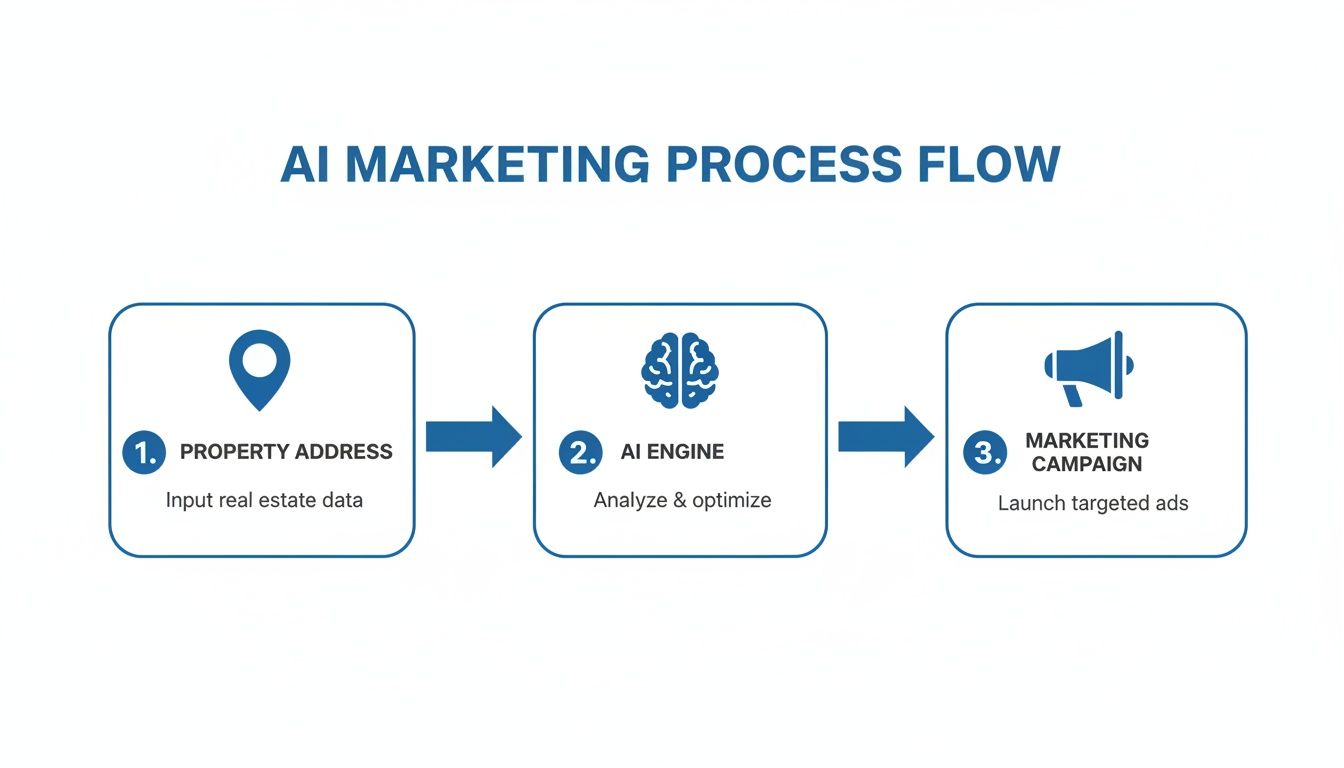
    This flow chart breaks it down perfectly. A single address goes in, the AI works its magic, and a full campaign comes out the other side.

    AI marketing process flow for real estate, showing data input, AI analysis, and targeted ad campaigns.

    The real takeaway here is the straight line from a simple input to a sophisticated, multi-channel output. It pulls you out of the most tedious parts of marketing.

    Crafting a Diverse and Engaging Content Mix

    A smart AI tool knows that a successful social media feed isn't just an endless stream of "New Listing!" posts. That gets old, fast. To keep people genuinely interested, you need variety. The goal is to build a dynamic content calendar that tells the full story of a property and, just as importantly, reinforces your expertise.

    An automated engine will generate a whole mix of content, with each piece tailored for a specific moment in that listing's journey.

    • New Listing Announcements: These are your big, flashy first impressions, designed to grab attention with the property's best features.
    • Open House Promotions: Think engaging graphics and captions that create a little FOMO (fear of missing out) and drive people to your event.
    • Price Adjustment Updates: A good AI frames a price drop not as a failure, but as a fresh opportunity for motivated buyers.
    • "Just Sold" Celebrations: This is all about social proof. These posts show off your success and build trust in your local market.
    • Neighborhood Spotlights: You’re selling a lifestyle, not just four walls. This content highlights local parks, coffee shops, and schools to paint a bigger picture.

    With a platform like ListingBooster.ai, this entire suite of content gets created from a single property link. It helps you maintain a consistent, professional, and authoritative voice across Facebook, Instagram, TikTok, and wherever else you’re active. For more ideas on building your brand, you can find a ton of great tips on the ListingBooster.ai blog.

    The Psychology Behind Scroll-Stopping Captions

    The best AI marketing tools don't just state facts; they act like seasoned copywriters. They lean on proven psychological frameworks to write captions that actually stop people from scrolling and get them to engage.

    This has nothing to do with robotic, generic text. It’s about tapping into the very real human emotions that drive big decisions, like buying a home.

    By embedding proven sales psychology directly into the content, an AI engine transforms a simple property update into a compelling call to action. It ensures your marketing resonates on an emotional level, not just an informational one.

    These systems are trained on marketing principles that have worked for decades. They know how to strategically weave these concepts into every post to get the biggest impact and inspire people to take the next step.

    Key Psychological Triggers in AI Content

    Here’s a look at how these triggers work in practice:

    Trigger How It's Used in Real Estate Marketing Example AI-Generated Post
    Scarcity Creates a sense of urgency by highlighting that the property is unique or won't be available for long. "The only home in the district with a walk-out basement under $500k. This one-of-a-kind opportunity won't last long!"
    Social Proof Builds trust by showing that others are interested or have had a positive experience. "We had over 20 groups through our open house this weekend! Don't miss your chance to see what everyone is talking about."
    Aspiration Helps buyers envision themselves living a better life in the new home. "Imagine your summer evenings spent on this beautiful patio. Your dream lifestyle is waiting at 123 Maple Street."

    By automatically baking these persuasive techniques into your posts, AI-powered real estate marketing turns your content from simple announcements into strategic assets that actually produce results. This automated engine doesn't just fill your calendar; it fills it with content that is engineered to convert, helping you build a powerful brand and a healthy sales pipeline with a fraction of the effort.

    Optimizing Listings for Both AI and Human Buyers

    Person holds a tablet displaying a house image and 'AI Optimized Listings' text, promoting real estate.

    In today's market, every property listing has two jobs. First, it has to connect with people on an emotional level, helping them picture their future in that home. But just as importantly, it needs to speak the language of algorithms, making sure it gets found by the AI systems that now power so many property searches.

    This dual focus is where you can find a huge, often overlooked, advantage. Writing a beautiful description isn't enough anymore. You have to strategically build your listings to be discoverable by people and machines, turning every property you represent into a magnet for the right audience.

    Speaking Two Languages at Once

    Think of it like this: your listing description has two completely different audiences. A human buyer is searching for a story. They want to feel the warmth of the "sun-drenched breakfast nook" or imagine hosting game night in the "spacious, open-concept living area." They respond to evocative language that paints a vivid picture.

    An AI algorithm, on the other hand, is scanning for cold, hard facts. It’s looking for structured data and specific keywords like "quartz countertops," "fenced backyard," and "three-car garage." It uses these data points to categorize the property and match it precisely to a user’s search. A truly effective AI-powered real estate marketing strategy delivers both.

    The art of modern listing optimization is crafting a narrative that captivates a human buyer while simultaneously embedding the structured data that AI search engines need to understand and recommend your property.

    Tailoring Descriptions for Every Platform

    One of the most time-consuming parts of marketing a new listing is tweaking the description for every single platform. The MLS has one character limit, Zillow has another, and an Instagram caption needs to be way shorter and punchier. Doing this manually for every property is a grind, and it often results in bland, copy-pasted text that doesn't perform well.

    This is exactly the kind of task an AI co-pilot was built for.

    • For the MLS: The AI can generate a detailed, comprehensive description loaded with all the essential features and keywords that other agents and their automated search tools are programmed to find.
    • For Zillow and Realtor.com: It whips up a more consumer-friendly version, highlighting lifestyle benefits and emotional hooks that grab the attention of buyers scrolling through the portal.
    • For Social Media: It produces short, scroll-stopping captions—complete with emojis and strong calls to action—perfectly formatted for platforms like Facebook and Instagram.

    Tools like ListingBooster.ai handle all of this automatically, generating multiple optimized versions of your description in seconds. This ensures your property looks its best on every channel, maximizing its reach without you lifting a finger. You can see more on how this works for individual agents seeking a competitive edge.

    Making Your Listings AI-Readable

    Beyond just using the right keywords, making a listing truly "AI-readable" involves something called schema markup. That might sound technical, but the idea is simple. It’s like adding invisible tags to your listing data that tell search engines like Google and ChatGPT precisely what each piece of information is.

    For example, instead of just seeing the number "3," schema markup tells the AI, "This number represents the bedroom count." This clarity helps AI systems confidently understand a property's features and serve it up to users asking specific questions like, "Show me three-bedroom homes with a pool near downtown."

    This structured approach is becoming crucial as the real estate AI market is projected to surge from $222.65 billion in 2024 to $303.06 billion in 2025, with AI expected to automate around 37% of industry tasks. By making your listings AI-readable now, you're positioning them to be found in this new search environment, giving yourself a distinct and lasting advantage.

    How to Scale Your Brokerage and Stay Compliant with AI

    As a real estate team or brokerage grows, a huge challenge surfaces. How do you keep your brand voice consistent and your marketing legally buttoned-up when dozens—or even hundreds—of agents are all creating their own content? This is exactly where AI-powered real estate marketing stops being just a cool productivity hack and becomes a critical tool for running the business.

    Left to their own devices, individual agents will naturally develop their own styles. That can lead to off-brand social media posts, wildly different messaging, and visuals that just don't meet the brokerage's standards. Over time, this erodes the brand you've worked so hard to build, making the whole operation look fragmented and less professional.

    Creating One Unified Voice for Your Entire Team

    Think of an AI platform as your central brand guardian. It’s a place where brokerage leadership can set up pre-approved templates, lock in a specific tone of voice, and make sure every single piece of marketing—from a just-listed post to a quarterly market report—sticks to the company playbook.

    This solves a massive operational headache. Instead of a manager having to manually review every agent's content or clean up the mess from a bad graphic, you empower the entire team with a tool that builds quality in from the start. Agents get to use professional-grade marketing assets, and the brokerage protects its identity, no matter how big it gets.

    This isn't about stifling creativity. It’s about giving every agent a professional framework that makes all of their marketing better. It means every agent, no matter their design experience, represents the brokerage with polish and authority.

    Automated Compliance That Manages Your Risk

    Branding is one thing, but the most important job AI can do for a brokerage is automate compliance. The risk of an agent accidentally violating Fair Housing laws with a poorly worded ad is a massive legal and financial liability. For any growing brokerage, trying to manually police every single caption and property description is a fool's errand.

    A smart AI marketing engine has compliance built right into its DNA. Before any content ever sees the light of day, the system automatically scans it for words and phrases that could be flagged as discriminatory or violate Fair Housing rules.

    This built-in check is constantly on the lookout for language that might suggest a preference or limitation based on protected classes, such as:

    • Familial Status: Catching phrases like "perfect for singles" or "no kids allowed."
    • Race or National Origin: Flagging any descriptions of a neighborhood's demographics.
    • Religion: Making sure that mentioning a nearby church or temple doesn't imply a religious preference.
    • Disability: Avoiding problematic terms like "not handicap accessible" in public-facing copy.

    This automated safety net completely changes the game for risk management. It turns AI-powered real estate marketing from a simple content tool into a powerful compliance engine that protects the brokerage from expensive lawsuits and damage to its reputation.

    For any organization ready to give their agents these kinds of safeguards, checking out the team options in a ListingBooster.ai pricing plan is the clear next move. It’s how you get enterprise-level protection that actually works for teams of any size.

    What Comes Next: Predictive and Agentic AI

    The AI tools making waves in real estate right now are mostly about generation—they're fantastic at writing property descriptions, drafting social media posts, and building marketing plans. That’s a huge time-saver, but it's really just the first inning of a whole new ballgame. The next leap forward is moving from creating content to autonomously performing tasks.

    Welcome to the world of predictive and agentic AI. Don't think of this as just a smarter writing assistant. Think of it as a junior agent who works around the clock, 24/7, without ever needing a coffee break.

    The Shift from Reactive to Proactive Marketing

    This jump from generative to agentic AI completely flips the script on how we approach marketing. For decades, our marketing has been reactive: you get a new listing, so you create a campaign for it. Agentic AI makes marketing proactive by figuring out what you need before you even know you need it.

    Imagine an AI that doesn't just write a "Just Listed!" post. Instead, it analyzes local market data and predicts the exact price point that will attract the most qualified buyers before the listing even goes live. Better yet, it could scan your CRM, find potential buyers who’ve looked at similar homes in the past, and have a targeted email campaign ready for your approval.

    This is the future of AI-powered real estate marketing—it’s not just about announcing what’s for sale. It’s about predicting who wants it and automatically reaching out to them. You're always two steps ahead of the market.

    Meet Your Future AI Agent

    The "agentic" part of agentic AI means the system can handle complex, multi-step jobs all by itself. For a real estate agent, this means handing off those time-sucking workflows that bog you down every day.

    Research from Gartner suggests that by 2028, approximately 15% of day-to-day work decisions could be made by AI agents. What does that actually look like? An AI could have a text conversation with a new lead to qualify them, automatically update their profile in your CRM, and even schedule a showing on an open slot in your calendar—all without you lifting a finger. You can get a deeper look into how AI will reshape the industry and what it means for your business.

    This might sound like something out of a sci-fi movie, but it’s the logical next step from where we are today. Every time you use a tool like ListingBooster.ai to whip up a social media calendar or tweak an MLS description, you're building the skills and trust needed for this next phase. Getting comfortable with today's AI is how you prepare to take full advantage of tomorrow's truly autonomous assistants.

    Frequently Asked Questions

    Jumping into AI-powered marketing brings up a lot of good questions. Agents I talk to are usually curious about how authentic it feels, how hard it is to learn, and—let's be honest—what it means for their jobs. Let's tackle these head-on.

    Does AI-Generated Content Feel Authentic?

    It does, but only if you think of it as a creative partner, not a robot doing your job for you. A smart AI tool acts like a skilled assistant, giving you a solid first draft built on marketing principles that actually work.

    Your job is to take that draft and inject your personality and local market knowledge into it. This whole process takes seconds, not hours. You’re not replacing your voice; you’re just getting a massive head start and skipping the blank page altogether.

    How Long Does It Take to Get Started?

    You can be up and running in the time it takes to grab a coffee. Seriously. Today's best platforms are built for busy agents, not software developers. The initial setup usually takes just 5-10 minutes.

    Just paste in a property URL or a few details, and the system can generate everything from social media posts to compelling MLS descriptions almost instantly. The design is so intuitive that you’ll feel like a pro from day one.

    Will AI Marketing Replace Real Estate Agents?

    Nope. AI won't replace agents, but agents who use AI are absolutely going to have an edge over those who don't. Think about it: these tools automate the tedious, soul-crushing parts of marketing—writing endless social posts, analyzing data—so you can focus on what you’re truly great at.

    AI is here to make you a better agent, not an obsolete one. It frees up your time so you can be out there building relationships, negotiating deals, and being the go-to expert your clients need.

    This isn't about replacement; it's about elevation. You get to operate at a higher level, focusing on the high-impact activities that actually close deals and build your reputation.

    Is AI Marketing Technology Affordable?

    Absolutely. Top-tier AI marketing tools are surprisingly budget-friendly. Many platforms start at a price that’s a tiny fraction of what you’d pay for a virtual assistant or social media manager—some plans are as low as $35 per month.

    Most even offer a free trial, so you can see the results for yourself without any risk. This really levels the playing field, giving every agent access to the kind of powerful marketing technology that was once reserved for the biggest brokerages.


    Ready to stop wasting time on marketing and start focusing on what you do best? With ListingBooster.ai, you can generate a complete 30-day marketing campaign in minutes. Start your free trial today and see how easy it is to build your brand and win more listings.

  • Your Guide to Real Estate Listing Marketing Software

    Your Guide to Real Estate Listing Marketing Software

    If you’ve ever felt like you’re spending more time playing marketing coordinator than real estate agent, you’re not alone. The hours spent writing property descriptions, designing flyers, and mapping out a social media plan for each new listing add up fast.

    That’s where real estate listing marketing software comes in. Think of it as your dedicated marketing engine, built specifically to tackle the mountain of prep work that comes before a home hits the market. It’s a specialized toolkit that turns hours of tedious manual tasks into just a few clicks.

    Understanding Your New Marketing Engine

    A modern workspace with a laptop showing a house, a pen, notebook, phone, and 'LISTING TOOLKIT' text.

    So, what exactly is this software? While your CRM is all about managing your client relationships, listing marketing software is laser-focused on the property itself. Its entire purpose is to help you win the listing and then promote it effectively.

    Instead of staring at a blank screen trying to find the perfect words, you can generate a compelling, MLS-compliant property description in seconds. Rather than guessing what to post on Facebook, you get a complete content calendar tailored to your new listing. This completely flips the script, moving you from a content creator to a strategic director, freeing you up to do what you do best: serve your clients and close deals.

    From Manual Grind to Automated Edge

    The core idea is to give you speed, polish, and a serious competitive advantage. The software pulls together property data, market trends, and even your own branding to generate a full-blown marketing kit. Imagine walking into a listing appointment not just with a CMA, but with tangible, professional marketing assets that show sellers you mean business.

    This isn’t just a niche tool; it’s where the industry is heading. The global market for real estate marketing automation software hit USD 1.12 billion in 2024 and is on track to reach USD 4.26 billion by 2034. This explosive growth signals a massive shift towards platforms like ListingBooster.ai that empower agents to work smarter. You can dive deeper into the numbers in this full research report.

    The whole point is to turn hours of prep into minutes of production. It’s about spending less time behind a keyboard and more time in front of sellers, demonstrating your value.

    The shift from the old way of doing things to a software-powered approach is night and day. Let's break down the difference.

    Traditional vs Software-Powered Listing Prep

    Marketing Task Traditional Method (Time & Effort) Software-Powered Method (Time & Effort)
    Property Description 1-2 hours: Manual writing, editing, and ensuring MLS compliance. 5 minutes: AI-generated drafts, with options for different tones and lengths.
    Social Media Plan 2-3 hours: Brainstorming posts, finding images, scheduling for multiple platforms. 10 minutes: Auto-generated, multi-week content calendar with copy and images ready to go.
    Flyer/Brochure Design 1-3 hours: Fiddling with templates in Canva or hiring a designer. 5 minutes: Professionally designed, brand-consistent templates auto-filled with property info.
    Competitive Analysis 1 hour+: Manually pulling comps and summarizing market position. 15 minutes: Automated report showing how the property stacks up against the competition.

    As you can see, the time savings are massive, allowing agents to focus on high-value activities instead of getting bogged down in administrative work.

    How It Works in Practice

    At its core, this software is about two things: preparation and presentation. It gives you a structured workflow to make sure every listing you go after is backed by a solid, data-driven marketing plan.

    Here’s what’s happening under the hood:

    • Data Aggregation: It starts by pulling all the essential property details, photos, and local market data from just an address.
    • Content Generation: It uses AI to write unique property descriptions, engaging social media posts, and persuasive email copy.
    • Asset Creation: It instantly produces print-ready flyers, detailed reports, and polished digital presentations.
    • Strategic Planning: It helps you build out a competitive analysis and a week-by-week marketing timeline.

    Ultimately, real estate listing marketing software gives you a powerful, immediate answer to a seller’s most important question: "How will you market my home better than anyone else?" By arming you with impressive, customized marketing materials on the spot, it helps you win the listing before you even walk out the door.

    Core Features That Help You Win Listings

    Laptop displaying real estate listings with marketing cards and a 'Win More Listings' banner on a desk.

    The best real estate listing marketing software isn't just about shaving a few minutes off your day. It’s about walking into a listing appointment armed with an entire marketing arsenal designed to wow sellers and lock down the contract. These platforms are built to address a seller's biggest questions head-on: "How will you make my home stand out?" and "What's your plan?"

    At their core, these tools let you generate impressive, client-facing materials on the spot. You stop telling sellers what you’re going to do and start showing them exactly what your high-end marketing looks like, right then and there.

    AI Property Descriptions

    Let's face it: writing compelling property descriptions is a chore. It takes creativity, time, and a knack for storytelling. AI description generators completely change the game. In a matter of seconds, they can spin up captivating narratives that put a home’s best features in the spotlight.

    But it’s not just about speed. A good tool crafts multiple versions of the description, each one tailored for different platforms—one for the character-limited MLS, another for Zillow, and a different angle for Realtor.com. This ensures your listing's story resonates with buyers wherever they're looking, all while keeping the language compliant with Fair Housing laws.

    Deployable Social Media Calendars

    Imagine sitting down with a potential seller and handing them a complete, multi-week social media plan for their property. That’s the power of a built-in social media calendar feature.

    Instead of just promising to post on Facebook, you can present a detailed, day-by-day schedule showing exactly what you’ll do. This isn't a vague promise; it's a concrete plan.

    • "Just Listed" announcements ready to go with professional graphics.
    • Feature highlights that call out the renovated kitchen or the perfect backyard for entertaining.
    • "Open House" reminders and engaging follow-up posts.
    • Neighborhood spotlights that sell the lifestyle, not just the house.

    This simple feature transforms your entire pitch. You’re no longer just an agent who says they’ll market the home; you’re the agent who showed up with the marketing plan already done.

    You’re not just selling a service; you’re selling confidence. When you can hand a seller a detailed 30-day marketing plan, it proves you are prepared, professional, and ready to execute from day one.

    This is the kind of preparation that drives growth in the U.S. real estate software market, which was valued at USD 2.45 billion in 2022 and is expected to hit USD 5.10 billion by 2030. It's no surprise the agent segment is projected to grow fastest at a 10.9% CAGR, fueled by tools that make marketing and client service more efficient. You can dive deeper into these trends in this market report.

    Competitive Analysis Tools

    Gut feelings don't win listings, but solid data does. A competitive analysis feature is your secret weapon for pricing conversations. It pulls real-time, hyper-local market data to show sellers exactly how their property compares to others on the market right now.

    This isn't a clunky spreadsheet. It’s a clean, easy-to-read report that backs up your pricing strategy with hard evidence, instantly positioning you as the local market expert who came prepared.

    Print and Export Assets

    Finally, you never want to leave a listing appointment empty-handed. Top-tier real estate listing marketing software lets you instantly print or export professional-grade materials like property flyers, market reports, and your marketing plan summary.

    Leaving behind these tangible, high-quality documents keeps you and your modern approach top-of-mind long after you’ve walked out the door. It’s that final, professional touch that helps you stand out and win the business.

    How This Software Gives Agents and Teams an Unfair Advantage

    The real magic of real estate listing marketing software isn't just about the cool features—it's about the leverage it gives you. It turns a bunch of powerful tools into real-world advantages that change how you compete and win listings. It’s the difference between always playing catch-up and finally getting ahead of the game.

    For a solo agent, this kind of software is the great equalizer. Suddenly, you can churn out marketing materials that look like they came from a big brokerage with an entire marketing department. No more choosing between prepping for a listing presentation and actually being out there with clients. You can do both, and your marketing will look sharp every single time, which is huge for building trust.

    This levels the playing field completely. You can walk into any listing appointment with the same polished, data-backed assets that the top producers in your market use.

    Scaling Consistency for Teams

    For teams and boutique brokerages, the biggest win is consistency. When every agent is working from the same playbook—the same software—every single listing presentation, social media post, and flyer reflects your team's brand and quality standards. It kills the wild-west marketing approach where every agent does their own thing.

    This means a brand new agent can present just as professionally as a 20-year veteran. It makes training new hires a breeze and allows you to scale your team without sacrificing the quality of your marketing. As you grow, your marketing muscle grows right with you.

    The core advantage here is flipping the switch from reactive to proactive marketing. You can have a complete promotional campaign ready to launch the second a listing agreement is signed. This shows sellers you mean business and builds a reputation for getting things done—fast.

    The Differentiator for Top Producers

    In a cutthroat market, top producers stay on top by standing out. When every agent is promising the same great service, real estate listing marketing software is your proof. It lets you walk the walk with a modern, tech-savvy approach that your competitors can only talk about.

    This isn't just about saving a few hours. It’s about showing off a superior process. When you can pull up an AI-generated social media calendar or a deep-dive market analysis right in the living room, you instantly look leagues ahead of the agent who showed up with a printed Zillow estimate. You’re not just selling a house; you’re selling a sophisticated marketing engine.

    By exploring the benefits for agents in detail, you can see how this kind of tool helps at every stage of an agent's career. This proactive approach shows sellers you're ready to hit the ground running, making them confident they chose the right person for the job.

    Choosing the Right Listing Marketing Software

    Picking the right real estate listing marketing software isn't just about chasing the platform with the longest feature list. It’s more like choosing a key business partner. You’re looking for something that fits seamlessly into how you already work, protects your license, and gives you a real, measurable return.

    Get this decision right, and the software becomes a powerful secret weapon in your listing presentations. Get it wrong, and you're stuck with wasted time, subscription fees, and a tool that just gathers dust. The best software makes you faster and more effective right out of the box.

    Start with the Must-Haves: Compliance and Data Accuracy

    Before you get dazzled by AI features or fancy templates, your first filter should always be compliance. In our industry, a single mistake can have serious consequences. Your software needs to be your shield, not a liability.

    • MLS & Fair Housing Compliance: This is the big one. The platform absolutely must generate property descriptions and marketing materials that follow all MLS rules and Fair Housing laws to the letter. Any tool that spits out biased or non-compliant language is a direct threat to your license.

    • Accurate Data: The software's market analysis and property details have to be spot-on. If it pulls outdated or just plain wrong information, your credibility with sellers is shot before you even get started.

    Your software is more than a marketing gadget; it’s a direct reflection of your professional standards. If it doesn't bake in compliance with regulations like Fair Housing, it's not worth your time—no matter how cool its features seem.

    Is Your Marketing Ready for What's Next?

    Today's marketing needs to perform on more than just the Zillows and social media platforms of the world. Search is changing fast, and your software should be keeping up.

    This is where an AI & SEO readiness check comes in. You need a tool that creates listing content optimized for how people actually find homes now—which includes traditional search engines like Google and new AI-powered platforms like ChatGPT. Being able to explain this forward-thinking approach to sellers shows them you're not just another agent; you're ahead of the curve.

    A Quick Evaluation Checklist

    To help you cut through the noise, here's a quick checklist you can use when comparing different platforms. Think of it as your cheat sheet for making a smart decision.

    Evaluation Checklist for Listing Software

    Feature/Consideration Importance Level What to Look For
    MLS Compliance Critical Explicit guarantees that all generated content meets local MLS rules.
    Fair Housing Adherence Critical Built-in filters and AI training to avoid discriminatory language.
    AI/SEO Readiness High Content is optimized for both traditional and conversational search.
    Data Accuracy High Direct, reliable data feeds for comps and property details.
    Onboarding Time Medium Can you be up and running in minutes, not days? Is it intuitive?
    Transparent Pricing Medium Clear, flat-rate subscription models. Avoid confusing credit systems.
    Free Trial Availability High A "try before you buy" option to ensure it fits your workflow.

    This table isn't exhaustive, but it covers the non-negotiables. Nail these points, and you'll be well on your way to finding a tool that genuinely helps you win more listings.

    Don't Overlook Practicality and Price

    Finally, the most advanced tool in the world is useless if you never use it. A clunky interface or confusing pricing structure can stop you in your tracks.

    • Onboarding Time: How fast can you go from signing up to creating your first complete listing kit? The answer should be minutes. A great tool feels like an old friend from the moment you log in—it just makes sense.

    • Pricing Models: Look for simple, transparent subscription plans. Platforms with hidden fees or weird credit systems are an immediate red flag. A free trial is also a must, as it lets you see the value for yourself before you pull out your credit card. You should be able to look at a clear pricing page and immediately understand which plan works for your business.

    Putting Your Software Into Action

    Let's walk through what this looks like in the real world. Forget theory for a moment and imagine how real estate listing marketing software actually changes your day-to-day. The moment a potential seller calls you for a listing appointment, the race begins. The old way meant scrambling for hours—pulling comps, wrestling with a CMA, and maybe hastily designing a basic flyer.

    Now, with the right platform, that entire frantic process gets an upgrade. Picture this instead: you get the call, and your only job is to plug the property's address into your software. In that single step, you’re not just prepping for a meeting; you're building a complete, knockout presentation kit.

    From A Single Address To A Full Presentation

    In less than ten minutes, the software does the heavy lifting and hands you a full suite of marketing materials. This isn't just a simple data sheet. It’s a polished, professional package that instantly shows the seller you’re operating on a different level than your competition.

    So, what’s in this instant marketing kit?

    • A Hyper-Local Market Analysis: Think of it as a CMA on steroids. It goes deeper, showing exactly how their home compares to the active competition with compelling visuals and hard data.
    • A Detailed 30-Day Social Media Schedule: You’re not just promising to post on social media; you’re showing them a tangible, day-by-day plan to create buzz and get buyers excited.
    • Professionally Designed Handouts: These aren't your typical templates. They're print-ready materials that clearly explain your modern marketing strategy, including how you use AI to get their listing seen.

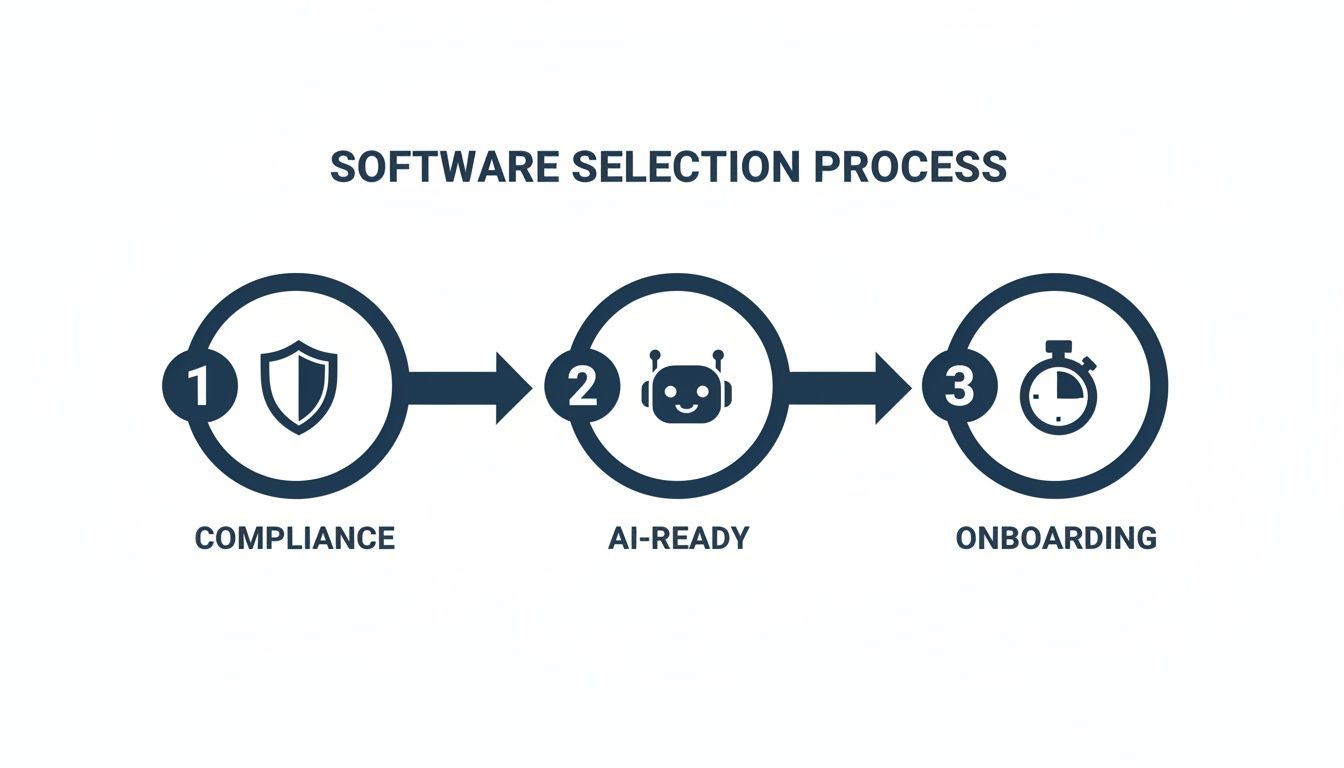
    This simple three-step infographic breaks down the essential criteria for choosing a platform that can deliver these kinds of results.

    Three-step software selection process infographic with icons for compliance, AI-ready, and onboarding.

    As you can see, the foundation is built on compliance and AI readiness—the core ingredients for a tool that truly works—before you even think about how quickly you can get it up and running.

    Changing the Conversation at the Listing Table

    When you walk into a listing appointment armed with this kit, your confidence is through the roof, and the entire vibe of the meeting changes. The conversation pivots away from a defensive haggle over commission and becomes an exciting discussion about the incredible value you bring. You’re not just telling them you have a killer marketing plan; you’re physically handing it to them.

    This simple act changes everything. You can confidently explain how your strategy will get their home maximum exposure, and you have the printed proof right there in their hands. It tells a powerful story that makes it incredibly easy for the seller to see you as the only logical choice.

    When you can show a seller a complete marketing plan before they’ve even signed the listing agreement, you’ve already won. You’re no longer just another agent; you are a marketing expert who came prepared to execute.

    This level of preparation is why so many agents are making the switch. In fact, 75% of pros who use these tools report higher client engagement. For team leads and broker-owners, it can slash pitch prep time by a staggering 80%. And as AI-driven search becomes the norm—with nearly 90% of home searches now happening on mobile or AI-powered platforms—having optimized content is non-negotiable. You can learn more about the commercial real estate software market and its explosive growth to see where things are headed.

    By demonstrating your modern approach right from the start, you effectively pre-sell your expertise and make the decision to hire you an easy one.

    Common Questions About Listing Marketing Software

    Whenever you're thinking about adding a new tool to your tech stack, it's natural to have a few questions. When it comes to real estate listing marketing software, most agents are wondering the same things: Will this really save me time? Is it compliant? And will it actually help me win more business?

    Let’s tackle some of the most common questions head-on so you can see if this kind of platform is right for you.

    One of the first things agents ask is about compliance. It’s a huge deal. "Will the AI get me in trouble?" is a question I hear all the time. A good platform is built from the ground up with compliance in mind. It’s not just a generic AI writer; it's trained specifically on Fair Housing laws and local MLS regulations to ensure every property description and ad it creates protects your license, not risks it.

    Another frequent question is whether this kind of software is meant to replace your CRM. The short answer is no—it's designed to work alongside it. Your CRM is your command center for client relationships and deal flow. Listing marketing software is a highly specialized tool for one critical part of your business: winning the listing and marketing the property effectively. Think of it as your pre-listing secret weapon.

    How Much Time Does It Really Save?

    This is where the rubber meets the road. Agents are rightfully skeptical if the time spent learning a new tool will outweigh the benefits. But a well-built platform can generate a full marketing plan from just a property address in less than 10 minutes.

    Let’s break down what you’re probably doing manually right now:

    • Writing Property Descriptions: At least 1-2 hours of agonizing over every word.
    • Creating a Social Media Plan: Another 2-3 hours of brainstorming posts and scheduling them.
    • Designing a "Just Listed" Flyer: 1+ hours wrestling with a clunky design program.

    This software takes those repetitive, time-sucking tasks off your plate entirely. You get back hours on every single listing, freeing you up to focus on what you do best—building relationships and closing deals.

    Is This Software Difficult to Learn?

    Nobody wants to spend weeks learning a complicated new system. The best listing marketing platforms are built for busy agents, not tech wizards. The whole point is to make your life easier, not harder.

    You should be able to log in and create your first complete, professional marketing presentation within minutes. It’s designed to be intuitive so you can get in, get what you need, and get back to your clients.

    For more deep dives into content strategy and winning listings, the ListingBooster.ai blog is packed with practical advice. It's a great spot to find new ideas.


    Ready to walk into every listing appointment with a marketing presentation that blows the competition away? ListingBooster.ai creates a complete, professional marketing kit in minutes, giving you the confidence and the edge you need to win. Start your 30-day free trial today!