Tag: AI search optimization

  • How to Optimize Listing Descriptions for AI Search: A Guide

    How to Optimize Listing Descriptions for AI Search: A Guide

    More buyers are starting their home search inside AI tools, not just on portals or Google. Over 40% of homebuyers now initiate searches on platforms where AI can extract and surface individual paragraphs from your content (Olive & Company). That changes the job of a listing description.

    The old model was simple. Stuff in the beds, baths, square footage, maybe a few adjectives, then hope the photos do the rest. That still fills a box in the MLS. It does not reliably help your listing get cited, summarized, or recommended by ChatGPT, Google AI, or Perplexity.

    If you want to know how to optimize listing descriptions for ai search, think less like a copywriter chasing flair and more like an operator building clean inputs for a recommendation engine. Your description has to do three things at once. It has to answer buyer intent, survive machine parsing, and stay compliant.

    The New Search Paradigm Your Listings Must Conquer

    AI recommendation engines reward listings that can be quoted cleanly. If a paragraph cannot stand on its own, it is less likely to be surfaced, summarized, or cited in tools like ChatGPT, Google AI, and Perplexity.

    A digital artistic representation of a neural network or neuron structure with a bright blue background.

    Why old listing copy disappears

    Agents still publish descriptions loaded with filler. “Welcome home.” “Stunning gem.” “Must see.” Those phrases waste the most valuable real estate in the listing, which is the first sentence and first paragraph.

    AI systems often evaluate content in chunks. A single extracted paragraph may be judged without the headline, photo gallery, or the rest of the description around it. If that paragraph opens with generic language and delays the actual value, the system has very little to work with.

    That changes how strong listing copy is built.

    Each paragraph should answer a buyer question directly. Each sentence should clarify a feature, a use case, or a location benefit. In practice, I treat every paragraph like a standalone response block that could be lifted into an AI-generated answer without needing cleanup.

    Practical rule: Copy one paragraph from the listing into ChatGPT by itself. If it still reads like a clear answer to a buyer need, the structure is working.

    Search has shifted from matching words to matching usable answers

    Traditional search indexed pages and matched phrases. AI search systems try to assemble the best answer from multiple sources, which means your description needs passages that are easy to extract and easy to trust.

    Agents who want the technical framing should understand how AEO differs from SEO. SEO helps a page rank. AEO helps a specific section of text get selected as an answer. Listing descriptions now have to do both.

    Here is the difference in day-to-day writing:

    Old listing mindset AI search mindset
    Write one flowing block of copy Write self-contained paragraphs
    Open with flair Open with the clearest buyer value
    List features Connect features to buyer outcomes
    Fill the MLS field Create text that AI can extract and reuse

    What strong AI-readable copy actually looks like

    The goal is not clever prose. The goal is explicit meaning.

    A flex room should not stay a flex room in the copy if the likely buyer intent is remote work, guests, hobbies, or a nursery. A covered patio should not sit there as a bare feature if it provides easy outdoor dining or low-maintenance hosting. Good AI-facing descriptions make that translation obvious.

    Here is a simple example:

    • Feature: south-facing backyard

    • Buyer meaning: more natural light and better daytime use

    • AI-readable phrasing: “The south-facing backyard offers a bright outdoor area that works well for gardening, casual dining, and weekend play.”

    • Feature: split-bedroom layout

    • Buyer meaning: more privacy between the primary suite and secondary rooms

    • AI-readable phrasing: “The split-bedroom layout places the primary suite away from the secondary bedrooms, which suits buyers who want added privacy or a quieter guest setup.”

    This is also where a system helps. I use ListingBooster.ai to structure copy into clean, buyer-intent-driven sections and keep the language compliant, especially when I want repeatable output across a full pipeline. If you want the specific real estate framework behind that process, review this guide on AI search optimization for real estate agents.

    The competitive gap is widening

    Agents who keep writing vague, flowery descriptions are making AI retrieval harder than it needs to be. The listing may still exist in the MLS, but it gives recommendation engines weak material to work with.

    Agents who write modular, specific, high-signal copy have an edge. Their listings are easier to quote, easier to summarize, and easier to recommend. That is the significant shift in search behavior, and it rewards agents who treat listing descriptions like structured inputs instead of filler text.

    Mapping Buyer Intent to AI-Readable Keywords

    Most agents start with property facts. That's fine, but facts alone don't create AI visibility. You need to map facts to the language buyers use when they ask conversational questions.

    Amazon's AI-driven search offers a useful clue here. In that environment, AI-generated content can include natural phrases like “ideal for outdoor activities in warm climates,” which may not show up in traditional keyword tools but still match real customer queries (Helium 10). Real estate works the same way.

    Build a concept library before you write

    Before drafting the description, create a simple concept library for the listing. This isn't a keyword dump. It's a translation sheet between the home and buyer intent.

    Use four columns:

    Property fact Buyer problem solved Natural-language query Phrase to use in copy
    Bonus room Needs workspace home with office space dedicated flex room for a home office
    Fenced yard Wants privacy for kids or dogs yard for pets or play fenced backyard with room for pets and play
    Walkable location Wants convenience home near shops and dining close to local dining, errands, and daily conveniences
    Covered patio Wants easy hosting home with outdoor entertaining covered patio for casual outdoor dining and entertaining

    This exercise changes how you write. Instead of listing features in isolation, you start framing them as answers.

    Think in buyer questions, not just keywords

    A lot of agents still optimize for phrases like “4 bedroom home in North Austin.” That's not wrong. It's incomplete. Buyers using AI ask layered questions that combine lifestyle, layout, budget sensitivity, commute, family needs, and emotional triggers.

    I like to pressure-test a listing with queries like these:

    • Lifestyle query: What kind of buyer would love this home?
    • Pain-point query: What problem does this floor plan solve?
    • Decision query: Why would someone choose this over similar homes nearby?
    • Neighborhood query: What daily routines does this location make easier?
    • Emotional query: What would it feel like to live here on a normal Tuesday?

    Those questions produce stronger raw material than a spreadsheet of search terms.

    If your description can't answer a buyer's spoken question, it's probably over-indexed on features and under-built for AI discovery.

    Separate head terms from intent phrases

    You still need core property language. Beds, baths, neighborhood, school district references where compliant, lot style, and major amenities all matter. But those are only one layer.

    A better system uses two buckets.

    Core discovery terms

    These are the obvious terms buyers and portals expect:

    • Location markers: neighborhood, city, nearby districts, landmark areas
    • Property type terms: condo, townhome, single-story, custom home
    • Structural features: primary suite, open-concept kitchen, guest room, updated bath

    Intent phrases

    These are the phrases buyers naturally use in AI prompts:

    • Daily-life language: easy commute, work-from-home setup, low-maintenance yard
    • Use-case language: space for hosting, room for multigenerational living, lock-and-leave convenience
    • Emotional framing: bright and calming, private retreat, flexible layout for changing needs

    One reason this works is that AI can match plain-language descriptions to broader queries more effectively than rigid keyword strings alone. If you've ever studied social content discovery, some of the same principles show up in 2024 carousel keyword strategies, where context and user intent matter as much as direct phrase matching.

    A field-ready framework agents can use fast

    When I build listing copy, I reduce the home to five intent layers:

    1. Who is this home for
      First-time buyers, move-up families, investors, downsizers, remote professionals, second-home buyers.

    2. What problem does it solve
      Lack of workspace, cramped entertaining, no private outdoor area, long commute friction, too much maintenance.

    3. What moments does it enable
      Quiet morning coffee, weekend hosting, easy school mornings, separate guest stays, simple lock-and-leave travel.

    4. What proof supports that claim
      Split floor plan, oversized island, fenced yard, dedicated office, attached garage, covered patio, walkability.

    5. What language would a buyer use
      Not “resort-style sanctuary.” More like “private backyard with room to relax and host friends.”

    This process gives you a bank of AI-readable phrases before writing starts. Once you've done it a few times, it becomes automatic.

    The Anatomy of a Perfect AI-Optimized Listing

    AI-ready descriptions win on structure. Length only helps when each section gives a recommendation engine a clear, self-contained answer it can quote, summarize, or rank.

    A diagram illustrating the five key elements required for creating an effective, AI-optimized product or service listing.

    Semrush’s analysis of AI search optimization patterns points in the same direction. Compact sections tend to perform better in AI-generated results than thin fragments or oversized blocks (Semrush). For agents, the practical takeaway is simple. Build short sections that fully explain one idea.

    Open with the clearest buyer match

    The first sentence has a job. It should tell AI and the buyer what kind of home this is, who it fits, and why it matters.

    Weak opening:
    “Welcome to this beautifully maintained home with charm and character.”

    Stronger opening:
    “This updated single-story home offers a flexible layout, private backyard, and dedicated office for buyers who want comfort, convenience, and work-from-home function.”

    That sentence gives AI usable signals immediately. Property type, layout benefit, outdoor value, workspace, and buyer fit.

    Add a tight summary that can stand alone

    The second block should work even if an AI system lifts only those two sentences into a recommendation. I write this section like a mini pitch, not a warm-up paragraph.

    A strong summary does three things:

    • Defines the fit: who is likely to care
    • Surfaces the main differentiators: what makes the home easier to remember
    • Connects the location to daily life: what convenience looks like in practice

    Example:
    “This home pairs an open main living area with a separated bedroom layout and quick access to shopping and commuter routes. Buyers looking for functional indoor-outdoor living will notice the covered patio, fenced yard, and kitchen that connects directly to the main gathering space.”

    That kind of paragraph holds up on its own. That matters because AI systems often extract and recombine sections instead of presenting the whole listing word for word.

    Build the body in complete thought units

    Many listing descriptions still fail for one reason. The copy either runs as one long paragraph or breaks into a pile of disconnected phrases. Neither format gives AI much confidence.

    Each paragraph should cover one topic completely.

    Layout and livability

    Explain how the floor plan works in real life.

    Example:
    “The split-bedroom layout gives the primary suite more privacy from the secondary bedrooms. A separate flex room near the front of the home works well as an office, study area, or guest overflow space, giving buyers options as needs change.”

    Kitchen and gathering space

    Connect finishes and layout to actual use.

    Example:
    “The kitchen opens to the main living and dining areas, making it easier to cook while staying connected to family or guests. An oversized island adds prep space, casual seating, and a natural center point for everyday routines.”

    Outdoor function

    State what the exterior enables.

    Example:
    “The fenced backyard creates usable space for pets, play, or weekend hosting. A covered patio adds shade and makes outdoor dining more practical during warmer months.”

    I use a simple standard here. If ChatGPT quoted one paragraph without the rest of the listing, that paragraph should still make sense.

    Use a scannable feature block after the prose

    Structured copy helps both readers and machines. After the narrative sections, add grouped bullets that separate major categories instead of dumping every feature into one line.

    • Interior highlights: open-concept living area, dedicated flex room, updated lighting, generous storage
    • Outdoor features: fenced yard, covered patio, low-maintenance landscaping
    • Location advantages: access to major routes, close to everyday shopping, convenient to dining and services

    This format creates cleaner boundaries between topics. It also makes the listing easier to reuse across MLS remarks, portal descriptions, brokerage sites, and AI summaries.

    Follow a repeatable template

    Here’s the format I use when I want descriptions to perform across search, recommendations, and portal scan behavior:

    Component Goal Writing note
    Opening sentence Match buyer intent fast Lead with the best-fit use case
    Summary block Explain value quickly Keep it specific and benefit-driven
    Paragraph 1 Clarify layout Complete one idea
    Paragraph 2 Explain kitchen and living flow Complete one idea
    Paragraph 3 Show outdoor and daily-life value Complete one idea
    Feature list Improve scan speed Group bullets by category

    If speed matters, use a structured drafting workflow instead of starting from zero. This guide to an AI property description writer for MLS listings shows how agents are turning property inputs into organized drafts they can edit for accuracy, positioning, and compliance.

    Cut the patterns that weaken AI extraction

    A few habits drag listing quality down fast:

    • Adjective stacking: “stunning, charming, beautiful, immaculate” adds fluff without meaning
    • Feature dumping: long upgrade lists with no buyer context
    • Dependent paragraphs: sections that only make sense if the previous paragraph was read first
    • Oversized blocks: dense copy lowers readability and weakens extraction
    • Generic luxury language: phrases like “must-see masterpiece” without specific proof

    The strongest AI-optimized listing reads clean because every sentence does a job. Clear structure improves generation, extraction, and measurement later. That is the difference between writing copy that sounds good and writing copy that gets surfaced.

    Leverage Advanced Tactics Schema Prompts and Compliance

    Once your copy structure is right, the technical layer starts to matter. Many agents, however, cease their efforts too soon. They think a polished paragraph is the whole game. It isn't.

    A conceptual graphic illustration of data streams converging into a central metallic sphere labeled Schema for AI.

    Schema markup completeness carries significant weight in AI recommendation systems. Authoritative list mentions account for about 41% of AI recommendation weight, and precise markup such as LocalBusiness and Organization performs better than generic schema (First Page Sage). For agents, the takeaway is simple. If AI can't confidently understand who you are, what the listing is, and how those entities connect, your visibility ceiling stays lower.

    Think of schema as an AI cheat sheet

    Schema tells machines what a page contains in an explicit, structured format. Instead of hoping an AI system infers that your site page is a listing, that you are the agent, and that your brokerage is the organization behind it, schema states those relationships directly.

    For a real estate marketing stack, the most practical schema categories are:

    • Organization schema: brokerage or team identity
    • LocalBusiness schema: local service presence and agent credibility signals
    • Article schema: neighborhood guides, market updates, and supporting content
    • HowTo schema: buyer guides, prep checklists, or local area walk-through content

    The key isn't just adding schema. It's using specific schema with clear relationships, unique identifiers, and consistent entity naming.

    Prompting matters more than most agents realize

    If you're using AI to draft listing descriptions, your prompt quality controls the output quality. Vague prompts produce vague copy. Good prompts produce modular, buyer-intent-rich descriptions you can use.

    Try prompt instructions like these:

    Generate a listing description in short standalone paragraphs. Each paragraph should answer one buyer concern clearly without relying on the previous paragraph. Translate features into benefits, use plain language, avoid clichés, and separate layout, kitchen, outdoor space, and location.

    Or this:

    Write MLS-safe copy for a single-family home. Lead with the strongest buyer use case. Include a scannable feature section. Avoid protected-class language, school quality claims, and vague luxury filler.

    That second instruction matters because AI can create compliance problems just as fast as it creates drafts.

    Compliance is part of optimization

    A description that gets attention but introduces Fair Housing risk is not optimized. It's a liability. Agents need to filter for both visibility and compliance.

    Watch for these common mistakes:

    • Protected-class implications: language that signals who should live there
    • School quality shortcuts: claims that imply educational superiority
    • Lifestyle exclusion language: wording that suggests a preferred buyer type in a discriminatory way
    • Over-personalized assumptions: copy that implies age, family status, religion, or similar characteristics

    A better pattern is to describe the property and its use cases without suggesting who belongs there. Focus on function, access, layout, and amenities.

    One practical way agents handle this is by using tools that combine generation with compliance review. For example, ListingBooster.ai is built to generate AI-optimized real estate marketing content and support schema-oriented visibility workflows for listings. The broader point is that whatever tool you use, it should help you structure content for AI search while reducing compliance risk before publication.

    Advanced execution beats pretty copy

    A polished paragraph helps. A well-structured entity footprint helps more. The agents who win this next cycle won't just write better descriptions. They'll publish clearer machine-readable content, connect that content to their brand identity, and avoid avoidable compliance mistakes.

    That's what separates an AI-friendly listing from one that sounds good on the page.

    How to Measure What Matters A/B Testing for AI Search

    Agents who treat listing descriptions like finished copy leave performance on the table. AI search rewards iteration. The winning workflow is closer to conversion testing than traditional listing marketing.

    A digital dashboard showing performance data charts for AI testing displayed on a car infotainment screen.

    Brevitas reports that AI visibility for real estate listings improves when agents keep refining copy based on whether listings appear in AI answers, how often that language gets reflected back, and which description formats produce stronger engagement (Brevitas). The useful takeaway is simple. Initial optimization gets you into the race. Measurement tells you what earns recommendation visibility.

    Track AI presence like a performance channel

    Page views and saves still matter, but they are incomplete. If the goal is AI discovery, track whether your listing and brand show up inside AI-generated responses for real buyer prompts.

    A simple operating dashboard should cover three areas:

    Metric bucket What to watch Why it matters
    AI presence whether the listing, brokerage, or agent brand appears in AI-generated answers Shows whether your copy is getting picked up in the recommendation layer
    Conversion behavior inquiry quality, saved listing behavior, showing requests Shows whether the visibility is attracting serious buyers
    Copy variation performance which version of the description produces stronger engagement after publication Gives you a repeatable basis for future edits

    “AI snippet share” is a practical internal label for this process. It means checking how often your wording or listing facts appear when buyers ask questions such as “best homes with office space near downtown” or “updated single-story homes with low-maintenance yard.”

    Test one variable at a time

    The fastest way to ruin an A/B test is to rewrite the entire listing at once. If you change the opener, reorder photos, swap the call to action, and rewrite the feature block together, you cannot isolate what improved performance.

    Keep the test narrow. Pick one variable and give it enough time to produce a signal.

    Useful tests include:

    • Opening angle: feature-first opening vs. problem-solution opening
    • Length: compact summary vs. expanded summary
    • Benefit framing: convenience language vs. flexibility language
    • Structure: paragraph-only format vs. paragraph plus grouped bullets

    Here is a clean example.

    Version A: “Updated home with open kitchen and fenced backyard.”

    Version B: “Flexible layout with indoor-outdoor flow, a fenced yard, and space that works well for remote work or guests.”

    That test shows whether AI systems and buyers respond better to plain feature labeling or to features paired with clear use cases.

    Good testing removes opinion from the process. The version that gets surfaced and gets inquiries wins.

    Build a review loop your team can actually maintain

    The process does not need to be complex. It needs to be consistent.

    1. Publish a baseline version
      Start with a structured description showcasing the home's strongest facts, likely buyer use cases, and neighborhood context.

    2. Run prompt checks manually
      Search relevant prompts in ChatGPT, Google AI results, and Perplexity. Use the kinds of questions buyers ask, not just MLS shorthand.

    3. Log appearance patterns
      Record whether the listing is cited, paraphrased, summarized accurately, or ignored. Track the specific phrases that seem to get picked up.

    4. Revise one element
      Update only the opener, one paragraph, or the feature grouping.

    5. Compare downstream results
      Review showing requests, lead quality, saved listing activity, and the language buyers use when they reach out.

    Agents with volume should formalize this. ListingBooster.ai helps by speeding up structured versioning, so teams can generate compliant variants, test them faster, and keep a cleaner record of what changed across listings.

    Measure response quality, not just response volume

    More inquiries do not always mean better copy. A description can attract clicks for the wrong reasons if it overemphasizes one feature or creates expectations the property cannot support.

    Watch for signals that the copy is matching buyer intent:

    • Buyers mention the same features or use cases highlighted in the description
    • Showing requests come from prospects who fit the likely price point and property type
    • Follow-up questions are specific, not confused
    • AI summaries reflect the home's strengths accurately instead of flattening it into generic portal language

    That is the benchmark. Good AI-facing copy improves discovery and sharpens fit.

    Use the results in your listing presentation

    Sellers do not need a lecture on retrieval models. They want proof that your marketing process adapts faster than the average agent's.

    Show them a system:

    • Versioned listing copy: different description angles tested against real buyer behavior
    • Prompt-based visibility checks: confirmation that the property can surface in AI-style search scenarios
    • Measured revisions: updates based on actual appearance and inquiry patterns, not gut feel

    That positions you as the agent who monitors performance after the listing goes live, not the one who writes a polished paragraph and hopes for the best. In the AI search era, that difference is real, measurable, and hard to copy.

    Frequently Asked Questions on AI Listing Optimization

    Do I need to rewrite every listing from scratch?

    No. You need to rewrite weak patterns from scratch. The reusable part is the structure. Once you have a reliable framework for openings, standalone paragraphs, and feature blocks, you can rebuild listing descriptions much faster without defaulting to generic phrasing.

    Should I prioritize MLS compliance or AI readability?

    MLS compliance comes first. Then you optimize within those boundaries. The good news is that clear, factual, plain-language copy usually helps both. Problems show up when agents try to sound clever, imply buyer identity, or overstate lifestyle claims.

    Are keyword tools still useful?

    Yes, but they aren't enough on their own. Use them for core discovery language, then expand into buyer-intent phrasing that reflects how people ask questions in AI tools. Technical terms help with indexing. Conversational phrasing helps with answer matching.

    How long should my description be?

    Long enough to fully explain the home's value, short enough that each section stays focused. Compact, self-contained paragraphs outperform bloated blocks. If a paragraph drifts into multiple topics, split it.

    Do bullet points help or hurt?

    They help when they organize information cleanly. A grouped feature section can improve scannability for people and clarity for AI. Just don't let the entire description become a lifeless inventory list. Use bullets to support the narrative, not replace it.

    Can AI write the description for me?

    It can draft it. You still need to guide it, edit it, and verify compliance. The strongest workflow is human-directed AI, not one-click publishing. Your edge comes from knowing the property, the buyer, and the market context better than a generic model does.

    What kinds of listing language should I cut immediately?

    Start with these:

    • Clichés: stunning, charming, must-see, won't last
    • Empty luxury filler: resort-style, masterpiece, dream home
    • Unclear benefits: upgraded finishes without saying why they matter
    • Dependent transitions: paragraphs that only make sense when read in sequence

    What should every AI-ready description include?

    At minimum:

    • A buyer-intent-led opening
    • Standalone paragraphs by subtopic
    • Feature-to-benefit translation
    • Scannable grouped highlights
    • Plain-language wording
    • A compliance review before publishing

    If you build around those elements consistently, you'll be ahead of the agents still writing for a portal field instead of an AI recommendation engine.


    If you want a faster way to turn raw property details into AI-readable, MLS-safe marketing content, ListingBooster.ai gives agents a workflow for generating structured listing descriptions, social assets, and supporting materials without starting from a blank page every time.
  • AI Search Optimization for Real Estate Agents: 2026 Guide

    AI Search Optimization for Real Estate Agents: 2026 Guide

    More than 40% of homebuyers now begin their property search on AI-driven platforms like ChatGPT, Perplexity, and Google AI Overviews instead of traditional search engines, according to Brevitas on AI-driven real estate search. That one shift changes the visibility game for every agent.

    If your marketing still assumes buyers will search Google, click ten blue links, and compare agent websites the old way, you're already behind. AI tools don't just rank pages. They synthesize answers, compress options, and recommend sources they can understand with confidence. For agents, that means the new goal isn't only being found. It's being selected as a credible answer.

    Here, ai search optimization for real estate agents stops being a buzzword and becomes a practical operating system. You need clean entity signals, structured content, schema markup, prompt-ready pages, and a review process that keeps your AI-generated marketing compliant. If you don't have a marketing team, that matters even more. The system has to be simple enough to run between showings, listing appointments, and contract deadlines.

    The New Frontier Why AI Search Changes Everything

    The old search model rewarded whoever could rank a page. The new model rewards whoever gives AI engines the clearest, most reusable version of the truth.

    A woman wearing a hat looks at a futuristic digital interface showing real estate property listings data.

    A buyer used to type "homes for sale in North Scottsdale" or "best Realtor near me." Now that same buyer asks a conversational tool, "Who are the best agents in North Scottsdale for relocation buyers who want golf communities?" The AI doesn't browse like a human. It assembles. It predicts. It cites what looks structured, consistent, and authoritative.

    Searchable isn't the same as recommendable

    An agent can still be searchable and invisible at the same time.

    You may have a decent website, a Zillow profile, and a few neighborhood pages. But if your name, address, and phone vary across platforms, your listing pages are thin, your FAQs are missing, and your site doesn't expose structured data clearly, AI has less confidence in your business than you think. That confidence gap is where competitors start appearing in answers you expected to own.

    Traditional SEO still matters. Local pages, titles, links, and reviews still matter. But AI adds a new filter. It asks, "Can I summarize this source? Can I trust the entity? Can I extract exact facts from it?" If the answer is no, your page can exist and still fail to earn a mention.

    Practical rule: If an AI system can't easily tell who you are, where you work, what neighborhoods you serve, and what property types you handle, it won't recommend you consistently.

    Why agent visibility is getting squeezed

    Portals, brokerage sites, Google Business Profiles, local directories, and social profiles all compete for the same recommendation layer now. AI doesn't care that you intended your website to be your digital home base. It cares whether your footprint is coherent.

    That creates a hard trade-off:

    • Broad branding loses to specificity: "Helping buyers and sellers achieve their dreams" says almost nothing to an AI system.
    • Generic listing copy gets ignored: Repetitive adjectives don't help AI match a home to a user query.
    • Outdated profiles weaken trust: Stale bios, missing specialties, and old service areas create conflicting signals.
    • Portal dependence becomes risky: If your authority lives mostly on third-party platforms, you don't control how AI interprets you.

    Agents who adapt have an advantage because most competitors still treat AI like a content toy. It's not. It's a discovery layer.

    Establishing Your AI Visibility Baseline

    Before changing anything, test what AI already believes about you.

    A six-step infographic detailing the AI Visibility Baseline Audit process for improving search engine presence.

    Most agents skip this part and go straight to publishing content. That's backwards. You need to see whether you're already showing up, what language AI uses to describe you, and which competitors appear in your place.

    Run a live prompt audit

    Use ChatGPT, Perplexity, and Google's AI results experience. Search as a buyer or seller would, not as a marketer.

    Start with prompts like these:

    1. "Best real estate agent in [city] for first-time homebuyers"
    2. "Top Realtor in [neighborhood] for luxury condos"
    3. "Who helps sellers in [city] with downsizing?"
    4. "Best agent in [market] for relocation from out of state"
    5. "Real estate expert for investment property in [city]"

    Then run branded prompts:

    • "[Your name] real estate agent [city]"
    • "[Your team name] reviews and specialties"
    • "Who is [competitor name] and where do they work?"

    Track what appears. Don't just note whether your name is present. Record these details in a simple spreadsheet:

    Prompt Platform Were you mentioned Was the description accurate Competitors named Source pages cited
    Local specialty query ChatGPT Yes/No Yes/No Names URLs or profiles
    Branded query Perplexity Yes/No Yes/No Names URLs or profiles
    Neighborhood query Google AI Yes/No Yes/No Names URLs or profiles

    Look for entity confusion first

    The first GEO job is entity authority. The methodology starts by standardizing Name, Address, Phone across your website, Google Business Profile, and directories. Those consistent signals contribute up to 42% to AI recommendations, and inconsistent NAP can reduce authority by 40% to 50%, as discussed in this GEO methodology walkthrough on YouTube.

    That sounds technical, but the audit is simple. Check whether every profile uses the same:

    • Business name: no random variations between "Jane Smith Realty" and "Jane Smith Real Estate Group"
    • Address format: suite numbers, abbreviations, and punctuation should match
    • Phone number: one primary line should dominate everywhere
    • Service area wording: neighborhoods and cities should be described consistently
    • Bio positioning: your specialties shouldn't contradict each other across platforms

    If AI sees "luxury specialist" on one profile, "first-time buyer expert" on another, and a generic bio everywhere else, it doesn't know which version of you to trust.

    Score your current footprint

    Use a simple red-yellow-green scoring method.

    • Green: your name appears, description is accurate, local specialty is clear
    • Yellow: you're mentioned, but the description is vague or missing important context
    • Red: you're absent, or AI recommends competitors for your specialty

    A clean audit usually reveals one painful truth. Most agents aren't losing visibility because they're bad at marketing. They're losing it because their digital identity is fragmented.

    Your baseline action list

    Once you've finished the audit, create a short correction list before writing anything new:

    • Fix NAP conflicts: website footer, Google Business Profile, brokerage page, social profiles, and directories
    • Tighten service descriptions: choose clear specialties by location and client type
    • Update stale bios: remove generic claims and add local relevance
    • Identify winning prompt themes: note the exact query patterns where competitors appear
    • Save source URLs: these show which pages AI trusts in your market

    That baseline becomes the map for everything else.

    The AI-Readable Content Playbook for Agents

    Most agent content fails because it sounds marketable but reads poorly to AI. It uses vague phrases, lacks extractable facts, buries important context, and skips the question formats buyers use.

    A woman looks intently at a laptop screen with digital lines emerging from it.

    Good AI-readable content does two jobs at once. It helps a human understand the property, market, or agent expertise quickly. It also helps a machine identify who the content is about, what problem it answers, and which details are reliable enough to reuse.

    MLS descriptions that carry actual meaning

    Here's the common version:

    Beautiful home in a great location with amazing upgrades and plenty of natural light. This one won't last.

    That copy may pass as filler, but it gives AI almost nothing useful.

    A stronger version looks more like this:

    Three-bedroom home in [neighborhood] with updated kitchen, fenced yard, dedicated home office, and access to nearby commuter routes, parks, and shopping. Primary suite includes walk-in closet and renovated bath. Suitable for buyers looking for a move-in-ready property with flexible work-from-home space.

    The difference is specificity. The second version names property type, layout, features, and user-fit context. AI can map those details to prompts such as "homes with office in [city]" or "move-in-ready family home near parks."

    A practical rewrite formula

    Use this sequence for every listing:

    1. Core identity
      State property type, location, and size basics in plain language.

    2. Distinctive features
      Add meaningful attributes, not empty adjectives.

    3. Lifestyle fit
      Explain who the home suits without stepping into protected-class language.

    4. Local relevance
      Mention commute, amenities, recreation, or neighborhood convenience.

    5. Search-friendly phrasing
      Include natural question language buyers might ask, such as "home with guest suite" or "condo near downtown restaurants."

    If you want an example of how AI tools can help structure this kind of copy, this real estate listing content generator article shows the difference between generic descriptions and content optimized for listing platforms.

    Neighborhood guides that answer buyer prompts

    The average neighborhood page says almost nothing beyond "great schools, parks, dining, and charm." That language is too generic to win AI citations.

    A useful neighborhood guide should answer the exact prompts buyers ask:

    • Is this area better for condos or single-family homes?
    • What kind of commute should I expect?
    • Is the neighborhood walkable or car-dependent?
    • What price bands show up most often?
    • Who typically buys here, in terms of lifestyle needs rather than protected categories?

    Before and after

    Before

    "Downtown East offers something for everyone. Residents love the vibrant feel, local shops, and community atmosphere."

    After

    "Downtown East attracts buyers looking for low-maintenance living close to restaurants, public transit, and newer condo inventory. Buyers comparing this area with nearby neighborhoods often ask about parking, noise levels, building amenities, and HOA structure. Inventory tends to appeal to professionals, second-home buyers, and owners who prioritize location over lot size."

    That second version gives AI clear retrieval points. It matches actual query intent.

    FAQ pages are answer blocks for AI

    This is the easiest win for solo agents because it doesn't require a redesign. Add a page of plain-language questions and concise answers for each core market segment.

    Examples:

    • How much down payment do first-time buyers need in [city]?
    • What should sellers fix before listing a home in [neighborhood]?
    • Are condos in [area] harder to finance?
    • How long does it take to close in [market]?
    • What should relocation buyers know before moving to [city]?

    Use short answers first, then expand with context. AI tools prefer content that starts with the answer and follows with detail.

    Write FAQ answers the way you'd answer a serious client on a phone call. Direct first sentence. Clarifying details second. Next steps third.

    Authority posts that make you recommendable

    Blog posts shouldn't exist just to "publish content." They should strengthen your claim to a market, property type, or client problem.

    The strongest agent authority topics usually fall into four buckets:

    Content type Weak version Strong version
    Market update "Market update for spring" "What buyers should know about price sensitivity in [neighborhood]"
    Seller education "Tips for selling your home" "What sellers in [area] should repair before listing"
    Buyer strategy "Homebuying advice" "How to compete for homes in [city] when inventory is tight"
    Location expertise "Living in [city]" "Which [city] neighborhoods fit buyers who want walkability and newer construction"

    Strong authority content works because it connects your expertise to a specific market question. That's what AI can cite.

    Prompt engineering for agents

    Prompt engineering isn't only for using AI tools. It's also for publishing content in the format AI systems already expect to retrieve.

    Turn broad topics into likely prompts:

    • "Should I buy or rent in [city] this year?"
    • "What's the best neighborhood in [city] for a short commute and single-family homes?"
    • "How do I prepare my house in [area] for sale without overspending?"
    • "Who knows the condo market in [neighborhood]?"

    Now build pages that answer those prompts directly in headers, intros, and FAQ blocks.

    A reusable content prompt template

    Use this when drafting a page with an AI assistant:

    "Write a plain-language page for a real estate agent serving [city/neighborhood]. Focus on buyers or sellers looking for [property type or goal]. Use direct answers, short paragraphs, FAQ formatting, neutral and compliant language, and specific local details such as commute factors, amenities, and property characteristics. Avoid hype and avoid protected-class language."

    That gives you cleaner raw material. It doesn't replace editing.

    What doesn't work

    A lot of agent content still fails for predictable reasons:

    • Keyword stuffing: repeating city names makes the page worse, not better
    • Boilerplate city swapping: AI spots near-duplicate location pages easily
    • Adjective-heavy copy: "gorgeous," "stunning," and "must-see" don't clarify anything
    • Protected-class shortcuts: words that imply who should live somewhere can create Fair Housing risk
    • Thin publishing: one neighborhood paragraph isn't authority content

    One practical option for agents who need to create listing copy and authority content without building the whole workflow manually is ListingBooster.ai, which generates AI-optimized listing descriptions, neighborhood guides, and related marketing assets from basic property or market inputs. It can save time, but the outputs still need agent review for accuracy and local nuance.

    Implementing Technical AISO with Schema and Structured Data

    Schema is the translator between your content and the systems trying to interpret it.

    Agents often avoid this part because it sounds like developer work. In practice, schema is just a structured way to label what your page already says. If your page says you're a real estate agent in a given city, schema helps AI parse that statement cleanly instead of guessing.

    According to Bruce Clay on real estate schema for AI-driven search, implementing structured data with Real Estate Schema markup can increase impressions and click-through rates by 20% to 30% in AI-driven searches, and 87% of top AI responses reference schema-optimized sources.

    Where agents should start

    If you only implement two schema types first, make them these:

    • RealEstateAgent or LocalBusiness schema on your bio, about, and contact pages
    • Listing schema with property details on individual listing pages

    If you publish FAQ content, add FAQPage schema to those pages too. That's often low effort and high value.

    Copy and paste template for agent schema

    Use JSON-LD in the head of the page or through your CMS/plugin.

    {
      "@context": "https://schema.org",
      "@type": "RealEstateAgent",
      "name": "Your Full Name or Team Name",
      "url": "https://www.yoursite.com",
      "image": "https://www.yoursite.com/agent-photo.jpg",
      "telephone": "Your Primary Phone",
      "email": "your@email.com",
      "address": {
        "@type": "PostalAddress",
        "streetAddress": "Your Street Address",
        "addressLocality": "Your City",
        "addressRegion": "Your State",
        "postalCode": "Your ZIP",
        "addressCountry": "US"
      },
      "areaServed": [
        "Neighborhood One",
        "Neighborhood Two",
        "City Name"
      ],
      "sameAs": [
        "https://www.linkedin.com/in/yourprofile",
        "https://www.facebook.com/yourpage",
        "https://www.instagram.com/yourprofile"
      ]
    }
    

    Keep the entries consistent with your public profiles. Don't use one office address here and a different one on your Google Business Profile.

    Copy and paste template for a property page

    This version gives AI explicit details about the home.

    {
      "@context": "https://schema.org",
      "@type": "Residence",
      "name": "123 Main Street",
      "description": "Three-bedroom home with updated kitchen, fenced yard, home office, and renovated primary bath in [Neighborhood].",
      "address": {
        "@type": "PostalAddress",
        "streetAddress": "123 Main Street",
        "addressLocality": "Your City",
        "addressRegion": "Your State",
        "postalCode": "00000",
        "addressCountry": "US"
      },
      "numberOfRooms": "3",
      "amenityFeature": [
        {
          "@type": "LocationFeatureSpecification",
          "name": "Home office"
        },
        {
          "@type": "LocationFeatureSpecification",
          "name": "Fenced yard"
        }
      ],
      "subjectOf": {
        "@type": "VideoObject",
        "name": "Virtual Tour",
        "embedUrl": "https://www.yoursite.com/virtual-tour"
      }
    }
    

    If your site structure supports richer listing markup, keep building from there. The point isn't perfection. It's clarity.

    FAQ schema for question-driven pages

    FAQ pages often become useful source material for AI because the structure mirrors how people search.

    {
      "@context": "https://schema.org",
      "@type": "FAQPage",
      "mainEntity": [
        {
          "@type": "Question",
          "name": "What should sellers fix before listing a home in [Neighborhood]?",
          "acceptedAnswer": {
            "@type": "Answer",
            "text": "Focus on visible maintenance issues, deferred repairs, and presentation items that affect first impressions and inspection concerns."
          }
        }
      ]
    }
    

    Common implementation mistakes

    A lot of schema work fails because the code doesn't match the page.

    • Mismatched details: schema says one thing, visible content says another
    • Empty fields: placeholders get published and stay live
    • Wrong page type: agent schema dropped onto every page without relevance
    • No validation: code gets added once and never checked again

    Use a schema validator and test after site updates. Also review this schema markup guide for real estate listings if you want examples tied specifically to listing pages and agent marketing workflows.

    The simplest way to think about schema is this. You're giving AI a labeled data card instead of asking it to read your handwriting.

    Activating Your Content Through Prompting and Distribution

    Publishing strong content isn't enough if it sits unutilized on your site. AI systems learn from what gets repeated, clarified, and distributed across your footprint.

    A 3D graphic showing rectangular data blocks connected by flowing lines to a complex molecular structure

    The useful mindset is simple. Every good page should create smaller answer units that can travel. A neighborhood guide can become a Q&A post, an email paragraph, a short video script, a Google Business update, and a social caption. Those repetitions make your expertise easier to find and easier to associate with a market niche.

    Structure pages for extraction

    AI tools tend to reuse content that is easy to lift cleanly. That means your pages should include:

    • Question headers: phrase subheads the way people ask
    • Short direct answers: answer first, explain second
    • Bulleted comparisons: especially for neighborhoods, property types, and seller decisions
    • Summary blocks: one short takeaway near the top of the page
    • Consistent terminology: don't rename the same service on every platform

    Here's an example.

    A weak heading says:
    "Why Our City Is Great"

    A stronger heading says:
    "What should first-time buyers know about buying in [city]?"

    That isn't just better copy. It's a better answer object.

    A simple 30-day cadence

    Use one topic per week and repurpose it instead of trying to invent fresh ideas every day.

    Week Core asset Repurposed pieces
    1 Neighborhood guide Social post, email note, short video, FAQ update
    2 Seller advice article Carousel, listing appointment talking point, GBP post
    3 Buyer question page Reel script, newsletter intro, Q&A post
    4 Market commentary LinkedIn post, client follow-up email, story sequence

    For solo agents, this cadence is manageable. For teams, it creates a repeatable publishing rhythm without constant one-off requests.

    Snippet engineering in practice

    When you write a page, include a short answer block near the top that could stand on its own.

    Example:

    Buyers considering [neighborhood] usually compare it for commute convenience, housing style, monthly carrying costs, and access to dining or parks. The area tends to fit people who value location and low-maintenance living more than large lots.

    That block can become a citation candidate, social caption, or email teaser.

    A distribution system also needs consistency across channels. If your website says you specialize in relocation, but your social feed only posts generic just-listed graphics, the signal weakens. That's one reason agents use tools that can repurpose one source asset into multiple formats, such as real estate social media automation workflows.

    Measuring Success and Ensuring Fair Housing Compliance

    AISO performance isn't measured well by vanity traffic alone. The more useful question is whether AI can now identify, summarize, and recommend you for the local work you want.

    The KPIs that matter

    Track these on a recurring schedule:

    • AI mention presence: whether your name appears for target prompts on major platforms
    • Description accuracy: whether AI describes your specialties correctly
    • Source page inclusion: which of your pages get surfaced or cited
    • Lead attribution notes: whether prospects mention ChatGPT, Perplexity, Google AI, or "I found you through an AI answer"
    • Prompt coverage: how many of your target local and specialty prompts produce relevant visibility

    Keep this review lightweight. A monthly check is enough for most solo agents. Teams and brokerages may want a shared scorecard.

    Compliance isn't optional

    AI-generated copy can create Fair Housing risk fast because it tends to overgeneralize neighborhoods, describe ideal residents, or use coded language without warning. Agents often assume they can catch issues by reading quickly before posting. That isn't reliable.

    Problem areas usually include:

    • Audience language: implying who belongs in a neighborhood
    • Lifestyle shortcuts: describing residents instead of property features
    • School and safety framing: drifting into sensitive positioning
    • Biased adjectives: loaded phrasing attached to communities or housing options

    The safer pattern is to describe homes, locations, amenities, logistics, and market conditions. Avoid language that suggests preference, exclusion, or protected-class targeting.

    If a sentence answers "who should live here?" instead of "what does this property or location offer?", review it carefully before publishing.

    For brokerages and team leaders, compliance review has to be systemic, not informal. If multiple agents are using AI tools independently, you need a standard approval workflow, prompt guidance, and a final review pass for market pages, listing copy, and social captions.

    Your Agent-Ready AISO Checklist and FAQ

    Use this as your operating checklist.

    • Audit your visibility: run buyer-style prompts in major AI tools and record what appears
    • Standardize your identity: make your NAP, specialties, and service areas match across profiles
    • Rewrite weak content: replace vague bios, thin neighborhood pages, and empty listing copy
    • Publish answer-first pages: FAQs, neighborhood explainers, and seller guidance pages work well
    • Add schema markup: start with agent, listing, and FAQ pages
    • Repurpose every asset: one page should create multiple snippets across your channels
    • Review for compliance: remove coded language and audience targeting before publishing
    • Track mentions monthly: visibility, description quality, and source pages matter most

    AI Search Optimization FAQ

    Question Answer
    What's the difference between AISO and SEO? SEO helps pages rank in search engines. AISO helps your content become understandable and reusable in AI-generated answers. You still need both.
    Do I need a new website? Usually not. Most agents need better structure, cleaner messaging, and schema before they need a full rebuild.
    What should I fix first? Start with NAP consistency, your core bio pages, your service pages, and one strong FAQ or neighborhood page.
    How do I know if it's working? Check whether AI tools mention you for target prompts and whether prospects start referencing AI-based discovery in conversations.
    Can I use AI to write everything? You can use AI to draft, summarize, and repurpose. You still need human review for accuracy, compliance, and local nuance.

    If you want a faster way to operationalize this without building every workflow from scratch, ListingBooster.ai helps agents generate AI-optimized listing content, authority content, and marketing assets designed for the new AI search environment. It's worth evaluating if you need a practical system that fits into a real agent schedule.

  • How to Optimize Listings for AI Search and Win More Clients

    How to Optimize Listings for AI Search and Win More Clients

    If you want your listings to show up in AI search, you have to stop thinking like a data entry clerk and start writing like a human. Forget about stuffing keywords. Instead, create rich, conversational descriptions that directly answer the kinds of questions real buyers are asking.

    The goal is to write copy that makes sense to platforms like ChatGPT, Google's AI, and Perplexity. Your listing needs to tell a story and "speak" like a person, not read like a database entry.

    Why AI Search Is a Game-Changer for Real Estate Listings

    A man in a suit points to a large digital screen showcasing real estate listings, with an 'AI SEARCH' sign visible.

    The ground is shifting under our feet in the real estate world, and AI is the tectonic plate. For years, we mastered keywords on Zillow and Google. We knew that phrases like "Austin homes for sale" were the key to getting found. That whole playbook is quickly becoming obsolete.

    Today’s homebuyers are starting to bypass the traditional search bar. They’re turning to AI assistants and asking complex, conversational questions.

    They aren't just typing keywords anymore; they're describing their dream home in plain English. Think about a query like, "Find me a quiet, family-friendly home in the suburbs of Atlanta with a fenced-in yard for my dog, a home office, and good natural light, all under $600,000." A standard MLS description, full of abbreviations and jargon, is completely invisible to this kind of search. AI isn't looking for keywords; it's hunting for answers.

    From Keywords to Real-World Context

    This evolution from simple keywords to deep contextual understanding is the biggest shift in property discovery we've seen in a decade. AI models are built to understand nuance, intent, and the relationships between different concepts. A traditional listing might just say "4 BR, 3 BA," but an AI-ready description would paint a picture: "This four-bedroom home offers plenty of space, including a downstairs bedroom with an en-suite bathroom perfect for guests or multigenerational living."

    The first is just data. The second is a genuine solution to a buyer's potential problem—and AI is designed to prioritize the solution. This means your listings have to move beyond just spitting out features and start telling a compelling story about the lifestyle a property offers.

    The biggest hurdle we face is that most real estate listings are written for databases, not for dialogue. AI search engines are conversational. If your content can't join that conversation, it simply won't be found.

    To understand just how different this approach is, let's break down the old way versus the new way.

    Traditional Keyword SEO vs AI Conversational Search

    Optimization Factor Traditional SEO (Google Search) AI Search Optimization (ChatGPT, Google AI)
    Primary Goal Rank for specific, high-volume keywords (e.g., "Miami condos for sale"). Directly answer complex, natural language questions (e.g., "Find a Miami condo with ocean views and a pet-friendly policy").
    Content Focus Keyword density and placement. Use of abbreviations and standard terms. Narrative, context, and lifestyle benefits. Answers the "why" behind the features.
    Language Style Formal, data-driven, often uses industry jargon ("HDWD flrs," "updtd kit"). Conversational, descriptive, and human-like. Uses full sentences and evocative language.
    Data Structure Relies on basic metadata and page titles. Heavily benefits from structured data (Schema.org) to define entities like price, address, and features.
    User Intent Assumes user is searching with broad, specific terms. Understands the nuanced intent behind a long, detailed conversational query.

    This table really highlights the fundamental change in strategy. We're moving from a technical, keyword-based game to a more human, story-driven approach.

    Why Your Current Listings Are Probably Invisible to AI

    Let’s be honest: most property descriptions are written to fit into the rigid fields of the MLS. They’re often short, packed with industry-specific abbreviations, and they completely fail to paint a complete picture of what makes a home special. This format, while efficient for agents, is a massive roadblock for AI.

    Here’s exactly where the old method is failing:

    • It Lacks Natural Language: An AI struggles to figure out what "HDWD flrs" or "lrg MBR" actually means. It needs full, descriptive sentences to really grasp the context.
    • It's Missing Contextual Clues: Your listing might mention a "bonus room," but does it explain if it's "an ideal space for a home gym" or "a quiet, dedicated home office"? That's the context AI needs to match the property to a specific user's prompt.
    • The Structure is Poor: Without clear headings or structured data (which we’ll get into), an AI model just sees a wall of text. It can't easily pull out key features like an "updated kitchen" or an "EV charging station."

    This isn't some far-off future trend; it's happening right now. Projections show that over 40% of homebuyers in 2026 will start their property search on AI platforms like ChatGPT instead of traditional search engines.

    For agents whose content isn't ready for this shift, invisibility is almost guaranteed. To dig deeper into this, check out our guide on AI-powered real estate marketing. It's no longer enough to just be online; you have to be understood by the AI that's guiding buyers to their next home.

    Writing Listing Descriptions That AI Understands and Recommends

    Let's be honest, the days of writing generic, feature-list descriptions for properties are over. If you want your listing to stand out in a world powered by AI, your copy needs to do more than just list the basics. It has to be "prompt-ready"—written to directly answer the kind of complex, conversational questions real buyers are now asking.

    This means we need to shift our mindset. Forget the old industry jargon and start thinking like a buyer. Instead of just "3 BR, 2 BA," we need to paint a picture that connects with a specific lifestyle. That's how you get an AI to see your property as the perfect match for a detailed search query.

    Weave in Natural Language Phrases

    AI search is getting incredibly good at understanding what people actually mean. It’s looking for phrases that signal how a property fits into someone's life. Our job is to sprinkle these phrases naturally throughout our descriptions.

    Think about how a real person would ask for a home:

    • "I'm looking for a house with an in-law suite for my parents."
    • "Find me a home with a dedicated office space."
    • "Show me houses with a big, fenced-in backyard for my dogs."

    Now, we need to embed the answers right into our copy. For example, that "bonus room" in your listing could be described as "a versatile upstairs loft, perfect as a kids' playroom or a quiet media room." That one small change gives an AI a ton of context, helping it categorize the home’s features with much greater accuracy.

    An AI doesn’t just see a "fenced-in yard." It understands that this feature solves a problem for a family who needs a safe place for their kids or pets. When you frame features as benefits, you're speaking the AI's language.

    Embedding Structured Data Within Your Narrative

    While natural language is your foundation, you still need to include hard data. The trick is to weave these facts directly into your storytelling. This approach makes your description compelling for a human reader and incredibly easy for a machine to scan and pull out key details like dates, brand names, or specific materials.

    Don't just bury important specs in a bulleted list. Integrate them into your sentences. For example, instead of just saying "New Roof," try this: "Enjoy peace of mind with a brand-new architectural shingle roof installed in May 2024, complete with a 30-year transferable warranty."

    Here’s a quick before-and-after to show you what I mean:

    Before (AI-Unfriendly):
    "Updated kitchen w/ SS appliances. New floors. Great for entertaining."

    After (AI-Optimized):
    "The chef’s kitchen was completely renovated in 2023 and features sleek quartz countertops, custom soft-close cabinetry, and a full suite of Bosch stainless steel appliances. New wide-plank oak flooring flows seamlessly into the open-concept living area, creating an ideal space for entertaining family and friends."

    The second version is packed with specific, verifiable details—2023 renovation, quartz, Bosch, oak flooring—that an AI can grab and index. This lets it answer incredibly specific buyer questions. This mix of great storytelling and hard data is the new gold standard. If you're looking for help with this, you might want to check out our guide on the top AI tools for real estate agents.

    The Power of Prompt-Ready Snippets

    A really effective tactic is to create "prompt-ready snippets." These are short, powerful sentences that call out a home’s best use cases. Think of them as pre-written answers to the questions buyers are asking their AI assistants.

    Here are a few examples you can adapt for your own listings:

    • For the remote worker: "A dedicated main-floor office with French doors provides the privacy needed for uninterrupted remote work."
    • For the growing family: "The property is situated within the highly-rated Northwood school district, just a short walk from the community park and playground."
    • For the eco-conscious buyer: "Lower your carbon footprint and utility bills with the home’s rooftop solar panels and a dedicated EV charging station in the two-car garage."

    These snippets go beyond just listing features; they highlight the lifestyle benefits. This makes it incredibly easy for an AI to connect your listing with a buyer who searches for "home office," "good schools," or "EV charger." You're proactively giving the AI exactly what it needs to make the match.

    This isn't just theory—it's where the industry is heading. A 2026 survey revealed that AI adoption among real estate agents has skyrocketed to 97%, a huge jump from just 80% in 2024. The main reason? Content creation. A whopping 82% of agents now use AI to write optimized listing descriptions, which shows just how vital these skills have become. You can learn more by reading this trend in the full real estate news report.

    Using Schema Markup to Speak Directly to Search Engines

    Your listing description is crucial for connecting with buyers, but there's a powerful, hidden layer that speaks directly to search engines and AI. This is where schema markup comes in. It’s a bit technical, but think of it as a secret language that gives platforms like Google a perfectly organized digital file on your property.

    Instead of an AI trying to guess what "four beds" or "$500k" means from a block of text, schema explicitly tells it: "This is the number of bedrooms" and "This is the price." It removes all the guesswork, allowing AI systems to understand your listing’s most important details with 100% accuracy. If you're serious about getting your listings ready for AI discovery, you can't skip this.

    What Real Estate Schema Actually Looks Like

    For real estate, we primarily lean on two types of schema that work together: RealEstateListing and Residence.

    • RealEstateListing: This is all about the transaction. It covers the asking price, listing agent details, when it was posted, and whether it’s still on the market.
    • Residence: This one describes the physical house itself—the number of bedrooms and bathrooms, the square footage, architectural style, and specific features.

    Using both gives an AI a rich, complete picture it can instantly digest. This is how a conversational search for "a three-bedroom home with a two-car garage under $500k" surfaces your listing—not by chance, but by reading the structured data you’ve provided.

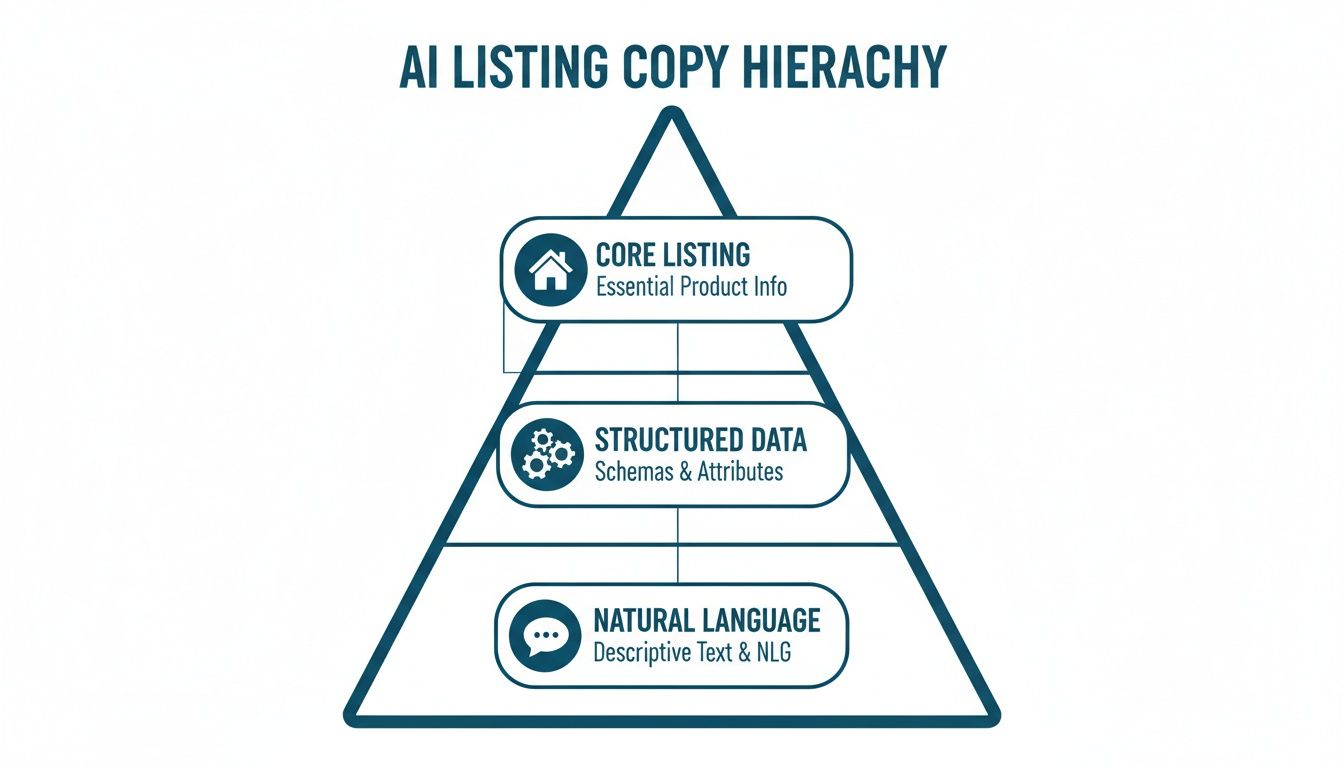
    The diagram below shows how your core data, this structured data layer, and your natural language description all fit together.

    AI listing copy hierarchy pyramid diagram illustrating core listing, structured data, and natural language.

    You can see that while the core listing is the foundation, structured data is the critical bridge that makes your beautifully written copy fully understandable to machines.

    The Details That Matter Most to AI Search

    Not all data fields are equally important. When you’re implementing schema, you need to zero in on the details that buyers ask about the most. These are the exact fields AI systems look for first.

    Make sure your schema clearly defines:

    1. The Basics: Address, price, number of bedrooms, number of bathrooms, and total square footage. These are non-negotiable.
    2. Key Property Specs: Explicitly tag items like numberOfRooms, floorSize, and yearBuilt.
    3. Standout Amenities: This is where you gain a real edge. Use the amenityFeature property to list high-demand items that an AI can easily match to a specific query. Good examples include:
      • EV charging station
      • Fenced-in yard
      • Swimming pool
      • Home office
      • Quartz countertops

    By structuring these features with schema, you're not just hoping an AI picks up on keywords. You're handing it a perfectly categorized, machine-readable inventory of what makes your property special.

    A Practical JSON-LD Template You Can Use

    This might sound intimidating, but it's simpler than it looks. The go-to format is JSON-LD, a script you or your web developer can pop into the <head> section of your listing's webpage.

    Here’s a simplified template you can adapt. Just swap out the placeholder info with your property's details.

    {
    "@context": "https://schema.org",
    "@type": "RealEstateListing",
    "name": "Charming Family Home in Sunnyvale",
    "url": "https://yourwebsite.com/listing/123-maple-street",
    "image": "https://yourwebsite.com/images/main-photo.jpg",
    "description": "A beautiful 4-bedroom, 3-bathroom home perfect for a growing family, featuring a modern kitchen and a spacious, fenced-in backyard.",
    "offers": {
    "@type": "Offer",
    "price": "750000",
    "priceCurrency": "USD"
    },
    "itemOffered": {
    "@type": "Residence",
    "address": {
    "@type": "PostalAddress",
    "streetAddress": "123 Maple Street",
    "addressLocality": "Sunnyvale",
    "addressRegion": "CA",
    "postalCode": "94086",
    "addressCountry": "US"
    },
    "numberOfRooms": "8",
    "bed": {
    "@type": "BedDetails",
    "numberOfBeds": "4"
    },
    "accommodationFloorPlan": {
    "@type": "FloorPlan",
    "numberOfBathroomsTotal": "3"
    },
    "floorSize": {
    "@type": "QuantitativeValue",
    "value": "2200",
    "unitCode": "SQF"
    },
    "amenityFeature": [
    {
    "@type": "LocationFeatureSpecification",
    "name": "EV Charging Station"
    },
    {
    "@type": "LocationFeatureSpecification",
    "name": "Fenced-in yard"
    },
    {
    "@type": "LocationFeatureSpecification",
    "name": "Home Office"
    }
    ]
    }
    }

    Adding this snippet to your listing’s code instantly transforms it from a simple webpage into a rich data source. This one move significantly boosts your chances of being surfaced by an AI as a direct, relevant answer to a buyer's highly specific question.

    How to Win on Zillow, Redfin, and the Major Real Estate Portals

    A tablet on a wooden desk displays a web portal interface, surrounded by office items and a plant.

    Let's be real: while your own website is your digital home base, most buyers are scrolling through Zillow, Redfin, and Realtor.com. These sites aren't just simple property databases anymore. Their internal search engines are powered by some seriously smart AI designed to figure out exactly what a buyer is looking for, often before the buyer even knows.

    To get your listings seen, you have to learn to speak their language. It's no longer enough to just push your MLS data out and hope for the best. You need to be strategic, tailoring your content to what each portal’s algorithm values most. If you skip this, you’re basically telling a huge chunk of your potential audience that your listing doesn't exist.

    Start with the MLS Agent Remarks

    Everything flows from your Multiple Listing Service (MLS). It's the source of truth for all the other platforms, which makes the "Agent Remarks" or "Private Remarks" section one of the most powerful, yet overlooked, tools in your arsenal to optimize listings for AI search. This is where you can inject the rich, narrative detail we’ve been talking about, right at the very beginning of the data chain.

    Think of it as the first domino. When Zillow and Redfin pull your data, they are absolutely parsing this section for clues and context that their own systems can use to categorize and rank your property.

    Here's how to make it count:

    • Don't Just State Facts, Sell the Benefit: "New HVAC in 2023" is fine. But "Enjoy worry-free comfort and lower energy bills with a brand-new HVAC system installed in 2023" is what connects with a buyer and gives the AI more context.
    • Match Your Language to Buyer Dreams: Use phrases that line up with how people actually search. For instance, "The finished basement offers a perfect setup for a home theater or in-law suite."
    • Call Out the Unique Stuff: Does the home have something most don't? Mention it! Things like "smart home integration with Nest thermostats" or "a dedicated dog run" are the kinds of specific, searchable terms that can get you found.

    By beefing up your MLS remarks, you're building a stronger foundation for every single place your listing shows up.

    Quick tip: Consistency is king. An AI builds confidence in a listing when the details on Zillow, Redfin, and your own site all match up perfectly. Any discrepancies can create digital confusion and potentially hurt your ranking.

    Play Zillow’s Game with Tags and Features

    Zillow's AI has one job: learn what features buyers love and show them more of it. It sits on a mountain of data about user behavior, and it uses that to push listings with in-demand features to the top. Your job is to make it dead simple for Zillow's AI to see that your listing has those features.

    The easiest win here is to be meticulous when you're entering the listing. Don't you dare skip the "Interior Features" or "Exterior Features" sections. If the home has quartz countertops, central air, or a walk-in closet, check the box. Every. Single. Time.

    Zillow’s system also scans your public description for keywords it can automatically turn into little blue tags, like "hardwood floors" or "updated kitchen." By weaving these terms naturally into your description, you’re sending a double signal to its algorithm—you've checked the box and you've written about it. That's a powerful combo that tells Zillow your property is a fantastic match for users looking for those amenities.

    Dig into Redfin’s Unique Data Fields

    Redfin often gets a bit more granular than the other portals, offering unique data fields you won’t see elsewhere. For example, it might have specific drop-down options for different types of flooring, specific roof materials, or particular architectural styles. It may feel tedious, but taking an extra five minutes to fill out these Redfin-specific fields can give you a real leg up on that platform.

    Why? Because Redfin's AI uses this detailed data to answer hyper-specific search queries. A buyer looking for a "Craftsman-style home with a metal roof" will only be shown listings where those attributes are correctly tagged. If you left those fields blank, your perfect-fit listing will be completely invisible to that highly qualified buyer.

    This is the new reality of marketing a property. The "one-size-fits-all" approach is officially dead. You have to tailor your data for each major portal, feeding their AI systems the exact information they need to confidently push your listing to the front of the line. It's this strategic effort that separates the top agents from everyone else in this AI-powered market.

    How Do You Know If Your AI Optimization Is Actually Working?

    This is the big question, right? You’ve put in the work to craft a compelling story, you’ve implemented the right data, but how can you tell if your efforts to show up in AI searches are paying off? The old-school metrics like page views just don't cut it anymore.

    We need to think differently. The goal isn’t just to get more eyeballs on a listing; it's about attracting buyers who are already pre-sold on the property. Success means your listings are being found by the right people and sparking genuine, high-intent inquiries from buyers who feel the home is a perfect fit before they even step through the door.

    Tracking the Metrics That Really Matter

    Your standard analytics are a decent starting point, but they barely scratch the surface. To really understand your AI optimization performance, you have to look for signals that reflect a buyer's true interest and the quality of their engagement.

    Here’s what I’m tracking in my own business:

    • Lead Source Attribution: This is as simple as it sounds. Start asking every single person who inquires, "How did you find us?" If they mention asking Google a question, using ChatGPT, or another AI assistant, you've got a direct hit. That’s your proof.
    • Quality of Inquiries: Pay close attention to the type of questions you're getting. Are people asking about the "dedicated home office with built-in bookshelves" or the "fenced-in yard perfect for a golden retriever" that you specifically highlighted? When their questions mirror your detailed copy, you know you're attracting well-matched buyers.
    • Time on Page: If you host listings on your own website, keep an eye on this. A longer-than-average time on page is a strong indicator that your story-driven descriptions are capturing and holding a reader's attention, which is a world away from a boring list of features.
    • Saves and Favorites: On portals like Zillow and Redfin, a noticeable increase in users "hearting" or saving your property suggests the platform's AI is successfully surfacing your listing to a more relevant, interested audience.

    The Simple Power of an A/B Test

    One of the most straightforward ways to see what works is to run a simple A/B test. It's not as complicated as it sounds.

    Take two similar properties in the same neighborhood. For one, stick with a more traditional, feature-heavy description. For the other, go all-in with the AI-optimized, narrative-driven style we've been talking about. Then, just track the number and quality of inquiries for each over a couple of weeks. The results will give you a clear, side-by-side comparison of which approach is truly connecting with buyers.

    The real estate AI market is exploding toward $1.3 trillion by 2034, growing at a blistering 36% compound annual rate. This isn't just about fancy tech; it's about tools that cut down our operational time and boost accuracy—directly impacting how listings get seen. In 2026, 97% of agents at top firms are expected to use AI, with 82% of them focusing on crafting listing descriptions that use real-time data and structured markup to rank higher in AI recommendations. You can find more insights on the growth of real estate AI tools.

    Staying Ahead of the Curve

    AI is moving at a breakneck pace, which means our strategy for measuring success has to be just as nimble. Your job isn't finished once you've updated your current listings; this is about creating a process for constant improvement.

    Make it a habit to set aside time each month to:

    1. Monitor AI Platform Updates: Keep an ear to the ground for news from Google, Perplexity, and the big real estate portals. When they announce changes to their AI or search algorithms, you need to be ready to adjust your game plan.
    2. Experiment with New Formats: Don't get stuck in a rut. Try adding a short, prompt-ready Q&A section to your next listing. Test out embedding different types of schema to see what moves the needle.
    3. Refine Your Templates: Use what you learn from your A/B tests and the quality of your inquiries to continuously improve your templates for listing descriptions and MLS remarks. What works best today might be table stakes tomorrow.

    This forward-thinking approach is what will keep your strategies effective as the technology evolves. For a closer look at streamlining these kinds of tasks, our guide on real estate marketing automation offers some great ideas. When you combine smart implementation with sharp measurement, you’ll ensure your listings don't just get seen—they get sold.

    Your Questions About AI Listing Optimization, Answered

    Jumping into AI optimization for your real estate listings can bring up a lot of questions. It's a new frontier, after all. We get it. Below, I’ve pulled together some of the most common questions agents ask when they're getting their feet wet with this stuff, along with practical, no-fluff answers.

    How Long Until I Actually See Results?

    This isn't a magic wand, but you'll see a shift faster than you might think. Unlike traditional Google SEO, which can be a slow burn taking months, AI-powered search works on a different clock. You could start seeing better-quality leads—think buyers asking about specific, unique features you've detailed—within just a few weeks of pushing your updated listings live on the major portals.

    The real variable is the re-indexing speed of platforms like Zillow, Redfin, and Google itself. The more detailed and context-rich your descriptions and structured data are, the quicker their AI systems will flag your listing as a top-tier answer to a user's conversational search.

    Do I Really Need to Hire a Web Developer for Schema Markup?

    Not always, but it's an option. If your website is on a common platform like WordPress, you're in luck. There are fantastic plugins that handle all the heavy lifting, letting you add schema by just filling out a form with the property details. No coding required.

    But if you have a custom-built site or the thought of touching your website's backend gives you hives, a developer can knock it out correctly in about an hour. Don't let the tech side scare you off; the competitive edge you gain is too valuable to pass up.

    The biggest mistake I see agents make is aiming for perfection right out of the gate. Just start. You can rewrite your listing descriptions with rich, natural language today. Tackle the technical stuff like schema next. Making progress is what matters most.

    Is This Strategy Just for Sales, or Does It Work for Rentals?

    It absolutely works for rentals. The core idea is identical. Renters are using AI assistants just as much as buyers, firing off questions like, "Find me a pet-friendly two-bedroom apartment near downtown that has in-unit laundry."

    Applying these same optimization methods to your rental listings will help you connect with serious, qualified tenants much faster. Just make sure you're highlighting the amenities and details that matter most to renters in both your narrative and your structured data.

    • Pet Policies: Be crystal clear. Are pets allowed? Are there size or breed restrictions?
    • Lease Terms: Mention your flexibility. Something like "flexible 6 to 12-month lease options" is great.
    • Included Utilities: Spell out what's covered. Does the rent include water, gas, or internet?
    • Community Perks: Call out features like a "24-hour fitness center" or a "secure package room."

    Is This Going to Replace My Regular Real Estate SEO?

    Think of it as the next step in its evolution, not a total replacement. Your traditional SEO work, which targets broad keywords like "Denver homes for sale," is still crucial for catching people at the top of the funnel. It gets your name in the hat.

    AI optimization is the layer on top of that. It's built to capture the highly specific, detailed search queries that come from buyers who are much further along in their journey—the ones who know exactly what they're looking for. The two approaches are a powerful combination. A solid SEO foundation gets you on the playing field, but optimizing for AI search is how you connect with the most motivated buyers.


    Ready to stop being invisible in AI search? ListingBooster.ai transforms your properties into complete marketing suites with AI-optimized descriptions for MLS and portals, social content, and schema markup that gets you found. Start your 30-day free trial today!