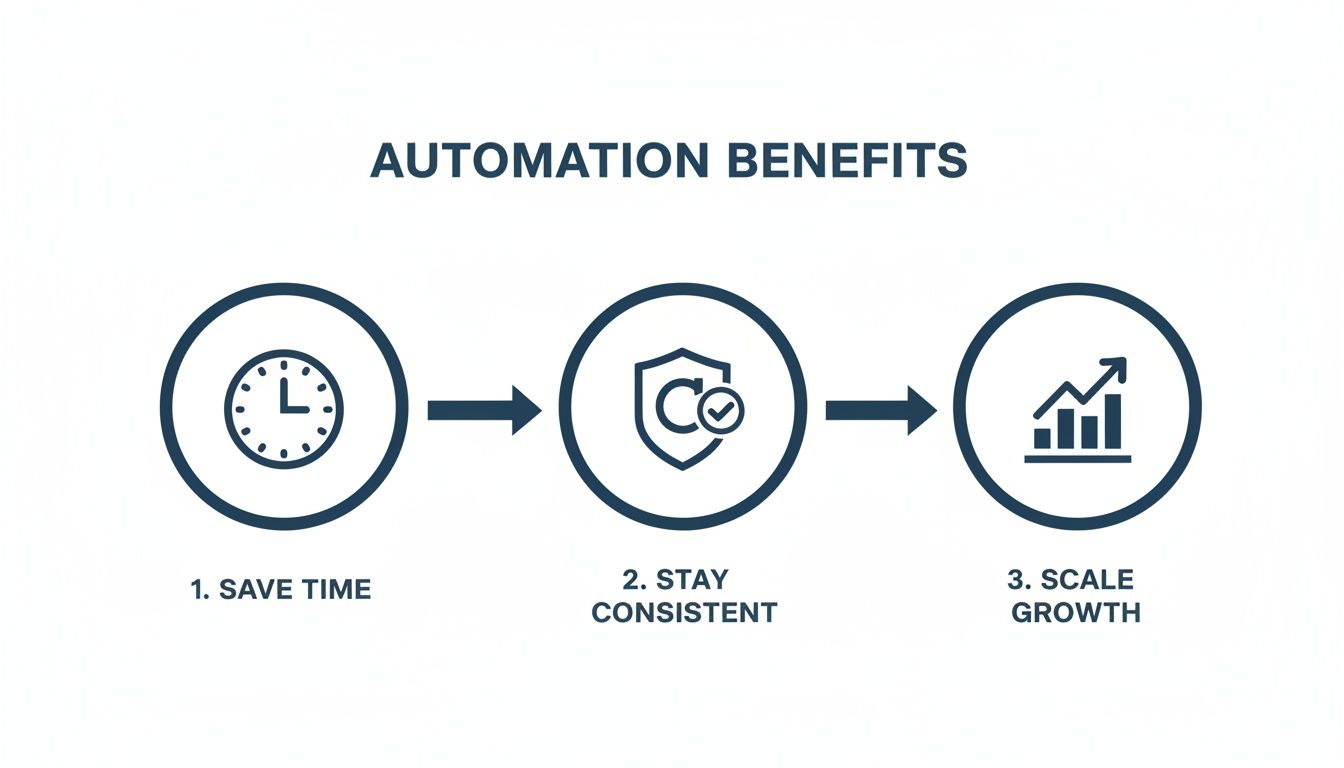
Tag: content automation

  • Automated Real Estate Content Marketing System: 2026 Guide

    Automated Real Estate Content Marketing System: 2026 Guide

    More than 40% of homebuyers now start with AI tools and search platforms before they ever speak to an agent. That shift changes what marketing has to do.

    An automated real estate content marketing system is no longer just a posting tool for a busy team. It has become the operating system for staying visible where buyers and sellers now ask their first questions. In practical terms, that means producing useful local content regularly, distributing it across the channels AI systems can read, and keeping your message consistent enough that your expertise is easy to recognize.

    I see the same problem across independent agents, top producers, and small brokerages. They are active, but not consistently visible. One listing gets a burst of attention, then the pipeline goes quiet. Market updates live in email but never make it to the website. Neighborhood expertise stays trapped in an agent's head or CRM notes instead of becoming public content that can surface in AI-driven answers.

    The business risk is straightforward. If your content is thin, outdated, or scattered across disconnected platforms, AI systems have very little to work with. You are harder to recommend, harder to cite, and easier to overlook, even if you know your market better than the agent who shows up first. For agents trying to understand that shift, LucidRank's AI SEO guide is a useful reference point.

    The New Visibility Gap in Real Estate Marketing

    A for sale sign in a rainy city street with people walking under umbrellas on the sidewalk.

    Most agents still market like it's a social scheduling problem. It isn't.

    The larger issue is visibility across AI-driven discovery. Buyers and sellers are asking broader questions in tools like ChatGPT and Google AI. They aren't only searching for a property address or an agent name. They're asking who knows a neighborhood, who explains the market clearly, who specializes in a property type, and who appears consistently credible.

    What an AI-readable digital footprint actually means

    An AI-readable digital footprint is the collection of content signals that help an AI system understand what you do, where you work, what property types you handle, and whether your information is current. That includes listing descriptions, neighborhood posts, market commentary, social captions, website pages, email content, and structured data.

    Manual marketing usually breaks down here for three reasons:

    • It happens irregularly. An agent posts heavily for one listing, then disappears for two weeks.
    • It stays fragmented. The website says one thing, Instagram says another, and the CRM contains useful context that never makes it into public content.
    • It isn't structured for machine interpretation. Even strong writing can be hard for AI systems to connect to a market, niche, or authority signal without supporting metadata and consistency.

    That is the visibility gap. It's not just a content gap.

    For agents trying to understand what this shift means in practical SEO terms, LucidRank's AI SEO guide is a useful primer on how search behavior and AI answer engines are changing what gets surfaced.

    Practical rule: If your marketing depends on you remembering to post, you're not building a durable presence. You're creating occasional activity.

    Why automation now sits at the center

    An automated real estate content marketing system solves a specific operational problem. It turns scattered marketing tasks into a repeatable system that creates, adapts, publishes, and tracks content across channels.

    That matters because buyers rarely make decisions after a single interaction. The market data above notes that property buyers often need 7-12 touchpoints before deciding, and firms using these systems report 20-40% faster lead response times, up to 50% more qualified pipeline opportunities, and 40-60% reductions in manual outreach costs in the same Market.us report.

    Old workflow versus system-driven workflow

    Approach What usually happens
    Manual posting Content depends on spare time, energy, and memory. Listing promotion is uneven and authority content gets skipped.
    Template-only tools Output is faster, but often generic, disconnected from CRM data, and weak on compliance review.
    Automated real estate content marketing system Listing, brand, audience, and follow-up content run on a coordinated schedule with reusable logic and clearer attribution.

    The practical takeaway is simple. In 2026, content automation isn't mainly about saving an hour on Instagram captions. It's about making sure your expertise exists in enough places, with enough consistency, that AI systems can recognize and surface it when prospects start their search.

    Core Features of a Modern Content Automation Engine

    A good automated real estate content marketing system shouldn't feel like a black box. You need to know what it's doing, why it matters, and where weak tools usually fail.

    A diagram illustrating five core features of a modern content automation engine for marketing strategies.

    Content generation that doesn't read like a prompt dump

    Modern systems use generative AI trained or fine-tuned on real estate content patterns and 23+ psychological frameworks such as scarcity and social proof. According to Maxa Designs on real estate marketing automation, that process can increase AI search visibility by over 40% and lift social engagement by 2-5x compared with manual creation when schema markup is included.

    That doesn't mean every caption should sound hyped up or salesy. Good systems use frameworks as structure, not as gimmicks. They know when a price-drop post needs urgency, when a market update needs authority, and when a neighborhood post needs clarity over persuasion.

    If you want a complementary read on the listing side of this shift, how AI transforms real estate marketing is useful because it focuses on how AI-generated descriptions are changing property presentation.

    Scheduling and distribution that match how agents actually work

    The scheduling layer should do more than let you queue posts.

    It should let one input produce multiple outputs. A new listing should trigger launch posts, open house reminders, price adjustment content, sold announcements, and supporting evergreen pieces without forcing the agent to rebuild each asset from scratch. It also needs to adapt formatting for each channel so you aren't pasting the same block of copy into Facebook, Instagram, LinkedIn, and email.

    A practical benchmark when evaluating tools is whether they can turn one property into a coordinated campaign. This is the exact problem discussed in this guide to a real estate agent AI content creation platform.

    Schema markup and AI readability

    Schema markup is the part many agents skip because it sounds technical. But its job is straightforward. It acts like a nutritional label for your content, telling machines what the page or post is about.

    Without it, AI systems have to infer more from context. With it, they can more clearly identify property details, event information, local expertise, service areas, and entity relationships.

    Look for a system that can support:

    • Listing context such as property details and status changes
    • Local authority signals tied to neighborhoods, market updates, and agent expertise
    • Cross-channel consistency so your website content and your promotional content reinforce each other

    Strong automation makes your marketing easier for both people and machines to interpret.

    Compliance scanning and brand control

    Many otherwise decent tools fail at this stage.

    Real estate content can't be treated like generic creator content. It has regulatory risk, brokerage review needs, MLS sensitivities, and brand consistency requirements. If a team has multiple agents writing their own versions of the same message, inconsistency creeps in fast.

    A modern engine should include:

    1. Pre-publish checks for risky language.
    2. Editable templates so agents can personalize without going off-brand.
    3. Shared voice controls for teams and brokerages.
    4. Approval paths when broker review is required.

    CRM integration and audience intelligence

    The system gets much stronger when it connects to the CRM. That connection lets content reflect lead stage, behavior, preferences, and timing instead of pushing the same message to everyone.

    This is also where automation becomes operational rather than cosmetic. Content stops being a pile of posts and starts supporting the pipeline.

    Calculating the ROI for Your Real Estate Business

    Agents who use CRM automation often see stronger revenue per salesperson and higher productivity, according to Real Geeks CRM automation stats and workflows. That matters more now because content automation is no longer just a staffing shortcut. It affects whether your business shows up consistently when buyers ask AI tools for agents, neighborhoods, listings, and local advice.

    ROI looks different for a solo agent, a team lead, and a brokerage owner. The math changes. The decision framework does not. Measure three things: hours returned to selling work, improvement in lead handling, and whether your content creates enough structured, published material to keep your brand visible in AI-driven search.

    For solo agents

    Solo agents usually feel the cost in missed execution before they feel it in software spend. Posts go out late. Listing updates stall. Follow-up content never gets written because client work comes first.

    Earlier research cited in this article found meaningful gains from automation across time savings, conversion from inquiry to viewing, and closed deals. The exact result depends on lead quality, follow-up discipline, and market conditions. Still, the practical question is simple. If automation gives you back several hours a week, do those hours go into admin work or into pricing meetings, listing appointments, and negotiation?

    That trade-off is where ROI becomes real.

    For a solo operator, I usually calculate value in four lines:

    ROI bucket What to measure
    Time recovered Hours no longer spent writing captions, resizing graphics, reformatting listing copy, and sending repeat follow-ups
    Lead response Faster speed to first touch, fewer missed inquiries, and more consistent nurture after showings
    Conversion lift More appointments set, more listing consultations held, and better follow-through from active buyers
    Visibility value More indexed pages, listing-related updates, neighborhood content, and Q&A assets that AI systems can cite or summarize

    The last bucket gets ignored too often. If your content system only saves time but does not publish useful, location-specific material on a reliable schedule, the return is capped. In the current search environment, invisibility has a cost.

    For team leaders

    Team leaders usually do not have an idea problem. They have a coordination problem.

    Margins decrease due to review cycles, redundant tasks, inconsistent messaging, and ineffective lead follow-up. A quality automation system minimizes these losses by transforming repetitive labor into a structured process. Agents begin with pre-approved materials. Coordinators dedicate less time to fixing fundamental errors. Managers receive more accurate reporting on what produced conversations and appointments.

    A practical ROI model for teams usually falls into three buckets:

    ROI bucket Where the gain shows up
    Productivity Less manual drafting, fewer revisions, and less time redistributing the same message across channels
    Pipeline quality Better lead routing, tighter follow-up timing, and nurture content matched to lead stage
    Revenue efficiency More agent time spent on appointments, negotiations, referrals, and client retention

    If you need to justify the budget internally, these real estate marketing ROI tools are useful for framing the decision around labor cost, output, and conversion instead of software price alone.

    Creative production costs matter too. Teams often underestimate the drag created by constantly resizing images and rebuilding assets for each channel. A simple reference like Master Social Media Post Sizes 2026 helps standardize production and cut rework.

    For brokerages

    Brokerages have a wider operating problem. They need brand consistency, compliance control, and enough local content velocity to keep dozens or hundreds of agents visible.

    That return rarely shows up as one neat number. It shows up in fewer review bottlenecks, fewer compliance corrections, faster launch times for listings and agent campaigns, and more consistent publication across offices. It also shows up in search presence. When agents publish fragmented, inconsistent content, AI systems have less reliable material to reference. When a brokerage runs a structured system across listing pages, local pages, agent bios, FAQs, and market updates, it improves the odds that the brand appears in AI-generated answers.

    The strongest ROI comes from replacing repeated manual tasks with a system tied to CRM activity, publishing rules, and reporting. A caption generator alone will not fix coordination, compliance, or visibility. A connected content operation can.

    Real-World Examples and Automated Workflows

    The fastest way to understand an automated real estate content marketing system is to follow the workflow from input to output.

    A professional woman uses a smartphone and laptop to manage automated real estate workflows in an office.

    Workflow one for listing promotion

    Start with a common scenario. An agent gets a new listing and has the property URL, core facts, photos, showing timeline, and brokerage requirements. In a manual workflow, that usually triggers several disconnected tasks. MLS remarks. Portal descriptions. Social launch posts. Open house promotion. Flyer copy. Price-drop updates. Sold content. Often by different people, in different tools.

    A system-driven workflow compresses that into one intake point and then branches it into channel-specific assets.

    For example, one listing input can generate:

    • Portal-ready descriptions for MLS-style and consumer-facing versions
    • Launch content for Instagram, Facebook, LinkedIn, and short-form channels
    • Event assets for open houses and follow-up reminders
    • Print collateral that uses the same positioning and facts
    • Update triggers for status changes like price reductions or just sold announcements

    That matters because consistency is part of credibility. If the website language, social positioning, and handout language all differ, the campaign feels improvised.

    When teams need image sizing and post dimensions dialed in for every platform, Master Social Media Post Sizes 2026 is a practical resource for avoiding last-minute resizing chaos.

    One useful framework here is the "one listing, many assets" approach. This walkthrough on turning one listing into 30 days of content maps out how agents can expand a single property into a fuller campaign rather than burning all their content on launch day.

    Workflow two for authority building

    The second workflow is less obvious, but it's often more important over time.

    Authority content is what keeps you visible between transactions. Neighborhood guides, buyer education, local market commentary, seller prep posts, and recurring updates create the context that helps prospects trust you before they ever contact you. Most agents know they should do this. Few keep it going manually.

    A better workflow starts from categories instead of ad hoc inspiration:

    1. Market knowledge
    2. Neighborhood expertise
    3. Buyer and seller education
    4. Agent positioning
    5. Relationship nurture

    The CRM layer becomes critical here. According to RealEstateContent.ai on automated real estate marketing, CRM-connected systems can trigger 12-month nurture campaigns based on lead behavior, and AI segmentation can produce 28-42% open rates versus sub-10% engagement from unsegmented manual blasts, correlating with a 22% higher lead-to-appointment conversion.

    Where these workflows usually break

    The weak points are predictable.

    • Agents over-edit everything. That erases the speed benefit.
    • Teams under-define the brand voice. That creates drift.
    • Brokerages ignore workflow design. The software gets blamed for a process problem.

    The best automation workflows don't remove the agent. They remove the repetitive production work so the agent can focus on judgment, relationships, and timing.

    A practical setup is to automate the first draft, the distribution path, and the nurture sequence, then keep final personalization for the moments that benefit from actual human context.

    Your Implementation and Integration Checklist

    Most agents don't need a complicated rollout. They need a clean starting path that gets them from account setup to a useful publishing rhythm without eating half a week.

    A person using a stylus on a tablet screen to check off items on a project checklist.

    Start with the minimum viable setup

    The first win is speed. Based on the publisher information provided for this article, setup can take 5-10 minutes from a property URL or basic details. That only helps, though, if you resist the urge to customize everything before you publish anything.

    Use this sequence:

    1. Create your core profile
      Add your service area, specialties, contact details, brokerage information, and primary audience.

    2. Set a basic voice guide
      Choose how you want your content to sound. Professional, conversational, local, luxury-focused, educational, or direct. Keep it simple at first.

    3. Connect publishing channels Link the platforms you use. Don't connect every account just because you can.

    Define what the system should produce

    The next step is output planning. Most failed implementations don't fail because the tool is hard. They fail because nobody decides what "done" looks like.

    Create a short content mix:

    • Listing content for active inventory and status updates
    • Authority content for neighborhood and market expertise
    • Nurture content for buyer and seller education
    • Brand content that shows how you work and what you notice locally

    If you're on a team, lock this down early. Otherwise every agent will interpret the mission differently.

    Build your first calendar, then edit lightly

    Generate your first 30-day content plan and review the first week before you touch the rest. That approach keeps setup practical and avoids turning implementation into a branding workshop.

    A good review pass should check for:

    Review point What to look for
    Voice Does it sound like your business, not a generic real estate page?
    Accuracy Are property facts, dates, and market references correct?
    Compliance Is anything likely to create avoidable risk?
    Channel fit Does the post match the platform's format and audience expectations?

    Implementation note: Launch with one reliable rhythm you can maintain. Consistency beats an ambitious setup that collapses after a week.

    Integrate with your actual workflow

    The final piece is operational. Decide who owns review, who approves edits if needed, and how new listings enter the system. If that intake path stays messy, the output will stay messy too.

    The agents who get the most from automation usually treat it like a standing business process, not like a content experiment.

    Overcoming Common Automation Objections

    The resistance to automation is usually rational. Agents have seen weak AI writing, risky ad copy, and software that promised efficiency but added more review work. The objections aren't silly. They're often based on bad tools.

    It's too expensive

    This objection sounds financial, but it's usually about trust. Agents don't mind paying for something that replaces real labor or protects real revenue. They mind paying for another dashboard that still leaves them doing the work.

    The better question is whether the system reduces costly manual steps. If it cuts repetitive writing, follow-up delays, asset reformatting, and review friction, it's competing with wasted hours and missed opportunities, not with a line item in isolation.

    For newer agents, automation can also close a capability gap. It can give them a steadier public presence without hiring design, copy, and coordination support they don't have.

    I'm worried about compliance

    This is the objection that deserves serious attention.

    According to Automizy's discussion of real estate marketing automation, 80% of agents use AI for content, but a major gap remains in compliance and brand voice consistency at scale. Tools with pre-publish Fair Housing scans and unified voice templates address a risk many platforms miss.

    That matches what happens in the field. The danger usually isn't one obviously reckless post. It's volume. Teams publish fast, agents improvise, and language drifts. A system that checks content before publishing can reduce risk because it introduces a standard process instead of hoping every user catches every issue manually.

    My content will sound robotic

    This happens when the tool is too generic or the user never sets brand inputs.

    The cure isn't to reject automation. It's to use it properly. Strong systems generate drafts from structured inputs, preferred tone, audience context, and reusable messaging rules. Then the agent or team edits where actual experience matters.

    Consider these alternatives to starting from a blank page:

    • Use templates as a base, not a script
    • Keep recurring phrases that reflect your brand
    • Personalize market observations and client examples
    • Let automation handle structure, not your entire identity

    One option in this category is ListingBooster.ai, which the publisher describes as a platform that creates listing descriptions, multi-channel content calendars, authority posts, and pre-publish Fair Housing scans for agents, teams, and brokerages.

    Bad automation strips out personality. Good automation protects your time so you can add personality where it counts.

    The trade-off is real. If you want every post to be handcrafted, you can keep doing that. You'll also keep the bottleneck that handcrafted marketing creates.

    Frequently Asked Questions

    How much does a system like this cost, and is it worth it for a new agent?

    Cost only makes sense in relation to what you're replacing. If the system helps you publish consistently, stay visible, and avoid spending hours every week creating content from scratch, it can be worth it even early in your career. New agents usually benefit most when they need authority signals but don't have a marketing team behind them.

    The bigger mistake is waiting until you're busy to build a content system. By then, you're trying to create visibility while also serving active clients.

    Will my content sound generic using an automated system?

    It can, if you use weak prompts, vague settings, or rigid templates with no editing. It doesn't have to.

    The strongest results come from using automation to produce structure and first drafts, then adjusting tone, local references, and positioning. Generic content usually comes from generic input. If your voice guide is clear and your review process is disciplined, the output will feel more like a scaled version of your brand than a replacement for it.

    How long does it realistically take to get set up and see results?

    Setup can be quick when the workflow is simple and your brand basics are already defined. The publisher information for this article states that setup can take 5-10 minutes from a property URL or basic details.

    Results come in layers. You can generate useful assets right away. But authority and AI visibility build through consistency, breadth, and repetition. Think of the system as a way to create a steady digital footprint over time, not as an instant reputation shortcut.

    Do I still need to review the content?

    Yes. Automation should reduce production work, not replace judgment.

    Review facts, timing, positioning, and anything tied to compliance or brokerage standards. The fastest and safest setup is usually a hybrid one. Let the system do the heavy lifting, then keep a short human review before publishing.


    If you want a simpler way to turn listings, market knowledge, and brand content into a repeatable publishing system, ListingBooster.ai is built for that workflow. It helps agents, teams, and brokerages generate AI-readable real estate content, organize a 30-day content calendar, and keep output editable and compliance-aware without relying on manual creation every time.

  • Mastering Your Real Estate Brokerage Content Automation Tool

    Mastering Your Real Estate Brokerage Content Automation Tool

    46% of REALTORS® now use AI-generated content for tasks like listing descriptions, making AI content generation the fourth most prevalent digital tool among agents, according to the National Association of REALTORS®' 2025 Technology Survey.

    That single number changes the conversation.

    A real estate brokerage content automation tool used to sound like a convenience. Something nice to have if you wanted help with social captions or listing copy. In practice, it has become part of the visibility stack that determines whether buyers and sellers can find you at all.

    The shift matters because discovery has changed. Agents are no longer competing only on portals, search engines, and social feeds. They’re competing inside AI-powered search experiences where people ask direct questions, compare neighborhoods, and look for local experts. If your content is inconsistent, thin, generic, or missing structure, you become hard to surface.

    Most agents still feel the problem in a very ordinary way. They’re trying to answer leads, prep for showings, manage inspections, handle contracts, and somehow publish polished marketing across multiple channels. By the time content gets pushed to the bottom of the list, visibility gets pushed down with it.

    That’s why this topic deserves a more serious look. A real estate brokerage content automation tool isn’t just about posting faster. It’s about building a system that turns listing data, market knowledge, and brand standards into publishable content that works across MLS, portals, social platforms, and the new AI search layer.

    The End of Manual Marketing in Real Estate

    The manual marketing model is breaking down because the workload no longer matches the pace of the business.

    An agent can’t spend half a day rewriting a listing description, another hour resizing graphics, and more time drafting platform-specific captions every time a property changes status. That approach might have been manageable when digital marketing was occasional. It fails when visibility depends on steady output.

    A professional woman holds a digital tablet while standing in front of large stacks of office paperwork.

    Why the old workflow no longer holds up

    The old pattern is familiar.

    You get a listing. You pull the property details. You write the MLS remarks manually. Then you rewrite the same information again for Instagram, Facebook, email, flyers, and your website. If the home has a price improvement or open house update, you repeat the cycle.

    That process creates three business problems:

    • It fragments your message. Each platform ends up with slightly different wording, tone, and detail.
    • It creates delay. Content often goes live late because client work comes first.
    • It increases risk. The more versions you write manually, the easier it is to miss brand standards or compliance issues.

    A lot of agents think this is just the cost of doing business. It isn’t. It’s a workflow problem.

    The pressure isn’t only about social media

    Automation is often first associated with social posting. That’s too narrow.

    What’s changed is that content now feeds multiple visibility channels at once. Your listing copy influences how a property is presented on portals. Your neighborhood content shapes local authority. Your market updates help establish relevance over time. Your consistency affects whether people see you as active, current, and trustworthy.

    Practical rule: If your marketing depends on finding spare time, it isn’t a system. It’s a gamble.

    The agents gaining ground aren’t necessarily better writers. They’ve built a process that lets them publish consistently without rebuilding every asset from scratch.

    What ambitious agents should take from this

    You don’t need to become a tech operator. You do need to stop treating content as a side task.

    A real estate brokerage content automation tool changes the job from “create everything manually” to “review, refine, and deploy.” That’s a major difference. One model eats your calendar. The other supports it.

    The goal isn’t robotic marketing. The goal is reliable marketing.

    When content production shifts from a handcrafted task to an organized workflow, agents get back time, teams stop improvising, and brokerages gain more control over what goes out under their name.

    What Are Real Estate Content Automation Tools

    A real estate brokerage content automation tool is a software system that takes property information, brand inputs, and marketing goals, then turns them into ready-to-use content across multiple channels.

    The simplest way to think about it is this. It’s a 24/7 digital marketing assistant built for real estate.

    You give it the raw ingredients. A property link, MLS details, photos, notes about the neighborhood, brand voice preferences, and sometimes market context. The tool processes that information and produces usable outputs such as listing descriptions, social posts, email copy, flyer language, and campaign ideas.

    A diagram illustrating the four steps of real estate brokerage content automation from data ingestion to engagement.

    The input, process, output model

    A lot of agents get uneasy when they hear “AI” because it sounds abstract. The mechanics are simpler than they seem.

    Here’s the working model:

    1. Input the data
      The tool pulls in listing facts, images, location details, and business rules.

    2. Generate content
      The system drafts copy for the places you market properties and your brand.

    3. Adapt by channel
      It rewrites the message for MLS, social, email, or print instead of forcing one generic block of text everywhere.

    4. Prepare for publishing
      You review, edit if needed, and push it live.

    That’s why these tools feel less like “magic” and more like assembly lines. Good ones don’t replace your judgment. They remove repetitive production work.

    What they actually produce

    Some agents assume these platforms only write short captions. A stronger tool does much more than that.

    Common outputs include:

    • MLS-ready descriptions that fit the style and constraints of listing platforms
    • Portal-friendly copy for Zillow, Realtor.com, Homes.com, and similar destinations
    • Social media variations for a new listing, open house, price change, or just sold update
    • Authority content such as neighborhood guides, buyer tips, and market commentary
    • Print-ready text for flyers and property sheets
    • Campaign planning assets such as a content calendar built around one listing or one local market theme

    The value is that one set of source data can power many assets.

    Why the analogy matters

    Think of a traditional agent workflow like cooking every meal from scratch, every single day, with no prep station.

    A content automation system is the commercial kitchen setup. The ingredients are organized. The prep work is accelerated. The output is more consistent. You still decide what gets served, but you’re no longer chopping every onion by hand.

    Good automation doesn’t erase your voice. It gives your voice a production system.

    That point matters because many agents fear sameness. They assume automation means bland content. In reality, blandness usually comes from weak prompts, poor setup, or generic tools not designed for real estate.

    A purpose-built real estate brokerage content automation tool should understand listing language, the difference between platform formats, and the business need for consistency across many touchpoints. It should feel less like a generic chatbot and more like a marketing operations layer for your real estate business.

    The ROI of Automated Content Beyond Time Savings

    Time savings gets all the attention because it’s easy to feel. You spend less time writing. You publish faster. You stop staring at a blank screen.

    That’s useful, but it’s not the main business case.

    The deeper return comes from what happens when content becomes consistent. Agents stay visible. Leads keep seeing useful material between transactions. Listings launch with less delay. Teams don’t wait on one person to write everything. Brokerages create a stronger public presence because more of their agents are publishing on-brand material regularly.

    Revenue follows repeatable workflow

    The strongest argument for automation is operational, not cosmetic.

    Sales teams that use automation see a 41% increase in revenue per salesperson and a 29% productivity boost, according to data summarized by Real Geeks using Salesforce and SuperOffice findings. Those numbers come from workflow automation broadly, but they matter here because content production is one of the most repeated workflows in a brokerage.

    If your marketing system is inconsistent, every listing launch and every lead-nurture sequence starts from friction. If your system is automated, your people can spend more time on activities that require human judgment.

    Authority compounds when content stops being random

    Most agents don’t lose business because they lack opinions. They lose business because their expertise doesn’t show up consistently where prospects look.

    A real estate brokerage content automation tool helps solve that by making repeatable publishing possible. That changes the role of content from occasional promotion to steady authority building.

    Here’s where ROI often appears before agents notice it directly:

    • Better recall: Prospects keep seeing your name, listings, and market insights.
    • Stronger trust: Consistent publishing makes you look active and prepared.
    • More usable lead nurture: Your database gets relevant touchpoints instead of silence.
    • Cleaner handoff across channels: One campaign can support social, email, and listing portals without separate rewrites.

    That’s why ROI shouldn’t be measured only by “hours saved this week.” It should also be measured by whether your business keeps showing signs of life and expertise when you’re busy closing deals.

    For a deeper framework on evaluating platform value, this guide on real estate marketing ROI tools is a useful companion.

    The hidden cost of manual inconsistency

    Manual marketing creates uneven output. One week you post heavily. The next two weeks disappear because you’re busy. Then a new listing arrives and you scramble again.

    That pattern weakens momentum.

    A better system creates a baseline level of visibility even when your calendar gets crowded. That matters because many transactions are won long before the client reaches out. They’ve already been watching. They’ve already formed an opinion about who looks current and credible.

    The return on automation often shows up first as fewer gaps, fewer delays, and fewer missed chances to stay top of mind.

    What good ROI looks like in practice

    It doesn’t always look dramatic from day one. Often it looks like this:

    Business signal Manual approach Automated approach
    Listing launch Delayed by writing and revisions Faster to prepare and publish
    Agent visibility Inconsistent More steady
    Team brand voice Varies by person More standardized
    Lead nurture Sporadic Easier to maintain
    Manager oversight Reactive More systemized

    That’s the shift ambitious agents and brokers should care about.

    Content automation is not just a labor saver. It’s a way to make your marketing operation more dependable. And dependable systems tend to produce better commercial results than heroic bursts of effort.

    Must-Have Features for Compliance and AI Search Readiness

    Many tools can draft a caption. That no longer qualifies as enough.

    If you’re choosing a real estate brokerage content automation tool in today’s market, two capabilities matter more than the rest. First, it needs to help protect you and your brokerage from avoidable compliance mistakes. Second, it needs to prepare your content for AI-powered discovery, not just traditional posting.

    A computer monitor displaying a compliance report dashboard for real estate brokerage business management processes.

    Compliance can’t be an afterthought

    Agents often treat compliance as a final review step. Brokerages know better. Once content is distributed, the correction process gets harder. Screenshots spread. Posts get shared. The original mistake keeps moving even after you delete it.

    That’s why built-in safeguards matter.

    A useful system should help with:

    • Fair Housing-sensitive language checks before content is published
    • MLS-aware formatting so listing copy doesn’t need complete rewrites
    • Brand standard controls across multiple agents and campaigns
    • Editable approval workflow so humans stay in charge of final decisions

    This is especially important at scale. A brokerage doesn’t just manage content volume. It manages exposure. One weak post can create legal, reputational, and operational headaches.

    If you want a practical look at this issue, this article on MLS-compliant AI content gets into the operational side of review and publishing.

    AI search readiness is the blind spot

    The bigger strategic mistake is assuming that if content looks good on Instagram or the MLS, it’s doing the whole job.

    It isn’t.

    A major gap in the market is AI search optimization, as over 40% of homebuyers now start searches in platforms like ChatGPT and Perplexity, yet most tools focus on social and MLS content while ignoring the schema markup and structured data needed for AI-readability, according to iHomefinder’s analysis of real estate marketing automation tools.

    That means many agents are creating visible content for humans scrolling feeds, but not structured content for systems that recommend agents, summarize listings, and answer buyer questions.

    What AI-readable content actually means

    At this stage, people often get lost, so keep it simple.

    AI-readable content is content that’s easy for machines to interpret, organize, and surface. It usually has clearer structure, better context, and supporting technical signals such as schema markup and consistent metadata.

    You don’t need to code it yourself. You do need your tools to account for it.

    A strong platform should support content that is:

    Feature area Why it matters
    Structured property details Helps systems interpret facts reliably
    Clear geographic context Supports neighborhood and local-market relevance
    Consistent entity naming Reduces confusion around people, places, and listings
    Schema-aware publishing support Improves machine readability
    Multi-format content output Extends one asset across search, portal, and social use

    Basic automation vs strategic automation

    A basic tool helps you produce content.

    A strategic tool helps you produce content that can travel across channels, hold up under compliance review, and become easier for AI systems to understand.

    That distinction matters because generic copy often sounds acceptable while still being invisible in emerging search experiences. It may read fine to a person, yet contain too little structure, too little local depth, and too few signals for AI systems to use confidently.

    If your tool only helps you post faster, it solves a workload problem. If it helps you become more machine-readable, it solves a visibility problem.

    For 2026 and beyond, that second problem is the one more agents will feel. The brokerages that recognize it early will have a much easier time building durable digital presence.

    Selecting a Tool for Solo Agents, Teams, and Brokerages

    The right system depends on how your business is structured.

    A solo agent, a team lead, and a brokerage owner may all say they want automation. They rarely need the same thing from it. The mistake is buying a tool built for one use case and forcing it onto another.

    What solo agents should prioritize

    A solo agent usually needs an advantage.

    You’re writing the copy, posting the updates, answering leads, and managing transactions. So your tool should reduce switching costs between tasks. It should help you create listing content fast, keep your social presence active, and support authority content that makes you look established even when you don’t have a marketing coordinator.

    For a solo operator, the ideal tool is simple to trigger and easy to edit. If setup feels heavy, you won’t use it consistently.

    What teams should prioritize

    Teams have a different problem. The issue isn’t just production volume. It’s coordination.

    One agent writes casually. Another sounds highly formal. A third forgets to post until the day before an event. The team starts to look fragmented. Clients don’t experience one coherent brand.

    Team leaders should look for content controls, shared templates, and a workflow that reduces hand-holding. The point isn’t to erase personality. It’s to stop the brand from splintering every time a different person posts.

    What brokerages should prioritize

    Brokerages need scale, risk control, and adoption.

    That’s why the brokerage conversation is less about “Can this write a good caption?” and more about “Can this support many agents without creating a compliance mess?”

    A key challenge for brokerages is managing compliance and brand consistency at scale, as 75% of agents rely on social media where a single non-compliant post can create significant risk, as discussed in Real Estate News coverage of agent demand for stronger AI tools and training.

    That one line captures the brokerage buyer mindset. If many agents are posting often, the business needs guardrails as much as speed.

    For side-by-side criteria, this comparison of real estate marketing software can help frame your shortlist.

    Content automation needs by business structure

    Business Structure Primary Challenge Key Feature Priority
    Solo Agent Limited time and inconsistent posting Fast content generation with easy editing
    Real Estate Team Multiple voices and uneven execution Shared templates and brand consistency controls
    Brokerage Scale, compliance exposure, and agent adoption Approval workflows, compliance checks, and centralized oversight

    A simple buying filter

    Before you evaluate demos, ask these questions:

    • Will this fit our workflow? A strong tool should reduce steps, not add a new layer of admin.
    • Can different users succeed with it? Brokerages especially need something agents will adopt.
    • Does it protect the brand? Templates, standards, and review controls matter more as headcount rises.
    • Will it support future visibility needs? Don’t buy a social convenience tool if your real need is discoverability across search environments.

    The right platform isn’t the one with the longest feature list. It’s the one that matches the complexity of your business.

    That’s the lens to use. Buy for your operating model, not for a generic product demo.

    How ListingBooster.ai Delivers on Automation and Visibility

    Some tools handle one narrow slice of the workflow. They help with captions, or only listing text, or only a content calendar. The more practical model is a system that handles both property marketing and authority building.

    That’s the gap a platform like ListingBooster.ai is designed to address. It combines immediate listing output with longer-term content meant to strengthen discoverability in AI-powered search environments.

    A real estate brokerage content automation dashboard displaying growth metrics, platform reach, and property view statistics.

    Listing Commander handles the launch window

    Start with the most urgent use case. You get a new listing and need to market it across multiple channels fast.

    A workflow like Listing Commander turns a property URL or listing details into a package of assets instead of a single block of text. That can include MLS-oriented descriptions, portal-ready copy, status-change posts, open house promotions, and print-ready materials.

    The practical advantage is not just speed. It’s continuity.

    When one source input drives many assets, the messaging stays aligned. You’re not rewriting the same facts in six different tabs and hoping the finished pieces still sound like they came from the same business.

    Authority Builder handles the slower, bigger job

    Most agents only think about content when a property needs promotion. That leaves a major gap between transactions.

    Authority Builder addresses the quieter part of marketing. The part where sellers and buyers are forming impressions before they ever contact you. Neighborhood guides, market updates, educational posts, and positioning content help answer a different question: not “What’s for sale?” but “Who seems like the agent who knows this market?”

    That matters in AI search because recommendation-style experiences often pull from broader digital footprints, not just one listing post.

    A strong content system should help you market the home in front of you and the reputation behind you.

    Why the psychology layer matters

    Most automated content fails for a simple reason. It sounds like automation.

    That’s where messaging frameworks make a difference. Tools like ListingBooster.ai use 23 psychology frameworks such as scarcity and social proof to generate MLS-compliant captions and descriptions that achieve 2-3x higher engagement rates compared with generic template-based content, according to Tom Ferry’s discussion of automation tech tools.

    The important takeaway isn’t just the engagement lift. It’s what the tool is trying to solve. Generic copy often states facts but creates no urgency, no curiosity, and no emotional hook. Psychology-informed writing is more likely to stop the scroll while still staying usable for real estate marketing.

    How an agent’s day changes with this setup

    Without a system, an agent gathers property details, drafts remarks manually, rewrites them for social, builds flyer copy, and tries to squeeze in a market update sometime later in the week.

    With a more complete automation workflow, the job becomes different:

    • You input the listing once
    • You review a set of draft assets
    • You adjust tone and local nuance
    • You publish across the channels that matter
    • You keep authority content moving in the background

    That change is subtle but important. The agent stops acting like a copywriter under deadline and starts acting like a marketer with editorial control.

    Why this matters beyond convenience

    Convenience is only the surface benefit.

    The more meaningful shift is that your business gains a repeatable system for being found, understood, and remembered. Property-level content supports immediate visibility. Authority content supports longer-term recognition. Compliance scanning helps reduce risk. AI-readable publishing support improves the odds that your work can surface in newer discovery environments.

    No single tool solves every marketing problem. But the platforms worth considering are the ones that connect content production with visibility strategy, not just post scheduling.

    Your Next Step Toward an Automated Brokerage

    The market has moved past the point where manual content creation counts as a serious growth strategy.

    Agents still need judgment, local knowledge, and client skills. None of that changes. What has changed is the delivery system around that expertise. If your knowledge isn’t translated into consistent, usable, compliant, machine-readable content, much of its business value stays hidden.

    That’s why the conversation around a real estate brokerage content automation tool should be more strategic than it used to be.

    This isn’t only about saving time on captions. It’s about replacing fragile marketing habits with a repeatable operating system. One that helps a solo agent stay visible, a team stay aligned, and a brokerage reduce chaos while supporting many agents at once.

    The firms that adapt early will likely look more prepared in every client interaction. Their listings will launch with less friction. Their agents will publish with more consistency. Their brand will show up more coherently across channels. And as AI-powered search keeps reshaping discovery, they’ll be better positioned to appear where clients increasingly ask for help.

    If you’ve been treating content as something you’ll “get to when things slow down,” that approach won’t hold up much longer.

    Start with a simple question. Do you want your marketing to depend on spare time, or on a system?

    The second path is the one that scales.


    If you want to see what an AI-ready real estate content workflow looks like in practice, explore ListingBooster.ai. It’s built to turn listing data and market expertise into editable marketing assets that support compliance, consistency, and visibility in the age of AI search.

  • Authority Building Content Tool for Realtors: A 2026 Guide

    Authority Building Content Tool for Realtors: A 2026 Guide

    More than 40% of homebuyers now start searches in ChatGPT, Perplexity, and Google AI rather than traditional search engines (YouTube reference). That single shift changes the entire content playbook for real estate agents.

    A lot of agents still believe authority comes from posting a few market updates, writing the occasional neighborhood guide, and sharing listings when they go live. That used to be enough to stay visible. It is not enough now.

    An authority building content tool for realtors is no longer just a posting assistant. It needs to help agents become legible to AI systems, consistent across channels, and credible enough that buyers and sellers encounter their expertise before the first conversation.

    Your Real Estate Content Strategy Is Now Obsolete

    Most agent content strategies are built for an internet that no longer exists.

    They were designed around Google rankings, social engagement, and basic brand presence. The problem is that buyers are no longer relying only on those paths. When a prospect asks an AI assistant who they should hire in a specific market, the old approach breaks down fast.

    A rustic For Sale sign stands on a roadside with modern skyscrapers in the background at sunset.

    Good content can still be invisible

    An agent can publish strong neighborhood pages, clean Instagram reels, and thoughtful buyer tips and still miss the next wave of discovery.

    That is the fundamental crisis. Visibility is no longer just about ranking on a page. It is also about whether your content is structured and consistent enough for AI systems to recognize you as a reliable local expert.

    If your current plan is built around occasional posting, disconnected blog articles, and generic captions, your authority is fragmented. AI tools do not piece together your expertise the way a human might.

    Three old assumptions fail here:

    • Posting occasionally builds presence: It usually builds a scattered footprint instead.
    • A great blog is enough: A strong article can help humans, but AI systems also need clean signals, repeatable themes, and clear market relevance.
    • Social media proves expertise on its own: Social content without structure often creates noise, not authority.

    For agents reworking their approach, this guide on real estate agent content strategy is useful because it pushes beyond generic posting advice.

    The old strategy optimized for clicks, not recommendations

    Traditional SEO was about getting traffic. The AI era is about getting referenced.

    That is a different objective. A neighborhood article written for keyword density is not the same as a body of content that consistently tells AI systems who you serve, where you work, what topics you own, and why your expertise should be surfaced.

    Key takeaway: If your content cannot be easily interpreted by AI systems, it may still look polished to humans while remaining practically invisible where many buyers now begin their search.

    For this reason, an authority building content tool for realtors matters now. The right tool does not just make content faster. It creates a discoverable, repeatable authority footprint that machines can parse and prospects can trust.

    The New Rules for Building Authority in the AI Era

    Authority now has two gates. A client has to trust you, and an AI system has to recognize what you know, where you know it, and who you help.

    That second gate is where many popular real estate marketing guides fall short.

    Infographic

    Authority is now both reputational and technical

    Buyers and sellers still choose agents based on confidence. What changed is how that confidence gets formed. Search results are no longer just ten blue links and a map pack. Prospects now ask ChatGPT, Google AI, and other answer engines direct questions about neighborhoods, timing, pricing, schools, and relocation. If your content is hard for those systems to interpret, your expertise stays hidden.

    This does not require every agent to become an SEO technician. It does require a content system that states your market position clearly and repeats it often enough to be understood across channels. Agents who want a more scalable process usually need real estate content marketing automation, not another batch of disconnected post ideas.

    The practical shift looks like this:

    Old model New model
    Publish content for readers Publish content for readers and AI systems
    Chase rankings Build recommendation signals
    Focus on isolated posts Build consistent topical identity
    Treat every platform separately Create one connected authority footprint

    What AI-readability looks like

    AI-readability means your expertise is easy to parse, categorize, and surface in response to a real question.

    That usually requires four things:

    • Clear entity signals: State your market, niche, audience, and service area plainly.
    • Structured topic coverage: Connect buyer questions, seller concerns, neighborhood commentary, and pricing insights into a coherent body of work.
    • Consistent publishing patterns: Long gaps and random bursts weaken trust signals.
    • Cross-channel alignment: Your site, social posts, listing copy, and email commentary should reinforce the same positioning.

    An agent who posts about luxury condos on LinkedIn, first-time buyers on Instagram, investors on a blog, and relocation on YouTube can still look competent to a human visitor. To an AI system, that often reads as weak topical focus.

    Hyperlocal specificity beats generic advice

    Generic real estate content is easy to produce and hard to win with.

    “Home buying tips” could describe any market in the country. “What first-time buyers in North Phoenix should expect from financing timelines, school-area trade-offs, and current inventory” gives both prospects and AI systems something concrete to work with. Specificity creates relevance. Relevance creates recall. Recall improves the odds that your name gets surfaced when someone asks a location-based question.

    I see this trade-off constantly. Generic content feels safer because it is reusable, but it rarely earns attention or recommendations. Hyperlocal content takes more thought, yet it gives you a defensible position that broad advice cannot.

    Consistency is an interpretation signal

    Consistency is not just a discipline issue. It helps machines decide whether your expertise is real, current, and tied to a defined market.

    When your content appears regularly, follows a recognizable theme, and keeps addressing the same local problems, your authority becomes easier to identify. That matters in AI search because answer engines favor patterns they can interpret with confidence.

    Practical rule: Judge every piece by one standard. Does it strengthen your authority in one market, for one audience, around a clear set of topics?

    The agents who gain ground in the AI era will be the ones whose expertise is easiest to understand and easiest to retrieve.

    Anatomy of an Effective Authority Building Tool

    An authority tool earns its keep by producing content that gets understood, reused, and trusted. For realtors, that means more than a posting queue. It means a system that turns local expertise into consistent, AI-readable assets your market can find.

    A digital dashboard on a tablet showing real estate building assessments, revenue projections, and neighborhood market analytics.

    A real tool starts with content infrastructure

    Agents do not lose on ideas. They lose on production discipline, topic selection, and follow-through.

    A useful authority building content tool creates a repeatable publishing system instead of a pile of disconnected captions. It should help you map topics, assign formats, and maintain a steady cadence without making every post sound the same. ListingBooster.ai describes its Authority Builder as a tool that generates a 30-day content calendar from a property URL, applies psychology-based copy frameworks, and keeps the output editable and MLS-compliant. Those are practical features, not just convenience features, because they reduce the time between insight and publication.

    The calendar itself matters less than the structure behind it. Good systems create coverage across the topics that build trust before a prospect ever reaches out:

    • Market interpretation: Posts that explain what local shifts mean for buyers, sellers, and investors.
    • Neighborhood education: Content tied to specific communities, school zones, price bands, or inventory pockets.
    • Decision support: Answers to recurring questions about financing, timing, prep, inspections, and negotiation.
    • Positioning content: Clear proof of how you work, what you notice, and where your judgment adds value.

    That mix gives AI systems more context to index and gives prospects more reasons to remember your name.

    AI-readable output matters more than pretty templates

    Many popular content tools for agents are built for visual consistency, not machine interpretation. They can keep a feed active and on-brand, yet still fail where search behavior is heading.

    Clients now ask ChatGPT, Google AI Overviews, and other answer engines direct questions about neighborhoods, pricing, timing, and local risk. If your content is vague, overdesigned, or stripped of useful context, those systems have very little to work with. Attractive graphics do not solve that problem.

    The output needs plain language, explicit local references, clear topic labeling, and enough substance that a machine can connect the post to a market, an audience, and an intent. I use a simple test with agents. Remove the headshot and logo. If the post no longer signals who it helps, where it applies, and what expertise it reflects, the tool is producing filler, not authority.

    Team use changes the buying criteria

    A solo agent can get away with a messy workflow for a while. A team cannot.

    Once several agents are publishing under one brand, content becomes an operating system issue. Voice drift shows up fast. Compliance risk increases. Approval delays pile up. Sierra Interactive makes the team problem plain in its real estate content marketing strategy analysis, especially for brokerages trying to balance local individuality with brand control.

    Effective team-ready tools need four things:

    • Brand controls: Shared standards for tone, positioning, and formatting.
    • Fair Housing checks: Guardrails that reduce avoidable compliance mistakes before posting.
    • Editable templates: Enough structure to keep quality high, with room for local insight and agent personality.
    • Approval workflows: Review paths that protect the brand without slowing the team to a crawl.

    Teams comparing software should also review how real estate content marketing automation handles execution at scale, because the workflow often matters as much as the copy itself.

    Psychology helps after the system works

    Many agents get distracted by hooks, urgency tactics, and engagement tricks too early. Those devices can improve response rates, but only after the content operation is sound.

    Start with output that is specific, compliant, and easy for both people and AI systems to interpret. Then improve packaging. That order matters.

    A useful authority building tool should save time, protect brand standards, support multi-agent use, and produce content that answer engines can parse without guesswork. That is the new bar. Anything less is a posting tool, not an authority tool.

    Calculating the ROI for Your Real Estate Business

    Most agents ask the wrong ROI question.

    They ask whether a tool saves a little time on captions. The better question is whether it helps the business create more trust before the first meeting, reduce wasted effort, and make expertise easier to prove.

    For solo agents, ROI starts with maximizing their effort

    A solo agent does not need more marketing theory. They need more usable output per working hour.

    That is why data-driven authority content matters. Realtors Property Resource provides data on over 190 million properties, giving agents a way to create market reports, neighborhood summaries, and property profiles that demonstrate local knowledge and help shorten sales cycles (RPR article).

    For a solo agent, the payoff often shows up in practical ways:

    • Listing appointments feel stronger: You walk in with relevant local insights, not generic promises.
    • Prospects come pre-educated: Content answers common questions before the call.
    • Your brand looks bigger than you are: Consistency makes a one-person business look established.

    The win is not just time saved. It is authority gained without adding staff.

    For team leads, ROI is about control without micromanagement

    A team lead usually sees content break in two places. One agent posts inconsistently. Another posts constantly but off-brand. A third avoids content altogether.

    That creates drag. The team lead ends up acting like an editor, compliance reviewer, and reminder system.

    A stronger authority workflow gives the team a shared content backbone while still leaving room for individual voice. That reduces internal friction. It also makes the team’s market position easier for prospects to understand because every agent reinforces the same expertise themes instead of improvising from scratch.

    Tools tied to reporting and repeatable workflows often earn their keep in this context. Team leads who want a business-case view should review frameworks like these real estate marketing ROI tools.

    For brokerages, ROI includes retention and risk reduction

    Brokerages have a wider lens.

    They care about whether agents feel supported, whether brand standards hold up across offices, and whether avoidable compliance problems get caught before publication. An authority system can support all three.

    The recruiting angle matters too. When a brokerage can give agents a practical content engine instead of vague encouragement to “post more,” it becomes easier to attract agents who want structure without hiring their own marketing team.

    The strongest returns are often indirect

    A lot of the payoff from an authority building content tool for realtors does not show up as a single line item.

    It shows up when:

    • a seller sees your market knowledge before the appointment
    • a buyer already trusts your educational content
    • an agent on your team stops publishing risky copy
    • your brokerage brand looks coherent across many individual profiles

    Those gains compound because they affect trust, speed, and positioning at the same time.

    Your Authority Building Tool Evaluation Checklist

    Most demos make every tool look capable.

    The useful question is not whether a platform can generate content. Nearly all of them can. The useful question is whether it can build authority that is visible, usable, and manageable in a real real estate business.

    The checklist that matters

    Use this table when comparing any authority building content tool for realtors.

    Feature/Criterion Why It Matters for Authority Building Your Rating (1-5)
    AI-readable content structure Helps your expertise show up clearly across web, social, and AI-driven discovery
    Hyperlocal content generation Builds defensible authority in a specific market instead of producing generic advice
    Content calendar automation Solves the consistency gap that weakens authority signals
    MLS-compliant writing support Reduces rework and keeps listing-related content usable in practice
    Fair Housing compliance checks Protects agents, teams, and brokerages from risky language
    Multi-platform publishing support Keeps your authority footprint connected across channels
    Team brand controls Maintains consistency when multiple agents create content
    Editable outputs Preserves authenticity and local nuance
    Data integration Makes content more credible and more useful to prospects
    Reporting and performance tracking Helps you see whether content is producing business value, not just activity

    The questions buyers often forget to ask

    Most agents focus on speed and price first. Those matter, but they are not enough.

    Ask tougher questions:

    • Can this tool generate market-specific authority content, not just general social posts?
    • Can I adapt the voice without rewriting everything myself?
    • Does it support teams and brokerages, or only individual users?
    • Does it reduce compliance risk or just create more content faster?
    • Will this help me become easier for AI systems to understand?

    Evaluation tip: If a tool mainly helps you post more often, it is a productivity tool. If it helps you become more identifiable and credible in your market, it is an authority tool.

    What weak tools usually look like

    Weak tools tend to have the same pattern.

    They produce polished but generic copy, lack local depth, force agents into repetitive templates, and offer no meaningful compliance or team controls. They often create more editing work than they remove.

    A strong tool should make your expertise easier to express. It should not create a new management job.

    Getting Started and Measuring What Matters

    Adoption should be simple.

    If a platform takes weeks to configure, most agents will stall out before they ever create a durable content rhythm. The best setups start with the minimum inputs needed to establish market focus, service area, audience, and brand voice.

    A professional analyzing a digital business performance dashboard on a desktop computer screen in an office.

    A simple rollout plan

    For most agents and teams, a clean launch looks like this:

    1. Define your authority lane
      Choose the market, client type, and core topics you want to own. Keep it narrow enough that your content becomes recognizable.

    2. Build a starter content mix
      Include market updates, buyer or seller education, neighborhood content, and positioning posts. This mix creates a more complete authority footprint than listing posts alone.

    3. Set publishing rules
      Decide what goes to Instagram, Facebook, LinkedIn, your website, and email. One message can be adapted, but each platform still needs a reason to exist.

    4. Create a review process
      Solo agents may just need a quick self-review checklist. Teams and brokerages usually need approval rules and compliance review.

    Stop measuring vanity metrics in isolation

    Likes and comments can be useful. They are not enough.

    When evaluating whether an authority system is working, watch for business indicators such as:

    • Time saved on content production: Is the team spending less time creating from scratch?
    • Inbound conversations tied to content: Are prospects mentioning your market updates, buyer tips, or neighborhood insights?
    • AI visibility checks: When local real estate questions are asked in AI tools, does your market presence appear more coherent and discoverable over time?
    • Consistency across channels: Are you publishing with a steady cadence instead of in bursts?

    Measure the quality of trust, not just the quantity of activity

    A post can perform well and still do nothing for authority. Many agents get misled by this.

    The better test is whether your content is improving the quality of the conversations you get. Are seller leads more educated? Are buyers asking sharper questions? Are listing appointments starting with less skepticism because your expertise is already visible?

    Practical benchmark: If your content system creates more posting but not better sales conversations, it needs adjustment.

    A useful authority building content tool for realtors should make your content easier to produce, easier to trust, and easier to connect to real business outcomes.

    Authority in Action Real-World Scenarios

    A good authority system changes daily operations. That is where its value becomes obvious.

    The newer agent building credibility fast

    A newer agent usually has energy, local knowledge, and not much market proof.

    Without a system, that agent posts listing shares, inspirational quotes, and occasional tips that look like everyone’s content. With a focused authority tool, the content shifts toward neighborhood explainers, buyer education, financing FAQs, and local market interpretation. The result is a profile that feels informed instead of inexperienced.

    The key change is not volume. It is relevance. The agent stops sounding like someone trying to “do marketing” and starts sounding like someone who understands the market.

    The top-producing team fixing brand drift

    A productive team often has the opposite issue. They have momentum, but content quality drifts because each agent improvises.

    One person leans casual. Another sounds corporate. A third posts regularly but says things the broker would rather not review after the fact. The team’s authority gets diluted because the public sees inconsistent expertise.

    A shared authority tool fixes the backbone. Core themes stay aligned, market messaging becomes more coherent, and agents still personalize the final output. The public sees one team with a recognizable point of view instead of several disconnected personal brands.

    The brokerage turning support into a recruiting advantage

    Brokerages often tell agents to build their brand, then leave them to figure out the mechanics alone.

    That creates predictable results. A few self-starters publish well. Many publish poorly. Most publish inconsistently. Compliance risk rises, and the brokerage brand looks uneven across agent profiles.

    When a brokerage gives agents a practical authority engine, support becomes tangible. Agents get usable content, management gets more oversight, and the brand becomes more consistent in public. That makes recruiting easier because the value is visible, not theoretical.

    These scenarios differ, but the pattern is the same. Better authority content reduces chaos and increases clarity.

    Frequently Asked Questions

    Does using an authority tool make my content sound generic

    It can if the tool only produces templates.

    A stronger tool gives you structure, local relevance, and editable drafts. The final standard should be simple. The content should still sound like you, but a more organized and consistent version of you.

    Is this just another social media scheduler

    No. A scheduler distributes content. An authority tool helps define, generate, and reinforce expertise across multiple content types and channels.

    Does this only matter for social media

    No. Authority now spans your website, listing content, market reports, educational posts, email, and any public content that shapes how prospects and AI systems understand your expertise.

    Do experienced agents need this as much as new agents

    Often more.

    Experienced agents usually have deeper knowledge but less time to package it consistently. The tool helps convert that experience into a visible authority footprint instead of leaving it trapped in one-to-one conversations.


    If you want an AI-powered system built specifically for this shift, ListingBooster.ai is designed to help real estate agents, teams, and brokerages create consistent, AI-readable authority content and marketing assets without building the process manually.

  • Automated Content For Real Estate Agents That Wins Listings

    Automated Content For Real Estate Agents That Wins Listings

    Automated content is essentially an AI-powered marketing assistant that takes your raw property data—the address, beds, baths, and key features—and instantly spins it into a full set of polished marketing materials. It’s the difference between spending hours writing copy and spending minutes reviewing it.

    This technology is what allows top agents to move from being constantly overworked to becoming hyper-efficient, giving them a serious edge in a competitive market.

    What Is Automated Content In Real Estate

    A person uses a laptop displaying a house, with a coffee mug and an 'Automated Marketing' sign.

    Imagine you've just signed a new listing. Instead of blocking off your afternoon to write, you plug the basic details into a system. Almost immediately, it hands you back a complete marketing kit. We're not talking about simple Mad Libs-style templates; this is smart technology that crafts genuinely strategic and engaging content designed to hook buyers and wow your sellers.

    Think of it as a force multiplier for your marketing. You provide the raw ingredients, and the system bakes the entire cake. A single address can generate:

    • Persuasive Property Descriptions: Written to grab attention on the MLS, Zillow, and Realtor.com.
    • A Complete Social Media Campaign: Ready-to-go posts covering every milestone, from "Coming Soon" to "Just Sold."
    • Engaging Email Copy: Perfect for announcing the new listing to your sphere of influence.
    • Professional Flyer and Brochure Text: Ensures your print materials match the quality of your digital presence.

    The whole idea is to do the heavy lifting once and let technology handle the tedious, repetitive parts. This gives you back precious hours to focus on what actually moves the needle in your business: talking to clients, negotiating deals, and building relationships.

    Who Benefits From Content Automation

    This isn't just a fancy tool for big, tech-forward teams. Agents at every stage of their career can see a real impact.

    For the solo agent, it's a game-changer. It means getting your nights and weekends back. Instead of spending 5-7 hours on marketing for every new listing, you can get it all done in under 10 minutes and compete with brokerages that have huge marketing departments.

    Growing teams gain something just as valuable: consistency. Automation makes sure every single agent is putting out top-notch, on-brand marketing. No more inconsistent messaging or sloppy posts that can dilute the brand you've worked so hard to build.

    For brokerages, it's about providing a powerful, scalable tool that helps every agent succeed. It dramatically reduces the need for a large in-house marketing team while ensuring all content is compliant with Fair Housing guidelines and local MLS rules—a huge risk-reduction benefit. This sets a high standard of professionalism for the entire company.

    The reality is, this kind of automation isn't a luxury anymore. It's becoming a fundamental part of running a successful modern real estate business.

    Manual Effort vs Automated Efficiency

    To really grasp the difference, let's look at the time sink of traditional marketing versus the speed of an automated system. This table breaks down the hours spent the old way compared to the minutes it takes with the right tool.

    Marketing Task The Manual Way (Hours Per Listing) The Automated Way (Minutes Per Listing)
    Writing MLS Property Description 1.5 – 2 Hours < 2 Minutes
    Crafting 5-7 Social Media Posts 2 – 3 Hours < 3 Minutes
    Creating Email Newsletter Copy 0.5 – 1 Hour < 1 Minute
    Writing Flyer & Brochure Text 0.5 – 1 Hour < 1 Minute
    TOTAL TIME SPENT 4.5 – 7 Hours < 7 Minutes

    As you can see, the time savings are staggering. What once took up an entire day can now be handled during a coffee break, freeing you to focus on dollar-productive activities that grow your business.

    Why Automation Isn't Just an Option—It's Your New Baseline

    In real estate, speed and visibility aren't just advantages anymore; they're the bare minimum for staying in the game. The race to grab a buyer's attention or land that next listing is won in minutes, not days. While your competition is still fumbling with property descriptions, an agent using automation is already launching a full-blown marketing campaign, cementing their reputation as the go-to expert in their market.

    This isn't about working a little faster. It’s a total shift in how you run your business. When you bring automated content into your real estate practice, you're not just saving a few hours. You're getting back a huge chunk of your life, locking in a consistent brand voice, and scaling your marketing efforts without ever having to hire an assistant.

    Get Your Most Valuable Asset Back: Time

    The biggest, most immediate win with content automation is getting your time back. Think about it. Instead of burning hours writing property descriptions, social media captions, and email blasts for every new listing, you could generate a complete, professional marketing package in less than ten minutes.

    What could you do with an extra five to seven hours for every single listing? That time adds up fast. You could be:

    • Following up on leads: Actually building relationships with the people who want to work with you.
    • Negotiating deals: Giving your full attention to getting the best outcome for your clients.
    • Networking: Hitting local events and forging partnerships that bring in more business.
    • Meeting clients: Spending more face-to-face time earning their trust.

    This is the whole point. Automation moves you from being a content creator back to being a business builder. It lets you focus on the human connections that no AI can ever replace.

    Lock in a Flawless, Consistent Brand

    Your brand is your promise. Every flyer, social post, and newsletter you send out either strengthens that promise or chips away at it. When you’re rushing to get a new listing live, it's easy for inconsistencies to creep in, and suddenly your messaging feels scattered.

    Automation acts as your brand's bodyguard. It ensures every piece of content that goes out the door—from the tone of voice to the visual style—is perfectly aligned with who you are.

    This kind of consistency is what builds trust. When people see your marketing, they instantly recognize it as yours: professional, polished, and reliable. This is how you create a memorable brand that doesn't just blend into the sea of other agents.

    This is even more critical for teams and brokerages. It makes sure every agent, no matter their marketing savvy, represents the company with the same high standard of professionalism. It protects the brand's reputation and guarantees every client gets a consistent experience.

    Platforms like ListingBooster.ai are designed for this, generating a whole suite of marketing materials from a single set of property details to ensure a unified message.

    The interface makes it clear how one entry can power a ton of content, all with a consistent look and feel, taking the guesswork out of branding.

    Scale Your Marketing—Not Your Payroll

    As your business grows, your marketing workload explodes. More listings mean more descriptions to write, more social campaigns to run, and more emails to send. In the past, this meant hiring a marketing assistant or even a small team, which adds serious overhead.

    Automation completely flips that script. It gives you the power to market five, ten, or even twenty listings with the same effort it used to take for one. That's real scalability. The tech handles all the repetitive stuff, freeing you to grow your market presence without growing your payroll. Operating this lean is a massive competitive advantage.

    The numbers don't lie. The AI in real estate market is projected to skyrocket from $164.96 billion in 2023 to a mind-boggling $731.59 billion by 2028. The technology powering this boom is the very same stuff that automates content and turns tedious tasks into powerful marketing. You can dig deeper into these AI agent trends on leewayhertz.com. The takeaway is clear: agents who don't get on board with these tools will find themselves left in the dust.

    How to Build an Automated Content Workflow That Actually Works

    Knowing that automated content can help your real estate business is one thing. Actually putting a system in place is a completely different ballgame.

    The great news? You don't need to be a tech wizard or block out a week on your calendar to get started. Building a smart, automated workflow is surprisingly straightforward. It’s all about creating a repeatable process that takes a new listing and turns it into a full-blown marketing campaign in just a few minutes.

    Let's walk through the five simple steps to make this happen.

    Infographic illustrating automation benefits: save time (clock icon), stay consistent (shield icon), and scale growth (chart icon).

    This isn't just about saving time. It's about creating a powerful cycle where efficiency and consistency fuel the growth you need to scale your business.

    Step 1: Choose the Right Automation Platform

    First things first, you need the right tool for the job. And I don’t mean a generic AI writer. You need a platform built from the ground up for real estate agents. Why? Because generic tools just don't get the nuances of property marketing or, more importantly, the strict compliance rules we all have to follow.

    Think of your ideal platform as the command center for all your listing content. As you vet your options, make sure they have these non-negotiable features:

    • Direct MLS Integration: This is the big one. The tool absolutely must be able to pull data directly from an MLS feed or at least a Zillow link. This single feature eliminates tons of manual data entry and prevents errors from the start.
    • Multi-Channel Content: It has to create everything you need. We're talking MLS property descriptions, social media posts for Facebook, Instagram, and LinkedIn, email newsletters, and even copy for print flyers.
    • Built-in Compliance Checks: A top-tier platform will automatically scan for Fair Housing Act red flags. This is a massive safeguard for your license and your business.
    • Complete Control: Automation should deliver a killer first draft, not a final, unchangeable product. You must have the ability to easily edit, tweak, and personalize every single word.

    Picking the right platform is the foundation for everything that follows. It's the difference between a tool that’s a small help and a system that completely changes how you do business.

    Step 2: Get Your Initial Setup Done

    Once you’ve made your choice, getting set up should be quick and painless. The best systems are designed for busy agents, not IT pros. It’s usually just a matter of plugging in a few key details to establish your brand and professional identity.

    This initial setup typically takes less than ten minutes and involves entering info like:

    • Your name, brokerage, and contact details.
    • Your professional headshot and company logo.
    • Your brand's tone of voice (e.g., "professional and trustworthy" or "friendly and approachable").

    The most powerful tools, like ListingBooster.ai, are ready to go almost immediately. Give them a property address or an online listing link, and they can start generating content right away. This minimal setup means you can go from sign-up to your first full marketing package in minutes.

    Step 3: Generate Your First Marketing Suite

    Okay, this is where the magic happens. With your account set up, you can now generate a complete marketing package for a new listing almost instantly. Just feed the system the property address, and the AI goes to work, crafting a whole suite of materials specifically for that home.

    This is the entire point of an automated content workflow for real estate agents. It replaces hours of tedious writing and design with a few clicks, giving you a professional, cohesive campaign that's ready to launch.

    In just a few moments, you should have a full set of assets at your fingertips—from an SEO-friendly Zillow description to a full social media calendar complete with captions and images.

    Step 4: Review and Personalize the Content

    Automation gives you speed, but your personal expertise provides the soul. This fourth step is probably the most important: a quick review to add your personal touch. This is your chance to inject your unique market knowledge and local flavor into the AI-generated copy.

    The AI can do a great job describing the granite countertops, but only you can add that perfect local detail like, "Just a short walk from the best coffee shop in the neighborhood, The Daily Grind." It’s these human touches that take content from good to great and build real connection with buyers.

    Spending just five to ten minutes here ensures your authentic voice shines through, which is crucial for building trust. You can explore more modern strategies and tools for today's real estate agents to see how this fits into a bigger picture.

    Step 5: Schedule and Distribute Everything

    With your polished content ready to go, the final step is getting it out there. A truly great automation platform doesn't just create the content; it helps you distribute it, too. Instead of logging into Facebook, then Instagram, then your email platform, you can schedule everything from a single dashboard.

    This lets you map out the entire promotional plan for a listing in one go. You can schedule the "Coming Soon" teaser, the big "Just Listed" announcement, the open house reminder, and the "Just Sold" celebration all at once. This organized, set-it-and-forget-it approach guarantees consistent marketing for your listings, freeing you up to focus on what you do best: selling homes.

    The Two Types Of Content Every Agent Needs

    A tablet displaying a house listing next to a printed real estate document on a wooden desk.

    A solid real estate content strategy is a lot like running a successful race. You need the explosive power of a sprinter to get off the blocks and the steady endurance of a marathoner to win in the long run. For agents, this means mastering two distinct but equally crucial types of content: Listing Content and Authority Content.

    Thinking you can get by with just one is a classic misstep that holds so many agents back. Listing content gets you in front of buyers today, but it's the authority content that makes people remember you and seek you out tomorrow. When you get both working together, you create a powerful marketing engine that just keeps feeding you new business.

    Listing Content: The Sprinter for Quick Wins

    This is the content that gets a specific property sold. It’s all about the transaction, it's urgent, and its sole purpose is to grab the attention of active buyers and sellers right now. When most people think of real estate marketing, this is what they picture—the "now" content that drives your daily business.

    Think of it as the sprinter in our race. It's built for speed and immediate impact, designed to achieve a very specific, short-term goal. The job of listing content is to turn a casual scroller into someone who schedules a showing or makes an offer.

    Examples of essential listing content include:

    • Compelling MLS Descriptions: Punchy, optimized copy that makes a property’s best features pop.
    • Social Media Campaigns: A planned series of posts that build excitement from "Coming Soon" to "Just Listed," "Open House," and finally, "Just Sold."
    • Email Announcements: Targeted blasts to your database letting everyone know about a hot new property.
    • Print Materials: Sharp text for flyers and brochures that looks just as good as your online posts.

    This is where automated content for real estate agents shines and delivers an immediate payoff. A good platform can whip up a full set of these materials in minutes, making sure your new listings get a massive wave of exposure from the moment they hit the market.

    Authority Content: The Marathoner for Brand Longevity

    While listing content is all about the house, authority content is all about you. This is your long-term play—the relationship-building content that cements your status as the go-to expert in your market. It’s not focused on one deal; it's about building lasting trust and credibility.

    This is the marathon runner of your strategy. It’s steady, consistent, and builds the brand endurance you need to succeed in any market, up or down. The goal is to educate, inform, and help, so when someone is finally ready to make a move, you’re the first and only agent they think of.

    This type of content answers your clients' questions before they even know they have them. It shows you have a deep-seated understanding of the local market and that you're a valuable resource, not just another salesperson.

    Key authority-building content includes:

    • Neighborhood Guides: Deep dives into local communities, covering everything from schools and parks to the best local coffee shop.
    • Monthly Market Updates: Smart, data-driven analysis of what's really happening with home prices and inventory in your area.
    • Homebuyer and Seller Tips: Genuinely helpful advice that demystifies the buying and selling process for people.
    • Agent Positioning Posts: Content that showcases your unique approach, client testimonials, and professional insights.

    Let's be honest, creating this kind of content from scratch takes a ton of time, which is why so many agents let it slide. But today, modern automation tools can generate this critical content for you, helping you build a rock-solid reputation without the grind.

    Why You Can’t Afford to Neglect Either One

    If you only focus on listing content, you become a commodity. You’re only as relevant as your current inventory, and once a property sells, all that marketing effort vanishes. This transactional cycle puts you on a hamster wheel, constantly chasing the next deal to stay visible.

    On the other hand, if you only publish authority content without showing off your active listings, you risk looking like a market commentator instead of an active agent. You might build a great reputation, but clients won't see tangible proof that you're actually in the trenches selling homes.

    A balanced strategy is the only way to win. The buzz from your listing content grabs immediate attention and pulls new people into your world. Once they're there, your authority content nurtures that relationship, building the trust that transforms a one-time client into a lifelong fan who sends referrals your way for years.

    So, What Are the Real Risks of Using AI?

    Let's be honest, jumping into any new technology feels a bit like stepping into the unknown. When it comes to automating your content, it’s smart to ask the tough questions. If you don't, you could be setting yourself up for some serious headaches down the road.

    The trick is to think of AI as your super-efficient assistant, not your replacement. It still needs you—your expertise, your oversight, your final sign-off. By tackling the big concerns head-on, you can use these tools to build your business without putting it at risk.

    Let's walk through the three main things to watch out for: data privacy, compliance rules, and keeping your brand voice intact.

    Keeping Your Data and Your Clients Safe

    You're dealing with sensitive information every single day—property details, client names, you name it. Handing that over to a new platform can feel a little unnerving. Where does it all go? Who sees it? This is a huge deal.

    A trustworthy automation tool will be crystal clear about how they handle your data. Before you even think about signing up, dig into their privacy policy and look for these non-negotiables:

    • Secure Data Handling: Make sure they use top-notch encryption to protect your information, both when it's being sent and when it's stored.
    • Clear Privacy Policies: The platform should state, in no uncertain terms, that they will never sell your or your clients' data. Period.
    • Limited Data Access: The tool should only access the bare minimum information needed to create the content, with tight controls on who can see it.

    This is why choosing a platform designed specifically for real estate is so important. They get it. They understand the confidentiality you’re bound to.

    Staying on the Right Side of Fair Housing and MLS Rules

    Compliance isn't just a buzzword; it's the bedrock of your business. One accidental slip-up with Fair Housing language could jeopardize your license, and breaking local MLS rules can lead to hefty fines and a reputation you can't easily fix. Honestly, writing descriptions quickly by hand can be surprisingly risky—it’s just too easy for a problematic phrase to slip in when you’re rushing.

    A great automation system is your safety net. The best tools have compliance checkers built right in, actively scanning for and flagging language that could be seen as discriminatory based on race, religion, familial status, or other protected classes. It catches potential problems before you publish.

    This isn't just about avoiding violations. It’s about reinforcing good habits and ensuring every piece of marketing you put out there is professional, ethical, and above reproach.

    Protecting Your Unique Brand Voice

    This is probably the number one fear I hear from agents: "Will this make me sound like a robot?" It’s a totally valid concern. You've spent years building a brand and a reputation based on your unique personality, and the last thing you want is to sound generic.

    The key is to stop thinking of AI as a one-click-and-done solution. The real magic happens in a simple two-step workflow: generate, then personalize.

    Let the AI create a solid first draft. It does the heavy lifting. Then, you swoop in for a few minutes to add your personal touch. Weave in your knowledge of that specific neighborhood, mention a local landmark, or just tweak the phrasing to match your style. That final human layer is what turns a good piece of content into great marketing that actually connects with people.

    For more ideas on this, our blog has a ton of advice on maintaining your brand while scaling your marketing.

    How To Measure Your Content Automation ROI

    It's easy to get excited about new tech, but how do you know if it's actually making you money? When it comes to automated content in real estate, looking at likes and shares just won't cut it. To really figure out your return on investment (ROI), you have to connect the dots to what truly matters: your time, your bank account, and your business growth.

    Getting past the surface-level fluff tells you the real story. Are you closing deals faster? Are your leads getting better? Answering these questions is how you prove your automation strategy is more than just a shiny object—it's a core part of your business.

    Quantify Your Reclaimed Time

    The first and most obvious win from automation is getting your time back. Think about it. Before, you were probably spending 5-7 hours creating marketing materials for every single listing. The first thing you should track is how much of that time you're now saving.

    Calculate the hours saved per listing. Seriously, do the math. If creating a complete marketing package now takes you 15 minutes instead of 5 hours, that's a huge victory. Now, multiply those saved hours by what your time is worth. That number is your immediate ROI, and it's often more than enough to justify the investment.

    Think of it this way: every hour automation gives you back is an hour you can pour into things that actually make you money—like following up with hot leads, meeting with clients, or hammering out a contract. This is the bedrock of your content automation ROI.

    Assess Lead Quality and Engagement

    More leads are nice, but better leads are what grow your business. Good automation shouldn't just pump up your inquiry numbers; it should improve the quality of those inquiries. A sloppy, inconsistent marketing message attracts window shoppers. A polished, targeted campaign gets the attention of serious buyers and sellers.

    So, how do you measure this? Keep an eye on a few things:

    • Lead-to-Appointment Ratio: What percentage of people who reach out actually end up in a meeting or a showing? If this number is climbing, it's a great sign your content is hitting the right notes with qualified people.
    • Inquiry Specificity: Listen to the kinds of questions people are asking. "Tell me about this house" is a weak lead. "Can I schedule a showing for tomorrow at 4 PM to see the backyard and kitchen?" is a buyer with high intent.

    Track Performance on Listing Portals

    How your listings perform on the big portals like Zillow and Realtor.com is a direct report card on your marketing. These platforms give you hard data showing exactly how potential buyers are engaging with your content.

    For every property, dig into these portal metrics:

    • Views and Saves: If you see a jump in how many people are viewing and saving your listings, it means your automated descriptions and professional photos are doing their job—they’re stopping the scroll.
    • Inquiries and Tour Requests: This is the bottom line. A healthy stream of messages and tour requests coming directly from these portals is proof that your content is convincing people to take the next step.

    By focusing on these real-world business results, you can see without a doubt whether your automated content system is working. If you're curious about the specific costs and potential returns of a tool like ListingBooster.ai, you can review our pricing plans here.

    Still Have Questions? Let's Clear Things Up.

    Even when you see the potential, it's smart to ask tough questions before diving into new tech. Let's tackle the most common concerns agents bring up about automating their content.

    "Will This Stuff Sound Like a Robot Wrote It?"

    That's the number one worry, and it's a fair one. We’ve all seen generic, clunky AI writing. But today’s tools are a world away from that. The trick is to think of the AI as your brilliant new assistant—it creates a solid first draft, and you provide the finishing touch.

    You spend a few minutes weaving in your personal insights about the neighborhood, the unique charm of the home, or a specific feature you know buyers will love. This way, you get the best of both worlds: incredible speed and your authentic, expert voice.

    The workflow is simple: generate, then personalize. Let the machine do the heavy lifting, then you add the human element that truly sells the home.

    "What About Fair Housing Compliance? Am I at Risk?"

    This is a big one, and surprisingly, writing everything yourself can actually be riskier, especially when you're in a hurry. It’s easy to accidentally use a word or phrase that could land you in hot water.

    Top-tier automation platforms designed for real estate have Fair Housing compliance checks built right in. They actively scan the text for problematic language and flag potential violations before you publish. Think of it as an essential safety net for your business and your license.

    "Is This Just for Creating Social Media Posts?"

    Not at all. That’s just scratching the surface. A truly powerful automation system is a full-blown marketing engine. You feed it the listing data once, and it produces a complete set of marketing materials.

    It’s not just a few social captions. You get:

    • Polished, optimized property descriptions for your MLS and major portals like Zillow.
    • A complete social media campaign, with posts for every stage from “Coming Soon” and “Open House” all the way to “Just Sold.”
    • Ready-to-go copy for your email blasts, client newsletters, and even print flyers.

    It’s about creating a consistent, professional marketing campaign across every channel for every single listing, without spending hours doing it manually.


    Ready to see how ListingBooster.ai can give you back hours on every listing and elevate your marketing? Start your free trial today and generate your first complete marketing package in minutes.