Tag: content strategy

  • Real Estate Agent Authority Building with Content: AI Guide

    Real Estate Agent Authority Building with Content: AI Guide

    More than 40% of homebuyers now start their search in AI systems like ChatGPT and Perplexity rather than traditional search engines, which changes what “visibility” means for every agent trying to build a pipeline today (Agent Elite). If your content only works on social feeds or only ranks in traditional search, you're missing a growing part of the market before the first conversation even happens.

    That's why real estate agent authority building with content needs a reset. The old playbook said to post often, sprinkle in local keywords, and hope your website gains traction. The current playbook is different. You need content that helps humans trust you and helps AI systems understand what you know, who you serve, and why you're relevant for a specific market.

    Authority isn't built by sounding polished. It's built by answering the right local questions, in the right formats, with enough consistency that buyers and sellers start seeing you as the obvious guide.

    The AI Search Revolution in Real Estate

    Most agents still assume that being “good at marketing” means posting on Instagram, running a few ads, and having a website with neighborhood pages. That assumption is already outdated.

    A conceptual graphic illustrating the impact of artificial intelligence on the real estate industry.

    A primary shift is discoverability inside AI search. A buyer no longer has to search “best Realtor in north Dallas” and click through ten websites. They can ask an AI assistant for an agent who understands first-time buyers, historic homes, or a specific school zone. If your content isn't structured clearly enough for those systems to interpret, you don't make the shortlist.

    Why old SEO advice isn't enough

    A lot of authority-building advice still points agents toward blogging for Google and publishing evergreen pages. That still matters. But it leaves a gap. As noted in this discussion of AI search optimization for real estate agents, the issue isn't just whether your content exists. It's whether your expertise is legible to AI systems.

    According to Sierra Interactive's analysis of real estate content strategy, existing authority-building frameworks focus on Google rankings and evergreen content, but don't explain how to structure content so AI systems cite and recommend agents. That's the problem. Many agents are publishing content that can rank in search but still fails to surface in AI-generated answers.

    Practical rule: If your content only makes sense after a human clicks around your site, it's too vague for AI discovery.

    AI systems look for clarity. They respond better to specific topics, explicit local context, clean formatting, and direct answers to buyer and seller questions. “Serving all your real estate needs” tells them almost nothing. “What to know before buying a condo in Uptown with HOA restrictions” is much stronger.

    The agents who disappear are usually the most generic

    Generic content fails twice. Human readers ignore it because it sounds like every other agent. AI systems ignore it because it lacks distinct signals.

    Here's what usually gets missed:

    • Broad positioning: “I help buyers and sellers in my market” doesn't create authority.
    • Weak local context: A city page without neighborhoods, property types, or client scenarios is thin.
    • No structured answers: Long, vague paragraphs don't help AI extract useful meaning.
    • Inconsistent publishing: Sporadic activity makes it harder to build a recognizable footprint.

    AI doesn't reward volume alone. It favors content that is specific, organized, and tied to clear entities like places, property types, and transaction situations.

    The agents who adapt fastest aren't necessarily better on camera or better writers. They're better at packaging expertise so both people and machines can understand it.

    Define Your Authority Blueprint

    Before you create content, define the footprint you want to own. Most agents skip this and go straight to posting. That's why their feeds look busy but their market position stays fuzzy.

    Authority works when people can describe you in one sentence. Not “a hardworking agent.” Something tighter. The downtown condo specialist. The family-move agent for the west side. The go-to advisor for relocation buyers who want strong school options and a shorter commute.

    Start with one market, one audience, one promise

    A useful authority blueprint begins with constraints. You do not need to cover every neighborhood, every client type, and every transaction scenario at once.

    Use this filter:

    1. Pick a hyperlocal market. Not just a metro. Think in terms of neighborhoods, ZIP codes, school zones, or property categories.
    2. Choose the audience you understand best. First-time buyers, move-up sellers, downsizers, relocations, investors, or luxury clients.
    3. Define the promise. What questions will your content answer better than anyone else nearby?

    That promise should be practical, not brand-heavy. “I help first-time buyers understand what each neighborhood feels like before they book a showing” is a real content promise. “I deliver unmatched service” is empty copy.

    A strong planning process also keeps your publishing focused. Tools built for this, such as the authority building content tool for realtors, can help turn a loose idea into a repeatable publishing map.

    Build your content pillars

    Most agents need three to five content pillars. Fewer than that and you become repetitive. More than that and you dilute your message.

    A practical setup looks like this:

    Pillar What it covers Why it builds authority
    Market interpretation price movement, inventory shifts, days on market, buyer leverage Shows you can explain conditions, not just report them
    Neighborhood depth block-by-block feel, housing stock, commute patterns, amenities Proves local knowledge buyers can't get from portal copy
    Process guidance inspections, financing prep, offer strategy, prep for listing Reduces anxiety and builds trust before the first call
    Property-specific education condos, historic homes, new construction, rental-to-own transitions Helps you own a niche conversation
    Local lifestyle schools, parks, restaurants, routines, community patterns Makes your brand feel lived-in, not transactional

    Each pillar needs recurring formats. Otherwise, you'll reinvent the wheel every week.

    Turn pillars into recurring content formats

    Many high-potential agents lose momentum at this stage. They understand their intended message but fail to establish a consistent method for delivering it.

    Use fixed formats inside each pillar:

    • Market interpretation: monthly market update, price trend breakdown, seller expectation reset
    • Neighborhood depth: neighborhood tour video, “who this area fits” post, local pros and trade-offs article
    • Process guidance: FAQ post, short video explainer, client mistake breakdown
    • Property-specific education: comparison post, buyer checklist, walkthrough narration
    • Local lifestyle: weekend guide, school-area explainer, commute-oriented post

    A blueprint should reduce decision fatigue. If you have to invent your strategy every Monday, you don't have a strategy.

    The actual trade-off is focus versus breadth. If you try to sound relevant to everyone, you'll sound memorable to no one. A smaller footprint gives your content a sharper edge. It also helps AI systems connect your name with specific local topics instead of a generic real estate label.

    Decide what not to post

    This matters as much as your pillars.

    Skip content that doesn't support your market position. That includes trend-chasing posts with no local angle, motivational filler, generic housing headlines without interpretation, and listing content with no educational value.

    A simple screen helps. Before publishing, ask:

    • Does this answer a real buyer or seller question?
    • Does this strengthen my local identity?
    • Would this help someone choose me over a more established agent?

    If the answer is no, don't post it just to stay active.

    Building Your Content Engine with AI Automation

    Most agents don't have a content problem. They have a production problem. They know what clients ask. They know what neighborhoods matter. What breaks is consistency. A few busy weeks hit, content stops, and authority stalls.

    That's why you need a content engine, not a burst of motivation.

    A six-step infographic showing the process of building a content engine using AI automation tools.

    Use a balanced content mix

    A content engine works best when it isn't overloaded with one format. Agents who rely only on short-form video often get attention but struggle to build durable authority. According to US Realty Training's benchmark guidance, agents should use a 30-30-30-10 content distribution model. That means 30% short-form video, 30% long-form authority content, 30% direct engagement, and 10% AI-optimized schema posts. The same source states that agents using balanced funnels see 25% higher lead nurturing conversion than those focused only on video.

    That mix forces discipline. It keeps you from becoming the agent who gets views but never builds a knowledge base.

    Here's the practical version:

    • Short-form video builds reach and familiarity.
    • Long-form authority content gives you searchable depth.
    • Direct engagement converts attention into conversations.
    • AI-optimized posts help machines understand your expertise.

    Build from source material, not from scratch

    The easiest way to stay consistent is to create one strong source asset and turn it into multiple outputs.

    A single neighborhood market update can become:

    1. A YouTube outline
    2. A blog post
    3. Three short social clips
    4. An email to your database
    5. A carousel post
    6. A schema-friendly FAQ page

    That workflow matters more than creativity. Most agents burn out because they treat every platform as a separate creative project.

    If you want a useful model for fast video repurposing, this short-form real estate content workflow shows how one property or market topic can feed multiple short-form assets without requiring full manual editing every time.

    The six-part production system

    A reliable engine usually follows six steps.

    Capture the raw material

    Start with what you already know from daily work. Pull from listing appointments, showing feedback, financing objections, appraisal surprises, inspection issues, neighborhood comparisons, and seller misconceptions.

    Raw prompts can be simple:

    • “Why buyers hesitate in this neighborhood”
    • “What sellers in this ZIP code misunderstand about pricing”
    • “What condo buyers need to ask before making an offer”

    This gives you content with real-world relevance. Not theory.

    Expand into authority assets

    Turn one prompt into a substantial piece first. A strong blog post, market brief, or YouTube script becomes the center of the system.

    AI tools can assist with operational efficiency in this area. For example, real estate agent content automation software for 2026 outlines how agents use systems to convert property details and local market topics into repeatable content workflows. In practice, platforms such as ListingBooster.ai combine listing-focused generation with authority content creation, including market updates, neighborhood guides, and buyer or seller education, while also scanning content for Fair Housing compliance.

    That matters because compliance mistakes usually happen when agents rush.

    Break into channel versions

    Once the core asset exists, split it by channel purpose.

    Channel Best use Format that fits
    YouTube search intent and depth tutorial, neighborhood explainer, market breakdown
    Instagram Reels fast attention and local familiarity one insight, one myth, one comparison
    LinkedIn professional interpretation market angle, relocation insight, policy implication
    Email nurturing warm leads short lesson, local update, next-step CTA
    Blog searchable authority structured answers, FAQs, local detail

    The same idea should not be copy-pasted everywhere. It should be reframed.

    Add AI-readable structure

    Many agents still lose visibility in this area. AI-readable content isn't mystical. It usually means your content is explicit, organized, and context-rich.

    Use:

    • clear titles tied to local queries
    • subheadings that match real questions
    • direct answers before storytelling
    • location names, property types, and transaction context
    • FAQ sections where useful
    • structured formatting instead of long opinion-heavy blocks

    Content built for AI search usually reads better for humans too. Clear beats clever.

    Schedule around operations

    Avoid publishing without a plan. Align your calendar with the actual needs of your business.

    A working rhythm might include:

    • one weekly authority video
    • one local long-form post
    • a few short-form clips cut from those assets
    • direct follow-up content triggered by actual lead activity
    • listing-event content when a property goes live, changes price, or closes

    This approach keeps content aligned with business development instead of turning it into a side hobby.

    Review and refine

    Every month, look at which topics generate the strongest conversations, not just the highest reach. Reach can flatter bad strategy. Useful authority content creates better questions from prospects.

    Good signs include:

    • prospects referencing a specific post or video
    • sellers repeating your language at appointments
    • buyers asking more advanced questions earlier
    • warmer inbound inquiries that need less education

    Optimizing for AI and Human Discovery

    Publishing content is only half the job. Discovery has split into two systems. Humans still scroll, click, save, and share. AI systems parse, summarize, and recommend. Your content has to perform in both.

    A split image representing the integration of human intelligence with AI technology for advanced scientific discovery.

    Human discovery needs packaging

    People rarely reward the most informative content if it's hard to consume. They reward the clearest framing.

    A market update for LinkedIn should sound different from a neighborhood reel on Instagram. The facts may overlap. The packaging should not.

    Use channel logic:

    • LinkedIn: lead with interpretation. Talk about what a trend means for buyers, sellers, or relocations.
    • Instagram: lead with one sharp local insight. Keep it visual and specific.
    • Facebook: make the post conversational and community-oriented.
    • Email: write for the person already watching you, not a stranger.
    • YouTube: answer the exact search intent clearly in the opening.

    If you're exhausted by constant creation, these strategies to stop the content treadmill are useful because they focus on getting more mileage from core content instead of chasing endless fresh topics.

    AI discovery needs clarity and structure

    AI systems surface content that is easier to interpret. They do not “feel” your brand positioning. They infer it from what you've published.

    A few habits improve discoverability:

    Name the topic directly

    Weak headline: “A few things to know before making your move”

    Stronger headline: “What first-time buyers should know before buying in East Nashville”

    The stronger version gives AI systems entities and context. It also gives humans a reason to click.

    Write in answer-first format

    Open with the answer. Then explain. This helps both skim readers and AI extraction.

    For example:

    • Bad approach: three paragraphs of setup before the takeaway
    • Better approach: “Condos in this neighborhood often attract first-time buyers because maintenance is lower, but HOA rules and monthly dues change affordability more than buyers expect.”

    Use local entities repeatedly and naturally

    Mention neighborhoods, property types, school areas, buyer situations, and transaction terms where relevant. This is how your content starts to form a recognizable semantic pattern.

    Keep pages scannable

    Subheadings, bullet points, short paragraphs, and FAQ sections do more than improve readability. They make it easier for systems to understand the relationships between ideas.

    The easiest way to become invisible in AI search is to publish polished vagueness.

    Why YouTube deserves a permanent place in the system

    Most agents underestimate YouTube because it feels slower than social media. That's exactly why it builds stronger authority.

    According to Housing.info's analysis of YouTube for new real estate agents, agents who publish one high-value, search-driven YouTube video per week can build local market authority and generate consistent inbound leads within their first 90 days. The same source notes that this works because YouTube videos function as long-shelf-life digital assets, and that listings with video receive 403% more inquiries.

    Those are two different wins. YouTube helps you build authority around questions, while listing video helps properties attract more response.

    What works better than generic posting

    A useful comparison makes this clearer.

    Weak approach Stronger approach
    “Just listed” with basic specs “What this listing tells buyers about inventory in this school zone”
    Generic market stats dump “Why sellers in this neighborhood are misreading buyer leverage”
    Lifestyle montage with no context “Who fits this neighborhood, and who probably doesn't”
    Broad buyer tips “Three mistakes condo buyers make in buildings with restrictive HOA rules”

    The stronger approach gives both people and machines enough detail to connect you with a specific expertise area.

    A practical publishing standard

    Before anything goes live, check for these five items:

    1. A clear local topic
    2. A defined audience
    3. A direct takeaway in the opening
    4. A format that matches the platform
    5. A reason someone would contact you after consuming it

    If one of those is missing, the content may still look active, but it won't compound into authority.

    Scaling Authority and Measuring What Matters

    Authority building falls apart when teams measure the wrong things. Likes are easy to track. Closed deals are what matter. The gap between those two is usually follow-up, systems, and consistency.

    A 3D graphic titled Scaling Authority displaying pillars representing key performance metrics like market impact and content engagement.

    The content-to-conversion view

    If you're running content seriously, treat it like a funnel. Content should attract, qualify, nurture, and prompt action. It should not just decorate your brand.

    According to Saleswise's guidance on real estate agent best practices, a multi-faceted content-to-conversion system uses psychology frameworks to target a 4.7% industry average conversion rate. The same source highlights automated CRM email sequences with 1.4% conversion, prompt social DM follow-ups that can deliver a 3x conversion boost, and warns that failing to follow up loses 70% of opportunities.

    That last point is the one many agents learn the hard way. Content can create demand, but poor follow-up wastes it.

    What to measure instead of vanity metrics

    A practical scoreboard looks like this:

    • Lead source quality: Did the lead come in warmer because they consumed educational content first?
    • Conversation readiness: Are prospects asking better questions and needing less basic education?
    • Appointment conversion: Do content leads book more easily than cold leads?
    • Pipeline movement: Which content themes produce actual consults, listings, or buyer agreements?
    • Follow-up speed: How quickly is every inbound message answered?

    Views can still be useful. They just aren't the main KPI.

    How teams scale without sounding fragmented

    Brokerages and teams face a different problem from solo agents. Their issue isn't starting. It's maintaining quality across multiple voices.

    A few standards help:

    Shared topic architecture

    Every agent doesn't need complete creative freedom. Teams work better when everyone publishes from the same approved categories, such as neighborhood expertise, market interpretation, process education, and property storytelling.

    That keeps the brand coherent while still allowing local personality.

    Templates with room for voice

    Rigid scripts make content lifeless. No standards make it messy. The middle ground is structured templates with editable sections for local observations, agent perspective, and client-specific nuance.

    Central compliance review

    This matters more at scale. When multiple agents are posting quickly across several channels, compliance risk increases. Central review processes or tools with built-in checks reduce the chance of rushed mistakes.

    A scalable authority system doesn't try to make every agent sound identical. It makes every agent sound reliably credible.

    Simple funnel design for authority-led agents

    You don't need a complicated dashboard to run this well. You need a clean path from content to contact.

    A basic model:

    Funnel stage What the prospect sees What your system should do
    Discovery video, blog, neighborhood post, listing story tag source and topic
    Interest profile visit, reply, site visit, video watch trigger relevant follow-up
    Nurture email sequence, helpful DM, local updates segment by buyer, seller, area, timing
    Conversion consult, valuation request, showing request assign owner and track response time
    Retention post-close education and check-ins request review and maintain relationship

    The trade-off here is simple. The more content you create, the more disciplined your backend needs to be. Without CRM triggers and response rules, scaling content just scales leakage.

    Authority should show up in appointments

    The clearest proof that your content is working is what happens in the room. Sellers arrive having watched your market updates. Buyers mention a video that clarified a neighborhood decision. Prospects treat you less like a stranger and more like a known advisor.

    That shortens the sales cycle in practical terms. You spend less time establishing baseline credibility and more time diagnosing the client's situation.

    Your Blueprint for Market Leadership

    The agents who win with content don't look frantic. Their marketing feels organized because it is. A seller asks how they'll market the home, and they don't improvise. They already have a property narrative, an educational angle, a local market perspective, and a follow-up plan.

    A buyer asks which neighborhood fits their lifestyle, and the answer doesn't come from a generic brochure. It comes from a library of neighborhood insight, process education, and market interpretation that has been built over time. The agent isn't trying to prove expertise in the moment. The proof is already public.

    That's the actual value of real estate agent authority building with content. It changes your role from option to default. Instead of chasing attention, you build a body of work that keeps introducing you, explaining your market, and filtering for fit before the inquiry arrives.

    There's also a clear contrast with agents who stay reactive. They post when they remember. They publish what everyone else is publishing. They lean on listing inventory for visibility, then disappear between transactions. That approach can create activity. It rarely creates authority.

    The better model is straightforward:

    • define the market you want to own
    • build a small set of repeatable content pillars
    • turn one strong idea into multiple useful formats
    • make every piece easier for humans and AI systems to understand
    • track conversations, follow-up, and conversion, not just reach

    Do that consistently and your content stops being marketing clutter. It becomes part of how your market knows you.


    If you want a practical way to turn listings, market knowledge, and local expertise into AI-readable marketing assets without building the workflow from scratch, ListingBooster.ai gives agents, teams, and brokerages a centralized system for producing listing content, authority posts, and compliant materials that support visibility in the age of AI search.
  • How to Improve Social Media Engagement for Real Estate in 2026

    How to Improve Social Media Engagement for Real Estate in 2026

    If you want to boost your social media engagement, the single most important shift you can make has nothing to do with hashtags or posting times. It’s about changing your entire approach from selling properties to serving your community.

    This means moving away from a feed that looks like a digital billboard and toward one that provides valuable neighborhood insights and sparks genuine human connections. It's this fundamental change that stops the endless scroll and starts real conversations.

    Why Your Real Estate Posts Are Falling Flat

    Man in blazer and jeans looks at his phone next to a 'SERVE DON'T SELL' sign outdoors.

    Does this sound familiar? You share beautiful listing photos, announce your upcoming open houses, and celebrate recent closings, but all you hear back is… silence. It’s a frustratingly common experience for agents who feel like they're shouting into an empty digital room.

    The problem isn't your listings; it's a disconnect between what you're posting and what your audience actually wants to see. Social media is a two-way conversation, not a one-way broadcast. Your followers hold all the power with a simple flick of their thumb.

    The "Billboard" Mindset is Killing Your Engagement

    Too many agents fall into the trap of treating their social profiles like digital billboards. Their feeds become a static stream of inventory—"Just Listed," "Price Reduced," "Just Sold." It’s an approach that’s a fast-track to being ignored.

    Think about it from your audience's perspective. People don't jump on Instagram, Facebook, or TikTok to be sold to. They're looking for connection, entertainment, and useful information.

    When every post is a sales pitch, you train your followers to tune you out. This creates audience fatigue, and even worse, it signals to the platform's algorithm that your content isn't very interesting. Before you know it, your posts stop showing up in their feeds altogether.

    The new golden rule of real estate social media is simple: Serve, don't just sell. Your goal is to become the go-to digital mayor of your community, not just another agent with properties for sale.

    To put this into perspective, let's compare the old way of thinking with a modern, engagement-focused strategy.

    Old vs. New Social Media Engagement Tactics

    Outdated Tactic (Low Engagement) Modern Strategy (High Engagement)
    Posting only listings and sales. Sharing community news, events, and spotlights.
    Using generic captions like "Beautiful 3-bed, 2-bath…" Telling a story about the home or neighborhood.
    Asking followers to "Click the link in bio" for everything. Posing genuine questions to spark conversation in the comments.
    Ignoring comments or giving one-word replies. Replying to every comment with a thoughtful response or question.
    Broadcasting announcements (one-way communication). Creating interactive content like polls, Q&As, and quizzes.
    Focusing solely on the transaction. Highlighting the lifestyle and experience of living in the area.

    Adopting the strategies on the right is how you transition from being just another agent to becoming a valued community resource.

    How Today's Buyers Are Finding You

    The way clients discover and vet agents is changing dramatically. A growing number of buyers—especially younger ones—are starting their search on social media or even by asking AI assistants like ChatGPT for recommendations.

    These modern clients are looking for proof of expertise and trustworthiness long before they’re ready to talk business. They're asking themselves:

    • What’s it really like to live in this town?
    • Who is the local expert on schools, new restaurants, and parks?
    • Which agent shares helpful advice without constantly pushing me to buy or sell?

    Your content is the answer to these questions. By focusing on your community and providing real value, you build the social proof and authority that both people and algorithms reward. When you’re seen as a helpful guide rather than just an advertiser, the likes, comments, and shares will follow.

    Build Your Content Foundation with Audience Insights

    Overhead view of a desk with audience segmentation cards, a pen, smartphone, and blue folder.

    Before you ever draft a single social media post, you have to get crystal clear on who you're trying to reach. If your engagement is falling flat, it’s probably because you're creating content for a faceless "audience" instead of speaking directly to real people with specific problems and goals.

    The truth is, generic content aimed at everyone ends up connecting with no one.

    Most agents I see make the same initial mistake: they lump everyone into two giant buckets called "buyers" and "sellers." That's like trying to perform surgery with a sledgehammer. It’s far too clumsy. To create content that actually gets noticed and shared, you have to get much more specific about the real-world situations your clients are in.

    Move Beyond Buyer and Seller Labels

    It's time to stop thinking in broad categories and start building detailed audience profiles, or personas. Think of them as character sketches for the exact people you want to attract. This isn't just a fun marketing exercise; it's the bedrock of a strategy that works.

    Give these personas names, jobs, and a bit of a backstory. What’s keeping them up at night? What are their biggest fears about the market? When you get this granular, your content creation shifts from guesswork to problem-solving.

    Here are a few examples to get you started:

    • "First-Time Finn and Fiona": A couple in their late 20s, tired of renting in the city. They're watching interest rates climb and feel completely overwhelmed, terrified of making a bad investment on their first home.
    • "Downsizing Diane": She's in her late 50s, the kids have moved out, and that big family house now feels empty. Her main goal is to sell and find something smaller and low-maintenance so she can finally travel more.
    • "Luxury Leo": A busy executive who needs to upgrade. He's all about efficiency, data, and privacy. He isn't scrolling social media for fun; he’s looking for an agent who speaks his language with hard numbers and total discretion.

    Once you have these profiles, the content ideas practically write themselves. You’re no longer staring at a blank screen wondering what to post. You’re simply answering the questions your ideal clients are already asking. For a deeper look at this process, our guide on developing a strong content marketing strategy for real estate is a great next step.

    Match Your Audience to the Right Platform

    One of the biggest mistakes agents make is trying to be everywhere at once. It’s a recipe for burnout and mediocre results. The smarter play is to go where your audience already is and absolutely dominate that space. Let your personas guide your platform choice, not the other way around.

    Every social platform has its own vibe and user base. Understanding these nuances is a game-changer for getting real traction.

    The goal isn't to have a profile on every platform. It's to build a commanding presence on the right platforms, where your ideal clients are looking for exactly what you offer.

    Let's see where our personas would likely spend their time online:

    Audience Persona Primary Platform Content Strategy
    First-Time Finn and Fiona Instagram & TikTok Create short, punchy videos that break down the buying process. Think Reels on "3 Things to Know About Mortgages" or quick tours of starter homes. Host "Ask Me Anything" sessions to ease their fears.
    Downsizing Diane Facebook Get active in local community groups. Share posts about great walkable neighborhoods, articles on decluttering for a move, or virtual tours of low-maintenance townhomes and condos.
    Luxury Leo LinkedIn & Instagram Post in-depth market reports and analyses. Write articles on luxury real estate trends. Use high-end photography and video on Instagram to showcase exclusive listings, focusing on unique architecture and amenities.

    This targeted approach means your message is hitting the right people at the right time. You stop just "posting content" and start strategically delivering value right into the hands of those who need it most. When you truly understand who you’re talking to, you lay the foundation for a social media presence that doesn't just get views—it builds trust and starts conversations.

    Create Visuals and Videos That Stop the Scroll

    Let’s be honest: in the world of social media, text just doesn't cut it anymore. If you want to grab someone's attention as they're flying through their feed, you need compelling visuals. High-quality images and—most importantly—video are your best tools for getting people to actually stop and listen.

    Visuals connect on an emotional level in a way that words simply can't. Think about it. What’s more powerful? A standard "Just Sold" graphic, or a photo of a family bursting with joy as they unlock their new front door? Video takes this even further, building a real sense of connection and trust. It lets potential clients feel like they already know you, long before you ever meet.

    Why Video Isn't Just an Option Anymore

    If you only take one thing away from this guide, make it this: video is the present and future of real estate marketing. It’s the single biggest driver of engagement, and platforms like TikTok, Instagram, and YouTube are actively pushing short, engaging clips to the top of everyone's feeds.

    The numbers don't lie. Real estate brands are seeing an average engagement rate of 3.1% on TikTok—a huge jump compared to Instagram's 0.3%. We're talking about a 26% increase in views, a 10% boost in reach, and a massive 68% surge in shares for video content. Even better, 52% of realtors now consider leads from social media video to be 'high quality.' That's double the 26% who say the same about leads from the MLS, and it's because video builds trust over time. You can read more about these real estate social media trends to see just how big the opportunity is.

    This shift means agents who aren't on video are quickly becoming invisible. And you don't need a fancy production company to get in the game. Your smartphone is more than enough to create authentic content that people will actually want to watch.

    Low-Budget Video Ideas Any Agent Can Film Today

    The secret to great video is authenticity, not a big budget. People want to see the real you and get a genuine feel for the neighborhoods you work in. Forget the polished, stuffy ads and focus on creating content that’s genuinely helpful and shows off your personality.

    Here are a few simple but powerful video ideas you can start filming right now:

    • 15-Second Neighborhood Tours: Walk down a cool street in a sought-after area and just start talking. Point out the unique architecture, a hidden park, or your favorite local coffee shop. Keep it short and sweet.
    • "Day in the Life" Reels: This is gold for humanizing your brand. Show the real work—short clips of you prepping for a showing, grabbing coffee between appointments, or digging into market research.
    • Quick Tip Videos: Answer a common client question in 60 seconds. Think "Three things first-time buyers always forget" or "How to stage your entryway for a killer first impression."
    • Local Business Spotlights: Interview the owner of a new cafe, a popular boutique, or a neighborhood restaurant. This is fantastic content that also builds your local network and positions you as a community expert.
    • Authentic Client Testimonials: Instead of another written review, ask a happy client to record a quick, casual video on their phone talking about their experience. It’s incredibly powerful social proof.

    I've seen agents get more shares and positive comments from a simple video about the best latte in town than they ever did from another perfect listing photo. It changes your role from "salesperson" to "trusted local guide."

    Key Takeaway: Your audience is hungry for authenticity. A shaky, heartfelt video where you share a genuine tip will always do better than a polished but soulless corporate ad. Don't let the quest for perfection keep you from hitting "record."

    Putting Your Visual Content on Autopilot

    While creating your own authentic videos is essential, you still need a steady stream of high-quality visuals for all your listings. This can be a huge time-suck, but it's also where you can work smarter, not just harder.

    This is where AI-powered tools are really changing the game for busy agents. Platforms like ListingBooster.ai have features specifically designed to do the heavy lifting for you. Its Listing Commander tool, for example, can take one of your properties and automatically generate a whole campaign's worth of marketing materials.

    What does that look like in practice? It means getting:

    • Branded Videos: Automatically created for new listings, open houses, price changes, and "Just Sold" announcements.
    • Social Media Graphics: A whole library of eye-catching, ready-to-post graphics for Instagram, Facebook, and other platforms.
    • Compliance Checks: Every piece of AI-generated content is scanned to make sure it follows Fair Housing guidelines, which is a huge relief and protects you from making a costly mistake.

    By bringing tools like this into your workflow, you guarantee a consistent flow of professional, on-brand content without spending hours in Canva. This frees you up to do what you actually do best: build relationships and engage with the leads your great content is bringing in. The best strategy is a mix—your personal, authentic videos combined with high-quality, automated visuals for maximum impact.

    Design a High-Engagement Content Calendar That Works

    If you're just posting on a whim, you're not really using social media—you're just shouting into the void and hoping for the best. The secret to real growth is consistency, and the only way to stay consistent without burning out is with a solid content calendar.

    But think of it as more than a simple schedule. A good calendar is your strategic plan for organizing posts around themes that actually matter to your audience. This is where a technique called content batching becomes your superpower. You set aside a block of time to create a whole week's—or even a month's—worth of content at once. It saves an incredible amount of time and mental energy.

    Build Your Calendar Around Content Pillars

    The question "What should I post today?" is a creativity killer. A better approach is building your entire calendar on a foundation of content pillars. These are the core topics you’ll consistently cover, which helps solidify your brand and prove your expertise.

    For real estate agents, a great starting point is to use four key pillars. This ensures you're delivering a well-rounded mix of content that educates, connects with your community, and, yes, showcases your listings.

    Here are the four pillars I've seen work best:

    • Market Expertise: This is your chance to be the authority. Break down local market stats, explain tricky concepts like fluctuating interest rates in plain English, or offer genuinely helpful tips for buyers and sellers.
    • Community Insider: Position yourself as the person who knows the neighborhood inside and out. Spotlight a new coffee shop, share a weekend events calendar, or post a quick video from your favorite local park. You're not just selling houses; you're selling a lifestyle.
    • Behind the Scenes: This is how you build trust and let people connect with the real you. Show your home staging process, share a client's success story (with their permission, of course!), or post a "day-in-the-life" Reel. It humanizes your business.
    • Property Features: You absolutely still need to post your listings! But do it with a little flair. Instead of a generic photo gallery, craft a narrative around the home or film a video highlighting a unique feature that gets lost in still photos.

    Following this framework is a game-changer for engagement because it guarantees you’re serving up varied, valuable content that speaks to different people for different reasons. For more on this, check out our guide to building a multi-platform real estate marketing strategy.

    A Sample Weekly Content Schedule

    With your pillars in place, planning your week becomes much simpler. This rhythm keeps your feed interesting and signals to the social media algorithms that your account is active and valuable, which can give your organic reach a nice little boost.

    Here’s a quick look at what a week could be:

    Day Content Pillar Example Post Idea
    Monday Market Expertise A simple graphic showing the average days on market in a key neighborhood.
    Tuesday Property Feature A Reel tour of a new listing, focusing on its incredible backyard oasis.
    Wednesday Community Insider A photo and quick Q&A with the owner of that new local cafe.
    Thursday Behind the Scenes An Instagram Story showing you setting up for an open house.
    Friday Community Insider A post listing the "Top 3 Family-Friendly Events" happening this weekend.
    Saturday Property Feature A "This or That" poll in your Stories: "Which kitchen do you prefer, A or B?"
    Sunday Behind the Scenes A heartfelt post celebrating clients who just got the keys to their first home.

    This kind of schedule prevents your feed from becoming an endless scroll of listings. You’re building a community, not just a lead list.

    Automate and Systemize for Maximum Impact

    I know, creating all this content sounds like a ton of work. But having good systems and the right tools makes all the difference. This simple three-step process for video is a great example.

    A three-step diagram illustrating the video creation process: plan, film, and share.

    You can apply this same "plan, create, share" workflow to all your content batching, not just video, to make your efforts far more efficient.

    The secret sauce for skyrocketing engagement is a blend of consistent, frequent, and value-packed posts. Platform algorithms reward this activity, but finding the right balance is crucial to avoid audience fatigue.

    Recent data really drives this home. For instance, large real estate brands with over 110,000 followers that post about eight times a week on TikTok are seeing 4.3% engagement rates—that's 1.5 times higher than smaller brands. And while 87% of agents are on Facebook, true success comes from balancing post frequency with genuine quality to keep people from hitting "unfollow." You can explore more data on real estate social media benchmarks to see how you stack up.

    This is where AI-powered tools can be a huge asset. For example, the Authority Builder feature in ListingBooster.ai is designed specifically to pre-plan a month of content around these exact pillars. It helps you create content that answers the very questions buyers are typing into AI search tools, establishing your expertise on autopilot. This frees you up to handle the most important part of engagement: actually replying to comments and building real relationships.

    Master the Art of Social Conversation and Community Building

    Look, creating great content is only half the job. If your posts go up and all you hear are crickets, you’ve fundamentally missed the point of social media. The real magic happens in the conversation—the replies, the DMs, and the back-and-forth that builds the kind of trust that turns a passive follower into a future client.

    True engagement isn't a monologue. It’s about moving beyond just posting and hoping for the best. You need a plan to spark dialogue, keep it going, and make every single person who interacts with you feel seen. This is how you stop being just another feed and start becoming a community hub.

    From Captions to Conversations

    Your captions are ground zero for starting a conversation. So many agents fall into the trap of writing captions that just state the obvious—"Beautiful 3-bed, 2-bath home for sale!"—which gives people absolutely no reason to reply. To get real engagement, you have to explicitly invite people into the discussion.

    Think of every caption as a hook. It's your chance to ask a question, start a friendly debate, or just get people to take a small action. It doesn't need to be complex; in fact, the simplest prompts often work best to stop the scroll.

    Here are a few tactics I’ve seen work wonders:

    • Ask Direct Questions: Go deeper than a generic "What do you think?" Get specific and make it easy to answer. Next to a photo of a gorgeous kitchen, try asking, "Dream kitchen feature: massive island or a walk-in pantry? Drop your pick below!"
    • Run "This or That" Polls: This is the definition of low-effort engagement for your audience. Post two different home styles—maybe a modern vs. a traditional exterior—and ask people to vote in the comments or a Story poll.
    • Use Fill-in-the-Blank Prompts: These are fun and almost impossible to ignore. A simple prompt like, "My absolute must-have in a new home is ______," can get your comments section buzzing.

    These small shifts completely change the dynamic. You’re no longer just talking at your audience; you’re finally talking with them.

    Encourage User-Generated Content

    One of the most authentic ways to build engagement is to get your followers to create content for you. We call this user-generated content (UGC), and it's pure gold for building a community and establishing social proof. When followers share photos or stories related to your local area, it deepens their connection to you and gets your name in front of their network.

    You can kick this off with a simple contest or prompt. For example: "What's your favorite local park? Share a photo and tag our page for a chance to be featured!"

    This does more than just fill your content calendar. It cements your reputation as the go-to local expert who genuinely cares about the community's lifestyle, not just the houses in it.

    The Power of Prompt and Authentic Replies

    How you handle comments and DMs is just as crucial as the content you post. A quick, thoughtful reply is a clear signal that you're paying attention and you actually value what your audience has to say. It's a non-negotiable part of building a loyal following.

    Responding to comments isn’t a chore; it’s a core business activity. Every comment is an opportunity to build a relationship, demonstrate your expertise, and show the algorithm that your content is valuable.

    Your goal with every reply should be to keep the conversation going. If someone answers your question, thank them and ask a follow-up. This back-and-forth dialogue is exactly what social media algorithms love to see, and they'll reward you by showing your post to more people.

    The data backs this up. With a staggering 92% of U.S. realtors on Facebook, you have to do more to stand out. And what works? Posts with great visuals and active, conversational comment threads. It’s no surprise that 52% of agents rate social media leads as 'high quality'—double the rating for MLS leads. That's because engaged followers have already started to trust you through these small, consistent interactions.

    Building this kind of digital rapport is also fundamental to your personal brand. If you're looking to really dial in what makes you unique, you might want to check out our guide on building a personal brand as a real estate agent using AI. Mastering these conversational skills will absolutely set you apart and turn your social profiles into a reliable source of leads.

    Common Questions on Improving Social Media Engagement

    Even with the best game plan, you're bound to have questions once you start getting serious about your social media. Let's tackle some of the most common hurdles I see agents face time and time again.

    How Often Should a Real Estate Agent Post on Social Media?

    Everyone wants a magic number, but the truth is simpler: consistency is far more important than frequency. Posting three to five genuinely valuable updates each week on your main platform (like Facebook or Instagram) will do more for your business than posting seven generic ones ever could.

    Think quality over quantity, always. A sporadic, inconsistent posting schedule just confuses your followers and the platform's algorithm. But when you establish a steady rhythm, you're teaching both when to expect new content from you, which can give your organic reach a serious, long-term boost.

    Dive into your built-in analytics to find your golden hours. Every platform will show you exactly when your audience is scrolling. Post during those peak times to give your content the best possible shot at being seen.

    I see so many agents burn out trying to post daily, and their content quality tanks. A sustainable schedule is your best friend. Your goal is to be a source of value, not just another source of noise.

    Now, for faster-paced platforms like TikTok or Instagram Reels, a higher frequency can definitely pay off. If you’ve got a good system for creating content, aiming for one or two short-form videos a day can build momentum incredibly fast. Just never, ever sacrifice quality for a quota.

    What Are the Most Important Social Media Metrics to Track?

    To know if your social media is actually working, you have to look past the vanity metrics. Likes are nice for an ego boost, but they don't tell you if you're building real connections or driving actual business.

    Instead, you need to measure the metrics that signal true interest and intent. These are the numbers that prove your strategy is paying off.

    Here are the key performance indicators (KPIs) that truly matter for real estate agents:

    • Comments: This is a direct sign that your content hit a nerve and sparked a conversation. More comments signal to the algorithm that your post is valuable, which in turn boosts its visibility.
    • Shares & Saves: A share is a personal endorsement to that person's entire network. A save means your content was so helpful they want to come back to it later. These are two of the most powerful indicators of high-quality content.
    • Reach: This number shows you how many unique people saw your post. Tracking your reach over time is the best way to see if you're successfully expanding beyond your current followers and growing your audience.
    • Link Clicks: If your goal is to get people to your website or a listing page—and it should be—this metric is non-negotiable. It directly measures how well your calls to action are performing.

    When you focus on these specific metrics, you get a crystal-clear picture of your content's real-world impact and its return on investment.

    How Can a Busy Solo Agent Create Enough Content?

    For a busy solo agent, the idea of creating a month's worth of content can feel completely overwhelming. The secret isn't to work harder; it's to get smart with your systems.

    First, batch your content creation. Block off a few hours one day a week—or even one full day a month—to plan, shoot, write, and schedule everything. This is so much more efficient than frantically trying to come up with a post idea every single day.

    Second, repurpose absolutely everything. One great piece of content can have many lives. For instance, that market update blog post you wrote can be sliced and diced into:

    • A series of five eye-catching graphics for Instagram.
    • A quick explainer video for Reels and TikTok.
    • A handful of talking points for an Instagram Live Q&A.
    • A summary for a Facebook post that links back to the full article.

    Finally, put technology to work for you. Instead of staring at a blank screen, you can use AI to do the heavy lifting. This automates the most time-consuming parts of content creation, freeing you up to focus on the human side of social media—actually talking and engaging with people.


    Ready to stop worrying about what to post and start building real authority? ListingBooster.ai can generate an entire 30-day, Fair Housing-compliant social media calendar from a single listing in minutes. See how it works at https://listingbooster.ai.

  • Real estate agent content strategy: Modern Tactics to Attract Clients

    Real estate agent content strategy: Modern Tactics to Attract Clients

    A solid real estate agent content strategy isn't about just posting randomly. It's your game plan for creating and sharing genuinely useful information that builds your reputation and pulls clients in long before they're even thinking about a transaction.

    This is how you move from just another agent with "Just Listed" posts to the go-to local expert. It’s how you get found by the modern buyers and sellers who always start their journey online.

    Why Your Current Content Isn't Attracting Clients

    Feeling frustrated because you're just posting listings and hoping the phone will ring? It's a common story. That old playbook is broken because the entire way clients find and choose agents has changed.

    People don't just ask a friend for a referral anymore. They go online and vet agents themselves. They're digging for proof of your local market knowledge, your expertise, and signs that you're trustworthy.

    If your content is inconsistent or generic, you're basically invisible online. When a potential seller starts searching "best real estate agents in [Your City]," search engines and new AI tools are scanning for digital clues. They're looking for agents who consistently put out helpful information—about local neighborhoods, market trends, and the buying or selling process itself.

    The New Reality: AI-Powered Search

    Search is becoming a conversation. People are asking Google's AI and ChatGPT direct questions like, "Who's the top agent for luxury condos downtown?" or "What should I know about buying a home near the best schools?" These systems don't just look for keywords; they analyze an agent's entire digital footprint to find and recommend a true expert.

    Think of it this way: your digital presence is now your resume. If you don't have a steady stream of relevant content online, AI has nothing to work with. It can't recommend you as the answer because, in these new channels, you effectively don't exist.

    This change is happening now, and it's creating a real sense of urgency. An agent without an AI-ready content strategy is hiding from the 73% of homeowners who are more likely to list with an agent using video and modern marketing techniques. You're not just competing with other agents anymore; you're competing with the algorithms that control who gets seen.

    This guide is the practical solution. We're going to walk you through how to turn those random acts of marketing into a predictable system for attracting clients. You'll find tons of other actionable guides on the ListingBooster.ai blog to help you along the way, but this playbook is your foundation. It will give you the strategy and tools to build a digital footprint that gets you noticed and establishes the authority you need to thrive.

    Setting Your Goals and Finding Your Niche

    Let’s be honest: a great real estate content strategy doesn't start with a viral TikTok idea or a clever Instagram caption. It starts with a destination. Posting content without a clear goal is like showing a house without knowing anything about the buyer—you might get lucky, but you're probably wasting everyone's time.

    Goals like "get more leads" are too vague to be useful. Real progress comes from getting specific and setting measurable targets. Are you aiming to boost your average sale price by 15% this year? Or maybe your focus is to capture 25% of the first-time homebuyer market in a specific zip code. Now those are goals you can build a real strategy around.

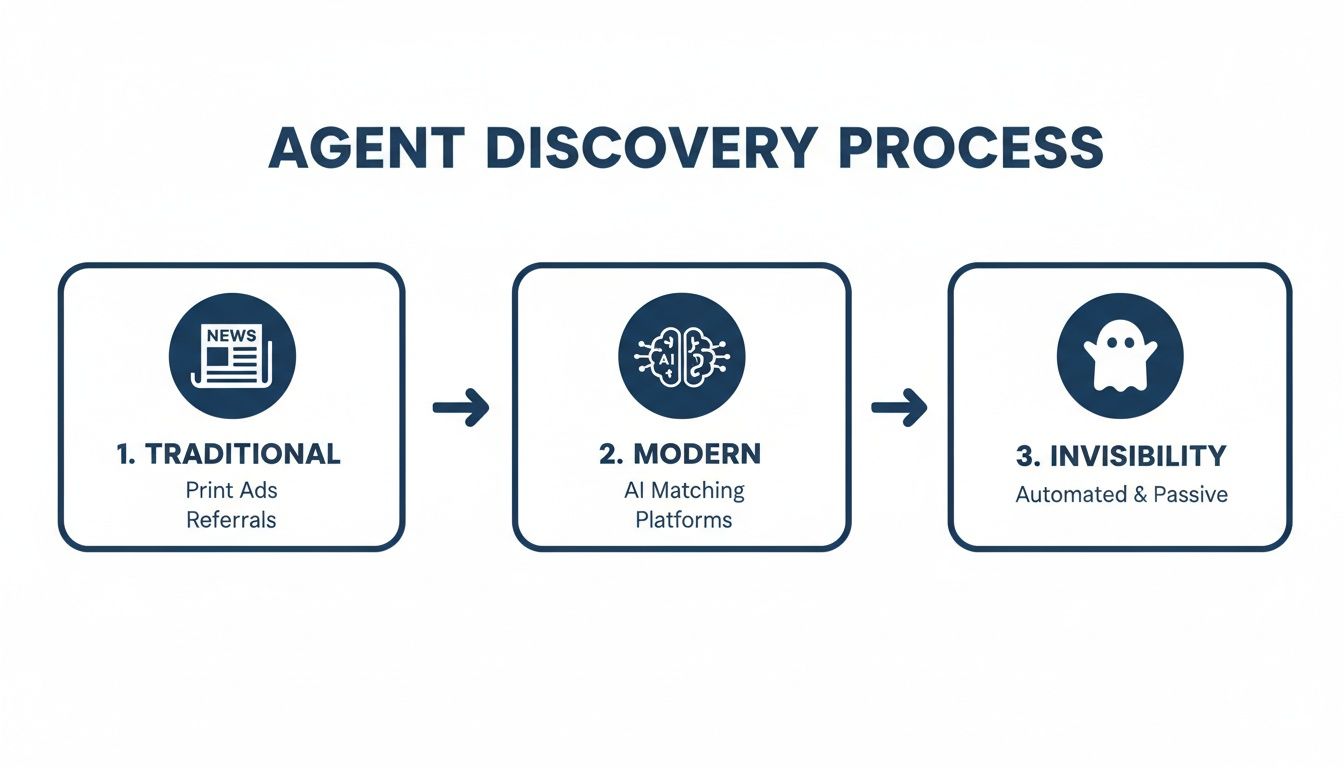
    The way clients find agents has completely changed. What worked five years ago is already outdated. Today, your digital presence is your primary storefront, and AI-powered search engines are the new matchmakers. If you’re not creating strategic content, you're practically invisible.

    Diagram showing the agent discovery process evolving from traditional methods to modern AI platforms and invisible automation.

    This new reality means every piece of content must have a job to do. To figure that out, you need to connect your big-picture business objectives to the content you create and, just as importantly, how you'll measure its success.

    This table provides a simple framework to connect the dots between your business goals and your content plan.

    Connecting Content Goals to Business Results

    Business Objective Content Goal Primary Channel Key Metric to Track
    Increase local market share Become the #1 search result for "[Your City] homes for sale" Website/Local SEO Organic search ranking and traffic
    Attract luxury listings Build a brand synonymous with high-end properties Instagram, YouTube Video views, follower growth, inquiry quality
    Generate seller leads Capture contact info from homeowners thinking about selling Email, Landing Pages Email sign-ups, lead magnet downloads
    Boost referral business Nurture past client relationships and stay top-of-mind Email Newsletter Open rate, click-through rate, direct replies

    Using a framework like this ensures you're not just posting for the sake of it. Every blog, video, and email is a calculated move to get you closer to your financial goals.

    Go Beyond Demographics to Pinpoint Your Ideal Client

    To create content that people actually care about, you have to know them better than their age and income. You need to get inside their head. What are their biggest fears about this process? What are their hopes for their next chapter?

    Let's say you want to work with young families moving from the city to the suburbs. Your client profile isn't just "millennial parents." It's "Sarah and Tom, both 34, with a toddler and another on the way. They’re terrified of picking the wrong school district and completely overwhelmed by the thought of a longer commute."

    See the difference? Now you know their specific pain points, which gives you endless content ideas that provide real value:

    • A blog post breaking down commute times from three popular suburbs.
    • An Instagram Reel showing off a hidden gem of a park in a family-friendly neighborhood.
    • A downloadable PDF guide to the top-rated elementary schools in your county.

    This approach stops you from creating generic noise and turns your content into an essential resource for the exact people you want to work with.

    Carving Out Your Niche in a Crowded Market

    You can't be the perfect agent for everyone. When you try to appeal to every type of buyer and seller, your message becomes watered down and forgettable. The agents who truly succeed are the ones who dominate a specific niche and become the undisputed expert in that space.

    Your niche is where your passion, your market's needs, and your unique expertise overlap. It's not about limiting your business; it's about focusing your marketing to attract the clients you serve best.

    Think about what makes you different. Did you work in construction for a decade? You could be the go-to agent for investors looking at fixer-uppers. Are you a data geek who loves analyzing market trends? Position yourself as the sharpest tool in the shed for real estate investors.

    Develop Your Core Messaging Pillars

    Once your goals are set and your niche is defined, the final piece of the foundation is establishing your core messaging pillars. These are the 2-3 foundational themes that every single piece of content should tie back to. They are the bedrock of your brand.

    Here are a few examples to get you thinking:

    • The First-Time Homebuyer Specialist:
      • Pillar 1: Demystifying the Process (Making real estate simple, accessible, and less scary).
      • Pillar 2: Your Financial Guide (Helping clients see homeownership as a path to building wealth).
      • Pillar 3: Community Connector (Introducing clients to their new neighborhood, not just their new house).
    • The Luxury Condo Expert:
      • Pillar 1: Unparalleled Market Insight (Data-driven advice on high-end properties and market shifts).
      • Pillar 2: A Curated Lifestyle (Showcasing the amenities, experiences, and community of luxury living).
      • Pillar 3: White-Glove Service (Highlighting discretion, elite negotiation skills, and impeccable client care).

    These pillars become your content filter. Before you hit "publish," ask a simple question: "Does this reinforce one of my core messages?" This check ensures every blog post, video, and email works together to build a powerful, memorable brand that consistently attracts your ideal clients.

    Choosing the Right Channels to Maximize Your Reach

    Having a great message doesn't mean a thing if the right people never see it. This is where so many agents get tripped up in their content strategy—they try to be everywhere at once. That's a surefire recipe for burnout and mediocre results. The smarter play is to focus your energy where your ideal clients are already hanging out.

    Your strategy has to start with the fundamentals, the absolute non-negotiables in real estate marketing. That means going where the buyers are already looking: the Multiple Listing Service (MLS) and the big property portals like Zillow and Realtor.com.

    Don't think of these as just data feeds; they're your most powerful marketing channels. Your property descriptions need to be more than a dry list of features. They have to tell a story—an AI-enhanced narrative that sells a lifestyle, not just a house. Tools like ListingBooster.ai can help you write descriptions that pop and are fine-tuned for how these platforms actually rank and show listings.

    Dominate Your Local Search Presence

    Before you even think about the endless scroll of social media, you need to lock down your local digital turf. Your Google Business Profile (GBP) is probably the single most important asset you have for local SEO. When someone types "real estate agent near me" into Google, a well-tended GBP is what gets you into that coveted local map pack.

    Keeping it fresh is simpler than you might think:

    • Post Regularly: Share something at least once a week. It could be a link to a new blog post, a "Just Sold" graphic, or a quick insight on local market stats. This just signals to Google that you're active and open for business.
    • Go All-In on Reviews: Make it a system. Every time you close a deal, ask for a review. They are a massive ranking factor and the best social proof you can get.
    • Answer Questions: Use the Q&A feature to get ahead of common questions about your market. You can essentially build a mini-FAQ right on your profile.

    Think of your Google Business Profile as your digital storefront. Neglecting it is like locking the front door during business hours. For many potential clients, it's the very first impression they'll have of you.

    Selecting the Right Social Media Platform

    Social media is where you build a community and let your personality shine, but you can't treat every platform the same. The key is to pick one or two and truly master them based on who you're trying to reach, instead of just tossing out random posts everywhere.

    Instagram
    This is your visual storytelling hub. It's a goldmine for agents targeting first-time homebuyers or working in areas with gorgeous homes and a vibrant lifestyle. You'll want to lean into high-quality photos, Reels for quick property tours, and Stories for that authentic, behind-the-scenes feel.

    Facebook
    With its massive and diverse user base, Facebook is still a powerhouse. It's fantastic for building community in local groups, running hyper-targeted ads for your listings, and sharing testimonials from happy clients. The audience often includes established homeowners, which makes it a great place to find seller leads.

    LinkedIn
    If your niche is corporate relocations, investors, or the luxury market, LinkedIn is your professional stage. This is the place for in-depth market analysis and connecting with other pros like mortgage brokers and attorneys. It’s less about "Just Listed" and more about "Here’s what the market data means for your investment portfolio."

    TikTok
    Don't write this one off as just for kids. TikTok is a huge opportunity for agents who can create quick, valuable, and engaging videos. Think 30-second clips on "Mistakes to Avoid When Buying Your First Home" or "Three Things You Didn't Know About the [Your Town] Market."

    The Unmatched Power of Your Website and Email List

    While social media is great for getting eyeballs, your website and email list are the assets you actually own. These are the channels where you turn casual followers into real, convertible leads. Your website should be the home base for all your best authority-building content, like deep-dive neighborhood guides and monthly market reports.

    SEO-optimized content on your own site is a long-term lead generation machine. In my experience, a single, well-written neighborhood guide can realistically pull in 15-20 seller leads over an 18-month period. That's the compounding magic of a solid content strategy; you create it once, and it keeps working for you 24/7.

    Your email list is your direct line—no algorithm getting in the way. It's the perfect tool for nurturing those long-term relationships, sharing off-market opportunities, and staying top-of-mind with past clients so they send referrals your way. Every single message gets delivered right where you want it: their inbox.

    The Four Pillars of High-Performing Real Estate Content

    With your goals and channels mapped out, it's time to dig into the heart of your real estate agent content strategy: what you’re actually going to create. A solid plan stops you from sounding like a broken record of "Just Listed" posts and helps you connect with people at every single stage of their journey.

    Think of your content as being built on four core pillars. Each one serves a different purpose, from showing off your inventory to proving you’re the local expert everyone should have on speed dial.

    Blue and wooden blocks on a desk illustrating content pillars for real estate: Listing, Market Authority, Personal Brand.

    Pillar 1: Listing Content

    This is your most direct, revenue-driving content. It’s not just about announcing a new property; it’s about creating a sense of urgency and inspiring immediate action. The goal here is simple: make people stop scrolling and picture their life in that home.

    Today, marketing a listing is a full-blown campaign, not just a blurb on the MLS.

    • AI-Powered Descriptions: Let AI help you craft compelling stories for the MLS and property portals. Focus on the lifestyle a home offers, not just the number of bedrooms and baths.
    • Scroll-Stopping Social Posts: For every listing, plan a sequence: a "Coming Soon" teaser to build buzz, a "Just Listed" announcement with stunning photos, an Open House invite, and finally, a "Just Sold" post to showcase your success.

    This pillar is your bread and butter. It's the tangible proof that you get results for your clients.

    Pillar 2: Market Authority Content

    While listings grab immediate attention, authority content is what builds your long-term reputation. This is where you prove you’re not just facilitating transactions but are a deeply knowledgeable market advisor. You want to be the first person people think of when they have a real estate question in your town.

    This content answers the questions your future clients are typing into Google before they even realize they need an agent.

    Your authority content is what makes AI-powered search engines recommend you. When someone asks a smart assistant, "Who is the expert on the downtown condo market?" this is the content that proves you are the answer.

    Here are a few high-impact ideas to get you started:

    • Hyper-Local Market Reports: Forget generic national stats. Dive deep into specific zip codes or even individual neighborhoods. That’s where real expertise shines.
    • Deep-Dive Neighborhood Guides: Create the ultimate resource on the communities you serve, covering schools, coffee shops, parks, and the overall vibe. This kind of content has an incredibly long shelf life.
    • Practical How-To's: Offer genuinely useful advice, like "5 Cost-Effective Upgrades to Make Before Selling" or "How to Navigate a Bidding War in Today's Market."

    Pillar 3: Personal Brand Content

    Let's face it: people do business with agents they know, like, and trust. This pillar is all about forging that human connection. It’s your chance to pull back the professional curtain and show the real person behind the license, making you far more relatable and memorable.

    In a sea of agents, your personal brand is what makes you stand out.

    Share client testimonials that highlight the experience of working with you, not just the final sale price. Give a behind-the-scenes look at a day in your life—from staging a home to navigating tough negotiations. This is how you build a loyal community that genuinely roots for your success.

    Pillar 4: Video Content

    Video isn’t just a nice-to-have anymore; it's a non-negotiable part of a modern agent's strategy. It is, by far, the most powerful tool we have for grabbing attention and building trust fast. The numbers don't lie—listings with video get a mind-boggling 403% more inquiries than those without. On top of that, 73% of homeowners now say they'd rather list with an agent who uses video. If you want to dive deeper, you can find more real estate marketing statistics that show video's true impact over at PhotoUp.net.

    The great thing about video is that it overlaps with every other pillar. You can create:

    • Listing Videos: Anything from quick property tours for Instagram Reels and TikTok to polished, cinematic walkthroughs for your YouTube channel.
    • Authority Videos: Short, punchy clips explaining a market statistic or offering a quick tip for first-time buyers.
    • Personal Brand Videos: A casual "ask me anything" session or a heartfelt video celebrating a client's closing day.

    AI tools make this so much easier now. They can help you write scripts, generate shot lists, and even map out your video calendar, making it simpler than ever to weave this crucial pillar into your weekly workflow.

    Tools, Prompts, and Tech to Make Your Workflow Sing

    Let's be real: a brilliant content strategy means nothing if you can't actually execute it consistently. The daily grind is real. This is where having the right tools and a smart workflow saves the day, turning your plan from a chore into a well-oiled machine.

    Think of today's tech, especially AI tools, as your ultimate assistant. They're not here to replace your expertise; they're here to handle the grunt work so you can focus on what you do best—connecting with people and closing deals.

    A person works on a laptop displaying a document, with coffee and an 'AI Content ToolKit' banner.

    AI Prompts That Actually Write Compelling Listings

    Staring at a blank screen trying to write yet another property description can be soul-crushing. We've all been there. Instead of reinventing the wheel for every listing, you can turn AI into your personal copywriter with the right instructions.

    Here are a couple of my favorite copy-and-paste prompts. Just swap out the bracketed details with your own property's info and watch the magic happen.

    Prompt for a Family Home:

    "Write a 150-word MLS property description for a 4-bedroom, 3-bathroom home in a quiet, family-friendly suburb. Highlight the large, fenced-in backyard, the updated kitchen with a breakfast nook, and its location within a top-rated school district. Use an aspirational and warm tone, focusing on creating a picture of family life and making lasting memories."

    Prompt for a Downtown Condo:

    "Generate a 100-word social media caption for a luxury 2-bedroom condo with floor-to-ceiling windows and city views. Emphasize the walkability to restaurants and nightlife, and use the psychological trigger of scarcity by mentioning it's a 'rare corner unit.' The tone should be sophisticated and energetic, targeting young professionals."

    Keeping Your AI Content Fair Housing Compliant

    This part is non-negotiable. AI is an incredible tool, but you are always the final check for compliance. Making sure every piece of marketing adheres to the Fair Housing Act is absolutely critical to protect your license and uphold your professional ethics.

    Before you hit "publish" on any AI-generated content, run it through this quick mental checklist:

    • Focus on the Property, Not People: Does the copy stick to the home's features and location? Or does it make assumptions about who might live there?
    • Scrub for Discriminatory Language: Have you double-checked for any words or phrases related to race, color, religion, sex, disability, familial status, or national origin? Be careful with steering language like "perfect for singles" or "a quiet, mature community."
    • Review Your Imagery: Do the photos and videos you're using reflect a diverse community and avoid reinforcing stereotypes?

    A solid rule of thumb I always follow is to describe the property, not the potential buyer. This simple filter helps you sidestep most Fair Housing issues and keeps your marketing focused squarely on the home itself.

    The Secret SEO Weapon: Schema Markup

    One of the most powerful—and most misunderstood—tools for getting your listings found on Google is schema markup. Don't let the name scare you. It's just a bit of code you add to your website that acts like a set of labels, telling search engines exactly what your content is about.

    For one of your listings, schema tells Google things like:

    • "This page is about a single-family home for sale."
    • "It has 4 bedrooms and 3 bathrooms."
    • "The asking price is $550,000."
    • "There's an open house this Saturday."

    When you provide this structured data, Google can show off your listings with "rich snippets"—those eye-catching search results with photos, prices, and event times baked right in. This makes your properties jump off the page and can seriously boost your click-through rates.

    The best part? You don't need to be a coding wizard. Many modern real estate website platforms and AI-powered tools like Listing Booster handle all this for you automatically. They add the right schema behind the scenes, giving you a huge SEO advantage without you lifting a finger.

    Common Questions About Your Content Strategy

    Even with a solid plan, actually doing the work can feel like a huge lift. It's easy to get bogged down, and the doubts start creeping in. Let's tackle the big questions I hear from agents all the time and give you some straightforward answers to get you unstuck and moving forward.

    We'll clear up the confusion so you can get back to what you do best—connecting with clients and closing deals.

    How Much Time Should I Realistically Spend on Content Each Week?

    This is probably the biggest roadblock for most agents. But I have good news: the old-school advice of grinding out 5-10 hours a week on marketing is dead. With the right tools and a smart approach, you can get this down to a manageable 1-2 hours a week.

    The secret? Stop thinking in daily sprints and start batching your work.

    Block out a single chunk of time—say, first thing Monday morning—to plan, create, and schedule everything for the week. Maybe even for the whole month. This one shift in your routine stops the daily "what should I post today?" scramble and gives you back hours for dollar-producing activities.

    Consistency comes from having a system, not from sheer willpower. When you batch your content, you create a repeatable process that ensures you're always showing up for your audience, even when you're swamped with showings and inspections.

    This turns content creation from a nagging daily chore into a predictable, streamlined part of your business.

    What If I'm Not a Good Writer or Designer?

    I hear this all the time, and honestly, it's based on a false premise. You don’t need to be a creative genius to win at content. Your real value is your deep real estate expertise and your on-the-ground knowledge of the local market—not your ability to write flowery prose or design magazine-worthy graphics.

    Your focus should be on authenticity, not artistry. The goal is to share clear, helpful insights that solve your audience's real-world problems. Today’s tools are specifically designed to fill in those creative gaps for you.

    • For Writing: AI tools can take your bullet points and spin them into compelling captions, using proven formulas that grab attention and get people to act.
    • For Design: Platforms like Canva are a lifesaver. They have thousands of professional-looking real estate templates that make you look polished in just a few minutes.

    Remember, consistency will always beat perfection. A helpful post that goes out every single week is infinitely more valuable than a "perfect" one that you only manage to create once a quarter. Done is always better than perfect.

    How Do I Know If My Content Is Actually Working?

    Measuring your ROI is absolutely critical, but you have to look past the vanity metrics like likes and shares. You need to be tracking the numbers that directly impact your bottom line. These are the metrics that actually put money in your pocket.

    Start by connecting your content efforts to tangible business outcomes:

    • Brand Awareness: Keep an eye on your reach (how many unique people see your stuff) and follower growth. Are more people in your target market seeing your name this month compared to last month?
    • Lead Generation: Track the clicks to your website from your social media bios, the number of people who download your seller's guide, and how many DMs you get asking about a listing.
    • Conversion: This one is the simplest and most powerful: just ask. Make it a non-negotiable part of your intake process to ask every single new client, "How did you first hear about me?"

    Pretty soon, you'll start hearing answers like, "I found your neighborhood guide on Google," or "I've been following your market updates on Instagram." That's when you can draw a straight line from your content right to your commission check.

    I'm Overwhelmed. Where Should I Even Start?

    If you're looking at all this and feeling completely overwhelmed, don't try to boil the ocean. Zero in on the single most important piece of low-hanging fruit: your listings.

    Master the "Listing Content" pillar first. It's the most direct path to getting results and has the most immediate impact on your income. Use an AI-powered tool to create a complete marketing kit for every single property you list.

    This package should include, at a minimum:

    1. An SEO-friendly MLS description.
    2. A full sequence of social media posts (Coming Soon, Just Listed, Open House, Under Contract, Just Sold).
    3. A quick script for a property tour video.

    Once you have a smooth, repeatable system for your listings, you can confidently branch out into market updates or that deep-dive neighborhood guide. Starting this way builds momentum and delivers immediate wins, giving you the foundation you need to build a more comprehensive content machine.


    Ready to stop guessing and start executing? ListingBooster.ai is the AI command center that builds your digital footprint automatically. Generate a complete, compliant, and psychologically compelling marketing suite for every listing in minutes, so you can focus on what you do best—selling homes.

    Start your free trial and see the difference at ListingBooster.ai.