You've seen this happen. The photographer delivers strong images, the seller wants the home live today, and the MLS text box is still blank. That last step looks simple, but it isn't. A real estate listing description now has to persuade, stay compliant, and read cleanly on platforms where buyers skim in seconds.
That's why weak copy costs more than most agents realize. It doesn't just make the listing sound flat. It can dilute the positioning of the property, create avoidable review issues, and waste the quality of everything else you've already done to launch well.
Why Your Listing Description Is Your Most Important Asset
The MLS description field is one of the few places where your judgment is fully visible. Photos show the property. Price signals strategy. But the words show whether the agent understands how to market a home with precision.
A strong real estate listing description does three jobs at once. It frames the home's value, helps the right buyer quickly understand what matters, and keeps the marketing grounded in language that won't create unnecessary risk. That's a very different task from tossing features into a paragraph and calling it done.
Why the text box matters more than agents think
Most agents were taught to treat listing copy like a summary. That's outdated. Buyers already see the core data in the listing interface. What they need from the description is context, priority, and momentum.
Zillow's guidance reflects that shift. It notes that a widely used benchmark is 250 words or less, including the headline, and that if space is limited, agents can leave out basics like beds, baths, and square footage when those details already appear elsewhere in the listing display on Zillow's listing description guidance.
Practical rule: Don't use your description to repeat the database. Use it to explain why this home is worth a closer look.
That same mindset improves everything downstream. Better listing copy gives you cleaner ad copy, stronger social captions, and more focused talking points for buyer inquiries. If you want examples of messaging angles that translate well from listing language into paid promotion, Contesimal has a useful roundup on ads that convert more deals.
What works and what usually fails
The descriptions that perform well tend to feel selective. They don't try to mention everything. They identify the few features that shape buyer perception, then present them in an order that makes sense.
What fails is familiar:
Feature dumping with no hierarchy
Generic adjectives like “stunning,” “beautiful,” and “must-see” doing all the work
Wall-of-text formatting that collapses on mobile
Buyer-targeting language that drifts into compliance trouble
You're not filling space. You're building a marketing asset.
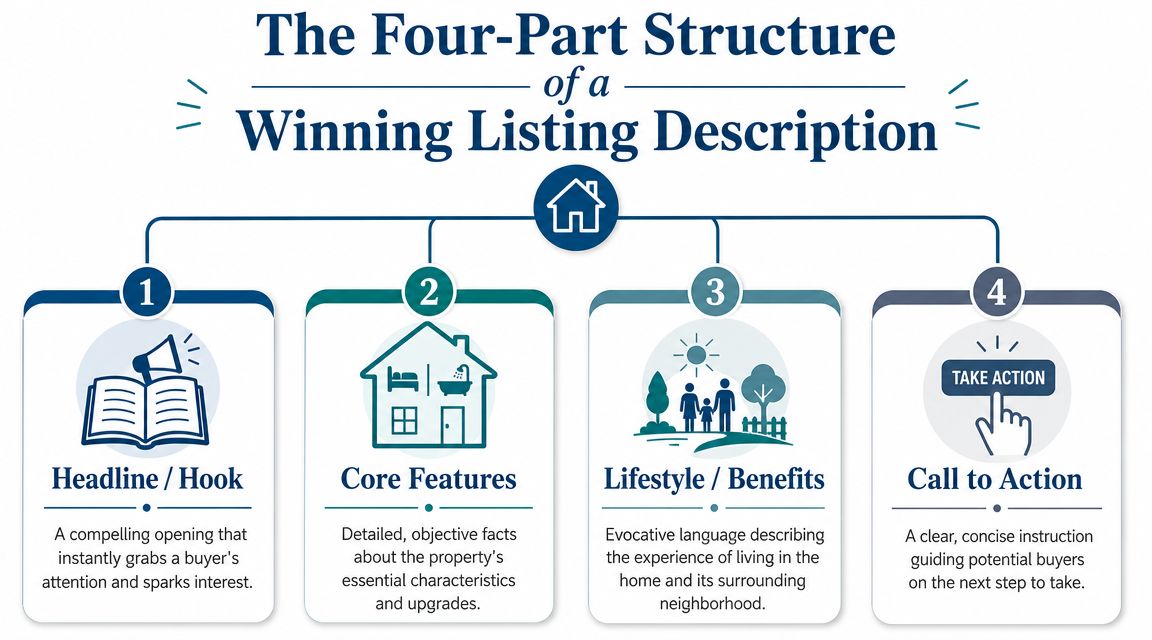
The Four-Part Structure of a Winning Description
Most weak descriptions have the same problem. They have information, but no sequence. The fix is a repeatable structure that helps buyers absorb the listing quickly and helps you write faster without sounding templated.
Start with an opening feature
Your first line has one job. It needs to surface the property's strongest angle immediately.
Lead with what changes perception fastest. That might be a renovated kitchen, a panoramic view, a rare layout, a detached workspace, or outdoor living that adds selling power. Don't open with “Welcome to” or “Don't miss this.” Those phrases take up space and say nothing.
Use this approach instead:
Weak opening “Beautiful 4 bedroom home in a great area.”
Stronger opening “Renovated kitchen, vaulted great room, and a covered patio that extends the living space outdoors.”
The second version gives the buyer something concrete to picture.
Add the facts buyers need first
After the hook, give a concise factual summary. Practitioner guidance commonly recommends short blocks, including a brief property summary of about 60 words, followed by 150 to 200 words on highlights and standout features, with 2 to 3 versions written for different buyer segments and a peer review pass before publishing, as outlined in this practitioner video on description tips for real estate agents.
That structure works because it respects the way people read on mobile. It also aligns with the platform constraint already noted above. Keep the copy lean. Prioritize upgrades, layout benefits, and details that don't already appear in a standard data field.
A clean factual block often covers:
Layout essentials such as split-bedroom plan, main-level primary, flex room, or finished lower level
Notable updates like new roof, replaced windows, remodeled bath, or upgraded appliances
Operational details buyers care about, including storage, parking, outdoor space, or work-from-home functionality
Use lifestyle language carefully
Lifestyle sells when it's tied to the property, not to the person who should buy it. That distinction matters.
Good lifestyle language describes the experience of the space:
morning light in the breakfast area
direct flow from kitchen to patio
a quiet home office with built-ins
a fenced yard with room for gardening, entertaining, or pets
Bad lifestyle language describes the occupant:
perfect for families
ideal for young professionals
safe neighborhood
exclusive community
Good listing copy lets the buyer imagine a life in the home without telling them who they are.
End with a real call to action
The CTA should be simple and specific. Not clever.
Examples that work:
Schedule a private showing.
Ask for the full feature sheet.
Tour the home in person to see the updates and layout flow.
That final sentence matters because many descriptions just stop. A clear closing gives the buyer a next step and makes the marketing feel complete.
Before and after example
Before “Beautiful move-in ready home with lots of updates. This home has a great floor plan, spacious rooms, nice backyard, and is close to shopping, dining, and schools. Must see.”
After “Updated kitchen, generous natural light, and a backyard setup designed for everyday use. This home offers a functional layout with spacious living areas, refreshed finishes, and flexible rooms that work for guests, work, or hobbies. The main living spaces connect easily to the outdoor area, creating a practical flow for relaxing or entertaining. Convenient access to shopping, dining, parks, and commuter routes adds everyday ease. Schedule a private showing to experience the layout and upgrades in person.”
The difference isn't style alone. It's structure.
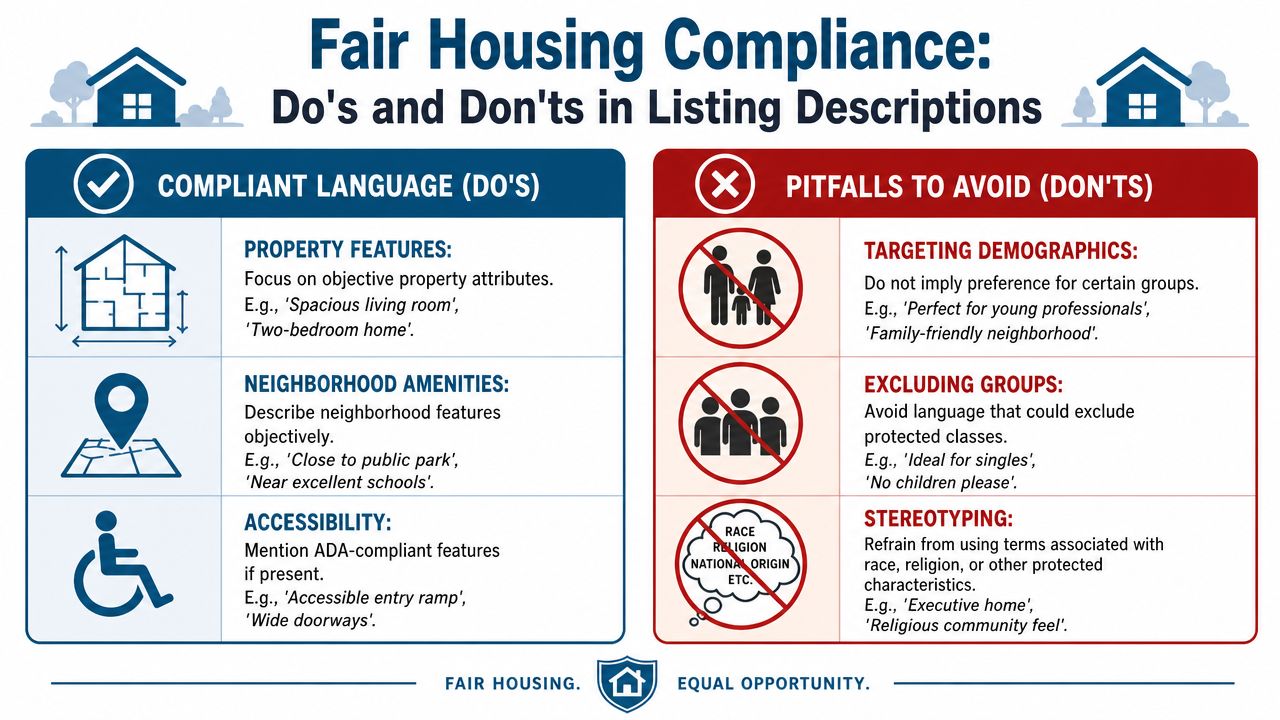
Mastering Compliant Copy to Avoid Fair Housing Pitfalls
A lot of listing advice tells agents to “sell the dream.” That sounds good until the copy starts implying who should live there. Then you're not marketing creatively. You're creating risk.
The safer standard is simpler. Describe the property, not the people. Dotloop's guidance highlights this exact gap in common training and notes that the safest copy is often the copy that is specific, factual, and avoids assumptions about the buyer, as discussed in Dotloop's article on writing great real estate listings.
Problem phrases and better replacements
Some phrases are common because agents hear them all the time. That doesn't make them safe.
Risky wording
Better direction
Perfect for families
Spacious backyard, multiple bedrooms, flexible living area
Safe neighborhood
Nearby parks, sidewalks, lighting, community amenities
Walk to church
Close to local services and neighborhood destinations
Ideal for young professionals
Home office, low-maintenance exterior, easy commute access
Exclusive area
Gated entry, private lot, limited through traffic
This isn't about stripping personality out of the copy. It's about putting the personality in the home itself.
Keep persuasion tied to observable facts
The cleanest persuasive writing uses details a buyer can verify:
Feature-based language like “floor-to-ceiling windows” or “covered rear patio”
Location context such as “near public park,” “close to downtown dining,” or “convenient access to commuter routes”
Accessibility features if present, described factually
Avoid euphemisms that blur meaning. If a home needs work, say what needs updating. If there's an unusual condition, don't hide it behind vague phrases.
Specific beats clever. In listing compliance, clarity is usually the safer choice.
A practical workflow helps. Draft the copy. Then do one review pass for accuracy and one separate pass only for compliance language. If you want help systematizing that review, ListingBooster.ai's compliant listing tool covers a real estate specific approach to generating and checking listing language.
Writing for Algorithms, MLS, Portals, and AI Search
Your description isn't read only by buyers. It's also parsed by listing portals, MLS systems, and AI tools that summarize homes in response to prompts and search queries.
That changes the writing standard. Fluffy prose may sound polished, but it often hides the exact signals these systems look for. Perry Real Estate College points to this newer shift, noting that buyers increasingly start with AI tools and that concise, specific, mobile-friendly phrasing with concrete attributes and location context may outperform vague copy because AI systems extract structured signals from explicit facts in its discussion of modern listing writing.
What machine-readable copy looks like
Think in searchable attributes, not just mood.
Instead of:
upgraded throughout
designer touches
amazing location
Write:
white oak flooring
quartz countertops
dual-pane windows
detached two-car garage
near Greenway Trail and downtown retail corridor
That doesn't mean robotic writing. It means using real nouns. The systems that surface listings can do more with “Bosch appliances” than with “chef-inspired kitchen.”
Adapt the same listing for each platform
A single version rarely fits every use case. MLS copy, portal copy, social captions, and AI-facing summaries often need different levels of compression and different emphasis.
One practical option is to build variants manually. Another is to use a purpose-built platform that understands real estate inputs and outputs platform-specific versions. ListingBooster.ai is one example. It generates listing descriptions and related marketing content from property details for different real estate platforms.
For a broader look at the underlying idea, MyMentions has a solid primer on optimizing for generative AI. The big takeaway is straightforward. Clear structure and explicit property facts travel better across new search environments.
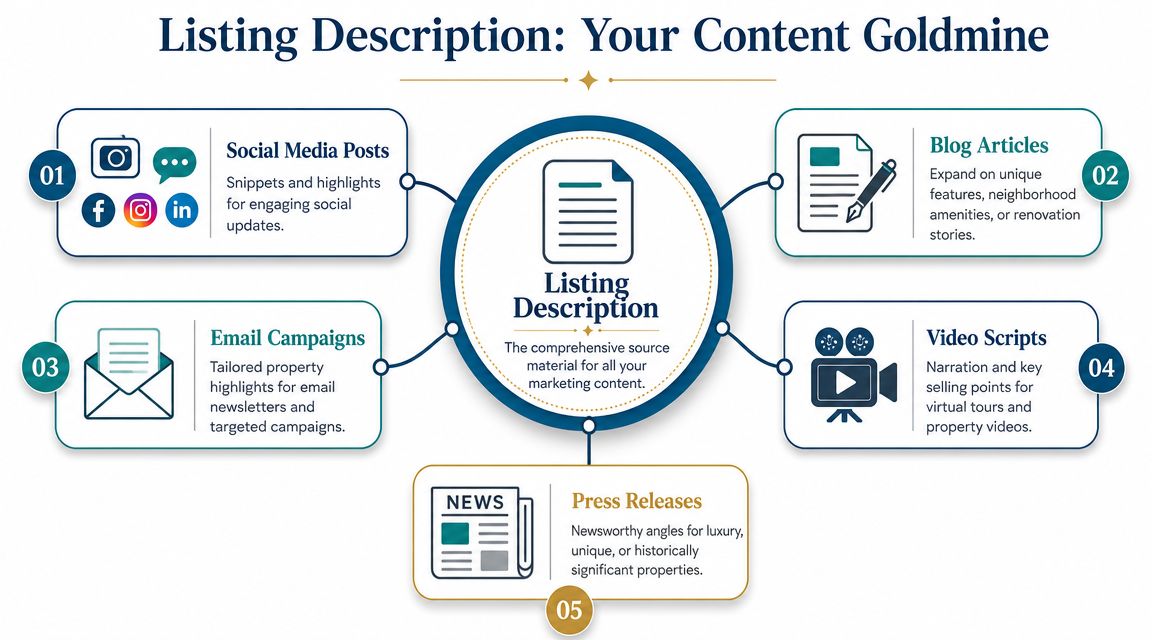
Turn Your Listing Description into a Content Goldmine
Writing a strong listing description takes effort. You should get more than one use out of it.
The smartest agents treat the final description as source material for every other marketing asset around the listing. That approach also improves consistency. Your Instagram caption, email teaser, open house post, and brochure copy all stay aligned because they came from the same core message.
Pull the description apart by format
Practitioner guidance suggests descriptions perform best in short blocks and recommends writing 2 to 3 versions for different buyer segments. That same discipline makes repurposing easier, as noted in this guidance on multi-channel content for agents.
Here's how to break one description into working parts:
Headline for social posts Use the opening hook as your “Just Listed” caption starter.
Facts for email and flyers Pull the factual block into a concise summary for newsletters, postcards, and brochures.
Lifestyle lines for Instagram or Facebook Use one or two benefit-focused sentences that describe how the space lives, while staying property-focused.
Feature details for video narration Turn your room-by-room highlights into a short walkthrough script.
One solid listing description should feed the entire launch, not sit in the MLS and die there.
Platform variants that actually make sense
You don't need endless rewrites. You need smart versions.
One version should be MLS-clean and tightly compliant. Another can be slightly warmer for social. A third can be stripped down for mobile-first platforms where skimming dominates. The point is not more words. It's better fit.
That's why agents who rely on one generic paragraph usually look repetitive across channels. The listing starts to feel copied, not marketed.
The Modern Agent's Advantage
The agents who stand out now don't just “write better.” They position properties with more discipline. They know when to lead with the feature, when to tighten the facts, when to cut a risky phrase, and when to create a shorter variant for a different platform.
That's a key advantage. A polished real estate listing description signals competence before a buyer ever schedules a showing and before a seller ever asks how you'll market the home. It shows that your process is deliberate.
If you want to keep sharpening that edge, it helps to follow marketing resources built around visual merchandising and listing presentation as well. aiStager regularly publishes useful ideas in aiStager's latest posts that complement the copy side of the listing launch.
The blank MLS field isn't a writing chore anymore. It's a test of whether your marketing can hold up across compliance review, mobile attention spans, and AI-driven discovery.
If you want a faster way to produce platform-specific, real-estate-focused copy without relying on generic AI prompts, ListingBooster.ai is built for that workflow. It helps agents turn property details into MLS-ready descriptions and supporting social content while keeping the process structured, editable, and practical for day-to-day listing launches.
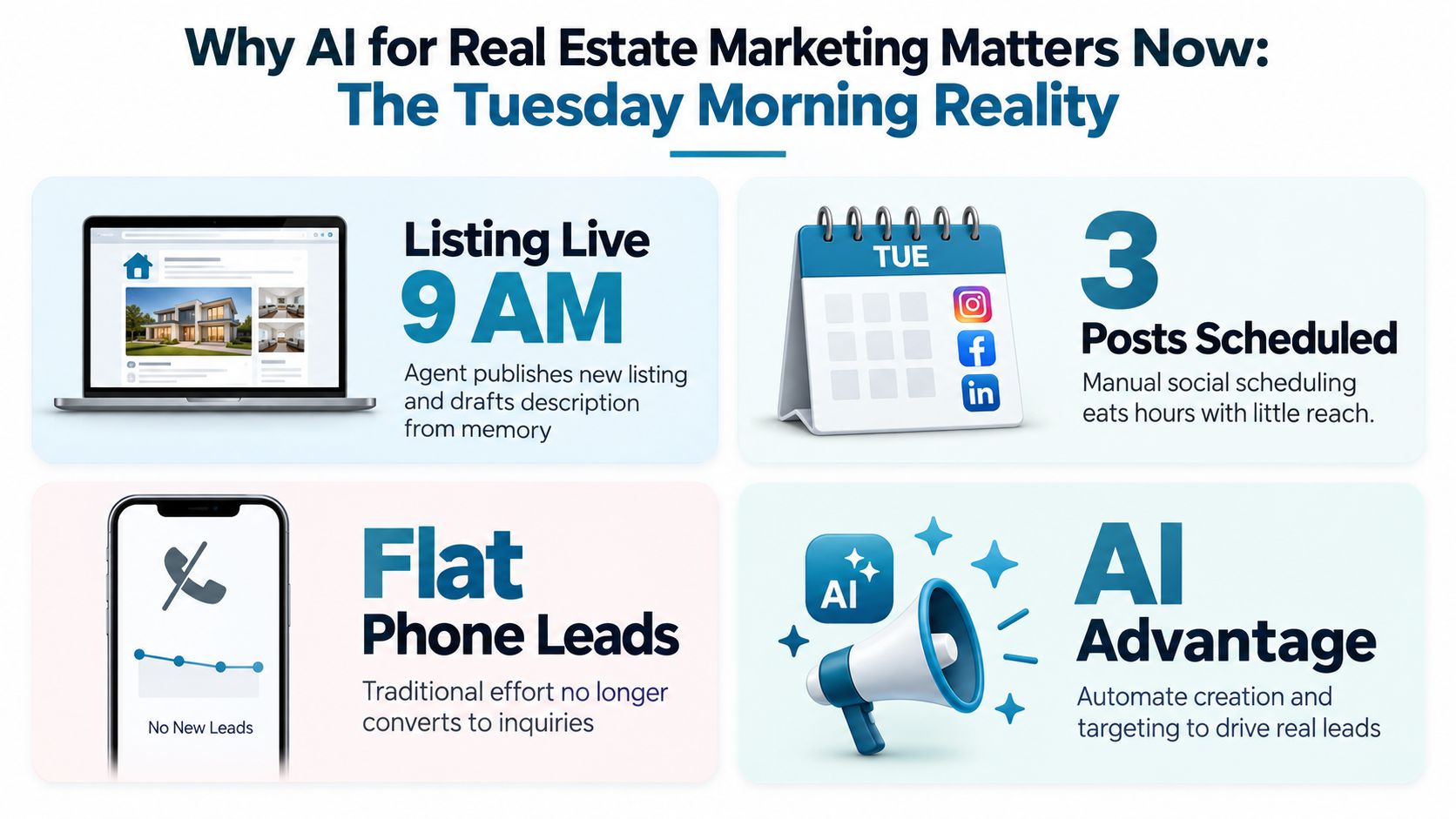
You know the drill. A new listing is going live, photos are in, the MLS deadline is close, your phone is ringing, and you still need a description, an Instagram caption, a Facebook post, a LinkedIn update, and something usable for email. Most agents don't lose time on marketing because they lack ideas. They lose it because every listing creates a fresh content pileup.
That pileup used to be annoying. Now it affects visibility.
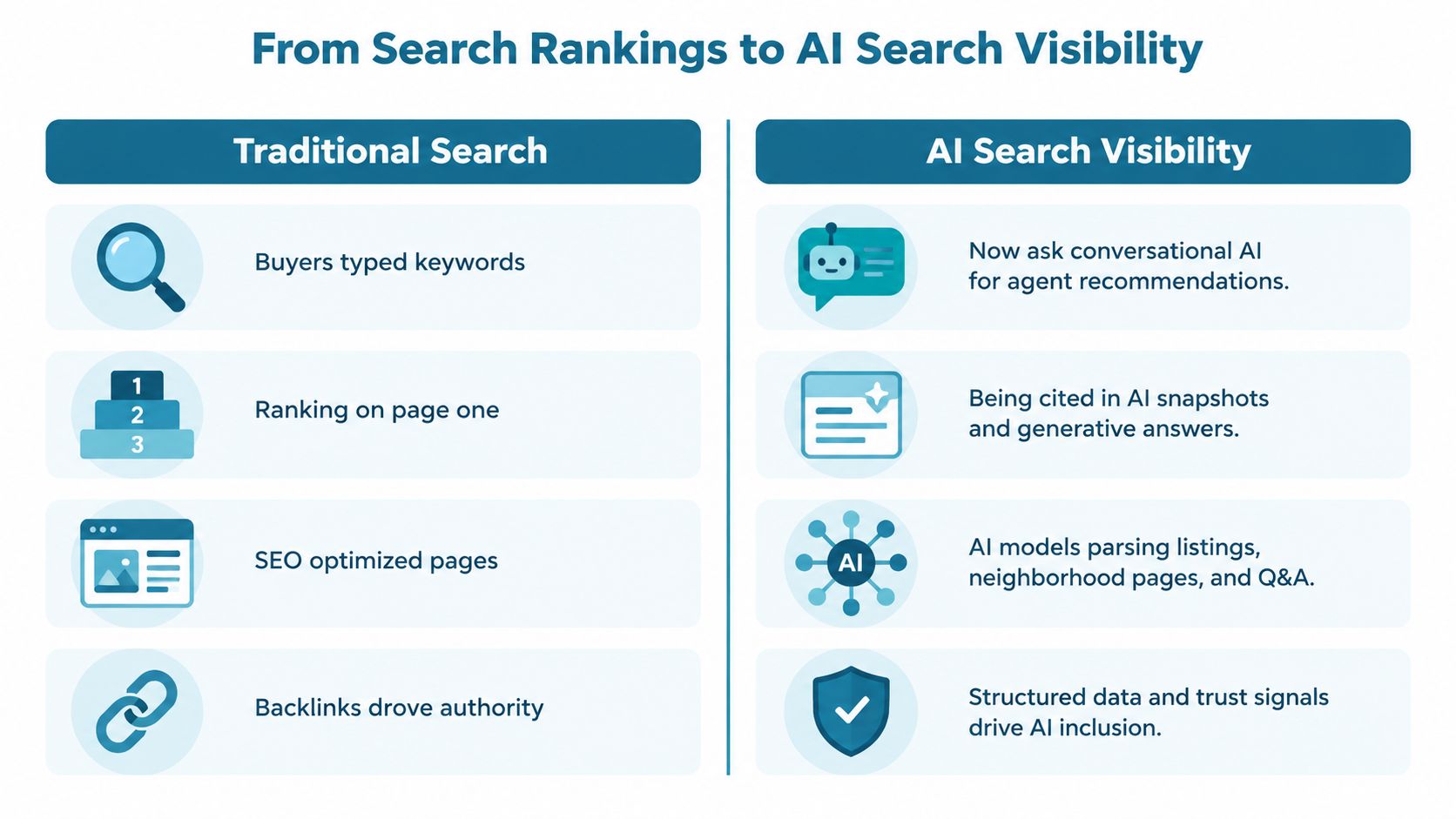
Over 40% of homebuyers now incorporate AI tools like ChatGPT, Perplexity, and Google AI into their search process, which means agents without a consistent, AI-readable digital footprint risk getting overlooked, as noted in Propphy's real estate AI guide. That changes the job. You're not just writing one description for the MLS anymore. You're building a listing marketing system that has to work across search, social, and syndication.

An AI real estate listing description generator earns its keep when it removes that scramble. Not by replacing your judgment. By giving you a repeatable starting point that turns verified property facts into clean first drafts you can adapt fast, review carefully, and publish everywhere with confidence.
The End of the Late-Night Content Scramble
A lot of agents still treat listing content as a last-minute writing task. That's the bottleneck.
You finish pricing strategy, coordinate staging, approve photos, and handle seller questions. Then marketing gets compressed into whatever time is left. The result is familiar: a rushed MLS description, copied captions across platforms, and inconsistent messaging from one listing to the next.
That approach breaks down fast when your listing has to do more than fill a text box.
The real problem isn't the blank page
The issue usually isn't writing skill. It's production capacity. One property now needs multiple versions of the same core message. The MLS needs factual, compliant copy. Instagram needs a concise hook. Facebook needs more context. LinkedIn needs a professional angle. Email needs a reason to click.
Good listing marketing starts with one verified source of truth, then branches into channel-specific versions.
That's why a solid AI workflow matters. It lets you start with structured property data and generate usable drafts quickly, while keeping your message aligned across every place the listing appears.
What changes when you use AI well
A strong system does three things at once:
Cuts the initial drafting burden: You stop writing every asset from scratch.
Improves consistency: The same property story carries across MLS, social, and email.
Protects your time: You spend more energy on review, positioning, and client service than on repetitive copywriting.
Used this way, AI isn't a novelty. It's an operating layer for listing launch.
Choosing the Right AI Generator for Your Business
Not every AI tool belongs in a real estate workflow. Generic AI can write fluent text, but fluent text is not the same thing as listing-ready marketing.
The difference starts with data. Effective real estate AI is built on structured data, and a purpose-built tool can process inputs like address, beds, baths, and square footage to generate compliant, localized, and channel-specific assets, according to ListingAI's description generator workflow. That matters because real estate content isn't just creative. It's operational.
Generic AI versus real estate-specific AI
Here's the practical comparison.
Feature
Generic AI (e.g., ChatGPT)
Purpose-Built Tool (e.g., ListingBooster.ai)
Property fact intake
Manual prompt entry
Structured fields for listing data
MLS-ready copy
Possible, but inconsistent
Designed for MLS-style output
Social versions
Requires extra prompting
Built to produce multiple channel variants
Fair Housing screening
Manual review required
Often included as a workflow guardrail
Brand voice control
Prompt-dependent
Usually guided by saved preferences or templates
Editable drafts
Yes
Yes, usually within a listing workflow
Fact grounding
Depends on what you type
Anchored to listing fields and source inputs
A generic tool is fine for brainstorming. It's less reliable when you need repeatable output from verified facts, especially under deadline.
What a good generator must do
If you're evaluating an AI real estate listing description generator, don't get distracted by how polished the demo sounds. Check whether it handles the parts that matter in daily practice:
MLS-ready copy: The draft should be concise, factual, and easy to edit for local MLS rules.
Social media versions: One listing should generate short-form posts without forcing you to reprompt from scratch.
Fair Housing screening: This should be part of the workflow, not an afterthought.
Editable drafts: You need to tighten language, remove weak claims, and tailor the message.
Brand voice support: Luxury, new construction, relocation, urban condo, and suburban move-up listings shouldn't all sound identical.
Fact grounding: The tool should work from actual property inputs, not guesswork.
Practical rule: If a tool saves time on drafting but creates more review risk, it's not efficient.
For a broader look at category options, this guide to AI content tools is useful as a general overview. For a more industry-specific roundup, this overview of top AI solutions for agents is a better fit for real estate workflows.
Where purpose-built tools fit
A platform like ListingBooster.ai fits naturally. It's built around real estate inputs and multi-channel output, rather than asking you to build the entire workflow from prompts alone. That's a meaningful distinction if your goal is speed with control, not just speed.
Establishing Your AI Content Workflow and Compliance Guardrails
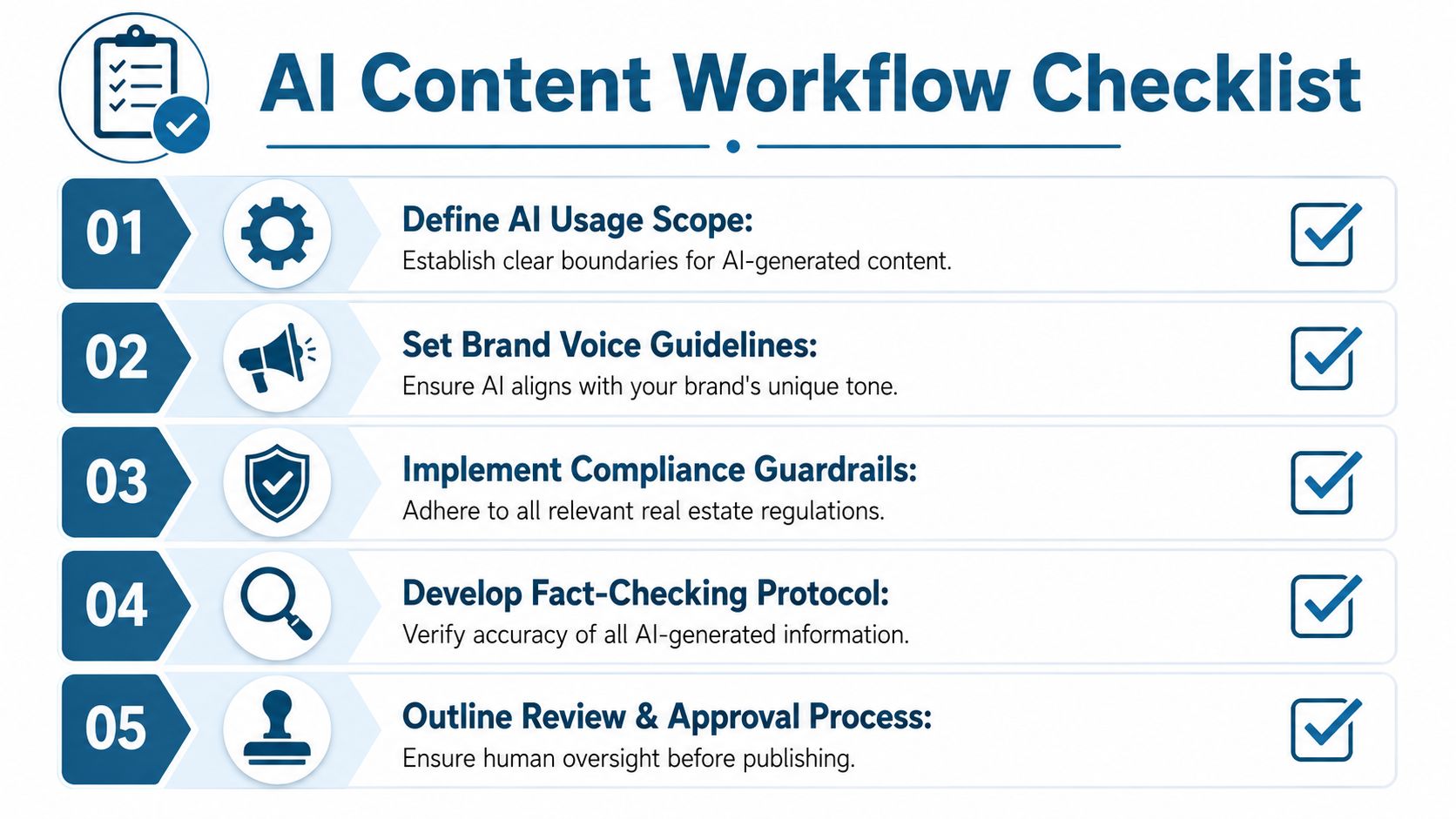
The most important decision happens before you generate anything. You need a review process.
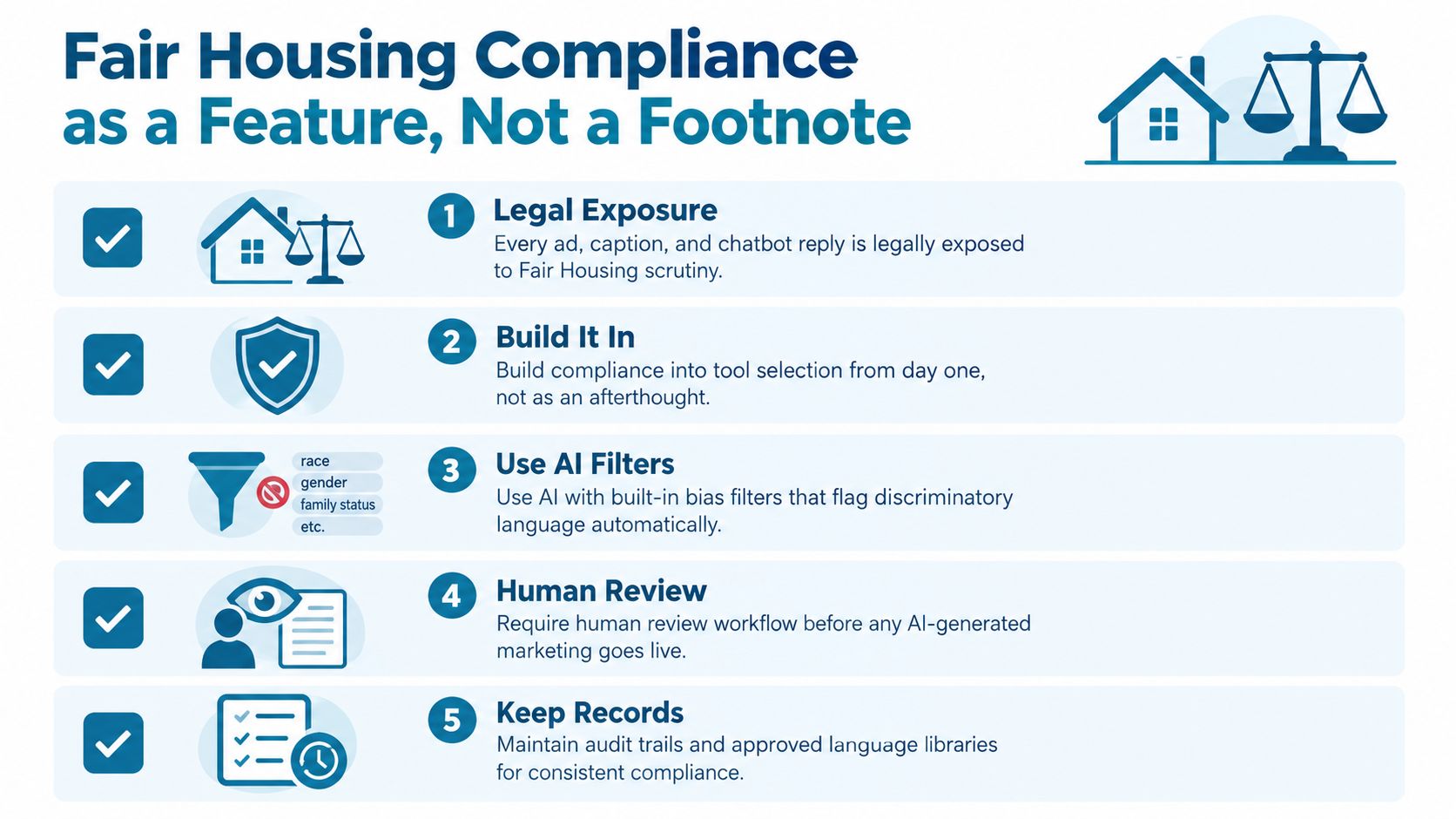
The biggest risk in AI content generation isn't poor writing. It's liability. A single unsupported claim or Fair Housing issue can spread across MLS, portals, and social posts, which is why a human approval workflow is essential, as discussed in Hypotenuse AI's real estate generator guide.
Verify facts before style
The AI draft should only be as strong as the facts you feed it. Manually confirm the fields that commonly cause problems:
Property basics: Bedrooms, bathrooms, square footage, lot size, parking, year built.
Upgrades and features: Renovation details, appliance brands, roof or HVAC updates, outdoor improvements.
Location details: School names, HOA references, transit claims, neighborhood amenities.
Status-sensitive details: Open house timing, price changes, concessions, occupancy notes.
If you can't verify it, don't publish it.
Screen for Fair Housing risk every time
Many agents get casual at this stage. Don't.
Avoid language that describes who should live in the home or implies anything about protected classes. Skip phrases like “perfect for families,” “safe neighborhood,” or “ideal for young professionals.” Describe the property itself instead.
Use this kind of translation:
Instead of: “Perfect for families” Use: “Flexible floor plan with multiple living areas and a fenced yard”
Instead of: “Safe, quiet street” Use: “Located on a cul-de-sac” or “set on a low-traffic residential street,” if accurate
Instead of: “Walk to church” Use: “Close to neighborhood services and community amenities,” if verified and appropriate
Your license doesn't care whether a problematic phrase came from you or from software. You're still responsible for the final copy.
Build a simple approval sequence
Keep it tight:
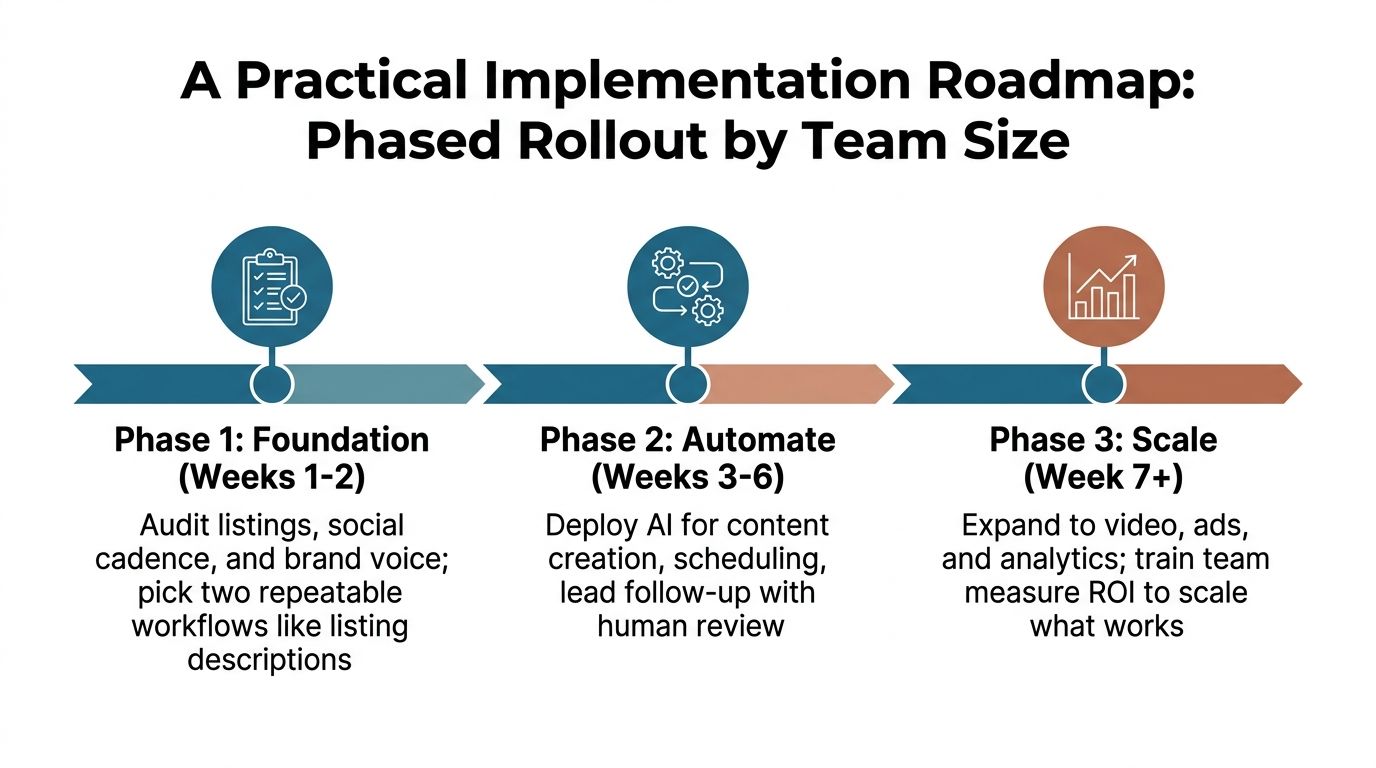
Load verified listing facts
Generate draft variations
Review for factual accuracy
Screen for compliance and unsupported claims
Approve platform versions for publishing
That process is what turns AI from a risk into an asset.
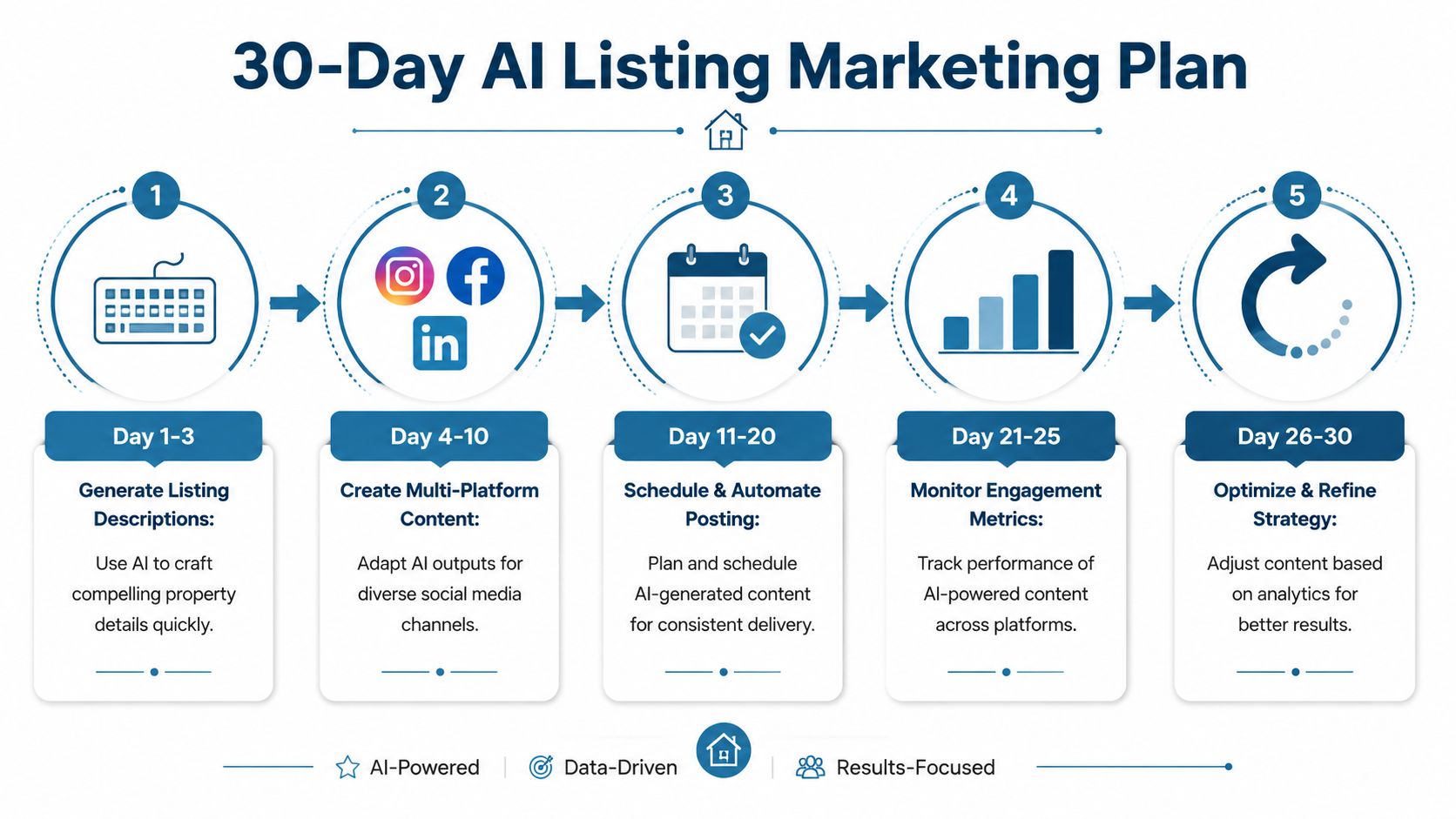
Executing Your 30-Day Listing Marketing Plan
The best use of an AI real estate listing description generator is to treat the MLS description as the core asset, not the final deliverable. One approved draft can drive a month of coordinated marketing if you plan it correctly.
Days 1 to 3 with the cornerstone asset
Start with the verified property record and your own notes from the home. Generate:
An MLS description: Clear, accurate, and stripped of fluff
A longer website version: More room for narrative and feature grouping
A short-form summary: Useful for portals, email intros, and teaser posts
At this stage, you're deciding what story the listing will tell. Is the angle architectural detail, updated interiors, lot utility, outdoor living, or location convenience? Pick one primary angle and one secondary angle. Don't try to make every feature the headline.
Days 4 to 10 with launch content
Once the core description is approved, derive launch assets from it.
A practical sequence looks like this:
Coming soon post: Focus on anticipation. Tease the strongest visual or functional feature.
Just listed post: Use the clearest summary version and strongest first image.
Story or Reel script: Turn the description into a walkthrough voiceover.
Email announcement: Keep the first paragraph tight and direct readers to photos or a tour page.
Days 11 to 20 with event-based updates
Most listings need more than one announcement. Build around the actual sales cycle.
Listing stage
Best content angle
What AI should generate
Open house
Access and urgency
Caption, story slides, reminder text
Price adjustment
Fresh value framing
Updated copy emphasizing features and positioning
Under contract
Momentum and proof of activity
Status post and seller-facing credibility content
Just sold
Marketing recap and market presence
Closing announcement and authority post
Content planning offers assistance. If you want a repeatable schedule instead of posting ad hoc, use a framework that helps you attract clients with content planning.
Days 21 to 30 with follow-up and reuse
After the listing has been live for a while, don't abandon the content. Recut it.
Use the original description to create a feature spotlight post, a behind-the-scenes caption about prep and launch, or a market positioning post that explains what the property represented in the local market. The same listing can support both lead generation and authority building when the workflow is organized from the start.
Adapting AI-Generated Content for Each Social Platform
The draft shouldn't be identical everywhere. Platform-native packaging matters.
Instagram and TikTok need movement
Instagram captions work best when they lead with a visual hook, then quickly anchor the property's strongest selling point. Reels need a short script with scene-by-scene pacing, not a pasted MLS paragraph.
For TikTok, use the listing description as raw material for voiceover structure:
opening hook tied to the standout feature
quick room-to-room progression
short closing line with next action
If you're turning approved listing copy into video ads or short-form creative, tools like ShortGenius automated ad generation can help speed up video production after the messaging is finalized.
Facebook needs context and conversation
Facebook still works well for community-aware listing posts and event promotion. The copy can be a little longer. Give enough detail for someone to understand why the property stands out, then invite a practical next step such as attending an open house or requesting details.
Good Facebook posts often combine:
a concise lead sentence
two to three verified features
one action prompt
LinkedIn should build professional credibility
LinkedIn is the place to frame the listing as evidence of your marketing process and market knowledge. Don't write like you're posting to Instagram with a suit on.
A LinkedIn listing post should sound like a professional market update attached to a property, not a sales flyer.
Use angles like pricing strategy, presentation quality, neighborhood demand patterns, or the importance of clean syndication-ready content. The property is still the hook, but your expertise is the core subject.
Building Your Authority Engine with AI
The smartest agents use listing content to build a body of work, not just fill a weekly posting slot.
With 43% of shoppers willing to use generative AI in their home search, discoverability now depends on a consistent footprint of authority content that helps AI systems recognize trusted local expertise, according to Skyline School's write-up on listing description generators.
The content pillars that actually help
Your AI workflow shouldn't stop at active listings. Build around a few durable themes:
Local market interpretation: Short commentary on inventory, pricing patterns, or buyer behavior in your area
This kind of content gives AI search systems more evidence about who you are, what market you know, and what topics you consistently cover.
Why listing-only content isn't enough
If your digital presence only appears when you have a property to sell, your footprint stays thin. A stronger pattern is to use each listing as a content trigger. One home can lead to an evergreen post about staging decisions, another about lot utility, another about condo positioning, another about pricing communication.
That's how an AI real estate listing description generator becomes part of your authority engine. It helps you start faster, then expand outward with judgment and local knowledge.
Measuring What Matters and Refining Your AI Strategy
If you only watch likes, you won't know whether the content is helping the business.
Track actions, not applause
Review your listing content monthly and focus on signals tied to actual intent:
Comments and direct messages: Did the post start real conversations?
Saves and shares: Did people treat it as useful enough to revisit or send along?
Website clicks: Did the content move people to the listing page or contact form?
Lead quality: Did inquiries relate to the property, the neighborhood, or future selling plans?
Appointments set: Did any content lead to a showing, consultation, or listing conversation?
Use the review to improve prompts
Look for patterns in what worked. Maybe feature-focused captions drove better inquiries than generic launch posts. Maybe your LinkedIn market commentary brought in referral conversations. Maybe short walkthrough scripts held attention better than static image posts.
Then adjust the workflow. Refine the source inputs, improve your prompts, shorten weak openings, and keep your review process tight. AI should make your system sharper over time, not just faster.
Conclusion: From Content Creator to Content Strategist
An AI real estate listing description generator is most useful when you stop treating it like a writing shortcut and start using it like marketing infrastructure. The win isn't just faster copy. It's a cleaner launch process, stronger consistency across channels, and fewer last-minute content decisions.
Agents still need to verify facts, apply judgment, and protect compliance. That part doesn't change. What changes is the amount of manual drafting required to get a listing in front of buyers professionally.
Used well, AI moves you out of production mode and into strategy mode. You spend less time wrestling captions and more time guiding positioning, reviewing quality, and serving clients. That's the right role for a working agent or team.
If you want to see what that kind of workflow looks like in practice, ListingBooster.ai is worth exploring. It's built for real estate-specific inputs and can help turn one set of verified listing facts into MLS-ready copy and supporting social content, while keeping editing and compliance review in your hands.
You're probably staring at the same box every agent knows too well: the listing description field is blank, the photos are uploaded, the facts are in the MLS, and you need copy that sounds sharp without creating a compliance problem. That tension is real. A good description helps market the property. A careless one can create avoidable risk.
AI raises the stakes. It can save time, but it can also produce phrases that sound polished while crossing a line. The safer path isn't just running finished copy through a bad-word filter. It's using a Fair Housing compliant listing description generator in a way that limits risk from the first prompt.
Why Every Listing Description Carries Legal Risk
Most agents don't get in trouble because they meant to discriminate. They get in trouble because ordinary marketing language drifted into describing the ideal occupant instead of the home.
That's why listing remarks deserve more respect than they often get. A sentence can be catchy, warm, and still imply preference. In print-only eras, exposure was narrower. Now every remark can spread across MLS feeds, portals, brokerage sites, email alerts, and social posts within hours.
The blank field problem
A typical sequence goes like this. An agent finishes the data entry, opens the remarks box, and starts with something harmless sounding: “perfect for…” That's usually the moment the risk begins. The sentence stops being about granite, floor plan, lot size, or transit access and starts being about who should live there.
General AI tools can make this worse because they're designed to predict persuasive language, not housing-law-safe language. If your prompt includes tone cues, buyer assumptions, or neighborhood stereotypes, the model may confidently expand them into copy you should never publish.
Practical rule: If a sentence tells the reader what kind of person belongs there, rewrite it so it tells the reader what the property offers.
Fair housing compliance is not a side issue in this workflow. The U.S. Fair Housing Act was enacted in 1968, and later policy shifts expanded the practical compliance burden for digital real estate marketing, which is why compliance tooling has become a working necessity for listing copy at scale, as noted in this overview of AI listing description compliance.
Why scale makes small mistakes expensive
At a brokerage level, the concern isn't just one bad phrase. It's repetition. When agents publish listing after listing under deadline pressure, the same weak habits get copied, pasted, and amplified.
A risky workflow looks like this:
Start with style before facts and let the tool improvise.
Prompt with buyer assumptions such as age, family status, religion, or income signals.
Rely on post-editing alone and hope someone catches every issue.
A safer workflow starts with constraints. That's where specialized systems help. They turn compliance from a final clean-up task into part of the drafting logic itself.
Understanding Prohibited and Preferred Language
The core principle is simple: describe the property, not the people.
That sounds easy until you look at how often real estate language slips into identity, lifestyle assumptions, or coded references. The goal isn't to make copy dull. It's to make it objective, attractive, and broad enough to welcome the widest possible audience.
What creates risk
Some language is obviously problematic. Some isn't. The more common problem in practice is subtle implication.
Here are the patterns I tell new agents to watch for:
Demographic assumptions “Ideal for young professionals,” “great for retirees,” and “perfect for families” all shift attention from the property to the person.
Religious or cultural references Mentioning proximity to a house of worship or framing a home around a cultural group can imply preference, even if the intent was convenience.
Familial status signals Phrases tied to children, parenting, or household composition can suggest who the home is for.
Subjective neighborhood coding Terms like “mature neighborhood,” “exclusive area,” or similar language can carry implications beyond the property itself.
Outdated room labels Terms such as “master bedroom” are often better replaced with neutral alternatives like “primary suite.”
Better wording in practice
This isn't about stripping all personality from the copy. It's about moving the energy into facts, layout, finishes, and verified location details.
Risky phrasing
Safer alternative
Perfect for young couples
Thoughtful layout with flexible living space
Walk to temple
Convenient access to neighborhood amenities
Quiet, mature neighborhood
Residential setting with established homes
Family-friendly backyard
Fenced backyard with usable outdoor space
Master bedroom
Primary bedroom or primary suite
The difference matters. The left column suggests people. The right column describes features.
The strongest listing remarks don't tell readers whether they belong. They give readers enough property detail to decide for themselves.
A quick test agents can use
Before you publish, read each sentence and ask:
Does this sentence describe the home or describe the likely occupant?
Is the claim objective, or is it coded opinion?
Could a reasonable reader hear preference or exclusion in it?
If the sentence fails any of those tests, rewrite it.
A good rewrite usually does one of three things:
swaps a person-based claim for a feature-based claim,
replaces a vibe word with a factual detail,
removes any reference that could signal protected-class preference.
That mental filter catches more than a banned-word list ever will.
How to Prompt Your AI for Compliant Descriptions
A compliant output starts with a compliant input. If your prompt is vague, emotional, or demographic, the draft will usually be the same. If your prompt is factual, constrained, and specific, your editing burden drops fast.
Use the factual-first method
Real-estate AI guidance consistently points to the same practical workflow: feed exact property facts first, set constraints, generate a core paragraph, then review and remove exclusionary language before publishing, as explained in this guide to AI property description workflows.
That means your prompt should include items such as:
Core property facts like beds, baths, square footage, lot details, parking, and HOA information
Specific upgrades such as quartz countertops, white oak floors, or a renovation date when verified
Objective location details like transit access, parks, or shopping, if those facts are accurate
Output limits such as tone, word count, and platform context
Negative constraints telling the model what to avoid
Copy-and-paste prompt template
Use something like this:
Write an MLS-ready property description using only the facts provided below. Focus on the property's features, layout, finishes, and verified location advantages. Do not reference buyer type, age, family status, religion, gender, disability, income level, or any protected characteristic. Do not imply who the property is for. Avoid subjective neighborhood coding and avoid vague terms when a specific fact is available. Use clear short sentences and a professional tone.
Facts: Property type: Beds/Baths: Square footage: Lot or outdoor features: Kitchen details: Primary suite details: Flooring: Parking: Recent upgrades with dates if verified: Nearby amenities or transit if verified: HOA if relevant:
Output: one main description for MLS.
That template works better than “Write a compelling description for this charming home” because it narrows the model's freedom where risk usually enters.
What not to put in the prompt
Avoid prompt instructions like these:
Target buyer language such as “for young families” or “appeals to professionals”
Emotional steering like “make it sound exclusive”
Unverified claims such as “updated kitchen” if you don't have the actual upgrade details
Formatting assumptions that may break MLS rules
Some broader AI resources are helpful for understanding how agents are using these tools day to day. The Virtual Tour Easy guide to AI is useful background reading if you want a wider view of where AI fits into the real estate workflow.
For MLS-specific drafting ideas, it also helps to review examples of an AI property description writer for MLS listings so you can compare general prompting with a more structured listing workflow.
One more operational detail
Don't forget platform formatting. Some MLS systems reject emojis and special symbols. Good copy can still fail if the final formatting isn't accepted by the system where you're publishing.
Automating Compliance with ListingBooster.ai
Manual review still matters, but a lot of risk can be reduced before you ever reach that step. That's the value of a purpose-built workflow. It doesn't just generate text. It limits where bad text can come from.
What a compliant-by-design workflow looks like
A strong system does four things in order:
Takes structured listing inputs instead of relying on a loose creative prompt.
Builds the draft around property facts rather than audience assumptions.
Checks for compliance issues automatically before the copy is finalized.
Produces variants for the channels you use without forcing you to rewrite from scratch.
That's where ListingBooster.ai fits cleanly into brokerage operations. It generates MLS-oriented property descriptions from listing inputs and applies a compliance-focused workflow so the agent isn't starting from a blank page or a generic chatbot prompt.
Before and after thinking
Consider the difference between these two drafts.
Loose draft: “Perfect for a growing family, this charming home sits in a quiet neighborhood and features an updated kitchen.”
Reworked draft: “This home offers a functional layout, fenced outdoor space, and a kitchen with verified improvements. The residential setting and usable interior flow support a range of living needs.”
The second version isn't weaker. It's safer because it stays tied to observable features.
Review standard: Good compliant copy still sells the property. It just does the selling through facts, not assumptions.
Why output discipline matters
Industry guidance puts the main description benchmark at about 200–250 words for balancing readability and detail on major portals, while also recommending an 8th–10th grade reading level and short sentences, according to this listing description length guide.
That matters in compliance work because long, meandering copy tends to invite filler language. Filler is where unsupported adjectives, coded neighborhood claims, and buyer assumptions sneak in.
A disciplined tool should help you produce copy that is:
Long enough to inform without wandering
Readable enough to scan quickly
Specific enough to sound credible
Neutral enough to avoid steering
The trade-off isn't compliance versus marketing strength. The trade-off is structured drafting versus improvisation. Improvised AI copy may feel fast in the moment, but it usually creates more review work later.
The Final Review Before You Publish
Even with a strong generator and a decent compliance scan, the final responsibility still belongs to the licensee and the brokerage. This responsibility is what distinguishes professionals from casual users of AI. They don't assume the draft is safe just because software produced it.
The sign-off checklist
Use a short, repeatable review before anything goes live:
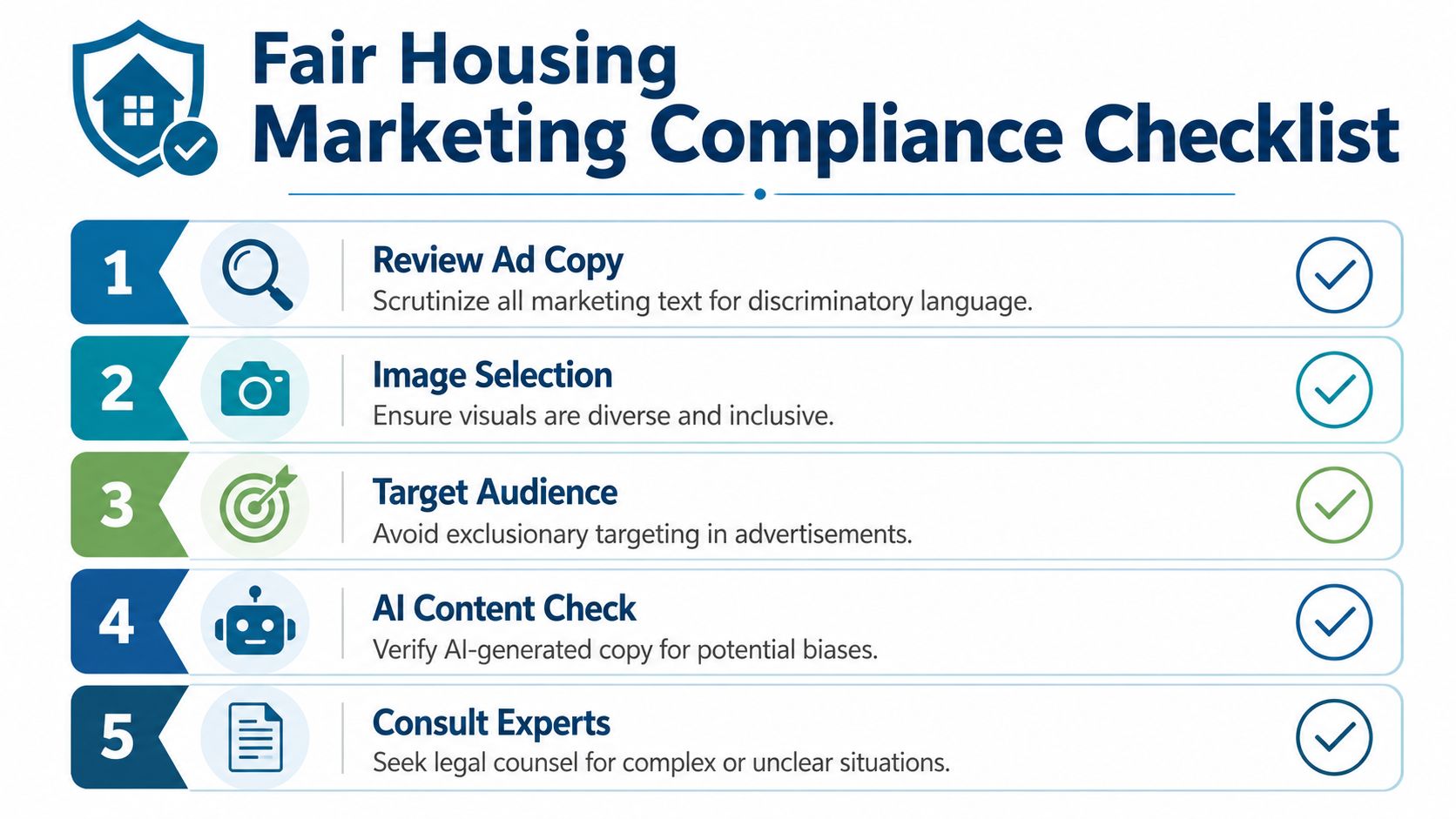
Read for protected-class references Remove any direct or indirect language tied to race, religion, sex, familial status, disability, or other protected categories in your jurisdiction.
Check that every sentence is property-centered If a sentence describes the likely resident instead of the home, rewrite it.
Replace vague claims with verifiable detail “Updated” should usually become the specific improvement if you can support it.
Review for platform fit MLS copy, portal copy, and social captions don't always tolerate the same formatting or style.
Get a second set of eyes when needed A colleague may catch an implication you missed.
Jurisdiction matters
Federal rules are only the floor. Your state, city, local board, or MLS may have tighter expectations. That's why I tell agents to keep one current internal reference point for approved wording and escalation questions.
If your team needs a practical framework for platform-safe marketing, this MLS-compliant real estate marketing article is a useful companion to the listing-description review process.
A final review isn't busywork. It's your professional sign-off that the marketing describes the property accurately and invites the broadest lawful audience.
Answering Your Toughest Compliance Questions
The hardest compliance questions usually show up in unique listings. Accessibility features, school references, neighborhood context, and local protected classes all create gray areas if you're using AI casually.
Can I mention accessibility features
Yes, if you describe the feature, not the person who should use it. “No-step entry,” “wider doorway,” or “elevator access” is different from making assumptions about disability or medical need. The safer habit is to describe the physical attribute and stop there.
Can I mention nearby schools or religious institutions
Be careful. School quality language and religious proximity can quickly drift into steering. If a location fact is important, keep it objective and relevant to geography, not to a type of resident. In many cases, agents are better off avoiding references that pull the copy toward protected-class inference.
Why isn't a compliance scanner alone enough
Because the deeper problem starts earlier. General AI has no built-in understanding of housing-law boundaries. It can introduce risky ideas through prompt context, style settings, or neighborhood framing before the checker ever sees the final sentence.
That's why one of the most important compliance questions today is not “How do I catch bad wording after generation?” It's “What parts of the generation system should be restricted so protected-class language can't emerge in the first place?” That design issue, along with the fact that state and local rules may extend beyond federal protected classes, is discussed well in this analysis of Fair Housing and AI workflows.
What should be restricted in the system itself
Three controls matter most:
Prompt inputs should be limited to factual property data and verified location details.
Style presets should avoid buyer avatars or demographic targeting.
Neighborhood references should be screened so they don't become coded signals about who belongs there.
That's the shift brokerages need to make. Don't just buy a tool that flags violations after drafting. Build a workflow that prevents the risky draft from appearing in the first place.
If your team wants a simpler way to draft property remarks inside a more controlled marketing workflow, ListingBooster.ai is worth evaluating for that purpose. It gives agents a structured way to generate listing content from property inputs while keeping compliance review part of the process, which is a far safer approach than improvising with a general chatbot and fixing problems later.
When we talk about creating MLS-compliant AI content, we're talking about using artificial intelligence to write property descriptions and other marketing copy that plays by the rules—specifically, the rules of your Multiple Listing Service (MLS) and Fair Housing laws. It’s all about tapping into AI's incredible speed without sacrificing accuracy or integrity. Every word has to be right, non-discriminatory, and respectful of data privacy.
The New Reality of Real Estate Marketing
The way people search for homes has fundamentally changed. Buyers aren't just scrolling through portals anymore. Many are now starting with conversational AI tools, asking for agent recommendations or quick summaries of available properties.
This shift puts immense pressure on your digital first impression. For agents on the ground, the challenge is straightforward: how do you churn out compelling, high-volume marketing content without accidentally stepping over a legal or regulatory line?
This is precisely where MLS-compliant AI content becomes a game-changer. It’s not just about grabbing any AI off the shelf; it's about using tools specifically built with the real estate industry's unique constraints in mind.
Defining Compliance in an AI Context
So, what separates a genuinely "compliant" AI tool from a generic one? It really boils down to a few core principles that a purpose-built platform will have baked into its DNA.
A compliant tool absolutely must prioritize these three things:
Data Privacy and Integrity: The AI should never, ever be trained on proprietary MLS data. It needs to process your listing information without storing or learning from it, which is crucial for protecting the integrity of the MLS database and following IDX rules.
Fair Housing Adherence: The system needs built-in guardrails to actively prevent discriminatory language. This isn't just about blocking obvious no-no words; it's about flagging subtle phrases that could imply preferences related to family status, neighborhood demographics, or other protected classes.
Factual Accuracy: It has to stick to the script. The AI should only generate descriptions based on the specific, factual data you provide for a listing. This prevents it from making up "features" or embellishing details that could lead to misrepresentation.
Key Takeaway: Using a generic AI for real estate is like driving without insurance. You might get away with it for a bit, but the risk of a costly compliance violation is always there. A specialized, compliant tool is your policy for marketing safely and effectively.
The Surge in Agent Adoption
The shift to AI isn't some far-off trend—it's happening right now. AI has quickly become a standard part of the real estate world. A staggering 97% of agents at major U.S. brokerages are now using AI tools in their daily work.
This isn't a small change; it shows how AI has gone from a curiosity to an essential piece of an agent's toolkit, especially for writing content. You can see the full breakdown in this Delta Media Group survey analysis.
What this massive adoption rate tells us is that agents who don't start integrating these tools risk getting left behind. The goal isn't to let AI run wild but to use it as a powerful, safe partner to stay competitive and give your clients the best service possible.
Building Your Compliance-First AI Framework
Before you let an AI write a single word of your marketing copy, you need a solid, compliance-first framework. This isn't about adding red tape; it's about building a smart, repeatable process that keeps you, your brokerage, and your clients out of hot water. Your entire strategy needs to be built on two pillars: protecting MLS data integrity and strictly adhering to Fair Housing laws.
Think of your MLS database like a private, members-only library. Every member contributes their books (listing data) under a very specific set of rules. A generic AI tool, when given this data, might just treat it like any other information on the public internet, using it to train its own model. That's a huge problem.
Unauthorized data scraping or letting an AI train on proprietary MLS feeds is a surefire way to get hit with fines or even lose your MLS access. The fundamental rule is simple: the data belongs to the cooperative, and its use is tightly controlled.
Upholding MLS Data Integrity
The gold standard for working with MLS data is something called stateless AI processing. It sounds technical, but the concept is critical: the AI uses your listing information for the specific task you give it and then immediately forgets it. It absolutely does not learn from, store, or share the proprietary data you provided.
This approach is non-negotiable for maintaining the integrity of the MLS. In fact, MLS executives are adamant about creating "walled garden" architectures to prevent data leaks. According to industry analysis, MLSs require this kind of transient AI processing where tools guarantee no training occurs on their data. This is essential for upholding broker attribution and IDX rules. If you want to go deeper, this analysis on MLS data and AI risk management really breaks down the technical side.
When you're vetting an AI partner, you need to ask some direct questions:
Is your processing stateless?
Do you train your models on my listing data?
How do you ensure compliance with our IDX rules?
You're looking for clear, unequivocal answers: "No," "No," and "We have built-in safeguards." Anything less is a red flag. This due diligence protects the entire real estate ecosystem.
Navigating Fair Housing Laws with AI
The second pillar, Fair Housing, demands even more careful attention. AI models learn from scraping unimaginable amounts of text from the internet, a place that's unfortunately full of hidden biases. Without the right guardrails, an AI can easily spit out language that sounds great on the surface but is actually discriminatory.
The danger isn't just about avoiding obviously illegal words. The real risk is in the subtle stuff—phrases that describe people instead of the property. For instance, calling a home's location a "quiet, family-friendly neighborhood" seems innocent enough. But it could be interpreted as discriminating against people without children, which is a violation of familial status protections.
Expert Tip: The safest rule of thumb is to always describe the property, never the potential buyer or neighbor. Focus on tangible features like "a spacious, fenced-in backyard" instead of "a perfect yard for kids to play in." Let the features speak for themselves.
Here are a few common areas where seemingly harmless phrases can land you in trouble:
Familial Status: Steer clear of terms like "family home," "perfect for singles," or "no kids."
Protected Classes: Any mention of nearby churches, specific cultural centers, or a neighborhood’s demographic makeup is off-limits.
Disability: While "walk-in closets" is perfectly fine, stating a property is "not handicap accessible" can be problematic. Focus on what the property has, not what it lacks.
One of the smartest things you can do is create your own internal guardrails. Put together a simple checklist to run every piece of AI-generated copy through before it goes live. That final human review is your ultimate safety net, making sure every description is not only compelling but also completely above board. And if you're looking for more ways to up your marketing game, check out our guide on the top AI tools for real estate agents for some great ideas.
Alright, let's get into the nitty-gritty of how you actually talk to an AI to get what you want. This is where the magic happens. Think of it less like barking an order and more like briefing a very talented, but extremely literal, assistant.
Your goal is to get brilliant, compliant copy by being crystal clear about what you want—and just as clear about what you don't want.
Tossing a generic prompt like "Write a description for 123 Main St" into the AI is a recipe for a bland, and potentially risky, result. A well-engineered prompt, on the other hand, builds a set of guardrails. It guides the AI to create MLS compliant AI content that’s both compelling and safe from the start.
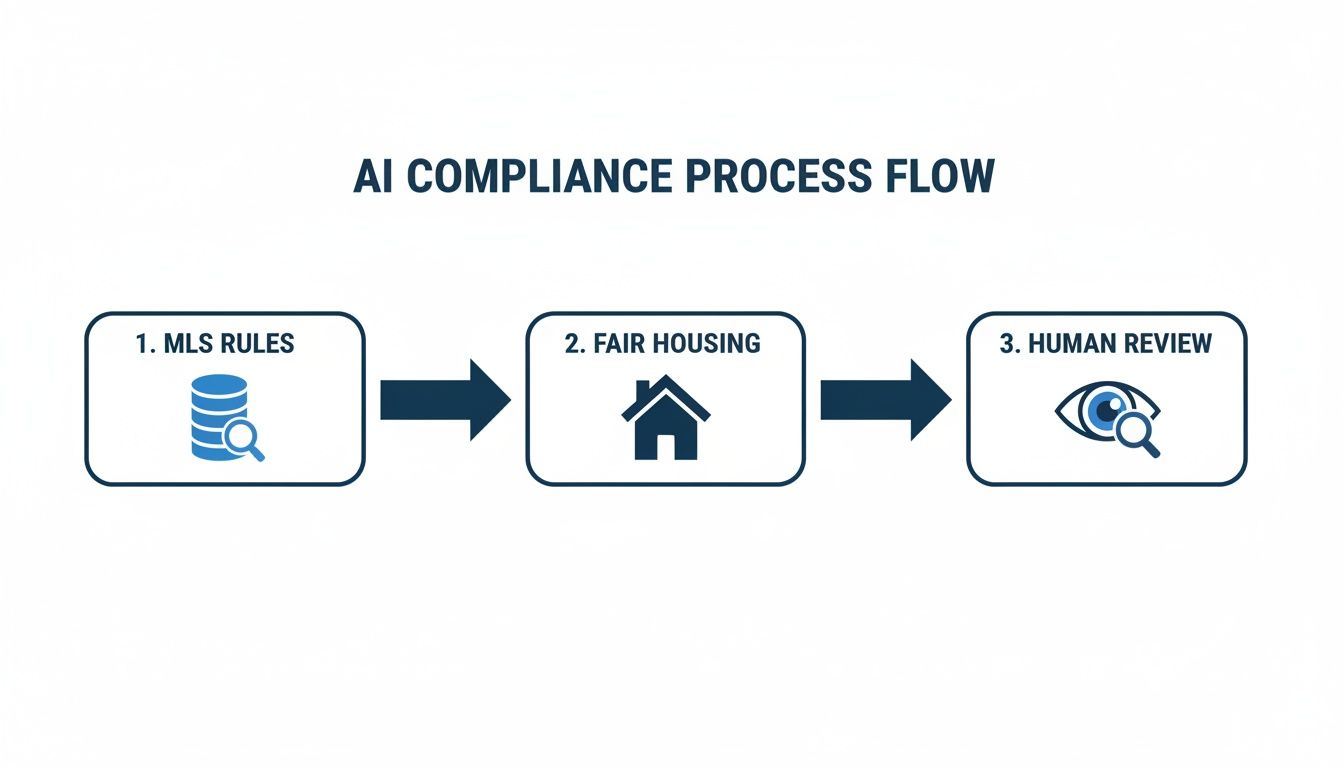
This whole process is about layering your instructions correctly. You start with the rules, add the property facts, and always, always end with a human check.
As you can see, compliance isn't a one-and-done task. It's a structured workflow, and human oversight is the final, non-negotiable step.
The Anatomy Of A Perfect Prompt
So, what does a great prompt actually look like? It’s like a recipe—miss one key ingredient, and the whole thing can fall flat.
Every solid real estate prompt needs these elements:
Set the Scene: Tell the AI its role and objective. "You are an expert real estate copywriter creating an engaging MLS description for a luxury property."
Feed it the Facts: This is the raw data. Address, square footage, bed/bath count, and a bulleted list of key features (e.g., Calacatta quartz countertops, new architectural shingle roof, saltwater pool).
Define the Vibe: Give the AI a clear direction on tone. Is it "elegant and sophisticated," "warm and inviting," or "modern and minimalist"?
Describe the Lifestyle, Not the Person: This is where agents get into trouble. Instead of saying it’s for "a family," describe the lifestyle the home supports, like "a home designed for entertaining and seamless indoor-outdoor living."
Build Your "Do Not" List: This is your most powerful compliance tool. Be explicit about what the AI cannot do.
My best piece of advice: Your negative constraints are your first line of defense. I start nearly every prompt with a hard-and-fast set of rules like, "Strictly adhere to all Fair Housing guidelines. Do not mention family, children, race, religion, or any other protected class. Focus only on the property’s features and amenities, not who might live here."
Effective vs Ineffective AI Prompts for Real Estate
The difference between a prompt that gets you into hot water and one that gets you a great listing description is all in the details. A vague prompt invites the AI to fill in the blanks, often with stereotypes or problematic language. A specific, constrained prompt forces it to be creative within safe boundaries.
Here's a look at how that plays out in the real world:
Scenario
Ineffective Prompt (High Risk)
Effective Prompt (Low Risk & High Impact)
Suburban Home
"Write a fun description for this 4-bed house. It's in a great, family-friendly neighborhood with good schools."
"You are a real estate copywriter. Write a warm, inviting description for the 4-bed, 3-bath home at 123 Maple Lane. Highlight the large, fenced-in yard, the bonus room over the garage, and its location just a short walk from community green spaces. CRITICAL: Do not use language that violates Fair Housing laws. Describe the home's features, not the potential buyer."
Downtown Loft
"Draft a description for a trendy downtown loft. Perfect for a single professional or a young couple."
"Act as a copywriter for urban real estate. Create a modern, sophisticated description for Loft #5B at 45 Main St. Emphasize the 15-foot ceilings, exposed brick walls, and oversized industrial windows. Mention the building's rooftop deck and its Walk Score of 98. CRITICAL: Do not mention age, profession, or marital status."
Luxury Waterfront
"Write a luxury listing for this waterfront mansion. It's an exclusive community for elite buyers."
"You are a luxury property specialist. Write an elegant and compelling description for the estate at 7 Ocean Drive. Focus on the direct ocean access from the private dock, the chef's kitchen with Sub-Zero and Wolf appliances, and the infinity-edge pool. Use a tone of understated luxury. CRITICAL: Avoid exclusionary or preferential language. Adhere to Fair Housing laws."
As you can see, the effective prompts aren't just longer; they are fundamentally different. They guide the AI with precision, leaving no room for error while pushing for high-quality, descriptive language.
Real-World Prompt Examples
Let's walk through a couple of common scenarios to see how this works in practice.
The Charming Starter Home
A quick, thoughtless prompt might be: "Write a description for a 3 bed, 2 bath starter home. It's in a great neighborhood for families." This is a Fair Housing minefield.
Here’s how to do it right:
Prompt: "You are a real estate copywriter. Write a warm and inviting MLS description for the property at 456 Oak Avenue.
Property Details:
3 bedrooms, 2 bathrooms, 1,400 sq ft
Fenced-in backyard with a large deck
Updated kitchen with new stainless steel appliances
Located two blocks from a public park and community center
Instructions:
Highlight the updated kitchen and the backyard deck as key selling points.
Focus on the property's features and its proximity to community amenities.
CRITICAL: Do not mention families, children, or describe the type of people who should live here. Adhere strictly to Fair Housing guidelines."
This prompt steers the AI toward tangible assets, making it a perfect example of creating MLS compliant AI content that sells the space, not a discriminatory stereotype. If you're curious about how AI is changing property discovery, we have an article on ChatGPT's impact on real estate search visibility.
The Sleek Downtown Condo
A weak attempt: "Write about a cool 1-bed condo downtown. Perfect for a young professional." Again, we're describing a person, which is a major red flag.
Here's the compliant, high-impact version:
Prompt: "Act as a copywriter specializing in urban properties. Create a sophisticated and modern property description for Unit 702 at 789 City Plaza.
Property Details:
1 bedroom, 1 bathroom, 850 sq ft
Floor-to-ceiling windows with panoramic city views
Building amenities: rooftop terrace, 24-hour concierge, fitness center
Walk score of 95, steps from public transit and restaurants
Instructions:
Emphasize the stunning city views and the convenience of a high walk score.
Use a tone that reflects a contemporary, upscale lifestyle.
CRITICAL: Do not use any discriminatory language. Focus only on the unit's features, building amenities, and location. Do not mention age, profession, or marital status."
By engineering your prompts with this level of detail, you turn a generic AI into a specialized marketing partner—one that produces compelling copy that attracts buyers without attracting lawsuits.
Your Most Important Step: The Human Review
Think of your AI tool as a highly skilled assistant. It can draft content with incredible speed, but you’re still the one in charge. The final call, the critical checks, and the ultimate responsibility all land squarely on your shoulders.
That’s why a final human review is the most vital, non-negotiable part of this entire process. Skipping it is a gamble you just can't afford to take in this business. A small mistake can lead to big problems.
This isn't about rewriting everything from scratch. It’s a focused, five-minute audit to make sure every word is accurate, compliant, and genuinely sounds like it came from you. This quick check is what separates professional, risk-managed marketing from reckless automation.
Your Three-Point Inspection Checklist
A systematic approach makes this review fast and effective. Before you even think about hitting "publish," every single AI-generated draft needs to pass this simple three-point inspection. Consider it your final safety net.
Fact-Check the Details: Does the description perfectly match the listing data? Double-check the square footage, room counts, lot size, and specific features you fed the AI. No exceptions.
Scan for Compliance and Tone: Read through with an eye for Fair Housing and MLS rules. Is the language inclusive and appropriate? You’re also checking to see if the tone aligns with your brand or if it sounds too robotic.
Align with Your Brand Voice: Does this actually sound like you? AI can mimic a style, but it can't replicate your unique market insights or that personal touch your clients know and trust.
A Real-World Example: I once saw an AI-generated description for a beautiful historic home that proudly mentioned a "newly installed oak staircase." One problem: the staircase was original, century-old pine. It was a small detail, but it was a material misrepresentation. The agent caught it during a quick two-minute review, avoiding a potentially serious issue.
This AI-driven productivity boost is changing the game. With 91% of marketers already actively using AI, the efficiency gains are undeniable. The teams who adapt are seeing 2-3x returns, mostly from how fast they can now create content. This is mirrored in real estate, where 74% of agents use AI for social media and emails, cutting down tasks that once took hours to just minutes. You can dig deeper into how human-AI teams are scaling operations in recent industry reports.
The Agent's Final Polish
Once you've done the technical checks for accuracy and compliance, it’s time to make the content truly yours. This is where you shift from fact-checker to storyteller.
An AI can’t capture the feeling of the morning sun hitting the kitchen island just right or the specific charm of the local coffee shop down the street. Adding just one sentence with a personal observation can elevate a good description into a great one.
Here’s a quick guide to adding that final, human touch:
Read It Out Loud: This is the fastest way to catch clunky phrasing or a robotic tone. If it sounds weird when you say it, it will feel weird when they read it.
Swap One Generic Word: Find a boring adjective like "nice" or "great" and replace it with something more evocative, like "sun-drenched" or "meticulously maintained."
Add a Local Gem: Mention the home's proximity to a beloved park, a popular farmer's market, or a key commuter route. This proves you have local expertise an AI can't fake.
This final step does more than just improve the copy. It reinforces your value as an expert agent, blending the efficiency of technology with the irreplaceable nuance of human experience.
Getting Your Listing Seen Everywhere That Matters
You’ve done the hard work. You’ve crafted a fantastic, human-verified property description that’s fully MLS-compliant. But that’s only half the battle. Now, you have to make sure it actually gets in front of the right buyers.
This isn’t just about posting to your local MLS anymore. Your listing’s journey takes it to major portals like Zillow and Realtor.com, and increasingly, it needs to be ready for the new wave of AI search from tools like Google’s AI Overviews and Perplexity. Each platform has its own quirks, and getting visibility means playing by their rules.
Tweaking Your Copy for the Major Portals
Think of each real estate portal as its own little world. They all have different character limits, display formats, and audience expectations. A one-size-fits-all approach just won’t cut it. What reads beautifully on your MLS feed might get awkwardly chopped off on Zillow, losing all its punch.
I've seen it happen too many times: a perfectly good description becomes a jumbled mess because the agent didn't account for how a specific portal handles line breaks or character counts.
Here's my quick-start guide for tailoring your copy:
Zillow: The first sentence is everything. Zillow often truncates the description preview, so your opening 50-75 words have to do the heavy lifting. Get the single most compelling feature in there immediately.
Realtor.com: Watch your formatting. This site can be notorious for stripping out line breaks and turning your nicely spaced feature list into a wall of text. Stick to simple paragraphs and always double-check the live listing.
Redfin: This portal loves scannable information. While it pulls from the MLS, its interface highlights bullet points and key features. Make sure your best assets are listed clearly so they stand out.
The smartest move is to have a few variations of your description ready to go. You can easily ask your AI tool to create them for you. For example, a simple follow-up prompt like, "Now, create a concise, under-250-character version of this for Zillow," can save you a ton of time and headaches.
Getting Ready for the Future of Search
The next big thing in real estate marketing is optimizing for AI search. We're already seeing buyers ask their phones or AI assistants, "Find me a three-bedroom home with a new kitchen in Denver under $600k." You need your listing to be the answer.
This goes way beyond simple keywords. The key is structured data.
This is where schema markup comes into play. It's a bit of code you can add to your website that acts like a set of labels, telling search engines exactly what each piece of information is. For a listing, you can explicitly tag things like:
When you structure your data this way, you're basically speaking the language of AI. You're making it incredibly simple for a search engine to understand your listing's features and match them to a buyer's very specific query. It's a massive advantage. If you want to go deeper on this, we've put together a full breakdown on using schema markup for real estate listings to get more eyes on your properties.
Why Meticulous Records Are Your Best Friend
In a business where compliance and liability are always top of mind, your records are your safety net. It’s not enough to just publish great, compliant AI content—you have to be able to prove how you did it. Think of it as your get-out-of-jail-free card.
Pro Tip: Treat your AI-generated content records with the same importance as a signed contract. They are a critical part of your compliance file for every listing and create a clear audit trail of your marketing efforts.
For every single property you market with AI, you need to save three key things. No exceptions.
The Final Prompt: Keep the exact prompt you used. This shows your intent and the guardrails you put in place, like your Fair Housing "do not say" list.
The Raw AI Output: Save a copy of the first draft the AI gave you, before any edits. This is your "before" picture.
The Final Published Version: Archive the final, edited copy that went live. This is your "after" picture, clearly showing your human oversight and review.
This simple three-step documentation process provides undeniable proof that you followed a thoughtful, compliance-first workflow. If a complaint ever arises, you can instantly pull these records and show that you took deliberate steps to create fair, accurate, and responsible marketing. It's a small habit that lets you work with confidence, knowing you've got the receipts to back it up.
Answering Your Biggest Questions About AI in Real Estate
New tech always brings up new questions, and that’s a good thing. When you're dealing with something as important as compliance, asking the right questions is critical. I hear from agents all the time who are curious about AI but also pretty cautious, and for good reason. Let’s clear the air and tackle some of the most common concerns I hear.
Can I Actually Get in Trouble for Using This Stuff?
The short answer is yes, the risk is real. But it’s not about using AI—it’s about how you use it.
If you grab a generic AI tool and it spits out a description using language that violates Fair Housing laws, you and your brokerage are on the hook. It’s that simple. For example, a phrase like "perfect for families" might seem harmless, but it can be flagged as discriminatory against people without kids. The same goes for copyrighted MLS data; if a general-purpose AI was trained on it improperly, you could be facing liability.
The only way to do this safely is to use a platform built from the ground up for real estate compliance. These tools are designed to know the rules, with MLS guidelines and Fair Housing checks baked right in. At the end of the day, the agent who hits "publish" is the one responsible, which is why a compliance-focused tool is a must-have for your business.
Let's be crystal clear: liability for AI-generated content falls squarely on you, the user. If you publish it, you own it—its accuracy and its compliance. This makes a specialized, compliant tool a non-negotiable part of your tech stack.
How Do I Make AI Content Not Sound Like a Robot?
This is where you come in. An AI can give you a solid draft, but you’re the one who gives it a soul and makes it sound like you. Getting this right is a two-part process that quickly becomes second nature.
First, you have to guide the AI by baking your brand voice directly into your prompts. Don't just ask for a generic description. Tell it what kind of personality you're looking for.
Try prompting with terms like "luxurious and professional" for a high-end property.
Ask for a "warm and inviting" tone for a cozy family home.
For a downtown condo, you might specify "modern and minimalist."
Second, and this is crucial, always treat the AI output as a strong first draft, not the final copy. Take a few minutes to polish it. Swap a boring word for a more powerful one, tweak a few key phrases, and add a little insider detail about the neighborhood that only a local expert like you would know. The best tools make this easy by giving you fully editable text.
Is a Paid AI Tool Really Worth the Money?
I get it, free tools are tempting. But for real estate pros, they're a huge gamble. A free, general-purpose AI has no concept of MLS rules or Fair Housing laws, which leaves you wide open to serious compliance risks.
Think of a paid, industry-specific tool as an investment in protecting your business and buying back your time. You're not just paying for software; you're paying for peace of mind.
Here’s what you get with a specialized subscription that you just won't find with a free tool:
Built-in Compliance Scans: These are automated checks that flag problematic language before you publish it.
Real Estate-Specific Prompts: You get templates and features designed by people who actually understand the nuances of our industry.
Data Protection: This is a big one. You get a guarantee that your private MLS data isn't being scraped to train a massive, public AI model.
When you weigh the small monthly cost against the risk of thousands in potential fines—not to mention the hours of work it saves you—the return on investment is a no-brainer.
What Else Can a Real Estate AI Do?
A great real estate AI platform is so much more than a description writer; it's a full-on marketing command center. Once you have a tool that understands the compliance landscape, you can use it to create content for your entire digital presence.
Beyond just the MLS remarks, it can help you generate all sorts of marketing materials:
Social Media Posts: Think engaging captions for Instagram, updates for Facebook, and professional posts for LinkedIn.
Listing Announcements: Need copy for a new listing, open house, price drop, or a "Just Sold" post? It’s done in seconds.
Authority-Building Content: You can quickly draft market updates, neighborhood guides, or even blog posts to establish yourself as the go-to expert.
This shifts your whole content strategy from reactive to proactive. You can consistently build your brand everywhere online, all while knowing every word is compliant.
Ready to generate a full month of compliant, scroll-stopping marketing content in minutes? ListingBooster.ai is the AI command center for agents who need to build authority without the burnout. Start your free 30-day trial and see the difference at https://listingbooster.ai.