Tag: fair housing

  • Real Estate Content Marketing: The 2026 Playbook

    Real Estate Content Marketing: The 2026 Playbook

    Listings with video can generate 49% more qualified leads, according to a 2026 real estate digital marketing roundup. That figure changes the question. Real estate content marketing isn't about how often you post. It's about whether your listing, expertise, and local knowledge can be found, understood, and cited by people and by the AI tools they use before contacting an agent.

    The agents winning attention in 2026 treat content as an operating system. One property record becomes a search page, a video script, a neighborhood explanation, an email, social posts, and concise answers that an AI engine can extract. The best programs are Fair Housing safe, listing specific, locally grounded, and reusable.

    What Real Estate Content Marketing Actually Means in 2026

    Real estate content marketing is the disciplined production and distribution of property, neighborhood, and authority content for three audiences at once: human buyers and sellers, search crawlers, and AI answer engines such as ChatGPT, Perplexity, and Google's AI Overviews.

    That definition matters because posting frequency is only the visible layer. A consistent Instagram account can still produce little business if the agent's website has no clear listing data, no useful local pages, no author credentials, and no direct answers to common buyer and seller questions. Search engines need crawlable pages. AI systems need specific, well-structured information they can interpret and cite.

    A diagram illustrating how real estate content marketing connects property, neighborhood, and authority content with targeted audiences.

    The discovery-first operating system

    Think of your content in three connected layers:

    • Owned channels: Your website, listing pages, blog, resource library, and email database. These assets remain under your control and can compound through indexing and internal links.
    • Earned channels: Mentions from local organizations, referring agents, media, aggregators, and other sites. These references can strengthen your authority and give AI systems more evidence about your expertise.
    • Paid amplification: Search ads, social promotion, retargeting, and listing campaigns that put useful content in front of a defined audience.

    A single MLS listing should feed every layer. Start with accurate property facts, then create a full landing page, a video walkthrough script, a social carousel, an email announcement, and a short FAQ. Link the property page to a neighborhood guide. Link that guide to a market report or advisory page. This structure gives people context and gives machines a connected set of signals.

    Agents who want to visualize spaces and property concepts can also use a resource such as the Vizcraft architectural platform as part of a broader presentation workflow. The tool doesn't replace accurate listing information, but it can help communicate design possibilities when those possibilities are clearly labeled as conceptual.

    Operating rule: Publish fewer disconnected posts and build more connected assets that answer a real local question.

    Why Content Marketing Has Become a Lead-Generation System

    In 2024, 54.2% of real estate agents' marketing budgets went to digital marketing, while 23.1% of U.S. real estate agents used content marketing, according to the Digital Agency Network real estate marketing statistics roundup. Those figures point to a larger change: content now has to make an agent discoverable before a prospect ever enters the CRM.

    AI answer engines intensify that requirement. They draw from clear, connected evidence such as accurate listing details, useful local explanations, and consistent agent expertise. Posting frequently helps only after the underlying content answers specific questions and gives search systems material they can interpret.

    Video strengthens the listing workflow. A 2026 market summary citing National Association of Realtors data reports that listings with video receive 403% more inquiries than listings without video, and that 73% of homeowners are more likely to list with an agent who uses video, up from 63% in 2021. The same summary identifies video walkthroughs as the most useful content type for home buyers, and reports that listings with video can produce 157% more organic search traffic than text-and-photo-only listings.

    These benchmarks do not guarantee performance from every video. They support a clear operating decision: produce a useful walkthrough for each listing, connect it to the property page, and make the visible features easy for people and systems to understand.

    Content warms the lead before the CRM does

    A portal inquiry often gives you a name, an email address, and a property reference. Your content can reveal stronger intent before a conversation starts. A buyer who reads an inspection guide, watches a walkthrough, and returns to a commute explainer has shown a different level of interest from someone who only scrolls past a photo.

    That behavior gives teams a practical basis for follow-up. A seller reading valuation explainers needs a different conversation from a buyer comparing property pages. Content also gives agents something useful to send before asking for a call, so nurture messages stay relevant instead of repetitive.

    Benchmark the right channels

    Use published benchmarks to compare channel direction, not to invent operating targets. The available source reports conversion, click-through, and engagement figures, but it does not provide verified average costs or lead-to-appointment rates for every channel. Keep those fields internal until your CRM contains enough clean data.

    Channel Avg Cost Lead-to-Appointment Rate Avg Days to Close
    Paid search Not provided in the benchmark Not provided Not provided
    Social paid Not provided in the benchmark Not provided Not provided
    Social organic Not provided in the benchmark Not provided Not provided
    Overall real estate marketing Not provided in the benchmark Not provided Not provided

    Published channel benchmarks report an average overall real estate conversion rate of 2.8%, with paid search at 3.7%, social paid at 1.3%, and social organic at 0.9%. They also report a 1.59% average Facebook ad click-through rate for real estate and 3.7% average Instagram engagement for real estate businesses, according to Ruler Analytics' real estate marketing benchmarks.

    The recommendation is straightforward. Build listing-specific content that answers buyer and seller questions, then reuse it across search, social, email, and retargeting. Search and strong conversion pages capture existing intent. Content creates the evidence that earns discovery in the first place.

    The Three Content Pillars Every Agent Needs

    A durable program needs three pillars: Listings, Authority, and Neighborhood. Each one answers a different question in the journey from discovery to decision.

    A diagram illustrating a comprehensive real estate buyer journey strategy covering Listings, Authority, and Neighborhood content categories.

    Listings capture decision-stage intent

    Your listing page should be more than an MLS description copied onto your website. Build a property-specific landing page with an accurate title, complete features, image captions, video, location context, showing information, and direct answers to questions buyers ask.

    Use long-tail language naturally. A page can address the property type, street or area, notable features, parking, outdoor space, updates, and nearby amenities without stuffing keywords. Add a concise FAQ that explains what the page already proves, not speculative claims about the property.

    Then repurpose the same source material:

    • Long-form page: Complete property narrative with verified facts.
    • Video walkthrough: A scene-by-scene script tied to visible features.
    • Social carousel: One feature or room per frame.
    • Short-form video: A clear opening, three property details, and a next step.
    • Email announcement: A concise summary linked to the full page.

    For agents building a repeatable short-form workflow, this practical guide to TikTok for real estate agents can help with platform-specific treatment. The underlying footage still needs to come from the listing, and every claim must match the property record.

    Authority earns the expert position

    Authority content answers questions that aren't tied to one property. Publish market explainers, seller preparation guides, buyer process pages, financing questions, inspection education, and decision checklists. Add a visible author bio that identifies your market, role, credentials, and areas of expertise.

    An authority page should take a position. “What sellers should verify before choosing a list price” is stronger than a vague article about market trends. Explain the decision, identify the evidence you use, and show the reader what to do next.

    Neighborhood content creates earlier discovery

    Neighborhood pages attract people before they've selected an agent or property. Cover transportation, public amenities, local businesses, housing stock, parks, services, and practical trade-offs. Keep descriptions factual and feature-based. Don't describe who belongs in an area or imply that one neighborhood is suitable for a protected group.

    Connect the pillars with internal links. A property page should link to its neighborhood guide. The guide should link to an authority report. The report should link back to relevant listings or seller resources. That connected architecture is more valuable than three isolated posts competing for attention.

    Matching Channels to Conversion Economics

    A channel earns its place by helping the right person discover, evaluate, or revisit a property and the agent behind it. Do not ask Instagram, YouTube, Facebook, email, and Google Business Profile to perform the same job. Build listing-specific source content first, then distribute it across channels and format it so search engines and AI answer engines can identify the property, location, features, and relevant expertise.

    Google Business Profile supports local discovery and reputation. Keep the profile accurate, publish useful updates, add original media, answer questions, and link visitors to the relevant property or resource page. It can support high-intent local searches, but it will not repair a weak website or vague listing copy.

    YouTube deserves production budget when you can create useful walkthroughs, neighborhood videos, and market explainers. Long-form video answers questions that a short caption cannot. Use a transcript and a clear description, then connect the video to the matching property or authority page. One well-produced explanation can supply shorter clips without creating a separate idea for every platform.

    Instagram works best as a visual distribution channel. Turn a walkthrough into Reels, verified features into a carousel, and a market explanation into a captioned clip. Published benchmarks report that Instagram Reels generate 67% more engagement than static image posts and 3.2 times more saves and shares than carousels, according to Ruler Analytics.

    A channel comparison

    Channel Best Content Format Avg. CTR / Engagement Typical CPL (USD) Primary Lead Type
    Google Business Profile Local updates, reviews, service pages Not provided Not provided Local buyer or seller inquiry
    YouTube Walkthroughs, neighborhood explainers Not provided Not provided Research-stage buyer
    Instagram Reels, carousels, Stories 3.7% Instagram engagement; Reels benchmark noted above Not provided Awareness and retargeting
    Facebook Listing ads, local updates, retargeting 1.59% average ad CTR Not provided Paid inquiry and remarketing
    Email Listing announcements, market notes, nurture Not provided Not provided Database and referral lead

    The benchmark source also reports 1.59% Facebook ad CTR, 3.7% Instagram engagement, 3.7% paid search conversion, 1.3% social paid conversion, and 0.9% social organic conversion. Treat these as reference points, not forecasts. The source does not provide a verified typical CPL, so leave that field open until your own lead and revenue data supports it.

    Budget rule: Spend production dollars on assets you own, then use social channels to distribute and retarget them.

    TikTok can produce attention, but it should not be the default buyer-conversion channel for every business. A solo agent should skip any format that cannot be templated per listing. If each post requires a new concept, edit, and approval process, the workflow will fail during a busy transaction week. Choose the channel that preserves factual listing details, creates reusable source material, and gives prospects a clear next action.

    Building a 30-Day Editorial Calendar That Compounds

    A calendar should reduce decisions, not create another administrative burden. Use a 4-2-1 weekly cadence as a working rule: four listing posts, two authority posts, and one neighborhood post each week. Treat that cadence as a production framework, not a promise to publish low-value material.

    A 30-day editorial calendar infographic for real estate agents detailing a 4-2-1 content posting schedule.

    A copy-ready sample week

    • Monday: Listing reveal carousel with verified features, price, location, and a link to the full property page.
    • Tuesday: Market-stat Reel that explains one local measurement in plain language.
    • Wednesday: Neighborhood vlog covering a route, amenity, business, or practical service.
    • Thursday: Authority blog answering one buyer or seller question.
    • Friday: Listing video walkthrough with captions and a clear viewing action.
    • Saturday: Before-and-after staging post focused on visible changes, without implying who should live in the property.
    • Sunday: Client story recap using permission-based, factual language and no demographic targeting.

    One listing can supply the Monday carousel, Friday walkthrough, and a Sunday follow-up without three separate shoots. Capture the source facts once, create the long-form page first, and cut each channel asset from that approved source. This is also the logic behind the workflow described in turn one listing into 30 days of content.

    Scale the calendar by role

    A solo agent can record and schedule a small batch during one production block. A team can assign listing facts and approvals to the listing coordinator, editing to a content specialist, and publishing to an operations role. A brokerage should maintain a shared content bank with approved templates, voice standards, Fair Housing checks, and market-specific modules.

    Use Threads or similar text channels only when the idea is worth adapting. A useful guide to how to maximize Threads reach can inform scheduling and repurposing, but distribution shouldn't outrun substance.

    Track each asset by purpose: discovery, engagement, inquiry, appointment, or referral. If a post receives attention but sends no qualified visitors to an owned page, label it awareness content instead of treating it as a failed conversion asset.

    Winning in AI Search Before Your Competitors Do

    AI discovery changes the publishing standard. Buyers now use AI tools for neighborhood research, and industry reporting describes a shift toward content structured for extraction and FAQ-style answers, as discussed in real estate marketing trends for 2026.

    Generic keyword articles won't give an answer engine enough confidence. ChatGPT, Perplexity, and Google's AI Overviews need clear entities, specific facts, useful context, and pages that demonstrate who wrote the information and why that person is qualified to discuss the market.

    Make three structural changes

    Add property structure. Use appropriate listing and real estate schema on every property page. Include address, property type, offers, images, dates, and other fields only when they accurately reflect the page. Schema doesn't make incorrect data trustworthy. It makes correct data easier for systems to interpret.

    Write neighborhood guides as questions and answers. Address queries such as what transportation serves the area, what amenities are nearby, what housing types appear there, and what practical trade-offs buyers should investigate. Keep answers direct, then expand with supporting detail.

    Build an author entity page. Your bio should connect your name to your brokerage, service area, credentials, authored reports, interviews, and contact details. Use consistent information across your website, profiles, and professional mentions.

    Audit one listing this week: Ask an AI tool a specific local question, then check whether your property page contains the exact facts, structure, and author context needed to support a reliable answer.

    The opportunity is not to stuff pages with phrases. It's to publish information that an AI system can identify, verify against your site, and connect to a real local expert. Agents who ignore that layer may still post regularly while remaining absent from the answer that matters.

    For a practical review of the best AI software for listing agents, compare tools by their ability to preserve listing facts, create structured derivatives, and support human review.

    Fair Housing Compliance Without Killing Your Copy

    Fair Housing compliance is an editorial requirement, not a final proofreading step. The Fair Housing Act prohibits housing advertising that indicates a preference, limitation, or discrimination based on protected characteristics. HUD's digital advertising guidance makes clear that the rule applies to words, phrases, photos, illustrations, symbols, forms, and digital targeting.

    An infographic illustrating fair housing compliance tips for real estate marketing to ensure inclusive and legal language.

    Remove direct and coded signals

    Don't use language that refers to protected classes or suggests who should live in a property. Avoid phrases such as “perfect for families,” “safe neighborhood,” “walk to church,” “exclusive,” “ideal for young professionals,” or “great starter home for a young couple.”

    Rewrite toward features:

    • Before: “Great starter home for a young couple.”
    • After: “Move-in ready home with two bedrooms and a fenced yard.”
    • Before: “Exclusive area for established residents.”
    • After: “Private setting with limited through traffic.”
    • Before: “Walk to church.”
    • After: “Near local services and transportation routes.”

    The National Fair Housing Alliance explains that Section 804(c) prohibits publishing statements about a dwelling that indicate a preference, limitation, or discrimination, and that targeted advertising based on protected traits is also illegal.

    Review imagery and placement

    A lifestyle image can communicate a target audience even when the caption doesn't. Use property, architecture, streetscape, and amenity photos where possible. If people appear, don't use the image or caption to imply that a particular type of resident is preferred.

    HUD materials on nondiscriminatory marketing also address media selection and locations. Don't choose advertising placements that are unlikely to attract people because of protected characteristics.

    Before publishing, run this checklist:

    1. Scan the copy: Remove direct protected-class references and coded preference language.
    2. Verify the visuals: Replace demographic signaling with neutral property and amenity imagery.
    3. Write neutral alt text: Describe the home, room, feature, or area, not the people pictured.
    4. Check targeting: Review audience settings and avoid protected-trait targeting.
    5. Confirm the facts: Make sure every feature, distance, and service claim is accurate.

    Compliance doesn't flatten strong copy. It forces you to describe what buyers can evaluate, which makes the marketing more useful and more defensible.

    Putting It All Together With a Real Estate-Native Tool

    A real estate content workflow should begin with one verified source, not a blank prompt. Start with the MLS listing URL or approved property details. Then create the long-form property page before adapting the information for social, video, email, and FAQs.

    A diagram illustrating how ListingBooster.ai transforms a single MLS URL into a suite of real estate content.

    The input-to-output workflow

    Input: One listing URL or a clean property record.

    Processing: Extract the listing facts, images, and local context. Separate confirmed features from interpretation. Apply a Fair Housing review before publication.

    Outputs:

    • Optimized listing description: Search-ready copy grounded in property specifics.
    • Neighborhood narrative: Local context covering services, transportation, amenities, and practical location details.
    • Short-form scripts: Video hooks, scene order, captions, and calls to action.
    • Email announcement: A send-ready draft for a client and referral database.
    • FAQ content: Direct questions and answers that can support search and AI extraction.
    • Market report snippet: A reusable block for an authority page or social post, provided the underlying local data has been verified.

    ListingBooster.ai is purpose-built for this real estate workflow. It generates MLS-ready property descriptions and platform-specific social content from listing details, including a 30-day content calendar, while keeping the agent responsible for reviewing facts and approving the final copy. Its real estate focus is useful when generic AI tools produce polished language that misses listing constraints or introduces unsupported claims.

    Choose the smallest workflow that fits

    A solo agent should start with one listing URL, one property page, one walkthrough script, three social adaptations, and one email. That creates a manageable asset chain without requiring a full production department.

    A team can add shared voice standards, role-based approvals, and a central content bank. A brokerage can standardize templates, compliance review, and local modules across offices while allowing agents to retain accurate market-specific details. The Agent Edge listing campaign engine is one workflow option for turning listing information into coordinated campaign assets.

    Measure the system by owned-page visits, qualified inquiries, email responses, booked conversations, and reuse across channels. Don't judge the program only by likes. The purpose of content is to make your expertise discoverable, understandable, and easy to act on.


    ListingBooster.ai turns a property URL into MLS-ready descriptions, platform-specific social posts, video scripts, email drafts, and a structured content calendar for real estate content marketing. Visit ListingBooster.ai to review the workflow, then decide whether a single-listing pilot or a shared team process makes sense for your business.
  • What Is Fair Housing: Real Estate Agent Compliance 2026

    What Is Fair Housing: Real Estate Agent Compliance 2026

    Friday afternoon, the photos are in, the seller wants the home live before dinner, and you're polishing the listing remarks. You type a phrase that feels harmless. Maybe it points to the kind of buyer you think will love the property. Maybe an AI tool suggests neighborhood copy that sounds polished enough to post as-is. By Monday, your broker gets a complaint.

    That's how fair housing problems often start. Not with obvious exclusion. With routine marketing decisions made quickly, under deadline, inside normal production pressure.

    For agents, brokers, and teams, what is Fair Housing isn't an academic question. It's a daily operating standard that affects listing remarks, showing practices, lead handling, intake forms, social captions, neighborhood copy, and the way your office documents decisions. A weak process can expose you even when no one intended harm. A strong process protects clients, supports equal access, and gives your brokerage something just as important in a dispute: a record showing you treated people consistently.

    Introduction to Fair Housing

    Friday at 4:45 p.m., the seller is asking why the listing is not live, your marketing tool has already drafted the remarks, and one sentence creates the problem. It does not have to be openly exclusionary. A reference to the “right family,” a comment that hints at religion, or neighborhood copy generated by AI that suggests who belongs there is enough to trigger scrutiny.

    Fair Housing sets the operating rules for those moments. For agents and brokers, it governs how homes are marketed, how inquiries are handled, how opportunities are presented, and how decisions are documented. The legal issue matters, but so does the daily business reality. A complaint can force file reviews, platform edits, retraining, broker involvement, and difficult conversations with clients who expected fast, aggressive marketing.

    The risk gets higher when teams use AI to speed up listing production. AI can produce polished copy fast. It can also repeat biased housing language, make unsupported neighborhood characterizations, or infer an ideal occupant from photos, school references, or prior prompts. The agent who publishes that copy still owns the outcome.

    One rule keeps teams out of trouble: market the property, not the person who should live there.

    That sounds simple until state law enters the picture. Federal Fair Housing rules are the floor, not the ceiling. Many states and local jurisdictions protect additional classes, and those differences affect ad copy, intake practices, and review standards. A sentence that looks acceptable to an untrained agent, or to a generic AI writing tool, may still create exposure in a state with broader protections.

    That is why fair housing compliance has to be built into the workflow, not saved for a last-minute edit. Clear approval standards, prompt controls for AI tools, and consistent review practices reduce avoidable mistakes. If your team is refining how to write compliant property descriptions, start with a process that checks both Fair Housing principles and the state-specific rules that apply where you market.

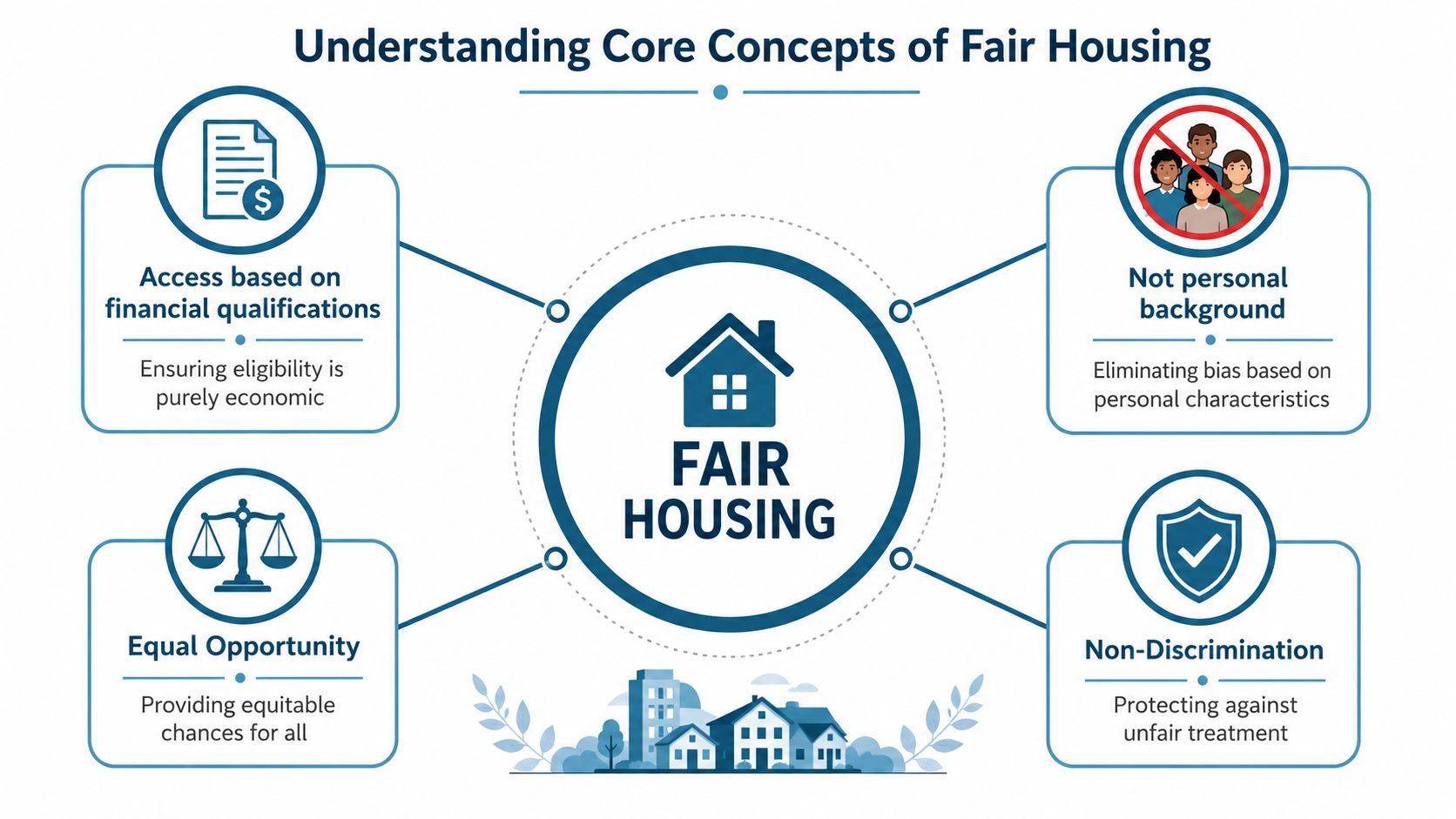
    Understanding Core Concepts of Fair Housing

    Fair Housing starts with a simple principle. Access to housing should turn on lawful qualifications such as price, credit standards, documented criteria, and availability, not on personal background.

    The federal rule is direct. The U.S. Department of Justice Fair Housing Act overview states that the federal Fair Housing Act makes it illegal to discriminate in the sale, rental, financing, and brokerage of housing because of seven protected classes: race, color, religion, sex, familial status, national origin, and disability. For real estate professionals, that reaches well beyond lease signing. It affects advertising, screening-related communications, client service, and referral patterns.

    Here's a useful way to think about it. A lender can ask whether a borrower qualifies under financial standards. A landlord can apply a lawful screening policy. An agent can market features, condition, location facts, and logistics. What none of them can do is tie access or messaging to a protected characteristic.

    A diagram outlining the core concepts of fair housing, including financial qualifications, non-discrimination, and equal opportunity.

    The difference between market criteria and protected traits

    A practical test helps.

    • Allowed focus: Price, number of bedrooms, lot size, flooring, updated systems, parking, transit access, HOA rules, lease terms, application steps.
    • Unsafe focus: The kind of person who should live there, assumptions about who belongs in the area, coded references to religion or ethnicity, or language that signals preference for households with or without children.

    The trouble is that many violations don't sound extreme. “Perfect for families,” “walk to church,” “safe neighborhood,” and “ideal for young professionals” all steer attention toward protected-class implications or demographics instead of the property itself. That's why agents should learn how to write compliant property descriptions before they scale content across MLS, social, and email.

    Disparate treatment and disparate impact in daily practice

    Disparate treatment is intentional difference in treatment. One buyer gets shown certain homes and another doesn't because of a protected trait. One renter gets different terms. One prospect gets discouraged.

    Disparate impact is harder to catch. A policy or tool looks neutral, but the effect falls more heavily on a protected group. That can happen in screening workflows, lead routing, neighborhood copy, and AI-generated content.

    If your process is neutral on paper but exclusionary in effect, regulators and complainants may still care about the outcome.

    That's why compliance isn't only a language exercise. It's also a systems exercise.

    Legal History and Protected Classes

    Fair Housing law matters more when you understand what it was built to change. The legal framework wasn't designed as a marketing style guide. It was designed to dismantle discrimination in housing access and create a market where people compete on legitimate qualifications rather than background.

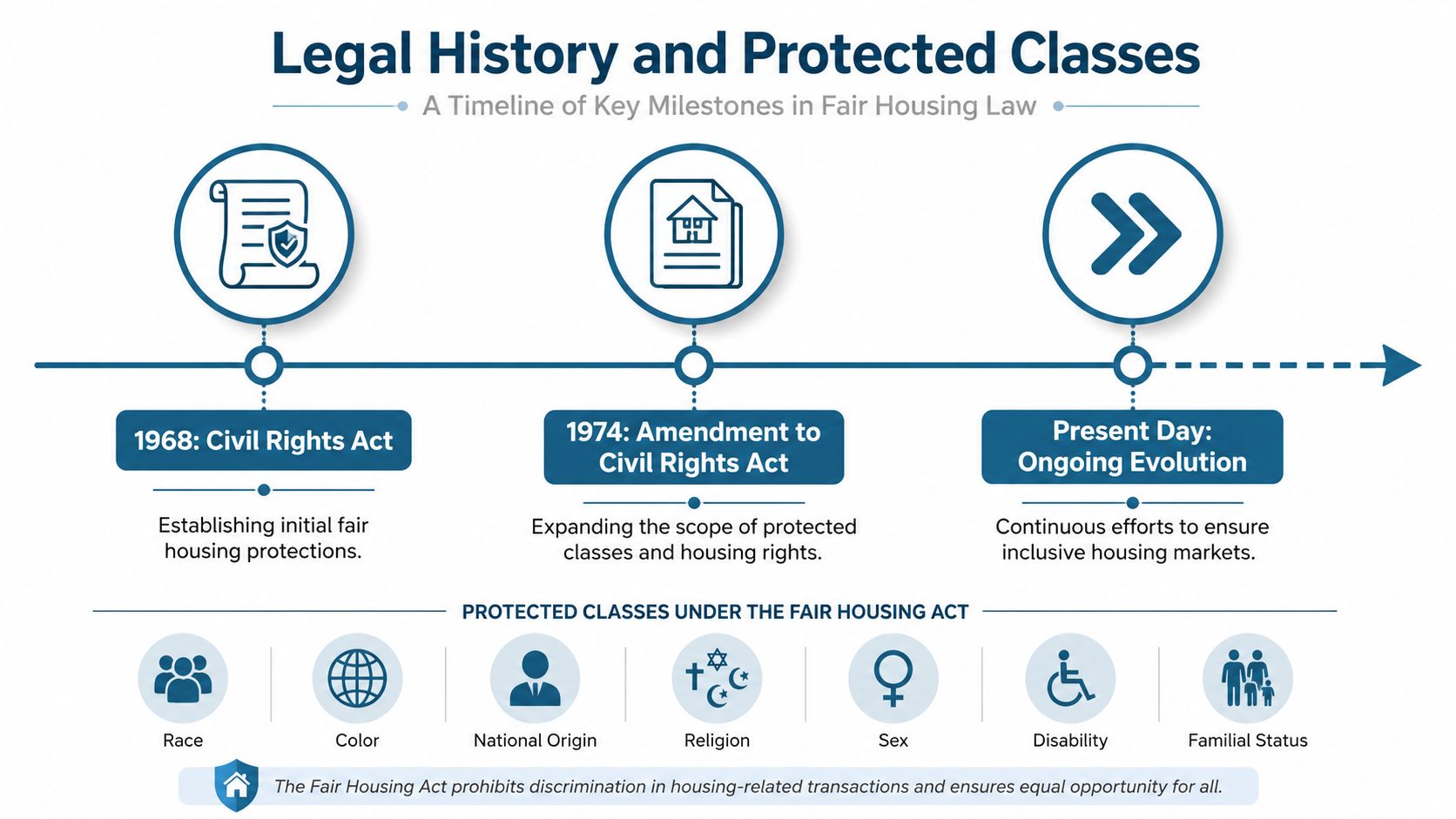
    On April 11, 1968, President Lyndon B. Johnson signed the Civil Rights Act of 1968, including Title VIII, known as the Fair Housing Act, according to the Department of Justice history of federal fair housing enforcement. At enactment, the law immediately covered approximately 1,000,000 units of government-owned or government-financed housing dating from November 1962, and by December 31, 1968, coverage expanded to roughly 43,000,000 additional housing units. The same DOJ history notes this was the first American law to explicitly ban racial discrimination in housing sales and rentals.

    A timeline graphic showing key milestones in US fair housing law and its seven protected classes.

    How the protected classes expanded

    Fair Housing didn't stop with the original law. The DOJ summary of the Fair Housing Act's development explains that over the decades following its 1968 enactment, the protected classes under fair housing laws expanded from the original four to include seven distinct categories through specific congressional amendments, altering the scope of legal protection for Americans.

    The timeline matters:

    Year Change Why agents should care
    1968 Added protections based on race, color, religion, and national origin Advertising and service practices could no longer lawfully sort people on those grounds
    1974 Added sex Marketing language and treatment could not lawfully reflect sex-based preference
    1988 Added disability and familial status through the Fair Housing Amendments Act Accessibility, family-related restrictions, and disability-related treatment became central compliance issues

    Today, the Act covers discrimination by direct housing providers and also reaches municipalities, banks, and homeowners insurance companies on the seven federal classes listed above, as described in that same DOJ resource.

    Why 1988 changed daily operations

    For most real estate professionals, the 1988 amendments changed the job in two major ways.

    First, familial status rules mean you can't market or manage housing in a way that disadvantages households with children under age 18. That includes special restrictions that isolate families or limit access to services or amenities.

    Second, disability protections reach both treatment and physical access issues. The Fair Housing Act's design and construction requirements apply to covered multifamily dwellings designed for first occupancy after March 13, 1991, and HUD's technical overview of design and construction requirements lays out seven required accessibility features, including an accessible entrance, usable common areas, usable doors, accessible routes within the unit, reachable controls, reinforced bathroom walls for future grab bars, and maneuverable kitchens and bathrooms. Failure to meet those standards is treated as disability discrimination under the Act.

    The compliance lesson for agents is simple. Disability issues don't begin and end with accommodation requests. They can start with the physical product, the listing language, and the way you answer questions about usability.

    State and local law create the real patchwork

    Federal law gives you the floor, not the full map. State and local rules often add categories or create different standards for advertising and rental decisions.

    One of the most practical examples is source of income. Federal law doesn't include it as a protected class. But Michigan fair housing guidance makes clear that Michigan bans discrimination based on source of income in rental housing. That matters when agents use templates, canned responses, or AI prompts built around federal rules alone. A generic “Fair Housing compliant” content generator may miss a state-level issue entirely.

    This also matters in accommodation-related areas where state law and current legal interpretation can be complicated. For Texas practitioners handling questions around assistance animals, Bryan Fagan PLLC on Texas ESA rights is a useful legal resource to review with counsel when a file raises disability accommodation issues.

    The operating takeaway

    Agents don't need to memorize every statute. They do need a habit:

    1. Start with federal protected classes
    2. Check state and local additions
    3. Review office policy before publishing
    4. Escalate edge cases to counsel or your broker

    That's how you keep a national marketing workflow from creating local liability.

    Common Violations and Real-World Examples

    Most Fair Housing complaints in marketing don't begin with openly discriminatory language. They begin with “normal” copy that nudges the reader toward a preferred type of resident.

    A rental ad says the unit is “perfect for a quiet couple” and highlights the building as not suitable for children. That's a familial-status problem. The copy doesn't describe flooring, layout, lease terms, or building rules. It describes who the advertiser wants.

    A listing caption says the home is in a “safe neighborhood” and “ideal for young professionals.” The first phrase sounds routine, but it can imply a coded demographic judgment instead of an objective location feature. The second points directly toward age-related preference and a target occupant profile. Both are avoidable.

    Where AI creates new mistakes

    The newer risk is speed. Teams use AI to draft MLS remarks, Instagram captions, neighborhood guides, and reply templates. The draft reads clean, the agent is busy, and the post goes live without a legal review mindset.

    The problem is documented at a high level. The National League of Cities fair housing overview notes that recent data shows AI-generated content tools can produce unintentional biases that disproportionately exclude protected groups, leading to algorithmic discrimination violations under the Fair Housing Act.

    That risk shows up in subtle ways:

    • Neighborhood summaries that describe who tends to live there
    • School-area captions that imply family-status targeting
    • Lifestyle copy that nudges toward religion, age, or cultural identity
    • Lead-routing or matching language that sounds personalized but effectively steers

    A polished draft isn't the same thing as a compliant draft.

    What actually works in practice

    When agents catch these issues early, the fix is usually straightforward. Strip out the occupant language. Replace it with verifiable property details and neutral location facts.

    Instead of “great for families,” use the actual feature: “three-bedroom layout with a fenced yard and covered patio.”

    Instead of “walk to church,” use “located near neighborhood services, dining, and commuter routes,” assuming those facts are accurate.

    Instead of “safe neighborhood,” describe objective facts such as “gated entry,” “streetlights,” or “proximity to public transit,” if those are verified. Don't make safety judgments.

    The strongest teams train agents to treat every draft, especially AI output, as a first pass that must be edited through a Fair Housing lens before publication.

    Dos and Don'ts for Listing Content

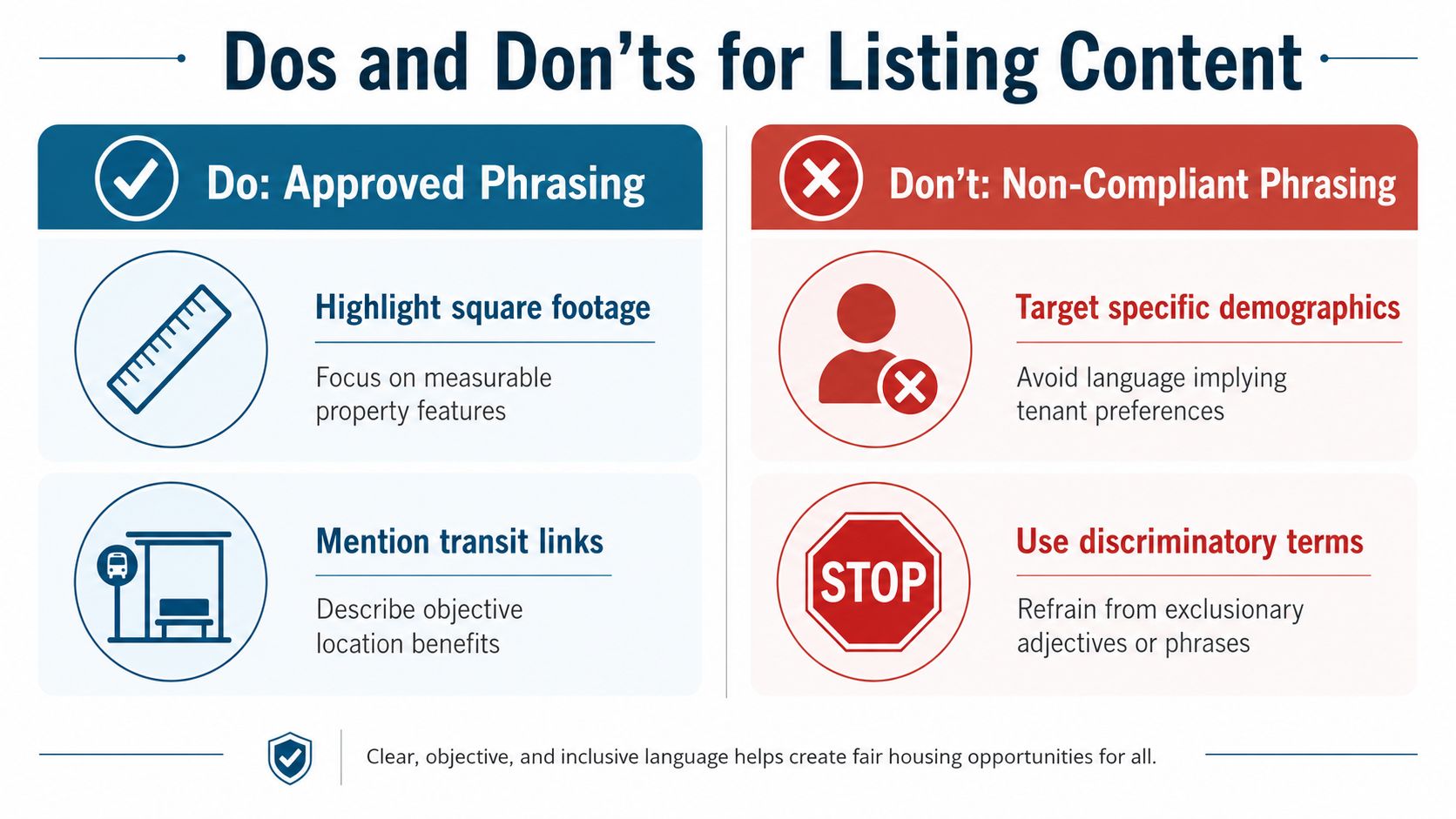
    Most compliant listing writing comes down to one discipline: describe the property, not the person. That sounds basic, but many agents still drift into audience targeting because that's how consumer marketing usually works. Housing is different.

    Illinois guidance, summarized in HousingWire's fair housing compliance article, advises that ads should emphasize amenities and features rather than an “ideal tenant,” and recommends holding all agents to documented review processes for consistent compliance. That's exactly the right operational standard for brokerages.

    An infographic titled Dos and Don'ts for Listing Content detailing fair housing guidelines for property listings.

    Better phrasing side by side

    Don't write Write this instead Why it works
    Perfect for families Three-bedroom home with a separate den and fenced backyard Focuses on layout and features, not familial status
    Ideal for young professionals Convenient access to downtown, transit, and coworking-friendly flex space Describes location and function without targeting a demographic
    Walk to church Near neighborhood amenities and community services Avoids religion-related implication
    Safe neighborhood Well-lit street, controlled-access entry, and sidewalks Uses objective facts instead of subjective safety claims
    Exclusive community Private cul-de-sac location with limited through traffic Removes exclusionary tone and states the physical characteristic

    A quick field checklist

    Before you publish, ask these questions:

    • Does this line identify a preferred resident? If yes, rewrite it around the home's features.
    • Am I making a judgment instead of stating a fact? Words like “safe,” “exclusive,” and “ideal” often create trouble.
    • Would this sentence sound different if a regulator read it instead of a seller? That's the right editing lens.
    • Did I verify each location claim? Transit access, nearby amenities, and building features should be factual.

    If you want more rewrite examples, this Compliant rental listing language from VerticalRent is a practical reference for ad phrasing decisions, and this ListingBooster resource offers a detailed guide to compliant real estate marketing.

    What doesn't work

    Agents get into trouble when they rely on “common sense” instead of a review standard. They also get into trouble when they assume coded language is safer because it's less explicit. Usually it isn't.

    Compliance note: If the phrase tells the reader who belongs there, take it out. If it tells the reader what the property offers, you're on safer ground.

    Consistent review beats clever wording every time.

    Enforcement and Penalties for Noncompliance

    A complaint rarely starts with the penalty chart. It usually starts with a listing, a caption, an AI-generated neighborhood summary, or an inconsistent response to two buyers asking the same question. By the time regulators or attorneys review the file, the issue is no longer just wording. It is whether the brokerage followed a repeatable process and can prove it.

    Financial exposure is real, but dollar amounts are only part of the risk. Enforcement can also bring testing, investigations, conciliation terms, training requirements, policy changes, reputational damage, and time pulled away from production. For teams using AI in marketing, there is an added problem. A fast drafting tool can multiply a bad phrase across MLS remarks, flyer copy, email campaigns, and social posts in one afternoon.

    Civil Penalties for Fair Housing Violations

    As noted earlier in the article, federal civil penalties can increase based on prior violation history. The larger point for working agents and brokers is practical. Repeat problems change how regulators and opposing counsel view your office. A one-off mistake is hard enough to explain. A pattern is much harder.

    State enforcement also matters. Some states and local jurisdictions apply broader protected classes or separate enforcement rules, so a line that looks acceptable under a general federal checklist may still create exposure in your market. That is one reason I advise offices to review AI prompts, listing templates, and ad approval workflows at the state level, not just the national level.

    What creates a defensible position

    A defensible file shows how the decision was made, who reviewed the content, what facts supported the description, and whether the same standard was applied across clients.

    The National Real Estate Services Authority compliance article highlights the basics that matter in an investigation: written intake procedures, use of client criteria only, records of properties or providers presented, and documentation of client interactions. That kind of audit trail matters even more when AI helps draft marketing copy. If a tool suggests language that creates steering or preference concerns, your office still owns the published result.

    Keep records that answer the questions enforcement staff usually ask:

    • What information did the client provide
    • What properties or options were shown
    • How were inquiries handled
    • Who approved the final listing or ad copy
    • What was edited, rejected, or regenerated in AI-assisted content

    That last point gets missed. If your team uses a Fair Housing compliant listing content tool, treat the output and the review history as compliance records, not just marketing drafts.

    A practical enforcement mindset

    Assume every published housing statement is discoverable. Assume text generated by AI will be judged the same way as text written by an agent. Assume inconsistency across leads, showings, or ad variants will look intentional unless your records show otherwise.

    Good compliance work is not about writing timid copy. It is about using objective facts, applying one review standard, and keeping records strong enough to defend the office if a complaint lands.

    Compliance Checklists and ListingBooster ai Integration

    A listing goes live at 9:00 a.m. By lunch, the seller loves the wording, the agent likes the speed, and nobody has noticed that the AI draft described the home as "perfect for young families" and the area as "exclusive." That is how Fair Housing problems enter ordinary marketing workflows. The issue is rarely bad intent. It is weak process.

    A workable compliance system gives agents clear drafting rules, a review path, and records that hold up if a complaint reaches the broker, state regulator, or HUD investigator. As noted earlier, offices need written procedures and consistent documentation. Here, the practical question is how to turn that standard into day-to-day listing production, especially when AI is involved and state rules may be stricter than the federal floor.

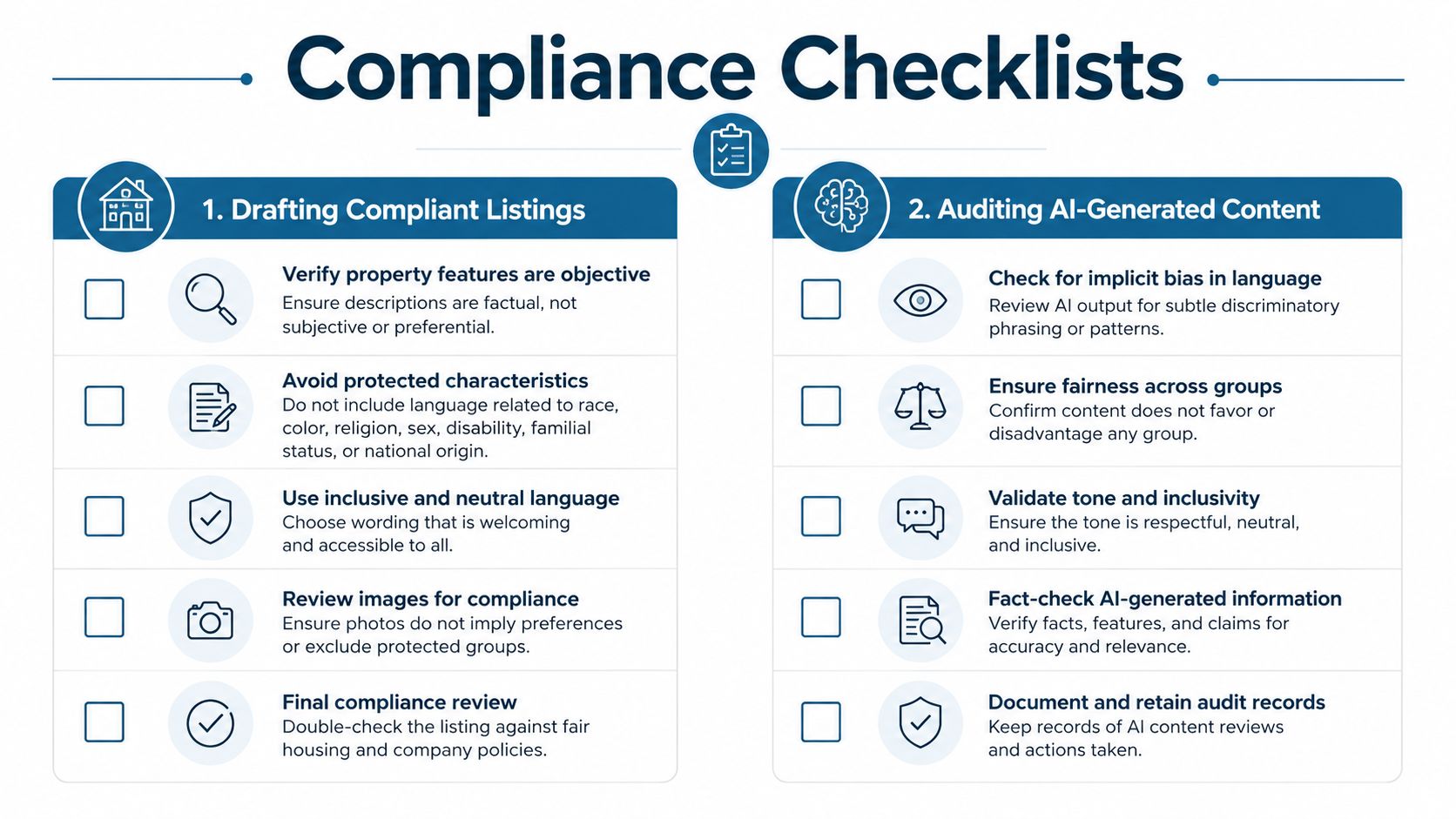
    A compliance checklist infographic for real estate listings and auditing AI-generated content for fair housing standards.

    Checklist for drafting compliant listings

    Use one review standard before MLS entry, syndication, paid ads, or social posting.

    • Start with verified property facts
      Confirm bedrooms, bathrooms, square footage, parking, amenities, access features, and location details against the file. Marketing copy should add clarity, not new claims.

    • Describe the property, not the ideal occupant
      Cut phrases that suggest who belongs there. Replace them with factual details about layout, condition, features, and permitted uses.

    • Keep neighborhood references objective
      "Near commuter rail," "close to public parks," and "easy access to I-95" are easier to defend than statements tied to demographics, culture, or assumed lifestyle fit.

    • Screen for protected-class issues and local-law additions
      Federal law is the starting point. State and city law may add classes such as source of income, sexual orientation, gender identity, marital status, age, military status, or lawful occupation. A phrase that passes one review standard in one state may create trouble in another.

    • Apply the same approval process to every listing
      Inconsistent review is where patterns form. Regulators and plaintiffs' counsel look for repeat behavior across agents, offices, and ad variants.

    Checklist for auditing AI-generated content

    AI speeds up drafting. It also introduces a specific risk: the system may generate polished language that sounds marketable but shifts from property facts into preference, exclusion, or coded phrasing.

    1. Read every line as advertising copy, not draft text
      If it is public-facing, review it as if it will appear in a file exhibit later.

    2. Compare the output to source documents
      AI often fills gaps with assumptions. Remove anything the listing file, seller disclosures, or broker instructions do not support.

    3. Flag coded terms
      Words like "exclusive," "safe," "private community," "ideal for families," or "walk to church" can create Fair Housing issues depending on context.

    4. Check for state-specific risk
      A broad AI prompt may produce language that ignores local protected classes or advertising rules. Brokerages operating across state lines should not rely on one generic prompt set.

    5. Save the approved version and the review history
      Keep the final copy, material edits, and reviewer identity. If the office uses AI, retain enough history to show what was changed and why.

    Where software helps and where it stops

    Software can standardize first drafts, flag obvious terms, and create a cleaner approval workflow. It does not replace broker supervision or legal judgment. I have seen teams get into trouble because they treated AI output as pre-cleared copy rather than a draft that still needed Fair Housing review.

    That is where specialized tools have a real advantage over general-purpose chat tools. A Fair Housing compliant listing content tool can help agents produce property-first copy, keep edits visible, and support a repeatable review process built for real estate marketing. The value is not speed alone. The value is a system that helps the office publish consistent language across listings, ad channels, and agents.

    The trade-off is straightforward. Manual review gives experienced agents flexibility, but it breaks down fast in a high-volume office. Standardized AI workflows improve consistency, but only if the brokerage sets the rules, trains agents on state-level differences, and audits what gets published. Use the tool. Keep the human review. Treat both as part of the compliance record.