A buyer asks ChatGPT, “Who's the best listing agent in my area?” before opening Google. The answer names two competitors, cites their brokerage pages, and points to a neighborhood guide you never knew existed. Your website may still rank well for local keywords, but that ranking doesn't guarantee you'll appear in the AI-generated shortlist.
That's the central challenge behind how to rank in ChatGPT for real estate. You're not optimizing only for a blue-link position. You're building a recognizable, corroborated entity that AI systems can identify, understand, verify, and cite across the web.
Why Real Estate Agents Need a Different Playbook for ChatGPT
A buyer asks ChatGPT which listing agent serves a specific neighborhood. The response may recommend a short list, summarize each agent's specialties, and cite brokerage pages or local guides before the buyer ever visits a website. A strong Google position alone does not guarantee inclusion.
That is the practical challenge behind how to rank in ChatGPT for real estate. Agents must build a recognizable, corroborated entity that AI systems can identify, understand, verify, and cite across multiple surfaces.
Buyer research is shifting in that direction. A major 2026 real-estate AI visibility study reported that 67% of homebuyers now use AI tools such as ChatGPT, Perplexity, Gemini, Claude, or Google AI Overviews as their primary agent-research method, up from 17% 18 months earlier. The same report found that 61.3% of buyer-side real-estate searches begin in an AI search engine rather than a traditional one, based on 12,400 AI-generated responses, 8.2 million tracked queries across 192 metros, and a 4,180-respondent buyer survey. (HousingWire's real-estate AI search coverage)
Your content must answer natural questions. Your name, brokerage, service areas, and specialties must match across platforms. Independent sources should reinforce the same identity and claims.
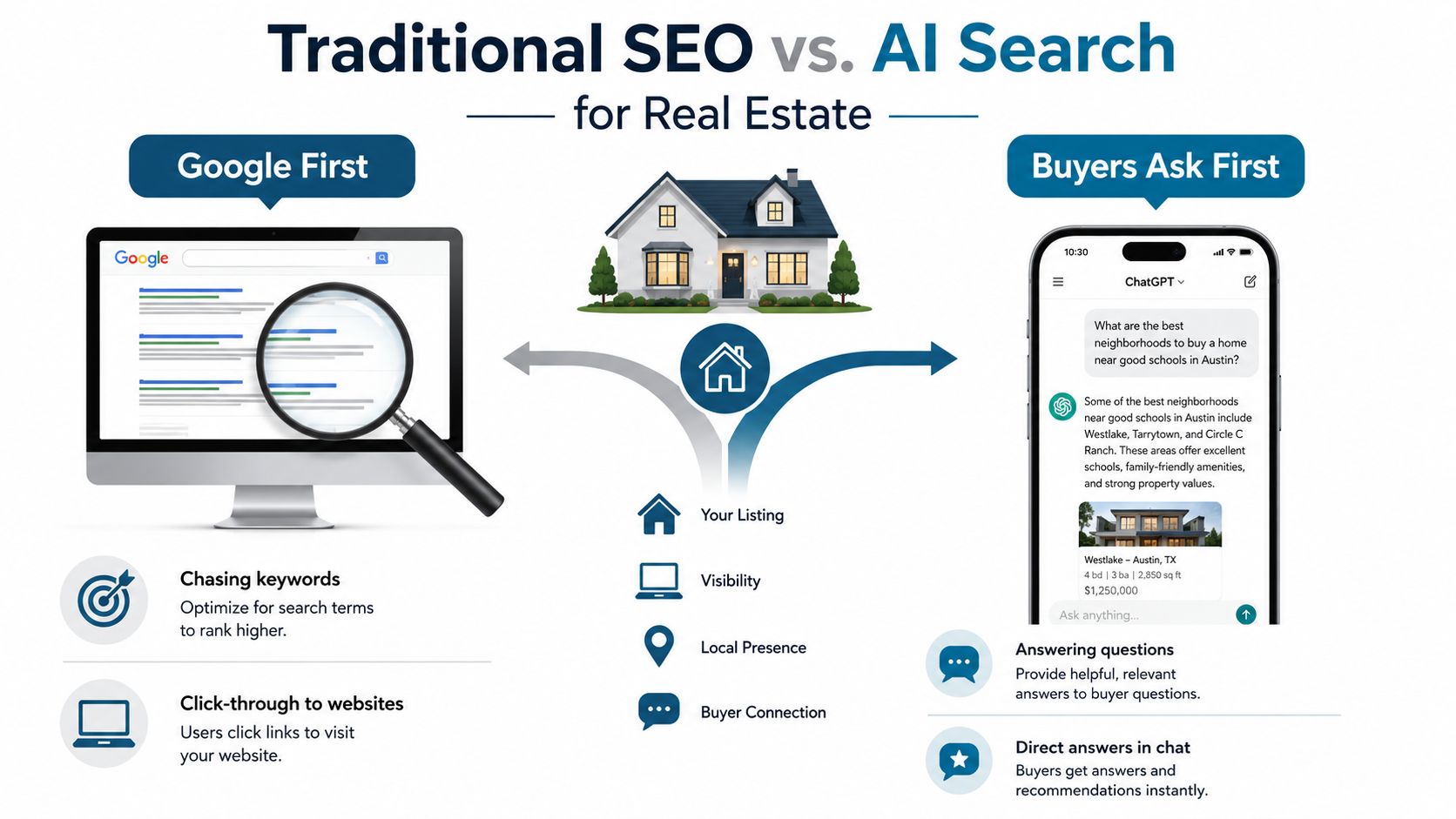
The five-part system
A workable AI-search system for real estate has five parts:
- Answer-ready content structure, so models can extract a clear response.
- Mandatory schema, so property, agent, location, and FAQ relationships are explicit.
- Local authority, including Google Business Profile, directories, press, and original market information.
- Promptable snippets, with concise passages built around buyer questions.
- Weekly measurement, showing where competitors are cited and where your brand is missing.
Real estate searches are decision-stage, trust-heavy, and highly geographic. Advice written for software or ecommerce brands misses the evaluation of credentials, market coverage, service fit, and local knowledge that happens when buyers choose an agent.
Practical rule: Stop asking only, “What keyword should this page rank for?” Ask, “Could an AI system confidently use this page to answer a buyer's question about my market?”
Use these practical prompt templates for real estate agents to create agent-specific tests. Run those questions against your website, listings, and local profiles each week, then fix the surface where your information is incomplete or inconsistent.
What AI Engines Cite in Local Real Estate Answers
AI engines select local real estate sources that connect an agent or brokerage entity to a specific service, location, property, or verifiable claim. A page earns citation potential when its business identity and market relevance remain clear across the surfaces buyers use.
The buyer-research shift changes the competition. The HousingWire study cited earlier analyzed AI-generated answers and buyer behavior across broad real estate searches. If buyers begin with conversational research, a listing page competes with more than nearby listings. It must become a source an AI system trusts enough to include in a concise answer.
A 2026 real-estate AI search report found that Google Business Profile and Maps listings accounted for 57.6% of citations in ChatGPT responses, while businesses' own websites accounted for 40.5%. Together, those surfaces represented 98.1% of citations in the report. (The Omnieclipse real-estate AI search report)
Use that finding to set priorities. Improve the website, then align it with your Google Business Profile, Maps presence, brokerage page, local directory profiles, and owned content. Every surface should describe the same business, service areas, credentials, and contact details.
| Content Attribute | Cited Sources | Uncited Sources |
|---|---|---|
| Entity identity | Agent name, brokerage, phone, service areas, and profile links that agree across platforms | Profiles with different names, outdated phone numbers, or conflicting office information |
| Local relevance | Neighborhood guides, market pages, and listings tied to a specific metro or service area | Generic articles about buying or selling nationwide |
| Evidence | Current listing details, sourced market information, credentials, and verifiable service descriptions | Unsupported claims such as “top agent” or “best in town” |
| Structure | Clear headings, tables, FAQs, descriptive page titles, and connected markup | Dense promotional copy with no obvious answers |
| Third-party validation | Local press, reputable directories, brokerage pages, and professional organizations | Thin directory entries with little context |
| Freshness | Pages that show a clear update date when information changes | Stale pages with expired listings or old market references |
Google visibility supports the system, but it does not finish it. A 2026 Semrush study found that purely AI-generated content appeared in Google's top spot only 9% of the time, reinforcing the value of human-useful, structured, source-backed content. (The Omnieclipse report's summary of the Semrush finding)
The practical goal is to become the citable entity. Run a weekly consistency check across your website, listings, profiles, and brokerage information, then correct the surface that gives AI engines incomplete or conflicting facts. Ranking in ChatGPT follows entity trust, not a single high-ranking page.
Structuring Listings and Authority Pages for AI Readability
The strongest real estate pages answer the obvious question immediately. Don't open with a brand slogan, a long lifestyle paragraph, or vague praise. Start with a concise summary that states what the property or page is about.
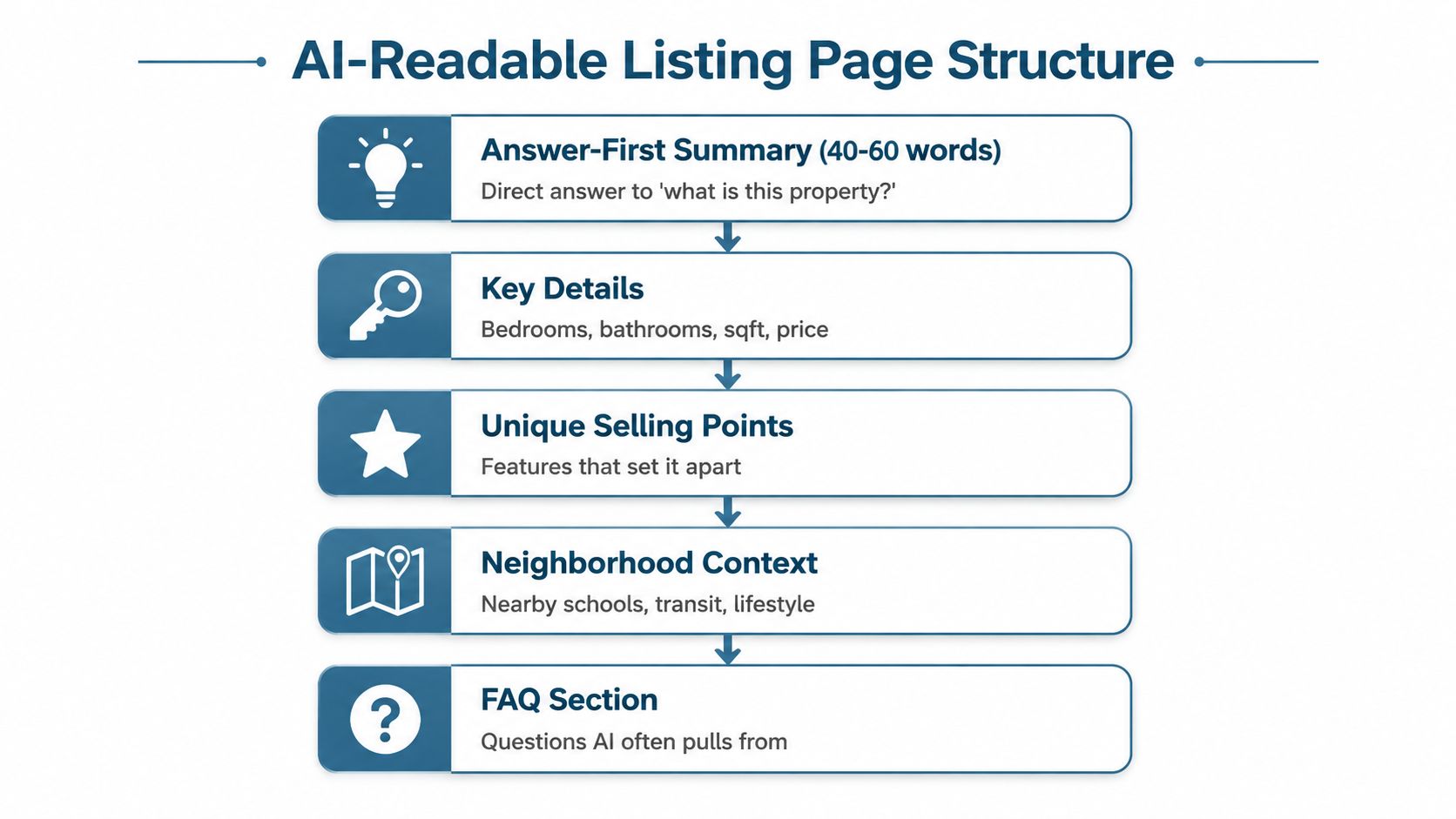
For a listing, place a 40 to 60 word answer-first summary near the top. Include the price band, property type, major characteristics, and a neutral description of the property's relevant features. Avoid protected-class references and subjective location language. “Three-bedroom condominium near rail service and a commercial district” is useful. “Perfect for young professionals” is not compliant.
Listing page outline
Use one H1, descriptive H2 headings, and H3 headings for specific FAQs. A practical listing structure looks like this:
- H1: Property type and location, using the actual listing identity.
- Summary: A 40 to 60 word answer to “What is this property?”
- Key details: Bedrooms, bathrooms, square footage, price, property type, year built, and listing status.
- Features: Renovations, storage, outdoor areas, parking, appliances, energy features, and other verifiable attributes.
- Location context: Transit, major roads, public amenities, shopping areas, and relevant geographic facts.
- Price and terms table: List price, property taxes when verified, HOA information when applicable, and other decision-supporting details.
- FAQ section: Questions about showings, offer timing, disclosures, financing considerations, and property features.
For most listings, aim for 800 to 1,200 words when the property and local context justify that depth. Don't pad a simple listing with repetitive adjectives. Every paragraph should help a buyer understand the property, the transaction, or the location.
Neighborhood authority page outline
A neighborhood guide needs more context. Target 1,500 to 2,500 words for a useful authority page, organized around questions rather than keyword variations:
- What the area includes and where its boundaries are.
- Housing types and current availability patterns, described carefully and supported by current information.
- Transportation, roads, public services, and nearby amenities.
- Market considerations for buyers and sellers, with dates and sources.
- Property features and planning considerations that affect decisions.
- Frequently asked questions with direct answers.
- A clear author and brokerage identity, including service area details.
Use tables for factual comparisons, bullet points for amenities, and short paragraphs for interpretation. A page that makes its facts easy to verify is more useful than one that tries to sound impressive.
The research supports this disciplined approach. A 16,851-query study reported that pages with the strongest heading-to-query match were cited 41.0% of the time, compared with about 30% for weaker matches. Pages using JSON-LD markup showed a 38.5% citation rate, versus 32.0% without markup, and articles with 4 to 10 subheadings performed best. (The AI Boost ChatGPT ranking factors study)
For a practical writing workflow, use this guide to create AI search ready listing descriptions. The tool matters less than the editorial discipline. The page must remain accurate, human-reviewed, and compliant.
Schema and Markup Real Estate Pages Cannot Skip
Schema gives search systems an explicit map of your business. It can identify the agent, connect the agent to a brokerage, associate a listing with an address and price, and mark up questions and answers that appear on the page.
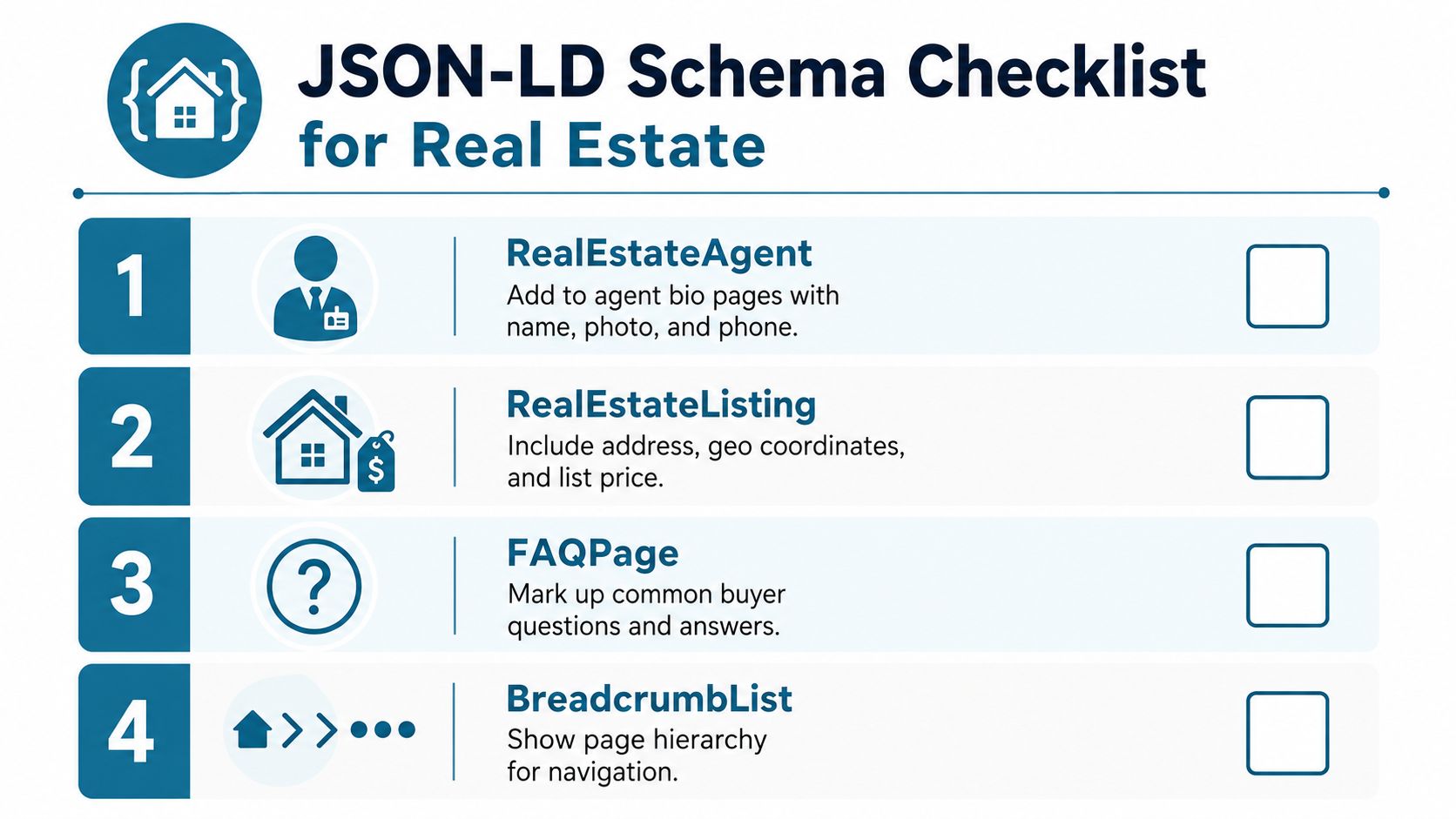
A real-estate schema guide recommends a connected JSON-LD graph using Organization or RealEstateAgent, RealEstateListing, Offer, Place with GeoCoordinates, FAQPage, BreadcrumbList, and ImageObject or VideoObject where applicable. (The GR West Estate real-estate schema guide)
Implement these types first
- RealEstateAgent: Add it to agent bio pages with the agent's name, professional image, phone number, brokerage relationship, service area, and relevant profile links. Use the same identity everywhere.
- RealEstateListing: Add it to individual property pages. Include the property address, geographic coordinates when available, property type, listing status, images, and price information.
- Offer: Use it for pricing terms that appear on the page. Keep the price, currency, availability, and validity information synchronized with the listing.
- FAQPage: Mark up visible questions and answers, not hidden text created only for crawlers. Questions should address real buyer or seller concerns.
- LocalBusiness: Use an appropriate local-business identity for the office or business entity, with phone, address, URL, service area, and operating information. Set areaServed to the neighborhoods or markets you cover.
- BreadcrumbList: Show the hierarchy from homepage to market page, agent page, or individual listing.
- ImageObject or VideoObject: Describe important media with accurate captions, URLs, and relationships to the relevant property or agent.
Validate the relationships
Run the page through Google's Rich Results Test and the Schema.org validator. Check that the visible content matches the markup, the listing price is current, and the same agent isn't represented as separate, contradictory entities on different templates.
Common implementation errors include missing priceValidUntil, incomplete nested address components, and a LocalBusiness schema that conflicts with the RealEstateAgent schema elsewhere on the site. Don't add fields to make the code look complete. Incorrect structured data creates ambiguity instead of authority.
Schema won't rescue thin pages or inconsistent business data. It works best when it confirms information that a buyer can already see and verify.
Building Local Authority That AI Engines Trust
Backlinks matter, but they're not the whole local authority strategy. AI engines need corroboration. They need repeated, consistent evidence that the same agent serves a specific market and has a legitimate professional presence there.
Build the trust stack in three layers.
First, maintain a complete Google Business Profile. Use the correct business category, service area, phone number, website, office details, photos, and business description. Publish useful updates and answer legitimate questions with factual information. Don't seed artificial questions or reviews, and don't make claims you can't support.
Second, clean up third-party profiles. Review Zillow, Realtor.com, Homes.com, Yelp, local chamber directories, brokerage pages, and relevant professional profiles. Use the same business name, address, phone number, website, service areas, and agent bio details. A mismatch can split your entity into several weaker versions.
Third, publish original local information. A monthly market update, a neighborhood data page, a downloadable report, or a clearly sourced transaction guide can give local publishers something useful to reference. Write quotable summaries such as, “Inventory conditions changed during the reporting period,” followed by the exact date, market definition, and source. Never turn an unsupported opinion into a market statistic.
| Authority Stack | Core Assets | AI Citation Benefit |
|---|---|---|
| Google Business Profile | Accurate category, service area, contact details, photos, updates, and Q&A | Gives AI systems a strong local business reference point |
| Third-party profiles | Zillow, Realtor.com, Homes.com, Yelp, brokerage pages, and chamber listings | Corroborates the agent's identity and market coverage |
| Original market assets | Dated reports, neighborhood pages, downloadable PDFs, and sourced observations | Creates material that local sites can quote or reference |
| Press-ready profile | Agent bio, credentials, areas served, media contact, and approved facts | Makes the entity easier for journalists and directories to describe |
| Social profiles | Consistent name, brokerage, service area, and links | Reinforces entity alignment across public surfaces |
The Local Visibility Index makes the selection problem stark. It reported that ChatGPT recommended only 1.2% of roughly 350,000 locations, compared with 35.9% for Google's local 3-pack. (The Cheers AI visibility gap analysis)
That gap means a strong Google position doesn't automatically transfer to ChatGPT. Use consistent profiles and useful local evidence to win visibility in AI summaries, rather than treating one optimized page as the entire plan.
Promptable Snippets and Testing Your AI Visibility
Your content team should write for the questions buyers ask. Generic prompts produce generic copy, while tightly specified inputs produce passages that are easier to publish, review, and cite.
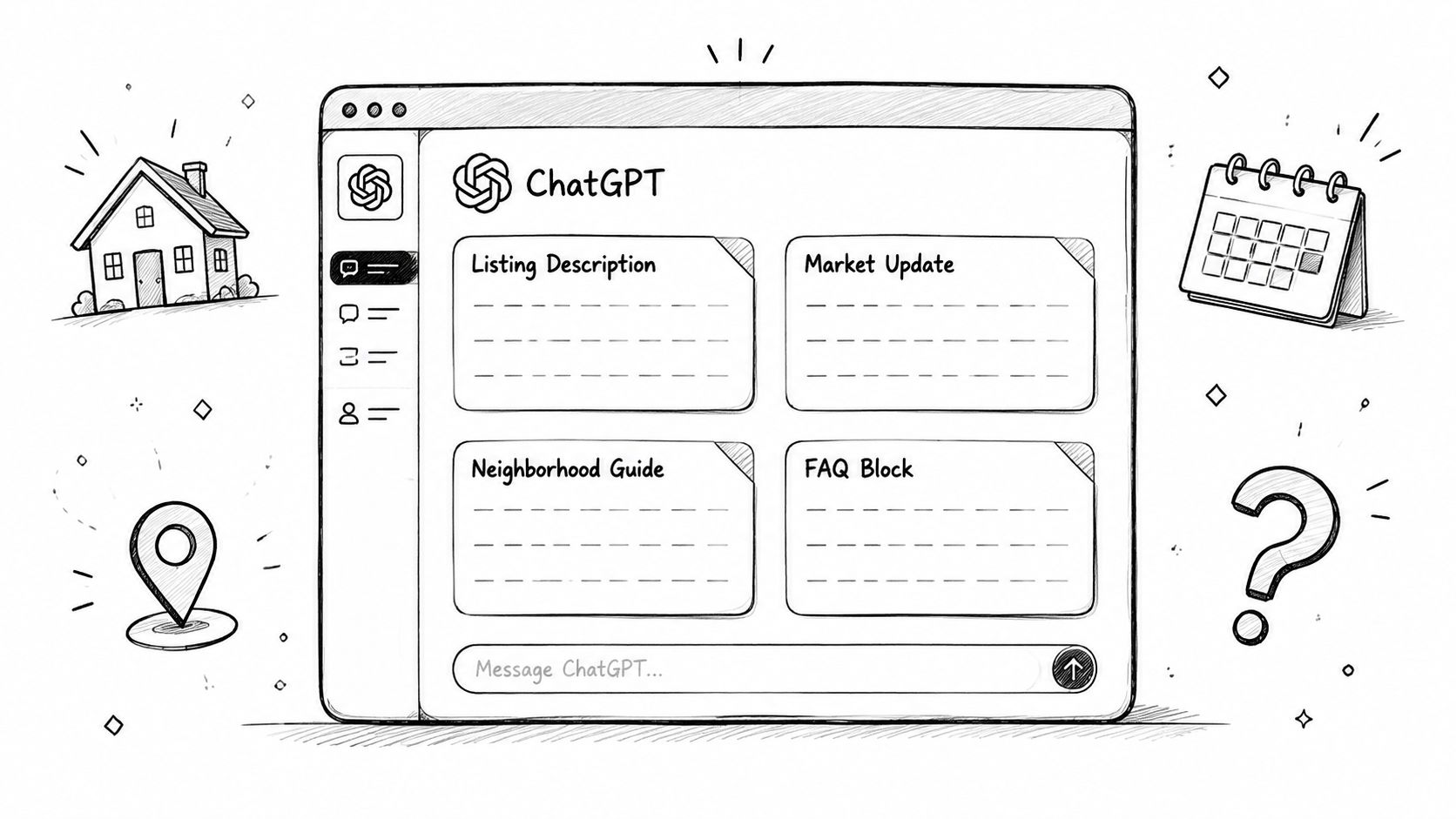
Use these four prompt templates as production briefs. Replace the bracketed fields with verified information.
Listing descriptions
Write a neutral, factual listing description for [property type] in [location]. Use a 50-word answer-first summary, then headings for key details, notable features, location context, and buyer FAQs. Include only the verified facts below: [paste facts]. Avoid demographic references, protected-class language, unsupported superlatives, and investment claims.
Ask for a table of key facts after the summary. Review every statement against the MLS record and listing disclosures before publication.
Monthly market updates
Create a concise market update for [market area] covering [reporting period]. Separate verified data from interpretation. Use a short summary, a table of reported indicators, three buyer considerations, three seller considerations, and five FAQs. Cite each supplied source next to the relevant fact. Do not predict future performance or invent missing data.
This format prevents a model from filling gaps with plausible-sounding numbers.
Neighborhood guides
Draft a location guide for [neighborhood or municipality]. Cover geographic boundaries, housing types, transportation, public amenities, shopping, services, and property considerations. Use descriptive H2 headings, answer-first paragraphs, a feature table, and FAQs. Describe places by observable features, not by who should live there. Use only these verified sources and facts: [paste sources and notes].
FAQ blocks
Create eight buyer and seller FAQs for [market and service]. Answer each in two or three sentences using only these verified business facts: [paste facts]. Include the agent or brokerage name only where relevant. Avoid guarantees, discriminatory wording, urgency claims, and advice that requires a licensed professional outside the agent's role.
For broader workflow comparisons, review this guide to AI tools for realtors. Treat any generated draft as an editorial starting point, not a final compliance-approved asset.
Test visibility every week
Run the same branded and non-branded prompts in ChatGPT, Perplexity, and Google AI Overviews. Log the date, exact prompt, named agents, cited URLs, property pages, and competitors that appear.
ChatGPT Search can return a small set of clickable citations, and one industry explanation says the search index typically surfaces about 3 to 6 numbered citations per response. (The Ziptie explanation of ChatGPT sources)
When a competitor appears, don't copy the competitor's language. Identify the missing source type. Is it a neighborhood guide, a brokerage profile, a market report, a complete Google Business Profile, or a third-party mention? Turn that gap into the next content brief, then retest the same prompt after publication and indexing.
Your 30-Day Plan to Rank in ChatGPT as a Real Estate Agent
A 30-day rollout works because it turns AI visibility into an operating rhythm. Don't wait for a complete website redesign. Fix the highest-value surfaces first, publish focused material, and record what appears in answers.
Days 1 through 7
Audit your agent pages, listing templates, neighborhood guides, Google Business Profile, social profiles, and directory listings. Record inconsistent names, phone numbers, addresses, service areas, expired listings, missing authorship, and unsupported claims. Select the buyer and seller prompts that matter most in your market.
Days 8 through 14
Deploy RealEstateAgent, RealEstateListing, Offer, LocalBusiness, FAQPage, and BreadcrumbList markup where the page content supports it. Rewrite priority pages with answer-first summaries, descriptive headings, verified tables, and visible FAQs. Create a single source-of-truth document for the agent's name, brokerage, service areas, contact information, credentials, and approved descriptions.
Days 15 through 21
Complete the Google Business Profile and clean third-party profiles. Publish one useful local authority asset, such as a dated market update or neighborhood guide. Create promptable snippets for listings, market questions, and service FAQs, then review them for factual accuracy and Fair Housing compliance.
Days 22 through 30
Run your prompt set across ChatGPT, Perplexity, and Google AI Overviews. Log citations and competitor visibility. Publish the content that addresses the clearest citation gap. For background on the broader workflow, this guide to ranking in ChatGPT in 2026 provides additional context.
| Measurement | Weekly question | What to record |
|---|---|---|
| Branded mentions | Does the agent or brokerage appear for branded prompts? | Mentioned name, wording, and prompt |
| Citation share of voice | Which URLs does the answer cite when several agents are relevant? | Your cited URLs and competitor cited URLs |
| ChatGPT answer frequency | How often does the entity appear across your fixed prompt set? | Appearance, absence, and answer context |
| Local accuracy | Does the answer describe the market and service area correctly? | Incorrect facts requiring correction |
| Content coverage | Which buyer questions lack a useful page? | Prompt, missing asset, publishing status |
Fair Housing compliance stays in every stage. HUD guidance says housing advertisers should identify and mitigate discriminatory outcomes when using platform-provided demographic evaluation tools, and FHA guidance states that residential-dwelling ads cannot indicate a preference, limitation, or discrimination based on protected class status. (HUD guidance on digital housing advertising)
Remove language that signals who belongs in a property or area. Describe verified features, services, transportation, amenities, property condition, and market facts. Review AI-generated copy before it reaches the MLS, website, social channels, or advertising platforms.
ListingBooster.ai can serve as the execution layer for brokerages that need repeatable listing descriptions, social content, authority posts, and review workflows across agents. Use it alongside human editing, schema validation, profile cleanup, and weekly prompt testing, not as a replacement for those controls.
ListingBooster.ai helps agents, teams, and brokerages turn verified property details into editable, AI-search-aware listing copy and coordinated social content, with Fair Housing review built into the workflow. Visit ListingBooster.ai to assess whether its Listing Commander and Authority Builder workflows fit your market, then start with one listing, one authority page, and one weekly visibility test.