Tag: lead generation

  • AI SEO for Real Estate Agents: The 2026 Playbook

    AI SEO for Real Estate Agents: The 2026 Playbook

    More than 40% of homebuyers now start their search in AI tools like ChatGPT, Perplexity, and Google AI rather than traditional search engines, according to Agent Elite’s analysis of AI-driven search behavior. That single shift changes the job of real estate marketing.

    For years, agents could treat SEO as a Google rankings problem. Publish neighborhood pages. Add a few blog posts. Optimize a title tag. Wait for clicks. That model is fading because buyers aren't always browsing lists of links anymore. They're asking an AI assistant who the right local agent is, which neighborhood fits their family, or which property matches their budget and lifestyle.

    That means ai seo for real estate agents isn't just traditional SEO with AI-written copy. It's the work of making your business understandable, trustworthy, and retrievable inside AI-generated answers. If your website, listings, reviews, bios, and local authority signals aren't structured clearly, AI tools have very little reason to surface you.

    Agents who adapt early have an opening. Agents who keep posting generic content into the void will stay technically online but practically invisible.

    The New Search Landscape Agents Cannot Ignore

    The old search journey was simple. A buyer typed a phrase into Google, scanned blue links, opened a few sites, and eventually filled out a form. Today's journey is more compressed. A buyer asks an AI tool for recommendations, gets a synthesized answer, and often forms a shortlist before visiting any website.

    That's why Google-discoverable and AI-recommendable are now different things.

    What ai seo for real estate agents actually means

    In practice, ai seo for real estate agents means building a digital presence that AI systems can parse, verify, and confidently cite. That includes:

    • Clear entity signals like consistent agent name, brokerage, market, specialties, and service areas across your site and profiles
    • Structured listing information that tells machines what a page represents
    • Authority content tied to real local expertise, not recycled market fluff
    • Platform consistency so AI tools don't see conflicting information about who you are or where you work

    Traditional SEO still matters. Your site still needs strong pages, local relevance, and useful content. But those assets now need to do a second job. They need to feed AI systems enough context to mention you in an answer.

    Practical rule: If a human has to infer what you do, where you work, and why you're credible, an AI system probably won't surface you reliably.

    Why old content habits are losing value

    A lot of agent websites are full of content that was built for an earlier version of search. Thin neighborhood blurbs. Generic FAQs. Market posts that could describe any ZIP code in the country. AI tools are less impressed by volume than many agents assume.

    They favor clarity and corroboration. If your content doesn't connect your name to a market, property type, client segment, and consistent body of expertise, it may never earn a mention.

    The practical difference looks like this:

    Traditional SEO mindset AI-first visibility mindset
    Rank a page for a keyword Become a cited answer for a buyer question
    Publish more blog posts Publish clearer, more structured local expertise
    Chase broad traffic Build recommendation eligibility
    Focus on page position Focus on citation, authority, and consistency

    What AI-readable content looks like

    AI-readable content isn't robotic writing. It's content organized so machines can interpret it correctly. The strongest agent pages usually do three things well:

    1. State the subject clearly
      A page should immediately identify whether it's about a listing, a neighborhood, an agent, a team, or a service.

    2. Add context AI can connect
      Mention the city, neighborhood, buyer type, property category, and relevant expertise naturally.

    3. Support claims with digital proof
      Reviews, listing history, market commentary, profile consistency, and structured page elements all help.

    If you're still treating your website as a brochure, you're missing the point. AI tools are looking for reliable local entities, not pretty pages.

    A good starting point is to understand how real estate agents can rank in ChatGPT search. The agents who show up there usually haven't won because they wrote more. They've won because their digital footprint is easier for AI systems to trust.

    Auditing Your Digital Footprint for AI Readiness

    Before changing your content, test whether AI tools recognize you at all. Most agents skip this step and go straight to publishing. That's backwards. You need a baseline.

    Start with the same behavior a buyer would use. Open ChatGPT or Perplexity and ask direct local questions.

    A professional woman working on data analytics and real estate software at her office computer workstation.

    Use live prompts to test visibility

    Run prompts like these with your city and niche:

    • General intent
      "Who are the best real estate agents in [City]?"

    • Client segment intent
      "Recommend a real estate agent in [City] for first-time homebuyers."

    • Property niche intent
      "Who specializes in luxury condos in [Neighborhood]?"

    • Seller intent
      "Which real estate agents in [City] are known for marketing homes well?"

    • Relocation intent
      "What realtor should I talk to if I'm moving to [City] from out of state?"

    Document the answers. Don't do this once. Test multiple phrasing variations, because AI results can shift based on prompt wording.

    What matters isn't just whether your name appears. Look at the shape of the answer.

    Read the results like an operator

    When an AI tool responds, check these points:

    • Named agents
      Are you missing entirely? Are the same competitors showing up repeatedly?

    • Cited sources
      Which websites, profiles, or directories seem to influence the answer?

    • Specialty alignment
      Does the AI connect you to the niche you want, or does it misunderstand your positioning?

    • Data accuracy
      Is your brokerage, market area, or role described correctly?

    • Authority signals
      Are review platforms, local bios, or neighborhood content being referenced?

    If AI tools don't know who you are, the issue usually isn't one page. It's fragmented digital identity.

    If your website says one thing, your Google Business Profile says another, and your social bios say almost nothing, AI tools won't stitch together the story you want.

    Check the assets that shape AI perception

    Most agents think first about website copy. AI systems don't. They assemble a picture from many sources.

    Audit these properties in one sitting:

    • Website home page
      Does it clearly state your market, audience, and specialty in plain language?

    • Agent bio pages
      Do they read like real expertise, or a generic corporate headshot paragraph?

    • Listing pages
      Are descriptions specific and structured, or vague and repetitive?

    • Google Business Profile
      Is every field complete and consistent with your website?

    • Social profiles
      Do your Instagram, Facebook, LinkedIn, and YouTube bios reinforce the same positioning?

    • Directory profiles
      Are your brand details and service areas aligned across major portals?

    A weak digital footprint usually has the same symptoms. Inconsistent market language. Thin bios. Missing specialties. No recognizable content pattern.

    Your AI readiness checklist

    Use this quick scorecard:

    Audit question What to look for
    Do AI tools mention you by name? Presence in recommendation-style answers
    Do they describe you accurately? Correct market, role, and specialties
    Do your profiles match each other? Consistent branding and service areas
    Do your pages explain specific expertise? Clear niche and local authority
    Is your listing data structured? Machine-readable property information
    Are your sources strong enough to cite? Substantive bios, guides, and local content

    If most of those boxes are shaky, fix the foundation before chasing output.

    One technical checkpoint deserves special attention. Your website should use structured data that helps machines interpret listings, business details, and agent information. If you're not sure where to start, review this guide to real estate schema markup. It's one of the clearest dividing lines between an AI-readable site and a site that just looks good to humans.

    Your AI-First Content Strategy Playbook

    Agents who publish steady, high-signal local content give AI systems more chances to surface their name, listings, and expertise. The agents who win here do two things well. They turn each listing into a distributed content asset, and they publish market content that proves they know their farm area better than a generic portal ever will.

    That requires a repeatable system, not scattered prompts.

    A five-step AI-first content strategy playbook infographic illustrating how to leverage AI for digital marketing success.

    Pillar one is property-specific marketing

    A listing should produce far more than an MLS description and a couple of social posts. Each property gives you raw material for search visibility, AI citations, retargeting, and lead capture. If that material stays trapped in the MLS, you lose reach and you lose useful signals.

    A strong listing content set usually includes:

    • A precise property description built around buyer intent, likely objections, and clear differentiators
    • Channel-specific social posts for new listing, open house, price improvement, under contract, and sold updates
    • Local context snippets tied to schools, commuting patterns, walkability, housing style, or buyer lifestyle
    • Search-focused metadata that keeps the listing readable across your site, portals, and social previews

    Manual prompts can get you part of the way:

    Write a real estate listing description for [address] aimed at [buyer type]. Highlight layout, lifestyle benefits, neighborhood context, and likely buyer objections. Keep the language specific, compliant, and natural.

    Create three social captions for a new listing in [neighborhood]. One should focus on lifestyle, one on urgency, and one on buyer fit. Avoid exaggerated claims and keep the tone professional.

    The problem is not ideas. It is production discipline. Agents rarely have time to turn every listing into a full content package while also handling showings, follow-up, pricing conversations, and transaction management.

    That is why workflow matters.

    ListingBooster.ai packages listing marketing into a usable operating system. Listing Commander generates property descriptions, social copy, and related marketing assets from listing details, while keeping the output editable so agents can add local nuance and remove anything that creates compliance risk. That trade-off matters. Full automation saves time, but human review is still required if you want copy that is accurate, differentiated, and safe to publish.

    Pillar two is authority content that supports lead quality

    Listing content creates short-term visibility. Authority content improves the odds that AI tools associate your name with a market, client type, and service area over time.

    The highest-value topics usually come from questions agents hear every week:

    • Neighborhood guides that explain buyer fit, price bands, housing stock, and trade-offs
    • Market updates that explain what current conditions mean for buyers and sellers
    • Educational posts for first-time buyers, downsizers, relocators, luxury clients, or investors
    • Positioning content that makes your specialties obvious across your site and social profiles

    Short, specific, local content often outperforms long generic posts because it is easier for AI systems to match to a real query.

    Useful prompt structures include:

    • Market commentary
      "Draft a short post explaining what current inventory conditions in [City] mean for sellers this month."

    • Neighborhood fit
      "Write a buyer-focused overview of [Neighborhood] for young families comparing lifestyle, housing stock, and commute convenience."

    • Agent positioning
      "Create a LinkedIn post that explains how I help relocation buyers make decisions quickly in [City]."

    The mistake I see most often is publishing content that sounds polished but says nothing specific. AI search does not reward vague expertise. It rewards repeated, credible signals tied to a place, a client problem, and a recognizable agent identity.

    The content model that holds up under compliance review

    Real estate content has a second job beyond visibility. It has to stay within advertising rules, fair housing standards, and brokerage requirements.

    That changes how agents should use AI.

    A workable AI-first process looks like this:

    Step What to do
    Start with real inputs Use actual listing facts, neighborhood knowledge, and client questions
    Generate first drafts fast Create descriptions, captions, emails, and blog outlines in batches
    Review for compliance Remove risky phrasing, unsupported claims, and language that could create fair housing issues
    Add local proof Insert market details, street-level context, and your own expertise
    Publish by channel Adapt the message to your site, Instagram, Facebook, LinkedIn, and email
    Track lead source Tag forms, calls, and inquiries so you can measure what content produces conversations

    Many agent content plans falter here. They measure output, not return. Ten posts a week means very little if none of them produce inquiries, listing appointments, or branded search demand.

    ListingBooster.ai is useful here because it connects production with consistency. Authority Builder helps agents create market-facing content around the questions buyers and sellers ask, while the editing workflow makes it easier to catch compliance issues before anything goes live. For teams that need scale, that is a practical advantage, not a cosmetic one.

    What works and what wastes time

    Works Wastes time
    Hyper-local content tied to real buyer and seller questions Broad blog posts that could apply to any city
    Listing copy adapted by platform and intent One description pasted everywhere
    Consistent niche signals across bios, posts, and pages Constantly changing your positioning
    Human review before publishing Posting raw AI output without checking facts or compliance
    Topic clusters tied to service areas and client types Random content with no clear commercial purpose

    A weekly publishing rhythm agents can sustain

    Keep the cadence simple enough to repeat.

    1. Pick one live business priority such as an active listing, target neighborhood, or client segment
    2. Create one core piece such as a listing page, market update, or neighborhood explainer
    3. Turn that into channel variants for social, email, short-form video, and your site
    4. Publish with clear attribution and lead tracking so inquiries can be tied back to the source
    5. Review performance and refine the next batch based on responses, not guesswork

    If you need topic ideas to keep that schedule full, this list of real estate blog ideas for agents is a strong starting point.

    The goal is not more content. The goal is a content system that produces compliant assets, strengthens your local authority, and generates leads you can trace back to a page, a post, or a listing.

    Technical Setup for AI Visibility and Compliance

    Content gets attention. Technical setup determines whether AI systems can interpret that content correctly.

    Many real estate marketing plans often fail at this point. Agents write more, post more, and distribute more, but the underlying website doesn't clearly tell machines what any page represents. A human visitor can figure it out. An AI system often won't.

    A colorful, abstract network of interconnected strands and spheres representing data connections for AI technical setup.

    Schema is the translation layer

    Schema markup is structured code that labels the meaning of a page. It can identify a business, an agent, a listing, a review, or a local service area in a way machines can parse cleanly.

    That matters because properly implementing schema markup for property descriptions can boost AI recommendation rates by as much as 35% in controlled tests, based on ALM Corp’s guide to SEO AI agents. The technical reason is straightforward. Structured data reduces ambiguity.

    A property page without schema leaves AI to infer context. A property page with schema tells AI what the address is, what type of property it is, who represents it, and how that page relates to a business entity.

    Where agents should apply structure first

    You don't need to turn your site into a development project to get value. Focus on the pages that shape discovery.

    Start here:

    • Homepage and about page
      Clarify the business entity, market area, and service type.

    • Agent bio pages
      Connect the person to the business and specialty.

    • Listing pages
      Mark up property details so they're machine-readable.

    • Neighborhood or city pages
      Reinforce local relevance and topical authority.

    • Review or testimonial areas
      Present trust signals in a way that supports your broader identity.

    For most agents, the issue isn't the absence of content. It's the absence of machine-legible meaning.

    Compliance is not optional

    Generic AI tools can produce copy fast. They can also produce risky copy fast.

    In real estate, compliance risk isn't a side issue. Fair Housing language, implied buyer preferences, coded neighborhood phrasing, and exclusionary descriptors can create serious problems. A lot of AI-generated copy looks polished right up until it says something an agent or brokerage shouldn't publish.

    That's why you need a human review layer and a compliance-aware process. Be especially careful with phrases that imply preferred demographics, family status, religion, or other protected characteristics. AI often mirrors patterns from the content it has seen before. That can introduce language you never intended.

    Review every AI-generated listing description and neighborhood summary as if your broker, attorney, and a regulator will read it tomorrow.

    The trade-off agents need to accept

    There are really two paths.

    Faster path Safer path
    Use a general AI tool and publish quickly Use a structured workflow with review and compliance checks
    Lower setup effort Better consistency and lower legal risk
    More manual patching later More durable content operations

    A lot of agents choose speed first and regret it later. The better approach is to standardize how listing details, page structure, compliance review, and publishing work together.

    If you're doing this manually, build a checklist. Confirm page type, business identity, property details, location language, and compliance review before anything goes live. If you're using software, the useful features aren't novelty features. They're structured output, editable copy, and compliance controls.

    Technical SEO used to feel optional to many agents because a decent-looking website could still generate some search traffic. In the AI era, weak technical setup doesn't just limit rankings. It limits whether an assistant can recommend you at all.

    Measuring What Matters in the AI Era

    The hardest part of ai seo for real estate agents isn't content production. It's proving whether the work is paying off.

    Traditional SEO trained agents to look at rankings, sessions, and form fills. Those metrics still matter, but they don't tell the whole story when the buyer's first meaningful interaction happens inside an AI response. If an assistant recommends you before the visitor ever reaches your website, old reporting starts to miss the true source of influence.

    A digital abstract visualization featuring colorful waves and bar charts representing data analysis and AI growth.

    The KPI shift agents need to make

    A useful AI-era measurement model looks at visibility before click traffic. Ask different questions.

    Track things like:

    • AI response citations
      Are AI tools referencing your site, profile, or content?

    • Share of recommendation
      How often does your name appear compared with direct competitors for local prompts?

    • Message-source context
      When leads contact you, do they mention ChatGPT, Perplexity, Google AI, or "an AI search"?

    • Content-to-conversation path
      Which pages or posts are most often associated with inbound inquiries?

    This shift matters because only 22% of real estate pros actively track AI citations, and that gap correlates with 3x lower lead conversion, according to Lokation’s guide to SEO in 2025 for real estate agents. Most agents are still measuring an old game while the buying journey has changed.

    Build an attribution system you can actually use

    You do not need a perfect dashboard on day one. You need a repeatable process.

    A practical attribution workflow includes:

    1. Prompt tracking
      Save a standard set of local AI queries and run them on a schedule.

    2. Citation logging
      Note when your website, profiles, or content assets appear in responses.

    3. Lead intake updates
      Add a field to contact forms or intake scripts asking how the prospect found you.

    4. Content mapping
      Tie inbound inquiries back to the pages, posts, or listing assets they referenced.

    That won't create perfect attribution because AI search is still less transparent than standard analytics. But it will tell you far more than a generic traffic report.

    The goal isn't to track every impression. The goal is to identify whether AI tools are starting to treat you as a local authority.

    What to stop obsessing over

    Some metrics become distracting in this environment.

    Useful signal Weak standalone signal
    AI citations Raw pageviews
    Recommendation frequency Single keyword ranking
    Qualified conversations Social impressions without inquiry context
    Branded search lift over time Published post count

    An agent can post constantly and still fail to become recommendable. Another can publish less often, but with stronger structure, cleaner entity signals, and better authority content, and get better downstream results.

    The practical challenge is that most tools weren't built for this reporting model. That's why agents increasingly need simple AI attribution dashboards, intake discipline, and content systems that make source tracing easier through structured publishing and consistent asset creation.

    Frequently Asked Questions About AI SEO

    How long does ai seo for real estate agents take to show results

    It depends on your starting point. If your digital footprint is inconsistent, the first stage is cleanup and clarity. If you already have solid profiles, structured pages, and market-specific content, AI visibility can improve faster. The key is consistency. One burst of AI-generated posting won't build durable authority.

    Do I need to be technical to do this well

    No, but you do need to respect the technical layer. You don't have to code schema by hand to benefit from structured data. You do need to make sure your website, profiles, and listing pages are set up correctly and reviewed regularly.

    Can I just use ChatGPT for everything

    You can use general AI tools for drafting, brainstorming, and repurposing. That doesn't mean you should trust raw output for publishing. General tools don't know your compliance standards, your brokerage rules, your local positioning, or your brand voice unless you guide them carefully.

    Will AI-generated content hurt my reputation

    Generic AI content can. Useful, edited AI-assisted content usually won't. The issue isn't whether AI touched the draft. The issue is whether the final content sounds informed, specific, and credible.

    How do I keep my brand voice from getting flattened

    Use source material. Feed your tools your real listing notes, client language, market observations, and past content that already sounds like you. Then edit for tone before publishing. Voice is usually lost when agents prompt from scratch with no context.

    What kind of content should I prioritize first

    Start with the assets closest to revenue. Listing pages, agent bios, service pages, and local authority pieces usually matter more than broad lifestyle blogging. Build from the pages that influence both AI understanding and lead quality.

    Is AI SEO only for large teams and brokerages

    No. Solo agents may benefit the most because they have the least time for manual content operations. A solo agent with a clean digital footprint and consistent authority signals can compete well in a niche market.

    What should I avoid first

    Avoid publishing unedited AI copy at scale. Avoid inconsistent bios across platforms. Avoid vague positioning like "serving all your real estate needs." And avoid treating traffic as the only sign of success. In AI search, recommendation quality matters more than raw visibility.


    ListingBooster.ai fits this shift by giving agents, teams, and brokerages a way to create AI-readable listing content and authority assets without building a full manual system from scratch. If you want to see how it works in practice, visit ListingBooster.ai.

  • A Guide to Content Marketing for Real Estate

    A Guide to Content Marketing for Real Estate

    Real estate content marketing is all about creating and sharing genuinely useful material online—think neighborhood guides, market updates, and property videos. It’s not about a hard sell. The goal is to build your reputation as a trusted expert, becoming the agent that both clients and new AI search tools want to recommend.

    Why Your Content Strategy Needs a Reboot

    Man in a blue shirt types on a laptop displaying real estate images, with 'CONTENT REBOOT' on a screen behind.

    The old playbook is officially dead. A simple website and the occasional Facebook post just don't cut it anymore. Your potential clients have changed how they search for information and agents. They're asking AI tools like ChatGPT and getting instant answers from Google's AI Overviews.

    This is a huge fork in the road. For agents who adapt, it's a massive opportunity. For those who don't, it’s a fast track to becoming invisible. If your online content isn't built for these new platforms, you're essentially hiding from a huge chunk of the market.

    The New Rules of Real Estate Visibility

    It's no longer just about ranking on Google. The real challenge now is being recommended by AI. These systems are designed to find the most helpful and authoritative expert on a given topic and present that information directly to the user.

    Without a consistent stream of high-quality, targeted content, AI simply won't see you as an authority. Your listings, your market knowledge, and your years of experience might as well not exist to this growing audience. This is why a smarter content marketing plan is no longer optional.

    The goal is to answer your clients' questions before they even know who you are. When AI scours the web for the best agent in your market, your content should provide undeniable proof that it's you.

    To stay relevant, your entire strategy has to evolve. Sticking with what worked five years ago means you're fighting for a smaller and smaller piece of the pie. The good news? Making the switch isn't as complicated as it sounds. You just need a better framework.

    Traditional vs AI-Optimized Content Marketing

    The first step is seeing the clear difference between the old way and the new way. The table below breaks down where the industry was versus where it's going. A modern, AI-optimized approach is all about structure, authority, and consistency—exactly what artificial intelligence is trained to look for.

    Aspect Traditional Content Marketing AI-Optimized Content Marketing
    Primary Goal Drive website traffic and leads. Become the definitive, recommended authority.
    Content Focus Property-centric posts and agent bios. Client-centric answers, market analysis, and guides.
    SEO Strategy Keyword stuffing and backlink acquisition. Question-based topics and structured data (schema).
    Success Metric Website visits and 'likes' or 'shares'. Direct AI recommendations and qualified inbound leads.
    Creation Process Manual, inconsistent, and time-consuming. Automated, consistent, and strategically planned.

    As you can see, the shift is from being loud to being the undeniable expert. It's less about working harder and much more about working smarter.

    It all comes down to building a system that consistently produces valuable content. This content serves two masters: the potential clients looking for help and the algorithms connecting them to you. This guide will give you that exact system, step-by-step, to establish you as the clear authority in your market.

    Building Your Content Foundation in Minutes

    A great real estate content strategy doesn't start with you staring at a blank page, wondering what to write. It starts with a solid foundation. The good news? You can build this entire core in the time it takes to drink your morning coffee.

    The whole idea is to create a repeatable system by quickly defining your essential brand elements. Forget about spending weeks agonizing over brand identity. We're going to nail down three things fast: your voice, your ideal client, and your market niche. Getting this right upfront means every single piece of content you create—from an Instagram Reel to a detailed market report—will feel authentic and hit home with the right audience.

    Define Your Unique Brand Voice

    Your brand voice is just your professional personality, captured on paper (or screen). It has to be consistent. So, who are you? Are you the analytical agent who geeks out on data and delivers sharp market insights? Or are you the friendly, boots-on-the-ground expert who knows every local coffee shop owner by name?

    There’s no right or wrong answer here, but you absolutely have to choose.

    Think about how you naturally talk to your clients. Are you more formal and reassuring, or do you bring a ton of energy and motivation to the table? That's the voice you need to bottle up. A tool like ListingBooster.ai actually lets you lock this in by selecting a few key attributes, instantly setting the tone for all the content it helps you create.

    Identify Your Ideal Client

    Who are you really talking to? If your content is aimed at "buyers and sellers," it's going to connect with precisely no one. You have to get specific. Your ideal client should feel like a real person with a name, a job, and a set of problems only you can solve.

    Let’s look at a few examples of client personas that actually work:

    • "First-Time Finn": He’s a millennial, probably in his early 30s with a partner, totally intimidated by the home-buying process. They need a guide to walk them through every single step, from pre-approval to closing.
    • "Luxury Lisa": A high-net-worth individual who demands privacy, discretion, and a white-glove experience for her multi-million dollar listing. She's not impressed by standard marketing.
    • "Downsizing Dave": An empty-nester who's ready to sell the big family home. He’s looking for a smaller, low-maintenance property, probably in a walkable neighborhood with great amenities.

    By focusing on a specific persona, your real estate content marketing becomes laser-focused. You're no longer just shouting into the void; you're having a direct conversation with someone who needs your exact expertise.

    This specificity is what makes your marketing work. You'll create content that directly answers Finn's anxieties about mortgages or highlights the exclusive, off-market strategies that appeal to Lisa.

    Specify Your Market Niche

    Just like you can't be the perfect agent for everyone, you can't be an expert everywhere. Your niche is your superpower. It’s that specific slice of the market—whether it's a geographic area, a school district, or a property type like historic homes or new construction condos—where your knowledge is undeniable.

    When you truly own a niche, you become the go-to authority. All of your content should reinforce this. Instead of a generic "Austin Market Update," you'll create a "South Congress Neighborhood Q3 Report." This hyper-local focus is exactly what search engines, including the new AI-powered ones, are looking for to identify a true local expert.

    With these three elements dialed in—your voice, client, and niche—you've officially built your brand foundation. The next step is to put it to work. When you feed this information into a smart platform, you can start generating high-quality, on-brand marketing materials almost instantly. To see this in action, check out our guide on how a real estate listing content generator uses these inputs to craft compelling property descriptions. This quick setup is the launchpad for a consistent and effective content system that won't burn you out.

    Alright, you've got your brand fundamentals sorted. Now comes the fun part: creating the actual content that pulls in clients and makes you the go-to agent in your market. This isn't about throwing random posts at the wall to see what sticks. We're going to build two distinct, powerful content engines that work together.

    Think of it this way: one engine is for the sprint, and the other is for the marathon.

    First, you have the Listing Commander. This is your rapid-fire system for turning a single new listing into a full-blown marketing blitz. The second is the Authority Builder, which is all about playing the long game—creating the kind of evergreen, valuable content that establishes you as a true market expert in the eyes of both clients and search engines.

    This approach means you're not just selling houses; you're building an unshakable brand.

    This whole process flows directly from the brand work you've already done. Your voice, your ideal client, and your market knowledge should be the DNA of every single thing you publish.

    A flowchart illustrating the brand setup process, detailing steps for voice, client, and market.

    It all comes back to this: great content marketing for real estate doesn't happen by accident. It starts with a solid foundation before you ever write a single word.

    The Listing Commander in Action

    The Listing Commander is your "go-button" for property marketing. When you get a new listing, you need to act fast. This strategy is designed to take a property's URL and spin up a whole suite of marketing materials in minutes, so you never miss that initial wave of buyer excitement.

    Let's say you just listed a 3-bed, 2-bath in a quiet suburb that's perfect for a young family. Instead of wrestling with writer's block, you can use a tool like ListingBooster.ai to instantly generate everything you need.

    Here’s what that looks like in the real world:

    • An AI-Optimized MLS Description: It won't just say "large backyard." It'll craft a story about "a sprawling backyard ready for summer barbecues and kids' soccer games." It’s written specifically to resonate with that "First-Time Finn" persona you identified earlier, speaking directly to their hopes and dreams.
    • A Full Social Media Campaign: You get a complete sequence of posts ready to go. It starts with a "Coming Soon" teaser to build buzz, moves to the "Just Listed" blast with a virtual tour, and finishes with a celebratory "Just Sold" post. Every caption has a clear purpose, whether it's "DM me for a private tour!" or "Tap the link to see all 25 photos."
    • A Print-Ready Flyer: A professional, on-brand property flyer gets created on the spot. It's perfect for printing out for the open house or dropping in neighborhood mailboxes.

    This isn't about being lazy; it's about being efficient. You save hours of tedious work and ensure every single listing gets the A-list marketing treatment.

    The Authority Builder Strategy

    While the Listing Commander handles the now, the Authority Builder is all about your future. This is the content that builds your reputation and makes you the agent that AI tools like ChatGPT recommend when someone asks, "Who's the best real estate agent in Scottsdale?"

    This engine is designed to automatically create the hyper-local, high-value content that answers your ideal client's biggest questions—often before they even ask them. It's about shifting from salesperson to indispensable resource.

    Your blog and long-form content are not just marketing tools; they are your digital library of expertise. This library is what AI search algorithms scan to determine who holds true authority in a market.

    Let's break down what this content actually looks like.

    Hyper-Local Market Updates

    Forget about quoting national housing news. The Authority Builder can help you create a detailed report for the specific neighborhood you serve. Imagine sending out a "Q3 Market Report for the Maplewood School District," packed with stats on average sale prices, days on market, and a short paragraph on what it all means for local buyers and sellers. That's how you prove you have your finger on the pulse of the community.

    In-Depth Neighborhood Guides

    This is where you can really set yourself apart. A great neighborhood guide isn't just a list of stores; it’s a story that sells a lifestyle. For instance, a guide to your city's "Downtown Arts District" could cover:

    • The Vibe: Describe the energy of the area. Is it bustling and creative, or quiet and historic?
    • Local Hotspots: Feature the best coffee shops, art galleries, and hidden-gem parks. Pro tip: Tag these local businesses when you share it on social media to build powerful community relationships.
    • Real Estate Snapshot: Give an overview of the housing stock. Are we talking historic lofts, new-build condos, or a mix of both?
    • The People: Briefly describe who lives there. This helps potential buyers instantly see if they'll feel at home.

    Practical Buyer and Seller Tips

    Finally, the Authority Builder creates content that solves real-world problems. Just think about the questions you get asked over and over again. Turn those expert answers into permanent assets on your website.

    • For Buyers: "5 Mistakes First-Time Homebuyers Are Making in This Market"
    • For Sellers: "My 60-Minute Checklist for Getting Your Home 'Showing Ready'"

    When you consistently produce these two types of content, something powerful happens. The Listing Commander creates immediate buzz for your properties, while the Authority Builder quietly establishes the deep trust and credibility that will fuel your business for years to come.

    Your Automated 30-Day Content Calendar

    A close-up of a wooden desk with an open calendar planner, pen, smartphone, and notebook.

    Let's be honest: the daily pressure to come up with fresh content ideas is exhausting. It's the number one reason agents post sporadically, failing to build any real momentum online. One week you're on fire, the next… crickets.

    Imagine taking all that guesswork and stress off your plate. That’s what a solid 30-day content calendar does. It’s not just a schedule—it’s your game plan for showing up consistently and purposefully, turning your social media from a chore into a lead-generating machine. You stop guessing and start executing.

    The Strategy Behind the Calendar

    A great content calendar isn't just a random list of post ideas. It's strategically designed to build relationships before asking for business. You might have heard Gary Vaynerchuk call it the "Jab, Jab, Jab, Right Hook" strategy. For us in real estate, it’s all about giving value and building connection before you ever drop a new listing.

    Your content mix should be heavily weighted toward giving, not taking.

    • Educational Content (60%): These are your "jabs." This is where you freely share your expertise—think local market stats, tips for first-time buyers, or explaining the closing process. This content establishes you as the go-to expert.
    • Personal & Community Content (30%): This is how people connect with you, not just your license. Share client success stories, behind-the-scenes moments, or spotlight a local business you love. It puts a human face to your brand.
    • Promotional Content (10%): This is your "right hook." These are your direct asks: new listings, open house invites, or a call for home valuations. Because you’ve already built so much trust and goodwill, these posts actually land with impact.

    This formula is what separates the agents who are seen as valuable community resources from the ones just shouting "Just Listed!" into the void.

    A Sample 30-Day Content Calendar

    So, what does this look like in practice? Here’s a simple, repeatable weekly structure you can use for the next month across platforms like Instagram, Facebook, and even LinkedIn.

    Day Theme Post Idea Example Psychological Trigger
    Monday Market Update Monday Create a simple graphic showing the average days on market in a key zip code. In the caption, explain what this means for sellers right now. Authority
    Tuesday Tip Tuesday Post a quick video or Reel: "3 Things Buyers Always Forget to Check During a Walkthrough." Reciprocity
    Wednesday Neighborhood Spotlight Feature a popular local park or new restaurant, tagging the business. Share why it adds so much value to the community. Community
    Thursday Listing Focus Post a "Coming Soon" teaser for a new property. Use a blurry photo or a single unique feature to build intrigue and ask people to DM you for the full details. Scarcity / FOMO
    Friday Client Success Friday With their permission, post a photo with your latest happy clients. Tell the short story of a hurdle you helped them overcome to close the deal. Social Proof
    Saturday Open House / BTS Go live from an open house, giving a quick tour. Or, post a "behind-the-scenes" photo of you prepping client folders for weekend showings. Aspiration
    Sunday Weekly Q&A Use the Instagram Stories question sticker: "Ask me anything about buying or selling this fall!" Answer the questions in your stories throughout the day. Engagement

    This framework gives you a reliable rhythm, and the themes are broad enough to keep your content fresh week after week. If you want to see how to put this on autopilot, our guide on real estate content marketing automation breaks down how tools can generate and schedule these posts for you.

    Make It Your Own

    Think of this calendar as a starting point, not a rigid rulebook. The real magic happens when you inject your personality and specific market knowledge into this framework.

    Your content calendar should be a living document. Pay attention to what your audience responds to. If your "Neighborhood Spotlight" posts get tons of engagement, consider doing them twice a week. The data will tell you what's working.

    For instance, if your niche is first-time homebuyers, your "Tip Tuesday" could be about different loan types. If you focus on luxury lakefront properties, your "Listing Focus" posts should use language that emphasizes exclusivity, privacy, and unique amenities.

    Ultimately, the goal is to shift your content from a reactive, stressful chore to a proactive, automated system. Every post will have a purpose, building your authority, fostering genuine connections, and driving the qualified leads your business needs.

    Getting Found by AI and Staying Out of Trouble

    You've put in the work to create some fantastic content. That's a huge step, but it doesn't guarantee anyone will actually see it. To make sure your efforts pay off, we need to tackle two final—and absolutely critical—layers: making your content discoverable by new AI search tools and ensuring it's 100% legally compliant.

    Getting this right is about more than just old-school SEO. We’re talking about structuring your content so that AI models, like the ones powering ChatGPT and Google’s AI Overviews, can instantly recognize you as a local expert. At the same time, you have to be vigilant about Fair Housing laws. One wrong phrase in a property description can put your license and reputation at serious risk.

    Making Your Content AI-Friendly

    Here’s the thing about AI: it doesn't "read" a website like a person does. It scans for structured data to find the most direct answer to a user's question, like, "Who's the best agent for waterfront properties in Miami Beach?" To be that answer, you have to speak the AI's language.

    That language is built on something called schema markup. Don't let the technical term scare you. Think of it as adding invisible "info tags" to the content on your website. These tags tell search engines precisely what each piece of information is, leaving no room for guesswork.

    Here are a few key types you'll want to have:

    • RealEstateAgent Schema: This tag clearly identifies you, telling AI, "This person is a real estate agent. Here is their name, brokerage, and the areas they serve."
    • RealEstateListing Schema: This breaks down your listings, clarifying, "This is the price, this is the bedroom count, and here are the specific amenities."
    • FAQPage Schema: This structures your Q&A content, making it incredibly easy for an AI to grab your expert answers and feature them directly in its search results.

    While you could learn to code this yourself, it's far easier to use a modern tool. Platforms like ListingBooster.ai are designed to automatically embed this schema into the content it generates, so every new listing or neighborhood guide is perfectly optimized for AI right out of the box.

    Your content's structure sends a powerful signal to AI. Clean, organized information with the right schema markup tells AI that you're an authority, making it far more likely to feature your content over unstructured text.

    Staying Compliant with Fair Housing Laws

    While you're wooing the algorithms, you can't lose sight of the legal and ethical lines. Fair Housing laws exist to prevent discrimination, and they apply to all of your marketing—from MLS descriptions and blog posts to your Instagram Reels. Even an unintentional slip-up can lead to massive fines and do lasting damage to your career.

    It’s a minefield. For instance, a seemingly harmless phrase like "a perfect family home" could be interpreted as discriminating against single people. Calling a neighborhood "quiet" might imply it's not welcoming to families with children.

    To keep your marketing both compelling and compliant, stick to these guidelines:

    • Describe the Property, Not the People. Always focus on the features of the home and community, not the type of person you imagine living there. Instead of "great for a young professional," try "a short walk to downtown and the light rail station."
    • Ditch Subjective and Exclusionary Words. Terms like "exclusive," "private," or "restricted" are major red flags. Stick to factual, objective descriptions.
    • Use Inclusive Imagery and Language. Make sure your photos and videos reflect the diversity of the community and don't signal a preference for any particular group.
    • Lean on an Automated Check. Manually checking every single post for compliance is not only a time-suck, but it's also easy to miss something. The smartest move is to use a tool that automatically scans your content for risky language before it goes live. Think of it as a critical safety net.

    When you understand the rules, you can create powerful marketing that is both effective and inclusive. For a more detailed breakdown, you can learn more about crafting MLS-compliant AI content and protecting your business. After all, the best content is the kind that gets seen by everyone and gets you in trouble with no one.

    Common Questions About Real Estate Content Marketing

    Even with a solid game plan, it's normal to have a few questions before diving into content marketing. It can feel like a big leap from the old-school methods we all know. Let's tackle the most common questions I hear from agents to clear things up and help you move forward with confidence.

    How Much Time Does This Really Take?

    This is the big one. I’ve heard from countless agents that they spend anywhere from 5-10 hours every single week just trying to keep up with content creation. That's a huge time-suck that pulls you away from clients and closing deals.

    The system we’re talking about here completely flips that script. By plugging into an AI-powered workflow, you can slash your active content creation time to just 15-30 minutes per week. Seriously. You feed it a single listing URL, and it generates a month’s worth of social media captions, blog ideas, and property descriptions. Your job shifts from being a stressed-out content creator to a savvy editor, giving you back hours to focus on what actually makes you money.

    Can I Still Sound Like Myself If I Use AI?

    Absolutely, and you should. This is probably the most important concern I hear, because a generic, robotic voice builds zero trust. Your personality is your brand.

    Good AI tools don't replace your voice; they learn it. During setup, you'll dial in your brand's personality. Are you all about the data and analytics? Or are you more warm, friendly, and community-focused? You define your tone and your ideal client, and the AI uses that as a blueprint.

    Think of the AI as your new assistant—an incredibly fast one. It handles the first draft, but you always have the final say. You give it that last polish to make sure it's 100% you, but all the heavy lifting is already done.

    This is a game-changer for brand consistency, especially for teams and brokerages that need everyone singing from the same song sheet.

    Should I Focus on a Blog or Social Media?

    The real answer? You need both. They play two very different, but equally crucial, roles. When they work together, they create a powerful lead-generation engine.

    • Your Blog is Your 'Authority Builder': This is your long-term asset. It's how search engines (and AI like ChatGPT) learn that you're the go-to expert on topics like "best family-friendly neighborhoods in Austin." This is where you build deep, lasting credibility that works for you 24/7.

    • Social Media is Your 'Listing Commander': This is all about speed and direct engagement. Use it to announce new listings, promote open houses, and build an active, engaged community. It’s perfect for creating urgency and getting immediate feedback.

    The magic happens when you integrate them. A single, in-depth blog post can be sliced and diced into five or six different social media updates. Then, you use those social posts to drive traffic right back to your blog, creating a feedback loop that constantly builds your authority.

    How Do I Know If My Content Is Actually Working?

    Likes and shares feel good, but they don’t pay the mortgage. To measure your real return on investment (ROI), you have to look past those vanity metrics and track what’s directly tied to your business.

    Here are the Key Performance Indicators (KPIs) that actually matter:

    1. Qualified Website Leads: How many people filled out your "Contact Me" or "Home Valuation" form after reading a blog post or neighborhood guide? That's a direct line from content to lead.
    2. Referral Traffic Sources: Check your website analytics. Are people clicking through from your Facebook, Instagram, or LinkedIn posts? This shows your social strategy is successfully driving traffic to your home base.
    3. AI Search Visibility: This is the new frontier. Every so often, ask an AI like ChatGPT to "recommend a top real estate agent in [your city]." Your goal is to see your name pop up because your content has established you as an authority.
    4. Direct Mentions: Simply ask new clients how they found you. When they start saying, "I saw your video about the new park," or "I read your blog post on staging," you know it’s working.

    Ultimately, the real ROI is a shorter sales cycle and a pipeline full of clients who already trust your expertise before they even give you a call.


    Ready to stop guessing and start building a content engine that does the work for you? ListingBooster.ai is the command center that turns your properties into authority-building content automatically. Start your free trial today and see the difference.

  • Master Your Real Estate Listing Syndication Strategy

    Master Your Real Estate Listing Syndication Strategy

    A modern real estate listing syndication strategy has to be about more than just distribution. It's a precise, AI-first game plan to make sure your properties actually get discovered by the next wave of homebuyers. This means structuring your listing data so that AI assistants and sophisticated search algorithms can understand, interpret, and ultimately recommend your properties. Just pushing listings to the portals and calling it a day isn't going to cut it anymore.

    Why Your Syndication Strategy Needs an AI-First Approach

    Person typing on a laptop displaying a 3D house model, with an 'AI-FIRST SYNDICATION' sign on the wall.

    Let’s be honest: just getting your listings onto Zillow isn’t a strategy. That’s the bare minimum. For years, the process was straightforward—enter a listing into the Multiple Listing Service (MLS) and let the syndication feeds do the rest, blasting that info out to a bunch of real estate portals.

    That old model was a game-changer back in the day, giving listings massive exposure. It’s a proven method; syndicated listings can pull in up to 50% more leads than those stuck on a single MLS. To really get a feel for its impact, it's worth digging into how syndication works and its key platforms.

    The Shift from Distribution to Discovery

    But the ground has shifted under our feet. The explosion of AI-powered search and conversational assistants means buyers are starting their home search in completely new ways. They aren't just typing "3-bedroom homes in Austin" into a search bar. They’re asking specific, conversational questions like, "Find me a home near a good elementary school with a fenced-in yard for my dog."

    If your listing data isn't structured to answer that kind of query, it's invisible. An AI assistant can't recommend a property it can't fully understand. This is where a modern real estate listing syndication strategy has to evolve from a simple distribution mindset to a strategic, AI-optimized placement model.

    The real challenge now isn't about where your listing appears, but how it appears to the algorithms that are the new gatekeepers for a growing chunk of the market.

    Structuring Listings for Machines, Not Just Humans

    This new reality requires us to think about listings as structured data sets, not just pretty sales pitches. Of course, compelling descriptions are still crucial for human buyers, but the data underneath has to be clean, tagged, and machine-readable.

    Here's how the mindset needs to change:

    • From Keywords to Concepts: Forget keyword stuffing. Instead, focus on clearly defining property features. An AI needs to know it’s a "fenced yard," not just pick that phrase out of a flowery sentence.
    • From Static Text to Dynamic Answers: Your listing should be built to answer a buyer's potential questions before they even ask. This means getting granular with details on school districts, commute times, and unique amenities.
    • From Manual Entry to Automated Optimization: Trying to manually tweak listings for every single portal and AI is a recipe for burnout. This is where modern tools are essential. Platforms like ListingBooster.ai automate the heavy lifting, ensuring your listings are structured correctly for maximum visibility everywhere they go.

    When you adopt an AI-first approach, you're not just getting ready for the future of real estate—you're getting a leg up on the competition today. This guide will walk you through building that strategy, step by step.

    Building Your Syndication Blueprint for Maximum Reach

    A truly effective syndication strategy isn’t about just blasting a listing out to every corner of the internet. That's the old "spray and pray" method, and frankly, it's a massive waste of time that just dilutes your message. A smarter approach is to think like a publisher, carefully selecting the right channels for the right property and then tailoring your content to fit each platform's unique audience.

    This means you have to ditch the copy-paste mentality for good. The super-detailed, technical description you crafted for the local MLS is going to get completely ignored in a fast-scrolling Instagram feed. To get real traction, you need to think in tiers, putting the most effort where you'll see the biggest return.

    Tier 1: The Heavy Hitters of Real Estate Search

    This is the bedrock of your entire syndication plan. Tier 1 is all about your local Multiple Listing Service (MLS) and the major national portals like Zillow, Realtor.com, and Redfin. These are the destinations where serious buyers live—they're actively searching, setting up alerts, and comparing properties.

    Getting seen here isn't optional. The audience on these platforms is hunting for hard data: price, square footage, bed/bath counts, and great photos. Your job is to deliver complete, accurate, and richly detailed information. A listing with missing fields or only a few low-quality photos feels unprofessional and often gets skipped by buyers and demoted by the platform’s own search algorithm.

    Success in Tier 1 isn't about creative writing; it's about data integrity. Make sure every single field in the MLS is filled out, your photo gallery is stacked with at least 25 high-resolution images, and your main description clearly spells out the key selling points in the first couple of sentences.

    Tier 2: Niche Portals for Pinpoint Targeting

    With your foundation firmly in place, it's time to get more surgical. Tier 2 channels are specialty websites that serve a very specific type of buyer. We're talking about platforms dedicated exclusively to luxury estates, historic homes, equestrian properties, or even eco-friendly new builds.

    Pushing a starter home to a luxury portal is just noise. But syndicating a multi-million dollar waterfront property there? That's essential. The buyers on these sites are highly qualified and are looking for specific features that mainstream portals might not highlight. Your content needs to reflect that—focus on telling the unique story of the property. Use more evocative language to call out the bespoke finishes, high-end appliance brands, and the architect's vision.

    Here are a few examples of niche categories to consider:

    • Luxury Properties: Sites that curate top-tier listings for high-net-worth individuals.
    • Vacation & Second Homes: Portals geared toward resort areas or properties with strong rental income potential.
    • Historic Real Estate: Platforms for buyers who are specifically looking for the charm and character of an older home.
    • Land & Farm: Sites dedicated to rural acreage, ranches, and agricultural operations.

    Tier 3: Social Platforms for Storytelling and Discovery

    Now we shift gears from a data-first approach to a story-first one. Platforms like Instagram, Facebook, and even LinkedIn aren't where people go to search for homes. They're there for discovery and entertainment. Your goal is to interrupt their endless scroll with something visually arresting that tells a compelling story.

    A simple "Just Listed" graphic with a link to the MLS just won't cut it anymore. Your content has to feel native to the platform. For Instagram, that means a dynamic video Reel walking through the front door, a beautiful carousel of twilight photos, or an interactive Story poll asking which kitchen feature is their favorite. On Facebook, you have more room to share a longer video tour and can engage directly with local community groups.

    The strategy here is to create content that sparks curiosity and drives conversation, ultimately leading people back to the more detailed Tier 1 listing. This is where a modern real estate listing syndication strategy really comes together, using each channel's strengths to build a complete marketing funnel for every single property.

    Real Estate Syndication Channel Comparison

    To really nail your blueprint, you have to understand the specific job of each channel. Not every platform is created equal, and knowing where to focus your energy is half the battle.

    This table breaks down the different tiers to help guide your content and optimization efforts.

    Channel Type Examples Primary Audience Key Optimization Tactic
    Tier 1 Powerhouses MLS, Zillow, Realtor.com High-intent buyers actively searching for homes. Maximize data completeness, use high-res photos, and write a clear, feature-focused description.
    Tier 2 Niche Portals LuxuryPortfolio.com, Land.com Highly qualified buyers seeking specific property types. Craft an elevated, narrative-driven description focusing on unique lifestyle benefits and premium features.
    Tier 3 Social Media Instagram, Facebook, LinkedIn Passive audience in discovery mode; local community. Create engaging, visual-first content (video reels, carousels) that tells a story and sparks conversation.

    By thinking in these three distinct tiers, you can move from a one-size-fits-all approach to a much more nuanced and powerful marketing plan that gives every listing the specific attention it deserves.

    Crafting Listing Content That AI and Buyers Love

    Once you've figured out where your listings are going, it’s time to focus on what you're sending. Just blasting the same generic MLS description everywhere is a recipe for being ignored. A truly effective real estate listing syndication strategy today means creating content that speaks to two completely different audiences at the same time: the emotional, story-seeking human buyer and the logical, data-hungry AI algorithm.

    Your job is to stop the scroll for a potential buyer while feeding clean, structured data to AI assistants so they can easily find and recommend your property. It’s not one or the other; you have to nail both to get maximum visibility. The listing has to be compelling to a person and crystal clear to a machine.

    Writing for Human Emotion and Aspiration

    Before we dive into the technical stuff, let's talk about people. Buyers don't buy houses; they buy a vision of their future life. They make decisions with their heart and then look for facts to back it up. That's why your property descriptions on big portals like Zillow and Realtor.com need to do more than list features.

    Instead of just stating "3 bedrooms, 2 bathrooms," you need to paint a picture. Try something like this: "Imagine waking up in a sun-drenched primary suite, with two additional bedrooms perfect for family, guests, or that home office you've always wanted." See the difference? You’re turning specs into lifestyle benefits.

    To make your descriptions really connect, think about:

    • Telling a Story: Every home has a vibe. Is it the ultimate spot for hosting game day? A quiet retreat from the city chaos? Frame your narrative around the life your ideal buyer wants to live.
    • Using Sensory Details: Go beyond what the house looks like. Talk about the "warmth of the original hardwood floors," the "quiet hum of the new energy-efficient HVAC," or the "aroma of coffee from the private balcony."
    • Solving a Problem: Hit on common buyer frustrations. Mention the "spacious mudroom that keeps clutter out of sight" or the "upstairs bonus room—a perfect escape for the kids."

    This is how you get potential buyers to mentally move in before they’ve even booked a showing.

    The best descriptions don't just list what a house has; they articulate what a buyer's life could be in that house. That’s the emotional hook that gets you the call.

    Optimizing for AI and Algorithmic Discovery

    While a great story wins over buyers, AI needs something entirely different: clean, organized, unambiguous data. AI assistants need to pull out facts like price, square footage, and amenities without having to guess. This is where the technical side of your content plan is so important.

    The single most powerful tool for this is schema markup. Think of schema as a set of tags you add to your listing's backend code. It doesn't change how the listing looks to a human, but it explicitly tells search engines and AI what each piece of information is. For example, it labels "123 Main St" as a street address and "$500,000" as the asking price.

    With proper schema, you make it incredibly easy for an AI to answer a user's query like, "Find me a four-bedroom home under $550,000 with a two-car garage." The AI can pull your listing with confidence because the data is clearly defined, not just buried somewhere in a descriptive paragraph. If you want to get really granular on this, we've put together a full guide where you can learn more about optimizing listings for AI search.

    From Standard Blurb to AI-Optimized Masterpiece

    Let's look at a real-world example. So many agents just copy and paste the character-limited MLS description everywhere. It’s a massive missed opportunity.

    Before (The Standard MLS Blurb):
    3BR/2BA home w/ updated kitchen. Granite counters, SS appliances. Fenced yard. Close to parks & schools. Motivated seller.

    It gets the basic facts across, but it’s completely uninspired. It does a poor job for humans and an even worse one for AI, offering no emotional connection and very little structured detail.

    Now, let’s see how we can transform this into a description that works hard for you on a major portal.

    After (The AI-Optimized Portal Description):
    Welcome to your serene retreat in the heart of the desirable Northwood neighborhood! This stunning 3-bedroom, 2-bathroom residence perfectly blends modern updates with timeless charm. Step inside to discover a bright, open-concept living area where warm hardwood floors guide you into a beautifully renovated kitchen. Here, you'll find gleaming granite countertops, a full suite of stainless steel appliances, and custom cabinetry—a true chef's dream.

    The spacious primary suite offers a private oasis, while two additional bedrooms provide flexible space for family, a home office, or a fitness room. Outside, the fully fenced backyard is your personal haven, perfect for weekend barbecues, gardening, or letting your furry friends roam free.

    Key Features for Your Search:

    • Bedrooms: 3
    • Bathrooms: 2 Full
    • Kitchen Features: Granite Countertops, Stainless Steel Appliances, Gas Range
    • Outdoor Space: Private Fenced Yard, Patio
    • Parking: Attached 2-Car Garage
    • Proximity: Walking distance to Northwood Park and top-rated Lincoln Elementary School.

    This updated version does it all. The narrative paragraphs draw the buyer in, while the clean, bulleted list of features gives AI the structured data it needs to match the property to highly specific searches. This dual-purpose approach is the heart of a modern real estate listing syndication strategy.

    Automating Your Syndication Workflow to Save Time

    Let's be honest: an agent's most precious resource is time. If you're manually pushing every new listing to every single portal, social media channel, and niche website, you're not just wasting hours—you're building a business model that can't scale. A truly effective real estate listing syndication strategy is all about creating a well-oiled machine that runs in the background. It ensures every property gets a powerful marketing launch without you having to manage every single detail, every single day.

    This isn't just about being more efficient; it's about delivering consistent, high-quality marketing for every client. When you automate, you're building a repeatable system. You guarantee that every listing, from a starter condo to a luxury estate, gets the same level of exposure from the day it's signed to the day it's sold. The real goal here is to set up a workflow that triggers the right actions at the right time, so you can get back to what you do best: serving your clients.

    Establishing Your Core Automation Hub

    Your entire automated workflow begins with the MLS. Think of it as the central nervous system for your listing data. Most modern MLS platforms have pretty solid syndication settings that let you control which portals automatically pull your listings. Getting this right is your first, most critical move.

    Start by making sure your feeds to the big players—Zillow, Realtor.com, and Redfin—are active and working correctly. This establishes the primary data pipeline that everything else will feed off of.

    Once that pipeline is flowing, you can add some serious horsepower with AI-powered tools. A platform like ListingBooster.ai can become your marketing command center. Instead of slaving away writing a dozen slightly different property descriptions, you just feed it the property URL. Within minutes, the AI generates all the content you need—from a keyword-rich, AI-friendly description for Zillow to a compelling, story-driven caption for an Instagram post.

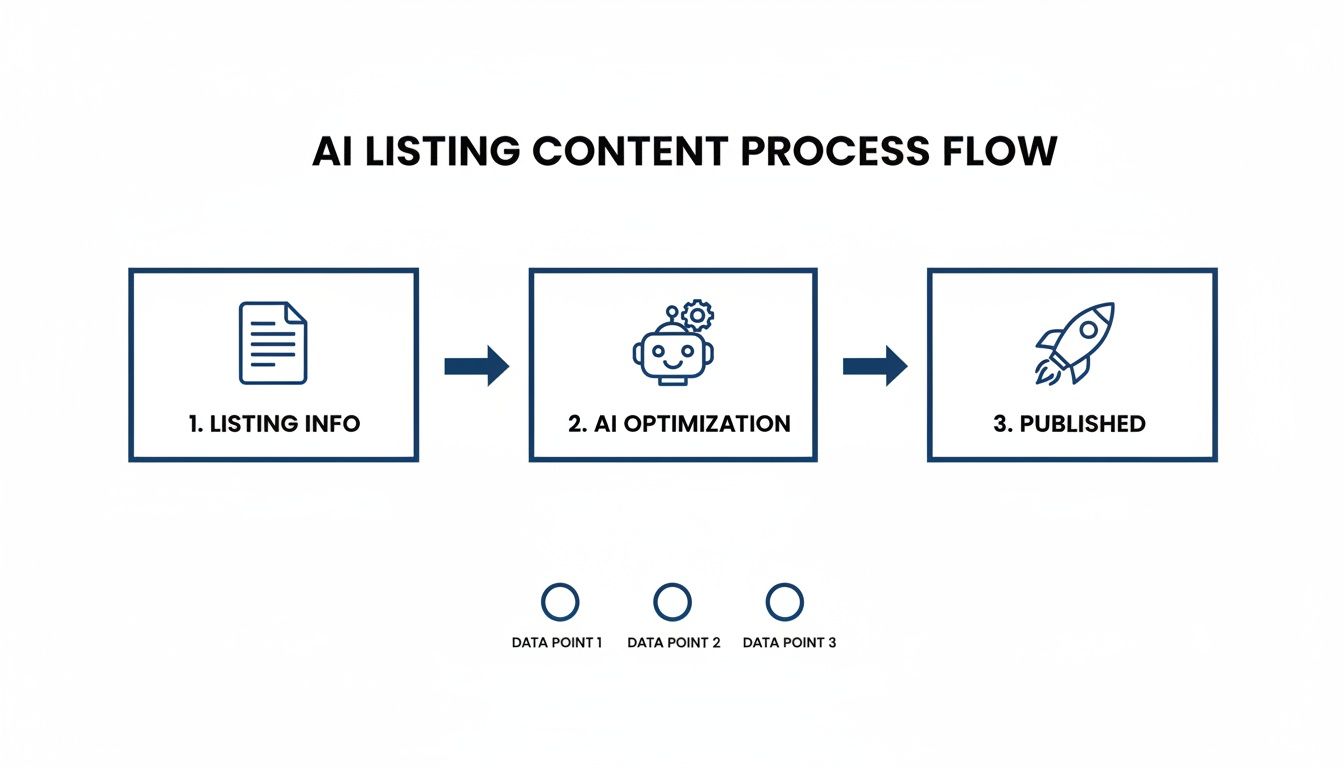
    This diagram shows just how simple the process becomes when AI steps in, taking raw data and turning it into a published, optimized asset.

    A process flow diagram illustrates AI content optimization for listings, from listing information to publishing.

    What used to be a tedious manual task is now a quick, three-step automated sequence, cutting your content creation time down dramatically.

    Creating a Distribution Cadence for Key Events

    Automation shouldn't just be a one-and-done action when a listing goes live. A smart strategy includes pre-planned content pushes tied to the natural lifecycle of a property listing. This approach keeps the listing feeling fresh in the market and maintains buyer interest. When you have a defined cadence, you're never scrambling for content when something important happens.

    I recommend building automated content triggers around these four key milestones:

    • New Listing Launch: This is your big moment. Your system should automatically create and schedule a complete set of assets: the optimized MLS description, unique portal descriptions, a "Just Listed" social media carousel, a video reel, and a broadcast email to your database.
    • Open House Promotion: About three or four days before the event, a fresh wave of content should deploy. This could be social media posts with the date and time, another email blast, and maybe an Instagram story series counting down to the event.
    • Price Reduction Alert: A price change is a huge marketing opportunity. This trigger should instantly push "Price Improvement" graphics to social media, update all the listing portals, and send a targeted email to buyers who may have viewed or saved the property.
    • Just Sold Celebration: Once the deal is done, your final automated push is all about showcasing your success. Think "Just Sold" posts for social media that highlight a great result (e.g., "Sold in 7 days for 102% of asking price!"). This is powerful social proof for future sellers.

    By setting this cadence, you’re not just a marketer anymore. You're the conductor of a fully orchestrated campaign that runs flawlessly in the background, reacting intelligently to key events without you lifting a finger.

    For any agent looking to put a system like this in place, the next logical step is to explore real estate content marketing automation. It's a deeper look into the specific tools and tactics that turn this strategy into a time-saving reality, ensuring your marketing can keep up as your business grows.

    Measuring Performance to Prove Your Value

    A person's hands analyze data on a laptop screen displaying various charts and graphs.

    A top-tier real estate listing syndication strategy isn't just about broadcasting a listing far and wide; it's about proving that every single effort translates into real results. Let’s be honest, syndication without data is just guesswork. By getting a handle on the right performance metrics, you can stop hoping for the best and start making smart, data-driven decisions that sharpen your approach.

    More importantly, this is how you demonstrate your undeniable value to sellers.

    Walking into a listing presentation armed with hard data and a professional reporting system sets you miles apart from the competition. It instantly shows you’re not just another agent who plans to stick a sign in the yard. Instead, it positions you as a strategic marketing partner who knows precisely how to maximize a property's exposure—and can prove it with numbers.

    Defining Your Key Performance Indicators

    Before you can show off your success, you need to know what it actually looks like. While every platform has its own set of analytics, your focus should be on the numbers that directly signal genuine buyer interest. These are your Key Performance Indicators (KPIs).

    Here are the core KPIs you should be tracking:

    • Listing Views per Channel: This is your top-of-funnel metric. How many eyeballs did you get on Zillow versus Realtor.com or your own brokerage site? This tells you which channels are winning the awareness game.
    • Saves and Favorites: A "save" is a far more powerful signal than a simple view. Tracking this shows you which listings are compelling enough for buyers to bookmark, which is a clear indicator of serious interest.
    • Inquiries and Messages: This is the ultimate conversion. How many tour requests, direct messages, or emails did the listing generate from each portal? This metric pinpoints which platforms deliver the most qualified leads right to your inbox.
    • Click-Through Rate (CTR): For channels like social media or your own website, what percentage of people who saw the listing actually clicked to learn more? A high CTR means your photos and headlines are doing their job and grabbing attention.

    Once you start tracking these KPIs for every listing, you'll uncover patterns that will make your future strategy even stronger. You might find that luxury homes kill it on a specific niche portal, while starter homes get more action from targeted Facebook ads. That's the kind of insight that turns your marketing from a service into a science.

    Building Your Client Marketing Report

    The real magic happens when you package this data for your clients. A sharp, clear Client Marketing Report is one of the most powerful tools in your arsenal, whether you're at the initial listing presentation or providing weekly updates. It makes your marketing efforts tangible and professional.

    Your report needs to be simple, visual, and easy for any homeowner to grasp. The goal isn't to bury them in spreadsheets; it's to tell a compelling story of your marketing activity and its impact. And if you're looking to get even more eyes on your listings through search, our guide on AI-powered SEO for real estate agents can give you a serious competitive advantage.

    When you can show a seller their home received 1,200 views and 45 saves in the first week, you’re doing more than just giving an update. You are actively reinforcing their decision to hire you and building unshakable trust through transparency.

    Here’s what a simple weekly report summary might look like:

    Marketing Channel This Week's Views Total Saves Inquiries
    Zillow 750 28 3
    Realtor.com 450 12 1
    Facebook Campaign 1,500 Impressions 5 Clicks 0
    Your Website 110 5 1

    Presenting a clean table like this gives immediate proof of the massive exposure your real estate listing syndication strategy is generating. It justifies your commission by showcasing the hard work happening behind the scenes, turning your marketing plan from a promise into a documented success story.

    Answering the Tough Questions About Listing Syndication

    Even the most buttoned-up strategy runs into questions. A smart real estate syndication plan has a lot of moving pieces, and knowing how to handle the common hiccups is what separates the pros from the amateurs. It’s how you keep your marketing machine humming.

    Let’s dig into the questions that pop up most often. Think of this as your field guide for troubleshooting your syndication and handling those tricky seller conversations. The right answers build confidence, for you and for them.

    How Do I Keep Listing Information Accurate Everywhere?

    This is the classic syndication headache. You drop the price in the MLS, but an hour later, some third-party site is still showing the old number. Inaccurate data isn't just annoying; it kills buyer trust and can even get you into hot water with compliance.

    The culprit is usually the lag time. Different portals pull data from the MLS feed at their own pace. Some might update every 15 minutes, while others only refresh a couple of times a day.

    Here’s how I’ve learned to manage it:

    • Make the MLS Your Single Source of Truth: Your MLS is the master record. Period. Get every detail 100% correct there before it goes anywhere else. This prevents the vast majority of problems downstream.
    • Spot-Check the Big Players: After a major update like a price change, I'll manually check the listing on my top-tier portals like Zillow and Realtor.com within a few hours. If a discrepancy is still there after 24 hours, it's time to reach out to their support team.
    • Use Direct Feeds When Possible: Many modern brokerages and syndication platforms have direct data feeds to the major portals. These often bypass the middlemen aggregators, leading to much faster and more reliable updates.

    Are Niche Listing Sites Really Worth The Effort?

    It’s a fair question. When the giant portals get all the traffic, why bother manually posting a luxury lakefront home to a small, specialty site?

    Because you’re not after all the traffic. You’re after the right traffic.

    Think of it this way: you can cast a giant net in the ocean (Zillow) and see what you get, or you can drop the perfect lure into a pond you know is stocked with trophy fish (a niche site). The buyer looking at luxury-specific sites has already self-qualified. They’re there for a reason.

    Niche sites aren’t about volume; they’re about precision. You're trading mass exposure for laser-focused visibility in front of a high-intent audience that is already looking for exactly what you're selling.

    How Do I Explain Syndication Value to My Sellers?

    Sellers want to see exactly how you're earning that commission. "I'll put it on the internet" is a response that died with dial-up. You need to position your real estate listing syndication strategy as the comprehensive, multi-channel marketing campaign it is.

    Don't just give them a list of websites. Show them your tiered approach. Use a simple visual in your listing presentation that breaks it down:

    1. Tier 1 Portals: This is where we get maximum eyeballs from the biggest pool of active buyers.
    2. Tier 2 Niche Sites: Here's where we target specific, highly-qualified buyers looking for homes just like yours.
    3. Tier 3 Social Media: This is how we create a story around your home and build local buzz.

    When you can lay out a clear, strategic plan that covers all the bases—from data-driven portals to story-driven social posts—you’re no longer just another agent. You’re a sharp marketing expert who justifies their value with a professional strategy that leaves the competition looking dated.


    Stop wasting hours on manual marketing and start winning more listings. With ListingBooster.ai, you can generate a complete, AI-optimized marketing suite for any property in minutes. Transform your listings, prove your value, and dominate your market. Start your free trial of ListingBooster.ai today