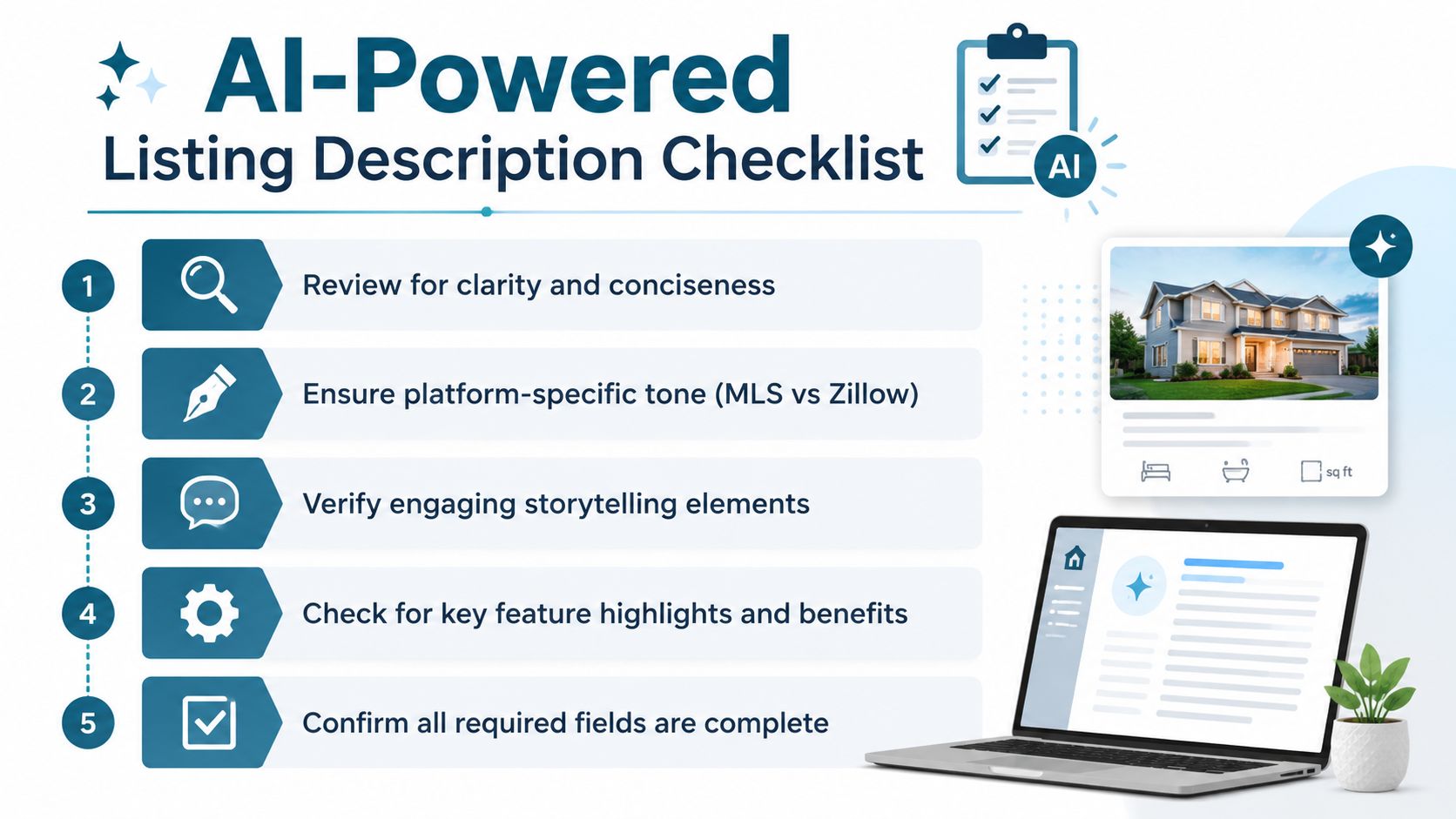
Tag: listing descriptions

  • How to Optimize Listing Descriptions for AI Search: A Guide

    How to Optimize Listing Descriptions for AI Search: A Guide

    More buyers are starting their home search inside AI tools, not just on portals or Google. Over 40% of homebuyers now initiate searches on platforms where AI can extract and surface individual paragraphs from your content (Olive & Company). That changes the job of a listing description.

    The old model was simple. Stuff in the beds, baths, square footage, maybe a few adjectives, then hope the photos do the rest. That still fills a box in the MLS. It does not reliably help your listing get cited, summarized, or recommended by ChatGPT, Google AI, or Perplexity.

    If you want to know how to optimize listing descriptions for ai search, think less like a copywriter chasing flair and more like an operator building clean inputs for a recommendation engine. Your description has to do three things at once. It has to answer buyer intent, survive machine parsing, and stay compliant.

    The New Search Paradigm Your Listings Must Conquer

    AI recommendation engines reward listings that can be quoted cleanly. If a paragraph cannot stand on its own, it is less likely to be surfaced, summarized, or cited in tools like ChatGPT, Google AI, and Perplexity.

    A digital artistic representation of a neural network or neuron structure with a bright blue background.

    Why old listing copy disappears

    Agents still publish descriptions loaded with filler. “Welcome home.” “Stunning gem.” “Must see.” Those phrases waste the most valuable real estate in the listing, which is the first sentence and first paragraph.

    AI systems often evaluate content in chunks. A single extracted paragraph may be judged without the headline, photo gallery, or the rest of the description around it. If that paragraph opens with generic language and delays the actual value, the system has very little to work with.

    That changes how strong listing copy is built.

    Each paragraph should answer a buyer question directly. Each sentence should clarify a feature, a use case, or a location benefit. In practice, I treat every paragraph like a standalone response block that could be lifted into an AI-generated answer without needing cleanup.

    Practical rule: Copy one paragraph from the listing into ChatGPT by itself. If it still reads like a clear answer to a buyer need, the structure is working.

    Search has shifted from matching words to matching usable answers

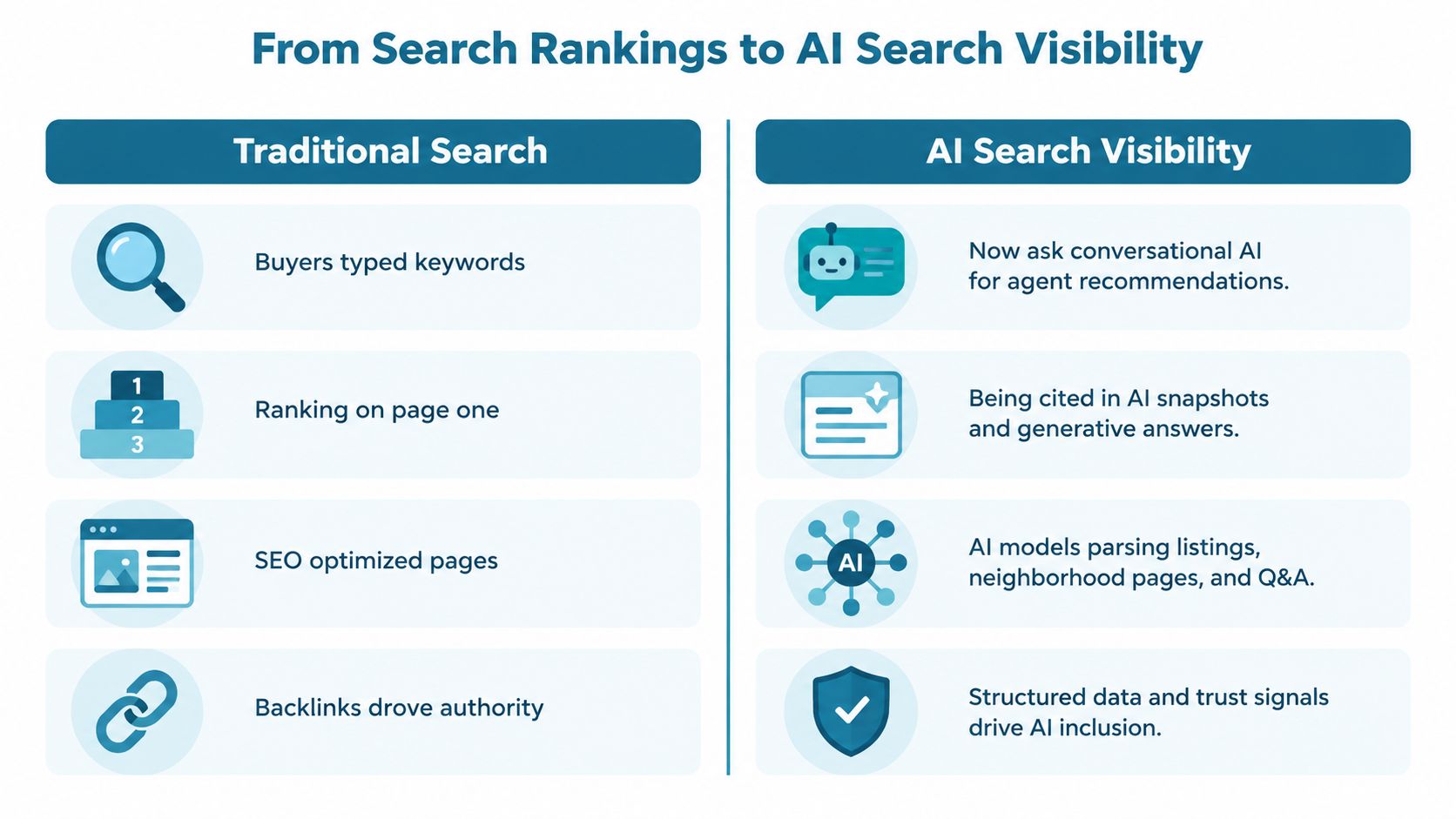
    Traditional search indexed pages and matched phrases. AI search systems try to assemble the best answer from multiple sources, which means your description needs passages that are easy to extract and easy to trust.

    Agents who want the technical framing should understand how AEO differs from SEO. SEO helps a page rank. AEO helps a specific section of text get selected as an answer. Listing descriptions now have to do both.

    Here is the difference in day-to-day writing:

    Old listing mindset AI search mindset
    Write one flowing block of copy Write self-contained paragraphs
    Open with flair Open with the clearest buyer value
    List features Connect features to buyer outcomes
    Fill the MLS field Create text that AI can extract and reuse

    What strong AI-readable copy actually looks like

    The goal is not clever prose. The goal is explicit meaning.

    A flex room should not stay a flex room in the copy if the likely buyer intent is remote work, guests, hobbies, or a nursery. A covered patio should not sit there as a bare feature if it provides easy outdoor dining or low-maintenance hosting. Good AI-facing descriptions make that translation obvious.

    Here is a simple example:

    • Feature: south-facing backyard

    • Buyer meaning: more natural light and better daytime use

    • AI-readable phrasing: “The south-facing backyard offers a bright outdoor area that works well for gardening, casual dining, and weekend play.”

    • Feature: split-bedroom layout

    • Buyer meaning: more privacy between the primary suite and secondary rooms

    • AI-readable phrasing: “The split-bedroom layout places the primary suite away from the secondary bedrooms, which suits buyers who want added privacy or a quieter guest setup.”

    This is also where a system helps. I use ListingBooster.ai to structure copy into clean, buyer-intent-driven sections and keep the language compliant, especially when I want repeatable output across a full pipeline. If you want the specific real estate framework behind that process, review this guide on AI search optimization for real estate agents.

    The competitive gap is widening

    Agents who keep writing vague, flowery descriptions are making AI retrieval harder than it needs to be. The listing may still exist in the MLS, but it gives recommendation engines weak material to work with.

    Agents who write modular, specific, high-signal copy have an edge. Their listings are easier to quote, easier to summarize, and easier to recommend. That is the significant shift in search behavior, and it rewards agents who treat listing descriptions like structured inputs instead of filler text.

    Mapping Buyer Intent to AI-Readable Keywords

    Most agents start with property facts. That's fine, but facts alone don't create AI visibility. You need to map facts to the language buyers use when they ask conversational questions.

    Amazon's AI-driven search offers a useful clue here. In that environment, AI-generated content can include natural phrases like “ideal for outdoor activities in warm climates,” which may not show up in traditional keyword tools but still match real customer queries (Helium 10). Real estate works the same way.

    Build a concept library before you write

    Before drafting the description, create a simple concept library for the listing. This isn't a keyword dump. It's a translation sheet between the home and buyer intent.

    Use four columns:

    Property fact Buyer problem solved Natural-language query Phrase to use in copy
    Bonus room Needs workspace home with office space dedicated flex room for a home office
    Fenced yard Wants privacy for kids or dogs yard for pets or play fenced backyard with room for pets and play
    Walkable location Wants convenience home near shops and dining close to local dining, errands, and daily conveniences
    Covered patio Wants easy hosting home with outdoor entertaining covered patio for casual outdoor dining and entertaining

    This exercise changes how you write. Instead of listing features in isolation, you start framing them as answers.

    Think in buyer questions, not just keywords

    A lot of agents still optimize for phrases like “4 bedroom home in North Austin.” That's not wrong. It's incomplete. Buyers using AI ask layered questions that combine lifestyle, layout, budget sensitivity, commute, family needs, and emotional triggers.

    I like to pressure-test a listing with queries like these:

    • Lifestyle query: What kind of buyer would love this home?
    • Pain-point query: What problem does this floor plan solve?
    • Decision query: Why would someone choose this over similar homes nearby?
    • Neighborhood query: What daily routines does this location make easier?
    • Emotional query: What would it feel like to live here on a normal Tuesday?

    Those questions produce stronger raw material than a spreadsheet of search terms.

    If your description can't answer a buyer's spoken question, it's probably over-indexed on features and under-built for AI discovery.

    Separate head terms from intent phrases

    You still need core property language. Beds, baths, neighborhood, school district references where compliant, lot style, and major amenities all matter. But those are only one layer.

    A better system uses two buckets.

    Core discovery terms

    These are the obvious terms buyers and portals expect:

    • Location markers: neighborhood, city, nearby districts, landmark areas
    • Property type terms: condo, townhome, single-story, custom home
    • Structural features: primary suite, open-concept kitchen, guest room, updated bath

    Intent phrases

    These are the phrases buyers naturally use in AI prompts:

    • Daily-life language: easy commute, work-from-home setup, low-maintenance yard
    • Use-case language: space for hosting, room for multigenerational living, lock-and-leave convenience
    • Emotional framing: bright and calming, private retreat, flexible layout for changing needs

    One reason this works is that AI can match plain-language descriptions to broader queries more effectively than rigid keyword strings alone. If you've ever studied social content discovery, some of the same principles show up in 2024 carousel keyword strategies, where context and user intent matter as much as direct phrase matching.

    A field-ready framework agents can use fast

    When I build listing copy, I reduce the home to five intent layers:

    1. Who is this home for
      First-time buyers, move-up families, investors, downsizers, remote professionals, second-home buyers.

    2. What problem does it solve
      Lack of workspace, cramped entertaining, no private outdoor area, long commute friction, too much maintenance.

    3. What moments does it enable
      Quiet morning coffee, weekend hosting, easy school mornings, separate guest stays, simple lock-and-leave travel.

    4. What proof supports that claim
      Split floor plan, oversized island, fenced yard, dedicated office, attached garage, covered patio, walkability.

    5. What language would a buyer use
      Not “resort-style sanctuary.” More like “private backyard with room to relax and host friends.”

    This process gives you a bank of AI-readable phrases before writing starts. Once you've done it a few times, it becomes automatic.

    The Anatomy of a Perfect AI-Optimized Listing

    AI-ready descriptions win on structure. Length only helps when each section gives a recommendation engine a clear, self-contained answer it can quote, summarize, or rank.

    A diagram illustrating the five key elements required for creating an effective, AI-optimized product or service listing.

    Semrush’s analysis of AI search optimization patterns points in the same direction. Compact sections tend to perform better in AI-generated results than thin fragments or oversized blocks (Semrush). For agents, the practical takeaway is simple. Build short sections that fully explain one idea.

    Open with the clearest buyer match

    The first sentence has a job. It should tell AI and the buyer what kind of home this is, who it fits, and why it matters.

    Weak opening:
    “Welcome to this beautifully maintained home with charm and character.”

    Stronger opening:
    “This updated single-story home offers a flexible layout, private backyard, and dedicated office for buyers who want comfort, convenience, and work-from-home function.”

    That sentence gives AI usable signals immediately. Property type, layout benefit, outdoor value, workspace, and buyer fit.

    Add a tight summary that can stand alone

    The second block should work even if an AI system lifts only those two sentences into a recommendation. I write this section like a mini pitch, not a warm-up paragraph.

    A strong summary does three things:

    • Defines the fit: who is likely to care
    • Surfaces the main differentiators: what makes the home easier to remember
    • Connects the location to daily life: what convenience looks like in practice

    Example:
    “This home pairs an open main living area with a separated bedroom layout and quick access to shopping and commuter routes. Buyers looking for functional indoor-outdoor living will notice the covered patio, fenced yard, and kitchen that connects directly to the main gathering space.”

    That kind of paragraph holds up on its own. That matters because AI systems often extract and recombine sections instead of presenting the whole listing word for word.

    Build the body in complete thought units

    Many listing descriptions still fail for one reason. The copy either runs as one long paragraph or breaks into a pile of disconnected phrases. Neither format gives AI much confidence.

    Each paragraph should cover one topic completely.

    Layout and livability

    Explain how the floor plan works in real life.

    Example:
    “The split-bedroom layout gives the primary suite more privacy from the secondary bedrooms. A separate flex room near the front of the home works well as an office, study area, or guest overflow space, giving buyers options as needs change.”

    Kitchen and gathering space

    Connect finishes and layout to actual use.

    Example:
    “The kitchen opens to the main living and dining areas, making it easier to cook while staying connected to family or guests. An oversized island adds prep space, casual seating, and a natural center point for everyday routines.”

    Outdoor function

    State what the exterior enables.

    Example:
    “The fenced backyard creates usable space for pets, play, or weekend hosting. A covered patio adds shade and makes outdoor dining more practical during warmer months.”

    I use a simple standard here. If ChatGPT quoted one paragraph without the rest of the listing, that paragraph should still make sense.

    Use a scannable feature block after the prose

    Structured copy helps both readers and machines. After the narrative sections, add grouped bullets that separate major categories instead of dumping every feature into one line.

    • Interior highlights: open-concept living area, dedicated flex room, updated lighting, generous storage
    • Outdoor features: fenced yard, covered patio, low-maintenance landscaping
    • Location advantages: access to major routes, close to everyday shopping, convenient to dining and services

    This format creates cleaner boundaries between topics. It also makes the listing easier to reuse across MLS remarks, portal descriptions, brokerage sites, and AI summaries.

    Follow a repeatable template

    Here’s the format I use when I want descriptions to perform across search, recommendations, and portal scan behavior:

    Component Goal Writing note
    Opening sentence Match buyer intent fast Lead with the best-fit use case
    Summary block Explain value quickly Keep it specific and benefit-driven
    Paragraph 1 Clarify layout Complete one idea
    Paragraph 2 Explain kitchen and living flow Complete one idea
    Paragraph 3 Show outdoor and daily-life value Complete one idea
    Feature list Improve scan speed Group bullets by category

    If speed matters, use a structured drafting workflow instead of starting from zero. This guide to an AI property description writer for MLS listings shows how agents are turning property inputs into organized drafts they can edit for accuracy, positioning, and compliance.

    Cut the patterns that weaken AI extraction

    A few habits drag listing quality down fast:

    • Adjective stacking: “stunning, charming, beautiful, immaculate” adds fluff without meaning
    • Feature dumping: long upgrade lists with no buyer context
    • Dependent paragraphs: sections that only make sense if the previous paragraph was read first
    • Oversized blocks: dense copy lowers readability and weakens extraction
    • Generic luxury language: phrases like “must-see masterpiece” without specific proof

    The strongest AI-optimized listing reads clean because every sentence does a job. Clear structure improves generation, extraction, and measurement later. That is the difference between writing copy that sounds good and writing copy that gets surfaced.

    Leverage Advanced Tactics Schema Prompts and Compliance

    Once your copy structure is right, the technical layer starts to matter. Many agents, however, cease their efforts too soon. They think a polished paragraph is the whole game. It isn't.

    A conceptual graphic illustration of data streams converging into a central metallic sphere labeled Schema for AI.

    Schema markup completeness carries significant weight in AI recommendation systems. Authoritative list mentions account for about 41% of AI recommendation weight, and precise markup such as LocalBusiness and Organization performs better than generic schema (First Page Sage). For agents, the takeaway is simple. If AI can't confidently understand who you are, what the listing is, and how those entities connect, your visibility ceiling stays lower.

    Think of schema as an AI cheat sheet

    Schema tells machines what a page contains in an explicit, structured format. Instead of hoping an AI system infers that your site page is a listing, that you are the agent, and that your brokerage is the organization behind it, schema states those relationships directly.

    For a real estate marketing stack, the most practical schema categories are:

    • Organization schema: brokerage or team identity
    • LocalBusiness schema: local service presence and agent credibility signals
    • Article schema: neighborhood guides, market updates, and supporting content
    • HowTo schema: buyer guides, prep checklists, or local area walk-through content

    The key isn't just adding schema. It's using specific schema with clear relationships, unique identifiers, and consistent entity naming.

    Prompting matters more than most agents realize

    If you're using AI to draft listing descriptions, your prompt quality controls the output quality. Vague prompts produce vague copy. Good prompts produce modular, buyer-intent-rich descriptions you can use.

    Try prompt instructions like these:

    Generate a listing description in short standalone paragraphs. Each paragraph should answer one buyer concern clearly without relying on the previous paragraph. Translate features into benefits, use plain language, avoid clichés, and separate layout, kitchen, outdoor space, and location.

    Or this:

    Write MLS-safe copy for a single-family home. Lead with the strongest buyer use case. Include a scannable feature section. Avoid protected-class language, school quality claims, and vague luxury filler.

    That second instruction matters because AI can create compliance problems just as fast as it creates drafts.

    Compliance is part of optimization

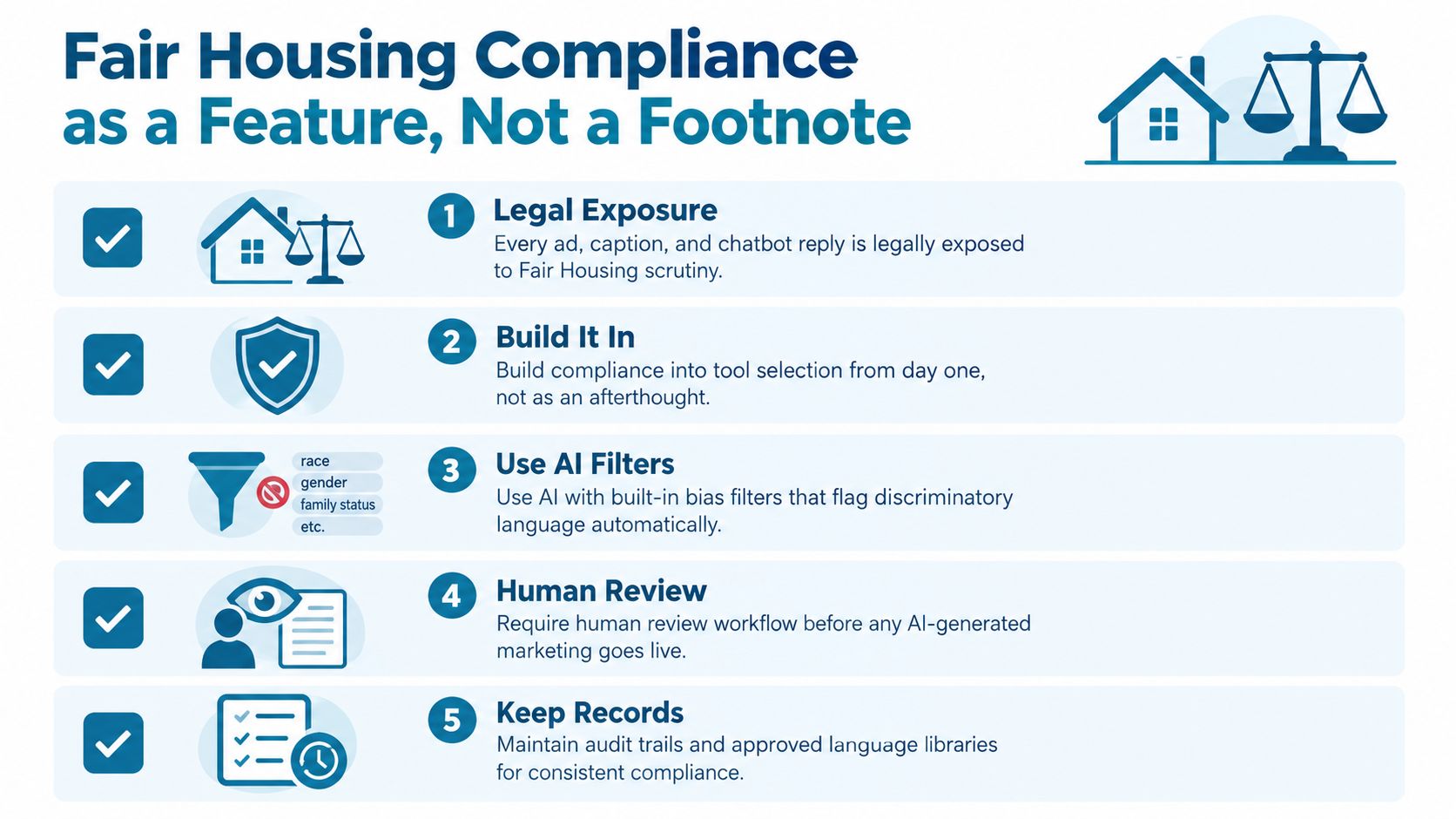
    A description that gets attention but introduces Fair Housing risk is not optimized. It's a liability. Agents need to filter for both visibility and compliance.

    Watch for these common mistakes:

    • Protected-class implications: language that signals who should live there
    • School quality shortcuts: claims that imply educational superiority
    • Lifestyle exclusion language: wording that suggests a preferred buyer type in a discriminatory way
    • Over-personalized assumptions: copy that implies age, family status, religion, or similar characteristics

    A better pattern is to describe the property and its use cases without suggesting who belongs there. Focus on function, access, layout, and amenities.

    One practical way agents handle this is by using tools that combine generation with compliance review. For example, ListingBooster.ai is built to generate AI-optimized real estate marketing content and support schema-oriented visibility workflows for listings. The broader point is that whatever tool you use, it should help you structure content for AI search while reducing compliance risk before publication.

    Advanced execution beats pretty copy

    A polished paragraph helps. A well-structured entity footprint helps more. The agents who win this next cycle won't just write better descriptions. They'll publish clearer machine-readable content, connect that content to their brand identity, and avoid avoidable compliance mistakes.

    That's what separates an AI-friendly listing from one that sounds good on the page.

    How to Measure What Matters A/B Testing for AI Search

    Agents who treat listing descriptions like finished copy leave performance on the table. AI search rewards iteration. The winning workflow is closer to conversion testing than traditional listing marketing.

    A digital dashboard showing performance data charts for AI testing displayed on a car infotainment screen.

    Brevitas reports that AI visibility for real estate listings improves when agents keep refining copy based on whether listings appear in AI answers, how often that language gets reflected back, and which description formats produce stronger engagement (Brevitas). The useful takeaway is simple. Initial optimization gets you into the race. Measurement tells you what earns recommendation visibility.

    Track AI presence like a performance channel

    Page views and saves still matter, but they are incomplete. If the goal is AI discovery, track whether your listing and brand show up inside AI-generated responses for real buyer prompts.

    A simple operating dashboard should cover three areas:

    Metric bucket What to watch Why it matters
    AI presence whether the listing, brokerage, or agent brand appears in AI-generated answers Shows whether your copy is getting picked up in the recommendation layer
    Conversion behavior inquiry quality, saved listing behavior, showing requests Shows whether the visibility is attracting serious buyers
    Copy variation performance which version of the description produces stronger engagement after publication Gives you a repeatable basis for future edits

    “AI snippet share” is a practical internal label for this process. It means checking how often your wording or listing facts appear when buyers ask questions such as “best homes with office space near downtown” or “updated single-story homes with low-maintenance yard.”

    Test one variable at a time

    The fastest way to ruin an A/B test is to rewrite the entire listing at once. If you change the opener, reorder photos, swap the call to action, and rewrite the feature block together, you cannot isolate what improved performance.

    Keep the test narrow. Pick one variable and give it enough time to produce a signal.

    Useful tests include:

    • Opening angle: feature-first opening vs. problem-solution opening
    • Length: compact summary vs. expanded summary
    • Benefit framing: convenience language vs. flexibility language
    • Structure: paragraph-only format vs. paragraph plus grouped bullets

    Here is a clean example.

    Version A: “Updated home with open kitchen and fenced backyard.”

    Version B: “Flexible layout with indoor-outdoor flow, a fenced yard, and space that works well for remote work or guests.”

    That test shows whether AI systems and buyers respond better to plain feature labeling or to features paired with clear use cases.

    Good testing removes opinion from the process. The version that gets surfaced and gets inquiries wins.

    Build a review loop your team can actually maintain

    The process does not need to be complex. It needs to be consistent.

    1. Publish a baseline version
      Start with a structured description showcasing the home's strongest facts, likely buyer use cases, and neighborhood context.

    2. Run prompt checks manually
      Search relevant prompts in ChatGPT, Google AI results, and Perplexity. Use the kinds of questions buyers ask, not just MLS shorthand.

    3. Log appearance patterns
      Record whether the listing is cited, paraphrased, summarized accurately, or ignored. Track the specific phrases that seem to get picked up.

    4. Revise one element
      Update only the opener, one paragraph, or the feature grouping.

    5. Compare downstream results
      Review showing requests, lead quality, saved listing activity, and the language buyers use when they reach out.

    Agents with volume should formalize this. ListingBooster.ai helps by speeding up structured versioning, so teams can generate compliant variants, test them faster, and keep a cleaner record of what changed across listings.

    Measure response quality, not just response volume

    More inquiries do not always mean better copy. A description can attract clicks for the wrong reasons if it overemphasizes one feature or creates expectations the property cannot support.

    Watch for signals that the copy is matching buyer intent:

    • Buyers mention the same features or use cases highlighted in the description
    • Showing requests come from prospects who fit the likely price point and property type
    • Follow-up questions are specific, not confused
    • AI summaries reflect the home's strengths accurately instead of flattening it into generic portal language

    That is the benchmark. Good AI-facing copy improves discovery and sharpens fit.

    Use the results in your listing presentation

    Sellers do not need a lecture on retrieval models. They want proof that your marketing process adapts faster than the average agent's.

    Show them a system:

    • Versioned listing copy: different description angles tested against real buyer behavior
    • Prompt-based visibility checks: confirmation that the property can surface in AI-style search scenarios
    • Measured revisions: updates based on actual appearance and inquiry patterns, not gut feel

    That positions you as the agent who monitors performance after the listing goes live, not the one who writes a polished paragraph and hopes for the best. In the AI search era, that difference is real, measurable, and hard to copy.

    Frequently Asked Questions on AI Listing Optimization

    Do I need to rewrite every listing from scratch?

    No. You need to rewrite weak patterns from scratch. The reusable part is the structure. Once you have a reliable framework for openings, standalone paragraphs, and feature blocks, you can rebuild listing descriptions much faster without defaulting to generic phrasing.

    Should I prioritize MLS compliance or AI readability?

    MLS compliance comes first. Then you optimize within those boundaries. The good news is that clear, factual, plain-language copy usually helps both. Problems show up when agents try to sound clever, imply buyer identity, or overstate lifestyle claims.

    Are keyword tools still useful?

    Yes, but they aren't enough on their own. Use them for core discovery language, then expand into buyer-intent phrasing that reflects how people ask questions in AI tools. Technical terms help with indexing. Conversational phrasing helps with answer matching.

    How long should my description be?

    Long enough to fully explain the home's value, short enough that each section stays focused. Compact, self-contained paragraphs outperform bloated blocks. If a paragraph drifts into multiple topics, split it.

    Do bullet points help or hurt?

    They help when they organize information cleanly. A grouped feature section can improve scannability for people and clarity for AI. Just don't let the entire description become a lifeless inventory list. Use bullets to support the narrative, not replace it.

    Can AI write the description for me?

    It can draft it. You still need to guide it, edit it, and verify compliance. The strongest workflow is human-directed AI, not one-click publishing. Your edge comes from knowing the property, the buyer, and the market context better than a generic model does.

    What kinds of listing language should I cut immediately?

    Start with these:

    • Clichés: stunning, charming, must-see, won't last
    • Empty luxury filler: resort-style, masterpiece, dream home
    • Unclear benefits: upgraded finishes without saying why they matter
    • Dependent transitions: paragraphs that only make sense when read in sequence

    What should every AI-ready description include?

    At minimum:

    • A buyer-intent-led opening
    • Standalone paragraphs by subtopic
    • Feature-to-benefit translation
    • Scannable grouped highlights
    • Plain-language wording
    • A compliance review before publishing

    If you build around those elements consistently, you'll be ahead of the agents still writing for a portal field instead of an AI recommendation engine.


    If you want a faster way to turn raw property details into AI-readable, MLS-safe marketing content, ListingBooster.ai gives agents a workflow for generating structured listing descriptions, social assets, and supporting materials without starting from a blank page every time.

  • Property Description Examples: 8 Proven Listings That Sell

    Property Description Examples: 8 Proven Listings That Sell

    In a market saturated with listings, a generic description is the fastest way to become invisible. The right words don't just describe a house; they create desire, build trust, and answer a buyer's unasked questions before they even scroll. A well-crafted property description is a powerful sales tool that can significantly impact buyer interest, inquiry volume, and even the final sale price. It’s the first real connection a potential buyer makes with a home, transforming a set of features into a compelling vision of their future life.

    This guide moves beyond simple adjectives to provide a replicable framework for every listing. We will break down eight strategic property description examples, analyzing the psychology, platform-specific tactics, and AI-optimization strategies used by top-producing agents. The goal is to equip you with more than just templates; it's to give you a deep understanding of why certain approaches work for specific property types and marketing channels.

    You will learn how to:

    • Craft feature-rich narratives that tell a story.
    • Optimize for MLS compliance and AI-powered search.
    • Adapt your message for social media, video, and community-focused angles.
    • Highlight investment potential and integrate market data effectively.

    From Zillow and Realtor.com to social media and video scripts, these insights provide actionable takeaways you can implement immediately. By mastering these techniques, you'll learn to write descriptions that not only attract attention but also attract higher-quality buyers, justify your pricing, and help you stand out in a competitive field. This is your playbook for turning listings into sales.

    1. Feature-Rich Narrative Description

    A feature-rich narrative description moves beyond a simple list of specifications. It weaves together a property's features, amenities, and location into a compelling story that paints a vivid picture for potential buyers. This method is designed to create an emotional connection, showing buyers not just what the house is, but how it would feel to live there. It's an excellent example of how to build a story around a property, which is highly effective for both human readers and AI search algorithms that interpret natural language to understand a home's value.

    A cozy living room scene with a blue sofa, warm throws, an open book, and coffee on a wooden table.

    This approach is popular in competitive or luxury markets where differentiation is key. By focusing on the lifestyle and experience, an agent can justify a premium price point and attract buyers seeking a specific atmosphere, not just a set of rooms.

    Strategic Breakdown

    • Goal: To sell a lifestyle, not just a structure. The narrative connects features to feelings and daily routines.
    • Mechanism: It uses descriptive, sensory language to make the buyer feel present in the home. Instead of "large primary bedroom," it becomes "a serene primary suite where you can unwind, with space for a reading nook overlooking the garden."
    • Best For: Unique properties, luxury homes, or any listing in a crowded market where emotional appeal can be a deciding factor.

    Actionable Tips for Implementation

    1. Lead with the "Wow" Factor: Start your description with the single most compelling feature. Is it a stunning city view, a chef's kitchen, or a peaceful backyard oasis? Grab attention immediately.
    2. Set the Scene: Use 2-3 sentences at the beginning to establish a mood. For example, "Imagine your weekends starting with coffee on a sun-drenched deck, with nothing but the sound of birds and a gentle breeze."
    3. Connect Features to Benefits: For every feature you list, explain the benefit.
      • Feature: "Newly installed quartz countertops."
      • Benefit: "…providing a durable, elegant surface perfect for meal prep and entertaining guests."
    4. Mention Local Conveniences: Briefly name 2-3 nearby amenities (parks, cafes, transit) that are within a 5-10 minute walk or drive, anchoring the home within its community.
    5. Create a Sense of Urgency: End with a call to action that encourages a visit without being overly aggressive. A good example is, "This unique home offers a rare blend of city convenience and private tranquility. Schedule your private tour today to experience it for yourself."

    2. MLS-Optimized Compliance-First Description

    An MLS-Optimized Compliance-First description prioritizes factual accuracy and adherence to Fair Housing laws above all else. This highly structured approach is engineered to provide clear, verifiable information for Multiple Listing Service (MLS) platforms and syndicated sites like Zillow and Realtor.com. Instead of emotional language, it focuses on quantifiable data: room dimensions, specific features, and objective property details.

    This method is critical for brokerages, especially those managing numerous agents, as it drastically reduces legal risk and liability. By sticking to the facts, agents avoid making subjective claims that could be misinterpreted or lead to Fair Housing violations. This format ensures that every piece of information is defensible, protecting both the agent and their clients. It’s a foundational property description example for maintaining professional standards and trust.

    Strategic Breakdown

    • Goal: To present a property factually and accurately, ensuring full compliance with Fair Housing regulations and minimizing legal risk.
    • Mechanism: It uses precise, objective language and avoids subjective, emotional, or potentially discriminatory terms. For example, "walk-in closet" is replaced with "closet measuring 5' x 8'." The description focuses on what the property is, not who it is for.
    • Best For: All property types, but it is non-negotiable for large brokerages, compliance-focused firms, and agents working in highly regulated markets.

    Actionable Tips for Implementation

    1. Focus on Features, Not People: Describe the property, not the potential buyer. Mention a "fenced backyard" but avoid describing it as "perfect for families with children," as this can be seen as steering and violates familial status protections.
    2. Use Specific Measurements: Replace vague terms like "large" or "spacious" with actual dimensions. State "Primary bedroom: 15' x 18'" instead of "a huge primary suite." Add a disclaimer like "All measurements are approximate" to mitigate liability for minor discrepancies.
    3. Document and Verify Claims: Ensure every feature mentioned, such as "new roof (2023)" or "updated HVAC system," can be verified with documentation. This builds credibility and protects you from claims of misrepresentation.
    4. Avoid Subjective Adjectives: Words like "charming," "cozy," "beautiful," or "luxury" are subjective and can be misleading. Stick to neutral, descriptive words like "wood-burning fireplace," "granite countertops," or "hardwood floors throughout." For a deeper dive, you can learn more about crafting real estate MLS-compliant marketing.
    5. Run a Compliance Check: Before publishing, review your description against Fair Housing guidelines or use a compliance checker tool. Ensure you have not mentioned any protected classes, including race, color, religion, national origin, sex, disability, or familial status.

    3. Social Media-Optimized Multi-Platform Description

    A social media-optimized description adapts the core message of a listing for the unique audiences and formats of different platforms like Instagram, Facebook, and TikTok. Instead of a one-size-fits-all approach, this method involves creating distinct versions of the copy, each tailored with platform-specific language, character limits, hashtag strategies, and calls to action. It’s an essential part of modern real estate marketing for agents who want to maintain a consistent posting schedule and capture attention where buyers are already scrolling.

    This method recognizes that a buyer on LinkedIn is looking for different information than a user on TikTok. Real estate influencers and marketing-savvy teams use this technique to maximize reach and engagement, often using AI tools like ListingBooster to generate platform-specific versions automatically. The goal is to make each post feel native to the platform it's on, which is a key element in many successful property description examples found online.

    Strategic Breakdown

    • Goal: To maximize visibility and engagement by tailoring a property's story to the specific culture and technical constraints of each social media channel.
    • Mechanism: It involves creating multiple copy variations. For example, an Instagram post might lead with an emoji-filled emotional hook, while a LinkedIn post for the same property would use data-driven language to position it as a sound investment.
    • Best For: Agents and teams with an active social media presence who want to build a brand, generate leads directly from social platforms, and appear current and professional.

    Actionable Tips for Implementation

    1. Customize Your Hook for Each Platform: Your opening line is critical.
      • Instagram: Lead with an emotional or aspirational statement. "Your downtown dream loft has arrived. ✨"
      • Facebook: Use a slightly longer, community-focused opening. "New on the market in the heart of Maplewood! This stunning 4-bedroom home is just steps from the community park and farmer's market."
      • TikTok: Front-load the most shocking or unique feature in the first 3 seconds. "Wait until you see the hidden speakeasy in this basement…"
    2. Adapt Your Hashtag Strategy: Don't copy and paste the same hashtags. Use 5-15 highly relevant tags per platform, researching trending real estate topics weekly.
    3. Vary Your Call to Action (CTA): Prompt the specific action each platform encourages.
      • Instagram: "Is this your dream home? Comment 'YES' below!" or "Link in bio for the full tour!"
      • Facebook: "Tag someone who would love this kitchen! Send us a message for a private showing."
      • LinkedIn: "A prime asset for any portfolio. Contact me to discuss market trends and schedule a confidential viewing."
    4. Tag Relevant Accounts: On platforms like Instagram and Facebook, tag local businesses, coffee shops, or parks mentioned in your description to expand your post's reach within the local community.
    5. Post at Peak Times: Schedule your new listing posts for Friday through Sunday, when social media engagement for real estate content is often at its highest. You can find more specific advice for platforms like Instagram by reviewing real estate post ideas.

    4. AI-Search-Optimized Description (ChatGPT/Perplexity Ready)

    An AI-search-optimized description is engineered to be found and understood not just by traditional search engines, but by conversational AI tools like ChatGPT, Perplexity, and Google's AI Overviews. As a growing number of homebuyers begin their search by asking AI direct questions like, "What are the best family homes in Lincoln Park under $1M?", this format ensures your listings and expertise appear in the answers. It combines structured data, natural language processing (NLP) cues, and comprehensive content to position an agent or property as an authoritative source.

    This method moves beyond creative prose and focuses on providing direct answers to the questions buyers are asking AI. It's a technical approach to property marketing that’s becoming vital as search behavior shifts from keyword queries to conversational discovery. Instead of just writing a good listing, you're building a data-rich profile that AI models can easily parse, reference, and recommend.

    Strategic Breakdown

    • Goal: To achieve high visibility and be cited as an authoritative source within AI-generated search results and recommendations.
    • Mechanism: It uses structured data (like JSON-LD for schema), clear heading hierarchies, and content that directly answers likely buyer questions. This makes it simple for Large Language Models (LLMs) to identify the property's key details, the agent's expertise, and the neighborhood's context.
    • Best For: Forward-thinking agents and brokerages who want to capture traffic from emerging AI search platforms and establish themselves as the go-to experts in their local markets. It’s particularly effective for building long-term digital authority.

    Actionable Tips for Implementation

    1. Structure for "Answerability": Format your content to directly answer specific questions. Use headings like "Homes Under $500k in The Heights" or create FAQ sections about local schools, commute times, and property taxes.
    2. Embed Structured Data: Use schema markup (JSON-LD) to explicitly label key information for AI. Include details like RealEstateAgent name, license number, areaServed, and specifics for the SingleFamilyResidence like floorSize, numberOfRooms, and address.
    3. Build Comprehensive Guides: Develop detailed neighborhood guides (over 2,000 words) that cover local statistics, school ratings, market trends (days on market, average price), and amenities. This content serves as a powerful signal of expertise that AI can reference when answering broad user queries about an area. Platforms like ListingBooster's Authority Builder can automate the creation of this type of AI-optimized content.
    4. Prove Your Authority with Data: Don't just say you're an expert; prove it with numbers. Include statements like, "With 47 homes sold in this neighborhood in 2023, our team has a deep understanding of market values." This social proof is easily digestible for AI entity recognition. If you want to dive deeper, you can learn more about optimizing listings for AI search and see how these strategies work in practice.
    5. Monitor Your AI Visibility: Regularly ask AI tools like ChatGPT and Perplexity questions such as, "Who are the top real estate agents in [your area]?" or "Show me modern homes for sale in [your neighborhood]." This helps you track whether your optimization efforts are working and adjust your strategy accordingly.

    5. Community & Neighborhood-Focused Description

    A community-focused description sells the location first and the property second. It prioritizes the neighborhood's character, local amenities, walkability, schools, and overall lifestyle above the home's specific features. This approach is highly effective for buyers who are not just purchasing a house but are "buying into" a community and seeking a specific social environment or set of conveniences. This is one of the most powerful property description examples for connecting with buyers on a personal level, especially those relocating or starting a family.

    A vibrant street scene with a person walking a dog on a sidewalk, lined with shops and trees.

    This method has been popularized by platforms like Zillow and Redfin, which integrate walk scores and detailed neighborhood guides directly into listings. It's also a hallmark of successful agents who build authority as local experts. By demonstrating deep knowledge of the area, an agent builds trust and shows buyers the long-term value of their investment in a thriving community.

    Strategic Breakdown

    • Goal: To attract buyers who value lifestyle and community integration as much as, or more than, the physical structure of the home.
    • Mechanism: It uses specific, named locations and authentic details to prove the neighborhood's appeal. Instead of "near parks," it says, "a 5-minute walk to Riverbend Park, home of the weekly farmers market and summer concert series."
    • Best For: Listings in walkable urban areas, family-friendly suburbs with strong school districts, or any area with a distinct and desirable local culture.

    Actionable Tips for Implementation

    1. Name-Drop Specific Locations: Mention popular local cafes, well-known restaurants, specific grocery stores (like Trader Joe's or Whole Foods), and beloved parks by name. This provides concrete, searchable reference points for buyers.
    2. Go Beyond Generic Ratings: Instead of just listing a school's rating, add context. For example, "Zoned for the top-rated Northwood Elementary, known for its award-winning robotics club and active parent-teacher association."
    3. Describe the Vibe: Capture the neighborhood's personality. Is it a quiet, tree-lined enclave perfect for evening strolls, or a bustling, energetic hub with vibrant nightlife? Use sensory details to describe the sounds and sights.
    4. Incorporate Commute and Transit Details: Provide actual commute times to major business districts or employers during peak hours. Mention proximity to specific bus lines, train stations, or major highways to address practical concerns.
    5. Mention Community Events: Highlight annual street fairs, farmers markets, holiday parades, or neighborhood block parties. This demonstrates a connected and engaged community, which is a major selling point for many buyers.

    6. Investment/Income Property Description

    An investment or income property description shifts the focus from emotional appeal to financial performance. Instead of selling a lifestyle, this data-driven approach targets real estate investors by presenting the property as a financial asset. The description prioritizes metrics like cash flow, capitalization (cap) rate, and return on investment (ROI), providing a clear, numbers-first case for profitability. It is a prime example of tailoring property marketing to a specific, highly analytical buyer persona.

    This method is standard practice on platforms like LoopNet and in the marketing materials of commercial brokerage firms like CBRE and Marcus & Millichap. The language is direct, professional, and centered on the property's ability to generate revenue and appreciate in value, making it one of the most effective property description examples for multi-family, commercial, or rental-focused residential assets.

    Strategic Breakdown

    • Goal: To prove the property's financial viability and long-term value to an investor. The description must be a transparent and compelling business case.
    • Mechanism: It uses financial data, market analysis, and clear projections to build a logical argument for purchase. Instead of "charming duplex," it becomes "a fully occupied duplex generating a 6.8% cap rate with a verifiable T-12 and clear value-add potential."
    • Best For: Multi-family buildings, commercial properties, single-family rentals (SFRs), or any property where the primary buyer motivation is financial return rather than personal use.

    Actionable Tips for Implementation

    1. Lead with Key Financial Metrics: Start with the most important numbers. Open with the cap rate, gross annual income, or number of units to immediately qualify the property for investors scanning listings.
    2. Provide Verifiable Financials: Include the Trailing 12 Months (T-12) statement of income and expenses. This actual data is far more credible than pro forma projections alone and builds immediate trust.
    3. Clearly State the Value-Add Thesis: Explain exactly how an investor can increase the property's value.
      • Opportunity: "Rents are currently 15% below market rate."
      • Action & Result: "…providing a clear opportunity to increase Gross Potential Rent upon lease turnover and boost the cap rate to over 8%."
    4. Detail Tenant and Lease Information: For multi-unit properties, provide a sanitized rent roll. Include lease start/end dates, current rent amounts, and unit types. This data is critical for an investor's own cash flow analysis.
    5. Highlight Market Fundamentals: Briefly mention local economic drivers that support the investment. Include key data points like population growth, major employers, or recent rent growth trends in the submarket to demonstrate long-term stability.

    7. Video/Visual-First Description (Short-Form)

    A video-first description prioritizes visuals over text, using short-form content on platforms like TikTok, Instagram Reels, and YouTube Shorts. In this format, the property itself tells the story through quick cuts and engaging clips, while the text serves primarily as a hook or caption. This is a critical modern approach, designed to capture attention within seconds in fast-moving social media feeds where users scroll quickly. It is an effective property description example for reaching younger demographics and building a personal brand.

    A smartphone on a tripod records a home interior, with 'SHORT-FORM TOUR' text overlay.

    This method has been popularized by Millennial and Gen Z agents who understand the power of viral content. By creating short, dynamic tours, agents can showcase a home's key features to a massive audience, often far beyond the local market. The focus is on creating a shareable, visually appealing asset that generates buzz and direct inquiries.

    Strategic Breakdown

    • Goal: To stop the scroll and generate immediate interest through compelling visuals. The video aims to make viewers feel an instant connection and curiosity.
    • Mechanism: It uses quick-paced editing, trending audio (when appropriate), and on-screen text overlays to create a 15-60 second highlight reel. The description is minimal, often just a catchy hook and a call to action.
    • Best For: Agents building a personal brand, properties with distinct visual appeal (great views, modern kitchens, unique architecture), and reaching buyers on social media platforms.

    Actionable Tips for Implementation

    1. Start with a Strong Hook: The first 3 seconds are crucial. Use a text overlay or opening line like, "POV: You just bought your dream home in Austin" or "This backyard will change your life." Immediately show the most impressive feature.
    2. Show, Don't Just Tell: Let the visuals do the talking. Instead of describing the open-concept layout, create a smooth video transition from the kitchen to the living room. Film people enjoying the space, like someone making coffee or relaxing by the pool, to sell a lifestyle.
    3. Keep the Pacing Fast: Dedicate no more than 3-5 seconds to each room or feature. This maintains momentum and holds viewer attention. The goal is a highlight reel, not a comprehensive tour.
    4. Optimize for Mobile Viewing: Use large, high-contrast text overlays that are easy to read on a phone screen. Film in vertical format (9:16 aspect ratio) to fill the entire screen on mobile devices.
    5. Use a Clear Call to Action (CTA): Tailor your CTA to the platform. On Instagram, you might say, "DM for a private tour!" On TikTok, it could be, "What do you think of this price? Comment below!" The caption should be brief, directing viewers back to the video or a link in your bio.

    8. Comparative Market Analysis (CMA) Integrated Description

    A CMA-integrated description goes beyond creative storytelling to ground the property's value in hard data. It transparently incorporates key details from a comparative market analysis (CMA) directly into the listing text. By preemptively addressing buyer questions about price and value with concrete data, this method positions the agent as a knowledgeable and trustworthy market expert. It's an excellent property description example for appealing to analytical, data-driven buyers.

    This approach builds confidence by showing the "why" behind the asking price. Instead of just stating a price, it provides context, such as recent comparable sales, price-per-square-foot metrics, and current market conditions. This is particularly effective for platforms like Zillow or Redfin, where buyers are already comparing multiple properties and their associated data points.

    Strategic Breakdown

    • Goal: To justify the asking price with transparent data, build agent credibility, and appeal to analytical buyers who prioritize value and investment potential.
    • Mechanism: It strategically weaves market statistics and comparable sales data into the property narrative. It might state, "Priced at $250/sqft, this home offers exceptional value compared to the neighborhood average of $275/sqft for similar properties."
    • Best For: Educated buyers, investors, and properties in markets with fluctuating prices or where the value proposition isn't immediately obvious. It's also ideal for agents aiming to establish themselves as data-driven authorities.

    Actionable Tips for Implementation

    1. Lead with a Value Statement: Start by positioning the home within the market. For instance, "Offering unparalleled value in the Northwood district, this is the only updated 3-bedroom home currently available under $500,000."
    2. Reference 2-3 Hyper-Relevant Comps: Mention a few recent, nearby sales to anchor your price. Say something like, "Its pricing is supported by recent sales on Maple St ($495k) and Oak Ave ($510k), neither of which featured a fully renovated kitchen."
    3. Use Price Per Square Foot: This metric provides a clear, apples-to-apples comparison. Frame it to highlight value: "At just $215 per square foot, this home compares favorably to recent area sales ranging from $225-$240."
    4. Explain Market Conditions: Add a sentence that creates urgency based on current market dynamics. A strong example is, "With only 1.5 months of inventory in this neighborhood, well-priced homes like this are moving quickly."
    5. Tie Data to a Call to Action: Conclude by connecting the data back to the opportunity. For example, "This is a rare opportunity to secure a well-positioned asset in a competitive market. Contact us for a full CMA report and a private showing."

    Property Description: 8-Way Comparison

    Approach Implementation Complexity 🔄 Resource Requirements ⚡ Expected Outcomes 📊 Ideal Use Cases 💡 Key Advantages ⭐
    Feature-Rich Narrative Description Moderate — careful copywriting and MLS vetting 🔄 Moderate — skilled writer, lifestyle photos, optional AI editing ⚡ Higher engagement; better AI natural-language matches 📊 Luxury/competitive listings; agents seeking emotional leads 💡 Differentiates listings; emotional connection; AI-friendly natural language ⭐
    MLS-Optimized Compliance-First Description Moderate — structured templates + compliance checks 🔄 Low–Moderate — templates, compliance tools, editorial review ⚡ Reliable syndication; zero-compliance risk when followed 📊 Brokerages, large teams, risk-conscious agents 💡 Bulletproof compliance; consistent formatting; scalable across agents ⭐
    Social Media-Optimized Multi-Platform Description Medium — multiple platform versions and monitoring 🔄 Moderate — content calendar, creative assets, social manager ⚡ Significantly higher reach & engagement across platforms 📊 Agents building brand or running coordinated social campaigns 💡 Increased engagement & reach; saves content time; platform-tailored CTA ⭐
    AI-Search-Optimized Description (ChatGPT/Perplexity Ready) High — schema, structured data, and LLM-focused copy 🔄 High — technical implementation, content depth, ongoing monitoring ⚡ Early-stage AI visibility; qualified leads from AI recommendations 📊 Forward-thinking agents/brokerages prioritizing AI discovery 💡 Future-proofs visibility; positions agent as AI-recommended authority ⭐
    Community & Neighborhood-Focused Description Medium — deep local research and contextual writing 🔄 Moderate — local interviews, school data, walkability metrics ⚡ Attracts lifestyle-motivated buyers; supports neighborhood authority 📊 Agents serving families, relocations, and community-focused markets 💡 Highlights location value; builds local expertise; reusable across listings ⭐
    Investment/Income Property Description High — rigorous financial analysis and disclosure 🔄 High — financial docs, pro forma, market comps, legal review ⚡ Attracts qualified investors; shortens investor due diligence 📊 Agents specializing in multi-family, commercial, or investor clients 💡 Targets capital buyers; credibility via transparent metrics; repeat business ⭐
    Video/Visual-First Description (Short-Form) Medium — scripting + shoot/edit workflow 🔄 Moderate — smartphone/videographer, editor, trending assets ⚡ Strong attention & viral potential; high engagement rates 📊 Agents targeting Gen Z/Millennial buyers and social-first audiences 💡 Rapid attention capture; high repurpose value; outperforms static images ⭐
    Comparative Market Analysis (CMA) Integrated Description High — frequent data updates and nuanced explanation 🔄 High — MLS data access, CMA tools, time for updates ⚡ Builds pricing credibility; reduces negotiation friction 📊 Agents focusing on pricing strategy, analytical buyers, CMAs 💡 Transparent pricing logic; positions agent as market expert; shortens selling cycle ⭐

    Your Next Step: Automate Your Authority and Win More Listings

    Throughout this guide, we've moved beyond basic templates and explored a strategic framework for crafting compelling property descriptions. We analyzed how a single listing can be reframed for eight distinct contexts, from the data-dense requirements of the MLS to the visual-first appeal of social media and the keyword precision needed for AI search. The goal was never just to provide you with static property description examples, but to equip you with a repeatable methodology for turning property features into client-focused narratives.

    You now have a clear understanding of how to:

    • Build a Feature-Rich Narrative that tells a story, not just lists facts.
    • Construct an MLS-Optimized Description that prioritizes compliance and agent-to-agent communication.
    • Adapt content for Social Media Platforms by adjusting tone, length, and calls to action.
    • Prepare your listings for the future with AI-Search-Optimized content.
    • Sell the lifestyle by creating a Community-Focused Description.
    • Highlight financial potential with a targeted Investment Property Description.
    • Support your visuals with concise, impactful Video-First Descriptions.
    • Integrate market data directly into your narrative with a CMA-Infused Approach.

    From Insight to Implementation: Overcoming the Bottleneck

    Understanding these distinct approaches is a critical first step. The real challenge, however, lies in implementation. Manually creating, editing, and distributing eight or more unique descriptions for every single listing is not just time-consuming; it's a significant operational bottleneck that prevents agents from scaling their business. This is where the gap between knowing what to do and actually doing it widens.

    Imagine the workflow: write the long-form narrative, then strip it down for the MLS, ensuring every word meets Fair Housing standards. Next, rephrase it with emojis and a punchy hook for Instagram. Then, write a more professional version for LinkedIn. After that, create a short script for a Reel. Finally, optimize a version with specific keywords for AI search engines like Perplexity. For a high-producing agent or a busy team, this process is simply not sustainable. It's the reason most agents default to a single, generic description blasted across all channels, diluting its impact.

    The Power of Automation in Building Authority

    The solution isn't to work harder or spend entire weekends writing copy. It's about using the right tools to automate the execution of your strategy. This is precisely why systems like ListingBooster.ai were developed. They are built to eliminate this friction entirely. Instead of seeing these eight description types as a mountain of work, you can see them as an automated marketing suite.

    A purpose-built platform can take a property's core details and instantly generate a complete, multi-platform marketing package. The Listing Commander engine, for example, is designed to produce these specific variations in minutes, allowing you to deploy expert-level marketing strategies for every property, every single time. This consistency is what builds an unmistakable brand. Furthermore, by creating and distributing content like neighborhood guides and market updates, an Authority Builder function ensures your expertise is visible to AI search engines long before a potential seller even begins their search for an agent.

    By embracing these frameworks and the tools that power them, you shift your focus from manual content creation to high-level strategy and client service. You're not just writing better descriptions; you're building a scalable, future-proof business designed to succeed in a market increasingly shaped by artificial intelligence. You are positioning yourself as the go-to authority, automatically and at scale.


    Ready to stop manually writing dozens of descriptions and start automating your marketing? See how ListingBooster.ai can take a single property and generate all the content examples discussed in this article in under two minutes. Visit ListingBooster.ai to transform your listing marketing from a chore into a competitive advantage.