Tag: ListingBooster.ai

  • How to Create Social Media Content for Real Estate: A 2026 Guide to Success

    How to Create Social Media Content for Real Estate: A 2026 Guide to Success

    If you’re like most agents, social media can feel like a constant, nagging chore. Posting on the fly between showings and closings is exhausting, and it rarely gets the results you want. The truth is, a haphazard approach just doesn't work anymore. You need a system.

    A simple, repeatable workflow is what separates agents who get real business from social media from those who just waste time. It’s how you move from sporadic posting to running a predictable, lead-generating machine.

    This guide walks you through that exact system—a powerful 5-stage process designed for busy agents: Plan, Create, Batch, Publish, and Analyze.

    Your Blueprint for Modern Real Estate Content

    With so many homebuyers starting their search on social media and even asking AI for agent recommendations, your online presence has become your digital storefront. A solid strategy isn't just a nice-to-have; it's a competitive necessity.

    Why a System Beats Sporadic Posting

    Think of this workflow as your content assembly line. Instead of reinventing the wheel every single day, you follow a proven process that turns a daily headache into a strategic advantage. I’ve seen it work for countless agents.

    When you have a reliable system in place, you accomplish several critical goals at once:

    • You build real authority. Consistently sharing valuable insights on your market solidifies your reputation as the go-to expert.
    • You capture more leads. Every post becomes a calculated opportunity to engage potential clients, not just a shot in the dark.
    • You stay visible. A steady stream of quality content ensures you’re easily found on social platforms and, crucially, by AI search engines.

    This entire process breaks a complex task down into simple, manageable stages.

    A social media workflow infographic showing three steps: Plan, Create, and Publish, with corresponding icons.

    The workflow is straightforward: figure out what you want to say, create the actual posts, and then get them in front of your audience.

    The Agent's 5-Stage Social Media Workflow

    Each stage in this workflow has a specific job, making sure nothing slips through the cracks. It's designed to be linear and easy to follow, even when you're short on time. Here’s a quick breakdown of how it all fits together.

    Stage Key Activity Primary Goal
    Plan Define your content pillars and map out your monthly calendar. Establish a clear, strategic direction for all your content.
    Create Write captions, design visuals, and use AI tools like ListingBooster.ai. Produce high-quality, scroll-stopping, and compliant posts.
    Batch Produce a large chunk of content (e.g., a month's worth) in a few focused sessions. Maximize your efficiency and guarantee you never miss a post.
    Publish Schedule your posts for the optimal days and times across your platforms. Reach the largest possible audience when they are most active.
    Analyze Review key metrics to see what content resonated with your audience. Refine your strategy based on real performance data, not guesswork.

    This isn't just theory—it's the practical blueprint top-producing agents use to turn their social media into a reliable source of business. By adopting this five-stage workflow, you stop being a reactive poster and become a proactive marketer.

    This system is how you build a powerful brand that connects with modern clients without spending all day glued to your phone. It provides the structure you need to stay visible and save precious time.

    In the next sections, we'll dive deep into each of these stages. I'll give you the actionable steps, templates, and tools to put this exact system into practice right away.

    Planning Your Content to Attract Ideal Clients

    Laptop with a digital calendar, notebook, pens, and phone on a desk, with 'PLAN CREATE PUBLISH' text.

    Before you even think about hitting 'record' or writing a single caption, you need a game plan. Posting on social media without a strategy is the digital equivalent of showing a house without knowing a single thing about the buyer. Sure, you might get lucky, but you're probably just wasting your time and theirs.

    The bedrock of a solid social media plan? Your content pillars.

    Think of these as the 3-5 core topics you'll return to again and again. They’re the foundation of your entire online brand, making sure every post you create has a real purpose. For real estate agents, this is what elevates you from just another person with a license to the trusted, go-to authority in your market.

    Establish Your Core Content Pillars

    Forget about generic, cookie-cutter advice. Your pillars need to speak directly to the real-world questions, fears, and dreams of the clients you want to work with. This is what gives people a compelling reason to follow you, even when they aren't in the middle of a transaction.

    I’ve found these four pillars to be incredibly effective for agents who want to build a real connection with their audience:

    • Local Market Insights: Don't just regurgitate headlines. Break down what rising interest rates actually mean for a first-time buyer in your specific city. Share hard data on appreciation rates for a popular neighborhood. This kind of content immediately positions you as the expert who not only has the numbers but truly understands them.
    • Neighborhood Deep Dives: Anyone can pull specs from the MLS. Your job is to provide the flavor. Show off the new coffee shop everyone's buzzing about, interview the owner of a beloved local boutique, or shoot a quick video tour of a hidden walking trail. You're helping people see themselves living in the community, not just the house.
    • Client Journeys and Education: The real estate process is confusing and intimidating for most people. Your content can change that. Walk your followers through the appraisal process, explain escrow in simple terms, or share an anonymized success story about how you helped a client navigate a tough bidding war. This builds immense trust and showcases your value.
    • The Real Life of an Agent: This is where your personality shines. It’s your personal branding pillar. Give people a peek behind the curtain—show them how you prep for an open house, a selfie from a continuing ed class, or even just your favorite local spot to decompress after a long day of negotiations. It makes you human and relatable.

    By consistently rotating through these themes, your social media feed transforms from a simple catalog of listings into an indispensable resource. This is how you create social media content that actually builds a brand that lasts.

    Map Your Pillars to a Content Calendar

    Once you've locked in your pillars, it’s time to get organized with a content calendar. This is your roadmap, giving you a bird's-eye view of what you're posting and when. For a busy agent, this simple tool is the secret to staying consistent without losing your mind. The daily panic of "what on earth do I post today?" disappears.

    A content calendar doesn't restrict your creativity; it frees it. By planning your core topics in advance, you create mental space for spontaneous, timely content when opportunities arise.

    Instead of posting at random, you can now be strategic. Maybe Mondays are for Market Insights, Wednesdays are for Neighborhood Deep Dives, and Fridays are for sharing a great Client Journey. This rhythm ensures your audience gets a well-rounded look at who you are and what you know.

    Tools like ListingBooster.ai can even do the heavy lifting for you. You can feed it your pillars, and it will generate a full 30-day calendar of post ideas, giving you a strategic plan in a matter of minutes.

    A Sample 30-Day Content Calendar

    Seeing a plan in action can really make it all click. A calendar takes those abstract pillars and turns them into a concrete to-do list, which is the key to creating content consistently enough to please both the algorithm and your audience.

    Here’s a snapshot of what the first two weeks could look like on a well-balanced real estate content calendar:

    Week 1 Pillar Example Post Idea
    Mon Market Insights Post a graphic showing the average days on market in a key zip code.
    Tue Real Life of an Agent A quick video of you picking up keys for a client's closing day.
    Wed Neighborhood Deep Dive Carousel post featuring 3 top-rated restaurants in the "Oakwood" area.
    Thu Listing Feature "Just Listed" video tour of a new property.
    Fri Client Journeys Share a testimonial graphic from a recent happy client.
    Week 2 Pillar Example Post Idea
    Mon Market Insights "Myth vs. Fact" post about whether it's a buyer's or seller's market.
    Tue Client Journeys Explain one common mistake first-time homebuyers make.
    Wed Real Life of an Agent Share a photo from a networking event or team meeting.
    Thu Listing Feature "Open House" reminder with a compelling detail about the property.
    Fri Neighborhood Deep Dive A Reel showcasing a local park or community event.

    This structured approach is about more than just filling a schedule. It’s about proving your value day in and day out, keeping your feed interesting, and giving followers a reason to keep coming back. That’s how you become their go-to agent, long before they're ready to make a move.

    Bringing Your Social Media Strategy to Life with AI

    You’ve done the foundational work—you have your content pillars and a calendar sketched out. Now for the exciting part: actually creating the posts that will make people stop scrolling and start engaging. This is where your strategy becomes real, turning those big-picture ideas into posts that get noticed.

    Every great social media post really boils down to two things: a killer visual and a caption that pulls you in. For years, creating both consistently was a massive time-suck for agents. But today, AI has completely flipped the script.

    Let AI Do the Heavy Lifting on Content Creation

    Let's be real—most agents don't have time to be full-time content creators. This is where artificial intelligence has become an absolute game-changer, letting you create high-quality content in a fraction of the time. Social media marketing is one of the top ways agents are using it, and for good reason.

    You can finally say goodbye to staring at a blank screen, trying to dream up another caption. With a tool like ListingBooster.ai, you can take a single property URL and, in about 5-10 minutes, generate an entire 30-day content calendar that’s ready to edit and post. It’s designed to write captions using proven psychological hooks like scarcity and social proof to create posts that truly connect with people.

    These tools can draft everything from hyperlocal market updates and buyer tips to a full suite of posts for your listings on the MLS, Zillow, and Redfin. It even optimizes them for AI search, which is critical now that over 40% of buyers are starting their home search on platforms like ChatGPT.

    This is a huge shift. You’re no longer just the creator; you’re the director. You guide the AI to generate the foundation, then you swoop in to add your personal expertise and flair.

    How to "Talk" to AI for Better Real Estate Content

    The secret to getting amazing content out of AI is knowing how to ask for it. If you give it a vague prompt, you'll get a bland, generic post. The magic is in the details. While tools like ListingBooster.ai have built-in features that handle this for you, understanding the logic behind a good prompt will make you a stronger marketer no matter what tool you use.

    Think of it like giving directions. The more specific you are, the better the result.

    Here are a few formulas I use that you can adapt:

    • For a New Listing Post: "Draft an Instagram caption for my new listing at [Address]. I'm targeting [e.g., first-time homebuyers looking for a starter home]. Highlight these three features: [Feature 1], [Feature 2], and [Feature 3]. I want the tone to feel [e.g., exciting and urgent, or warm and welcoming]. End with a call-to-action to DM me for a private tour, and add some popular real estate hashtags for [City/Neighborhood]."
    • For a Market Update: "Write a LinkedIn post about the latest market stats for [Your City]. Key numbers are: average sale price is [Number], average days on market is [Number], and inventory is [up/down] by [Percentage]. I want to frame this as a window of opportunity for [buyers/sellers]. Finish by asking a question to get a conversation started in the comments."
    • For a Brand-Building Post: "Give me an idea for a 5-slide Instagram carousel about 'The Top 5 Mistakes Home Sellers Make.' Each slide should cover one common mistake and a quick tip on how to avoid it. The tone should feel helpful and confident. The last slide needs a CTA to download my free Seller's Guide."

    My Two Cents: Your final, human touch is what separates good AI content from great AI content. Always read through what the AI gives you. Inject your personality, add a quick personal story, or tweak a sentence so it sounds exactly like something you'd say. That combination of AI's speed and your authentic voice is impossible to beat.

    This way, you ensure every post is working toward a specific goal, whether that’s getting leads for a listing or just reminding people that you’re the expert they need to call.

    From a Single Listing to a Complete Marketing Campaign

    The best AI tools built for real estate do so much more than just write captions—they act as your entire marketing control center. The ‘Listing Commander’ feature inside ListingBooster.ai is a perfect example of what's possible now.

    You just drop in a property URL, and it generates a whole campaign’s worth of assets for you.

    • Optimized MLS & Portal Descriptions: It writes property descriptions designed to be read by both people and AI search algorithms, helping your listings get found on Zillow and Redfin.
    • A Full Suite of Social Posts: You get a ready-made calendar with "Just Listed" announcements, Open House promotions, "Under Contract" updates, and "Just Sold" celebrations.
    • Psychology-Driven Angles: It doesn't just state facts. It frames them with a marketing angle. A post might create a sense of scarcity ("A backyard like this is a rare find in our area!") or use social proof ("Join the wave of families moving to this sought-after neighborhood.").

    This process turns what used to be a full day's work into something you can knock out in minutes. If you want to dive deeper into this, you can learn more about how to choose the right AI tools for real estate agents in our detailed guide.

    Build Your Reputation Before They Even Think of Calling

    While listings are your bread and butter, your long-term success comes from building a brand that establishes you as the go-to expert. This is where your non-listing content comes in, and the ‘Authority Builder’ function in a tool like ListingBooster.ai automates this beautifully.

    It generates content around your core pillars, giving you a steady stream of posts that position you as a leader.

    • Hyper-local Market Breakdowns: Posts that turn confusing market data into simple, actionable insights for your specific farm area.
    • Answers to Common Questions: Educational content that addresses the biggest concerns of buyers and sellers, proving you’re a trusted advisor.
    • Agent Positioning Posts: Content that highlights your unique value, your work ethic, and testimonials from happy clients.

    When you consistently share this kind of content, you're building a digital reputation that works for you around the clock. You become the obvious answer when someone asks their favorite AI assistant, "Who's the best real estate agent in my city?" You’re not just selling houses anymore; you're building a brand that attracts clients automatically.

    Work Smarter, Not Harder: Batch and Schedule Your Content

    A smartphone, laptop, and a blue 'AI-Powered Content' folder on a wooden desk.

    If you want to grow on social media, you have to be consistent. But let's be real—as a busy agent, trying to come up with a fresh post every single day is a direct route to burnout. This is where top producers have a secret weapon: content batching.

    Instead of treating social media like a daily chore, you turn it into a focused, once-a-month power session. You dedicate a couple of hours to plan, create, and schedule everything in one go. It’s the difference between scrambling for an idea at 8 AM and having your entire month's marketing working for you in the background.

    What Content Batching Actually Looks Like

    Let's walk through it. Picture this: it’s the first Monday of the month. You’ve blocked out two hours on your calendar for “Social Media,” grabbed your coffee, and opened your laptop. You’re about to knock out your content for the next 30 days.

    The best part? You're not staring at a blank screen. With a tool like ListingBooster.ai, you’ve already generated a ton of assets—post ideas, captions, and visuals—from your new listing or your content pillars.

    Here’s how that two-hour block might break down:

    • First, organize your assets. Open up the folder where your AI tool saved everything. You'll see graphics, video clips, and pre-written captions for that listing on 123 Maple Street, alongside market updates and buyer tip posts.
    • Next, review and personalize. Spend the first 30-45 minutes reading through the AI-generated captions. This is your chance to inject your personality. Tweak a phrase, add a quick story about a client, or mention your favorite local coffee shop. Make it sound like you.
    • Then, finalize the visuals. Give the graphics and video clips a quick once-over. Is your logo correct? Does the branding feel right? Maybe swap a generic stock photo for a picture you snapped at a recent community event.
    • Finally, load up your scheduler. With all your polished content ready to go, open your favorite social media scheduling tool. Now you can plug in each post, matching it to the themes you planned on your content calendar.

    In just a couple of hours, you’ve transformed a single property URL into a month of engaging, on-brand content, all scheduled and ready to publish. Think about all the time and daily stress you just saved. If you want to take this to the next level, digging into real estate content marketing automation can reveal even more ways to streamline your workflow.

    Your Strategic Posting Schedule

    Now that your content is batched, there's one last crucial step: scheduling it to post at the right times. Your goal is to publish when your audience is actually online and scrolling.

    A great post published at the wrong time is invisible. Scheduling isn't just about convenience; it's a strategic move to maximize the reach of every piece of content you create.

    While every market has its own rhythm, certain patterns hold true for real estate audiences across the board. Use this as a starting point.

    Recommended Real Estate Posting Times

    Platform Optimal Days Optimal Times (Local Time) Content Type Suggestion
    Instagram Tue, Wed, Thu 9 AM – 11 AM, 1 PM – 3 PM Reels, Carousels, Stories
    Facebook Mon, Wed, Fri 10 AM – 12 PM Community news, Listings, Client stories
    LinkedIn Tue, Wed, Thu 10 AM, 12 PM, 4 PM Market insights, Professional wins, Networking

    Think of this table as your baseline. After a month, dive into your analytics and see what the data tells you. You might find your audience is full of night owls or early birds.

    The ultimate goal here is to get off the content treadmill for good. Put your social media on autopilot so you can focus on what truly matters: serving your clients and closing deals.

    Engaging Your Audience and Analyzing What Works

    Flat lay desk with a plant, phone, clock, and planner notebooks, with 'BATCH YOUR MONTH' text.

    Hitting “publish” might feel like crossing the finish line, but in reality, the race has just begun. The most successful agents I know have mastered a two-part process. The second part—what happens after a post goes live—is where the real magic happens.

    This is your chance to turn a one-way announcement into a genuine conversation. It’s how you’ll figure out what your audience truly cares about, allowing you to stop guessing and start creating content that actually gets results.

    The Underrated Power of Replying to Comments

    Think of comments on your posts as digital handshakes. You wouldn't ignore someone who walked up to you at an open house, would you? Ignoring a comment is the online equivalent. When you take the time to reply, you’re not just being polite; you're building a community and signaling to the algorithm that your content is worth showing to more people.

    This simple act can make a huge difference. For real estate agents, replying to a question on a new listing post could boost its reach by as much as 21% on Instagram. That means more eyes on your property, without spending another dime on ads. The 2026 engagement report from Buffer dives deep into these findings, and they're pretty eye-opening.

    When someone comments, they’re giving you their attention—the most valuable currency on social media. Acknowledge it. Answer their question, thank them for their input, or ask a follow-up question to keep the conversation going.

    This practice alone transforms your social media profile from a static billboard into a lively community hub. It shows both your followers and the platform itself that you're present, engaged, and an authority worth paying attention to.

    Focus on Metrics That Actually Matter

    It’s easy to get lost in a sea of data. Vanity metrics like follower counts and likes feel good, but they don't directly translate to commissions. To know if your social media efforts are truly paying off, you need to track the Key Performance Indicators (KPIs) that are tied to your actual business goals.

    Instead of getting bogged down, focus your attention on these three key areas:

    • Lead Generation: How many direct messages (DMs) did you get from potential clients this month? How many people clicked the link in your bio to fill out a contact form? This is the most direct measure of your content's ROI.
    • Website Clicks: How many people clicked through to view a listing on your website? This metric shows that your content is successfully pulling people from a rented space (social media) to your owned digital property.
    • Audience Engagement Quality: Look beyond the single-emoji comments. Are people asking thoughtful questions about the market? Are they tagging friends in your listing posts? High-quality engagement is a powerful sign that you're connecting with the right audience.

    Tracking these specific outcomes reveals which pieces of content are actually moving people closer to becoming a client. For a closer look at this, our guide on how to improve social media engagement has some great, actionable tactics.

    Conduct a Monthly Content Review

    Once a month, block off just 30 minutes to look back at what you've posted. This isn't about being self-critical; it's about being strategic. Pull up your analytics on Instagram or Facebook and ask a few straightforward questions.

    • What Worked? Pinpoint your top 2-3 posts. Was it that off-the-cuff video tour of a new listing? The carousel post celebrating a client's closing? The quick graphic breaking down local market stats? Look for the common threads.
    • What Flopped? Now, find the posts that got the least traction. Don't sweat it. This is just valuable feedback from your audience about what they don't want to see.
    • How Can We Double Down? Based on what you found, what should you do more of next month? If video content is clearly winning, it’s time to plan more of it. If your text-heavy posts fell flat, think about how you could turn those same ideas into a more visual format.

    This quick monthly check-in is the final, crucial step in your content system. It ensures your strategy stays fresh and effective, helping you create content that not only stops the scroll but also drives real, measurable growth for your business.

    Frequently Asked Questions

    Even with a great plan in hand, real-world questions always pop up when you start creating social media content. Let's walk through some of the most common hurdles I see agents face and get you clear, straightforward answers.

    How Often Should a Real Estate Agent Post on Social Media?

    I see so many agents burn out trying to post something—anything—every single day. Here's a little secret: you don't have to.

    The real goal is consistency, not just frequency. It’s far more effective to share 3-5 genuinely valuable posts each week than to spam your followers' feeds with mediocre content just to check a box. Churning out daily posts is the fastest way to dilute your message and exhaust yourself.

    A great, sustainable rhythm balances your content pillars. Think of it like this: a market update on Monday, a feature on a local neighborhood Wednesday, and a client success story to wrap up the week on Friday. This approach keeps your feed fresh and positions you as a reliable expert. And when you use a tool to pre-schedule your calendar, it becomes completely manageable.

    Remember, the aim is to stay top-of-mind, not to overwhelm your audience (or yourself). Quality and consistency always win.

    What Content Performs Best for Real Estate Agents?

    Hands down, it's video. Specifically, short-form video for Instagram Reels and TikTok is where you'll see the most engagement and get the most eyes on your brand right now.

    The best part is, these videos don't have to be complicated productions. Think about creating quick, valuable content that gets straight to the point:

    • Rapid Property Tours: Forget long, drawn-out videos. A 30-second walkthrough that hits the top three features of a new listing is perfect.
    • Quick Tip Videos: Share your expertise in bite-sized clips. Think "3 Things First-Time Buyers Miss During an Inspection" or "How to Prep Your Home for a Showing in 15 Minutes."
    • "Day in the Life" Glimpses: Show the human side of the business. Quick videos of you prepping for an open house or grabbing coffee between appointments make you relatable.

    Of course, professional photos are still the backbone of a great listing post. But no matter the format, the content that truly connects is the content that tells a story. Instead of just listing a home's specs, use your caption to paint a picture of the lifestyle someone will enjoy there. That’s how you get people to stop scrolling.

    How Can I Create Content and Remain Fair Housing Compliant?

    This is a big one, and it's completely non-negotiable. Protecting your business and serving every community ethically starts with Fair Housing compliance. The guiding principle is simple: always focus on the property, not the people.

    Your descriptions should stick to objective features of the home and the community. For example, instead of saying a neighborhood is "perfect for young families," you should say it’s "close to several parks, playgrounds, and highly-rated schools." This describes the area's amenities without making assumptions about who should or shouldn't live there.

    This is where specialized AI tools really shine. A platform like ListingBooster.ai has compliance checks built right in. The software is designed to automatically flag problematic words or phrases before you ever publish, which drastically reduces your risk and gives you incredible peace of mind.

    Do I Need a Big Budget for Social Media Content?

    Not at all. The most powerful content creation tool you own is probably already in your pocket. Modern smartphones shoot incredible photos and videos, and that's truly all you need to get started.

    Your biggest investment is your time—which is exactly why AI-powered content generation is such a game-changer for agents. For a small monthly fee, you can automate hours of brainstorming and writing. This frees you up to focus on the things that actually make you money, like engaging with comments and following up on DMs from potential clients.

    My advice? Start with organic content, see what resonates with your audience, and then put a small ad budget behind your top-performing posts to expand their reach.


    Ready to stop scrambling and start systemizing your social media? ListingBooster.ai is the command center that turns your listings and expertise into a month of scroll-stopping, AI-readable, and compliant content in minutes. Start your free trial today and see the difference.
  • A Guide to Real Estate Marketing ROI Tools for Agents

    A Guide to Real Estate Marketing ROI Tools for Agents

    Real estate marketing ROI tools aren't just another piece of software. They're the tools that finally connect your marketing spend to your bank account, showing you what’s actually working to bring in deals. Think of them as the bridge between "likes" and listings.

    Moving Beyond Guesswork in Your Marketing

    A man analyzes financial reports and charts on paper next to a laptop displaying data, with an overlay text 'MEASURE REAL ROI'.

    We've all been there: you throw money at a campaign and cross your fingers, relying on gut feelings and vanity metrics. But hope isn't a strategy. It's time to stop guessing and start measuring.

    This means asking smarter questions. Forget wondering, "Did my Facebook post get enough likes?" Instead, you should be asking, "How many qualified seller leads did that $100 ad spend actually generate?" Answering that question is how you make every dollar in your marketing budget work harder for you.

    What Should You Really Be Measuring?

    To get a true picture of your return on investment, you need to track the numbers that directly impact your bottom line. Forget the fluff; these are the metrics that matter most.

    Here’s a quick-reference table of the key metrics every agent needs to have a handle on to truly understand their marketing performance.

    Metric What It Measures Why It Matters for Agents
    Cost Per Lead (CPL) Your total campaign cost divided by the number of leads generated. This tells you exactly how much you're paying to make your phone ring or get an email inquiry.
    Client Acquisition Cost (CAC) The total marketing and sales cost to turn a lead into a closed deal. This is your true cost of getting a new client. It's the most important number for profitability.
    Lifetime Value (LTV) The total net profit a single client will likely generate over time, including repeat business and referrals. Knowing this helps you decide how much you can afford to spend to acquire a client in the first place.

    The magic happens when you understand the relationship between your CAC and LTV. A low acquisition cost and a high lifetime value is the formula for a thriving, sustainable real estate business. You can see how new strategies are impacting these numbers in our guide on AI marketing for real estate agents.

    Following the Breadcrumbs: Attribution and Channel Performance

    Attribution is just a fancy word for figuring out what's working. It’s about connecting the dots to see which marketing touchpoint deserves the credit for a new lead or client. Did they find you from a Google search, a postcard you sent, or a social media ad they clicked?

    Knowing the answer is everything. It shows you where to double down and where to pull back.

    When you look at the hard data, one channel consistently delivers for real estate: SEO. Studies show it can generate a staggering 721% return for B2C campaigns. That blows other channels out of the water, with email marketing coming in at 298% and PPC at a mere 24%.

    This data is your secret weapon. As search engines and AI assistants get better at recommending local experts, a strong organic search presence becomes your most valuable marketing asset. Proving which channels deliver the best results not only helps you refine your strategy but also gives you the confidence to invest your marketing dollars wisely.

    Building Your Real Estate ROI Tech Stack

    The idea of a "tech stack" sounds more intimidating than it is. It's not about buying some monstrous, all-in-one system that costs a fortune and takes a year to learn. Honestly, the best approach is to handpick a few core tools that work together to give you the specific answers you need.

    Your goal here is clarity, not complexity. For a solo agent just starting out, this might be as simple as a well-organized spreadsheet and a free analytics account. For a growing team, a more robust CRM is probably in the cards. The key is that each piece of your stack should solve a problem, not create one.

    The Core Tool Categories

    From what I’ve seen work for countless agents, a solid ROI tracking system usually boils down to a combination of a few key tools. Each one has a specific job in connecting your marketing spend to an actual commission check.

    • Analytics Platforms: Think of these as your website's scoreboard. Something like Google Analytics 4 (GA4) is non-negotiable. It shows you who's visiting your site, how they found you in the first place, and what pages or listings they’re spending time on.

    • CRM with Attribution: Your CRM is the heart of your business—it’s your digital rolodex. But modern CRMs do so much more. The real magic is in the attribution features, which can tag a new lead with the exact marketing campaign that brought them to you. This is how you prove that a specific Facebook ad you ran in January led to a closing in April.

    • UTM Builders: This sounds technical, but it’s surprisingly simple. Urchin Tracking Modules (UTMs) are just little snippets of text you add to the end of a link. They act like digital breadcrumbs, telling your analytics platform exactly where a website visitor came from.

    For instance, a UTM can tell you if a click came from the link in your email newsletter or the one in your Instagram bio, even if both point to the same property page. That level of detail is the secret to figuring out what’s really working.

    Putting the Tools into Practice

    Let's walk through a real-world example. Say you're launching a marketing blitz for a new listing. You've got a beautiful single-property website and you want to push traffic to it from every direction.

    Using a UTM builder, you'd create a few unique links:

    • One for the email blast you're sending to your sphere of influence.
    • Another for the paid Facebook ad campaign you're running.
    • A third for the QR code you put on the property flyers.

    When someone scans that flyer's QR code and fills out the contact form on your site, your CRM automatically captures that UTM data. Instantly, you know that lead came directly from your "print flyer" efforts. That's hard proof that your offline marketing is pulling its weight.

    This simple process closes the loop between your marketing actions and your business results.

    If you start seeing a pattern—like your email campaigns bringing in a steady stream of high-quality leads—you know to double down on that strategy. On the flip side, if a particular ad campaign gets a ton of clicks but zero actual leads, it’s a clear signal to either tweak the ad or cut your losses. If you're looking to see how various platforms handle these features, our real estate marketing software comparison offers a great breakdown.

    Setting Up a Rock-Solid Tracking System

    Look, all the fancy ROI tools in the world won't help you if the data you're feeding them is garbage. Without a solid tracking setup, you're just making educated guesses. Building one from the ground up is how you get a crystal-clear picture of what’s actually driving your business forward.

    Think of it as leaving a trail of digital breadcrumbs. You want to follow a prospect’s journey from the first time they see your ad to the moment they become a client. It's not about being a tech genius; it's about being consistent across every single thing you do.

    Get Obsessed with UTM Codes

    The absolute foundation of great tracking is the UTM code (Urchin Tracking Module). It sounds technical, but it’s just a simple bit of text you add to the end of a URL to tell your analytics tools where a visitor came from. They’re like custom name tags for every link you share online.

    Let's say you're posting a new listing on your Facebook page. Instead of just dropping the raw link, you'd use a tagged one.

    • Original Link: yourwebsite.com/123-main-street
    • Tracked Link: yourwebsite.com/123-main-street?utm_source=facebook&utm_medium=social&utm_campaign=new-listing-promo

    This simple addition tells your analytics that this specific visitor came from Facebook (source), it was a regular social media post (medium), and it was for your new listing promo (campaign). You can build these for free in seconds using Google's Campaign URL Builder.

    I can't stress this enough: get in the habit of using them for everything. Email signatures, social media profiles, QR codes on your print flyers—if it's a link you control, it needs a UTM.

    Put Your Tracking Pixels to Work

    While UTMs tell you where people come from, tracking pixels tell you what they do when they get to your site. These little snippets of code, like the Meta Pixel (for Facebook and Instagram) or the Google Tag (for Google Analytics and Ads), are your eyes and ears. They’re essential for tracking conversions.

    And a conversion isn't just a closed deal. In real estate, a valuable conversion could be anything:

    • Someone fills out your "Contact Me" form.
    • A prospect schedules a showing on your website.
    • A user downloads your free home valuation guide.

    When your pixels are installed correctly, they "fire" when one of these actions happens. If someone clicks your Facebook ad for a new listing and then fills out a contact form, the pixel tells Meta that your ad just generated a high-quality lead. This is the exact data you need to measure ROI and let the ad platform find more people just like that one.

    So many agents make the mistake of only putting a pixel on their homepage. For this to work, the code needs to be on every single page of your site—especially the "thank you" or confirmation pages that pop up after someone submits a form. That's how you confirm a conversion.

    Bring All Your Data Together

    The final piece of the puzzle is to connect all your different data streams. Your leads don't just come from your website; they come from everywhere.

    Most modern CRMs are built to automatically pull in leads from the major portals like Zillow and Realtor.com, tagging them by source right away. This is huge because it lets you directly compare the Cost Per Lead (CPL) from your portal budget against the leads you're generating from your own marketing efforts. You can dig deeper into how these different strategies can complement each other by reading up on AI-powered real estate marketing.

    When you start using a platform like ListingBooster.ai to create your marketing materials, this tracking mindset becomes second nature. Slap a UTM on the links in the AI-generated social posts. That way, you can trace a lead from a specific Instagram post about 123 Main Street all the way to your CRM, proving its value down to the penny.

    Creating Your First Marketing ROI Dashboard

    All that data you're collecting is just noise until you organize it. A marketing ROI dashboard is what turns those raw numbers into clear, simple answers about what’s working and what’s not. Forget needing a data science degree; the goal here is to build a visual command center for your marketing.

    The good news is you don’t have to spend a fortune. Powerful tools like Google Looker Studio are completely free and surprisingly easy to get started with. Many real estate CRMs also have fantastic built-in reporting that can get the job done. The first move is to simply connect your data sources—think Google Analytics, your social media business accounts, and your CRM—to whichever dashboard tool you choose.

    This is all fed by the tracking systems we talked about earlier. It’s a simple, three-part process.

    Infographic illustrating a three-step bulletproof tracking process: create UTM, install pixel, and pull data.

    As you can see, it all starts with properly tagging your links (UTMs), tracking user actions on your site (pixels), and then pulling all that clean data into one central spot.

    Visualizing Your Key Performance Indicators

    Once your data is flowing in, resist the urge to track every metric under the sun. That’s a fast track to analysis paralysis. Your first dashboard should be clean, focused, and designed to answer your most important business questions at a glance.

    Start with these essential KPIs:

    • Leads by Source: A simple pie or bar chart is perfect for this. It instantly shows you where leads are coming from—Facebook Ads, organic Google searches, Zillow, your email list, etc. This is your 30,000-foot view of what's driving traffic.
    • Cost Per Lead (CPL) by Channel: This widget calculates exactly what you pay for a single lead from each channel. Just divide your ad spend for a channel by the number of leads it brought in. It’s the ultimate reality check for your budget.
    • Lead-to-Client Conversion Rate: This is the big one. It shows you the percentage of leads that actually become clients, revealing the quality of the leads from each source.

    A great dashboard tells a story. For example, you might see that your Facebook ads generate 100 leads at a low $15 CPL, but your email newsletter only brings in 10 leads. The story unfolds when you see the newsletter leads convert at 20% while the Facebook leads only convert at 1%. That’s an insight worth its weight in gold.

    Understanding Attribution Models

    As you set up these visualizations, you'll run into something called attribution models. It sounds complicated, but it's just the rule you use to decide which marketing touchpoint gets credit for a new lead or client.

    Think of it like a soccer game. Who gets credit for the goal? The player who scored, or the one who made the amazing pass that set it all up? The two most common models are:

    • First-Touch Attribution: This gives 100% of the credit to the very first thing a person interacted with. It’s fantastic for knowing which channels are best at introducing people to your brand. It credits the player who made that initial, game-changing pass.
    • Last-Touch Attribution: This gives 100% of the credit to the final touchpoint before someone converted. This highlights what's most effective at getting people to sign on the dotted line. It credits the player who actually kicked the ball into the net.

    Given the long sales cycle in real estate, I find a first-touch model is often the most insightful. Knowing what first brought someone into your world—whether it was a blog post they read six months ago or a Zillow inquiry last week—is crucial for optimizing your marketing and keeping your pipeline full for the long haul.

    Using AI and Data to Optimize Campaigns

    A man in a denim shirt and glasses looks at a tablet with 'Optimize with AI' text.

    Alright, your ROI dashboard is live, the data is flowing cleanly, and the tracking is humming along. This is the moment where measurement turns into money. It’s time to shift from just collecting data to making genuinely smarter, more profitable decisions with it.

    Instead of running on gut feelings, you can now operate with surgical precision. Start by making a regular review of your dashboard a non-negotiable part of your week. Spotting your highest-performing channels and content is no longer a mystery; it’s right there in the charts.

    If your dashboard shows that blog posts about local market updates are driving the most organic leads, that’s a flashing green light to write more of them. On the flip side, if your paid ads on a certain platform have a sky-high cost-per-lead but zero conversions, it's time to either reallocate that budget or kill the campaign entirely.

    Running Simple Marketing Experiments

    The real power of your new setup comes from running simple experiments. A/B testing, where you compare two versions of something to see which one performs better, is one of the most effective ways to boost your returns. You don't need a lab coat for this—just a clear question you want to answer.

    For example, let's say you're about to send out a "Just Listed" email. You could test two different headlines:

    • Version A: "Just Listed: 4-Bedroom Home in Northwood"
    • Version B: "This Northwood Home Has the Backyard You've Been Dreaming Of"

    Send each version to half of your email list and watch the numbers. Which one gets more opens? More clicks? The winner becomes your new go-to headline style. You can apply this exact same method to your ad copy, listing photos, and even the call-to-action buttons on your website.

    Where AI-Powered Tools Shine

    This experimental mindset is where AI-powered real estate marketing ROI tools really change the game. They can massively speed up your testing and content creation, giving you more material to test in a fraction of the time.

    With a platform like ListingBooster.ai, you could generate two completely distinct property descriptions for a new listing in seconds.

    A man in a denim shirt and glasses looks at a tablet with 'Optimize with AI' text.

    From here, you can see how quickly different marketing assets can be created. This allows you to run A/B tests on social media posts, MLS remarks, and email blasts, all managed from one central hub.

    Run one AI-generated description on Zillow and the other on Realtor.com, then track which one generates more inquiries. This isn't just a gimmick; it’s a data-driven approach to finding the exact language that resonates with buyers and gets them to take action.

    This process transforms content creation from a time-sucking chore into a powerful strategic advantage. It’s all about using AI to quickly produce variations that you can test in the real world to find out what truly works.

    Building Your Long-Term SEO Authority

    Beyond tweaking your current campaigns, AI helps you play the long game. We all know that organic search often delivers the highest marketing ROI, which means building your search engine presence is critical.

    Tools like the Authority Builder module in ListingBooster.ai can automate the creation of consistent, high-quality content like hyper-local market updates and neighborhood guides.

    This content isn't just for show. It’s specifically designed to be easily understood by modern AI search engines like Perplexity or Google’s AI Overviews. This positions you as the go-to expert when someone asks, "Who is the best real estate agent in [your city]?"

    By consistently publishing valuable information, you build a powerful digital footprint that attracts a steady stream of high-intent, low-cost leads for years to come.

    Common Questions About Real Estate Marketing ROI

    As you start digging into your marketing numbers, a few questions always seem to come up. It's completely normal. Moving from just doing marketing to actually measuring it is a big shift, and it’s where a lot of agents get stuck.

    Instead of getting lost in the weeds, let's clear up some of the most common questions I hear from agents. These are the practical answers you need to turn data into deals.

    What Is a Good Marketing ROI for Real Estate Agents?

    This is probably the number one question I get. While there’s no universal answer, a solid benchmark to shoot for is a 5:1 return. That means for every $1 you put into marketing, you get $5 back in gross commission income.

    But don't get hung up on that number. Some channels, like a well-oiled SEO strategy, might deliver a much higher return over the long haul. The most important thing is to figure out your own baseline first. Once you know your starting point, the real goal is simple: beat it next month.

    How Can I Track ROI from Offline Marketing Like Flyers?

    You can't put a tracking pixel on a postcard, but you can absolutely measure its impact. The trick is to build a "digital bridge" that guides people from your physical mailer to a trackable online location.

    Here are a few ways to do it:

    • Unique QR Codes: Don't use the same QR code everywhere. Create a specific one for your open house flyers and a different one for your "Just Sold" postcards. Link each one to a landing page with a unique UTM tag.
    • Memorable Vanity URLs: Nobody is going to type a long, complicated URL from a yard sign. Use a short, catchy domain like "Tour123MainSt.com" that redirects to your full, tracked property page link.
    • Digital Sign-In Sheets: At your next open house, ditch the clipboard. Use a tablet with a simple form that asks, "How did you hear about us?" Make it a required dropdown with options like "Flyer," "Yard Sign," or "Postcard."

    The real magic happens when you get this information into your CRM immediately. Tagging every new lead with its source lets you trace a closed deal all the way back to a specific mailer, proving its worth.

    I Am a Solo Agent on a Tight Budget. What Tools Should I Start With?

    You absolutely do not need to spend a fortune to get started. In fact, you can build an incredibly powerful tracking system for free. It just takes a little manual effort.

    Your initial, no-cost stack should include:

    1. A Simple Spreadsheet: Fire up Google Sheets or Excel. This is where you'll manually log your marketing expenses and the leads that come from each source. It’s your financial home base.
    2. Google Analytics 4: This is non-negotiable for understanding what happens on your website. It’s the best free tool for seeing where your traffic comes from and what people do once they arrive.
    3. Google's Campaign URL Builder: This tool lets you create special links (UTMs) for every single ad, email, or social media post. It’s how Google Analytics knows to credit a new lead to your Facebook ad versus your email newsletter.

    This simple setup gives you everything you need to see which channels are actually working. Once you can prove to yourself that a channel is profitable, you'll have the confidence to invest in more advanced real estate marketing ROI tools that can automate the process.


    Ready to move beyond spreadsheets and build a marketing engine that practically runs itself? ListingBooster.ai is the AI-powered command center that generates, launches, and tracks all your marketing. It’s designed to prove its own ROI from day one.

    See how you can build a high-return marketing machine by visiting https://listingbooster.ai and starting your free trial.

  • Real Estate Agent Personal Branding AI Unlocked

    Real Estate Agent Personal Branding AI Unlocked

    Let's face it, talking about "AI personal branding" for real estate agents used to sound like something out of a sci-fi movie. But today, it's the new reality for staying top-of-mind with modern clients. It’s all about using smart technology to build, grow, and manage a consistent brand across all your digital channels—from social media to your own website.

    The real goal here? Making sure your expertise shows up when buyers and sellers turn to AI-powered search for help finding the right local agent.

    Why AI Is No Longer Optional For Agent Branding

    A smiling man in a blue shirt uses a tablet in a bright, modern home, with an 'AI-FIRST PRESENCE' graphic overlay.

    The days of just having a website and posting on Facebook every now and then are officially over. How clients find you has completely changed. Here’s a statistic that should make every agent pause: over 40% of homebuyers now start their journey on conversational AI platforms like ChatGPT, Perplexity, and Google's AI Overviews. They're not just "Googling" anymore.

    You can see more on how this shift is impacting agents at ListingBooster.ai.

    This seismic shift creates a massive blind spot for agents still stuck in the old way of doing things. If your online content isn't built for AI to easily find, understand, and recommend, you're essentially invisible to a huge chunk of potential clients. It’s no longer about simply having a digital presence; it's about having an AI-first presence.

    The Tale of Two Agents

    Think about two agents, Sarah and Mark, both working in the same busy suburban market.

    Mark is doing what's always worked. He posts new listings on his social channels when he can, and his website is pretty good, but it hasn't been updated in a while. His brand message is all over the place because, frankly, he’s too swamped closing deals to create consistent, valuable content.

    Sarah, on the other hand, has woven AI into her daily workflow. She uses a tool like ListingBooster.ai to stay ahead of the game. With it, she can:

    • Generate an entire month’s worth of hyper-local social media content in just a few minutes.
    • Create insightful market updates and neighborhood guides that position her as the go-to expert.
    • Optimize every single property description so that AI search tools not only understand it but are more likely to recommend it.

    Now, imagine a family moving to town asks ChatGPT, "Who is the best real estate agent for young families in [their suburb]?"

    The AI scans the digital world for answers. It finds Sarah’s library of helpful content about local schools, community parks, and market trends relevant to families. What about Mark? His profile, with its occasional "Just Listed" posts, doesn't even make the cut.

    The difference here isn't just about saving time. It's about being strategically visible where it matters most. AI doesn't replace your hard-earned expertise; it amplifies it, making sure your personal brand gets discovered by the next wave of clients.

    This simple story really drives home the urgency. Without an AI-powered branding strategy, you're not just falling behind—you risk becoming completely invisible online.

    Traditional Branding vs AI-Powered Personal Branding

    The gap between the old and new methods is widening. Here's a quick look at how the manual grind of yesterday compares to the intelligent, automated approach available today.

    Aspect Traditional Branding (Manual) AI-Powered Branding (e.g., ListingBooster.ai)
    Time Investment Hours per week manually writing posts, emails, and descriptions. Minutes to generate a month's worth of on-brand content.
    Consistency Often sporadic; posts are inconsistent in tone, frequency, and quality. Perfectly consistent; maintains brand voice and posting schedule effortlessly.
    Content Scope Limited to what one person can realistically produce; often just listings. Broad and deep; easily creates market reports, guides, and community content.
    AI Visibility Low. Standard content is not optimized for AI discovery tools. High. Content is specifically structured for AI search and recommendations.
    Market Reach Limited to existing social followers and traditional search traffic. Expands reach to the growing audience using conversational AI for discovery.
    Compliance Risk of manual errors and inconsistent disclaimer usage. Automated compliance checks and consistent inclusion of necessary disclosures.

    The choice is becoming clearer every day. Embracing these new tools isn't just about efficiency; it's a fundamental business decision for survival and growth in a rapidly changing industry.

    Defining an Authentic Brand Voice for AI to Learn

    A business person is writing notes with a house model and laptop on a desk, representing real estate work.

    Before you let an AI loose to build your brand, you have to give it a solid blueprint. AI is a fantastic mimic, but it can't invent a personality from scratch. Your first job is to define the authentic, human brand voice you want it to adopt.

    If you skip this foundational work, you’ll end up with generic content that sounds like every other agent out there.

    This whole process is about putting down on paper what makes you, well, you. Think of it as creating a "Brand DNA" document that your AI can study. The goal is simple: every piece of content the AI helps you create, from a quick social media post to a detailed market update, should sound like it came straight from you.

    Pinpointing Your Ideal Client

    You can't be everything to everyone, so the first step is getting crystal clear on who you want to reach. An agent targeting luxury downtown condo buyers is going to sound completely different from one who works with first-time homebuyers in the suburbs. You have to get specific.

    Ask yourself:

    • Demographics: What’s their age range, profession, or family situation?
    • Psychographics: What are their fears? Their motivations? How do they prefer to communicate—text, email, a phone call?
    • Pain Points: What keeps them up at night about the real estate process? Is it the fear of a bidding war, anxiety about school districts, or just navigating a complex sale?

    A detailed client persona is the cornerstone of your real estate agent personal branding AI strategy. The more nuance you add, the better your AI assistant can craft messages that truly connect with that specific audience.

    Articulating Your Unique Value

    Once you know who you're talking to, you need to decide what you're going to say. What makes you different from the dozens of other agents in your market? This is your unique value proposition (UVP), and it's the heart of your brand.

    Are you the tough-as-nails negotiator who lives for getting the best possible deal? Or maybe you're the empathetic guide who holds a client's hand through the emotional rollercoaster of buying or selling. Perhaps you’re the data geek who provides market insights no one else has.

    Your brand isn't just about what you do; it's about how you do it. This "how" is what makes you memorable. Your personality is your biggest asset, and it's exactly what an AI needs to learn to replicate effectively.

    Training Your AI with Brand Pillars

    Now, let's turn these ideas into something an AI can actually use. You'll create a set of core principles or "brand pillars" that will guide all the content it generates. Think of these as the non-negotiable rules your AI has to follow.

    Here’s a quick example of brand pillars for an agent targeting young families:

    Brand Pillar Description
    Tone of Voice Empathetic, educational, and reassuring. No stuffy, formal language.
    Core Topics Local schools, community events, family-friendly activities, market safety.
    Key Differentiator "Your partner in finding a community, not just a house."
    Forbidden Words "Luxury," "exclusive," "deal," "investment property." Stick to words like "home," "community," and "future."

    With these pillars defined, you're ready to create a master prompt that teaches your AI how to think and write like you. This initial setup is the most important step in creating a real estate agent personal branding AI system that feels genuine, connects with your audience, and ultimately, builds your authority at scale.

    Building Your Authority Content Engine with AI

    You’ve nailed down your brand voice—now it’s time to put it to work. Using AI to build your personal brand isn't just about saving a few hours. It’s about creating a consistent, high-value content engine that cements your reputation as the go-to expert in your market. This is the crucial shift from just posting listings to proactively proving your expertise.

    Forget the generic, cookie-cutter posts you see everywhere. We're talking about a steady stream of "Authority Builder" content. Think hyper-local market updates, genuinely insightful neighborhood guides, and compelling client success stories that do the selling for you before a prospect even thinks about picking up the phone.

    From Blank Calendar to Full Strategy

    Every agent knows the feeling: staring at a blank content calendar, wondering what on earth to post. What about today? This week? This indecision is a momentum-killer, leading to sporadic posts that don't build trust or authority.

    This is exactly where a dedicated AI tool completely changes the game. Instead of pulling ideas out of thin air, a platform like ListingBooster.ai can generate an entire 30-day content calendar in minutes. Just feed it your brand pillars and target audience, and it delivers a strategic mix of posts designed to educate and engage your ideal clients.

    This kind of system ensures your real estate agent personal branding AI strategy is always running in the background, building your visibility and credibility. It's the difference between showing up occasionally and truly owning the real estate conversation in your community.

    Creating Content That Pre-Sells Your Expertise

    Authority content is more than just staying active online; it’s about proving you know your stuff. The numbers don't lie. A massive 99% of buyers say an agent's thought leadership influences their decisions. On top of that, 73% are more likely to trust an agent who demonstrates expertise over one who just runs ads. This isn't just a hunch; it's backed by research from sources like LinkedIn on how expertise builds trust.

    Your content engine should be built on three core pillars:

    • Market Mastery: Share data-driven updates on local trends, inventory numbers, and pricing shifts. Show them you have your finger on the pulse.
    • Neighborhood Knowledge: Go deep. Create guides on specific communities that cover everything from school ratings to the best local coffee shop.
    • Client Success: Tell stories (with permission, of course!) that highlight the real problems you solved for past clients.

    This isn’t just content. It’s a growing library of proof that you're the most knowledgeable and effective agent for the job.

    Here are a few prompts you can adapt to get your AI partner generating high-quality content that sounds like you.

    AI Prompt Templates for Authority Content

    Content Type Example AI Prompt Template
    Local Market Update "Act as a real estate expert in [Your City]. My brand voice is [Adjective 1, Adjective 2]. Write a short, engaging Instagram post explaining what the latest [e.g., interest rate change, inventory numbers] means for local first-time homebuyers. End with a question."
    Neighborhood Spotlight "Generate a script for a 60-second TikTok video about the top 3 hidden gems in the [Neighborhood Name] area. My tone is [e.g., upbeat and friendly]. Include visuals I should capture for each spot."
    Client Success Story "I just helped a client [Describe the scenario, e.g., sell their home over asking price in a tough market]. My brand is [Your Brand Voice]. Write a compelling Facebook post that tells this story without revealing private details. Focus on the client's success and our strategy."
    Educational 'How-To' "Create a 5-slide Instagram carousel post explaining the 'contingency clause' in simple terms for someone who has never bought a home. My voice is [e.g., clear, reassuring, and professional]. Suggest a strong call-to-action for the last slide."

    These templates are your starting point. Tweak them with your specific niche, voice, and local details, and you'll quickly build a content machine that works for you.

    Expert Tip: Your One-Week Content Spark

    "Act as my social media strategist. I'm a real estate agent in [Your City] specializing in [Your Niche]. My brand voice is [Empathetic, data-driven]. Map out a 5-day content plan. Day 1: A 'Myth vs. Fact' about our local market. Day 2: A carousel highlighting 3 dog-friendly parks in [Neighborhood]. Day 3: A short video script explaining 'escrow.' Day 4: A client success story. Day 5: An 'Ask Me Anything' prompt to drive engagement."

    A simple prompt like this can turn your brand definition into a full week of strategic content. You'll go from being just another agent online to a genuine authority figure, making you the obvious choice for both clients and even AI search tools.

    Turning Property Listings into AI-Optimized Marketing Suites

    Your authority content is fantastic for building expertise, but let's be real—your property listings are where the rubber meets the road. This is where your personal brand directly engages with the market. AI is what takes a simple address and turns it into a full-blown, brand-aligned marketing campaign. It ensures every listing doesn't just sell a home, but also cements your reputation.

    Picture this: you take a single property URL and, in minutes, generate a complete suite of marketing assets. This isn't some far-off idea; it's a workflow that savvy agents are already using to get an edge. One simple input can spit out multiple MLS descriptions tweaked for Zillow or Redfin, plus an entire social media campaign ready to go for every stage—from 'Just Listed' to 'Just Sold'.

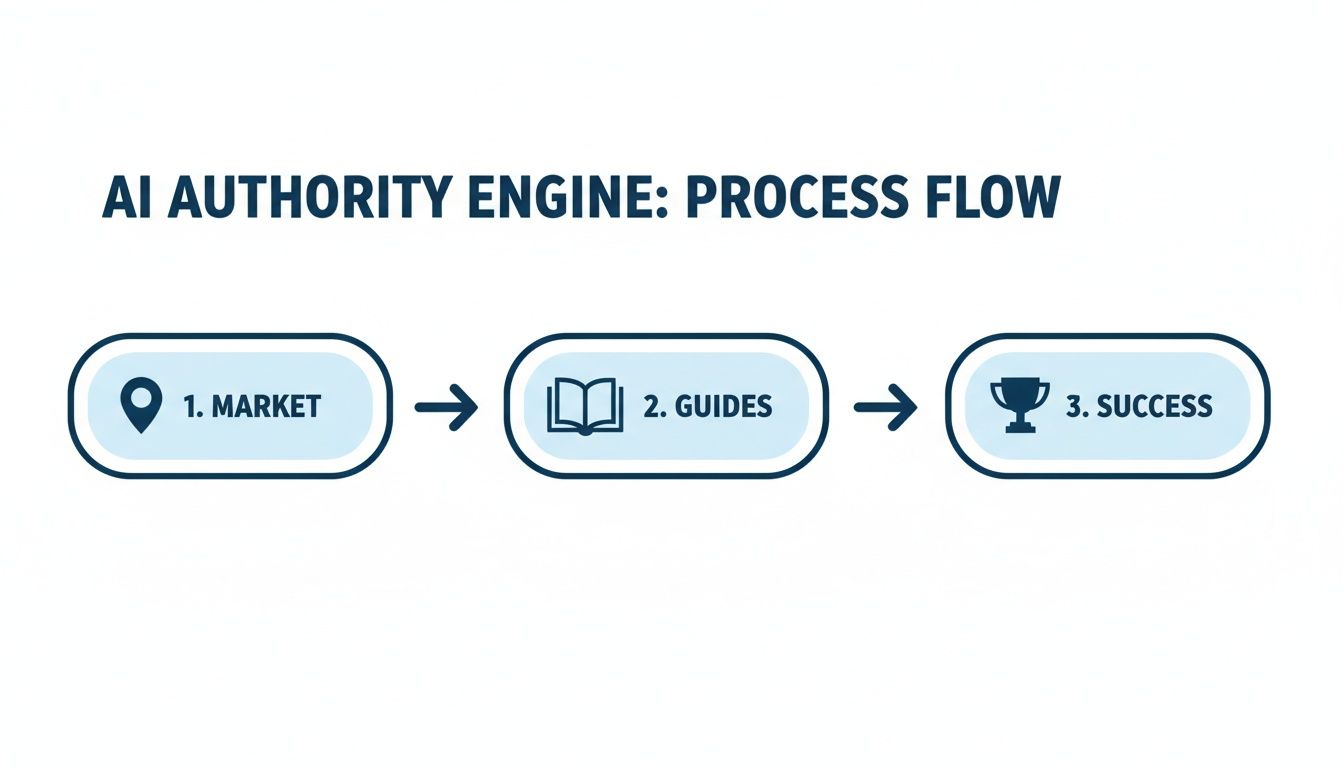
    This process shows exactly how AI can build your brand authority by turning raw market data and property details into compelling guides and success stories.

    Flowchart illustrating the AI Authority Engine process: Market, Guides, and Success.

    The big takeaway here is that AI isn’t just writing stuff for you. It's creating a connected ecosystem where your market knowledge, helpful guides, and client wins all feed into each other, amplifying your personal brand with every single listing.

    Beyond Pretty Pictures to Smart Data

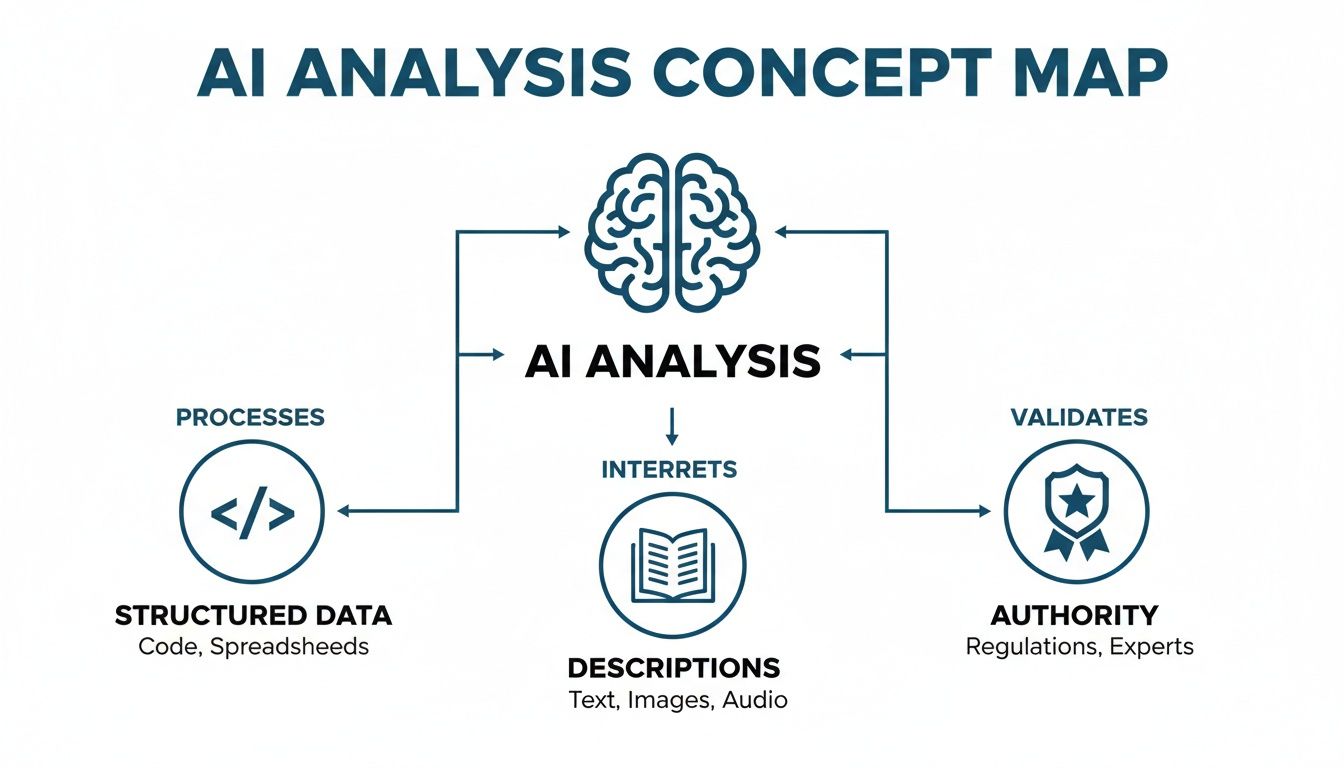
    The real magic of using AI for your listings happens behind the scenes. It's not just about crafting catchy descriptions; it’s about making your properties machine-readable for what's coming next in search.

    When you use a sophisticated AI tool to create a listing, it can automatically embed schema markup. You can think of this as a hidden layer of code that talks directly to search engines and AI assistants like ChatGPT. This code tells them, in no uncertain terms:

    • This is a residential property.
    • Here is the precise address, price, and bedroom count.
    • This is the agent in charge of this listing.

    This small technical detail is a massive advantage. It takes all the guesswork out of it for AI, making your listings far more likely to pop up when a potential buyer asks an AI, "Show me three-bedroom homes for sale in downtown Austin."

    Your listings stop being just static web pages and become structured data points that AI can instantly understand, categorize, and recommend. This is the core of a modern real estate agent personal branding AI strategy.

    The AI Listing Commander in Action

    This is exactly the kind of heavy lifting that specialized platforms are designed to handle. A feature like the Listing Commander from ListingBooster.ai, for example, takes any property and explodes it into a complete marketing suite. It generates everything from social media posts to print-ready materials, all while embedding that crucial schema markup that dictates how the home will appear in ChatGPT and Google AI search.

    Ultimately, this approach fuses your property marketing directly with your personal brand. Every single home you list becomes another piece of your portfolio, showcasing your expertise, market insight, and modern approach. You’re not just selling a property; you're building a library of discoverable, AI-optimized assets that continuously reinforce your authority in the market.

    Staying Compliant and Consistent When You Scale

    Growing your personal brand from just you to a team of five, ten, or even a hundred agents is a huge undertaking. The real challenge? Making sure every single agent represents the brokerage’s standards perfectly, while still letting their own personality come through. This is where a lot of teams and brokerages get stuck.

    It’s not just about looking polished. Inconsistent messaging can create serious problems. Think about it: one agent fires off a quick social media post, and without meaning to, they’ve violated Fair Housing guidelines. That single post can lead to major legal headaches and financial penalties. For managing brokers, the constant supervision can feel like a full-time job in itself.

    Your AI Compliance Watchdog

    This is exactly why centralized real estate agent personal branding AI platforms are becoming mission-critical for operations, not just another marketing toy. Picture having an AI that works like a compliance officer, automatically scanning every piece of content—from a detailed listing description to a quick Facebook update—before it ever sees the light of day.

    You can train this system on your brokerage's specific brand rules, the language you want to use, and—most importantly—all the legal requirements you have to follow. It’s like having a built-in safety net that flags tricky phrases or things you might have missed.

    This isn't just about preventing mistakes. It's about giving every agent the freedom to create content with confidence, knowing a system has their back—and the brokerage's. You get all the creativity without the risk.

    Keeping the Brand Voice United

    Beyond the legal stuff, keeping your brand voice consistent across a big team is what builds real recognition in your market. You want a client to get the same amazing experience whether they’re working with a brand-new agent or a seasoned top producer. An AI platform can lock in that consistency without you having to micromanage everyone.

    It can automatically weave the brokerage’s core values and key messages into everything it helps create. A rookie agent’s market report will have the same professional polish as a veteran’s latest success story.

    • For Teams: It makes sure every agent sounds like they belong to the same cohesive, professional group.
    • For Brokerages: It offers a scalable way to generate Fair Housing-compliant content for everyone, knocking out both risk and branding challenges at once. You can see how platforms like ListingBooster.ai deliver these solutions for brokerages and solve this exact problem.

    This kind of automated quality control allows brokerages to maintain incredibly high standards as they grow. It turns the constant headache of brand management into a smooth, automated process, clearing the path for growth that’s both compliant and sustainable.

    Common Questions About AI in Real Estate Branding

    Jumping into AI can feel a little intimidating, I get it. Your personal brand is your most important asset, and the last thing you want is to mess it up with something that feels complex, sounds robotic, or just becomes another subscription you don't use.

    Let's cut through the noise and talk about the real concerns I hear from agents every day. The truth is, modern real estate agent personal branding AI isn't built for programmers; it's built for you. The fear of a massive learning curve is valid, but most of these platforms are designed to be up and running in just a few minutes.

    Will My Content Sound Inauthentic?

    This is the big one, isn't it? Your business is built on trust and human connection. The thought of putting out generic, soulless content is terrifying, and it should be.

    But here’s the thing: a good AI system doesn't create a voice for you. It learns to mimic yours.

    The initial work you do—defining your brand pillars, your ideal client, and what makes you different—is the most critical part of the whole process. When you teach the AI your specific tone, whether you're witty, super professional, or warm and empathetic, you’re setting the guardrails. From that point on, every piece of content it helps you create is just a reflection of the brand you already built. It’s a tool for amplification, not replacement.

    The goal isn't to sound like an AI. It's to sound like you, but at a scale you could never dream of achieving on your own. Think of it as cloning your best marketing ideas without having to clone yourself.

    Is the Investment Really Worth It?

    Let's be honest, time is your most valuable currency. Think about the hours you pour into brainstorming social posts, wrestling with listing descriptions, and just trying to keep up. An AI platform hands you those hours back. It automates the grunt work, freeing you up for the things that actually move the needle: connecting with clients and closing deals.

    The ROI isn't just about saving time; it's about creating opportunities. While one agent is scrambling to post something, anything, to Instagram, the agent with an AI-powered system is walking into a listing appointment with a fully optimized property description, a 30-day social media plan, and print-ready flyers already done. That’s not just efficient—it shows you're a market leader who comes prepared. You can see more about how this works on the ListingBooster.ai website.

    Do I Need to Be a Tech Expert?

    Absolutely not. If you can post on Facebook or send an email, you’ve got all the tech skills you need.

    The best AI tools are built for simplicity. You feed it the basic info—a property address, your brand voice notes—and the system does all the heavy lifting in the background. For a closer look at how simple this can be, check out our guide on how agents are using AI to save time.

    It’s all about making your workflow smarter, not harder.


    Ready to build a brand that works for you, even when you're not? ListingBooster.ai is your marketing command center, turning your expertise into discovery-ready content in minutes.

    Start your free trial of ListingBooster.ai today!

  • ChatGPT Real Estate Search Visibility Your Ultimate Guide

    ChatGPT Real Estate Search Visibility Your Ultimate Guide

    The way people hunt for homes is undergoing a seismic shift. They're no longer just endlessly scrolling through Zillow. Instead, they’re firing up conversational AI like ChatGPT and asking, "Show me the best family-friendly neighborhoods in Austin under $700K." This is the single biggest evolution in real estate discovery, and yet, most agents are completely invisible on these new platforms.

    The New Frontier of Finding a Home

    A person uses a laptop to browse modern houses, utilizing AI home search technology.

    The gap between old-school search and this new AI-driven conversation is enormous. Think of a traditional search engine as a giant library card catalog. It points you to every book that might match your query, but you're left to do all the heavy lifting. Conversational AI, on the other hand, is like having an expert librarian who listens, understands your needs, and hands you the perfect book.

    This "librarian" doesn't just scan for keywords. It's built to understand context, quality, and authority. For real estate agents, this means your online presence can't just be a gallery of listings anymore. It has to be AI-readable—packed with clear, structured, and authoritative information that an AI can confidently recommend to a serious homebuyer.

    Why This Shift Matters Now

    The scale of this change isn't some far-off prediction; it's happening right now and growing every day. Real estate queries already make up 6% of all ChatGPT conversations, which translates to an eye-watering $66 billion in associated market value. That puts our industry in the top 15 most impacted by the platform. Homebuyers are simply skipping the old ways and asking AI direct questions about neighborhoods, property features, and even the top agents in their city. You can dive deeper into these usage stats and what they mean for the market.

    This guide is your roadmap to getting you and your properties found in this new arena. We're going to break down exactly how to earn top-tier ChatGPT real estate search visibility.

    The core problem is simple: if your listings and expertise aren't structured for AI, you don't exist in the most important new channel for buyer discovery.

    Understanding the Two Search Worlds

    To win here, you first have to grasp how differently buyers behave on these platforms. The user's mindset and what they expect are worlds apart, which demands a completely new strategy for how you present your expertise online.

    To see this clearly, let's compare the old way versus the new way side-by-side.

    Traditional Search vs AI Search At a Glance

    Feature Traditional Search (e.g., Google, Zillow) AI Search (e.g., ChatGPT, Perplexity)
    User Input Keywords like "3 bedroom homes Austin TX" Natural questions like "What are the pros and cons of living in Zilker?"
    User Goal Find a list of links to begin their own research Get a direct, synthesized recommendation or answer
    Result Type A ranked list of websites and portals to browse A conversational, trusted answer based on synthesized data
    Key to Visibility SEO keywords, backlinks, website authority Structured data, entity authority, and contextual relevance

    The table makes it obvious: one is a directory, the other is a concierge.

    This is precisely where a tool like ListingBooster.ai comes into play. It was designed from the ground up to translate your real estate expertise into the language AI understands, making sure you’re the agent that the "librarian" trusts and recommends.

    How AI Decides Which Listings to Recommend

    To get your listings noticed in a ChatGPT real estate search, you first need to get inside the AI's "head." It doesn't browse Zillow like a person. Think of it more like a brilliant, lightning-fast research assistant with a single mission: find the absolute best, most trustworthy real estate information on the internet.

    This AI assistant is constantly scanning the web, hunting for signals that scream "authority," "clarity," and "relevance." It's not just matching keywords anymore; it's piecing together a deep understanding of a property, a neighborhood, and even an agent's expertise. If your online presence sends weak or confusing signals, you might as well be invisible.

    To get recommended, your listings and website need to be structured in a way this AI assistant can instantly understand and trust. The goal is to make it incredibly easy for the AI to see not just what your listing is, but why it's the perfect fit for a specific buyer.

    The AI's Mental Checklist for Real Estate Content

    When ChatGPT looks at your listings or your professional website, it isn't wowed by the beautiful photography first. Instead, it runs a sophisticated analysis to verify the information it finds, much like a diligent researcher cross-referencing multiple sources. It gives top priority to data it can interpret with total confidence.

    This entire process is built on a few core pillars that act as its quality filter:

    • Structured Data: This is the AI's native language. It’s like putting digital labels on everything, telling the AI, "This number is the price," "This text is the street address," and "This is the square footage."
    • Narrative Quality: The AI actually reads your listing descriptions to grasp the story and unique appeal of a home. Vague, cookie-cutter copy gets tossed aside for rich, detailed narratives that paint a vivid picture.
    • Agent Authority: It actively looks for proof that you're a real expert in your market. This means finding consistent content about local areas, glowing client reviews, and a professional digital footprint.

    Basically, the AI is asking a simple question: "Is this information clear, descriptive, and from a credible source?" If the answer is "no" to any of these, it moves right on to a listing that provides stronger signals. This is a crucial concept to understand, and we dive deeper into it in our guide to AI search optimization for real estate listings.

    Turning Technical Jargon into Simple Ideas

    Let's break down one of the most important—and often misunderstood—signals: structured data, also known as schema markup. Don't let the technical name scare you off.

    Think of schema markup as a universal translator for your listing. Without it, an AI might see the number "750,000" and have no idea if it's the price, a zip code, or part of an address. With schema, you are explicitly telling the AI, "This is the price, in US dollars," which removes all the guesswork.

    This kind of clarity is everything. When an AI can understand your data with 100% certainty, it's far more likely to recommend your property. It’s the difference between handing that research assistant a messy pile of notes versus a neatly organized, labeled binder. The binder wins every time.

    Agents and teams who put in the effort to provide these clear signals are already seeing the rewards. Recent data shows that real estate domains received 0.47% of all referrals from ChatGPT Search, putting the industry at #15 among all categories. This confirms that AI is already sending motivated buyers to real estate websites that provide structured, authoritative information. You can discover more insights on ChatGPT's impact on web traffic and see why this is a channel you can't afford to ignore.

    By focusing on making your content "AI-friendly," you're directly influencing how these powerful new platforms see, understand, and ultimately rank your listings.

    The Six Pillars of AI-Powered Real Estate Visibility

    Getting your listings noticed by AI search tools like ChatGPT isn't about some single, magic-bullet tactic. It's much more like building a house. You need a solid foundation built on six interconnected pillars. Get these right, and you'll have a stable, impressive structure that AI algorithms will confidently recommend to potential homebuyers.

    Mastering these areas ensures your listings—and your professional brand—are not just seen, but deeply understood and valued by conversational AI. Let's break down the framework that will define your success in this new era of search.

    This is a great way to visualize how AI actually sifts through your digital footprint. It prioritizes the hard facts (structured data), the human element (your descriptions), and your credibility (your authority).

    A concept map illustrating how AI analysis processes structured data, interprets descriptions, and validates authority.

    The key takeaway here is that AI visibility is a blend of technical precision, emotional connection, and real-world credibility. You need all three to win.

    Pillar 1: Structured Data Markup

    Think of structured data, or schema, as the universal language for AI. It’s a set of standardized tags you add to your website's code to explicitly tell an AI what each piece of information means. Without it, the AI is just guessing.

    For example, schema can label a number as a listing price, a line of text as a street address, or a date as an open house event. This removes all ambiguity. It’s the difference between handing an AI a messy, handwritten note versus a perfectly organized spreadsheet; the AI will always trust the spreadsheet.

    Pillar 2: AI-Optimized Listing Descriptions

    The days of writing dry, feature-list descriptions are over. Today’s AI is smart enough to analyze the story and emotional pull of your property descriptions. It's actively looking for content that paints a compelling picture of what it’s like to live in the home.

    To get this right, you need to focus on:

    • Natural Language: Write for people, not robots. Use descriptive language that sparks emotion and helps a buyer imagine the lifestyle the home offers.
    • Hyper-Local Context: Mention the nearby park, that popular coffee shop down the street, or the well-regarded school district. This gives the AI valuable context to match your listing to specific prompts like, "Find me a home near a good elementary school."
    • Clear Feature-Benefit Connections: Don’t just list "granite countertops." Instead, explain the benefit: "durable and elegant granite countertops, perfect for entertaining guests."

    By enriching your descriptions with narrative detail, you're feeding the AI the exact kind of high-quality, contextual information it needs to make a confident recommendation.

    This approach creates copy that connects with both human buyers and the algorithms that are now guiding them.

    Pillar 3: Demonstrable Agent Authority

    The AI isn't just evaluating your listings; it's evaluating you. It actively scans the web for signals that prove you are a knowledgeable and trusted expert in your specific market. Building this digital authority is absolutely critical for achieving high ChatGPT real estate search visibility.

    This means you need to be consistently publishing content that shows off your local expertise. I'm talking about hyper-local neighborhood guides, detailed market analyses, or blog posts answering the questions you know buyers and sellers in your area are asking. This content acts as a digital resume, proving to the AI that you are a credible source.

    Pillar 4: Strategic Backlinks and Citations

    Think of backlinks as votes of confidence from other websites. When a reputable local news site, a neighborhood blog, or a mortgage broker’s website links to your agent profile or a listing, it sends a powerful signal to AI that your content is trustworthy.

    Similarly, consistent citations—mentions of your name, brokerage, and phone number across various online directories—help solidify your digital identity. This web of links and mentions validates your professional presence, making you a much more authoritative figure in the eyes of an AI.

    Pillar 5: Consistent Social Media Signals

    Your social media activity is a public record of your engagement and expertise. AI systems can and do crawl these platforms to gauge your relevance and influence. Consistently posting about new listings, open houses, market updates, and client testimonials builds a cohesive digital footprint.

    Every single post reinforces your specialization and activity in the market. This steady stream of relevant content adds another layer of proof, showing that you are an active and engaged professional who is worthy of being recommended.

    Pillar 6: Mastering User Prompts

    Finally, you have to understand how people are searching now. They don't just type keywords into ChatGPT; they ask detailed, conversational questions. Your entire content strategy should be designed to directly answer these kinds of prompts.

    For instance, instead of just optimizing for "Austin homes for sale," create content that answers, "What are the pros and cons of living in the Zilker neighborhood of Austin?" By anticipating these real-world queries, you position your content as the perfect answer, making it a no-brainer for AI to surface your expertise.

    This proactive approach is essential. Consider that a platform like ChatGPT.com attracts 5.6 billion monthly visits, with users who are highly engaged. It's a channel you can't afford to ignore. You can explore more detailed ChatGPT user statistics to get a better sense of the platform's incredible reach.

    Putting AI Visibility Strategies into Practice

    Knowing the six pillars is one thing, but actually putting them to work in your daily business is where you'll find your competitive edge. Theory is great, but a practical, well-executed strategy is what actually brings in clients. Let's break down how different real estate pros can use these ideas to get a real advantage and boost their ChatGPT real estate search visibility.

    These strategies aren't just for big, tech-forward brokerages. Whether you're a solo agent building a name in your neighborhood or a growing team aiming to lead the market, the core principles are the same. It's just the scale and focus that change. Each role offers a unique chance to turn AI visibility from a buzzword into a powerful lead-generation machine.

    The Solo Agent in a Competitive Suburb

    If you're a solo agent, your goal is to become the go-to expert for a specific community. You can't outspend the big teams, but you can absolutely out-expert them. Your strategy needs to be all about creating deep, hyper-local content that AI sees as the definitive source for your area.

    This means you’ll want to lean heavily into pillar three (Agent Authority) and pillar six (Mastering User Prompts).

    • Actionable Tactic: Create a series of blog posts or short videos that answer the exact questions people are asking about your suburb. Think things like, "What are the best parks in Northwood?" or "Is the public school system in Lakeview a good fit for young families?"
    • Implementation: A tool like ListingBooster.ai's Authority Builder can be a game-changer here. It can automatically draft these hyper-local guides for you. What normally takes hours of research and writing can be done in minutes, giving you a steady flow of content that proves you know your stuff.

    By consistently answering these specific, long-tail questions, you build a content library that establishes you as the resource, making it a no-brainer for ChatGPT to recommend you.

    The Growing Team in a Major Metro Area

    A growing team has a different puzzle to solve: how to scale brand consistency and content creation across multiple agents. Efficiency and a unified voice are everything. Your main focus should be on pillar two (AI-Optimized Descriptions) and pillar five (Consistent Social Signals) to make sure every listing and social media post meets the team's high standards.

    A scattered brand message is a weak signal to AI. When every agent on your team shares high-quality, consistently formatted, and AI-optimized content, it creates a powerful, unified digital footprint that AI algorithms can easily recognize and trust.

    The key here is automation and having a central hub for content. Manually writing unique, optimized descriptions and social posts for every new listing, open house, and sale across a dozen agents just isn't sustainable. You can get more insights on this by reading our guide on how to optimize listings for AI search.

    This is where a tool like ListingBooster.ai’s Listing Commander becomes essential. It takes a single property and generates a complete, on-brand marketing suite for every agent on the team, making sure every piece of content is optimized for AI visibility right from the start.

    The Forward-Thinking Brokerage

    For a brokerage, the mission is to give agents tools that give them a leg up on the competition. Providing a platform that automates AI optimization is a massive value-add that helps with both recruitment and keeping top talent. This means deploying all six pillars across the entire organization.

    The opportunity is huge. Recent data shows that ChatGPT now commands 17.1% of all digital queries globally. On top of that, users spend an average of 13 minutes and 9 seconds per session—more than double the time spent on Google. A brokerage that helps its agents tap into this highly engaged audience is setting them up for massive success. You can discover more insights about these user engagement statistics and what they mean for the market.

    By offering a tool like ListingBooster.ai, a brokerage instantly handles the technical headache of schema markup and the time-suck of content creation. It turns what would be weeks of manual work for an agent into a simple, 10-minute setup, creating a system for them to improve their ChatGPT real estate search visibility.

    How ListingBooster.ai Does the Heavy Lifting for You

    A hand interacts with a tablet displaying a data dashboard, emphasizing automated visibility and insights.

    It’s one thing to understand the six pillars of AI visibility, but it’s another thing entirely to put them into practice. Manually creating schema-marked content, writing psychologically compelling descriptions, and consistently publishing neighborhood guides is a full-time job. Let's be honest, who has that kind of time?

    This is exactly where ListingBooster.ai steps in. It’s designed to be the practical, hands-on application of everything we’ve talked about in this guide, turning what would be weeks of marketing grunt work into a simple, five-minute setup. The entire system is built to solve the core challenges of getting seen in ChatGPT real estate search without forcing you to become a coder or a content marketing guru.

    Instantly Master Your Listing Content

    The first hurdle every agent hits is creating genuinely great, AI-readable content for each listing. We're not talking about a few quick sentences for the MLS. This is about crafting unique stories for Zillow, social media, and your own website, all while weaving in the technical signals that AI engines need to see.

    ListingBooster.ai’s Listing Commander engine handles this for you instantly. Just feed it the basic property details, and it cranks out a complete marketing suite.

    • AI-Ready Descriptions: It writes compelling, emotionally engaging descriptions that capture the attention of both human buyers and AI algorithms.
    • Automatic Schema Markup: The platform takes care of all the technical mumbo-jumbo, embedding the right structured data so AI can understand your listing’s details with perfect clarity.
    • Multi-Platform Copy: You get tailored copy for the MLS, Zillow, and all your social media channels, making sure your message is consistent and powerful everywhere it appears.

    Think of it as your in-house marketing team that never sleeps. It makes sure every single property you list is perfectly positioned to be found and recommended by conversational search tools the moment it goes live.

    This system takes care of the first two pillars—Structured Data and AI-Optimized Descriptions—so you never have to touch a single line of code.

    Build Unshakeable Agent Authority

    The next big challenge is proving your local expertise, day in and day out. AI needs to see a constant flow of authoritative content that cements your status as the go-to expert for your market. But who has the bandwidth to write market updates and neighborhood guides every week?

    This is where ListingBooster.ai’s Authority Builder feature comes in. It automates this crucial part of your digital presence by creating a steady pipeline of high-quality, hyper-local content. It generates market updates, buyer tips, and detailed neighborhood guides that directly answer the kinds of questions your future clients are asking AI. You can explore how our broader real estate AI platform helps you build an even stronger brand.

    The speed at which people are adopting AI for search makes this kind of automation a necessity. In recent quarters, a staggering 14.68% of users turned to ChatGPT for search, which is a 7.73% jump from the previous year. This massive shift means that using a tool like ListingBooster.ai isn't just an advantage anymore—it's essential for reaching a huge and fast-growing audience of homebuyers. You can dig into more of these ChatGPT usage statistics to see the trend for yourself.

    To top it all off, the platform includes built-in Fair Housing compliance checks. This gives you peace of mind, knowing your automated content is not only effective but also completely professional and compliant. It’s simply the fastest, most efficient way to put an advanced AI visibility strategy to work for your business.

    Measuring Success in the New AI Search Era

    So, you've started optimizing for AI search. That's a huge step. But how do you know if any of it is actually working? Forget vanity metrics like social media likes or a general uptick in website traffic. To really see if you're making an impact in ChatGPT real estate search, you have to track the results that actually grow your business.

    The goal here is to look past the old SEO dashboards. We need a new set of key performance indicators (KPIs) built for this new, conversational world. This isn't just about counting clicks; it's about measuring your influence, your authority, and the quality of leads coming from places you've never gotten them from before.

    Shifting from Clicks to Conversations

    In the world of AI search, success looks different. It's less about being the #1 link for a keyword and more about being the definitive answer to a homebuyer's question. Your measurement strategy has to reflect that big change.

    Here are the modern metrics that truly matter:

    • Brand Mentions in AI Responses: This is the big one. Are you or your brokerage being mentioned by name when a user asks, "Who are the top real estate agents in Austin?" When an AI names you, that's the ultimate proof of your authority.
    • Referral Traffic from AI Platforms: Dig into your website analytics. Can you see visitors coming directly from platforms like ChatGPT? This is hard data showing the AI is sending potential clients right to your digital doorstep.
    • Visibility for Conversational Queries: Start tracking your presence for those long, question-based prompts. Are your listings and articles showing up for things like, "What are the best neighborhoods for families with young kids in Scottsdale?"
    • Lead Quality Analysis: Pay close attention to the leads that come from these AI-driven sources. Are they more informed? Do they seem more ready to transact? Higher-quality leads are a dead giveaway that your authoritative content is hitting the mark.

    The single most important metric in the AI era is how often your expertise is cited as the trusted source. When ChatGPT mentions you by name, you’ve won. It’s the digital equivalent of a powerful word-of-mouth referral, scaled.

    Proving ROI and Gaining Your Edge

    When you track these specific KPIs, you're no longer guessing. You're making smart, data-driven decisions about where to put your time and marketing dollars. This gives you clear proof of the return on investment from your AI optimization efforts, showing exactly how it’s feeding your sales pipeline.

    Everything in this guide has been a roadmap—from getting inside the "mind" of an AI to putting the six pillars of visibility into action. We've talked about how platforms like ListingBooster.ai can automate the most complex parts, turning what would normally be weeks of technical headaches into a simple, streamlined process.

    Now you have the framework to not only execute this strategy but also to measure its success. By focusing on these new metrics, you can definitively prove your growing influence and secure a dominant position in the new frontier of real estate. The agents who adapt—and measure what matters—are the ones who will lead the market tomorrow.

    Got Questions? We've Got Answers

    Let's tackle some of the most common questions agents ask about getting their listings found in AI-powered search.

    Is AI Going to Replace Me?

    Absolutely not. It's best to think of AI tools like ListingBooster.ai as a super-efficient assistant, not your replacement. It takes care of the tedious work—creating consistent, optimized, and compliant content for every listing.

    This frees you up to do what you do best: add your personal market insights, connect with clients, and build the relationships that are the bedrock of this business. The winning formula isn't AI or a human touch; it's AI efficiency plus your authentic expertise.

    How Fast Can I Expect to See Results in ChatGPT?

    It varies, but it's often much faster than traditional SEO, which can take months to show any movement. Since large language models are always hungry for new information, high-quality, well-structured content can get picked up and start appearing in search results pretty quickly.

    The speed really depends on how competitive your local market is and how consistently you're putting out optimized content. Using a tool like ListingBooster.ai gives you a head start by making sure your content is perfectly tuned for AI from the moment you publish it. This gives the AI clear, strong signals about your listings and your authority.

    The whole goal is to make it dead simple for AI to understand why you're the expert. The easier you make it for the AI to confirm your authority and the relevance of your listings, the faster you'll show up.

    Is It Hard to Add That Schema Markup Thing?

    If you try to do it by hand? Yes, it can be a real headache. It’s basically a coding task, which is a huge roadblock for most agents and a big reason why so many listings are completely invisible to AI search right now.

    This is exactly the problem platforms like ListingBooster.ai's 'Listing Commander' were built to fix. It generates all the correct schema markup for your properties automatically, behind the scenes. You just enter your listing details like you normally would, and the tool handles the technical heavy lifting, making sure your properties are formatted perfectly for AI without you ever having to touch a line of code.


    Ready to stop being invisible and start getting discovered? ListingBooster.ai automates the entire process, turning complex AI optimization into a simple, 5-minute task. Start your free trial and see the difference today.