You've seen this happen. The photographer delivers strong images, the seller wants the home live today, and the MLS text box is still blank. That last step looks simple, but it isn't. A real estate listing description now has to persuade, stay compliant, and read cleanly on platforms where buyers skim in seconds.
That's why weak copy costs more than most agents realize. It doesn't just make the listing sound flat. It can dilute the positioning of the property, create avoidable review issues, and waste the quality of everything else you've already done to launch well.
Why Your Listing Description Is Your Most Important Asset

The MLS description field is one of the few places where your judgment is fully visible. Photos show the property. Price signals strategy. But the words show whether the agent understands how to market a home with precision.
A strong real estate listing description does three jobs at once. It frames the home's value, helps the right buyer quickly understand what matters, and keeps the marketing grounded in language that won't create unnecessary risk. That's a very different task from tossing features into a paragraph and calling it done.
Why the text box matters more than agents think
Most agents were taught to treat listing copy like a summary. That's outdated. Buyers already see the core data in the listing interface. What they need from the description is context, priority, and momentum.
Zillow's guidance reflects that shift. It notes that a widely used benchmark is 250 words or less, including the headline, and that if space is limited, agents can leave out basics like beds, baths, and square footage when those details already appear elsewhere in the listing display on Zillow's listing description guidance.
Practical rule: Don't use your description to repeat the database. Use it to explain why this home is worth a closer look.
That same mindset improves everything downstream. Better listing copy gives you cleaner ad copy, stronger social captions, and more focused talking points for buyer inquiries. If you want examples of messaging angles that translate well from listing language into paid promotion, Contesimal has a useful roundup on ads that convert more deals.
What works and what usually fails
The descriptions that perform well tend to feel selective. They don't try to mention everything. They identify the few features that shape buyer perception, then present them in an order that makes sense.
What fails is familiar:
- Feature dumping with no hierarchy
- Generic adjectives like “stunning,” “beautiful,” and “must-see” doing all the work
- Wall-of-text formatting that collapses on mobile
- Buyer-targeting language that drifts into compliance trouble
You're not filling space. You're building a marketing asset.
The Four-Part Structure of a Winning Description
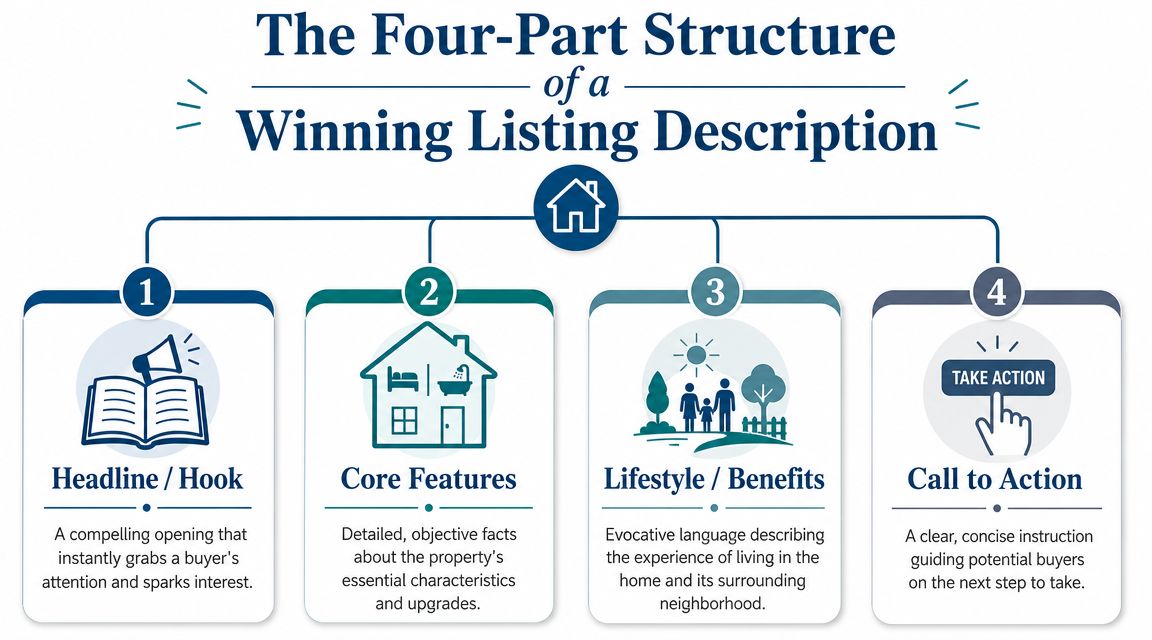
Most weak descriptions have the same problem. They have information, but no sequence. The fix is a repeatable structure that helps buyers absorb the listing quickly and helps you write faster without sounding templated.
Start with an opening feature
Your first line has one job. It needs to surface the property's strongest angle immediately.
Lead with what changes perception fastest. That might be a renovated kitchen, a panoramic view, a rare layout, a detached workspace, or outdoor living that adds selling power. Don't open with “Welcome to” or “Don't miss this.” Those phrases take up space and say nothing.
Use this approach instead:
Weak opening
“Beautiful 4 bedroom home in a great area.”Stronger opening
“Renovated kitchen, vaulted great room, and a covered patio that extends the living space outdoors.”
The second version gives the buyer something concrete to picture.
Add the facts buyers need first
After the hook, give a concise factual summary. Practitioner guidance commonly recommends short blocks, including a brief property summary of about 60 words, followed by 150 to 200 words on highlights and standout features, with 2 to 3 versions written for different buyer segments and a peer review pass before publishing, as outlined in this practitioner video on description tips for real estate agents.
That structure works because it respects the way people read on mobile. It also aligns with the platform constraint already noted above. Keep the copy lean. Prioritize upgrades, layout benefits, and details that don't already appear in a standard data field.
A clean factual block often covers:
- Layout essentials such as split-bedroom plan, main-level primary, flex room, or finished lower level
- Notable updates like new roof, replaced windows, remodeled bath, or upgraded appliances
- Operational details buyers care about, including storage, parking, outdoor space, or work-from-home functionality
Use lifestyle language carefully
Lifestyle sells when it's tied to the property, not to the person who should buy it. That distinction matters.
Good lifestyle language describes the experience of the space:
- morning light in the breakfast area
- direct flow from kitchen to patio
- a quiet home office with built-ins
- a fenced yard with room for gardening, entertaining, or pets
Bad lifestyle language describes the occupant:
- perfect for families
- ideal for young professionals
- safe neighborhood
- exclusive community
Good listing copy lets the buyer imagine a life in the home without telling them who they are.
End with a real call to action
The CTA should be simple and specific. Not clever.
Examples that work:
- Schedule a private showing.
- Ask for the full feature sheet.
- Tour the home in person to see the updates and layout flow.
That final sentence matters because many descriptions just stop. A clear closing gives the buyer a next step and makes the marketing feel complete.
Before and after example
Before
“Beautiful move-in ready home with lots of updates. This home has a great floor plan, spacious rooms, nice backyard, and is close to shopping, dining, and schools. Must see.”
After
“Updated kitchen, generous natural light, and a backyard setup designed for everyday use. This home offers a functional layout with spacious living areas, refreshed finishes, and flexible rooms that work for guests, work, or hobbies. The main living spaces connect easily to the outdoor area, creating a practical flow for relaxing or entertaining. Convenient access to shopping, dining, parks, and commuter routes adds everyday ease. Schedule a private showing to experience the layout and upgrades in person.”
The difference isn't style alone. It's structure.
Mastering Compliant Copy to Avoid Fair Housing Pitfalls
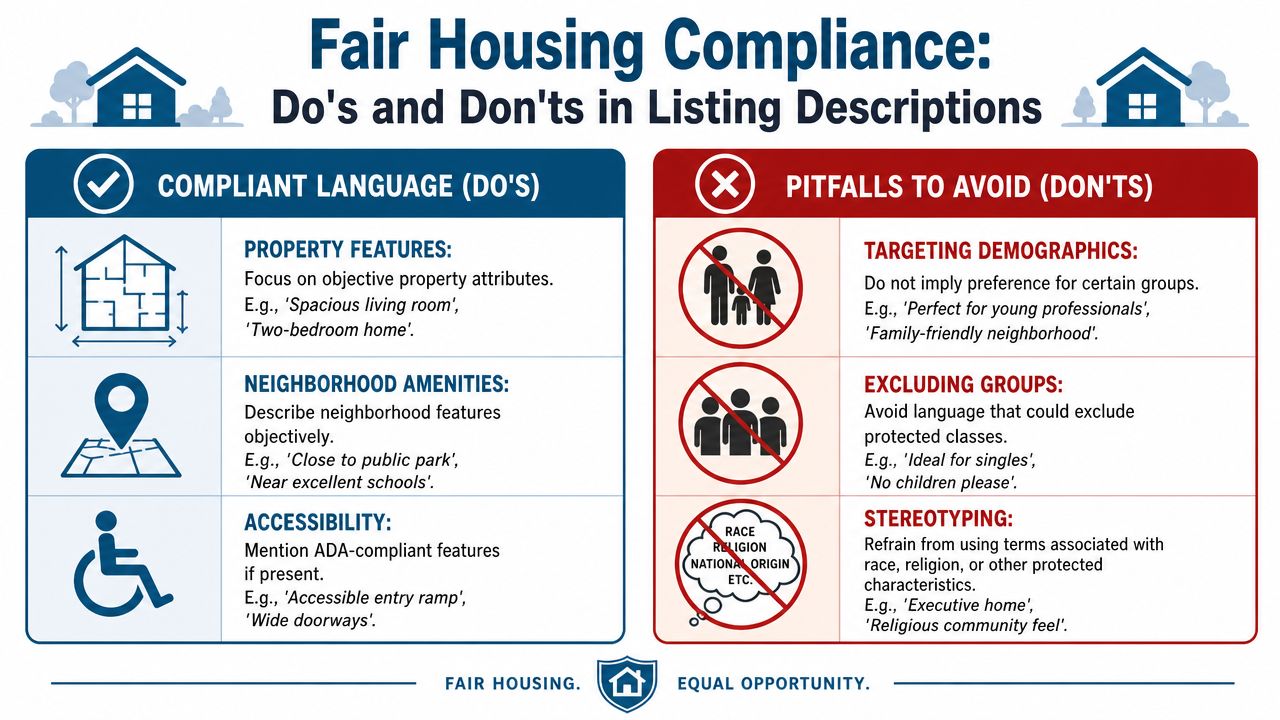
A lot of listing advice tells agents to “sell the dream.” That sounds good until the copy starts implying who should live there. Then you're not marketing creatively. You're creating risk.
The safer standard is simpler. Describe the property, not the people. Dotloop's guidance highlights this exact gap in common training and notes that the safest copy is often the copy that is specific, factual, and avoids assumptions about the buyer, as discussed in Dotloop's article on writing great real estate listings.
Problem phrases and better replacements
Some phrases are common because agents hear them all the time. That doesn't make them safe.
| Risky wording | Better direction |
|---|---|
| Perfect for families | Spacious backyard, multiple bedrooms, flexible living area |
| Safe neighborhood | Nearby parks, sidewalks, lighting, community amenities |
| Walk to church | Close to local services and neighborhood destinations |
| Ideal for young professionals | Home office, low-maintenance exterior, easy commute access |
| Exclusive area | Gated entry, private lot, limited through traffic |
This isn't about stripping personality out of the copy. It's about putting the personality in the home itself.
Keep persuasion tied to observable facts
The cleanest persuasive writing uses details a buyer can verify:
- Feature-based language like “floor-to-ceiling windows” or “covered rear patio”
- Location context such as “near public park,” “close to downtown dining,” or “convenient access to commuter routes”
- Accessibility features if present, described factually
Avoid euphemisms that blur meaning. If a home needs work, say what needs updating. If there's an unusual condition, don't hide it behind vague phrases.
Specific beats clever. In listing compliance, clarity is usually the safer choice.
A practical workflow helps. Draft the copy. Then do one review pass for accuracy and one separate pass only for compliance language. If you want help systematizing that review, ListingBooster.ai's compliant listing tool covers a real estate specific approach to generating and checking listing language.
Writing for Algorithms, MLS, Portals, and AI Search
Your description isn't read only by buyers. It's also parsed by listing portals, MLS systems, and AI tools that summarize homes in response to prompts and search queries.
That changes the writing standard. Fluffy prose may sound polished, but it often hides the exact signals these systems look for. Perry Real Estate College points to this newer shift, noting that buyers increasingly start with AI tools and that concise, specific, mobile-friendly phrasing with concrete attributes and location context may outperform vague copy because AI systems extract structured signals from explicit facts in its discussion of modern listing writing.
What machine-readable copy looks like
Think in searchable attributes, not just mood.
Instead of:
- upgraded throughout
- designer touches
- amazing location
Write:
- white oak flooring
- quartz countertops
- dual-pane windows
- detached two-car garage
- near Greenway Trail and downtown retail corridor
That doesn't mean robotic writing. It means using real nouns. The systems that surface listings can do more with “Bosch appliances” than with “chef-inspired kitchen.”
Adapt the same listing for each platform
A single version rarely fits every use case. MLS copy, portal copy, social captions, and AI-facing summaries often need different levels of compression and different emphasis.
One practical option is to build variants manually. Another is to use a purpose-built platform that understands real estate inputs and outputs platform-specific versions. ListingBooster.ai is one example. It generates listing descriptions and related marketing content from property details for different real estate platforms.
For a broader look at the underlying idea, MyMentions has a solid primer on optimizing for generative AI. The big takeaway is straightforward. Clear structure and explicit property facts travel better across new search environments.
Turn Your Listing Description into a Content Goldmine
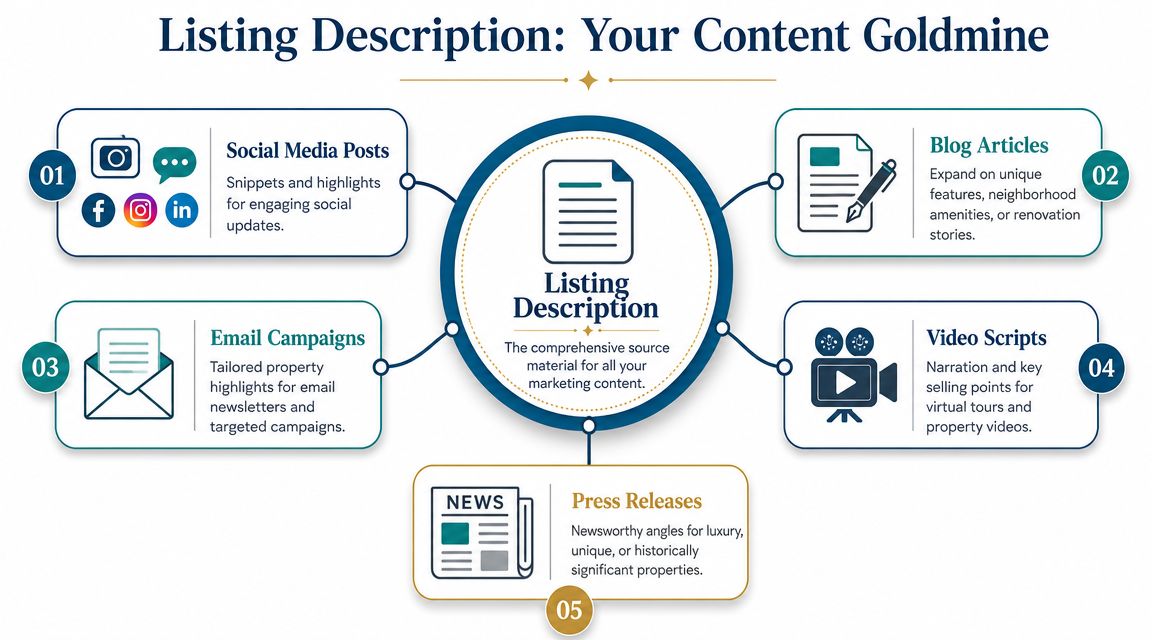
Writing a strong listing description takes effort. You should get more than one use out of it.
The smartest agents treat the final description as source material for every other marketing asset around the listing. That approach also improves consistency. Your Instagram caption, email teaser, open house post, and brochure copy all stay aligned because they came from the same core message.
Pull the description apart by format
Practitioner guidance suggests descriptions perform best in short blocks and recommends writing 2 to 3 versions for different buyer segments. That same discipline makes repurposing easier, as noted in this guidance on multi-channel content for agents.
Here's how to break one description into working parts:
Headline for social posts
Use the opening hook as your “Just Listed” caption starter.Facts for email and flyers
Pull the factual block into a concise summary for newsletters, postcards, and brochures.Lifestyle lines for Instagram or Facebook
Use one or two benefit-focused sentences that describe how the space lives, while staying property-focused.Feature details for video narration
Turn your room-by-room highlights into a short walkthrough script.
One solid listing description should feed the entire launch, not sit in the MLS and die there.
Platform variants that actually make sense
You don't need endless rewrites. You need smart versions.
One version should be MLS-clean and tightly compliant. Another can be slightly warmer for social. A third can be stripped down for mobile-first platforms where skimming dominates. The point is not more words. It's better fit.
That's why agents who rely on one generic paragraph usually look repetitive across channels. The listing starts to feel copied, not marketed.
The Modern Agent's Advantage
The agents who stand out now don't just “write better.” They position properties with more discipline. They know when to lead with the feature, when to tighten the facts, when to cut a risky phrase, and when to create a shorter variant for a different platform.
That's a key advantage. A polished real estate listing description signals competence before a buyer ever schedules a showing and before a seller ever asks how you'll market the home. It shows that your process is deliberate.
If you want to keep sharpening that edge, it helps to follow marketing resources built around visual merchandising and listing presentation as well. aiStager regularly publishes useful ideas in aiStager's latest posts that complement the copy side of the listing launch.
The blank MLS field isn't a writing chore anymore. It's a test of whether your marketing can hold up across compliance review, mobile attention spans, and AI-driven discovery.
If you want a faster way to produce platform-specific, real-estate-focused copy without relying on generic AI prompts, ListingBooster.ai is built for that workflow. It helps agents turn property details into MLS-ready descriptions and supporting social content while keeping the process structured, editable, and practical for day-to-day listing launches.