Tag: proptech

  • Discover ai for real estate agents: Elevate Marketing with AI

    Discover ai for real estate agents: Elevate Marketing with AI

    In the world of real estate, we’ve always known the power of a good first impression. But what if your new front door is digital, and the gatekeeper is an AI? That's exactly what's happening. More and more, potential clients are turning to platforms like ChatGPT and asking them directly, “Who is the best agent in my area for a growing family?”

    If you haven’t built a presence that these AI models can see, you’re essentially invisible to a huge new pool of buyers and sellers.

    A smiling real estate agent holds a tablet in front of an open house door, featuring "Digital Front Door" text.

    The New Reality of Real Estate AI

    Let’s be real—artificial intelligence isn't just another shiny new tool. It represents a massive change in how people find and ultimately choose a real estate agent. For years, we focused on website SEO and keeping our Zillow profiles polished. Those things still matter, but they’re no longer enough.

    Today, the home search often begins with a conversation, not with a person, but with an AI.

    Think of it this way: you have to actively teach these AI models who you are and what you do best. Every single market report you publish, every neighborhood guide you write, and every social media post you share acts as a lesson. It’s all evidence that proves your expertise, defines your service areas, and shows exactly why you’re the right agent for a specific kind of client.

    Why You Can't Afford to Be Invisible

    When a potential buyer asks an AI for an agent recommendation, it doesn't just pull a name out of a hat. The AI scours the internet, looking for the most credible and authoritative sources to answer that question. It’s hunting for agents who consistently put their knowledge out there.

    If you haven't been creating content and building your digital footprint, the AI has no data to support recommending you. You simply won't make the shortlist.

    This is why adopting AI for real estate agents is no longer optional; it’s a core part of a modern business plan. It’s not about replacing your hard-earned skills. It's about broadcasting them to make sure the next generation of clients can find you.

    It’s happening fast. A recent survey shows that 82% of agents are already using AI tools in their business. Time savings is a huge perk, with 71% seeing major benefits and 34% getting back more than four hours every week. You can learn more about these AI adoption trends and see how writing assistants for marketing lead the way.

    The Shift in How Homebuyers Find Agents

    To really get a sense of how much has changed, just look at how people used to find agents compared to how they're starting to search now. This difference shows why you can't wait to adapt your marketing strategy.

    The Shift in How Homebuyers Find Agents

    Search Method Traditional Approach (Pre-2024) AI-Powered Approach (2026 & Beyond)
    Starting Point Google Search, Zillow, Referrals ChatGPT, Perplexity, Google AI Overviews
    Key Question "real estate agents near me" "Who is the best agent in my market for first-time buyers?"
    Discovery Factor Website SEO, Paid Ads Consistent, Authoritative Content; Digital Footprint
    Agent Visibility Based on ad spend and basic SEO Based on AI's assessment of expertise and authority

    The takeaway here is pretty clear. Visibility used to be a game you could win with a bigger ad budget. Now, it’s about who consistently provides the most value and proves their authority online.

    Using the right AI tools is the most efficient path to building that digital authority. It’s how you’ll meet clients where they are and stay ahead in a market that’s more crowded than ever.

    Essential AI Strategies That Win More Business

    The high-level talk about AI is one thing, but what really matters is how top agents are actually using it to get ahead. Forget the abstract concepts; success comes from practical strategies that produce real, measurable results. When you fold smart automation into your daily business, you change the game for how you find clients, market homes, and manage your day.

    A person works on a laptop displaying data charts, next to a house model, with "AUTOMATE & GROW" text.

    These strategies aren't here to replace you. Think of them as a way to amplify your own expertise. Instead of getting buried in repetitive tasks, you can spend your time on what matters most—building relationships and closing deals. Let's dig into the core approaches that turn AI from a buzzword into a business-building workhorse.

    Automate Your Lead Nurturing

    Leads that come from AI-powered search don't act like your typical Zillow lead. They’ve already asked very specific, high-intent questions, and they expect an immediate, relevant answer. Following up by hand is just too slow and inconsistent to capture their attention.

    This is exactly where AI-driven lead nurturing steps in. It's like having a tireless assistant working around the clock to engage every new lead with personalized messages. It can answer their basic questions instantly and keep your name at the top of their list, all without you lifting a finger.

    Think about how these automated workflows could run in the background:

    • Instant Welcome Series: The moment a lead signs up, the AI sends a personalized email or text that references their original question and offers something of value, like a guide to the neighborhood they were looking at.
    • Smart Follow-ups: The system can drip out a sequence of messages over days or weeks. Each one can offer a new piece of information or ask a simple qualifying question to gauge their interest.
    • Behavioral Triggers: If a lead clicks on a link for a specific neighborhood in your market report, the AI can automatically send them more listings from that exact area.

    This kind of consistent engagement makes sure no lead ever goes cold. It frees you up to put your energy where it belongs: on the prospects who are actually ready to talk.

    Key Takeaway: An automated nurturing system is your 24/7 front line, building relationships at a scale you could never manage manually. It guarantees the consistent, timely follow-up that is absolutely critical for converting online leads into appointments.

    Generate Hyper-Personalized Property Marketing

    One of the biggest time-sucks for any agent is creating all the marketing materials for a new listing. Writing compelling MLS descriptions, social media posts, email blasts, and ad copy can take hours—valuable hours you could be spending face-to-face with clients.

    AI completely flips this script. You can feed an AI tool the basic details of a property, and it will generate an entire suite of marketing content in minutes. But this isn't just about being fast; it's about creating higher-quality, personalized materials. For instance, a good AI can spit out:

    • Multiple Listing Descriptions: One version packed with keywords for the MLS, another written in a more storytelling style for Zillow, and a third that uses persuasive language for your own website.
    • A Full Social Media Calendar: A month's worth of ready-to-go posts for Instagram, Facebook, and LinkedIn, each written for that platform’s audience and complete with suggested images and hashtags.
    • Targeted Email Campaigns: Drafts for an email to your sphere, an announcement for other local agents, and focused messages for potential buyers you already have in your database.

    This approach gives every single listing the robust, multi-channel exposure it deserves without draining your time and energy. You can learn more about building a complete plan in our guide to AI marketing for real estate agents.

    Establish Your Digital Authority

    To be the agent that AI search engines recommend, you have to prove you're an expert. That means consistently publishing hyper-local content that makes it clear you're the go-to authority for your market. The problem is, creating market reports and neighborhood guides from scratch is a massive time commitment.

    AI-powered tools can automate this entire process. They can pull in local market data and generate insightful, well-written content that builds your credibility while you sleep.

    Imagine being able to publish these kinds of assets every single week:

    1. Hyper-Local Market Updates: Detailed reports on specific zip codes or neighborhoods, breaking down pricing trends, inventory levels, and days on market.
    2. In-Depth Neighborhood Guides: Content that dives deep into local schools, parks, new restaurants, and community events, showing you have your finger on the pulse of the area.
    3. Targeted Buyer and Seller Tips: Articles that answer the exact questions your ideal clients are Googling, from "common first-time homebuyer mistakes" to "how to prep a house for sale."

    By consistently creating this content, you’re not just marketing yourself. You’re actively training AI models to recognize you as the definitive expert for your service area.

    Turn Any Listing Into A Full Marketing Campaign

    Imagine this: you get a new listing, and instead of spending the next few hours (or days) piecing together a marketing plan, you just grab the property's URL. In less than five minutes, you have a complete, multi-channel campaign ready to go. This isn't science fiction; it's exactly what AI for real estate agents can do for you right now, automating the tedious work so you can get back to your clients.

    For most agents, marketing a new listing is a scramble. You’re trying to write a compelling MLS description on a Sunday night, design a flyer, and figure out what to post on social media. AI completely flips that script. The speed is one thing, but the real magic is in the quality and strategic thinking that goes into the content it creates for you.

    From Property Details To A Full Campaign

    The whole process is surprisingly simple. You start with the basics—usually just the address or MLS number—and plug it into a specialized AI platform. From there, the system acts like your own personal marketing assistant, pulling all the necessary pieces together instantly.

    Here’s a look at how this plays out using a tool like ListingBooster.ai's 'Listing Commander'.

    As you can see, you provide a tiny bit of information, and in return, you get a full suite of marketing materials tailored to that specific property. This solves one of the biggest time-sinks for any busy agent: creating content from scratch.

    What used to be a long checklist of separate tasks—writing copy, designing posts, scheduling emails—becomes a single, unified step. This means every property you represent gets the A-list marketing treatment it deserves, no matter how packed your schedule is.

    What A Single Click Can Generate

    The real value hits home when you see just how much you get. This isn't just about generating a paragraph of text. It’s about getting an entire marketing kit built to attract buyers across every platform you use.

    A complete AI-generated campaign typically includes:

    • Optimized Listing Descriptions: You don't just get one, you get several. There’s a keyword-heavy version for the MLS, a more narrative-driven one for Zillow, and another persuasive option for your own website.
    • A 30-Day Social Media Calendar: This is a lifesaver. It gives you ready-to-publish posts for Instagram and Facebook, complete with engaging captions, smart hashtags, and even ideas for visuals. It covers everything from the "coming soon" buzz to open house reminders and the final "Just Sold" announcement.
    • Professional Print Materials: Instantly create sleek, modern flyers and property brochures. These are print-ready and perfect for leaving at the property, handing out at open houses, or distributing locally.
    • Email and Ad Copy: Get pre-written drafts for an email blast to your database and powerful copy designed specifically for running targeted digital ads on platforms like Facebook.

    Think about walking into your next listing appointment. Instead of just bringing a CMA, you can show up with a tangible, ready-to-launch marketing plan. You can actually show the seller the social media posts, descriptions, and flyers that will be used to sell their home. That’s how you demonstrate your value from the very first meeting.

    The 'Why' Behind The AI-Generated Content

    But this isn't just about cranking out generic text. The best AI tools are built on a solid foundation of marketing psychology and search engine logic. Every piece of content is crafted to do a specific job, whether that’s stopping someone from scrolling on Instagram or helping your listing rank higher in a search.

    For instance, the property descriptions it writes often use proven copywriting frameworks. They might tap into the Aspiration Trigger, helping a buyer picture themselves living in the home, or use Scarcity by emphasizing unique features that won't be available for long. If you want to really level up your descriptions, we break it down further in our article on using a real estate listing content generator.

    Beyond that, the content is built with schema markup in mind. This is basically the "language" that AI search engines like ChatGPT and Google's AI Overviews need to understand data. By structuring your property details in a way that these systems can easily digest, you're giving your listing a much better shot at being featured in AI-powered search results. You’re not just writing for people anymore; you're teaching the machines how to sell your listing for you.

    Use AI to Become the Go-To Local Expert

    What if you could “pre-sell” your expertise to clients before they even know your name? With search engines and AI assistants getting smarter, this isn't just a possibility—it's how top agents are getting ahead. To become the agent that a tool like ChatGPT recommends, you have to prove you’re the definitive local authority. It’s all about consistently demonstrating your knowledge in a way that modern search algorithms can understand and trust.

    Think about it. When a potential buyer asks their phone, "Who is the top agent in Austin for lakefront homes?" the system isn't guessing. It’s scanning the web for evidence—articles, market reports, and social media posts that show deep, specific expertise. This is where AI tools built for real estate agents become your most valuable asset, helping you stand out as a true market leader instead of just another name on a list.

    This process isn't as complicated as it sounds. The right AI can take a simple piece of information, like your listing's URL, and automatically create a whole campaign's worth of marketing materials.

    Flowchart illustrating an instant marketing process: input property URL, AI engine generates content and visuals, then marketing assets are distributed.

    As you can see, you no longer need to be a marketing whiz to produce expert-level content. You just need the right system to do the heavy lifting for you.

    Build Your Digital "Authority Engine"

    I like to think of this strategy as building an "Authority Engine." This isn't a single piece of software, but rather a consistent process for creating and sharing high-value information about your market. The goal is to build a deep library of digital content that constantly "teaches" search engines and AI models about what you do and where you do it.

    An Authority Engine automates what used to be a painfully manual, time-consuming job. It works behind the scenes to generate a steady stream of content, positioning you as the go-to resource in your community.

    A solid Authority Engine should consistently produce content like this:

    • Hyper-Local Market Updates: Imagine instantly generating reports on recent sales, inventory stats, and price trends for a specific zip code or even a single neighborhood. This showcases a command of the market that few can match.
    • Helpful Buyer and Seller Guides: You can create guides that answer the exact questions your clients are asking, like "Tips for first-time buyers in Scottsdale" or "How to get a historic home ready for the market."
    • In-Depth Neighborhood Spotlights: Go beyond property data. Generate articles that highlight local schools, new restaurants, parks, and community events to prove you have a real, boots-on-the-ground connection to the area.

    This automated approach keeps your digital presence active and relevant, building your credibility 24/7, even while you sleep.

    When you consistently publish content that answers your ideal clients' most pressing questions, you aren't just writing blog posts. You're building a digital resume that proves your value to both human prospects and the AI gatekeepers who guide them.

    Unify Your Brand Voice for Teams and Brokerages

    For team leads and brokers, keeping the brand's voice consistent while empowering individual agents is a never-ending struggle. An Authority Engine solves this beautifully by creating a central hub for content creation that keeps everything high-quality and on-brand.

    Instead of every agent trying to reinvent the wheel—and creating a mess of off-brand, inconsistent marketing in the process—the AI acts as a single source of truth for polished, professional, and compliant content.

    This strategy offers some huge wins for larger organizations:

    1. Rock-Solid Brand Consistency: Every piece of content, from a social post to a market report, automatically aligns with the brokerage’s brand guidelines. This creates a powerful and cohesive presence in the market.
    2. Elevated Quality for Everyone: It puts an end to poorly written posts or amateur-looking graphics. Every agent is equipped to represent the brokerage with compelling, professional marketing.
    3. Authority at Scale: The brokerage as a whole builds a massive footprint of expert content, dramatically increasing its visibility and authority in AI-driven search results.

    This approach helps your team evolve from a group of individual agents into a unified force of recognized market experts. Building this kind of presence is a game-changer, and you can explore more strategies on how to build authority as a real estate agent in our detailed guide. In the end, your value is proven long before the first handshake.

    Navigating The Risks And Rewards Of AI

    Let's be honest about AI. Every real estate agent I talk to has the same two reactions: excitement about what it can do, and a healthy dose of skepticism. It’s completely understandable. You hear about the incredible potential to save time and boost your marketing, but you also have legitimate questions about accuracy, compliance, and keeping your data safe.

    The upside is pretty clear, and it starts with getting your time back. We consistently see agents save four or more hours per week by handing off tasks like writing property descriptions and social media content to an AI assistant. But this isn't just about working less; it's about achieving a level of marketing consistency that's nearly impossible to do by yourself.

    With a good AI tool, every single listing gets a professional, comprehensive marketing campaign. This means no more missed opportunities or forgotten posts because you got busy. You get to build your brand consistently while you focus on what really matters—your clients.

    Confronting The Top Concerns Agents Have

    Of course, it's not all sunshine and automated social posts. Many agents are rightfully cautious, and their concerns usually boil down to three main issues: the quality of the content, the privacy of their data, and legal compliance. Ignoring these would be a huge mistake.

    Let’s tackle them head-on:

    • Accuracy and Control: A major fear, shared by 63% of agents, is that AI-generated content will be flat-out wrong or sound like a robot wrote it. This is why you must always be the one in the driver's seat. AI should give you a fantastic first draft, never the final, unedited word.
    • Data Privacy: You handle sensitive client information every single day. Knowing where that data goes and how it's being used isn't just a small detail—it's critical. Any professional tool worth its salt needs a transparent privacy policy and serious security.
    • Fair Housing Compliance: Your marketing has to follow strict Fair Housing laws, period. An AI that isn't specifically trained on these regulations could easily spit out biased or problematic language, putting you and your brokerage at serious legal risk.

    These aren't minor worries. They are the exact reason why using a generic, public AI tool like ChatGPT for your professional real estate business is so dangerous. You need something built with a "safe infrastructure" specifically for our industry.

    How Professional AI Platforms Create A Safety Net

    This is where a specialized tool like ListingBooster.ai completely changes the game. Instead of making you figure out all the risks on your own, it builds the safety net right into the software. This turns AI from a potential liability into a protected asset.

    Think of it like this: you can cook a burger over a campfire you built yourself, or you can use a high-end gas grill. Both will cook the burger, but the grill has built-in temperature controls, safety shutoffs, and delivers predictable results. The campfire… well, that carries a much higher risk of things going sideways.

    A professional platform provides this safe grilling environment in a few key ways.

    The Brokerage Perspective: The conversation at the leadership level has shifted. It's no longer 'if' agents will use AI, but 'how' the brokerage can manage it. A 2026 survey found that while 97% of major firms report their agents are using AI, executives are growing more concerned about the risks. For brokers, building a "safe infrastructure" for compliance and data privacy is now a top priority. You can read the full report on brokerage AI adoption and concerns to see why this is so important.

    Key Safeguards To Look For

    When you're looking at any AI tool, make sure it has these specific features. They are what separate a helpful tool from a risky gamble.

    1. Built-In Compliance Scanning: The best platforms automatically check every piece of content for potential Fair Housing violations before it ever goes public. This simple feature is an essential guardrail that protects you from incredibly costly mistakes.
    2. 100% Editable Outputs: You should never be stuck with what the AI gives you. Full editability means you can always review the content, tweak the language, and add your personal expertise. This ensures your voice stays authentic and every fact is double-checked by you.
    3. Real Estate-Specific Training: A platform designed for real estate understands our industry's jargon, nuances, and legal landscape. It's trained on high-quality real estate data—not the entire unfiltered internet—which results in far more relevant, accurate, and safer content.

    By choosing an AI platform that has these safeguards built-in, you get the best of both worlds: the amazing efficiency of automation paired with the control and peace of mind you need to run your business the right way.

    Your Questions About Real Estate AI Answered

    Let's be honest, the buzz around AI is everywhere, and it’s natural to feel a mix of excitement and maybe a little apprehension. When new tech shows up, it’s smart to ask the tough questions. What does this really mean for my day-to-day work? Is this just another complicated tool I don’t have time to learn?

    I get it. So, let’s skip the hype and have a straight-to-the-point chat about the most common concerns agents have. My goal here is to give you clear, practical answers so you can decide for yourself if this is right for your business.

    Will AI Replace Real Estate Agents?

    No, absolutely not. But this is the question on everyone's mind. Here’s the reality: AI won't replace agents, but agents who use AI will replace those who don’t.

    Think of it less like a competitor and more like the best marketing assistant you've ever had—one that never sleeps. It's a tool designed to take over the repetitive, time-sucking tasks that get in the way of what you do best. We're talking about drafting five versions of a listing description or coming up with a week's worth of social media posts.

    The whole point is to automate the busywork so you can double down on the things a machine can never do. That’s where your real value lies:

    • Building genuine trust and relationships with your clients.
    • Navigating the nuances of a tough negotiation.
    • Giving the kind of hyper-local advice that only comes from real-world experience.

    A platform like ListingBooster.ai is built to supercharge your skills, not make them obsolete. It makes you faster and more effective, freeing you up to be the human expert your clients need.

    Is It Difficult To Get Started With AI?

    It used to be. Early AI tools often felt like they were built for tech wizards, not busy real estate agents. Thankfully, those days are over. Modern platforms are designed specifically for our industry, which means they're built to be incredibly easy to use.

    Getting up and running on a system like ListingBooster.ai, for example, can take less than ten minutes. There's no complicated software to install or code to learn.

    You can literally start with just a property address. That’s it. From that one piece of information, the platform generates a whole suite of marketing materials for you. There's no steep learning curve because everything it creates is ready to use and completely editable.

    Most professional tools also offer free trials. This gives you a chance to see the time savings and marketing firepower for yourself, with no strings attached, so you can be confident it’s a good fit for your workflow.

    How Can I Ensure My Content Is Compliant And Accurate?

    This is a huge and valid concern. In real estate, compliance and accuracy aren't just best practices; they're non-negotiable. This is where professional-grade AI tools stand apart from the generic chatbots out there.

    A specialized system like ListingBooster.ai has crucial safeguards built right in to protect you. Here’s a look at how that works:

    1. For Compliance: Before you even see the final output, every piece of content—whether it’s a blog post or an Instagram caption—is automatically scanned for potential Fair Housing violations. This acts as an essential safety net, helping protect you, your brokerage, and your clients from serious legal trouble.
    2. For Accuracy: The AI is there to give you a fantastic first draft, not the final say. Everything it generates is always 100% editable. You have the final control to review the facts, tweak the tone, and add your personal insights and local market knowledge.

    This approach gives you the speed of automation without ever forcing you to give up professional oversight. You get the efficiency of AI while remaining firmly in the driver's seat as the expert.

    How Much Does AI For Real Estate Typically Cost?

    It’s far more affordable than most agents think, especially when you weigh it against the alternatives. Hiring a part-time marketing assistant or paying a freelancer to write your content can easily run you hundreds, if not thousands, of dollars a month.

    In contrast, most top-tier AI platforms for agents run on a simple monthly subscription. A comprehensive tool like ListingBooster.ai, for instance, can start at just $34.99 per month.

    When you look at the return on that small investment, it becomes a no-brainer. Agents using these tools often report saving over four hours every single week. That's 16 hours a month you get back. What could you do with that time? More showings? Better client follow-up? Maybe just a little more time for yourself?

    It's like having a full-service marketing department at your fingertips for less than the cost of a few cups of coffee a week.


    Ready to stop worrying about what to post and start focusing on your clients? ListingBooster.ai gives you a full marketing command center that turns any listing into a complete campaign in minutes. Start your free trial today and see how easy it is to build your authority and win more business.

  • The Ultimate Guide to Professional Real Estate Marketing Tools in 2026

    The Ultimate Guide to Professional Real Estate Marketing Tools in 2026

    When we talk about professional real estate marketing tools, we're not just talking about software. We're talking about a complete system designed to automate, optimize, and scale how you find clients and close deals. These aren't just bells and whistles; they are data-driven engines that replace outdated, manual methods with something far more efficient.

    Why Your Old Marketing No Longer Works in 2026

    The real estate game has changed, and it’s not going back. If you feel like you're running twice as fast just to stay in the same place, you're not wrong. We're in the middle of a massive shift where the marketing tactics that built careers—flyers, bench ads, even basic social media posts—are losing their punch.

    Think of it this way: you might be the most skilled artisan in town, but you’re trying to compete in a high-tech factory with just a hammer and chisel. Your expertise is undeniable, but your toolkit is holding you back. This creates a dangerous "invisibility crisis" where the clients you’re perfect for simply can't find you.

    The Rise of the AI Home Search

    Here’s the core of the problem: the home-buying journey no longer starts with a phone call or a drive through a new neighborhood. It starts with a question typed into an AI.

    Your future clients are turning to platforms like ChatGPT and Google's AI to ask things like:

    • "Who are the top real estate agents in my area?"
    • "Show me a market analysis for my zip code."
    • "What are the best family-friendly neighborhoods with good schools?"

    If your online presence and marketing materials aren't built to be found and understood by these AI systems, you are effectively invisible to a huge, and growing, part of the market. This isn't just a trend; it's the new foundation of how real estate works.

    The numbers back this up. The global real estate advertising market is already massive, valued at USD 37.39 billion in 2025 and projected to swell to USD 39.54 billion in 2026. This explosive growth is almost entirely powered by digital platforms, especially AI tools that automate advertising and lead generation. You can explore the full report on this massive market growth to see just how big this wave is.

    The new reality is stark: You can be the best agent in your city, but if AI doesn't know you exist, neither will a huge portion of your future clients.

    This is why upgrading your marketing toolkit isn’t about getting a slight competitive edge anymore. It’s a matter of survival. The agents who embrace modern professional real estate marketing tools won't just keep up; they will dominate their local markets.

    In the next sections, we'll dive into the specific tools that make up the essential marketing kit for every modern agent.

    The Modern Agent's Marketing Toolkit At a Glance

    To succeed, you need a stack of tools that work together seamlessly. This table gives you a quick overview of the essential categories that form the foundation of a winning marketing strategy.

    Tool Category Primary Goal Key Function
    Lead Generation Attract potential buyers & sellers Running targeted ads, creating landing pages
    CRM Nurture relationships & manage contacts Organizing leads, tracking communication
    Visual Marketing Showcase properties beautifully Virtual tours, high-res photos, drone video
    Content Creation Build authority & engage audiences Writing blog posts, social media updates
    Analytics Measure performance & optimize ROI Tracking website traffic, ad conversions

    Each of these categories is crucial, but the real magic happens when they are integrated, feeding data into one another to create a powerful, automated system that works for you 24/7. This is where a comprehensive platform can make all the difference.

    Building Your Foundational Marketing Toolkit

    To get ahead in today's market, you can't just rely on a random collection of apps. You need a complete, interconnected set of professional real estate marketing tools that all work together. Think of it like building a house. You wouldn't just throw up walls without a solid foundation, electrical wiring, and plumbing. Each system has a job, and they all have to connect perfectly.

    Let's walk through the four essential pillars of a modern agent's marketing toolkit. We'll go beyond the basic descriptions and dig into the real strategy behind each category, showing you how they combine to create a powerful marketing engine that will leave your competition in the dust.

    The Digital Brain: Your CRM

    It all starts with your Customer Relationship Management (CRM) platform. This is the central nervous system of your entire business, and it's so much more than a glorified address book. A modern real estate CRM is your digital brain—it remembers every conversation, tracks every touchpoint, and prompts you on the next best step for every single person in your world.

    Ever try to keep track of the unique needs of 50 different clients? Remembering their kids' names, their non-negotiable home features, and the last time you even spoke is next to impossible. A top-tier CRM like Follow Up Boss handles this for you. It organizes your contacts, automates follow-up reminders, and makes sure no lead ever slips through the cracks. It turns a chaotic pile of sticky notes into a relationship-building powerhouse that works from the first point of contact all the way to the closing table and beyond.

    The diagram below shows just how much the game has changed. We've moved from old-school tactics to a new world where AI search is king, creating an "invisibility crisis" for agents who don't adapt.

    Diagram showing the real estate marketing shift from traditional methods to AI search optimization due to an invisibility crisis.

    This image really drives home the point: if your marketing tools aren't built for the way people find information now, you're essentially invisible to a huge chunk of potential clients.

    The Community Megaphone: Social Media

    Social media is your community megaphone. It's no longer a place to just shout "just listed!" into the void. Platforms like Instagram, Facebook, and even TikTok are where you build a real brand, establish yourself as the hyperlocal expert, and genuinely connect with people in your area.

    By consistently sharing things people actually find useful—like local market stats, guides to the best neighborhoods, or quick tips for first-time homebuyers—you become the name they trust. This isn't about vanity metrics like likes; it's about building trust at scale. When someone asks an AI assistant, "Who's the top real estate agent in my neighborhood?" a strong and active social media presence helps make sure your name is the answer. If you want to dig deeper into your options, our guide on comparing different real estate marketing software can help you refine your strategy.

    The Digital Curb Appeal: Visual Content Tools

    We all know that in real estate, first impressions are made online. That's where visual content tools come in—they create your digital curb appeal. We're talking about the stunning photos, immersive video walkthroughs, and 3D tours that make a buyer stop scrolling and pay attention. In today's visual world, professional-quality media isn't a luxury; it's a necessity.

    A listing with professional photography and video doesn't just get more clicks; it communicates quality, commands a higher perceived value, and builds instant credibility for you as an agent.

    This doesn't always mean hiring an expensive crew. Your toolkit can range from professional drone services for that "wow" factor to incredibly user-friendly design apps like Canva. With Canva, you can create beautiful, polished graphics for your social media posts in just a few minutes. These tools ensure every property you represent looks its absolute best online, helping buyers fall in love with a home before they even set foot inside.

    The Digital Prospector: Lead Generation Platforms

    Finally, lead generation platforms are your digital prospector, working around the clock to find your next client. These tools aren't just about buying a list of names. They empower you to run highly targeted ad campaigns on Google and Facebook that reach specific groups of people with incredible accuracy.

    Think of it as fishing with a sonar-equipped rod instead of just a hook and line. You can serve ads directly to:

    • Renters in high-income zip codes whose leases are about to expire.
    • Growing families searching for homes in specific school districts.
    • Homeowners who've been in their property for 10+ years and are likely to be thinking about selling.

    These professional real estate marketing tools don't just find you more leads; they find you the right leads. They fill your CRM with high-intent prospects, giving your business a predictable and steady stream of new opportunities to pursue.

    Winning with Modern Visual Marketing

    If your CRM is the brain of your business, then your visual content is its curb appeal. It’s that critical first impression that makes a buyer stop scrolling and lean in. In today’s market, high-quality visuals aren’t just a nice-to-have; they are the bedrock of trust and the fastest way to signal your authority as a top agent.

    Think about it this way: a listing description tells a buyer about the home, but professional photos and videos show them. That leap from telling to showing is everything. It’s how you forge an instant emotional connection, allowing a buyer to picture themselves walking from the kitchen to the living room or arranging their furniture in the primary suite.

    Professional real estate videographer using a drone and camera to capture a modern house for visual marketing.

    This is why listings with stunning visuals don't just get more clicks. They attract serious, qualified buyers who are already sold on the home before they even set foot inside.

    The Essential Visual Toolkit

    Creating that magnetic digital curb appeal requires the right set of tools. The days of getting by with blurry smartphone pictures are long gone. To stand out, you have to deliver a premium, immersive viewing experience that feels professional from the first glance.

    Your visual marketing arsenal should include a mix of these key players:

    • Professional Photography and Videography: This is non-negotiable. High-resolution photos capture a property’s character, while a polished video walkthrough tells its story.
    • Drone Photography and Video: For properties with acreage, amazing views, or unique exteriors, a drone gives you a jaw-dropping perspective that ground-level shots can't touch. It puts the home in context and shows off the entire setting.
    • 360° Virtual Tour Software: Tools like Matterport or Zillow 3D Home let buyers take control and "walk" through a property on their own terms. This builds a powerful sense of familiarity and even ownership.
    • Mobile Video Editing Apps: Not every video needs a Hollywood budget. Apps like CapCut or InShot are perfect for creating quick, authentic clips for social media—think neighborhood tours or agent intros—right from your phone.

    The impact of video in real estate is undeniable, and the numbers speak for themselves. Listings with videos get 403% more inquiries, and properties marketed with professional photos and dynamic tours tend to sell around 30% faster. For a deeper dive, check out more real estate marketing trends that highlight its full power.

    Getting Your Visuals Seen

    Creating beautiful content is only half the job. The other half—the one that really moves the needle—is getting it in front of the right people on the right platforms. A one-size-fits-all approach just doesn't cut it anymore.

    Here’s a simple but effective strategy for distributing your visual content:

    1. YouTube for In-Depth Tours: This is home base for your full-length, high-production property videos. Buyers on YouTube are in research mode and want all the details. Give them a comprehensive tour that makes them feel like they're really there.
    2. Instagram Reels for Quick Highlights: Use Reels for punchy, 30-60 second clips that grab attention fast. Showcase a home's best features—a chef's kitchen, a gorgeous backyard view, a unique design element—to hook viewers and drive them to the full listing.
    3. TikTok for Authentic Glimpses: This platform is all about authenticity. Think behind-the-scenes content, quick "before and after" reveals of a newly staged room, or a rapid-fire tour of a neighborhood's hidden gems. Keep it real and relatable.

    Investing in a powerful visual strategy is really an investment in your own credibility. It shows sellers you’re a modern agent who knows exactly how to position their home to get the best result. To learn how to weave this into your pitch, see our guide on building a listing presentation that wins clients. In 2026, there’s no question: professional visuals are the foundation of every successful marketing plan.

    The AI Revolution in Real Estate Marketing

    The tools we've talked about so far—CRMs, visual content platforms, and lead generation services—are the nuts and bolts of any solid marketing strategy. But there’s a new, game-changing layer being built on top of it all: Artificial Intelligence. This isn't just some new app for your phone; it’s a completely different way of thinking about and executing your marketing.

    Think about a solo agent juggling listing descriptions, a 30-day social media calendar, email campaigns, and ad copy. It's a constant grind. Now, imagine that same agent having an AI Command Center. Suddenly, that one person has the output of a small marketing agency. It's not just another tool; it's a massive upgrade to what you can accomplish on your own.

    This isn't some far-off future. It's happening right now. The numbers don't lie: 85% of agents are already using AI in their business. A huge 89% of industry leaders believe it's critical to stay competitive, and it’s projected that 95% of brokerages will be using AI by 2030. The shift is well underway, and you can discover more about real estate marketing statistics that paint a very clear picture of where things are headed.

    Putting Your Tedious Marketing on Autopilot

    Let’s be honest, a lot of marketing is just plain tedious. AI's first and most immediate job is to take those time-sucking tasks right off your plate. Remember all those hours you’ve spent staring at a blank screen, trying to write the perfect MLS description or come up with a month’s worth of social media ideas? AI-powered tools can do that work in minutes.

    For instance, you feed it the basic property info—address, beds, baths, and a few unique features. Almost instantly, the AI can generate:

    • Compelling Listing Descriptions: Crafted to capture attention and sell the lifestyle, not just the specs.
    • Social Media Content: A full content calendar for Instagram, Facebook, and LinkedIn, complete with eye-catching captions and relevant hashtags.
    • Email Marketing Copy: From property announcements to lead nurture sequences that keep you top-of-mind.

    This isn’t about replacing your unique voice. It’s about amplifying it. AI gives you a fantastic, professional first draft, freeing you to sprinkle in your own market knowledge and personality. It’s the perfect blend of high-tech efficiency and your high-touch expertise.

    By automating this foundational work, you can easily get dozens of hours back every single month. That’s more time you can pour into what really moves the needle: connecting with clients, showing homes, and closing deals.

    Winning the New Search Game

    While automation is a huge win, AI's most important role is preparing you for the future of how people find homes. Today, a fast-growing number of buyers—already around 40%—are skipping Google and starting their search on AI assistants like ChatGPT.

    They're asking conversational questions like, "Show me homes in my price range with a modern kitchen," or even, "Who is the best agent for selling historic homes in my city?"

    For your listings and your personal brand to show up in those answers, your online content needs to be structured in a way that AI can easily read and understand. This is where a couple of behind-the-scenes concepts, schema markup and AI-readable content, become incredibly important.

    • Schema Markup: Think of this as a special "translator" for search engines. It’s a bit of code on your website that tells an AI exactly what it's looking at (e.g., "This is a house for sale," "This is the price," "This is the agent's name").
    • AI-Readable Content: This just means creating property descriptions and blog posts that are so clear, detailed, and well-organized that an AI can confidently present them as the best answer to someone's question.

    The good news is that modern professional real estate marketing tools handle all this technical optimization for you. They automatically format your listings and content to be found and favored by this next wave of search. This isn't a "nice-to-have" anymore; it's becoming a fundamental requirement for staying visible. To really see how this plays out, take a look at our practical guide on AI marketing for real estate agents.

    Your AI Marketing Command Center

    So far, we've looked at all the individual tools a modern agent needs: the CRM, social media schedulers, content creators, and lead gen tools. The problem is, juggling a dozen different subscriptions is pure chaos. It’s where so many talented agents lose time, momentum, and brand consistency. Having the right tools isn't enough; you need them to work together as one cohesive system.

    This is exactly where an integrated platform like ListingBooster.ai comes in. It’s not just another app to add to the pile. Think of it as an AI-powered command center that pulls all your marketing tasks under one roof, replacing multiple professional real estate marketing tools with a single, smarter engine.

    A person uses a laptop at a desk with an 'Ai Command Center' display showing a building and data.

    It’s like having a dedicated copywriter, a social media manager, and a digital strategy expert on your team, all accessible through one simple dashboard that you can run in just a few minutes a day.

    From a Single Address to a Complete Marketing Campaign

    Here’s how it works in the real world. An agent logs into ListingBooster.ai and does one thing: they enter a property address. That’s it. From there, the platform's two core engines—the Listing Commander and the Authority Builder—spring into action.

    The Listing Commander is all about marketing the property itself. It instantly builds out a full campaign for that listing, including:

    • Powerful MLS Descriptions: You get multiple versions written specifically for different sites like Zillow, Realtor.com, and your local MLS.
    • A 30-Day Social Media Plan: Complete with ready-to-go posts for every phase of your listing, from "Coming Soon" and "Just Listed" to "Open House" and "Just Sold."
    • Professional Print Materials: Instantly generate beautiful flyers and brochures that are ready to print for your next open house.

    At the same time, the Authority Builder gets to work promoting you. It creates content that solidifies your reputation as the local expert—think hyper-local market updates, neighborhood profiles, and valuable home-selling advice. This helps build the consistent online presence you need to be seen as a trusted authority by new AI search engines.

    This isn't just about spitting out generic text. The platform strategically uses 23 different psychological frameworks—like scarcity, social proof, and aspiration—to write copy that actually stops people from scrolling and gets them to take action.

    It's the difference between stating "the kitchen is updated" and painting a picture of them proudly hosting their first holiday dinner there. One informs, the other persuades.

    Smart Features That Solve Real-World Problems

    An integrated AI platform does more than just create content; it solves some of the biggest headaches that agents, teams, and brokers deal with every single day. This is where it becomes a truly essential business tool.

    Two features, in particular, make a massive difference:

    1. Automated Compliance Checks: Before you post anything, every caption and description is automatically scanned for potential Fair Housing violations. This gives you—and your brokerage—an invaluable layer of protection and peace of mind.
    2. AI Search Optimization: The content is written for people first, but it's also structured for search engines. It includes the right keywords and formatting so AI assistants like ChatGPT can easily find and recommend your listings and your agent profile.

    This approach tackles the biggest challenges at every level. A solo agent gets back dozens of hours each month. A team leader can finally ensure every agent’s marketing looks polished and consistent. And a brokerage can give hundreds of agents top-tier marketing and compliance support without the staggering cost. This is how you get ahead in today's market.

    Building Your Modern Real Estate Workflow

    Knowing which professional real estate marketing tools are out there is one thing, but actually weaving them into your daily grind is where the magic happens. This isn’t about throwing money at a dozen different apps and hoping one sticks. It's about building a smarter, more deliberate workflow that frees you from the busywork and lets you focus on what you do best—building relationships and closing deals.

    Don't think of this as a massive, overnight project. It’s a series of small, strategic adjustments that build on each other. The goal is simple: to shift from constantly reacting to everything to operating with a calm, proactive plan that gives you a real advantage in your market.

    Start with a Simple Audit

    First things first, you need to find the leaks in your schedule. Take a hard, honest look at your last work week. When you weren't face-to-face with a client, where did all those hours actually go?

    • Content Creation: How much time did you spend staring at a blank screen, trying to find the right words for an MLS description or a few engaging social media posts?
    • Repetitive Tasks: Think about the grunt work. How often were you manually creating flyers, posting the same update across multiple platforms, or chasing down cold leads with another follow-up email?
    • Marketing Inconsistency: Did your marketing feel a bit random? A post here, a flyer there, squeezed in whenever you found a spare moment?

    When you identify exactly where your time is being drained, you can pinpoint where a new tool will make the most immediate difference. For many agents, the biggest bottleneck is creating and distributing marketing content.

    Build Your New Workflow One Step at a Time

    You don't need to tear down your entire process to see results. Think of it like getting a new high-end appliance for your kitchen; you start by using it for one thing until it feels natural, and only then do you start exploring everything else it can do.

    1. Identify Your Biggest Leverage Point: Looking at your audit, what’s the one task that, if automated, would save you the most time? For 70% of agents, this comes down to content marketing.
    2. Start with One High-Impact Tool: Instead of trying to master five different apps at once, begin with a single, powerful platform, like an AI content generator that can also handle social media scheduling.
    3. Integrate It into Your Routine: Make a commitment. For the next two weeks, use this tool for every single new listing. The objective is to make it a natural part of your workflow, not just another item on your to-do list.
    4. Measure the Results: Look at the real-world impact. How many hours did you get back per listing? Did you see more likes, comments, and shares on your posts? Did you get more inquiries?
    5. Expand and Scale: Once that new habit is locked in, you can start leveraging the tool's other features. Maybe you start generating market reports or designing print materials, expanding its role in your day-to-day operations.

    The ultimate goal is to become an AI-Powered Agent. While your competitors are stuck scrambling and reacting, you’ll be operating with calm, proactive precision. You’ll walk into listing appointments already armed with a complete marketing plan. This is the new standard of professionalism.

    The right set of professional real estate marketing tools isn't just another business expense. It's the single best investment you can make in your future growth and, frankly, your own sanity.

    Got Questions? Let's Get Them Answered.

    Diving into new marketing tech can feel like a lot, I get it. But you don't need to be a coding genius to make it work for you. Below are some of the most common questions I hear from agents about professional real estate marketing tools. My goal is to give you straight answers so you can feel confident moving forward.

    Are These Professional Marketing Tools Hard to Learn?

    That’s a fair question, and one I hear all the time. The short answer is no—the good ones aren't. Modern platforms, especially AI-driven systems, are built for busy agents, not tech gurus. You can often get everything up and running in less than 10 minutes.

    Honestly, their entire purpose is to get the technology out of your way so you can focus on what you do best: working with clients. The process is usually incredibly simple. You feed it some basic property info, and the AI does all the heavy lifting on the marketing side.

    How Can I Justify Paying for Another Subscription?

    Look, the last thing any agent wants is another monthly bill. But this isn't just an expense; it’s a direct investment in your own efficiency and lead generation.

    First, let's talk about your time. What’s an hour of your time worth? Now, how many hours do you sink into writing listing descriptions, creating social media posts, or designing flyers every week? A platform that automates all of that gives you an immediate return by buying back your time.

    Even more critically, these tools are your ticket to getting seen on new AI search platforms. This puts you directly in front of a new wave of homebuyers and sellers you wouldn't have reached otherwise. That direct line to new business delivers a return that completely overshadows the monthly fee.

    Will Using AI Make My Marketing Sound Like a Robot Wrote It?

    Not if you're using the right platform. Think of the best AI tools as a brilliant assistant who prepares a fantastic first draft for you. It gives you a professionally written, compliant, and engaging foundation to start with.

    From there, you just spend a few seconds adding your personal touch and local market knowledge. This blend of AI speed and your human expertise makes your marketing more consistent and powerful, while still sounding 100% like you.

    With So Many Options, What Tool Should I Start With for the Biggest Impact?

    For the fastest and most meaningful results, go with an integrated AI marketing platform. Standalone tools like a CRM or a social media scheduler are helpful, but an all-in-one system tackles the single most time-consuming part of your job: content creation.

    It automatically generates all the content you need for every channel—your MLS descriptions, social media campaigns, and even print materials. You instantly free up dozens of hours a month while dramatically improving the quality and consistency of your brand everywhere.


    Ready to stop burning hours on manual marketing tasks and start owning your market? ListingBooster.ai is your AI command center, turning one property address into a full-scale marketing campaign in minutes. Take back your time, guarantee compliance, and get in front of the next generation of clients.

    Start your free trial and see the difference at ListingBooster.ai.

  • Real Estate Listing Pitch Tools: Win More Listings with AI-Driven Presentations

    Real Estate Listing Pitch Tools: Win More Listings with AI-Driven Presentations

    The tools you bring to a listing pitch aren't just bells and whistles anymore—they're the engine behind a modern, data-backed marketing strategy. The right platforms let you automate content creation, pull real-time market insights, and craft digital experiences that prove your worth before you even shake hands.

    Moving Beyond the Traditional Listing Presentation

    Let's be honest: the days of winning a listing with a basic Comparative Market Analysis (CMA) tucked into a glossy binder are long gone. Today's sellers are savvy. They’ve done their homework, and they expect to see a sophisticated marketing plan that justifies your commission and shows them exactly how you'll get their home sold. A stack of papers with stale comps just doesn't build confidence.

    A man holds a tablet displaying a modern house with a green lawn, presenting a data-driven pitch.

    This shift is about moving from static presentations to dynamic, AI-powered pitches. It’s about showing, not just telling. Imagine walking into a meeting with a complete 30-day social media content calendar already built out for the property. That’s a world away from vaguely promising you'll post it on Facebook. You’re not just suggesting a price; you’re presenting a data-driven strategy that showcases your expertise from the get-go.

    The New Standard of Preparedness

    Modern real estate listing pitch tools are at the heart of this new standard. They let you front-load the heavy lifting, turning hours of manual prep into a few minutes of automated magic. This isn't just about saving time; it's about fundamentally elevating your value proposition.

    When you present a fully-formed marketing plan at the first meeting, you instantly set yourself apart. You're not the agent who promises to "get started" once the contract is signed—you're the one who showed up ready to launch.

    This tech-forward approach is quickly becoming the norm. The market for Multiple Listing Service (MLS) Listing Software, valued at $5 billion in 2025, is projected to hit an incredible $14 billion by 2033. That’s a compound annual growth rate (CAGR) of 12%, signaling a massive industry move toward smarter, automated solutions that help agents win. You can dig deeper into these real estate market trends and projections to see where things are headed.

    The goal is to make the seller feel like their home is already on the market with a top-tier expert before they’ve even signed the listing agreement. Your preparation becomes your most powerful persuasion tool.

    From Static to Strategic

    This is more than just a new way to present; it’s a new way to think. The table below breaks down just how stark the difference is between the old and new methods.

    Comparing Old vs New Listing Pitch Strategies

    This side-by-side look shows how modern tools transform traditional pitch elements into powerful, data-backed selling points.

    Pitch Component Traditional Approach Modern AI-Powered Approach
    Pricing Strategy Manual CMA with 3-6 month old comps. Live, dynamic CMA with real-time market data and predictive analytics.
    Marketing Plan A verbal promise or a generic checklist. A fully generated, property-specific 30-day marketing calendar.
    Visuals Printed photos or a simple slideshow. AI-generated virtual tours, floor plans, and staging concepts.
    Seller Updates Pledged weekly calls or emails. A personalized client dashboard with real-time performance metrics.
    Property Story Basic description written from a template. Unique, AI-crafted listing descriptions tailored to target buyer personas.

    The difference is clear. You're no longer just an agent; you're a marketing strategist armed with a powerful arsenal. Platforms like AI-powered marketing command centers for agents give you the ability to build this kind of compelling narrative.

    This guide will walk you through exactly how to build a modern, AI-ready listing pitch that doesn't just present information—it tells a convincing story of success from the moment you walk in the door.

    Building Your Pitch with Smarter Market Analysis

    A killer listing presentation is built on a foundation of undeniable data. The days of printing out a few stale comps from the MLS and calling it a day are long gone. Today's sellers are savvy, and they expect a pricing strategy backed by live, hyperlocal data that tells a clear story about their home's value in the current market.

    A person works on a laptop displaying a real estate map and property data, with financial charts and documents nearby.

    This is where modern real estate listing pitch tools give you a serious edge. Instead of burning hours pulling records and cobbling together charts, you can generate a comprehensive Comparative Market Analysis (CMA) in minutes. That speed isn't about cutting corners; it's about freeing you up to focus on what actually matters: interpreting the data and crafting a narrative that builds trust and showcases your expertise.

    Beyond Static Comps to Live Data

    Think about the tools you have at your disposal. Platforms like PropStream or Saleswise don't just scrape historical MLS data. They tap into live, nationwide records, giving you a much deeper, richer dataset to work with. This is how you produce insightful charts, detailed seller net sheets, and neighborhood guides that feel immediate and authoritative.

    Let's walk through a real-world scenario. You're meeting a homeowner in a hot, competitive neighborhood. Instead of showing them three similar homes that sold three months ago, you pull up a dynamic chart. It shows the average days on market for their specific zip code over the last 30 days. You can even show them the absorption rate, pinpointing the exact level of buyer demand right now.

    This completely changes the conversation. It moves from, "Here's what sold," to, "Here's what the market is doing today, and this is how we'll position your home to win."

    AI-driven market analysis is truly a secret weapon for agents who know how to use it. In fact, proptech is booming, and AI is at the forefront of everything from marketing automation to portfolio management. The best tools can now generate a full CMA using live data in under a minute—a feat that was pure science fiction just a few years ago. You can see for yourself how AI is automating real estate valuations and market analysis to get a sense of how fast things are moving.

    Turning Data Into a Persuasive Narrative

    Having all this powerful data is one thing. Presenting it in a way that sellers actually understand and connect with is a whole different ballgame. The best pitch tools are designed to do just that—translate complex numbers into visually engaging, easy-to-digest assets.

    Your goal is to show the why behind your pricing strategy, not just the what. Forget the dense spreadsheets. Instead, present:

    • An Equity Analysis: Show homeowners exactly how much equity they've built over the years. This isn't just a number; it's the financial reward for their investment, and it positions them as prime, high-equity prospects.
    • Clear Trend Visualizations: Use simple line graphs to illustrate the median sale price trends in their specific area over the last quarter, year, or even five years. It makes market momentum tangible.
    • Detailed Net Sheets: Give them a transparent, line-by-line breakdown of estimated closing costs and, most importantly, their net proceeds at a few different price points.

    The real goal isn't just to land on a list price. It’s to build such a strong, data-supported case that the seller feels total confidence in your strategy. You're no longer just an agent with an opinion; you're a market expert with the proof to back it up.

    When you walk into an appointment with this level of analysis already done, you communicate a superior level of professionalism and preparation. You can answer any pricing question with a clear, data-backed visual, building instant credibility. This proactive, data-first approach proves you have a winning strategy from the start, making it much easier for the seller to sign with you. To take it even further, check out our guide on https://listingbooster.ai/blog.

    Crafting Visuals That Stop the Scroll

    Let's be honest, a pricing strategy alone won't win you the listing. Sellers need to see their home through a buyer's eyes—and not just any buyer, but the right buyer. They need to believe you can make their property look so good that it stops people mid-scroll and makes them say, "I have to see this place."

    Standard, run-of-the-mill photography just doesn't cut it anymore. Your pitch needs to prove you're a marketing powerhouse, capable of creating an immersive experience. This is where you can really set yourself apart by showcasing the advanced real estate listing pitch tools you use, especially those that create virtual tours, 3D models, and my personal favorite, AI-powered virtual staging. You're not just listing a property; you’re selling a lifestyle.

    Breathing Life into Empty Spaces with AI

    Think about one of the toughest listings: a vacant home. Those empty rooms often feel cavernous and cold, making it nearly impossible for a seller to envision a top-dollar offer. It's even tougher for buyers to form an emotional connection. This is your moment to shine.

    Instead of vague promises, walk in with a tangible solution. Pull up a tool like Virtual Staging AI and, right there in the presentation, show them what’s possible. Present a side-by-side comparison: their stark, empty living room next to a beautifully furnished version featuring a plush sofa, modern art, and perfect ambient lighting.

    Doing this accomplishes three things instantly:

    • You deliver immediate value. You've identified a problem (the empty space) and presented a stunning, practical solution right on the spot.
    • You build the case for a higher price. A home that looks move-in ready, even virtually, is perceived as being worth more. It helps buyers see the potential, not the problems.
    • You prove you're ahead of the curve. You’re not just another agent with a DSLR. You’re a marketing expert who invests in technology to get sellers better results.

    Offering Immersive 3D Tours for a Global Reach

    Beyond stunning photos, giving buyers the ability to walk through a home from their couch is a massive advantage. This is where a tool like Matterport becomes your secret weapon, letting you create a detailed, interactive 3D model of the entire property. In your pitch, this isn't just a bell or a whistle—it's the foundation of your global marketing strategy.

    The data backs this up. Virtual tours and AI staging are fundamentally changing how people shop for homes. The National Association of Realtors found that 80% of consumers watch videos online every week, and nearly 50% say video directly influences what they buy. That's a powerful stat to share with a seller. If you're curious about how these tools are impacting the wider industry, you can discover more insights about commercial real estate tools.

    Here’s a glimpse of the kind of digital twin that a platform like Matterport produces:

    This isn't just a slideshow. You're showing the seller a multi-layered digital asset that includes a 3D "dollhouse" view, accurate floor plans, and a fully walkable tour. You're proving your marketing has a depth that flat photos can never achieve.

    When you can show a seller that a buyer across the country can virtually walk from the kitchen to the patio and measure the wall for their sofa, you’re no longer just selling a house. You're selling confidence, convenience, and a truly world-class marketing experience.

    By weaving these visual technologies into your presentation, you completely change the conversation. It's no longer about your commission; it's about the incredible value you bring. You’re showing them, not just telling them, how you’ll use the right real estate listing pitch tools to make their home absolutely irresistible to the market.

    Building Your Marketing Arsenal Before the Appointment

    Imagine walking into a listing appointment not just with a CMA, but with a complete, tangible marketing plan already locked and loaded. This isn't some futuristic idea; it's the new standard of preparedness, and it's all made possible by some seriously powerful real estate listing pitch tools.

    Instead of just promising a seller what you will do, you get to show them what you've already done. This simple shift completely changes the dynamic. You're no longer just a salesperson asking for their business—you’re a strategic partner who has already invested your own time and expertise into their property. That kind of commitment speaks volumes more than a verbal promise ever could.

    Turning a Property Address into a Full Marketing Suite

    The secret sauce here is using automation platforms like ListingBooster.ai. You can feed it something as simple as a property URL or a few basic details, and it will generate an entire suite of professional marketing assets. Think of it as your own in-house marketing agency, working behind the scenes so you can stay focused on the client.

    This pre-appointment prep is an absolute game-changer. It means you can walk in with a comprehensive, 30-day marketing plan that covers every critical touchpoint—from the online listing to social media buzz and even print-ready materials.

    The real power is in the proof. When you hand a seller a printed social media calendar for their specific home, you're not just selling a service—you're delivering a product. It instantly builds credibility and makes your commission feel like a smart investment rather than just another cost.

    Before you even meet the seller, an AI-powered tool can have a surprising amount of work done. This table breaks down some of the key assets you can prepare ahead of time to make your pitch incredibly compelling.

    Key Assets from a Marketing Automation Tool

    Marketing Asset How It Strengthens Your Pitch Features to Emphasize
    AI-Generated Property Descriptions Shows you're ready to go live immediately with professional, optimized copy. Multiple versions for MLS, Zillow, and social media; built-in compliance checks.
    30-Day Social Media Calendar Proves you have a proactive, long-term strategy for visibility. "Coming Soon," "Just Listed," and "Open House" posts are already scheduled.
    Print-Ready Marketing Materials Provides tangible takeaways like flyers and postcards for the seller to see. High-quality designs that reinforce your brand and professionalism.
    Virtual Tour & Staging Previews Demonstrates your command of modern tech to make their home stand out. Showcases how you can market the property even when it's vacant or cluttered.

    Having these materials in hand proves you’re not just talking about a plan—you’ve already started executing it.

    Generating AI-Optimized Listing Descriptions

    One of the first things you can generate is the property description itself. Modern tools don't just spit out generic copy; they craft multiple versions, each one fine-tuned for a different platform.

    • MLS-Compliant Descriptions: These are formatted correctly from the get-go and scanned for compliance, saving you the headache of manual edits and potential fines.
    • Zillow & Realtor.com Versions: You can get longer, more story-driven descriptions designed to hook online browsers and paint a picture of life in the home.
    • AI Search-Optimized Content: Some platforms even include schema markup. This is a bit more technical, but it helps the property show up in new AI search engines like ChatGPT, future-proofing your marketing.

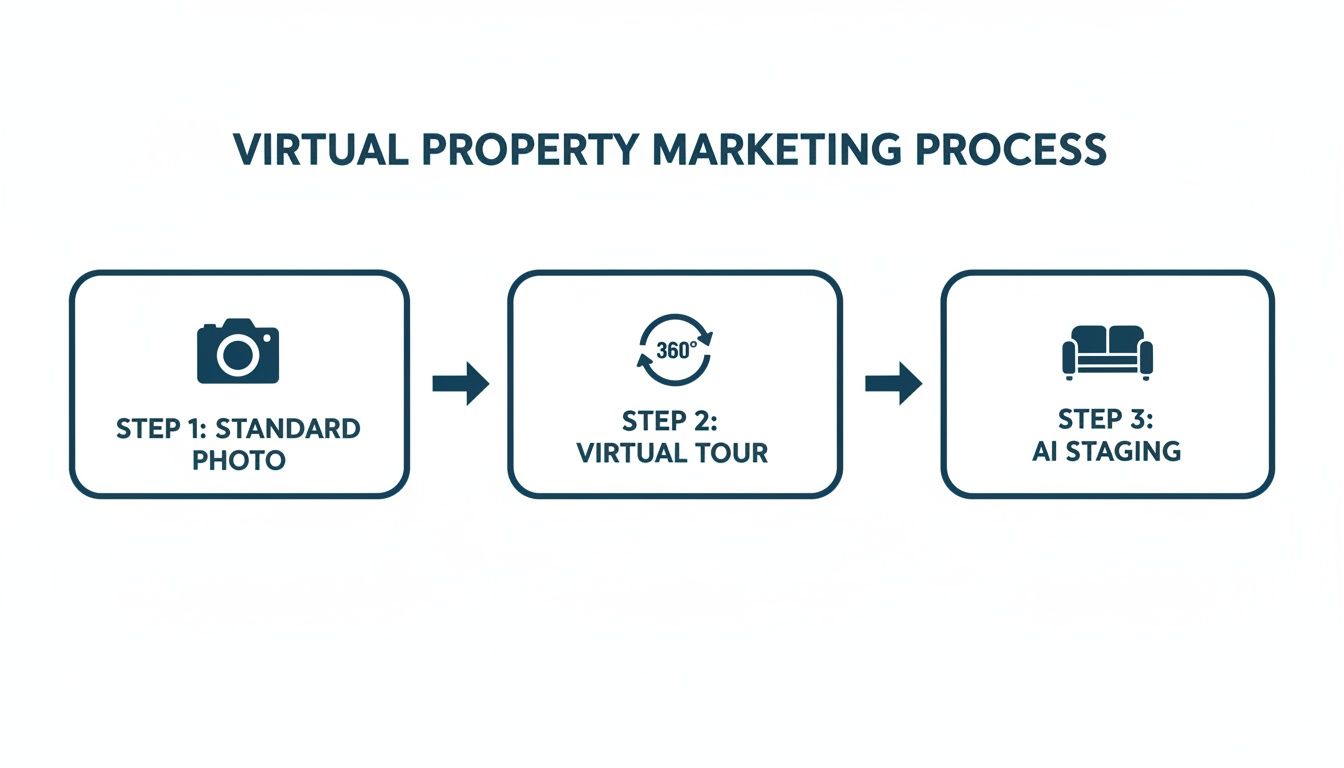
    This flowchart maps out how different visual marketing assets work together to build a powerful online presence.

    Flowchart showing virtual property marketing process: standard photo, virtual tour, and AI staging.

    When you can show a seller this kind of multi-layered visual strategy, it proves you're using every tool at your disposal to make their property pop.

    Crafting a Complete Social Media Calendar

    Maybe the most impressive piece of your arsenal is a fully fleshed-out social media calendar. These tools can generate a month's worth of content, custom-fit to every stage of the selling process.

    And we're not just talking about a list of ideas. This is a complete package with ready-to-post captions, relevant hashtags, and even image suggestions. Your calendar will likely include posts for:

    • Coming Soon: To build that crucial early buzz and anticipation.
    • Just Listed: The big announcement designed to drive immediate traffic and get people sharing.
    • Open House Promotion: Timed posts leading up to the event to pack the house.
    • Property Feature Spotlights: Individual posts that highlight what makes the home special, like a brand-new kitchen or that amazing backyard.
    • Under Contract & Sold: Posts that celebrate the win, giving you powerful social proof and keeping your name in front of future clients.

    The Critical Role of Compliance and Psychology

    The best real estate listing pitch tools are smart. They don't just create content; they build in crucial safeguards and persuasive elements that do some of the heavy lifting for you.

    For starters, every piece of AI-generated text should be scanned for Fair Housing compliance. This is a massive value-add that protects both you and your clients from serious legal risk.

    Beyond that, these platforms are often built on proven psychological frameworks to make the content hit harder. You'll see elements of:

    • Scarcity: "A one-of-a-kind view like this won't last long."
    • Aspiration: "Imagine hosting summer barbecues on this stunning patio."
    • Social Proof: Mentioning a popular neighborhood or recent nearby sales.

    When you show up with this marketing arsenal already in hand, you’re demonstrating a level of preparedness and tech-savvy that your competition simply can't match. You're showing sellers that you don’t just have a plan—you have a system built for maximum exposure from day one. To get a better idea of how these features come together, you can check out the packages on the ListingBooster.ai pricing page.

    Pitching for the Signature: How to Present Your Work

    All the prep work in the world doesn’t mean a thing if you can’t connect with the seller in their living room. You've built an incredible marketing package with some serious tech behind it, but now you have to make it human. This is where you shift from a tech-savvy agent to a trusted advisor.

    The listing appointment isn't about showing off your tools; it's about showing the seller you have a rock-solid plan to get them the best possible outcome. The AI-generated assets are your proof. Your job is to tell the story of how that proof translates into a faster sale and more money in their pocket.

    Frame Everything as a "For You" Benefit

    This is critical. Never, ever lead with the tech. Sellers don't care about the AI model you used. They care about results. So, you need to frame every piece of your presentation around what it does for them.

    It’s a simple but powerful shift in language. Instead of saying, "I used AI to write this," you show them how your strategy directly benefits their bottom line.

    Here’s how that sounds in a real conversation:

    • When presenting the AI-optimized description: Don't just hand it over. Say, "I’ve already drafted a description specifically designed to rank higher on Zillow and Google. We've targeted the exact keywords buyers are searching for, so we attract serious inquiries right from the start."

    • When showing the social media calendar: Lay the printed calendar on their coffee table. Explain, "Most listings get a flurry of interest and then go quiet. This is our 30-day proactive plan to keep your home top-of-mind. Each of these posts is crafted to build excitement and drive a crowd to our open house."

    • When revealing the virtual staging: Pull up the before-and-after shots on your tablet. Say, "We know it’s hard for buyers to imagine their life in an empty room. So, we've created these virtually staged photos to help them make an emotional connection and see the home's true potential. This is what gets us stronger offers, faster."

    See the difference? You're not just listing features. You’re demonstrating a complete, high-octane marketing engine that's already fired up and working for them.

    Confidently Handling Commission Objections

    Objections are just part of the job, and the commission question is almost always coming. But when you’ve done this level of prep, the conversation changes. You're not defending your fee; you're justifying the immense value you’ve already brought to the table.

    When a seller asks about your commission, what they're really asking is, "Show me why you're worth it." Your pre-built marketing arsenal is your answer.

    Let's walk through the most common objections and how your tech-powered pitch shuts them down.

    Objection 1: "Will you do it for less?"

    • Your Response: "I understand why you're asking. My clients hire me because this marketing system is designed to create a bidding war that nets them the highest possible price. A small discount on my fee could easily cost you $10,000 or more on the final sale if we don't market your home this aggressively from day one. This entire plan is what prevents leaving money on the table."

    Objection 2: "The other agent said they could list it for more."

    • Your Response: "Anyone can throw out a big number, but a price is only real if a buyer actually writes a check for it. My pricing strategy is based on live market data—this shows us the sweet spot where the most qualified buyers are looking right now. Then, we use this aggressive marketing plan to create the demand that proves that top-dollar price is the right one, instead of just hoping someone overpays."

    Objection 3: "So, what makes you different from other agents?"

    • Your Response: "That's my favorite question. Most agents will tell you they’ll put your home on the MLS and do some social media posts. I believe in showing, not telling. I prepared this entire marketing portfolio for your home before you ever agreed to hire me. This is the level of detail and proactive strategy I bring to the table from the very beginning, and it’s what gets my clients better results."

    Your modern real estate listing pitch tools give you the receipts. You're not making empty promises; you’re backing them up with a tangible, fully-realized plan the seller can see and touch. This proactive approach builds a massive amount of trust and makes it clear you’re the expert who will use every advantage to win.

    Answering Your Questions About Pitch Tools

    I get it. Bringing new tech into a business that runs on relationships and proven methods can feel like a big leap. You're right to wonder if these modern real estate listing pitch tools are a good fit for your style, your budget, and the brand you've worked so hard to build.

    Let's cut through the noise and tackle the questions I hear most often from agents who are thinking about making the switch. This isn't about adding more complexity to your day—it's about giving you back precious time and a serious advantage in a crowded market.

    Are These Tools Hard for Non-Technical Agents to Learn?

    This is usually the first question, and the biggest hurdle for a lot of people. The answer is a firm no. The best platforms out there were designed for busy agents on the go, not for software engineers. The whole point is to make your marketing life simpler, not more complicated.

    Most of these tools work on a pretty simple idea: you give it a property address or a few key details, and the system does all the heavy lifting for you.

    • Quick Setup: Honestly, you can have your account up and running in under 10 minutes.
    • Intuitive Interface: The good ones have clean dashboards that walk you through the process, often with helpful tips built right in.
    • Minimal Input, Maximum Output: The dream is to generate an entire marketing package from a single property link. This saves you from having to jump between five different complex programs.

    Plus, most of them offer a free trial. You can take it for a spin, generate a full pitch for a test property, and see for yourself how easy it is before you ever pull out a credit card.

    How Do These Tools Ensure My Marketing Is Compliant?

    This is a big one. Staying compliant with Fair Housing laws and MLS regulations is non-negotiable, and this is where a top-tier tool really proves its worth. We've all been there, proofreading descriptions late at night, but manual checks are prone to human error—and mistakes can lead to huge fines and damage to your reputation.

    The best platforms bake compliance checks right into their software. They have built-in scanners that analyze AI-generated property descriptions and social media copy, flagging words or phrases that might get you into trouble with Fair Housing. They also spit out MLS-compliant descriptions formatted correctly right from the start.

    For brokers, this is a game-changer. It’s a scalable way to reduce risk across an entire team of agents. You can ensure brand consistency and legal protection without having to manually review every single listing that goes out the door.

    This automated safety net is a powerful feature you can even mention to clients. It shows them you’re a true professional who takes every measure to protect their interests.

    Can I Still Personalize the Generated Content?

    Absolutely. Think of the AI as a professional copywriter who hands you a fantastic first draft. It saves you from that paralyzing "blank page" stare, but it’s not the final word.

    While the initial output is automated for speed, it's almost always fully editable. You have complete control to:

    • Tweak the Tone: Make the language sound more like you—whether that’s luxurious, warm and friendly, or straight-up data-driven.
    • Add Local Details: This is where you shine. Weave in those neighborhood gems, local landmarks, or unique community quirks that only a true expert would know.
    • Refine the Call-to-Action: Customize how you ask for the next step so it aligns perfectly with your sales process.

    The AI handles the heavy lifting—the structure, the optimization, the compliance—freeing you up to add the personal touches that make your marketing uniquely yours.

    How Do I Stand Out if Other Agents Use These Tools Too?

    Your edge comes from how you use the tools, not just the fact that you have them. Your real advantage is in the story you tell and the incredible level of preparedness you show up with. When you walk into a listing appointment with a complete, professional marketing suite already built, you’re operating on a completely different level.

    It’s not about the tool; it’s about the strategist wielding it. Your ability to explain why an AI-optimized marketing plan is so critical in today’s market is what positions you as the forward-thinking expert. You’re the one connecting the dots for the seller, showing them exactly how each asset—from social media posts to property flyers—translates into more buyer interest and a better final price.


    Ready to walk into your next listing appointment more prepared than ever? ListingBooster.ai generates a complete, AI-powered marketing suite in minutes, giving you the ultimate edge. See how it works and start your free trial.

  • How a Real Estate AI Platform Can Win You More Listings

    How a Real Estate AI Platform Can Win You More Listings

    So, what exactly is a real estate AI platform?

    Think of it as your own personal marketing department, working around the clock to handle the time-consuming tasks that used to eat up your schedule. It’s a specialized software tool built to automate things like writing property descriptions, creating social media posts, and even digging into market data. The whole point is to take the repetitive work off your plate so you can get back to what matters most: your clients and closing deals.

    What Is a Real Estate AI Platform Anyway?

    A person uses a laptop on a wooden desk next to a model house and marketing reports with charts.

    Let's get practical. Imagine having a marketing strategist, a brilliant copywriter, and a savvy social media manager all on your team, ready to go 24/7. That's essentially what a real estate AI platform brings to the table. It's not here to replace you; it's designed to be a powerful assistant, freeing you from the marketing grind that gets in the way of dollar-producing activities.

    Here’s a real-world scenario: while you're out showing homes or deep in negotiations, your AI platform can instantly analyze new market data. It can write a compelling, MLS-compliant property description and schedule an entire month of social media content for that listing, all from a single property address.

    From Manual Grind to Strategic Advantage

    We all remember the old way of marketing a property. It was a slow, manual marathon. You'd agonize over writing every listing description from scratch, coordinate with photographers and stagers, and then spend hours manually posting updates across a dozen different websites and social media profiles. Every single listing felt like starting from zero.

    Today, a modern real estate AI platform bundles all of that work into one streamlined system. These tools use sophisticated algorithms to analyze data, generate human-sounding content, and automate your entire marketing workflow. For you, this means creating a complete marketing kit for a new listing in minutes, not days.

    This isn't just a niche trend; it's a massive industry shift. The global AI in real estate market jumped from $222.65 billion to $301.58 billion in just one year, which is a staggering 35.5% growth rate. The market is speaking loud and clear.

    Redefining Your Day-To-Day Workflow

    This technology is completely changing how agents work. Forget spending Sunday night staring at a blinking cursor, trying to find the perfect words for a listing description. Now, you can generate several expertly written, optimized versions in a matter of seconds.

    To see just how much of a difference this makes, let's compare the old way with the new AI-powered approach.

    Traditional Marketing vs AI-Powered Marketing

    Marketing Task The Old Way (Manual Hours) The New Way (AI Minutes)
    Write Listing Description 1-2 hours of creative effort 2-3 minutes to generate & refine
    Create Social Media Posts 2-3 hours per listing (for a week) 5-10 minutes for a month's worth
    Design a Property Flyer 1 hour (fiddling with templates) <1 minute to auto-generate
    Analyze Local Comps 1-2 hours of MLS research 2-5 minutes for an instant report

    As you can see, the time savings are enormous. This isn't just about efficiency; it's about reclaiming your time to focus on what actually grows your business.

    The real power of an AI platform isn’t just doing things faster. It's about walking into every listing appointment more prepared than your competition with the data, content, and a full marketing plan ready to go.

    This shift lets you concentrate on what you excel at: building relationships, advising clients, and navigating complex transactions. The platform lays the marketing foundation, ensuring your online presence is always professional, consistent, and actively building your brand.

    Tools like ListingBooster.ai were built from the ground up to support this new reality, turning a simple property address into a complete suite of ready-to-use marketing materials. It’s all about moving from a reactive, "catch-up" marketing style to a proactive, data-driven strategy that wins over sellers and captivates buyers.

    The Core Features That Supercharge Your Listings

    Tablet and smartphone displaying real estate listings on a blue cover with 'SUPERCHARGE LISTINGS' text.

    It’s one thing to talk about having an “AI assistant,” but the real magic is in what it actually does for you day-to-day. A true real estate AI platform isn't just a single gadget; it's more like a Swiss Army knife of tools built specifically to solve the marketing headaches that agents deal with constantly. These core features are the engine of your business, handling the critical tasks that decide how fast and how well you can get a property in front of buyers.

    Let's dig into the essential functions that can take a simple property address and spin it into a complete marketing campaign. Think of these as your secret weapons, giving you an immediate advantage from the moment you land a new listing.

    Instant and Optimized Property Descriptions

    We've all been there—staring at a blank screen, trying to find a new, creative way to say "charming three-bedroom with a great backyard." This is where a good AI platform shines. Its standout feature is the ability to generate compelling, MLS-compliant, and portal-ready property descriptions in seconds.

    And I'm not talking about cookie-cutter, robotic text. The AI sifts through property details, analyzes the photos, and even considers local market trends to write a story that grabs a buyer's attention. It knows what works on Zillow versus the MLS and tailors the language accordingly.

    • MLS Compliance: The AI is trained on MLS regulations and Fair Housing laws, so it automatically steers clear of problematic language and respects character counts. This saves you from tedious edits and potential fines.
    • Portal Optimization: Descriptions are written to perform well on major sites like Zillow, Realtor.com, and Redfin, using keywords and a structure that hooks online shoppers.
    • Multiple Versions: Need a few different angles? Instantly generate one description that plays up the luxury details, another that focuses on the family-friendly vibe, and a third that highlights the investment potential. This lets you A/B test your marketing message with ease.

    This one feature can turn a two-hour writing session into a two-minute review process. That's time you get back to spend on clients and negotiations.

    Automated Social Media Content Calendars

    Staying active on social media is a must for agents today, but man, is it a time suck. A top-tier real estate AI platform tackles this by creating an entire social media calendar from a single property link.

    Imagine just dropping in a Zillow URL and getting back a 30-day plan filled with ready-to-use posts. We're talking engaging captions, smart hashtags, and even ideas for visuals. This ensures your new listing gets the steady drumbeat of promotion it needs, without you having to manually craft a post every single day. The content is diverse, from a "Just Listed" splash to neighborhood spotlights and open house reminders.

    The point is to graduate from random, sporadic posting to a consistent, professional online presence. AI makes that possible, even for a busy solo agent trying to do it all.

    Data-Driven Competitive Analysis

    Nothing builds confidence like walking into a listing appointment armed with solid data. Another core function of these platforms is the ability to run a quick but powerful competitive analysis, giving you the ammo you need to nail your listing presentation and pricing strategy.

    The AI scans the market for active, pending, and sold properties that are genuine comps for your listing. It then packages this data into a clean, simple report that highlights what makes your property stand out. This is more than just pulling comps; it's about crafting a data-backed story that shows sellers you've done your homework and know how to position their home to win.

    This instantly positions you as the local market expert. You’re no longer just sharing an opinion on price—you’re presenting a clear, data-driven plan for getting their home sold.

    How AI Actually Puts Money Back in Your Pocket

    When you're looking at any new tool for your business, it all boils down to one simple question: what’s the actual return? For a real estate AI platform, the value isn't about the shiny new features. It's about what that technology does for your time, your income, and your reputation. This isn't just another tech subscription; it’s a business decision that directly impacts your bottom line.

    The return on investment, or ROI, from AI really breaks down into three key areas: getting your time back, winning more listings, and building a powerful personal brand. Each one of these pillars helps you build a more profitable and sustainable business.

    Reclaiming Your Most Valuable Asset: Your Time

    The first, and most immediate, return you’ll feel is getting back all those hours you used to sink into tedious marketing tasks. Seriously, think about how much time you've spent wrestling with property descriptions, creating social media posts from scratch, or fiddling with flyer designs. An AI platform handles all of that in just a few minutes.

    This is where the financial gain really kicks in. Instead of being chained to your desk, you can put those hours back into the high-value, money-making activities that only you can do.

    • Lead Follow-Up: Actually having the time to nurture your pipeline and turn leads into clients.
    • Negotiations: Giving your full focus to getting the best possible deals for the people you represent.
    • Client Relationships: Building the strong connections that fuel repeat business and referrals for years to come.

    The efficiency gains agents are seeing aren't small, either. With AI adoption hitting a critical mass, 87% of brokerage leaders say their agents are actively using these tools. And those agents? They're reporting time savings between 70% to 90% and accuracy improvements over 95%. That's a clear path to a better work-life balance and a more focused business. You can dive deeper into these industry-wide trends on Rentana.io.

    Winning More Listings with Data-Backed Confidence

    Let's be honest: showing up to a listing presentation with a generic pitch and a standard CMA just doesn't cut it anymore. Today's sellers expect you to be a data-savvy market expert. A real estate AI platform gives you the firepower to not just meet that expectation, but blow it away.

    Imagine generating a detailed competitive analysis and a complete, professional marketing plan in minutes, before you even walk through their front door. You’re not just telling sellers what you’re going to do; you’re showing them.

    This screenshot shows how a platform like ListingBooster.ai can instantly generate a full suite of marketing materials.

    This isn't just a gimmick. It's the ability to create everything from compelling MLS descriptions to a month's worth of social media content, all from just a property address. You're presenting a complete, ready-to-launch strategy on day one.

    When you can show up with a data-backed pricing strategy and a fully-formed marketing campaign already in hand, you completely change the conversation. It stops being about your commission and starts being about the immense value you deliver. That level of confidence and preparation is how you win more listings.

    Building a Brand That Does the Selling for You

    The long-term ROI is all about building a professional brand that’s so solid, it pre-sells your expertise. We all know that consistency is the secret sauce to building authority, but it feels almost impossible to maintain when you're busy. AI fixes that.

    An automated 30-day social media calendar keeps your listings and your expertise in front of potential clients day in and day out. Better yet, AI-optimized content helps you rank higher in modern search engines and AI assistants like ChatGPT, positioning you as the go-to expert who's ahead of the curve.

    This consistent, high-quality output builds your reputation while you sleep. When a potential seller starts researching agents online, they find a polished, active, and knowledgeable professional. By the time they pick up the phone to call you, they're already sold.

    Putting AI to Work From Listing to Close

    It's one thing to talk about features, but what does using a real estate AI platform actually look like on a typical Tuesday? Let's walk through a real-world scenario to make this concrete. We'll follow a smart agent, Alex, who needs to prepare for a competitive listing appointment and wants to walk in more prepared than anyone else.

    The old way was a grind. It meant hours of pulling comps, wrestling with a slide deck, and maybe, if there was time, scratching out a basic marketing plan. Alex’s new process is a complete departure and starts just a few minutes before heading out the door.

    From Property Address to Presentation Ready

    Alex's entire prep now starts with a single action: typing the property's address into a real estate AI platform. In minutes, the system gets to work. It pulls public data, crunches the latest market numbers, and generates a whole suite of materials ready for the presentation. This isn't your standard CMA; it's a full-blown, professional marketing preview.

    Instead of a generic pitch, Alex now has:

    • A data-driven competitive analysis that visually maps out the property's position in the market.
    • A tangible preview of the marketing plan, complete with sample property descriptions and a social media content outline.
    • Print-ready handouts that explain how the listing will be optimized for AI search on platforms like Google and ChatGPT.

    By the time Alex arrives, they're armed with a specific, data-backed strategy. This instantly changes the tone of the meeting. The conversation isn't about commission; it's about the undeniable value and expertise Alex brings to the table. The seller is blown away, and Alex wins the listing.

    Activating the Campaign Instantly

    Once the listing agreement is signed, what used to be the start of a long slog is now a simple click. Alex just activates the marketing plan that was already built. The AI-generated property descriptions—already fine-tuned for the MLS and Zillow—are given a quick review and pushed live. No writer's block, no delays.

    Next up, Alex turns on the 30-day social media calendar. With that one click, a full month of engaging, professional-looking promotional content is scheduled across all of Alex’s social media channels. This guarantees consistent marketing without the daily grind, freeing up Alex to do what really matters: drumming up buyer interest and managing showings.

    This process is designed to deliver a clear return on your investment by giving you back your time, helping you secure more listings, and building your brand.

    Flowchart illustrating the real estate ROI process, showing time, listings, and brand leading to return on investment.

    As you can see, saving time directly translates into winning more listings. Winning more listings builds a stronger brand, which ultimately drives a much higher ROI.

    Your Blueprint for Modern Real Estate

    This story isn't just an example; it's a blueprint you can use in your own business. It shows how the right platform adds real value at every single stage of the listing lifecycle, from that first bit of prep to the ongoing promotion. You stop reacting and start operating with a proactive, repeatable system.

    This workflow isn't about replacing you. It's about amplifying your expertise. It transforms you from just another agent into a strategic marketing partner—which is exactly what sellers are looking for today.

    By handing off the repetitive tasks to the machine, agents like Alex can focus on high-level strategy and client service. The AI provides the tools to show up prepared, present a modern marketing game plan, and deliver an experience that builds a five-star reputation.

    This entire workflow, from prep to launch, can be run from a single dashboard. To see the kinds of tools that make this happen, you can check out the features available for agents on platforms like ListingBooster.ai. This isn't some futuristic fantasy; it’s a practical, accessible strategy for any agent who's ready to win in a tough market.

    How to Choose the Right AI Platform for Your Business

    Picking the right real estate AI platform can feel a lot like walking through a crowded open house. Everything looks promising at first glance, but you know the devil is in the details. Not every tool is created equal, and a slick interface doesn't mean much if the platform doesn't actually fit your business goals, your budget, or your legal duties.

    To make the right choice, you have to look past the marketing fluff and focus on what really matters. It’s a process of asking the right questions to find a tool that will accelerate your growth, not just create new headaches. It starts with the non-negotiables that protect your license and then moves on to the practical stuff—price, usability, and how fast you’ll actually see a return on your investment.

    First Things First: Prioritize Compliance and Data Integrity

    Before you even think about fancy features, your number one priority has to be compliance. In this business, one wrong move with Fair Housing laws or a simple MLS rule violation can lead to hefty fines, or worse, damage to the reputation you've worked so hard to build. The stakes are simply too high to gamble.

    A trustworthy AI platform isn't a generic content generator; it's trained specifically on the nuances of real estate regulations. This means it should automatically know how to avoid discriminatory language and work within the specific character limits and guidelines of your local MLS.

    • Fair Housing Guardrails: The platform absolutely must have built-in filters to prevent it from generating any language that could be seen as discriminatory. You should ask vendors directly how they train their models to recognize and sidestep problematic phrasing.
    • MLS Rule Adherence: A good AI tool gets that every MLS has its own strict rules. It should be smart enough to manage character counts and formatting on its own, saving you the frustrating back-and-forth of manual edits and rejections.

    The most powerful AI in the world is a liability if it puts your license at risk. Always confirm that the platform is designed with a "compliance-first" approach, making it an asset that protects you, not a tool you have to constantly police.

    Evaluate the Business and Financial Fit

    Once you’ve confirmed a platform is safe and compliant, the next step is making sure it makes sense for your bottom line. The perfect tool is one that fits seamlessly into your workflow and budget, delivering real value without adding unnecessary complexity or cost. One of the biggest factors here is what I call time-to-value—how quickly can you go from signing up to confidently using it in a listing presentation?

    Look for platforms built for speed. The best ones let you generate a complete marketing kit in just 5-10 minutes. For a busy agent, that kind of efficiency is a game-changer.

    Of course, the pricing structure is just as important. The models out there vary quite a bit, so you need to find one that aligns with your business volume and cash flow.

    • Subscription vs. Per-Listing Fees: A monthly subscription gives you predictable costs, which is great for active agents. A pay-per-listing model might look cheaper at first, but it can get surprisingly expensive during a busy season.
    • Integration with Existing Tools: Does the platform play nice with your current CRM or other systems? Smooth integration saves a ton of time and stops you from having to manually shuttle data between different apps.

    Taking a close look at the pricing and features of a real estate AI platform can give you a solid benchmark for what to expect in the market. This helps ensure you’re not overpaying for features you'll never use or getting locked into a plan that can't grow with you.

    Assess Usability and Agent Support

    Finally, a platform is only worth the investment if you and your team will actually use it. A clunky, complicated interface will be abandoned in a heartbeat, no matter how powerful its features are. The best systems are intuitive and feel natural from the get-go, requiring almost no training.

    When you're trying out a platform, ask yourself these simple questions:

    1. Is the interface clean and easy to navigate? You shouldn't have to hunt through confusing menus to find what you need.
    2. How responsive is their customer support? If you hit a snag, you need to know that a real person is there to help you—and quickly.
    3. Are the outputs easy to edit? AI should give you an amazing first draft, but you always need to have the final say to add your personal touch and unique local insights.

    By systematically walking through these key areas—compliance, business fit, and usability—you can cut through the noise and confidently choose a real estate AI platform that truly empowers your business and helps you win more listings.

    Below is a quick checklist you can use to keep these crucial factors top of mind as you compare your options.

    Evaluation Checklist for a Real Estate AI Platform

    This table summarizes the key factors to consider when selecting an AI marketing platform for your real estate business.

    Evaluation Criterion Why It Matters What to Look For
    MLS Compliance Prevents listing rejections and saves you from tedious manual edits. Protects your standing with the MLS. Automatic character counting, adherence to local MLS rules, and formatting specific to your board.
    Fair Housing Protects your license and reputation from serious legal and ethical violations. Built-in filters that block discriminatory language and phrasing related to protected classes.
    Integration Saves time by connecting seamlessly with the tools you already use, like your CRM or transaction manager. Direct integrations with major real estate software, or at least the ability to connect via tools like Zapier.
    Pricing Model Ensures the cost aligns with your business volume and financial strategy, avoiding surprise expenses. Clear, transparent pricing tiers. Look for options that scale with you, whether subscription or per-listing.
    Onboarding Time A fast setup means a quicker return on your investment. You need a tool, not a project. An intuitive interface that allows you to generate your first marketing kit in under 15 minutes.
    Return on Investment The platform should demonstrably save you time or help you win more listings, justifying its cost. Case studies, testimonials, or a clear value proposition showing how it improves efficiency or conversion rates.

    Using a structured approach like this ensures you're not just buying another piece of software, but investing in a genuine partner for your business's growth.

    Your Competitive Edge in the Age of AI

    We’re at a turning point in real estate. While the buzz around AI is everywhere, the reality on the ground is that most agents and brokerages are still just dipping their toes in the water. This creates a massive opportunity for anyone willing to jump in now.

    Putting a real estate AI platform to work isn't just a tech upgrade; it's a fundamental shift in how you operate. It’s about moving from a reactive to a proactive mindset, showing up to every appointment more prepared than anyone else, and using data to back up your every move.

    Seizing the First-Mover Advantage

    Picture this: you walk into a listing presentation with a complete, data-driven marketing plan already built. While other agents are making promises about what they could do, you’re showing the seller what you’ve already done for their specific property. That’s how you set a new standard and immediately prove your value.

    The gap between the early adopters and everyone else is huge right now. Projections show the real estate AI market is on track to hit an incredible $1.3 trillion by 2034. But get this—only about 5% of firms are actually using AI effectively today. The other 95% are still trying to figure it all out. You can read more about these market projections and the adoption gap to grasp just how big this opportunity is.

    This is your window. By getting comfortable with these tools now, you’re not just keeping up; you’re setting the pace.

    Adopting AI isn't a threat to your job. It's the single best way to prove your worth, win more listings, and build a real estate business that lasts.

    Building a Future-Proof Business

    At the end of the day, this is about more than just saving time. It’s about building a resilient, scalable business that can thrive no matter what the market is doing. When you automate the repetitive marketing tasks, you free yourself up for what truly matters: the high-touch, human side of the business that no machine can ever replace.

    You’re also building a consistent, professional brand that works for you 24/7, establishing you as an authority in your market. This doesn't just prepare you for your next deal; it sets you up for a long, successful career where you're always ahead of the curve. The agents who get this today will be the ones leading the market tomorrow.

    Frequently Asked Questions

    Jumping into new tech always comes with a few questions, and AI platforms for real estate are no exception. Agents are smart to ask about compliance, content quality, and how much time it'll take to get up and running. Let's tackle the big ones so you can feel confident moving forward.

    Is AI-Generated Content Compliant and Safe?

    This is the big one, and for good reason. The short answer is yes—the good platforms are built from the ground up with compliance in mind. They are specifically trained to avoid discriminatory language that would violate Fair Housing laws and are programmed to follow the technical rules and character limits of your local MLS.

    But remember, the buck always stops with you, the licensed agent. The best way to think about AI is as a highly skilled assistant who hands you a first draft. It’s still your job to give it a final look, ensuring everything is accurate, meets legal standards, and truly represents the property you're selling.

    Think of the AI as your first-draft specialist. It does the heavy lifting, giving you a strong, optimized, and compliant foundation that you then polish with your unique voice.

    Will My Marketing Feel Robotic or Impersonal?

    There's a natural fear that AI will make your marketing sound like it was written by a machine. In practice, it actually does the opposite. The platform's real job is to get you past that dreaded "blank page" feeling by creating a solid, well-structured starting point.

    From there, you get to do the fun part: sprinkle in your own local expertise and personal touch.

    • Add Local Flavor: Mention the amazing coffee shop around the corner or the annual neighborhood block party.
    • Share a Personal Insight: Add a sentence about what you, personally, love about the home's layout or the afternoon sun in the living room.
    • Refine the Tone: Easily tweak a few words to make sure it sounds exactly like you.

    This is the winning formula—blending AI's speed with the authentic, human connection that clients are looking for. Your marketing ends up being both incredibly effective and uniquely yours.

    How Long Does It Take to Learn These Platforms?

    Worried you'll be stuck in tutorials for weeks? Don't be. Modern AI tools are designed for busy agents, not tech gurus. The whole point is to deliver value almost instantly.

    With a well-designed real estate AI platform, you can realistically go from signing up to generating your first complete marketing package in just 5 to 10 minutes. The time it takes to see a real return on your investment is incredibly fast, getting you back to what you do best: building relationships and selling homes.


    Ready to see how an AI-powered marketing plan can help you win your next listing presentation? ListingBooster.ai generates a full suite of client-ready materials in minutes. Start your free trial today.

  • AI Marketing for Real Estate Agents: How It’s Used and Where It Fits

    AI Marketing for Real Estate Agents: How It’s Used and Where It Fits

    You've likely heard the buzz around "AI marketing for real estate agents," but what does it actually mean for your business? Forget the complex jargon. At its core, AI marketing is about using smart technology to automate and improve the repetitive, time-consuming parts of your job, allowing you to focus on client relationships and closing deals.

    Think about the hours spent writing property descriptions, creating social media posts, or preparing materials for a listing presentation. AI tools can handle much of that heavy lifting, providing a consistent and professional foundation for your marketing efforts. This guide explains what AI marketing means in practice, how agents are using it, and where it fits into a modern real estate workflow.

    What AI Marketing Means in Real Estate

    A laptop shows real estate listings next to a sign 'AI for Agents', a coffee, and a notebook.

    In plain language, AI marketing for real estate agents isn't about robots replacing agents. It’s about leveraging technology as an efficient assistant that handles critical marketing tasks with speed and consistency. Instead of staring at a blank page trying to find a new way to describe "natural light," you can input a property's key features and receive a polished, MLS-compliant description in seconds.

    The practical value of AI is how it streamlines day-to-day operations. It supports agents in several key areas:

    • Listing Descriptions and Property Content: Generate compelling property narratives that meet MLS guidelines and are optimized for different platforms.
    • Search Visibility: Structure listing content to improve how it appears on Google, major portals, and even in new AI-powered search tools.
    • Social Media Content at Scale: Create and schedule a consistent stream of posts, market updates, and property highlights without the daily grind.
    • Listing Presentation Preparation: Quickly assemble marketing plans and competitive analysis to present to potential sellers.
    • Time Savings and Consistency: Reclaim hours previously spent on manual content creation while ensuring every marketing piece maintains a professional tone.

    The goal isn't to replace your expertise—it's to amplify it. AI handles the grunt work, freeing you up to focus on strategy, building relationships, and negotiating deals.

    Common AI Marketing Use Cases for Agents

    Let’s move from theory to practice. Savvy agents are integrating AI into their workflows to work smarter, not just harder. This isn't a futuristic concept; it's a real advantage being used today. Here are the most common use cases, framed as workflow support rather than a magic solution.

    Content Creation for Listings

    The most immediate application is generating marketing content for new listings. Agents use AI to create multiple versions of property descriptions from a single set of details. This means getting a concise, MLS-compliant description while simultaneously producing a more detailed, story-driven narrative for a personal website or blog.

    Platform-Specific Optimization

    Different platforms have different rules and audiences. AI helps tailor content for specific channels like the local MLS, Zillow, and Realtor.com. This includes adjusting character counts, formatting, and highlighting features that perform best on each site, improving a listing’s visibility and appeal.

    Social Media Scheduling and Post Generation

    Consistency is key to social media, but it's incredibly time-consuming. Agents use AI to generate an entire month's worth of social media posts for a listing, including captions, image suggestions, and relevant hashtags. This ensures a steady online presence without the daily effort.

    Presentation and Pre-Listing Materials

    One of the most powerful uses is in preparing for listing appointments. Instead of scrambling to pull together examples of past work, an agent can use AI to generate a custom marketing preview for a prospective seller's property. This includes a draft listing description, a sample social media plan, and a competitive marketing analysis, demonstrating proactive expertise.

    Authority and Market Content

    Beyond individual listings, AI is used to establish local expertise. Agents can quickly draft insightful neighborhood guides, market trend analyses, and helpful blog posts. By consistently publishing valuable information, they build their brand and become a trusted resource in their community.

    Real Estate AI workflow diagram illustrating three steps: Win Listing, Market Property, and Build Authority.

    This isn't just a trend; it's a massive shift. Projections show that by 2026, AI will be a core part of real estate, with 70% of professionals adopting new tools annually. Morgan Stanley even estimates that automating just 37% of an agent's tasks could unlock $34 billion in efficiency gains. You can read the full 2026 State of AI in Real Estate Marketing report to dig deeper into the data.

    Tools Agents Use to Support AI-Driven Marketing

    Once agents understand the use cases, the natural next question is about the tools. It’s crucial to see these tools as assistants that execute a strategy, not as replacements for an agent’s judgment. They make tasks faster and more consistent.

    AI marketing for real estate agents typically combines content creation, distribution, and consistency. While some agents rely on general-purpose AI writing tools, others use real estate–specific platforms that account for MLS formatting, platform requirements, and presentation needs. Tools in this category include a mix of general AI assistants and industry-focused platforms such as ListingBooster.ai, depending on how structured an agent’s marketing workflow needs to be.

    Listing Content & Presentation Tools

    These tools focus on preparing listing descriptions, platform-specific content, and materials agents use during listing appointments. They are designed to streamline the pre-listing and active marketing phases.

    • ListingBooster.ai – A real estate–specific AI platform used by some agents to generate MLS-compliant listing descriptions, platform-specific marketing content, and presentation materials as part of their overall marketing workflow.
    • General AI Writers – Tools like ChatGPT can be used with specific prompts to draft property descriptions, blog posts, and other marketing copy. They require more detailed instruction to ensure real estate compliance.

    General AI Assistants and Schedulers

    Another common approach is pairing a general-purpose AI writer with a social media scheduling tool that has AI features.

    • AI-Powered Social Schedulers: Many popular social media management platforms now integrate AI to suggest optimal posting times, generate caption variations, or create simple graphics, helping agents maintain an active presence.

    The choice between a general tool and one built for real estate often comes down to workflow preference. Specialized platforms save time because they understand industry terminology and compliance from the start. General tools offer flexibility but require more effort to guide.

    Recent data shows the impact of these strategies: 60% of agents report their highest ROI is coming from social media marketing, often powered by AI, and 52% of leads generated through these efforts are higher quality. You can find more eye-opening AI agent statistics on warmly.ai to see how quickly the landscape is changing.

    How AI Shapes Your Brand and Puts You on the Map

    Laptop with marketing analytics dashboards and 'BOOST YOUR BRAND' text overlay, set against a blurred background of houses.

    Adopting AI into your marketing is more than a time-saver; it’s an upgrade to your brand's digital presence. Consistent, high-quality content is the foundation of online visibility. By using AI to produce polished, platform-specific content for every listing, you expand your digital footprint and improve your visibility on traditional search engines and emerging AI-powered search platforms.

    This consistency presents your brand as a sophisticated, modern marketing operation, which is increasingly important to potential sellers.

    Moving Beyond Automation to Build Real Authority

    The true value of AI marketing emerges when it helps you build authority at scale. By consistently publishing insightful market updates, neighborhood guides, and helpful content, you position yourself as the go-to local expert.

    Seller expectations are rising. They seek partners with a clear, tech-forward marketing strategy. The AI sector in real estate is projected to grow from $222.65 billion in 2024 to $303.06 billion in 2025, signaling a massive industry transformation. You can find more real estate marketing statistics here to understand the full scope.

    AI isn't about replacing what you do. It's about amplifying your expertise, building your reputation, and showing sellers you're equipped to win in a competitive market.

    Answering Your Questions About AI in Real Estate

    Adopting new technology naturally brings up questions. Here are answers to some of the most common inquiries from agents considering AI for their marketing.

    Do I Need to Be a Tech Whiz to Make This Work?

    Not at all. Modern real estate AI platforms are designed for agents, not developers. If you can enter a property address or copy and paste information, you have the necessary skills. The purpose of these tools is to simplify your job, not add another complex system to manage.

    What About Fair Housing Compliance?

    This is a critical consideration and a significant benefit of using a real estate-specific AI tool. The best platforms are trained on Fair Housing guidelines to help avoid discriminatory language. AI focuses objectively on a property's features—like granite countertops or a fenced yard—rather than making assumptions about potential residents. While you are always the final reviewer, the AI provides a compliant foundation to build upon.

    Can AI tools real estate agents use help me win more listings?

    Yes, by making you appear more prepared and professional. When you walk into a listing presentation with a complete, ready-to-launch marketing plan—including a sample MLS description and a 30-day social media calendar—you demonstrate a level of marketing savvy that builds immediate trust and sets you apart from the competition.

    Is This Going to Replace My Professional Copywriter?

    Think of AI as a powerful assistant, not a replacement for human expertise. It can get you 80% of the way to a finished piece of marketing content in seconds. Your role is to add the final 20%—the unique neighborhood insights, personal voice, and local details that only an expert can provide. The AI handles the heavy lifting, freeing you to focus on the high-value strategic touches.

    Conclusion

    AI marketing in real estate isn’t about replacing agents—it’s about reducing manual work and improving consistency. As expectations around digital presence and content quality increase, agents are experimenting with different ways to integrate AI into their marketing workflows. The specific tools matter less than understanding how AI fits into listing preparation, presentation, and ongoing visibility. To learn more, visit the real estate marketing blog.