
Tag: real estate ai search

  • What Is IDX and Why It Still Matters for Real Estate

    What Is IDX and Why It Still Matters for Real Estate

    A new agent usually hears “IDX” during a brokerage onboarding call, nods along, and hopes nobody asks for a definition. Then the questions arrive: Why are listings appearing on the website? Who controls the data? Why did a property remain visible after its status changed? And will the same pages be readable by ChatGPT, Perplexity, or Google AI search?

    The practical answer to what IDX is starts with a distinction. IDX isn't a website, a software product, or a lead-generation guarantee. It's a regulated policy framework and technical delivery layer that lets authorized MLS participants display other participants' listings on public-facing digital channels. That framework still matters because modern AI search depends on accurate, structured, publicly accessible property information.

    What IDX Means for Agents and Brokers

    IDX stands for Internet Data Exchange. In the United States, it's the policy framework that allows MLS participants to authorize the limited electronic display and delivery of other participants' listings through websites, mobile apps, and audio devices. The MLS controls which records and fields may appear, and the public display has to follow the applicable rules. NAR describes IDX as a controlled display and delivery framework.

    That makes IDX different from the password-protected MLS dashboard. The MLS is the working database used by authorized professionals. IDX is the approved path that exposes a permitted portion of that inventory to consumers through a brokerage or agent-controlled experience. A seller may also suppress public Internet display in circumstances allowed by the MLS rules, so not every record automatically belongs on every public site.

    The working definition

    Think of IDX as three connected layers:

    • Permission: The MLS authorizes an eligible participant to display specific listing data.
    • Control: MLS rules determine the records, fields, attribution, delivery channels, and other display requirements.
    • Presentation: A website, app, or other approved interface turns that data into searchable public pages.

    The technology matters, but the policy comes first. A vendor can build an elegant search interface, but it can't authorize data that the MLS hasn't made available. Your system also can't freely combine IDX records with off-MLS information if the resulting display violates MLS rules.

    That's why an IDX feed isn't the same thing as scraping a portal. Scraping copies information from a public website without creating the MLS-authorized relationship required for compliant display. IDX gives the participant a defined right to present approved fields under defined conditions.

    Practical rule: Treat IDX as a compliance-controlled distribution system first, and a website feature second.

    What agents actually get

    A correctly implemented IDX site can give an agent or brokerage searchable inventory on its own domain, property detail pages, inquiry forms, and a branded path for buyer engagement. It can also create a dependable foundation for content systems that need accurate listing information. Agents comparing those systems may find this guide to the best AI software for listing agents useful when evaluating marketing workflows.

    IDX doesn't replace follow-up, positioning, or local expertise. It gives your audience a legitimate public search experience and gives your brokerage a compliant way to publish listings beyond the MLS interface. That distinction keeps expectations realistic: IDX supplies authorized inventory and presentation infrastructure, not automatic traffic or closed transactions.

    How the IDX Policy Took Shape Over Time

    IDX became important because MLS data had to move from a professional database into a consumer-facing environment without losing attribution or control. The National Association of REALTORS® approved the IDX policy in May 2000, authorizing MLS participants to display one another's listings on their websites under specific rules and limitations. NAR's IDX background and FAQ records that original adoption and later revisions.

    That milestone changed the practical role of an agent website. Before an authorized public display framework existed, a brokerage site couldn't reproduce the broader MLS inventory. After IDX, the website could become a consumer search destination while preserving the listing brokerage's connection to the record.
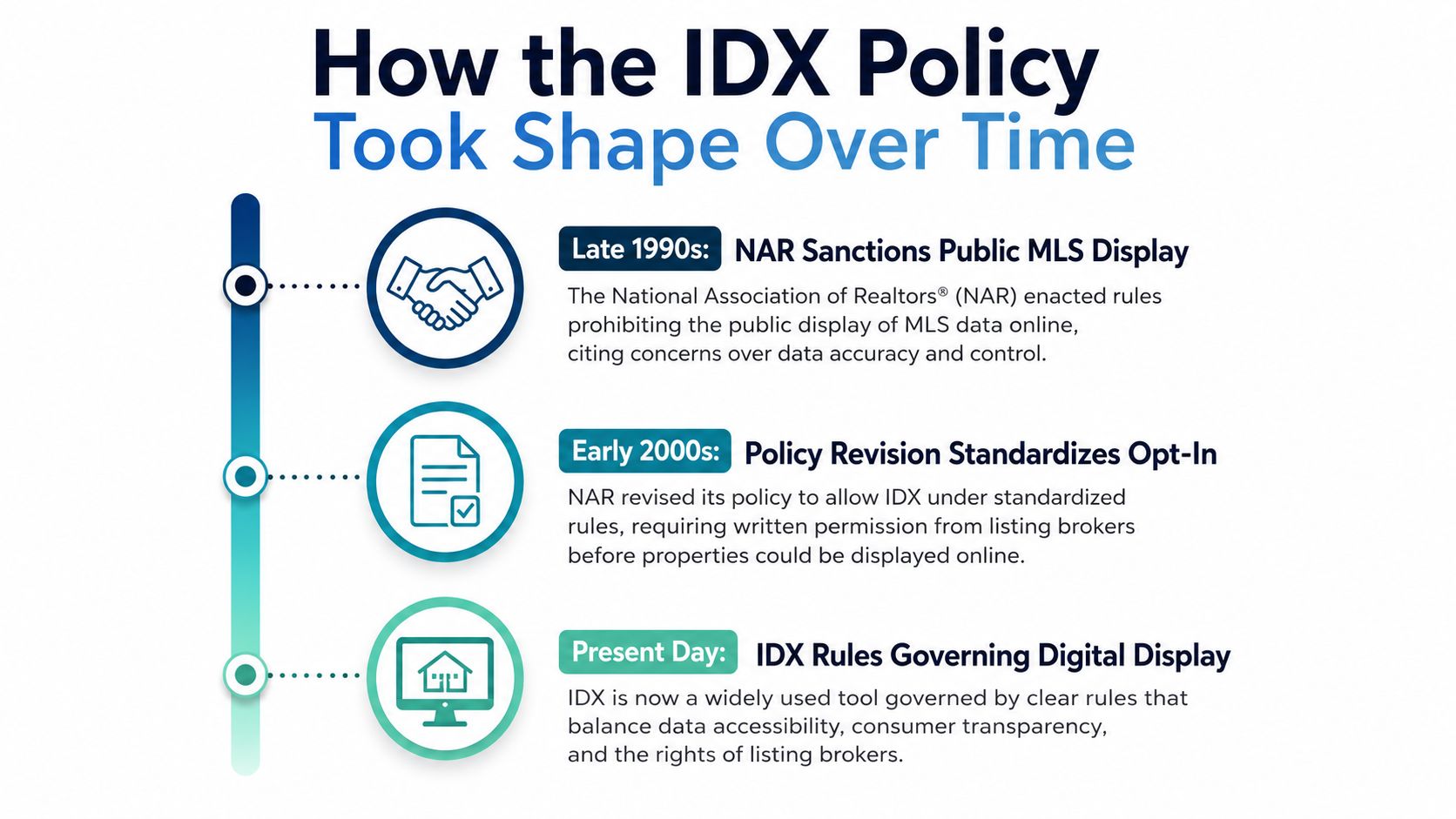
    A timeline graphic illustrating the evolution of IDX real estate policies from the late 1990s to present.

    The policy has continued to evolve. NAR's policy materials note multiple revisions, including another round adopted in November 2017. The important point isn't memorizing every amendment. It's understanding that IDX has repeatedly adapted to new delivery methods and new questions about how a listing appears outside the MLS interface.

    From websites to machine-readable discovery

    NAR places IDX in the Handbook on Multiple Listing Policy as Statement 7.58, and its policy language now covers electronic display and delivery across more than traditional websites. The IDX policy page explains its place in the broader MLS policy structure.

    The 2018 revisions expanded authorized delivery channels to websites, mobile apps, and audio devices, while defining display to include delivery under the participant's control. NAR's 2018 revision guidance details those channel changes.

    That history now intersects with AI-first discovery. A survey published by Veterans United reported that 52% of respondents use AI to search for homes, while another survey reported 39% use AI tools in home searches. The Veterans United survey provides the 52% figure and its methodology. These figures don't answer whether a particular listing will appear in an AI response, but they do explain why display, attribution, and machine-readable access deserve broker-level attention.

    How IDX Data Flows

    A buyer's property search depends on several systems working in sequence. The listing brokerage enters or updates the record in the MLS. Public IDX display then depends on the applicable authorization, seller instructions, and MLS rules. Once the listing qualifies, the MLS makes approved data available through a feed or another authorized delivery method.

    The receiving platform imports fields such as price, bedroom and bathroom counts, square footage, permitted address information, status, and listing-office identifiers. Each MLS sets its own field definitions and delivery rules. A field in the internal MLS record does not automatically belong on a public page. NAR explains how MLS-designated fields and seller suppression affect IDX display.
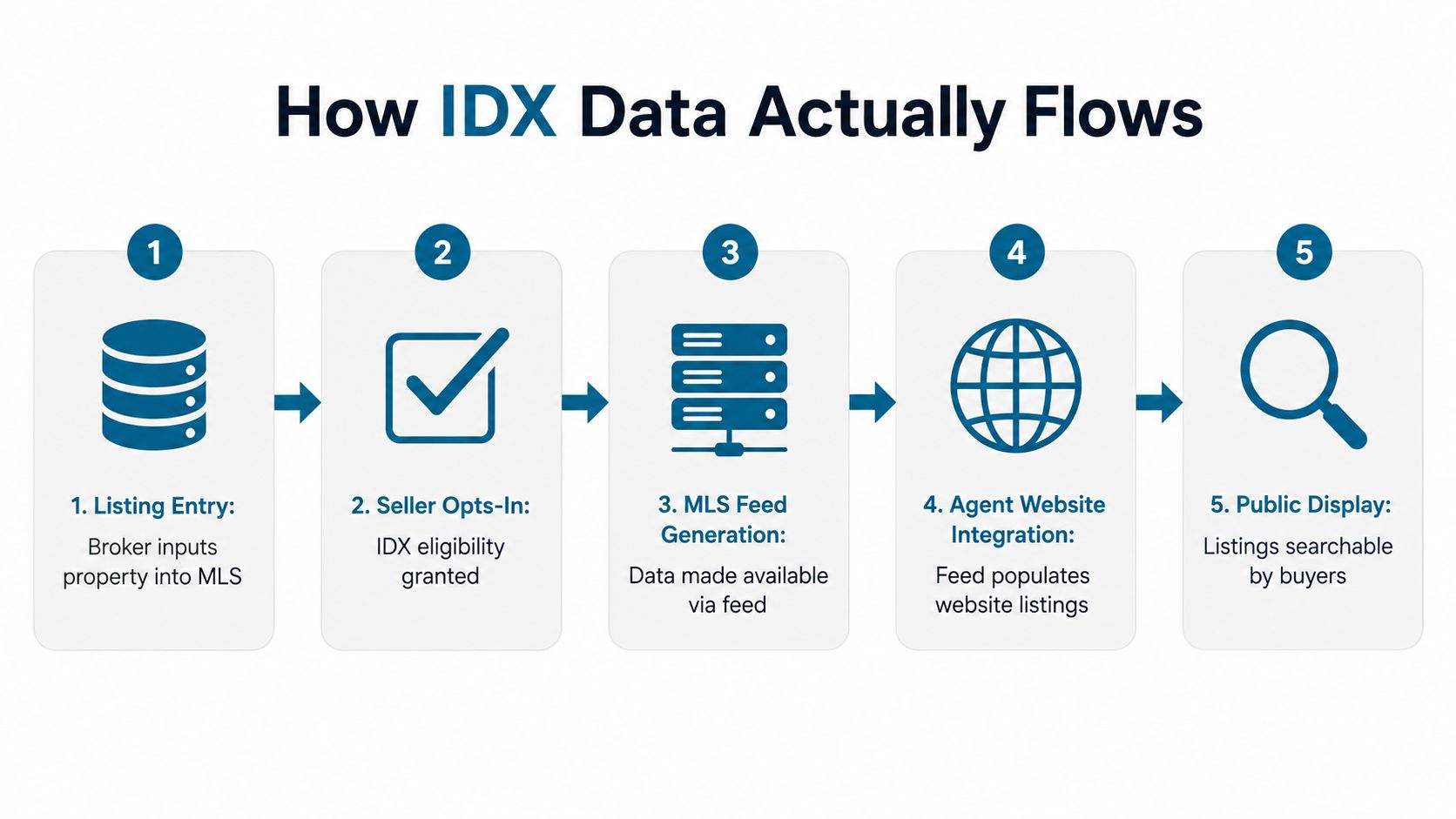
    A five-step flowchart illustrating how IDX property listing data flows from broker entry to public website display.

    The five operational stages

    1. Listing entry: The listing brokerage creates or updates the record in the MLS.
    2. Eligibility check: Seller instructions and MLS rules determine whether public IDX display is allowed.
    3. Feed generation: The MLS makes the permitted record and fields available to an approved recipient.
    4. Field mapping: The receiving system maps MLS names and values into its database and page templates.
    5. Public rendering: The website or app presents search results, property details, disclosures, and contact paths.

    Field mapping causes many implementation problems. One MLS may use different field names, status values, required disclosures, or formatting conventions from another. The receiving system must normalize those differences while preserving the record's meaning. That work affects more than the visible page. Complete, clearly labeled fields give search engines and AI crawlers better material to interpret, while a broken mapping can leave a page looking normal but missing important context.

    Where implementations fail

    Stale data is the most visible failure. If the feed, vendor, cache, or website does not refresh promptly, a buyer may see an outdated price or status. NAR policy materials describe prompt download access requirements for active listings and address sold data from January 1, 2012 onward, as well as publicly accessible sold information maintained by the MLS. The summary of 2022 MLS changes outlines these access and update-sensitive requirements.

    Schema drift is quieter but just as disruptive. An MLS changes a field label or value while the website continues expecting the previous structure. The page may still load, but key information can disappear from the rendered content and the structured data. That weakens the page for both traditional search and AI-first discovery through tools such as ChatGPT, Perplexity, and Google AI search.

    For a broader explanation of how listing technology affects brokerage operations, review these technology insights for Florida agents. Feed monitoring, field validation, and compliance checks belong in the operating process, not only in the launch checklist.

    Benefits and Limitations for Agents and Brokerages

    A buyer lands on an agent's website, searches available homes, opens a property page, and submits an inquiry without being sent to a national portal. That controlled path is IDX's clearest benefit. It connects listing interest to inquiry forms, saved searches, and brokerage lead routing, subject to MLS and vendor rules.

    Where IDX earns its place

    For a solo agent, IDX supplies credible inventory on the agent's own domain. The buyer can search, review listing details, and contact the participant within the same branded environment. The trade-off is that the agent gains a useful destination but does not automatically gain traffic, authority, or a distinct market position.

    Teams use the same search experience with more structured routing. Inquiries can go to the appropriate agent while the brokerage maintains shared branding, page standards, and follow-up rules.

    A brokerage also benefits from central control. One managed implementation gives the firm a consistent public display instead of leaving agents to copy, paste, or manually maintain property information. That reduces inconsistent descriptions and makes compliance review easier to organize.

    Properly structured property, area, and listing pages can expand a site's search visibility. A feed alone creates no authority, and indexing is never guaranteed. It does give Google and AI-first tools such as ChatGPT and Perplexity more accessible material to interpret than a brochure site containing only a homepage and contact form. The same pages must still be accurate, crawlable, and clearly attributed.
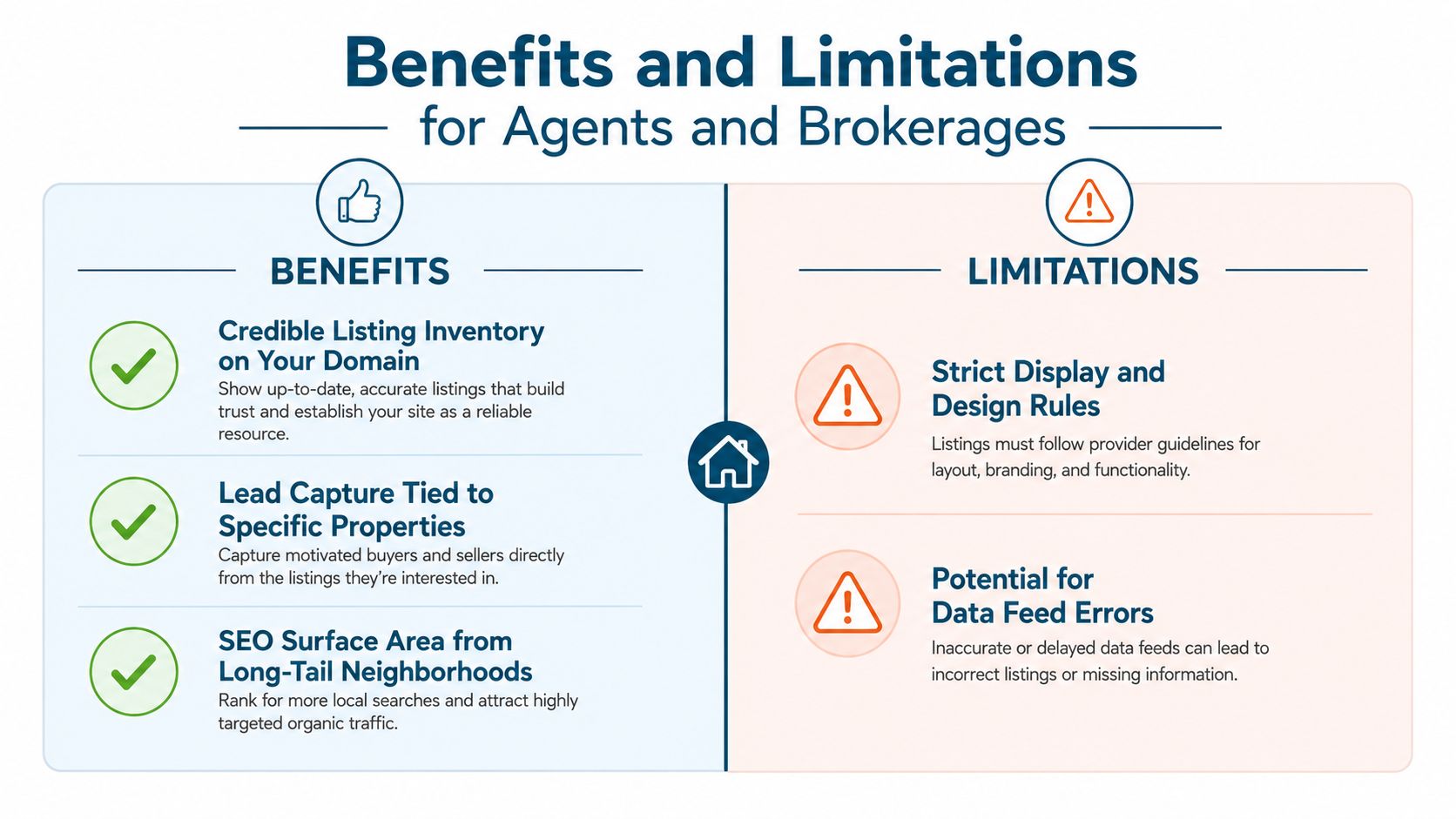
    A comparison chart outlining the benefits and limitations of using IDX listing feeds for real estate brokers.

    The costs that show up later

    The drawbacks appear in daily operations:

    • Refresh delays: The MLS can record a status change before the public site reflects it.
    • Display restrictions: Required fields, brokerage attribution, and contact details limit page design choices.
    • Feed errors: Mapping failures can remove fields, mislabel statuses, or produce broken pages.
    • Vendor dependence: The brokerage may rely on a provider for hosting, updates, support, and MLS relationships.
    • Limited differentiation: Competing firms may display much of the same inventory through similar products.
    • Compliance exposure: Problems arise when agents alter, export, or present feed data outside permitted rules.

    NAR guidance requires IDX displays to identify the brokerage firm clearly in readily visible color and typeface. They must also provide a consumer contact method, such as an email address or telephone number. The IDX qualification guidance explains these identification and contact requirements.

    A useful trade-off: IDX fits a business that needs compliant search, branded engagement, and centralized lead handling. It is a poor investment if the expectation is that a feed alone will create differentiation, traffic, or conversion.

    Why IDX Still Matters in AI-Driven Search

    Traditional IDX was built for people browsing websites. AI-mediated search changes the interface, but it doesn't eliminate the need for accessible source material. ChatGPT, Perplexity, Google AI Overviews, and voice assistants need publicly reachable information they can interpret, compare, and summarize.

    An IDX page can provide a structured property URL, visible listing details, brokerage attribution, and a relationship to the MLS-authorized record. That gives search systems a clearer source than a listing hidden behind a login or embedded in an inaccessible interface. It still doesn't guarantee inclusion. Crawling, indexing, licensing, freshness, and the AI platform's retrieval process all affect whether a page contributes to an answer.
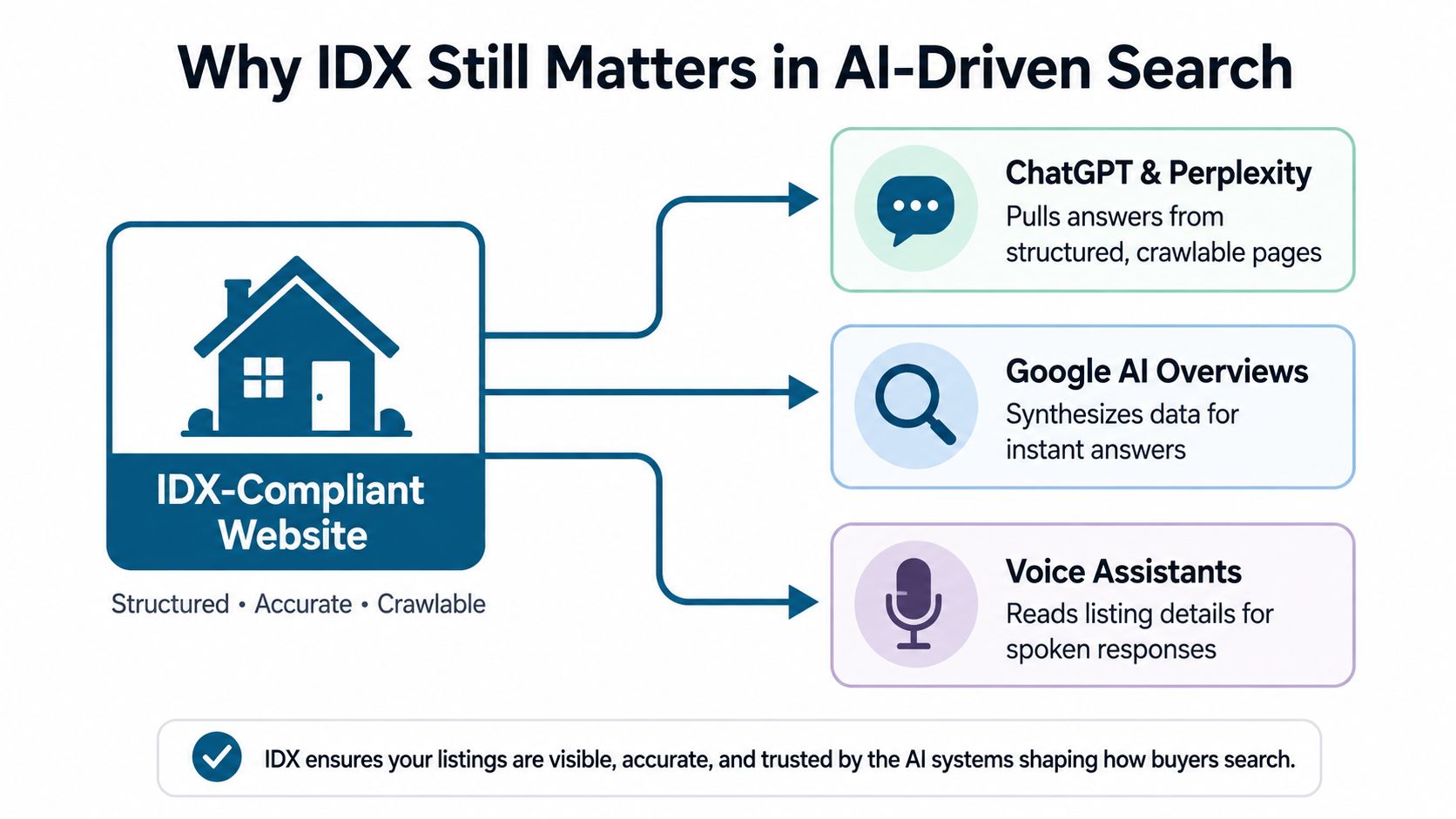
    An infographic titled Why IDX Still Matters in AI-Driven Search showing how IDX-compliant websites inform AI search platforms.

    The unresolved policy questions

    Classic IDX rules were written around controlled public display. AI systems introduce harder questions. If an AI tool summarizes a listing, is that a display, a delivery, an advertisement, or another category under the applicable MLS rules? Does an IDX opt-out apply when a third-party system retrieves and summarizes the page? Who is responsible when an AI answer presents stale or incomplete information?

    No single technical setting resolves those questions. Brokers should review MLS policy, vendor agreements, and platform terms before intentionally sending listing data into third-party AI services. They should also document which pages are public, which crawlers are permitted, and how listing removal requests are handled.

    For agents trying to cut through AI hype, the practical approach is to improve the source pages first rather than chase every new interface.

    An AI-readability checklist

    • Use structured data: Mark up property details with appropriate schema where the implementation supports it.
    • Keep URLs stable: Avoid changing the canonical listing URL every time a feed refreshes.
    • Maintain sitemaps: Remove expired URLs and include eligible, current pages.
    • Review robots directives: Don't accidentally block legitimate crawlers from pages you want discovered.
    • Show attribution clearly: Keep brokerage and participant contact information visible.
    • Audit answers: Search property addresses and local listing queries in major AI tools, then compare responses with the current MLS record.

    Agents planning a broader 2026 AI optimization for real estate strategy should treat IDX as the data foundation, not the entire optimization plan. Authority content, accurate local context, and consistent entity information still matter around the listing page.

    Choosing Your IDX Implementation Path

    Most agents have three realistic choices, and each solves a different problem.

    MLS-provided widgets and portals are usually the quickest route. They can put a searchable experience on a site without a substantial technical project. The trade-off is limited design control, weaker ownership of page architecture, and less flexibility for SEO, schema, lead routing, and AI-oriented content.

    Third-party IDX vendors offer a middle path. Providers such as IDX Broker, iHomefinder, Showcase IDX, and Realtyna typically manage the feed connection and provide search, maps, listing pages, and lead features. The important evaluation point isn't the feature list. Ask whether the vendor produces clean crawlable URLs, supports appropriate structured data, handles your MLS coverage, and gives your brokerage usable control over disclosures and routing.

    A custom implementation gives the most control. A developer or AI-powered platform can shape templates, schemas, internal links, and content workflows around the brokerage's operating model. That flexibility comes with more responsibility for maintenance, testing, MLS approvals, and technical support. ListingBooster.ai can fit into the broader marketing side of that decision through its Agent Edge listing campaign engine, while the IDX feed itself still has to follow the applicable MLS requirements.

    Compare the practical options

    Option Setup Cost SEO Control Customization Best For
    MLS widget or portal Usually the lightest initial commitment Low Low Agents who need a fast public search presence
    Third-party IDX vendor Ongoing vendor commitment with implementation work Moderate, depending on URLs and markup Moderate Agents and teams wanting managed infrastructure
    Custom build Higher implementation effort High High Brokerages prioritizing brand, routing, structured pages, and technical control

    The right decision depends on more than budget. Consider your technical comfort, the number of agents who need access, brand consistency, CRM routing, local SEO goals, and whether AI search visibility is a serious priority for 2026.

    Decision test: If you can't explain how the system refreshes data, removes expired listings, displays attribution, and routes leads, you aren't ready to choose the interface.

    Ask vendors for a live demonstration using a real property page. Check the URL, page source, mobile search, status updates, brokerage attribution, sitemap behavior, and lead notification path. A polished demo can hide weak architecture, while a less flashy platform may provide the controls your brokerage needs.

    Next Steps and Common IDX Questions

    Run this checklist before signing a vendor agreement or rebuilding your website:

    1. Confirm participation: Verify that your agent or brokerage account is authorized for IDX through the relevant MLS.
    2. Audit display compliance: Check brokerage identification, participant contact details, required disclosures, field restrictions, and seller-directed suppression.
    3. Review integration: Test search, detail pages, status changes, photos, mobile behavior, URLs, sitemaps, and lead routing.
    4. Choose the implementation: Decide whether a widget, managed vendor, or custom build fits your budget and operational goals.
    5. Schedule reviews: Recheck refresh behavior and display compliance every 30 days, as an internal operating habit rather than a substitute for MLS guidance.
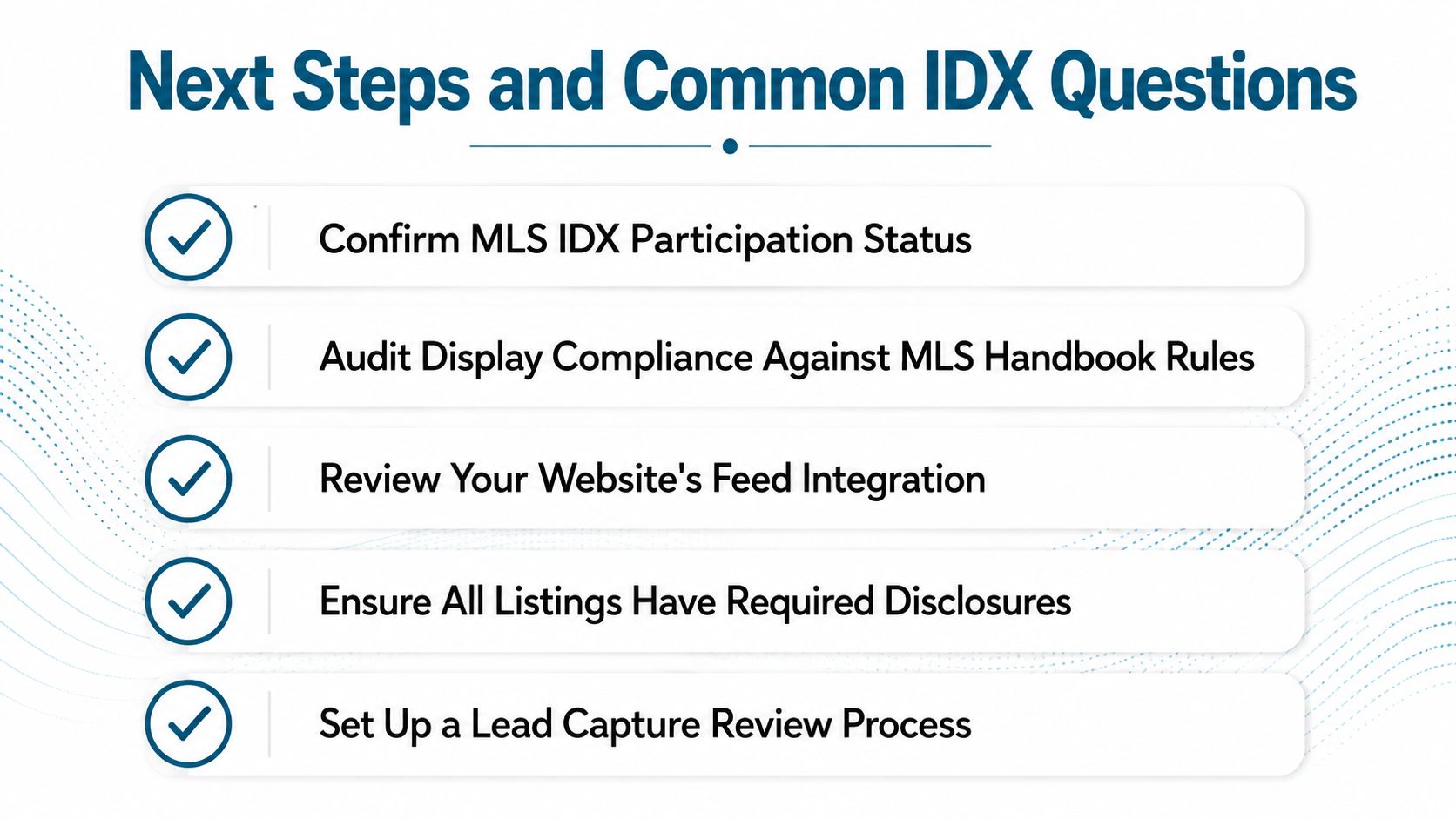
    A checklist infographic titled Next Steps and Common IDX Questions outlining five key real estate website requirements.

    Common questions

    How long does MLS approval take?

    Timing varies by MLS, participant status, vendor, and required paperwork. Ask your MLS and vendor for the current approval sequence, then confirm the launch date only after authorization is documented.

    Does IDX work on social media?

    IDX is designed for approved websites, mobile apps, and audio devices, not unrestricted social distribution. Share links to compliant listing pages, and verify that your MLS permits the specific content and destination.

    Can I display off-MLS listings through IDX?

    Not automatically. IDX authorizes limited display of eligible MLS listings, while off-MLS data may follow different permissions. Separate the sources, document consent, and ask your broker before publishing.

    What does an IDX vendor build cost?

    Costs vary by provider, MLS coverage, customization, support, and implementation scope. Request an itemized proposal that separates recurring service, setup, development, and any MLS-related charges.

    What happens when a listing sells?

    The public page should follow the MLS status and retention rules. Test sold-status handling, page updates, redirects, and removal behavior with your vendor instead of assuming the system handles every market identically.

    Will IDX listings show in ChatGPT and Google AI Overviews?

    They may be discovered if the pages are public, crawlable, structured, and permitted for retrieval, but inclusion isn't guaranteed. Search your own addresses and review crawler, sitemap, and robots settings.


    ListingBooster.ai helps agents, teams, and brokerages turn property information into editable, Fair Housing-conscious listing descriptions and social content while supporting a consistent digital presence around their listings. Visit ListingBooster.ai to review how its real-estate-specific workflow can complement a compliant IDX strategy.
  • How to Get Real Estate Listings Found in AI Search (2026)

    How to Get Real Estate Listings Found in AI Search (2026)

    More buyers are starting their home search inside AI tools, not just Google and portal filters. Verified industry data cited by ListingBooster says over 40% of homebuyers now start in ChatGPT, Perplexity, and Google AI, which means a listing can be beautifully marketed in the old system and still be functionally invisible in the new one.

    That changes the job. Getting found is no longer just about ranking a page or stuffing a Zillow description with neighborhood keywords. AI systems need structured facts, crawlable content, repeated signals across platforms, and enough authority to trust your listing when someone asks a conversational question like “show me a family-friendly home near good schools with a yard and updated kitchen.”

    If you want to know how to get real estate listings found in ai search, treat it like an operational system, not a one-off marketing trick. You need technical readability, language model-friendly copy, broader digital presence, and a way to tell whether those efforts are producing visibility and leads.

    The Invisibility Crisis Facing Real Estate Agents in 2026

    The biggest mistake agents make is assuming that if a listing is live on the MLS and syndicated to portals, AI tools will naturally pick it up. They often won’t. AI search doesn’t reward presence alone. It rewards clarity, freshness, context, and repeated proof.

    The shift is simple. Traditional search asked, “Which page ranks for this keyword?” AI search asks, “Which source can I trust to answer this buyer’s request?” Those are different systems with different winners.

    A buyer doesn’t type only “Austin homes for sale” anymore. They ask full questions. They ask for a loft near tech employers, a starter home in a walkable neighborhood, or a quiet property with a large yard and room for a home office. If your listing data is thin, generic, or stale, AI has nothing solid to work with.

    Practical rule: A listing that humans can understand at a glance is not automatically a listing that AI can interpret, compare, and recommend.

    At this stage, many agents disappear. They rely on short descriptions, inconsistent syndication, portal duplication, and manual updates. Meanwhile, AI tools are pulling from sources that look more complete and more current.

    The old playbook was visibility through rankings. The new playbook is visibility through machine-readable authority. That means your site, listing pages, profile content, and supporting assets need to work together so an AI system can confidently connect the property, the place, and the agent behind it.

    Agents who adapt won’t just “show up online.” They’ll become the source AI systems cite when buyers ask for help.

    Auditing Your Current AI Search Footprint

    Before changing anything, see what AI systems already know about you. Most agents skip this step and start rewriting copy blindly. That wastes time because you don’t know whether the problem is weak listing content, missing website pages, poor crawlability, or no authority signals at all.

    Start with a manual audit across the tools buyers use.

    Person wearing a green sweater using a digital stylus on a tablet showing a global map

    Run buyer-style prompts, not vanity searches

    Don’t search only your name. Use prompts that mirror how a real buyer or seller would ask for help.

    Try prompts like these:

    • Agent discovery prompt: “Who are the best real estate agents in [city/neighborhood] for first-time buyers?”
    • Property-type prompt: “Show me homes for sale with a pool in [neighborhood].”
    • Lifestyle prompt: “What neighborhoods in [market] are good for families who want parks, schools, and newer homes?”
    • Relocation prompt: “I’m moving to [city]. Which agents specialize in [area or price band]?”
    • Listing feature prompt: “Find condos in [area] with walkability, updated kitchens, and covered parking.”

    Run versions of those in ChatGPT, Perplexity, and Google search results where AI Overviews appear. Keep screenshots or notes. You’re looking for patterns, not perfection.

    Document what appears and what doesn’t

    Create a simple spreadsheet with these columns:

    Check What to record
    Platform ChatGPT, Perplexity, Google AI Overview
    Prompt used The exact buyer-style query
    Your presence Were you, your brokerage, or your listing mentioned?
    Source cited Did the AI reference your site, a portal, or another source?
    Accuracy Were property facts and service areas correct?
    Gaps Missing amenities, wrong status, weak agent positioning, no mention at all

    This baseline matters because AI visibility is often partial. You may appear for your name but not for a neighborhood specialization. You may rank in traditional search but not be cited in AI responses. You may see portal pages appear while your own website gets ignored.

    If your own listing page never surfaces but a portal duplicate does, that usually means the portal has clearer structure, stronger authority signals, or both.

    Check your listing pages like a machine would

    Open a few active listings on your own site and ask basic questions:

    • Can a crawler read the important details easily? Price, beds, baths, square footage, address, amenities, and photos should be visible in crawlable HTML.
    • Is the description specific? Generic copy makes the page interchangeable with hundreds of others.
    • Are updates current? AI systems tend to distrust stale inventory.
    • Do you include local context? A property without neighborhood signals is harder for AI to match to conversational prompts.
    • Does the page stand on its own? If someone lands directly on it, does it explain the home clearly without relying on MLS shorthand?

    Audit your agent footprint beyond listings

    AI doesn’t evaluate listings in isolation. It also looks for evidence that you’re a credible local source. Search for your name, team name, brokerage, and neighborhood specialty. Then inspect:

    • Your website bio pages
    • Neighborhood guides
    • Google Business Profile content
    • Social profiles
    • Portal bios
    • Open house and event pages
    • Blog posts tied to local market knowledge

    Many agents discover their digital identity is fragmented. Their website says one thing, Zillow says another, social bios are sparse, and no page clearly states what markets or property types they specialize in.

    That’s your starting point. Once you can see the gaps, you can fix them with intent instead of guessing.

    Implementing AI-Readable Technical Foundations

    AI can’t recommend what it can’t reliably parse. That’s why the technical layer matters first. If your listing pages don’t communicate property facts in a standardized format, even strong copy may not rescue them.

    The core move is structured data with Real Estate Schema markup in JSON-LD. According to Brevitas on AI real estate SEO, sites with validated schema see 2-5x higher impressions in Google Search Console for AI queries, while 65% of listings currently lack schema, which creates near-total AI invisibility.

    A diagram illustrating the technical foundations for making real estate listings optimized for AI search engines.

    Treat schema like a property data feed for machines

    A buyer sees a kitchen photo and reads “beautiful updated home.” An AI system needs explicit fields. It needs to know price, address, square footage, amenities, geo-coordinates, images, status, and who represents the listing.

    That’s what JSON-LD does. It tells search engines and AI systems exactly what the page contains without forcing them to infer everything from prose.

    A practical implementation starts with property-level markup pulled from your MLS or website database. Include the details that make a listing matchable in natural-language search, such as:

    • Core facts like price, location, square footage, room counts, and listing status
    • Feature signals such as pool, garage, hardwood floors, view, yard, or renovation details
    • Geo data that helps systems understand proximity and neighborhood context
    • Media references including image URLs and virtual tour links
    • Agent and brokerage identifiers so the property is tied to a real professional entity

    If you need a more concrete walkthrough, this guide to schema markup for real estate listings is worth reviewing before you hand requirements to a developer or website vendor.

    Validation is not optional

    Schema helps only when it’s correct. Broken or incomplete markup creates confusion, and confusion reduces trust.

    The practical workflow is straightforward:

    1. Extract the listing data from MLS, IDX, or your site database.
    2. Embed JSON-LD markup on the listing page.
    3. Validate the page in Google’s Rich Results Test.
    4. Fix every error and warning before treating the page as production-ready.
    5. Re-test after template or feed changes because small CMS edits can break markup without anyone noticing.

    The source above also notes that rich snippets can increase click-through rates by up to 30% in traditional search results when markup is implemented correctly and validated. Even though this article is focused on AI search, that matters because stronger traditional presentation often supports broader discovery.

    What works: one clean listing page with validated schema, stable URLs, crawlable HTML, and current property facts.
    What fails: JavaScript-heavy pages with hidden details, broken markup, and manual status changes that lag behind the MLS.

    Add event and tour context

    Many listing pages stop at basic property fields. That leaves useful buyer signals on the table. Open houses and tours are exactly the kind of structured details AI systems can use to answer intent-heavy questions.

    Use VirtualTour and Event schema where relevant. If a home has a 3D walkthrough or upcoming open house, mark it up. That gives AI systems a stronger picture of the experience around the property, not just the static facts.

    This matters in practice because buyers increasingly ask questions that imply action. They don’t just ask what exists. They ask what they can tour this weekend, what has a virtual walkthrough, or what’s newly available in a certain area.

    Keep pricing and availability fresh

    Freshness is where many technically decent setups fall apart. A page can have excellent schema and still lose visibility if its pricing or status drifts from reality.

    The verified guidance recommends integrating a RESO Web API or CRM connection for real-time syncing of pricing and availability. That source states manual updates fail 70% of the time without API, and stale listings are dropped 80% faster in generative summaries when AI systems detect outdated data on the page or across sources.

    That doesn’t mean every solo agent needs a custom engineering project. It means your stack should support reliable syncing. Ask your website provider, IDX vendor, or developer these blunt questions:

    • How often do listing pages update from the MLS feed?
    • Does the page output current price and status in crawlable HTML?
    • Does schema update automatically with listing changes?
    • Can open house data and tours be structured too?
    • How do we monitor markup breakage after site updates?

    Build pages that can stand on their own

    Some listing websites rely too heavily on framed IDX content or thin page templates. AI systems tend to reward pages that explain a property clearly in one place.

    A strong listing page usually includes:

    Page element Why it helps AI search
    Unique headline and summary Gives immediate topical context
    Full property details in HTML Makes facts easier to parse
    Structured data markup Standardizes the facts
    Local context copy Connects the home to neighborhood intent
    FAQ or practical details Answers buyer-style questions directly
    Tours and open house data Adds action-oriented signals

    Technical SEO fundamentals still matter too. If pages load poorly, render inconsistently on mobile, or block crawlers from key resources, the AI layer suffers because the indexing layer is weak.

    Monitor the technical layer every week

    The source guidance cites Bruce Clay’s recommendation for a checklist-based workflow that includes Search Console monitoring and weekly audits. That’s a useful mindset. Schema setup is not a one-time task. Feeds break. pages change. Plugins conflict. Templates get edited.

    Review active listings every week for three things:

    • Markup health
    • Status and price accuracy
    • Whether core details remain visible and crawlable

    When agents ask why AI search feels unpredictable, this is often the answer. Their content may be decent, but the underlying data layer isn’t stable enough to earn trust.

    Writing Listing and Agent Content for Language Models

    Technical markup makes a listing readable. Copy makes it recommendable.

    AI systems don’t respond well to lazy listing language. “Stunning home in a great location” tells them almost nothing. It doesn’t identify the likely buyer, the lifestyle fit, the distinctive features, or the local context that turns a vague property into a relevant answer.

    Verified guidance from the listing-description methodology says optimized listings appear in 25-40% more AI responses when they move beyond generic templates, and that 75% of agents use generic templates. The same guidance recommends descriptions of 300+ words with 5-7 key entities such as amenities and location features, written to answer conversational queries, as shown in this AI listing description reference.

    What weak copy looks like

    Here’s the kind of description that underperforms in AI search:

    Beautiful 3-bedroom, 2-bath home in a desirable neighborhood. Open floor plan, updated kitchen, spacious backyard, and great schools nearby. Don’t miss this opportunity.

    A human can skim that. An AI model can’t extract much value from it because the description could apply to hundreds of listings. There’s no strong place context, no buyer intent match, and no descriptive specificity.

    What stronger AI-friendly copy looks like

    Now compare it to this style:

    Rare single-story 3-bedroom home in Circle C with a renovated kitchen, shaded backyard, and flexible front room that works as a home office or playroom. The layout opens into the main living area, making it useful for buyers who want connected entertaining space without giving up private bedrooms. Located near neighborhood parks, trails, and everyday retail, the home fits buyers looking for a family-friendly area with quick access to Southwest Austin employers and schools.

    That version gives the model more to work with. It names the neighborhood. It identifies likely buyer use cases. It surfaces entities like single-story layout, renovated kitchen, backyard, home office, parks, trails, and employer access. It reads like a recommendation answer, not just a listing filler paragraph.

    Write for questions buyers actually ask

    The easiest way to improve listing copy is to stop thinking in “features only” mode and start thinking in “question answer” mode.

    Ask what a buyer might type or say:

    • Is this good for a family?
    • Is it near restaurants or trails?
    • Is there a home office setup?
    • Is this walkable?
    • Does it feel move-in ready?
    • Is this rare for the price range?
    • What kind of buyer would love this home?

    Then answer those naturally inside the listing.

    AI-friendly content doesn’t mean robotic content. It means content that anticipates the buyer’s question and answers it clearly.

    Add agent content that supports the listing

    A listing alone usually isn’t enough. AI tools also look for who is publishing and whether that person has credible local context. That’s where your bio, neighborhood pages, FAQs, and market commentary help.

    Your agent content should make these points easy to find:

    • Where you work
    • Who you help
    • What property types you know well
    • Which neighborhoods you consistently cover
    • What kinds of questions you answer well

    If your site bio only says “top-producing agent passionate about helping clients,” it isn’t doing much for AI discovery. A stronger bio says what market you serve, what situations you specialize in, and what local knowledge buyers can expect from you.

    For MLS-safe workflows, this guide to MLS-compliant AI content is useful when you’re building repeatable prompts for listings, bios, and neighborhood copy.

    Use FAQ blocks and spoken language

    FAQ sections are one of the easiest wins because they mirror how people ask AI systems for help. Add short, direct questions under listing pages or neighborhood pages.

    Examples:

    • Is this home close to parks or trails?
    • What type of buyer fits this layout best?
    • What makes this neighborhood attractive for relocation buyers?
    • Are there open house dates or a virtual tour available?
    • What nearby amenities stand out?

    These don’t need to be long. They need to be specific and truthful.

    Ready-to-Use AI Prompts for Listing Descriptions

    Goal Prompt Template
    Create a full listing description “Write a 300+ word real estate listing description from these facts: [paste property details]. Include 5-7 specific entities such as amenities, neighborhood features, schools, parks, commute anchors, or lifestyle details. Use natural language, avoid clichés, and make it sound useful for buyers asking conversational questions in AI search.”
    Add lifestyle positioning “Rewrite this listing description for buyers who care about lifestyle fit. Mention walkability, work-from-home practicality, entertaining space, outdoor use, and nearby conveniences only if supported by the facts provided.”
    Generate FAQ copy “Create 6 short FAQs for this property based on these details: [paste details]. Questions should sound like real buyer queries and answers should stay factual, concise, and MLS-safe.”
    Improve a weak MLS draft “Take this generic listing description and rewrite it with specific property details, local context, and likely buyer use cases. Remove empty phrases like ‘won’t last long’ and replace them with concrete information.”
    Create an agent-local intro “Write a short paragraph introducing the listing in the context of [neighborhood/city]. Explain what type of buyer this area tends to attract and which local amenities matter most, using only the details provided.”

    Keep the human review in the loop

    AI can speed drafting. It shouldn’t be your compliance department. Review every output for fair housing issues, unsupported claims, and local accuracy.

    Good AI-assisted content feels natural because it’s grounded in real facts. The best-performing listing descriptions usually sound like a knowledgeable agent explaining why a specific buyer would care, not like a machine trying to sound enthusiastic.

    Building Digital Density and Local Authority Signals

    A single optimized listing can surface occasionally. A connected web of content gives AI systems a reason to trust you repeatedly.

    That’s the difference between isolated optimization and digital density. In practice, digital density means your listing, your website, your local pages, your social channels, your portal presence, and your agent identity all reinforce the same facts and expertise.

    A digital representation of interconnected network nodes hovering above a modern city skyline with text overlay.

    Why one page rarely carries the whole load

    AI systems don’t just ask, “Is this listing page relevant?” They also ask, in effect, “Does the broader web confirm this source knows this market and this property?”

    That’s why a lone listing page often struggles. If the same home appears on your site with useful copy, gets mentioned in your local market content, is supported by neighborhood pages, appears with aligned details on social and portals, and connects back to a credible agent profile, the AI has a richer confidence signal.

    Verified guidance on AI citation performance notes that listings with high digital density can see 4x higher recommendation rates in AI responses. That insight is discussed further in the measurement section below, but the operational takeaway belongs here. Repetition across quality channels matters.

    Turn each listing into a content cluster

    When a listing goes live, don’t stop at the MLS upload. Build a small content cluster around it.

    That cluster can include:

    • A full website listing page with unique copy and structured facts
    • A neighborhood page update that strengthens area relevance
    • A short blog post about buyer fit or local lifestyle tied to that property type
    • Social posts adapted from the listing angle, not copied blindly
    • Open house content with matching dates and details
    • An updated agent profile or featured listing section on your site

    Systems prove helpful. Some agents use ChatGPT and manual workflows. Others use real estate-specific tools. ListingBooster.ai neighborhood guide automation is one example of a workflow tool that can turn local expertise into repeatable neighborhood content without writing each page from scratch.

    Keep the message aligned across platforms

    Digital density is not about spraying the same caption everywhere. It’s about alignment.

    A strong multi-platform footprint usually shares these traits:

    Signal area What alignment looks like
    Listing details Price, status, amenities, and descriptions stay consistent
    Geographic language The same neighborhoods, landmarks, and local terms appear naturally
    Agent positioning Your specialty is clear across bios and profiles
    Supporting content Blog posts, FAQs, and social captions reinforce the same expertise
    Internal linking Your site connects listings to neighborhoods, services, and agent pages

    If one platform calls the area “South Congress” and another uses only a ZIP code, while your own site barely mentions the neighborhood at all, you dilute your authority signal.

    Strong AI visibility usually comes from agreement across sources. Mixed signals make you harder to trust and harder to cite.

    Local authority is built through repetition, not claims

    Many agents try to manufacture authority with slogans. AI systems don’t care that you call yourself the neighborhood expert. They care whether your content history supports that claim.

    If you want authority in a market, publish content that proves it:

    • Recent listing pages in that area
    • Neighborhood pages with useful local detail
    • FAQs that answer common buyer concerns
    • Market commentary tied to recognizable places
    • Agent bios that state a clear service focus

    This is also where solo agents can beat bigger brands. Large portals have broad authority. Local agents can have sharper specificity. A well-maintained site with detailed neighborhood language and consistent listing content often gives AI systems better context than generic syndicated inventory alone.

    Measuring Performance and Proving Your AI Impact

    Most AI search advice falls apart. It tells agents how to optimize and then leaves them with the same old dashboard.

    That’s a problem because Google Search Console doesn’t capture LLM citations, which means your standard SEO reports don’t tell you whether ChatGPT or Perplexity referenced your listing or your site in an answer. Verified guidance on AI citation tracking points to a newer approach: APIs with source attribution logs, along with broader tracking of digital density and downstream lead quality, as discussed in this Redfin article on using AI to find a home.

    A digital 3D holographic graph showing rising data trends on a circular pedestal in an office.

    Stop treating impressions as the whole story

    Traditional SEO metrics still matter. They just don’t tell the whole story anymore.

    An agent can see stable search impressions and still miss AI visibility entirely. Another agent can get cited in AI responses but see that impact show up indirectly through branded search, direct traffic, saved listings, or more qualified inquiries.

    The verified data says listings with high digital density see 4x higher recommendation rates in AI responses and a measurable 35% lead uplift. That’s the key reframing. The goal is not only traffic. The goal is influence that results in inquiries.

    What to track now

    You need a blended scoreboard. Track conventional metrics, but add AI-specific observation.

    Use a reporting sheet that includes:

    • AI prompt monitoring: Run the same buyer-style prompts weekly and log whether your site, profile, or listing appears.
    • Citation evidence: Where available, save source attribution logs or screenshots of AI answers citing your content.
    • Listing-level changes: Note updates to schema, copy, FAQs, and syndication.
    • Lead source notes: Ask leads where they found you. Some will explicitly mention ChatGPT, Google AI, or “an AI answer.”
    • Assisted signals: Watch for lifts in branded searches, direct visits, and time-on-page for optimized listings.

    Judge by influence, not only clicks

    A lot of AI discovery is assistive. A buyer may first hear your name from an AI answer, then search you directly later. If you only look at last-click attribution, you’ll undercount the impact.

    That means your reporting conversations with sellers should change too. Instead of saying, “Your listing had this many pageviews,” say:

    “We’re tracking whether AI systems are surfacing the property, which sources they cite, and whether that visibility is producing branded search, direct visits, and inquiries.”

    That’s a stronger story because it reflects how discovery now works.

    Build a practical review rhythm

    You don’t need an enterprise analytics team to do this. You need consistency.

    A manageable review cadence looks like this:

    1. Weekly. Re-run core prompts and log appearances.
    2. Weekly. Check listing freshness and source consistency.
    3. Monthly. Compare lead quality and listing engagement across optimized and non-optimized properties.
    4. Quarterly. Review which neighborhoods, property types, and content formats show up most often in AI answers.

    If you can’t prove AI visibility, it becomes easy to abandon the effort too early. If you can show that optimized listings surface more often, generate stronger buyer questions, and contribute to inquiries, AI search stops feeling experimental and starts looking like a real acquisition channel.

    From Invisible to Inevitable Your AI Search Playbook

    The agents winning AI visibility aren’t guessing. They’re building a system.

    They audit what AI tools already know. They make listing pages machine-readable with clean structured data. They replace generic copy with descriptions that answer real buyer questions. They reinforce each listing across a wider content footprint so the web confirms what the page claims. Then they track the outcome in a way that reflects AI-era discovery, not just old-school SEO dashboards.

    That’s the practical answer to how to get real estate listings found in ai search. It isn’t one tactic. It’s a stack.

    If your listings still rely on thin MLS copy, inconsistent updates, and scattered digital presence, you don’t have an AI search strategy yet. You have inventory online. Those are not the same thing.

    Agents who treat this seriously will be easier to find, easier to trust, and easier for AI systems to recommend. Agents who ignore it will keep wondering why strong listings and solid experience aren’t translating into visibility.

    The good news is that this is fixable. Most of the work is operational. Clean the data. Improve the copy. Expand the signal footprint. Measure what changes. Keep the system running.


    If you want one place to operationalize that workflow, ListingBooster.ai gives agents a practical way to turn listing details into AI-optimized descriptions, authority content, and repeatable marketing assets without building the process manually every time.