Tag: real estate AI tools

  • 10 Best AI Marketing Software for Real Estate Agents (2026)

    10 Best AI Marketing Software for Real Estate Agents (2026)

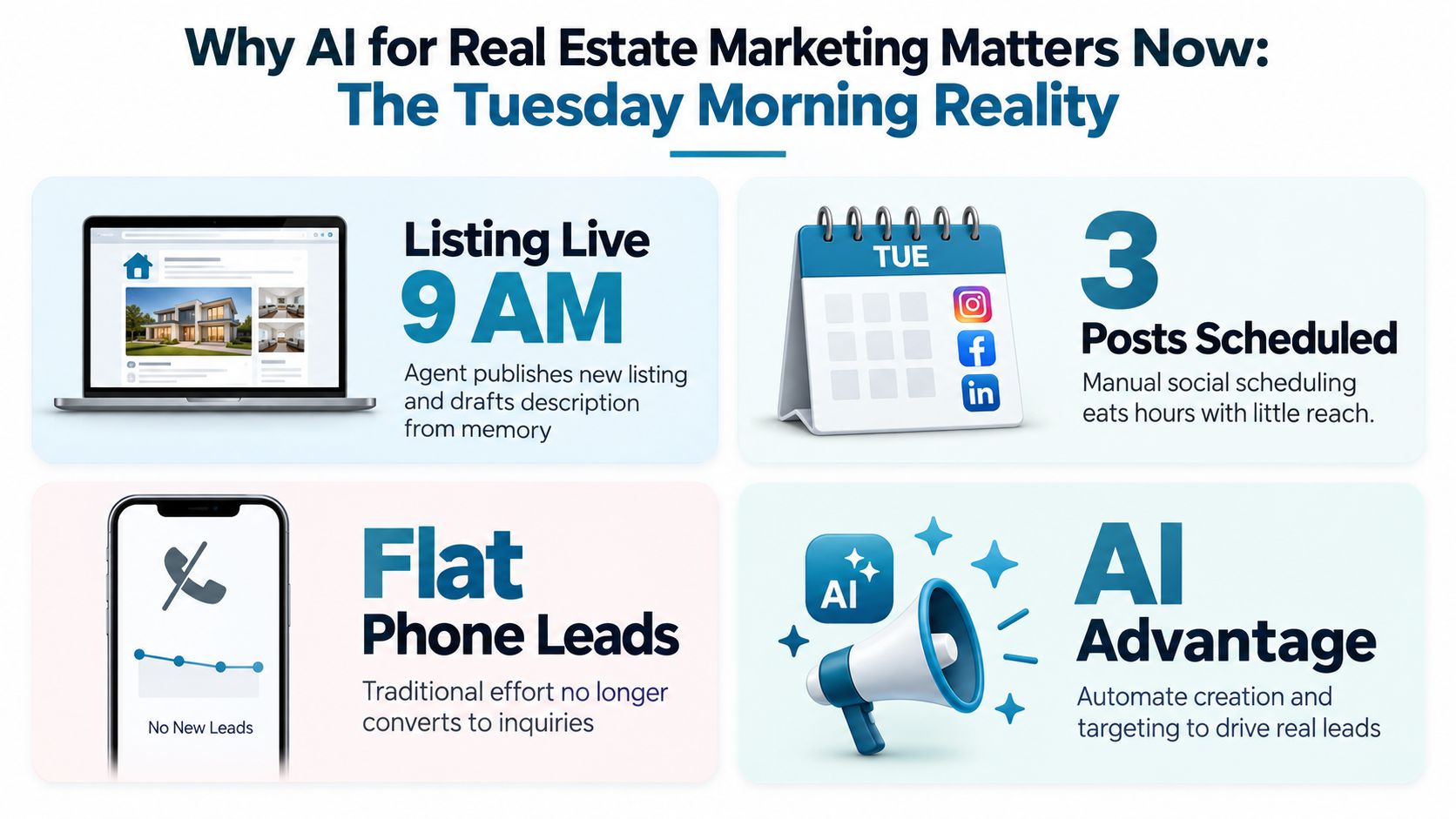
    National Association of Realtors data shows 51% of buyers found their agent online in 2024, up from 43% in 2020. That is the clearest reason AI marketing software now matters in real estate. The fight is no longer limited to Zillow placement or social reach. Agents also need content, follow-up, and listing pages that can surface in tools buyers use to ask direct questions, compare neighborhoods, and shortlist agents.

    The old stack still gets work done. A Canva post, a few ChatGPT prompts, a CRM drip, and manual follow-up can carry a solo agent for a while. I have seen that setup break down as soon as listing volume rises or a team adds agents. Content gets inconsistent, leads wait too long for replies, and nobody is fully sure which system owns the next step.

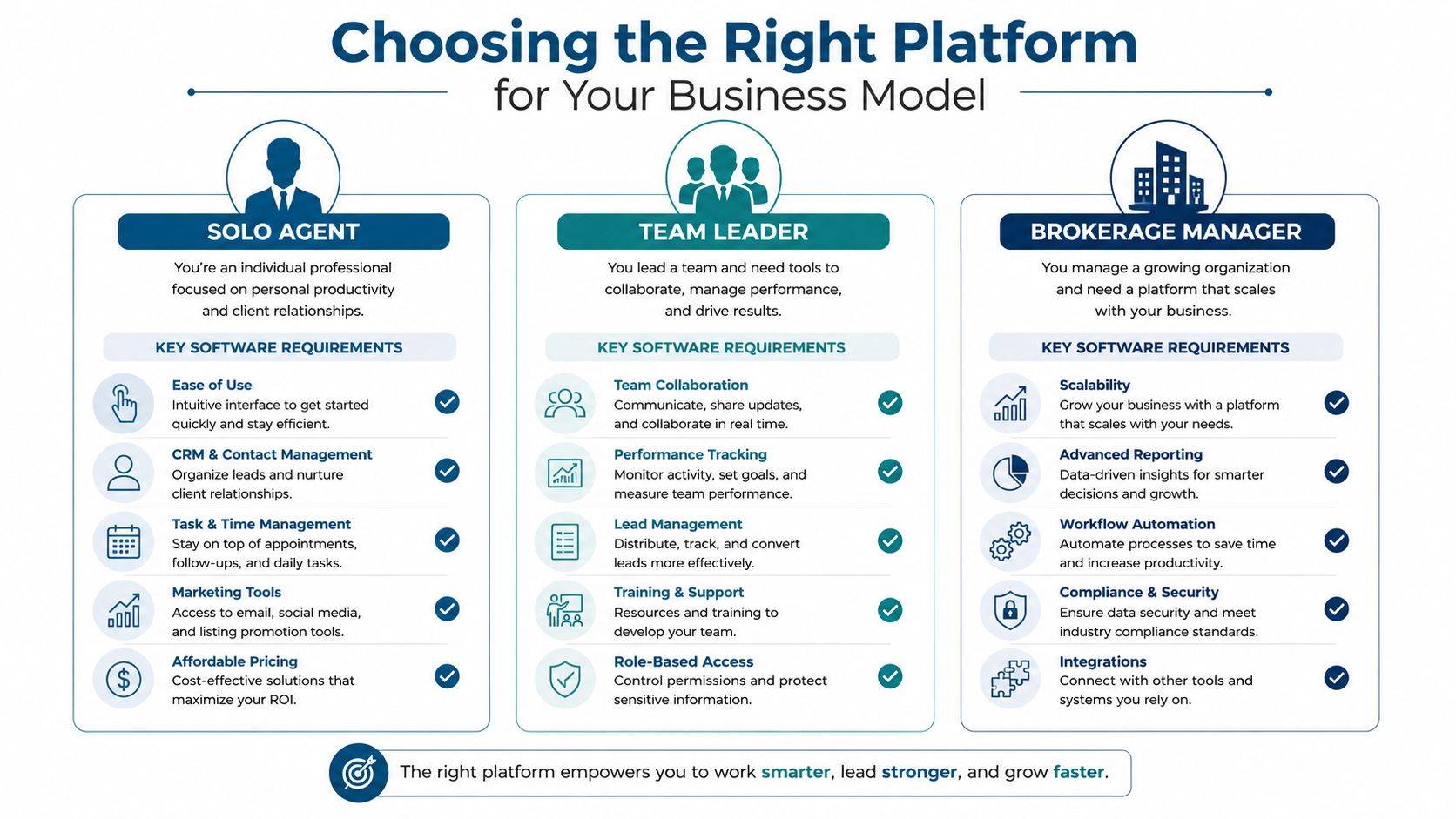
    The better way to choose software is to start with the business model and bottleneck. Solo agents usually need speed and consistency without adding another full-time job. Teams need tighter lead routing, better conversion discipline, and brand control across multiple agents. Brokerages need repeatable execution, compliance guardrails, and reporting that shows which offices or agents are using the system well.

    That is the lens for this guide. It does not rank tools by feature count. It matches platforms to the jobs agents hire them to do: convert inbound leads faster, turn one listing into a full content program, identify likely sellers before competitors do, or build brand authority that keeps showing up across channels. For agents comparing content-first tools with follow-up-first systems, this breakdown on AI marketing tools for real estate agents is a useful starting point.

    Some platforms are stronger for lead conversion. Others are better for content production, seller targeting, or brokerage-level control. The right choice depends less on who has the longest feature list and more on where your pipeline slows down.

    1. ListingBooster.ai

    ListingBooster.ai

    ListingBooster.ai is the best fit for agents who need content output, AI-search visibility, and compliance control in one place. That matters because generic writing tools can produce copy, but they don’t understand listing workflows, MLS constraints, status changes, or the need to keep an agent’s voice consistent across social, portals, and print.

    What stands out is the property-specific workflow. You start from a property URL or MLS entry, then generate MLS-friendly descriptions, social posts, carousels, story concepts, print assets, and schema-marked materials designed for AI indexing. Instead of treating content like isolated one-off tasks, it treats a listing as a campaign.

    Why it fits solo agents, teams, and brokerages differently

    For a solo agent, ListingBooster.ai solves the consistency problem. Busy agents often know what they should post, but they don’t have time to turn one listing into weeks of content. This platform builds a 30-day content calendar in minutes and keeps the messaging cohesive.

    For teams, the bigger win is controlled variety. The platform’s self-learning style engine helps preserve brand voice while still letting different agents sound like people, not cloned templates. For brokerages, the compliance layer matters most. The platform uses a 14-step quality pipeline with 9 hard compliance checks, including Fair Housing, banned-phrase detection, and financial-fidelity safeguards.

    Practical rule: If your biggest issue is “we know we should market more, but nobody has time,” choose a tool built around campaign generation, not prompt-by-prompt writing.

    ListingBooster.ai is also one of the few options on this list built for the AI-search era, not just social posting. Its schema-focused output and AI-readable materials support discoverability when buyers ask tools for the best agent in a market. If you want a deeper breakdown of that shift, the company’s guide to AI marketing for real estate agents is worth reviewing.

    Trade-offs and best workflow

    The trade-off is that you should verify current pricing and credit structure before committing, because plan details appear in different places across company materials. It also focuses direct publishing on Instagram, Facebook, LinkedIn, and X, so agents who rely heavily on TikTok may still need a manual step.

    A practical workflow looks like this:

    • Start with the listing URL: Generate the base suite immediately after signing or inputting the property.
    • Edit for nuance: Review the copy for local context, seller sensitivities, and final legal compliance.
    • Deploy by listing status: Use the status-aware content to update messaging when the home goes active, pending, or sold.
    • Layer authority content: Add neighborhood guides or market updates so your profile isn’t only listing-driven.

    This is the strongest option here for agents who want one tool that connects listing marketing, authority building, and AI discoverability without forcing a separate design team into the process.

    Visit ListingBooster.ai

    2. Ylopo (Raiya AI)

    Ylopo makes sense when your problem isn’t content creation. It’s lead follow-up. Specifically, it’s for agents who already generate traffic through an IDX site and need faster, more contextual outreach based on what leads are doing.

    Raiya AI watches lead behavior on your branded search site, then triggers texts or voice outreach tied to that activity. That’s a different use case from generic chatbot software. If someone repeatedly views homes in one price band or neighborhood, the outreach can reflect that behavior instead of sending canned drip messages that feel disconnected.

    Best fit for database activation

    Ylopo is strongest for agents and teams with a decent amount of website traffic and a backlog of old leads that never got properly nurtured. If you’ve got years of contacts sitting in a CRM and nobody is calling them consistently, behavior-based automation can wake that database back up.

    Its stack is broad enough that some teams use it as a near full-funnel engine:

    • Branded IDX sites: Good for capturing behavior data directly.
    • Behavioral texting and voice: Better than generic autoresponders when timing matters.
    • Remarketing: Useful when site visitors bounce and need repeated exposure.
    • CRM sync and alerts: Helps agents know when to personally step in.

    Ylopo works best when your site is the center of your lead ecosystem. If your traffic lives somewhere else, the behavioral advantage gets weaker.

    The trade-off is commitment. To get the most value, you generally need your search experience and lead activity flowing through Ylopo’s environment. If you prefer a lighter stack or already love your current website and CRM combo, the switch can feel heavier than expected. Pricing is also quote-based, so budget predictability isn’t as clear upfront as it is with simpler point solutions.

    Visit Ylopo

    3. BoldTrail (formerly kvCORE), Inside Real Estate

    BoldTrail (formerly kvCORE), Inside Real Estate

    BoldTrail is what I’d look at when the business has outgrown tool sprawl. If you’re running a larger team or brokerage and you’ve stitched together a CRM, website, lead-routing system, recruiting software, and ad tools, the operational drag starts to show. BoldTrail’s appeal is consolidation.

    This platform combines CRM, IDX websites, marketing automation, and organizational modules under one roof. For brokerages, that can matter more than having the flashiest AI copy generator. The core value is getting multiple agents, lead sources, and business units onto one operating system.

    Where BoldTrail wins

    BoldTrail is strongest when leadership wants more standardization. You can centralize lead handling, automate campaigns, manage listing promotion, and connect add-ons through its marketplace. That’s useful for teams where every missed handoff costs money.

    There’s also a practical authority-building angle here. If you’re evaluating whether to use a full operational stack or pair a lighter CRM with a specialized content tool, this guide on real estate agent marketing software lays out the trade-off well.

    A few situations where BoldTrail is a strong match:

    • Brokerages with recruiting goals: Back-office and recruiting modules make it more than a marketing tool.
    • Large teams with ISA support or lead routing complexity: It handles process better than lightweight systems.
    • Organizations tired of multiple subscriptions: Consolidation can reduce operational friction.

    Where it doesn’t fit cleanly

    BoldTrail is usually too much platform for a newer solo agent. The learning curve is steeper, setup takes time, and feature access can vary depending on brokerage contracts or custom deals. Pricing opacity is another consideration. Enterprise-oriented platforms often make financial sense at scale, but they’re harder to evaluate quickly.

    The practical takeaway is simple. Buy BoldTrail if your core issue is operational complexity across people and systems. Don’t buy it just because “all-in-one” sounds efficient. A solo agent who only needs better listing marketing and content production will probably get faster results elsewhere.

    Visit BoldTrail

    4. Chime

    Chime

    Teams that respond to internet leads first usually win more conversations. Chime is built for that race.

    Its appeal is less about one headline AI feature and more about control over the whole lead engine. You get the website, CRM, ad tools, lead scoring, and an AI Assistant in one system. For a team that already has lead flow and needs tighter execution, that matters more than adding another specialized app.

    I usually put Chime in the "growth-stage team" bucket. A solo agent focused on brand authority or listing content can get better ROI from lighter tools. A team running paid search, social ads, and portal leads has a different problem. They need speed, routing, and consistent follow-up without babysitting five disconnected systems.

    Where Chime makes sense

    Chime is a strong fit for teams that buy leads and want marketing and conversion data in the same place. The practical benefit is operational. New inquiries can trigger property recommendations, text follow-up, task creation, and pipeline updates without the usual manual patchwork between ad platforms and CRM records.

    That setup works well for three business models:

    • Solo agent with a real ad budget: Useful if lead conversion is the main objective and the agent is ready to work inside a structured CRM every day.
    • Small team: Often the best fit. Chime helps standardize response times, assign leads, and keep nurtures active when agents are in showings.
    • Brokerage or large team: Viable if leadership wants visibility into lead flow and forecasting, but some larger organizations may still want deeper customization than Chime offers.

    The distinction matters. If the goal is brand authority, Chime is not the first tool I would buy. If the goal is converting paid leads before they cool off, it belongs on the shortlist.

    Why agents buy it

    The primary benefit is workflow compression. Instead of exporting leads from one platform, loading them into another, and hoping agents follow up, Chime keeps the handoff inside one operating system.

    A practical implementation looks like this:

    1. Run paid traffic to Chime landing pages or site pages.
    2. Capture the inquiry directly in the CRM.
    3. Let the AI Assistant handle the first touch and basic qualification.
    4. Route hot responses to the right agent fast.
    5. Keep everyone else in long-term nurture with alerts, saved search updates, and automated follow-up.

    That workflow is especially useful for buyer teams that depend on fast response and steady nurture. It is less compelling for an agent whose main marketing strategy is sphere referrals, organic social content, or high-end listing presentation.

    Main trade-offs

    Chime can get expensive once you add the pieces that make it attractive in the first place. Pricing is not always easy to evaluate upfront, and some ad or AI functions may depend on higher tiers or add-on services. Teams should ask for a line-by-line breakdown before signing, including setup, onboarding, and any managed advertising costs.

    There is also a discipline requirement. Chime works best when a team commits to process. Agents need to log activity, managers need to watch routing and response times, and someone has to own setup quality. Without that, an all-in-one platform turns into an expensive contact database.

    Chime is a good choice for teams that want one system to capture, qualify, and work internet leads at scale. It is a weaker fit for agents who mainly need content production, listing marketing, or personal brand growth.

    Visit Chime

    5. BoomTown (Success Assurance)

    BoomTown (Success Assurance)

    BoomTown is for teams that know a hard truth about themselves. They’re not losing leads because the CRM is bad. They’re losing leads because nobody follows up fast enough or long enough.

    That’s where Success Assurance changes the equation. Instead of relying only on AI-generated messages, BoomTown uses a concierge-style model to engage leads by text and call, qualify them, and pass over warmer conversations. If your team consistently misses first contact or lets cold leads die in the database, managed engagement can outperform a pure software approach.

    Why managed outreach can beat DIY automation

    A lot of teams overestimate their internal discipline. They buy leads, install a smart CRM, and assume agents will work the pipeline. In practice, the first few days get attention and the next several months don’t. BoomTown’s concierge approach is built to close that gap.

    Here’s where it fits best:

    • High inquiry volume: Teams with too many inbound leads for agents to respond personally.
    • Long-term nurture needs: Leads that aren’t ready today but shouldn’t be ignored.
    • Visibility into conversations: Managers can monitor transcripts and CRM activity without guessing.

    If your problem is execution, not strategy, human-backed automation usually beats another dashboard.

    The trade-off is cost and philosophy. BoomTown’s concierge layer isn’t pure AI, and that can be a feature or a drawback depending on what you want. Some teams prefer the managed support because it protects response speed. Others want tighter brand control and lower monthly overhead, even if that means more internal labor.

    Visit BoomTown

    6. CINC (CINC AI + “Alex”)

    CINC (CINC AI + "Alex")

    CINC is built for volume. If your team buys online leads aggressively, runs a lot of traffic, and needs automated qualification without adding more staff, CINC deserves a close look.

    Its AI layer reacts to lead behavior on your site, while Alex acts as a virtual lead expert that helps qualify and book appointments. The positioning is straightforward. CINC isn’t trying to be your brand-content studio. It’s trying to move large lead flow into more booked conversations.

    Best use case for CINC

    This is a team platform, not a casual add-on. It works best when a rainmaker or team leader has already committed to lead generation at scale and needs a system for routing, accountability, and persistent follow-up.

    The strongest fit usually looks like this:

    • Paid lead engines are already active: CINC can capitalize on lead volume, but it’s less compelling without it.
    • Multiple agents need routing: Lead assignment and accountability matter more as teams grow.
    • Appointment setting is the choke point: Alex is useful when getting from inquiry to booked call is the main struggle.

    A lot of team leaders like the built-in operational pressure. Dashboards and routing systems make it easier to see whether agents are working their opportunities or just saying they are.

    What to watch before buying

    CINC can feel heavy if your lead business isn’t mature enough yet. A smaller agent or team may end up paying for capacity and complexity they don’t really need. Like other quote-based systems, the buying process also takes longer because you won’t get simple public pricing and be done in ten minutes.

    This is a solid choice for conversion infrastructure. It’s not the right pick if your primary issue is building authority, staying visible in AI search, or producing listing campaigns.

    Visit CINC

    7. Structurely (Aisa Holmes)

    Structurely (Aisa Holmes)

    Structurely is the tool I’d put in front of agents who already like their CRM but know their follow-up coverage is weak. That’s a common situation. They don’t want to rip out their whole stack. They just want an AI ISA that can respond, qualify, and hand off warmer opportunities.

    Aisa Holmes is built for that job. It asks practical qualifying questions around timeline, financing, location, and motivation across SMS, email, and web chat, then alerts the agent when the lead is ready for a real conversation.

    A strong plug-in when you don’t want a full platform switch

    Structurely earns its place on a best ai marketing software for real estate agents list. Marketing doesn’t stop at lead generation. If no one follows up consistently, the ad spend and content work upstream lose value. Structurely addresses that gap without demanding a full ecosystem migration.

    Why teams choose it:

    • CRM compatibility: Helpful if you’re committed to something like Follow Up Boss and don’t want to leave.
    • Real-estate-specific scripting: Better fit than generic customer-service bots.
    • Always-on qualification: Good for nights, weekends, and immediate inbound response.

    The biggest trade-off is stack complexity. A plug-in solution gives you flexibility, but it also means another vendor, another bill, and another integration to monitor. For some teams, that’s fine. For others, it becomes one more moving part to manage.

    Visit Structurely

    8. Verse.ai

    Verse.ai takes a hybrid path. It combines AI with human engagement to handle new lead response, qualification, and scheduling. That makes it appealing for teams that want stronger conversion performance but don’t want to trust the entire first-contact experience to software alone.

    This category exists for a reason. Automated messages are fast, but they can fall apart when the conversation gets messy or the lead asks something off-script. Verse tries to keep the speed of AI while adding human judgment when the interaction needs it.

    Best for teams that care about speed-to-lead but want oversight

    Verse is a good match when leads come from multiple sources and the team needs one managed conversion layer across all of them. Instead of asking agents to instantly jump on every inquiry, the platform can handle first response and early qualification, then book or transfer when the prospect becomes more serious.

    Its strongest use cases are:

    • Multi-source lead intake: Portals, paid ads, website forms, and referrals entering one follow-up process.
    • Agent time protection: Agents spend less time on early-stage back-and-forth.
    • Managed accountability: Reporting helps teams see whether response standards are being met.

    This model tends to work well for teams that know follow-up is mission-critical but don’t want to hire a full internal ISA department. The downside is cost. Quote-based hybrid services are usually harder for very small teams to justify than lighter DIY tools.

    Visit Verse.ai

    9. Roomvu

    Roomvu

    Roomvu is best when your top priority is staying visible locally without scripting and filming everything yourself. Plenty of agents understand the value of market-update content and neighborhood authority posts. They just don’t want to become full-time creators.

    Roomvu automates branded, hyper-local content across social channels, including videos, graphics, and localized market material. It’s a practical fit for agents who want a steady stream of authority content and don’t care about writing every caption personally.

    Authority content without weekly production work

    The business case for Roomvu is straightforward. Brand authority compounds when agents publish regularly. The problem is consistency. Agents disappear for two weeks, then overpost around a listing launch, then disappear again. Roomvu smooths that out.

    It’s especially useful for:

    • Agents building local mindshare: Neighborhood content and market commentary help when listings are sparse.
    • Newer agents: Consistent output can make a newer agent look more established online.
    • Busy producers: You can stay active without dedicating large blocks of time to creation.

    One caution matters here. Any managed or semi-managed content platform needs contract and ownership terms reviewed carefully, especially if there’s a website component involved. Agents should know what they control, what can be exported, and what happens if they cancel.

    Visit Roomvu

    10. SmartZip (SmartTargeting)

    SmartZip (SmartTargeting)

    If your business is listing-first, SmartZip belongs near the top of your shortlist. It isn’t trying to be a broad content suite or an all-purpose CRM. It focuses on one of the hardest problems in residential real estate. Finding likely sellers before everyone else does.

    That focus is why it still matters. SmartZip aggregates data from over 25 sources and predicts which homeowners are likely to move within 6 to 12 months, with a 72% accuracy rate. Used well, that lets agents farm more intelligently instead of blanketing a territory with generic outreach.

    Best for agents who want more listings, not just more leads

    This is a farming and listing-acquisition tool first. It works best for agents who know their market, want to dominate specific zip codes, and are willing to back predictions with consistent outreach through ads, mail, email, or handwritten touches.

    SmartZip is strongest in a few clear scenarios:

    • Territory farming: Better than broad prospecting when you want likely-seller prioritization.
    • Listing-focused teams: Especially useful when buyer leads are less important than future inventory.
    • CRM-connected follow-up: Integration with Top Producer helps move predictions straight into action.

    If you’re trying to understand how that outreach should connect to AI-readable content and local authority, this guide on getting real estate listings found in AI search is a practical companion.

    SmartZip gives you who to target. You still need strong messaging, nurture, and listing presentation to convert those opportunities.

    The main trade-offs

    SmartZip isn’t ideal if your business runs mostly on sphere, repeat clients, and inbound buyer demand. It also requires enough budget and process discipline to execute a farming plan well. A strong prediction model won’t help much if the agent never follows through with campaign execution.

    For listing hunters, though, this is one of the clearest examples of AI solving a real business problem instead of just generating prettier copy.

    Visit SmartZip

    Top 10 AI Marketing Platforms for Real Estate, Feature Comparison

    Product Core features UX & Quality Value & Price Target audience Unique selling points
    ListingBooster.ai 🏆 MLS-optimized listings, 30‑day social calendar, schema markup, auto-update posts ★★★★☆ Fast 5–10min setup; compliance pipeline 💰 from $34.99–$59.95/mo, 30‑day trial 👥 Solo agents, teams, brokerages ✨ AI-readable schema, 14-step quality & Fair Housing checks, 23 psychology frameworks
    Ylopo (Raiya AI) Behavioral AI texting/voice, IDX sites, remarketing ★★★★ Proven higher reply rates 💰 Quote-based (add-ons vary) 👥 Agents wanting behavior-based outreach ✨ Raiya references on-site behavior for context-aware follow-up
    BoldTrail (Inside Real Estate) CRM + IDX + marketing autopilot + marketplace ★★★★ Enterprise-grade for large orgs 💰 Contract/quote pricing 👥 Large teams & brokerages ✨ End-to-end stack with back-office & marketplace integrations
    Chime CRM + IDX sites + ads + AI Assistant ★★★★ Unified interface; evolving features 💰 Tiered / opaque pricing 👥 Teams needing built-in ads & AI tools ✨ Predictive scoring + AI budget/keyword ad optimization
    BoomTown (Success Assurance) Lead-gen + CRM + managed concierge outreach ★★★★ High-touch human-backed nurture 💰 Quote-based, managed service cost 👥 Teams that want DFY lead qualification ✨ 24/7 concierge handoff + live transfers when ready
    CINC (CINC AI + "Alex") High-volume lead-gen, AI follow-up, virtual 'Alex' ★★★★ Built for volume & fast routing 💰 Quote-based, demo required 👥 Teams buying/handling many online leads ✨ Automated qualification & appointment booking workflows
    Structurely (Aisa Holmes) AI ISA for SMS/email/chat, CRM integrations ★★★★ 24/7 conversational coverage 💰 Tiered / quote-based 👥 Agents/teams wanting plug-in AI ISA ✨ Real-estate-specific scripts; works with existing CRMs
    Verse.ai AI + human lead engagement, SLA-based responses ★★★★ Fast response SLAs, managed hybrid 💰 Quote-based / custom plans 👥 Teams wanting managed AI outreach & booking ✨ Sub‑90s lead response with human fallbacks & reporting
    Roomvu Automated local market videos, AI avatars, voice cloning ★★★★ High-frequency localized content 💰 Subscription/contract terms 👥 Agents who need steady localized content ✨ Auto-posted market videos, avatar & voice-clone options
    SmartZip (SmartTargeting) ML likely-seller scores, targeted mailers & ads ★★★★ Data-driven farming focus 💰 Quote-based; territory limits possible 👥 Agents focused on listing acquisition ✨ Predictive "likely-seller" modeling + execution tools

    Your Next Move From Agent to AI-Powered Authority

    Speed decides a surprising share of real estate outcomes. The agents who respond first, stay visible between transactions, and show clear proof of marketing execution usually win more of the conversations that matter.

    That is why AI matters in real estate marketing. It changes output, response time, and consistency. It also changes who can operate like a larger business without adding staff.

    The best ai marketing software for real estate agents is not the same for every business. A solo agent usually needs efficiency first. One tool should help turn listings into usable content, keep follow-up from slipping, and reduce the daily pile of small marketing tasks. A team usually needs conversion control. Response rules, lead routing, appointment setting, and CRM discipline matter more than another content feature. A brokerage needs standardization. The software has to support multiple agents, protect brand and compliance requirements, and avoid creating five different workflows for the same job.

    That is the buying lens I use with clients. Start with business model, then match the tool to the bottleneck.

    If the bottleneck is brand authority, use software that can produce listing content, local market commentary, and on-brand assets at a pace you can sustain. If the bottleneck is lead conversion, use AI follow-up, AI ISA coverage, or managed nurture that prevents paid leads from sitting untouched for hours. If the bottleneck is listing growth, use predictive seller targeting and pair it with a real outreach plan, not just a dashboard score.

    A lot of bad software decisions come from buying for aspiration instead of operation. Solo agents often buy an enterprise-style CRM and never finish setup. Teams sometimes buy more content capacity when the core issue is weak speed-to-lead and poor accountability. Brokerages stack point solutions, then spend a quarter trying to make disconnected systems work together. The smarter move is narrower. Buy the tool that fixes the problem you already feel every week.

    Adoption is also changing expectations. AI is no longer a novelty in agent marketing. Clients see faster responses, more polished listing promotion, and more consistent social visibility from competitors who have already put these systems into daily use. Waiting usually means losing ground in places that are hard to notice at first. Slower follow-up. Thinner content pipelines. Less visibility in search and social discovery.

    Implementation matters more than the demo.

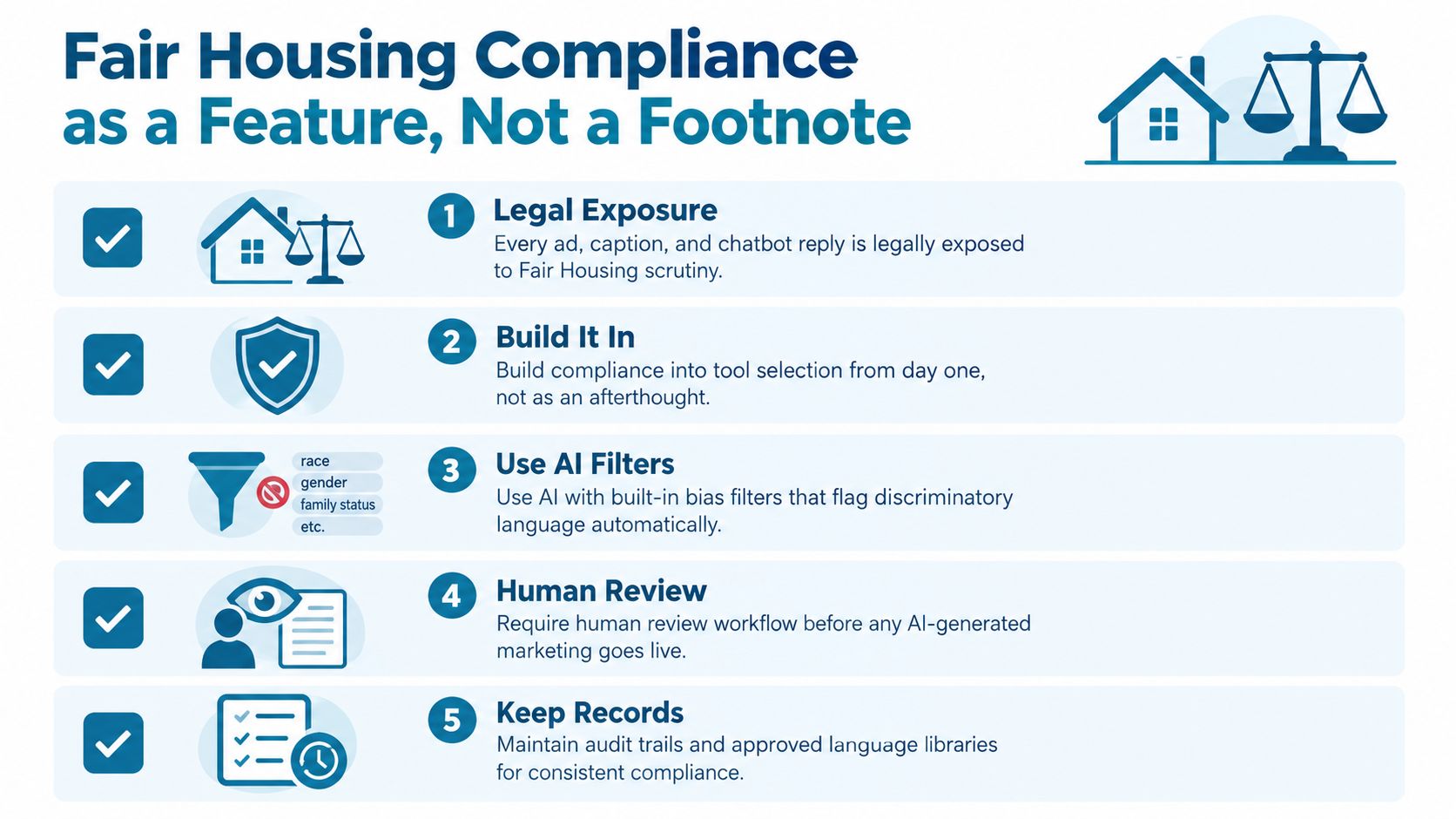
    A predictive seller platform still needs territory strategy, call cadence, and mail consistency. An AI lead-conversion platform still needs routing rules, handoff logic, and someone who owns the pipeline. A content engine still needs human review for compliance, Fair Housing sensitivity, and local accuracy. The agents getting real return from AI are not using magic software. They are running tighter workflows.

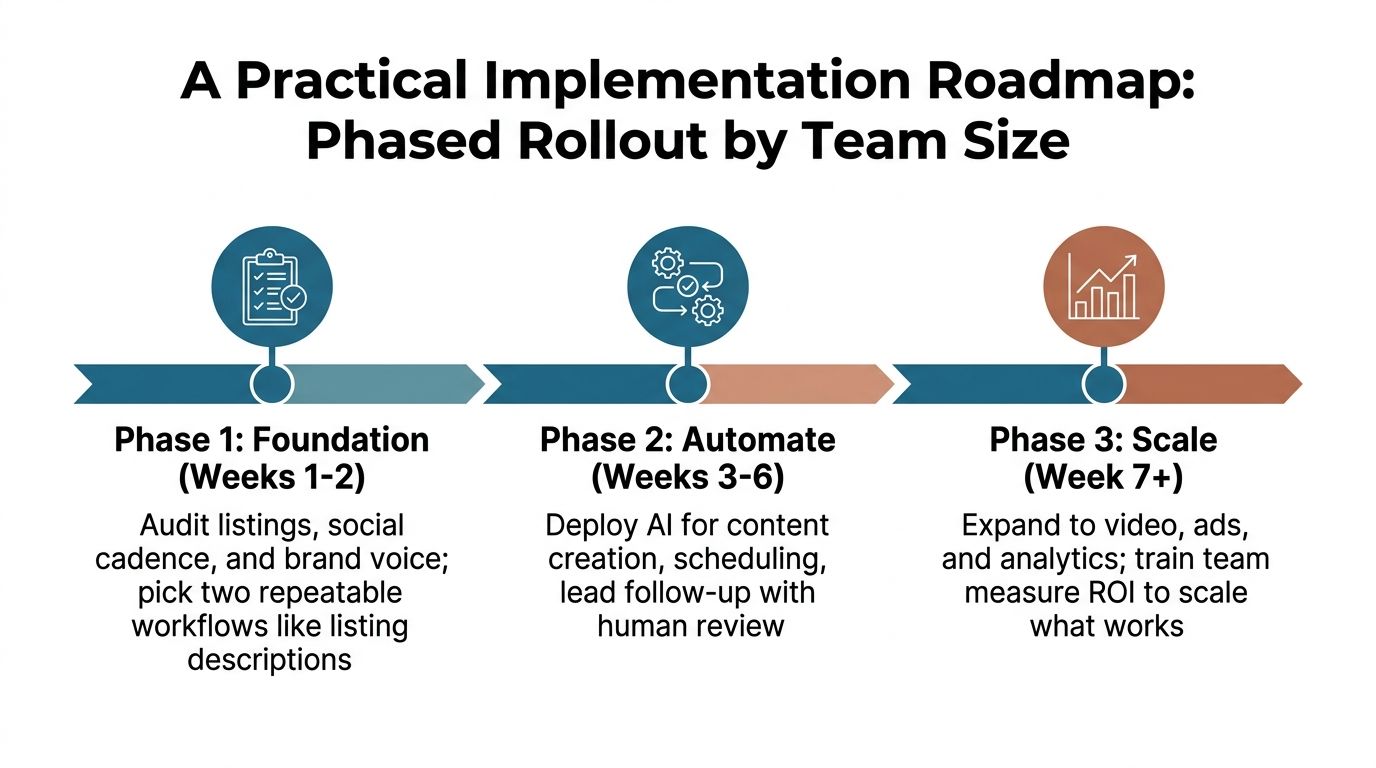
    A practical rollout looks different by business type. A solo agent can start with one content and listing marketing system, then add automated lead nurture once content production is consistent. A team can start with speed-to-lead and appointment-setting workflows, then layer in authority content for recruiting and listing presentations. A brokerage can standardize approved marketing workflows first, then decide where individual agents need extra conversion support.

    That sequence matters. The right first tool makes the second one easier to use.

    Start with one objective. Measure it for 60 to 90 days. Track time saved, response speed, appointments set, listing opportunities created, or content output. Keep the system if it changes a real business number. Replace it if your team avoids using it or if setup complexity outweighs the gain.

    Agents will not become AI-powered authorities by collecting subscriptions. They get there by choosing software that fits how they already operate, then building repeatable habits around it.

    If you want one platform that connects listing marketing, authority content, compliance safeguards, and AI-search visibility, ListingBooster.ai is a practical place to start. It fits solo agents, teams, and brokerages that need real estate-specific workflows instead of generic AI copy tools.

  • AI Listing Presentation Content Generator: Your 2026 Guide

    AI Listing Presentation Content Generator: Your 2026 Guide

    A listing gets signed on Tuesday. Photos are booked for Thursday. The seller asks for the marketing plan before dinner. By that night, you are still piecing together MLS remarks, social copy, presentation slides, and email follow-up from different notes, different tools, and different versions of the property story.

    That pace used to be manageable. It now costs visibility.

    An AI listing presentation content generator helps agents build the first draft of the campaign from one set of inputs: property details, audience, market context, and seller goals. Instead of writing every asset one by one, you can generate listing copy, social captions, open house promotion, seller-facing presentation language, and follow-up content in one workflow.

    While that improves efficiency, efficiency is no longer the whole story. Buyer discovery is shifting fast. Analysts at DataIntelo project strong growth for the AI Content Generator market, and in real estate the bigger change is search behavior, with over 40% of homebuyers now starting in AI interfaces like ChatGPT rather than traditional search engines, according to DataIntelo’s AI content generator market report.

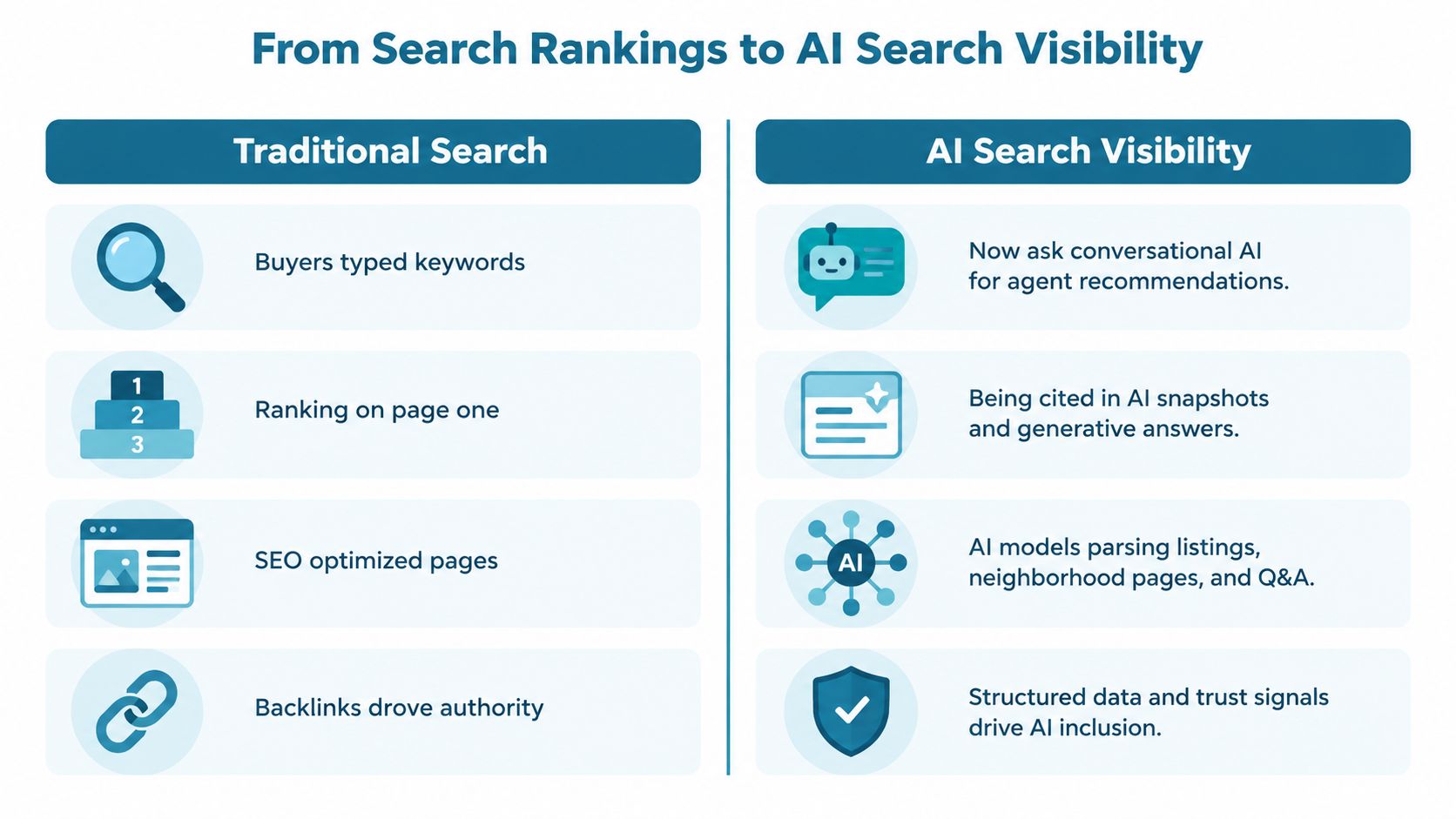
    That changes the job. Content now needs to do more than rank in Google and look polished in a listing presentation. It needs to be structured clearly enough for AI search engines like ChatGPT and Perplexity to interpret, summarize, and surface when buyers ask broad questions about neighborhoods, price points, lifestyle fit, or local inventory.

    If your content is inconsistent, thin, or written only for a fast launch, your listings are harder for both people and AI systems to find. That shows up in fewer qualified views, weaker seller confidence, and more pressure to explain results after the listing goes live.

    The End of Last-Minute Real Estate Marketing

    The old workflow looked like this. You got the listing agreement signed, opened a blank document, copied details from the MLS sheet, tried to make the description sound fresh, then jumped into Canva, then into your social scheduler, then into your inbox because the seller wanted to know what was going live and when.

    That workflow creates decent marketing some of the time. It also creates rushed marketing a lot of the time.

    A woman using a tablet displaying real estate listings while sitting at a wooden desk.

    The agents pulling away from the pack work differently. They don’t wait until launch day to figure out the story of the property. They use an AI listing presentation content generator to create the first draft of the entire campaign early, then spend their time improving positioning, checking compliance, and tailoring the message to the seller and market.

    What the scramble actually costs

    The problem isn’t only lost time. It’s fragmented thinking.

    When you write the MLS remarks first, then improvise Instagram copy later, then come up with open house messaging the night before, every piece ends up sounding like it came from a different brand. Buyers see inconsistency. Sellers feel it too, even if they can’t name it.

    A better workflow looks like this:

    • Start with one source of truth: Property details, seller goals, market context, and tone go into the generator once.
    • Generate the campaign together: MLS copy, social content, appointment slides, and promotional angles come out aligned.
    • Edit strategically: You adjust for nuance, compliance, local knowledge, and seller sensitivities.

    Practical rule: Agents don’t need more marketing tasks. They need fewer blank pages.

    The real shift is where buyers begin

    This is why the tool matters beyond productivity. Buyers aren’t just typing into Google and clicking ten blue links anymore. Many start with AI-driven discovery, ask broader questions, and get summarized answers.

    That means your marketing content has a second job now. It must persuade humans and also give AI systems enough clear, relevant context to understand who you are, what you list, and what markets you know.

    An AI listing presentation content generator helps you move from reactive marketing to pre-built visibility. That’s the difference between “I need to post something today” and “my listing campaign is already running.”

    What Is an AI Listing Content Generator

    Think of it as a marketing command center, not a chatbot that spits out paragraphs.

    A generic writing tool can draft copy. A real estate-focused AI listing presentation content generator is built around the actual work agents do every week: win the listing, position the property, distribute the message across channels, and keep your name visible between transactions.

    The listing engine

    The first part is the property engine. You feed it the address, notes, photos, property features, selling points, and sometimes seller priorities. From that input, it produces the material agents usually create separately.

    That often includes:

    • MLS-ready descriptions with a tone matched to the property
    • Social posts for new listing, open house, price improvement, and just sold updates
    • Email and text copy for sphere outreach
    • Presentation language for listing appointments or seller updates
    • Print-ready messaging for flyers and handouts

    The practical advantage is consistency. Instead of writing five versions of the same story, you build one message architecture and adapt it by channel.

    The authority engine

    The second part is less obvious, but more valuable over time. Good tools don’t only create content for a specific listing. They also generate the material that makes you look established between listings.

    That means content like:

    • Neighborhood guides
    • Market updates
    • Buyer and seller education posts
    • Agent positioning content
    • Local insight posts tied to your farm area

    This is the part many agents skip because it feels less urgent than a live listing. It’s also the part that shapes long-term visibility when someone asks an AI search engine who knows a specific area.

    A listing gets attention for a moment. Authority content keeps your name in circulation after that moment passes.

    Why this isn’t just “AI writing”

    A real tool should understand that different outputs have different jobs. MLS copy has to be concise and careful. A seller presentation needs confidence and strategy. Social posts need stronger hooks and cleaner pacing. Neighborhood content should sound informed, not promotional.

    That’s why a real estate-specific system beats a blank prompt box. It’s built around use cases, not just word generation.
    A good AI listing presentation content generator also lets you shape voice. If your brand is calm and analytical, the content shouldn’t sound like a hype-heavy ad. If your business is luxury-focused, the wording should reflect restraint and polish. If you work first-time buyers, the language should feel clear and welcoming.

    The best outputs still need a human pass. But they remove the heavy lift, which is where most agents lose time and consistency.

    How This Technology Creates a Competitive Advantage

    A seller books two listing appointments. One agent walks in with a recycled deck and generic talking points. The other shows property-specific messaging, polished marketing angles, and a visible track record of useful local content that already appears across search and AI answer engines. The second agent looks more prepared before the conversation even starts.

    That advantage is no longer about speed alone. It is about discoverability.

    Visibility now starts before the lead reaches you

    Buyers and sellers increasingly begin with AI search tools such as ChatGPT and Perplexity, not a direct visit to an agent website. Those systems cannot assess your negotiation skill from a handshake or hear what past clients say at a dinner party. They scan what they can find online, then infer who appears credible, active, and locally informed.

    A thin digital footprint makes that harder.

    An AI listing presentation content generator helps agents publish enough useful, market-specific content to become easier for these systems to recognize. The practical win is consistency. Agents have always known they should produce more market commentary, listing content, and seller education. The bottleneck has been getting it done without sacrificing client work.

    The return shows up in three parts

    This technology improves production, positioning, and conversion at the same time.

    Business need Old approach AI-supported approach
    Listing marketing Build every asset manually Produce a coordinated campaign faster
    Seller presentations Reuse a generic deck Match the messaging to the property and seller concerns
    Personal authority Publish only when time opens up Maintain a steady stream of local expertise content

    Each part supports the others. Stronger listing content helps win the presentation. Consistent authority content helps you enter the consideration set earlier, including inside AI-generated answers. Better seller-facing materials help justify your fee and strategy with more confidence.

    Waiting creates a visibility gap

    Many agents still compare AI tools to a faster copywriter. This comparison overlooks the fundamental shift in discoverability.

    The shift is closer to the move from print brochures to digital-first marketing. Early adopters built a larger footprint, learned faster, and became easier to find. Late adopters had to catch up while also defending market share.

    If buyers and sellers use AI tools to narrow their options, your content stops being just marketing collateral. It becomes part of the evidence those systems use to decide whether to mention you.

    Adopting this technology becomes a career-protection move. It does not replace local knowledge, pricing judgment, or relationship skills. It gives those strengths enough visible proof online for search engines and AI search engines to surface you.

    Used well, these tools do not make an agent sound robotic. They make expertise easier to find, easier to understand, and harder to overlook.

    Key Features That Separate Great Tools from Gadgets

    A tool earns its keep when a new listing hits on Thursday, the seller wants to review messaging by Friday, and the campaign still goes live without your team scrambling. Demos rarely show that moment. Daily use does.

    A real estate agent does not need another app that spits out a polished paragraph. You need a system that can handle listing timelines, seller expectations, compliance review, and the fact that MLS copy, social content, and presentation slides all have different jobs.

    A diagram outlining the essential features of an AI-powered real estate listing generator for marketing content.

    Channel-aware copy generation

    Start with the simplest test. Does the tool understand context, or does it keep rephrasing the same description?

    A useful AI listing presentation content generator creates separate versions for MLS remarks, portal descriptions, seller presentation copy, email announcements, and social captions. Those formats reward different levels of detail, different tone, and different calls to action. If the output feels interchangeable, the tool is pushing work back onto the agent.

    This problem shows up fast in fragmented workflows. One tool writes the listing description, another handles graphics, a third drafts social posts, and none of them keep the message aligned. The result is slower review, more manual editing, and a campaign that feels assembled instead of planned.

    Built-in campaign thinking

    The better tools build a full content package around the listing, not just one asset at a time.

    That means generating:

    • A launch sequence: New listing post, story copy, email announcement, and open house promotion
    • Mid-cycle content: Price update messaging, feature spotlights, neighborhood positioning
    • Post-sale assets: Just sold content that reinforces your process and market knowledge

    This shift from single-asset writing to coordinated campaign production is covered well in our guide to real estate listing copywriting with AI. It matters because agents are no longer competing only for clicks in Google. They are competing for inclusion in AI-generated answers from platforms like ChatGPT and Perplexity, where structured, consistent listing narratives have a better chance of being surfaced.

    Compliance support that goes beyond lip service

    Weak tools usually reveal their limitations.

    Agents report spending 15-30% of content creation time on manual Fair Housing review, according to Studeo’s discussion of listing workflow gaps. If your system cannot reduce that review burden in a clear, repeatable way, it is not saving much time. It is just shifting the time to a later step, where consequences are more significant.

    Useful compliance support includes:

    • Flagging risky language before publishing
    • Creating an audit-friendly review process
    • Applying compliance checks consistently across multiple agents

    Weak compliance support usually looks like this:

    • A vague “compliance-friendly” label
    • No explanation of how content is screened
    • Relying on agents to catch every issue manually

    At team or brokerage level, this becomes an operations problem, not just a writing problem.

    Support for AI-readable structure

    This feature gets overlooked because sellers never ask about it directly. They will still feel the impact.

    Content now has to perform in two discovery systems. Traditional search still matters. AI search engines also matter, especially as more buyers begin their research inside ChatGPT, Perplexity, and similar tools. Those systems pull from content that is clear, well-structured, and consistent across topics and channels.

    For real estate, that means the tool should help produce content with labeled property details, organized feature breakdowns, neighborhood context, and recurring topical signals around your market. Decorative copy may read well in a post. Structured content is more likely to be understood, cited, and reused by AI systems.

    Here is a practical evaluation table:

    Feature Why it matters Red flag
    Platform-specific outputs Cuts manual rewrites and keeps messaging matched to the channel Same copy recycled everywhere
    Social calendar generation Keeps the listing visible through launch and follow-up One-off captions only
    Compliance checks Reduces legal risk and review time No transparency on screening
    Structured content output Improves visibility in search and AI answer engines Purely decorative copy
    Brand voice controls Keeps your marketing recognizable across agents and listings Generic, interchangeable tone

    A gadget gives you text. A serious tool gives you a repeatable content system your team can review, publish, and use to stay visible where clients now search.

    Real-World Workflows From Listing to Closing

    The easiest way to judge an AI listing presentation content generator is to watch where it fits in the actual week of an agent.

    Not in theory. In the actual handoff between prospecting, appointment prep, launch work, seller communication, and post-close marketing.

    A real estate agent handing keys to a new homeowner in front of a stone house.

    The broader market is moving in this direction fast. The AI Presentation Generators market reached $1.5 billion in 2025 and is forecasted to hit $4.0 billion by 2033. In real estate, agents use these tools to build customized pitches with local trends and value propositions 10x faster than manual methods, according to HTF Market Insights on AI presentation generators.

    The new listing launch

    A practical workflow starts with the property, not the channels.

    An agent takes the listing details, photos, and key notes from the seller conversation, then runs them through the content generator. Out comes the campaign skeleton: MLS copy, launch post, open house announcement, email draft, and a few alternate hooks based on likely buyer appeal.

    The key benefit isn’t that every line is publish-ready. It’s that the hard part is done before the day gets chaotic.

    The same logic shows up in tools designed for fast listing presentation creation. The goal is to cut assembly time so the agent can focus on pricing strategy, visual selection, and message quality.

    The competitive listing appointment

    Many agents gain the greatest advantage here.

    Instead of showing up with a generic “here’s how I market homes” deck, the agent arrives with content built for that seller’s actual address. The presentation includes a draft property narrative, example social positioning, launch concepts, and a clear explanation of how the listing will be packaged online.

    That changes the conversation. The seller no longer has to imagine your process. They can see it.

    Sellers respond to proof of preparation. A tailored draft plan often lands harder than broad claims about service.

    The authority play between transactions

    The third workflow is quieter, but it’s what keeps agents visible between closings.

    A team might use a generator to keep neighborhood commentary, market updates, buyer tips, and seller education moving without starting from zero every time. A solo agent might use it weekly to publish polished local content while staying client-facing during business hours.

    This is also where one real estate-specific option can fit. ListingBooster.ai generates MLS remarks, social posts, and listing presentation materials from property details, which makes it relevant for agents who want one workflow for both property promotion and ongoing content.

    The result isn’t just more content. It’s a more coherent body of work. Over time, that body of work helps future clients, and increasingly AI systems, understand what market you own and how you operate.

    Sample Prompts to Generate Content Instantly

    The quality of your output depends on the quality of your instructions. Weak prompts produce bland copy. Strong prompts give the model context, audience, constraints, and tone.

    Use these as starting points, then adapt them to your voice and market.

    Prompt for a luxury listing narrative

    Use this when the property needs mood, lifestyle positioning, and restraint.

    Write a luxury listing description for a waterfront home. Focus on privacy, calm, natural light, architectural details, and the feeling of arriving at a retreat. Avoid exaggeration and avoid generic phrases like “one-of-a-kind” unless supported by the details I provide. Create three versions: one for MLS, one for a seller presentation, and one for an Instagram caption. Keep the tone polished and confident. Include a short list of buyer appeal angles at the end.

    Why it works:

    • It defines the emotional frame
    • It asks for channel-specific versions
    • It blocks lazy luxury clichés

    Prompt for open house social content

    This one helps when you need a coordinated mini-campaign.

    1. Ask for sequence, not one post
      “Create three social posts for an upcoming open house. The first should build curiosity, the second should highlight standout features, and the third should create urgency around attendance.”

    2. Add audience and constraints
      “Target move-up buyers and local neighbors. Keep each caption distinct. Write in a warm, professional voice.”

    3. Require format variation
      “Include one Instagram caption, one Facebook post, and one short story sequence with slide text.”

    Prompt for a just sold authority post

    Most just sold posts waste the opportunity. They announce the outcome but say nothing about how you work.

    Write a just sold post that highlights strategy, preparation, and client guidance. Do not focus only on the transaction result. Emphasize the steps taken to position the property, communicate with the seller, and manage the process from launch to closing. Give me a LinkedIn version, a short Facebook version, and a concise email paragraph for my database.

    Keep prompts specific to the job the content needs to do. “Write me a caption” is too vague to be useful.

    The best prompt doesn’t sound clever. It sounds operational. That’s what gets better output.

    Choosing and Implementing Your AI Content Engine

    A seller calls at 4:30 p.m. They want a listing presentation tomorrow morning. You still need a pricing story, a marketing plan, property copy, and content that will hold up across MLS, social, email, and the new layer many agents still ignore: AI search results.

    That is the essential buying decision. Choose the tool that removes time pressure without lowering quality.

    The right AI listing presentation content generator should fix a specific operational problem in your business. For many agents, that means faster appointment prep, cleaner launch content, more consistent follow-up, and fewer last-minute rewrites for compliance or channel fit.

    A person sitting at a desk looking at a laptop displaying a list of various AI tools.

    What to look for first

    Start with workflow fit, not feature volume.

    A short filter works well:

    • Does it support compliance review or at least make review easier? If not, you still carry the same risk with a faster draft.
    • Can it generate distinct versions for MLS, portal descriptions, social, and seller-facing presentation slides? One generic block of copy creates more editing, not less.
    • Can you train or guide the voice? If every output sounds like the same agent in every market, it weakens your brand.
    • Can it support presentation prep and post-launch marketing in one system? Those jobs feed each other.
    • Can it help you create content that is structured clearly enough to surface in AI search tools, not just traditional search? Buyers now ask ChatGPT and Perplexity for neighborhood guidance, property comparisons, and agent recommendations. Content built only for Google misses part of that demand.

    That last point deserves more attention. A lot of tools can write a description. Fewer can help you produce clean, specific, well-structured content that AI search engines can interpret and cite. If your listing pages, presentation materials, and market commentary stay vague, your visibility drops in the places future clients are already searching.

    What implementation actually looks like

    Implementation usually succeeds or fails on process discipline.

    Start with one active listing. Run the tool against a real property, not a sample. Keep your edits. Those edits become your voice rules, your compliance notes, and your quality standard for the next listing.

    Then build a simple operating checklist:

    Step What to do
    Start with one listing Test the tool on a live presentation and launch workflow
    Save your edits Turn recurring changes into voice and accuracy rules
    Build a checklist Cover presentation copy, listing content, social, email, and review
    Expand in phases Add market updates and seller nurture content once the core workflow is stable

    Teams that get the best return usually standardize inputs early. That means the same property facts, audience notes, positioning angle, and compliance reminders go into every draft request. The output improves because the setup improves.

    If you are comparing systems, this guide to listing presentation software for agents helps clarify the difference between a general presentation tool and a platform built around real estate use cases.

    The payoff is straightforward. Less rework. Faster prep. Better consistency across channels. Stronger odds that your content shows up where buyers and sellers now search, including AI-driven discovery, not just the usual search results.

    Frequently Asked Questions

    Is AI-generated content unique and safe to use

    Usually, yes, but “generated” doesn’t mean “approved.”

    You should still review every output for accuracy, tone, compliance, and obvious generic phrasing. The practical standard is simple: use AI for first draft generation and structure, then apply human review before anything goes live.

    Will this replace my marketing assistant

    No. It changes the assistant’s job.

    Instead of spending time drafting routine content from scratch, a marketing assistant can review, refine, schedule, coordinate assets, and maintain quality control. For solo agents, the tool fills gaps. For teams, it helps staff move faster and work more consistently.

    How much editing should I expect

    Expect some editing every time.

    Strong tools reduce the heavy lift, but they won’t know every nuance about your seller, your market, or your judgment calls. In practice, the best workflow is to edit for voice, local accuracy, compliance, and channel fit.

    Can I trust AI for listing presentations

    You can trust it to accelerate preparation, not to replace expertise.

    Use it to draft property narratives, presentation talking points, and campaign ideas. Then bring your own pricing logic, objection handling, and seller strategy. The agent still wins the business. The tool helps the agent show up prepared enough to prove the value quickly.


    If you want a practical way to create MLS copy, social posts, and seller-facing marketing materials without rebuilding the same campaign every time, ListingBooster.ai is built for that workflow. It’s designed for agents, teams, and brokerages that need AI-readable content, stronger listing presentation materials, and a repeatable system that keeps them visible as buyers shift toward AI-driven search.

  • AI Property Description Writer for MLS listings 2026 Guide

    AI Property Description Writer for MLS listings 2026 Guide

    40% of homebuyers now begin their search on AI platforms like ChatGPT and Google AI, which changes what a listing description is supposed to do as a marketing asset (Saleswise). It is no longer just a box to fill before publishing to the MLS. It is part sales copy, part compliance document, and part machine-readable signal.

    That shift matters more than most agents realize.

    For years, the listing description was treated like a necessary chore. You entered the facts, polished a few lines, removed anything risky, and moved on. That workflow made sense when distribution was mostly portal-based and the primary battle was getting the listing live fast enough. In 2026, that is not enough. Buyers increasingly ask AI tools broad, intent-rich questions such as which homes fit a lifestyle, budget range, or neighborhood preference. If your description is vague, generic, or structurally messy, it may still look acceptable to a human skimming a portal page while remaining weak for AI interpretation.

    An AI property description writer for MLS listings solves the obvious problem first. It saves time. But the bigger opportunity is visibility. Agents who understand that difference are building content that works across MLS feeds, portals, websites, social channels, and AI-driven discovery tools.

    The catch is that faster writing alone does not win. The output has to be accurate, compliant, specific, and readable by both people and machines. That means structured details, clear language, meaningful feature emphasis, and disciplined review before anything goes live.

    Used well, AI empowers agents. Used carelessly, it creates bland copy or legal exposure. The advantage goes to agents who treat AI as a production system, not a novelty.

    The New Front Door to Real Estate

    How buyers find homes is changing, and it is happening outside the MLS and the major portals.

    A growing share of discovery now starts with a question typed into ChatGPT, Perplexity, or another AI assistant. Buyers ask for homes with a first-floor primary suite, a yard that works for dogs, a short commute, space for grandparents, or a layout that fits remote work. If a listing description does not express those details clearly, the property is less likely to surface in that early recommendation layer.

    That creates a new marketing problem for agents. The listing description is no longer just a sales paragraph for human readers. It also needs to be readable by systems that summarize, rank, and recommend homes before a buyer ever clicks through to a portal or website.

    Visibility now starts before the click

    This is the AI-readability gap. Many listings are technically accurate but weak at communicating usable signals. They mention granite counters and stainless appliances, then stop short of explaining how the home lives, who it fits, or what makes the location practical. A human can sometimes fill in those blanks. An AI system usually cannot.

    That gap matters because modern buyers are asking intent-based questions, not just filtering by bed and bath count. They want “good homes for multigenerational living” or “updated houses near walkable retail with privacy in the backyard.” Descriptions that are vague, stuffed with clichés, or missing context leave money on the table because they reduce the odds that the property appears in those AI-assisted discovery moments.

    Short, generic copy also creates downstream problems. It forces agents to explain the same value points in showings, follow-up emails, social posts, and price reduction conversations. Better source copy fixes that at the start.

    The old writing process does not hold up

    The traditional workflow was built for speed to publication. Get the listing entered. Stay inside the character limit. Avoid obvious compliance issues. Move on.

    That approach still gets a property live. It does not reliably make the property discoverable in systems that depend on clear, specific, well-structured language.

    Agents now need descriptions that do four jobs at once:

    • Help buyers qualify the home quickly: Explain layout, upgrades, use cases, and neighborhood fit in plain language.
    • Give AI systems interpretable signals: Surface features tied to buyer intent, not just a list of materials and room counts.
    • Reduce compliance risk: Avoid careless phrasing that can trigger Fair Housing or misrepresentation issues.
    • Support multi-channel marketing: Provide source copy that can be adapted for the MLS, portals, websites, email, and social content.

    This marks a fundamental shift. AI writing tools save time, but the bigger business value is future-proofing visibility. Agents who treat listing descriptions as discoverability assets will be better positioned as search behavior keeps moving toward AI-mediated recommendations.

    What Is an AI Property Description Writer

    An AI property description writer is a real estate writing tool that turns listing facts into a usable first draft in seconds. In practice, it works like a trained assistant who already knows the job, but still needs an agent to set direction, catch risk, and sharpen the final positioning.

    That distinction matters. Generic AI can produce readable copy. A real estate-focused tool is built for the inputs agents work with every day, and for the constraints that make listing copy harder than it looks.

    Infographic

    A real estate-specific tool functions like a trained assistant who already knows the job

    The better tools are designed around how listings are marketed, not just how paragraphs are written.

    They take inputs such as:

    • Core facts: Bedrooms, bathrooms, square footage, lot details, upgrades
    • Property character: Style, finishes, views, layout strengths, renovation story
    • Buyer angle: Luxury, family, investor, downsizer, first-time buyer
    • Platform context: MLS, portal descriptions, website copy, social snippets

    From there, the tool can produce multiple versions with different priorities. One draft may lead with layout and livability. Another may stress income potential or lock-and-leave convenience. Another may tighten phrasing to fit MLS limits without stripping out the details that help a buyer or an AI system understand the home.

    That last point is easy to miss. Strong listing copy now has to read well to people and remain clear enough for AI tools to interpret accurately. If the description is vague, repetitive, or stuffed with generic adjectives, it becomes harder for systems like ChatGPT or Perplexity to surface the property in a useful way.

    What stronger tools do

    The category has matured quickly. Since ChatGPT’s 2022 debut, many AI description tools have entered the market, and some now analyze Street View imagery, extract specific features, and use persuasion patterns to write more engaging copy. That work previously cost agents $50 to $200 per listing when outsourced (Numerous.ai).

    From a practitioner standpoint, the fundamental value is not that the software writes for you. It is that the software gives you a faster first draft with enough structure to edit intelligently.

    Good tools can help you:

    Function What it changes
    Drafting speed Produces a usable starting point almost immediately
    Tone variation Adjusts style for luxury, family, urban, investment, or lifestyle positioning
    Channel adaptation Creates versions suited to MLS, portal pages, websites, and social posts
    Detail emphasis Pulls forward the most marketable features instead of listing everything equally
    Consistency Keeps wording and quality steadier across many listings

    I would still treat every output as draft copy. AI is fast. It is not accountable. It can overstate upgrades, imply things you cannot support, or default to wording that sounds polished but says very little.

    Why this is different from templates

    Templates save time by standardizing structure. They also flatten nuance.

    An AI writer can vary the angle based on the property, the likely buyer, and the channel where the copy will appear. That gives agents a practical middle ground between writing every listing from scratch and recycling the same tired formula.

    The business advantage goes beyond convenience. A better draft gives you stronger source copy for the MLS, cleaner material for the website, and language that is easier to adapt for buyer-facing channels. It also gives AI-driven discovery tools more specific signals about what the home is, who it fits, and why it stands out.

    Used well, an AI property description writer shortens the drafting phase so the agent can spend time where judgment matters most: positioning, compliance review, and market-specific edits. The agents getting the best results are not publishing raw output. They are using AI to produce a strong draft, then refining it with local knowledge and clear standards.

    Why AI Descriptions Are Critical for Modern Agents

    Significantly reducing the time spent drafting a listing description matters for one reason. It frees agents to do the work that affects revenue, risk, and discoverability.

    Time savings are the entry point, not the full value.

    An AI property description writer removes one of the most repetitive jobs in the listing cycle. That helps solo agents protect production time, gives teams a cleaner handoff between sales and marketing, and reduces the backlog that builds when multiple listings go live at once. The bigger payoff is what happens with that recovered time. Strong agents use it to improve positioning, tighten facts, and shape copy for how buyers now search.

    That last point is the shift many agents still underestimate.

    Visibility now depends on AI-readability

    Listing copy used to be written mainly for MLS readers and portal visitors. Now it also needs to be interpreted by systems that summarize listings, answer buyer questions, and recommend homes inside tools like ChatGPT and Perplexity.

    Those systems reward clarity.

    A description with specific feature relationships, plain language, and buyer-intent phrasing gives machines far better material to retrieve and summarize than a paragraph full of generic adjectives. “Main-level guest suite with adjacent full bath” carries more retrieval value than “flexible floor plan.” “Fenced yard with room for a pool” is more useful than “outdoor oasis.”

    This is the AI-readability gap. Many agents are still optimizing for publication. The stronger operators are optimizing for retrieval.
    Consistency is an operational advantage

    As listing volume grows, uneven copy quality becomes a brand problem and a review problem.

    One agent writes sharp, structured descriptions. Another submits vague copy loaded with filler. A third leaves out the details buyers care about. AI helps establish a dependable first draft so managers and marketing staff can spend less time rebuilding copy and more time improving it.

    That creates practical benefits:

    • Cleaner brand standards: Listings feel aligned across agents and offices.
    • Faster approvals: Reviewers edit for accuracy and positioning instead of rewriting from scratch.
    • Better onboarding: Newer agents start from a usable draft instead of guessing at tone and structure.
    • More channel-ready copy: The same source description adapts more easily to websites, portals, and social posts.

    The strategic value is future-proofing

    The strongest agents are not using AI just to write faster. They are using it to create listing data that is easier for both people and AI systems to understand.

    That distinction matters because buyer discovery is fragmenting. A buyer may still browse a portal, but they may also ask an AI assistant for homes with a first-floor office, multigenerational layout, or walkable access to restaurants. If the description does not express those facts clearly, the property becomes harder to surface, even if it is a strong match.

    The time saved on drafting funds that higher-value work. Instead of spending the better part of an hour writing from a blank field, the agent can review feature hierarchy, add neighborhood context carefully, and run a final compliance check using MLS-compliant AI content practices.

    That is the business case. Faster drafting matters because it creates room for better visibility and lower publishing risk.

    Agents do not need to become SEO specialists or prompt hobbyists. They need listing descriptions that communicate the property clearly, hold up under review, and give AI-driven search tools enough signal to understand who the home fits and why it stands out.

    Crafting Compliant and Compelling Narratives

    Fast copy is only useful if it is safe to publish and strong enough to move a buyer from interest to inquiry.

    That is where many agents run into trouble. AI can produce polished language very quickly. It can also produce small inaccuracies, risky phrasing, or exaggerated implications just as quickly.

    A person typing on a laptop displaying a property listing for a coastal home with real estate clauses.

    Compliance is not optional

    This is the first rule. AI does not remove agent responsibility.

    A major gap in the current market is the human verification workflow. Agents still need to check AI-generated details against official records to avoid misrepresentation risk. Inaccuracies about property features or neighborhood characteristics can damage buyer trust and create legal exposure (Writor).

    That means every description needs a review pass against the file.

    Use a simple verification sequence:

    1. Confirm hard facts
      Check square footage, bed and bath count, lot size, HOA details, appliance inclusions, roof year, renovation timing, and any fees.

    2. Check implication risk
      Remove language that suggests facts you cannot verify. “New” and “fully renovated” invite scrutiny if the scope is partial or dated.

    3. Watch neighborhood phrasing
      Avoid language that strays into protected-class implications, safety claims, school quality claims, or coded demographic cues.

    4. Match the MLS record
      If the Add/Edit entry says one thing and the description says another, the description loses.

    Tip: Treat AI output like a talented but unsupervised assistant. It can draft the copy. You still sign your name to it.

    For agents who want a deeper operational approach to this review process, this guide on MLS-compliant AI content covers the compliance side in more detail.

    Compelling does not mean exaggerated

    A common failure mode with AI-generated descriptions is language that sounds polished but hollow. The home becomes “stunning,” “breathtaking,” and “rare” without earning any of those words.

    Strong copy is more disciplined.

    Instead of inflating the property, it translates the property into buyer value. That usually comes from three moves:

    Lead with what is differentiating

    Do not open with the full feature list. Open with the element a buyer would remember after one reading.

    That might be:

    • Layout utility: Main-level office, multigenerational suite, flexible bonus room
    • Lifestyle draw: Covered outdoor living, walkability, mountain views, private yard
    • Upgrade story: Renovated kitchen, designer finishes, major systems already addressed
    • Market fit: Lock-and-leave convenience, income potential, low-maintenance footprint

    Use psychology carefully

    Many newer tools apply persuasion frameworks such as scarcity, social proof, aspiration, and future pacing. Those can improve readability when handled with restraint.

    Good use sounds like this: the copy helps a buyer picture morning light in the breakfast area, summer evenings on the patio, or a work-from-home setup that fits daily life.

    Bad use sounds like hype.

    A useful test is simple. If the sentence adds urgency without adding substance, cut it.

    Keep sentences grounded in observable facts

    The best listing narratives feel vivid because they are anchored. Features create the story.

    Here is the difference:

    Weak phrasing Stronger phrasing
    Beautiful family home Four-bedroom layout with a fenced backyard and flexible upstairs loft
    Entertainer’s dream Open kitchen flows into the main living area and covered patio
    Luxury throughout Wide-plank flooring, custom cabinetry, and updated lighting across the main level

    The best workflow combines both disciplines

    Compliance and persuasion are often treated as competing goals. They are not.

    The best descriptions do both. They stay inside Fair Housing and MLS boundaries while still making the home feel desirable, specific, and worth a showing.

    That usually means the final draft goes through two separate lenses:

    • Risk lens: Is every factual claim supportable and every phrase compliant?
    • Marketing lens: Is the description concrete, readable, and oriented around buyer intent?

    Most weak descriptions fail one of those tests. Some are safe but forgettable. Others are vivid but reckless.

    The workable middle ground is where AI helps most. It can generate options quickly, surface strong framing, and give the agent a cleaner draft to refine. But the final quality still comes from editing judgment.

    Prompting for Perfection with Templates and Examples

    The quality of AI output depends heavily on the quality of the instruction.

    Many agents blame the tool when the problem is the prompt. If you feed the system a flat list of fields and ask for “a great MLS description,” you will usually get polished generic copy. If you give it context, positioning, and guardrails, the output improves fast.

    A professional typing on a laptop screen showing an AI assistant interface generating a real estate description.

    What strong prompts include

    A practical prompt does not need to be long. It needs to be directional.

    Include these elements whenever possible:

    • Property facts: The verified details only.
    • Primary buyer angle: Who is most likely to respond to this home?
    • Top features: The two to five details that differentiate it.
    • Tone instruction: Professional, warm, luxury-forward, crisp, or investor-focused.
    • Compliance instruction: Avoid protected-class language, unverifiable claims, and school or safety assumptions.
    • Output constraint: Ask for MLS-ready copy with clean structure and natural language.

    AI Prompt Templates for Property Descriptions

    Marketing Goal Prompt Template Snippet Key Elements to Include
    Luxury positioning Write an MLS-ready property description for a luxury buyer. Focus on finishes, privacy, layout flow, and lifestyle. Keep the tone polished and specific. Avoid clichés and unsupported superlatives. Renovations, materials, views, outdoor living, smart-home features, privacy
    Family functionality Write an MLS listing description aimed at buyers who need practical space. Emphasize room layout, storage, yard use, and flexible living areas. Keep it warm, clear, and compliant. Bedroom distribution, bonus rooms, fenced yard, kitchen flow, school claims avoided
    Investment appeal Write a property description for an investor-minded audience. Highlight maintenance updates, layout efficiency, rental flexibility where appropriate, and low-maintenance features. Do not make ROI claims. Systems updates, unit setup, parking, turnover-friendly finishes, location convenience
    Urban lifestyle Create a concise MLS description for a city buyer. Focus on walkability, natural light, modern finishes, storage, and lock-and-leave convenience. Avoid vague filler. Transit access if verified, in-unit laundry, balcony, building amenities, workspace
    Downsizer appeal Write a description for buyers seeking easier living. Emphasize single-level function, low upkeep, comfort, and accessible flow without making assumptions about age or ability. Main-level living, low-maintenance exterior, storage, updated kitchen, outdoor ease

    Tip: Ask for two versions. One should be feature-led. The other should be lifestyle-led. Compare them before editing.

    For additional inspiration, these property description examples show how angle and structure change the final result.

    Before and after example one

    Before

    3 bed, 2 bath home with updated kitchen, hardwood floors, finished basement, and fenced backyard. Close to parks, shopping, and schools. Great opportunity.

    After

    Updated and move-in ready, this three-bedroom home pairs everyday function with flexible living space. The renovated kitchen opens into the main gathering area, hardwood floors add warmth across the primary level, and the finished basement creates room for a media space, office, or gym. Outside, the fenced backyard offers usable space for play, pets, or weekend entertaining, all in a location convenient to parks and daily essentials.

    Why the second version works better:

    • It organizes the features by use case
    • It removes empty filler
    • It gives the buyer a mental picture
    • It stays grounded in actual details

    Before and after example two

    Before

    Beautiful condo with 2 bedrooms, 2 bathrooms, balcony, stainless steel appliances, and great amenities. Must see.

    After

    This two-bedroom condo delivers the low-maintenance convenience many buyers want without sacrificing comfort. The split-bedroom layout supports privacy, stainless steel appliances and clean-lined finishes keep the kitchen current, and a private balcony adds welcome outdoor space. The overall setup works well for buyers seeking a home base that feels efficient, bright, and easy to maintain.

    This version is not flashy. That is the point. It is more specific, more useful, and easier for both a buyer and an AI system to interpret.

    Common prompting mistakes

    A lot of weak outputs come from the same avoidable habits.

    • Too little guidance: “Write me an MLS description” is not enough.
    • Too much hype: Asking for “high-converting luxury copy” often triggers fluff.
    • Unverified facts: If you include assumptions, the AI will write around them.
    • No audience: Without a buyer angle, the draft becomes generic.
    • No editing pass: Even good prompts still need review.

    The best practice is simple. Build a repeatable prompt skeleton, customize the property-specific fields, and keep a final human edit mandatory. Once agents do that a few times, the process becomes fast and surprisingly consistent.

    Your AI-Powered Workflow with ListingBooster.ai

    A practical AI workflow should reduce manual effort without turning the agent into a proofreader for bad automation.

    That is where purpose-built systems separate themselves from general writing tools. The goal is not merely to generate text. The goal is to turn listing data into usable marketing assets with enough structure to support distribution, compliance review, and AI-readability.

    A professional woman working on a computer displaying a digital real estate management dashboard with analytics.

    A clean workflow looks like this

    The strongest setups follow a simple production path.

    Start with the property source

    Pull in a property URL or the verified listing details. The less manual re-entry required, the better. This keeps the draft anchored to the record instead of loose notes or memory.

    Generate multiple usable drafts

    The system should create more than one narrative angle. A single draft is better than a blank page. Multiple angles are better than a single draft because they let the agent choose the right emphasis for the market and the buyer profile.

    Look for variation such as:

    • MLS-focused version
    • Portal-friendly version
    • Lifestyle-heavy version
    • Shortened version for supporting channels

    Review for compliance and factual integrity

    Here, agent oversight remains essential. If the workflow includes Fair Housing screening and flags risky wording before publication, that saves time and reduces preventable mistakes. The final responsibility still sits with the agent.

    Edit for local truth

    No tool knows the local feel of a block, a subdivision, or a buyer pool the way an experienced agent does. Tighten the draft where it feels generic. Remove any language that sounds imported from another market. Add details that matter in your area if they are verified and relevant.

    The unresolved issue is still ROI proof

    The market has not solved one major problem. Competitors still lack hard evidence showing how AI descriptions affect discoverability or inquiry performance. They also do not clearly demonstrate how schema markup or content structure makes a listing more readable in ChatGPT or Google AI search (SkylineSchool).

    That matters because agents should be skeptical of broad promises. “Optimized for AI” is easy to say. It is harder to explain operationally.

    A credible workflow should at least do three things well:

    Workflow requirement Why it matters
    Clear content structure Helps both humans and AI systems interpret feature relationships
    Channel-specific outputs Reduces copy-paste shortcuts that weaken quality
    Editable drafts with review controls Keeps the agent in control of final accuracy and positioning

    Where ListingBooster.ai fits

    One purpose-built option in this category is ListingBooster.ai, which generates AI-optimized listing descriptions for MLS and major real estate portals, scans content for Fair Housing concerns, and supports broader listing marketing workflows from the same property input.

    That kind of setup is useful for three groups in particular:

    • Solo agents who need speed without publishing rough copy
    • Teams that need a more consistent voice across agents
    • Brokerages that want scalable content controls with less manual oversight

    Practical standard: If your workflow ends with “copy from ChatGPT, paste into MLS, hope it sounds right,” you do not have a workflow. You have a draft generator.

    The right process is structured enough to save time and disciplined enough to protect accuracy. That balance is what future-proofs the listing description as AI search becomes a larger part of buyer discovery.

    Frequently Asked Questions

    Will AI replace an agent’s local expertise

    No. AI can draft copy. It cannot replace local judgment.

    It does not know which features matter most to buyers in your micro-market unless you tell it. It cannot verify the subtle truth behind a property the way an agent can. The best use is to let AI handle first-draft production while the agent handles positioning, accuracy, and local nuance.

    Do AI-generated descriptions sound generic

    They do when the prompt is generic or the agent publishes the first output untouched.

    Better input produces better drafts. The quickest way to improve quality is to give the tool a clear buyer angle, verified features, and tone guidance, then edit the result for local specificity. Generic output is usually a workflow problem, not an AI inevitability.

    How much editing should an agent expect

    Enough to verify every factual statement and tighten any language that feels vague, inflated, or out of sync with the property.

    The edit is usually much shorter than writing from scratch, but it is still required. AI reduces drafting labor. It does not remove publishing responsibility.

    Is AI-safe language the same as good marketing language

    Not always.

    Some descriptions are compliant but forgettable. Others are persuasive but risky. The goal is not to choose one over the other. The goal is to publish copy that is both compliant and specific enough to make the home feel real.

    Should agents use a general AI tool or a real estate-specific one

    General AI tools can produce decent drafts. Real estate-specific tools tend to fit the workflow better because they are built around MLS-style inputs, listing structure, and compliance concerns.

    The deciding factor is not novelty. It is whether the tool helps you create accurate, usable, editable copy without adding new bottlenecks.

    What is the biggest mistake agents make with AI listing copy

    Publishing too fast.

    The second biggest mistake is treating the listing description as a small task instead of a discoverability asset. In the AI-search era, that short block of copy influences more than the MLS page. It shapes how the property is interpreted across the web.


    ListingBooster.ai helps agents, teams, and brokerages create AI-readable real estate marketing content without building the entire workflow by hand. If you want a faster way to produce MLS-ready descriptions, supporting listing content, and compliant drafts that are easier to review, explore ListingBooster.ai.

  • AI Blog Writer for Realtor Websites A Guide for Agents

    AI Blog Writer for Realtor Websites A Guide for Agents

    Thinking an AI blog writer is just another time-saving gadget for your real estate business is a mistake. It’s become an essential part of an agent's toolkit, especially now. These tools are specifically designed to help you churn out the kind of consistent, locally-obsessed content that gets you noticed—not just by people, but by the AI search engines where your next clients are starting their home search. If you're not there, you're invisible.

    Your Old Blogging Strategy Is Broken. Here’s Why.

    Let's be honest, the old playbook for getting online leads is officially retired. For years, the game was simple: sprinkle some keywords on your site, show up in local Google results, and watch the leads trickle in. That game is over.

    Homebuyers today are skipping the traditional search bar. They’re jumping straight into conversations with AI like ChatGPT, Perplexity, and Google’s own AI Overviews. They’re asking direct questions like, “What are the best family-friendly neighborhoods in Austin with a budget under $700k?” and getting instant, detailed answers.

    A man from behind uses a laptop showing a digital map with a red location pin.

    Here’s the hard truth: if your website isn't a deep well of expert content, these AI systems have nothing to draw from. They can't recommend you as the local pro because, as far as their algorithms are concerned, you don’t have the digital proof to back up your expertise.

    A startling analysis from ListingBooster.ai reveals that over 40% of homebuyers in 2026 are initiating their search with AI tools, not Google. If your content isn't optimized for AI, you’re missing out on nearly half of your potential market.

    Where Legacy Content Fails

    That blog post you wrote last year about "5 Tips for Spring Cleaning"? It’s not cutting it anymore. Sporadic, generic content just doesn't build the kind of authority you need to be seen as the definitive expert for a specific area.

    This is a fundamental shift in how we need to think about our websites. The difference between the old way and the new, AI-first approach is stark.

    Traditional Blogging vs AI-Optimized Blogging

    Factor Traditional Blogging AI-Optimized Blogging
    Primary Audience Human readers, Google's crawlers AI models (like ChatGPT) and humans
    Content Focus Broad topics, general appeal Hyperlocal neighborhood analysis, market data
    Goal Rank for a few keywords Become the go-to source for AI answers
    Frequency Sporadic (monthly, if you're lucky) Consistent (weekly or more) to signal relevance
    Structure Narrative-driven articles Structured data (lists, tables, FAQs)

    The new reality is clear: you need content that is structured for AI to parse, consistently published, and laser-focused on your local market.

    An AI blog writer for realtor websites, like the one from ListingBooster.ai, is built for this new world. It helps you move from being an occasional blogger to a prolific local authority. The point isn’t just to create more blog posts—it’s to create the right posts that make AI assistants confidently recommend you when a buyer asks, "Who is the best real estate agent in my town?"

    Building Your Hyperlocal Content Pillar Strategy

    Before you let an AI blog writer produce a single word, you need a game plan. I’ve seen too many agents spin their wheels creating generic posts like "5 Tips for Buying a Home" that get lost in the digital noise. To truly dominate your local market, you need a hyperlocal content pillar strategy.

    What's that? Think of it as building your website's library of expertise. Instead of random posts, you organize your content around core topics—or "pillars"—that answer the real questions buyers and sellers in your town have. This not only serves your clients better but also tells search engines loud and clear that you are the authority for your area.

    From Broad Ideas to Hyperlocal Pillars

    So, what do these pillars actually look like for a real estate agent on the ground? It's about shifting your mindset from one-off blog posts to creating entire categories of deep, valuable, and repeatable local knowledge.

    Here are three powerful content pillars I recommend every agent adapts for their own market:

    • Neighborhood Deep Dives: This is where you go way beyond pulling basic stats from the MLS. Talk about the vibe of a community. Where’s the best coffee? How’s the parking at the local park? What’s the real reputation of the school district? You become a lifestyle guide, not just someone who opens a lockbox.

    • Local Market Analyses: Your clients see the national news headlines about interest rates and housing trends. What they really want to know is what's happening on their street. This pillar is all about you translating complex market data into simple, digestible insights for specific zip codes or even subdivisions.

    • Seasonal Homeowner Guides: This is such an easy win. A "Winter Home Prep" checklist for an agent in Miami is going to be wildly different from one for an agent in Minneapolis. This content shows you understand the practical, day-to-day realities of owning a home right where you live and work.

    The real goal here is to create a body of work so specific and valuable that when someone asks an AI assistant about living in your town, your content is the answer. You're not just writing blogs; you're building the definitive digital encyclopedia for your market.

    Planning Your Content with an AI Assistant

    Once you’ve decided on your pillars, this is where an AI blog writer for realtor websites becomes an incredible brainstorming partner. A blank content calendar can be intimidating, but with AI, you can go from zero to a full-blown plan in minutes. The trick is feeding it specific, pillar-based prompts.

    Let’s say one of your pillars is "Neighborhood Deep Dives" and you work in Austin, TX. Your prompts suddenly become super-focused and effective:

    • "Generate 5 blog post ideas for the 'Zilker' neighborhood in Austin, focusing on outdoor activities and walkability for young families."
    • "Create a blog post outline comparing the pros and cons of living in 'Mueller' vs. 'The Domain' for a young professional working in tech."
    • "Draft a 1,000-word article about the top-rated elementary schools in the 'Eanes ISD' zone. Include details on nearby parks and family-friendly restaurants in the surrounding neighborhoods."

    Using this approach, you can rapidly generate a ton of relevant, high-impact ideas for every single one of your pillars. It’s a repeatable system. For a deeper dive into structuring these posts and your overall plan, check out our guide to developing a complete real estate agent content strategy. This framework ensures every piece of content you create with your AI assistant is strategic, builds your authority, and, most importantly, attracts the right clients.

    Bringing Your Blog Posts to Life with AI

    Alright, you’ve mapped out your hyperlocal content pillars. Now it’s time to move from planning to actually creating content, and this is where an AI blog writer for realtor websites can feel like a secret weapon. The trick isn't to just push a button and publish whatever the AI creates. The real value comes from using it to generate a solid first draft that you can quickly polish with your own expertise.

    Think of the AI as a very fast, but very literal, junior copywriter. It can do the heavy lifting—the initial research and structuring—but it needs crystal-clear instructions to get you something useful. If your prompts are vague, you'll get generic content that’s a waste of time. But when you get specific, you can get incredible results.

    How to Craft Prompts That Actually Work

    The quality of your AI-generated post is a direct reflection of the quality of your prompt. Instead of asking for "a blog about Austin," you need to give the AI detailed marching orders that guide it toward the exact hyperlocal article you have in mind.

    Just look at the difference between a weak prompt and a strong one:

    • Weak Prompt: "Write a blog post about the Arbor Hills neighborhood."
    • Strong Prompt: "Draft a 1,200-word blog post on the pros and cons of living in the Arbor Hills neighborhood of Austin, TX. Focus on family-friendliness, school quality (mentioning specific schools like Hill Elementary), and typical commute times to downtown and The Domain. Write in an informative but casual tone for a family with young children considering a move."

    See the difference? That level of detail is what turns the AI from a random word generator into a focused content assistant. It's why so many agents are successfully weaving AI into their marketing. A 2026 AI Real Estate Marketing Benchmark Report found that 73% of top-producing agents now use AI weekly for creating content, cutting down their time on these tasks by a massive 78%. You can dig into the data yourself in the full AI in real estate marketing report.

    Turning an AI Draft into Your Authentic Voice

    Once you have that first draft from the AI writer, your job truly begins. This is where you inject your personality, your firsthand local knowledge, and your unique brand voice into the text. An AI can't tell a story about the amazing coffee from that little cafe on the corner or describe the buzz of the weekend farmer's market. Only you can do that.

    The most effective AI-generated content doesn't sound like AI at all. It sounds like you, just produced more efficiently. The AI builds the house; you're the one who decorates it and makes it a home.

    To get the draft polished and ready for publication, I always focus on these four areas:

    • Add Personal Stories: When the AI mentions a park, add a sentence about taking your own kids there or your favorite walking trail.
    • Use Your Own Photos: Swap out any generic stock images for your own photos of the neighborhood, local storefronts, or community events. Nothing builds trust like real-life visuals.
    • Fine-Tune the Tone: Read the article out loud. Does it actually sound like something you would say to a client? Tweak words and sentences until it matches your natural style.
    • Fact-Check Everything: Always double-check data points, school names, local businesses, and anything else the AI provides. It's fast, but it’s not infallible.

    This diagram helps visualize how each individual post contributes to your overall authority in your market.

    Diagram illustrating a hyperlocal content hierarchy with a main pillar breaking down into neighborhoods, market data, and guides.

    As you can see, your main content pillars branch out into specific, authority-building topics—all of which an AI can help you create at a much faster pace. By getting help with some of this process, you can finally maintain a steady stream of high-quality, local content that would be almost impossible to manage otherwise. For more ideas on putting this into practice, check out our guide on automated content for real estate agents.

    Optimizing Content for Local and AI Search

    Desk setup with 'LOCAL AI SEO' sign, model house, keyboard, and tablet showing a map with pins.

    So, you’ve used your AI blog writer for realtor websites to create a fantastic article. That's a huge win, but the job isn't done. Now you have to make sure people—and the AIs they’re asking for advice—can actually find it.

    We're now optimizing for two different, but equally critical, audiences. The first is Google, which powers local search. The second is the new world of AI assistants like ChatGPT. You need to show up in both.

    Think about it. You want your post about the "Lakewood" neighborhood to not only rank on Google but also be the source when a potential buyer asks their AI, "What's it really like to live in Lakewood?" Let's get into how you can make that happen.

    Mastering Local SEO for Realtors

    Local SEO is all about proving your turf. It's how you send unmistakable signals to search engines that you're the go-to expert for a specific town, community, or even a single zip code. This isn’t about just stuffing keywords; it’s about weaving your location into the very fabric of your content.

    For example, a post titled "First-Time Homebuyer Tips in Scottsdale" needs to deliver on that promise. Talk about specific local loan programs, drop in references to well-known landmarks like Old Town or the McDowell Sonoran Preserve, and analyze market trends that are unique to Scottsdale.

    Here’s where the rubber meets the road:

    • Go Hyperlocal with Keywords: Don't just target "homes for sale." Get specific with phrases like "homes for sale in 85251" or "Scottsdale real estate market trends."
    • Create Location-Focused Headings: Use your subheadings (H3s) to answer real questions. Think "Commute Times from South Scottsdale to Phoenix" or "Top-Rated Schools in the North Scottsdale District."
    • Embed a Google Map: If you're doing a deep dive on a neighborhood, nothing says "local" like an embedded map of the area. It's a powerful visual signal that anchors your content to a real place.

    By consistently tying your content to real-world locations, you build a powerful digital footprint. This makes it easy for search engines to connect your expertise with the specific areas you serve.

    Making Your Content Readable for AI Search

    While local SEO helps you win on traditional search engines, AI search is a different ballgame. AI models don't "crawl" the web like Google's bots. They digest structured, clearly labeled information to build their knowledge base and provide answers. This is where schema markup becomes your secret weapon.

    Think of schema markup as a translator you add to your website's code. It tells AI models exactly what your content is about—identifying the author, topic, date, and other key details in a language they understand instantly.

    Yes, it's a technical step, but it's what pulls your content out of the anonymous digital slush pile and positions it as a citable, authoritative source.

    The good news is you don't have to be a coder to get this done. Modern real estate marketing tools can handle the heavy lifting. Imagine walking into a listing appointment with a complete marketing plan already finished, including an AI-optimized property description that shows a seller exactly how you'll make their home discoverable in this new era of search. While other agents are still figuring this out, you're showing up as a market leader.

    To get a sense of what’s possible, check out the features on today’s AI-powered real estate marketing platforms. Being prepared with this level of detail proves you aren't just another agent—you're a strategist who understands the future of real estate search.

    Of course. Here is the rewritten section with a more natural, human-expert tone.


    Navigating Fair Housing Compliance with AI

    Let's be blunt: in our industry, compliance isn't just a guideline—it's the law. An AI blog writer for realtor websites can churn out content at a pace we've never seen before, which is fantastic for productivity. But that speed comes with a huge catch: the risk of accidentally breaking the Fair Housing Act. Nothing is more important than protecting your license and your reputation.

    The problem is that general-purpose AI tools like ChatGPT are just that—general. They have no concept of the strict regulations we operate under. Without that specific programming, they can easily write descriptions that steer clients toward or away from certain neighborhoods or paint a picture of an "ideal buyer" that is exclusionary. That’s how a helpful tool quickly becomes a major liability.

    Phrases That Raise Red Flags

    Even with a perfectly innocent prompt, a generic AI can hand you back a draft filled with red flags. These are phrases that might seem harmless on the surface but carry discriminatory weight. As the agent, you have to be the final, vigilant editor, spotting and cutting any language that describes the character of a neighborhood or the people who live there.

    Keep a sharp eye out for phrases like these in your AI-generated drafts:

    • "A great neighborhood for young professionals."
    • "Perfect for traditional families."
    • "Located in an exclusive, private community."
    • "A quiet area, ideal for empty-nesters."
    • "Close to St. Mary's Church."

    While they may seem like simple marketing descriptions, each of these can be seen as preferring one type of person over another, putting you in direct violation of fair housing laws. The rule is simple: always stick to describing the property itself—its features, its condition, its amenities, and its proximity to public places.

    The key is to describe the property, not the people you imagine living in it. An AI doesn’t understand this distinction, but a compliance-focused real estate tool does. It's a critical safety net in an era of automated content creation.

    The Advantage of a Purpose-Built Tool

    This is exactly why an AI writer designed specifically for real estate is a game-changer. These platforms are built from the ground up with compliance in mind, giving you a layer of protection that a general AI simply can't offer. Some tools even provide scalable, Fair Housing-compliant content by scanning every caption before it goes live.

    Ultimately, AI is an assistant, not a replacement for your professional judgment. But starting with a tool that's already programmed to flag problematic language dramatically cuts down your risk. It allows you to get the speed you want from AI without betting your license on it. You can learn more about how to create MLS-compliant AI content in our dedicated article.

    Answering Your Top Questions About AI for Real Estate Blogging

    Whenever a new tool promises to make our jobs easier, a healthy bit of skepticism is a good thing. I hear the same questions from agents all the time when it comes to using AI for their blogs: "Will it sound like a robot?" "Is it worth the money?" "Can't I just use a free version?"

    Let's get right into it. The goal here isn't to replace you; it's to give you back a huge chunk of your time while still publishing content that keeps you front-and-center in your market.

    Will My Blog Content Sound Robotic?

    This is, without a doubt, the biggest hang-up for most agents. And it's a fair concern. But the short answer is no, it won’t sound robotic—as long as you’re not just hitting "publish" on the first thing it spits out.

    Think of an AI writer as a brilliant but inexperienced assistant. It can handle about 70-80% of the heavy lifting by researching and structuring a solid first draft. Your role is to come in and add the final 20-30% that makes it uniquely yours.

    This is where you weave in your expertise:

    • Share a quick story about that coffee shop in the neighborhood you’re writing about.
    • Swap out the generic stock photos for pictures you took yourself.
    • Adjust the tone to match the way you actually talk to clients.

    The AI lays the foundation, but you’re the one who builds the house. That partnership is the secret to creating authentic, high-quality content without spending all day on it.

    Is It Really Worth the Cost for a Solo Agent?

    For a solo agent or a small brokerage, I'd argue it’s not just worth it—it's essential. Your most limited resource isn't money; it's time. You’re already juggling showings, contracts, lead generation, and everything in between. The monthly fee for a good AI writer is a drop in the bucket compared to the value of the hours it frees up.

    A blog post that might have taken you 4-5 hours to research, write, and edit from scratch can now be done in well under an hour. That’s time you can put directly back into money-making activities, like calling leads or meeting with clients.

    Think of it this way: if the tool saves you just one hour per post and you publish weekly, you've just bought yourself back over 50 hours in a year. For a busy agent, that’s more valuable than gold.

    Can't I Just Use a Free AI Tool Instead?

    You could, but you’d be taking a big risk and missing out on the features that actually make this strategy work for real estate. While a free, general-purpose AI like ChatGPT is impressive, it’s not built for our industry.

    Using a generic AI for your real estate blog is like trying to do a CMA with a basic calculator. It might get you a number, but you wouldn’t trust it.

    A real estate-specific platform gives you a professional advantage:

    • Hyperlocal Data: They often integrate with MLS data or other real estate-specific sources to pull in relevant market stats.
    • Smarter Prompts: You get templates and prompts engineered to write about things buyers and sellers actually care about, like neighborhood guides or selling tips.
    • Fair Housing Guardrails: This is the big one. Specialized tools have built-in checks that scan for words and phrases that could get you into serious trouble. This feature alone is worth the price, protecting you from massive legal and reputational damage.

    A generic tool just can't offer that level of safety or specialized insight. It's simply not worth the risk when professional-grade tools are so accessible.


    ListingBooster.ai is the AI marketing command center that ensures your expertise is visible to the next generation of homebuyers. It generates a complete, compliant, and hyper-local content calendar in minutes, letting you focus on what you do best—selling homes. Start your free 30-day trial today!

  • Using Software to Get More Listings in a Competitive Market

    Using Software to Get More Listings in a Competitive Market

    Let's be honest: the old playbook for getting real estate listings is collecting dust. Thinking that you need software to get more listings isn't just a modern trend—it's a critical survival tactic. Why? Because the very place your future clients start their search is changing, and AI is the new gatekeeper.

    Why The Old Ways Just Don’t Cut It Anymore

    A person holds a paper map with a red pin while pointing at a tablet displaying real estate listings.

    Relying on the same old strategies in today's market feels like showing up to a drone race with a paper kite. It just won't fly. The entire ground has shifted under the industry, and it's all about how potential clients now find and vet agents. A huge number of sellers and buyers are no longer starting on Google; their first stop is an AI chat tool.

    If your marketing "strategy" is just posting on social media whenever you remember, printing some generic flyers, and crossing your fingers for referrals, you’re becoming invisible. These new AI assistants don't care about your good intentions. They recommend agents based on a consistent, authoritative, and easily digestible digital presence. If you don't have one, you simply don't exist in their world.

    A Tough Reality: The Gap Between Agents is Widening

    This tech shift is creating a stark winner-takes-all scenario. I see it every day. A small group of agents who embrace these new tools are absolutely dominating their markets, while everyone else is left fighting for scraps.

    The numbers don't lie. Even as the market contracts—with an estimated 70,000 agents leaving the business by 2026—the performance gap is staggering. A shocking 49% of Realtors close 0-1 sales annually. At the same time, the top 7% of agents handle 16 or more transactions, scooping up the majority of the business. You can dig deeper into this data in a 2026 real estate market analysis from OliverRealty.net.

    This isn't just a temporary trend. It's a complete rewiring of how our industry works. The top producers aren't necessarily better negotiators or salespeople—they are simply better marketers who have built systems to amplify their expertise and reach.

    Here's the bottom line: If an AI search assistant can't find you and immediately understand what makes you the expert, a huge chunk of potential sellers will never even know you exist. Your experience becomes irrelevant if it's not discoverable.

    Let's break down exactly what this shift looks like in your day-to-day work. The difference between the old, manual grind and a modern, AI-powered approach is night and day.

    Old Listing Strategy vs New AI-Powered Approach

    Marketing Tactic The Old Way (Manual & Inconsistent) The New Way (AI-Powered & Automated)
    Social Media Sporadic posts when you have time, often with generic captions and stock photos. A full 30-day content calendar generated in minutes, with psychologically-backed captions and branded visuals for every listing milestone.
    Property Descriptions Writing descriptions from scratch for MLS, Zillow, and flyers—a time-consuming and repetitive task. AI-optimized descriptions crafted for each platform instantly, designed to rank higher and attract qualified buyer interest.
    Authority Building Occasionally writing a blog post or market update, which often falls to the bottom of the to-do list. Automated creation of hyperlocal market reports, seller guides, and neighborhood spotlights that consistently build your reputation as a local expert.
    Listing Presentations Using a generic presentation deck and promising to market the home after you win the listing. Arriving with a pre-built, custom marketing plan for the specific property, complete with social media mockups and print assets.

    Looking at this comparison, the path forward becomes incredibly clear. It’s no longer about working harder; it’s about working smarter. The agents who adopt these new tools aren't just saving time—they are building a powerful, consistent marketing engine that works for them 24/7, winning listings before they even walk in the door.

    Setting Up Your Digital Marketing Command Center

    Let’s be honest, the last thing you want is another complicated piece of software that feels like a full-time job to manage. Most tools promise the world but deliver a mountain of frustration. A proper marketing command center should be the exact opposite—it should be something you can set up in minutes and have it working for you almost immediately.

    With a tool like ListingBooster.ai, the initial setup isn't about navigating a complex dashboard. It's about teaching the AI who you are. You'll simply plug in your business profiles, define the tone and voice of your brand, and specify your farm areas. Think of it as creating a digital clone of your real estate expertise.

    Go from Newcomer to Neighborhood Expert—Instantly

    Once you've fed the system your basic info, you can start building serious authority right away. The first place I always tell agents to go is the 'Authority Builder.' This isn't just some random blog post generator; it's designed to position you as the definitive expert for your specific neighborhoods.

    For instance, you can tell it to write a market update for a single zip code or even a niche subdivision. By using hyperlocal keywords like "condos in downtown Walnut Creek" or "family homes near Northgate High," you get content that resonates deeply with the exact clients you want to attract.

    The real magic here is spending a little time on the front end to build an automated system that works for you 24/7. This turns a simple property listing into a full-blown marketing campaign, letting you get back to what actually grows your business: building relationships and closing deals.

    This is what a simple, effective command center should feel like—one spot to run your entire marketing presence without the headache.

    A clean dashboard like the one above shows just how streamlined this can be. That small, upfront time investment translates into a massive, professional marketing output from a single platform. If you want to dive deeper into the mechanics, you can learn more by checking out our guide on real estate marketing automation for agents.

    Nailing this initial setup is crucial. It’s the foundation for every piece of content you create, ensuring everything is on-brand, hyper-local, and perfectly tuned to bring in your next seller.

    Turn Every Listing You Take Into a Future Listing You Win

    Think about your current listing. It's more than just a property to sell—it's your best billboard for attracting the next seller. The real magic happens when you use software to get more listings, turning the work you're already doing into an automated portfolio that proves your value to everyone in the neighborhood.

    This all starts in what ListingBooster.ai calls the ‘Listing Commander’. Forget staring at a blank page, trying to dream up the perfect property description. You just plug in a property address or a few key details, and it generates multiple descriptions for you. You get a tight, keyword-focused version for the MLS and a more compelling, story-driven narrative perfect for Zillow and Redfin.

    It’s not just about saving time. It’s about crafting descriptions that are actually built to rank higher in search results and hook buyers from the very first sentence.

    Put Your Social Proof on Autopilot

    With your descriptions ready, the system gets to work attracting future sellers for you. It builds out a complete social media campaign for every stage of your listing’s journey. This means you’ll have ready-to-go posts for:

    • Just Listed: To kick things off with a bang and generate immediate buzz.
    • Open House: Driving real foot traffic with eye-catching visuals and a clear call to action.
    • Under Contract: Building momentum and showing everyone you get results.
    • Just Sold: This is the ultimate proof that you’re the agent who gets the job done.

    This isn't just posting for the sake of it. You're turning your daily wins into a constant stream of marketing that highlights your success.

    Your goal isn't just to announce another sale. It's to make every other homeowner in that area see your post and think, "That's the agent I need to talk to." Each 'Sold' update becomes a mini case study of your expertise.

    Before any of this content goes live, you’ll spend about 10 minutes setting up your "Digital Marketing Command Center." It's a quick, one-time setup that ensures everything the software creates sounds like you.

    Diagram showing three steps for a digital marketing command center setup: connect brand, define voice, target area.

    As you can see, you’ll connect your brand assets, fine-tune your voice and personality, and lock in your target farm areas. This foundation makes sure all the automated content feels personal, authentic, and hyper-local.

    How to Write Posts That Turn Followers Into Leads

    Great software doesn't just create content; it creates content that works. It’s the difference between a post that gets scrolled past and one that actually stops someone in their tracks and makes them think.

    For instance, a "Just Listed" post can tap into scarcity by highlighting a home's unique features that are hard to find in that specific neighborhood. An "Under Contract" post can use social proof by mentioning that it received multiple offers, which instantly reinforces your skill in a tough market.

    Here’s a real-world caption for a 'Sold' post that absolutely nails it:

    "SOLD in 12 days for 103% of asking price! We deployed a targeted digital campaign to put this beautiful Oakmont home in front of over 15,000 qualified local buyers, leading to a fantastic result for our sellers. Who's next? If you're curious about your home's new value, send me a DM."

    This caption is powerful because it's packed with specific, impressive numbers that build instant credibility and make people curious. When you consistently share these kinds of wins, you’re not just posting on social media—you're building a public resume that pre-sells your value long before you ever walk into a listing appointment.

    Building a Digital Presence That Pulls in Sellers

    Let's be real—winning a listing today starts long before you ever step foot in the seller's home. It starts online. What a potential seller finds when they Google your name is what determines if you even get the call. The game has changed. You need to stop looking like just another salesperson and start being seen as the go-to local market expert.

    This is where a consistent stream of valuable content becomes your secret weapon. And thankfully, using software to get more listings means you don't have to write it all yourself.

    The ‘Authority Builder’ inside ListingBooster.ai is designed for exactly this. It's not just a blog-post generator; think of it as your personal marketing engine, consistently publishing hyper-local market updates, in-depth seller guides, and neighborhood spotlights. It works around the clock to build your reputation as a trusted advisor.

    Become the Go-to Local Expert

    Here’s a scenario that's becoming more common every day: a homeowner asks their smart speaker or an AI assistant, "Who is the best real estate agent in my town?" The AI sifts through the digital world and recommends the agent who has the strongest, most consistent online footprint—the one who has already proven their expertise.

    Your job is to be that agent. And you do it by creating genuinely helpful content for specific situations.

    • Wake Up Your Database: Use the tool to generate a detailed market report for a single zip code. Email it to your sphere of influence. It’s an immediate, high-value touchpoint that keeps you top of mind without being salesy.
    • Win Over Relocators: Create an in-depth neighborhood guide covering the best parks, school ratings, and local coffee shops. This becomes a magnet for out-of-town buyers and sellers who are desperately searching for a true local specialist.

    Having this content pipeline automated means you’re finally off the content creation hamster wheel. You get to focus on what you do best—building relationships and closing deals—while your digital presence grows on its own.

    The new currency in real estate is trust, and you build it by consistently providing value before you ever ask for business. An automated content strategy ensures you're always delivering that value.

    Tap Into Overlooked Social Media Channels

    And don't just keep this great content on your website. It’s perfect fuel for your social media, especially on platforms where most agents aren't even showing up.

    Think about this: social media is the number one source for leads for 53% of Realtors, yet the competition is surprisingly thin on certain platforms. For example, only 27% of agents are actively using TikTok, leaving a massive opportunity for video. You can dig into more of these eye-opening real estate sales statistics from Wifitalents.com.

    A tool like ListingBooster.ai helps you multiply your efforts. That one market update can be instantly turned into several short video scripts, a carousel for Instagram, and an article for LinkedIn. You can take a single neighborhood spotlight and have a full week's worth of content that cements you as the agent for that area.

    When you pair automated content with a smart distribution plan, you build a formidable digital reputation. This strategy doesn't just attract sellers directly; it also signals to AI search engines that you are the authority they should be recommending. Your online presence becomes your most effective, always-on tool for generating listing appointments.

    If you want to dive deeper, you can check out our guide on how to build authority as a real estate agent for more in-depth strategies.

    Winning the Listing Before You Even Arrive

    A smiling female real estate agent holds a clipboard while speaking with a client in a modern home.

    The listing presentation is where it all happens, right? Well, not exactly. The best agents I know have the deal 90% closed before they even ring the doorbell.

    Imagine walking into that meeting not with a boilerplate pitch, but with a fully-fleshed-out, custom marketing plan for their specific home. This is how you completely sidestep the commission conversation and start winning on pure, undeniable value.

    Using software to get more listings isn't just about scheduling a few social media posts. It’s about building a powerful pre-appointment arsenal. With a tool like ListingBooster.ai, you show up armed with a whole set of materials that instantly puts you in a different league.

    The goal is to stop promising what you'll do and start showing what you've already done.

    Shifting from Pitching to Proving

    Think about the typical agent. They arrive with a generic presentation binder and spend half the time talking about their brokerage's market share. A top producer, on the other hand, walks in with tangible proof of their strategy from day one.

    The entire conversation changes when you can spread a custom-built plan across their coffee table.

    Here’s what you should have in hand, all generated in a matter of minutes:

    • An AI-Optimized Property Description: This isn't just a quick paragraph. It's a compelling story written specifically to catch the eye of buyers and perform well on the MLS, Zillow, and Redfin algorithms.
    • A 30-Day Social Media Calendar: Show them actual mockups of posts for every key moment—"Just Listed," "Open House," "Under Contract," and "Sold." This proves you have a real plan to generate buzz, not just a vague promise.
    • Print-Ready Marketing Materials: Have a few professionally designed flyers ready to go. It’s a small thing, but it shows you’re serious about a comprehensive marketing push right from the start.

    When a seller sees this level of preparation, their confidence in you goes through the roof. It immediately answers all those unspoken questions they have about your work ethic and marketing savvy.

    The real aim here is to flip the script. You want to move the conversation away from, "So, why should we hire you?" and toward, "This is incredible. When can we get started?"

    This approach doesn't just impress; it educates the seller on what modern real estate marketing actually involves. You immediately position yourself as the expert guide they need to navigate it successfully.

    Explaining Your Tech-Forward Advantage

    Having all these assets is the first step. The second, and just as crucial, is explaining why they matter. You have to connect the dots for the seller so they understand this isn't just fancy tech—it's a strategic edge that puts more money in their pocket.

    Here’s how you can frame that conversation using the materials you’ve prepared:

    When you show them the property description:

    "I want you to see this property description. We've written it not just to sound appealing to buyers, but also to be picked up by new AI search tools. When someone asks their phone or smart speaker for homes like yours, this optimization helps your property get found. Honestly, most agents aren't even thinking about this yet."

    When you lay out the social media calendar:

    "And this 30-day social media plan isn't just about posting pretty pictures. Every post has a purpose—to create urgency and build social proof. For example, once we go 'Under Contract,' we'll use that post to attract backup offers and show everyone in the neighborhood that we deliver results quickly."

    This proactive, tech-focused strategy proves you’re an agent built for today's market, not yesterday's. You aren't just telling them you’ll sell their home; you’re showing them you have a sophisticated system to make it happen. For any agent wanting to nail this part of their process, diving into an AI listing presentation tool can be an absolute game-changer.

    Let's Clear the Air: Your Top Questions About Listing Software

    I get it. The last thing you need is another complicated tool promising the world but just adding to your to-do list. When I talk to agents about using software to land more listings, the same few (very valid) questions always come up.

    Let's tackle them head-on, with no fluff.

    "But I’m Not a 'Tech Person.' Is This Hard to Use?"

    This is probably the number one concern I hear, and my answer is always a hard no. Honestly, modern tools like ListingBooster.ai were built specifically for busy agents, not tech gurus.

    You can get the whole thing set up in about 5-10 minutes. Seriously.

    You don’t have to be a graphic designer or a marketing copywriter. You just pop in a property URL or a few details, and the system generates an entire campaign’s worth of assets for you. Everything is ready to go, taking all the technical guesswork out of creating professional-grade marketing.

    "Will This Make My Marketing Sound Like a Robot Wrote It?"

    This is a big one. Your personal brand is built on your voice and local expertise, and the last thing you want is to sound generic or, well, robotic.

    Here’s the thing: good software doesn't replace you; it gives you a powerful head start. It uses proven marketing principles—like creating urgency or showing social proof—to draft content that actually stops the scroll.

    Think of the AI as your new marketing assistant, not your boss. It provides a fantastic first draft, but everything is 100% editable. You can quickly tweak the text to inject your personality and local insights, making sure it always sounds like you.

    It's the best of both worlds: you save hours of work without sacrificing your unique brand voice.

    "What About Real Estate Compliance?"

    Compliance isn't just a box to check; it's non-negotiable. This is where professional-grade software becomes a huge asset, especially compared to writing social media posts on the fly.

    Platforms built for our industry, like ListingBooster.ai, have compliance baked right in.

    For example, every social media post it creates for you runs through a built-in Fair Housing compliance scan before you even hit "publish." This is a safety net you just don't have when you’re crafting captions from scratch. For individual agents and brokerages alike, it's about having the peace of mind to market yourself confidently.


    Ready to see how an automated marketing command center can help you win more listings? ListingBooster.ai generates a complete, AI-optimized marketing suite for every property, building your authority and proving your value before you even walk into a presentation. Start your free trial at listingbooster.ai and experience the difference.

  • Real Estate Marketing Software Comparison for 2026

    Real Estate Marketing Software Comparison for 2026

    Choosing the right real estate marketing software really comes down to one question: are you trying to solve yesterday's problems, or are you setting up your business to attract tomorrow's AI-savvy client? Old-school CRMs are great for managing contacts, but modern platforms do something far more important—they build your digital authority so you show up for the 40% of buyers now starting their search with AI.

    This guide is your map for choosing a tool that won’t just help you keep up, but will actually put you ahead of the curve.

    How AI Is Reshaping Real Estate Marketing

    The way people find real estate agents has completely changed. Relying on your referral network and a few local ads just doesn't cut it anymore. Today, a huge chunk of the market starts their journey on AI search tools like ChatGPT and Google's AI Overviews. If you haven't built a strong, AI-friendly digital presence, you're practically invisible.

    This shift forces us to look at real estate marketing software differently. It’s no longer a "nice-to-have" tool; it's a fundamental part of your business's survival and growth. Think of these platforms as the essential bridge connecting your expertise to the new digital-first client.

    A man using a laptop in an office, with 'AI FIRST MARKETING' text and a data network graphic.

    Why Software Is No Longer Optional

    The proof is in the numbers. The market for real estate marketing automation is exploding, set to jump from USD 1.12 billion in 2024 to USD 4.26 billion by 2034. That's not just a trend; it's a clear signal that agents are scrambling for AI-driven tools to get an edge in a fiercely competitive industry.

    This guide will break down the features that actually matter for thriving in this new environment. We'll look at how different platforms are built for different types of agents, so you can find the perfect match for your specific business goals.

    The real question isn't "Which software is best?" It's "Which software will get me recommended by AI?" Your online presence is your new business card, and the right tool is what builds it from the ground up.

    To get started, let’s frame the decision around what you actually need. We can simplify things by looking at common agent profiles and their biggest marketing hurdles. This will help you zero in on the features that will make the biggest difference for your business as we move into the detailed comparisons. If you want to dive deeper into this strategic shift, check out our guide on AI-powered real estate marketing.

    Quick Look At Key Decision Factors For Agents

    This table helps narrow down what you should be looking for based on where you are in your career. It’s a simple way to identify your top priority before you get lost in the feature lists.

    Agent Profile Primary Marketing Goal Most Critical Software Feature
    The Ambitious Solo Agent Establish credibility and generate leads quickly. Automated social media content creation.
    The Overwhelmed High-Producer Save time on marketing without sacrificing quality. One-click generation of all listing assets.
    The Growing Team Leader Ensure brand consistency and agent compliance. Centralized, brand-aligned content templates.

    Use this as your starting point. Knowing your primary goal and the single most important feature to achieve it will make evaluating the different platforms much more straightforward.

    Key Criteria for Evaluating Marketing Software

    Choosing the right marketing software can feel like navigating a maze. With so many options, it's easy to get sidetracked by flashy features that don't actually move the needle. Let's cut through the noise and focus on what truly matters for a modern real estate agent.

    Think of this as your practical checklist. A great platform isn't just about automating a few tasks; it's about building a digital marketing engine that works for you around the clock, attracting clients and building your brand. Here are the non-negotiables.

    AI-Powered Content Generation

    Let's be honest: manually writing compelling property descriptions, dozens of social media posts, and neighborhood updates is a massive time-suck. This is where AI becomes your most valuable assistant. The need for consistent, high-quality content is the biggest shift in our industry, and your software has to keep up.

    This is about more than just filling in a template. You need an AI that thinks like a marketer. Look for a platform that can:

    • Tell a Story: The AI should create content using proven marketing frameworks (like scarcity or social proof) that grab attention and make people feel something.
    • Adapt on the Fly: From one set of property details, it should be able to generate unique content for your MLS, Instagram, Facebook, and even print flyers.
    • Sound Like You: A great tool lets you define your brand's voice, ensuring every AI-generated post sounds authentic and not like a robot wrote it.

    Direct MLS and Portal Integration

    Accuracy is everything in real estate. Any platform that makes you manually copy and paste listing data is a recipe for disaster—it's inefficient and opens the door to costly mistakes. Top-tier software needs to plug directly into your MLS.

    This direct link is crucial for two reasons. First, it guarantees your marketing is always based on the most current listing information. Second, it helps generate MLS-compliant descriptions, protecting you from fines and violations. If you want to understand this better, we did a deep dive on creating MLS-compliant AI content that's worth a read.

    Beyond that, the software needs to be smart enough to know what works on Zillow and Realtor.com. The keyword-rich, detailed description that’s perfect for the MLS often falls flat on consumer portals, which require a totally different approach.

    Integrated Social Media Management

    Creating great content is only half the battle. If it just sits in a folder, it’s useless. Your marketing platform should have a built-in social media calendar for planning and scheduling your posts without ever leaving the app.

    A great marketing tool doesn't just give you the fish (the content); it teaches you to fish (by providing the system to publish it consistently). The best platforms combine world-class content generation with a simple, integrated scheduling tool.

    This is the secret to consistency. It lets you map out your posts for the week or month, ensuring you stay top-of-mind with your audience. For team leaders, this is even more critical—it provides a single dashboard to manage the entire brand's social media presence.

    Brand Consistency and Team Features

    For brokers or team leads, keeping the brand looking sharp across a dozen different agents is a constant headache. When everyone is making their own flyers and social posts, the brand can quickly look messy and unprofessional.

    A platform built for growth solves this with dedicated team features. Look for essentials like:

    • Shared Brand Kits: A central hub for logos, brand colors, fonts, and headshots that everyone can access.
    • Locked-Down Templates: Pre-designed, brand-approved templates that agents can use for their listings, ensuring a professional look every time.
    • Approval Workflows: The ability for an admin or broker to review and approve marketing materials before they go public.

    Focusing on these core criteria will help you make a smart investment. You’ll end up with a tool that solves real problems and gives you a genuine competitive edge.

    Diving Deep: A Feature-by-Feature Software Comparison

    To really figure out which tool is right for you, we have to look past the sales pitches and get into a practical, side-by-side analysis. This breakdown pits three very different kinds of platforms against each other: an AI-native content engine (ListingBooster.ai), an all-in-one marketing and sales behemoth (HubSpot for Real Estate), and a traditional, industry-specific CRM (IXACT Contact).

    Forget simple checklists. We’re going to look at what each feature actually means for your day-to-day grind. This is where you’ll see the huge differences in how these tools are built and what problems they're designed to solve.

    Software selection criteria diagram showing content, integration, and branding features with bullet points.

    The image above really gets to the heart of the matter. The best software for an agent is a balancing act between creating compelling content, integrating smoothly with other systems, and keeping your branding sharp and consistent. It's about finding a tool that saves you time while making you look like the go-to expert in your market.

    Real Estate Marketing Software Feature Showdown

    Let's get into the nitty-gritty. The market is packed, with well-known players like HubSpot and IXACT Contact owning different corners of the ring. HubSpot is famous for its powerful nurturing sequences, often boosting email open rates by 20-30%. On the other hand, IXACT Contact is a workhorse for contact management, helping agents juggle 500+ leads without dropping a ball.

    But the game is changing. New, specialized AI tools are popping up and solving very specific agent pain points. Take ListingBooster.ai, for example. It’s built on two core engines. The 'Listing Commander' takes a property link and spits out everything you need—from MLS descriptions to social media posts—all with the right schema baked in for search visibility. At the same time, its 'Authority Builder' uses 23 different psychology frameworks to create market updates and other content that actually gets people to pay attention. For a broader view of how technology is shaping the industry, you can check out the latest real estate market research.

    Here’s a practical look at how these platforms compare on the features that matter most to agents.

    Feature ListingBooster.ai HubSpot (Real Estate) IXACT Contact
    AI Content Generation Advanced: Built on psychology frameworks to generate all marketing assets (MLS, social, print, blogs) from just a property URL. Highly specialized for real estate. General: Provides AI writing help for emails and blog posts using broader marketing templates. It’s useful but not fine-tuned for real estate specifics. Basic: Comes with pre-written email templates and basic drip campaigns. It lacks any dynamic, AI-driven content creation for specific properties.
    MLS Integration Direct & Compliant: Pulls listing data straight from the source for accuracy and automatically generates MLS-compliant property descriptions. Manual/API: Needs a custom integration or manual data entry to get property info in the system. It won’t check your descriptions for MLS compliance. Manual Entry: You’re on your own here. All property details for marketing materials have to be entered by hand.
    Social Media Tools Integrated Calendar: Features a built-in content calendar, allowing you to schedule all the AI-generated posts without leaving the platform. Full Suite: A core part of its marketing hub, offering advanced social media scheduling, listening, and detailed analytics. Content Library: Gives you a collection of articles and posts to share, but you’ll need another tool to actually schedule them. It’s not an all-in-one social solution.
    Brand Consistency High: Uses a central brand kit and locked templates to make sure every piece of content you create looks professional and stays on-brand. High (with setup): You can achieve strong brand consistency, but it requires a lot of upfront work to configure templates and set user permissions. Moderate: You get branded email headers and signatures, but there’s limited control over the look and feel of other marketing assets.

    Two Different Ways of Thinking

    The table makes it pretty clear: these platforms are built on fundamentally different philosophies. ListingBooster.ai operates on a "content-first" model. It’s designed around the idea that high-quality, automated marketing is the fastest way to generate new leads and build your brand.

    HubSpot and IXACT Contact, by contrast, are "relationship-first" platforms. Their primary job is to help you manage the contacts you already have in your sphere. HubSpot tackles this with powerful, large-scale automation, while IXACT Contact provides a simple, real estate-focused system for follow-ups and organization.

    The crucial distinction lies here: CRMs help you manage your business, while AI content engines build your business. One organizes your existing network; the other creates the digital authority that attracts a new one.

    This is what you're working with inside ListingBooster.ai, where a single property URL becomes the fuel for an entire marketing campaign. It’s all about speed and specialization, letting you pump out dozens of high-quality assets in minutes.

    What This Means for You on the Ground

    So, how do you choose? It comes down to identifying your biggest bottleneck.

    • If your main challenge is consistently creating good content for your listings and social media feeds, a tool like ListingBooster.ai is a direct fix for that headache.
    • If you have a massive database and need to run complex, long-term email campaigns, HubSpot’s powerful marketing automation is probably the right fit.
    • If you just need a simple, no-nonsense CRM to keep your contacts organized and manage your transactions, IXACT Contact delivers an easy-to-use, industry-specific solution.

    Picking the right software isn't about finding the one with the longest feature list. It’s about finding the one whose features are purpose-built to solve your most pressing problems.

    Picking the Right Tool for Your Real Estate Business

    A side-by-side feature comparison is a good start, but it doesn't tell the whole story. To really figure out which platform is right for you, we have to look at how these tools work in the real world—under the pressure of your daily grind.

    After all, the best software for a solo agent chasing their first few deals is completely different from what a brokerage managing 200 agents needs. Let's translate our analysis into practical, real-world recommendations for four common agent profiles.

    Three white signs on a wooden table illustrating 'BEST FIT' categories for real estate professionals.

    The Ambitious Solo Agent

    When you're a solo agent, you wear every hat: CEO, marketer, and transaction coordinator. Time is your most valuable asset, and your main goal is to build a brand that brings in leads while you’re out with clients. You don't need another complex system to manage; you need a tool that acts like your first marketing hire.

    • Pain Point: Creating consistent social media content feels like a full-time job you don't have time for.
    • Core Need: Get the absolute most marketing impact from the least amount of time invested.

    Recommendation: For the solo agent, ListingBooster.ai is the clear frontrunner. A full-blown CRM can create more organizational work than you need right now. ListingBooster.ai goes straight for the biggest bottleneck—content creation—and generates an entire suite of listing materials and social posts in just a few minutes. It lets you build authority and stay top-of-mind online without pulling you away from what actually makes you money.

    The Overwhelmed High-Producer

    You're closing deals left and right, but your marketing has fallen by the wayside. Referrals keep you busy, but you know you’re leaving money on the table without a polished, consistent online presence. Between showings and negotiations, there's just no time to write clever Instagram captions or design slick "Just Sold" flyers.

    • Pain Point: Not enough time to execute professional-level marketing for every listing.
    • Core Need: Speed and professional-grade results without any fuss.

    Recommendation: This scenario is exactly what ListingBooster.ai was built for. Its one-click "Listing Commander" engine is a game-changer for busy top producers. You plug in a property URL, and it spits out a complete marketing campaign. Every single listing gets the top-tier promotion it deserves, even when you're completely swamped. For more options, check out our guide on top AI tools for real estate agents.

    The Growing Team Leader

    As a team leader, your problems have multiplied. Your focus is no longer just on your own production but on brand consistency, agent productivity, and scalability. You need to give your agents effective marketing tools while making sure they don't go rogue with off-brand designs or non-compliant messaging.

    • Pain Point: Keeping the brand's voice and look consistent across multiple agents.
    • Core Need: Centralized control over branding, marketing templates, and compliance.

    Recommendation: This one really depends on your primary goal. For deep operational control and setting specific user permissions, HubSpot is a powerhouse. You can lock down exactly who can edit or publish marketing materials, turning it into a fortress of brand consistency. However, for a team focused purely on scaling up content marketing, ListingBooster.ai offers a more direct and streamlined solution. Its shared brand kits and locked templates ensure every agent's output is polished, professional, and on-brand.

    HubSpot is like building a custom office for your team—incredibly powerful, but it requires a serious setup investment. ListingBooster.ai is like giving everyone a high-end, pre-built marketing toolkit that just works, right out of the box.

    The Compliance-Focused Brokerage

    For a brokerage, marketing isn't just about sales—it’s about managing risk. Every social media post from an agent is a potential liability. You need a system that not only makes marketing easy for your team but also has compliance and brand standards baked right in.

    • Pain Point: Ensuring hundreds of agents stick to brand standards and legal guidelines.
    • Core Need: A scalable, compliant, and cost-effective marketing platform.

    Recommendation: ListingBooster.ai makes a really compelling case for brokerages. On the team side, it enforces a unified brand, wrangling all those 'cats with smartphones' into creating compliant, high-quality posts. From a business perspective, brokerages can sidestep the steep cost of an in-house design team—often $50K+ per year—by adopting a scalable AI solution instead. That one-two punch of automated compliance and massive cost savings makes it a smart, strategic choice.

    Our Top Recommendations for 2026

    After digging deep into today's real estate marketing software, one thing is crystal clear: there's no single "best" platform for everyone. The right choice comes down to the specific problem you're trying to fix in your business.

    But for the modern agent who's serious about building a strong, AI-proof brand, one tool really caught our attention with its laser focus on content and establishing authority. We're cutting through the marketing fluff to give you our straight-up, actionable recommendations based on what we found. Our picks aren't about who has the longest feature list, but who offers the most direct solution to an agent's biggest headaches.

    Top Overall Pick for Content and Authority: ListingBooster.ai

    If your main goal is to pump out high-quality, on-brand marketing content without spending all day doing it, ListingBooster.ai is, without a doubt, our top pick. It was built from the ground up to solve the single biggest bottleneck for agents: the black hole of time that is content creation. It's brilliant because it does one thing exceptionally well.

    The platform is powered by two engines that work together. The 'Listing Commander' is your high-speed production line. You drop in a property link, and it spits out a complete marketing kit—we’re talking MLS-compliant descriptions, portal-optimized text, social media campaigns, and even print-ready materials. For a busy top producer, this is an absolute game-changer.

    At the same time, the 'Authority Builder' works in the background to cement your status as the local go-to expert. It quietly generates market updates, neighborhood guides, and other content that positions you as the obvious answer when a buyer or seller asks their favorite AI for a recommendation.

    • Who It's For: The ambitious solo agent, the high-producing agent with zero extra time, or the team leader who needs brand consistency without having to micromanage every post. It's for anyone who gets that their online presence is their most valuable asset.
    • What It Does Best: The speed of content creation is unmatched. It also uses psychology-based marketing frameworks to write copy that actually connects with people, and the built-in brand controls are a godsend for teams. Its simplicity is its superpower.
    • Where It Falls Short: This is not a full-blown CRM. If you need heavy-duty contact management and transaction pipelines, you'll need to pair it with another system. Think of it as a specialized marketing engine, not an all-in-one business platform.
    • Getting Started: The setup is shockingly fast—you can be up and running in under 10 minutes. The only real task is to load your brand kit (logos, colors, headshot) and tell the AI about your brand's voice. Once that’s done, it applies those rules to everything it creates.

    Best for Enterprise-Level Automation: HubSpot

    For a growing team or an established brokerage needing a central hub to manage the entire client journey, HubSpot is an outstanding choice. Its real muscle is in its deep, customizable automation and powerful CRM. If your biggest challenge is managing a massive database with complex, long-term nurturing campaigns, HubSpot has the horsepower you need.

    The platform also gives you incredibly detailed control over user permissions, which is a huge plus for brokerages worried about compliance and brand consistency. You can decide exactly who can create, edit, or publish marketing materials, making sure every agent stays on message.

    The Key Difference: While ListingBooster.ai creates the content to fill the top of your funnel, HubSpot excels at managing the leads once they're in your system. They solve two different—but closely related—problems.

    • Who It's For: Established teams and brokerages that have a dedicated marketing person or the technical know-how to handle a sophisticated system. It’s ideal for businesses focused on intricate email nurturing and sales pipeline management.
    • What It Does Best: Powerful automation workflows, exhaustive reporting and analytics, and a massive ecosystem of integrations. Its main selling point is its ability to be the single source of truth for all your sales and marketing data.
    • Where It Falls Short: The cost and complexity can be a deal-breaker for solo agents or smaller teams. While it has AI content tools, they're more generic and lack the real estate-specific instincts you'll find in a purpose-built platform.
    • Getting Started: Brace yourself for a significant setup period. Getting HubSpot configured correctly demands a real strategy for migrating your data, setting up properties, and building out your workflows. This isn't a plug-and-play tool, and many teams hire a professional to help with implementation.

    Making Your Final Decision

    Alright, you've seen the side-by-side comparisons and dug into the features. Now comes the hard part: actually picking one and moving forward. It’s easy to get stuck here, but choosing the right platform isn't about finding the one with the longest feature list. It’s about finding the tool that solves your biggest headaches and actually fits into how you work every day.

    To get over the finish line, let's walk through a final checklist. This isn't just more analysis; it’s about making a practical, real-world choice for your business.

    Your Action-Oriented Checklist

    1. Identify Your Top 3 Headaches: Forget the shiny objects for a minute. What are the three most time-consuming, frustrating marketing tasks on your plate right now? Does your top choice solve those specific problems head-on?
    2. Estimate Your Reclaimed Time: Be honest—how many hours are you losing each week to tasks this software could handle? Many agents find they can get back 10-15 hours a month. That’s more time for calls, showings, and closing deals.
    3. Book Demos with Your Top 2 Contenders: Don't skip this. A live demo is your chance to see if the platform actually works the way you think it does. Ask them to show you exactly how you would perform a task you do every day. Is it intuitive or clunky?
    4. Map Out Your Transition: Think about day one. How will you get your contacts and current marketing materials into the new system? A platform with a quick setup—often under 10 minutes—means you start seeing a return on your investment almost immediately.

    Think of this as hiring a partner, not just buying a product. The right software should feel like a natural part of your workflow, freeing you up to focus on clients, not wrestling with tech.

    Following these steps will help you pick the right software and, just as importantly, give you a clear path to getting it up and running smoothly from the start.

    A Few Common Questions

    When you're comparing real estate marketing platforms, a few practical questions always come up. Here’s a straightforward look at what agents typically ask when deciding on the right tool.

    How Much Time Does This Actually Save?

    It varies from agent to agent, but many who switch to AI-powered marketing report saving 15-20 hours every month. Think about it: instead of spending hours writing property descriptions, crafting social media posts, and designing flyers, the software does the heavy lifting.

    You can generate a complete marketing kit from just a property URL in less than 10 minutes. That time saved is better spent on what actually grows your business—connecting with clients.

    Does AI-Generated Content Sound Like Me?

    Absolutely. The best platforms are built for personalization. A tool like ListingBooster.ai doesn't just spit out generic text; it learns your specific brand voice, local market nuances, and the unique selling points you want to highlight.

    The AI uses your input as a guide, creating content that feels authentic to you. Everything it generates is completely editable, so you can always add that final personal touch.

    The point of AI isn't to replace your voice—it's to amplify it. It handles the 90% of content creation that's repetitive, freeing you up to add the final 10% that is uniquely you.

    What's the Difference Between a CRM and a Specialized Marketing Tool?

    This is a key distinction. An all-in-one CRM, like HubSpot or IXACT Contact, is designed to manage your entire business—from lead nurturing to closing deals. A specialized marketing tool dives deep into just one thing, like creating high-impact content and building your brand authority.

    While a CRM offers a wide range of features, a specialized tool provides much more sophisticated capabilities in its specific niche. For instance, you’ll get AI-optimized descriptions designed to rank on portals or social media content that uses proven psychological triggers, which most CRMs simply don't offer. Understanding this difference is critical in any real estate marketing software comparison, as it really comes down to your strategic priorities.


    Ready to stop wasting time on marketing and start building your authority? ListingBooster.ai generates a complete, on-brand marketing campaign for your listings in minutes. Start your 30-day free trial today!

  • Real Estate AI vs ChatGPT Choosing Your Winning Tool in 2026

    Real Estate AI vs ChatGPT Choosing Your Winning Tool in 2026

    The real difference between a specialized real estate AI and a tool like ChatGPT boils down to one thing: specialization versus generalization.

    Think of it this way: ChatGPT is a brilliant, all-purpose assistant. It's fantastic for brainstorming blog post ideas or drafting a quick email. But a specialized real estate AI is a complete business system, engineered from the ground up to generate leads and secure listings. It works with industry-specific data, runs compliance checks, and automates marketing workflows that a general tool simply can't handle.

    The AI Decision Every Agent Must Make

    Choosing the right AI isn't some far-off consideration anymore—it's a critical business decision that affects your bottom line right now. The entire discovery process is being turned on its head. For years, Google was the undisputed starting point for clients. Today, AI-powered search is quickly becoming the new front door.

    This shift means your online brand needs to be built for AI recommendation engines, not just old-school search engines.

    Here’s a number that should get your attention: a staggering 40% of homebuyers now start their property searches using AI chat interfaces like ChatGPT, Perplexity, and Google AI. They're bypassing traditional search altogether. You can read more about this major shift in homebuyer habits and what it means for your business, but the takeaway is clear. The distinction between a general tool and a specialized one has never been more important.

    A person choosing between ChatGPT and Listingbooster.Ai on laptops, displaying different real estate houses.

    To make the right call for your business, you have to understand what these tools were fundamentally built to do. One is a creative partner for your day-to-day tasks; the other is a strategic asset designed for growth.

    Here’s a quick look at how they stack up.

    Real Estate AI vs ChatGPT At a Glance

    Criterion ChatGPT (General-Purpose AI) Specialized Real Estate AI (e.g., ListingBooster.ai)
    Primary Function General content creation and brainstorming. Automated, industry-specific marketing and lead generation.
    Data Source Broad internet data (often outdated). Real-time MLS data, local market trends, and property details.
    Compliance No built-in Fair Housing or industry compliance checks. Integrated compliance scanners for Fair Housing regulations.
    Workflow Requires manual prompting, editing, and fact-checking. End-to-end automated workflows from a single input (e.g., address).
    Business ROI Time savings on individual writing tasks. Measurable ROI through lead generation, time savings, and risk reduction.

    This table gives you the high-level view, but the core difference is in the results. A general AI saves you time on isolated tasks, while a specialized AI generates tangible business outcomes—more leads, faster sales, and a stronger market presence.

    Understanding Your Two AI Options

    Before you can decide between a general AI and a real estate-specific one, you need to understand what you're actually looking at. These aren't just two flavors of the same thing. They're entirely different tools, built for completely different jobs. One is a jack-of-all-trades, while the other is a precision instrument for your business.

    Think of ChatGPT as a brilliant, highly capable intern. It's a Large Language Model (LLM) that has learned from a staggering amount of text from across the internet. That training makes it fantastic for brainstorming, whipping up a quick email, or answering just about any general question you can throw at it.

    What is a General LLM Like ChatGPT?

    ChatGPT is essentially a creative partner. You give it a prompt, and it generates text that sounds remarkably human by recognizing and replicating patterns from its training data. For a real estate agent, this can be genuinely helpful for things like:

    • Drafting a quick social media post about what's happening in the local market.
    • Brainstorming a few topics for your next community newsletter.
    • Creating a basic outline for a blog post on home-staging tips.

    The key thing to remember is that its knowledge is a mile wide and an inch deep. ChatGPT has no connection to real-time MLS data, doesn't grasp the subtle nuances of your specific neighborhood, and certainly doesn't have any built-in safeguards for real estate compliance. It’s a powerful starting point, but every single thing it produces needs to be carefully fact-checked, edited, and guided by you to be safe and effective in a professional setting.

    At its core, ChatGPT is a text generator. A specialized real estate AI, on the other hand, is an outcome generator. It’s built not just to write words, but to produce tangible business results like qualified leads and compliant marketing campaigns.

    What is Specialized Real Estate AI?

    Purpose-built platforms like ListingBooster.ai are complete business systems. They aren't just a general-purpose language model with a real estate theme; they are engineered from the ground up with deep industry data, automated marketing workflows, and the compliance guardrails that agents absolutely need. They are designed to solve very specific real estate problems.

    Instead of just waiting for a prompt, these tools are built to run entire workflows. For instance, you give it a property address, and the system automatically gets to work. It:

    • Pulls the latest, most accurate data directly from the MLS.
    • Generates multiple listing descriptions, each optimized with marketing psychology in mind.
    • Builds out a complete social media campaign, complete with visuals.
    • Scans every piece of content for Fair Housing compliance before it ever goes live.

    This isn’t just about creating content; it’s a secure, automated marketing machine. This difference is critical for agents who need tools that directly build their business, not just tools that help with individual writing tasks. To see how this plays out for your online brand, check out our guide on improving ChatGPT real estate search visibility.

    Ultimately, it's the difference between having an assistant and having an entire marketing department on demand.

    How Do They Really Stack Up for Real Estate Agents?

    When you’re weighing a general tool against a specialized one, a simple feature list just doesn't cut it. The real difference in the real estate AI vs ChatGPT debate shows up when we look at them through the lens of an agent's daily grind and legal duties. To make a smart choice, we have to evaluate them on what actually impacts your business—from the data they use to the psychology behind the words they write.

    This approach helps us move past "what does it do?" and get to "what does it do for me?" It makes it crystal clear where a flexible tool like ChatGPT can lend a hand and where a purpose-built system like ListingBooster.ai is non-negotiable for growing your business safely.

    Data Relevance and Accuracy

    For any AI in real estate, the first and most critical point of failure is its data source. Great marketing lives and dies on timely, accurate, and hyper-local information.

    ChatGPT’s knowledge comes from a massive but frozen snapshot of the internet, often months or even years out of date. It has no live feed from your MLS, so it can’t see real-time pricing, property statuses, or specific neighborhood trends. Any market data it gives you is a rough guess at best and demands that you double-check everything.

    Specialized real estate AI, on the other hand, is built on a foundation of live data. Platforms like ListingBooster.ai plug directly into MLS feeds. This means every single piece of content, whether it's a listing description or a market update, is created using the most current and accurate property details available.

    The Takeaway: ChatGPT guesses based on old internet data; specialized AI knows based on live MLS data. For any task where accuracy is an absolute must, that direct data connection is everything.

    Compliance and Risk Mitigation

    In real estate, compliance isn’t just a good idea—it’s the law. The risk of accidentally violating Fair Housing laws with biased language is huge, and you can bet regulators are watching AI-generated content like a hawk.

    ChatGPT has zero built-in knowledge of the Fair Housing Act. If you ask it to write a listing description, it might spit out phrases that seem innocent but are potential violations, like "perfect for a growing family" or "walking distance to churches." You, the agent, are 100% responsible for catching and fixing these mistakes, which adds a ton of manual work and legal risk to your plate.

    In stark contrast, platforms like ListingBooster.ai are designed with compliance baked right in. They use automated scanners that actively check for and flag language that could get you in trouble with Fair Housing rules. This feature acts as a crucial safety net, turning AI from a potential liability into a compliance shield.

    Workflow Automation and Efficiency

    The whole point of AI is to save you time, but how it saves time is what really matters. The conversation around real estate AI vs ChatGPT often boils down to the difference between simple task help and true workflow automation.

    Using ChatGPT is a constant, manual, multi-step dance:

    1. Think up a detailed prompt.
    2. Generate the first draft.
    3. Fact-check every single data point and market claim.
    4. Edit it to match your tone, style, and brand.
    5. Review it with a fine-toothed comb for compliance.

    Specialized AI takes that entire process and shrinks it down to a single click. You type in a property address, and the system does the rest—pulling data, writing a complete set of marketing assets, and checking it all for compliance. It’s not just faster; it's a fundamentally smarter way to work, freeing you up to spend time with clients instead of a keyboard.

    Marketing Psychology and Persuasion

    At the end of the day, effective marketing isn't just about describing a house; it's about persuading someone to take the next step. This requires tapping into proven psychological triggers.

    ChatGPT can write a perfectly fine description. But it has no idea how to weave in principles like scarcity ("This one-of-a-kind view won't last long"), social proof ("Join the many new homeowners discovering this vibrant neighborhood"), or aspiration ("Imagine hosting summer gatherings on your private rooftop deck"). Its writing is often generic because it lacks a strategic marketing brain.

    Specialized tools come pre-loaded with these persuasive strategies. ListingBooster.ai, for instance, uses 23 different psychological frameworks to craft content that’s designed to stop the scroll and get people to engage. It turns a simple property announcement into a compelling call to action.

    It's no surprise that real estate AI adoption has exploded, and this strategic capability is a major reason why. A recent Delta Media survey revealed a massive shift, with 97% of brokerage leaders reporting their agents now use AI daily. You can read the full report in this top AI survey of real estate leaders. This really underscores the move away from just individual agent use toward building safe, powerful AI infrastructure for the whole brokerage.

    Choosing The Right Tool For The Right Task

    The real conversation around real estate AI versus ChatGPT isn't about which one is "better." It's about which tool is built for the specific job you need to do right now. When you start thinking in terms of "jobs-to-be-done," the choice becomes instantly clear. After all, you wouldn't use a screwdriver to hammer a nail, and the same practical logic applies to your AI toolkit.

    For certain tasks, a general-purpose tool like ChatGPT is a fantastic fit. It shines when it comes to broad, creative, and administrative functions where you don't need hyper-specific industry data or strict compliance.

    When To Use ChatGPT

    Think of ChatGPT as your creative brainstorming partner or a quick-start writing assistant. It's the perfect choice for open-ended, low-risk tasks that help you explore ideas or handle general communications.

    • Brainstorming Community Events: Need some fresh ideas for your next client appreciation party or a neighborhood sponsorship? ChatGPT can spit out dozens of creative concepts in seconds.
    • Drafting Internal Memos: It can quickly generate a first draft for a team update or an internal announcement about new office policies.
    • Writing a General LinkedIn Post: You can ask it to write a post about broad market trends, like the benefits of homeownership, that doesn't rely on hyper-local, real-time data.

    These are the kinds of tasks where speed and idea generation trump deep data accuracy or legal oversight. It gives you a solid starting point that you can then polish with your own expertise.

    The core principle is simple: use ChatGPT for tasks that require creative input but have low business risk. For core business operations that directly impact your income and liability, you need a specialized tool.

    When To Use Specialized Real Estate AI

    Your core business operations demand precision, compliance, and deep market knowledge. This is where a specialized system like ListingBooster.ai becomes not just a preference, but a necessity. These are high-stakes activities that directly generate revenue and carry significant legal responsibilities.

    For example, when your job is to "Generate a comprehensive marketing campaign for a new property," a specialized AI is the only logical choice. With just a property address, a platform like ListingBooster.ai can produce an entire suite of assets:

    • MLS-compliant and psychologically optimized listing descriptions.
    • A month's worth of hyper-local social media content, scheduled and ready to go.
    • Print-ready materials for your open house.
    • All content is automatically scanned for Fair Housing compliance.

    This flowchart breaks down the decision-making process, highlighting how critical compliance is in steering you toward the right tool.

    Flowchart for AI tool selection, considering data compliance, privacy, customization, and deployment options.

    The visual makes it obvious: if your task requires legally compliant and data-driven output, the path leads directly to a specialized solution. For any professional agent, this is a non-negotiable dividing line.

    To make this even more practical, let's look at some common daily tasks you might face and which AI tool makes the most sense.

    Choosing Your AI Tool: A Scenario-Based Guide

    Agent Task Recommended AI Tool Why It's the Right Choice
    Drafting a new property listing description. Specialized Real Estate AI Ensures Fair Housing compliance, uses market-specific keywords, and connects to MLS data for accuracy. High-risk task.
    Brainstorming blog post ideas. ChatGPT Great for generating creative topics and outlines quickly. No compliance risk.
    Creating a month of social media posts for a listing. Specialized Real Estate AI Pulls real property data, ensures compliant language, and creates hyper-local content tied to the listing's features.
    Writing an email to your team about a new CRM. ChatGPT Perfect for general internal communications where speed and clarity are the main goals.
    Generating a market update report for a client. Specialized Real Estate AI Pulls real-time, localized data and presents it accurately, building client trust. Using general data would be a mistake.
    Coming up with a clever tagline for your newsletter. ChatGPT Excellent for creative and marketing-focused idea generation.

    By matching the tool to the task, you build a workflow that's both efficient and safe. You can learn more about the different kinds of specialized platforms available in our complete guide to AI tools for real estate agents. This approach lets you tap into the creative power of general AI for low-stakes tasks while relying on the precision and safety of a purpose-built system for what matters most—growing your business.

    Unpacking the Real Cost and Return

    When you stack up real estate AI against a general tool like ChatGPT, looking at the monthly price tag is like judging a house by its curb appeal alone—it doesn't tell you what's going on inside. The real cost of any tool is a mix of the subscription fee, the time you sink into it, and the risks you take on. And the true return? That's measured in how much more efficient you become, how many more leads you generate, and whether it actually helps you grow your business.

    A "free" or cheap tool like ChatGPT often comes with a hefty price in hidden costs. The biggest one is your time. Every minute you spend trying to craft the perfect prompt, then editing, fact-checking, and scrubbing the output for compliance is a minute you're not on the phone or meeting with clients. This "time tax" piles up fast, turning that low-cost subscription into a major drag on your productivity.

    The Sneaky Costs of General-Purpose AI

    The drain on your resources goes beyond just lost hours. Getting your data ready is a huge roadblock. For most real estate pros using general AI, data bottlenecks and a lack of trust are constant problems, while specialized tools are already proving how efficient they can be. A staggering number of firms—over three-quarters—are struggling with data readiness, as fragmented systems cripple AI models that need clean, reliable information. In fact, only 8% report being fully ready. You can see the industry's full report on scaling AI to understand how deep these gaps run.

    These aren't just abstract problems. The hidden costs look like this:

    • You're the Compliance Officer: You have to manually scan every single sentence to make sure you're not accidentally violating Fair Housing laws.
    • Endless Fact-Checking: Every market stat, neighborhood detail, or property feature has to be double-checked against the live MLS.
    • Brand Voice Chaos: On a team, every agent ends up with their own way of prompting the AI, which completely erodes any sense of a consistent brand voice.

    The biggest expense of using a general AI is the opportunity cost. All that time spent wrestling with prompts and policing content is time that a specialized system could have turned into actual, client-facing work.

    The Value You Get from a Specialized Platform

    On the flip side, a platform built specifically for real estate, like ListingBooster.ai, is engineered from the ground up to give you a clear, measurable return on your investment. Its value isn't just about the tasks it checks off a list; it's about the tangible business results it creates. You're making an upfront investment in a system that pays you back over and over through massive time savings, automated lead gen, and—critically—risk reduction.

    This ROI gets even clearer as your business grows. For a solo agent, a tool like this acts as an always-on marketing assistant, handing you back hours every single week. For a team, it's the engine that keeps your brand consistent, making sure every agent's marketing hits the same high standard of quality and compliance.

    And for a brokerage? It provides a secure, scalable system that gives agents the tools they need to succeed while shielding the business from serious legal and reputational blowback. The cost shifts from being an expense to an investment in a predictable, efficient, and compliant way to grow.

    Why Specialized AI Is Your Competitive Edge

    Deciding between a general-purpose AI and a specialized platform isn't just a tech decision—it’s a major strategic choice for your real estate business. The whole "real estate AI vs. ChatGPT" debate really comes down to a single question: Do you need a simple writing assistant, or do you need a complete business-building system?

    ChatGPT is fantastic for quick, isolated tasks. But it just can't compete with the strategic depth a dedicated real estate platform brings to the table.

    Two professionals reviewing real estate documents with images, the man pointing at content while the woman listens.

    A specialized AI gives you a real, measurable advantage. Picture this: you walk into a listing presentation armed not just with comps, but with a complete, AI-generated marketing plan already built for that specific property. We're talking compliant listing descriptions, a full social media calendar, and even professional print materials, all ready to go.

    While your competition is stuck wrestling with ChatGPT prompts, you're showing sellers exactly how your marketing system will get their property seen in AI-powered search—where 40% of buyers now begin their home search.

    That’s the fundamental difference. Specialized systems like ListingBooster.ai are designed from the ground up with engines built for property marketing and agent branding. They pull in real-time MLS data and have compliance checks baked right in, delivering work that’s faster, safer, and far more effective. You can dig deeper into what a dedicated real estate AI platform includes and see how it directly impacts your bottom line.

    This proactive, data-fueled approach doesn't just save you time; it positions you as a modern market leader, giving you an undeniable edge before the listing agreement is even on the table.

    Common Questions Answered

    When deciding between a general AI like ChatGPT and a tool built just for real estate, a few key questions always come up. Here are the straight-up answers you need to make the right call for your business.

    Can I Just Use ChatGPT for All My Real Estate Marketing?

    You could, but you'd be taking on a lot of risk and extra work. Think of ChatGPT as a brilliant intern—great for brainstorming and getting a first draft, but it doesn't know the first thing about our industry's specific rules. It can't access live MLS data, has no concept of Fair Housing laws, and certainly doesn't know the subtle persuasive language that actually gets buyers off the fence.

    The bottom line is that ChatGPT is a generalist. It wasn’t built with the legal nuances, data requirements, and sales psychology of a real estate agent in mind. That puts all the responsibility for accuracy and compliance squarely on your shoulders.

    Are These Specialized Real Estate AI Tools Hard to Learn?

    Not at all. In fact, they're usually much easier. Platforms like ListingBooster.ai are designed for busy agents, not coders. The whole point is to save you time.

    Most of the time, all you have to do is drop in a property address. The system takes it from there, creating an entire marketing package for you. It's way faster than trying to write and refine the perfect series of prompts in a general tool like ChatGPT.

    How Does a Specialized AI Keep My Marketing Compliant?

    This is one of the biggest differentiators. A dedicated real estate AI has compliance baked right into its DNA. For example, ListingBooster.ai has built-in scanners that automatically check for words or phrases that could get you into trouble with Fair Housing regulations. It's an automated safety net that a general-purpose AI simply doesn't have.


    Ready to see what an AI built specifically for real estate can do for you? With ListingBooster.ai, you can turn a property address into a complete, compliant marketing campaign in just a few minutes. Start your free 30-day trial and feel the difference.

  • How to Win Listing Appointments: A Proven Playbook to Close More Listings

    How to Win Listing Appointments: A Proven Playbook to Close More Listings

    In today's market, walking into a listing appointment armed with a smile and a generic CMA just doesn't cut it anymore. Winning over a seller—especially an informed one—demands a completely different playbook. It's about proving your value long before you ever shake their hand.

    This is the new reality for agents who are serious about not just competing, but dominating their market.

    The Modern Playbook to Secure More Listings

    We're going to break down the exact framework top-producing agents are using right now to consistently win listings. This isn't about theory; it's a tactical guide covering everything from pre-appointment research and crafting an AI-powered presentation to mastering the pricing talk, handling tough objections, and following up like a pro.

    This approach isn't just a new trick; it’s a fundamental shift in how you operate. It's about moving from simply stating your value to actually demonstrating it. You’ll show sellers precisely how you'll get their home maximum exposure in a crowded market. The path from being a new agent to becoming a top producer is paved with better preparation and smarter strategies.

    A diagram illustrates agent performance optimization, showing a progression from new agent to top agent.

    As you can see, success isn't an accident. It comes from evolving your tactics from basic, everyday activities to sophisticated, high-value strategies that set you apart.

    Why Every Single Appointment Counts

    The pressure is on for every meeting you take. Industry benchmarks show that an average agent often needs 3-4 listing appointments to secure just one signed agreement. For newer agents, those odds can be even tougher, sometimes requiring five or more meetings to get a single listing.

    But here’s the good news: Top performers who master their prep and walk in with a customized marketing plan completely flip this script. They often close one deal for every two or three appointments. You can dive deeper into the numbers by checking out these insights on agent conversion rates from MaverickRE.com.

    The gap between an average agent and a top producer boils down to one critical skill: the ability to present a superior marketing plan that a seller can see, touch, and truly understand.

    This guide will show you exactly how to build and present that winning plan.

    The Modern Agent's Listing Appointment Funnel

    The journey from a "maybe" to a signed listing agreement has several distinct stages. While a traditional agent often relies on personality and a standard CMA, a modern, AI-powered agent uses technology to create undeniable value at every step. This table breaks down the difference.

    Funnel Stage Traditional Agent Action AI-Powered Agent Action (Using ListingBooster.ai) Key Outcome
    Prospect Research Performs a basic MLS CMA and glances at Zillow. Conducts deep-dive research on the seller, property history, and local market trends using AI analysis. Arrives with unparalleled knowledge and a hyper-personalized strategy.
    Presentation Prep Prints out comps and a generic marketing flyer. Generates a complete, tailored marketing suite: property websites, AI-written descriptions, video scripts, and social media campaigns. Presents a "ready-to-launch" marketing plan, not just a proposal.
    The Presentation "I'll market your home on these sites…" "Here's the exact property website we’ve built, the SEO strategy we'll use, and the targeted ads ready to go live." Builds immense confidence and differentiates from all competition.
    Closing Asks for the listing with a standard agreement. Secures the listing by showcasing tangible, already-created marketing assets, making the decision obvious. Higher conversion rate and stronger client trust from day one.

    By using a tool like ListingBooster.ai, you transform your entire approach. You're no longer just pitching your services; you're giving the seller a preview of the exceptional, tech-forward experience they'll receive. This simple shift is what makes you the clear and obvious choice.

    Winning the Appointment Before You Arrive

    Let's be honest, the best agents know the listing agreement is usually won or lost long before they ever walk through the seller's front door. The real work—the stuff that actually sets you apart from the three other agents they're meeting—happens in the hours leading up to that kitchen table conversation. This prep work is your secret weapon.

    It all starts by looking past the standard Comparative Market Analysis (CMA). Of course, comps are crucial, but they’re just table stakes. Everyone brings a CMA. Real differentiation comes from digging deeper and doing a full-blown investigation into the property and, just as importantly, the people who own it.

    Uncover the Story Behind the Sale

    Your first mission is to become an absolute expert on their home. I’m not talking about just square footage and bedroom count. You need to get into the nitty-gritty of public records and the property’s complete history.

    • Go Deep on Property History: Pull up everything you can find. Previous sales prices, refinancing activity, any permits pulled for renovations—it all tells a story. A recent refi might hint that their equity position isn't what you'd assume. Permits for a new kitchen or a finished basement are your first clues to major selling points you need to highlight.

    • Figure Out Their "Why": This is where you put on your detective hat. Use public records and a bit of savvy social media sleuthing (ethically, of course) to understand why they're actually moving. Does a LinkedIn profile show a new job in another state? That means you're working with a hard deadline. Are their Facebook photos filled with a new grandchild? They might be downsizing to be closer to family, which is a completely different emotional driver.

    This kind of intelligence is pure gold. It allows you to frame your entire conversation around their specific situation and what matters most to them. You immediately build rapport because it's obvious you’ve done your homework. You’re not just another agent trying to get a listing; you’re a strategic partner who genuinely understands their goals.

    The Power of "Pre-Suasion"

    Once you have this deep understanding, it’s time to put a powerful strategy into play: pre-suasion. This is all about sending a meticulously crafted pre-listing package that shows up before you do. It frames you as the go-to expert and sets the stage for a slam-dunk meeting.

    And I don't mean that flimsy folder with your bio and a business card that most agents drop off. The modern pre-listing package is a bold statement about your value and a sneak peek at your marketing firepower. It’s your first, and best, chance to prove you operate on a totally different level.

    Your pre-listing package has one primary job: to answer the seller’s biggest unasked question before you even meet them—"How are you actually going to market my home to get me the best possible price?"

    A high-impact package instantly shows them you're ahead of the curve. Instead of just promising a great marketing plan, you deliver a preliminary version of it. This is how you leave the agents who just show up with a canned speech and a generic folder in the dust.

    Showcase Your Modern Marketing Plan

    The heart of your pre-listing package should be tangible, concrete proof of your marketing strategy. This is where tools like ListingBooster.ai become an absolute game-changer. In just a few minutes, you can generate an entire suite of custom marketing materials specifically for their property.

    Here’s what a truly modern, AI-powered pre-listing package should include:

    • AI-Optimized Property Descriptions: Show them the exact listing descriptions you've already drafted for Zillow, Redfin, and the MLS. Let them see the powerful language designed to capture buyer attention.
    • AI Search Strategy Overview: Include a simple, one-page graphic or summary that explains how you'll make sure their home shows up when people search on platforms like ChatGPT. You can mention that over 40% of buyers are now starting their search this way, which immediately positions you as a forward-thinking expert.
    • A Sample Social Media Campaign: Don't just talk about social media—show them. Give them a printout of a "Just Listed" Instagram post or a short video script. It proves you're ready to create buzz from the moment they sign.

    When a seller sees this level of proactive preparation, the entire dynamic of the meeting shifts. You’re no longer there to audition for the job. You’re there to collaborate on the brilliant marketing plan you’ve already put in motion. You’ve basically won the most important part of the appointment before you even shake their hand.

    Crafting a Differentiated AI-Powered Presentation

    The listing presentation is your moment on stage. This is where you move beyond just talking a big game and actually prove your marketing chops. Let's be honest, a generic slideshow and a standard CMA are forgettable. What wins the listing before you even ask for it is a compelling, data-driven story that shows exactly how you're different.

    A man in a suit works on a laptop showing a map, with a model house and documents on his desk, depicting a real estate transaction.

    This isn’t about bragging about your brokerage’s market share or how many homes you sold last quarter. It's about structuring a narrative with a clear beginning, a powerful middle, and a decisive end—all laser-focused on the seller's property. The goal? To make the seller feel like you're a modern marketing strategist who has already started working for them.

    Move from Telling to Showing

    The biggest mistake I see agents make is talking in vague generalities. They’ll say things like, "I use social media," or "I'll make sure your home is on all the major websites." That approach is weak and, frankly, unconvincing. Today, you have to demonstrate your marketing prowess with concrete, visual examples.

    Instead of just talking about posting on Instagram, imagine walking in and handing them a complete, ready-to-launch 30-day content calendar for their specific property. Show them the scroll-stopping posts, the compelling video concepts, and the targeted ad copy you’ve already drafted. This simple shift from abstract promises to tangible proof is a game-changer.

    When a seller can see and hold the marketing plan for their own home, it transforms the entire dynamic of the appointment. You’re no longer just an agent pitching for a job; you're a trusted partner executing a strategy.

    Using a tool like ListingBooster.ai lets you generate this entire suite of materials in minutes, turning your prep time into a massive competitive advantage. You walk in with a level of preparedness that other agents simply can't match.

    Demonstrate Your AI and SEO Advantage

    Here’s something most agents miss: a huge number of buyers now start their home search not on Zillow, but by asking AI assistants for recommendations. If your marketing plan doesn't account for this, you're invisible to a massive audience. Explaining this concept to sellers is a huge differentiator.

    You don't need to give them a technical lecture on algorithms. Just keep it simple and relatable.

    • Try this script: "An interesting shift is happening in how people find homes. A lot of buyers now start by asking systems like ChatGPT, 'Show me the best three-bedroom homes with a pool in our area.' My marketing strategy ensures your home's description is written in a way that these AI systems understand and prioritize, putting your property right at the top of their list. While most agents focus only on the old-school websites, we make sure your home is visible everywhere modern buyers are looking."

    To really drive this home, bring a visual aid. Present a side-by-side comparison: on one side, a standard, boring MLS description, and on the other, an AI-optimized description full of the evocative language and structured data that gets a home noticed. It shows them exactly how you create a more discoverable and desirable listing.

    The Anatomy of a Winning Presentation

    Your presentation should feel like a logical and compelling journey. Structure it to build confidence and momentum from the moment you walk in the door.

    1. The Impactful Opening: Start by confirming their goals, referencing the research you did beforehand. This immediately shows you were listening and that this entire presentation is built around their specific needs.
    2. The Strategic Marketing Plan: This is the heart of your presentation. Unveil the tangible assets you've created—the property website, the social media calendar, and the AI-optimized descriptions. Walk them through each piece and explain the "why" behind your strategy.
    3. The Data-Driven Pricing Strategy: Present your CMA not just as a suggestion, but as a strategic positioning plan backed by hard data. Connect the dots and explain how your marketing will justify that price point.
    4. The Powerful Closing: Summarize the immense, tangible value you bring to the table and clearly outline the next steps. Make signing the agreement feel like the natural and obvious conclusion to the conversation.

    This structured approach makes your value proposition easy to understand and almost impossible to refuse. The goal is to leave the seller with a folder full of print-ready materials that prove you are the most prepared, forward-thinking agent they will ever meet.

    Turn Statistics into Signatures

    The data on agent performance really highlights how critical this level of preparation is. Based on industry numbers from 150 raw listing appointments, an average agent can expect about a 65% show rate, which comes out to 98 kept appointments. At the kitchen table, a typical 55% conversion rate on those meetings will yield around 54 listings.

    But here’s where it gets interesting. Pre-appointment differentiation completely changes this math. Agents who show up with a comprehensive analysis and a ready-to-deploy marketing suite created with AI tools immediately boost their perceived expertise. This pushes their conversion rates far, far beyond that 55% benchmark. By showing up with your marketing already done, you're not just another agent—you're the obvious choice.

    Getting Real About Pricing and Objections

    This is it. The moment of truth. When the conversation pivots to the listing price and your commission, this is where you either lock in the listing or lose it. Let's be clear: winning this part of the conversation isn’t about having some slick, memorized rebuttal. It’s about being the unshakable expert in the room, guiding the seller through a logical, data-backed process that makes signing with you feel like the only smart move.

    Two business professionals collaborate on an AI marketing plan, using a tablet and laptop with a visible calendar.

    You have to reframe what's happening. You’re not just throwing out a number; you're revealing the strategic plan that will position their home to win in this market.

    Your CMA is a Battle Plan, Not a Price Tag

    Most sellers think a Comparative Market Analysis (CMA) is just a fancy way of saying "here's the price." It's your job to blow that assumption out of the water. Show them it's the foundation of your entire marketing strategy.

    Don't just flash the final number. Walk them through the story of how you got there, focusing on the real market forces at play.

    • Talk Absorption Rate: Put it in plain English. "Look, right now there are 10 homes like yours for sale in the neighborhood. Buyers are snapping them up at a rate of 2 per month. That gives us a 5-month supply of inventory. This single number tells us exactly how we need to price your home to stand out and get you moving in your timeframe."
    • Show Them Buyer Demand: Bring the data to life. "Homes in this price range, when marketed aggressively, are going under contract in an average of 21 days. Our pricing strategy is designed to catch that first wave of the most serious buyers the moment we go live."

    When you anchor the price to hard data like this, it’s no longer your opinion versus theirs. It’s the market’s reality. You didn't just pick the price; the data dictated it.

    Your CMA shouldn’t just answer, “What’s my home worth?” It should definitively answer, “How will we position this home to attract the most qualified buyers and achieve the highest possible sale price in today’s market?”

    This approach instantly elevates you from salesperson to strategist. It builds the kind of trust that gets contracts signed.

    Turning Objections into Opportunities

    Let’s be honest, objections are going to happen. But they aren't roadblocks; they're buying signals. When a seller pushes back on your commission or pricing, what they're really asking is, "Show me one more time why you're worth it."

    Instead of getting defensive, lean in. Use their questions as the perfect opportunity to circle back to your unique value proposition.

    Here’s how to handle the two big ones you'll hear all the time.

    Objection 1: "Another Agent Said They Could Get Us a Higher Price."

    Ah, the classic. Someone's trying to buy the listing. Don't take the bait and start bad-mouthing the competition. That just makes you look small. Instead, validate their desire and pivot back to your bulletproof strategy.

    • How to Respond: "I completely get why that higher number is attractive—my goal is the exact same as yours, to put the most money in your pocket. To help me understand, did that agent share the specific market data or marketing plan they're using to justify that price? My analysis is based on what today's active, qualified buyers are actually paying. The biggest danger is pricing too high out of the gate. It causes a home to go stale, and that almost always leads to price chasing and a lower final price. My strategy is to create a frenzy of interest right away to drive the price up with real competition."

    Objection 2: "Will You Cut Your Commission?"

    This is a gut check. They’re testing your confidence in your own value. If you discount your fee at the first sign of pressure, you’re basically telling them your service isn't worth what you charge.

    Stand firm. Connect your commission directly to the superior results you deliver. Your AI-powered marketing plan is your ace in the hole here.

    • How to Respond: "That's a perfectly fair question. My commission directly funds the comprehensive marketing investment required to get you top dollar. The advanced AI strategy we've gone over—the targeted social ads, the search engine positioning—that’s all designed to create a bigger buyer pool. More demand and more competition is what gets you a higher sale price. The real cost isn't my commission; it's the money left on the table by an agent with a weaker plan. My entire focus is on maximizing your net profit, and this is the proven way to do it."

    If you want to get a better handle on the real-world costs and value of these systems, it’s worth exploring what leading platforms charge. For example, check out the pricing for ListingBooster.ai to see how these investments translate into tangible services.

    Ultimately, winning the pricing conversation comes down to preparation and conviction. When you present a strategy rooted in undeniable data and tie every objection back to the incredible value you bring, signing with you becomes the easiest, most logical decision they can make.

    Executing a Follow-Up System That Secures the Listing

    Walking out of a listing appointment without a signed agreement isn’t a loss. Think of it as halftime. So many listings are won—or lost—in the silence that follows the meeting. A generic "thank you" email just won't cut it anymore. What you need is a smart, multi-touch follow-up system that keeps you top-of-mind and nudges the seller toward signing with you.

    This kind of methodical approach does more than just show you're interested; it backs up the high level of service you promised in your presentation. It proves your work ethic is already in high gear, long before any contract is signed. It's all about adding real, tangible value with every interaction, making it an easy choice for them to hire you.

    Moving Beyond the Standard Thank You

    Your follow-up sequence can't just be a series of polite check-ins. Every touchpoint needs to be a strategic move, designed to subtly remind them of what sets you apart. The goal is to prove you're already thinking and acting like their agent.

    Here's a simple but incredibly effective three-step sequence you can roll out over the next 48 hours:

    • Touchpoint 1 (Within 2 Hours): The Personalized Video Message. Pull out your phone and record a quick, 60-second video. Mention something specific you loved about their home and connect it back to your marketing plan. Something like, "I'm already thinking about how we can make that incredible backyard the star of our video campaign." It’s personal, fast, and shows you're already on the ball.

    • Touchpoint 2 (The Next Morning): The Value-Add Email. Send a quick email with something genuinely useful, like a market update for their zip code or a link to a recent article on local real estate trends. This positions you as the proactive market expert who is already looking out for their best interests.

    • Touchpoint 3 (24 Hours Later): The Future-Focused Resource. This is a brilliant little move that shows you're listening to their whole story, not just the sale. Send them a link to an AI-generated neighborhood guide for the area they're hoping to move to. It's a small gesture that shows a massive amount of empathy for their entire journey.

    This sequence is powerful because it isn't about pestering them for a decision. It’s about consistently proving your value and expertise, one helpful step at a time.

    Gauging the Temperature and Making the Final Push

    After that initial flurry of contact, you need to read the room. Are their replies warm and engaging, or are they short and to the point? Your next move depends entirely on their vibe. If they're showing interest, it might be the right time to gently push for a decision.

    A great follow-up system isn’t about pressure; it's about persistent, professional value. You win by being the most helpful and proactive agent in their inbox, making the final decision feel like a natural next step.

    If you sense they're still on the fence, send one more piece of value. A link to a glowing testimonial from a past client in their neighborhood can work wonders. Social proof is often the final nudge a seller needs to feel confident. After that, you can make the final call to ask for the signature, framing it as the logical next step to get that powerful marketing plan you built into action.

    This disciplined follow-up is where you win, especially when you're up against other agents. Nationally, real estate lead conversion rates can be depressingly low, sometimes hovering between 0.5% to 1.2%. But here's the kicker: agents who use strong, tech-enabled follow-up systems see 41% higher lead conversion.

    Tools like ListingBooster.ai not only help you build the presentation but also give you the valuable content you need for a killer follow-up sequence. By mixing speed with genuinely useful, automated content, you can blow industry averages out of the water. For a deeper dive, check out these real estate agent conversion rates from The Real Estate Trainer.

    Common Questions About Winning More Listings

    Even with the best game plan, questions are going to pop up. Let's be honest, navigating today's real estate market means keeping up with new tech and ever-changing seller expectations. Here are some of the most common questions I get from agents who are serious about winning more listing appointments.

    A blue "SECURE THE LISTING" sign on a desk with a smartphone displaying real estate images, laptop, and camera.

    What Is the Biggest Mistake Agents Make in a Listing Appointment?

    Easy. The single biggest mistake is making the presentation all about themselves. Too many agents walk in with a canned speech about their brokerage’s sales numbers or their personal awards. I'll be blunt: sellers don't care about your resume. They care about how you're going to sell their home for the most money possible.

    A winning approach completely flips the script. It starts with the deep-dive research we covered earlier, so you walk in already understanding the seller's motivations and what makes their property special. Your presentation then becomes a custom marketing plan, not a sales pitch.

    Don't just say, "I use social media." Show them a 30-day content calendar you've already mocked up for their listing. That's how you demonstrate real, tangible value from the first minute.

    How Can I Explain AI in My Marketing Plan Without Confusing a Seller?

    Keep it simple and always tie the tech back to the result. Sellers don’t need a technical lecture on algorithms, but they absolutely need to see the benefit. Analogies are your best friend here.

    Try something like this:

    "A lot of buyers now start their search by asking AI assistants like ChatGPT for home recommendations. My marketing approach makes sure your property's description is written in a language these new systems understand and prioritize. While other agents just focus on Zillow, we make sure your home shows up everywhere modern buyers are actually looking."

    To really make it click, bring a visual. Show them a printout of a standard, boring MLS description right next to the dynamic, AI-optimized version you created for them. When they see how much more compelling your version is, the value of your approach becomes impossible to ignore.

    How Can I Compete Against Top Producers as a New Agent?

    You win by out-preparing them and using modern strategies they've likely ignored. A lot of seasoned agents lean on their reputation and are still running an old playbook. That's your opening.

    You can walk away with the listing by being the most prepared, most tech-savvy agent they meet. Show up with a level of detail that genuinely wows them. Use tools to create a full marketing suite for their property before you even knock on the door.

    You can frame your newness as a powerful advantage:

    • Your Script: "As a newer agent, my entire business is built on using the absolute latest marketing technology to give my clients an edge. I don't rely on old methods; I focus on what works right now to get your home in front of the most buyers."

    Your hustle, paired with a concrete, modern marketing plan, can easily beat a competitor's long resume. It's a huge part of learning how to win listing appointments when you're building your business. For more strategies, check out the great resources on the ListingBooster.ai real estate blog.

    How Do I Handle the Commission Objection with a Tech-Powered Plan?

    You get ahead of it by demonstrating so much value that the commission becomes an investment, not a cost. When the question of your fee comes up, you aren't defending it—you're explaining the return they're going to get.

    You have to script this out and say it with confidence. Connect your fee directly to the superior marketing you're bringing to the table.

    • Your Script: "That's a fair question. The marketing plan I've laid out for you isn't standard. We're using an AI-powered strategy to make sure your home is found on platforms most other agents completely ignore. That extra visibility, combined with our targeted social media campaigns, is designed to create more competition among buyers, which drives up the final sale price. Really, it's less about the commission and more about the net amount you'll walk away with. My job is to put more money in your pocket by investing in a smarter marketing strategy upfront."

    This completely reframes the conversation. You’re not a cost; you’re a profit center. Your fee is what fuels the engine that gets them a better outcome.


    Ready to walk into every listing appointment with an undeniable competitive advantage? ListingBooster.ai generates a complete, AI-powered marketing suite for any property in minutes. Stop pitching your value and start proving it. Try it free and see how you can win more listings at https://listingbooster.ai.

  • AI-powered real estate marketing: Boost Listings and Close More Deals

    AI-powered real estate marketing: Boost Listings and Close More Deals

    At its core, AI-powered real estate marketing is about using smart software to handle the repetitive, time-consuming tasks that bog agents down. Think about crafting property descriptions, scheduling a month's worth of social media posts, or digging through market data. AI automates and improves these jobs, freeing you up to focus on what truly matters: building client relationships and closing deals.

    It’s the key to gaining a real advantage in a market that waits for no one.

    Winning the First Click in an AI-Driven World

    A hand holds a 'WIN THE FIRST CLICK' sign in front of a modern house and a woman with a brochure.

    The old real estate marketing playbook is officially obsolete. For years, the formula was simple: get your website ranked on Google, throw some money at social media ads, and wait for the leads to trickle in. But that entire model is built on a foundation that's cracking, because the way clients search for homes has fundamentally changed.

    A huge chunk of the market isn't starting on Google anymore. They're asking conversational AI tools for recommendations. This is a massive shift. Traditional SEO was a game of matching keywords. The new game is about becoming such a trusted authority that an AI recommends you by name. If your marketing isn't built for AI to find and understand, you’re basically invisible to this growing group of buyers.

    The New Search Landscape

    Let this sink in: over 40% of homebuyers now begin their search using AI tools like ChatGPT, Perplexity, and Google's AI Overviews, not a standard search bar. This isn't a small trend—it’s a seismic shift that rewrites the rules of digital visibility. For agents sticking to the old ways, this means a huge portion of potential clients will never even see their listings. You can dive deeper into the numbers with these real estate marketing statistics to see just how fast this is happening.

    This is more than just a new tech fad; it's a completely different way for expertise to be discovered online. AI-powered real estate marketing isn't just a nice-to-have; it's the necessary response to meet modern buyers and sellers where they're actually looking for answers.

    Think of it like this: Traditional marketing was like putting a billboard on a busy highway. AI-powered marketing is like having a trusted local guide who personally recommends you to every traveler asking for the best place to live.

    Why Your Old Marketing Habits Are Failing

    The biggest problem with the old way is that manual marketing efforts just can't keep up anymore. The sheer volume of work—fresh social media content every day, perfectly optimized listing descriptions, and up-to-the-minute market analysis—is enough to burn out even the most dedicated agent.

    Take a look at how the daily grind of real estate marketing is being completely reshaped by AI. The table below contrasts the time-consuming tasks of yesterday with the intelligent, automated workflows available today.

    Old Marketing Habits vs New AI Strategies

    Marketing Task The Traditional Manual Approach The Modern AI-Powered Approach
    Listing Descriptions Spending hours writing and rewriting descriptions, trying to fit different portal requirements. Instantly generate multiple versions of a compelling description, each tailored for MLS, Zillow, social media, and more.
    Social Media Posting sporadically "when you have time," leading to an inconsistent and ineffective online presence. An automated calendar posts high-quality, relevant content for you daily, building a consistent and authoritative brand.
    Lead Nurturing Manually responding to every inquiry, often with a delay that costs you the lead. AI-driven chatbots provide instant, 24/7 responses to common questions, qualifying leads while you sleep.
    Market Analysis Spending days pulling comps and manually crunching numbers to understand local market trends. Generate in-depth, hyper-local market reports in minutes, positioning yourself as the neighborhood expert.
    Content Creation Struggling with writer's block to create blog posts or neighborhood guides to boost SEO. Produce well-researched, engaging articles and community content with a few clicks, establishing your digital authority.

    As you can see, the shift isn't just about saving time; it's about producing better, more consistent results that manual methods simply can't match.

    An AI-driven strategy positions you as an authority before you even get the listing. It builds your reputation as the go-to expert in your market, so when a user asks an AI, "Who is the best agent in Anytown, USA?"—your name is the one that comes up.

    Adopting AI-powered real estate marketing is more than an upgrade. It’s a strategic decision to stay relevant and win that all-important first click in this new digital arena.

    How AI Works as Your Marketing Co-Pilot

    Let's cut through the jargon. What is AI-powered real estate marketing, really? It’s not some complicated, futuristic robot taking over your job. It's much simpler and more practical than that.

    Think of it like having a dedicated marketing assistant—a co-pilot—sitting next to you. This co-pilot handles all the tedious, repetitive digital marketing tasks that eat up your day. You know the ones: writing property descriptions, scheduling social media posts, and formatting everything for different websites.

    This isn't about replacing your expertise; it's about amplifying it. The AI does the heavy lifting in the background, freeing you up to focus on what you do best: building relationships, negotiating deals, and being the trusted guide your clients need. It’s a force multiplier that takes one simple input—a property address—and spins it into a complete marketing campaign.

    Turning a Single Address into a Full Campaign

    The real magic happens when you see how an AI system connects the dots. When you give a tool like ListingBooster.ai a property address, it doesn't just see a pin on a map. It instantly dives into a sea of data to build a smart marketing plan from the ground up.

    Here’s a quick look under the hood:

    • It Gathers the Intel: The AI pulls from public records, MLS data, and current market trends tied to that specific property. It instantly identifies the key selling points, neighborhood perks, school districts, and recent comps.
    • It Writes the Story: Using all that data, it starts writing. It doesn't just spit out one generic description; it creates multiple versions tailored for different platforms—a detailed one for the MLS, a punchy one for Zillow, and a short, engaging one for an Instagram caption.
    • It Builds the Campaign: This goes way beyond just descriptions. The AI maps out an entire content plan for you. It designs social media posts for the new listing, graphics for the open house, "just sold" announcements, and even local market updates that establish you as the go-to expert.

    What used to take hours of painstaking work—or even days, if we're being honest—is now done in minutes. Every single one of your listings gets a professional, comprehensive marketing launch without you having to sacrifice your valuable time.

    The Core Jobs of Your AI Co-Pilot

    At its core, your AI co-pilot is built to handle three critical parts of your marketing: creating content, optimizing your listings on portals, and managing your social media. By taking these off your plate, it consistently builds your online presence, almost on autopilot.

    Your AI co-pilot doesn't just save you time—it builds a consistent, professional brand that works around the clock. It's the engine driving your digital reputation, making sure you’re always visible and authoritative online.

    Let's break down what this looks like day-to-day.

    • Compelling Listing Descriptions: No more writer's block. The AI crafts descriptions that are both factually accurate and emotionally resonant, using proven sales copy techniques to grab a buyer's attention and highlight a home's best features.
    • Automated Social Calendars: It actually plans out a full 30-day social media schedule based on your listings and the local market. This means you maintain a consistent, engaging presence on Facebook and Instagram without the daily stress of wondering what to post.
    • Property Portal Optimization: The AI knows that a listing description for your local MLS needs a different touch than one for a national portal like Zillow. It creates unique, optimized content for each one, helping your listings stand out and get seen by more potential buyers.

    By weaving these tasks together, AI-powered real estate marketing creates a self-sustaining system for your brand. Every new listing becomes another opportunity to reinforce your expertise, capture new leads, and solidify your reputation as the agent to know in your market. That consistent, high-quality output is exactly how you build a dominant digital footprint.

    Building Your Automated Content Engine

    Let's be honest, the daily grind of content planning is a huge time suck. That feeling of staring at a blank cursor, trying to figure out what to post on Instagram or how to word a new listing description—it’s exhausting. What if you could get rid of that stress for good? This is where an AI-powered real estate marketing engine comes in, and it's less science fiction and more practical magic.

    The whole idea is to take what used to be a week's worth of marketing prep and shrink it down to just a few minutes. You start with one simple piece of information, usually just the property address, and the system does the rest. It spits out a complete, ready-to-go marketing campaign. This isn't just about saving time; it's about giving every single one of your listings the top-tier, professional launch it deserves, without fail.

    This flow chart breaks it down perfectly. A single address goes in, the AI works its magic, and a full campaign comes out the other side.

    AI marketing process flow for real estate, showing data input, AI analysis, and targeted ad campaigns.

    The real takeaway here is the straight line from a simple input to a sophisticated, multi-channel output. It pulls you out of the most tedious parts of marketing.

    Crafting a Diverse and Engaging Content Mix

    A smart AI tool knows that a successful social media feed isn't just an endless stream of "New Listing!" posts. That gets old, fast. To keep people genuinely interested, you need variety. The goal is to build a dynamic content calendar that tells the full story of a property and, just as importantly, reinforces your expertise.

    An automated engine will generate a whole mix of content, with each piece tailored for a specific moment in that listing's journey.

    • New Listing Announcements: These are your big, flashy first impressions, designed to grab attention with the property's best features.
    • Open House Promotions: Think engaging graphics and captions that create a little FOMO (fear of missing out) and drive people to your event.
    • Price Adjustment Updates: A good AI frames a price drop not as a failure, but as a fresh opportunity for motivated buyers.
    • "Just Sold" Celebrations: This is all about social proof. These posts show off your success and build trust in your local market.
    • Neighborhood Spotlights: You’re selling a lifestyle, not just four walls. This content highlights local parks, coffee shops, and schools to paint a bigger picture.

    With a platform like ListingBooster.ai, this entire suite of content gets created from a single property link. It helps you maintain a consistent, professional, and authoritative voice across Facebook, Instagram, TikTok, and wherever else you’re active. For more ideas on building your brand, you can find a ton of great tips on the ListingBooster.ai blog.

    The Psychology Behind Scroll-Stopping Captions

    The best AI marketing tools don't just state facts; they act like seasoned copywriters. They lean on proven psychological frameworks to write captions that actually stop people from scrolling and get them to engage.

    This has nothing to do with robotic, generic text. It’s about tapping into the very real human emotions that drive big decisions, like buying a home.

    By embedding proven sales psychology directly into the content, an AI engine transforms a simple property update into a compelling call to action. It ensures your marketing resonates on an emotional level, not just an informational one.

    These systems are trained on marketing principles that have worked for decades. They know how to strategically weave these concepts into every post to get the biggest impact and inspire people to take the next step.

    Key Psychological Triggers in AI Content

    Here’s a look at how these triggers work in practice:

    Trigger How It's Used in Real Estate Marketing Example AI-Generated Post
    Scarcity Creates a sense of urgency by highlighting that the property is unique or won't be available for long. "The only home in the district with a walk-out basement under $500k. This one-of-a-kind opportunity won't last long!"
    Social Proof Builds trust by showing that others are interested or have had a positive experience. "We had over 20 groups through our open house this weekend! Don't miss your chance to see what everyone is talking about."
    Aspiration Helps buyers envision themselves living a better life in the new home. "Imagine your summer evenings spent on this beautiful patio. Your dream lifestyle is waiting at 123 Maple Street."

    By automatically baking these persuasive techniques into your posts, AI-powered real estate marketing turns your content from simple announcements into strategic assets that actually produce results. This automated engine doesn't just fill your calendar; it fills it with content that is engineered to convert, helping you build a powerful brand and a healthy sales pipeline with a fraction of the effort.

    Optimizing Listings for Both AI and Human Buyers

    Person holds a tablet displaying a house image and 'AI Optimized Listings' text, promoting real estate.

    In today's market, every property listing has two jobs. First, it has to connect with people on an emotional level, helping them picture their future in that home. But just as importantly, it needs to speak the language of algorithms, making sure it gets found by the AI systems that now power so many property searches.

    This dual focus is where you can find a huge, often overlooked, advantage. Writing a beautiful description isn't enough anymore. You have to strategically build your listings to be discoverable by people and machines, turning every property you represent into a magnet for the right audience.

    Speaking Two Languages at Once

    Think of it like this: your listing description has two completely different audiences. A human buyer is searching for a story. They want to feel the warmth of the "sun-drenched breakfast nook" or imagine hosting game night in the "spacious, open-concept living area." They respond to evocative language that paints a vivid picture.

    An AI algorithm, on the other hand, is scanning for cold, hard facts. It’s looking for structured data and specific keywords like "quartz countertops," "fenced backyard," and "three-car garage." It uses these data points to categorize the property and match it precisely to a user’s search. A truly effective AI-powered real estate marketing strategy delivers both.

    The art of modern listing optimization is crafting a narrative that captivates a human buyer while simultaneously embedding the structured data that AI search engines need to understand and recommend your property.

    Tailoring Descriptions for Every Platform

    One of the most time-consuming parts of marketing a new listing is tweaking the description for every single platform. The MLS has one character limit, Zillow has another, and an Instagram caption needs to be way shorter and punchier. Doing this manually for every property is a grind, and it often results in bland, copy-pasted text that doesn't perform well.

    This is exactly the kind of task an AI co-pilot was built for.

    • For the MLS: The AI can generate a detailed, comprehensive description loaded with all the essential features and keywords that other agents and their automated search tools are programmed to find.
    • For Zillow and Realtor.com: It whips up a more consumer-friendly version, highlighting lifestyle benefits and emotional hooks that grab the attention of buyers scrolling through the portal.
    • For Social Media: It produces short, scroll-stopping captions—complete with emojis and strong calls to action—perfectly formatted for platforms like Facebook and Instagram.

    Tools like ListingBooster.ai handle all of this automatically, generating multiple optimized versions of your description in seconds. This ensures your property looks its best on every channel, maximizing its reach without you lifting a finger. You can see more on how this works for individual agents seeking a competitive edge.

    Making Your Listings AI-Readable

    Beyond just using the right keywords, making a listing truly "AI-readable" involves something called schema markup. That might sound technical, but the idea is simple. It’s like adding invisible tags to your listing data that tell search engines like Google and ChatGPT precisely what each piece of information is.

    For example, instead of just seeing the number "3," schema markup tells the AI, "This number represents the bedroom count." This clarity helps AI systems confidently understand a property's features and serve it up to users asking specific questions like, "Show me three-bedroom homes with a pool near downtown."

    This structured approach is becoming crucial as the real estate AI market is projected to surge from $222.65 billion in 2024 to $303.06 billion in 2025, with AI expected to automate around 37% of industry tasks. By making your listings AI-readable now, you're positioning them to be found in this new search environment, giving yourself a distinct and lasting advantage.

    How to Scale Your Brokerage and Stay Compliant with AI

    As a real estate team or brokerage grows, a huge challenge surfaces. How do you keep your brand voice consistent and your marketing legally buttoned-up when dozens—or even hundreds—of agents are all creating their own content? This is exactly where AI-powered real estate marketing stops being just a cool productivity hack and becomes a critical tool for running the business.

    Left to their own devices, individual agents will naturally develop their own styles. That can lead to off-brand social media posts, wildly different messaging, and visuals that just don't meet the brokerage's standards. Over time, this erodes the brand you've worked so hard to build, making the whole operation look fragmented and less professional.

    Creating One Unified Voice for Your Entire Team

    Think of an AI platform as your central brand guardian. It’s a place where brokerage leadership can set up pre-approved templates, lock in a specific tone of voice, and make sure every single piece of marketing—from a just-listed post to a quarterly market report—sticks to the company playbook.

    This solves a massive operational headache. Instead of a manager having to manually review every agent's content or clean up the mess from a bad graphic, you empower the entire team with a tool that builds quality in from the start. Agents get to use professional-grade marketing assets, and the brokerage protects its identity, no matter how big it gets.

    This isn't about stifling creativity. It’s about giving every agent a professional framework that makes all of their marketing better. It means every agent, no matter their design experience, represents the brokerage with polish and authority.

    Automated Compliance That Manages Your Risk

    Branding is one thing, but the most important job AI can do for a brokerage is automate compliance. The risk of an agent accidentally violating Fair Housing laws with a poorly worded ad is a massive legal and financial liability. For any growing brokerage, trying to manually police every single caption and property description is a fool's errand.

    A smart AI marketing engine has compliance built right into its DNA. Before any content ever sees the light of day, the system automatically scans it for words and phrases that could be flagged as discriminatory or violate Fair Housing rules.

    This built-in check is constantly on the lookout for language that might suggest a preference or limitation based on protected classes, such as:

    • Familial Status: Catching phrases like "perfect for singles" or "no kids allowed."
    • Race or National Origin: Flagging any descriptions of a neighborhood's demographics.
    • Religion: Making sure that mentioning a nearby church or temple doesn't imply a religious preference.
    • Disability: Avoiding problematic terms like "not handicap accessible" in public-facing copy.

    This automated safety net completely changes the game for risk management. It turns AI-powered real estate marketing from a simple content tool into a powerful compliance engine that protects the brokerage from expensive lawsuits and damage to its reputation.

    For any organization ready to give their agents these kinds of safeguards, checking out the team options in a ListingBooster.ai pricing plan is the clear next move. It’s how you get enterprise-level protection that actually works for teams of any size.

    What Comes Next: Predictive and Agentic AI

    The AI tools making waves in real estate right now are mostly about generation—they're fantastic at writing property descriptions, drafting social media posts, and building marketing plans. That’s a huge time-saver, but it's really just the first inning of a whole new ballgame. The next leap forward is moving from creating content to autonomously performing tasks.

    Welcome to the world of predictive and agentic AI. Don't think of this as just a smarter writing assistant. Think of it as a junior agent who works around the clock, 24/7, without ever needing a coffee break.

    The Shift from Reactive to Proactive Marketing

    This jump from generative to agentic AI completely flips the script on how we approach marketing. For decades, our marketing has been reactive: you get a new listing, so you create a campaign for it. Agentic AI makes marketing proactive by figuring out what you need before you even know you need it.

    Imagine an AI that doesn't just write a "Just Listed!" post. Instead, it analyzes local market data and predicts the exact price point that will attract the most qualified buyers before the listing even goes live. Better yet, it could scan your CRM, find potential buyers who’ve looked at similar homes in the past, and have a targeted email campaign ready for your approval.

    This is the future of AI-powered real estate marketing—it’s not just about announcing what’s for sale. It’s about predicting who wants it and automatically reaching out to them. You're always two steps ahead of the market.

    Meet Your Future AI Agent

    The "agentic" part of agentic AI means the system can handle complex, multi-step jobs all by itself. For a real estate agent, this means handing off those time-sucking workflows that bog you down every day.

    Research from Gartner suggests that by 2028, approximately 15% of day-to-day work decisions could be made by AI agents. What does that actually look like? An AI could have a text conversation with a new lead to qualify them, automatically update their profile in your CRM, and even schedule a showing on an open slot in your calendar—all without you lifting a finger. You can get a deeper look into how AI will reshape the industry and what it means for your business.

    This might sound like something out of a sci-fi movie, but it’s the logical next step from where we are today. Every time you use a tool like ListingBooster.ai to whip up a social media calendar or tweak an MLS description, you're building the skills and trust needed for this next phase. Getting comfortable with today's AI is how you prepare to take full advantage of tomorrow's truly autonomous assistants.

    Frequently Asked Questions

    Jumping into AI-powered marketing brings up a lot of good questions. Agents I talk to are usually curious about how authentic it feels, how hard it is to learn, and—let's be honest—what it means for their jobs. Let's tackle these head-on.

    Does AI-Generated Content Feel Authentic?

    It does, but only if you think of it as a creative partner, not a robot doing your job for you. A smart AI tool acts like a skilled assistant, giving you a solid first draft built on marketing principles that actually work.

    Your job is to take that draft and inject your personality and local market knowledge into it. This whole process takes seconds, not hours. You’re not replacing your voice; you’re just getting a massive head start and skipping the blank page altogether.

    How Long Does It Take to Get Started?

    You can be up and running in the time it takes to grab a coffee. Seriously. Today's best platforms are built for busy agents, not software developers. The initial setup usually takes just 5-10 minutes.

    Just paste in a property URL or a few details, and the system can generate everything from social media posts to compelling MLS descriptions almost instantly. The design is so intuitive that you’ll feel like a pro from day one.

    Will AI Marketing Replace Real Estate Agents?

    Nope. AI won't replace agents, but agents who use AI are absolutely going to have an edge over those who don't. Think about it: these tools automate the tedious, soul-crushing parts of marketing—writing endless social posts, analyzing data—so you can focus on what you’re truly great at.

    AI is here to make you a better agent, not an obsolete one. It frees up your time so you can be out there building relationships, negotiating deals, and being the go-to expert your clients need.

    This isn't about replacement; it's about elevation. You get to operate at a higher level, focusing on the high-impact activities that actually close deals and build your reputation.

    Is AI Marketing Technology Affordable?

    Absolutely. Top-tier AI marketing tools are surprisingly budget-friendly. Many platforms start at a price that’s a tiny fraction of what you’d pay for a virtual assistant or social media manager—some plans are as low as $35 per month.

    Most even offer a free trial, so you can see the results for yourself without any risk. This really levels the playing field, giving every agent access to the kind of powerful marketing technology that was once reserved for the biggest brokerages.


    Ready to stop wasting time on marketing and start focusing on what you do best? With ListingBooster.ai, you can generate a complete 30-day marketing campaign in minutes. Start your free trial today and see how easy it is to build your brand and win more listings.

  • AI Marketing for Real Estate Agents: How It’s Used and Where It Fits

    AI Marketing for Real Estate Agents: How It’s Used and Where It Fits

    You've likely heard the buzz around "AI marketing for real estate agents," but what does it actually mean for your business? Forget the complex jargon. At its core, AI marketing is about using smart technology to automate and improve the repetitive, time-consuming parts of your job, allowing you to focus on client relationships and closing deals.

    Think about the hours spent writing property descriptions, creating social media posts, or preparing materials for a listing presentation. AI tools can handle much of that heavy lifting, providing a consistent and professional foundation for your marketing efforts. This guide explains what AI marketing means in practice, how agents are using it, and where it fits into a modern real estate workflow.

    What AI Marketing Means in Real Estate

    A laptop shows real estate listings next to a sign 'AI for Agents', a coffee, and a notebook.

    In plain language, AI marketing for real estate agents isn't about robots replacing agents. It’s about leveraging technology as an efficient assistant that handles critical marketing tasks with speed and consistency. Instead of staring at a blank page trying to find a new way to describe "natural light," you can input a property's key features and receive a polished, MLS-compliant description in seconds.

    The practical value of AI is how it streamlines day-to-day operations. It supports agents in several key areas:

    • Listing Descriptions and Property Content: Generate compelling property narratives that meet MLS guidelines and are optimized for different platforms.
    • Search Visibility: Structure listing content to improve how it appears on Google, major portals, and even in new AI-powered search tools.
    • Social Media Content at Scale: Create and schedule a consistent stream of posts, market updates, and property highlights without the daily grind.
    • Listing Presentation Preparation: Quickly assemble marketing plans and competitive analysis to present to potential sellers.
    • Time Savings and Consistency: Reclaim hours previously spent on manual content creation while ensuring every marketing piece maintains a professional tone.

    The goal isn't to replace your expertise—it's to amplify it. AI handles the grunt work, freeing you up to focus on strategy, building relationships, and negotiating deals.

    Common AI Marketing Use Cases for Agents

    Let’s move from theory to practice. Savvy agents are integrating AI into their workflows to work smarter, not just harder. This isn't a futuristic concept; it's a real advantage being used today. Here are the most common use cases, framed as workflow support rather than a magic solution.

    Content Creation for Listings

    The most immediate application is generating marketing content for new listings. Agents use AI to create multiple versions of property descriptions from a single set of details. This means getting a concise, MLS-compliant description while simultaneously producing a more detailed, story-driven narrative for a personal website or blog.

    Platform-Specific Optimization

    Different platforms have different rules and audiences. AI helps tailor content for specific channels like the local MLS, Zillow, and Realtor.com. This includes adjusting character counts, formatting, and highlighting features that perform best on each site, improving a listing’s visibility and appeal.

    Social Media Scheduling and Post Generation

    Consistency is key to social media, but it's incredibly time-consuming. Agents use AI to generate an entire month's worth of social media posts for a listing, including captions, image suggestions, and relevant hashtags. This ensures a steady online presence without the daily effort.

    Presentation and Pre-Listing Materials

    One of the most powerful uses is in preparing for listing appointments. Instead of scrambling to pull together examples of past work, an agent can use AI to generate a custom marketing preview for a prospective seller's property. This includes a draft listing description, a sample social media plan, and a competitive marketing analysis, demonstrating proactive expertise.

    Authority and Market Content

    Beyond individual listings, AI is used to establish local expertise. Agents can quickly draft insightful neighborhood guides, market trend analyses, and helpful blog posts. By consistently publishing valuable information, they build their brand and become a trusted resource in their community.

    Real Estate AI workflow diagram illustrating three steps: Win Listing, Market Property, and Build Authority.

    This isn't just a trend; it's a massive shift. Projections show that by 2026, AI will be a core part of real estate, with 70% of professionals adopting new tools annually. Morgan Stanley even estimates that automating just 37% of an agent's tasks could unlock $34 billion in efficiency gains. You can read the full 2026 State of AI in Real Estate Marketing report to dig deeper into the data.

    Tools Agents Use to Support AI-Driven Marketing

    Once agents understand the use cases, the natural next question is about the tools. It’s crucial to see these tools as assistants that execute a strategy, not as replacements for an agent’s judgment. They make tasks faster and more consistent.

    AI marketing for real estate agents typically combines content creation, distribution, and consistency. While some agents rely on general-purpose AI writing tools, others use real estate–specific platforms that account for MLS formatting, platform requirements, and presentation needs. Tools in this category include a mix of general AI assistants and industry-focused platforms such as ListingBooster.ai, depending on how structured an agent’s marketing workflow needs to be.

    Listing Content & Presentation Tools

    These tools focus on preparing listing descriptions, platform-specific content, and materials agents use during listing appointments. They are designed to streamline the pre-listing and active marketing phases.

    • ListingBooster.ai – A real estate–specific AI platform used by some agents to generate MLS-compliant listing descriptions, platform-specific marketing content, and presentation materials as part of their overall marketing workflow.
    • General AI Writers – Tools like ChatGPT can be used with specific prompts to draft property descriptions, blog posts, and other marketing copy. They require more detailed instruction to ensure real estate compliance.

    General AI Assistants and Schedulers

    Another common approach is pairing a general-purpose AI writer with a social media scheduling tool that has AI features.

    • AI-Powered Social Schedulers: Many popular social media management platforms now integrate AI to suggest optimal posting times, generate caption variations, or create simple graphics, helping agents maintain an active presence.

    The choice between a general tool and one built for real estate often comes down to workflow preference. Specialized platforms save time because they understand industry terminology and compliance from the start. General tools offer flexibility but require more effort to guide.

    Recent data shows the impact of these strategies: 60% of agents report their highest ROI is coming from social media marketing, often powered by AI, and 52% of leads generated through these efforts are higher quality. You can find more eye-opening AI agent statistics on warmly.ai to see how quickly the landscape is changing.

    How AI Shapes Your Brand and Puts You on the Map

    Laptop with marketing analytics dashboards and 'BOOST YOUR BRAND' text overlay, set against a blurred background of houses.

    Adopting AI into your marketing is more than a time-saver; it’s an upgrade to your brand's digital presence. Consistent, high-quality content is the foundation of online visibility. By using AI to produce polished, platform-specific content for every listing, you expand your digital footprint and improve your visibility on traditional search engines and emerging AI-powered search platforms.

    This consistency presents your brand as a sophisticated, modern marketing operation, which is increasingly important to potential sellers.

    Moving Beyond Automation to Build Real Authority

    The true value of AI marketing emerges when it helps you build authority at scale. By consistently publishing insightful market updates, neighborhood guides, and helpful content, you position yourself as the go-to local expert.

    Seller expectations are rising. They seek partners with a clear, tech-forward marketing strategy. The AI sector in real estate is projected to grow from $222.65 billion in 2024 to $303.06 billion in 2025, signaling a massive industry transformation. You can find more real estate marketing statistics here to understand the full scope.

    AI isn't about replacing what you do. It's about amplifying your expertise, building your reputation, and showing sellers you're equipped to win in a competitive market.

    Answering Your Questions About AI in Real Estate

    Adopting new technology naturally brings up questions. Here are answers to some of the most common inquiries from agents considering AI for their marketing.

    Do I Need to Be a Tech Whiz to Make This Work?

    Not at all. Modern real estate AI platforms are designed for agents, not developers. If you can enter a property address or copy and paste information, you have the necessary skills. The purpose of these tools is to simplify your job, not add another complex system to manage.

    What About Fair Housing Compliance?

    This is a critical consideration and a significant benefit of using a real estate-specific AI tool. The best platforms are trained on Fair Housing guidelines to help avoid discriminatory language. AI focuses objectively on a property's features—like granite countertops or a fenced yard—rather than making assumptions about potential residents. While you are always the final reviewer, the AI provides a compliant foundation to build upon.

    Can AI tools real estate agents use help me win more listings?

    Yes, by making you appear more prepared and professional. When you walk into a listing presentation with a complete, ready-to-launch marketing plan—including a sample MLS description and a 30-day social media calendar—you demonstrate a level of marketing savvy that builds immediate trust and sets you apart from the competition.

    Is This Going to Replace My Professional Copywriter?

    Think of AI as a powerful assistant, not a replacement for human expertise. It can get you 80% of the way to a finished piece of marketing content in seconds. Your role is to add the final 20%—the unique neighborhood insights, personal voice, and local details that only an expert can provide. The AI handles the heavy lifting, freeing you to focus on the high-value strategic touches.

    Conclusion

    AI marketing in real estate isn’t about replacing agents—it’s about reducing manual work and improving consistency. As expectations around digital presence and content quality increase, agents are experimenting with different ways to integrate AI into their marketing workflows. The specific tools matter less than understanding how AI fits into listing preparation, presentation, and ongoing visibility. To learn more, visit the real estate marketing blog.