Tag: real estate automation

  • A Modern Playbook for Real Estate Content Marketing Automation

    A Modern Playbook for Real Estate Content Marketing Automation

    Let's be honest, content marketing for real estate is a beast. You're trying to juggle client meetings, property showings, and endless paperwork, all while being told you need to be a social media guru, a prolific blogger, and a master copywriter. It's an impossible workload.

    This is where content marketing automation comes in—and it’s not about robotic, soulless posts. It's about using smart tools and AI to handle the repetitive, time-sucking tasks of creating, scheduling, and distributing your marketing materials. Think of it as your digital assistant, working 24/7 to build your brand so you can focus on what actually closes deals: your clients.

    Why You Can't Afford to Ignore Automation

    The game has changed. Buyers aren't just starting their search on Zillow anymore; they're asking AI tools like ChatGPT and Google's AI Overviews for agent recommendations. To even be in the running, you need a strong, consistent digital presence. Manually creating that much high-quality content while running a business is a recipe for burnout.

    This is exactly why real estate content marketing automation is no longer a "nice-to-have." It’s a core business strategy. It doesn't replace your expertise or your personal touch. It amplifies it by freeing you up to do more of what you do best—building relationships and guiding people home.

    A laptop shows real estate listings next to a house model, notebook, and smartphone on a desk, with 'Marketing on Autopilot' text.

    Solving the Real-World Marketing Headaches Agents Face

    Automation isn't some abstract concept; it provides a direct solution to the daily frustrations that hold agents back. Does any of this sound familiar?

    • The Consistency Trap: You post on Instagram three times one week, then go silent for two. Your brand presence feels unreliable because you only post when you have a rare free moment.
    • The Time Sink: Hours evaporate every week as you stare at a blank screen, trying to dream up new post ideas, write clever captions, and design halfway-decent graphics.
    • The Brand Dilemma: If you run a team or brokerage, keeping every agent's marketing on-brand and professional is a constant battle.
    • The Compliance Nightmare: Manually triple-checking every single post and description for Fair Housing and MLS compliance is tedious and leaves you open to costly mistakes.

    A well-oiled automation system tackles these problems head-on. Your marketing runs on a predictable schedule, your brand voice stays consistent, and critical compliance checks are built right into the workflow, giving you peace of mind.

    This Isn't Just a Trend, It's a Tidal Wave

    The shift toward automation is happening across every industry, and real estate is no exception. The marketing automation market rocketed to $6.65 billion in 2024 and is expected to hit an incredible $15.58 billion by 2030.

    Even more telling? A massive 79% of marketers already automate parts of their customer journeys. Businesses still relying on purely manual processes are quickly becoming the minority. You can discover more insights about this automation surge and see just how widespread this movement has become.

    Let's look at what this difference means in terms of your most valuable asset: time.

    Manual Effort vs Automated Workflow

    Marketing Task Manual Approach (Hours/Week) Automated Approach (Minutes/Week) Key Benefit of Automation
    Listing Descriptions 2-3 Hours 15 Minutes Instantly generate multiple unique, SEO-friendly descriptions.
    Social Media Calendar 3-5 Hours 20 Minutes Create and schedule a month's worth of content in one session.
    Blog/Authority Content 4-6 Hours 30 Minutes Draft well-researched articles quickly, focusing your time on editing.
    Compliance Checks 1-2 Hours 5 Minutes Built-in safeguards automatically check for Fair Housing and MLS rules.
    Total Time Investment 10-16 Hours/Week ~1-1.5 Hours/Week Reclaim over 90% of your marketing time.

    The numbers don't lie. Shifting to an automated workflow frees up an entire workday (or more) every single week.

    This is exactly why tools like ListingBooster.ai were created. They are designed to take a single property link and generate a complete marketing kit from it—from MLS descriptions to social media posts and even printable flyers. The entire goal is to move you from being a full-time content creator to a savvy marketer who gets better results in a fraction of the time.

    Building Your Authentic Automated Content Foundation

    Jumping straight into automation without a clear plan is like trying to build a house with no blueprint. Sure, you have all the latest power tools, but the end result will be a chaotic mess. Effective real–estate content marketing automation doesn’t start with software; it starts with strategy. The whole point is to make the technology an extension of your unique brand, not a generic replacement for it.

    Before you generate a single post, you need to know what you're trying to achieve. What does success actually look like for your business? Your goals are the North Star that will guide every piece of content you automate. Are you laser-focused on generating new buyer leads? Or maybe you want to become the undisputed expert in a specific neighborhood? Perhaps your main goal is nurturing past clients to keep those referrals rolling in.

    Each of these objectives requires a completely different type of content. A lead-gen strategy might mean pushing out posts about first-time homebuyer tips, while an authority-building play would lean heavily into hyper-local market analyses and trends.

    Defining Your Brand Voice and Value

    Your brand is so much more than a logo and a color palette—it's the personality your clients feel in every interaction. Automation platforms like ListingBooster.ai don't just spit out generic text; they’re designed to learn your specific voice and apply it consistently. But first, you have to tell the system who you are.

    Start by getting crystal clear on these core questions. Your answers will become the direct inputs for your automation engine.

    • Who is your ideal client? Think beyond broad strokes. Are they luxury sellers in gated communities, millennial first-time buyers scraping together a down payment, or military families on a tight timeline? Get specific.
    • What’s your unique selling proposition (USP)? Do you specialize in historic homes? Maybe you have a background in construction that gives you a unique edge, or you offer a guaranteed sale program. This is what sets you apart from the agent down the street.
    • What three words describe your professional vibe? Are you analytical and data-driven? Or are you warm, empathetic, and all about the community?
    • How do you talk? Do you prefer a formal, buttoned-up tone, or are you more casual and conversational, maybe even cracking a joke or using local slang?

    These aren't just fluffy branding exercises. Your answers directly feed the prompts and settings within your automation software, making sure the content it creates actually sounds like you. This is the critical human element that keeps your marketing from feeling robotic and disconnected.

    Key Takeaway: Great automation doesn't erase your personality; it scales it. When you clearly define your brand voice and value upfront, you give the AI the exact ingredients it needs to create content that builds real, human connections.

    Turning Your Brand Identity into Content Pillars

    Once you have a sharp picture of your brand, it's time to translate it into a few core content pillars. Think of these as the main themes or topics your audience can consistently expect from you. They become the bedrock of your entire automated content calendar.

    For instance, an agent positioning themselves as a "data-driven advisor" might build their strategy around these pillars:

    1. Weekly Market Stats: Automated posts that pull the latest local inventory numbers, median sale prices, and average days on market.
    2. Neighborhood Deep Dives: In-depth guides to specific communities, covering everything from schools and amenities to property trends and local secrets.
    3. Investment Insights: Content that breaks down complex topics like 1031 exchanges, cap rates, or how to spot an undervalued property.

    On the other hand, an agent whose brand is all about being a "community connector" would have a totally different set of pillars:

    1. Local Business Spotlights: A weekly feature on a new coffee shop, boutique, or popular local restaurant.
    2. Upcoming Community Events: Posts highlighting farmers' markets, local festivals, high school football games, and other happenings.
    3. Client Success Stories: Sharing testimonials and photos from happy new homeowners standing proudly in front of their new homes.

    By establishing this foundation first, you're not just automating a list of tasks—you're building a scalable system for authentic brand expression. This strategic groundwork ensures that when you finally hit "go," your real estate content marketing automation is perfectly aligned to build the exact reputation you want. For a deeper look at structuring these ideas, our guide on crafting a winning real estate agent content strategy is a fantastic place to start.

    Designing Your Core Automation Workflows

    This is where the rubber meets the road. Strategy is great, but the real magic in real estate content marketing automation happens when you build repeatable systems—or workflows—that take care of your most time-consuming marketing tasks. Instead of starting from scratch every time a new listing hits or you need to post on social media, you’ll have a proven process locked and loaded.

    Let's get practical and break this down into the two most important systems every agent needs: one for marketing specific properties and another for building your brand authority over the long haul. These two engines work hand-in-hand to create a powerful, automated content machine that runs for you.

    The Property Marketing Workflow: From Listing to Close

    Your busiest times are always tied to a property's lifecycle. There’s the initial excitement of a new listing, the buzz of an open house, and the celebration of a sale. An automated workflow ensures your marketing keeps up with the pace without piling on the stress.

    The goal is incredibly simple: take one piece of information, like an MLS link, and let the system spin up an entire marketing campaign from it.

    Imagine you just landed a new listing. Here’s what this process looks like in real time:

    1. The Trigger: You drop the property address or MLS link into a tool like ListingBooster.ai.
    2. Instant Content Creation: The platform immediately pulls property details and photos to generate a whole suite of marketing assets. We're not just talking about a single description; it creates multiple versions, each one fine-tuned for a different platform.
    3. Launch: With just a few clicks, you approve and schedule everything.

    That single action sets off a chain reaction, deploying perfectly-timed content for every stage of the listing’s journey.

    Just Listed Campaign Assets

    • MLS Descriptions: You'll get several compelling, SEO-friendly descriptions written to highlight the home's best features. In fact, 82% of agents are already using AI to craft listing descriptions that pop on the MLS, Zillow, and Redfin. This is critical as more buyers use AI-powered search to find their next home.
    • Social Media Posts: A complete series of posts for Instagram, Facebook, and LinkedIn is ready to go, complete with engaging captions, smart hashtags, and eye-catching graphics or video templates.
    • Printable Flyers: Need a professional, on-brand flyer for the sign box or the local coffee shop’s bulletin board? It's ready to download and print.

    Open House Promotion

    As the open house gets closer, the workflow automatically pivots. It can generate a fresh batch of content designed specifically to drive foot traffic:

    • Reminder posts for social media with the date, time, and a compelling call to action.
    • A "sneak peek" video reel stitched together from property photos.
    • Sharp, targeted ad copy ready for a small Facebook ad campaign.

    Just Sold Announcement

    Once the deal is closed, the final stage kicks in. The system produces "Just Sold" graphics and social posts, which are pure gold for social proof. Nothing attracts new seller leads in the neighborhood faster. Best of all, this entire process is managed from one central dashboard.

    The Evergreen Brand Authority Workflow

    While property-specific content generates immediate buzz, your brand-building content is what earns you long-term trust and cements your status as the local market expert. This workflow is all about creating and scheduling a steady drip of valuable, non-listing content that keeps you top-of-mind with your audience between transactions.

    Think of this system as your silent partner, working in the background to establish your expertise on autopilot. You can map out an entire month of high-quality, diverse content in less than an hour.

    Pro Tip: Your brand authority content should directly answer the questions your clients are already asking. Think back to your last five client conversations—what topics kept coming up? Turn those into your automated content pillars.

    Building Your Automated Content Calendar

    So, what does a month of automated content actually look like? You set the big-picture themes—your content pillars—and the automation tool fills in the calendar for you. You can find more deep-dive examples of these systems in our full guide to real estate marketing automation for agents.

    Here's a sample schedule for an agent who wants to be known as the go-to "local market advisor."

    Sample 30-Day Automated Content Calendar

    This table shows how an automation tool can build a diverse content mix based on pre-defined pillars, ensuring you're always providing value.

    Week Monday Tuesday Wednesday Thursday Friday
    Week 1 Market Update Monday Buyer Tip (Financing) Neighborhood Guide New Listing Post Client Testimonial
    Week 2 Market Update Monday Seller Tip (Staging) Local Event Spotlight Open House Post Agent Intro Post
    Week 3 Market Update Monday Buyer Tip (Inspections) Neighborhood Guide Price Improvement Fun Friday (Local Fun Fact)
    Week 4 Market Update Monday Seller Tip (Pricing) Local Business Feature Just Sold Post Q&A Session Post

    Every single one of these pieces can be generated automatically. The "Market Update" pulls recent sales data, "Buyer Tips" are created from a library of common questions, and "Neighborhood Guides" are built using local information. Your only job is to give it a quick review, approve it, and let the system take care of the rest.

    This is exactly how you turn marketing from a daily grind into a strategic, automated asset that grows your business.

    Nailing the Execution: Smart Scheduling and Staying Compliant

    You've got a stockpile of fantastic, on-brand content ready to go. That's a huge win. But here's the reality: amazing content is useless if it's posted when no one's listening, or worse, if it lands you in legal hot water. This is where the execution part of your automation playbook really starts to shine, handling the critical jobs of smart distribution and airtight compliance.

    The goal here is to shift your mindset from content creator to content strategist. Instead of scrambling to figure out what to post today, you can focus on the big picture. Your automated system is in the background, reliably pushing out the right message at the right time, every single time. It’s all about building consistency without burning yourself out.

    A simple new listing can trigger a cascade of content across all your channels—this is the core idea.
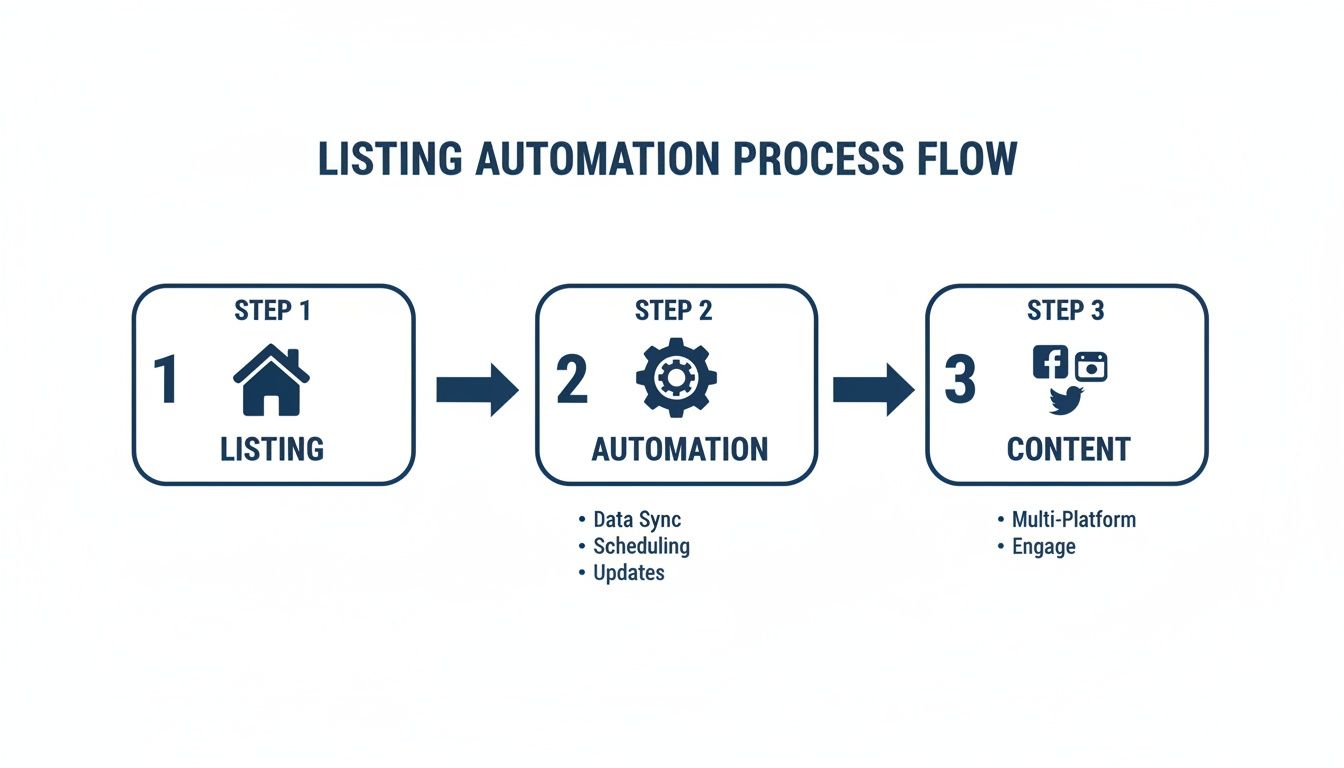
    A three-step listing automation process flow diagram showing listing, automation, and multi-platform content.

    This workflow shows the real magic of automation. You provide one input, and the system creates a powerful, diverse output that would have taken you hours to do by hand.

    Mastering Your Automated Content Calendar

    Timing is everything on social media. A post about an open house that goes out at 2 AM on a Tuesday might as well be invisible. Smart automation tools don't just post for you; they post at the optimal moments, when your content will actually get seen and engaged with.

    Modern platforms are smart. They look at your audience data to see when your followers are most active. This means your "Just Listed" announcement can hit Facebook during the peak evening scroll time, while your market analysis article pops up on LinkedIn during business hours when professionals are paying attention.

    Here are a few pointers for setting up your schedule:

    • Tailor Timing to the Platform: Don't just blast everything at once. Instagram engagement often spikes during lunch breaks and after work. LinkedIn, on the other hand, is a mid-week, workday platform.
    • Vary Your Cadence: It’s okay to post more frequently about timely things like new listings or open houses. For your evergreen content, like market updates or homeowner tips, space it out a bit to keep your audience from getting fatigued.
    • Batch and Approve: Set aside 30 minutes once a week (or once a month) to review and approve the entire content calendar. This puts you in the driver's seat, blending automated efficiency with your final human touch.

    From a Broker's Point of View: "For our brokerage, automated scheduling isn't just a time-saver; it's a brand management tool. We ensure every agent has a baseline of professional, well-timed content going out, which elevates the perception of our entire company."

    This "set it and forget it" strategy ensures your online presence stays active and professional, even when you’re swamped with clients, inspections, or closings.

    Navigating Compliance with Built-In Safeguards

    This might be the most valuable—and most overlooked—benefit of a good automation system: it's your first line of defense against compliance violations. Manually checking every single property description and social media caption for Fair Housing language and local MLS rules isn't just a pain—it's incredibly risky.

    The Fair Housing Act is very clear about prohibited language. Words that seem completely innocent can imply illegal discrimination based on protected classes like race, religion, or familial status. Think about it: calling a property a "perfect bachelor pad" or "great for a growing family" could easily get an agent into trouble.

    This is where automation gives you some much-needed peace of mind. Platforms like ListingBooster.ai build compliance checks right into the content creation process.

    • Fair Housing Scans: Before the content even gets finalized, the AI scans every description and caption for problematic keywords and phrases that could trigger a violation.
    • MLS Rule Adherence: The system is also programmed with specific MLS guidelines, making sure your property descriptions don't include prohibited info (like your phone number) and meet all the right formatting rules.

    This automated safety net takes compliance from a stressful manual checklist and makes it a seamless part of your workflow. For brokers, this is a game-changer for risk management. You can ensure every agent under your license is marketing properties both professionally and legally. This isn't just about marketing smarter; it's about marketing safer.

    Using Advanced Automation to Build Market Authority

    A man shows market authority charts on a tablet to two colleagues in a business meeting.

    Automating things like new listing announcements and open house reminders is a fantastic start—it’s a huge time-saver. But that’s just scratching the surface. Real market leadership isn't just about selling properties; it's about becoming the definitive source for local real estate knowledge. This is where real estate content marketing automation evolves from a simple productivity hack into a serious brand-building machine.

    The real goal here is to shift the conversation beyond the transaction. You want to be the expert people turn to for advice, even when they aren't actively buying or selling. When someone asks a search engine, "Who is the top real estate agent in my city?" your consistent stream of high-value, automated content is what gets your name to the top of that list.

    Generating Hyper-Local Insights on Autopilot

    One of the most powerful ways to cement your authority is by consistently publishing data-driven, hyper-local market analysis. Let's be honest, manually pulling comps, calculating absorption rates, and writing a coherent summary every single week is a grind. Automation makes it practically effortless.

    Imagine setting up workflows that automatically create content like:

    • Neighborhood Deep Dives: Detailed guides on specific subdivisions, complete with school ratings, recent sales data, and notes on unique local spots.
    • Monthly Market Recaps: A quick, easy-to-digest summary of the latest sales figures, inventory levels, and price movements in your key service areas.
    • Investor-Focused Content: Pieces that break down cap rates for local duplexes or shine a spotlight on up-and-coming zip codes with strong rental demand.

    This isn’t just filler content. It's specific, valuable information that positions you as an advisor, not just an agent. In today’s market, this is more critical than ever. A staggering 82% of agents now use AI for their listing descriptions, and 74% use it for creating social media, blogs, and emails. This allows top agents to produce tailored, authoritative content at a scale that was impossible just a few years ago.

    Weaving Psychology into Your Automated Content

    Good marketing informs, but great marketing persuades. Advanced platforms like ListingBooster.ai are built to bake proven psychological frameworks directly into the content they generate. This makes your automated posts far more effective at stopping the scroll and getting people to take action.

    Think about how your automated content can subtly tap into these principles:

    • Social Proof: Automatically generate social posts that highlight glowing client testimonials or "Just Sold" announcements in a coveted neighborhood.
    • Scarcity: Craft captions for a new listing that emphasize its one-of-a-kind features and the competitive market, creating a natural sense of urgency.
    • Aspiration: Write property descriptions that go beyond listing features and instead paint a vivid picture of the lifestyle the new owner will step into.

    This isn’t about being manipulative; it's about connecting with people on an emotional level. By automating this, you ensure every single piece of content you push out is not only informative but also psychologically compelling.

    The New Standard: Walking into a listing appointment with just a CMA is no longer enough. The modern authority figure arrives with a complete, AI-optimized marketing suite ready to launch, demonstrating undeniable preparation and expertise before the conversation even begins.

    From Agent to Unquestioned Market Leader

    This level of preparation completely changes the dynamic of your client meetings. Instead of just telling sellers you have a solid marketing plan, you show them. You can literally hand them an already-generated social media calendar, several MLS description options to choose from, and a draft of a blog post ready to go live.

    This demonstrates a level of professionalism and strategic foresight that most agents just can't compete with. It’s the ultimate proof that you’re not just another agent—you're a true marketing partner who knows exactly how to position their home for maximum exposure and impact. To dig deeper into this approach, check out our guide on how to build authority as a real estate agent using these strategies.

    Ultimately, this advanced use of automation is how you build a powerful, trusted brand that both clients and search engines will recommend without a second thought.

    Measuring Success and Tuning Your Automation Engine

    Getting your automated content system up and running is a huge win, but don't fall into the "set it and forget it" trap. The real magic happens when you treat it like a living, breathing part of your business—something you can tweak and refine to get even better results. This isn't just about clawing back a few hours in your week; it's about building a predictable, scalable way to grow your pipeline.

    To really nail this, you have to look beyond the vanity metrics. Sure, a post with 100 likes feels great, but likes don't sign listing agreements. The real proof is in the data that shows genuine client interest and brings you one step closer to the closing table.

    The Metrics That Actually Move the Needle

    Don't get lost in a sea of analytics. There are only a handful of numbers that truly tell you if your automated content is doing its job.

    When you sit down for your monthly review, these are the KPIs you should be laser-focused on:

    • Engagement Rate: This is way more valuable than a raw like count. It's the percentage of your audience that's actually stopping to comment, share, or save your posts. It’s a clear signal that your message is hitting home.
    • Link Clicks: Are people actually clicking through to your listing pages, your website, or your "What's My Home Worth?" landing page? This is a direct measure of someone raising their hand and showing intent.
    • Direct Message Inquiries: A DM that says, "Hey, can you tell me more about that property on Elm Street?" is a red-hot lead. Keep a running tally of how many of these your automated content generates.
    • Lead Form Submissions: When you offer something valuable like a neighborhood guide or a market update, are people willing to trade their email for it? This is a fantastic way to measure how much they trust your expertise.

    My Two Cents: Block out 30 minutes on your calendar at the end of every single month to go over these numbers. Don't just glance at them—look for the story they're telling. Did that video tour of the new listing get way more DMs than the static photos? Did the "Hidden Gems of Downtown" post drive a ton of clicks? That's gold.

    Creating Your Feedback Loop for Smarter Content

    This data isn't just a report card on your past performance; it's your roadmap for what to do next. Think of your monthly review as your chance to pop the hood and make small, strategic adjustments.

    Let's say you notice your "Tips for Sellers" posts are getting fantastic engagement, but your "First-Time Buyer" content is crickets. That's a clear signal to adjust your content mix for the coming month. Maybe you dive into ListingBooster.ai and tweak the brand voice prompts to sound a little less formal, making you more approachable to that buyer demographic.

    By embracing this cycle of measuring, learning, and adjusting, you turn your automation from a simple content scheduler into a powerful, responsive growth engine. You're constantly feeding it information about what works, ensuring your digital presence becomes an ever-more-reliable source of qualified leads and new business.

    Frequently Asked Questions

    Will My Automated Content Sound Like a Robot Wrote It?

    This is a big one, and a valid concern. The good news is, no, not if you're using the right tools. Modern AI platforms have come a long way from the old, clunky template fillers.

    The secret is in the setup. These systems are designed to learn your voice. You feed it examples of your writing, define your ideal client, and specify your tone—whether you're witty, professional, or more of a friendly neighborhood guide. The result is content that genuinely sounds like you, not a generic script.

    How Much Time Will This Actually Take to Set Up and Run?

    Getting started is quicker than you might think. Seriously. You can connect your accounts and dial in your brand preferences in about 5-10 minutes.

    After that initial setup, the real magic happens. Generating a full marketing package for a new listing or planning an entire month's worth of social media posts can be done in just a few clicks. The day-to-day work is mostly just reviewing and approving content, freeing you up for what really matters.

    The point of real estate content marketing automation isn't just about saving a few hours. It’s about getting back the time you need for the dollar-productive activities—the calls, appointments, and negotiations that actually move the needle.

    Is This Content Safe for MLS and Fair Housing Rules?

    Absolutely. Compliance is a non-negotiable, and the best platforms are built with that in mind from the ground up.

    They have safeguards baked right in. Think of it like a spell-checker, but for compliance. These tools automatically scan every property description and social media post for language that could violate Fair Housing laws. They also ensure your listings meet specific MLS character limits and guidelines, so you can publish with confidence.


    Ready to stop scrambling and start scaling your marketing? ListingBooster.ai turns a single property link into a complete, compliant, and on-brand marketing campaign in minutes. Start your 30-day free trial today.

  • AI-powered real estate marketing: Boost Listings and Close More Deals

    AI-powered real estate marketing: Boost Listings and Close More Deals

    At its core, AI-powered real estate marketing is about using smart software to handle the repetitive, time-consuming tasks that bog agents down. Think about crafting property descriptions, scheduling a month's worth of social media posts, or digging through market data. AI automates and improves these jobs, freeing you up to focus on what truly matters: building client relationships and closing deals.

    It’s the key to gaining a real advantage in a market that waits for no one.

    Winning the First Click in an AI-Driven World

    A hand holds a 'WIN THE FIRST CLICK' sign in front of a modern house and a woman with a brochure.

    The old real estate marketing playbook is officially obsolete. For years, the formula was simple: get your website ranked on Google, throw some money at social media ads, and wait for the leads to trickle in. But that entire model is built on a foundation that's cracking, because the way clients search for homes has fundamentally changed.

    A huge chunk of the market isn't starting on Google anymore. They're asking conversational AI tools for recommendations. This is a massive shift. Traditional SEO was a game of matching keywords. The new game is about becoming such a trusted authority that an AI recommends you by name. If your marketing isn't built for AI to find and understand, you’re basically invisible to this growing group of buyers.

    The New Search Landscape

    Let this sink in: over 40% of homebuyers now begin their search using AI tools like ChatGPT, Perplexity, and Google's AI Overviews, not a standard search bar. This isn't a small trend—it’s a seismic shift that rewrites the rules of digital visibility. For agents sticking to the old ways, this means a huge portion of potential clients will never even see their listings. You can dive deeper into the numbers with these real estate marketing statistics to see just how fast this is happening.

    This is more than just a new tech fad; it's a completely different way for expertise to be discovered online. AI-powered real estate marketing isn't just a nice-to-have; it's the necessary response to meet modern buyers and sellers where they're actually looking for answers.

    Think of it like this: Traditional marketing was like putting a billboard on a busy highway. AI-powered marketing is like having a trusted local guide who personally recommends you to every traveler asking for the best place to live.

    Why Your Old Marketing Habits Are Failing

    The biggest problem with the old way is that manual marketing efforts just can't keep up anymore. The sheer volume of work—fresh social media content every day, perfectly optimized listing descriptions, and up-to-the-minute market analysis—is enough to burn out even the most dedicated agent.

    Take a look at how the daily grind of real estate marketing is being completely reshaped by AI. The table below contrasts the time-consuming tasks of yesterday with the intelligent, automated workflows available today.

    Old Marketing Habits vs New AI Strategies

    Marketing Task The Traditional Manual Approach The Modern AI-Powered Approach
    Listing Descriptions Spending hours writing and rewriting descriptions, trying to fit different portal requirements. Instantly generate multiple versions of a compelling description, each tailored for MLS, Zillow, social media, and more.
    Social Media Posting sporadically "when you have time," leading to an inconsistent and ineffective online presence. An automated calendar posts high-quality, relevant content for you daily, building a consistent and authoritative brand.
    Lead Nurturing Manually responding to every inquiry, often with a delay that costs you the lead. AI-driven chatbots provide instant, 24/7 responses to common questions, qualifying leads while you sleep.
    Market Analysis Spending days pulling comps and manually crunching numbers to understand local market trends. Generate in-depth, hyper-local market reports in minutes, positioning yourself as the neighborhood expert.
    Content Creation Struggling with writer's block to create blog posts or neighborhood guides to boost SEO. Produce well-researched, engaging articles and community content with a few clicks, establishing your digital authority.

    As you can see, the shift isn't just about saving time; it's about producing better, more consistent results that manual methods simply can't match.

    An AI-driven strategy positions you as an authority before you even get the listing. It builds your reputation as the go-to expert in your market, so when a user asks an AI, "Who is the best agent in Anytown, USA?"—your name is the one that comes up.

    Adopting AI-powered real estate marketing is more than an upgrade. It’s a strategic decision to stay relevant and win that all-important first click in this new digital arena.

    How AI Works as Your Marketing Co-Pilot

    Let's cut through the jargon. What is AI-powered real estate marketing, really? It’s not some complicated, futuristic robot taking over your job. It's much simpler and more practical than that.

    Think of it like having a dedicated marketing assistant—a co-pilot—sitting next to you. This co-pilot handles all the tedious, repetitive digital marketing tasks that eat up your day. You know the ones: writing property descriptions, scheduling social media posts, and formatting everything for different websites.

    This isn't about replacing your expertise; it's about amplifying it. The AI does the heavy lifting in the background, freeing you up to focus on what you do best: building relationships, negotiating deals, and being the trusted guide your clients need. It’s a force multiplier that takes one simple input—a property address—and spins it into a complete marketing campaign.

    Turning a Single Address into a Full Campaign

    The real magic happens when you see how an AI system connects the dots. When you give a tool like ListingBooster.ai a property address, it doesn't just see a pin on a map. It instantly dives into a sea of data to build a smart marketing plan from the ground up.

    Here’s a quick look under the hood:

    • It Gathers the Intel: The AI pulls from public records, MLS data, and current market trends tied to that specific property. It instantly identifies the key selling points, neighborhood perks, school districts, and recent comps.
    • It Writes the Story: Using all that data, it starts writing. It doesn't just spit out one generic description; it creates multiple versions tailored for different platforms—a detailed one for the MLS, a punchy one for Zillow, and a short, engaging one for an Instagram caption.
    • It Builds the Campaign: This goes way beyond just descriptions. The AI maps out an entire content plan for you. It designs social media posts for the new listing, graphics for the open house, "just sold" announcements, and even local market updates that establish you as the go-to expert.

    What used to take hours of painstaking work—or even days, if we're being honest—is now done in minutes. Every single one of your listings gets a professional, comprehensive marketing launch without you having to sacrifice your valuable time.

    The Core Jobs of Your AI Co-Pilot

    At its core, your AI co-pilot is built to handle three critical parts of your marketing: creating content, optimizing your listings on portals, and managing your social media. By taking these off your plate, it consistently builds your online presence, almost on autopilot.

    Your AI co-pilot doesn't just save you time—it builds a consistent, professional brand that works around the clock. It's the engine driving your digital reputation, making sure you’re always visible and authoritative online.

    Let's break down what this looks like day-to-day.

    • Compelling Listing Descriptions: No more writer's block. The AI crafts descriptions that are both factually accurate and emotionally resonant, using proven sales copy techniques to grab a buyer's attention and highlight a home's best features.
    • Automated Social Calendars: It actually plans out a full 30-day social media schedule based on your listings and the local market. This means you maintain a consistent, engaging presence on Facebook and Instagram without the daily stress of wondering what to post.
    • Property Portal Optimization: The AI knows that a listing description for your local MLS needs a different touch than one for a national portal like Zillow. It creates unique, optimized content for each one, helping your listings stand out and get seen by more potential buyers.

    By weaving these tasks together, AI-powered real estate marketing creates a self-sustaining system for your brand. Every new listing becomes another opportunity to reinforce your expertise, capture new leads, and solidify your reputation as the agent to know in your market. That consistent, high-quality output is exactly how you build a dominant digital footprint.

    Building Your Automated Content Engine

    Let's be honest, the daily grind of content planning is a huge time suck. That feeling of staring at a blank cursor, trying to figure out what to post on Instagram or how to word a new listing description—it’s exhausting. What if you could get rid of that stress for good? This is where an AI-powered real estate marketing engine comes in, and it's less science fiction and more practical magic.

    The whole idea is to take what used to be a week's worth of marketing prep and shrink it down to just a few minutes. You start with one simple piece of information, usually just the property address, and the system does the rest. It spits out a complete, ready-to-go marketing campaign. This isn't just about saving time; it's about giving every single one of your listings the top-tier, professional launch it deserves, without fail.

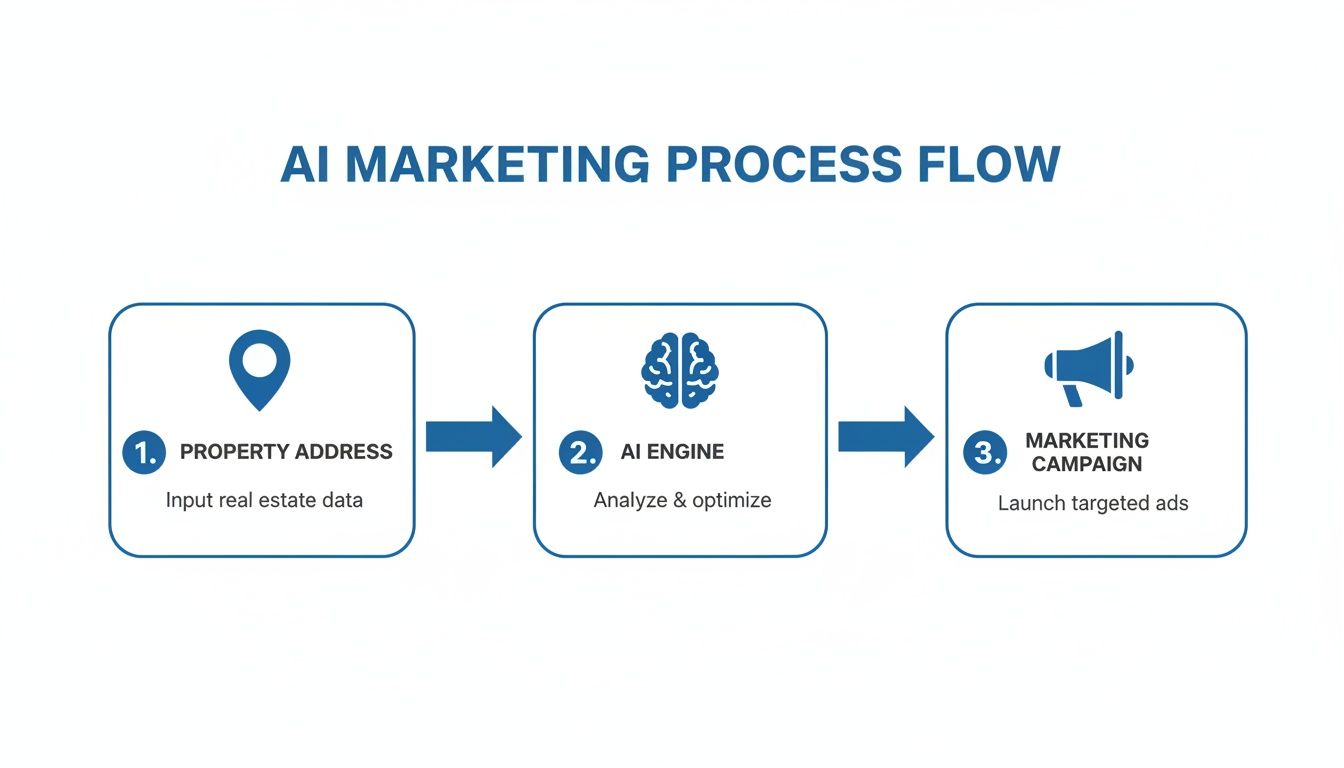
    This flow chart breaks it down perfectly. A single address goes in, the AI works its magic, and a full campaign comes out the other side.

    AI marketing process flow for real estate, showing data input, AI analysis, and targeted ad campaigns.

    The real takeaway here is the straight line from a simple input to a sophisticated, multi-channel output. It pulls you out of the most tedious parts of marketing.

    Crafting a Diverse and Engaging Content Mix

    A smart AI tool knows that a successful social media feed isn't just an endless stream of "New Listing!" posts. That gets old, fast. To keep people genuinely interested, you need variety. The goal is to build a dynamic content calendar that tells the full story of a property and, just as importantly, reinforces your expertise.

    An automated engine will generate a whole mix of content, with each piece tailored for a specific moment in that listing's journey.

    • New Listing Announcements: These are your big, flashy first impressions, designed to grab attention with the property's best features.
    • Open House Promotions: Think engaging graphics and captions that create a little FOMO (fear of missing out) and drive people to your event.
    • Price Adjustment Updates: A good AI frames a price drop not as a failure, but as a fresh opportunity for motivated buyers.
    • "Just Sold" Celebrations: This is all about social proof. These posts show off your success and build trust in your local market.
    • Neighborhood Spotlights: You’re selling a lifestyle, not just four walls. This content highlights local parks, coffee shops, and schools to paint a bigger picture.

    With a platform like ListingBooster.ai, this entire suite of content gets created from a single property link. It helps you maintain a consistent, professional, and authoritative voice across Facebook, Instagram, TikTok, and wherever else you’re active. For more ideas on building your brand, you can find a ton of great tips on the ListingBooster.ai blog.

    The Psychology Behind Scroll-Stopping Captions

    The best AI marketing tools don't just state facts; they act like seasoned copywriters. They lean on proven psychological frameworks to write captions that actually stop people from scrolling and get them to engage.

    This has nothing to do with robotic, generic text. It’s about tapping into the very real human emotions that drive big decisions, like buying a home.

    By embedding proven sales psychology directly into the content, an AI engine transforms a simple property update into a compelling call to action. It ensures your marketing resonates on an emotional level, not just an informational one.

    These systems are trained on marketing principles that have worked for decades. They know how to strategically weave these concepts into every post to get the biggest impact and inspire people to take the next step.

    Key Psychological Triggers in AI Content

    Here’s a look at how these triggers work in practice:

    Trigger How It's Used in Real Estate Marketing Example AI-Generated Post
    Scarcity Creates a sense of urgency by highlighting that the property is unique or won't be available for long. "The only home in the district with a walk-out basement under $500k. This one-of-a-kind opportunity won't last long!"
    Social Proof Builds trust by showing that others are interested or have had a positive experience. "We had over 20 groups through our open house this weekend! Don't miss your chance to see what everyone is talking about."
    Aspiration Helps buyers envision themselves living a better life in the new home. "Imagine your summer evenings spent on this beautiful patio. Your dream lifestyle is waiting at 123 Maple Street."

    By automatically baking these persuasive techniques into your posts, AI-powered real estate marketing turns your content from simple announcements into strategic assets that actually produce results. This automated engine doesn't just fill your calendar; it fills it with content that is engineered to convert, helping you build a powerful brand and a healthy sales pipeline with a fraction of the effort.

    Optimizing Listings for Both AI and Human Buyers

    Person holds a tablet displaying a house image and 'AI Optimized Listings' text, promoting real estate.

    In today's market, every property listing has two jobs. First, it has to connect with people on an emotional level, helping them picture their future in that home. But just as importantly, it needs to speak the language of algorithms, making sure it gets found by the AI systems that now power so many property searches.

    This dual focus is where you can find a huge, often overlooked, advantage. Writing a beautiful description isn't enough anymore. You have to strategically build your listings to be discoverable by people and machines, turning every property you represent into a magnet for the right audience.

    Speaking Two Languages at Once

    Think of it like this: your listing description has two completely different audiences. A human buyer is searching for a story. They want to feel the warmth of the "sun-drenched breakfast nook" or imagine hosting game night in the "spacious, open-concept living area." They respond to evocative language that paints a vivid picture.

    An AI algorithm, on the other hand, is scanning for cold, hard facts. It’s looking for structured data and specific keywords like "quartz countertops," "fenced backyard," and "three-car garage." It uses these data points to categorize the property and match it precisely to a user’s search. A truly effective AI-powered real estate marketing strategy delivers both.

    The art of modern listing optimization is crafting a narrative that captivates a human buyer while simultaneously embedding the structured data that AI search engines need to understand and recommend your property.

    Tailoring Descriptions for Every Platform

    One of the most time-consuming parts of marketing a new listing is tweaking the description for every single platform. The MLS has one character limit, Zillow has another, and an Instagram caption needs to be way shorter and punchier. Doing this manually for every property is a grind, and it often results in bland, copy-pasted text that doesn't perform well.

    This is exactly the kind of task an AI co-pilot was built for.

    • For the MLS: The AI can generate a detailed, comprehensive description loaded with all the essential features and keywords that other agents and their automated search tools are programmed to find.
    • For Zillow and Realtor.com: It whips up a more consumer-friendly version, highlighting lifestyle benefits and emotional hooks that grab the attention of buyers scrolling through the portal.
    • For Social Media: It produces short, scroll-stopping captions—complete with emojis and strong calls to action—perfectly formatted for platforms like Facebook and Instagram.

    Tools like ListingBooster.ai handle all of this automatically, generating multiple optimized versions of your description in seconds. This ensures your property looks its best on every channel, maximizing its reach without you lifting a finger. You can see more on how this works for individual agents seeking a competitive edge.

    Making Your Listings AI-Readable

    Beyond just using the right keywords, making a listing truly "AI-readable" involves something called schema markup. That might sound technical, but the idea is simple. It’s like adding invisible tags to your listing data that tell search engines like Google and ChatGPT precisely what each piece of information is.

    For example, instead of just seeing the number "3," schema markup tells the AI, "This number represents the bedroom count." This clarity helps AI systems confidently understand a property's features and serve it up to users asking specific questions like, "Show me three-bedroom homes with a pool near downtown."

    This structured approach is becoming crucial as the real estate AI market is projected to surge from $222.65 billion in 2024 to $303.06 billion in 2025, with AI expected to automate around 37% of industry tasks. By making your listings AI-readable now, you're positioning them to be found in this new search environment, giving yourself a distinct and lasting advantage.

    How to Scale Your Brokerage and Stay Compliant with AI

    As a real estate team or brokerage grows, a huge challenge surfaces. How do you keep your brand voice consistent and your marketing legally buttoned-up when dozens—or even hundreds—of agents are all creating their own content? This is exactly where AI-powered real estate marketing stops being just a cool productivity hack and becomes a critical tool for running the business.

    Left to their own devices, individual agents will naturally develop their own styles. That can lead to off-brand social media posts, wildly different messaging, and visuals that just don't meet the brokerage's standards. Over time, this erodes the brand you've worked so hard to build, making the whole operation look fragmented and less professional.

    Creating One Unified Voice for Your Entire Team

    Think of an AI platform as your central brand guardian. It’s a place where brokerage leadership can set up pre-approved templates, lock in a specific tone of voice, and make sure every single piece of marketing—from a just-listed post to a quarterly market report—sticks to the company playbook.

    This solves a massive operational headache. Instead of a manager having to manually review every agent's content or clean up the mess from a bad graphic, you empower the entire team with a tool that builds quality in from the start. Agents get to use professional-grade marketing assets, and the brokerage protects its identity, no matter how big it gets.

    This isn't about stifling creativity. It’s about giving every agent a professional framework that makes all of their marketing better. It means every agent, no matter their design experience, represents the brokerage with polish and authority.

    Automated Compliance That Manages Your Risk

    Branding is one thing, but the most important job AI can do for a brokerage is automate compliance. The risk of an agent accidentally violating Fair Housing laws with a poorly worded ad is a massive legal and financial liability. For any growing brokerage, trying to manually police every single caption and property description is a fool's errand.

    A smart AI marketing engine has compliance built right into its DNA. Before any content ever sees the light of day, the system automatically scans it for words and phrases that could be flagged as discriminatory or violate Fair Housing rules.

    This built-in check is constantly on the lookout for language that might suggest a preference or limitation based on protected classes, such as:

    • Familial Status: Catching phrases like "perfect for singles" or "no kids allowed."
    • Race or National Origin: Flagging any descriptions of a neighborhood's demographics.
    • Religion: Making sure that mentioning a nearby church or temple doesn't imply a religious preference.
    • Disability: Avoiding problematic terms like "not handicap accessible" in public-facing copy.

    This automated safety net completely changes the game for risk management. It turns AI-powered real estate marketing from a simple content tool into a powerful compliance engine that protects the brokerage from expensive lawsuits and damage to its reputation.

    For any organization ready to give their agents these kinds of safeguards, checking out the team options in a ListingBooster.ai pricing plan is the clear next move. It’s how you get enterprise-level protection that actually works for teams of any size.

    What Comes Next: Predictive and Agentic AI

    The AI tools making waves in real estate right now are mostly about generation—they're fantastic at writing property descriptions, drafting social media posts, and building marketing plans. That’s a huge time-saver, but it's really just the first inning of a whole new ballgame. The next leap forward is moving from creating content to autonomously performing tasks.

    Welcome to the world of predictive and agentic AI. Don't think of this as just a smarter writing assistant. Think of it as a junior agent who works around the clock, 24/7, without ever needing a coffee break.

    The Shift from Reactive to Proactive Marketing

    This jump from generative to agentic AI completely flips the script on how we approach marketing. For decades, our marketing has been reactive: you get a new listing, so you create a campaign for it. Agentic AI makes marketing proactive by figuring out what you need before you even know you need it.

    Imagine an AI that doesn't just write a "Just Listed!" post. Instead, it analyzes local market data and predicts the exact price point that will attract the most qualified buyers before the listing even goes live. Better yet, it could scan your CRM, find potential buyers who’ve looked at similar homes in the past, and have a targeted email campaign ready for your approval.

    This is the future of AI-powered real estate marketing—it’s not just about announcing what’s for sale. It’s about predicting who wants it and automatically reaching out to them. You're always two steps ahead of the market.

    Meet Your Future AI Agent

    The "agentic" part of agentic AI means the system can handle complex, multi-step jobs all by itself. For a real estate agent, this means handing off those time-sucking workflows that bog you down every day.

    Research from Gartner suggests that by 2028, approximately 15% of day-to-day work decisions could be made by AI agents. What does that actually look like? An AI could have a text conversation with a new lead to qualify them, automatically update their profile in your CRM, and even schedule a showing on an open slot in your calendar—all without you lifting a finger. You can get a deeper look into how AI will reshape the industry and what it means for your business.

    This might sound like something out of a sci-fi movie, but it’s the logical next step from where we are today. Every time you use a tool like ListingBooster.ai to whip up a social media calendar or tweak an MLS description, you're building the skills and trust needed for this next phase. Getting comfortable with today's AI is how you prepare to take full advantage of tomorrow's truly autonomous assistants.

    Frequently Asked Questions

    Jumping into AI-powered marketing brings up a lot of good questions. Agents I talk to are usually curious about how authentic it feels, how hard it is to learn, and—let's be honest—what it means for their jobs. Let's tackle these head-on.

    Does AI-Generated Content Feel Authentic?

    It does, but only if you think of it as a creative partner, not a robot doing your job for you. A smart AI tool acts like a skilled assistant, giving you a solid first draft built on marketing principles that actually work.

    Your job is to take that draft and inject your personality and local market knowledge into it. This whole process takes seconds, not hours. You’re not replacing your voice; you’re just getting a massive head start and skipping the blank page altogether.

    How Long Does It Take to Get Started?

    You can be up and running in the time it takes to grab a coffee. Seriously. Today's best platforms are built for busy agents, not software developers. The initial setup usually takes just 5-10 minutes.

    Just paste in a property URL or a few details, and the system can generate everything from social media posts to compelling MLS descriptions almost instantly. The design is so intuitive that you’ll feel like a pro from day one.

    Will AI Marketing Replace Real Estate Agents?

    Nope. AI won't replace agents, but agents who use AI are absolutely going to have an edge over those who don't. Think about it: these tools automate the tedious, soul-crushing parts of marketing—writing endless social posts, analyzing data—so you can focus on what you’re truly great at.

    AI is here to make you a better agent, not an obsolete one. It frees up your time so you can be out there building relationships, negotiating deals, and being the go-to expert your clients need.

    This isn't about replacement; it's about elevation. You get to operate at a higher level, focusing on the high-impact activities that actually close deals and build your reputation.

    Is AI Marketing Technology Affordable?

    Absolutely. Top-tier AI marketing tools are surprisingly budget-friendly. Many platforms start at a price that’s a tiny fraction of what you’d pay for a virtual assistant or social media manager—some plans are as low as $35 per month.

    Most even offer a free trial, so you can see the results for yourself without any risk. This really levels the playing field, giving every agent access to the kind of powerful marketing technology that was once reserved for the biggest brokerages.


    Ready to stop wasting time on marketing and start focusing on what you do best? With ListingBooster.ai, you can generate a complete 30-day marketing campaign in minutes. Start your free trial today and see how easy it is to build your brand and win more listings.

  • Real estate agent marketing software: Win more listings with automation

    Real estate agent marketing software: Win more listings with automation

    Ever feel like you’re a professional juggler instead of a real estate agent? Between showing properties, negotiating deals, and managing clients, the last thing you have time for is playing graphic designer or copywriter.

    This is where specialized real estate agent marketing software comes in. Think of it as your dedicated marketing assistant, working behind the scenes 24/7 to build your brand and attract new clients, so you can focus on what you do best: closing deals.

    What Is Real Estate Agent Marketing Software, Anyway?

    Let's get real for a minute. How many hours do you actually spend writing property descriptions for Zillow, trying to come up with clever social media posts, or wrestling with a clunky design tool to create a decent-looking flyer?

    That manual grind isn't just a time-suck. It’s a major bottleneck that keeps you from high-value, dollar-producing activities. Real estate agent marketing software is built to smash that bottleneck. Instead of a messy collection of separate tools, this software acts as a central command center for all your listing marketing, helping you shift from being reactive to proactive.

    It's More Than Just a CRM

    A Customer Relationship Management (CRM) tool is fantastic for keeping your contacts and deals organized. But it doesn't create the actual marketing materials you need to win those deals in the first place. That’s the critical gap this software fills.

    Its core job is to handle tasks like:

    • Generating Content: Instantly writing compelling property descriptions, social media captions, and even blog posts.
    • Amplifying Listings: Creating a full suite of marketing assets to promote a new property across every important channel.
    • Building Your Authority: Establishing you as the go-to expert with data-driven reports and market analyses.

    This technology isn't just a passing trend; it represents a fundamental shift in how top agents compete. The global market for these tools is projected to hit USD 4.26 billion by 2034, which tells you just how essential they're becoming.

    At the end of the day, these platforms give solo agents and small teams the power to create marketing materials that look like they came from a big-budget brokerage. It completely levels the playing field. Imagine walking into your next listing appointment with a polished, tech-forward presentation that not only justifies your commission but proves your undeniable value.

    Choosing the right platform is one of the smartest moves for real estate agents looking to modernize their business and win more listings.

    Exploring Core Features Every Agent Needs

    Diving into the world of real-to-estate agent marketing software can feel like a lot. Every platform throws a long list of features at you, but what really matters? The key isn't about having the most bells and whistles; it's about finding tools that solve your two biggest headaches: winning more listings and building a brand that stands out.

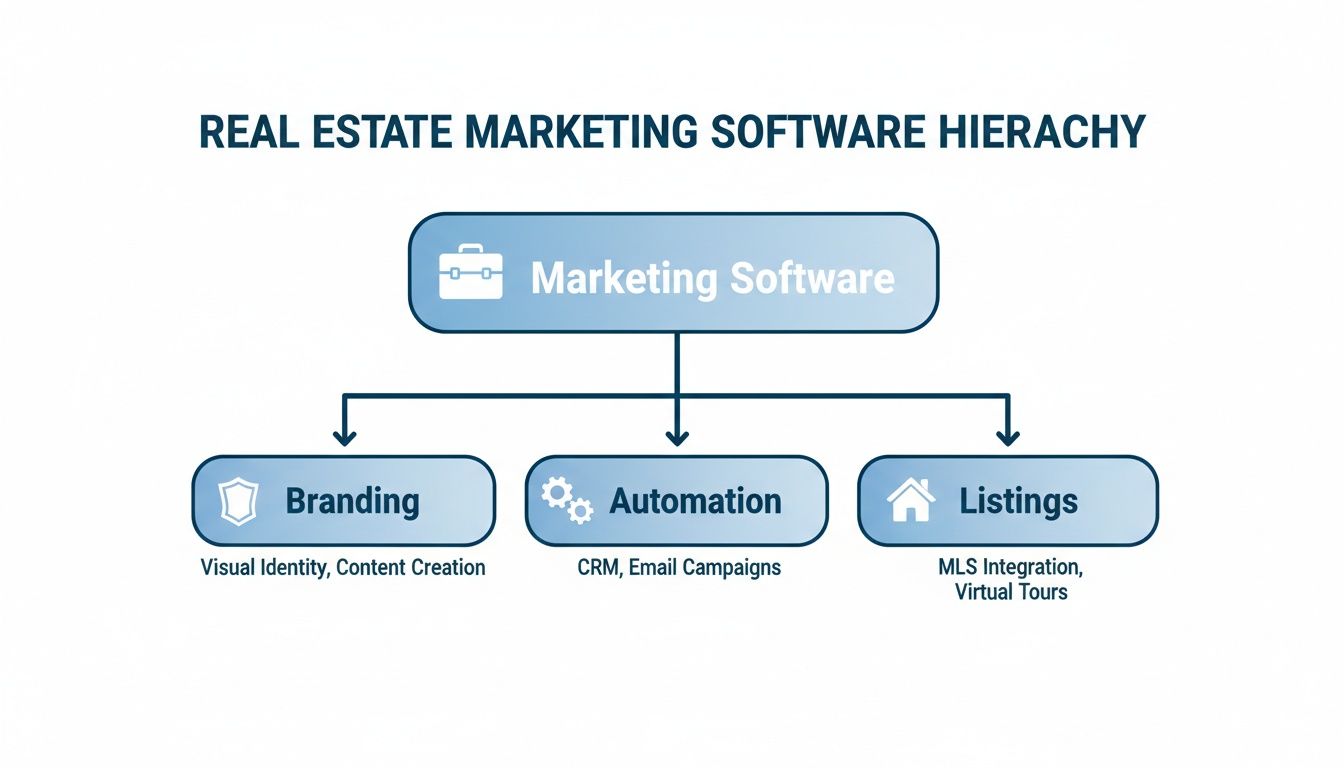
    Instead of just running down a checklist, let's look at these features in a way that actually makes sense for your daily grind. I like to group them into three core pillars: Branding, Automation, and Listings.

    A hierarchical diagram illustrating real estate marketing software categories: branding, automation, and listings with details.

    As you can see, these pillars don't exist in a vacuum. They work together, supporting a complete marketing strategy that takes you from building your reputation all the way to launching a killer property campaign. The whole point is to make each part work together, saving you time and getting you better results.

    Listing Amplification Tools

    This is where the rubber meets the road for your properties. Think of Listing Amplification features as your marketing launchpad. They're built to take a single property and, almost instantly, spin it into a full suite of marketing materials designed to grab attention from day one.

    The must-have tools here include:

    • AI-Powered Content Generation: We're talking about more than just a bland property description. Good software will write multiple versions of your listing copy, each one fine-tuned for the platform it's on—whether that's Zillow, Redfin, or your local MLS. It knows what works where.
    • Automated Social Media Calendars: Stop staring at a blank screen wondering what to post. The right platform can take a new listing and instantly generate a 30-day social media plan. It writes the captions, picks the best photos, and even schedules it all out for you. Consistent promotion, zero extra effort.

    Imagine this: you type in a property address, and a few minutes later, you have an entire marketing package ready to go. That's not the future; it's the new standard. In fact, industry analysis shows agents save up to 10 hours per week just by automating repetitive work like creating listing materials.

    Authority Building Features

    Winning over a new client doesn't start at the listing presentation. It starts weeks, or even months, before. Authority Building features are your behind-the-scenes engine for establishing yourself as the go-to expert in your market. When sellers in your area think "real estate," you want them to think of you first.

    A solid platform will give you:

    • Automated Market Reports: These tools let you create professional, data-packed reports for any neighborhood or zip code on the fly. They're perfect for your blog, email newsletters, or as a powerful leave-behind at an open house.
    • AI Blog and Content Ideas: Stuck on what to write about? Good software uses AI to serve up relevant blog topics and even outlines based on what's happening in your local market and what questions your clients are asking. This keeps your website fresh and helps you show up in search results.

    Presentation and Pitching Tools

    Alright, now it's time to close the deal. These features are all about walking into that listing appointment and blowing the competition out of the water. They give you tangible, impressive assets that prove you know how to market a home.

    Look for tools that can create:

    • Competitive Market Analyses (CMAs): Move beyond the boring, data-dump CMAs of the past. Modern tools create visually stunning, easy-to-digest reports that clearly show a seller where their home fits into the current market.
    • Print-Ready Marketing Plans: Walk into a meeting with a professionally designed flyer or brochure that lays out your entire digital marketing strategy for their home. It's a simple but powerful way to show sellers you have a concrete plan, justifying your commission and building trust from the first handshake.

    How to Win Listings with a Modern Pitch

    When you sit down at a listing appointment, it all boils down to one question brewing in the seller's mind: "Why should I hire you over everyone else?" In a crowded market, the old playbook—a generic CMA and a vague promise to "market the property aggressively"—just doesn't land anymore. This is exactly where real estate agent marketing software becomes your ace in the hole, turning your pitch from a simple conversation into a powerful demonstration of what you can deliver.

    Instead of just telling sellers what you'll do, you can actually show them. Picture this: you walk into an appointment with a complete, professionally designed marketing plan already built for their specific property. It's not a flimsy promise; it's tangible proof that you're already on the job.

    Shifting from Promise to Proof

    The traditional listing pitch is built on asking for trust based on past performance. The modern, tech-forward approach builds that trust right there on the spot by showcasing your superior marketing chops. You're no longer just an agent; you're a marketing strategist armed with a clear, data-driven plan to sell their home.

    This proactive method completely reframes the entire discussion. The focus immediately shifts from your commission rate to the undeniable value you bring to the table. Sellers can see with their own eyes that you've already invested time, effort, and strategy into their property before they've even signed on the dotted line.

    A well-prepared, tech-forward presentation instantly sets you apart from the 90% of agents who show up with the same tired materials. It directly addresses the seller's biggest unspoken fear: "Will my agent actually do enough to get me the best price?" By laying out a complete plan, you prove that you will.

    This is what readiness looks like. You're not just talking about launching a campaign; you're showing them it's ready to go in minutes, not days.

    Four real estate professionals discuss strategies, with one holding a tablet showing 'Win Listings'.

    With a platform like ListingBooster.ai, you can generate a full suite of marketing materials for a property instantly, demonstrating an ability to launch a comprehensive marketing campaign for a seller's home at a moment's notice.

    The Modern Pitch in Action

    Let's break down the difference. The old method involves a standard folder filled with comps. The new method uses real estate agent marketing software to create a compelling package that justifies your value from the second you walk in the door.

    The Traditional Pitch vs. The Modern Pitch

    Element The Traditional Approach The Modern, Software-Powered Approach
    Analysis A standard, data-heavy CMA printed straight from the MLS. A visually engaging, easy-to-understand competitive analysis.
    Marketing Plan A verbal promise of "social media posts and portal listings." A printed 30-day social media calendar and examples of AI-optimized portal descriptions.
    Materials A generic company brochure. Custom-branded flyers detailing your digital strategy specifically for their home.

    The best part? You can generate these assets in minutes before you even head to the appointment. For example, you can:

    • Create a Data-Driven Analysis: Generate a clean, modern competitive analysis that homeowners can actually understand.
    • Produce Tangible Marketing Assets: Print out a beautiful flyer that breaks down your multi-platform digital strategy, showing how you optimize for Zillow and social media algorithms.
    • Showcase Your AI Edge: Present AI-crafted property descriptions that tell a compelling story about the home, proving you know how to attract more qualified buyers.

    This level of preparation sends a clear message: you are not just another agent. You are a marketing powerhouse. It turns the listing appointment into a simple formality because you’ve already proven you're the only logical choice for the job.

    Automate Your Marketing and Reclaim Your Time

    If there’s one thing every real estate agent is short on, it’s time. Juggling client meetings, showings, and a mountain of paperwork means marketing often falls by the wayside. This is exactly where real estate agent marketing software becomes a game-changer, turning your marketing efforts from a constant time-suck into an automated engine that works for you around the clock.

    Imagine putting your social media posts and property flyers on autopilot. You can maintain a consistent, professional online presence without the daily grind, freeing you up to focus on what actually makes you money: closing deals.

    Person using a laptop with marketing automation software, holding a coffee cup, with a calendar and plant.

    This isn’t just about saving a few minutes. It's about clawing back huge chunks of your week. The entire industry is moving in this direction, with the market for these tools valued at USD 12.87 billion and growing fast. In fact, real estate agents are the fastest-growing professional group adopting this tech, all driven by the simple need to find and keep clients more effectively. You can dig deeper into the real estate software market on SkyQuestt.com to see the full picture.

    Two Pillars of Real Estate Automation

    When you break it down, effective marketing automation for agents really stands on two legs. Each one supports a critical part of your business, making sure your listings get seen and your personal brand gets built.

    These two pillars are:

    • Property-Specific Automation: This is all about the "now." It's the tactical marketing you need the second a new listing goes live.
    • Personal Brand Automation: This is the long game. It’s the strategic work of building your reputation as the go-to expert in your area.

    When you automate both, something powerful happens. Your property marketing creates immediate buzz, while your brand marketing builds a pipeline of future clients who already trust you before they've even met you.

    Automating for Listings and Authority

    Think about property automation like this: you land a new listing, and within minutes, the software generates a complete 30-day social media calendar with captions and images ready to post. It's a system that gives every single property the high-quality exposure it deserves across all your channels, without you having to block out hours to create the content yourself.

    At the same time, your personal brand automation is quietly working in the background to cement your authority. The software can create insightful market reports, neighborhood guides, or even just smart blog post ideas based on what's happening locally. By consistently putting out valuable information, you build trust with people long before they’re even thinking about moving. This consistent activity is also a huge factor in getting you to the top of Google, making sure you’re the first agent a seller finds.

    Choosing the Right Marketing Software for Your Business

    Picking the right real estate agent marketing software is a lot like choosing a business partner. It's not about being wowed by flashy features. It's about finding a platform that genuinely fits into your daily hustle and solves your biggest headaches. A little homework upfront ensures you invest in a tool that actually makes you money, not just another line item on your monthly credit card statement.

    The first thing to do is look under the hood. A slick design is nice, but the real power comes from what the software can actually do for a real estate agent. You want a tool built by people who get the day-to-day grind of listings, closings, and client calls.

    Your Essential Evaluation Checklist

    Before you even think about a free trial, sit down and make a list of your non-negotiables. This simple checklist will be your guide, helping you cut through the sales pitches and focus on what will truly boost your productivity and your bottom line.

    Think about these critical areas:

    • MLS Compliance and Fair Housing Alignment: This is the big one. The software absolutely must create content that follows Fair Housing laws and your local MLS rules to the letter. Getting this wrong isn't just a slip-up; it's a massive risk to your license and business.
    • Ease of Use and Onboarding: How fast can you go from zero to a full marketing kit for a new listing? The best tools are incredibly intuitive. You should be able to plug in an address and get to work immediately, without needing a week of training.
    • Quality of AI-Generated Content: Put the AI to the test. Read the property descriptions it writes. Do they sound like something you'd proudly present to a client? Is the social media copy catchy and smart? The AI should feel like a top-notch assistant, not a robot spitting out generic phrases you have to rewrite anyway.
    • Integration with Key Portals: Your listings need to look amazing on the platforms that matter. The software should format everything perfectly for major players like Zillow, Redfin, and Realtor.com. That's how you make sure your properties get seen by the most buyers.

    Test Driving for Real-World Results

    When you find a platform with a free trial, use it. But don't just poke around the dashboard. Grab one of your actual listings—a current one or even one you just sold—and run it through the system from start to finish. Generate the listing narrative, build the social media posts, and create the seller presentation.

    This is where the truth comes out. A hands-on test shows you exactly how much time you’ll save and whether the marketing materials are polished enough to land you that next listing.

    Finally, think about growth. The right tool needs to be just as effective for a solo agent as it is for a brokerage with a dozen agents. This is key because the entire industry, from property management to commercial sales, is going digital. As researched by Zion Market Research, the commercial real estate software market is expanding rapidly, and agents need marketing tools that can keep up.

    To help you organize your search, use a structured checklist to compare your options side-by-side.

    Software Evaluation Checklist for Real Estate Agents

    Evaluation Criteria Key Questions to Ask Why It Matters for Your Business
    Core Functionality Does it generate all the content I need (descriptions, social, ads)? Does it handle both pre-listing and active listing tasks? A comprehensive tool saves you from juggling multiple subscriptions and streamlines your entire marketing workflow from start to finish.
    Usability & Speed How many clicks does it take to create a full marketing package? Is the interface intuitive or confusing? Time is money. You need a tool that works at the speed of your business, not one that slows you down with a steep learning curve.
    Compliance & Accuracy Does the software have built-in checks for Fair Housing and MLS rules? Does it pull accurate data? This is your safety net. Automated compliance protects you from costly violations and ensures your marketing is professional and legally sound.
    Customization & Branding Can I easily add my own branding, logo, and headshot? Can I tweak the AI-generated content to match my voice? Your brand is your biggest asset. The software should enhance it, not force you into a generic template. It needs to sound like you.
    Cost vs. Value (ROI) What is the total cost? How many hours will this save me per listing? How much is that time worth? Look beyond the price tag. If a tool saves you 5-10 hours per listing, it pays for itself almost immediately and frees you up for dollar-producing activities.
    Support & Training Is there a responsive support team? Are there helpful tutorials or onboarding guides available? When you're on a deadline, you need answers fast. Good support ensures you can overcome any technical hurdles and get the most out of the platform.

    By asking these questions, you move from just buying software to making a strategic investment in your business's future. Before making that final call, always compare the different plans available. A clear breakdown of features helps you pick a tier that fits where you are now and where you want to be. For a great example, check out ListingBooster.ai’s pricing plans to see how features and value scale together.

    Common Questions About Real Estate Marketing Software

    Bringing new tech into your business can feel like a big leap, especially when you’re already juggling a dozen other things. It's totally normal to have questions and maybe even a few doubts. Let's clear the air and tackle the most common concerns agents have about real estate agent marketing software. My goal is to help you see exactly how it fits into your workflow and why it's a game-changer.

    We'll walk through some straightforward answers to help you feel confident about the real-world value these platforms bring to the table.

    Is This Type of Software Difficult to Learn?

    Not at all. I get it—the last thing you need is another complicated tool with a steep learning curve. Modern platforms are built for busy agents, not tech gurus. The whole point is to make your life easier, not harder. You can literally get started in minutes just by plugging in a property address.

    The best software is all about a smooth user experience. It walks you through creating property descriptions, social media posts, and even listing presentations. And here’s the best part: the AI-generated content is completely editable. You can make quick tweaks to match your personal brand and voice while still saving yourself hours of writing. The focus is on you managing clients, not wrestling with software.

    How Is This Different from My CRM?

    This is a really important distinction to make. Your CRM is your command center for managing relationships and tracking your pipeline—it's essential. But real estate agent marketing software is a different beast entirely; it's a specialized tool focused purely on content creation and winning listings.

    Think of it like this:

    • Your CRM holds all your client data, but it won't write a killer, SEO-friendly Zillow description that gets people in the door.
    • A social media scheduler can push out posts, but it can't dream up an entire 30-day marketing campaign from a single property address.

    This is the gap this software fills. It’s the creative engine that produces the actual marketing materials you need to impress sellers and effectively promote your listings everywhere.

    Can AI-Generated Content Sound Authentic?

    Yes, and this is where the magic happens. The top platforms aren't using some generic chatbot AI. They are trained specifically on high-performing real estate copy—the kind of stuff that actually sells homes. The AI knows how to talk about a home’s features in a way that resonates with buyers, focusing on the lifestyle and benefits, not just the specs.

    But the most critical piece of the puzzle is compliance. Good software ensures every piece of content it generates is aligned with Fair Housing guidelines and your local MLS rules. You always have the final say, with full control to edit and refine the text to add your personal flair.

    It’s the best of both worlds: you get fast, compliant, and optimized content that you can easily polish to sound exactly like you.

    What Is the Real ROI of Using This Software?

    The return on your investment here is huge, and it shows up in a few key ways. This isn't just another monthly expense; it's a strategic investment in your business's growth.

    First, you get a massive amount of your time back. Writing property descriptions, creating social media calendars, building flyers—tasks that used to eat up hours can now be done in minutes. That’s more time for what really matters: lead follow-up, client meetings, and negotiating deals.

    Second, you'll see a direct impact on winning more listings. Imagine walking into a listing appointment with a polished, data-driven marketing plan already in hand. It immediately sets you apart from the competition and makes it easy to justify your commission. You're not just telling them you’re the best choice; you’re showing them.

    Third, it helps you build a consistent, high-quality brand presence. Better marketing attracts more inbound leads over time. Honestly, for a small monthly cost, winning just one extra listing a year delivers an incredible ROI. And that doesn't even count the compounding benefits of being more efficient every single day. If you want more ways to build your brand, check out some real estate blog topics to get your creative juices flowing.


    Ready to see how AI can transform your listing presentations and help you win more business? ListingBooster.ai gives you the tools to create stunning, compliant, and effective marketing materials in minutes. Start your free trial today and discover a smarter way to market your properties.

    https://listingbooster.ai