Tag: real estate compliance

  • What Is Fair Housing: Real Estate Agent Compliance 2026

    What Is Fair Housing: Real Estate Agent Compliance 2026

    Friday afternoon, the photos are in, the seller wants the home live before dinner, and you're polishing the listing remarks. You type a phrase that feels harmless. Maybe it points to the kind of buyer you think will love the property. Maybe an AI tool suggests neighborhood copy that sounds polished enough to post as-is. By Monday, your broker gets a complaint.

    That's how fair housing problems often start. Not with obvious exclusion. With routine marketing decisions made quickly, under deadline, inside normal production pressure.

    For agents, brokers, and teams, what is Fair Housing isn't an academic question. It's a daily operating standard that affects listing remarks, showing practices, lead handling, intake forms, social captions, neighborhood copy, and the way your office documents decisions. A weak process can expose you even when no one intended harm. A strong process protects clients, supports equal access, and gives your brokerage something just as important in a dispute: a record showing you treated people consistently.

    Introduction to Fair Housing

    Friday at 4:45 p.m., the seller is asking why the listing is not live, your marketing tool has already drafted the remarks, and one sentence creates the problem. It does not have to be openly exclusionary. A reference to the “right family,” a comment that hints at religion, or neighborhood copy generated by AI that suggests who belongs there is enough to trigger scrutiny.

    Fair Housing sets the operating rules for those moments. For agents and brokers, it governs how homes are marketed, how inquiries are handled, how opportunities are presented, and how decisions are documented. The legal issue matters, but so does the daily business reality. A complaint can force file reviews, platform edits, retraining, broker involvement, and difficult conversations with clients who expected fast, aggressive marketing.

    The risk gets higher when teams use AI to speed up listing production. AI can produce polished copy fast. It can also repeat biased housing language, make unsupported neighborhood characterizations, or infer an ideal occupant from photos, school references, or prior prompts. The agent who publishes that copy still owns the outcome.

    One rule keeps teams out of trouble: market the property, not the person who should live there.

    That sounds simple until state law enters the picture. Federal Fair Housing rules are the floor, not the ceiling. Many states and local jurisdictions protect additional classes, and those differences affect ad copy, intake practices, and review standards. A sentence that looks acceptable to an untrained agent, or to a generic AI writing tool, may still create exposure in a state with broader protections.

    That is why fair housing compliance has to be built into the workflow, not saved for a last-minute edit. Clear approval standards, prompt controls for AI tools, and consistent review practices reduce avoidable mistakes. If your team is refining how to write compliant property descriptions, start with a process that checks both Fair Housing principles and the state-specific rules that apply where you market.

    Understanding Core Concepts of Fair Housing

    Fair Housing starts with a simple principle. Access to housing should turn on lawful qualifications such as price, credit standards, documented criteria, and availability, not on personal background.

    The federal rule is direct. The U.S. Department of Justice Fair Housing Act overview states that the federal Fair Housing Act makes it illegal to discriminate in the sale, rental, financing, and brokerage of housing because of seven protected classes: race, color, religion, sex, familial status, national origin, and disability. For real estate professionals, that reaches well beyond lease signing. It affects advertising, screening-related communications, client service, and referral patterns.

    Here's a useful way to think about it. A lender can ask whether a borrower qualifies under financial standards. A landlord can apply a lawful screening policy. An agent can market features, condition, location facts, and logistics. What none of them can do is tie access or messaging to a protected characteristic.
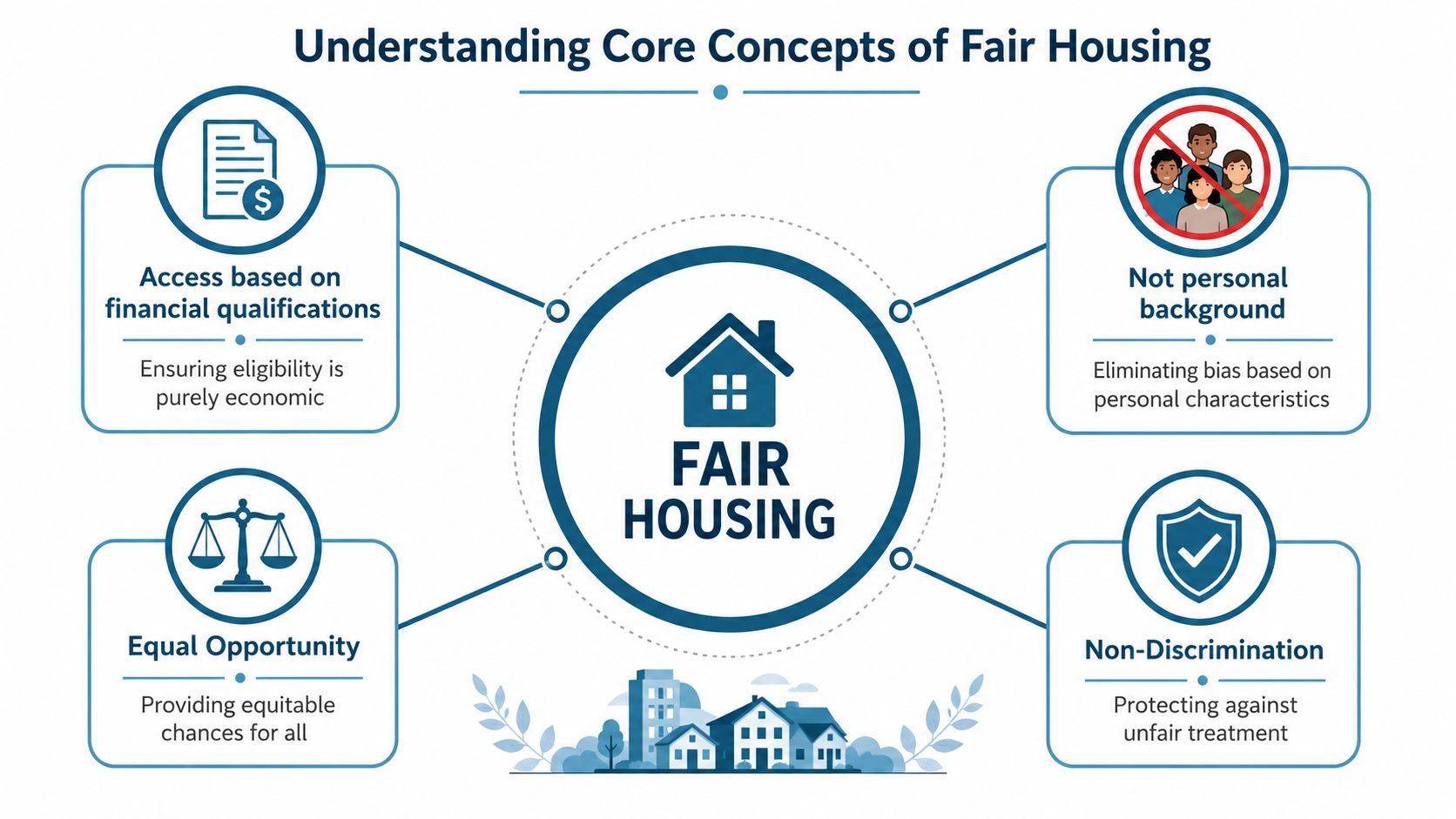
    A diagram outlining the core concepts of fair housing, including financial qualifications, non-discrimination, and equal opportunity.

    The difference between market criteria and protected traits

    A practical test helps.

    • Allowed focus: Price, number of bedrooms, lot size, flooring, updated systems, parking, transit access, HOA rules, lease terms, application steps.
    • Unsafe focus: The kind of person who should live there, assumptions about who belongs in the area, coded references to religion or ethnicity, or language that signals preference for households with or without children.

    The trouble is that many violations don't sound extreme. “Perfect for families,” “walk to church,” “safe neighborhood,” and “ideal for young professionals” all steer attention toward protected-class implications or demographics instead of the property itself. That's why agents should learn how to write compliant property descriptions before they scale content across MLS, social, and email.

    Disparate treatment and disparate impact in daily practice

    Disparate treatment is intentional difference in treatment. One buyer gets shown certain homes and another doesn't because of a protected trait. One renter gets different terms. One prospect gets discouraged.

    Disparate impact is harder to catch. A policy or tool looks neutral, but the effect falls more heavily on a protected group. That can happen in screening workflows, lead routing, neighborhood copy, and AI-generated content.

    If your process is neutral on paper but exclusionary in effect, regulators and complainants may still care about the outcome.

    That's why compliance isn't only a language exercise. It's also a systems exercise.

    Legal History and Protected Classes

    Fair Housing law matters more when you understand what it was built to change. The legal framework wasn't designed as a marketing style guide. It was designed to dismantle discrimination in housing access and create a market where people compete on legitimate qualifications rather than background.

    On April 11, 1968, President Lyndon B. Johnson signed the Civil Rights Act of 1968, including Title VIII, known as the Fair Housing Act, according to the Department of Justice history of federal fair housing enforcement. At enactment, the law immediately covered approximately 1,000,000 units of government-owned or government-financed housing dating from November 1962, and by December 31, 1968, coverage expanded to roughly 43,000,000 additional housing units. The same DOJ history notes this was the first American law to explicitly ban racial discrimination in housing sales and rentals.
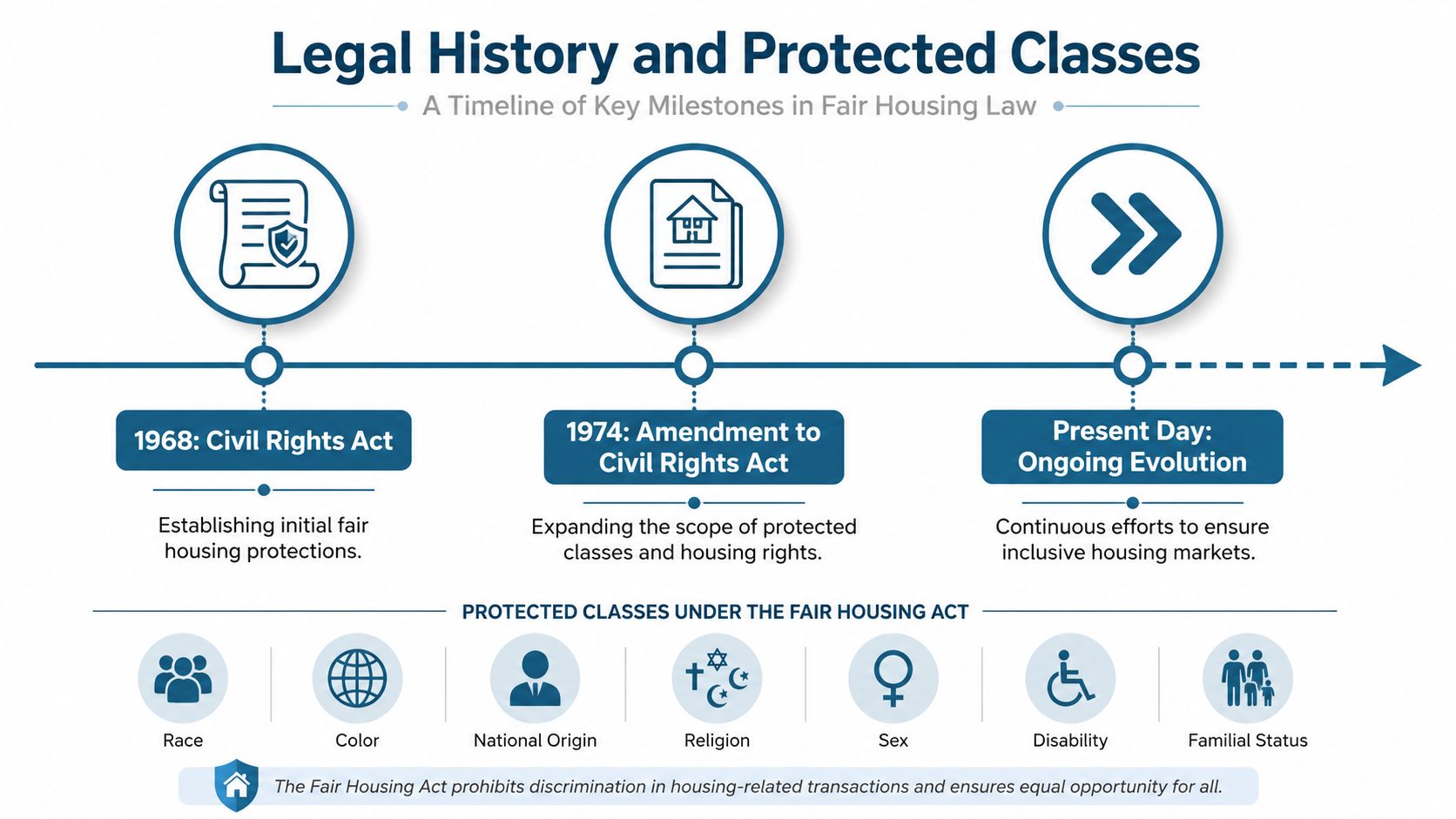
    A timeline graphic showing key milestones in US fair housing law and its seven protected classes.

    How the protected classes expanded

    Fair Housing didn't stop with the original law. The DOJ summary of the Fair Housing Act's development explains that over the decades following its 1968 enactment, the protected classes under fair housing laws expanded from the original four to include seven distinct categories through specific congressional amendments, altering the scope of legal protection for Americans.

    The timeline matters:

    Year Change Why agents should care
    1968 Added protections based on race, color, religion, and national origin Advertising and service practices could no longer lawfully sort people on those grounds
    1974 Added sex Marketing language and treatment could not lawfully reflect sex-based preference
    1988 Added disability and familial status through the Fair Housing Amendments Act Accessibility, family-related restrictions, and disability-related treatment became central compliance issues

    Today, the Act covers discrimination by direct housing providers and also reaches municipalities, banks, and homeowners insurance companies on the seven federal classes listed above, as described in that same DOJ resource.

    Why 1988 changed daily operations

    For most real estate professionals, the 1988 amendments changed the job in two major ways.

    First, familial status rules mean you can't market or manage housing in a way that disadvantages households with children under age 18. That includes special restrictions that isolate families or limit access to services or amenities.

    Second, disability protections reach both treatment and physical access issues. The Fair Housing Act's design and construction requirements apply to covered multifamily dwellings designed for first occupancy after March 13, 1991, and HUD's technical overview of design and construction requirements lays out seven required accessibility features, including an accessible entrance, usable common areas, usable doors, accessible routes within the unit, reachable controls, reinforced bathroom walls for future grab bars, and maneuverable kitchens and bathrooms. Failure to meet those standards is treated as disability discrimination under the Act.

    The compliance lesson for agents is simple. Disability issues don't begin and end with accommodation requests. They can start with the physical product, the listing language, and the way you answer questions about usability.

    State and local law create the real patchwork

    Federal law gives you the floor, not the full map. State and local rules often add categories or create different standards for advertising and rental decisions.

    One of the most practical examples is source of income. Federal law doesn't include it as a protected class. But Michigan fair housing guidance makes clear that Michigan bans discrimination based on source of income in rental housing. That matters when agents use templates, canned responses, or AI prompts built around federal rules alone. A generic “Fair Housing compliant” content generator may miss a state-level issue entirely.

    This also matters in accommodation-related areas where state law and current legal interpretation can be complicated. For Texas practitioners handling questions around assistance animals, Bryan Fagan PLLC on Texas ESA rights is a useful legal resource to review with counsel when a file raises disability accommodation issues.

    The operating takeaway

    Agents don't need to memorize every statute. They do need a habit:

    1. Start with federal protected classes
    2. Check state and local additions
    3. Review office policy before publishing
    4. Escalate edge cases to counsel or your broker

    That's how you keep a national marketing workflow from creating local liability.

    Common Violations and Real-World Examples

    Most Fair Housing complaints in marketing don't begin with openly discriminatory language. They begin with “normal” copy that nudges the reader toward a preferred type of resident.

    A rental ad says the unit is “perfect for a quiet couple” and highlights the building as not suitable for children. That's a familial-status problem. The copy doesn't describe flooring, layout, lease terms, or building rules. It describes who the advertiser wants.

    A listing caption says the home is in a “safe neighborhood” and “ideal for young professionals.” The first phrase sounds routine, but it can imply a coded demographic judgment instead of an objective location feature. The second points directly toward age-related preference and a target occupant profile. Both are avoidable.

    Where AI creates new mistakes

    The newer risk is speed. Teams use AI to draft MLS remarks, Instagram captions, neighborhood guides, and reply templates. The draft reads clean, the agent is busy, and the post goes live without a legal review mindset.

    The problem is documented at a high level. The National League of Cities fair housing overview notes that recent data shows AI-generated content tools can produce unintentional biases that disproportionately exclude protected groups, leading to algorithmic discrimination violations under the Fair Housing Act.

    That risk shows up in subtle ways:

    • Neighborhood summaries that describe who tends to live there
    • School-area captions that imply family-status targeting
    • Lifestyle copy that nudges toward religion, age, or cultural identity
    • Lead-routing or matching language that sounds personalized but effectively steers

    A polished draft isn't the same thing as a compliant draft.

    What actually works in practice

    When agents catch these issues early, the fix is usually straightforward. Strip out the occupant language. Replace it with verifiable property details and neutral location facts.

    Instead of “great for families,” use the actual feature: “three-bedroom layout with a fenced yard and covered patio.”

    Instead of “walk to church,” use “located near neighborhood services, dining, and commuter routes,” assuming those facts are accurate.

    Instead of “safe neighborhood,” describe objective facts such as “gated entry,” “streetlights,” or “proximity to public transit,” if those are verified. Don't make safety judgments.

    The strongest teams train agents to treat every draft, especially AI output, as a first pass that must be edited through a Fair Housing lens before publication.

    Dos and Don'ts for Listing Content

    Most compliant listing writing comes down to one discipline: describe the property, not the person. That sounds basic, but many agents still drift into audience targeting because that's how consumer marketing usually works. Housing is different.

    Illinois guidance, summarized in HousingWire's fair housing compliance article, advises that ads should emphasize amenities and features rather than an “ideal tenant,” and recommends holding all agents to documented review processes for consistent compliance. That's exactly the right operational standard for brokerages.
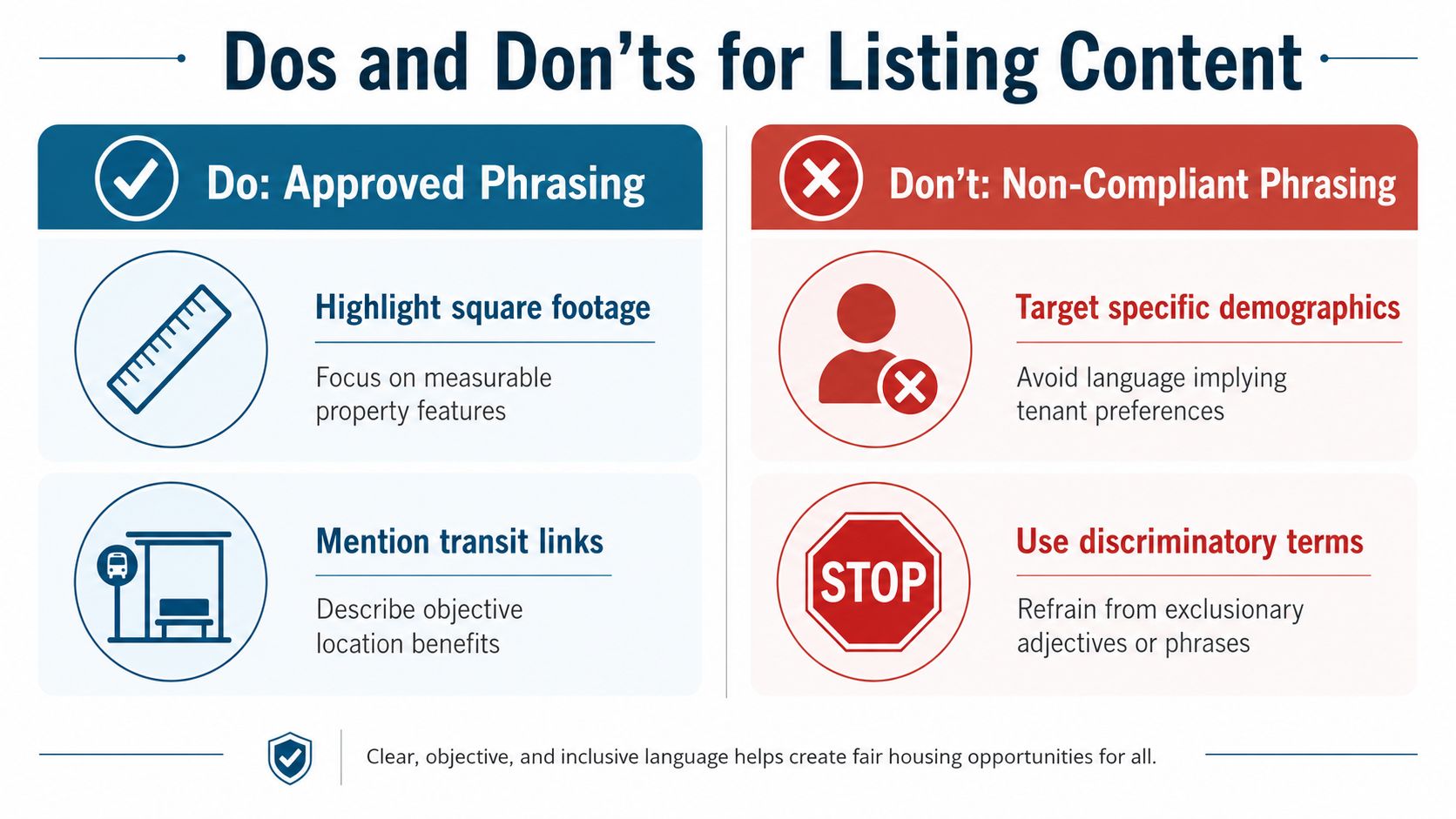
    An infographic titled Dos and Don'ts for Listing Content detailing fair housing guidelines for property listings.

    Better phrasing side by side

    Don't write Write this instead Why it works
    Perfect for families Three-bedroom home with a separate den and fenced backyard Focuses on layout and features, not familial status
    Ideal for young professionals Convenient access to downtown, transit, and coworking-friendly flex space Describes location and function without targeting a demographic
    Walk to church Near neighborhood amenities and community services Avoids religion-related implication
    Safe neighborhood Well-lit street, controlled-access entry, and sidewalks Uses objective facts instead of subjective safety claims
    Exclusive community Private cul-de-sac location with limited through traffic Removes exclusionary tone and states the physical characteristic

    A quick field checklist

    Before you publish, ask these questions:

    • Does this line identify a preferred resident? If yes, rewrite it around the home's features.
    • Am I making a judgment instead of stating a fact? Words like “safe,” “exclusive,” and “ideal” often create trouble.
    • Would this sentence sound different if a regulator read it instead of a seller? That's the right editing lens.
    • Did I verify each location claim? Transit access, nearby amenities, and building features should be factual.

    If you want more rewrite examples, this Compliant rental listing language from VerticalRent is a practical reference for ad phrasing decisions, and this ListingBooster resource offers a detailed guide to compliant real estate marketing.

    What doesn't work

    Agents get into trouble when they rely on “common sense” instead of a review standard. They also get into trouble when they assume coded language is safer because it's less explicit. Usually it isn't.

    Compliance note: If the phrase tells the reader who belongs there, take it out. If it tells the reader what the property offers, you're on safer ground.

    Consistent review beats clever wording every time.

    Enforcement and Penalties for Noncompliance

    A complaint rarely starts with the penalty chart. It usually starts with a listing, a caption, an AI-generated neighborhood summary, or an inconsistent response to two buyers asking the same question. By the time regulators or attorneys review the file, the issue is no longer just wording. It is whether the brokerage followed a repeatable process and can prove it.

    Financial exposure is real, but dollar amounts are only part of the risk. Enforcement can also bring testing, investigations, conciliation terms, training requirements, policy changes, reputational damage, and time pulled away from production. For teams using AI in marketing, there is an added problem. A fast drafting tool can multiply a bad phrase across MLS remarks, flyer copy, email campaigns, and social posts in one afternoon.

    Civil Penalties for Fair Housing Violations

    As noted earlier in the article, federal civil penalties can increase based on prior violation history. The larger point for working agents and brokers is practical. Repeat problems change how regulators and opposing counsel view your office. A one-off mistake is hard enough to explain. A pattern is much harder.

    State enforcement also matters. Some states and local jurisdictions apply broader protected classes or separate enforcement rules, so a line that looks acceptable under a general federal checklist may still create exposure in your market. That is one reason I advise offices to review AI prompts, listing templates, and ad approval workflows at the state level, not just the national level.

    What creates a defensible position

    A defensible file shows how the decision was made, who reviewed the content, what facts supported the description, and whether the same standard was applied across clients.

    The National Real Estate Services Authority compliance article highlights the basics that matter in an investigation: written intake procedures, use of client criteria only, records of properties or providers presented, and documentation of client interactions. That kind of audit trail matters even more when AI helps draft marketing copy. If a tool suggests language that creates steering or preference concerns, your office still owns the published result.

    Keep records that answer the questions enforcement staff usually ask:

    • What information did the client provide
    • What properties or options were shown
    • How were inquiries handled
    • Who approved the final listing or ad copy
    • What was edited, rejected, or regenerated in AI-assisted content

    That last point gets missed. If your team uses a Fair Housing compliant listing content tool, treat the output and the review history as compliance records, not just marketing drafts.

    A practical enforcement mindset

    Assume every published housing statement is discoverable. Assume text generated by AI will be judged the same way as text written by an agent. Assume inconsistency across leads, showings, or ad variants will look intentional unless your records show otherwise.

    Good compliance work is not about writing timid copy. It is about using objective facts, applying one review standard, and keeping records strong enough to defend the office if a complaint lands.

    Compliance Checklists and ListingBooster ai Integration

    A listing goes live at 9:00 a.m. By lunch, the seller loves the wording, the agent likes the speed, and nobody has noticed that the AI draft described the home as "perfect for young families" and the area as "exclusive." That is how Fair Housing problems enter ordinary marketing workflows. The issue is rarely bad intent. It is weak process.

    A workable compliance system gives agents clear drafting rules, a review path, and records that hold up if a complaint reaches the broker, state regulator, or HUD investigator. As noted earlier, offices need written procedures and consistent documentation. Here, the practical question is how to turn that standard into day-to-day listing production, especially when AI is involved and state rules may be stricter than the federal floor.
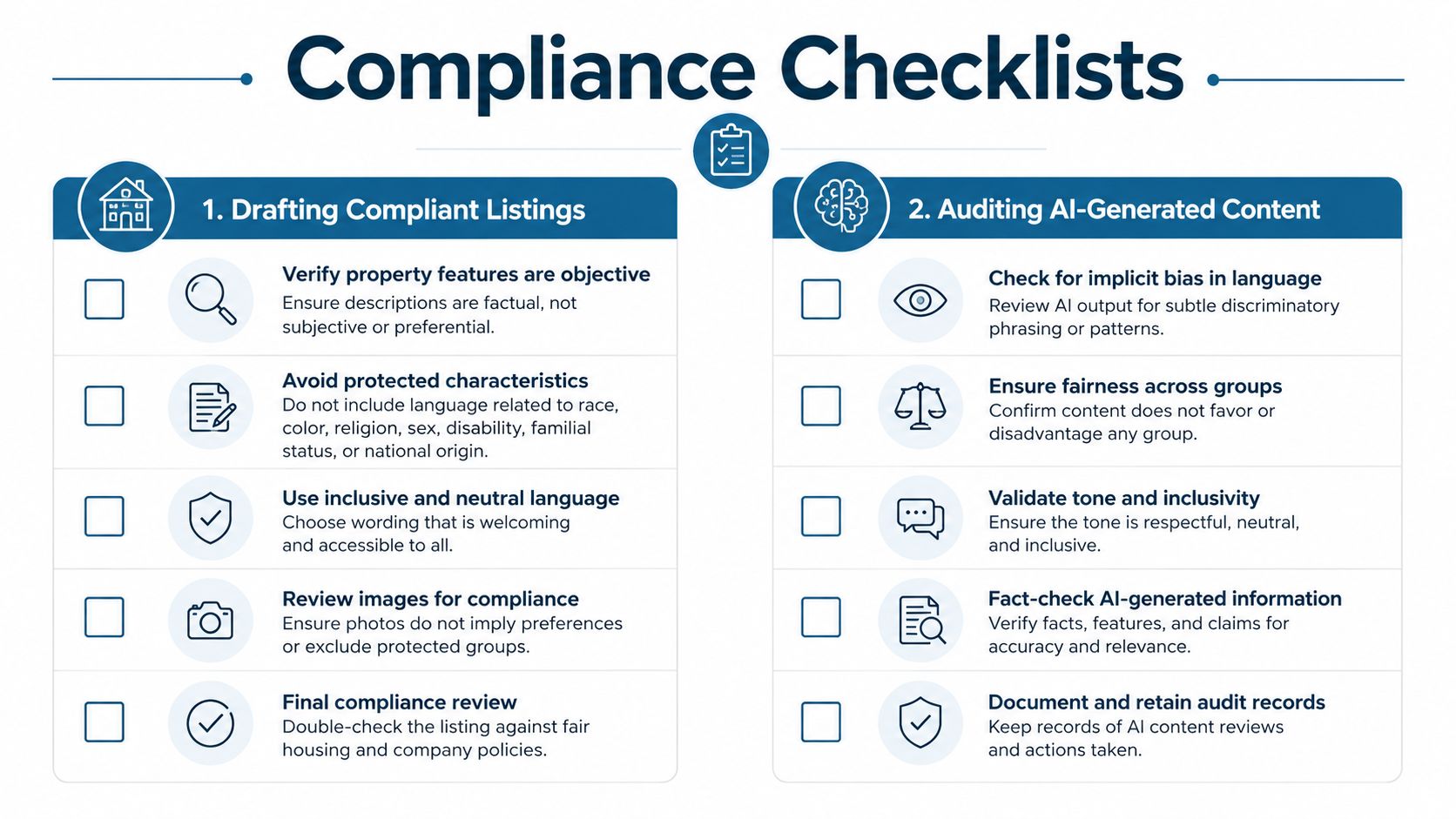
    A compliance checklist infographic for real estate listings and auditing AI-generated content for fair housing standards.

    Checklist for drafting compliant listings

    Use one review standard before MLS entry, syndication, paid ads, or social posting.

    • Start with verified property facts
      Confirm bedrooms, bathrooms, square footage, parking, amenities, access features, and location details against the file. Marketing copy should add clarity, not new claims.

    • Describe the property, not the ideal occupant
      Cut phrases that suggest who belongs there. Replace them with factual details about layout, condition, features, and permitted uses.

    • Keep neighborhood references objective
      "Near commuter rail," "close to public parks," and "easy access to I-95" are easier to defend than statements tied to demographics, culture, or assumed lifestyle fit.

    • Screen for protected-class issues and local-law additions
      Federal law is the starting point. State and city law may add classes such as source of income, sexual orientation, gender identity, marital status, age, military status, or lawful occupation. A phrase that passes one review standard in one state may create trouble in another.

    • Apply the same approval process to every listing
      Inconsistent review is where patterns form. Regulators and plaintiffs' counsel look for repeat behavior across agents, offices, and ad variants.

    Checklist for auditing AI-generated content

    AI speeds up drafting. It also introduces a specific risk: the system may generate polished language that sounds marketable but shifts from property facts into preference, exclusion, or coded phrasing.

    1. Read every line as advertising copy, not draft text
      If it is public-facing, review it as if it will appear in a file exhibit later.

    2. Compare the output to source documents
      AI often fills gaps with assumptions. Remove anything the listing file, seller disclosures, or broker instructions do not support.

    3. Flag coded terms
      Words like "exclusive," "safe," "private community," "ideal for families," or "walk to church" can create Fair Housing issues depending on context.

    4. Check for state-specific risk
      A broad AI prompt may produce language that ignores local protected classes or advertising rules. Brokerages operating across state lines should not rely on one generic prompt set.

    5. Save the approved version and the review history
      Keep the final copy, material edits, and reviewer identity. If the office uses AI, retain enough history to show what was changed and why.

    Where software helps and where it stops

    Software can standardize first drafts, flag obvious terms, and create a cleaner approval workflow. It does not replace broker supervision or legal judgment. I have seen teams get into trouble because they treated AI output as pre-cleared copy rather than a draft that still needed Fair Housing review.

    That is where specialized tools have a real advantage over general-purpose chat tools. A Fair Housing compliant listing content tool can help agents produce property-first copy, keep edits visible, and support a repeatable review process built for real estate marketing. The value is not speed alone. The value is a system that helps the office publish consistent language across listings, ad channels, and agents.

    The trade-off is straightforward. Manual review gives experienced agents flexibility, but it breaks down fast in a high-volume office. Standardized AI workflows improve consistency, but only if the brokerage sets the rules, trains agents on state-level differences, and audits what gets published. Use the tool. Keep the human review. Treat both as part of the compliance record.

  • Your AI-Powered Real Estate Listing Marketing Plan for 2026

    Your AI-Powered Real Estate Listing Marketing Plan for 2026

    You've probably lived this week already. A listing agreement gets signed, photos are getting scheduled, the seller wants to know exactly how you'll promote the property, and your team starts assembling the usual stack: MLS copy, social posts, an email blast, an open house graphic, a flyer, and maybe a video if someone has time.

    That scramble used to be normal. It's still common. But it's no longer efficient, and what's more, it's no longer enough.

    A modern real estate listing marketing plan has to do two jobs at once. It has to persuade human buyers on the channels they already use, and it has to make your listing and your brand understandable to AI-driven search tools that summarize, recommend, and filter options before a buyer ever clicks through. If your workflow still depends on disconnected vendors, manual copywriting, and last-minute posting, you're losing time, consistency, and visibility.

    The agents getting traction now aren't necessarily creating more content by hand. They're building systems that turn one listing into a month of compliant, channel-specific marketing assets that stay on brand and support measurable ROI.

    Why Your Current Listing Marketing Plan Is Becoming Invisible

    Most agents still build a listing campaign for platforms they can see. Instagram. Facebook. The MLS. An email newsletter. Maybe a property website. That checklist feels productive because it's familiar.

    The problem is that buyer discovery has changed faster than most listing workflows. Existing marketing plans often focus on traditional SEO and social posts, but they miss the schema markup, natural-language descriptions, and digital footprint work that help agents appear in AI search results. That gap matters because AI search engines now dominate 40% of buyer searches, according to Marq's discussion of AI search visibility in real estate marketing.

    AI search doesn't behave like old search

    Google used to reward the page that ranked. AI tools reward the source they can interpret with confidence.

    When a buyer asks ChatGPT or Perplexity a question like “Which agents market homes well in North Dallas?” or “Show me a renovated three-bedroom home near downtown with a yard and modern kitchen,” the answer isn't a page of blue links. It's a summary. A recommendation set. A narrative response built from structured signals across the web.

    That changes what a real estate listing marketing plan has to accomplish.

    • Your listing copy must be readable by AI. That means clean property facts, natural descriptions, and consistent wording across channels.
    • Your digital footprint has to match. If your website says one thing, social captions say another, and portal descriptions are thin or generic, AI has less confidence in surfacing you.
    • Your content has to exist beyond launch day. One “just listed” post isn't a marketing plan. It's a moment.

    If you want a useful refresher on channel-level execution, these actionable real estate marketing tactics are worth reviewing. The missing piece is connecting those tactics into a system that also works for AI discovery.

    Practical rule: If your marketing only works when someone scrolls directly onto your post, it's too fragile for the current search environment.

    Old checklists are still busy. They're just less effective

    A lot of listing plans still look polished on paper and underperform in practice. They rely on a burst of activity at launch, then fade into inconsistent follow-up. They generate assets manually, which means quality depends on how busy the agent is that week. They're built for platforms, not for discoverability.

    That's why so many otherwise capable agents feel like their effort isn't compounding. They are working. Their content just isn't being assembled in a way that machines can interpret and buyers can keep finding.

    A real estate listing marketing plan for the current market has to be built as a repeatable content engine, not a launch checklist.

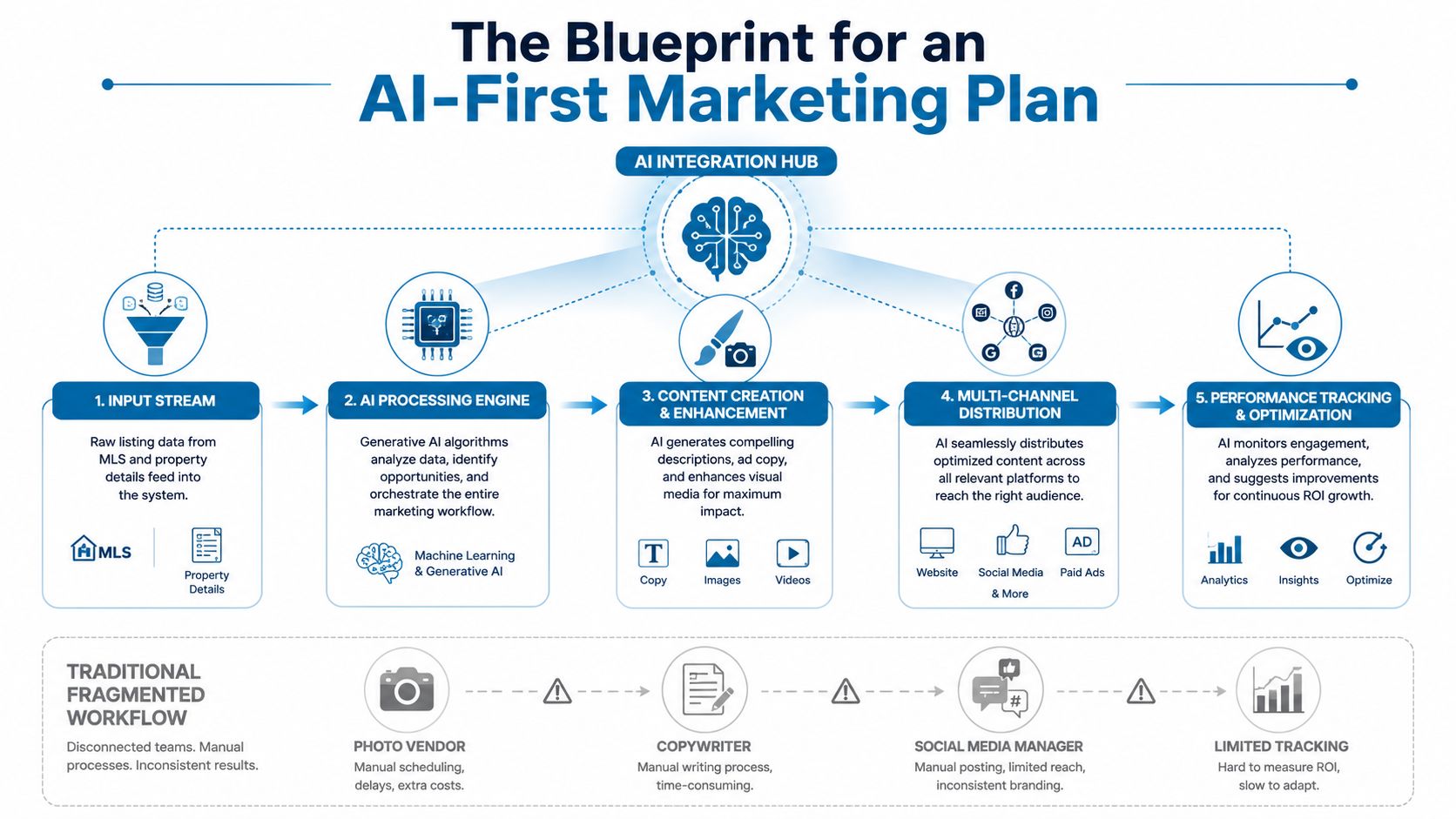
    The Blueprint for an AI-First Marketing Plan

    The old workflow is fragmented. You book a photographer. You draft MLS remarks. You ask someone on the team to make social graphics. You rewrite the same property story three times for different platforms. Then you try to remember what was posted, what still needs an email, and whether the property page is doing any heavy lifting.

    An AI-first workflow starts from a different assumption. The listing is the core asset. Everything else should be generated, adapted, distributed, and tracked from that source.

    A diagram illustrating a five-step AI-first marketing plan compared to a fragmented traditional real estate workflow.

    Start with assets that actually matter

    No AI tool can rescue weak inputs. The foundation is still visual quality, accurate property data, and a dedicated destination page for the listing.

    Listings with high-quality professional images sell 68% faster than listings without them, according to Matterport's real estate marketing plan guidance. That isn't a nice-to-have. It's the baseline.

    A strong listing asset stack usually includes:

    • Professional photography. Not just enough photos, but the right photos, edited consistently and sequenced well.
    • Structured property details. Address, bed and bath count, lot details, major upgrades, room highlights, school or location facts stated carefully and factually, open house times, and showing instructions.
    • A dedicated property page. The page should hold the full story with rich media such as virtual tours, floor plans, and high-resolution visuals, rather than sending traffic to a generic homepage.
    • Image metadata. Clear file names and alt text help search engines and accessibility tools understand what each image represents.

    Build once, adapt many times

    This shift is operational. Instead of writing separate pieces from scratch, you create one source package and let AI produce channel-specific variants.

    That source package should feed:

    Core listing input AI output
    Property facts MLS-ready description
    Photo set Social captions and graphic prompts
    Listing page copy Email teaser and website content
    Open house details Event posts and reminder copy
    Status changes Pending and sold announcements

    Purpose-built real estate tools differ from generic chatbots. A generic tool can produce text. It usually doesn't understand MLS tone, Fair Housing boundaries, listing status transitions, or the need to turn one property into a coordinated campaign. ListingBooster.ai is one example of a real-estate-specific system built around that workflow, generating listing descriptions and social content from property inputs rather than requiring agents to invent every asset manually.

    The operating model matters more than the prompt

    Agents often ask whether they can do this with ChatGPT plus a few templates. Technically, yes. Operationally, it gets messy fast.

    You still need to control brand voice, route approvals, keep required disclosures in place, and make sure each format is suited to the platform. If you're evaluating how AI should publish and manage content safely across channels, Mallary.ai's AI social media guide is a practical read because it focuses on workflow discipline instead of novelty.

    The winning setup isn't “AI writes a caption.” It's “the listing generates a complete campaign without forcing the agent to rebuild the story every time.”

    What an AI-first plan includes

    A workable real estate listing marketing plan now has five connected layers:

    1. Capture the listing cleanly
      Pull in property facts, visual assets, status, dates, and any seller-approved notes.

    2. Generate a master narrative
      Create the central property story in natural language, grounded in features, finishes, layout, and location details.

    3. Transform that narrative into channel variants
      Produce social captions, email copy, listing descriptions, ad copy, open house promos, and follow-up status posts.

    4. Publish to multiple destinations
      Send traffic to the dedicated property page, not a catch-all homepage.

    5. Track response by source
      Attribute inquiries, appointments, and downstream outcomes to the content and channel that produced them.

    Agents who adopt this model don't just save time. They get consistency. Their seller presentations improve because they can show a complete plan. Their team execution gets tighter because everyone works from the same source material. And their listings become easier for both buyers and AI tools to understand.

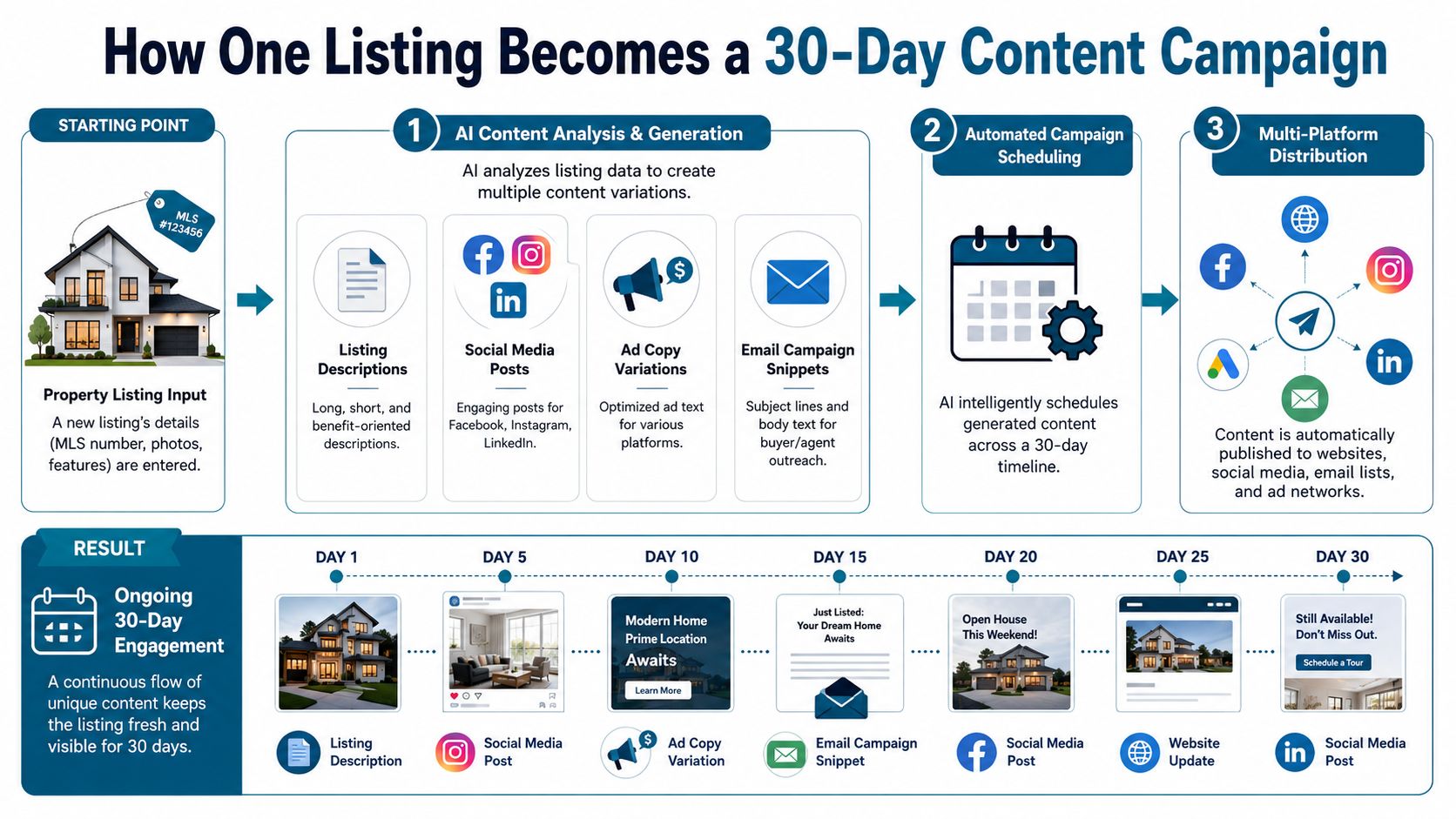
    How One Listing Becomes a 30-Day Content Campaign

    The easiest way to understand a modern real estate listing marketing plan is to stop thinking in assets and start thinking in campaign arcs. One property should create enough raw material to support launch, engagement, reminders, event promotion, status updates, and post-sale authority content.

    That doesn't mean posting the same photo with a different caption over and over. It means extracting distinct angles from the same listing and assigning each angle to a different moment in the month.

    A diagram illustrating how an automated AI tool transforms a single real estate property listing into a 30-day marketing campaign.

    Start with the property record, not a blank page

    Take a newly signed listing. You upload the address or MLS details, the photo set, the core features, any notable upgrades, showing notes, and the open house schedule if you have it.

    From there, the campaign should branch into six practical content streams.

    1. The listing description

    This is the anchor piece. It has to work for the MLS, for portal syndication, for your property page, and for AI search interpretation.

    Good listing copy does three things well:

    • It describes the property by features. Layout, materials, updates, light, outdoor space, storage, and functional details.
    • It avoids audience assumptions. No language about who should live there.
    • It creates scan-friendly structure. Buyers and AI systems both respond better to clear, factual, natural phrasing.

    A compliant example angle might read like this:

    Renovated kitchen with quartz surfaces, updated lighting, and an open connection to the main living area. The primary suite includes a reworked bath and improved storage. Outdoor features include a covered patio, fenced yard, and recent landscaping.

    Nothing in that copy relies on hype or protected-class implications. It provides useful information.

    Turn launch week into multiple stories

    The first mistake agents make is treating “Just Listed” as a single post. It should be a sequence.

    Short-form video is especially important here. In the pre-listing phase, mobile-first vertical short-form video drives 403% more inquiries and can lead to 6% higher sale prices compared to static listings, according to Reel Estate AI's real estate marketing statistics roundup. That's why launch content should be designed for phones first.

    A practical launch week might look like this:

    • Day 1 just listed post
      A broad introduction with the hero exterior image and a clear CTA to view the full property page.

    • Day 2 room highlight post
      Focus on the kitchen, living area, or primary suite. One feature, one visual story.

    • Day 3 short-form video
      A vertical walk-through teaser with text overlays that surface key facts immediately.

    • Day 4 email teaser
      A tight subject line, a short body, one image, and a direct link to the property page.

    • Day 5 market-angle post
      Position the home within current local inventory, carefully and factually, without making future-value claims.

    • Day 6 open house announcement
      Event details, parking or access notes if relevant, and a simple invitation to tour.

    • Day 7 reminder post
      A last call before the open house with a different image and a different angle.

    What the content actually looks like

    Agents need output, not theory. One listing can produce varied content such as:

    Content type Example angle
    Just listed caption New to market with updated interiors and a flexible floor plan
    Email teaser New listing with refreshed kitchen, outdoor living space, and weekend tour times
    Open house copy Tour the home in person and review updates, layout, and outdoor features
    Pending post Under contract with continued demand in the area
    Sold post Closed successfully with a tailored launch-to-close campaign
    Market insight post What buyer response to this listing says about current demand for updated homes

    Each piece should sound different because each serves a different purpose. Launch content creates awareness. Open house content drives attendance. Pending and sold content build authority and neighborhood visibility. Market insight content helps sellers understand how you think.

    For agents who want a planning template for spacing these posts across the month, this real estate content calendar for agents is a useful companion.

    Post variety matters more than post volume. Buyers tune out repetition quickly, but they respond to new angles on the same property.

    Use strategic omission when the platform calls for it

    Not every platform should get the full information set upfront. Standard advice says more photos create more interest. In practice, some channels reward restraint.

    On Facebook Marketplace, many agents find that teaser-style presentation creates stronger inquiry behavior than fully revealing every decision-making detail in the preview. One useful tactic is to hold back a major image, such as the kitchen or primary bedroom, and let the initial Marketplace preview lead with exterior shots and a clear value hook. The goal isn't to be vague. It's to create enough curiosity to move a buyer into a message, click, or tour request.

    That's the kind of judgment a good campaign needs. Distribution shouldn't be robotic. It should be adaptive.

    The middle of the month is where automation pays off

    Once launch week passes, most listings go quiet. That's a mistake. The middle stretch is where consistent content keeps a property discoverable and keeps your brand in front of future sellers.

    A single listing can generate mid-cycle posts like:

    • Feature spotlight posts that rotate through kitchen, outdoor area, bath updates, floor plan flexibility, and storage
    • Behind-the-scenes posts showing preparation, staging details, or photography day notes
    • Open house countdown posts with different visuals and short, direct copy
    • Agent insight posts about how the listing was positioned and marketed
    • Status-change copy ready to publish the moment the listing moves to pending

    A product-led workflow saves real time. Instead of inventing content after each showing or schedule change, the campaign already exists. You edit, approve, and deploy.

    Don't waste the post-sale moment

    Many agents stop marketing when the contract is signed. That leaves a lot on the table.

    The post-sale stage should include:

    1. Pending announcement copy
      Useful for social proof and seller confidence in nearby homeowners.

    2. Just sold content
      Framed around execution, presentation, and process, not exaggerated claims.

    3. Market insight commentary
      A short post on what buyer engagement revealed about demand for similar homes in that area.

    4. Neighbor-facing follow-up
      Clean, factual communication that invites nearby owners to ask what's moving in the current market.

    Done well, one listing doesn't just sell one home. It fills your pipeline, supports your authority, and gives you a reusable content engine.

    Mastering Compliance and AI Search Optimization

    Most AI marketing mistakes in real estate don't happen because the tool wrote awkward copy. They happen because the tool wrote risky copy.

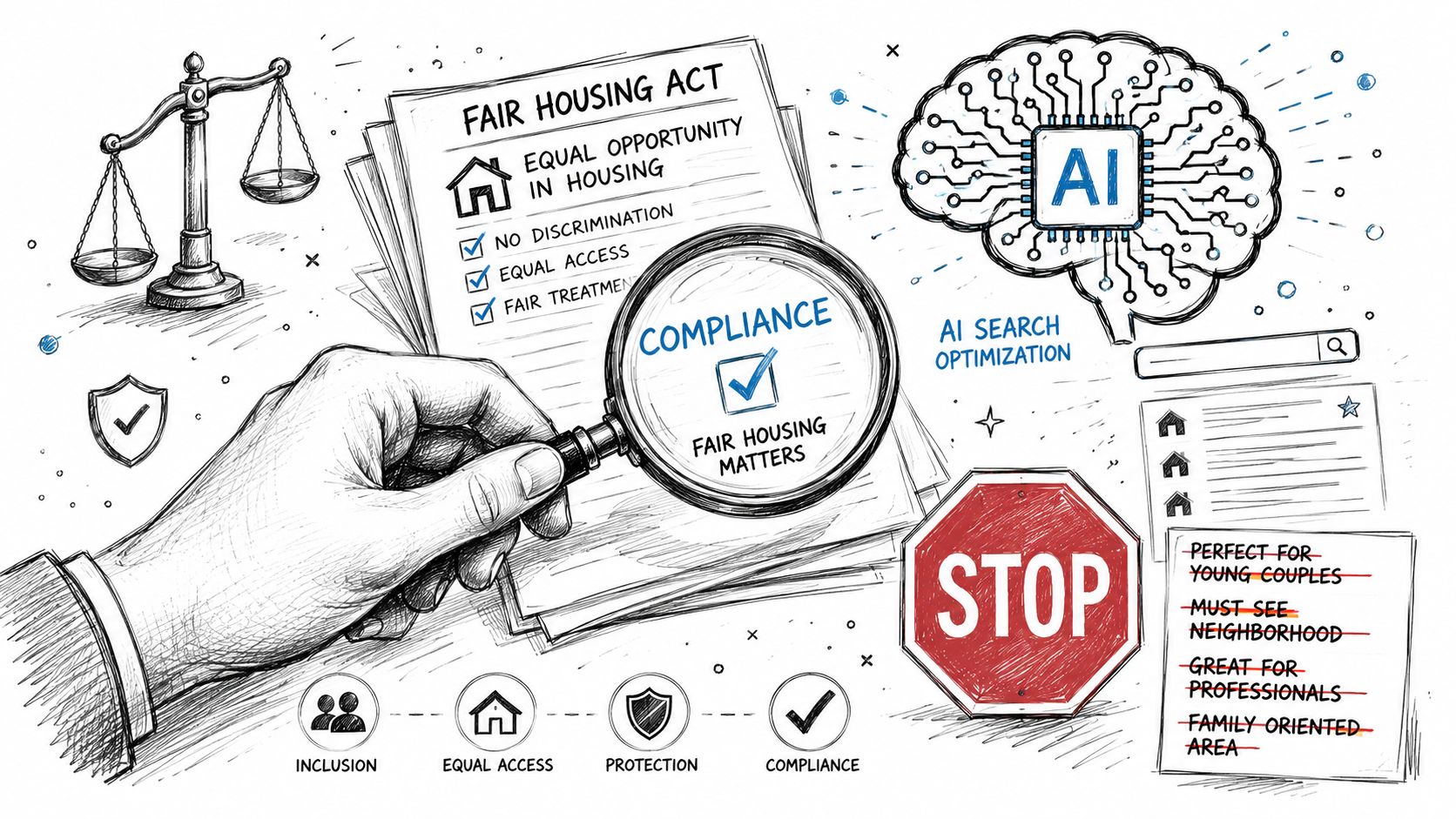
    Generic AI systems don't understand the pressure points of real estate advertising unless the user catches them. They'll often mirror bad prompts, amplify subjective claims, or produce language that creates Fair Housing exposure. That's not a minor editing issue. It's a workflow flaw.

    A hand holds a magnifying glass over documents titled Fair Housing Act, emphasizing compliance and equal opportunity.

    Feature-based writing keeps you out of trouble

    The fastest way to create compliance risk is to write for a person instead of for the property.

    “Perfect for families.” “Ideal for young professionals.” “Safe area.” “Walk to church.” Those phrases are common. They're also exactly the kind of language agents need to remove from an AI-assisted process.

    A compliant system should generate copy around:

    • Property features such as layout, finishes, lot size, storage, views, and outdoor elements
    • Objective location details such as proximity to transit, parks, dining, or major routes, stated factually
    • Verifiable upgrades such as new roof, updated kitchen, or renovated bath, if documented
    • Event and access information such as open house timing or tour instructions

    California's advertising guidance also requires claims to be accurate and verifiable, and it specifically warns against unsupported statements about value or future market performance. In Texas, advertising rules require the broker's name to appear clearly and at a specific size relationship in ads. State-level requirements vary, which is another reason generic AI needs supervision before anything goes live.

    Disclosure requirements have to be built into the workflow

    For REALTORS®, disclosure isn't optional or platform-specific. Under the NAR Internet Advertising Policy, every page marketing properties or services must disclose the agent's full name, the brokerage name, the office city and state, and the jurisdictions where the agent holds a license, as outlined in NAR's Internet Advertising Policy.

    That matters for websites, landing pages, listing pages, and any AI-generated property marketing that lives on a page of its own.

    A lot of agents remember to add this on their main site and forget it on standalone listing pages or campaign pages. AI-generated content needs those fields wired in automatically, not added manually when someone remembers.

    If your AI can generate a property page but can't reliably place required advertising disclosures on that page, it isn't ready for production use.

    For a practical reference on where AI-generated content can drift into Fair Housing risk, this Fair Housing guide for AI-generated real estate content is worth keeping handy for your team.

    AI search optimization is really structured clarity

    A lot of “AI optimization” talk gets abstract fast. In practice, it's straightforward.

    AI systems surface content they can classify confidently. That means your property marketing should tell the machine, clearly and consistently, what the page is, who it's from, and what facts it contains.

    That usually includes:

    Element Why it matters
    Clear property page title Helps identify the listing and location
    Natural-language description Gives context in readable form
    Consistent agent and brokerage information Reinforces authorship and trust
    Rich media on the listing page Expands the page beyond thin text
    Schema markup Signals that the page represents a property for sale or related real estate content

    Many generic tools fall short; they can draft text, but they don't help you create the full package that supports AI discoverability. A specialized real estate workflow is better suited to handling property context, disclosures, and structured output together.

    Compliance and visibility are linked

    Agents often treat compliance as the brake and marketing as the gas. In reality, clean compliance improves visibility because it forces clearer language, cleaner structure, and more consistent attribution.

    The same discipline that keeps you from writing a risky caption also helps AI systems understand your content better. Feature-based copy is easier to classify. Required disclosures strengthen trust signals. A dedicated property page with rich media gives search systems more context.

    That's why the right setup isn't just “AI plus review.” It's AI trained and structured for real estate from the start.

    Evaluating AI Solutions and Measuring True ROI

    The AI tool market is crowded, and most demos look better than real daily use. The useful question isn't whether a platform can generate text. Nearly all of them can. The question is whether it fits the way a real estate listing marketing plan runs.

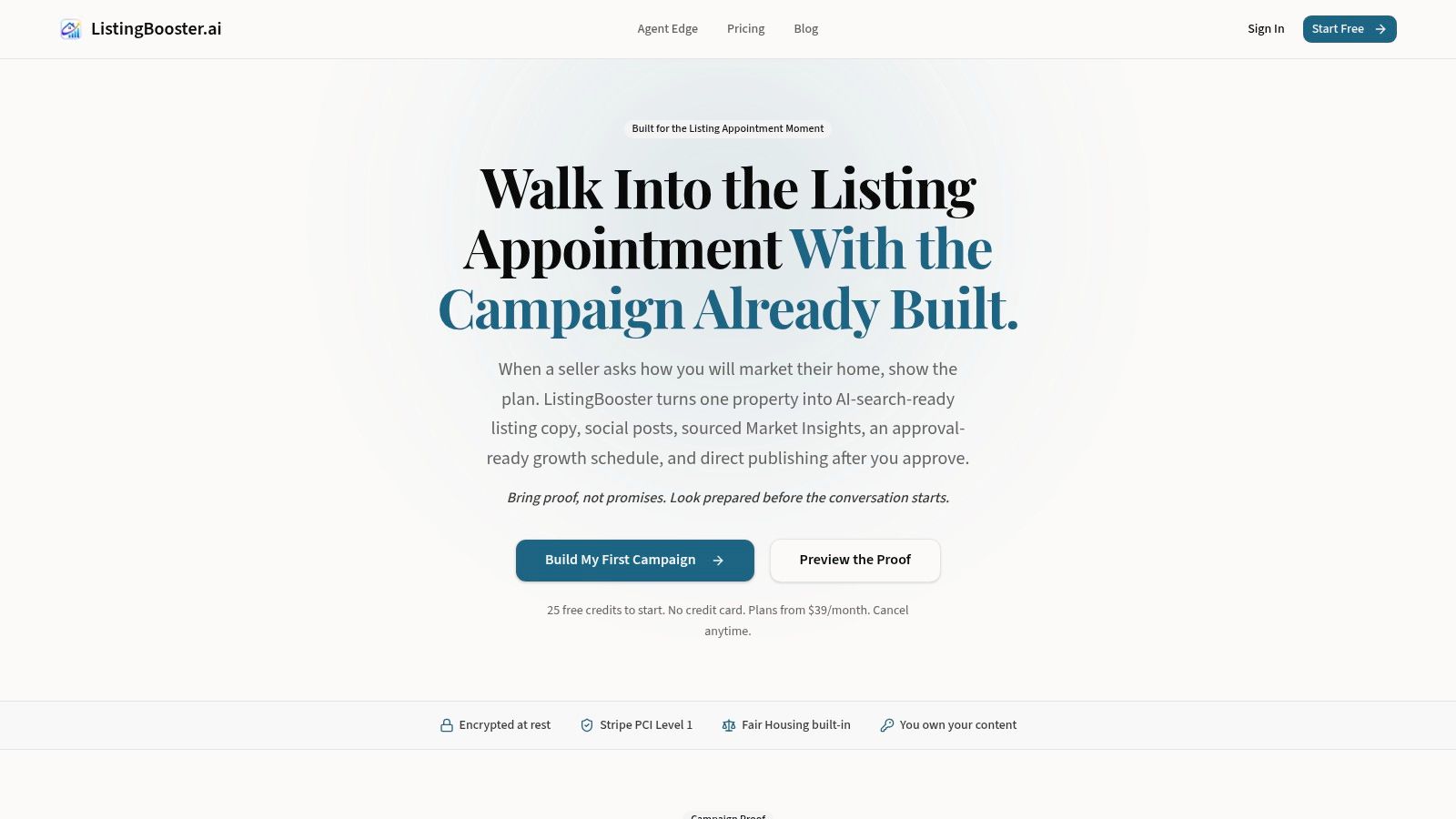
    Screenshot from https://listingbooster.ai

    A buyer's checklist for AI marketing tools

    When agents evaluate AI tools, I recommend ignoring the flashy output for a minute and checking the workflow requirements first.

    Ask these questions:

    • Is it built for real estate?
      A general writing assistant may help with rough drafts, but it usually won't understand listing statuses, portal copy, open house promotion, or brokerage-level compliance needs.

    • Does it support compliant content creation?
      Real estate marketing needs guardrails around audience language, subjective claims, and disclosures.

    • Can it create a full campaign from one listing?
      If the system still forces you to rebuild every caption, email, and status update from scratch, the time savings won't hold up in practice.

    • Does it support AI-readable output?
      Your workflow should help create property pages and content structures that machines can interpret, not just people.

    • Can your team use it under pressure?
      The right tool has to work when a listing goes live, price changes, or an open house gets added late.

    A lot of brokers are also asking a broader business question right now, not just a marketing one. This overview on understanding AI's profitability is useful because it frames AI as an operational investment, not just a novelty purchase.

    Stop measuring likes as if they're the goal

    A weak AI setup can still produce posts that look active. That doesn't mean it's producing business.

    The average real estate sector conversion rate is 2.8% to 4.7%, and success should be measured by tying every lead and appointment directly to the marketing spend that generated it, as noted in SearchLab's real estate marketing statistics. That standard changes how you judge a listing campaign.

    A useful scorecard looks more like this:

    Measure Why it matters
    Inquiries by source Shows which channels produce real response
    Appointment bookings Tells you whether content is moving people to action
    Showing requests Reflects listing-level intent better than likes
    Lead-to-appointment path Exposes friction in follow-up or landing pages
    Cost tied to each inquiry and appointment Reveals what spend is actually productive
    Closings attributed to campaign source Validates ROI at the business level

    What to track inside the campaign

    Real estate marketing gets blurry when all traffic lands in one place and everything shows up as “direct.” That's why disciplined attribution matters.

    At minimum, your workflow should answer:

    1. Which post or email produced the click?
    2. Which landing page produced the inquiry?
    3. Which inquiry became a conversation, showing, or appointment?
    4. Which appointments closed?

    If you can't answer those four questions, your reporting is too shallow. You're measuring activity, not outcomes.

    For teams refining this process, these real estate marketing ROI tools can help shape a cleaner tracking setup.

    The metric that matters isn't “Did people engage with the content?” It's “Which content produced the next business step?”

    Budget discipline still matters

    AI can lower the time cost of marketing, but it doesn't remove the need for budget decisions. Many agents still use the general rule of thumb to allocate around 10% of annual revenue to marketing, which gives structure to choices around media, campaigns, and support tools. What changes with AI is how much output you can produce from the same input and how consistently you can execute it.

    That's the ROI case. Better throughput. Better consistency. Better attribution. Fewer bottlenecks around launch week.

    Building Your Automated Marketing Machine

    A real estate listing marketing plan used to be a checklist. Schedule photos. Write the description. Post the listing. Send the email. Promote the open house. Update the status. Repeat.

    That manual model still works in the narrowest sense. Homes still get marketed. But it doesn't scale well, it breaks under volume, and it leaves too much to memory and improvisation.

    What the better system looks like

    An automated marketing machine does a few things differently:

    • It centralizes the listing story so your MLS copy, property page, social posts, and email all come from the same source.
    • It keeps compliance close to the workflow so disclosures and feature-based language don't depend on last-minute edits.
    • It turns one listing into sustained visibility rather than a burst of launch-day activity.
    • It makes ROI review possible because your content, pages, and campaigns are built with attribution in mind.

    The bigger shift is strategic. When your system creates a month of content from one listing, your marketing stops being reactive. Sellers feel that difference immediately. Teams feel it in consistency. Brokerages feel it in lower content chaos and fewer compliance surprises.

    Audit the process you're running now

    If you want to improve your current plan, start with simple questions:

    • Where are you rewriting the same property story repeatedly?
    • Which assets get created late because no one owns them?
    • Which pages or posts go live without complete disclosures?
    • What happens after the “just listed” moment passes?
    • Can you connect content output to appointments and closings?

    Those answers usually reveal the bottleneck quickly. It's rarely a lack of effort. It's usually a lack of system design.

    The agents who stand out now aren't just better at posting. They're better at building a repeatable machine that makes every listing more discoverable, more consistent, and easier to market without starting from zero each time.


    If your current workflow still depends on scattered drafts, rushed captions, and manual follow-up, it's worth taking a close look at ListingBooster.ai. It's built specifically for real estate agents, teams, and brokerages that want to turn one property into a full set of compliant listing descriptions, social posts, and campaign assets without rebuilding the marketing plan from scratch every time.

  • Unlock Growth: Social Media Brand Guidelines for Real Estate

    Unlock Growth: Social Media Brand Guidelines for Real Estate

    At its core, a social media brand guideline is simply your playbook. It’s the rulebook that defines how your brand looks, sounds, and acts online. For a real estate agent, this isn't just corporate fluff—it’s what ensures every post, from a new listing on Instagram to a market update on Facebook, is instantly recognizable as yours. It’s how you turn a chaotic social feed into a consistent, trust-building machine that attracts clients.

    Why Brand Guidelines Are a Real Estate Agent’s Secret Weapon

    With over 95% of homebuyers using the internet in their property search, your social media presence is no longer just a marketing add-on. It’s your digital storefront, your first impression, and your ongoing conversation with potential clients. Without a clear plan, your posts can look messy, random, and unprofessional, which is a surefire way to confuse buyers and sellers. This is exactly where brand guidelines come in to save the day.

    A person planning a brand blueprint, working on a laptop with design blueprints and a model house.

    Think of your guidelines as the blueprint for building a home. A builder would never just start throwing up walls without a detailed plan, and you shouldn't try to build your brand without one either. These rules make sure every single element—from the fonts on a "Just Sold" graphic to the friendly tone of a video tour—works together to build a strong, appealing, and valuable brand.

    Building Trust Through Consistency

    Consistency is the bedrock of trust. It’s that simple. When potential clients see the same polished look and professional voice across your Instagram, Facebook, and LinkedIn, they start to see you as reliable and organized. It’s not just a feeling; studies show that maintaining a consistent brand can boost revenue by over 30% because it makes you memorable and credible.

    Your guidelines are what make this consistency possible. They spell out the key details, so whether it's you, your assistant, or even an automated tool posting, the message always feels like it came directly from you.

    A strong brand guideline is your promise to your audience. It says, "This is who I am, this is the quality you can expect, and I will deliver it every single time." This predictability is what transforms casual followers into loyal clients.

    From Solo Agent to Unified Team

    If you’re a solo agent, brand guidelines are your best tool for establishing authority. They help you carve out your specific niche and become the go-to expert everyone in your area thinks of first. But for a real estate team or brokerage, they are absolutely non-negotiable. They’re what makes you look like a unified force instead of a loose collection of individuals.

    Guidelines solve the most common branding headaches that teams face:

    • Mixed Messaging: They stop one agent from posting ultra-luxe content while another shares casual, behind-the-scenes videos. That kind of disconnect can seriously dilute the team's brand.
    • Visual Chaos: They ensure everyone uses the same approved logos, color schemes, and photo styles. The result? The entire team’s content looks polished, cohesive, and instantly recognizable.
    • Compliance Nightmares: They provide clear, simple rules on required disclosures, like including your brokerage info and license number on every post. This protects the whole team from costly legal and ethical missteps.

    In the end, a solid set of social media guidelines shifts your online efforts from a series of random acts into a predictable lead-generation system. They guarantee every piece of content you create is working toward a single, powerful goal: building a brand that clients recognize, trust, and ultimately choose to work with.

    The Building Blocks of a Memorable Real Estate Brand

    To build a social media presence that clients actually remember, you need a blueprint. Your social media brand guidelines are that blueprint—a detailed instruction manual that dictates every single thing you post online. This goes way beyond just picking a logo; it's about creating a consistent and professional experience for your audience.

    Think of it like designing a custom home. You wouldn't just pick a door color and call it a day, right? You'd obsess over the architectural style, the flow of the rooms, the interior finishes, and the overall feeling you want the home to evoke. Your brand requires that same meticulous planning to feel cohesive and instantly recognizable.

    What Goes Into Your Brand Guideline Document?

    Every agent's brand is unique, but the strongest ones are built on a solid, well-documented foundation. Think of this document as your North Star for every post, story, and video you create. It's the rulebook that keeps you, your assistant, or any marketing help you hire perfectly on-brand, every single time.

    Here are the non-negotiable elements you need to include.

    Table: Key Components for Your Brand Guideline Document

    Component Description Example for a Real Estate Agent
    Brand Voice The personality of your brand. It's who you are consistently. "The friendly, no-nonsense neighborhood guide who simplifies the buying process."
    Brand Tone The emotional flavor you add to your voice for specific situations. Celebratory: "We did it! Huge congrats to the Smiths on closing today!"
    Empathetic: "Feeling priced out? I get it. Here’s what the numbers really mean."
    Visual Identity The complete look and feel of your brand, from colors to fonts. Colors: Primary Blue (#003366), Accent Gold (#D4AF37).
    Fonts: Montserrat for headings, Lato for body text.
    Logo Usage Clear rules for how your logo should (and should not) be used. "Always include a 20px clear space around the logo. Use the all-white version on dark photos."
    Content Pillars The 3-5 core topics you will consistently post about. Market analysis, client success stories, local community spotlights, and home maintenance tips.
    Platform-Specific Rules Nuanced guidelines for how your brand shows up on different platforms. Instagram: Use high-res, bright photos. All video Reels must have captions.
    LinkedIn: Professional tone, focus on market data and career milestones.
    Compliance & Legal Mandatory disclaimers, hashtags, and logos you must include. "Must include Equal Housing Opportunity logo on all property posts. Add broker-required hashtags like #[BrokerageName] #[LicenseNumber]."

    Having this document ready means you never have to guess what to post or how it should look. It's your single source of truth for building a powerful and consistent brand online.

    1. Nail Down Your Brand Voice and Tone

    Let's start with what your brand sounds like. This is your brand voice—your brand's distinct personality. Are you the sharp, data-driven analyst who geeks out on market trends? Or are you the warm, approachable neighborhood expert who knows the best coffee shops and dog parks? There’s no wrong answer, but you have to pick a lane and stay in it.

    Your voice shapes how you write every caption, script every video, and even reply to comments. A consistent voice builds familiarity and trust, which is everything in this business. We cover this foundational step in more detail in our guide to building a powerful personal brand in real estate.

    Your tone, on the other hand, is the emotional inflection you apply to that voice. It adapts to the context of the post.

    • Your Voice is who you are. (e.g., "The Savvy Investor's Advisor")
    • Your Tone is how you feel in a specific moment. (e.g., using a celebratory tone for a "Just Sold" post or an empathetic tone when discussing buyer frustrations)

    2. Lock In Your Visual Identity

    Next up is your visual identity—what your brand looks like. In a crowded social media feed, your visuals are what stop the scroll. Consistency here is absolutely critical. Research shows that using a signature color palette can boost brand recognition by a staggering 80%, making your posts instantly familiar to your followers.

    Your visual guidelines need to be crystal clear. Define these elements:

    • Color Palette: Don't just say "blue and gray." Specify the exact hex codes for your primary and secondary colors, like a primary navy (#0A2240) and a secondary beige (#F5F5DC). This ensures perfect color matching every time.
    • Typography: Choose one or two fonts and stick to them. A clear heading font and a readable body font are all you need. Define their sizes, weights (bold, regular), and when to use them.
    • Logo Usage: Outline clear do's and don'ts for your logo. Show how it should look on light and dark backgrounds and specify how much empty space to leave around it.
    • Photo and Video Style: Is your aesthetic bright and airy? Moody and luxurious? Do you always apply a specific filter to your Instagram Stories? Write it down.

    A defined visual identity ensures that whether someone sees a listing photo, a market update graphic, or a video tour, they immediately connect it with your high-quality, professional brand.

    3. Establish Your Content Pillars

    Finally, your guidelines must map out your content pillars. These are the 3-5 core topics you will talk about over and over again to establish your expertise. If you try to post about everything, you’ll quickly become known for nothing.

    Content pillars give your social media strategy a clear purpose and make it so much easier to plan what you're going to post.

    Here are a few pillar ideas perfect for agents:

    • Market Updates: Share data-driven insights on your local market. Think "month-over-month" price changes or inventory levels.
    • Buyer & Seller Education: Provide genuinely helpful advice that guides clients through the process. A quick video on "3 Common Mistakes First-Time Buyers Make" is a great example.
    • Community Spotlight: Show you're a true local expert by highlighting area businesses, events, and the lifestyle your clients are buying into.
    • Listing Showcase: Go beyond the standard MLS photos. Post "behind-the-scenes" tours, highlight a unique feature, or create a video about the neighborhood.

    By defining these three core components—voice, visuals, and content pillars—you create a powerful and repeatable framework for success. This structure is what truly drives engagement. In fact, brands with strict guidelines see a massive boost in audience participation, with 64% of users actively tagging those brands or using their hashtags. That's how you build a loyal community, one post at a time.

    Adapting Your Brand for Each Social Media Platform

    Creating a solid set of brand guidelines is step one. But the real magic happens when you learn how to tweak those rules for the unique personality of each social media platform. Simply blasting the same post across Instagram, Facebook, TikTok, and LinkedIn is a surefire way to get ignored. It's like wearing a tuxedo to a backyard barbecue—sure, you showed up, but you're completely out of sync with the vibe.

    Great branding isn't about being rigidly uniform; it's about contextual consistency. Your core identity—your voice, values, and look—should always be recognizable. But how you express that brand needs to bend to the expectations of the audience you're talking to. Think of it as being fluent in several languages; you’re still the same person, but you're communicating in a way the locals actually understand and appreciate.

    This infographic shows how your fundamental Brand DNA informs your Voice, Visuals, and Content—the pillars of your social media presence.

    Infographic explaining Real Estate Branding through Brand DNA, Voice, Visuals, and Content.

    The main takeaway here is that these pieces must all work in harmony. However, their execution will look very different depending on where you are. Let's break down how to translate your brand for the platforms that matter most to real estate pros.

    Instagram: The Visual Showcase

    Instagram is a dream board. It's where potential clients go to get inspired and imagine their future life in a new home. Your brand here needs to be visually stunning, period.

    • Visuals: Your photos and videos have to be top-notch—crisp, bright, and professionally polished. Follow your color palette and photo style religiously. Using pre-made templates for your Reels and Stories is a game-changer for staying consistent.
    • Voice & Tone: Write captions that are conversational and pull people in. It's good to mix short, punchy lines with longer, story-driven captions for property deep dives or client testimonials. Emojis are your friend here; they add a human touch.
    • Content: Your best bets are gorgeous listing photos, aspirational Reels that show off a home’s best features, quick video tours, and client success stories paired with high-quality images.

    Facebook: The Community Hub

    Think of Facebook as your digital neighborhood. This is where you build genuine relationships and become a local resource. While good visuals still count, the platform is really built for interaction, conversation, and sharing helpful information. It’s less of a glossy magazine and more of a friendly community newsletter.

    Your content should be a conversation starter. Ask questions, run polls about local preferences, and share community news that gets people talking. This is your chance to put a face to the name and prove you're an active, invested member of the community you serve.

    On Facebook, your brand voice should sound like the helpful neighbor everyone trusts for good advice. It's less "look at this beautiful home" and more "here's what you need to know about our local market."

    TikTok: The Trendsetter

    TikTok is fast, fun, and all about what's trending right now. A formal, stuffy corporate video will stick out like a sore thumb. To win on TikTok, you have to be authentic, agile, and not afraid to show a more casual, entertaining side of your brand.

    • Visuals: Vertical video is the only way to go. Don't feel the need to overproduce it; a clean video shot on your phone often performs better than a slick, cinematic ad. Jump on trending audio and effects to get more eyes on your content.
    • Voice & Tone: Get to the point. Be quick, direct, and entertaining. You can translate your expert brand voice into a snappy 15-second "Myth vs. Fact" video about mortgages or a quick Q&A answering a common buyer question.
    • Content: Stick to educational snippets ("3 things to look for during an inspection"), behind-the-scenes glimpses (setting up for an open house), and funny, relatable videos about the highs and lows of buying or selling a home.

    LinkedIn: The Professional Network

    LinkedIn is your digital business card and professional portfolio, all in one. This is the arena for establishing your credibility and networking with other agents, brokers, and high-net-worth clients. Everything you post should reflect your business savvy and expertise.

    This is the perfect platform for sharing in-depth market analysis, celebrating career milestones like closing a major commercial deal, or posting articles about real estate investment strategies. The friendly guide from Facebook becomes a sharp, data-driven market expert here. On LinkedIn, polish and professionalism are everything—they are what build trust and establish you as an authority.

    Staying on the Right Side of the Law on Social Media

    In real estate, it can take years to build a stellar reputation and just one careless social media post to tear it all down. This is where your social media brand guidelines become more than just a marketing tool—they’re your legal guardrails, protecting you from hefty fines and keeping the trust you’ve worked so hard to build. Let's be clear: this is the most critical part of your entire playbook.

    The same rules that apply to your print ads and mailers follow you onto your Instagram Stories, Facebook posts, and TikTok videos. There’s no legal distinction. Ignoring these regulations isn’t just a bad idea; it can lead to serious penalties, including the suspension of your license.

    The Fair Housing Act: Your Social Media Filter

    At its core, the Fair Housing Act is a federal law that exists to prevent housing discrimination. When you're posting online, this means your language can't even hint at a preference for or against people based on protected classes like race, religion, sex, familial status, or disability.

    It’s surprisingly easy to get this wrong, even with the best intentions. An agent might post about a "perfect bachelor pad," which could be seen as discriminating against families. Another common slip-up is describing a neighborhood as "quiet and ideal for retirees," which could discourage younger buyers or those with kids.

    Think of the Fair Housing Act as a simple filter for every word you write. Your descriptions should focus only on the property's features—its size, its condition, its location—and never on the kind of person you imagine living there.

    To keep your posts compliant, your language needs to be neutral and objective. Don't paint a picture of the buyer; paint a picture of the home.

    • Instead of this: "Ideal for a growing family, with a big yard for kids to play in."

    • Try this: "Features a spacious, fully fenced backyard."

    • Instead of this: "A short walk to nearby churches and synagogues."

    • Try this: "Conveniently located near several local community centers and places of worship."

    It's a small change in wording, but it makes a world of difference in keeping your marketing inclusive and, most importantly, legal.

    Disclosures and Disclaimers: They Aren't Optional

    Transparency is everything in this business. Every social media profile you have and every post you make about a property must include specific disclosures. These are non-negotiable requirements from national, state, and local regulators. They're your digital business card, and they need to be accurate and visible everywhere you are online.

    Your brand guidelines should spell out exactly what information is required, where it goes, and what it should look like.

    Mandatory Disclosures Checklist:

    1. Brokerage Affiliation: You must clearly and conspicuously show the name of your brokerage on your profiles and posts. Don't hide it behind a link or bury it at the end of a long caption. Make it obvious.
    2. License Information: Your real estate license number should be in your social media bios. Depending on your state, you may also need to include it on individual property posts.
    3. Equal Housing Opportunity: Any ad related to a property must include the Equal Housing Opportunity logo or the statement. Your guidelines need to specify how and where to place this on graphics, in video overlays, or in captions.

    If you want to go deeper and make sure you're bulletproof, our article on creating MLS-compliant marketing materials for real estate is a great resource. These rules aren't just about avoiding trouble; they're a public declaration of your professionalism and your commitment to doing business the right way.

    When you bake these compliance rules directly into your social media brand guidelines, you build a safety net for yourself and your entire team. It gives you the confidence to market listings creatively, knowing every single post is not just effective but also 100% compliant.

    Alright, let's get practical. You can have the most brilliant brand strategy in the world, but if it just sits in a document, it’s not doing you any good.

    Creating your guidelines is one thing; actually weaving them into your day-to-day work is another. This checklist is your road map for turning those great ideas into real, consistent action. Follow these steps to build, launch, and maintain a brand that truly works.

    Phase 1: Laying the Groundwork

    This first stage is all about discovery and definition. It's where you'll make the foundational decisions that will guide every post, story, and video you create. Get your team together—even if your "team" is just you and a laptop—and start digging in.

    1. Run a Quick Brand Audit: You can't know where you're going until you know where you stand. Pull up your last 20 social media posts. What do you see? Look for patterns in your tone, your visuals, and your messaging. Make a simple list of what feels right and what feels a little off-brand or inconsistent.

    2. Define Your Core Identity: Now, get your key people in a room (or on a Zoom call) and answer the big questions. Who are we really trying to reach? What makes us different from the agent down the street? If someone scrolled past our content, what three words do we want to pop into their head?

    3. Document the Essentials: With those answers in hand, it's time to start building your guide. Don't overcomplicate it. Start with the "big three":

      • Brand Voice: Nail down your personality in a single, clear sentence. (e.g., "We're the friendly, no-nonsense guide for families finding their forever home.")
      • Visual Identity: Get specific. List your exact color hex codes, your chosen fonts, and the do's and don'ts for using your logo.
      • Content Pillars: Choose 3-5 core topics that you will own. These are the subjects you'll return to again and again to build your reputation as an expert.

    Phase 2: The Rollout

    This is where your brand guide comes to life. You need to turn your notes into an official, easy-to-find resource and get your entire team excited about using it. How you introduce it makes all the difference.

    "A brand guide that sits in a forgotten folder is useless. The rollout is your opportunity to energize your team and show them how these guidelines make their jobs easier, not harder, by providing clarity and removing guesswork."

    First, create a single source of truth. Put your guidelines into a cloud-based document, like a Google Doc or a Notion page, that everyone can access anytime. No more hunting for old email attachments.

    Next, schedule a team meeting just for this. Don't just send an email and hope for the best—that's a recipe for failure. Walk everyone through the guide, section by section. Explain the thinking behind the choices and show them how this new clarity empowers them. Frame it as a tool that removes the daily guesswork of "What should I post?" and gives them the confidence to create high-impact content.

    Phase 3: Review and Reinforce

    Your brand isn't set in stone. The market shifts, platforms change, and your business evolves. Your guidelines need to be a living document, not a historical artifact. A regular review process keeps them sharp, relevant, and consistently applied.

    • Quarterly Check-Ins: Set a recurring calendar reminder every three months to review your social media performance. Are the guidelines holding up? Is the content still on-brand and hitting its mark? This is the time for small adjustments and course corrections.
    • Annual Overhaul: Once a year, do a deep dive. Does your brand voice still reflect your business goals? Do your visuals feel fresh or dated? Are your content pillars still resonating with your audience?
    • Lead by Example: This might be the most important part. As the leader, your own posts are the most powerful enforcement tool you have. When your team sees you living and breathing the brand guidelines every day, they'll understand it's the standard, not just a suggestion.

    Automating Your Brand with ListingBooster.ai

    Let's be honest. Juggling clients, showings, and paperwork makes it nearly impossible to keep your social media presence perfectly consistent. For team leaders, getting every agent to stick to the brand book is a never-ending battle. This is where automation stops being a buzzword and becomes your most valuable asset, turning your social media brand guidelines from a document into an effortless daily habit.

    A person works on a laptop showing a web page about automated consistency, star ratings, and checkmark icons.

    Think of a platform like ListingBooster.ai as an automated brand manager. It takes all the rules you’ve carefully defined and applies them flawlessly every single time. It’s how you scale a professional and compliant brand without drowning in manual work.

    Your Brand on Autopilot

    Imagine a system that already knows your brand inside and out. During a quick setup, you teach ListingBooster.ai your specific brand voice, visual style, and non-negotiable compliance details. It's like onboarding a hyper-efficient marketing assistant who never forgets a rule and works around the clock.

    The platform essentially memorizes the core of your guidelines:

    • Brand Voice: Whether you’re the "data-driven market analyst" or the "friendly neighborhood expert," the AI learns to write in your voice.
    • Visual Style: It automatically applies your exact brand colors, fonts, and logo placement to every graphic it generates.
    • Compliance Rules: Your brokerage info, license numbers, and required disclaimers are baked right in.

    Once this is done, the platform becomes your personal brand engine, ready to create perfect content whenever you need it.

    Generating Content That Is Always On-Brand

    With your guidelines locked in, ListingBooster.ai gets to work. This is where you really see the power of automation, as it saves you countless hours while ensuring every post is spot-on.

    By automating how your brand guidelines are applied, you practically eliminate human error and inconsistency. You're free to focus on what you do best—serving clients—knowing your online presence is building trust with every single post.

    Listing Commander takes one property and spins up a complete set of on-brand social media content for its entire journey. "New Listing" posts, "Open House" alerts, and "Just Sold" announcements all follow your visual and voice standards automatically. No more second-guessing.

    At the same time, Authority Builder focuses on content that cements your expertise. It creates market updates, homebuyer tips, and community spotlights that sound just like you, reinforcing your status as the go-to local professional. This is a core piece of an effective real estate social media automation strategy.

    The Ultimate Compliance Safety Net

    Maybe the most important job automation handles is compliance. With global social media ad spend projected to reach a staggering $219 billion by 2026, the legal and financial risks of getting your messaging wrong are higher than ever.

    ListingBooster.ai acts as a crucial safety net by automatically checking every caption for Fair Housing Act compliance before it gets published. For brokerages, this is a lifesaver; for individual agents, it's invaluable peace of mind. The system flags risky language, helping you steer clear of costly violations and protect your hard-earned reputation. It ensures your marketing isn't just consistent, but also completely compliant.

    Frequently Asked Questions

    Even with the best plan in hand, you're bound to have a few questions. Let's tackle some of the most common ones we hear from agents who are building out their social media brand guidelines.

    How Long Does It Take To Create Guidelines?

    That really depends on the size of your operation. If you're a solo agent who's ready to focus, you can knock out the essentials—your brand voice, colors, and key content topics—in just a few hours. That’s enough to create a strong foundation for consistency.

    For teams and brokerages, it’s smart to budget about a week. This gives you enough time to get feedback from everyone, agree on a unified strategy, and make sure all the compliance details are buttoned up and clearly communicated.

    Will Brand Guidelines Make My Content Feel Robotic?

    It's a common fear, but the reality is the exact opposite. Think of your guidelines not as a restrictive cage, but as the playbook for your creativity. They give your brand a distinct personality, which actually makes it easier to sound authentic day in and day out.

    Instead of second-guessing how to be professional but still approachable, you have a clear voice to step into. This frees you up to focus on what really matters: creating great content that connects with people.

    What Is the Biggest Branding Mistake Real Estate Agents Make?

    Hands down, the single most damaging mistake is inconsistency. One day you post a slick, professionally shot video of a luxury listing, and the next it's a blurry, off-the-cuff photo from an open house. This creates confusion and tanks your credibility. Potential clients have no idea what to expect from you.

    This is the exact problem that good brand guidelines solve. They ensure that every single thing you post, no matter the topic or format, reinforces the same professional and instantly recognizable brand.

    How Often Should I Update My Brand Guidelines?

    Your brand guide should be a living document, not something you create once and file away forever. Make a point to review it annually or any time you make a major shift in your business strategy.

    An annual check-in is the perfect time to make sure your branding still reflects your current goals and any new market trends. It also lets you adapt to new features on social media platforms. Your core identity should stay consistent to build recognition, but small tweaks are what keep you relevant.


    Ready to stop guessing and start growing? With ListingBooster.ai, you can define your brand and automate a month's worth of on-brand, compliant content in minutes. See how it works and start your free trial.