Tag: real estate crm

  • Affordable Real Estate Marketing Tools to Grow Your Agency

    Affordable Real Estate Marketing Tools to Grow Your Agency

    Let's get one thing straight: you don't need a six-figure marketing budget to build a successful real estate business. That's an old-school myth. The game has completely changed, and the advantage now goes to agents who are smart with their tech, not just the ones with the deepest pockets.

    The Modern Blueprint for Budget-Friendly Real Estate Marketing

    A man typing on a laptop with "BUDGET MARKETING" and a house cloud icon in the background.

    Honestly, your ability to compete today isn't about how much you spend; it’s about how intelligently you work. The rise of affordable, cloud-based software has leveled the playing field, giving solo agents and small teams the power to build an online presence that punches well above its weight. This is your single biggest opportunity to build authority and attract clients without breaking the bank.

    The secret isn't just finding one cheap tool. It's about building an interconnected system—a "marketing stack"—where each piece of software makes the others more effective. Think of it as a small, efficient crew working for you 24/7.

    To get started, you need a solid foundation. Let's look at the essential tools that make up a modern, affordable marketing stack.

    Core Components of a Modern, Affordable Marketing Stack

    Every agent needs a handful of core tools to automate their growth and get back their most valuable asset: time. These aren't just nice-to-haves; they're the absolute essentials for running a lean, effective marketing machine.

    Tool Category Primary Function Average Monthly Cost (Solo Agent)
    CRM Your command center for all client interactions, lead tracking, and automated follow-ups. $25 – $99
    Social Media Automation Schedules posts in advance to maintain a consistent, professional presence without the daily grind. $15 – $50
    AI Content Creation Generates listing descriptions, social posts, blogs, and emails in minutes, solving the "what to post" problem. $29 – $79

    Having these three pieces in place forms a powerful trio. Your CRM manages the relationships, your scheduler keeps you visible, and your AI writer provides the fuel for it all.

    The most significant advantage for today's agent is accessibility. The barrier to entry for professional-grade marketing has been drastically lowered, making it possible to build a powerful brand from day one with minimal investment.

    This isn't just a hunch; the market data backs it up. The real estate marketing automation software market has exploded, growing from USD 1.12 billion in 2026 with a forecast to hit USD 4.26 billion by 2034.

    Why the huge jump? Because cloud-based tools now hold a commanding 68.4% market share. This shift, detailed in a recent market shift analysis, means you get access to top-tier features that were once locked away in expensive enterprise systems. You can finally have the same capabilities as the big brokerages, but for a fraction of the cost.

    Define Your Goals to Prioritize Your Toolkit

    It’s so easy to get distracted by every new app and software that promises to be a "game-changer" for your business. But the fastest way to burn through your marketing budget is to chase those shiny objects. A smart tech stack isn't built by reading software reviews first; it's built by looking inward at your own business goals.

    Before you even think about a free trial or a credit card, take a moment for a quick, honest assessment. Where is your business right now? And where do you realistically want it to be in six months? The answer to that question changes everything.

    If you’re a newer agent, your entire focus is probably on lead generation. But if you’re a seasoned pro, you might be desperate to get some time back from all the administrative quicksand. Your toolkit should reflect that reality. A new agent’s budget should go almost entirely toward tools that find and capture leads. An established agent, on the other hand, might get a much better return from a tool that automates follow-up with their massive database.

    Turn Your Headaches into a Shopping List

    Let’s get practical for a second. What are the top three things causing you the most friction in your business right now? I bet a few of these sound painfully familiar:

    • "I've got a pile of old leads, but no consistent way to follow up with them."
    • "My social media feels random and I'm never sure what to post."
    • "I spend way too much time writing listing descriptions when I should be talking to clients."
    • "My team’s marketing materials all look different, and it's driving me crazy."

    Each one of these frustrations points directly to a category of affordable real estate marketing tools. That inconsistent follow-up is screaming for a CRM with automated campaigns. A weak social media game tells you it's time for a content scheduler and a solid idea generator. Wasting hours on descriptions? That's a clear sign you need an AI writer built for real estate.

    My best advice: Don't buy a tool for all the cool things it can do. Buy it for the specific problem it will solve for you right now. The goal is to make smart investments that fix a real issue and directly help your business grow.

    This simple exercise is your best defense against impulse buys. It forces you to spend with purpose, shifting your thinking from "What's the best tool out there?" to "What's the right tool for me?"

    What to Buy Based on Your Business Stage

    To make this crystal clear, let's walk through a few common situations. Your current position in the business is the single best predictor of which tools will give you the most bang for your buck, right away.

    If You're Just Starting Out and Need Leads

    As a new agent, your mission is simple: fill the pipeline. Every activity should be geared toward generating new contacts and getting your name out there.

    • Your Must-Haves: A simple, effective CRM is non-negotiable for capturing and organizing every single lead. Pair that with an AI content generator like ListingBooster.ai, which can pump out a high volume of social media posts, listing descriptions, and blogs to build your authority from scratch. This combo lets you look professional from day one and ensures no lead ever falls through the cracks.

    If You're Established but Drowning in Busywork

    You've got a steady flow of clients, which is great. The problem? You’re buried in administrative tasks and feel like you're always playing catch-up. Your goal isn't more leads—it's more time.

    • Your Must-Haves: This is the time to invest in a more advanced CRM with powerful automation features. You'll also get huge value from a social media scheduler that lets you batch-create your content for the week in a single sitting. Reclaiming just 5-10 hours a week on admin work is like hiring a part-time assistant for a tiny fraction of the price.

    If You're a Team Leader Needing Consistency

    You're running a team, and your biggest challenge is making sure every agent's marketing looks and sounds professional and unified. Quality control and compliance are your top priorities.

    • Your Must-Haves: You'll want a team-based CRM, a platform for collaborative content approval, and an AI tool that includes brand voice templating. This stack ensures that whether an agent is posting about a new listing or sharing a market update, the message, tone, and branding are always on-point and compliant, which is crucial for protecting the brokerage's reputation.

    Assembling Your Essential Marketing Tech Stack

    Desk flat lay with a tablet, smartphone, notebook, pen, and plant. Text 'Marketing Tech Stack' overlaid.

    Alright, you’ve figured out what you need. Now for the fun part: building your marketing engine. The key isn't to just collect a bunch of random apps. It’s about getting a few core tools that work together, making your life easier and your marketing more effective.

    We're going to focus on three core pieces that form the backbone of a smart, affordable marketing strategy for any agent. When your CRM, social media tool, and content generator are all in sync, you create a workflow that practically runs itself. This lets you punch well above your weight class.

    Your CRM: The Brains of the Operation

    Your Customer Relationship Management (CRM) system is the absolute heart of your business. It’s so much more than a fancy contact list; it’s where you build and track every single relationship, ensuring no lead ever falls through the cracks.

    For an agent on a budget, the best CRM is one that automates follow-up without a bunch of confusing features you’ll never touch. Don’t get distracted by shiny objects. Just focus on the essentials.

    Here’s your must-have checklist:

    • Automated Lead Nurturing: Can it run simple "drip campaigns"? You need to be able to automatically send a sequence of texts or emails to new leads. This is non-negotiable for staying top-of-mind.
    • Lead Source Tracking: The CRM absolutely must show you where your leads came from—Zillow, a Facebook ad, your website, etc. How else will you know where your marketing dollars are actually working?
    • Task Management: Look for a system that lets you create reminders for calls, follow-ups, and even client anniversaries. It keeps you from dropping the ball.
    • Simple Segmentation: You need the ability to "tag" contacts (like "First-Time Buyer" or "Luxury Seller"). This is crucial for sending relevant messages instead of blasting everyone with the same thing.

    A CRM that does these four things well is the foundation for a scalable business. It handles the busywork, freeing you up for those dollar-productive conversations.

    Your Social Media Scheduler: Buying Back Your Time

    Your social media profile is your 24/7 open house. And in this game, consistency is king. According to the National Association of Realtors, 51% of millennial buyers are more likely to work with an agent who has a real social media presence. But who has time to post every single day?

    This is where a social media scheduler becomes your best friend. Instead of panicking about what to post each morning, you can block off an hour or two once a week and schedule everything in advance. It's a game-changing shift in how you work.

    A social media scheduler doesn't just save time; it buys you mental clarity. By batching your content creation, you free up daily headspace to focus on client needs and income-producing activities.

    When picking a tool, just look for a clean layout, the ability to schedule in bulk, and simple analytics. You need to see what's working so you can do more of it.

    Your AI Content Machine: The Fuel for Your Engine

    So, you have a system to manage leads and a tool to schedule posts. But what are you actually going to post? This is where most agents get stuck. Writing great listing descriptions, social media updates, and neighborhood blog posts is a massive time sink.

    An AI content generator built for real estate, like ListingBooster.ai, solves this "blank page" problem for good. It becomes a critical part of your affordable tech stack. Just imagine plugging in a property address and getting all this back in seconds:

    1. Several MLS-compliant listing descriptions, each written for a different type of buyer.
    2. A 30-day social media plan covering "Just Listed," "Open House," and "Just Sold" announcements, plus general market insights.
    3. A list of blog post ideas and outlines to position yourself as the go-to local expert.

    The best part is that modern AI adapts to your personal brand. You’re not getting robotic, generic text. You’re getting a draft that’s 90% of the way there, just waiting for your final personal tweaks.

    This is how it all connects: Your CRM catches the lead, your AI creates the content to keep them engaged, and your scheduler pushes it out automatically. That’s the magic of a smart, affordable tech stack. To see how various platforms compare, check out our detailed guide on real estate marketing software comparisons.

    Making Content Your Easiest Task, Not Your Biggest Chore

    Let's be honest. You can have the best CRM on the market and a perfectly organized social media scheduler, but if you don't have anything to say, you're just spinning your wheels. For most agents, the constant demand for fresh, engaging content is the single biggest roadblock to consistent marketing. This is where your tech stack truly comes to life.

    While other tools manage your contacts and your calendar, an AI content platform is what actually creates the words and ideas that get people to pay attention. We're seeing a massive shift in the industry because of it. In fact, 85% of real estate agents are already using AI in their business, and 89% of brokerage leaders believe it's critical for staying competitive.

    What’s really game-changing is the price. Thanks to how modern AI is built, powerful tools that used to be out of reach are now available for USD 34.99 to USD 49 a month. For more context on this and other industry trends, the team at PhotoUp has some great data. For less than what you’d spend on a new set of open house signs, you can solve the "what do I post today?" problem for good.

    Your New Marketing Command Center

    Think of a tool like ListingBooster.ai as your marketing command center. It’s not just another generic AI writer; it's built from the ground up for real estate agents. It basically has two engines working for you at all times.

    • Listing Commander: This is your property-focused powerhouse. Feed it a little bit of information about a listing, and it generates a whole suite of marketing materials for that specific home.
    • Authority Builder: This engine is all about you. It helps you create content that builds your personal brand, showcases your expertise, and establishes you as the go-to agent in your area.

    This two-pronged approach is what makes it one of the most practical and affordable real estate marketing tools out there. It handles your immediate need to market a property while also playing the long game of building your reputation.

    An AI content tool isn't here to replace you. It’s here to do the heavy lifting—the 90% of content creation that’s repetitive and frankly, a time sink. That frees you up to add the final 10% of personal insight and local flavor that no machine can replicate.

    See It In Action: A Real-World Workflow

    Enough with the theory. Let's walk through what this actually looks like. An agent—we'll call her Sarah—just landed a great new listing: a 3-bedroom craftsman in a hot neighborhood. In the past, this meant blocking off her entire afternoon for writing.

    Today, her process is totally different. She just logs into ListingBooster.ai and plugs in the property address.

    That one simple action kicks off the whole process. In less than five minutes, the Listing Commander engine gets to work, handing her a complete campaign on a silver platter.

    One Listing Becomes a Month of Marketing

    Here’s a quick rundown of what Sarah gets from that single address entry:

    1. Polished MLS Descriptions: The platform delivers four different property descriptions. She gets a comprehensive, MLS-compliant version, a more evocative luxury narrative for high-end websites, a short and punchy version for mobile apps like Zillow, and a creative, story-driven description for her own blog. If you want to dive deeper into this, our guide on using AI for real estate listing copywriting is a great resource.

    2. A 30-Day Social Media Calendar: Sarah receives a full month of ready-to-go social media posts. The content is already planned around key dates, from "Just Listed" fan-fare and open house reminders to "Under Contract" updates and "Just Sold" announcements.

    3. Ready-to-Print Materials: The copy for a professional property flyer and a neighborhood mailer are done. The text highlights the home’s best features and even pulls in data about recent sales nearby.

    4. Ideas for Blogs and Videos: The Authority Builder engine chimes in with five blog post ideas tied to her listing, like "3 Things Buyers Love About the Northwood Neighborhood." It even gives her a working outline for a short video tour script.

    Just like that, Sarah doesn't just have a listing description. She has a month's worth of on-brand, compliant, and genuinely useful content ready to go. Now she can spend her time doing what she does best—talking to clients and closing deals—knowing her marketing is running smoothly in the background. That's the real power of adding an AI content engine to your stack.

    Putting Your Tools to Work: Smart Workflows and Content Calendars

    Having a great set of tools is one thing; knowing how to weave them into your daily routine is where the magic happens. A killer tech stack is useless if it just sits there. The real payoff from these affordable marketing tools comes when you build a consistent, repeatable plan that turns your big-picture strategy into daily action.

    This isn't about working harder—it's about creating a simple system that saves you time and keeps your brand front and center without causing burnout. Let's move past the guesswork and build a marketing machine that runs like clockwork.

    For example, a tool like ListingBooster.ai boils the entire content creation process down to its absolute essentials. You start with the basics of your listing, let the AI work its magic, and then you're ready to push that content out everywhere.

    AI content creation process flowchart showing input listing, generate content, and distribute steps.

    As you can see, it's a straightforward path from listing details to a full-blown marketing campaign. That efficiency is the cornerstone of a smart, budget-conscious strategy.

    What a 30-Day AI-Powered Content Plan Looks Like

    So, what does this look like in the real world? Let's say you feed a new listing into an AI tool. Instead of a blank slate, you get a strategic 30-day content calendar designed to hit different marketing goals each week. It’s not just random posts; it’s a narrative.

    Here's a breakdown of what that month could look like:

    • Week 1 (The Launch): It's all about creating buzz. Your calendar would be loaded with "Coming Soon" teasers, a "Just Listed" announcement, a script for a quick video tour, and maybe a carousel post highlighting the home's top 3 features.
    • Week 2 (Driving Engagement): The focus shifts to getting your audience to interact. Think polls asking, "Which is your favorite room?" or posts showcasing neighborhood gems like the best local coffee shop or a beloved park, connecting the property to the lifestyle.
    • Week 3 (Building Authority): Now you zoom out a bit to establish your expertise. The AI might generate a local market update for that specific neighborhood, a blog post idea like "3 Tips for First-Time Buyers," or a "Did You Know?" graphic about local property value trends.
    • Week 4 (Creating Urgency): As the month winds down, the content nudges people to act while also reinforcing your personal brand. You’ll see posts like "Last Chance to Tour!" before an open house, a client testimonial, and maybe a behind-the-scenes look at a day in your life as an agent.

    This is how you move from just selling a house to building a brand. You become the go-to expert who provides real value, not just another agent with a sign in the yard.

    Your Simple Weekly Workflow

    With a content plan ready to go, your week suddenly becomes much more manageable. Forget scrambling for something to post every morning. It’s all about batching your tasks and letting your tools do the heavy lifting.

    This sample workflow shows how you can use a few hours a week to run a powerful marketing system.

    Sample One-Week Content Workflow Using an Affordable Stack

    Here’s a realistic look at how you can structure your week. This schedule is designed for maximum efficiency, letting you get your marketing done so you can focus on clients.

    Day Primary Task Tool Used Time Commitment
    Monday Content Generation AI Content Tool (e.g., ListingBooster.ai) 30-45 Minutes
    Tuesday Scheduling Social Media Scheduler 60 Minutes
    Wednesday Lead & Automation Review CRM 20 Minutes
    Thursday Audience Engagement Social Media Platforms 20-30 Minutes
    Friday Performance Check CRM & Scheduler Analytics 15 Minutes

    Think about that for a second. In under an hour on Monday, you’ve created your core content for the entire week. On Tuesday, you load it all into your scheduler, and your social media is handled. The rest of the week is just quick check-ins and genuine interaction.

    This kind of system is built to last. By batching your work, you stop the daily content panic and reclaim hours. It’s a core principle behind the most successful real estate marketing automation for agents who want to grow their business without hiring a huge team.

    Knowing Your Numbers and Staying Out of Trouble

    You’ve found some great, affordable marketing tools. That's a huge win. But how do you actually know if that small investment is pulling its weight? Tracking your return on investment (ROI) is everything, but it doesn't have to be a nightmare of complex spreadsheets. You just need to focus on a few key numbers that tell the real story.

    I see a lot of agents get bogged down by "vanity metrics" like page likes or follower counts. Those are nice, but they don't pay the bills. What you really need to know is which channels are bringing you actual leads and how much it's costing you to get them.

    The Metrics That Truly Matter

    To get a real handle on your ROI, you need to zero in on a few essential data points. The good news is that most CRMs and social media schedulers have dashboards that make this pretty straightforward.

    Here’s what you should be watching like a hawk:

    • Lead Source Attribution: This is your number one priority. You absolutely have to know whether a new lead found you through a Facebook ad, your blog, or a Google search. This data is gold—it tells you exactly where to spend more time and money.
    • Cost Per Lead (CPL): This is a simple but powerful calculation. Just divide your total monthly tool and ad spend by the number of leads you generated. A CPL of $10 feels a lot better than a CPL of $100, and this single number will guide your spending decisions better than anything else.
    • Real Engagement: Forget simple likes. Look at the comments, shares, and direct messages. This is where you see if you're building a real community or just shouting into the void. High engagement almost always translates to warmer, more qualified leads down the line.

    Speaking of massive ROI, let's talk about video. It's become one of the most effective and surprisingly budget-friendly ways for agents to market themselves. Consider this: listings with video get a mind-boggling 403% more inquiries than listings without. On top of that, a recent look at digital marketing trends revealed that marketers who use video grow their revenue 49% faster than those who don't. That’s proof that even a small investment in video can pay off in a big way.

    Compliance: The Ultimate Budget Protector

    True affordability isn’t just about the monthly price tag on your software. It’s about protecting your business from the catastrophic financial and reputational hit of a compliance violation. Real estate marketing is a heavily regulated field, and one wrong move can be incredibly expensive.

    Affordability means peace of mind. A tool that costs you thousands in fines was never truly affordable. Prioritizing compliance is the ultimate form of budget protection.

    This is where smart, modern AI platforms offer incredible value. They aren't just writing clever social media posts; they're acting as your first line of defense against costly mistakes. A tool like ListingBooster.ai, for example, was built from the ground up with these rules in mind.

    • Fair Housing Guardrails: As the AI generates content, it’s constantly scanning for words or phrases that could potentially violate Fair Housing laws. It’s designed to help you avoid discriminatory language tied to race, religion, familial status, or other protected classes.
    • MLS Rule Adherence: The platform also understands the specific rules for MLS descriptions, helping you steer clear of prohibited words or phrases that could get your listing flagged or removed.

    By building these safeguards directly into your content workflow, you drastically reduce your risk. It allows you to market your properties with confidence, knowing your affordable tools are also working hard to keep your business safe and your license secure.

    Common Questions & Quick Answers

    One of the biggest hesitations I hear from agents about new technology is the fear of a massive learning curve. It's a valid concern. You're busy, and the last thing you need is another complicated system to master.

    The good news is, most of today's affordable real estate marketing tools are built to be incredibly user-friendly. Platforms like ListingBooster.ai are a perfect example—they're designed to be set up in minutes. You can literally plug in a property address and have a complete marketing campaign ready to go. The goal is to save you time, not give you a tech-induced headache.

    So, What's the Real Cost?

    This is usually the next question, and the answer is surprisingly reasonable. You can build a genuinely powerful marketing stack for less than $150 per month.

    That budget comfortably covers the essentials: a solid CRM, a social media scheduler, and a specialized AI content tool. When you put that $150 next to the price of a single newspaper ad or the salary for a part-time assistant, the value of these digital tools is crystal clear.


    Ready to see how an AI-powered content strategy can fill your pipeline and build your brand? ListingBooster.ai creates a full, compliant, and on-brand content calendar in just a few clicks. Give the free trial a spin and see for yourself.

  • The Top 12 Real Estate Agent Productivity Tools for 2026

    The Top 12 Real Estate Agent Productivity Tools for 2026

    In today's market, the most successful agents aren't just great at sales; they're masters of efficiency. Juggling leads, listings, marketing, and paperwork can feel like a dozen jobs in one. The right technology is not just a nice-to-have; it's the core of a scalable, profitable business. This guide cuts through the noise to reveal the definitive list of real estate agent productivity tools that high-performers are using to automate tasks, win more listings, and reclaim their time.

    We move beyond generic feature lists to provide real-world workflow examples, strategic tech stacks for different agent types, and honest assessments of where each tool shines and where it falls short. You will find practical guidance on building a technology ecosystem that actually works for you, not against you. Each recommendation is backed by screenshots and direct links, so you can see the platform in action.

    This is not another surface-level roundup. Instead, think of it as your blueprint for operational excellence in 2026. We will dive into specific platforms like ListingBooster.ai for marketing automation, Follow Up Boss for client relationship management, and SkySlope for transaction coordination. The goal is to help you select the precise software to solve your biggest operational bottlenecks. Whether you're a solo agent aiming for your first million in GCI or a team lead building an empire, the right tools are here. Let’s find the stack that will help you close more deals.

    1. ListingBooster.ai

    ListingBooster.ai stands out as a powerful AI marketing command center built for the new era of search. As home buyers increasingly turn to tools like ChatGPT for agent recommendations, this platform focuses on making you and your listings discoverable. It’s an essential addition to any agent’s toolkit, designed not just for marketing automation but for winning listings by demonstrating a clear, forward-thinking strategy.

    ListingBooster.ai

    The system operates on two core engines. Listing Commander ingests a property address and generates a complete, platform-ready marketing suite in minutes. This includes AI-optimized descriptions for MLS, Zillow, and Realtor.com, plus a 30-day social content calendar. Authority Builder works in parallel to produce market updates and neighborhood guides, positioning you as the go-to expert.

    Standout Features

    • AI Search Optimization: Generates content and schema markup specifically to improve visibility in AI search results, a critical differentiator from generic social media schedulers.
    • Presentation-Ready Assets: Creates print-ready materials and an "AI Search Strategy" document to show sellers exactly how you’ll market their home, giving you a tangible advantage in listing presentations.
    • Built-in Compliance and Psychology: Scans content for potential Fair Housing issues and uses 23 psychological copy frameworks (like scarcity and social proof) to boost engagement.
    • Team and Brokerage Controls: Offers enterprise-level settings for brand consistency and scalable deployment across teams.

    Practical Use Case

    An agent preparing for a listing appointment can input the property address and generate a full marketing plan in under 10 minutes. They can walk into the meeting with a polished, AI-savvy strategy that includes social media mockups, platform-specific property descriptions, and a clear explanation of how the listing will surface in modern search engines. This preparation demonstrates a high level of professionalism and technical competence. The platform provides extensive details on how it works for agents, teams, and brokerages.

    • Pricing: Offers a 30-day free trial (no credit card needed). The Pro plan is $34.99/month, and the Enterprise plan is $119/month.
    • Pros: Huge time-saver, specifically built for AI search visibility, excellent for winning listings, built-in compliance scans.
    • Cons: Generated content always requires final agent review for local nuance and legal sign-off. The site lacks prominent third-party case studies to quantify results.

    2. Follow Up Boss

    Follow Up Boss is a powerful, real estate-specific CRM designed to centralize agent communication and supercharge lead response times. It distinguishes itself by being an open platform, meaning it integrates with over 250 different lead sources, websites, and tools rather than locking you into a proprietary, all-in-one system. This makes it a standout among real estate agent productivity tools for agents and teams who want to build a custom tech stack.

    Follow Up Boss CRM interface showing contact management for real estate agents

    The platform consolidates all texts, calls, and emails into a single inbox, providing a complete history of every client interaction. Its built-in AI assistant helps with tasks like summarizing long conversations, suggesting email replies, and prioritizing which leads to contact next, saving valuable minutes on every interaction.

    Key Features & User Experience

    Follow Up Boss is celebrated for its clean, intuitive interface that agents actually enjoy using, which drives higher adoption rates on teams. The "Smart Lists" feature automatically organizes contacts based on their recent activity, ensuring no opportunity falls through the cracks. The mobile app is robust, allowing agents to manage their entire pipeline from the field.

    • Pros: Exceptional ease-of-use, extensive integration capabilities, and top-tier 7-day-a-week customer support. The open platform provides flexibility without vendor lock-in.
    • Cons: It is not an all-in-one solution; you must bring your own website and lead generation tools. The integrated dialer costs extra on lower-tier plans.

    Pricing starts at $57 per user, per month (billed annually) for the "Grow" plan.

    Website: https://www.followupboss.com

    3. kvCORE (Inside Real Estate)

    kvCORE is an end-to-end platform often provided by brokerages, combining IDX websites, an AI-assisted Smart CRM, marketing automation, and lead generation into a single system. It stands out by offering a cohesive ecosystem where an agent's website, client management, and marketing efforts are deeply interconnected. This all-in-one approach makes it a common choice among real estate agent productivity tools, especially for agents who prefer a unified dashboard rather than managing separate services.

    The platform automates much of the lead follow-up process with its "Marketing Autopilot," sending relevant property alerts and behavioral-based messages to nurture contacts. Its Smart CRM uses AI to score leads and suggest daily actions, helping agents prioritize their time effectively. For agents looking to expand their toolkit, kvCORE's marketplace offers integrations for services like AI-powered listing description generation, with some tools having separate pricing structures for advanced features.

    Key Features & User Experience

    kvCORE's strength lies in its integration; everything from website traffic to client communication funnels into one place, providing agents with a holistic view of their business. The customizable IDX websites serve as the core lead capture mechanism, directly feeding new contacts into the CRM for automated nurturing campaigns. The system also includes robust mobile apps for managing business on the go.

    • Pros: A single login for website, CRM, and marketing simplifies an agent's tech stack. It's ubiquitous across many US brokerages and features a large integration ecosystem.
    • Cons: Pricing is not transparently listed for individual agents, as it's typically a brokerage-level purchase. The agent's experience can vary significantly based on their brokerage's implementation and level of support.

    Pricing is typically bundled into brokerage technology fees.

    Website: https://kvcore.com

    4. BoomTown

    BoomTown is an all-in-one real estate platform designed for growth-focused teams and brokerages who are serious about paid lead generation. It combines high-converting IDX websites, a powerful back-end CRM, and a sophisticated advertising engine for PPC and social media campaigns. The system is built around a proven model: attract high-intent traffic through paid ads, capture leads on the website, and nurture them through automated workflows and agent follow-up.

    BoomTown platform showing real estate CRM and lead management dashboards

    Unlike open-platform CRMs, BoomTown provides a complete, end-to-end system where the website, lead generation, and client management are deeply integrated. This creates a cohesive ecosystem where lead behavior on the website directly informs agent actions and automated "Action Plans" within the CRM, making it a powerful choice among real estate agent productivity tools for teams investing heavily in online advertising.

    Key Features & User Experience

    The platform's strength lies in its mature and structured workflows, which are designed to help teams scale predictably. The CRM includes predictive capabilities that suggest which leads are most likely to transact, helping agents prioritize their daily activities for maximum impact. Success coaching and extensive support resources are included to ensure teams implement the system effectively and get a return on their investment.

    • Pros: Offers a proven playbook for paid-lead generation with mature, team-oriented workflows. The platform scales effectively for large teams and entire brokerages.
    • Cons: Premium, quote-based pricing is not publicly available and represents a significant investment. A dedicated advertising budget is necessary to realize a positive ROI.

    Pricing is customized based on team size and market, available upon request.

    Website: https://boomtownroi.com

    5. Chime (Lofty)

    Chime, which has rebranded to Lofty, is an AI-powered, all-in-one platform built for real estate teams and brokerages that want their website, CRM, and marketing automation under a single roof. It stands out by integrating an IDX website directly with a powerful CRM and a suite of marketing tools, aiming to reduce the need for multiple, disconnected software subscriptions. This makes it one of the more robust real estate agent productivity tools for those who prefer a unified system.

    Chime (Lofty) AI assistant for real estate agents

    The system is designed to capture, nurture, and convert leads through a combination of its public-facing website and internal automation. Its AI assistant helps agents with lead qualification, appointment setting, and crafting communications, allowing them to focus on high-value tasks. Lofty provides a complete ecosystem from lead generation and advertising to transaction management integrations.

    Key Features & User Experience

    Lofty's platform is feature-rich, combining a power dialer, dynamic lead scoring, and automated "Smart Action Plans" within its CRM. Agents can send automated market reports and listing alerts directly from the system, keeping clients engaged with relevant information. The mobile app is designed to give agents full functionality while they are away from their desks.

    • Pros: Its broad feature set reduces vendor sprawl by providing a website, CRM, and marketing tools in one package. The platform has strong automation capabilities and team management controls.
    • Cons: Pricing is not public and is reported to be in the mid-to-high tier, which can be a significant investment. Some users have reported inconsistent customer support experiences.

    Pricing is available upon request through a personalized demo.

    Website: https://lofty.com

    6. Ylopo

    Ylopo is an AI-driven marketing and lead nurture engine that automates multi-channel ad campaigns and follow-up. It creates custom-branded home search websites and then uses behavioral data to send dynamic listing alerts. This platform stands out by deploying conversational AI to engage and qualify leads around the clock, making it one of the most powerful real estate agent productivity tools for teams looking to scale without hiring a large inside sales department.

    The system’s AI, named "Raiya," handles initial outreach and long-term nurture through both text and automated voice calls. This frees up agents to focus only on conversation-ready prospects that the AI has already qualified and can even live-transfer directly to an agent’s phone.

    Key Features & User Experience

    Ylopo's "Mission Control" dashboard provides a central hub for agents to monitor ad performance, lead activity, and AI conversations. Its deep integration with major CRMs, like its Follow Up Boss inbox app, allows agents to see the full context of AI interactions directly within their primary workflow. The user experience is geared toward automation, letting agents set the system and trust it to handle tedious nurture tasks.

    • Pros: Offloads time-intensive lead follow-up and provides sophisticated multi-channel ad management. It integrates seamlessly with leading real estate CRMs.
    • Cons: Requires both a subscription and a separate media spend. Pricing is not publicly listed and it works best when paired with disciplined CRM processes.

    Pricing is custom and requires a demo.

    Website: https://www.ylopo.com

    7. RealScout

    RealScout is a client-facing home search platform designed to boost engagement within an agent’s existing database. It acts as a powerful add-on to a CRM by providing a branded, MLS-backed search experience that tracks client activity and surfaces high-intent "heat" signals. By replacing generic portal alerts with a collaborative, intelligent system, it helps convert dormant contacts into active clients.

    RealScout's home search and alert platform for real estate agents

    The platform’s standout feature is its natural-language search, allowing clients to set up alerts for specific attributes like "house with a big backyard" or "kitchen with a breakfast bar." This creates a more personalized and effective property search, keeping buyers on the agent’s site instead of wandering to major portals. Its "Scout Score" algorithm analyzes user behavior to pinpoint which contacts are most likely to transact soon.

    Key Features & User Experience

    RealScout integrates directly with major CRMs, pushing detailed activity data back into your primary system so you can see who is actively searching. The user interface is clean for both the agent and the client, with a robust mobile app that encourages collaboration on the go. Agents can monitor buyer activity feeds and seller Home Value Alerts to identify timely opportunities for outreach.

    • Pros: Generates significantly higher client engagement than standard MLS or portal alerts. The "Scout Score" provides clear, actionable intent data. Pricing is transparent and published online.
    • Cons: It is not a standalone CRM and requires integration with another system to be fully effective. MLS availability is market-dependent and not nationwide.

    Pricing for solo agents starts at $39 per month for up to 500 contacts, with options to add more contacts and upgrade to team or enterprise plans.

    Website: https://www.realscout.com

    8. Homebot

    Homebot is a client-nurture and retention platform that keeps agents top-of-mind with their sphere of influence through automated, high-value content. It works by sending homeowners a monthly "Home Digest," a personalized report detailing their home's equity, market trends, and potential savings on their mortgage. This consistent, data-rich touchpoint generates repeat and referral business by proactively answering the financial questions homeowners have about their most significant asset.

    Homebot homeowner digest report example for real estate agent productivity tools

    The platform’s standout feature is its co-sponsorship model, which allows agents to partner with a mortgage lender. This partnership often reduces or even eliminates the agent's monthly cost, making it an incredibly accessible tool for building long-term client relationships. It bridges the gap between transactions, positioning the agent as a continuous home wealth advisor rather than just a one-time service provider.

    Key Features & User Experience

    Homebot is designed as a "set-and-forget" system that delivers consistent results with minimal ongoing effort. After the initial client import, the platform runs on autopilot, sparking conversations with past clients who may be ready to sell or refinance. Agents can customize reports with their branding, add video messages for a personal touch, and integrate with their CRM via Zapier to track engagement.

    • Pros: Set-and-forget nurture system that reliably sparks listing and refinance conversations. Very affordable entry-level options, especially with a co-sponsoring lender.
    • Cons: Primarily a nurture tool for an existing database, not a source for net-new lead generation. Adding clients beyond the base plan involves incremental costs.

    Pricing starts at $38 per month for up to 500 clients, with an additional $10 for every 500 contacts thereafter.

    Website: https://homebot.ai/pricing/agent

    9. Sisu

    Sisu is a real estate operating system designed to drive team performance by unifying key business functions into a single, data-driven platform. It excels at connecting CRM data, transaction management, and commission calculations to create powerful dashboards and leaderboards. This focus on gamification and accountability makes it one of the most effective real estate agent productivity tools for team leaders aiming to scale their operations and foster a competitive culture.

    Sisu dashboard showing real estate team performance metrics and leaderboards

    The platform pulls data from your existing CRM and transaction systems to track key performance indicators (KPIs) like conversations, appointments set, and contracts signed. By visualizing this activity on live TV dashboards and in contests, Sisu helps team members see exactly how their daily efforts contribute to overall goals, creating a transparent and motivating environment.

    Key Features & User Experience

    Sisu is built around accountability and clear operational insights. Its transaction management component includes a client portal and integrations with e-signature platforms, keeping everything organized from contract to close. The commission and P&L tracking features eliminate messy spreadsheets, providing brokers with instant visibility into their business's financial health.

    • Pros: Excellent for building a culture of accountability and scaling team operations. It reduces spreadsheet chaos by unifying scattered data into a single source of truth.
    • Cons: The platform offers the best ROI for teams; it may be overkill for many solo agents. It requires clean CRM data and disciplined processes to be effective.

    Pricing is customized based on team size and needs, requiring a consultation.

    Website: https://sisu.co

    10. SkySlope

    SkySlope is a dedicated transaction management platform designed to bring compliance, standardization, and efficiency to the contract-to-close process. It's particularly favored by brokerages and large teams aiming to create a single source of truth for all transaction documents. The system establishes a digital paper trail with clear audit logs, helping to ensure every file is complete and compliant before closing. This focus makes it a vital real estate agent productivity tool for maintaining operational excellence at scale.

    SkySlope transaction management interface showing compliance checklists for real estate agents

    The platform offers a suite of connected products, including SkySlope Forms for direct access to MLS and association documents, and DigiSign for e-signatures. For brokerages, SkySlope provides powerful oversight tools, allowing compliance officers to review and approve files based on customized checklists. This structured workflow significantly reduces the chance of errors and streamlines the administrative burden on agents, letting them focus more on client service and less on paperwork. As agents seek to master every aspect of their business, you can find more tips on our real estate marketing blog.

    Key Features & User Experience

    SkySlope is built around the concept of a "digital transaction file," where all documents, logs, and communications are stored. The user experience is straightforward, guiding agents through required tasks with checklists that update in real-time. The system's integration with tools like zipForm and Dotloop, plus its 24/7 support, are frequently cited as major benefits by its users.

    • Pros: Exceptional for brokerage-level compliance and auditing. Standardized checklists reduce errors and ensure consistency across a team. Broad forms coverage and award-winning support.
    • Cons: Pricing is often geared towards teams or brokerages, which may be costly for a solo agent. Some core features like e-signatures and accounting are add-on products.

    Pricing is customized based on brokerage or team size and feature set.

    Website: https://skyslope.com

    11. DocuSign for Real Estate

    DocuSign is the industry standard for electronic signatures, providing a secure and legally binding way to execute contracts from anywhere. Its real estate-specific offerings go beyond simple signing, providing agents with dedicated workspaces to manage all documents for a single transaction. This platform is a core component of modern real estate agent productivity tools, designed to accelerate the journey from offer to closing by removing the friction of in-person paperwork.

    DocuSign for Real Estate interface showing document management for a property transaction

    The platform’s strength lies in its ubiquity and reliability. Clients and cooperating agents are already familiar with the interface, which simplifies cross-broker transactions. For agents in supported states, DocuSign provides direct access to the latest association and MLS forms, pre-tagged and ready for use. This direct integration saves significant time and reduces the risk of using outdated documents, ensuring compliance throughout the deal.

    Key Features & User Experience

    DocuSign for Real Estate is known for its robust security and detailed audit trails, which provide a complete history of every document view, signature, and approval. Its mobile app allows agents and clients to sign and send documents on the go, a critical feature for time-sensitive negotiations. The ability to create reusable templates for frequently used documents like listing agreements or purchase offers further streamlines an agent's workflow.

    • Pros: Widespread adoption makes it easy for clients and other parties to use. Strong security, compliance features, and broad integrations with other real estate software. Special pricing for NAR members.
    • Cons: Lower-tier plans have limits on the number of documents ("envelopes") you can send. The full "Rooms" feature set may be more complex than a solo agent requires.

    Pricing for real estate agents, with special NAR member discounts, starts at $20 per month (billed annually).

    Website: https://www.docusign.com/solutions/industries/real-estate

    12. ShowingTime+ Appointment Center

    ShowingTime+ Appointment Center is a specialized service designed to completely offload the logistical burden of scheduling property showings. Instead of fielding endless calls and texts, listing agents can delegate the entire process to a team of 24/7 appointment specialists. This single-purpose focus makes it one of the most effective real estate agent productivity tools for agents and teams managing a high volume of listings, giving them back hours each week.

    ShowingTime+ Appointment Center

    The platform centralizes all requests, confirmations, and feedback, providing a clear dashboard for every listing. Beyond simple scheduling, its features extend to route planning for buyer's agents with ShowingCart and, in certain markets, an Offer Manager to neatly organize and compare offers. This turns a chaotic, manual process into a structured and efficient workflow.

    Key Features & User Experience

    The primary benefit is the significant time saved, allowing agents to focus on client relationships and income-producing activities rather than appointment coordination. The mobile app is straightforward, providing on-the-go access to schedules and feedback. Agents appreciate the professional front it presents to cooperating brokers, with a dedicated number and live specialists handling every request.

    • Pros: Massive time savings for busy listing agents, professional 24/7 live answering service, and centralized feedback collection. It's often very affordable on a per-listing or monthly basis.
    • Cons: The availability of advanced features like Offer Manager is market-dependent. While many MLSs include a basic version, the more powerful features usually require a paid upgrade.

    Pricing varies by MLS and region, but plans often start at a low monthly fee for an individual agent.

    Website: https://showingtimeplus.com/solutions/showings-and-offers/appointment-center

    Top 12 Real Estate Agent Productivity Tools — Comparison

    Product Core Features ✨ UX / Quality ★ Price / Value 💰 Target Audience 👥 Standout / USP 🏆
    ListingBooster.ai 🏆 AI-optimized MLS & portal descriptions, 30-day social calendar, schema markup, Fair Housing scan ★★★★★ — fast setup (5–10 min), editable, compliance checks 💰 Pro $34.99/mo · Enterprise $119/mo · 30‑day free trial; strong ROI claim 👥 Solo agents, teams, brokerages 🏆 Purpose-built for AI discovery; presentation-ready assets & Authority Builder
    Follow Up Boss Real-estate CRM, native calling/texting, 250+ integrations, AI summaries ★★★★ — simple UI, 7-day support, fast adoption 💰 Subscription (varies); open system avoids lock‑in 👥 Solo agents & teams focused on speed-to-lead 🏆 Speed-to-lead + team accountability with built-in AI
    kvCORE (Inside Real Estate) IDX websites, Smart CRM, marketing automations, analytics ★★★★ — single login, widely deployed by brokerages 💰 Quote-based / add-ons can raise cost 👥 Brokerages & large teams 🏆 End-to-end stack widely adopted across brokerages
    BoomTown IDX site + CRM, high-converting PPC/retargeting, nurture automations ★★★★ — proven paid-lead workflows, coaching resources 💰 Premium, quote-based + ad spend required 👥 Growth-minded teams & brokerages 🏆 Best-in-class paid-lead engine and conversion playbook
    Chime (Lofty) CRM, IDX websites, power dialer, automations & reporting ★★★ — broad feature set reduces vendor sprawl 💰 Mid–high tier (not public) 👥 Teams wanting all-in-one platform ✨ Strong automations & team controls
    Ylopo AI Text & Voice nurture, multi-channel ads, branded search sites ★★★★ — strong ad ops + conversational nurture 💰 Subscription + media spend; pricing varies 👥 Teams running paid ads & high-volume follow-up ✨ Conversational AI (SMS/voice) + ad integration
    RealScout Client-facing search, natural-language alerts, Scout Score intent ★★★★ — higher engagement, CRM integrations 💰 Published tiers by contact limits 👥 Agents/teams focusing on buyer engagement ✨ Intent signals & collaborative MLS search
    Homebot Monthly homeowner/buyer digests, valuation & market intel ★★★ — set-and-forget nurture for past clients 💰 Affordable entry; lender co-sponsorship option 👥 Agents nurturing past clients/referrals ✨ Financial digest that sparks listing/refi conversations
    Sisu Activity & goal tracking, transaction mgmt, commission P&L dashboards ★★★★ — builds accountability; dashboard-centric 💰 Team-oriented pricing; best ROI for teams 👥 High-performing teams with ISAs/TCs ✨ Unified ops for accountability & performance metrics
    SkySlope Transaction management, compliance workflows, forms, DigiSign add-on ★★★★ — compliance-first, audit trails 💰 Varies by size; add-ons available 👥 Teams & brokerages standardizing compliance ✨ Robust audit/compliance tools at scale
    DocuSign (Real Estate) E-sign Workspaces, templates, association forms, audit trails ★★★★★ — ubiquitous, secure, widely accepted 💰 Tiered plans; NAR discounts; envelope limits on low tiers 👥 All agents & brokerages 🏆 Industry-standard e-signature with strong integrations
    ShowingTime+ Appointment Center 24/7 appointment specialists, route planning, Offer Manager ★★★★ — major time saver for listing teams 💰 Low monthly entry in many markets; market-dependent 👥 Listing agents, teams managing high showings ✨ Live scheduling support + centralized feedback/offer org

    From Tools to Systems: The Future of Your Real Estate Business

    The journey through this guide of real estate agent productivity tools reveals a clear truth: technology is no longer an optional add-on for a successful real estate career. It has become the core operational framework that separates the agents who are merely busy from those who are truly productive and profitable. We've explored powerful platforms from CRMs like Follow Up Boss and Lofty (Chime) to specialized transaction management software like SkySlope and listing marketing engines like ListingBooster.ai.

    The key takeaway is not simply to acquire more software. The goal is to build an intelligent, interconnected system. A standalone tool might solve one problem, but a well-integrated tech stack solves for scale. It creates a seamless flow of information from lead capture, to nurturing, to contract, and finally to closing and beyond, minimizing manual data entry and freeing up your most valuable asset: your time.

    Shifting from Tactics to Strategy

    Many agents fall into the trap of adopting tools tactically to put out fires. A new lead source comes in, so you get a new CRM. Paperwork becomes overwhelming, so you find a transaction coordinator. This reactive approach leads to a disjointed, expensive, and often underused collection of subscriptions.

    A strategic approach, however, begins with a different question: "Where is my biggest bottleneck?"

    • Is it lead conversion? Your focus should be on a robust CRM with strong follow-up automation like Follow Up Boss or a comprehensive platform like kvCORE.
    • Is it creating compelling marketing? Tools like ListingBooster.ai are built to automate the creation of high-quality listing materials, saving you hours on every single property.
    • Is it transaction chaos? A dedicated system like SkySlope or DocuSign for Real Estate introduces order and compliance to your contract-to-close process.

    By identifying the most significant friction point in your business and selecting a single tool to address it first, you create a tangible return on your investment. Master that one platform, integrate it into your daily workflow, and only then identify the next bottleneck to solve. This methodical, one-step-at-a-time process prevents overwhelm and ensures each tool you add serves a distinct, critical purpose.

    Implementation Is Everything

    Remember, the most advanced software is useless if it's not implemented correctly and used consistently. As you select your tools, consider the practical realities of putting them to work. Factor in the onboarding process, the availability of customer support, and the learning curve for you and your team.

    Commit to the setup. Block out time on your calendar specifically for training and system configuration. A weekend dedicated to building out your CRM workflows or marketing templates will pay dividends for years to come. This initial investment of effort is what transforms a piece of software from a recurring expense into a revenue-generating asset.

    Ultimately, the right collection of real estate agent productivity tools allows you to build a business that works for you, not the other way around. It empowers you to deliver exceptional client service, not by working harder, but by working smarter. You transition from being a solo operator constantly juggling tasks to becoming the CEO of a streamlined, predictable, and scalable enterprise. The future of your business isn't about finding a single magic-bullet tool; it's about thoughtfully constructing the system that will carry you toward your biggest goals.


    Ready to eliminate your biggest marketing bottleneck? Start by automating your listing content with ListingBooster.ai. In just a few clicks, it generates everything you need to professionally market a property, freeing you to focus on what truly matters: your clients. Explore how it fits into your new productivity system at ListingBooster.ai.

  • Real estate marketing automation for agents: A Modern Agent’s Guide

    Real estate marketing automation for agents: A Modern Agent’s Guide

    If you're a real estate agent, you know the grind. The constant juggling act of client calls, showings, and mountains of paperwork often leaves the most crucial part of your business—marketing—on the back burner.

    This is where marketing automation comes in. It's not about being less personal; it's about being more strategic. Think of it as a system that handles the repetitive, time-consuming tasks so you can pour your energy into what you do best: building relationships and closing deals. It’s your secret weapon for turning manual follow-ups and late-night content creation into a smooth, background process that works for you 24/7.

    Why Automation Is a Non-Negotiable Advantage

    Let’s be real for a moment. The old-school agent playbook is stretched thin. You're trying to be everywhere at once: posting on social media, instantly responding to new Zillow leads, and nurturing past clients for referrals. It feels impossible because, frankly, it is. Doing it all manually is a recipe for burnout.

    The problem isn't that you're not working hard enough. It's that you're trading your most valuable asset—your time—for tasks that don't directly make you money. When you're manually crafting a "just checking in" email for the tenth time, you're not negotiating a deal or meeting a new client. And in an age where home buyers start their journey online, your digital presence and speed-to-lead are everything.

    The Shift from Hustle to System

    This is where building an automated system changes the game entirely. It’s not about replacing your personal touch; it’s about creating more time for it. When you have smart systems in place, every lead gets an immediate, relevant response, instantly positioning you as an organized and on-the-ball professional.

    Instead of a scattered, "hope-this-works" approach, automation gives you a reliable framework.

    • A Consistent Brand Presence: Your marketing is active and engaging even when you’re tied up in a closing or showing homes all day.
    • Smarter Lead Nurturing: No more leads falling through the cracks. Every single contact is guided thoughtfully through your pipeline.
    • Winning Back Your Time: Imagine getting hours back each week to focus on the dollar-productive activities that only you can do.

    The difference is staggering. Agents who put these systems to work see 80% more leads and achieve 77% higher conversion rates than those sticking to manual methods. Even better, these systems can drive a 451% increase in qualified leads, filling your pipeline with people who are actually ready to transact.

    By automating the repetitive, you amplify the personal. Automation isn't about doing less; it's about achieving more with focused, high-impact effort. It’s your silent partner that never sleeps, ensuring your marketing engine is always running.

    A quick look at the difference between the old way and the new way makes it crystal clear.

    Manual vs Automated Marketing Tasks A Time and Impact Comparison

    Here’s a quick comparison showing the time saved and improved outcomes when agents switch from manual marketing efforts to an automated system for key tasks.

    Marketing Task Manual Approach (Time/Effort) Automated Approach (Time/Effort) Result
    New Lead Follow-Up 15-30 mins per lead (if you're fast). Often delayed, inconsistent. Instantaneous. Triggered email/SMS sequence, task created in CRM. 90% of buyers choose the agent who responds first. You win the conversation.
    Social Media Posting 1-2 hours daily. Sporadic, often done in "batch" and feels forced. 1 hour setup for a 30-day calendar. Posts automatically on schedule. Consistent brand visibility without the daily time suck. Stays top-of-mind.
    "Just Listed" Promo 2-4 hours per listing. Manually creating emails, social posts, flyers. 5 minutes. System generates property website, emails, and social posts. Faster promotion, broader reach, and more time to serve the client.
    Past Client Nurturing Hours per month (if it happens at all). Often forgotten. Fully automated. Sends birthday wishes, home anniversaries, market reports. Dramatically increased repeat and referral business.

    As you can see, it's not even close. The automated approach buys you back time while delivering a far more professional and consistent client experience.

    Ultimately, this is a business decision. It’s about moving from a reactive agent constantly chasing the next task to a proactive business owner with a predictable system for growth. As you start digging into these tools, learn more about how to get started with our guide on leveraging AI for real estate agents.

    Designing Your Automated Lead-To-Listing Workflow

    Picture this: a new lead comes in, and a system instantly kicks into gear to capture, qualify, and nurture them—all without you having to drop everything and grab your phone. This isn’t some futuristic fantasy. It’s what a well-oiled, automated lead-to-listing workflow can do for your real estate business.

    Building this system is all about swapping chaos for control. You're moving from a purely reactive, "firefighting" mode to a smooth, predictable engine that consistently drives your business forward. The core idea is simple: every lead, no matter where they come from, gets a specific, automated path to follow. A hot lead from Zillow has a completely different mindset than someone who casually filled out a home valuation form on your website. Your automation needs to recognize and respect that from the very first touchpoint.

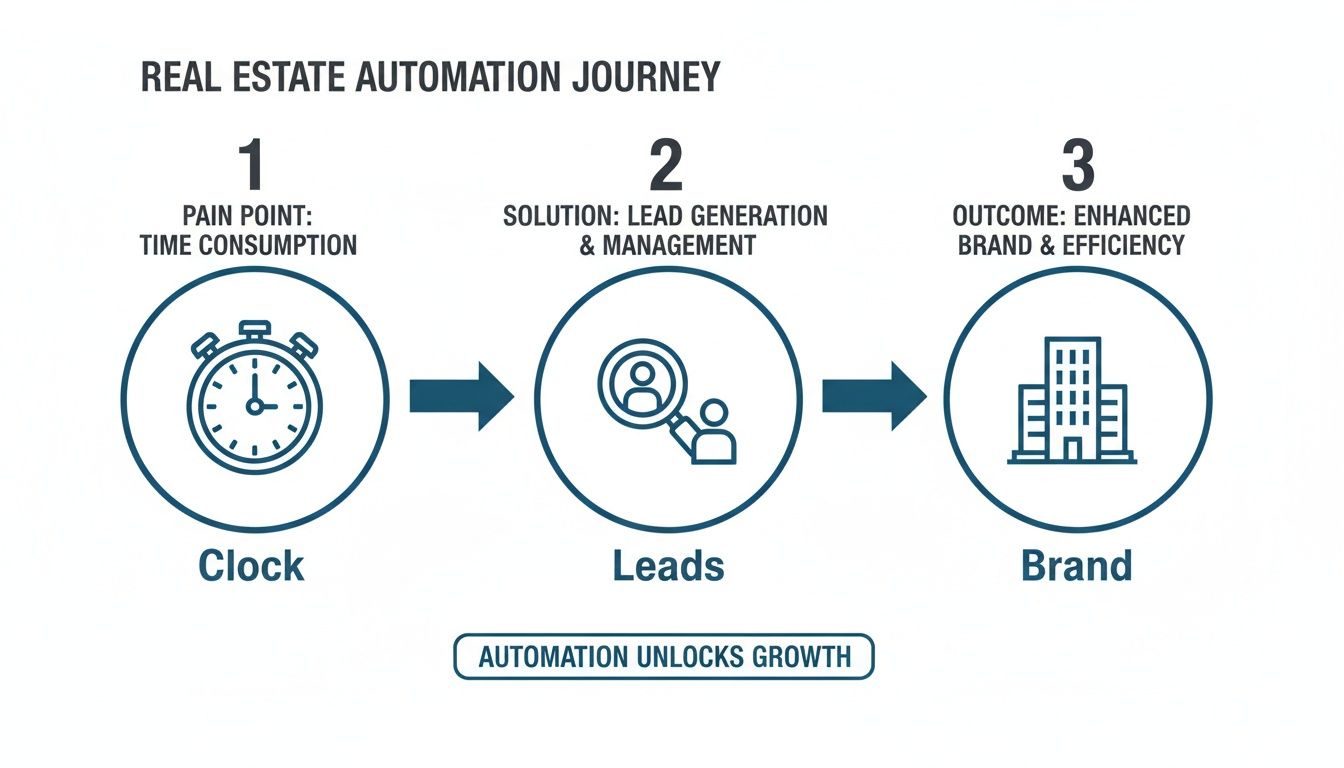
    This diagram really nails the journey—from clawing back your time to generating a steady stream of leads and building a brand that sticks.

    Diagram illustrating the real estate automation journey from time consumption to lead generation and brand growth.

    It’s a clear path. You start by winning back lost hours, then you systematically generate more leads, and finally, you build a memorable brand. Automation is the engine that powers it all.

    Mapping Your Initial Contact Points

    First things first, you need to know every single digital "front door" a lead can use to enter your world. Don't just guess—sit down and physically list them out. This clarity is the bedrock of any effective real estate marketing automation for agents.

    Your list will probably look something like this:

    • Website Forms: The classic "Contact Us" or "What's My Home Worth?" submissions.
    • Portal Leads: Those high-intent inquiries from Zillow, Redfin, or Realtor.com.
    • Social Media: A DM on Instagram asking about a listing or a lead from a Facebook ad campaign.
    • Open House Sign-ins: Digital sign-in sheets are goldmines that can—and should—feed directly into your CRM.

    Once you have this map, the fun begins. You can craft a unique, automated response for each source. That Zillow lead? They should get an immediate text: "Hi [Name], just got your inquiry for 123 Main St. Free for a quick call in the next 5 minutes?" Speed is everything here. We all know the stats—something like 90% of buyers go with the agent who gets back to them first.

    Meanwhile, the lead from your website who asked for a home valuation gets a totally different, but equally instant, email. That message can confirm you've received their request and maybe even include a link to your pre-listing guide. You're positioning yourself as the expert before you've even picked up the phone.

    Building the Nurture Sequence

    After that first contact, your system should automatically tag the lead in your CRM based on where they came from and what they want (e.g., "Zillow Buyer Lead" or "Website Seller Lead"). This tag is the trigger. It sets off a tailored sequence of emails, texts, and even tasks for you to complete.

    A great workflow doesn't just respond; it anticipates the client's next question. By sending a pre-listing packet or a neighborhood guide automatically, you're not just saving time—you're building trust and demonstrating expertise from the first click.

    Let's walk through a real-world scenario for a seller lead who filled out your "Home Valuation" form:

    1. The Instant Response: The moment they hit "submit," an email and a text message go out. The email confirms their request and attaches your guide on the "5 Mistakes to Avoid When Selling in [Your City]."
    2. Day 2 Follow-Up: An automated email goes out sharing a recent client success story or a glowing testimonial. Hello, social proof.
    3. Day 4 Insight: Another email lands in their inbox with a quick market update for their specific neighborhood, showing off your local knowledge.
    4. Day 7 Task Creation: The system stops sending messages and instead creates a task directly in your calendar: "Call Jane Doe." By now, she's been warmed up with genuinely useful content, making your call feel helpful, not pushy.

    This kind of multi-step, multi-channel approach keeps you top-of-mind without you having to manually track every single lead. It turns follow-up from a dreaded chore into a reliable system that consistently guides potential clients from a casual click to a signed listing agreement.

    Using AI to Create Real Estate Content That Actually Sells

    Let's be honest: for most agents, writing content feels like a chore. You're juggling showings, offers, and a mountain of paperwork. The last thing you have time for is crafting the perfect Instagram caption or a compelling property description.

    This is where AI automation changes the game. I'm not talking about replacing your unique voice, but about giving you a powerful assistant that can handle up to 90% of the tedious writing, freeing you up to do what you do best—sell homes.

    Modern AI tools aren't just spitting out generic, robotic text. They can craft descriptions specifically tuned for the platform you're posting on. An MLS description, for instance, needs to be dense with facts and keywords for other agents. But a Zillow description? That needs to tell a story and paint a picture for a potential buyer.

    One Property, Multiple Platforms, Zero Extra Work

    Think of a good AI tool as your in-house copywriter, one who’s an expert on every single marketing channel. It knows what makes a buyer pause their scroll on Facebook and what they’re searching for on Redfin. This means you can create multiple, optimized versions of a listing's story in a matter of seconds.

    For just one property, a smart AI platform can instantly generate:

    • An MLS-ready description that’s all business—packed with keywords, specs, and the critical details agents look for.
    • A compelling Zillow & Redfin narrative that sells the lifestyle. Think less about square footage and more about "sipping your morning coffee on the sun-drenched patio."
    • Quick, eye-catching social media captions and posts designed for likes, comments, and shares.

    All you do is plug in the property address and basic details, and out comes a full suite of marketing materials. It’s a massive time-saver.

    Man typing on a laptop displaying AI-generated real estate listings and content outdoors.

    Build a 30-Day Content Calendar Before Your Coffee Gets Cold

    The real magic of real estate marketing automation for agents is achieving consistency without the daily grind. Forget waking up and thinking, "Ugh, what do I post today?" You can generate a complete 30-day social media calendar faster than you can finish your morning coffee.

    And this isn't just a bunch of random posts. A good system will create a strategic mix of content designed to engage your audience and build your brand.

    AI doesn't just write words; it builds a strategy. It can weave in proven psychological triggers like scarcity ("This gem won't last long!") or social proof ("Join the wave of buyers discovering this amazing neighborhood!") to turn passive followers into active leads.

    These calendars go beyond just your listings. They’ll mix in local market updates, spotlights on neighborhood coffee shops, and genuinely helpful homebuyer tips. This is how you stop being just another agent and become the go-to expert for your area. For more strategies on this, we've got a ton of great articles over on the ListingBooster.ai blog.

    Stay Compliant Without Even Thinking About It

    Here's a benefit most people overlook: built-in compliance. When you're writing everything yourself, it’s surprisingly easy to accidentally use a phrase that could get you in hot water with Fair Housing guidelines. It's a risk you might not even realize you're taking.

    The best AI platforms have compliance checks baked right in. They automatically scan every sentence they generate to flag and remove problematic language. It’s a critical layer of protection for you and your brokerage that works behind the scenes.

    This automated safety net ensures your marketing is not only powerful but also ethical and legally sound. It gives you the confidence to move fast and publish great content, which is exactly what you need to do. After all, buyers consistently rank detailed property info and quality photos as the most important features on a real estate website.

    Automating Lead Nurture Campaigns That Actually Convert

    Here’s a tough truth in real estate: most agents give up on a lead way too early. A couple of calls, an email or two, and then… crickets. That lead gets dumped into the "cold" pile, never to be seen again. This is exactly where setting up smart, automated marketing becomes your secret weapon.

    It's not about spamming people with generic junk. It’s about building nurture sequences that feel personal, targeted, and genuinely helpful. These campaigns work for you in the background, long after you would have manually moved on.

    A smartphone displaying marketing icons, a coffee cup, a calendar, and a document with 'NURTURE SEQUENCE' text.

    Different Leads Need Different Conversations

    A one-size-fits-all follow-up script just doesn't cut it. The real magic in lead nurturing comes from segmentation. Think of your CRM as your command center, automatically tagging leads based on where they came from and what they’re looking for. This lets you send the right message to the right person, every time.

    Every agent should have at least these three campaigns running on autopilot:

    • The New Online Lead Sequence: A 10-day mix of emails and texts for those fresh Zillow or website leads. The goal here is to build trust fast with valuable content that isn't just a sales pitch.
    • The Past Client Referral Engine: This is a long-term, low-touch campaign that keeps you top-of-mind. Automate birthday wishes, send a "Happy Home-iversary" email, or share a quarterly local market report. It's all about staying relevant.
    • The "Wake the Dead" Campaign: You know all those leads that went silent months ago? This sequence is built to re-engage them. A big market shift or a new listing in their old area of interest is the perfect trigger to get back in touch.

    Personalization at scale is the name of the game. Your system should automatically send a first-time homebuyer guide to a new lead tagged as a 'renter' and a neighborhood market report to someone who inquired about a specific zip code.

    A Look at a Real-World Nurture Sequence

    Let's walk through how this actually works. Imagine a new buyer lead fills out a form on your website. Instead of just a single "thanks for your inquiry" email, your automated system can kick off a multi-day, multi-channel strategy that starts building real rapport.

    The table below lays out a simple but incredibly effective sequence. It’s designed to position you as an expert resource from day one, not just another agent hunting for a commission.

    Sample 7-Day Nurture Sequence for New Buyer Leads

    Day Channel (Email/SMS) Content Focus Goal
    1 Instant SMS & Email Acknowledge inquiry, attach a buyer's guide for your city, and suggest a quick 5-minute call. Demonstrate speed and value immediately.
    3 Email Share a recent client testimonial or success story about finding the perfect home in a competitive market. Build social proof and credibility.
    5 Email Send a concise market update for a neighborhood they showed interest in. Showcase your local market expertise.
    7 SMS A simple, low-pressure text: "Hi [Name], just checking in. Find any homes online that caught your eye this week?" Re-engage and prompt a direct conversation.

    This kind of automated approach guarantees every single lead gets consistent, high-value follow-up, which dramatically increases your chances of turning them into a client. You're not just pestering them; you're educating, building trust, and proving your worth before you ever shake their hand.

    Are Your Automations Actually Working? How to Measure and Optimize

    Setting up your automation system is a huge first step, but it's not the end of the road. Think of it like a new car—you don't just buy it and never check the oil. The real magic happens when you start consistently measuring what’s working, what isn't, and refining your approach. This is how you transform your marketing from a series of one-off tasks into a predictable machine for growing your business.

    To get there, you have to ignore the "vanity metrics." Things like social media likes feel good, but they don't tell you if you're actually getting closer to a commission check. We need to focus on the numbers that directly impact your bottom line.

    Zeroing In on Your Key Performance Indicators

    The best way to see what's really going on is to track a few Key Performance Indicators, or KPIs. These are just simple, powerful numbers that tell a clear story about your marketing's health. Your automation platform should make these easy to find.

    Here are the KPIs I always tell agents to live by:

    • Email Open Rate: Are people even opening your emails? A low open rate is a red flag that your subject lines aren't cutting through the noise of a crowded inbox.
    • Click-Through Rate (CTR): This shows how many people who opened your email actually clicked a link inside. It's the true measure of whether your message and call-to-action are compelling.
    • Lead-to-Appointment Conversion Rate: This is the big one. It tracks the percentage of leads from your automated campaigns that actually book a meeting with you. This KPI tells you everything about the quality of your leads and the power of your nurture sequences.

    A classic scenario I see all the time is a high open rate but a rock-bottom CTR. That tells you the subject line was great—it got their attention—but the email content itself didn't deliver on the promise. That's a clear signal to tweak your email body or your call-to-action.

    Using A/B Testing to Make Smart Changes

    Once you know your numbers, you can start making them better with A/B testing. Don't let the term intimidate you; it's just a simple experiment. You test one small change at a time to see what your audience responds to. The goal is to make small, informed improvements that stack up into massive gains.

    Let's say you're sending out a "Just Listed" email. Instead of guessing the best subject line, you test two versions:

    • Version A: "Just Listed: 123 Main Street"
    • Version B: "Your Chance to Live in the Perfect Neighborhood"

    Your automation tool sends Version A to one half of your list and Version B to the other. You let it run for 24 hours and check the results. If Version B gets a 20% higher open rate, you've just learned something valuable about what grabs your audience's attention.

    You can apply this same simple logic to everything—the call-to-action on a Facebook ad, the timing of an SMS follow-up, or the image you use in a newsletter. By constantly testing, you stop guessing and start building a strategy that you know works.

    Your Top Questions About Real Estate Marketing Automation, Answered

    Jumping into marketing automation can feel like a huge leap. I get it. Agents often ask me if these systems are too complicated, too pricey, or just too… robotic. Let's cut through the noise and talk about what's really on your mind when you think about automating your workflow.

    How Tech-Savvy Do I Really Need to Be?

    Honestly, not very. If you've ever posted on Facebook or figured out how to use your email, you've got this.

    Today’s best platforms are built for busy agents, not coders. The whole point is to make your life easier, not give you another technical headache. Getting started usually just means connecting your social media accounts and plugging in some basic info about your brand—a process that often takes less than 10 minutes. The interfaces are designed to be intuitive, guiding you through each step without any confusing jargon.

    Will My Marketing Lose Its Personal Touch and Sound Like a Robot Wrote It?

    That’s a completely fair question. We've all seen clunky, obviously automated marketing, and nobody wants that. But the AI we have today is a different beast entirely.

    Good platforms now use incredibly sophisticated language models that produce content that feels natural and human. They can even adapt their tone of voice—shifting from a formal, professional property description for the MLS to a fun, punchy caption for an Instagram Reel.

    Think of it this way: the AI is your junior copywriter, not your replacement. It does 90% of the heavy lifting, and then you swoop in for the final polish. You can always edit every single word, add a personal anecdote, or tweak a phrase to sound exactly like you.

    It's the ultimate combination: the lightning speed of automation paired with your authentic voice.

    Is This Really Affordable for a Solo Agent or Someone on a Tight Budget?

    Yes, and here's why: it’s not about the monthly subscription cost, it’s about the value of your time. Time is the one thing you can never get back, and it's your most valuable asset in this business.

    Think about it. If a platform saves you just 5-10 hours of marketing work every month, it’s almost certainly paying for itself. That’s time you can now pour back into dollar-producing activities like showing homes, nurturing high-value leads, or negotiating contracts. Most services, including ours, offer scalable plans and free trials so you can see the ROI for yourself. You can take a look at the different pricing options available for agents to see how it might fit into your budget.

    How Does Automation Help with Compliance?

    This is a huge benefit that often gets overlooked. A good real estate marketing automation for agents platform is your secret weapon for staying on the right side of MLS rules and Fair Housing laws.

    The best tools have compliance baked right in.

    • Pre-Publication Scanning: The AI automatically scans your text for trigger words and problematic phrases that could land you in hot water with Fair Housing regulations.
    • Consistency for Teams: For brokers, this is a lifesaver. It ensures every agent on the team is marketing properties with the same compliant language.
    • A Built-In Safety Net: It’s an extra layer of protection for your license and your reputation, minimizing the risk of a costly, accidental mistake.

    This built-in oversight lets you market properties confidently and quickly. You can focus on selling without constantly looking over your shoulder, worrying about compliance issues. It’s an essential tool for any agent who's serious about their career.


    Ready to turn your marketing from a constant grind into a powerful growth machine? ListingBooster.ai is the command center designed to give you back your time and establish you as the expert in your market. See how it works at https://listingbooster.ai.