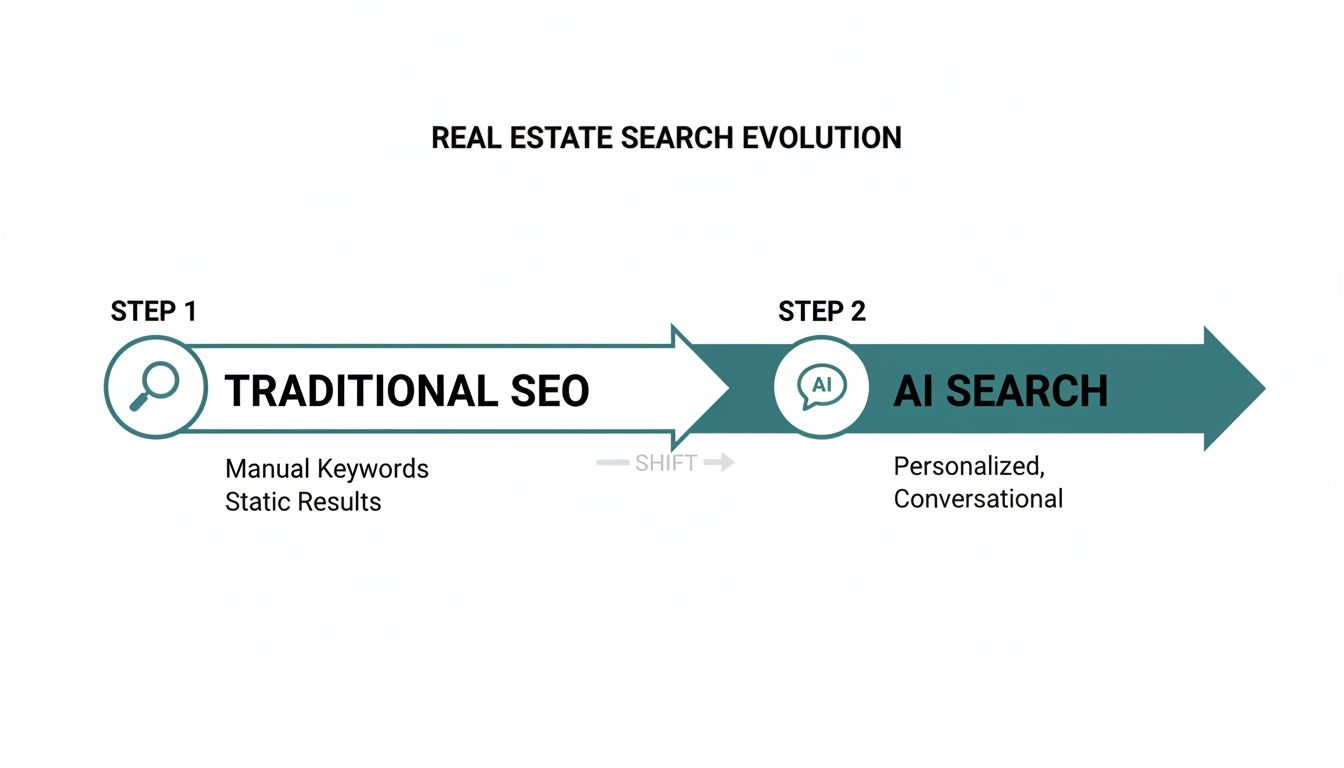
If you're still relying on the old playbook to get listings in 2026, you're going to get left behind. It’s no longer just about who can make the most cold calls or knock on the most doors. The game has changed.
Your Foundational Shift: Become the Obvious Choice for Sellers
Think about it: before a modern homeowner ever thinks about calling an agent, they go online. They're researching their home's value, looking up market trends, and, most importantly, vetting local agents. This is where you need to win.
The secret isn't about chasing every lead; it's about building your digital authority so the best leads come directly to you.
This means you stop being a reactive salesperson and start becoming the go-to resource they find in their initial search. Your online presence—your website, your social media, your content—needs to do the heavy lifting for you, establishing your credibility long before you ever shake their hand. It all starts when you truly grasp what sellers expect from agents today.
This isn't just a minor tweak to your strategy. It's a fundamental shift that positions you not as another agent trying to get a listing, but as the trusted expert they were hoping to find all along.
Mastering High-Value Prospecting Channels
If you're serious about getting more real estate listings, you have to move beyond casting a wide, generic net. The real secret is a smart, multichannel prospecting plan that focuses your energy where it counts most. This means nurturing the relationships you already have in your Sphere of Influence (SOI) while also strategically pursuing frustrated For Sale By Owners (FSBOs) by showing them exactly how much value you bring to the table.
When it comes to expired listings, a modern, empathetic approach wins the day. Don't just promise you can sell their home; show them how your marketing plan is superior to the one that failed them before. This is especially important right now. With active for-sale listings projected to jump by 8.9% in 2026, the agents who can stand out will capture the lion's share of that new business. You can dive deeper into these numbers by checking out the full housing market forecast on Realtor.com.
The game isn't just about knowing where to find potential sellers. It's about how you connect with them and solve their specific problems, whether you're building a reputation in a geographic farm or responding to a lead from Zillow.
Not all prospecting channels are created equal. Some offer quick wins with high conversion rates, while others are a long-term play requiring consistent effort. To help you decide where to invest your time and money, here’s a breakdown of the most common channels.
Prospecting Channel Effectiveness Matrix
Channel
Typical Conversion Rate
Effort/Cost
Key Tactic/Tool
Sphere of Influence (SOI)
High (10-20%+)
Low Cost, High Effort
Consistent, value-add communication via a CRM like Follow Up Boss
For Sale By Owner (FSBO)
Medium (3-5%)
Medium Effort
Proving value with a killer pre-listing packet and market data
Expired/Withdrawn
Medium (4-6%)
Medium Effort
A superior marketing plan and empathy for their frustration
Geographic Farming
Low (1-2%)
High Cost/Effort
Hyper-local content, direct mail, and community events
Online Leads (PPC/Zillow)
Low (1-3%)
High Cost
Speed-to-lead and a long-term, automated follow-up cadence
As you can see, your SOI is often your most potent source of business because it's built on trust. However, a healthy mix of channels ensures you have a steady stream of opportunities, balancing high-effort farming with faster-turnaround leads from sources like FSBOs or expireds. The key is to pick a few and master them.
Get Found When Sellers Ask AI for Help
Think about this for a second: when a potential seller asks a tool like ChatGPT, "Who's the best real estate agent in my city?" does your name pop up? If the answer is no, you're already behind. This is the new battleground for winning listings before your competition even knows a seller exists.
So, how do you get on AI's radar? It’s all about what you publish online. These AI models are constantly reading everything to figure out who the real experts are. Every hyper-local market report, neighborhood guide, and seller-focused blog post you create acts as a piece of evidence, proving your authority in your specific market.
This shift in how sellers find agents couldn't come at a better time. We're seeing a healthy rebound in the market, with the JLL Global Real Estate Perspective report showing a 19% increase in global real estate investment volumes from 2024. That means more motivated sellers are out there, and they're starting their search online.
Creating all this content consistently can feel like a full-time job. That's where tools like ListingBooster.ai come into play. They can help generate the kind of expert content that AI is looking for, formatted in a way it can easily understand and recommend.
Want to learn exactly how to set this up? We've put together a full guide on Real Estate AI Search Optimization that breaks it all down.
How to Win the Listing Appointment Every Time
Getting your foot in the door is one thing; walking out with the signed listing agreement is another game entirely. The agents who consistently win don't just show up with a standard CMA. They present a complete, undeniable marketing plan that makes the seller feel like you're the only agent who can get the job done right.
This is where you can really shine and set yourself apart. Don't just tell them what you'll do—show them. Walk in with tangible, customized marketing materials already prepared for their specific property.
Imagine their reaction when you hand them:
An AI-powered, emotionally compelling property description written specifically for their home.
A sample 30-day social media calendar, mapping out exactly how you'll create buzz.
Professionally designed flyers and print assets, ready to go.
This isn't about promising results. It's about proving you're already working for them before they've even signed.
Think of it as building instant trust. When you come this prepared, you're not just another agent—you're the expert they were hoping to find. It demonstrates a level of commitment and sophistication that speaks for itself.
For a full playbook on everything to bring and say, check out our complete guide on how to win listing appointments and grab the free checklist to take with you.
Your Always-On Listing Attraction System
Imagine a world where potential listing leads come to you, day or night. That’s the goal here. We’re going to build a smart, automated workflow that attracts homeowners who are thinking about selling, gives them genuinely helpful information, and guides them toward booking an appointment with you—all without you having to manually chase every single lead.
Think of it as your own lead-generating engine that runs in the background. This frees you up to do what you do best: connect with clients and close deals.
This simple breakdown shows how it all comes together. When you have the right strategy, you can deliver a powerful presentation and walk away with a signed agreement.
This process isn't just theory; it's a proven path from first contact to a successful partnership.
Why is this so crucial right now? The current market is tight. Over 65% of homeowners are sitting on mortgage rates below 5%, making them hesitant to sell. Yet, with home values soaring, the temptation is real. You can get a deeper dive into these trends in the 2026 market outlook.
Answering Your Top Questions About Landing More Listings
Let's cut right to the chase and tackle some of the most common questions agents have when trying to build their listing pipeline. I hear these all the time, so let's get you some clear, actionable answers.
What's the Fastest Way to Get My First Real Estate Listing?
Your quickest path to that first "For Sale" sign in the yard is almost always through your Sphere of Influence (SOI). These are the people who already know you, trust you, and actually want to see you succeed.
Forget the hard sell. Start by having real conversations. Reach out and offer a complimentary home equity report or share some surprising local market stats. You're not asking for business; you're providing value. This builds on the trust you already have and gets results much faster. The proof is in the numbers—an estimated 40% of buyers find their agent through a friend or family referral, making your personal network an absolute goldmine.
How Many Hours a Week Should I Really Prospect for Listings?
The most successful listing agents I know consistently block out 10-15 hours per week just for prospecting. The secret ingredient here isn't the total number of hours, but the unwavering consistency.
Think of it this way: Two hours of focused, phone-off, door-closed prospecting every single day will yield far better results than one marathon eight-hour session once a week. You'll burn out. Treat that daily time block like a non-negotiable meeting with the CEO of your business—because that's exactly what it is.
Does Cold Calling Still Actually Work for Getting Listings?
Yes, it absolutely does, but you have to be smart about it. While it has a lower success rate than calling someone who knows you, targeted cold calling is incredibly effective for niche opportunities like For Sale By Owners (FSBOs) and Expired Listings.
The key is to drop the generic sales script and lead with a specific solution to their obvious problem. For an expired listing, you could open with, "I noticed your home just came off the market. I specialize in re-launching properties with a fresh marketing angle and have a few specific ideas for yours." For a FSBO, show them hard data on how agents in your MLS consistently secure a higher net price, even after commission. You're not a salesperson; you're a problem solver.
Ready to stop chasing leads and start attracting them? ListingBooster.ai builds your digital authority and automates your marketing so sellers find you. See how it works.
What we once called a marketing "plan" needs a serious update. It’s no longer just a collection of disconnected tactics—an open house this weekend, a postcard blast next month. A modern marketing plan is a cohesive system, where every single action builds on the last, creating momentum for your business.
Why the change? Because our clients have changed.
Building Your Foundational Marketing Strategy
Think about how people find information now. It's a seismic shift. A massive chunk of your future clients—over 40% of homebuyers—don't start on Zillow anymore. They start by asking questions to AI tools like ChatGPT or what they see in Google’s AI Overviews.
They're asking things like, "Who's the best agent for first-time buyers in Denver?" or "What are the best Austin neighborhoods for a young family?"
If your digital footprint isn't optimized to be the definitive answer to those questions, you're basically invisible to a growing slice of the market.
A truly effective, modern real estate marketing plan stands on four pillars:
Your Unique Value Proposition (UVP): This is who you help and why you're the absolute best choice for them.
Digital Authority: This means creating content that proves your expertise, not just to people but to the AI algorithms that are now the gatekeepers of information.
Mastering Key Channels: Picking the right places to connect with your ideal clients, from social media and email to nailing your local SEO.
Measuring What Matters: Ditching vanity metrics and tracking the numbers that actually lead to closed deals.
Defining Your Unique Value Proposition
Everything starts here. Your Unique Value Proposition (UVP) is your clear, simple answer to the question, "Why should I hire you over every other agent in town?"
A powerful UVP isn't about trying to be the jack-of-all-trades. It's about being the perfect, go-to expert for a specific type of client.
Are you the agent military families on relocation can trust implicitly? The pro who specializes in helping seniors downsize with dignity? Or the savvy advisor who understands the nuances of multi-family investment properties?
Your specialty is your North Star. It guides your messaging, your content, and where you spend your time and money. For instance, an agent who crushes it with first-time homebuyers will be creating guides on down payment assistance and videos walking them through the home inspection. An agent in the luxury space? They’re probably producing cinematic tours of exclusive properties and writing deep-dives on architectural styles.
Without that sharp focus, your marketing becomes generic noise.
Your UVP isn't just a catchy tagline. It's the strategic DNA of your business. It dictates every blog post, every social update, and every ad you run. It's your promise to a specific group of people you're uniquely qualified to serve.
From Traditional Tactics to Modern Strategy
To really grasp how to build a plan for today, you have to see the difference between the old way and the new way. Traditional real estate marketing was all about broad, often untrackable, outreach. The modern approach is hyper-targeted, measurable, and focused on building digital assets that work for you around the clock.
It's the difference between renting a billboard for a month and building a permanent library of expert content that AI and search engines recommend to your ideal clients 24/7.
This table really puts the evolution of our industry into perspective.
Traditional vs Modern Real Estate Marketing
Marketing Element
Traditional Approach
Modern Approach for 2026
Lead Generation
Cold calling, door knocking, print ads
AI-optimized content, local SEO, social media lead nurturing
Property Marketing
Yard signs, newspaper ads, basic photos
Immersive 3D tours, AI-written descriptions, multi-channel social campaigns
Client Communication
Generic email blasts, phone calls
Personalized video texts, automated email drips, interactive presentations
Tracking website traffic, lead conversion rates, cost per lead
Embracing this requires a total mindset shift. The goal is no longer just "getting your name out there." It’s about building a digital presence so authoritative that you become the obvious expert in your niche. Your marketing should do the heavy lifting, pre-selling your value and expertise long before you ever shake a potential client's hand.
Establishing Your Authority with AI-Powered Content
In real estate, your expertise is your most valuable asset. But expertise that stays in your head doesn't win clients. The real challenge is making your knowledge visible online, where it can work for you 24/7. This is what a modern real estate marketing plan is all about: building a digital "Authority Engine."
This engine runs on high-value content that directly answers the questions your ideal clients are asking. Instead of just guessing what to post, you can build a systematic approach that cements your reputation as the definitive market expert.
The Kind of Content That Actually Builds Trust
Your goal isn't just to create more content; it's to create the right content. This means pushing past generic "Just Listed" posts and providing genuine value that showcases your deep local knowledge.
Put yourself in the shoes of a prospective client. Think about someone relocating to your town. They don't just want a list of available houses; they want real insight.
Neighborhood Spotlights: Forget the basic stats. Film a video tour or write a detailed blog post about a single neighborhood. Talk about the hidden gems—the best coffee shop, the walkability to the park, the authentic community vibe. That's the stuff people can't find on Zillow.
Hyper-Local Market Analyses: County-wide data is too broad. Break it down. Create a short, easy-to-digest analysis for a specific zip code or school district. Explain what the numbers really mean for a buyer trying to craft an offer or a seller deciding if it's the right time to list.
Step-by-Step Seller and Buyer Guides: Develop resources that walk people through the complicated parts of a transaction. A simple "First-Time Seller's Checklist for Anytown, USA" or a guide to the "5 Common Mistakes Buyers Make in Our Competitive Market" immediately positions you as a helpful, trustworthy guide.
When you create content that solves real problems, you earn trust. That trust is what makes your phone ring when someone is finally ready to make a move.
A Practical 30-Day Content Calendar Framework
Consistency is the fuel for your authority engine. Having a content calendar takes away the daily "what should I post?" anxiety and makes sure your message is strategic and intentional. A simple weekly structure is all you need to get started.
Here’s a framework you can adapt to your own brand and market:
Day
Theme
Real-World Post Example
Monday
Market Insight
A quick video or graphic showing the average days on market in a popular neighborhood, plus your take on what it means for sellers.
Tuesday
Agent Expertise
A post sharing a quick tip: "Negotiating repairs can be tricky. Here’s the one thing I always tell my clients to focus on…"
Wednesday
Neighborhood Focus
An Instagram carousel post on the "3 Reasons People Are Moving to the Northwood Area," featuring photos of local businesses and parks.
Thursday
Client Success Story
Share a testimonial (with permission!). "So thrilled for my clients who just closed on their dream home! We beat out five other offers by…"
Friday
Community & Lifestyle
A fun, engaging post asking, "What's your favorite weekend activity in [Your Town]?" This shows your local connection and sparks conversation.
This structure gives you a balanced mix of showing off your expertise, building your personal brand, and connecting with your community. It turns your social media from a random feed into a powerful part of your marketing plan.
Your content isn't just marketing; it's pre-selling your value. Every helpful article and insightful market update builds a case for why you are the go-to expert, long before you ever have a listing appointment.
Automating Your Authority
Consistently building this content engine can feel like a second full-time job. The good news? You don't have to do it all manually. Modern tools can handle much of the heavy lifting.
Platforms like ListingBooster.ai's Authority Builder were designed for exactly this.
Instead of blocking out hours for writing and design, you can generate a month's worth of psychologically-informed, compliant content in just a few minutes. These tools can create the market updates, buyer tips, and neighborhood guides that build the consistent digital presence needed for search tools to recommend you. For a deeper look, you can learn more about how to build authority as a real estate agent in our dedicated guide.
This kind of automation is a game-changer. It frees you up to focus on what you do best—nurturing leads and closing deals—while your digital marketing works tirelessly in the background to solidify your status as the trusted authority in your market.
Own Your Digital Backyard: Choosing the Right Marketing Channels
Fantastic content is pointless if no one sees it. You've done the hard work of defining your brand and message, but now comes the critical part: getting that message in front of the right people. This means building a smart, balanced marketing mix that blends organic, "free" traffic with targeted paid advertising.
The real magic happens when your platforms work together. Think about it: a detailed neighborhood guide you wrote shouldn't just sit on your blog collecting dust. It should be the engine for your marketing. You can slice it up for social media posts, feature it in your email newsletter, and use it to strengthen your local search rankings. This creates a cohesive online presence that pulls in leads from all directions.
Be the First Click: Winning at Local Search
When someone in your town googles "realtor near me," your name needs to be at the top of that list. That doesn't happen by accident. It’s the direct result of smart Local SEO (Search Engine Optimization). Since real estate is all about location, your online footprint has to scream "local expert."
Getting this right involves a few key moves:
Your Google Business Profile is Everything: Treat this like your digital storefront. It needs to be perfect—correct contact info, service areas, and hours are just the start. The real work is in constantly adding fresh listing photos, posting updates about your community, and, most importantly, asking every happy client for a review.
Create Hyper-Local Content: Your website and blog need to be a treasure trove of information about specific neighborhoods, school districts, and even zip codes. Write articles like "The Top 5 Family-Friendly Streets in Northwood" or "A Coffee Lover's Guide to Downtown Austin." This tells search engines you're the go-to authority for that area.
Keep Your Info Consistent: Your business name, address, and phone number (what we call NAP) must be identical everywhere online. From your Zillow profile to Yelp, any inconsistencies can tank your search rankings.
Think of local SEO as your digital curb appeal. It’s the first impression a potential client gets. A polished, active profile tells both people and Google that you’re a professional who’s plugged into the community.
Build Relationships with Social Media and Email
If local search is how new clients discover you, social media and email are how you turn that introduction into a relationship. This is where you build the trust that gets you hired.
The numbers don't lie. Digital channels aren't just an add-on anymore; they're central to the business. A massive 92% of U.S. realtors now actively use Facebook to find leads, making it an essential tool for client acquisition. This is reflected in their spending, too—over 54.2% of agent marketing budgets are now poured into digital efforts, a figure that's only growing with the rise of AI tools. You can dive deeper into these real estate marketing statistics on digitalagencynetwork.com.
This data makes it crystal clear: a modern marketing plan must have a robust social and email game.
Social Media: Platforms like Instagram and Facebook are perfect for showing off your personality and local know-how. Post quick video tours, highlight a new local coffee shop, or share a photo of your clients getting their keys. It's about building a community and providing value, not just running ads.
Email Marketing: Your email list is gold. It’s a direct line to your audience that you completely own. Send out a weekly or bi-weekly newsletter with your latest blog posts, market updates, and featured listings. For an extra edge, segment your list to send buyers, sellers, and past clients different content that’s relevant to them.
Juggling content for all these platforms can feel like a second full-time job. To streamline this, check out our guide on developing a multi-platform real estate marketing strategy. It lays out a framework to get more mileage out of every single piece of content you create.
When you weave these channels together, you create a powerful lead-generation system. Your blog pulls in traffic from search, your social media builds a loyal community around that content, and your email list nurtures that community until they’re ready to become clients.
Crafting AI-Optimized Listings That Actually Convert
Think of your property listing. It's the single most important piece of marketing you create. A weak listing just sits on the MLS, collecting dust. A powerful one? It becomes a lead-generating machine, working for you 24/7. The secret to a modern marketing plan is turning every listing into a conversion tool—one that’s optimized not just for buyers, but for the AI that now guides them.
The impact of AI on real estate is undeniable. We're seeing the market explode from $222.65 billion in 2024 to a projected $303.06 billion in 2025, driven by tools that help agents build authority and close deals faster. More importantly, buyer behavior has changed. Over 40% of homebuyers now start their search on platforms like ChatGPT, Perplexity, and Google's AI Overviews. If your listings aren't optimized for these new gatekeepers, you're practically invisible. You can dig into more of these real estate marketing insights from CallRail's latest report.
This isn't a minor shift; it demands a whole new playbook for writing and structuring your listings.
Going Beyond Basic Descriptions
For years, the standard was a dry, fact-based description: "3 bed, 2 bath with a large backyard." Frankly, that approach is dead. Today’s buyers aren’t just looking for square footage; they’re buying a lifestyle, a feeling, an aspiration.
Your job is to paint a vivid picture that taps into their emotions. Instead of just saying "updated kitchen," you bring it to life: "A chef’s kitchen designed for gathering, where quartz countertops gleam under new recessed lighting—perfect for hosting weekend brunches with friends." See the difference?
This is where AI tools like ListingBooster.ai's Listing Commander really shine. They're built on proven psychological frameworks—like scarcity ("This one-of-a-kind view won't last long") and aspiration ("Imagine starting your mornings on this sun-drenched patio")—to craft descriptions that connect with buyers on a much deeper level.
The difference between a standard listing and an AI-optimized one is stark. One lists facts; the other sells a dream. This shift from features to feelings is what stops the scroll and compels a buyer to book a showing.
The Power of Structured Data and Schema
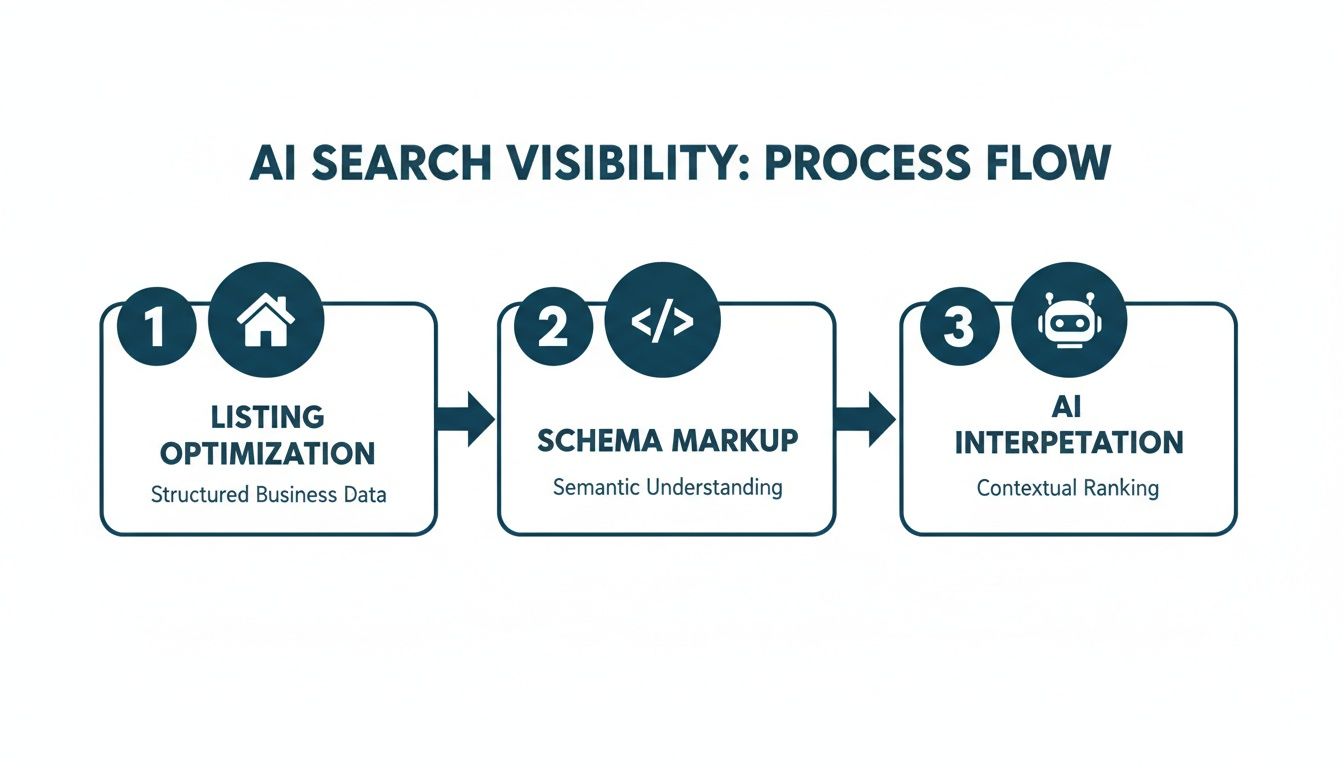
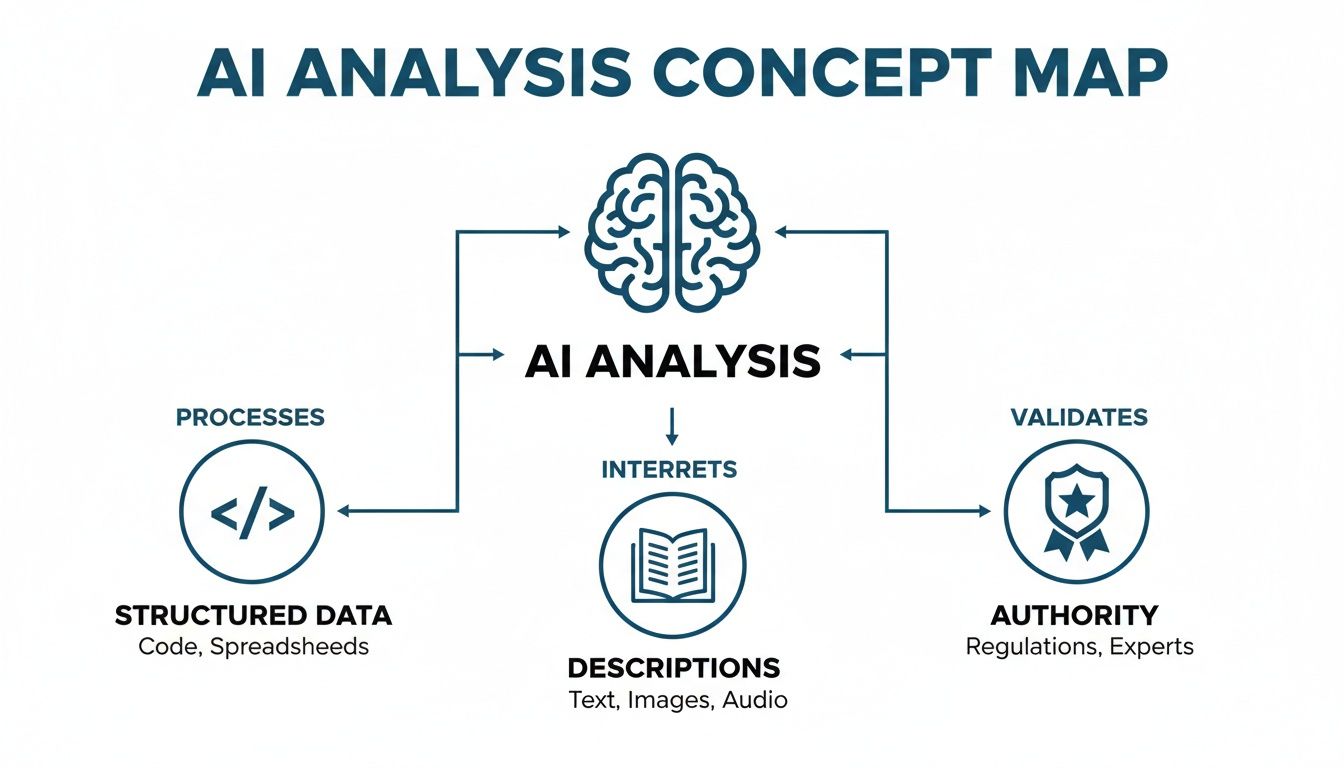
To win in this new era of AI search, you have to speak the language search engines understand. This is where schema markup becomes your secret weapon. It’s a bit of code you add to your website that explicitly tells search engines what your content is about.
For a property listing, schema acts like a perfectly organized label for every detail:
@type: SingleFamilyResidence
numberOfRooms: 7
floorSize: 2400 sq ft
address: 123 Main St
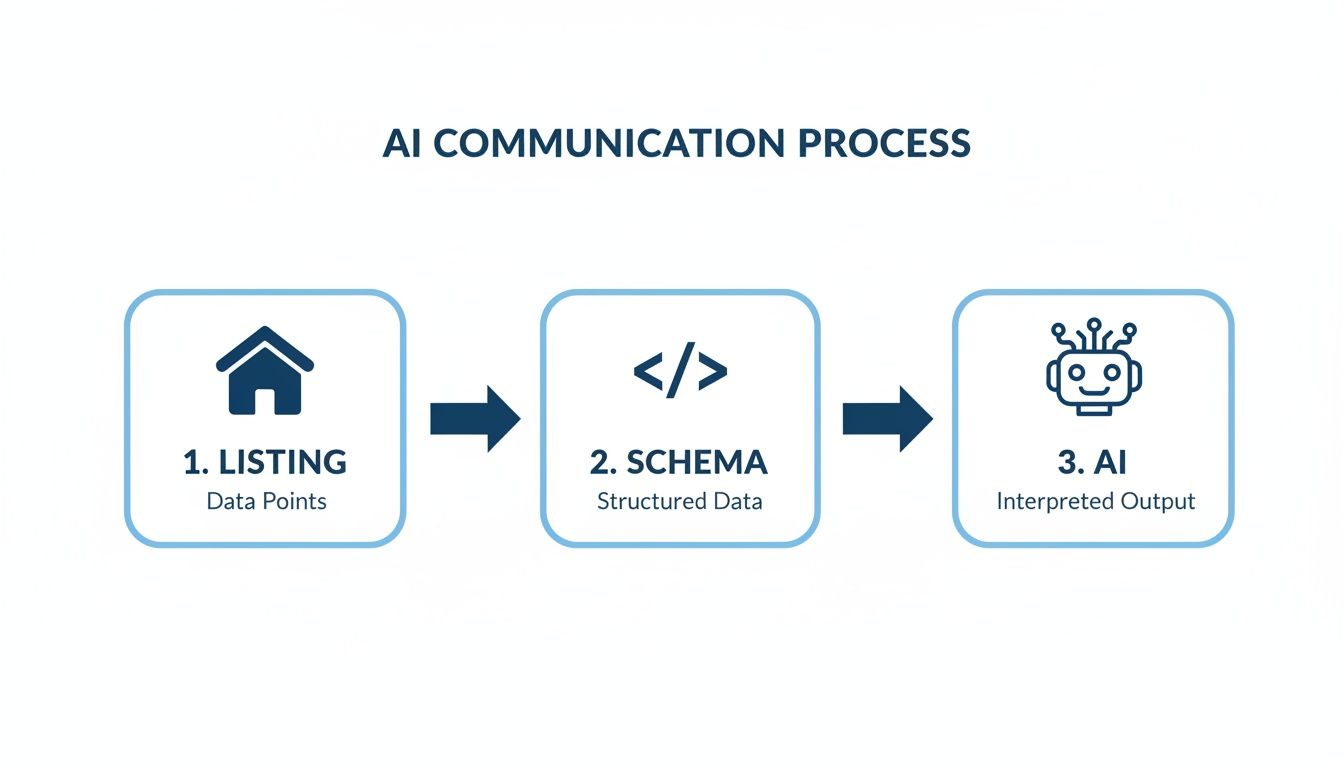
When you structure your listing data this way, you're not leaving it up to Google or ChatGPT to guess what’s on the page. You’re handing them a cheat sheet, making it incredibly easy for them to serve up your property when a buyer asks, "Find me a four-bedroom home in Northwood with a pool."
This is how all your digital marketing efforts—SEO, social, and email—should work together to amplify your message.
As you can see, it's a connected process where each step builds on the last to maximize your reach.
From Description to Complete Marketing Suite
A great listing description is just the start. A truly effective plan uses that core message as the foundation for a full-blown, multi-channel campaign. The real magic of an AI-driven platform is its ability to spin that one asset into an entire marketing suite.
For example, with a tool like Listing Commander, you just input the property details once. In seconds, you get:
Multiple MLS-compliant descriptions written for different character limits.
A complete social media campaign with posts for "Just Listed," "Open House," and "Price Improvement."
Print-ready flyer copy and even an engaging video script.
AI-optimized copy specifically for portals like Zillow and Realtor.com.
This process ensures your branding is consistent everywhere and, more importantly, saves you countless hours. You can launch a comprehensive campaign the moment a listing goes live. To see just how powerful this is, check out our guide on using AI for effective real estate listing copywriting. By automating the content, you free yourself up to do what you do best: build relationships and close deals.
How to Win Listings Before The Appointment
Think of the listing appointment not as your first pitch, but as the final exam. Too many agents show up with just a Comparative Market Analysis (CMA) and a binder full of promises. A truly modern marketing plan flips that script. It lets you walk in with tangible proof of what you've already done for their property.
This simple shift completely reframes the conversation. You’re no longer asking, "Why should you hire me?" Instead, you're demonstrating, "Here's how we're already ahead of the game." You’re not just selling a future service; you're handing them the finished product and showing your value from minute one.
Your Pre-Appointment Marketing Arsenal
Instead of just showing up, imagine arriving with a bespoke marketing suite prepared specifically for their property. This isn't about sinking hours into speculative work. It's about using smart, efficient tools to create seriously impressive assets in just a few minutes.
Your goal is to make hiring you feel like the only logical choice. When you present a folder—digital or physical—containing materials already built for their home, it sends a powerful message. It proves you’re proactive, prepared, and operating on a completely different level than the agent who just brought a standard three-ring binder.
According to the National Association of Realtors, 38% of sellers find their agent through a referral. A smooth, fast sale fueled by great marketing is what earns those referrals. Your presentation is the first step in proving you can deliver that experience.
Your Pre-Listing Presentation Checklist
Before you ever step foot in the seller's home, your marketing plan should have already produced a set of compelling assets that show you mean business.
Here’s a quick checklist of what to prepare:
An AI-Optimized Listing Description: Don't settle for a generic template. Generate a compelling, MLS-compliant description that sells the lifestyle of the home, not just its features. A tool like ListingBooster.ai's Listing Commander can draft this in seconds, using proven copywriting principles to capture buyer interest.
A Sample 30-Day Social Media Calendar: Show them you have a plan. A simple visual of a month's worth of "Just Listed," "Open House," and property highlight posts makes your strategy tangible and demonstrates the consistent effort you'll invest.
An AI Search Visibility Mockup: Create a one-page document showing how their home will appear in new AI-driven search engines. Explain that your use of special code (schema markup) helps tools like ChatGPT and Google AI understand their property's best features, making it more discoverable to the 40% of buyers who now start their search on these platforms.
The Unfair Advantage in Action
Let’s play this out in a real-world scenario. Two agents are vying for the same listing.
Agent A arrives with a well-researched CMA and a folder of marketing materials from past sales. They talk a good game about their experience, their brokerage's reputation, and their general marketing approach. They promise to create great marketing for the home. It’s a solid, but predictable, pitch.
Agent B arrives with the same CMA but also presents:
A beautifully written, AI-generated description of the seller’s actual home.
A printed 30-day social media schedule, with daily posts already planned out for Facebook and Instagram.
A simple explainer showing how their listing will be optimized for AI search, proving they understand where the market is headed.
Agent B isn't just making promises; they're delivering concrete proof of a superior strategy. They've already put in the work, demonstrated their tech-forward approach, and made the seller feel like their home is already a top priority.
Who do you think gets the listing?
Tracking What Matters: Measuring Your Marketing ROI and Staying Compliant
Are your marketing dollars actually making you money? If you can't answer that question, you're just guessing. It's time to stop treating marketing as an expense and start managing it like the powerful investment it is. That means moving beyond vanity metrics like social media "likes" and digging into the numbers that really move the needle.
A solid marketing plan lives and dies by a few core numbers. These tell the real story of what’s working, showing you where to double down and what to cut loose.
The KPIs You Should Obsess Over
Set aside time once a month for a simple review. Don't overcomplicate it. Just focus on the metrics that directly connect your marketing efforts to your bank account.
Lead Generation Cost (LGC): This is your most basic health check. Just divide your total marketing spend for the month by the number of new leads you brought in. Now you know exactly what it costs to get a potential client's attention.
Lead-to-Client Conversion Rate: Of all the leads that came in, how many actually signed a buyer or seller agreement with you? This is the ultimate test of your lead quality and your follow-up skills.
Website Traffic by Channel: Open up your Google Analytics. Where are people coming from? Are your efforts to rank in local search paying off with organic traffic? Is that Instagram account actually sending people to your site?
I've seen agents get excited about a low cost per lead, but that's only half the story. If you’re spending $50 per lead but converting 10% of them, you're doing far better than an agent spending $20 per lead but only converting 1%. You have to track both to see the complete picture.
Compliance: Your Non-Negotiable Safety Net
Using AI and automation to create marketing content is a huge advantage, but it also means you have to be extra careful about compliance. There are no excuses and no exceptions—every single ad, social post, and property description must follow Fair Housing laws and your local MLS rules.
Violating these regulations, even by accident, can come with massive fines, a ruined reputation, and even the loss of your license. This isn't something to take lightly.
The good news is that you don't have to navigate this alone. Modern platforms like ListingBooster.ai build compliance checks right into the system. When the AI helps you write a listing description or a social media update, it’s actively scanning for words or phrases that could get you into trouble, particularly around protected classes (race, religion, familial status, and so on).
This acts as a critical safety net. It gives you the freedom to market your listings at scale without the constant fear of making a costly mistake. By pairing smart KPI tracking with automated compliance checks, your marketing becomes both powerful and responsible—a strategy built for sustainable, long-term growth.
Common Questions About Modern Real Estate Marketing
Jumping into a new way of marketing, especially with AI in the mix, naturally brings up a few questions. I hear the same concerns from agents all the time: Where do I even begin? What’s this going to cost me? And how will I know if it’s actually working?
Let’s tackle those head-on so you can move forward with confidence.
"I'm Totally Overwhelmed. What's the Very First Thing I Should Do?"
When you're staring down a mountain of new ideas, the best approach is to take one small step that gives you a quick, tangible win. Don't try to reinvent your entire marketing strategy in a weekend.
My advice? Focus on your very next listing.
Just one. Use a platform like ListingBooster.ai to generate the full marketing package for that single property. In just a few minutes, you’ll have a professionally written, AI-optimized description and a batch of ready-to-go social media posts. This single action shows you the proof of concept, saves you hours of work, and delivers that "aha!" moment about working smarter.
"How Much Should I Budget for New AI Tools?"
This isn't about adding a massive new line item to your expenses. It's about being smarter with the money you're already spending. Take a hard look at your current marketing budget. How much is going toward things with little to no trackable return, like generic print ads or mass postcard mailings?
You'll probably be surprised at how affordable many of these powerful AI tools are. A subscription can start around $35 per month, often less than you’d pay for a one-off print ad. You're simply swapping an old-school, untrackable expense for a highly efficient and measurable one.
"How Can I Realistically Measure ROI?"
Measuring the return on your investment here requires a slight shift in perspective. It's not just about counting raw leads. Instead, look at it through two critical lenses:
Time Saved: This is your most valuable, non-renewable asset. Calculate the hours you'd normally spend agonizing over listing descriptions, creating social media content, and trying to come up with fresh ideas. If a tool saves you even 10 hours a month, what's that time worth? You can use it for client follow-up, lead nurturing, or even just taking a well-deserved break.
Speed to Market: Think about how much faster you can get a new listing professionally marketed. Launching a complete campaign days earlier can make a huge difference, often leading to a quicker sale at a better price. That directly impacts your commission and, just as importantly, your client's happiness.
Ready to stop guessing and start implementing a proven system? ListingBooster.ai acts as the command center for your property marketing—automating content, optimizing your listings for the way people search today, and giving you back the time to focus on what you do best.
If you want to build authority as a real estate agent in today's market, you have to become the undisputed source of local knowledge online. This isn't just about posting listings. It's about consistently creating valuable, hyperlocal content that both potential clients and AI-powered search engines can find easily. It's how you prove your value long before the first handshake.
Why Agent Authority Is Your New Competitive Edge
The old playbook is officially outdated. Relying on mailers, billboards, or even a solid referral network just isn't enough to lock down your position in the market anymore. Here's a number that should get your attention: 43% of homebuyers start their search online. Their first impression of you is formed right there, long before they ever think about picking up the phone. They aren't just searching for any agent; they're looking for an expert they can trust.
This fundamental shift in client behavior demands a new way of thinking. Building your authority as a real estate agent has moved from a "nice-to-have" marketing tactic to the absolute core of a sustainable business strategy.
The Modern Definition of Real Estate Authority
So, what does "authority" even mean in today's market? It’s a powerful mix of what you know and how consistently you share that knowledge. Think of it as your professional reputation, but scaled for the digital age. It boils down to three things:
Hyper-Local Expertise: This is so much more than just knowing the current inventory. It means being the go-to person for neighborhood market trends, school district ratings, upcoming zoning changes, and even the best local coffee shop.
A Consistent Online Presence: Posting once in a blue moon won't get you anywhere. True authority is built on a steady, reliable stream of valuable content across your website, blog, and social media channels.
Undeniable Social Proof: This is the proof in the pudding. It includes everything from glowing client testimonials and detailed case studies to impressive sales data and positive media mentions that back up your claims of expertise.
For most agents I talk to, the biggest hurdle isn't a lack of knowledge. You know your market inside and out. The real struggle is finding the time and a cohesive strategy to broadcast that expertise effectively, day in and day out.
The reality is that clients hire agents they trust, not just those who sell the most homes. Your content—from market updates to neighborhood spotlights—is your primary tool for building that trust at scale.
A Framework for Building Your Authority
To beat the overwhelm, you need a system. A scattershot approach of random posts and occasional emails leads to burnout and, frankly, minimal results. A modern framework, on the other hand, streamlines the entire process and ensures every single thing you do contributes to your larger goal. This guide is built on four essential pillars that work together to establish you as the go-to expert in your market.
Positioning: Nailing down exactly who you serve and what makes you the only logical choice for them.
Content: Creating a consistent flow of information that answers your ideal client's questions and showcases your deep expertise.
SEO: Making sure your content actually gets found by the search engines and, more importantly, by the people who need it.
Social Proof: Systematically capturing your wins and sharing them in a way that builds massive credibility.
By weaving these four pillars into your business, you create a powerful, self-sustaining engine for growth. Tools designed to automate and organize this process, like those inside ListingBooster.ai, are built specifically to help agents put this framework into action efficiently. They turn a daunting task into a manageable—and profitable—workflow.
This guide will walk you through each pillar, giving you actionable steps to build your authority and win more business. Let's get started.
Defining Your Niche and Market Position
Let’s be honest: you can’t be the go-to real estate agent for everyone. Trying to serve every buyer and seller in your city is a surefire way to get lost in the noise and burn yourself out. Real, lasting authority doesn't come from casting a wide net; it comes from having a sharp, strategic focus on a specific corner of the market where you can become the undisputed expert.
This is about more than just picking a neighborhood you like working in. It's about intentionally carving out a space where your unique skills, personality, and professional goals line up perfectly with a specific client’s needs. This focus is the very foundation you’ll use to build authority as a real estate agent.
Pinpoint and Own Your Micro-Market
A micro-market is a highly targeted segment you can absolutely dominate. Think about it: generalists compete with every agent in town, but specialists compete with almost no one. Your goal is to become so synonymous with your niche that when a potential client even thinks about that category, your name is the first one that comes to mind.
Consider a few ways to slice the market:
Geographic Niche: This is the classic, but you need to go deeper than a city or zip code. Get specific. Think "historic homes in the Garden District" or "lakefront properties in the North Shore suburbs." The more granular, the better.
Property Type Niche: Are you passionate about a certain style of home? You could build a reputation specializing in mid-century modern restorations, new construction condos, or multi-family investment properties.
Client Demographic Niche: Serving a specific group of people allows you to tailor your entire message directly to their pain points and life stage. Great examples include first-time homebuyers, military relocations, downsizing empty-nesters, or luxury buyers.
The trick is to find a niche that has enough business to be profitable but is specific enough that you can realistically become the #1 expert. This targeted approach makes every marketing dollar you spend and every piece of content you create infinitely more effective.
Audit Your Personal Brand and Competitors
Before you plant your flag in a niche, you need a clear-eyed view of your own strengths and who you’re up against.
Start with some honest self-reflection. What deals have you truly enjoyed the most? What unique skills or background do you bring to the table? Maybe your previous career in finance makes you a natural for working with investors, or your background in design gives you an edge with historic properties.
Next, get to know the agents already playing in the niches you're considering. Don't just look at their sales volume. Dig into their online presence.
What kind of content are they putting out?
What's their brand voice and visual style like?
Most importantly, where are the gaps in their strategy that you could fill?
This isn't about copying them. It's about finding opportunities to differentiate yourself and craft a unique value proposition that nobody else is offering.
Your brand isn’t just a logo or a headshot. It’s the promise you make to your clients. A well-defined niche makes that promise crystal clear and instantly recognizable to the right people.
Translate Your Position into Automated Content
Once you've defined your niche and brand position, you have to broadcast it. Consistently. This is where modern tools can give you a massive, almost unfair, advantage. Manually creating hyperlocal content day after day to reinforce your expertise is a major time-suck.
This is the exact problem platforms like ListingBooster.ai were built to solve. For instance, with its 'Authority Builder' feature, you can define your niche—let's say, "first-time homebuyers in the Northwood neighborhood." The system then gets to work automatically generating content laser-focused on that audience, such as:
Guides on securing FHA loans for homes right there in Northwood.
Breakdowns of local school ratings and nearby park amenities.
Market updates focused specifically on entry-level home prices in that area.
This automated approach ensures your online presence is constantly working for you, reinforcing your specialized expertise around the clock. It turns your defined position from a line on a business plan into a living, breathing digital footprint that attracts your ideal clients and solidifies your authority.
Building Your Automated Content Engine
If you want to build real authority, consistent, high-value content is the engine that gets you there. A smart content strategy does more than just fill your social media feed; it establishes you as an expert and essentially pre-sells your services long before a potential client ever picks up the phone. This isn't about posting generic advice—it's about building a practical, repeatable system.
The entire goal is to become the go-to resource in your market by consistently answering the questions your ideal clients are asking online. By focusing on smart automation, you can maintain this powerful presence without sacrificing precious time you need for showings, negotiations, and closing deals.
The Content That Actually Builds Trust
To build authority as a real estate agent, your content has to go way beyond a simple stream of new listings. It needs to provide genuine, tangible value and prove you have a deep, nuanced understanding of the local market.
I recommend focusing your energy on these three core content pillars:
Hyperlocal Market Updates: Don't just pull city-wide stats. Break down what's happening in specific neighborhoods you serve—from average days on market to new inventory trends. This is what shows you have your finger on the pulse of the micro-markets that matter.
Buyer and Seller Tip Series: Create content that actually guides people through the transaction process. Think short, punchy video tips on "3 Common Mistakes First-Time Buyers Make in Our City" or a simple checklist for "Getting Your Home Prepped to Sell This Spring."
Deep Dives into Neighborhood Amenities: This is where you truly shine. Showcase what makes a community special by featuring local businesses, reviewing new restaurants, or creating a guide to the best parks and schools in the area. This positions you as a true community insider, not just another salesperson.
In a world where 88% of homebuyers turn to agents for guidance, a strong online presence is non-negotiable. This is why the sharpest agents are using tools to automate hyperlocal content that positions them as the go-to expert before a buyer even thinks about calling someone. In fact, one study showed that agents using structured educational content, like FAQs on financing, shortened their sales cycle by 27%. That’s powerful proof that authority is all about pre-selling trust.
Automate Your Authority with a Content Calendar
Let's be honest: the biggest killer of content consistency is a lack of time. Manually brainstorming and creating posts every single day is a direct path to burnout. This is where automation becomes your secret weapon.
Tools like ListingBooster.ai were designed to solve this exact problem. Instead of staring at a blank screen wondering what to post, you can generate an entire 30-day content calendar that’s already tailored to your brand and niche—all in just a few minutes. These systems use proven psychological frameworks, like scarcity and social proof, to turn otherwise dry market data into social media posts that genuinely connect with your audience.
The most successful agents don't have more hours in the day; they have better systems. An automated content calendar is the system that ensures your authority-building never stops, even when you're busy closing deals.
This approach keeps your content mix perfectly balanced between educational, promotional, and community-focused posts, all without the daily grind. You can dive deeper into these strategies on the ListingBooster.ai blog.
The Authority-Building Content Calendar
To see how this works in the real world, here’s a sample weekly schedule. This structure ensures you’re hitting all the right notes to engage your audience, demonstrate your expertise, and ultimately, build your brand as the local authority.
Day of the Week
Content Theme
Post Example (Generated by ListingBooster.ai)
Authority Goal
Monday
Market Update
"Good morning, [City]! The weekend saw 3 homes go under contract in the [Neighborhood] area, with an average list price of $450k. What does this mean for sellers? Scarcity is on your side."
Demonstrate Data Expertise
Tuesday
Buyer/Seller Education
"Quick Tip Tuesday: Before you start your home search, get pre-approved! It strengthens your offer and gives you a clear budget. DM me for my list of trusted local lenders."
Build Trust
Wednesday
Neighborhood Spotlight
"Mid-week shoutout to [Local Coffee Shop]! Their lattes are the best fuel for house hunting in [Neighborhood]. What’s your favorite local spot?"
Showcase Local Knowledge
Thursday
Listing Promotion
"Just Listed! This stunning 3-bed, 2-bath home in [Neighborhood] won't last long. With a brand-new kitchen and a huge backyard, it's perfect for a growing family. Click the link for a virtual tour!"
Drive Leads
Friday
Client Success Story
"So excited for my clients, the Smiths, who just closed on their dream home! Helping them navigate a competitive market to win this gem was an honor. Welcome to [Neighborhood]!"
Provide Social Proof
This kind of repeatable schedule transforms content creation from a daily chore into a strategic, automated process. It’s how you consistently build your reputation as the definitive real estate authority in your market.
Making Sure AI Search Knows You're the Local Pro
Having deep market knowledge is fantastic, but it’s completely useless if new search tools can't find you. If you want to build real authority as a real estate agent, you have to start thinking beyond old-school SEO and get your digital presence ready for AI search. Don't worry, this isn't about becoming a coder; it's about making your expertise easy for machines to understand.
Think about it. When a potential client asks an AI assistant like ChatGPT or Perplexity, "Who is the best agent for first-time buyers in the Northwood neighborhood?" the AI isn't just skimming websites for keywords. It's actively looking for structured, organized data that screams "expert" on that specific topic. Your job is to hand-feed it that data.
Translating Your Expertise for AI
The basics of on-page SEO—using keywords in your website copy, blog posts, and property descriptions—still matter. That’s your foundation. But AI search needs another layer of detail. It needs to grasp not just what you're saying, but the context and relationships between all the bits of information you publish.
For instance, it’s one thing to write that a property has three bedrooms. It’s another thing entirely for an AI to understand this is a "RealEstateListing" with a "numberOfBedrooms" value of "3," located in a specific "Neighborhood" that has a certain "publicSchool" rating. This is where a slightly technical idea called schema markup becomes an agent's secret weapon.
Schema markup is basically a special vocabulary you add to your website's code. It helps search engines understand your content on a deeper level and give users much more helpful results. Think of it as creating a super-detailed digital business card for every single listing and blog post you create.
This structured data is the native language of AI. Without it, you’re making the algorithms guess what you mean, and they'll either guess wrong or, even worse, just ignore you.
Putting Schema on Autopilot
Let’s be honest, manually adding schema markup to every listing, blog post, and market report is a nightmare. It's tedious, technical, and no agent has time for that. This is exactly why a platform like ListingBooster.ai can be such a game-changer for building your digital authority.
The 'Listing Commander' feature, for example, takes care of all of this for you. When it generates marketing materials for your property, it's not just spitting out pretty text and photos. It's embedding all the right schema markup directly into the code of those digital assets.
Here’s what that actually means for you:
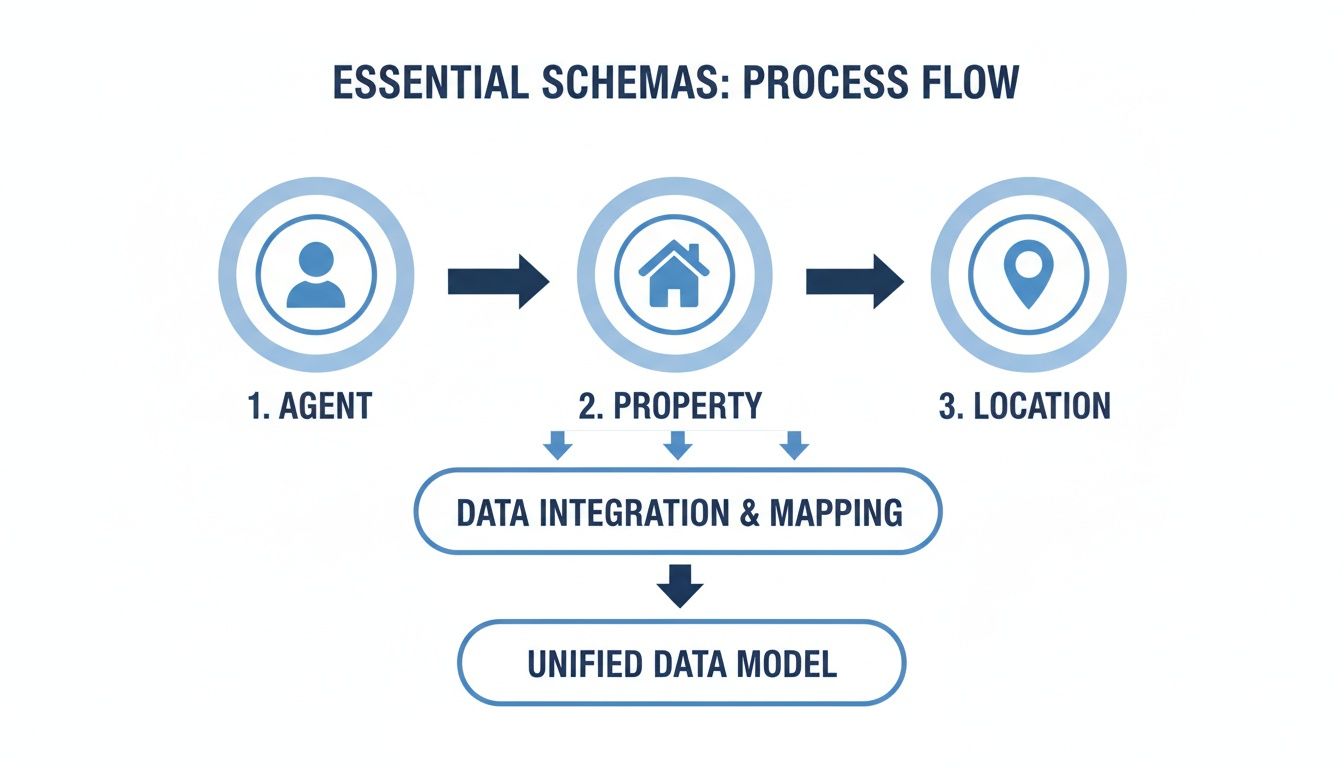
For a New Listing: It automatically applies RealEstateListing schema, tagging the price, address, square footage, and number of rooms so AI can process it instantly.
For an Open House: It uses Event schema to clearly define the date, time, and location, which helps search engines feature it in local event searches.
For Your Agent Profile: It structures your contact info and service areas with RealEstateAgent schema, explicitly telling AI who you are, what you do, and where you work.
This hands-off process ensures every piece of content you push out is perfectly tuned for the next generation of search. It's a huge leg up on the competition.
What AI-Optimized Content Looks Like in the Wild
So, let's get practical. You're writing a property description. The old way might be: "Charming 3-bed, 2-bath home in the sunny Glenwood neighborhood, perfect for families."
An AI-optimized description, built with schema in mind, adds a ton of context behind the scenes. The buyer sees the same engaging text, but the AI sees clean, structured data points:
Data Point
Value
Schema Tag
Property Type
SingleFamilyResidence
@type
Bedrooms
3
numberOfBedrooms
Neighborhood
Glenwood
containedInPlace
Key Feature
Fenced Backyard
amenityFeature
This is exactly the kind of detail that lets an AI search engine confidently match your listing to a specific query like, "Find me a family-friendly home with a yard in Glenwood." Your listing doesn’t just show up—it's served up as a perfect, authoritative answer.
The same logic applies to your blog. A post on local market trends is no longer just text; it's an Article with an author (you), a publisher (your brokerage), and a clear about topic (real estate in your city). Every piece of structured content builds on the last, creating a powerful web of data that solidifies your status as the go-to local expert in the eyes of the very algorithms connecting you with your next client.
Using Social Proof to Build Unshakeable Trust
Okay, so you've got your content and SEO firing on all cylinders. That's a great start, but it's not the whole picture. Nothing—and I mean nothing—builds credibility faster than cold, hard proof of your success. This is where social proof becomes your superpower. It's the tangible evidence that takes you from claiming you're an expert to proving it, giving potential clients that final nudge of confidence they need to pick up the phone and call you.
To really make this work, you can't just wing it. You need a system for capturing and showcasing your wins. This isn't about just dropping a few text-based reviews on your website and calling it a day. We're talking about creating a living, breathing story of your success that's simply too compelling for prospects to ignore.
Go Beyond Basic Testimonials
Let's be honest, the old method of grabbing a quick, written blurb after a closing just doesn't cut it anymore. Today's clients are savvier than ever. They want to see the nitty-gritty details, the stories, and the hard data that prove you can actually deliver on your promises.
Your mission is to build a central hub for all this proof—think of it as a digital trophy case or a "Results" page on your website. This page shouldn't just list your wins; it should sell your expertise with things like:
Detailed Case Studies: Don't just say you sold a house. Walk people through the story. What was the client's biggest challenge? What specific strategy did you use to solve it? And what was the incredible result? Use real numbers here, like "Sold in 7 days for 10% over the asking price."
Sales Volume Data: Telling people you're a top producer is one thing. Showing them is another. Simple charts or infographics displaying your sales volume, average sale price, or list-to-sale ratio can be incredibly powerful.
Client Success Stories: These are less about stats and more about the human element. They tell the story behind the transaction, which makes your success feel both relatable and real.
Building true authority demands this level of transparency. In fact, agents who create these "proof pages"—showcasing sales data, in-depth stories, and market wins—build trust exponentially faster. This is critical when 50% of homebuyers are looking for an agent to guide them to the right home. One agent I know even cut their sales cycle by 27% just by using structured case studies to explain their process. If you want to dive deeper, you can read more about building an agent authority stack that helps you get more leads and close more deals.
To really understand the shift, let's look at how modern social proof stacks up against yesterday's testimonials.
Social Proof vs. Traditional Testimonials
Method
Traditional Testimonial
Dynamic Social Proof (e.g., Case Study, Data)
Impact on Authority
Client Quote
"Jane was great to work with!"
"We were struggling to sell our unique property. Jane's staging and marketing plan brought in 5 offers."
Moves from a generic compliment to a specific, problem-solving narrative that builds real-world credibility.
Data & Results
Mentioned vaguely, if at all.
"Sold for $25,000 over asking price in just 4 days."
Hard numbers are undeniable. They provide concrete, verifiable evidence of your skill and market knowledge.
Visuals
Usually just a block of text.
Includes photos, charts showing market trends, or a short video clip of the happy client.
Visual proof is more engaging and memorable, making the story stick with potential clients.
Relatability for Leads
Can feel generic and interchangeable with other agents.
A detailed story allows future clients to see themselves in the situation and trust you to solve their problems.
Creates a powerful connection by demonstrating that you understand and can overcome specific client challenges.
As you can see, the difference is huge. One feels like a polite thank-you note, while the other is a powerful tool that actively sells your value.
A Simple Framework for Powerful Video Testimonials
A single, well-done video testimonial is worth its weight in gold. When a prospect can actually see and hear a genuinely thrilled client talk about their experience, it creates an instant emotional connection. That's a level of trust you just can't get from text alone.
But you can't just hope for these to fall into your lap. You need a simple, repeatable process.
Ask at the Peak of Happiness: The absolute best time to ask is right after a smooth closing or the moment you've delivered fantastic news. Their excitement is authentic and totally contagious.
Give Them Simple Prompts: Don't put them on the spot by just saying, "Can you record a testimonial?" Guide them with easy questions like, "What was your biggest worry before we started working together?" or "Can you describe how you felt when we got that amazing offer?"
Make It Insanely Easy: Tell them to just record a quick video on their smartphone. Stress that it doesn't need to be a Hollywood production. Authenticity beats polish every single time.
Turn Every "Just Sold" into a Social Proof Event
Every time you close a deal, it’s a golden marketing opportunity. Instead of just tossing up a static "Just Sold" graphic and moving on, you can use a tool like ListingBooster.ai to turn that single moment into a powerful, multi-channel social proof campaign.
With a single closed listing, the platform can automatically create an entire suite of content for you, like:
An engaging social media post announcing the sale, complete with compelling copy and professional graphics.
A short video reel or story that highlights the property's best features and celebrates the great outcome.
An email template ready to be sent to your database, reinforcing your track record and proving you're active and successful in the market.
This approach transforms one achievement into a dynamic story that reinforces your authority everywhere your audience is looking. It keeps your success consistently front and center, making you the obvious choice.
Your Authority-First Workflow for Real Estate
Pulling all these strategies together isn't about reinventing your entire business. It's about putting a simple, repeatable system in place that builds your authority on autopilot. Think of it as shifting from an agent who’s always chasing the next content idea to a market expert who operates with a clear, predictable plan.
The process itself is surprisingly straightforward. You start by laying the groundwork with a tool like ListingBooster.ai's‘Authority Builder’. This lets you generate and schedule a full 30 days of hyperlocal, niche-specific content in one go. It’s like putting your brand building on cruise control, freeing you up while consistently reinforcing your expertise across your social channels.
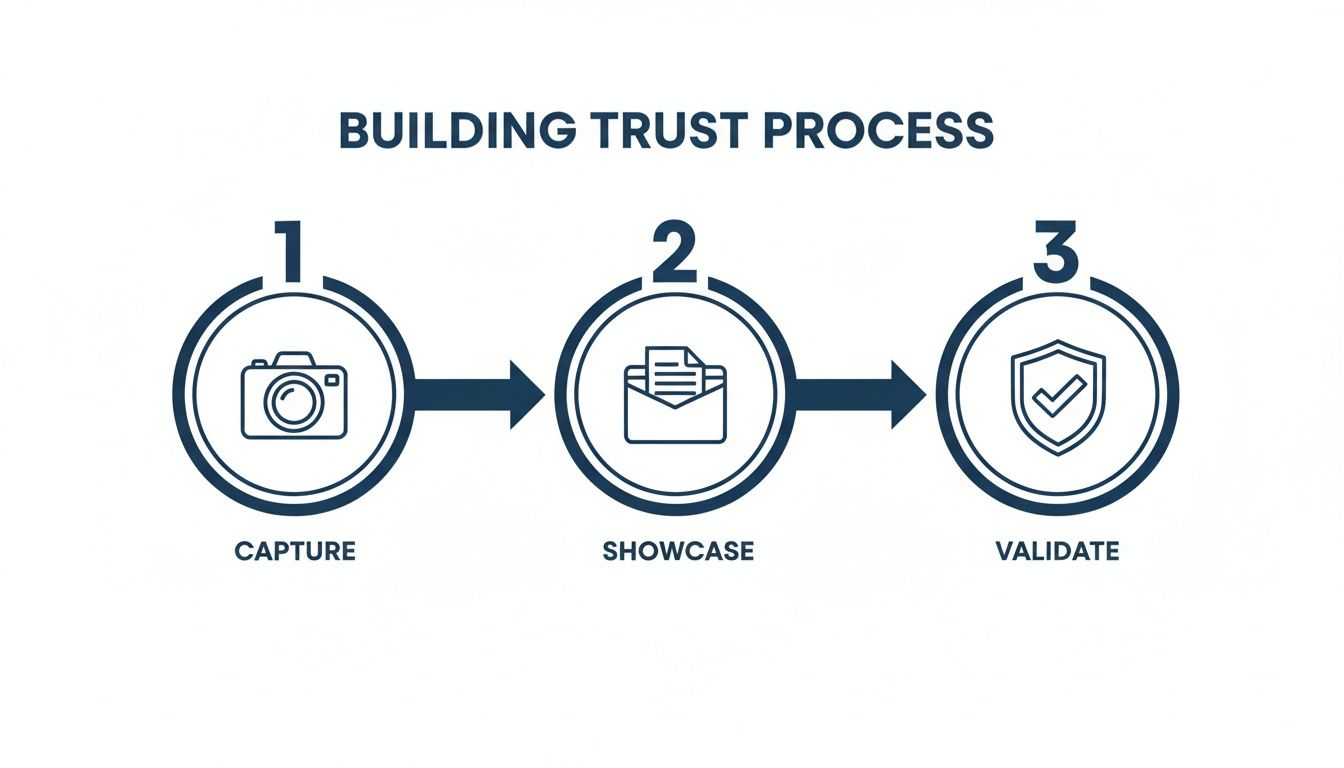
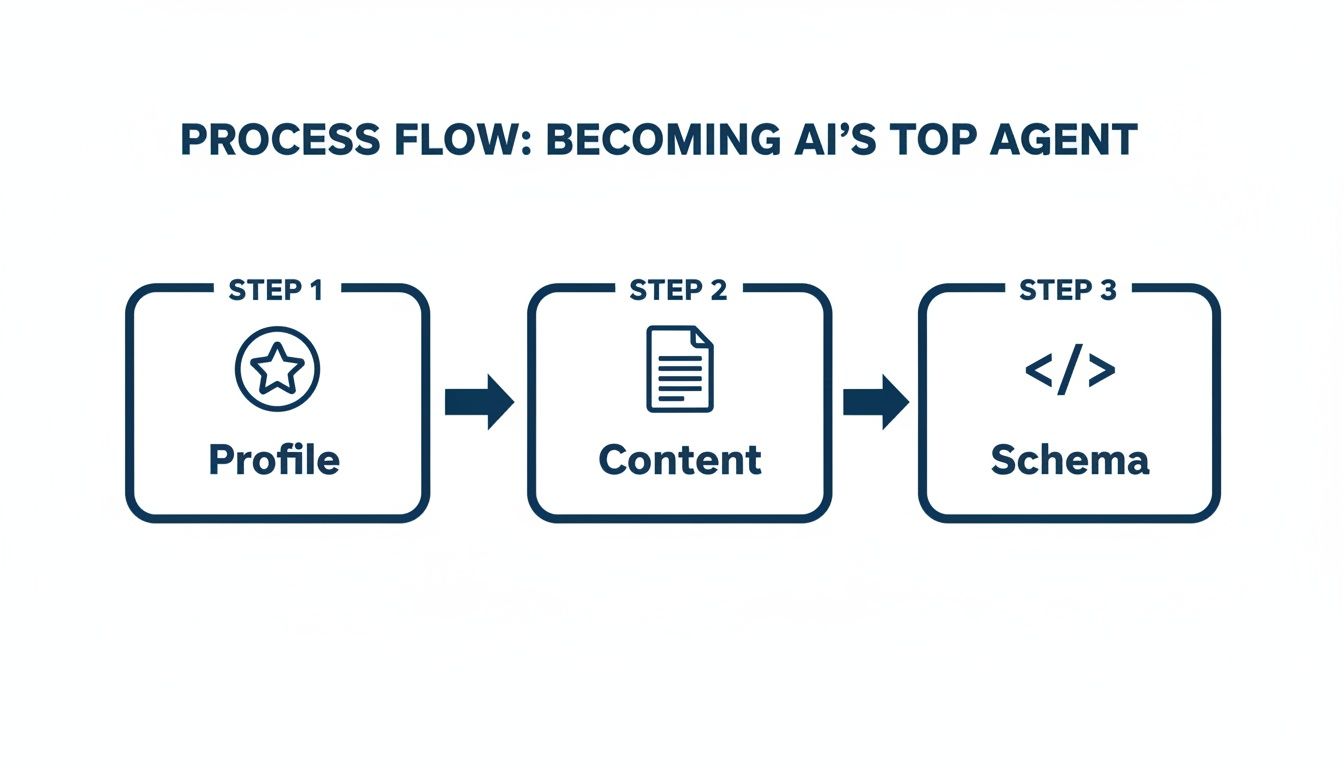
This simple diagram breaks down the trust-building process your content powers.
This cycle—capturing your expertise, showcasing it through great content, and then validating it with real proof—is what creates that unshakable client confidence.
Deploying Your Listing Marketing Suite
Now for the fun part. Every time you get a new listing, you launch the ‘Listing Commander’. This is your tactical marketing engine. In just a few minutes, it generates an entire suite of AI-optimized assets for that specific property. We're talking everything from a compelling MLS description to social media posts and even print-ready flyers.
This isn't just about marketing a house; it’s about demonstrating your value at every single turn.
This shift in operations is profound. You no longer just show up to listing appointments; you arrive with a pre-built, professional marketing plan that proves your value from the very first minute.
This workflow means you’re not just marketing differently—you’re operating like a true market authority. You're set up to win listings before the conversation even begins because you’ve already shown them a superior strategy. To see how these features empower agents, you can explore the tools available on ListingBooster.ai.
Frequently Asked Questions
Building your authority doesn't happen overnight, but with a smart, consistent strategy, you can definitely speed things up. Let's tackle some of the most common questions I hear from agents who are ready to get serious about establishing themselves as an expert.
How Long Does It Take to Build Authority?
You're not going to become the top agent in your city in a month, but you can see a real, tangible shift in as little as 90 days if you stick to the plan. Consistency is everything here.
This is where a platform like ListingBooster.ai becomes a game-changer. It helps you hit the ground running with a constant flow of expert content and perfectly optimized listings. This consistent output helps AI search engines recognize your specific expertise much, much faster than you could ever achieve doing it all by hand.
Can New Agents Build Authority Without Many Sales?
Yes, one hundred percent. New agents can build authority by going deep, not wide. Forget about your sales history for a minute and focus on becoming the undeniable expert in a hyper-local niche. Your first goal is to be the go-to resource for a single neighborhood or a specific type of buyer.
Don't wait for sales to prove your worth. Prove your worth with your knowledge, and the sales will follow. Your consistent content about local trends, businesses, and schools will build the trust that secures those first deals.
Tools like the Authority Builder in ListingBooster.ai are perfect for this. You can instantly create genuinely helpful content about market stats, school districts, and community events in your target area. That deep knowledge, shared consistently, is what makes you a credible expert.
What Is the Single Most Important Factor?
If you take one thing away from this guide, let it be this: consistency. A single viral post is just a blip on the radar. What truly builds a lasting reputation is a steady, reliable stream of valuable content.
This is what builds trust with potential clients and what gets you noticed by search algorithms. An automated content system is your secret weapon here. It ensures your digital presence is always active and reinforcing your expertise, even when you're completely swamped with showings and closings.
Ready to stop chasing leads and start operating like a true market authority? ListingBooster.ai generates a complete suite of AI-optimized assets—from social media posts to compelling MLS descriptions—designed to help you win listings before you even walk in the door.
If you're a real estate agent, you've probably spent years perfecting your SEO strategy to get to the top of Google. But what if I told you that the game has completely changed?
AI SEO is the new frontier. It’s no longer about simply ranking #1 for a keyword. It’s about optimizing your entire online footprint—your website, your listings, your local profiles—so that AI tools like Google's AI Overviews and ChatGPT recommend you directly. The goal is to be the answer when a buyer asks their AI assistant, "Who is the best agent in Austin for first-time homebuyers?"
How AI Is Rewriting Real Estate Marketing
The modern homebuyer's journey looks very different today. Instead of scrolling through endless blue links on a search results page, your potential clients are getting direct, summarized answers from AI. This is a massive opportunity for agents who get ahead of the curve and a real threat to those who don't.
Old-school SEO was a grind of keywords and backlinks. The new battlefield is about feeding AI systems the structured, authoritative information they crave to confidently recommend you and your listings.
The New Battlefield for Visibility
This isn't some far-off trend—it's happening right now. A staggering 40% of homebuyers are already using AI tools to kick off their property search, and that number is climbing fast.
These AI platforms don't just pick any random website. They're designed to find and prioritize content that is:
Trustworthy: Pulled directly from your website and a well-maintained Google Business Profile.
Structured: Uses a technical language called schema markup to clearly define property details, agent info, and local expertise.
Authoritative: Backed up by a consistent stream of high-quality content like hyper-local market reports and in-depth neighborhood guides.
Think about it. When a potential client asks ChatGPT for "family-friendly neighborhoods in Denver with good schools," the AI scans the web to synthesize an answer. Your goal is to make sure your content is the most reliable, comprehensive source it finds.
The core of AI SEO for real estate agents is simple: build a digital footprint that makes you the undeniable local expert. When you consistently publish helpful, structured content, you're not just marketing—you're training AI to recognize your authority.
Comparing Traditional SEO and AI SEO for Real Estate
To really grasp this shift, it helps to see the old and new approaches side-by-side. This table breaks down the crucial differences between yesterday's SEO tactics and the AI-driven strategies required to win clients today.
Strategy Element
Traditional SEO Approach
Modern AI SEO Approach
Primary Goal
Rank #1 on a search results page.
Become the AI's go-to source for recommendations.
Keyword Focus
Broad match keywords (e.g., "homes for sale Austin").
Conversational, long-tail questions (e.g., "what is the best Austin neighborhood for young families?").
Content Strategy
Blog posts targeting specific keywords.
Creating a web of interconnected, authoritative content (market reports, neighborhood guides, agent profiles).
Technical Focus
On-page SEO, backlinks, and site speed.
Schema markup, structured data, and entity-based optimization.
Source of Truth
Ranking algorithms based on links and keywords.
AI models synthesizing data from trusted, structured sources.
Lead Generation
Attract clicks from a list of search results.
Intercept buyers at the moment of inquiry with a direct AI-generated answer.
As you can see, the new approach is far more holistic. It’s about building a brand that AI can understand and, more importantly, trust.
Why Portal Dependency Is a Losing Game
Relying on portals like Zillow and Realtor.com has always meant you were renting, not owning, your leads. Building an AI-optimized presence on your own website creates a sustainable lead pipeline that belongs to you. It's about positioning your brand to capture high-intent leads before they ever even think to visit a crowded portal.
The numbers don't lie. With AI Overviews now dominating a huge portion of search results, click-through rates to traditional websites are plummeting for agents who fail to adapt. But it's not all doom and gloom. Agents who are leaning into AI SEO are reporting a 68% improved ROI because they are showing up exactly where modern buyers are looking. You can dig into more of these AI SEO statistics and their impact to see the full picture.
Mastering AI SEO for real estate agents means building a marketing engine that works for you 24/7. It’s the key to becoming the definitive answer to a homebuyer's question, not just another name lost in the crowd.
Writing AI-Optimized Property Listings That Convert
Let's be honest, your property description has a new audience. It’s no longer just a sales pitch for a human buyer; it's a critical data source for AI search tools. This means every single word you write has to do double duty: entice a person and educate an algorithm. The old days of just cramming in generic keywords are long gone.
Today's winning strategy is all about entity-based SEO. This is a fancy way of saying you need to describe a property by its relationship to the world around it. You're not just selling four walls and a roof; you're selling a lifestyle, a community, a place. You need to connect the dots between the home and local entities like schools, parks, popular restaurants, and transit hubs.
When you do this, you turn a simple listing into a rich, contextual story. So when a potential buyer asks an AI, "Find me a three-bedroom house in Scottsdale near a good elementary school and a dog park," your listing is infinitely more likely to pop up if it clearly communicates those connections.
Moving Beyond Keywords to Entities
To really nail this for AI, think more like a storyteller than a salesperson. Instead of just listing "granite countertops," you need to describe the "chef’s kitchen with sleek granite countertops, perfect for entertaining." See the difference? That subtle shift adds context that both people and machines can easily understand.
This is the core of what makes AI SEO for real estate agents so effective. It’s all about providing clear, descriptive, and interconnected information.
Instead of: "big backyard"
Try: "a sprawling, fully-fenced backyard that’s ideal for summer barbecues."
Instead of: just the city name
Try: "nestled in the quiet, tree-lined streets of the historic Northwood district."
Instead of: a vague location
Try: "just a five-minute walk to the popular Oak Street Farmer's Market and steps from the entrance to Greenway Park."
This level of detail gives AI models like ChatGPT and Google's AI the precise data they need to match your listing with very specific buyer searches. Every connection you make to a local entity—a park, a school, a coffee shop—strengthens your listing's relevance.
Crafting Descriptions for Humans and AI
Your goal is to write copy that feels completely natural and compelling to a person while also being perfectly structured for a machine. This is where combining vivid, descriptive language with a few psychological triggers becomes a superpower.
Let’s walk through a real-world example. Say you've got a new listing and you've used a tool like ListingBooster.ai to generate the first draft. Here’s how you can polish it to hit both targets.
The Standard, Boring MLS Description: “3 bed, 2 bath home in Austin. Updated kitchen, large yard. Close to downtown. Great for families. Must see.”
The AI-Optimized, Compelling Description: “Discover your dream home in the heart of Austin’s vibrant Zilker neighborhood. This beautifully renovated 3-bedroom, 2-bathroom residence offers the perfect blend of modern comfort and urban convenience. The fully updated kitchen features stainless steel appliances and quartz countertops, flowing seamlessly into an open-concept living area bathed in natural light.
Step outside to a private, spacious backyard, perfect for weekend gatherings. Located just a 10-minute drive from downtown Austin and within the highly-rated Zilker Elementary school district, this home is an ideal choice for families. Enjoy being walking distance from Zilker Park and Barton Springs Pool. This opportunity won’t last long—schedule your private tour today.”
The difference is night and day, right? The second version is packed with local entities (Zilker neighborhood, Zilker Elementary, Zilker Park) and uses light psychological cues like "dream home" (tapping into aspiration) and "won’t last long" (creating scarcity).
A great AI-optimized listing tells a story that resonates with a buyer's aspirations while simultaneously feeding search engines a structured, fact-based summary of the property and its surrounding environment. The two goals aren't in conflict; they actually support each other.
A Practical Checklist for AI-Ready Listings
As you sit down to write your next property description, run through this mental checklist to make sure it's optimized for modern search.
Lead with a Killer Hook: Start with a sentence that grabs attention and highlights the home's most unique selling point.
Name Specific Entities: Don't be vague. Mention the actual names of neighborhoods, school districts, parks, key streets, and popular local businesses.
Use Natural Language: Write like you talk. Ditch the jargon and awkward keyword-stuffing. Imagine you're describing the home to a client in person.
Describe the Lifestyle: Paint a picture. What does it feel like to live there? Talk about morning coffee on the patio or weekend walks to the nearby cafe.
Incorporate Urgency: Use phrases like "highly sought-after neighborhood" or "a rare find in this market" to create a little friendly urgency.
Structure for Scannability: Keep your paragraphs short (just 2-3 sentences) and use bullet points for key features. This makes the description easy to read on any device.
By following this framework, you’ll create listings that not only shine on traditional portals like Zillow and Realtor.com but are also perfectly teed up to be recommended by the AI assistants that are quickly becoming a homebuyer's first stop.
Building the Digital Authority AI Recommends
Optimized listings get your properties seen, but building digital authority gets you recommended. It’s a crucial distinction. AI search engines like Perplexity and Google’s AI Overviews don’t just find houses; they find experts.
When a potential client asks their phone, "Who is the best real estate agent in Scottsdale?" the AI isn't just looking for keywords. It's scanning for signals of expertise, consistency, and trust across the web. Your job is to build that digital footprint so you're the undeniable answer.
This isn't about just having a blog. It’s about becoming the go-to online resource for your market. Think of every article you post as another brick in the foundation of your reputation, strengthening your authority one piece of content at a time.
The Content That Signals True Expertise
To be seen as an expert, you have to create content that answers the specific, nuanced questions your clients are actually asking. You need to get way beyond generic "tips for buyers" and dig deep into what makes your local market tick. This is how you prove your value long before the first phone call.
AI rewards content that is genuinely helpful and demonstrates firsthand knowledge. Here are the kinds of posts that build real authority:
Hyper-Local Neighborhood Guides: Don't just list demographics. Talk about the lifestyle. Where's the best local coffee shop? What's the walkability score really like? What's the community vibe?
Insightful Market Updates: Anyone can spit out MLS data. Your job is to provide expert analysis. What do rising interest rates actually mean for a first-time buyer in your specific city?
Practical "How-To" Articles: Solve real-world problems for your audience. Think "How to Successfully Appeal Your Property Tax Assessment in Maricopa County" or "A First-Time Homebuyer's Complete Checklist for North Phoenix."
AI doesn't just index keywords; it understands concepts and recognizes genuine expertise. When you consistently publish content that answers the questions your clients have, you are actively training AI to recommend you as the most qualified professional in your area.
Creating a Consistent Digital Footprint
Consistency is everything when it comes to building authority. A single great blog post is a drop in the ocean. A steady stream of valuable content, on the other hand, creates a rising tide that lifts your entire online presence.
I get it—creating this content consistently is a massive challenge for busy agents. This is where having a smart system becomes a critical advantage, ensuring your digital presence grows without eating up all your time.
The reality is that AI search isn't replacing traditional search; it's layering right on top of it. And the agents who adapt to this new reality are the ones who will win. In fact, first-party sites and Google Business Profiles make up 86% of AI citations. That means the digital assets you directly control are what AI pulls from the most.
Automating your content creation with a tool like ListingBooster.ai helps you maintain that crucial consistency. Imagine generating a full 30-day calendar of market updates, agent profiles, and neighborhood spotlights in the time it takes to grab a cup of coffee. This systematic approach ensures your digital footprint is always active, relevant, and growing.
How Your Content Turns into AI Recommendations
So, how does a blog post about a local farmers market actually translate into a new lead from an AI search? The connection is more direct than you might think. AI models synthesize information from multiple sources to build a confident answer for the user.
Let's walk through a real-world scenario:
A user asks Google's AI, "What are the best family-friendly neighborhoods in Scottsdale?"
The AI scans the web for reliable content discussing Scottsdale, families, local schools, parks, and community events.
It finds your in-depth guide to the "Top 5 Scottsdale Neighborhoods for Families," your article on the "Best Parks in North Scottsdale," and your latest market report mentioning specific school district ratings.
Because your content is comprehensive, well-structured, and consistently published on your own website, the AI identifies you as a credible authority.
In its response, it not only recommends the neighborhoods you wrote about but might also mention you as a knowledgeable local real estate expert, sending high-intent traffic right to your digital doorstep.
Every piece of high-value content is another data point proving your expertise. You're building a web of interconnected, authoritative information that makes it easy for AI to understand who you are and why you're the best choice. For a deeper dive into how this all works inside Google's world, check out our guide on how Google AI is changing real estate search. This is what separates the top agents in the age of AI.
Using Schema Markup to Speak Directly to AI
Think of your website as a beautifully designed brochure. Humans get it instantly. But to a search engine or an AI assistant, it’s just a jumble of text and images. They need a translator to know that "$500,000" is a price, "4" is the number of bedrooms, and "Jane Doe" is the agent.
That translator is called schema markup. It’s basically a special vocabulary you add to your website's code. It doesn't change a thing for human visitors, but it makes a world of difference to the machines by adding invisible labels to every piece of information.
Why Schema Is a Game-Changer for AI SEO
Without schema, an AI is left guessing what your content means. With it, you're spelling everything out: "This is a real estate listing, here's the address, this is the square footage, and that’s the agent’s contact info."
This structured data is the magic behind those rich, detailed search results you see on Google—the ones with photos, prices, and bed/bath counts right on the results page. For AI SEO for real estate agents, this is non-negotiable. AI systems love information they can understand with 100% certainty, and schema delivers exactly that.
Just look at this screenshot from Schema.org. It shows just a fraction of the specific fields you can define for a RealEstateListing.
As you can see, the code lets you label everything from the askingPrice to specific amenityFeature details. You're essentially handing search engines a perfectly organized summary of your property.
You Don't Need to Be a Coder Anymore
The best part? You don't need to be a web developer to pull this off. Ten years ago, adding schema was a tedious, manual slog. Today, modern real estate marketing platforms and website plugins can handle it all for you.
Think of it this way: schema markup turns your website's content into a perfectly organized database that AI can query directly. When you structure your data this way, you're not just hoping to rank—you're providing the direct answer to a machine's question.
Tools like ListingBooster.ai automatically embed the right schema for your properties and your agent profile. When you generate a property description or a bio, the platform is working behind the scenes to wrap that content in the appropriate code. This means every piece of content you create is ready for AI the moment you hit "publish."
The Most Important Schema Types for Agents
While there are hundreds of schema types out there, you only need to focus on a few key ones to get the biggest bang for your buck. Getting these right gives AI a complete picture of who you are, what you sell, and where you work.
RealEstateListing: This is the big one. It covers all the property-specific details like price, address, number of rooms, and square footage.
RealEstateAgent: This one is all about you. It includes your name, brokerage, contact info, and license number, proving your credentials.
LocalBusiness: This helps ground your business in a physical location, connecting you to a specific town or neighborhood and giving your local search presence a serious boost.
Review: This markup highlights client testimonials, turning your hard-won social proof into a structured signal of trust that both search engines and potential clients can see.
By implementing these, you're building a complete, machine-readable profile of your business. If you want to dive deeper into how this code can transform your listings, check out our detailed guide on using schema markup for real estate listings.
The key takeaway here is simple: what used to be a highly technical and expensive SEO task is now an essential—and completely accessible—part of your marketing toolkit. By making sure your digital footprint is properly structured, you make it incredibly easy for AI to find, understand, and recommend both you and your properties.
Your Actionable AI SEO Workflow for Listings
It's one thing to talk about theory, but it's another to actually put it into practice and get results. So let's connect all these ideas into a practical, repeatable workflow you can start using the second you land your next listing. The goal here isn't to add more work to your plate; it’s to use an AI-powered system to roll out a complete, optimized marketing campaign in just a few minutes.
Think about walking into your next listing presentation. Instead of just bringing a CMA, imagine showing up with a fully-realized digital marketing plan, ready to launch the moment they sign. That’s the kind of competitive edge this workflow gives you.
This process shows how raw listing data gets transformed into AI-friendly content that search engines and discovery platforms can instantly understand and serve up to potential buyers.
The big takeaway? AI is the translator. It takes basic property details and turns them into the structured, optimized assets you need to be visible online today.
The New Listing Launchpad
The clock starts ticking the moment that listing agreement is signed. Speed and precision are everything. Your mission is to get that property maximum exposure across every platform that matters—from your local MLS to social media—and to do it fast. Every single piece of content needs to be optimized for both human eyeballs and AI discovery right from the get-go.
Let's walk through a real-world scenario. You just listed a beautiful 4-bedroom home in a sought-after suburban neighborhood.
Instead of sitting there for hours trying to craft the perfect MLS description or wracking your brain for social media ideas, you turn to an AI platform like ListingBooster.ai. All you do is plug in the property's address or a few key details, and the system immediately gets to work.
Generating Core Assets in Minutes
In less time than it takes to make a cup of coffee, you have a full suite of marketing materials. And this isn't generic, cookie-cutter stuff. It’s all built on the principles of AI SEO for real estate agents, with each asset crafted for a specific channel and a specific purpose.
Here’s what you get, instantly:
An AI-Optimized MLS Description: This isn't your standard bland description. It’s written in natural language, weaving in local landmarks (nearby parks, school districts) and using subtle phrasing that resonates with buyers. Of course, it’s fully editable and compliant with Fair Housing guidelines.
A Full Month of Social Media Content: The system spits out a 30-day social media calendar. You get posts for every stage of the listing lifecycle: "Coming Soon," "Just Listed," "Open House," and even "Under Contract." Each one has a unique angle, smart image suggestions, and the right local hashtags.
Print-Ready Materials: Need flyers for the open house? Done. Professional brochures are generated on the spot, bridging your digital efforts with high-quality physical handouts.
This isn't just a time-saver. It's about deploying a professional, multi-channel marketing campaign with a consistency and quality that, until recently, would have required a whole marketing team.
This immediate, comprehensive launch shows your sellers you’re on the ball. You aren't just promising great marketing; you're delivering it from day one.
From Listing Launch to Authority Building
But the workflow doesn't end when the listing goes live. The very same system that launched your property marketing can now pivot to build your long-term digital authority. This is where you connect the dots between your property-specific marketing and your brand as the go-to local expert.
After scheduling out all your social posts for the listing, you can start planning content that will keep working for you long after this home has sold.
This next phase is all about building your brand:
Schedule Hyper-Local Market Updates: Generate and schedule a weekly or monthly market report for that specific neighborhood. This positions you as the agent who knows the numbers.
Create Neighborhood Guides: Put together an in-depth guide to the community where your listing is. This becomes an evergreen piece of content that attracts future buyers and boosts your organic traffic.
Answer Common Client Questions: Quickly create short, helpful articles answering questions like, "What are property taxes like in this area?" or "What are the best local restaurants?"
This smooth shift from property promotion to brand building is what creates a sustainable marketing engine. Each new listing becomes a new opportunity to strengthen your digital footprint, making it even easier for AI to recommend you for the next piece of business. For those wanting to dig deeper, there are many powerful AI tools for real estate agents that can be integrated into this process.
By adopting this systematic approach, you create a powerful feedback loop. Your optimized listings get immediate attention, and your authority content builds a foundation of trust that attracts future clients—all powered by one efficient workflow.
Common Questions About AI SEO in Real Estate
Even with all the benefits laid out, I get it—jumping into AI-driven marketing can feel like a big step. It’s natural to have questions. Let's walk through some of the most common ones I hear from agents, so you can feel confident making this shift.
Will AI SEO Replace My Website?
Absolutely not. In fact, it does the exact opposite. AI SEO makes your website more critical to your business than ever.
Think of your website as your digital storefront. It's the ultimate source of truth about you and your listings. AI search tools, like Google's AI Overviews and ChatGPT, are hungry for reliable, direct information, and they trust your website and Google Business Profile above all else. Why? Because the information comes straight from the source—you.
AI SEO is simply the process of fine-tuning your content so these AI systems can easily understand it, trust it, and recommend you. It's not a replacement for your site; it's a supercharger for it.
How Do I Measure the Success of AI SEO?
This is a great question. Success here isn't just about climbing to the #1 spot on a search results page. AI SEO for real estate agents is all about driving real business and cementing your reputation as the local expert.
You'll want to watch a mix of metrics to see the full picture:
Direct Leads: Are you getting more form submissions through your website? Are more people clicking to call from your Google Business Profile? These are the clearest signs of a direct return on your investment.
Organic Growth: Keep an eye on your website's organic traffic. You should see a steady climb. Also, just search for your own name and brokerage—are you showing up more prominently?
AI Visibility: This is the new frontier. When your content starts appearing in Google's AI Overviews for local real estate questions, that's a huge win. It’s a clear signal your strategy is hitting the mark.
Social Buzz: Pushing out consistent, high-quality content will naturally boost engagement on your social media. This isn't just vanity; it's a powerful indicator that your brand authority is growing.
Do I Need to Be a Tech Whiz to Implement This?
Not at all, and that’s the best part. Modern tools are built for agents, not developers. The whole point is to take these complex, once-inaccessible marketing strategies and make them simple.
Good platforms are designed to be intuitive and save you precious time. You typically just plug in a property address or a few details, and the AI takes over, handling the heavy lifting of writing great copy, crafting social posts, and even embedding the right code (schema markup) for you.
How Does AI Content Stay Compliant?
Compliance is non-negotiable, and any AI tool worth its salt in the real estate space knows this. These systems are specifically trained to steer clear of language that could get you in trouble with Fair Housing laws. They stick to objective property features and the lifestyle benefits of the community.
On top of that, a platform like ListingBooster.ai ensures all AI-generated content is completely editable. You always have the final say. This gives you total control to make sure every listing description and social post is 100% compliant with your local MLS rules and brand voice before it goes public.
Ready to stop being invisible in AI search? ListingBooster.ai is the command center that transforms your listings into a complete marketing suite and builds your digital authority automatically. Start your free 30-day trial today.
Think of schema markup as a translator for your real estate listings. It's a special kind of code you add to your website that tells search engines like Google exactly what they're looking at—not just a page with words and numbers, but a specific property for sale or rent with a price, address, and number of bedrooms.
This structured data is what powers those eye-catching rich results you see in Google search, where key details pop out right on the results page. It's a simple change that makes your listings impossible to ignore and grabs a buyer's attention before they even click.
Why Schema Is a Game Changer for Real Estate Agents
In a digital marketplace overflowing with listings, just having a beautiful property isn't enough to get noticed. Schema markup has quickly evolved from a technical "nice-to-have" into a must-have tool for any serious real estate agent. It’s the invisible framework that gives search engines context.
Here's a practical example: without schema, Google sees a webpage with text like "3 bedrooms," "$500,000," and "Miami." With schema, it understands that this is a SingleFamilyResidence with a numberOfRooms value of 3, available for sale under an Offer of $500,000, and located in the city of Miami. That level of clarity makes all the difference.
Turning Data Into Your Competitive Edge
This structured approach is what allows search engines to showcase your properties in much more compelling ways. When you implement the right schema, you unlock rich results that put the most important information front and center on the search results page.
This isn't just theory; it has a real impact on your bottom line. We've seen from industry data that real estate websites using schema correctly can see their click-through rates (CTR) jump by 20-30% compared to listings without it. Why? Because rich results that highlight price, square footage, and availability are simply more enticing to a homebuyer scrolling through pages of links.
Key Takeaway: Schema markup isn't just an SEO trick. It transforms a standard listing page into a dynamic marketing tool that answers a buyer's most pressing questions before they even visit your site.
Connecting Schema to Real Business Goals
At the end of the day, it's all about generating more qualified leads, and this is where schema truly delivers. By presenting clear, structured information right away, you attract buyers who are serious and have already self-qualified based on the details you provided.
This translates directly into tangible business results:
Higher Click-Through Rates: Rich snippets are visually appealing and stand out, naturally earning more clicks from interested buyers.
Better Quality Leads: When a user clicks, they already know the key details, which means they are much further along in their journey.
Improved Search Visibility: Proper schema helps Google categorize your listings, boosting your chances of ranking for specific, high-intent searches like "three-bedroom house for sale in Miami."
Future-Proofing for AI: As AI tools and conversational search grow, they will rely on structured data to find and present real estate information. Schema makes your listings ready for that future.
For agents looking to streamline this, platforms like ListingBooster.ai are built to automate much of the marketing work, including creating optimized content. But understanding the fundamentals is key, and this guide will walk you through exactly how to put schema to work for your own listings.
Choosing the Right Schema for Your Properties
Okay, let's get into the practical side of things. Simply knowing why you need schema is one thing, but knowing how to implement it is where you really start seeing results. The secret isn't just slapping some code on your property pages; it's about being incredibly specific and choosing the right structured data to describe what you're selling or renting.
Think of it this way: you're creating a crystal-clear filing system for Google. The more precise your labels, the faster and more accurately it can pull up your listing for a genuinely interested buyer.
At the very top, you have the RealEstateListing schema. This is your main container, the big bucket that tells search engines, "Heads up, this page is about a property on the market." It’s your starting point for all the transactional details—who the agent is, when the listing went live, and so on.
But that's just the beginning. To really make your listing pop in search results, you have to layer in more detail. The RealEstateListing schema is most powerful when you nest more specific property types inside it. This is how you give Google the juicy details it loves to show off in those rich results.
Get Specific: Matching Schema to Property Types
Let's be honest, not all properties are created equal, and your schema needs to reflect that. Just using a generic Residence tag is fine, I guess, but it's a missed opportunity. If you're listing a classic suburban house, using SingleFamilyResidence sends a far stronger and more accurate signal.
The same goes for a unit in a high-rise building. In that case, Apartment is the right call. These details really matter because they directly map to how people search. Someone typing "downtown apartment for rent" has a very different goal than someone looking for a "four-bedroom house for sale." Using the correct schema is your best bet for capturing that high-intent traffic.
Just look at that list. From datePosted to leaseLength, you have everything you need to paint a complete picture for search engines.
Real-World Scenarios: Putting it All Together
So, how does this look in practice? The best schema combination depends entirely on the property and what you're trying to achieve.
Here are a few common situations you probably deal with every week:
The Suburban Home for Sale: Imagine a four-bedroom house in a nice, quiet neighborhood.
Primary Schema:RealEstateListing to set the stage for the transaction.
Nested Property Type:SingleFamilyResidence to clarify it's a standalone house.
Transaction Schema:Offer to state the asking price, like "$550,000".
The Downtown Condo for Rent: A sleek two-bedroom unit in a modern building.
Primary Schema:RealEstateListing to frame it as a rental.
Nested Property Type:Apartment to define the unit.
Transaction Schema: Use Offer with priceSpecification to show it's a rental (e.g., "$2,800" per month) and include the leaseLength.
An Upcoming Open House: You need to get the word out about a specific viewing time.
Primary Schema: Start with RealEstateListing and the right property type (SingleFamilyResidence, Apartment, etc.).
Event Schema: Nest an Event (specifically an OpenHouseEvent) inside the listing. This is where you'll announce the date, start time, and end time, which can trigger those special event-based snippets in search results.
My Two Cents: Don't ever skip the Offer schema. A RealEstateListing describes what the property is, but the Offer tells people the price and availability—arguably the two most important details for anyone searching. Without it, your rich snippet is missing the whole point.
By thoughtfully combining these schema types, you're essentially handing Google an unambiguous roadmap to your listing's data. That precision is what gives the search engine the confidence to feature your properties with those detailed, eye-catching rich snippets that bring in more qualified clicks and better leads.
Building Your First JSON-LD Snippets from Scratch
Alright, let's get our hands dirty and build the actual JSON-LD code that makes your listings stand out to search engines. The code might look a bit technical at first glance, but I promise it's more like filling out a form than writing software from scratch.
Think of it like this: JSON-LD is just a way of organizing your listing's key details—address, price, bedrooms—into a neat, machine-readable format. By labeling each piece of information, you're essentially handing Google a perfect summary of your property, which it can then use to build those eye-catching rich results.
My goal here is to give you a few solid, adaptable templates. You won't need to become a coding expert; you just need to know how to swap out the placeholder details with your own.
The Classic Single-Family Home for Sale
Let's start with the bread and butter of real estate: a single-family home for sale. Imagine you're listing a great three-bedroom house at 123 Main Street. The schema needs to clearly state its type, location, features, and sale price. To do this, we'll create a RealEstateListing that wraps two key components: a SingleFamilyResidence (the house itself) and an Offer (the sale details).
Here’s a practical JSON-LD snippet you can use as your foundation:
See how it works? The itemOffered section defines the physical house, while the offers part handles the money side of things. Pay special attention to the geo property—adding latitude and longitude coordinates is a fantastic way to nail down your location for local search and map-based queries.
The Urban Apartment for Rent
Now, let's switch gears to a rental. An apartment listing has a slightly different focus, especially when it comes to the lease terms. We'll use the Apartment schema type and tweak the Offer to show a monthly rent instead of a one-time sale price.
Here's how you'd structure the JSON-LD for a two-bedroom apartment:
Pro Tip: The amenityFeature property is your secret weapon. Don't just list amenities in your description; structure them with schema. This makes it easier for AI and advanced search filters to identify properties with specific features like a "Rooftop Pool" or "In-Unit Laundry."
Mapping Your MLS Data to Schema Properties
One of the biggest hang-ups for agents is figuring out which MLS field goes into which schema property. It’s actually a pretty direct translation once you see it laid out. Whether you're pulling from your MLS, Zillow, or Redfin, the logic is the same.
Here's a quick cheat sheet to help you map your listing data.
This kind of direct translation is exactly what tools like ListingBooster.ai automate. They pull data straight from your listing and generate the right JSON-LD, saving you the headache of manually matching every field.
Still, understanding how it works puts you in control, letting you fine-tune or troubleshoot your markup to ensure your schema markup for real estate listings is always accurate and effective.
How Schema Gives You an Edge in Local and AI Search
Structured data isn't just a technical SEO task anymore. It’s your direct line to the future of how people find homes, especially as searches become more local and conversational.
Think about it. We’re moving beyond a simple list of blue links. The goal now is to make your listings the definitive source of information for AI assistants and local map searches. When a potential buyer asks an AI tool like Perplexity or gets a response from Google's AI Overviews for "three-bedroom houses with a pool in Austin," these systems are hunting for clean, unambiguous data. That data is your schema markup.
Without structured data, your listing is just a block of text an AI has to interpret and potentially get wrong. But with it, your property becomes a factual, organized answer that can be served directly to a motivated buyer.
Winning the "Near Me" Game with Place and LocalBusiness Schema
In real estate, almost every search has a local intent. Nobody is just looking for a house; they're looking for a house in a specific neighborhood, a certain school district, or a particular city. This is where combining your property schema with local-focused markup becomes a game-changer.
When you pair your RealEstateListing with Place and LocalBusiness schema, you're handing Google’s local algorithm everything it needs on a silver platter.
Place Schema: This is how you nail down the property's exact geographic location. Using geo coordinates is a powerful signal that reinforces the listing's relevance for anyone searching on a map.
LocalBusiness Schema: This one is for your brokerage or agency. It cements your physical presence, defines your service area, and lists your contact info, giving you a huge lift for all those "realtors near me" queries.
This combination is a powerful one-two punch for climbing the ranks in Google's Local Pack and on Maps. You’re telling Google not just what you're selling, but also where it is and who is selling it. It builds a triangle of trust and relevance that pushes you ahead of competitors who are only using basic listing markup.
From my experience: I’ve seen agents jump in local rankings just by making sure their office address in LocalBusiness schema was identical to their Google Business Profile, and that their listings used precise geo coordinates. It seems minor, but that kind of consistency is exactly what the local algorithm is designed to reward.
Getting Your Listings Ready for AI-Powered Discovery
The move to AI-powered search is happening a lot faster than most people think. As AI reshapes how properties are discovered, schema markup is the essential bridge that allows your listings to show up in these new generative answers. Here's a key insight: pages with valid schema are 2-4x more likely to be featured in Google's AI Overviews, Perplexity answers, and ChatGPT outputs. That’s critical, since over 40% of homebuyers now start their search on these platforms, skipping traditional search engines altogether. You can get more details on this in an insightful guide from DigitalApplied.com on how schema powers AI.
This means your structured data is no longer just for getting fancy rich snippets. It's the core dataset that AI models use to compare properties, understand unique features, and even recommend agents. A well-marked-up listing with detailed amenityFeature schema, for instance, could be the perfect answer an AI needs for a very specific user query. For more tips on creating high-performing content, you can find other great strategies on the ListingBooster.ai blog.
Ultimately, putting a solid schema strategy in place is about future-proofing your business. You aren't just optimizing for today's search results; you're making sure your properties are visible, understandable, and recommended by the AI tools that are quickly becoming the new normal for homebuyers everywhere.
Getting Your Schema Markup Live and Working
Crafting the perfect JSON-LD snippet is a great first step, but that code doesn't do you any good until it's live on your site—and more importantly, correct. A single misplaced comma or a typo can break your entire schema, making it completely invisible to search engines.
This is why validation is your most crucial quality check before you publish anything. Think of it as proofreading a listing before it goes on the market. You'd never want a glaring typo in your property description, and you definitely don't want a syntax error crippling your code. Luckily, we have some powerful and free tools to catch these problems early.
The process of turning raw listing data into something Google’s AI can understand and feature in search results looks a lot like this:
This really drives home how schema acts as the essential bridge between your property data and its visibility in advanced, AI-driven search.
Use Google’s Rich Results Test for Validation
Your first and most important stop should always be Google’s own Rich Results Test. This is the official source of truth for checking if your page is even eligible for the rich results you’re after. You can either paste your code snippet directly into the tool or give it the URL of a page where the code is already live.
The test gives you a clear answer on two fronts:
Is it valid? It checks for syntax errors, ensuring your code is structured correctly.
Is it eligible? It confirms if your page qualifies for rich results based on the schema you provided.
A successful test will greet you with a green checkmark, giving you the green light to deploy. If the tool finds errors, it will pinpoint the exact line of code causing the issue. Most of the time, the fix is simple—a missing comma, a typo in a property name, or a misplaced bracket.
The test might also show warnings. These aren't deal-breakers, but they are suggestions for recommended properties you’ve left out. Adding them can make your schema even more powerful, so it's worth paying attention to them.
Deploying Your Schema Markup
Once your code passes the test, it's time to get it onto your website. You generally have two ways to go about this.
Direct Implementation: This is the most straightforward route. You just add the <script> tag containing your JSON-LD into the <head> section of your property listing’s HTML. If you use a CMS like WordPress, a plugin or a simple theme file edit can get this done quickly.
Google Tag Manager (GTM): If you'd rather not touch your website's code directly, GTM is a fantastic alternative. You can create a new "Custom HTML" tag, paste in your JSON-LD script, and then set a trigger to fire that tag only on the specific listing pages where it belongs.
A Quick Tip from Experience: Whichever method you choose, always test a single listing page first. Deploy the code, then run that specific URL through the Rich Results Test again to make sure it’s working live. Once you confirm it’s good, you can roll it out to your other properties.
Keep an Eye on Performance
Your work isn't finished just because the code is live. The final piece of the puzzle is monitoring its impact in Google Search Console. Head over to the "Enhancements" or "Shopping" section, where you’ll find reports specifically for your RealEstateListing schema. This dashboard shows you exactly which pages have valid schema, which have errors, and how many search impressions they are getting.
This kind of ongoing monitoring is key. It helps you catch issues before they become major problems and lets you see the real-world results of your work. When you combine this with a smart local SEO strategy, the effects can be huge. For location-based searches so common in real estate, we’ve seen that optimized markup can improve local visibility by 3-5 positions.
If handling all this sounds like a lot, you might be interested in an automated solution. You can check out the different plans ListingBooster.ai offers to handle the entire process for you.
A Few Common Questions About Real Estate Schema
Even after you get the hang of it, a few questions always seem to pop up when agents and brokers start implementing schema for their listings. Let's run through some of the most common ones I hear.
Getting these details ironed out will help you move forward with confidence.
Do I Need to Be a Programmer to Do This?
Not at all. I get this question a lot, and the answer is a firm no. While schema is technically a form of code, you don’t need any programming background to put it to work. Think of JSON-LD less like writing software and more like filling out a highly detailed form.
For most real estate professionals, it boils down to two simple approaches:
Copy-and-Paste Templates: The examples I've shared in this guide are your best friend. Just take the template, swap out the placeholder details with your property's information, and you're good to go. The structure is already done for you.
Use an Automated Tool: Many modern real estate website platforms and plugins handle schema generation behind the scenes. Tools built specifically for this, like ListingBooster.ai, take it a step further by pulling your listing data and creating the right code automatically.
Your job is to understand what information needs to go into the schema, not to become a coder overnight.
How Long Until I See Any Results?
This is the million-dollar question, and the honest answer is: it depends. After you add the schema to your website, Google has to come back and crawl your pages to find it. That process can take anywhere from a few days to several weeks.
You can give Google a nudge by requesting a re-index of your key listing pages through Google Search Console. Typically, you might start seeing rich results show up in search within two to four weeks. As for a real impact on your traffic and click-through rates, you'll see that story unfold in your performance reports over the next couple of months.
My Two Cents: Be patient. Schema is a long-term play, not a quick hack. You're building a solid foundation of structured data that will consistently improve your visibility over time.
Can I Add Schema to My Zillow or Realtor.com Listings?
This one is a crucial distinction. You cannot add your own custom schema markup to listings on third-party sites like Zillow, Trulia, or Realtor.com. You simply don't have access to the back-end code of their websites.
This is precisely why optimizing your own website is so critical. It's one of your most effective strategies for competing head-on with the big portals for search visibility. When you drive traffic to your own site, you control everything—the user experience, how you capture leads, and your brand's story. Your website is your digital storefront, and schema is the best sign you can hang out front.
Should I Use RealEstateListing or Product Schema?
For any home, apartment, or property you're marketing, RealEstateListing is the right tool for the job. It was specifically designed for properties and includes fields that the generic Product schema just doesn't have, like leaseLength or numberOfRooms.
Some SEOs have played around with Product schema to try and get listings into product-style carousels, but that's really a workaround, not a best practice. Using RealEstateListing gives search engines the most accurate context about what you're actually offering. For long-term SEO health, always stick with the most specific schema type available.
Ready to stop wrestling with code and start dominating local search? ListingBooster.ai transforms any property into a complete marketing suite, automatically generating the perfect schema markup to make your listings discoverable by AI and search engines. See the difference for yourself with a free trial at https://listingbooster.ai.
Think of real estate schema markup as a secret language you teach your website to speak directly to search engines. It's a specific type of code that takes the jumble of information on a property listing—the address, price, square footage—and neatly organizes it into a format that Google, Bing, and AI assistants can instantly understand.
Instead of just seeing text, they see a structured RealEstateListing. This small change has a huge impact.
Why Schema Markup Is Your New Competitive Edge
In a digital market overflowing with listings, just showing up in search results isn't enough. While your standard SEO efforts help you get found, schema markup is what helps you win the click. It's the technical secret sauce that transforms a boring blue link into an eye-catching rich snippet, often featuring a property photo, price, and availability right there on the results page.
This structured data doesn't just make your listings more attractive to people scrolling by; it makes them perfectly digestible for the bots and AI systems that power modern search. And as homebuyer habits shift, that distinction is becoming everything.
Boost Your Visibility and Attract Motivated Buyers
When you add schema to your listings, you’re basically handing Google a perfectly organized spec sheet for each property. This clarity allows your listings to pop up in more relevant search carousels and specialized result types, giving your online presence a serious boost.
The difference is staggering. We've seen that pages using schema can achieve a 40% higher click-through rate (CTR) than those without it. Even more telling, these visually appealing rich results snag 58% of all clicks, leaving standard results to fight over the remaining 41%. This isn't just a minor tweak; it's a fundamental advantage, especially as more buyers turn to AI for their initial research.
Key Takeaway: By structuring your listing data with schema, you're answering a buyer's most pressing questions before they even click. This pre-qualifies your audience, driving higher-intent traffic and, ultimately, better leads.
To give you a clearer picture, here's how schema changes the game for your property listings.
The Immediate Impact of Schema on Your Listings
Feature
Without Schema Markup
With Schema Markup
Search Appearance
A standard blue link with a basic title and description.
A rich snippet with a photo, price, and bed/bath count.
Click-Through Rate
Relies solely on compelling copy to earn a click.
Attracts more clicks with visual cues and key data.
AI & Voice Search
Invisible. AI cannot reliably parse the unstructured data.
Prime candidate for being featured in AI-generated answers.
Local SEO
Address is just text; less likely to appear in map packs.
Address is clearly defined, improving map and "near me" visibility.
As you can see, the benefits go far beyond aesthetics. It's about making your data more useful and accessible to both humans and machines.
Adapting to the Age of AI Search
The home search process isn't what it used to be. Today, over 40% of homebuyers are starting their search with AI tools like ChatGPT or relying on Google's AI Overviews. These systems don't "read" websites like people do; they hunt for clean, structured data to give direct, confident answers. Without schema markup, your listings are practically invisible to this massive, growing audience.
By implementing schema, you ensure your properties aren't just indexed but are deeply understood. This makes them the perfect source for an AI assistant to pull from when a user asks for "three-bedroom homes in downtown Austin under $700k."
Here’s what that means for you in practical terms:
Enhanced Rich Snippets show off key details like price, bed/bath count, and square footage right in the search results.
Improved Local SEO Performance comes from clearly defining property addresses and coordinates, making you a stronger contender for map-based searches.
Future-Proofing Your Listings prepares your business for the next wave of voice search and AI-first real estate platforms that demand structured data.
When you make your data easy for machines to process, you position yourself as an authoritative source of information. You can dig deeper into how Google's AI is transforming real estate search to see just how critical this is for staying relevant. At the end of the day, schema is the bridge connecting your MLS data to the future of how people find their next home.
The Essential Schema Types Every Agent Should Know
When you're trying to get a search engine's attention, you have to speak its language. For us, that language is schema markup. While there are hundreds of different schema "types," you really only need to master a few key ones to make your listings and your personal brand pop in search results.
Think of it as building a digital dossier for each property. Every piece of schema you add is another layer of rich detail, creating a complete picture that both Google's algorithms and, more importantly, your potential clients can instantly understand. Let's dig into the core building blocks you'll be working with.
The Foundation: RealEstateListing
The absolute cornerstone of everything we're doing here is the RealEstateListing schema. This is the main bucket that holds all the juicy details about a property for sale or rent. It’s your way of telling Google, in no uncertain terms, "Hey, this page is about a specific property on the market."
But you can get even more granular. Inside the main RealEstateListing type, you can specify exactly what kind of property it is—a SingleFamilyResidence, an Apartment, a House, or even an entire ApartmentComplex. This is huge. That little detail is what helps Google connect your listing with someone searching for "single-family homes for sale in Denver."
Describing the Property and Location
Once you've set the stage with the listing type, it's time to fill in the critical details. This is where you start "nesting" other schema types inside your main one to add layers of precision.
Place: This one is non-negotiable for local SEO. It pins down the physical location of the property—street address, city, state, postal code. Using the Place schema forges a direct link between your listing and a geographic area, which is exactly what you need to show up in map packs and "near me" searches.
GeoCoordinates: To really dial it in, you nest GeoCoordinateswithin the Place schema. This provides the exact latitude and longitude. For a search engine, this is the ultimate source of truth. It removes any and all guesswork about where the property is, ensuring it appears correctly on maps.
These two work hand-in-hand to put your listing on a physical spot on the map. That's how you capture local buyers.
When you combine RealEstateListing with specific location data like Place and GeoCoordinates, you're not just describing a house. You're pointing to this exact house at this exact location. That level of precision is what attracts high-intent local traffic.
Detailing the Offer and Agent Information
A listing is just a pretty picture without the price and a person to call. Two more schema types handle this essential information, giving buyers what they need to actually make a move.
First up is the Offer schema. You nest this right inside your RealEstateListing to spell out the dollars and cents. The key fields here are:
price: The asking price for the property.
priceCurrency: The currency, like "USD".
availability: The current status, such as InStock (which means available) or SoldOut (sold).
Keeping this info perfectly aligned with what's on your page is critical. If your schema says one price and your webpage says another, you'll confuse Google and could lose your chance at getting those valuable rich results.
Finally, the RealEstateAgent schema is all about building your credibility and brand. This identifies you or your brokerage as the professional behind the listing. You can include your name, phone number, brokerage, and even links to your social profiles. By connecting this schema to a listing, you're telling Google, "This expert is representing this property," which boosts the authority of both the listing and your own online profile.
How to Implement JSON-LD for Your Listings
Alright, let's get into the nuts and bolts of putting this into practice. Implementing real estate schema might sound like a job for a developer, but it's really just about translating your property details into a language that search engines speak fluently. We'll be using JSON-LD, which is Google's preferred format because it's clean and doesn't interfere with your website's design code.
Think of it like creating a universal spec sheet for your listing. You’re simply taking the information you already have—address, price, bedrooms from the MLS—and mapping it to standard schema properties. This structured data script then gets added to the page, making it instantly digestible for search crawlers and AI.
This simple diagram shows how the core pieces of your schema come together, pulling in data about the agent, the property, and its location to create a unified profile.
This flow is key. It visualizes how all those separate data points are combined into a comprehensive, machine-readable story for each listing that search engines can process in a snap.
Mapping Your MLS Data to Required Schema Fields
First things first, you need to match your listing info to the correct schema fields. Some fields are non-negotiable—they're essential for your schema to even be considered valid. Others are highly recommended because they make your listings far more competitive and useful to buyers.
Let's start with the must-haves.
These properties are the absolute foundation of your RealEstateListing schema:
@type: This tells Google what kind of thing you're describing. You'll always use RealEstateListing.
name: A descriptive title for the property, like "Stunning 4-Bedroom Colonial in Westlake."
url: The direct, permanent URL of the listing page on your site.
offers: This is where you nest the pricing and availability details. It needs its own @type of Offer, along with the price, priceCurrency, and availability.
To give you a practical idea of how this works, I've put together a quick mapping table. This shows you how to take common fields from your MLS data and plug them into the required JSON-LD properties.
Getting these basics right is the most critical part of the process. If you nail these, you're already ahead of the game.
My Two Cents: Don't just dump the property address into the name field. This is prime real estate. Craft a descriptive, keyword-rich title that highlights a key feature, just like you would for a headline. It helps both users and search engines understand what makes the property special right away.
It's amazing how many sites miss this. While over 45 million domains use some form of schema, industry data shows that only about 30% of all websites have implemented it correctly. When you consider that 72.6% of top-ranking pages on Google use schema, that gap represents a massive opportunity to outmaneuver your competition.
Adding Highly Recommended and Optional Properties
Once you have the essentials locked in, it’s time to add the details that make your listings truly shine. These "highly recommended" fields provide the rich context that powers those eye-catching search results and helps buyers make decisions before they even click.
Think about what buyers are constantly asking about. These properties answer those questions preemptively.
address: A structured property using PostalAddress to clearly define the street, city, state, and zip.
geo: Nested inside address, the GeoCoordinates property uses latitude and longitude for perfect map placement.
image: A list of URLs for your best high-quality photos. Don't skimp here; visuals sell.
description: Your compelling property description, the same one you've already written.
floorSize: Uses a QuantitativeValue to specify square footage (e.g., "value": "2400", "unitCode": "SQFT").
amenityFeature: A fantastic property where you can list out all the good stuff like a pool, fireplace, or two-car garage.
This is what helps you show up for those super-specific searches like "four-bedroom house with a pool in Austin." For a deeper dive into preparing for these new search patterns, check out our guide on how to optimize your listings for AI search.
Putting It All Together: A Complete JSON-LD Example
Let's see what this looks like when we combine everything into a complete, ready-to-use JSON-LD script for a single-family home. You can use this as a template—just swap out the example values with your own property data.
{ "@context": "https://schema.org", "@type": "RealEstateListing", "name": "Charming 3-Bedroom Home with Modern Updates", "url": "https://www.yourexamplerealestate.com/listings/123-maple-street", "description": "Discover this beautifully updated 3-bedroom, 2-bathroom home in the heart of Springfield. Features a newly renovated kitchen with granite countertops, a spacious backyard, and a two-car garage. Perfect for families!", "image": [ "https://www.yourexamplerealestate.com/images/123-maple-1.jpg", "https://www.yourexamplerealestate.com/images/123-maple-2.jpg", "https://www.yourexamplerealestate.com/images/123-maple-3.jpg" ], "accommodationCategory": "SingleFamilyResidence", "numberOfBedrooms": 3, "numberOfBathroomsTotal": 2, "floorSize": { "@type": "QuantitativeValue", "value": "1800", "unitCode": "SQFT" }, "address": { "@type": "PostalAddress", "streetAddress": "123 Maple Street", "addressLocality": "Springfield", "addressRegion": "IL", "postalCode": "62704", "addressCountry": "US" }, "geo": { "@type": "GeoCoordinates", "latitude": "39.7817", "longitude": "-89.6501" }, "offers": { "@type": "Offer", "price": "350000", "priceCurrency": "USD", "availability": "https://schema.org/InStock" } }
Once you’ve filled this out with your listing’s details, you just need to place it on your website. The standard way to do this is to wrap the code in a <script type="application/ld+json"> tag and insert it within the <head> section of that specific property's page. If you're on a platform like WordPress, there are often plugins or theme settings that make this easy. This placement ensures search crawlers find and process your structured data right away.
Making Sure Your Schema Actually Works
You've done the hard work of creating your real estate schema markup, but don't pop the champagne just yet. That code is only useful if search engines can actually read it. A single misplaced comma or a missing quote can render the whole thing invisible, meaning all that effort was for nothing.
This is why validation isn't just a "nice-to-have" final check; it's a non-negotiable step in the process. Think of it like a final walkthrough before closing a deal. You need to be certain that Google and other search engines can understand every last detail you've meticulously added to your JSON-LD script.
The Right Tools for the Job
The good news? You don't need a degree in computer science to do this. Google gives us a fantastic, free tool for this exact purpose: the Rich Results Test. This is your first and most important stop. It tells you directly whether Google sees your markup correctly and if your page is eligible for those valuable, eye-catching search features.
For a second opinion, I also recommend the Schema Markup Validator from Schema.org. While Google's tool focuses on what it cares about for rich results, the Schema.org validator checks your code against the universal standard. Running your code through both gives you complete peace of mind.
It’s simple to use. Just grab your property page URL or paste the JSON-LD code snippet directly into the tool. It will immediately scan everything and flag any issues that need fixing.
Here's a look at the Rich Results Test tool before you plug in your URL or code.
This clean interface is your gateway to confirming your schema is flawless and ready to be crawled.
What Your Test Results Mean
After running the test, you’ll get an instant verdict. A beautiful green checkmark is what you're aiming for, confirming your page is eligible for rich results. The report will break down the specific schema types it found, like RealEstateListing or BreadcrumbList, showing you that everything is being picked up correctly.
But don't panic if you see red or orange. It happens to everyone, especially at first.
Errors are the deal-breakers. These are critical problems that stop your page from being eligible for rich results. You must fix these.
Warnings are more like strong suggestions. They point out recommended details you've left out. Your schema will still work, but adding this info can make your listing much more powerful.
My Two Cents: Don't ignore the warnings. Seriously. That missing image or review field might seem small, but it could be the very thing that makes a buyer click on your competitor’s listing instead of yours.
Fixing the Most Common Schema Mistakes
Over the years, I've seen agents run into the same handful of hiccups when they first start with schema. Luckily, they're usually quick fixes once you know what to look for.
Here are the most common culprits and how to sort them out:
Missing Required Fields: Forgetting a fundamental property like name or offers is a classic mistake that will always throw an error. Double-check your code to make sure all the essential RealEstateListing pieces are there.
Wrong Price Format: This one gets people all the time. The price needs to be just a number—no dollar signs, no commas. So, it should be "price": "495000", not "$495,000". You define the currency separately with the priceCurrency field.
Bad Availability URL: You can't just type "Available." The availability status needs a proper Schema.org link. For an active listing, that’s "https://schema.org/InStock". When it sells, you'll change it to "https://schema.org/SoldOut".
Simple Syntax Errors: A rogue bracket or a missing comma can bring the whole script down. These are the most frustrating but also the easiest to fix. Carefully scan your JSON-LD for typos, or use an online JSON validator to pinpoint the exact line causing the problem.
By methodically testing your code and keeping an eye out for these common slip-ups, you can deploy your schema with confidence. You'll know it's perfectly tuned to grab the attention of both search engines and the buyers you want to attract.
Automating Your Schema With ListingBooster.ai
While manually building your real estate schema gives you ultimate control, let's be honest—it's a meticulous and time-consuming job. I've seen it happen time and again: a single misplaced comma or a price that wasn't updated can undo all that hard work in an instant. This is where automation stops being a simple convenience and becomes a real strategic advantage.
Think about it. Instead of spending hours matching MLS fields to schema properties and wrestling with JSON-LD code, you can use a tool built for the job. This approach practically eliminates the risk of human error and frees you up to focus on what actually moves the needle: serving clients and closing deals.
How Automation Takes the Guesswork Out of It
The biggest headache with manual schema is keeping everything current. Prices get reduced, a property goes from "For Sale" to "Pending," or new photos get uploaded. An automated system like ListingBooster.ai takes this entire burden off your shoulders by generating perfectly optimized JSON-LD for you.
Our platform’s 'Listing Commander' engine was designed specifically for this. All you have to do is provide a property URL. It gets to work, intelligently pulling all the necessary data and structuring it into the exact schema format that search engines and AI platforms like Google and ChatGPT need to see.
What takes hours of manual coding and validation can be accomplished in just a few minutes with the right tool. This isn’t just about saving time; it's about deploying a flawless, competitive SEO strategy at scale.
This means every single property you're marketing is equipped with clean, error-free structured data from the moment it goes live. No need to become a part-time coder or cross your fingers when you hit "validate."
The Strategic Advantage of Automated Schema
In a market this competitive, speed and accuracy are non-negotiable. Automation gives you a clear edge by making sure your listings are instantly machine-readable, which dramatically increases their chances of showing up in rich snippets and AI-powered search results.
Here’s a quick look at how it changes the game:
The Old Way: Hunt down a code template, painstakingly copy-paste property data, triple-check the JSON-LD for mistakes, inject it into your site's header, and then run it through multiple validation tools to find the inevitable error.
The Smart Way: Enter a listing URL into ListingBooster.ai, and the platform generates and embeds the correct schema for you. Done.
This kind of efficiency is a lifesaver for agents, teams, and brokerages juggling multiple properties. Schema stops being a tedious chore and becomes a seamless, integrated part of your marketing machine. If you want to get ahead of the curve, it's worth learning more about how a dedicated real estate AI platform can future-proof your business.
At the end of the day, automation turns a complex technical task into a simple, repeatable action. It’s the best way to guarantee your listings are always speaking the language of search engines, helping you attract more qualified buyers without getting bogged down in the code.
Common Questions About Real Estate Schema
Getting into the technical side of real estate marketing can feel daunting, but when it comes to schema, most of the hang-ups come from just a few common questions. Once you get these straightened out, you'll have the confidence to put this powerful tool to work.
We've rounded up the questions we hear most often from agents and brokers to clear up any confusion and help you get started.
Do I Need to Be a Coder to Use Real Estate Schema Markup?
Not at all. This is probably the biggest misconception out there. While schema is technically code, you don't need to be a developer to make it work.
The job isn't about writing code from scratch. It's about taking a proven template—like the ones in this guide—and simply plugging in your property's specific details. Think of it as filling out a form, not building an engine. You're just matching the address, price, and square footage to the right fields.
A great analogy is driving a car. You don't need to be a mechanic to get where you're going. You just need to know how to operate it. Schema is the same; you just need to know what information to provide, not how to build the code itself.
And if you want a completely hands-off approach, tools like ListingBooster.ai generate the code for you automatically. Your only job is to provide the listing info.
Where Exactly Does the Schema Code Go on My Website?
This is a fantastic and crucial question. The code needs to be in the right spot for search engines to find it quickly.
The official best practice, recommended by Google, is to place your JSON-LD script inside the <head> section of your property listing's HTML. Putting it here ensures that when a search engine crawler visits your page, it sees and understands the structured data immediately.
If you’re using a CMS like WordPress, you have a few options:
Theme Settings: Many modern themes have a dedicated section for adding scripts to the header.
Plugins: You can find dozens of simple plugins designed to inject code snippets into your site’s <head> or <body>.
Custom Fields: For more advanced setups, you can use custom fields to populate the schema template dynamically.
Of course, platforms built for this, like ListingBooster.ai, handle this placement for you. The code gets put in the right place every time without you ever having to touch the website’s backend.
Can I Use the Same Schema Code for Multiple Listings?
Absolutely not. This is a critical mistake to avoid. Each schema script must be 100% unique to the specific property it describes.
While the template remains the same, the data inside—the address, price, photos, description—must be changed for every single listing. Copying and pasting the exact same block of code across different property pages is a recipe for disaster.
It sends confusing, contradictory signals to Google and can seriously hurt your SEO. It can even cause Google to distrust all the structured data on your site. Accuracy is everything.
How Long Until I See Rich Snippets in Google Search?
There’s no magic number here. When rich snippets appear depends entirely on Google's own schedule for crawling and indexing your site.
Once you’ve added and validated your schema, you can give Google a nudge. Just head into Google Search Console and request a re-index of the page. This can sometimes speed things up.
Generally, you could see results anywhere from a few days to several weeks later. The most important thing is consistency. When you implement correct schema across all your listings, you're signaling to Google that your site is a reliable source of property data. That builds trust, which is what ultimately earns you those valuable, eye-catching rich results.
Ready to stop wrestling with code and start dominating AI search? ListingBooster.ai automates the entire real estate schema markup process, generating flawless, optimized JSON-LD for every property in minutes. Give your listings the competitive edge they deserve by making them instantly understandable to Google and ChatGPT. Try it free today at https://listingbooster.ai and see the difference automation makes.
For years, we've thought about real estate search as typing keywords into Google and sifting through the results. That's all changing. A Google AI real estate search is less like using a search engine and more like having a conversation with a highly informed assistant who gives you direct answers.
Instead of just a list of websites, buyers get immediate, summarized property recommendations. This shift is fundamentally altering how homebuyers find properties and connect with agents online.
The New Front Door to Real Estate
Picture this: a homebuyer bypasses the big portals like Zillow entirely. Instead, they just ask their phone, "Find me a four-bedroom house in Scottsdale with a pool and a modern kitchen for under $900k." The detailed, conversational answer they get back—packed with photos, property specifics, and even agent suggestions—is your new digital front door.
Think of it like the switch from paper maps to GPS. A map shows you the roads, but a GPS tells you the best route. Google's AI doesn't just list websites; it pulls information together to actively recommend the specific properties and agents it believes are the most relevant and authoritative.
How Property Search Is Changing
This table breaks down the key differences between the old way of searching and what we're seeing now with AI. It's a fundamental shift in how information is found and presented.
Attribute
Traditional Google Search
Google AI Search
User Interaction
Types keywords ("Scottsdale 4br pool")
Asks natural questions
Result Format
A list of blue links to websites
A direct, summarized answer with visuals
Information Source
Websites ranked by authority and relevance
Synthesized information from multiple sources
Agent's Goal
Get a click to the listing page
Be featured in the AI's answer
The bottom line is that the game has changed. Your focus needs to shift from just ranking your website to becoming the primary source for the AI's answers.
Understanding the Shift in Discovery
At its core, Google’s AI is built to understand context and intent, not just isolated keywords. It connects concepts to deliver a single, comprehensive answer, and that has massive implications for how you get found.
From Clicks to Answers: The goal is no longer just to earn a click to your website. The new win is having your expertise, your listings, and your name featured directly within the AI-generated response.
Conversational Queries: Buyers are asking complex, detailed questions in plain English, the kind that traditional search engines often struggled to handle effectively.
Zero-Click Searches: The rise of AI answers is accelerating a trend that was already happening. Data now shows that over 60% of Google searches end without a click to any website. This is because the AI gives the user what they need right on the results page. You can dig into more stats about this behavior on The Voice SF.
Your success now hinges on becoming the definitive 'answer' for your local market. When Google’s AI looks for an expert, your digital presence must send the clearest, most authoritative signals.
This isn't just another marketing trend to watch—it’s a critical business pivot. Agents who adapt now will become the go-to resource for both the AI and the clients who rely on it. Those who don't risk becoming completely invisible online.
How AI Is Rewriting Property Discovery
Let’s get into the nuts and bolts of how this new home-buying journey actually works. It's no longer about a buyer just typing 'homes for sale in Austin' into a search bar. The property search of today is more like a conversation, where a buyer can fine-tune what they’re looking for in real-time with an AI assistant.
This goes way beyond simple text searches. A potential buyer could upload a photo of a mid-century modern living room they clipped from a magazine and ask, "Find me homes for sale near me with this aesthetic." This isn't some far-off future concept; it's happening right now, and it’s completely changing how your listings get discovered.
This shift from static searching to an interactive dialogue is being driven by platforms like Google’s AI Overviews, ChatGPT, and Perplexity. For many buyers, these tools are quickly becoming the first stop—acting less like a search bar and more like a personal concierge.
From SEO to AEO: The New Standard
For years, we've all been laser-focused on Search Engine Optimization (SEO). The entire game was about getting your website onto the first page of Google. Now, a new discipline is taking over: Answer Engine Optimization (AEO).
AEO isn’t about ranking a link; it's about being the answer. When someone asks an AI a question, it pulls information from multiple sources it trusts and stitches together a direct response. Your goal is to make sure your listings and your expertise are woven into that response.
The distinction is crucial. With AEO, winning isn't about getting a click. It's about being featured and recommended directly within the AI's summary, making you the implied authority on the subject.
The Impact of Visual and Conversational Search
Thanks to AI, finding a property is becoming far more intuitive. Buyers no longer have to contort their thinking to fit a search engine's rigid keyword rules. Instead, they can search the way they actually think and talk.
We’re already seeing a massive behavioral shift. Recent data shows that over 40% of homebuyers now start their property search on AI platforms rather than on traditional search engines. People are uploading photos of architectural styles they like and asking the AI to 'find homes currently for sale that look like this.' It's a clear signal that visual search is becoming a primary tool for discovery.
This trend isn't something you can ignore; it demands a strategic pivot. To stay relevant, your marketing now has to cater to these new, highly specific, and often visual questions.
Answer Engine Optimization is about making your content so clear, authoritative, and well-structured that an AI has no choice but to recognize you as the expert and feature your information directly in its answer.
Practical Implications for Real Estate Agents
So, what does all this mean for your day-to-day business? It means the information you're putting online has to be structured in a way that AI can easily understand and trust.
Think about these key changes:
Listing Descriptions Matter More: AI tools are reading your MLS descriptions for specific features. Vague, fluffy language gets ignored. Detailed, descriptive text that highlights unique selling points gets pulled into AI answers.
Hyperlocal Content Is King: Writing a blog post that answers "What are the best school districts in North Scottsdale?" or "What's the commute like from Chandler to Phoenix?" positions you as the local expert an AI will quote.
Your Digital Authority Is Your Lifeline: The AI is programmed to prioritize sources it deems trustworthy. That means a well-maintained Google Business Profile, a steady stream of positive reviews, and an active professional social media presence are no longer optional—they’re authority signals.
Adapting to this new reality is non-negotiable if you want to be in business for the long haul. Getting a handle on the fundamentals of AI search optimization for real estate listings is the first step toward building a business that thrives in this new environment.
Why Your Old SEO Playbook Is Making You Invisible
For the better part of a decade, real estate marketing had a simple, clear-cut goal: get to the top of Google. The entire strategy was built around winning that precious click. But the ground has shifted beneath our feet. That old playbook, the one focused exclusively on ranking your website, is now a fast track to being completely overlooked.
Traditional SEO was all about being the most attractive blue link on a page of search results. The new objective is worlds apart: you need your expertise and your listings featured directly within the AI's answer. This is a massive shift, and it makes a lot of old-school tactics useless.
Let's put it another way. Old SEO was about convincing people to visit your digital storefront. The new model, which you can think of as Answer Engine Optimization (AEO), is about having the AI grab your best products and advice and present them to the customer on the digital sidewalk—long before they even consider visiting your store.
The Problem With "Zero-Click" Searches
The biggest challenge to the old way of doing things is the explosive growth of "zero-click searches." This is exactly what it sounds like: a user asks Google a question, gets the answer right there on the results page, and never clicks through to an actual website. Google’s AI Overviews are pouring fuel on this fire.
Think about it from a homebuyer's perspective. Why would they bother clicking ten different links to piece together information on a neighborhood when an AI can summarize it all for them in one neat package? They won't. We're already seeing a huge chunk of all Google searches end without a single click, and that number is only going up.
This means even a #1 ranking no longer guarantees you'll get seen, let alone get any traffic. If the AI scrapes the key details from your listing and presents them in its own summary, the user has absolutely no reason to visit your website. Your content gets used, but you don't get the credit or, more importantly, the lead.
In this new AI-powered world, your goal isn't just to be found by users. It's to be understood and trusted by the AI itself. The AI is the new gatekeeper standing between you and your future clients.
If your online presence doesn't send loud, clear signals of authority, the AI will simply pull its answers from a competitor who does.
How Does an AI Decide Who to Feature?
An AI doesn't "trust" like a person does. It builds confidence by analyzing data. It's looking for signals of authority, consistency, and expertise across the entire web, like a super-thorough researcher cross-referencing dozens of sources before they're confident in a fact.
The AI is constantly scanning your entire digital footprint to see if you're the real deal. This includes:
Your Website: Is the content well-organized, rich with detail, and laser-focused on your specific local market?
Your Google Business Profile: Is it completely filled out, frequently updated, and stacked with recent, positive reviews?
Your Social Media: Are you consistently posting about the market and engaging with your audience?
Your Listings: Are the property descriptions packed with specific, meaningful details that an AI can easily understand?
If this information is weak, outdated, or contradicts itself, the AI sees it as unreliable. For instance, if your website claims you're a luxury condo specialist but your Google Business Profile is a ghost town and you haven't posted on social media in six months, the AI will just pass you by. It will turn to another agent whose digital signals are strong and cohesive, making them the source for its answer.
This is a critical wakeup call. Your old SEO strategy might still be trickling in some traffic, but it's making you invisible where it counts most—inside the answers of a Google AI real estate search. To win, you need a new strategy built from the ground up to make you the AI's most trusted expert in town.
Becoming the AI's Top Recommended Agent
Making the leap from being just another agent online to becoming the AI's go-to recommendation isn't about finding a single magic bullet. It's a deliberate strategy, a bit like building a case. You need to assemble a comprehensive digital identity that consistently signals you're the expert—the most authoritative and trustworthy voice in your market.
I'm going to break this down into three core pillars: mastering your Google Business Profile, creating hyperlocal content that answers real-world questions, and using Schema Markup to speak the AI's language. Each piece builds on the last, creating a powerful presence that AI systems are designed to find and feature.
Think of it like preparing a star witness for a trial. The AI is the judge, and your entire online footprint is the evidence. Your job is to present a clear, consistent, and compelling case that proves you are the definitive expert for your area.
Pillar 1: Fortify Your Google Business Profile
Your Google Business Profile (GBP) is way more than a digital business card now. For an AI, it's a primary source of truth. When someone asks Google, "Who's the best real estate agent in Scottsdale?" the first place the AI looks for clues is GBP data. It's scanning for completeness, recent activity, and what others are saying about you.
An incomplete or dormant profile is a huge red flag for the system. To really dial it in for AI, you've got to focus on these key elements:
Fill Out Everything: I mean everything. Go through every single field available—services offered, specific service areas, and a detailed, keyword-rich business description. Don't leave any blanks.
Generate and Engage with Reviews: A steady stream of positive, recent reviews is probably the single most powerful trust signal you can have. Make it a habit to ask clients for them, and make sure you respond to every single one, good or bad.
Post Weekly with Google Posts: Use this feature to share market updates, new listings, and client success stories. It's a direct signal to Google that you are an active, engaged professional in your local market.
Your GBP is the foundation. Without a strong, active profile, anything else you do to gain visibility will be fighting an uphill battle.
The goalposts have completely moved for agents. Success isn't about traditional page one rankings anymore. It's about getting recommended by an AI when a potential client asks a specific, conversational question.
For agents looking to stay competitive, real estate SEO in 2026 is less about ranking pages and more about being recommended by AI. The whole game is shifting to getting your expertise featured in Google AI Overviews or sourced by tools like ChatGPT, Gemini, and Perplexity. Buyer search behavior is changing fast, and you can dive deeper into these emerging home search trends to see what it means for agents who want to stay ahead.
AI is built to find answers to very specific questions, so it naturally prioritizes content that does the same. Generic blog posts like "5 Tips for Buying a Home" are now just noise. To get noticed, you have to become the undisputed source for hyperlocal information.
This means you need to start creating content that answers the exact questions your ideal clients are asking before they even know who you are.
For instance, instead of writing a broad article about your city, drill down and create a definitive guide to a single neighborhood. You could cover things like:
School District Nitty-Gritty: Go beyond just ratings. Talk about specific programs, school culture, and zoning quirks.
Real-World Commute Times: Provide realistic commute estimates from that neighborhood to major employment centers during rush hour.
The Local Vibe: Detail the parks, hidden-gem restaurants, and shops that make that area unique.
Housing Stock Deep Dive: Discuss the common architectural styles, typical lot sizes, and average price points.
This is the kind of content that directly answers a conversational query like, "What's the best neighborhood in Chandler for a family with young kids and a $600k budget?" When an AI finds your detailed guide, it recognizes you as a true authority and is far more likely to feature your insights in its generated answer. We cover more ways to do this in our guide on improving real estate search visibility with ChatGPT.
Pillar 3: Use Schema Markup as Your AI Translator
Okay, this is the most powerful and criminally overlooked tool in an agent's arsenal: Schema Markup. The best way to think of Schema is as a secret language that lets you talk directly to search engines and AI. It's a bit of code you add to your website that explicitly labels your content, which means the AI doesn't have to guess what it's looking at.
For example, without Schema, an AI sees "3 bed, 2 bath" as just a string of text. But with Schema, you can label it as numberOfBedrooms: 3 and numberOfBathroomsTotal: 2. This structured data is perfectly clear and incredibly valuable to an AI trying to match a property to a user's very specific request.
By adding Schema to your property listings, you are essentially translating your property details into a format the AI understands perfectly. This dramatically increases the odds that your listings will get pulled directly into AI-generated answers for queries like, "show me three-bedroom townhomes with a two-car garage." It’s the ultimate way to make sure your data is clear, accurate, and ready for an AI recommendation.
Using Technology to Automate Your AI Visibility
Let's be realistic. Manually tackling every part of an Answer Engine Optimization (AEO) strategy—keeping your profile pristine, churning out hyperlocal content, and wrestling with Schema Markup—is a monumental task. While all these steps are crucial, the sheer effort can feel like taking on a second full-time job.
This is exactly where technology shifts from being a simple convenience to a core part of your competitive strategy. The right platform can serve as the command center for your entire AI optimization plan. It handles the most repetitive, time-consuming tasks, takes the technical guesswork out of the equation, and makes sure every piece of content is perfectly structured for a Google AI real estate search.
Essentially, it allows you to focus on what you do best—working with clients—while your digital foundation is expertly built for you in the background. This process all comes down to three core pillars: your digital profile, your content, and the technical schema that makes it all work.
As you can see, a winning AEO strategy isn't about just one thing. It's about integrating your personal brand (Profile), demonstrating your market expertise (Content), and speaking the technical language that AI systems understand (Schema).
Streamlining Your Listing Marketing
This is where a tool like ListingBooster.ai comes in. It was built to solve the core AEO challenges by automating the creation of AI-ready content and the technical markup that goes with it. It’s designed to connect the dots between your properties and AI visibility.
Think of the platform as your dedicated AI marketing engine. For instance, its Listing Commander feature can take a single property and instantly generate a full suite of marketing materials. This isn't just about pulling in generic MLS text; it creates AI-optimized property descriptions written to be easily digested by language models, full of the specific details that answer conversational search queries.
The biggest hurdle for agents isn't knowing what to do; it's finding the time to do it all consistently. Automation bridges that gap, turning strategy into execution without draining your most valuable resource—time.
More importantly, the platform automatically embeds the necessary Schema Markup for you. This removes what is often the biggest technical roadblock for agents. You no longer have to learn code or stress about making a mistake; the system handles the translation, making your listings instantly understandable to Google's AI Overviews and other systems.
Beyond marketing individual listings, you need to establish yourself as the local expert to get recommended by AI. This requires a steady flow of hyperlocal content that proves you know your stuff. This is where another key feature, Authority Builder, comes into play.
Authority Builder automates the creation of the exact content we've been talking about—local market updates, neighborhood guides, and practical tips for buyers. It helps you build a digital footprint that screams "local specialist," which is precisely the kind of source an AI is programmed to trust and cite when someone asks, "Who's the best agent in my town?"
By generating content that answers the specific, nuanced questions potential clients have, you're building a library of resources that positions you as the go-to answer engine for your market. This automated approach means you're not just creating content for the sake of it. You're strategically building a body of work that sends clear, consistent signals of expertise to AI systems—an essential piece of the puzzle for any modern agent.
How to Measure Success in the AI Era
In this new AI-first world, your old success metrics are getting dusty. If you're still obsessing over traditional key performance indicators (KPIs) like website traffic and keyword rankings, you're missing the bigger picture.
Think about it: when an AI gives a user a direct, perfect answer, they have no reason to click through to your site. This makes those old vanity metrics completely misleading. It's time for a new measurement playbook—one that focuses on your authority and direct engagement, not just clicks. Success isn't just about driving traffic anymore; it's about being the source of truth for a Google AI real estate search.
Tracking Your Visibility in AI Answers
The most straightforward way to see if you're winning is to check if AI systems are actually recommending you. This takes a bit of manual work, but the insight you gain into your real digital authority is priceless. This is your new reputation management.
Get in the habit of regularly asking different AI tools specific, conversational questions about your market. Set a weekly reminder to query platforms like Google's AI Overviews, ChatGPT, and Perplexity with prompts like:
"Who is the top real estate agent in [Your City]?"
"Which agent specializes in luxury condos in [Your Neighborhood]?"
"Recommend a realtor for first-time homebuyers in [Your County]."
Keep a log of the answers you get. As you put your AEO strategy into action, you should start seeing your name, your agency, and links to your content pop up more and more. That’s the ultimate proof that what you're doing is working.
The new benchmark for success is not how high you rank, but how often you are recommended. Your goal is to become the AI's trusted advisor for your local market, making your name synonymous with real estate expertise.
Monitoring New Lead and Engagement Signals
Beyond direct mentions, you need to look at the real-world impact on your business. AI often pushes users to take immediate action rather than just browse a website, so your focus should shift to metrics that show genuine intent.
Your Google Business Profile is a goldmine for this kind of data. Pay close attention to the insights it provides, specifically looking for upward trends in:
Phone Calls: A jump in calls coming from your GBP is a powerful signal that people are finding you through search and are ready to connect.
Direction Requests: When more people are asking for directions to your office, you know you're attracting high-intent interest.
Website Clicks from GBP: Even if your overall site traffic dips, clicks from your profile are typically much higher-quality leads.
Also, keep a close eye on the quality of leads coming in from every channel. You'll likely find that leads from AI-driven searches are better informed and more qualified—the AI has already answered their basic questions for you. Tracking your lead-to-close ratio for these contacts will give you the clearest picture of the true ROI of your AEO efforts.
Frequently Asked Questions
As real estate agents get their arms around this new world of AI-driven search, a lot of questions are popping up. Let's tackle some of the most common ones so you can move forward with confidence.
What's the Real Difference Between SEO and AEO?
Think of it this way: traditional SEO (Search Engine Optimization) is all about climbing the ladder of Google's blue links. Your goal is to get your website ranked high enough to earn a click from a user.
AEO (Answer Engine Optimization) is a totally different ballgame. The goal here isn't just to be a link on a list; it's to be the answer the AI gives. You're trying to get your information, your listings, and your expertise featured directly in the AI's response. It’s about becoming the source, not just another option.
Do I Need to Be a Coder to Use Schema Markup?
Absolutely not. While Schema Markup is technically a type of code, you definitely don't need to learn how to write it yourself. That's where the right tools come in.
Platforms like ListingBooster.ai handle this for you. They automatically generate and embed the correct Schema Markup for all your listings. This makes your property details perfectly readable for a Google AI real estate search without you ever touching a line of code.
These tools act like a universal translator, making sure Google's AI understands every important detail about your properties.
How Long Does It Take to See Results from AEO?
Building true authority with an AI system is more of a marathon than a sprint, just like with old-school SEO. It's an ongoing process of consistently providing valuable content and proving you're a trusted source.
That said, you can get some quick wins right out of the gate. The fastest results will come from two things:
Dialing in your Google Business Profile: This is the lowest-hanging fruit. A complete and active profile is a massive trust signal for AI.
Using Schema on every new listing: This immediately gives your properties a better shot at showing up in those specific, conversational searches.
From there, consistently publishing great local content will build on that early momentum. Every blog post, market update, and neighborhood guide helps solidify your status as the go-to expert, eventually turning you into the agent the AI recommends most in your area.
Stop letting AI ignore you and start getting recommended. ListingBooster.ai is your command center for creating AI-optimized property descriptions, hyperlocal content, and the Schema Markup you need to dominate this new era of search. Try it free and see how you can automate your authority.
The way people hunt for homes is undergoing a seismic shift. They're no longer just endlessly scrolling through Zillow. Instead, they’re firing up conversational AI like ChatGPT and asking, "Show me the best family-friendly neighborhoods in Austin under $700K." This is the single biggest evolution in real estate discovery, and yet, most agents are completely invisible on these new platforms.
The New Frontier of Finding a Home
The gap between old-school search and this new AI-driven conversation is enormous. Think of a traditional search engine as a giant library card catalog. It points you to every book that might match your query, but you're left to do all the heavy lifting. Conversational AI, on the other hand, is like having an expert librarian who listens, understands your needs, and hands you the perfect book.
This "librarian" doesn't just scan for keywords. It's built to understand context, quality, and authority. For real estate agents, this means your online presence can't just be a gallery of listings anymore. It has to be AI-readable—packed with clear, structured, and authoritative information that an AI can confidently recommend to a serious homebuyer.
Why This Shift Matters Now
The scale of this change isn't some far-off prediction; it's happening right now and growing every day. Real estate queries already make up 6% of all ChatGPT conversations, which translates to an eye-watering $66 billion in associated market value. That puts our industry in the top 15 most impacted by the platform. Homebuyers are simply skipping the old ways and asking AI direct questions about neighborhoods, property features, and even the top agents in their city. You can dive deeper into these usage stats and what they mean for the market.
This guide is your roadmap to getting you and your properties found in this new arena. We're going to break down exactly how to earn top-tier ChatGPT real estate search visibility.
The core problem is simple: if your listings and expertise aren't structured for AI, you don't exist in the most important new channel for buyer discovery.
Understanding the Two Search Worlds
To win here, you first have to grasp how differently buyers behave on these platforms. The user's mindset and what they expect are worlds apart, which demands a completely new strategy for how you present your expertise online.
To see this clearly, let's compare the old way versus the new way side-by-side.
Traditional Search vs AI Search At a Glance
Feature
Traditional Search (e.g., Google, Zillow)
AI Search (e.g., ChatGPT, Perplexity)
User Input
Keywords like "3 bedroom homes Austin TX"
Natural questions like "What are the pros and cons of living in Zilker?"
User Goal
Find a list of links to begin their own research
Get a direct, synthesized recommendation or answer
Result Type
A ranked list of websites and portals to browse
A conversational, trusted answer based on synthesized data
Key to Visibility
SEO keywords, backlinks, website authority
Structured data, entity authority, and contextual relevance
The table makes it obvious: one is a directory, the other is a concierge.
This is precisely where a tool like ListingBooster.ai comes into play. It was designed from the ground up to translate your real estate expertise into the language AI understands, making sure you’re the agent that the "librarian" trusts and recommends.
How AI Decides Which Listings to Recommend
To get your listings noticed in a ChatGPT real estate search, you first need to get inside the AI's "head." It doesn't browse Zillow like a person. Think of it more like a brilliant, lightning-fast research assistant with a single mission: find the absolute best, most trustworthy real estate information on the internet.
This AI assistant is constantly scanning the web, hunting for signals that scream "authority," "clarity," and "relevance." It's not just matching keywords anymore; it's piecing together a deep understanding of a property, a neighborhood, and even an agent's expertise. If your online presence sends weak or confusing signals, you might as well be invisible.
To get recommended, your listings and website need to be structured in a way this AI assistant can instantly understand and trust. The goal is to make it incredibly easy for the AI to see not just what your listing is, but why it's the perfect fit for a specific buyer.
The AI's Mental Checklist for Real Estate Content
When ChatGPT looks at your listings or your professional website, it isn't wowed by the beautiful photography first. Instead, it runs a sophisticated analysis to verify the information it finds, much like a diligent researcher cross-referencing multiple sources. It gives top priority to data it can interpret with total confidence.
This entire process is built on a few core pillars that act as its quality filter:
Structured Data: This is the AI's native language. It’s like putting digital labels on everything, telling the AI, "This number is the price," "This text is the street address," and "This is the square footage."
Narrative Quality: The AI actually reads your listing descriptions to grasp the story and unique appeal of a home. Vague, cookie-cutter copy gets tossed aside for rich, detailed narratives that paint a vivid picture.
Agent Authority: It actively looks for proof that you're a real expert in your market. This means finding consistent content about local areas, glowing client reviews, and a professional digital footprint.
Basically, the AI is asking a simple question: "Is this information clear, descriptive, and from a credible source?" If the answer is "no" to any of these, it moves right on to a listing that provides stronger signals. This is a crucial concept to understand, and we dive deeper into it in our guide to AI search optimization for real estate listings.
Turning Technical Jargon into Simple Ideas
Let's break down one of the most important—and often misunderstood—signals: structured data, also known as schema markup. Don't let the technical name scare you off.
Think of schema markup as a universal translator for your listing. Without it, an AI might see the number "750,000" and have no idea if it's the price, a zip code, or part of an address. With schema, you are explicitly telling the AI, "This is the price, in US dollars," which removes all the guesswork.
This kind of clarity is everything. When an AI can understand your data with 100% certainty, it's far more likely to recommend your property. It’s the difference between handing that research assistant a messy pile of notes versus a neatly organized, labeled binder. The binder wins every time.
Agents and teams who put in the effort to provide these clear signals are already seeing the rewards. Recent data shows that real estate domains received 0.47% of all referrals from ChatGPT Search, putting the industry at #15 among all categories. This confirms that AI is already sending motivated buyers to real estate websites that provide structured, authoritative information. You can discover more insights on ChatGPT's impact on web traffic and see why this is a channel you can't afford to ignore.
By focusing on making your content "AI-friendly," you're directly influencing how these powerful new platforms see, understand, and ultimately rank your listings.
The Six Pillars of AI-Powered Real Estate Visibility
Getting your listings noticed by AI search tools like ChatGPT isn't about some single, magic-bullet tactic. It's much more like building a house. You need a solid foundation built on six interconnected pillars. Get these right, and you'll have a stable, impressive structure that AI algorithms will confidently recommend to potential homebuyers.
Mastering these areas ensures your listings—and your professional brand—are not just seen, but deeply understood and valued by conversational AI. Let's break down the framework that will define your success in this new era of search.
This is a great way to visualize how AI actually sifts through your digital footprint. It prioritizes the hard facts (structured data), the human element (your descriptions), and your credibility (your authority).
The key takeaway here is that AI visibility is a blend of technical precision, emotional connection, and real-world credibility. You need all three to win.
Pillar 1: Structured Data Markup
Think of structured data, or schema, as the universal language for AI. It’s a set of standardized tags you add to your website's code to explicitly tell an AI what each piece of information means. Without it, the AI is just guessing.
For example, schema can label a number as a listing price, a line of text as a street address, or a date as an open house event. This removes all ambiguity. It’s the difference between handing an AI a messy, handwritten note versus a perfectly organized spreadsheet; the AI will always trust the spreadsheet.
Pillar 2: AI-Optimized Listing Descriptions
The days of writing dry, feature-list descriptions are over. Today’s AI is smart enough to analyze the story and emotional pull of your property descriptions. It's actively looking for content that paints a compelling picture of what it’s like to live in the home.
To get this right, you need to focus on:
Natural Language: Write for people, not robots. Use descriptive language that sparks emotion and helps a buyer imagine the lifestyle the home offers.
Hyper-Local Context: Mention the nearby park, that popular coffee shop down the street, or the well-regarded school district. This gives the AI valuable context to match your listing to specific prompts like, "Find me a home near a good elementary school."
Clear Feature-Benefit Connections: Don’t just list "granite countertops." Instead, explain the benefit: "durable and elegant granite countertops, perfect for entertaining guests."
By enriching your descriptions with narrative detail, you're feeding the AI the exact kind of high-quality, contextual information it needs to make a confident recommendation.
This approach creates copy that connects with both human buyers and the algorithms that are now guiding them.
Pillar 3: Demonstrable Agent Authority
The AI isn't just evaluating your listings; it's evaluating you. It actively scans the web for signals that prove you are a knowledgeable and trusted expert in your specific market. Building this digital authority is absolutely critical for achieving high ChatGPT real estate search visibility.
This means you need to be consistently publishing content that shows off your local expertise. I'm talking about hyper-local neighborhood guides, detailed market analyses, or blog posts answering the questions you know buyers and sellers in your area are asking. This content acts as a digital resume, proving to the AI that you are a credible source.
Pillar 4: Strategic Backlinks and Citations
Think of backlinks as votes of confidence from other websites. When a reputable local news site, a neighborhood blog, or a mortgage broker’s website links to your agent profile or a listing, it sends a powerful signal to AI that your content is trustworthy.
Similarly, consistent citations—mentions of your name, brokerage, and phone number across various online directories—help solidify your digital identity. This web of links and mentions validates your professional presence, making you a much more authoritative figure in the eyes of an AI.
Pillar 5: Consistent Social Media Signals
Your social media activity is a public record of your engagement and expertise. AI systems can and do crawl these platforms to gauge your relevance and influence. Consistently posting about new listings, open houses, market updates, and client testimonials builds a cohesive digital footprint.
Every single post reinforces your specialization and activity in the market. This steady stream of relevant content adds another layer of proof, showing that you are an active and engaged professional who is worthy of being recommended.
Pillar 6: Mastering User Prompts
Finally, you have to understand how people are searching now. They don't just type keywords into ChatGPT; they ask detailed, conversational questions. Your entire content strategy should be designed to directly answer these kinds of prompts.
For instance, instead of just optimizing for "Austin homes for sale," create content that answers, "What are the pros and cons of living in the Zilker neighborhood of Austin?" By anticipating these real-world queries, you position your content as the perfect answer, making it a no-brainer for AI to surface your expertise.
This proactive approach is essential. Consider that a platform like ChatGPT.com attracts 5.6 billion monthly visits, with users who are highly engaged. It's a channel you can't afford to ignore. You can explore more detailed ChatGPT user statistics to get a better sense of the platform's incredible reach.
Putting AI Visibility Strategies into Practice
Knowing the six pillars is one thing, but actually putting them to work in your daily business is where you'll find your competitive edge. Theory is great, but a practical, well-executed strategy is what actually brings in clients. Let's break down how different real estate pros can use these ideas to get a real advantage and boost their ChatGPT real estate search visibility.
These strategies aren't just for big, tech-forward brokerages. Whether you're a solo agent building a name in your neighborhood or a growing team aiming to lead the market, the core principles are the same. It's just the scale and focus that change. Each role offers a unique chance to turn AI visibility from a buzzword into a powerful lead-generation machine.
The Solo Agent in a Competitive Suburb
If you're a solo agent, your goal is to become the go-to expert for a specific community. You can't outspend the big teams, but you can absolutely out-expert them. Your strategy needs to be all about creating deep, hyper-local content that AI sees as the definitive source for your area.
This means you’ll want to lean heavily into pillar three (Agent Authority) and pillar six (Mastering User Prompts).
Actionable Tactic: Create a series of blog posts or short videos that answer the exact questions people are asking about your suburb. Think things like, "What are the best parks in Northwood?" or "Is the public school system in Lakeview a good fit for young families?"
Implementation: A tool like ListingBooster.ai's Authority Builder can be a game-changer here. It can automatically draft these hyper-local guides for you. What normally takes hours of research and writing can be done in minutes, giving you a steady flow of content that proves you know your stuff.
By consistently answering these specific, long-tail questions, you build a content library that establishes you as the resource, making it a no-brainer for ChatGPT to recommend you.
The Growing Team in a Major Metro Area
A growing team has a different puzzle to solve: how to scale brand consistency and content creation across multiple agents. Efficiency and a unified voice are everything. Your main focus should be on pillar two (AI-Optimized Descriptions) and pillar five (Consistent Social Signals) to make sure every listing and social media post meets the team's high standards.
A scattered brand message is a weak signal to AI. When every agent on your team shares high-quality, consistently formatted, and AI-optimized content, it creates a powerful, unified digital footprint that AI algorithms can easily recognize and trust.
The key here is automation and having a central hub for content. Manually writing unique, optimized descriptions and social posts for every new listing, open house, and sale across a dozen agents just isn't sustainable. You can get more insights on this by reading our guide on how to optimize listings for AI search.
This is where a tool like ListingBooster.ai’s Listing Commander becomes essential. It takes a single property and generates a complete, on-brand marketing suite for every agent on the team, making sure every piece of content is optimized for AI visibility right from the start.
The Forward-Thinking Brokerage
For a brokerage, the mission is to give agents tools that give them a leg up on the competition. Providing a platform that automates AI optimization is a massive value-add that helps with both recruitment and keeping top talent. This means deploying all six pillars across the entire organization.
The opportunity is huge. Recent data shows that ChatGPT now commands 17.1% of all digital queries globally. On top of that, users spend an average of 13 minutes and 9 seconds per session—more than double the time spent on Google. A brokerage that helps its agents tap into this highly engaged audience is setting them up for massive success. You can discover more insights about these user engagement statistics and what they mean for the market.
By offering a tool like ListingBooster.ai, a brokerage instantly handles the technical headache of schema markup and the time-suck of content creation. It turns what would be weeks of manual work for an agent into a simple, 10-minute setup, creating a system for them to improve their ChatGPT real estate search visibility.
How ListingBooster.ai Does the Heavy Lifting for You
It’s one thing to understand the six pillars of AI visibility, but it’s another thing entirely to put them into practice. Manually creating schema-marked content, writing psychologically compelling descriptions, and consistently publishing neighborhood guides is a full-time job. Let's be honest, who has that kind of time?
This is exactly where ListingBooster.ai steps in. It’s designed to be the practical, hands-on application of everything we’ve talked about in this guide, turning what would be weeks of marketing grunt work into a simple, five-minute setup. The entire system is built to solve the core challenges of getting seen in ChatGPT real estate search without forcing you to become a coder or a content marketing guru.
Instantly Master Your Listing Content
The first hurdle every agent hits is creating genuinely great, AI-readable content for each listing. We're not talking about a few quick sentences for the MLS. This is about crafting unique stories for Zillow, social media, and your own website, all while weaving in the technical signals that AI engines need to see.
ListingBooster.ai’s Listing Commander engine handles this for you instantly. Just feed it the basic property details, and it cranks out a complete marketing suite.
AI-Ready Descriptions: It writes compelling, emotionally engaging descriptions that capture the attention of both human buyers and AI algorithms.
Automatic Schema Markup: The platform takes care of all the technical mumbo-jumbo, embedding the right structured data so AI can understand your listing’s details with perfect clarity.
Multi-Platform Copy: You get tailored copy for the MLS, Zillow, and all your social media channels, making sure your message is consistent and powerful everywhere it appears.
Think of it as your in-house marketing team that never sleeps. It makes sure every single property you list is perfectly positioned to be found and recommended by conversational search tools the moment it goes live.
This system takes care of the first two pillars—Structured Data and AI-Optimized Descriptions—so you never have to touch a single line of code.
Build Unshakeable Agent Authority
The next big challenge is proving your local expertise, day in and day out. AI needs to see a constant flow of authoritative content that cements your status as the go-to expert for your market. But who has the bandwidth to write market updates and neighborhood guides every week?
This is where ListingBooster.ai’s Authority Builder feature comes in. It automates this crucial part of your digital presence by creating a steady pipeline of high-quality, hyper-local content. It generates market updates, buyer tips, and detailed neighborhood guides that directly answer the kinds of questions your future clients are asking AI. You can explore how our broader real estate AI platform helps you build an even stronger brand.
The speed at which people are adopting AI for search makes this kind of automation a necessity. In recent quarters, a staggering 14.68% of users turned to ChatGPT for search, which is a 7.73% jump from the previous year. This massive shift means that using a tool like ListingBooster.ai isn't just an advantage anymore—it's essential for reaching a huge and fast-growing audience of homebuyers. You can dig into more of these ChatGPT usage statistics to see the trend for yourself.
To top it all off, the platform includes built-in Fair Housing compliance checks. This gives you peace of mind, knowing your automated content is not only effective but also completely professional and compliant. It’s simply the fastest, most efficient way to put an advanced AI visibility strategy to work for your business.
Measuring Success in the New AI Search Era
So, you've started optimizing for AI search. That's a huge step. But how do you know if any of it is actually working? Forget vanity metrics like social media likes or a general uptick in website traffic. To really see if you're making an impact in ChatGPT real estate search, you have to track the results that actually grow your business.
The goal here is to look past the old SEO dashboards. We need a new set of key performance indicators (KPIs) built for this new, conversational world. This isn't just about counting clicks; it's about measuring your influence, your authority, and the quality of leads coming from places you've never gotten them from before.
Shifting from Clicks to Conversations
In the world of AI search, success looks different. It's less about being the #1 link for a keyword and more about being the definitive answer to a homebuyer's question. Your measurement strategy has to reflect that big change.
Here are the modern metrics that truly matter:
Brand Mentions in AI Responses: This is the big one. Are you or your brokerage being mentioned by name when a user asks, "Who are the top real estate agents in Austin?" When an AI names you, that's the ultimate proof of your authority.
Referral Traffic from AI Platforms: Dig into your website analytics. Can you see visitors coming directly from platforms like ChatGPT? This is hard data showing the AI is sending potential clients right to your digital doorstep.
Visibility for Conversational Queries: Start tracking your presence for those long, question-based prompts. Are your listings and articles showing up for things like, "What are the best neighborhoods for families with young kids in Scottsdale?"
Lead Quality Analysis: Pay close attention to the leads that come from these AI-driven sources. Are they more informed? Do they seem more ready to transact? Higher-quality leads are a dead giveaway that your authoritative content is hitting the mark.
The single most important metric in the AI era is how often your expertise is cited as the trusted source. When ChatGPT mentions you by name, you’ve won. It’s the digital equivalent of a powerful word-of-mouth referral, scaled.
Proving ROI and Gaining Your Edge
When you track these specific KPIs, you're no longer guessing. You're making smart, data-driven decisions about where to put your time and marketing dollars. This gives you clear proof of the return on investment from your AI optimization efforts, showing exactly how it’s feeding your sales pipeline.
Everything in this guide has been a roadmap—from getting inside the "mind" of an AI to putting the six pillars of visibility into action. We've talked about how platforms like ListingBooster.ai can automate the most complex parts, turning what would normally be weeks of technical headaches into a simple, streamlined process.
Now you have the framework to not only execute this strategy but also to measure its success. By focusing on these new metrics, you can definitively prove your growing influence and secure a dominant position in the new frontier of real estate. The agents who adapt—and measure what matters—are the ones who will lead the market tomorrow.
Got Questions? We've Got Answers
Let's tackle some of the most common questions agents ask about getting their listings found in AI-powered search.
Is AI Going to Replace Me?
Absolutely not. It's best to think of AI tools like ListingBooster.ai as a super-efficient assistant, not your replacement. It takes care of the tedious work—creating consistent, optimized, and compliant content for every listing.
This frees you up to do what you do best: add your personal market insights, connect with clients, and build the relationships that are the bedrock of this business. The winning formula isn't AI or a human touch; it's AI efficiency plus your authentic expertise.
How Fast Can I Expect to See Results in ChatGPT?
It varies, but it's often much faster than traditional SEO, which can take months to show any movement. Since large language models are always hungry for new information, high-quality, well-structured content can get picked up and start appearing in search results pretty quickly.
The speed really depends on how competitive your local market is and how consistently you're putting out optimized content. Using a tool like ListingBooster.ai gives you a head start by making sure your content is perfectly tuned for AI from the moment you publish it. This gives the AI clear, strong signals about your listings and your authority.
The whole goal is to make it dead simple for AI to understand why you're the expert. The easier you make it for the AI to confirm your authority and the relevance of your listings, the faster you'll show up.
Is It Hard to Add That Schema Markup Thing?
If you try to do it by hand? Yes, it can be a real headache. It’s basically a coding task, which is a huge roadblock for most agents and a big reason why so many listings are completely invisible to AI search right now.
This is exactly the problem platforms like ListingBooster.ai's 'Listing Commander' were built to fix. It generates all the correct schema markup for your properties automatically, behind the scenes. You just enter your listing details like you normally would, and the tool handles the technical heavy lifting, making sure your properties are formatted perfectly for AI without you ever having to touch a line of code.
Ready to stop being invisible and start getting discovered? ListingBooster.ai automates the entire process, turning complex AI optimization into a simple, 5-minute task. Start your free trial and see the difference today.
Real estate AI search optimization is all about making sure AI-powered tools like ChatGPT and Google AI Overviews see you as the go-to expert. It’s a fundamental change in thinking. We're moving away from simply targeting keywords and instead focusing on building a rich, trustworthy digital presence that an AI can confidently recommend.
The goal is to show up when a buyer asks a natural, conversational question, like, "Who is the best agent for first-time buyers in my city?"
Why Your Old SEO Strategy Is Failing in AI Search
For years, the game was simple: master Search Engine Optimization (SEO). If you could nail the right keywords, build some backlinks, and climb the search rankings, you were golden. But that playbook is quickly becoming a relic. The way people find real estate agents is changing right under our feet, and it's all because of conversational AI.
This isn't just a minor tweak to the algorithm. It's a complete shift from what we knew as SEO to something new: Answer Engine Optimization (AEO). AI platforms don't just find websites anymore; they pull information from all over the web to give a direct, synthesized answer. They're looking for genuine authorities, not just pages stuffed with keywords.
To put it simply, the strategies that got you here won't get you there. Let's look at the key differences.
Factor
Traditional SEO (What Used to Work)
AI Search Optimization (What Works Now)
Core Goal
Ranking #1 on a search results page.
Becoming the AI's recommended answer.
Primary Tactic
Keyword targeting and backlink building.
Building a verifiable digital entity and authority.
Content Focus
Blog posts optimized for specific search terms.
In-depth, helpful content that demonstrates real expertise.
Technical Focus
On-page SEO, site speed, mobile-friendliness.
Structured data (schema), consistent information across platforms.
Success Metric
High search engine ranking and organic traffic.
High-quality leads from direct AI recommendations.
The table really drives home the point: what worked yesterday was about being findable. What works today is about being verifiable and recommendable.
The New Search Landscape
Picture a potential client asking their AI assistant, "Who is the best real estate agent for first-time buyers in Austin?" The AI isn't just looking for an agent who has "Austin first-time buyer agent" plastered all over their site. It's smarter than that. It scans and connects the dots across an agent's entire digital footprint to figure out who truly knows their stuff.
The AI is looking for specific signals of expertise, like:
Helpful, Niche Content: Do you have articles or videos breaking down the home-buying process in specific Austin neighborhoods?
Structured Data: Is your professional profile and are your listings tagged with schema markup? This is the technical language that clearly tells an AI about your services, locations, and specialties.
Consistent Authority: Do your Google Business Profile, Zillow reviews, and personal website all paint the same picture of a successful, specialized agent?
An agent whose online presence is robust, consistent, and built for this kind of deep, contextual understanding is the one who will get the AI's recommendation every time. Standing still is no longer an option if you want to stay visible.
This is about playing the long game. AEO is a holistic strategy designed to prove your authority to AI systems, which in turn delivers highly motivated clients right to your doorstep.
The Growing Impact of AI Referrals
This isn't just theory—it's already happening. We're seeing a measurable impact on website traffic. Across the real estate industry, AI referral traffic now accounts for 1.01% of all website traffic. That number might seem small, but it represents a powerful and rapidly growing source of high-intent leads.
These aren't just casual browsers. These are people who have asked a specific question and been pointed directly to you. This is why optimizing with structured data and a clear, entity-based strategy is so critical. You can dig into more of the data on these AEO benchmarks to see just how much of an impact this is having.
The goal isn't just to rank on a search results page anymore. The goal is to become the answer when a potential client asks a question. This requires a deeper level of content and data consistency than ever before.
Ultimately, it comes down to this: Traditional SEO was about making your website findable. Real estate AI search optimization is about making your expertise verifiable and recommendable. The agents who get this and adapt now are the ones who will own the market in this new era of property search.
How to Optimize Your Digital Assets for AI Discovery
To get noticed in this new world of AI-driven search, your online presence needs a serious rethink. It's time to stop thinking of your website, business listings, and social profiles as static brochures. Instead, see them as dynamic data sources that AI can read, understand, and, most importantly, trust. The mission is to make every piece of your digital footprint so clear and authoritative that AI engines can't help but recommend you.
This whole process starts by changing how you present information online. We're moving away from old-school keyword stuffing and toward building data-rich, structured assets that an AI can easily digest. Let's get tactical and break down how to make your digital presence AI-ready.
Speak the AI's Language with Structured Data
Structured data, usually implemented using Schema.org's vocabulary, is essentially a Rosetta Stone for AI. It’s a way of labeling the information on your website so that search engines and AI models instantly know what everything means. Without it, you’re forcing the AI to guess. With it, you're handing over a perfectly organized file that says, "Here's exactly what this is."
For real estate agents, this is a massive advantage. You can go way beyond just writing "3 beds, 2 baths" and use specific schema tags that an AI can parse in a heartbeat.
Here’s where to start:
RealEstateListing Schema: Tag your properties with explicit details like numberOfRooms, floorSize, yearBuilt, and amenityFeature. This gives an AI the specific data points it needs to match a listing to a very specific user query.
LocalBusiness Schema: Use this on your contact and about pages. It clearly defines your business name, address, phone number (NAP), and the areas you serve, leaving no room for interpretation.
Person Schema: Apply this to your agent bio to cement your professional identity. You can include your affiliations, specialties, and years of experience—all in a format an AI understands.
Think of schema as the behind-the-scenes work that makes your listings and profile incredibly easy for an AI to process and confidently recommend.
Turn Your Google Business Profile into a Local Powerhouse
Your Google Business Profile (GBP) is way more than just a map pin. It’s one of your most powerful tools for local real estate AI search optimization. AI models lean heavily on GBP for verified, local information. If you've been letting your profile gather dust, you're missing a huge opportunity.
It's time to transform your GBP into a beacon of local authority.
Fill Out Everything: And I mean everything. Go through your business details, service areas, hours, Q&A, and services with a fine-toothed comb.
Get Hyper-Local: Don’t just say you serve a city. Naturally weave neighborhood names, local landmarks, and community-specific terms into your business description, updates, and Q&A responses.
Post Weekly Updates: Seriously, this is non-negotiable. Share new listings, open house schedules, local market stats, or community news. This constant activity signals to AI that you are an active, relevant expert.
Champion Your Reviews: Actively ask for reviews and respond to every single one. Reviews that mention local keywords (like "she was the best agent for finding our home in the Northwood neighborhood") are pure gold, providing social proof that an AI can easily interpret.
You Are the Primary Source
In this new landscape, you have far more control than you might think. Recent research analyzing millions of AI citations from tools like ChatGPT and Gemini found something fascinating: a business's own website and its business listings are the most dominant sources. In fact, first-party websites and business listings command 44% and 42% of citations, respectively. This gives you direct influence over what AI systems learn about you.
You can read the full research about these AI and local search findings to see just how critical your own digital properties have become. The data is clear: by optimizing your own assets with consistent, authoritative information, you get to shape what AI recommends.
By focusing on your own website and GBP, you are directly feeding AI the exact story you want it to tell about you. You become the source of truth for your brand and your market.
Keep It Consistent Everywhere
Inconsistency is the enemy of AI trust. If your business name, address, and phone number (what we call NAP) are different across your website, GBP, Zillow profile, and social media accounts, you're creating confusion. AI algorithms see this inconsistency as a red flag for reliability, which can tank your chances of getting recommended.
Take the time to do a digital audit. Make sure your core business information is identical everywhere it lives online. It's a simple step, but this consistency builds a cohesive digital identity that AI can easily verify and trust. For agents looking to manage this more efficiently, exploring different AI tools for real estate agents can be a huge help in maintaining consistency and building authority.
Ultimately, every platform you're on should reinforce the exact same message: you are the definitive expert for your market.
Writing Content That AI Actually Understands and Promotes
In the end, great content is what fuels any smart real estate AI search optimization strategy. If you want to show up in these new AI-powered search results, your property descriptions, market guides, and neighborhood deep dives need to do double duty. They have to grab the attention of human readers and make perfect sense to the algorithms recommending you.
This means we have to move past the fluff. Vague, overused adjectives aren't going to cut it anymore. It's time to get descriptive and specific, focusing on the details that an AI can actually process. Your content needs to be the definitive answer when an AI looks for local expertise—not just listing features, but telling a story that an AI can easily break down and match to a buyer's real-life needs.
From Generic to Entity-Rich Descriptions
The difference between a standard MLS description and one written for AI discovery is night and day. Most descriptions are full of empty phrases like "charming home" or "nice backyard." Honestly, these terms mean very little to an AI trying to answer a specific question like, "Find me a home with a large yard for kids in a good school district."
AI thinks in terms of entities—concrete, definable things like school districts, park names, architectural styles, and even brand-name appliances. Your job is to feed it these details.
Let's look at a real-world before-and-after.
Before (The Standard MLS Description):
"Beautiful 3-bedroom home with an updated kitchen and a nice backyard. Great for a family. Close to schools and parks. Must see!"
This is vague. It gives an AI almost nothing specific to work with, and frankly, it doesn't do much to excite a human buyer either.
After (The AI-Optimized Description):
"Discover this stunning 3-bedroom, 2-bathroom Craftsman-style home in the highly sought-after Northwood school district. The completely remodeled kitchen features GE Monogram stainless steel appliances, quartz countertops, and a subway tile backsplash. Step outside to a spacious, fully-fenced backyard with a mature oak tree and a custom-built stone patio, perfect for summer entertaining. Located just a 5-minute walk from the popular Meadowbrook Park and its new playground."
See the difference? This version is packed with entities. It doesn't just say "updated kitchen"; it specifies the appliance brand. It doesn't just say "nice backyard"; it describes its features and what you can do there. This is how you make your content not just discoverable, but truly persuasive.
Answering Questions Before They're Even Asked
Today’s buyers aren't just typing "homes for sale in [City]." They're asking conversational questions, and your content strategy needs to be built around answering them directly. Put yourself in their shoes and create content that solves their biggest problems and curiosities.
This is the core idea behind Generative Engine Optimization (GEO)—creating content in a natural Q&A format that AI can easily pull from to build its answers.
Think about creating blog posts or dedicated website pages that answer questions like:
What are the best neighborhoods in Miami for young professionals?
How are the public schools rated in Scottsdale, AZ?
What's the average commute time from the suburbs to downtown Seattle?
When you use clear headings (like H2s and H3s) that actually pose these questions, you're making it incredibly easy for an AI to see your content as a valuable, authoritative source.
Your goal is simple: Become the go-to source an AI references when it answers questions about your local market. When your content is clear, genuinely helpful, and written for people, AI tools are far more likely to trust and feature it.
Weaving in Hyper-Local Details
Long-tail keywords are just longer, more specific search phrases. In real estate, these are golden. They're often hyper-local and signal that a buyer knows what they want and is ready to act. AI algorithms love this level of detail because it helps them deliver much more accurate results.
So, instead of only targeting a broad term like "Austin homes for sale," you need to get more granular. Weave these descriptive, local phrases naturally into your content.
Here are a few examples of hyper-local entities you can work in:
Neighborhood Amenities: "a short walk to the Trader Joe's on 2nd Street"
Local Landmarks: "enjoying views of Camelback Mountain from the patio"
Community Features: "access to the community pool and tennis courts in the Glenwood HOA"
School Information: "zoned for the award-winning Lincoln High School"
Sprinkling these specific, local details throughout your property descriptions, neighborhood guides, and blog posts shows deep local expertise. It proves to both potential clients and the AI systems they're using that you're the agent who truly knows the area. This is the heart of effective real estate AI search optimization.
Building the Authority That AI Recommends
AI doesn't just skim for keywords; it actively looks for trusted, authoritative sources to recommend. To really stand out today, you need to become the definitive expert in your market—so much so that when AI needs an answer, it points directly to you. This isn't about writing a few blog posts. It's about weaving together a rich tapestry of content that consistently proves your expertise.
Think about the questions buyers are asking: "Who's the best agent for families moving to Austin?" or "What are the pros and cons of the Oak Hill neighborhood?" For an AI to recommend you, it needs to find more than your business name; it needs to find a history of you providing real value on those exact topics.
Go Hyper-Local with Your Content Strategy
Let's be honest: generic content gets lost in the noise. To build real authority that AI can recognize, you have to own a niche. The most powerful niche you have is your own backyard. This means shifting from broad real estate advice to creating hyper-local deep dives that only a true local expert could write.
Your content calendar should look less like a general real estate blog and more like a local community guide. Here are a few ideas to get you started:
Detailed Neighborhood Guides: Don't just list stats. Talk about the best local coffee shops, the parks with the best playgrounds, commute times to downtown, and what makes the architecture unique. Tell the story of the neighborhood.
Monthly Market Analyses: Grab data from your MLS and add your professional take. Explain what the numbers actually mean for someone trying to buy or sell in your town right now.
Genuine Buyer and Seller Guides: A "First-Time Homebuyer's Guide to Denver" is infinitely more useful—and more discoverable—than a generic one.
Every piece of helpful, local content you create adds another brick to your foundation of digital authority. It's exactly what AI algorithms are built to find and reward.
Consistency Is Your Greatest Asset
Posting once in a while just won't work. Authority is built with a steady, consistent rhythm over time. This consistent drumbeat of valuable content sends a clear signal to AI that you're an active and reliable source of information.
And it’s not just about how often you post. It's about maintaining a cohesive message everywhere you have a presence. Your blog, Google Business Profile, and social media should all tell the same story: you are the go-to expert for this market. This consistency is crucial for real estate AI search optimization because it makes your digital identity solid, verifiable, and trustworthy for algorithms.
The real power of a consistent content strategy is that it pre-sells your expertise. By the time a potential client finds you through an AI recommendation, they already see you as the authority because your content has proven it.
This approach has never been more critical. Data shows AI-driven search traffic has exploded by 527% year-over-year, completely changing the game. This high-intent traffic also leads to a 27% lower bounce rate and 38% longer sessions than non-AI visitors. You can dig into more of these AI SEO statistics on Elementor.com to see just how much this can impact your lead generation.
Interlink Your Expertise
Here's a small step that makes a huge difference: connect your content. When you publish a new neighborhood guide, link back to your recent market updates or active listings in that area. This internal linking strategy does two powerful things:
It helps AI understand relationships. You're essentially drawing a map for the algorithms, showing them how different topics connect and creating a more complete picture of your expertise.
It keeps users engaged. It naturally guides visitors to other relevant content on your site, which increases the time they spend there and signals to AI that you're providing real value.
Think of each blog post or guide as a single point in a network. The more you connect them, the stronger your authority signal becomes. You can dive deeper into these strategies by exploring AI-powered real estate marketing tactics that help automate and scale these efforts.
Ultimately, building authority is about proving your value long before a client ever picks up the phone. When you consistently create deep, hyper-local content, you're feeding AI the exact signals it needs to confidently recommend you as the answer.
How to Optimize Your Listings on Zillow and Realtor.com
Let's face it, your listings aren't just living on your personal website. They’re being sent out across a huge network of property portals. A massive number of buyers start their journey on sites like Zillow, Realtor.com, and Redfin, and each one has its own algorithm deciding who sees what. If you really want to master real estate AI search optimization, you have to get strategic about how you present your properties on these crucial third-party platforms.
Simply treating each portal as a generic data dump from your MLS is a huge missed opportunity. Zillow's algorithm, for instance, goes nuts for rich media and incredibly detailed descriptions. Realtor.com, on the other hand, seems to put a lot of weight on how responsive an agent is and how complete their profile is. To get ahead, you have to play by their specific rules.
Tailoring Your Strategy for the Big Portals
Think of each portal as its own little search engine. It has its own quirks and preferences. A one-size-fits-all strategy is a surefire way to get your listings buried on page five. The goal is to spoon-feed each platform exactly the kind of content its algorithm loves, which gets you maximum visibility right where the buyers are looking.
Here’s a look at how you can adapt your game for the two biggest players:
For Zillow: Go all-in on visuals and descriptive text. Zillow absolutely rewards listings that are loaded with high-resolution photos, 3D home tours, and detailed, story-driven descriptions. Their AI literally checks for completeness, so fill out every single field—from the type of flooring to the specific brand of the kitchen appliances.
For Realtor.com: Here, the focus shifts a bit towards professionalism and speed. Yes, great content matters, but their algorithm also cares a lot about your agent profile. Make sure your bio is complete, you have recent reviews, and your response time to inquiries is lightning-fast. They want to connect buyers with agents who are active and ready to engage.
This kind of portal-specific tweaking is what separates the listings that get all the clicks from the ones that just sit there. It signals to the algorithms that your property is a high-quality, relevant result for their users.
A classic mistake I see all the time is agents uploading the bare minimum from the MLS and just hoping for the best. To actually win on these sites, you have to go in and manually enhance each listing on every major portal. Treat each one as its own unique marketing campaign.
The Anatomy of a Perfectly Optimized Portal Listing
Getting a listing to perform well isn't just luck; it's a system. It’s about more than just snapping good photos. You need to provide structured, comprehensive data that both people and AI can digest easily. A simple checklist can be a lifesaver, ensuring you never miss a critical optimization step.
Let's break down the essential pieces of a listing that’s truly ready for AI discovery.
Portal Listing Optimization Checklist:
Descriptive Photo Filenames: Before you even think about uploading, rename your image files. Ditch IMG_1234.jpg and use something like 123-main-street-kitchen-with-granite-island.jpg. This is pure metadata gold that the portal search engines can read and understand.
Complete All Data Fields: I can't stress this enough. Fill in every single available field, no matter how tiny it seems. Name the brand of the Sub-Zero fridge, specify that the countertops are Carrara marble, and list the type of flooring in every room. AI feeds on this granular data.
Embed a Video Tour: Listings with embedded video tours almost always rank higher. Seriously, even a simple, well-shot walkthrough you filmed on your phone is infinitely better than no video at all. It tells the platform's AI that this is a rich, informative listing.
Write a Portal-Specific Description: Don’t just copy-paste from the MLS. Write a compelling narrative that sells the lifestyle. Mention local spots by name, like "just a short walk to Meadowbrook Park" or "zoned for the award-winning Northwood School District." If you need some help with this, you can learn more about how to optimize your listings for AI search with powerful, data-rich copy.
Tag Rooms in Photos: Get into the portal's back-end tools and label each photo. Tag the "Primary Bedroom," the "Kitchen," and the "Living Room." This helps the AI categorize your visuals and show your listing in more specific search results.
By running through this checklist for every single property, you're positioning your listings to grab the most attention on the platforms that matter. You’re effectively turning each portal into a powerful and consistent lead-generation machine.
Seeing if Your AI Optimization Is Actually Working
So, you've put in the work. You’ve tweaked your listings, beefed up your bio, and started creating content with AI search in mind. Great. But how do you know if any of it is actually making a difference?
Flying blind is a recipe for wasted effort. You need to know what’s working and what isn’t. Tracking your performance isn’t about chasing vanity metrics; it’s about connecting your efforts to what really matters: your bottom line.
This is how you ensure all that work translates into more qualified leads and, ultimately, more closed deals.
What to Actually Keep an Eye On
To see the real impact, you need to look at a few specific numbers. These metrics will paint a clear picture of whether your strategy is attracting the right kind of attention from both AI platforms and serious clients.
Here’s what I recommend tracking in your analytics tools:
AI Referral Traffic: Get into your Google Analytics 4 (GA4) and create a segment to isolate visitors coming from known AI sources like Perplexity or ChatGPT. Is that number ticking up month over month? That’s your first sign you’re on the right track.
Conversational Query Rankings: You’ll need a good rank tracking tool for this. Are you starting to appear for those long, question-based searches? Think queries like, "what are the best school districts in North Austin?" or "how much are property taxes for a three-bedroom in Williamson County?" This shows you're answering the questions real people are asking.
Lead Quality from AI: This is the big one. Of the leads that come through an AI referral, how good are they? Do they close faster? Are they more serious buyers? If the answer is yes, you've hit the jackpot. This is the ultimate proof that your strategy is paying off.
Turning Data Into Smarter Decisions
Just looking at the numbers isn’t enough. The real magic happens when you use that data to refine what you’re doing.
Did you notice that new neighborhood guide you wrote is bringing in a ton of AI traffic? That’s your cue. It’s a clear signal to double down and create more content just like it for other popular areas you serve.
Think of your analytics as a direct line of feedback from the AI models. The data tells you exactly what content they see as authoritative and which queries you're winning. Listen to it.
On the flip side, if a piece of content is a dud, don’t be afraid to change course. Maybe that market update was too bland, or a listing description was missing those crucial, entity-rich details. Use these insights to constantly tweak your approach. It’s a continuous cycle of test, measure, and refine that keeps you ahead of the game.
Got Questions About AI Search? I've Got Answers.
As an agent, you're probably hearing a lot about AI search. It's natural to have questions. Here are some straightforward answers to the most common ones I hear.
What's the Real Difference Between SEO and AEO?
It's a common point of confusion, but the distinction is critical.
Think of traditional SEO as trying to get your website a top spot on a Google search results page. You're competing to be on the list.
Answer Engine Optimization (AEO), sometimes called Generative Engine Optimization (GEO), is completely different. Your goal isn't just to be on a list; it's to have the AI point directly to you as the definitive answer. SEO helps people find you. AEO makes you the recommended authority.
So, How Does This AI Stuff Actually Affect Me as an Agent?
This is where it gets personal. AI search completely flips the script on how buyers and sellers find an agent.
They aren't just typing "Austin realtor" anymore. They're asking their AI assistant conversational questions, like, "Who is the best agent for a young family moving to Austin, Texas?" The AI then scans the digital world for an agent who has consistently demonstrated expertise in that specific niche and location. If your online presence doesn't scream "family-focused Austin expert," you're simply not in the running. You'll be invisible.
The big shift is this: You're no longer just competing for a ranking. You're competing to become the single, AI-verified answer for your slice of the market. The goal is to be referenced, not just listed.
Okay, I'm In. What's the Single Most Important First Step?
Don't overcomplicate it. Start with the two assets you control completely: your Google Business Profile (GBP) and your own website.
Why these two? Because they are the primary sources AI models pull from to learn about who you are and what you do. In fact, they account for a combined 86% of citations.
Your mission is to make these profiles airtight. Every detail needs to be complete, consistent across both platforms, and loaded with hyper-local keywords and content. This builds a rock-solid foundation of trust that AI algorithms can easily understand and rely on when they're deciding who to recommend. Honestly, it's the fastest path to building real authority.
Ready to stop guessing and start dominating AI search? ListingBooster.ai is your command center for creating the authority-building content that gets you noticed. Generate a full month of AI-optimized social posts, property descriptions, and market updates in minutes. Start your 30-day free trial today.
Optimizing for AI search is all about structuring your online presence—everything from your property listings to your agent bio—so that conversational AI like ChatGPT and Google’s AI Overviews can find you, understand what you do, and recommend you to buyers and sellers. It's a fundamental shift. Instead of just targeting keywords, you're positioning yourself to be the definitive answer when people ask AI for help.
Why AI Is the New Front Door for Homebuyers
The way your next client finds you has changed, and it happened faster than most agents realize. For years, the path was simple. A potential buyer would head to Google and type in something like "homes for sale in Denver." That's not the starting point for a lot of people anymore.
A huge and growing number of buyers are skipping that old-school search bar entirely.
They're starting their home search by having a conversation with an AI. They're not using clunky keywords; they're asking detailed, natural questions.
"Find me a real estate agent who specializes in historic downtown condos under $800k."
"What are the best family-friendly neighborhoods with top-rated schools near the tech corridor?"
"Show me three-bedroom homes with a large backyard and a recently remodeled kitchen."
This isn’t some far-off trend—it’s happening right now. Traditional SEO is still part of the puzzle, but it’s not enough on its own. It was built for a world of blue links. AI search is different; it’s designed to deliver a single, confident answer. If your digital presence isn't built in a way that AI can easily understand, you're completely invisible in these critical conversations.
The Shift to Conversational Discovery
What’s really happening here is a move from keywords to intent. An AI doesn't just look for "Denver homes." It pulls together information from all over the web—your website, your Zillow reviews, neighborhood blogs, local business directories—to figure out who is the most credible and relevant expert for a very specific, nuanced request.
The goal of AI search optimization for real estate isn't to rank #1. It's to be the answer. You need to build a digital identity so clear and trustworthy that an AI has no doubt about presenting you as the go-to local expert.
This change is picking up speed like you wouldn't believe. By 2026, the real estate industry saw a massive surge in AI adoption, with 92% of corporate real estate firms running AI pilots—a huge jump from just 5% three years earlier. This is happening because consumer behavior is changing. We're already seeing over 40% of homebuyers starting their property search right inside an AI chat, bypassing Google completely. You can explore more data on this AI-driven pivot in real estate search for a deeper dive.
Your Advantage in This New Landscape
For any agent ready to adapt, this is a golden opportunity. Big brokerages are still trying to figure it all out, running tests and forming committees. But individual agents and small teams can be nimble and move fast. By focusing on creating a rich, interconnected, and machine-readable online footprint, you can become the source that AI models learn to trust and recommend.
This means looking at every single one of your digital assets with a new lens:
Your Listings: The descriptions can't just be a list of features. They need to tell a compelling story about the lifestyle a buyer gets with the home.
Your Profile: It has to be crystal clear about your niche, the specific areas you serve, and your proven track record.
Your Content: Your blog posts and social media need to directly answer the questions your ideal clients are asking every day.
The agents who get this right aren't just going to keep up; they're going to grab a serious competitive edge. They’re building a brand that's discoverable not just by people, but by the AI assistants that are quickly becoming the main gateway to the real estate market.
Building an AI-Readable Digital Footprint
To show up in the new world of AI search, you have to start thinking less like a marketer and more like a data scientist. AI engines like Google's and ChatGPT aren't just "browsing" your website; they're consuming and connecting data points. They're looking for clear, consistent signals that define who you are, what you specialize in, and where you work.
The whole game is about making it incredibly easy for these systems to understand and trust your expertise. An AI builds its picture of you by piecing together information from your website, your Google Business Profile, client reviews, and your Zillow profile. If those sources tell different stories, your authority gets watered down, and you become invisible.
This is a fundamental shift away from just chasing keywords. We're moving toward becoming the direct, authoritative answer to a person's question.
As you can see, the old model was about ranking. The new model is about being the source of truth for a conversational query.
The Secret Language: Structured Data and Schema
The most powerful tool in your technical arsenal for AI search optimization for real estate is structured data, specifically using Schema.org markup.
Think of schema as a set of secret instructions you add to your website's code. It doesn’t change how your site looks to a human visitor, but it speaks directly to machines, telling them precisely what your content is about. It removes all the guesswork.
Instead of an AI trying to figure out if you're a real estate agent from the text on your "About" page, you use RealEstateAgent schema to declare it explicitly. That's a huge signal of clarity and authority.
An AI is like a librarian trying to organize the world's information. Schema markup is the Dewey Decimal System for your business—it tells the AI exactly where you belong on the shelf, making sure you get recommended for the right queries.
For a property listing, you can use schema like SingleFamilyResidence to tag details like the number of bedrooms (numberOfRooms), square footage (floorSize), and unique features (amenityFeature). That structured data is infinitely more valuable to an AI than a simple paragraph of text it has to parse.
Essential Schema Markup for Real Estate Agents
Here’s a quick-reference table of the most critical schema types to get implemented on your website. This is the bedrock of your AI-readable footprint.
Schema Type
Key Properties to Include
Why It Matters for AI
RealEstateAgent
name, address, telephone, areaServed, knowsAbout
Directly tells AI your profession, location, and areas of expertise.
Provides structured, unambiguous details about a specific property.
Review
reviewRating, author, reviewBody, itemReviewed
Feeds AI trust signals directly from your clients' experiences.
RealEstateListing
datePosted, price, itemOffered (linked to the property)
Clearly defines the transactional nature of the page for an AI.
LocalBusiness
openingHours, paymentAccepted, hasMap, department
Solidifies your status as a legitimate, local service provider.
Putting this schema in place is non-negotiable. It’s the single biggest technical step you can take to make your website more visible to AI.
Your Google Business Profile Is Your AI Anchor
When an AI model wants to understand a local business, your Google Business Profile (GBP) is one of the first and most trusted sources it checks. It's the anchor for your local identity. An incomplete or inconsistent profile is a major red flag that tells an AI you might not be a credible source.
Optimizing your GBP for AI is more than just filling in the blanks. It’s about strategically proving your local dominance.
Be Hyper-Specific with Service Areas: Don't just put "Phoenix." List the specific neighborhoods and zip codes you dominate, like "Arcadia (85018)" or "Biltmore Area (85016)." This is how you capture "near me" and hyper-local searches.
Lock Down Your NAP: Your Name, Address, and Phone number (NAP) must be 100% identical everywhere—your website footer, social media, and all real estate portals. A simple variation like "St." vs. "Street" can create confusion for an AI.
Use Google Posts Like a Local Blogger: Share market updates, new listings, open house announcements, and community news. This feeds Google’s AI a constant stream of fresh, locally relevant information tied directly to your business profile.
Coach Your Clients on Reviews: Reviews are gold. Gently encourage clients to mention the neighborhood they bought or sold in or the specific type of property you helped with ("He was a lifesaver finding us a condo in Old Town Scottsdale"). Those details are powerful signals of your niche expertise.
Tying It All Together
Finally, consistency is the glue. Every single platform you're on should tell the same story about who you are and where you're the expert. This can be a challenge for agents and teams to manage, which is why exploring different AI tools for real estate agents can be a huge help in keeping your messaging tight and consistent.
Run a quick audit of your digital presence. Ask yourself:
The Bio Test: Is my bio on Zillow, Realtor.com, and my own website telling the exact same story about my specialties and service areas?
The Branding Test: Am I using the same professional headshot and brand colors everywhere to create an instantly recognizable identity?
The Property Description Test: Do my listing descriptions use a consistent voice and always highlight the unique lifestyle features relevant to my target buyer?
When you meticulously align all these pieces, you create a powerful, interconnected web of information. Each consistent signal reinforces your authority, making it dead simple for an AI to see you as the go-to expert for real estate in your market. This is what building a modern, machine-readable brand is all about.
Optimizing Listings for Conversational Search
Let's be honest, conversational AI doesn't care about your standard "3 bed, 2 bath, updated fixtures" description. That kind of language is practically invisible to a smart assistant trying to answer a real buyer's question. If you want to win at AI search optimization for real estate, you have to stop writing inventories and start telling stories.
This is a fundamental shift in how we approach listing copy. Instead of just listing what a house has, we need to explain what it offers. Don't just say "fenced-in backyard." Instead, paint a picture: "Enjoy total privacy in a fully fenced backyard, perfect for summer barbecues and a safe space for kids and pets to play freely." That’s the kind of natural, descriptive language that AI is built to understand and reward.
From Features to Lived Experiences
The real trick is to translate every single feature into a tangible benefit or a vivid experience. You have to get inside the head of a buyer and anticipate their conversational queries. An AI is far more likely to serve up your listing for a search like, "find me a home with great natural light for my houseplants," if your description talks about the "sun-drenched living room with south-facing windows that fill the space with bright, airy light all day long."
Here’s how this looks in practice. It's a simple, but powerful, change in mindset:
Instead of: "New home office"
Try this: "A dedicated main-floor office gives you a quiet, professional space for remote work, complete with built-in shelving to keep you organized and focused."
Instead of: "Close to parks"
Try this: "You're just a five-minute walk from the entrance to Oakwood Park, giving you instant access to miles of walking trails, playgrounds, and community green space."
This reframing makes your listing infinitely more useful to both a person scrolling through Zillow and the AI that's helping them search.
The Power of AI-Enhanced Image SEO
Of course, the words are only half the story. AI now "sees" your property photos, which means optimizing your images is no longer optional—it's essential. When you upload a picture of a kitchen, an AI doesn’t just register a room; it identifies specific elements like the countertops, appliances, and sink style. This is where you can get a huge leg up.
Tagging your images with descriptive alt text helps the AI understand exactly what's in the picture. This simple step dramatically increases the odds of your listing popping up for very specific searches.
AI-powered computer vision can analyze your property photos and automatically add SEO-friendly tags for features like 'quartz countertops,' 'stainless steel appliances,' or 'farmhouse sink.' This process makes your images—and by extension, your entire listing—discoverable for highly specific buyer queries.
This isn't some far-off future tech; it's already here. The 2025 National Association of Realtors' Technology Survey found that 68% of Realtors are already using AI tools to boost their marketing. We're seeing these tools tweak photos and metadata, leading to 15-25% faster sales by making listings more visible on major portals. Discover more insights about how AI automation is reshaping real estate marketing and see what your competition is up to.
Crafting the Perfect AI-Friendly Listing
When you combine that narrative-driven copy with meticulously tagged images, you create a powerful, AI-readable asset. The goal is to build a complete digital profile of the property that leaves nothing to the imagination.
Here are a few quick wins you can implement on your very next listing:
Lead with Lifestyle: Open your description with a hook that paints a picture of what it's like to live there.
Get Hyperlocal: Drop in names of neighborhoods, local parks, and popular nearby coffee shops to firmly place the property in its community.
Rename Your Image Files: Before you even upload, change IMG_2475.jpg to something like 123-elm-street-remodeled-kitchen-with-island.jpg.
Write Detailed Alt Text: For every photo, add a short, descriptive sentence. For example: "Spacious primary bedroom with large windows overlooking the tree-lined backyard."
By making these changes, you're not just writing a better property description. You're building a rich data source that’s perfectly structured for conversational AI, ensuring your listings get seen, understood, and recommended to the right buyers.
Build Your Authority with AI-Ready Content
If you want AI to recommend you, it first has to see you as a true authority. This isn't about tricking an algorithm; it's about proving you're the real deal through consistent, high-value content. Think of it this way: AI models scan and synthesize a mind-boggling amount of information to find the most trustworthy and helpful answer. Your job is to become that answer for your local market.
This means you need to create a deep web of content that directly addresses the specific, conversational questions your future clients are asking. Forget basic blog posts. You're building an entire library of expertise that signals to AI that you are the go-to expert for real estate in your town.
Answer Questions Before They're Even Asked
The heart of your content strategy should be getting ahead of what people are asking. They aren’t just typing "homes for sale in [City]" anymore. They're asking AI assistants detailed, nuanced questions, and you need to have the answers published and waiting on your website.
Your content should be built around these kinds of real-world queries:
Neighborhood Guides: Go deep on every neighborhood you serve. Don't just list amenities; paint a picture of the lifestyle. What’s the vibe on a Saturday morning? Where do locals grab coffee? This is the rich, textured detail that AI is looking for.
Market Updates: Move past generic stats. Explain what the numbers actually mean for a local buyer or seller. Your content should be able to answer a question like, "What does a 5% interest rate change mean for my budget in the Northwood neighborhood?"
Buyer and Seller Pain Points: Write articles that solve common problems. Topics like "How to Win a Bidding War in a Competitive Market" or "The Top Mistakes First-Time Sellers Make" immediately establish you as a helpful guide.
This proactive approach is the bedrock of AI search optimization for real estate. You're directly feeding AI models the clear, useful information they're designed to find and share.
Think in Topics, Not Just Keywords
The old SEO game was all about ranking for specific keywords. The new game is about owning entire topics. An AI wants to see that you have comprehensive knowledge about a subject, not just one popular blog post that hit the mark.
This is where the idea of "content pillars" comes in. A content pillar is a massive, central piece of content on a broad topic, which you can then break down into many smaller, related articles.
Example Content Pillar: "Relocating to [Your City]"
Main Pillar Post: A detailed, ultimate guide covering everything a newcomer would need to know.
Spoke Posts (linking back to the main pillar):
"The Top 5 Family-Friendly Suburbs in [Your City]"
"A Simple Guide to Understanding Local Property Taxes"
"Comparing School Districts in the [Your City] Area"
"Best Dog Parks and Pet-Friendly Spots for New Residents"
This hub-and-spoke structure clearly demonstrates your deep expertise, making it incredibly easy for an AI to recognize your authority and recommend your content for a whole host of relocation questions.
Creating this web of interconnected content does more than just answer a single question. It builds a knowledge graph that an AI can clearly see, establishing you as the central hub of information for your market.
The data is already starting to back this up. AI referral traffic, while still new, is becoming a key source of high-intent leads. Right now, the real estate industry captures just 1.01% of website traffic from AI sources like Perplexity and ChatGPT. Although that number seems small, this traffic is made up of motivated users who convert at a higher rate. For agents on the ball, this highlights a massive opportunity to build an AI-readable digital footprint. You can see more of these emerging real estate AEO benchmarks to get a sense of the landscape.
A Practical Content Plan for Busy Agents
I know what you're thinking—creating all this content sounds exhausting. But it doesn't have to be. Your unique local knowledge is the raw material, and you're creating it every single day.
Document, Don't Create: Turn your daily client conversations into content. Did you just explain the pros and cons of a specific school district? That's a blog post. Did you just tour a new construction development? That's a neighborhood spotlight video.
Use a Simple Q&A Framework: For each piece of content, frame it as a question and answer. Use headings that sound like real questions people would ask, like "What Are the Typical Closing Costs for a Buyer in [Your County]?" This makes your content incredibly easy for both humans and AI to understand.
By consistently publishing helpful, locally-focused content, you build a powerful moat around your business. You become the trusted source that AI—and more importantly, your future clients—turn to first. For more ideas on getting started, you might find our guide on AI marketing for real estate agents helpful.
How to Know If Your AI Optimization Is Actually Working
So, you've put in the work to optimize your listings and profiles for AI search. That's great, but how can you be sure it's actually paying off? Unlike classic SEO where you can get fixated on a single keyword ranking, measuring success with AI is more about watching a collection of signals that prove your authority is growing. The real goal isn't just to rank—it's to become the go-to source that AI trusts and recommends.
You won't find a tidy, all-in-one dashboard for this just yet. Instead, you'll need to play detective and connect the dots between a few key metrics. When you see these numbers moving up and to the right, you'll know your strategy is hitting the mark.
The KPIs That Matter Most
Think of this as gathering evidence. The proof of your success will pop up in your website analytics, your lead sources, and even in your initial conversations with new clients. I'd suggest starting a simple spreadsheet to track these data points month over month.
Here’s what you should be watching closely:
A Bump in Direct Website Traffic: This is a big one. When someone types your website address directly into their browser, it means they already know your name. This is often what happens right after an AI has mentioned you, and it’s a powerful sign that your brand recognition is on the rise.
More Branded Search Queries: Jump into your Google Search Console and look at the search terms people are using to find you. An increase in searches for your name, your team's name, or your brokerage (like "Jane Doe real estate") is pure gold. It shows your reputation is spreading organically.
Leads Mentioning AI: This is the most direct feedback you’ll ever get. Make it a habit to ask every single new lead, "How did you hear about us?" The moment you start hearing things like, "I asked ChatGPT for the best agent in…" or "Google’s AI answer recommended you," you’ll know you've cracked the code.
Digging for Clues in Google Search Console
Your Google Search Console is an absolute must-have for this—and it's free. It gives you a direct window into how searchers are finding you, whether through a traditional search or an AI-powered one.
Head over to the "Performance" report. This is where you can filter queries to see the exact questions leading people to your site. Keep an eye out for long, conversational phrases. A search like "best real estate agent for first-time buyers in Scottsdale" is a perfect example of how people talk to AI. Seeing more of these queries pop up is a clear indicator that your content is hitting the right notes for conversational search.
The whole point of AI optimization is to become the definitive answer to a user's question. When your content starts surfacing for these super-detailed queries, it's proof that you're successfully carving out your niche authority in the eyes of the algorithm.
Quick Wins You Can Implement Today
Building true authority in the eyes of AI is a marathon, not a sprint. But there are a few high-impact things you can do right now to get some early traction. These steps are designed to send strong, immediate signals about who you are, where you work, and what you’re an expert in.
Hyper-Target Your Google Business Profile: Don't just list your city. Go into your profile and add the top 5-10 specific neighborhoods or zip codes where you're the undisputed local pro. This is how you show up in those hyper-local, "near me" AI recommendations.
Rewrite Your Top 3 Listing Descriptions: Pick your three most important listings and give the descriptions a makeover. Use that narrative, lifestyle-focused language we talked about. Instead of just listing features, translate them into benefits. Paint a picture of what it feels like to live in that home and be part of that community.
Add a Mini Q&A to Your Homepage: Create a small "Frequently Asked Questions" section right on your homepage. Answer 3-4 of the most common questions you get from clients, and use the full question as the heading for each answer. This makes your expertise instantly scannable for AI crawlers.
By tracking the right KPIs and knocking out these quick wins, you can start building a clear picture of your progress. To take it a step further, specialized real estate listing marketing software can help automate some of these tasks, freeing up your time while making sure you stay visible.
Common Questions About AI for Real Estate
Jumping into AI search can feel like charting unknown waters. It’s completely normal to have questions about how this all works and, more importantly, what it means for your real estate business. Let's tackle the most common ones I hear from agents so you can move forward with confidence.
How Is AI Search Different From Traditional Google SEO?
This is a big one. For years, we’ve all been conditioned to think in terms of keywords. Traditional SEO is a game of ranking for phrases like "homes for sale in Austin." You fight to get your website link onto that coveted first page.
AI search flips the script entirely. The goal isn't just to be a link in a list; it's to be the answer to a conversational question. Think about how a person would actually ask for help: "What are the best Austin neighborhoods for families with a $700k budget?"
To answer that, an AI doesn't just look for keywords. It pulls together information from dozens of sources it trusts and presents a single, direct response. This means your strategy has to change. You need to focus on feeding the AI the right signals: structured data (like schema markup), consistently helpful content, and a rock-solid local reputation built on reviews. You're trying to convince the machine that you are the most reliable expert for that specific need.
Do I Need to Be a Tech Expert to Do This?
Honestly, no. Not even close.
I get it—words like "schema markup" sound complex and make you think you need to learn code. The good news is that modern real estate tools are built for the rest of us. Many platforms can automatically generate AI-ready descriptions and apply all the necessary structured data behind the scenes. You never have to see a single line of code.
For your own website, there are simple plugins that do the heavy lifting. Your real job is to focus on the strategy. It’s all about creating genuinely useful, hyper-local content that proves you know your stuff. The tech is just there to amplify your expertise, not replace it.
The most important skill in the age of AI isn't coding; it's clarity. If you can clearly articulate your value and local expertise, you have everything you need to succeed. The tools are just there to help you amplify that message.
How Long Does It Take to See Results From AI Optimization?
This isn't like flipping a switch on a Facebook ad. Think of it more like planting a tree than starting a motor. It’s a long-term strategy that builds momentum over time.
You can definitely see some early traction within a few weeks, especially if you tackle the quick wins. Fully optimizing your Google Business Profile and beefing up your current listings with better, narrative-driven copy can get the ball rolling.
But to build the kind of deep authority that makes you a top AI recommendation? That typically takes about three to six months of consistent work. The key is persistence—regularly publishing expert content, gathering client reviews, and showing up as the local authority. The sooner you start building this foundation, the bigger your head start will be when everyone else tries to catch up.
Will This Strategy Also Generate Seller Leads?
Absolutely. In fact, it's one of the most effective ways to get in front of sellers before they've even decided to list.
Homeowners almost always start their journey by asking research questions. They're turning to AI for answers to things like:
"What is my home worth in the Northwood neighborhood?"
"Who is the top listing agent for historic homes in Savannah?"
"What are the average days on market for a four-bedroom house in my zip code?"
When you create content that directly answers these questions—like detailed local market reports, case studies of your recent sales, or articles explaining your unique marketing process—you position yourself as the obvious expert. So when a potential seller finally asks an AI for an agent recommendation, your digital footprint makes you the logical choice. High-intent leads come directly to you because you were the source of truth from the very beginning.
Stop being invisible in the age of AI search. While other agents scramble, ListingBooster.ai transforms your properties into a complete, AI-optimized marketing suite in minutes. Generate scroll-stopping social content, compelling MLS descriptions, and print-ready assets that prove you’re the market leader.