Tag: real estate SEO

  • ChatGPT Real Estate Search Visibility Your Ultimate Guide

    ChatGPT Real Estate Search Visibility Your Ultimate Guide

    The way people hunt for homes is undergoing a seismic shift. They're no longer just endlessly scrolling through Zillow. Instead, they’re firing up conversational AI like ChatGPT and asking, "Show me the best family-friendly neighborhoods in Austin under $700K." This is the single biggest evolution in real estate discovery, and yet, most agents are completely invisible on these new platforms.

    The New Frontier of Finding a Home

    A person uses a laptop to browse modern houses, utilizing AI home search technology.

    The gap between old-school search and this new AI-driven conversation is enormous. Think of a traditional search engine as a giant library card catalog. It points you to every book that might match your query, but you're left to do all the heavy lifting. Conversational AI, on the other hand, is like having an expert librarian who listens, understands your needs, and hands you the perfect book.

    This "librarian" doesn't just scan for keywords. It's built to understand context, quality, and authority. For real estate agents, this means your online presence can't just be a gallery of listings anymore. It has to be AI-readable—packed with clear, structured, and authoritative information that an AI can confidently recommend to a serious homebuyer.

    Why This Shift Matters Now

    The scale of this change isn't some far-off prediction; it's happening right now and growing every day. Real estate queries already make up 6% of all ChatGPT conversations, which translates to an eye-watering $66 billion in associated market value. That puts our industry in the top 15 most impacted by the platform. Homebuyers are simply skipping the old ways and asking AI direct questions about neighborhoods, property features, and even the top agents in their city. You can dive deeper into these usage stats and what they mean for the market.

    This guide is your roadmap to getting you and your properties found in this new arena. We're going to break down exactly how to earn top-tier ChatGPT real estate search visibility.

    The core problem is simple: if your listings and expertise aren't structured for AI, you don't exist in the most important new channel for buyer discovery.

    Understanding the Two Search Worlds

    To win here, you first have to grasp how differently buyers behave on these platforms. The user's mindset and what they expect are worlds apart, which demands a completely new strategy for how you present your expertise online.

    To see this clearly, let's compare the old way versus the new way side-by-side.

    Traditional Search vs AI Search At a Glance

    Feature Traditional Search (e.g., Google, Zillow) AI Search (e.g., ChatGPT, Perplexity)
    User Input Keywords like "3 bedroom homes Austin TX" Natural questions like "What are the pros and cons of living in Zilker?"
    User Goal Find a list of links to begin their own research Get a direct, synthesized recommendation or answer
    Result Type A ranked list of websites and portals to browse A conversational, trusted answer based on synthesized data
    Key to Visibility SEO keywords, backlinks, website authority Structured data, entity authority, and contextual relevance

    The table makes it obvious: one is a directory, the other is a concierge.

    This is precisely where a tool like ListingBooster.ai comes into play. It was designed from the ground up to translate your real estate expertise into the language AI understands, making sure you’re the agent that the "librarian" trusts and recommends.

    How AI Decides Which Listings to Recommend

    To get your listings noticed in a ChatGPT real estate search, you first need to get inside the AI's "head." It doesn't browse Zillow like a person. Think of it more like a brilliant, lightning-fast research assistant with a single mission: find the absolute best, most trustworthy real estate information on the internet.

    This AI assistant is constantly scanning the web, hunting for signals that scream "authority," "clarity," and "relevance." It's not just matching keywords anymore; it's piecing together a deep understanding of a property, a neighborhood, and even an agent's expertise. If your online presence sends weak or confusing signals, you might as well be invisible.

    To get recommended, your listings and website need to be structured in a way this AI assistant can instantly understand and trust. The goal is to make it incredibly easy for the AI to see not just what your listing is, but why it's the perfect fit for a specific buyer.

    The AI's Mental Checklist for Real Estate Content

    When ChatGPT looks at your listings or your professional website, it isn't wowed by the beautiful photography first. Instead, it runs a sophisticated analysis to verify the information it finds, much like a diligent researcher cross-referencing multiple sources. It gives top priority to data it can interpret with total confidence.

    This entire process is built on a few core pillars that act as its quality filter:

    • Structured Data: This is the AI's native language. It’s like putting digital labels on everything, telling the AI, "This number is the price," "This text is the street address," and "This is the square footage."
    • Narrative Quality: The AI actually reads your listing descriptions to grasp the story and unique appeal of a home. Vague, cookie-cutter copy gets tossed aside for rich, detailed narratives that paint a vivid picture.
    • Agent Authority: It actively looks for proof that you're a real expert in your market. This means finding consistent content about local areas, glowing client reviews, and a professional digital footprint.

    Basically, the AI is asking a simple question: "Is this information clear, descriptive, and from a credible source?" If the answer is "no" to any of these, it moves right on to a listing that provides stronger signals. This is a crucial concept to understand, and we dive deeper into it in our guide to AI search optimization for real estate listings.

    Turning Technical Jargon into Simple Ideas

    Let's break down one of the most important—and often misunderstood—signals: structured data, also known as schema markup. Don't let the technical name scare you off.

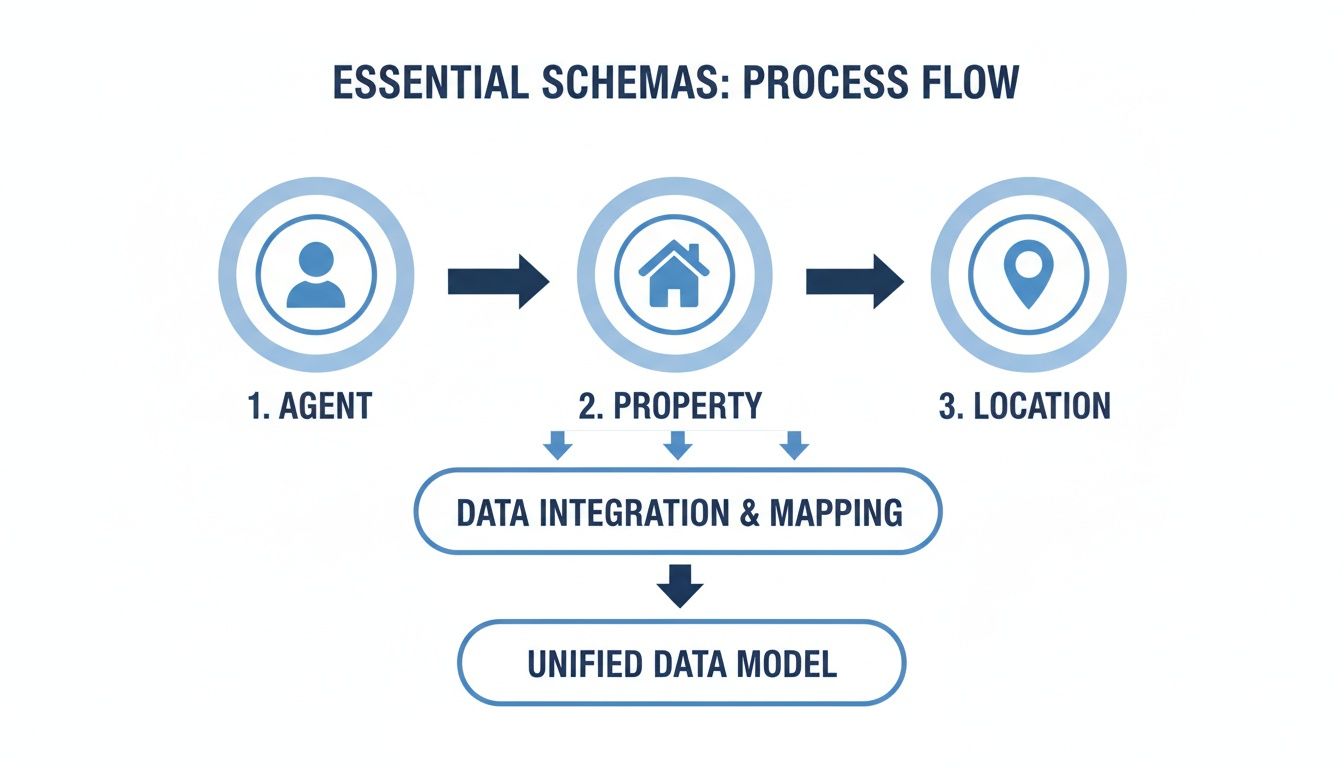
    Think of schema markup as a universal translator for your listing. Without it, an AI might see the number "750,000" and have no idea if it's the price, a zip code, or part of an address. With schema, you are explicitly telling the AI, "This is the price, in US dollars," which removes all the guesswork.

    This kind of clarity is everything. When an AI can understand your data with 100% certainty, it's far more likely to recommend your property. It’s the difference between handing that research assistant a messy pile of notes versus a neatly organized, labeled binder. The binder wins every time.

    Agents and teams who put in the effort to provide these clear signals are already seeing the rewards. Recent data shows that real estate domains received 0.47% of all referrals from ChatGPT Search, putting the industry at #15 among all categories. This confirms that AI is already sending motivated buyers to real estate websites that provide structured, authoritative information. You can discover more insights on ChatGPT's impact on web traffic and see why this is a channel you can't afford to ignore.

    By focusing on making your content "AI-friendly," you're directly influencing how these powerful new platforms see, understand, and ultimately rank your listings.

    The Six Pillars of AI-Powered Real Estate Visibility

    Getting your listings noticed by AI search tools like ChatGPT isn't about some single, magic-bullet tactic. It's much more like building a house. You need a solid foundation built on six interconnected pillars. Get these right, and you'll have a stable, impressive structure that AI algorithms will confidently recommend to potential homebuyers.

    Mastering these areas ensures your listings—and your professional brand—are not just seen, but deeply understood and valued by conversational AI. Let's break down the framework that will define your success in this new era of search.

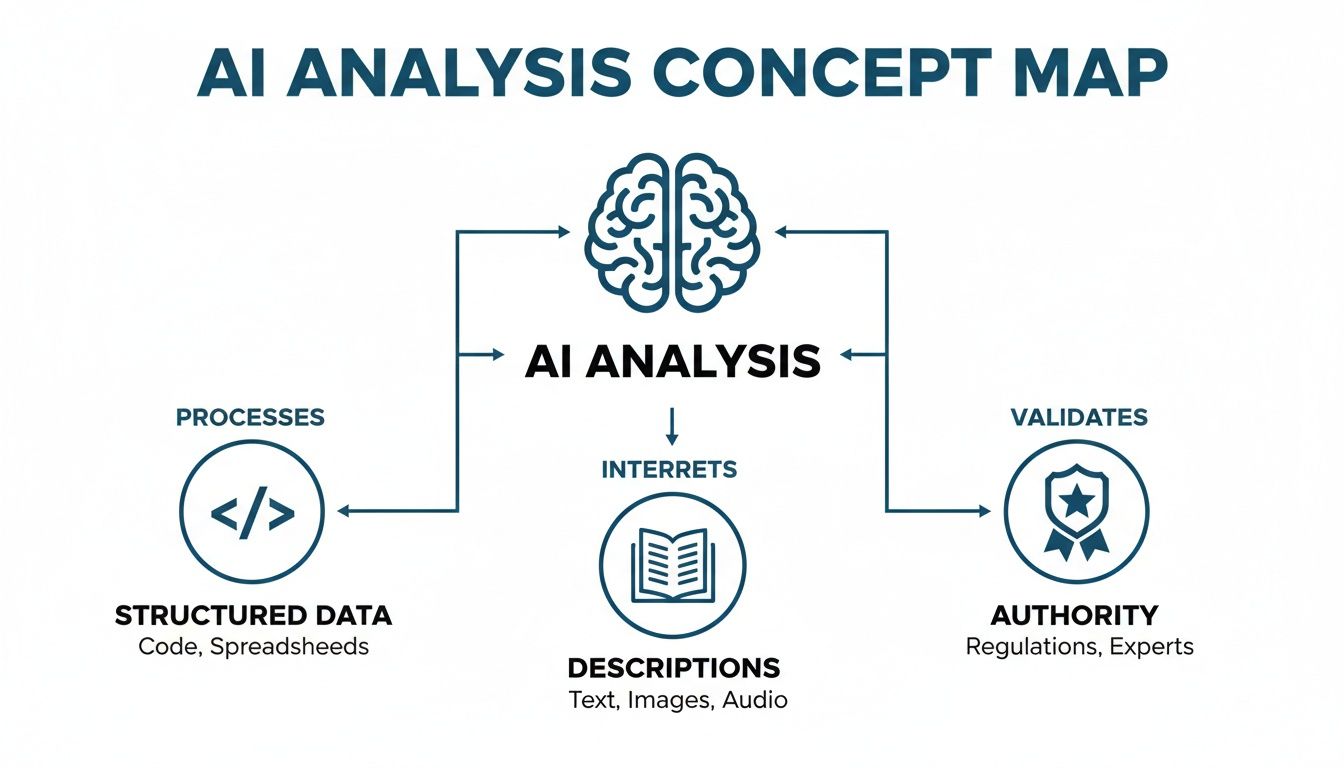
    This is a great way to visualize how AI actually sifts through your digital footprint. It prioritizes the hard facts (structured data), the human element (your descriptions), and your credibility (your authority).

    A concept map illustrating how AI analysis processes structured data, interprets descriptions, and validates authority.

    The key takeaway here is that AI visibility is a blend of technical precision, emotional connection, and real-world credibility. You need all three to win.

    Pillar 1: Structured Data Markup

    Think of structured data, or schema, as the universal language for AI. It’s a set of standardized tags you add to your website's code to explicitly tell an AI what each piece of information means. Without it, the AI is just guessing.

    For example, schema can label a number as a listing price, a line of text as a street address, or a date as an open house event. This removes all ambiguity. It’s the difference between handing an AI a messy, handwritten note versus a perfectly organized spreadsheet; the AI will always trust the spreadsheet.

    Pillar 2: AI-Optimized Listing Descriptions

    The days of writing dry, feature-list descriptions are over. Today’s AI is smart enough to analyze the story and emotional pull of your property descriptions. It's actively looking for content that paints a compelling picture of what it’s like to live in the home.

    To get this right, you need to focus on:

    • Natural Language: Write for people, not robots. Use descriptive language that sparks emotion and helps a buyer imagine the lifestyle the home offers.
    • Hyper-Local Context: Mention the nearby park, that popular coffee shop down the street, or the well-regarded school district. This gives the AI valuable context to match your listing to specific prompts like, "Find me a home near a good elementary school."
    • Clear Feature-Benefit Connections: Don’t just list "granite countertops." Instead, explain the benefit: "durable and elegant granite countertops, perfect for entertaining guests."

    By enriching your descriptions with narrative detail, you're feeding the AI the exact kind of high-quality, contextual information it needs to make a confident recommendation.

    This approach creates copy that connects with both human buyers and the algorithms that are now guiding them.

    Pillar 3: Demonstrable Agent Authority

    The AI isn't just evaluating your listings; it's evaluating you. It actively scans the web for signals that prove you are a knowledgeable and trusted expert in your specific market. Building this digital authority is absolutely critical for achieving high ChatGPT real estate search visibility.

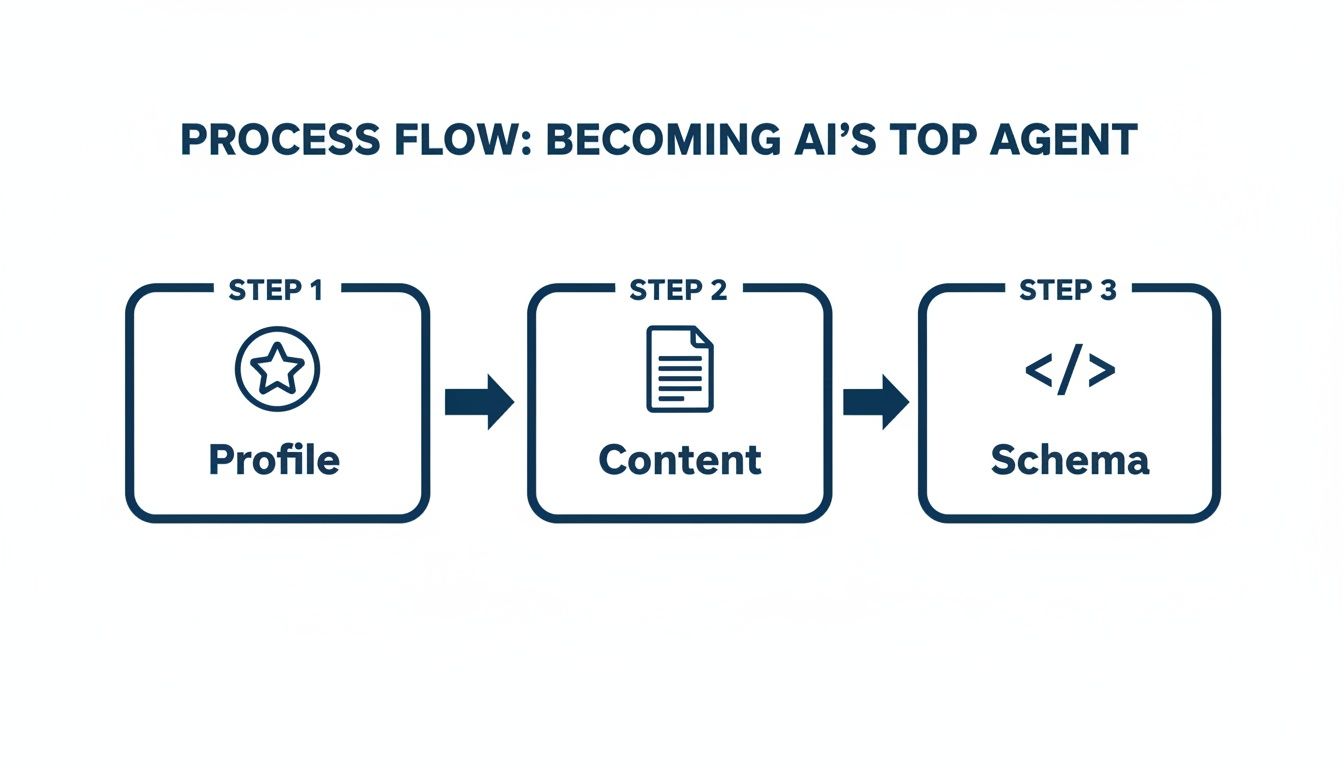
    This means you need to be consistently publishing content that shows off your local expertise. I'm talking about hyper-local neighborhood guides, detailed market analyses, or blog posts answering the questions you know buyers and sellers in your area are asking. This content acts as a digital resume, proving to the AI that you are a credible source.

    Pillar 4: Strategic Backlinks and Citations

    Think of backlinks as votes of confidence from other websites. When a reputable local news site, a neighborhood blog, or a mortgage broker’s website links to your agent profile or a listing, it sends a powerful signal to AI that your content is trustworthy.

    Similarly, consistent citations—mentions of your name, brokerage, and phone number across various online directories—help solidify your digital identity. This web of links and mentions validates your professional presence, making you a much more authoritative figure in the eyes of an AI.

    Pillar 5: Consistent Social Media Signals

    Your social media activity is a public record of your engagement and expertise. AI systems can and do crawl these platforms to gauge your relevance and influence. Consistently posting about new listings, open houses, market updates, and client testimonials builds a cohesive digital footprint.

    Every single post reinforces your specialization and activity in the market. This steady stream of relevant content adds another layer of proof, showing that you are an active and engaged professional who is worthy of being recommended.

    Pillar 6: Mastering User Prompts

    Finally, you have to understand how people are searching now. They don't just type keywords into ChatGPT; they ask detailed, conversational questions. Your entire content strategy should be designed to directly answer these kinds of prompts.

    For instance, instead of just optimizing for "Austin homes for sale," create content that answers, "What are the pros and cons of living in the Zilker neighborhood of Austin?" By anticipating these real-world queries, you position your content as the perfect answer, making it a no-brainer for AI to surface your expertise.

    This proactive approach is essential. Consider that a platform like ChatGPT.com attracts 5.6 billion monthly visits, with users who are highly engaged. It's a channel you can't afford to ignore. You can explore more detailed ChatGPT user statistics to get a better sense of the platform's incredible reach.

    Putting AI Visibility Strategies into Practice

    Knowing the six pillars is one thing, but actually putting them to work in your daily business is where you'll find your competitive edge. Theory is great, but a practical, well-executed strategy is what actually brings in clients. Let's break down how different real estate pros can use these ideas to get a real advantage and boost their ChatGPT real estate search visibility.

    These strategies aren't just for big, tech-forward brokerages. Whether you're a solo agent building a name in your neighborhood or a growing team aiming to lead the market, the core principles are the same. It's just the scale and focus that change. Each role offers a unique chance to turn AI visibility from a buzzword into a powerful lead-generation machine.

    The Solo Agent in a Competitive Suburb

    If you're a solo agent, your goal is to become the go-to expert for a specific community. You can't outspend the big teams, but you can absolutely out-expert them. Your strategy needs to be all about creating deep, hyper-local content that AI sees as the definitive source for your area.

    This means you’ll want to lean heavily into pillar three (Agent Authority) and pillar six (Mastering User Prompts).

    • Actionable Tactic: Create a series of blog posts or short videos that answer the exact questions people are asking about your suburb. Think things like, "What are the best parks in Northwood?" or "Is the public school system in Lakeview a good fit for young families?"
    • Implementation: A tool like ListingBooster.ai's Authority Builder can be a game-changer here. It can automatically draft these hyper-local guides for you. What normally takes hours of research and writing can be done in minutes, giving you a steady flow of content that proves you know your stuff.

    By consistently answering these specific, long-tail questions, you build a content library that establishes you as the resource, making it a no-brainer for ChatGPT to recommend you.

    The Growing Team in a Major Metro Area

    A growing team has a different puzzle to solve: how to scale brand consistency and content creation across multiple agents. Efficiency and a unified voice are everything. Your main focus should be on pillar two (AI-Optimized Descriptions) and pillar five (Consistent Social Signals) to make sure every listing and social media post meets the team's high standards.

    A scattered brand message is a weak signal to AI. When every agent on your team shares high-quality, consistently formatted, and AI-optimized content, it creates a powerful, unified digital footprint that AI algorithms can easily recognize and trust.

    The key here is automation and having a central hub for content. Manually writing unique, optimized descriptions and social posts for every new listing, open house, and sale across a dozen agents just isn't sustainable. You can get more insights on this by reading our guide on how to optimize listings for AI search.

    This is where a tool like ListingBooster.ai’s Listing Commander becomes essential. It takes a single property and generates a complete, on-brand marketing suite for every agent on the team, making sure every piece of content is optimized for AI visibility right from the start.

    The Forward-Thinking Brokerage

    For a brokerage, the mission is to give agents tools that give them a leg up on the competition. Providing a platform that automates AI optimization is a massive value-add that helps with both recruitment and keeping top talent. This means deploying all six pillars across the entire organization.

    The opportunity is huge. Recent data shows that ChatGPT now commands 17.1% of all digital queries globally. On top of that, users spend an average of 13 minutes and 9 seconds per session—more than double the time spent on Google. A brokerage that helps its agents tap into this highly engaged audience is setting them up for massive success. You can discover more insights about these user engagement statistics and what they mean for the market.

    By offering a tool like ListingBooster.ai, a brokerage instantly handles the technical headache of schema markup and the time-suck of content creation. It turns what would be weeks of manual work for an agent into a simple, 10-minute setup, creating a system for them to improve their ChatGPT real estate search visibility.

    How ListingBooster.ai Does the Heavy Lifting for You

    A hand interacts with a tablet displaying a data dashboard, emphasizing automated visibility and insights.

    It’s one thing to understand the six pillars of AI visibility, but it’s another thing entirely to put them into practice. Manually creating schema-marked content, writing psychologically compelling descriptions, and consistently publishing neighborhood guides is a full-time job. Let's be honest, who has that kind of time?

    This is exactly where ListingBooster.ai steps in. It’s designed to be the practical, hands-on application of everything we’ve talked about in this guide, turning what would be weeks of marketing grunt work into a simple, five-minute setup. The entire system is built to solve the core challenges of getting seen in ChatGPT real estate search without forcing you to become a coder or a content marketing guru.

    Instantly Master Your Listing Content

    The first hurdle every agent hits is creating genuinely great, AI-readable content for each listing. We're not talking about a few quick sentences for the MLS. This is about crafting unique stories for Zillow, social media, and your own website, all while weaving in the technical signals that AI engines need to see.

    ListingBooster.ai’s Listing Commander engine handles this for you instantly. Just feed it the basic property details, and it cranks out a complete marketing suite.

    • AI-Ready Descriptions: It writes compelling, emotionally engaging descriptions that capture the attention of both human buyers and AI algorithms.
    • Automatic Schema Markup: The platform takes care of all the technical mumbo-jumbo, embedding the right structured data so AI can understand your listing’s details with perfect clarity.
    • Multi-Platform Copy: You get tailored copy for the MLS, Zillow, and all your social media channels, making sure your message is consistent and powerful everywhere it appears.

    Think of it as your in-house marketing team that never sleeps. It makes sure every single property you list is perfectly positioned to be found and recommended by conversational search tools the moment it goes live.

    This system takes care of the first two pillars—Structured Data and AI-Optimized Descriptions—so you never have to touch a single line of code.

    Build Unshakeable Agent Authority

    The next big challenge is proving your local expertise, day in and day out. AI needs to see a constant flow of authoritative content that cements your status as the go-to expert for your market. But who has the bandwidth to write market updates and neighborhood guides every week?

    This is where ListingBooster.ai’s Authority Builder feature comes in. It automates this crucial part of your digital presence by creating a steady pipeline of high-quality, hyper-local content. It generates market updates, buyer tips, and detailed neighborhood guides that directly answer the kinds of questions your future clients are asking AI. You can explore how our broader real estate AI platform helps you build an even stronger brand.

    The speed at which people are adopting AI for search makes this kind of automation a necessity. In recent quarters, a staggering 14.68% of users turned to ChatGPT for search, which is a 7.73% jump from the previous year. This massive shift means that using a tool like ListingBooster.ai isn't just an advantage anymore—it's essential for reaching a huge and fast-growing audience of homebuyers. You can dig into more of these ChatGPT usage statistics to see the trend for yourself.

    To top it all off, the platform includes built-in Fair Housing compliance checks. This gives you peace of mind, knowing your automated content is not only effective but also completely professional and compliant. It’s simply the fastest, most efficient way to put an advanced AI visibility strategy to work for your business.

    Measuring Success in the New AI Search Era

    So, you've started optimizing for AI search. That's a huge step. But how do you know if any of it is actually working? Forget vanity metrics like social media likes or a general uptick in website traffic. To really see if you're making an impact in ChatGPT real estate search, you have to track the results that actually grow your business.

    The goal here is to look past the old SEO dashboards. We need a new set of key performance indicators (KPIs) built for this new, conversational world. This isn't just about counting clicks; it's about measuring your influence, your authority, and the quality of leads coming from places you've never gotten them from before.

    Shifting from Clicks to Conversations

    In the world of AI search, success looks different. It's less about being the #1 link for a keyword and more about being the definitive answer to a homebuyer's question. Your measurement strategy has to reflect that big change.

    Here are the modern metrics that truly matter:

    • Brand Mentions in AI Responses: This is the big one. Are you or your brokerage being mentioned by name when a user asks, "Who are the top real estate agents in Austin?" When an AI names you, that's the ultimate proof of your authority.
    • Referral Traffic from AI Platforms: Dig into your website analytics. Can you see visitors coming directly from platforms like ChatGPT? This is hard data showing the AI is sending potential clients right to your digital doorstep.
    • Visibility for Conversational Queries: Start tracking your presence for those long, question-based prompts. Are your listings and articles showing up for things like, "What are the best neighborhoods for families with young kids in Scottsdale?"
    • Lead Quality Analysis: Pay close attention to the leads that come from these AI-driven sources. Are they more informed? Do they seem more ready to transact? Higher-quality leads are a dead giveaway that your authoritative content is hitting the mark.

    The single most important metric in the AI era is how often your expertise is cited as the trusted source. When ChatGPT mentions you by name, you’ve won. It’s the digital equivalent of a powerful word-of-mouth referral, scaled.

    Proving ROI and Gaining Your Edge

    When you track these specific KPIs, you're no longer guessing. You're making smart, data-driven decisions about where to put your time and marketing dollars. This gives you clear proof of the return on investment from your AI optimization efforts, showing exactly how it’s feeding your sales pipeline.

    Everything in this guide has been a roadmap—from getting inside the "mind" of an AI to putting the six pillars of visibility into action. We've talked about how platforms like ListingBooster.ai can automate the most complex parts, turning what would normally be weeks of technical headaches into a simple, streamlined process.

    Now you have the framework to not only execute this strategy but also to measure its success. By focusing on these new metrics, you can definitively prove your growing influence and secure a dominant position in the new frontier of real estate. The agents who adapt—and measure what matters—are the ones who will lead the market tomorrow.

    Got Questions? We've Got Answers

    Let's tackle some of the most common questions agents ask about getting their listings found in AI-powered search.

    Is AI Going to Replace Me?

    Absolutely not. It's best to think of AI tools like ListingBooster.ai as a super-efficient assistant, not your replacement. It takes care of the tedious work—creating consistent, optimized, and compliant content for every listing.

    This frees you up to do what you do best: add your personal market insights, connect with clients, and build the relationships that are the bedrock of this business. The winning formula isn't AI or a human touch; it's AI efficiency plus your authentic expertise.

    How Fast Can I Expect to See Results in ChatGPT?

    It varies, but it's often much faster than traditional SEO, which can take months to show any movement. Since large language models are always hungry for new information, high-quality, well-structured content can get picked up and start appearing in search results pretty quickly.

    The speed really depends on how competitive your local market is and how consistently you're putting out optimized content. Using a tool like ListingBooster.ai gives you a head start by making sure your content is perfectly tuned for AI from the moment you publish it. This gives the AI clear, strong signals about your listings and your authority.

    The whole goal is to make it dead simple for AI to understand why you're the expert. The easier you make it for the AI to confirm your authority and the relevance of your listings, the faster you'll show up.

    Is It Hard to Add That Schema Markup Thing?

    If you try to do it by hand? Yes, it can be a real headache. It’s basically a coding task, which is a huge roadblock for most agents and a big reason why so many listings are completely invisible to AI search right now.

    This is exactly the problem platforms like ListingBooster.ai's 'Listing Commander' were built to fix. It generates all the correct schema markup for your properties automatically, behind the scenes. You just enter your listing details like you normally would, and the tool handles the technical heavy lifting, making sure your properties are formatted perfectly for AI without you ever having to touch a line of code.


    Ready to stop being invisible and start getting discovered? ListingBooster.ai automates the entire process, turning complex AI optimization into a simple, 5-minute task. Start your free trial and see the difference today.

  • Master Real Estate AI Search Optimization to Rank Higher

    Master Real Estate AI Search Optimization to Rank Higher

    Real estate AI search optimization is all about making sure AI-powered tools like ChatGPT and Google AI Overviews see you as the go-to expert. It’s a fundamental change in thinking. We're moving away from simply targeting keywords and instead focusing on building a rich, trustworthy digital presence that an AI can confidently recommend.

    The goal is to show up when a buyer asks a natural, conversational question, like, "Who is the best agent for first-time buyers in my city?"

    Why Your Old SEO Strategy Is Failing in AI Search

    For years, the game was simple: master Search Engine Optimization (SEO). If you could nail the right keywords, build some backlinks, and climb the search rankings, you were golden. But that playbook is quickly becoming a relic. The way people find real estate agents is changing right under our feet, and it's all because of conversational AI.

    This isn't just a minor tweak to the algorithm. It's a complete shift from what we knew as SEO to something new: Answer Engine Optimization (AEO). AI platforms don't just find websites anymore; they pull information from all over the web to give a direct, synthesized answer. They're looking for genuine authorities, not just pages stuffed with keywords.

    To put it simply, the strategies that got you here won't get you there. Let's look at the key differences.

    Factor Traditional SEO (What Used to Work) AI Search Optimization (What Works Now)
    Core Goal Ranking #1 on a search results page. Becoming the AI's recommended answer.
    Primary Tactic Keyword targeting and backlink building. Building a verifiable digital entity and authority.
    Content Focus Blog posts optimized for specific search terms. In-depth, helpful content that demonstrates real expertise.
    Technical Focus On-page SEO, site speed, mobile-friendliness. Structured data (schema), consistent information across platforms.
    Success Metric High search engine ranking and organic traffic. High-quality leads from direct AI recommendations.

    The table really drives home the point: what worked yesterday was about being findable. What works today is about being verifiable and recommendable.

    The New Search Landscape

    Picture a potential client asking their AI assistant, "Who is the best real estate agent for first-time buyers in Austin?" The AI isn't just looking for an agent who has "Austin first-time buyer agent" plastered all over their site. It's smarter than that. It scans and connects the dots across an agent's entire digital footprint to figure out who truly knows their stuff.

    The AI is looking for specific signals of expertise, like:

    • Helpful, Niche Content: Do you have articles or videos breaking down the home-buying process in specific Austin neighborhoods?
    • Structured Data: Is your professional profile and are your listings tagged with schema markup? This is the technical language that clearly tells an AI about your services, locations, and specialties.
    • Consistent Authority: Do your Google Business Profile, Zillow reviews, and personal website all paint the same picture of a successful, specialized agent?

    An agent whose online presence is robust, consistent, and built for this kind of deep, contextual understanding is the one who will get the AI's recommendation every time. Standing still is no longer an option if you want to stay visible.

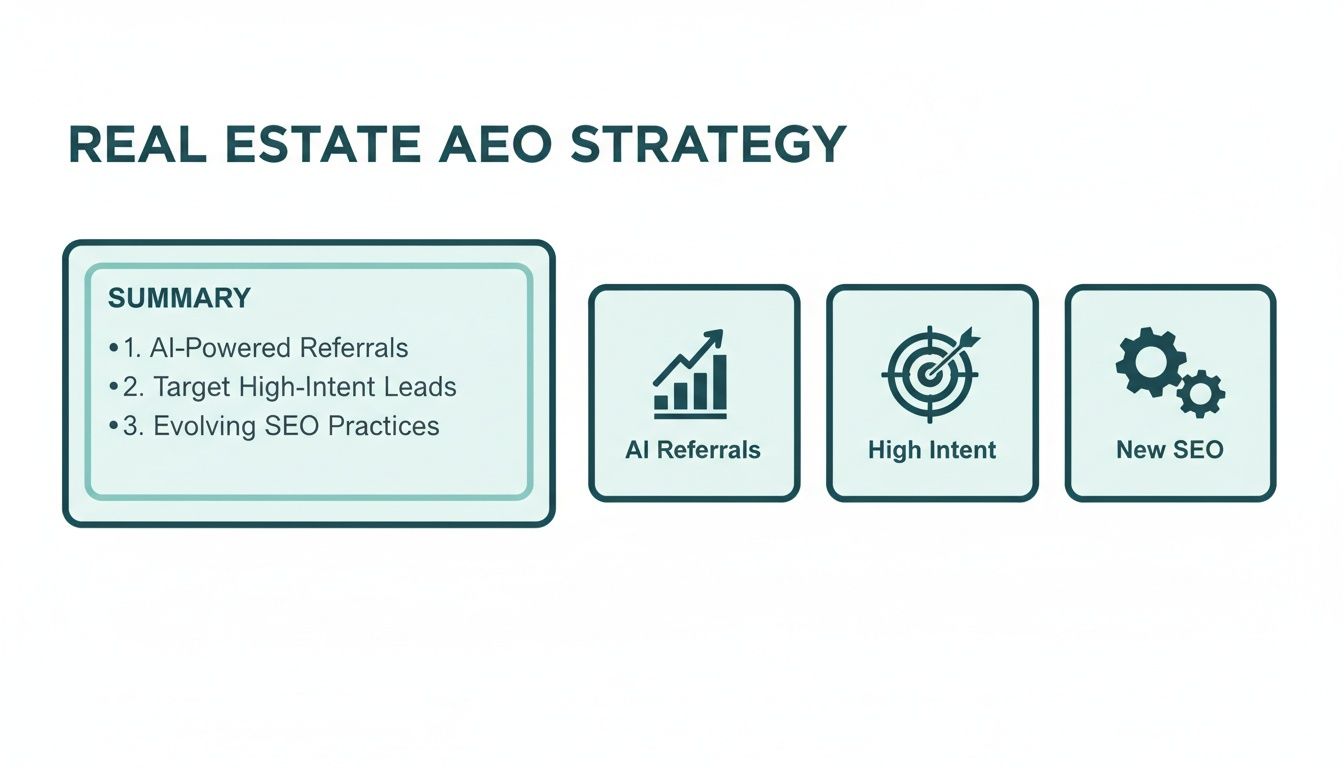
    An infographic outlining a Real Estate AEO Strategy with AI-powered referrals, high-intent leads, and new SEO practices.

    This is about playing the long game. AEO is a holistic strategy designed to prove your authority to AI systems, which in turn delivers highly motivated clients right to your doorstep.

    The Growing Impact of AI Referrals

    This isn't just theory—it's already happening. We're seeing a measurable impact on website traffic. Across the real estate industry, AI referral traffic now accounts for 1.01% of all website traffic. That number might seem small, but it represents a powerful and rapidly growing source of high-intent leads.

    These aren't just casual browsers. These are people who have asked a specific question and been pointed directly to you. This is why optimizing with structured data and a clear, entity-based strategy is so critical. You can dig into more of the data on these AEO benchmarks to see just how much of an impact this is having.

    The goal isn't just to rank on a search results page anymore. The goal is to become the answer when a potential client asks a question. This requires a deeper level of content and data consistency than ever before.

    Ultimately, it comes down to this: Traditional SEO was about making your website findable. Real estate AI search optimization is about making your expertise verifiable and recommendable. The agents who get this and adapt now are the ones who will own the market in this new era of property search.

    How to Optimize Your Digital Assets for AI Discovery

    To get noticed in this new world of AI-driven search, your online presence needs a serious rethink. It's time to stop thinking of your website, business listings, and social profiles as static brochures. Instead, see them as dynamic data sources that AI can read, understand, and, most importantly, trust. The mission is to make every piece of your digital footprint so clear and authoritative that AI engines can't help but recommend you.

    This whole process starts by changing how you present information online. We're moving away from old-school keyword stuffing and toward building data-rich, structured assets that an AI can easily digest. Let's get tactical and break down how to make your digital presence AI-ready.

    A man in a suit jacket uses a tablet and laptop at a desk in a modern office.

    Speak the AI's Language with Structured Data

    Structured data, usually implemented using Schema.org's vocabulary, is essentially a Rosetta Stone for AI. It’s a way of labeling the information on your website so that search engines and AI models instantly know what everything means. Without it, you’re forcing the AI to guess. With it, you're handing over a perfectly organized file that says, "Here's exactly what this is."

    For real estate agents, this is a massive advantage. You can go way beyond just writing "3 beds, 2 baths" and use specific schema tags that an AI can parse in a heartbeat.

    Here’s where to start:

    • RealEstateListing Schema: Tag your properties with explicit details like numberOfRooms, floorSize, yearBuilt, and amenityFeature. This gives an AI the specific data points it needs to match a listing to a very specific user query.
    • LocalBusiness Schema: Use this on your contact and about pages. It clearly defines your business name, address, phone number (NAP), and the areas you serve, leaving no room for interpretation.
    • Person Schema: Apply this to your agent bio to cement your professional identity. You can include your affiliations, specialties, and years of experience—all in a format an AI understands.

    Think of schema as the behind-the-scenes work that makes your listings and profile incredibly easy for an AI to process and confidently recommend.

    Turn Your Google Business Profile into a Local Powerhouse

    Your Google Business Profile (GBP) is way more than just a map pin. It’s one of your most powerful tools for local real estate AI search optimization. AI models lean heavily on GBP for verified, local information. If you've been letting your profile gather dust, you're missing a huge opportunity.

    It's time to transform your GBP into a beacon of local authority.

    • Fill Out Everything: And I mean everything. Go through your business details, service areas, hours, Q&A, and services with a fine-toothed comb.
    • Get Hyper-Local: Don’t just say you serve a city. Naturally weave neighborhood names, local landmarks, and community-specific terms into your business description, updates, and Q&A responses.
    • Post Weekly Updates: Seriously, this is non-negotiable. Share new listings, open house schedules, local market stats, or community news. This constant activity signals to AI that you are an active, relevant expert.
    • Champion Your Reviews: Actively ask for reviews and respond to every single one. Reviews that mention local keywords (like "she was the best agent for finding our home in the Northwood neighborhood") are pure gold, providing social proof that an AI can easily interpret.

    You Are the Primary Source

    In this new landscape, you have far more control than you might think. Recent research analyzing millions of AI citations from tools like ChatGPT and Gemini found something fascinating: a business's own website and its business listings are the most dominant sources. In fact, first-party websites and business listings command 44% and 42% of citations, respectively. This gives you direct influence over what AI systems learn about you.

    You can read the full research about these AI and local search findings to see just how critical your own digital properties have become. The data is clear: by optimizing your own assets with consistent, authoritative information, you get to shape what AI recommends.

    By focusing on your own website and GBP, you are directly feeding AI the exact story you want it to tell about you. You become the source of truth for your brand and your market.

    Keep It Consistent Everywhere

    Inconsistency is the enemy of AI trust. If your business name, address, and phone number (what we call NAP) are different across your website, GBP, Zillow profile, and social media accounts, you're creating confusion. AI algorithms see this inconsistency as a red flag for reliability, which can tank your chances of getting recommended.

    Take the time to do a digital audit. Make sure your core business information is identical everywhere it lives online. It's a simple step, but this consistency builds a cohesive digital identity that AI can easily verify and trust. For agents looking to manage this more efficiently, exploring different AI tools for real estate agents can be a huge help in maintaining consistency and building authority.

    Ultimately, every platform you're on should reinforce the exact same message: you are the definitive expert for your market.

    Writing Content That AI Actually Understands and Promotes

    In the end, great content is what fuels any smart real estate AI search optimization strategy. If you want to show up in these new AI-powered search results, your property descriptions, market guides, and neighborhood deep dives need to do double duty. They have to grab the attention of human readers and make perfect sense to the algorithms recommending you.

    This means we have to move past the fluff. Vague, overused adjectives aren't going to cut it anymore. It's time to get descriptive and specific, focusing on the details that an AI can actually process. Your content needs to be the definitive answer when an AI looks for local expertise—not just listing features, but telling a story that an AI can easily break down and match to a buyer's real-life needs.

    A hand taps a tablet screen displaying an application with icons, text like 'AI Readers', and a banner 'AI-Readable Assets'.

    From Generic to Entity-Rich Descriptions

    The difference between a standard MLS description and one written for AI discovery is night and day. Most descriptions are full of empty phrases like "charming home" or "nice backyard." Honestly, these terms mean very little to an AI trying to answer a specific question like, "Find me a home with a large yard for kids in a good school district."

    AI thinks in terms of entities—concrete, definable things like school districts, park names, architectural styles, and even brand-name appliances. Your job is to feed it these details.

    Let's look at a real-world before-and-after.

    Before (The Standard MLS Description):

    • "Beautiful 3-bedroom home with an updated kitchen and a nice backyard. Great for a family. Close to schools and parks. Must see!"

    This is vague. It gives an AI almost nothing specific to work with, and frankly, it doesn't do much to excite a human buyer either.

    After (The AI-Optimized Description):

    • "Discover this stunning 3-bedroom, 2-bathroom Craftsman-style home in the highly sought-after Northwood school district. The completely remodeled kitchen features GE Monogram stainless steel appliances, quartz countertops, and a subway tile backsplash. Step outside to a spacious, fully-fenced backyard with a mature oak tree and a custom-built stone patio, perfect for summer entertaining. Located just a 5-minute walk from the popular Meadowbrook Park and its new playground."

    See the difference? This version is packed with entities. It doesn't just say "updated kitchen"; it specifies the appliance brand. It doesn't just say "nice backyard"; it describes its features and what you can do there. This is how you make your content not just discoverable, but truly persuasive.

    Answering Questions Before They're Even Asked

    Today’s buyers aren't just typing "homes for sale in [City]." They're asking conversational questions, and your content strategy needs to be built around answering them directly. Put yourself in their shoes and create content that solves their biggest problems and curiosities.

    This is the core idea behind Generative Engine Optimization (GEO)—creating content in a natural Q&A format that AI can easily pull from to build its answers.

    Think about creating blog posts or dedicated website pages that answer questions like:

    • What are the best neighborhoods in Miami for young professionals?
    • How are the public schools rated in Scottsdale, AZ?
    • What's the average commute time from the suburbs to downtown Seattle?

    When you use clear headings (like H2s and H3s) that actually pose these questions, you're making it incredibly easy for an AI to see your content as a valuable, authoritative source.

    Your goal is simple: Become the go-to source an AI references when it answers questions about your local market. When your content is clear, genuinely helpful, and written for people, AI tools are far more likely to trust and feature it.

    Weaving in Hyper-Local Details

    Long-tail keywords are just longer, more specific search phrases. In real estate, these are golden. They're often hyper-local and signal that a buyer knows what they want and is ready to act. AI algorithms love this level of detail because it helps them deliver much more accurate results.

    So, instead of only targeting a broad term like "Austin homes for sale," you need to get more granular. Weave these descriptive, local phrases naturally into your content.

    Here are a few examples of hyper-local entities you can work in:

    • Neighborhood Amenities: "a short walk to the Trader Joe's on 2nd Street"
    • Local Landmarks: "enjoying views of Camelback Mountain from the patio"
    • Community Features: "access to the community pool and tennis courts in the Glenwood HOA"
    • School Information: "zoned for the award-winning Lincoln High School"

    Sprinkling these specific, local details throughout your property descriptions, neighborhood guides, and blog posts shows deep local expertise. It proves to both potential clients and the AI systems they're using that you're the agent who truly knows the area. This is the heart of effective real estate AI search optimization.

    Building the Authority That AI Recommends

    AI doesn't just skim for keywords; it actively looks for trusted, authoritative sources to recommend. To really stand out today, you need to become the definitive expert in your market—so much so that when AI needs an answer, it points directly to you. This isn't about writing a few blog posts. It's about weaving together a rich tapestry of content that consistently proves your expertise.

    Think about the questions buyers are asking: "Who's the best agent for families moving to Austin?" or "What are the pros and cons of the Oak Hill neighborhood?" For an AI to recommend you, it needs to find more than your business name; it needs to find a history of you providing real value on those exact topics.

    A beige house with a tiled roof on a sunny day, with an open notebook and pen on the green lawn in the foreground.

    Go Hyper-Local with Your Content Strategy

    Let's be honest: generic content gets lost in the noise. To build real authority that AI can recognize, you have to own a niche. The most powerful niche you have is your own backyard. This means shifting from broad real estate advice to creating hyper-local deep dives that only a true local expert could write.

    Your content calendar should look less like a general real estate blog and more like a local community guide. Here are a few ideas to get you started:

    • Detailed Neighborhood Guides: Don't just list stats. Talk about the best local coffee shops, the parks with the best playgrounds, commute times to downtown, and what makes the architecture unique. Tell the story of the neighborhood.
    • Monthly Market Analyses: Grab data from your MLS and add your professional take. Explain what the numbers actually mean for someone trying to buy or sell in your town right now.
    • Genuine Buyer and Seller Guides: A "First-Time Homebuyer's Guide to Denver" is infinitely more useful—and more discoverable—than a generic one.

    Every piece of helpful, local content you create adds another brick to your foundation of digital authority. It's exactly what AI algorithms are built to find and reward.

    Consistency Is Your Greatest Asset

    Posting once in a while just won't work. Authority is built with a steady, consistent rhythm over time. This consistent drumbeat of valuable content sends a clear signal to AI that you're an active and reliable source of information.

    And it’s not just about how often you post. It's about maintaining a cohesive message everywhere you have a presence. Your blog, Google Business Profile, and social media should all tell the same story: you are the go-to expert for this market. This consistency is crucial for real estate AI search optimization because it makes your digital identity solid, verifiable, and trustworthy for algorithms.

    The real power of a consistent content strategy is that it pre-sells your expertise. By the time a potential client finds you through an AI recommendation, they already see you as the authority because your content has proven it.

    This approach has never been more critical. Data shows AI-driven search traffic has exploded by 527% year-over-year, completely changing the game. This high-intent traffic also leads to a 27% lower bounce rate and 38% longer sessions than non-AI visitors. You can dig into more of these AI SEO statistics on Elementor.com to see just how much this can impact your lead generation.

    Interlink Your Expertise

    Here's a small step that makes a huge difference: connect your content. When you publish a new neighborhood guide, link back to your recent market updates or active listings in that area. This internal linking strategy does two powerful things:

    1. It helps AI understand relationships. You're essentially drawing a map for the algorithms, showing them how different topics connect and creating a more complete picture of your expertise.
    2. It keeps users engaged. It naturally guides visitors to other relevant content on your site, which increases the time they spend there and signals to AI that you're providing real value.

    Think of each blog post or guide as a single point in a network. The more you connect them, the stronger your authority signal becomes. You can dive deeper into these strategies by exploring AI-powered real estate marketing tactics that help automate and scale these efforts.

    Ultimately, building authority is about proving your value long before a client ever picks up the phone. When you consistently create deep, hyper-local content, you're feeding AI the exact signals it needs to confidently recommend you as the answer.

    How to Optimize Your Listings on Zillow and Realtor.com

    Let's face it, your listings aren't just living on your personal website. They’re being sent out across a huge network of property portals. A massive number of buyers start their journey on sites like Zillow, Realtor.com, and Redfin, and each one has its own algorithm deciding who sees what. If you really want to master real estate AI search optimization, you have to get strategic about how you present your properties on these crucial third-party platforms.

    Simply treating each portal as a generic data dump from your MLS is a huge missed opportunity. Zillow's algorithm, for instance, goes nuts for rich media and incredibly detailed descriptions. Realtor.com, on the other hand, seems to put a lot of weight on how responsive an agent is and how complete their profile is. To get ahead, you have to play by their specific rules.

    Tailoring Your Strategy for the Big Portals

    Think of each portal as its own little search engine. It has its own quirks and preferences. A one-size-fits-all strategy is a surefire way to get your listings buried on page five. The goal is to spoon-feed each platform exactly the kind of content its algorithm loves, which gets you maximum visibility right where the buyers are looking.

    Here’s a look at how you can adapt your game for the two biggest players:

    • For Zillow: Go all-in on visuals and descriptive text. Zillow absolutely rewards listings that are loaded with high-resolution photos, 3D home tours, and detailed, story-driven descriptions. Their AI literally checks for completeness, so fill out every single field—from the type of flooring to the specific brand of the kitchen appliances.
    • For Realtor.com: Here, the focus shifts a bit towards professionalism and speed. Yes, great content matters, but their algorithm also cares a lot about your agent profile. Make sure your bio is complete, you have recent reviews, and your response time to inquiries is lightning-fast. They want to connect buyers with agents who are active and ready to engage.

    This kind of portal-specific tweaking is what separates the listings that get all the clicks from the ones that just sit there. It signals to the algorithms that your property is a high-quality, relevant result for their users.

    A classic mistake I see all the time is agents uploading the bare minimum from the MLS and just hoping for the best. To actually win on these sites, you have to go in and manually enhance each listing on every major portal. Treat each one as its own unique marketing campaign.

    The Anatomy of a Perfectly Optimized Portal Listing

    Getting a listing to perform well isn't just luck; it's a system. It’s about more than just snapping good photos. You need to provide structured, comprehensive data that both people and AI can digest easily. A simple checklist can be a lifesaver, ensuring you never miss a critical optimization step.

    Let's break down the essential pieces of a listing that’s truly ready for AI discovery.

    Portal Listing Optimization Checklist:

    1. Descriptive Photo Filenames: Before you even think about uploading, rename your image files. Ditch IMG_1234.jpg and use something like 123-main-street-kitchen-with-granite-island.jpg. This is pure metadata gold that the portal search engines can read and understand.
    2. Complete All Data Fields: I can't stress this enough. Fill in every single available field, no matter how tiny it seems. Name the brand of the Sub-Zero fridge, specify that the countertops are Carrara marble, and list the type of flooring in every room. AI feeds on this granular data.
    3. Embed a Video Tour: Listings with embedded video tours almost always rank higher. Seriously, even a simple, well-shot walkthrough you filmed on your phone is infinitely better than no video at all. It tells the platform's AI that this is a rich, informative listing.
    4. Write a Portal-Specific Description: Don’t just copy-paste from the MLS. Write a compelling narrative that sells the lifestyle. Mention local spots by name, like "just a short walk to Meadowbrook Park" or "zoned for the award-winning Northwood School District." If you need some help with this, you can learn more about how to optimize your listings for AI search with powerful, data-rich copy.
    5. Tag Rooms in Photos: Get into the portal's back-end tools and label each photo. Tag the "Primary Bedroom," the "Kitchen," and the "Living Room." This helps the AI categorize your visuals and show your listing in more specific search results.

    By running through this checklist for every single property, you're positioning your listings to grab the most attention on the platforms that matter. You’re effectively turning each portal into a powerful and consistent lead-generation machine.

    Seeing if Your AI Optimization Is Actually Working

    So, you've put in the work. You’ve tweaked your listings, beefed up your bio, and started creating content with AI search in mind. Great. But how do you know if any of it is actually making a difference?

    Flying blind is a recipe for wasted effort. You need to know what’s working and what isn’t. Tracking your performance isn’t about chasing vanity metrics; it’s about connecting your efforts to what really matters: your bottom line.

    This is how you ensure all that work translates into more qualified leads and, ultimately, more closed deals.

    What to Actually Keep an Eye On

    To see the real impact, you need to look at a few specific numbers. These metrics will paint a clear picture of whether your strategy is attracting the right kind of attention from both AI platforms and serious clients.

    Here’s what I recommend tracking in your analytics tools:

    • AI Referral Traffic: Get into your Google Analytics 4 (GA4) and create a segment to isolate visitors coming from known AI sources like Perplexity or ChatGPT. Is that number ticking up month over month? That’s your first sign you’re on the right track.

    • Conversational Query Rankings: You’ll need a good rank tracking tool for this. Are you starting to appear for those long, question-based searches? Think queries like, "what are the best school districts in North Austin?" or "how much are property taxes for a three-bedroom in Williamson County?" This shows you're answering the questions real people are asking.

    • Lead Quality from AI: This is the big one. Of the leads that come through an AI referral, how good are they? Do they close faster? Are they more serious buyers? If the answer is yes, you've hit the jackpot. This is the ultimate proof that your strategy is paying off.

    Turning Data Into Smarter Decisions

    Just looking at the numbers isn’t enough. The real magic happens when you use that data to refine what you’re doing.

    Did you notice that new neighborhood guide you wrote is bringing in a ton of AI traffic? That’s your cue. It’s a clear signal to double down and create more content just like it for other popular areas you serve.

    Think of your analytics as a direct line of feedback from the AI models. The data tells you exactly what content they see as authoritative and which queries you're winning. Listen to it.

    On the flip side, if a piece of content is a dud, don’t be afraid to change course. Maybe that market update was too bland, or a listing description was missing those crucial, entity-rich details. Use these insights to constantly tweak your approach. It’s a continuous cycle of test, measure, and refine that keeps you ahead of the game.

    Got Questions About AI Search? I've Got Answers.

    As an agent, you're probably hearing a lot about AI search. It's natural to have questions. Here are some straightforward answers to the most common ones I hear.

    What's the Real Difference Between SEO and AEO?

    It's a common point of confusion, but the distinction is critical.

    Think of traditional SEO as trying to get your website a top spot on a Google search results page. You're competing to be on the list.

    Answer Engine Optimization (AEO), sometimes called Generative Engine Optimization (GEO), is completely different. Your goal isn't just to be on a list; it's to have the AI point directly to you as the definitive answer. SEO helps people find you. AEO makes you the recommended authority.

    So, How Does This AI Stuff Actually Affect Me as an Agent?

    This is where it gets personal. AI search completely flips the script on how buyers and sellers find an agent.

    They aren't just typing "Austin realtor" anymore. They're asking their AI assistant conversational questions, like, "Who is the best agent for a young family moving to Austin, Texas?" The AI then scans the digital world for an agent who has consistently demonstrated expertise in that specific niche and location. If your online presence doesn't scream "family-focused Austin expert," you're simply not in the running. You'll be invisible.

    The big shift is this: You're no longer just competing for a ranking. You're competing to become the single, AI-verified answer for your slice of the market. The goal is to be referenced, not just listed.

    Okay, I'm In. What's the Single Most Important First Step?

    Don't overcomplicate it. Start with the two assets you control completely: your Google Business Profile (GBP) and your own website.

    Why these two? Because they are the primary sources AI models pull from to learn about who you are and what you do. In fact, they account for a combined 86% of citations.

    Your mission is to make these profiles airtight. Every detail needs to be complete, consistent across both platforms, and loaded with hyper-local keywords and content. This builds a rock-solid foundation of trust that AI algorithms can easily understand and rely on when they're deciding who to recommend. Honestly, it's the fastest path to building real authority.


    Ready to stop guessing and start dominating AI search? ListingBooster.ai is your command center for creating the authority-building content that gets you noticed. Generate a full month of AI-optimized social posts, property descriptions, and market updates in minutes. Start your 30-day free trial today.

  • AI search optimization for real estate: Boost Listings & Attract Buyers

    AI search optimization for real estate: Boost Listings & Attract Buyers

    Optimizing for AI search is all about structuring your online presence—everything from your property listings to your agent bio—so that conversational AI like ChatGPT and Google’s AI Overviews can find you, understand what you do, and recommend you to buyers and sellers. It's a fundamental shift. Instead of just targeting keywords, you're positioning yourself to be the definitive answer when people ask AI for help.

    Why AI Is the New Front Door for Homebuyers

    The way your next client finds you has changed, and it happened faster than most agents realize. For years, the path was simple. A potential buyer would head to Google and type in something like "homes for sale in Denver." That's not the starting point for a lot of people anymore.

    A huge and growing number of buyers are skipping that old-school search bar entirely.

    They're starting their home search by having a conversation with an AI. They're not using clunky keywords; they're asking detailed, natural questions.

    • "Find me a real estate agent who specializes in historic downtown condos under $800k."
    • "What are the best family-friendly neighborhoods with top-rated schools near the tech corridor?"
    • "Show me three-bedroom homes with a large backyard and a recently remodeled kitchen."

    This isn’t some far-off trend—it’s happening right now. Traditional SEO is still part of the puzzle, but it’s not enough on its own. It was built for a world of blue links. AI search is different; it’s designed to deliver a single, confident answer. If your digital presence isn't built in a way that AI can easily understand, you're completely invisible in these critical conversations.

    The Shift to Conversational Discovery

    What’s really happening here is a move from keywords to intent. An AI doesn't just look for "Denver homes." It pulls together information from all over the web—your website, your Zillow reviews, neighborhood blogs, local business directories—to figure out who is the most credible and relevant expert for a very specific, nuanced request.

    The goal of AI search optimization for real estate isn't to rank #1. It's to be the answer. You need to build a digital identity so clear and trustworthy that an AI has no doubt about presenting you as the go-to local expert.

    This change is picking up speed like you wouldn't believe. By 2026, the real estate industry saw a massive surge in AI adoption, with 92% of corporate real estate firms running AI pilots—a huge jump from just 5% three years earlier. This is happening because consumer behavior is changing. We're already seeing over 40% of homebuyers starting their property search right inside an AI chat, bypassing Google completely. You can explore more data on this AI-driven pivot in real estate search for a deeper dive.

    Your Advantage in This New Landscape

    For any agent ready to adapt, this is a golden opportunity. Big brokerages are still trying to figure it all out, running tests and forming committees. But individual agents and small teams can be nimble and move fast. By focusing on creating a rich, interconnected, and machine-readable online footprint, you can become the source that AI models learn to trust and recommend.

    This means looking at every single one of your digital assets with a new lens:

    • Your Listings: The descriptions can't just be a list of features. They need to tell a compelling story about the lifestyle a buyer gets with the home.
    • Your Profile: It has to be crystal clear about your niche, the specific areas you serve, and your proven track record.
    • Your Content: Your blog posts and social media need to directly answer the questions your ideal clients are asking every day.

    The agents who get this right aren't just going to keep up; they're going to grab a serious competitive edge. They’re building a brand that's discoverable not just by people, but by the AI assistants that are quickly becoming the main gateway to the real estate market.

    Building an AI-Readable Digital Footprint

    To show up in the new world of AI search, you have to start thinking less like a marketer and more like a data scientist. AI engines like Google's and ChatGPT aren't just "browsing" your website; they're consuming and connecting data points. They're looking for clear, consistent signals that define who you are, what you specialize in, and where you work.

    The whole game is about making it incredibly easy for these systems to understand and trust your expertise. An AI builds its picture of you by piecing together information from your website, your Google Business Profile, client reviews, and your Zillow profile. If those sources tell different stories, your authority gets watered down, and you become invisible.

    This is a fundamental shift away from just chasing keywords. We're moving toward becoming the direct, authoritative answer to a person's question.

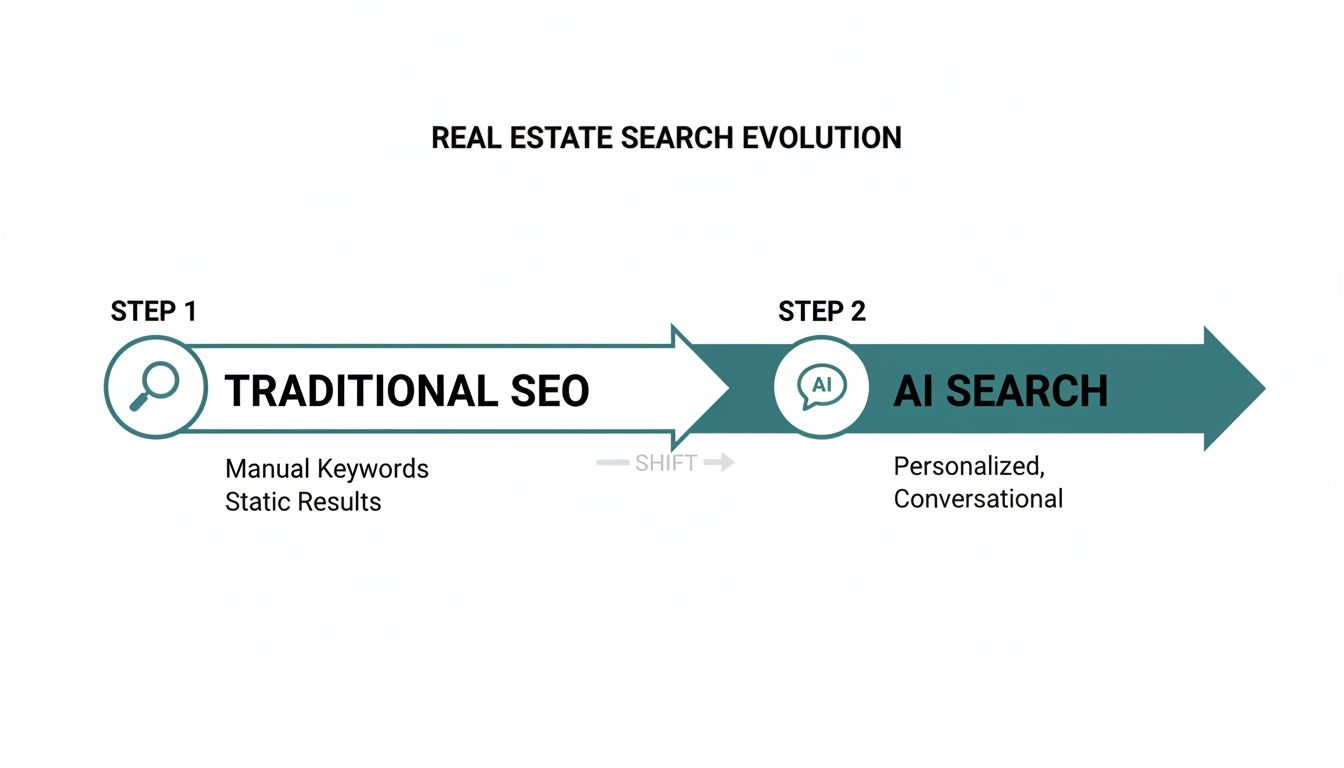
    Infographic showing the evolution of real estate search from traditional SEO to AI search, highlighting key features.

    As you can see, the old model was about ranking. The new model is about being the source of truth for a conversational query.

    The Secret Language: Structured Data and Schema

    The most powerful tool in your technical arsenal for AI search optimization for real estate is structured data, specifically using Schema.org markup.

    Think of schema as a set of secret instructions you add to your website's code. It doesn’t change how your site looks to a human visitor, but it speaks directly to machines, telling them precisely what your content is about. It removes all the guesswork.

    Instead of an AI trying to figure out if you're a real estate agent from the text on your "About" page, you use RealEstateAgent schema to declare it explicitly. That's a huge signal of clarity and authority.

    An AI is like a librarian trying to organize the world's information. Schema markup is the Dewey Decimal System for your business—it tells the AI exactly where you belong on the shelf, making sure you get recommended for the right queries.

    For a property listing, you can use schema like SingleFamilyResidence to tag details like the number of bedrooms (numberOfRooms), square footage (floorSize), and unique features (amenityFeature). That structured data is infinitely more valuable to an AI than a simple paragraph of text it has to parse.

    Essential Schema Markup for Real Estate Agents

    Here’s a quick-reference table of the most critical schema types to get implemented on your website. This is the bedrock of your AI-readable footprint.

    Schema Type Key Properties to Include Why It Matters for AI
    RealEstateAgent name, address, telephone, areaServed, knowsAbout Directly tells AI your profession, location, and areas of expertise.
    SingleFamilyResidence address, floorSize, numberOfRooms, amenityFeature, geo Provides structured, unambiguous details about a specific property.
    Review reviewRating, author, reviewBody, itemReviewed Feeds AI trust signals directly from your clients' experiences.
    RealEstateListing datePosted, price, itemOffered (linked to the property) Clearly defines the transactional nature of the page for an AI.
    LocalBusiness openingHours, paymentAccepted, hasMap, department Solidifies your status as a legitimate, local service provider.

    Putting this schema in place is non-negotiable. It’s the single biggest technical step you can take to make your website more visible to AI.

    Your Google Business Profile Is Your AI Anchor

    When an AI model wants to understand a local business, your Google Business Profile (GBP) is one of the first and most trusted sources it checks. It's the anchor for your local identity. An incomplete or inconsistent profile is a major red flag that tells an AI you might not be a credible source.

    Optimizing your GBP for AI is more than just filling in the blanks. It’s about strategically proving your local dominance.

    • Be Hyper-Specific with Service Areas: Don't just put "Phoenix." List the specific neighborhoods and zip codes you dominate, like "Arcadia (85018)" or "Biltmore Area (85016)." This is how you capture "near me" and hyper-local searches.
    • Lock Down Your NAP: Your Name, Address, and Phone number (NAP) must be 100% identical everywhere—your website footer, social media, and all real estate portals. A simple variation like "St." vs. "Street" can create confusion for an AI.
    • Use Google Posts Like a Local Blogger: Share market updates, new listings, open house announcements, and community news. This feeds Google’s AI a constant stream of fresh, locally relevant information tied directly to your business profile.
    • Coach Your Clients on Reviews: Reviews are gold. Gently encourage clients to mention the neighborhood they bought or sold in or the specific type of property you helped with ("He was a lifesaver finding us a condo in Old Town Scottsdale"). Those details are powerful signals of your niche expertise.

    Tying It All Together

    Finally, consistency is the glue. Every single platform you're on should tell the same story about who you are and where you're the expert. This can be a challenge for agents and teams to manage, which is why exploring different AI tools for real estate agents can be a huge help in keeping your messaging tight and consistent.

    Run a quick audit of your digital presence. Ask yourself:

    • The Bio Test: Is my bio on Zillow, Realtor.com, and my own website telling the exact same story about my specialties and service areas?
    • The Branding Test: Am I using the same professional headshot and brand colors everywhere to create an instantly recognizable identity?
    • The Property Description Test: Do my listing descriptions use a consistent voice and always highlight the unique lifestyle features relevant to my target buyer?

    When you meticulously align all these pieces, you create a powerful, interconnected web of information. Each consistent signal reinforces your authority, making it dead simple for an AI to see you as the go-to expert for real estate in your market. This is what building a modern, machine-readable brand is all about.

    Optimizing Listings for Conversational Search

    Let's be honest, conversational AI doesn't care about your standard "3 bed, 2 bath, updated fixtures" description. That kind of language is practically invisible to a smart assistant trying to answer a real buyer's question. If you want to win at AI search optimization for real estate, you have to stop writing inventories and start telling stories.

    This is a fundamental shift in how we approach listing copy. Instead of just listing what a house has, we need to explain what it offers. Don't just say "fenced-in backyard." Instead, paint a picture: "Enjoy total privacy in a fully fenced backyard, perfect for summer barbecues and a safe space for kids and pets to play freely." That’s the kind of natural, descriptive language that AI is built to understand and reward.

    A photographer using a DSLR camera to capture a bright, modern kitchen for real estate listings.

    From Features to Lived Experiences

    The real trick is to translate every single feature into a tangible benefit or a vivid experience. You have to get inside the head of a buyer and anticipate their conversational queries. An AI is far more likely to serve up your listing for a search like, "find me a home with great natural light for my houseplants," if your description talks about the "sun-drenched living room with south-facing windows that fill the space with bright, airy light all day long."

    Here’s how this looks in practice. It's a simple, but powerful, change in mindset:

    • Instead of: "New home office"

    • Try this: "A dedicated main-floor office gives you a quiet, professional space for remote work, complete with built-in shelving to keep you organized and focused."

    • Instead of: "Close to parks"

    • Try this: "You're just a five-minute walk from the entrance to Oakwood Park, giving you instant access to miles of walking trails, playgrounds, and community green space."

    This reframing makes your listing infinitely more useful to both a person scrolling through Zillow and the AI that's helping them search.

    The Power of AI-Enhanced Image SEO

    Of course, the words are only half the story. AI now "sees" your property photos, which means optimizing your images is no longer optional—it's essential. When you upload a picture of a kitchen, an AI doesn’t just register a room; it identifies specific elements like the countertops, appliances, and sink style. This is where you can get a huge leg up.

    Tagging your images with descriptive alt text helps the AI understand exactly what's in the picture. This simple step dramatically increases the odds of your listing popping up for very specific searches.

    AI-powered computer vision can analyze your property photos and automatically add SEO-friendly tags for features like 'quartz countertops,' 'stainless steel appliances,' or 'farmhouse sink.' This process makes your images—and by extension, your entire listing—discoverable for highly specific buyer queries.

    This isn't some far-off future tech; it's already here. The 2025 National Association of Realtors' Technology Survey found that 68% of Realtors are already using AI tools to boost their marketing. We're seeing these tools tweak photos and metadata, leading to 15-25% faster sales by making listings more visible on major portals. Discover more insights about how AI automation is reshaping real estate marketing and see what your competition is up to.

    Crafting the Perfect AI-Friendly Listing

    When you combine that narrative-driven copy with meticulously tagged images, you create a powerful, AI-readable asset. The goal is to build a complete digital profile of the property that leaves nothing to the imagination.

    Here are a few quick wins you can implement on your very next listing:

    • Lead with Lifestyle: Open your description with a hook that paints a picture of what it's like to live there.
    • Get Hyperlocal: Drop in names of neighborhoods, local parks, and popular nearby coffee shops to firmly place the property in its community.
    • Rename Your Image Files: Before you even upload, change IMG_2475.jpg to something like 123-elm-street-remodeled-kitchen-with-island.jpg.
    • Write Detailed Alt Text: For every photo, add a short, descriptive sentence. For example: "Spacious primary bedroom with large windows overlooking the tree-lined backyard."

    By making these changes, you're not just writing a better property description. You're building a rich data source that’s perfectly structured for conversational AI, ensuring your listings get seen, understood, and recommended to the right buyers.

    Build Your Authority with AI-Ready Content

    If you want AI to recommend you, it first has to see you as a true authority. This isn't about tricking an algorithm; it's about proving you're the real deal through consistent, high-value content. Think of it this way: AI models scan and synthesize a mind-boggling amount of information to find the most trustworthy and helpful answer. Your job is to become that answer for your local market.

    This means you need to create a deep web of content that directly addresses the specific, conversational questions your future clients are asking. Forget basic blog posts. You're building an entire library of expertise that signals to AI that you are the go-to expert for real estate in your town.

    A person, a local market expert, reviews a house on a tablet and a map.

    Answer Questions Before They're Even Asked

    The heart of your content strategy should be getting ahead of what people are asking. They aren’t just typing "homes for sale in [City]" anymore. They're asking AI assistants detailed, nuanced questions, and you need to have the answers published and waiting on your website.

    Your content should be built around these kinds of real-world queries:

    • Neighborhood Guides: Go deep on every neighborhood you serve. Don't just list amenities; paint a picture of the lifestyle. What’s the vibe on a Saturday morning? Where do locals grab coffee? This is the rich, textured detail that AI is looking for.
    • Market Updates: Move past generic stats. Explain what the numbers actually mean for a local buyer or seller. Your content should be able to answer a question like, "What does a 5% interest rate change mean for my budget in the Northwood neighborhood?"
    • Buyer and Seller Pain Points: Write articles that solve common problems. Topics like "How to Win a Bidding War in a Competitive Market" or "The Top Mistakes First-Time Sellers Make" immediately establish you as a helpful guide.

    This proactive approach is the bedrock of AI search optimization for real estate. You're directly feeding AI models the clear, useful information they're designed to find and share.

    Think in Topics, Not Just Keywords

    The old SEO game was all about ranking for specific keywords. The new game is about owning entire topics. An AI wants to see that you have comprehensive knowledge about a subject, not just one popular blog post that hit the mark.

    This is where the idea of "content pillars" comes in. A content pillar is a massive, central piece of content on a broad topic, which you can then break down into many smaller, related articles.

    Example Content Pillar: "Relocating to [Your City]"

    • Main Pillar Post: A detailed, ultimate guide covering everything a newcomer would need to know.
    • Spoke Posts (linking back to the main pillar):
      • "The Top 5 Family-Friendly Suburbs in [Your City]"
      • "A Simple Guide to Understanding Local Property Taxes"
      • "Comparing School Districts in the [Your City] Area"
      • "Best Dog Parks and Pet-Friendly Spots for New Residents"

    This hub-and-spoke structure clearly demonstrates your deep expertise, making it incredibly easy for an AI to recognize your authority and recommend your content for a whole host of relocation questions.

    Creating this web of interconnected content does more than just answer a single question. It builds a knowledge graph that an AI can clearly see, establishing you as the central hub of information for your market.

    The data is already starting to back this up. AI referral traffic, while still new, is becoming a key source of high-intent leads. Right now, the real estate industry captures just 1.01% of website traffic from AI sources like Perplexity and ChatGPT. Although that number seems small, this traffic is made up of motivated users who convert at a higher rate. For agents on the ball, this highlights a massive opportunity to build an AI-readable digital footprint. You can see more of these emerging real estate AEO benchmarks to get a sense of the landscape.

    A Practical Content Plan for Busy Agents

    I know what you're thinking—creating all this content sounds exhausting. But it doesn't have to be. Your unique local knowledge is the raw material, and you're creating it every single day.

    • Document, Don't Create: Turn your daily client conversations into content. Did you just explain the pros and cons of a specific school district? That's a blog post. Did you just tour a new construction development? That's a neighborhood spotlight video.
    • Use a Simple Q&A Framework: For each piece of content, frame it as a question and answer. Use headings that sound like real questions people would ask, like "What Are the Typical Closing Costs for a Buyer in [Your County]?" This makes your content incredibly easy for both humans and AI to understand.

    By consistently publishing helpful, locally-focused content, you build a powerful moat around your business. You become the trusted source that AI—and more importantly, your future clients—turn to first. For more ideas on getting started, you might find our guide on AI marketing for real estate agents helpful.

    How to Know If Your AI Optimization Is Actually Working

    So, you've put in the work to optimize your listings and profiles for AI search. That's great, but how can you be sure it's actually paying off? Unlike classic SEO where you can get fixated on a single keyword ranking, measuring success with AI is more about watching a collection of signals that prove your authority is growing. The real goal isn't just to rank—it's to become the go-to source that AI trusts and recommends.

    You won't find a tidy, all-in-one dashboard for this just yet. Instead, you'll need to play detective and connect the dots between a few key metrics. When you see these numbers moving up and to the right, you'll know your strategy is hitting the mark.

    The KPIs That Matter Most

    Think of this as gathering evidence. The proof of your success will pop up in your website analytics, your lead sources, and even in your initial conversations with new clients. I'd suggest starting a simple spreadsheet to track these data points month over month.

    Here’s what you should be watching closely:

    • A Bump in Direct Website Traffic: This is a big one. When someone types your website address directly into their browser, it means they already know your name. This is often what happens right after an AI has mentioned you, and it’s a powerful sign that your brand recognition is on the rise.

    • More Branded Search Queries: Jump into your Google Search Console and look at the search terms people are using to find you. An increase in searches for your name, your team's name, or your brokerage (like "Jane Doe real estate") is pure gold. It shows your reputation is spreading organically.

    • Leads Mentioning AI: This is the most direct feedback you’ll ever get. Make it a habit to ask every single new lead, "How did you hear about us?" The moment you start hearing things like, "I asked ChatGPT for the best agent in…" or "Google’s AI answer recommended you," you’ll know you've cracked the code.

    Digging for Clues in Google Search Console

    Your Google Search Console is an absolute must-have for this—and it's free. It gives you a direct window into how searchers are finding you, whether through a traditional search or an AI-powered one.

    Head over to the "Performance" report. This is where you can filter queries to see the exact questions leading people to your site. Keep an eye out for long, conversational phrases. A search like "best real estate agent for first-time buyers in Scottsdale" is a perfect example of how people talk to AI. Seeing more of these queries pop up is a clear indicator that your content is hitting the right notes for conversational search.

    The whole point of AI optimization is to become the definitive answer to a user's question. When your content starts surfacing for these super-detailed queries, it's proof that you're successfully carving out your niche authority in the eyes of the algorithm.

    Quick Wins You Can Implement Today

    Building true authority in the eyes of AI is a marathon, not a sprint. But there are a few high-impact things you can do right now to get some early traction. These steps are designed to send strong, immediate signals about who you are, where you work, and what you’re an expert in.

    1. Hyper-Target Your Google Business Profile: Don't just list your city. Go into your profile and add the top 5-10 specific neighborhoods or zip codes where you're the undisputed local pro. This is how you show up in those hyper-local, "near me" AI recommendations.

    2. Rewrite Your Top 3 Listing Descriptions: Pick your three most important listings and give the descriptions a makeover. Use that narrative, lifestyle-focused language we talked about. Instead of just listing features, translate them into benefits. Paint a picture of what it feels like to live in that home and be part of that community.

    3. Add a Mini Q&A to Your Homepage: Create a small "Frequently Asked Questions" section right on your homepage. Answer 3-4 of the most common questions you get from clients, and use the full question as the heading for each answer. This makes your expertise instantly scannable for AI crawlers.

    By tracking the right KPIs and knocking out these quick wins, you can start building a clear picture of your progress. To take it a step further, specialized real estate listing marketing software can help automate some of these tasks, freeing up your time while making sure you stay visible.

    Common Questions About AI for Real Estate

    Jumping into AI search can feel like charting unknown waters. It’s completely normal to have questions about how this all works and, more importantly, what it means for your real estate business. Let's tackle the most common ones I hear from agents so you can move forward with confidence.

    How Is AI Search Different From Traditional Google SEO?

    This is a big one. For years, we’ve all been conditioned to think in terms of keywords. Traditional SEO is a game of ranking for phrases like "homes for sale in Austin." You fight to get your website link onto that coveted first page.

    AI search flips the script entirely. The goal isn't just to be a link in a list; it's to be the answer to a conversational question. Think about how a person would actually ask for help: "What are the best Austin neighborhoods for families with a $700k budget?"

    To answer that, an AI doesn't just look for keywords. It pulls together information from dozens of sources it trusts and presents a single, direct response. This means your strategy has to change. You need to focus on feeding the AI the right signals: structured data (like schema markup), consistently helpful content, and a rock-solid local reputation built on reviews. You're trying to convince the machine that you are the most reliable expert for that specific need.

    Do I Need to Be a Tech Expert to Do This?

    Honestly, no. Not even close.

    I get it—words like "schema markup" sound complex and make you think you need to learn code. The good news is that modern real estate tools are built for the rest of us. Many platforms can automatically generate AI-ready descriptions and apply all the necessary structured data behind the scenes. You never have to see a single line of code.

    For your own website, there are simple plugins that do the heavy lifting. Your real job is to focus on the strategy. It’s all about creating genuinely useful, hyper-local content that proves you know your stuff. The tech is just there to amplify your expertise, not replace it.

    The most important skill in the age of AI isn't coding; it's clarity. If you can clearly articulate your value and local expertise, you have everything you need to succeed. The tools are just there to help you amplify that message.

    How Long Does It Take to See Results From AI Optimization?

    This isn't like flipping a switch on a Facebook ad. Think of it more like planting a tree than starting a motor. It’s a long-term strategy that builds momentum over time.

    You can definitely see some early traction within a few weeks, especially if you tackle the quick wins. Fully optimizing your Google Business Profile and beefing up your current listings with better, narrative-driven copy can get the ball rolling.

    But to build the kind of deep authority that makes you a top AI recommendation? That typically takes about three to six months of consistent work. The key is persistence—regularly publishing expert content, gathering client reviews, and showing up as the local authority. The sooner you start building this foundation, the bigger your head start will be when everyone else tries to catch up.

    Will This Strategy Also Generate Seller Leads?

    Absolutely. In fact, it's one of the most effective ways to get in front of sellers before they've even decided to list.

    Homeowners almost always start their journey by asking research questions. They're turning to AI for answers to things like:

    • "What is my home worth in the Northwood neighborhood?"
    • "Who is the top listing agent for historic homes in Savannah?"
    • "What are the average days on market for a four-bedroom house in my zip code?"

    When you create content that directly answers these questions—like detailed local market reports, case studies of your recent sales, or articles explaining your unique marketing process—you position yourself as the obvious expert. So when a potential seller finally asks an AI for an agent recommendation, your digital footprint makes you the logical choice. High-intent leads come directly to you because you were the source of truth from the very beginning.


    Stop being invisible in the age of AI search. While other agents scramble, ListingBooster.ai transforms your properties into a complete, AI-optimized marketing suite in minutes. Generate scroll-stopping social content, compelling MLS descriptions, and print-ready assets that prove you’re the market leader.

    Start your free trial and see the difference.

  • AI Search Optimization for Real estate Listings: How It Works and Why It Matters

    AI Search Optimization for Real estate Listings: How It Works and Why It Matters

    The old way of thinking about online real estate marketing is officially over. It's no longer about just stuffing keywords into a listing. Instead, the focus is now on creating structured, descriptive, and consistent property information. This shift in strategy is a direct response to a fundamental change in how people find homes. As AI systems increasingly summarize information for buyers asking real, conversational questions, they need to clearly understand a home's features to surface it accurately. This guide explains the mechanics of AI search optimization for real estate listings and what actually affects visibility.

    What AI Search Means for Real Estate Listings

    A man uses his smartphone in front of a modern house with an 'AI HOME SEARCH' sign.

    The way people find their next home is changing. For years, it was a simple keyword game. A buyer would type "3 bed 2 bath Boston" into a search bar, and the system would pull up listings matching those exact terms. Success depended on having the right words in the right places.

    Today, AI-driven home search works on a different level. It’s about understanding what a buyer really wants, often expressed through natural language.

    Natural Language vs. Keyword Search

    Think about how people actually talk. A modern home search sounds less like a computer command and more like a conversation. A buyer might now ask, “Find me a home with a large backyard for entertaining near good schools.”

    This kind of query isn't just a string of keywords; it expresses a lifestyle, a specific need, and a set of priorities. This is where old search methods fall apart.

    • Traditional Keyword Search: This was about matching words. If a buyer searched for "fenced yard," a listing had to contain that exact phrase to appear.
    • AI-Driven Discovery: This is about interpreting natural language and context. An AI understands that a description mentioning "a perfect space for summer barbecues" and "fully enclosed for privacy" likely satisfies the buyer's need, even if the exact keywords are missing.

    AI Summarization vs. Traditional Ranking

    This evolution is happening because AI doesn't just deliver a list of links anymore. It aims to provide direct, synthesized answers. It pulls information from the MLS, major portals, your website, and neighborhood data to construct a complete, coherent summary of a property for the user.

    Why are listings increasingly discovered through questions? Because modern search tools are designed to provide immediate, comprehensive answers, not just links. Your goal is no longer just to rank in a list; it's to be understood so deeply that an AI can confidently summarize your listing as the perfect answer to a buyer's question. Vague or incomplete information simply gets lost in translation.

    How AI Systems Interpret Listing Information

    Hands typing on a laptop displaying a real estate listing of a modern house, with 'Listing Intelligence' text overlay.

    To make a listing visible to AI, you have to think like the machine. Modern AI search acts like a meticulous research assistant, pulling together every scrap of information it can find to build a complete profile of a property. Its purpose is to understand a listing so deeply that it can confidently recommend it as the perfect answer to a buyer's complex, conversational question.

    These systems are hungry for clarity and structure. If your information is jumbled—contradictory, vague, or incomplete—the AI can't form a clear picture, and the listing gets lost.

    The key idea is simple: AI systems summarize what they can clearly understand.

    Clarity and Structure of Listing Descriptions

    The public remarks in the MLS are the heart of a property’s story. AI doesn't just scan for "granite countertops." It analyzes sentence structure and how different ideas connect to paint a picture.

    • Old way: "3 bed, 2 bath, granite counters, new roof."
    • AI-friendly way: "Enjoy morning coffee at the spacious granite-topped kitchen island in this updated 3-bedroom home. With the peace of mind of a brand-new roof, this home is ready for its next chapter."

    The second example gives the AI context. It connects features with real-life activities and tangible benefits, which is gold for an AI trying to answer a query like, "find me a move-in ready home with an updated kitchen."

    Consistency Across Platforms

    An AI doesn't just look at the MLS. It’s a detective, cross-referencing information with what it finds on Zillow, Realtor.com, your own website, and anywhere else the listing appears. It’s searching for a single source of truth.

    When the price on one site doesn't match another, or the square footage is different, it creates data conflicts. To an AI, these inconsistencies are red flags signaling unreliable information. That confusion can cause the system to demote the listing in favor of one with clean, consistent data.

    Contextual Signals and Structured Data

    Beyond the words you write, AI systems analyze contextual information to understand the lifestyle a home offers.

    • Neighborhood Context: It cares about proximity to popular cafes, parks, and schools. Mentioning "a short walk to Elm Street Park" provides invaluable local context.
    • Lifestyle Qualities: Photos and descriptions that highlight specific uses are key. A "perfect home office with abundant natural light" or a "backyard designed for entertaining" gives the AI tangible data points.
    • Structured Data and Metadata: Behind the scenes, details like property type, year built, and specific amenity checkboxes provide structured data that AI systems can easily process and compare. Ensuring this information is complete and accurate is crucial.

    Ultimately, it’s not just about what you say about the property; it’s about how that information connects to a web of external data to create a compelling picture for a buyer.

    How Agents Are Adapting Their Listing Content for AI Search

    Flowchart illustrating the Agent AI Adaptation Process with manual audit, AI interpretation, and platform assist stages.

    The shift from simple keyword searches to AI-powered discovery is already changing real estate marketing. It’s no longer about just listing features; it’s about telling a story that an AI can easily understand, summarize, and recommend. Agents approach AI search optimization in different ways. Some manually audit and rewrite listing content to improve clarity and structure, while others rely on real estate–specific platforms to standardize descriptions and marketing materials. The common thread is improving how listing information is presented and understood, regardless of the tools used.

    As AI-driven search becomes more common, some agents are changing how they prepare listing content. Instead of relying only on traditional MLS descriptions, they focus on clearer structure, platform-specific wording, and consistency across channels. Industry-specific platforms such as ListingBooster.ai are sometimes used to help agents generate structured, MLS-compliant listing descriptions and supporting marketing materials designed to be more easily interpreted across search engines and AI-driven discovery tools.

    The goal is always better clarity and structure, whether you're doing it by hand or using a tool to help. For a deeper dive into these strategies, you can explore the ListingBooster.ai blog or learn more about how AI is reshaping real estate marketing. For agents ready to explore platform-driven solutions, information is available on services like ListingBooster.ai.

    Core Principles for Creating AI-Ready Real Estate Listings

    Getting your listings to show up in AI-powered search isn't about learning secret code. It’s about clarity, consistency, and great storytelling. This is your playbook for making a property’s story so clear that both buyers and AI pay attention.

    Ditch the Feature List, Tell a Story

    Today’s AI understands context and sentiment. A dry, fact-only description gives it little to work with when a potential buyer asks, "Find me a home with a great backyard for parties." Your job is to paint a picture with words, describing the experience of living there.

    • What we used to do: "Large backyard, deck, mature trees."
    • What we do now: "The expansive backyard is an entertainer's dream, featuring a multi-level deck perfect for summer barbecues. Mature oak trees provide ample shade for relaxing afternoons."

    The second example gives the AI contextual clues like "entertainer's dream" and "summer barbecues," directly connecting features to a buyer's desires.

    Your Data Must Be Consistent. Everywhere.

    AI constantly cross-references your listing details across the MLS, Zillow, and your own website. When it spots a discrepancy—a different price or square footage—it sees a red flag. This data conflict signals unreliability, which can cause an AI to push your listing down in favor of one with a clean data trail. Think of your MLS entry as the single source of truth.

    Go Hyperlocal to Add Authenticity

    A house is part of a community. AI looks for hyperlocal signals to build a complete lifestyle profile. Simply mentioning specific, named locations adds a powerful layer of verifiable detail.

    • Instead of "close to parks," try "just a five–minute walk to the Elm Street Park playground."
    • Instead of "near coffee shops," write "around the corner from The Daily Grind, a local favorite."

    These specific names are data points an AI can verify, allowing it to confidently recommend your listing.

    Structure for Scanners (Both Human and Robot)

    Nobody likes a wall of text. Both people and AI prefer information that is well-organized and easy to scan.

    • Short Paragraphs: Stick to 2-3 sentences per paragraph.
    • Bullet Points: Use bullets to call out key features or recent upgrades.
    • Subheadings: If your listing portal allows, break up your description with simple headings like "Gourmet Kitchen" or "Outdoor Oasis."

    Good structure helps an AI parse your listing efficiently, ensuring your property's best assets are instantly identifiable.

    The Future of AI Discovery for Real Estate Listings

    The future of getting your listings found by AI isn't about a secret tech hack; it's about going back to basics. The listings that will rise to the top are the ones that are structured, consistent, and full of rich detail. Why? Because that’s not only what an AI can easily understand and summarize, but it’s also what a human buyer finds most compelling.

    Adopting this mindset is about building a more trustworthy digital footprint for your entire business.

    • Better Conversations with Clients: When you can explain how AI finds property listings, you can articulate your marketing strategy to sellers in a new way, building confidence and setting yourself apart.
    • A Stronger Brand: Consistency across your website and major portals builds a brand that looks reliable and professional to both potential clients and AI systems.
    • Future-Proof Your Business: The core principles of clarity, structure, and consistency are timeless. Building them into your workflow now sets you up for success no matter what technology comes next.

    As AI-driven home search gets smarter, the agent's role becomes more important, not less. You're the human expert who makes sure the story of a home is told right. AI can crunch data, but it can't replicate your deep neighborhood knowledge.

    Conclusion: Clarity Is the New Optimization

    AI search optimization in real estate is less about gaming algorithms and more about clarity. As AI tools increasingly summarize information for buyers and sellers, listings that are structured, consistent, and descriptive are easier to understand and surface. Agents who understand how AI interprets listing information are better positioned to explain modern marketing strategies—regardless of which tools they choose to use. When you focus on making your listings easy to understand, you automatically make them more discoverable.

    Frequently Asked Questions

    Does this mean I need to write my listings for robots instead of people?

    Absolutely not. It's the opposite. These AI search tools are built to think more like humans. The best thing you can do is write clear, compelling, and well-organized descriptions that a real buyer would love. A description that paints a picture resonates with both people and the AI trying to understand them.

    What is the single most important thing I can do for AI search optimization for real estate listings right now?

    If you do only one thing, make it consistency. Go through your listings and make sure the core data—price, square footage, bed/bath count—is 100% identical everywhere it appears online. When an AI sees conflicting information, it raises a red flag that can hurt your listing's visibility.

    Do I need to be a tech whiz to do this?

    Not at all. This is about effective communication and organization—skills you already use every day. The foundation is built on things you control: writing high-quality copy, taking great photos, and ensuring your data is consistent. It’s about being more intentional with the content you’re already creating.

    Article created using Outrank