You know the drill. A new listing is going live, photos are in, the MLS deadline is close, your phone is ringing, and you still need a description, an Instagram caption, a Facebook post, a LinkedIn update, and something usable for email. Most agents don't lose time on marketing because they lack ideas. They lose it because every listing creates a fresh content pileup.
That pileup used to be annoying. Now it affects visibility.
Over 40% of homebuyers now incorporate AI tools like ChatGPT, Perplexity, and Google AI into their search process, which means agents without a consistent, AI-readable digital footprint risk getting overlooked, as noted in Propphy's real estate AI guide. That changes the job. You're not just writing one description for the MLS anymore. You're building a listing marketing system that has to work across search, social, and syndication.
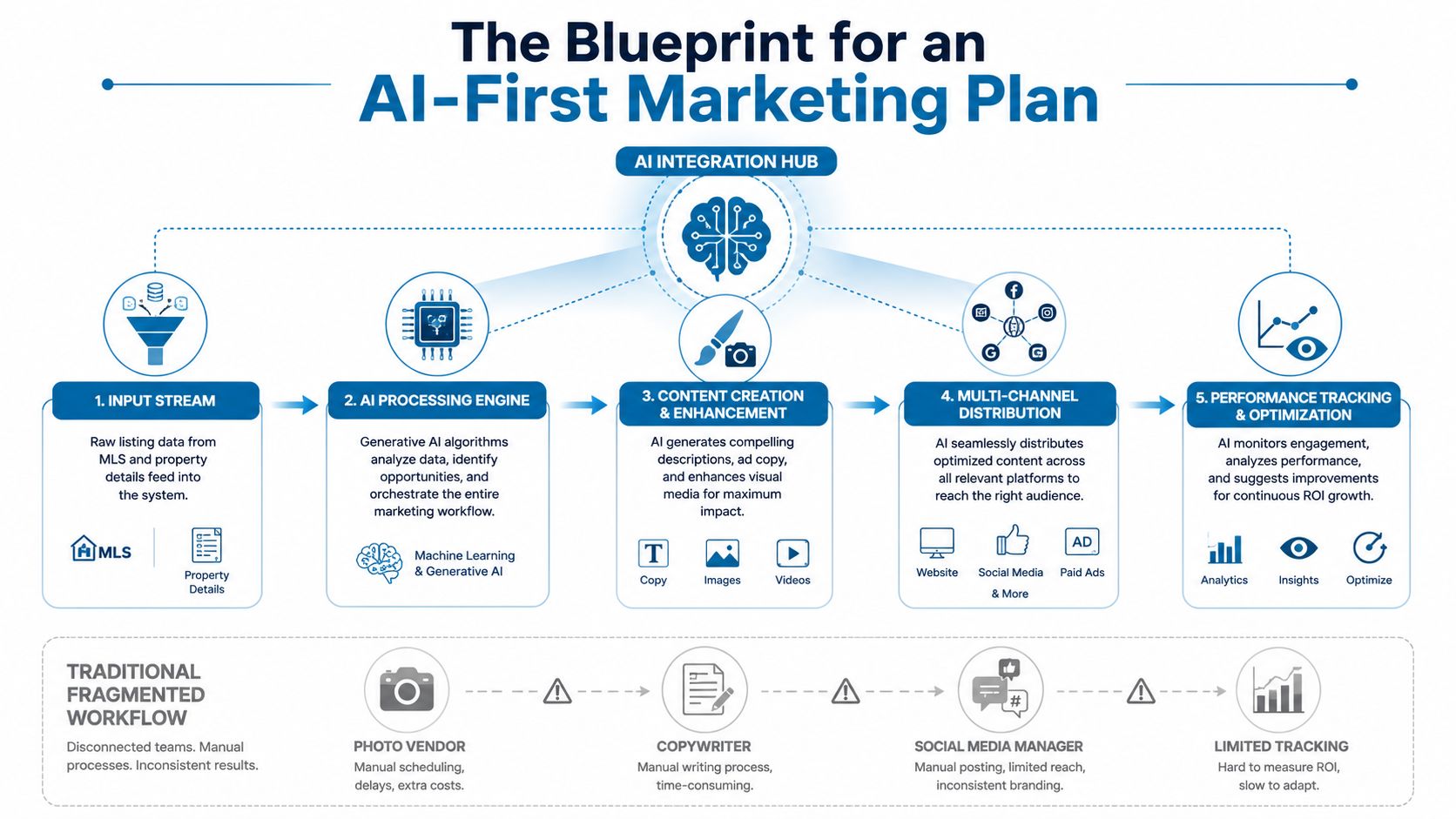
An AI real estate listing description generator earns its keep when it removes that scramble. Not by replacing your judgment. By giving you a repeatable starting point that turns verified property facts into clean first drafts you can adapt fast, review carefully, and publish everywhere with confidence.
The End of the Late-Night Content Scramble
A lot of agents still treat listing content as a last-minute writing task. That's the bottleneck.
You finish pricing strategy, coordinate staging, approve photos, and handle seller questions. Then marketing gets compressed into whatever time is left. The result is familiar: a rushed MLS description, copied captions across platforms, and inconsistent messaging from one listing to the next.
That approach breaks down fast when your listing has to do more than fill a text box.
The real problem isn't the blank page
The issue usually isn't writing skill. It's production capacity. One property now needs multiple versions of the same core message. The MLS needs factual, compliant copy. Instagram needs a concise hook. Facebook needs more context. LinkedIn needs a professional angle. Email needs a reason to click.
Good listing marketing starts with one verified source of truth, then branches into channel-specific versions.
That's why a solid AI workflow matters. It lets you start with structured property data and generate usable drafts quickly, while keeping your message aligned across every place the listing appears.
What changes when you use AI well
A strong system does three things at once:
Cuts the initial drafting burden: You stop writing every asset from scratch.
Improves consistency: The same property story carries across MLS, social, and email.
Protects your time: You spend more energy on review, positioning, and client service than on repetitive copywriting.
Used this way, AI isn't a novelty. It's an operating layer for listing launch.
Choosing the Right AI Generator for Your Business
Not every AI tool belongs in a real estate workflow. Generic AI can write fluent text, but fluent text is not the same thing as listing-ready marketing.
The difference starts with data. Effective real estate AI is built on structured data, and a purpose-built tool can process inputs like address, beds, baths, and square footage to generate compliant, localized, and channel-specific assets, according to ListingAI's description generator workflow. That matters because real estate content isn't just creative. It's operational.
Generic AI versus real estate-specific AI
Here's the practical comparison.
Feature
Generic AI (e.g., ChatGPT)
Purpose-Built Tool (e.g., ListingBooster.ai)
Property fact intake
Manual prompt entry
Structured fields for listing data
MLS-ready copy
Possible, but inconsistent
Designed for MLS-style output
Social versions
Requires extra prompting
Built to produce multiple channel variants
Fair Housing screening
Manual review required
Often included as a workflow guardrail
Brand voice control
Prompt-dependent
Usually guided by saved preferences or templates
Editable drafts
Yes
Yes, usually within a listing workflow
Fact grounding
Depends on what you type
Anchored to listing fields and source inputs
A generic tool is fine for brainstorming. It's less reliable when you need repeatable output from verified facts, especially under deadline.
What a good generator must do
If you're evaluating an AI real estate listing description generator, don't get distracted by how polished the demo sounds. Check whether it handles the parts that matter in daily practice:
MLS-ready copy: The draft should be concise, factual, and easy to edit for local MLS rules.
Social media versions: One listing should generate short-form posts without forcing you to reprompt from scratch.
Fair Housing screening: This should be part of the workflow, not an afterthought.
Editable drafts: You need to tighten language, remove weak claims, and tailor the message.
Brand voice support: Luxury, new construction, relocation, urban condo, and suburban move-up listings shouldn't all sound identical.
Fact grounding: The tool should work from actual property inputs, not guesswork.
Practical rule: If a tool saves time on drafting but creates more review risk, it's not efficient.
For a broader look at category options, this guide to AI content tools is useful as a general overview. For a more industry-specific roundup, this overview of top AI solutions for agents is a better fit for real estate workflows.
Where purpose-built tools fit
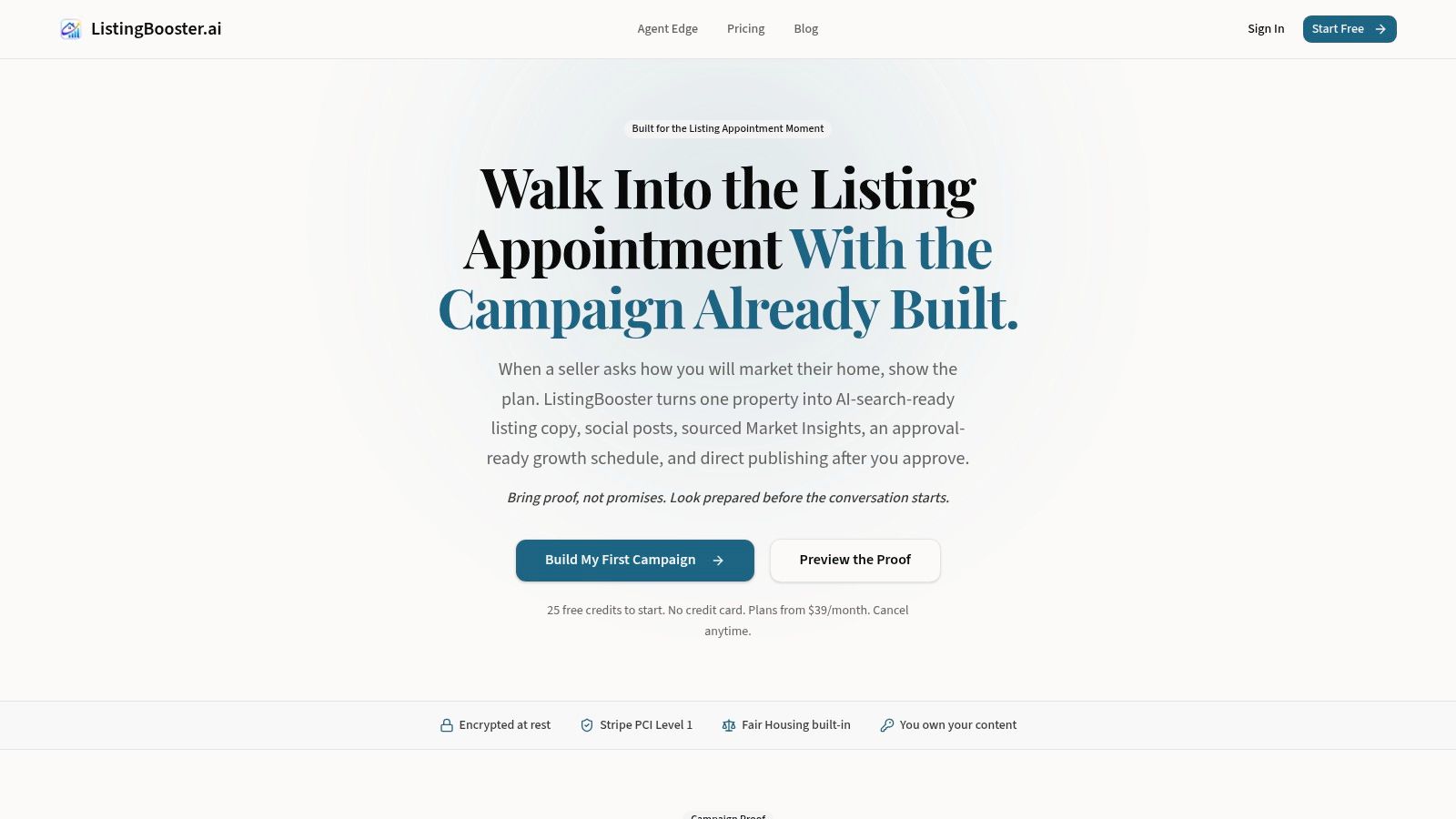
A platform like ListingBooster.ai fits naturally. It's built around real estate inputs and multi-channel output, rather than asking you to build the entire workflow from prompts alone. That's a meaningful distinction if your goal is speed with control, not just speed.
Establishing Your AI Content Workflow and Compliance Guardrails
The most important decision happens before you generate anything. You need a review process.
The biggest risk in AI content generation isn't poor writing. It's liability. A single unsupported claim or Fair Housing issue can spread across MLS, portals, and social posts, which is why a human approval workflow is essential, as discussed in Hypotenuse AI's real estate generator guide.
Verify facts before style
The AI draft should only be as strong as the facts you feed it. Manually confirm the fields that commonly cause problems:
Property basics: Bedrooms, bathrooms, square footage, lot size, parking, year built.
Upgrades and features: Renovation details, appliance brands, roof or HVAC updates, outdoor improvements.
Location details: School names, HOA references, transit claims, neighborhood amenities.
Status-sensitive details: Open house timing, price changes, concessions, occupancy notes.
If you can't verify it, don't publish it.
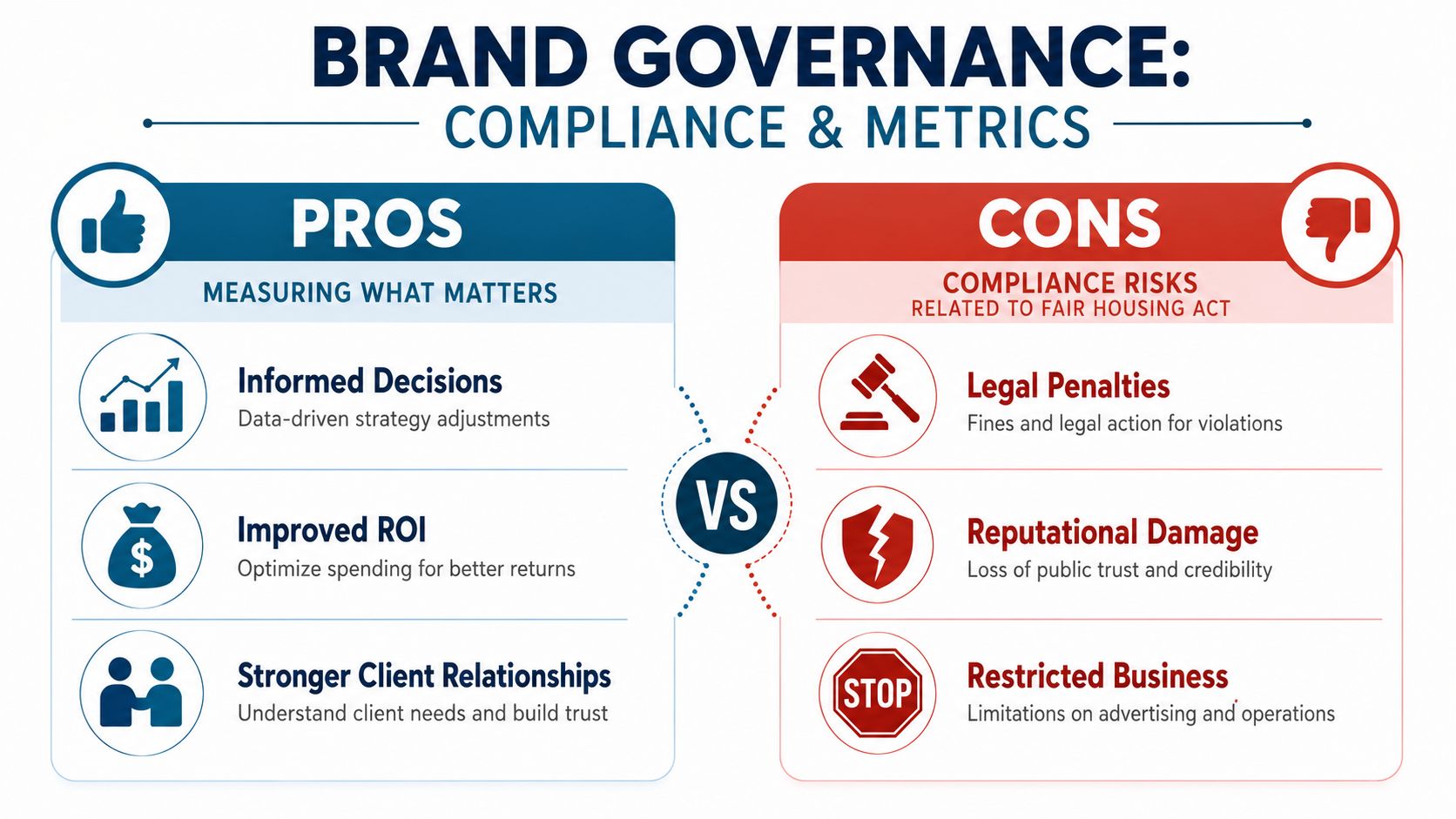
Screen for Fair Housing risk every time
Many agents get casual at this stage. Don't.
Avoid language that describes who should live in the home or implies anything about protected classes. Skip phrases like “perfect for families,” “safe neighborhood,” or “ideal for young professionals.” Describe the property itself instead.
Use this kind of translation:
Instead of: “Perfect for families” Use: “Flexible floor plan with multiple living areas and a fenced yard”
Instead of: “Safe, quiet street” Use: “Located on a cul-de-sac” or “set on a low-traffic residential street,” if accurate
Instead of: “Walk to church” Use: “Close to neighborhood services and community amenities,” if verified and appropriate
Your license doesn't care whether a problematic phrase came from you or from software. You're still responsible for the final copy.
Build a simple approval sequence
Keep it tight:
Load verified listing facts
Generate draft variations
Review for factual accuracy
Screen for compliance and unsupported claims
Approve platform versions for publishing
That process is what turns AI from a risk into an asset.
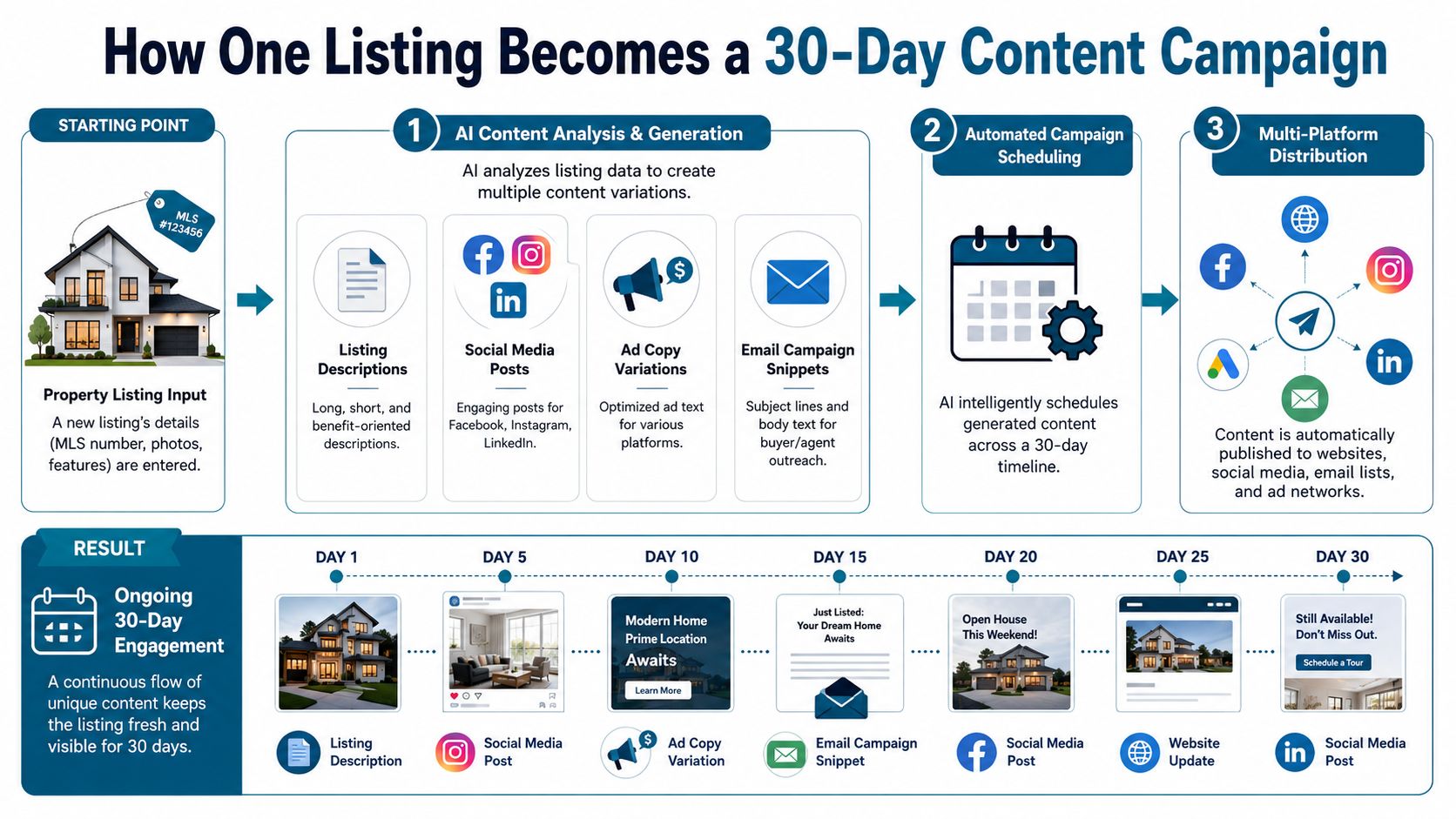
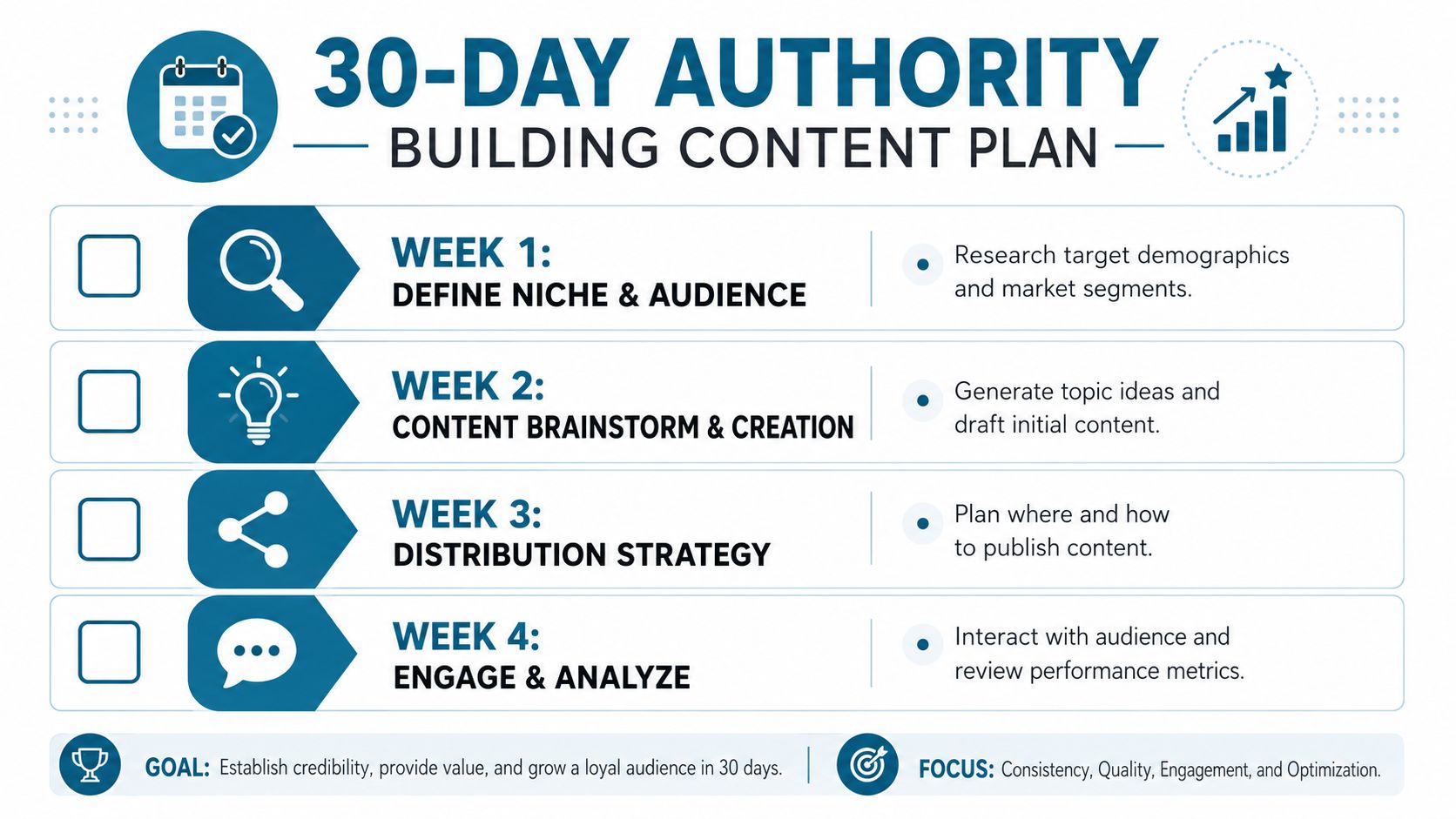
Executing Your 30-Day Listing Marketing Plan
The best use of an AI real estate listing description generator is to treat the MLS description as the core asset, not the final deliverable. One approved draft can drive a month of coordinated marketing if you plan it correctly.
Days 1 to 3 with the cornerstone asset
Start with the verified property record and your own notes from the home. Generate:
An MLS description: Clear, accurate, and stripped of fluff
A longer website version: More room for narrative and feature grouping
A short-form summary: Useful for portals, email intros, and teaser posts
At this stage, you're deciding what story the listing will tell. Is the angle architectural detail, updated interiors, lot utility, outdoor living, or location convenience? Pick one primary angle and one secondary angle. Don't try to make every feature the headline.
Days 4 to 10 with launch content
Once the core description is approved, derive launch assets from it.
A practical sequence looks like this:
Coming soon post: Focus on anticipation. Tease the strongest visual or functional feature.
Just listed post: Use the clearest summary version and strongest first image.
Story or Reel script: Turn the description into a walkthrough voiceover.
Email announcement: Keep the first paragraph tight and direct readers to photos or a tour page.
Days 11 to 20 with event-based updates
Most listings need more than one announcement. Build around the actual sales cycle.
Listing stage
Best content angle
What AI should generate
Open house
Access and urgency
Caption, story slides, reminder text
Price adjustment
Fresh value framing
Updated copy emphasizing features and positioning
Under contract
Momentum and proof of activity
Status post and seller-facing credibility content
Just sold
Marketing recap and market presence
Closing announcement and authority post
Content planning offers assistance. If you want a repeatable schedule instead of posting ad hoc, use a framework that helps you attract clients with content planning.
Days 21 to 30 with follow-up and reuse
After the listing has been live for a while, don't abandon the content. Recut it.
Use the original description to create a feature spotlight post, a behind-the-scenes caption about prep and launch, or a market positioning post that explains what the property represented in the local market. The same listing can support both lead generation and authority building when the workflow is organized from the start.
Adapting AI-Generated Content for Each Social Platform
The draft shouldn't be identical everywhere. Platform-native packaging matters.
Instagram and TikTok need movement
Instagram captions work best when they lead with a visual hook, then quickly anchor the property's strongest selling point. Reels need a short script with scene-by-scene pacing, not a pasted MLS paragraph.
For TikTok, use the listing description as raw material for voiceover structure:
opening hook tied to the standout feature
quick room-to-room progression
short closing line with next action
If you're turning approved listing copy into video ads or short-form creative, tools like ShortGenius automated ad generation can help speed up video production after the messaging is finalized.
Facebook needs context and conversation
Facebook still works well for community-aware listing posts and event promotion. The copy can be a little longer. Give enough detail for someone to understand why the property stands out, then invite a practical next step such as attending an open house or requesting details.
Good Facebook posts often combine:
a concise lead sentence
two to three verified features
one action prompt
LinkedIn should build professional credibility
LinkedIn is the place to frame the listing as evidence of your marketing process and market knowledge. Don't write like you're posting to Instagram with a suit on.
A LinkedIn listing post should sound like a professional market update attached to a property, not a sales flyer.
Use angles like pricing strategy, presentation quality, neighborhood demand patterns, or the importance of clean syndication-ready content. The property is still the hook, but your expertise is the core subject.
Building Your Authority Engine with AI
The smartest agents use listing content to build a body of work, not just fill a weekly posting slot.
With 43% of shoppers willing to use generative AI in their home search, discoverability now depends on a consistent footprint of authority content that helps AI systems recognize trusted local expertise, according to Skyline School's write-up on listing description generators.
The content pillars that actually help
Your AI workflow shouldn't stop at active listings. Build around a few durable themes:
Local market interpretation: Short commentary on inventory, pricing patterns, or buyer behavior in your area
This kind of content gives AI search systems more evidence about who you are, what market you know, and what topics you consistently cover.
Why listing-only content isn't enough
If your digital presence only appears when you have a property to sell, your footprint stays thin. A stronger pattern is to use each listing as a content trigger. One home can lead to an evergreen post about staging decisions, another about lot utility, another about condo positioning, another about pricing communication.
That's how an AI real estate listing description generator becomes part of your authority engine. It helps you start faster, then expand outward with judgment and local knowledge.
Measuring What Matters and Refining Your AI Strategy
If you only watch likes, you won't know whether the content is helping the business.
Track actions, not applause
Review your listing content monthly and focus on signals tied to actual intent:
Comments and direct messages: Did the post start real conversations?
Saves and shares: Did people treat it as useful enough to revisit or send along?
Website clicks: Did the content move people to the listing page or contact form?
Lead quality: Did inquiries relate to the property, the neighborhood, or future selling plans?
Appointments set: Did any content lead to a showing, consultation, or listing conversation?
Use the review to improve prompts
Look for patterns in what worked. Maybe feature-focused captions drove better inquiries than generic launch posts. Maybe your LinkedIn market commentary brought in referral conversations. Maybe short walkthrough scripts held attention better than static image posts.
Then adjust the workflow. Refine the source inputs, improve your prompts, shorten weak openings, and keep your review process tight. AI should make your system sharper over time, not just faster.
Conclusion: From Content Creator to Content Strategist
An AI real estate listing description generator is most useful when you stop treating it like a writing shortcut and start using it like marketing infrastructure. The win isn't just faster copy. It's a cleaner launch process, stronger consistency across channels, and fewer last-minute content decisions.
Agents still need to verify facts, apply judgment, and protect compliance. That part doesn't change. What changes is the amount of manual drafting required to get a listing in front of buyers professionally.
Used well, AI moves you out of production mode and into strategy mode. You spend less time wrestling captions and more time guiding positioning, reviewing quality, and serving clients. That's the right role for a working agent or team.
If you want to see what that kind of workflow looks like in practice, ListingBooster.ai is worth exploring. It's built for real estate-specific inputs and can help turn one set of verified listing facts into MLS-ready copy and supporting social content, while keeping editing and compliance review in your hands.
The problem usually isn't posting frequency. It's post type. Generic listing announcements tell people what happened. Strong real estate quotes for social media tell people what to believe about your expertise, your market, and the kind of outcomes you help create.
These eight categories work because each one taps a specific psychological trigger: authority, urgency, social proof, identity, aspiration, or reassurance. Use them well and your posts stop sounding like templates. They start sounding like a trusted advisor who knows the market and knows how to communicate.
1. The Market Authority Quote
Most agents wait until a seller asks for proof before they sound credible. That's backwards. Authority posts should do the pre-selling before the inquiry arrives.
A market authority quote works when it translates local conditions into a short, confident observation. Not fake data. Not broad national commentary. A sharp, local line that tells followers you understand pricing, timing, prep, and buyer behavior in your area.
What this looks like in practice
Try copy like this:
“Well-prepared homes don't just photograph better. They create stronger first impressions and better conversations with buyers.”
Or:
“Pricing isn't a guess. It's a positioning decision, and the homes that get attention fastest are usually the ones aligned with how buyers are comparing options today.”
These don't need percentages to work. In fact, if you don't have verified local numbers ready, qualitative framing is safer and often more believable. Pair the quote with a simple chart from your MLS, a screenshot of recent comparable activity, or a short talking-head Reel explaining what changed this month.
A practical workflow is to create one authority quote every week from a recurring source. New pendings, days on market shifts, price reduction patterns, buyer objections you heard at open houses, or what appraisers are reacting to right now. If you want help turning listing data into repeatable social copy, this guide on AI social media posts for real estate listings is a useful starting point.
Copy-paste examples
Pricing angle: “The first week on market shapes the rest of the campaign. Smart pricing protects momentum.”
Seller prep angle: “Buyers don't reward effort. They reward clarity. Prep the home so the value is obvious.”
Buyer demand angle: “When buyers hesitate, they compare. When a home is positioned well, they act.”
Local expert angle: “Every neighborhood has its own rhythm. Strategy that works two ZIP codes over may not work here.”
Practical rule: If the quote could be posted by an agent in any city without changing a word, it's too generic.
What doesn't work is borrowed economist language, stiff market jargon, or unsupported stats. Authority isn't sounding technical. Authority is sounding useful.
2. The Transformation Before-After Quote
Transformation posts perform because people remember contrast. They want to see what changed, why it changed, and who guided the process.
This category isn't only about renovation. It can be a property transformation, a marketing transformation, or an emotional transformation from uncertainty to relief. That's why before-and-after content often earns stronger attention than polished final photos alone.
Here's the visual style that fits this format:
The quote should name the shift
Strong examples:
“This home didn't need luck. It needed a better plan.”
“What buyers saw at launch was very different from what the seller had been living with for years.”
“The story changed when the presentation changed.”
Those lines create curiosity. Then your caption supplies the context. Maybe the seller had cluttered rooms, poor lighting, dated paint, or listing photos that didn't reflect the home well. Maybe the buyer couldn't see potential until staging, copy, and sequencing made the opportunity visible.
This format works especially well as a carousel. Slide one is the quote. Slide two shows the original condition. Slide three shows the updated presentation. Slide four explains what you changed. Slide five gives the lesson a seller can use.
What to include and what to avoid
Show the challenge: “Dark photos,” “awkward furniture layout,” or “unclear room function” is more compelling than saying “we worked our magic.”
Make the agent role visible: Explain the decision. Recommended paint, adjusted room use, rewrote listing copy, changed launch timing.
Protect privacy: Get written permission before sharing client-sensitive details, family stories, or interior images that reveal personal information.
Tag collaborators carefully: Stagers, photographers, organizers, and contractors can help expand reach if the post supports their work too.
Use AI tools to create first drafts, but don't let them flatten the narrative. The strongest version sounds specific to the house. If you're systematizing listing-stage content, ListingBooster's property workflows can help generate variations, but your final edit should preserve the actual challenge and the actual turnaround.
What fails here is fake drama. If nothing meaningful changed, don't force a transformation story. Audiences can tell.
3. The Fear of Missing Out Urgency Quote
Urgency works when it reflects reality. It fails when it sounds like pressure.
A FOMO quote should help buyers or sellers understand timing, competition, or momentum in plain language. It should never imply panic, guarantee outcomes, or make unsupported claims about demand. In these situations, agents often get sloppy. They say “won't last,” “market is insane,” or “act now” with no context. That language burns trust fast.
Here's the kind of image that supports this angle well:
Use urgency with proof, not hype
Better examples:
“The buyers who are ready before the right home appears usually move with less stress.”
“When inventory feels tight in a price band, preparation matters more than prediction.”
“If you've been waiting for perfect certainty, that may be the thing keeping you from a strong opportunity.”
These quotes create movement without sounding manipulative. Then your caption can explain the immediate reason. Maybe multiple buyers asked about the same school zone. Maybe well-presented starter homes are moving quickly. Maybe sellers in a certain range are getting attention because there aren't many comparable options available.
Urgency should describe the market. It should never replace strategy.
Compliance note for FOMO posts
Be especially careful with wording tied to audience type. Don't say a home is “perfect for young families,” “ideal for professionals,” or “great for retirees.” That drifts into Fair Housing risk. Keep the focus on the property features, market conditions, and transaction readiness.
Good calls to action for this category:
Buyer CTA: “If you want the prep checklist before the next one hits, message me.”
Seller CTA: “If you're wondering whether current momentum applies to your home, ask for a pricing review.”
Open-house CTA: “Want the full launch details before the weekend traffic starts? Send a DM.”
What works best is restraint. Two urgency posts in a short span can feel timely. Repeating scarcity language every day makes your feed sound like a clearance sale.
4. The Buyer Seller Psychology Education Quote
Educational quotes pull in a different kind of lead. Not the person who wants a quick listing link. The person who wants guidance.
These posts work because real estate decisions are emotional long before they're transactional. Sellers get attached. Buyers second-guess. Both sides read too much into silence, negotiation, or timing. When you name those reactions clearly, you sound experienced without sounding salesy.
Say the thing clients are already feeling
Use lines like:
“Most pricing mistakes start with attachment, not analysis.”
“Buyer hesitation doesn't always mean disinterest. Sometimes it means they're trying to picture the decision clearly.”
“The hardest part of selling is often separating what the home means to you from how the market sees it.”
This category performs best when the quote leads into a short explanation. For example, a seller may resist neutralizing a room because they love the design. Your caption can explain that buyers need easier visual interpretation. Or a buyer may panic after offer acceptance. Your caption can normalize the emotional drop that often follows a big commitment.
Turn one quote into multiple formats
Carousel: One emotional truth per slide, ending with a practical takeaway.
Reel: Speak the quote on camera, then explain it in under a minute.
Story sequence: Quote on slide one, poll on slide two, answer on slide three.
Email subject line: “Why sellers overprice, and how to avoid it.”
This category also aligns with the broader shift away from generic quote dumps. Industry guidance increasingly points toward content that's personal, local, and explanatory rather than recycled inspiration. Psychology posts fit that standard because they show you understand the human side of the transaction.
What doesn't work is armchair therapy. Don't overstate emotions, and don't speak like a motivational speaker. Stay grounded in actual behaviors you see in showings, negotiations, and prep conversations.
5. The Neighborhood Location Pride Quote
Neighborhood quotes build local authority better than generic market slogans because they help followers picture life, not just property.
A good one makes a place feel distinct. Not “great area.” Not “close to everything.” Those phrases are dead from overuse. The post should highlight sensory detail, rhythm, and local patterns that a non-local wouldn't know to mention.
This type of imagery gives the quote something real to sit on:
Make the neighborhood sound lived-in
Examples that work:
“People move here for the address. They stay because daily life gets easier.”
“This neighborhood isn't loud about its appeal. It wins people over block by block.”
“The best thing about this area isn't one landmark. It's how many small routines fit naturally into a week here.”
Then support the quote with verifiable detail. Farmers market days, walking routes, commuter access, local coffee spots, park layout, redevelopment activity, or the kind of housing mix buyers can expect. You're not writing a tourism brochure. You're helping someone imagine what it feels like to belong there.
Fair Housing note
Avoid describing who belongs in the neighborhood. Describe the neighborhood itself. That means amenities, access, style, pace, housing stock, and local businesses. Not protected classes, assumed household types, or coded language about “good families,” “safe streets,” or “up-and-coming demographics.”
Useful content pairings:
Street reel: Walk a few blocks and narrate what locals appreciate.
Business tag: Feature a local café, bakery, or bookstore and explain why clients mention it.
Seasonal update: Show how the area changes in spring, summer, holiday season, or school-year traffic periods.
A neighborhood quote is often the bridge between local awareness and future seller trust. People don't just see that you know listings. They see that you know the area well enough to market it credibly.
6. The Agent Personality Behind-the-Scenes Quote
People hire competence. They remember personality.
That's why behind-the-scenes quotes matter. They let prospects hear your standards, values, and work style before a consultation. In crowded markets, this is often the difference between “another agent in my feed” and “the one I'd call.”
Show your values without sounding self-congratulatory
Use lines like:
“A smooth closing usually means someone handled a lot of problems quietly.”
“Most of this job happens before the photo, before the sign, and before the contract deadline.”
“My clients don't need me to look busy online. They need me to notice what could go wrong before it does.”
These work because they reveal process and mindset. They don't rely on awards, clichés, or vague hustle language. They sound like someone who has been through enough transactions to know where the friction lives.
Decision moments: Why you advised waiting a few days to launch, changing photo order, or adjusting caption focus.
Client-care moments: The call you made after inspection issues, the vendor update before weekend opens, the extra showing coordination.
The goal isn't to look busy. It's to make your judgment visible.
What doesn't work is generic grind content. “Up early, crushing it” says nothing. A specific observation about how you protect a client from a weak launch says a lot. Keep the tone conversational. First person is fine here because the whole point is to make the person behind the business feel real.
7. The Client Testimonial Success Story Quote
Social proof is strongest when it sounds like a real human, not a polished brochure.
A client quote should capture emotion, context, and one specific reason the experience mattered. Don't over-edit the life out of it. If the client said they felt less overwhelmed because you explained each step clearly, that's better than a stiff line about “excellent service and professionalism.”
The most believable testimonial structure
Use this simple pattern:
“We felt completely lost at the beginning, but every step was explained clearly. By the time we closed, we felt confident instead of stressed.”
Or:
“What stood out was the honesty. We got clear advice, even when it wasn't the easy answer.”
Or:
“The sale didn't go in a straight line, but we always knew what was happening and what the next move should be.”
That language works because it reflects actual client concerns: confusion, stress, trust, clarity, timing, and communication. It also maps directly to what future clients want to hear.
How to make testimonial posts stronger
Name the context: First-time buyer, relocation seller, downsizer, investor, inherited property, off-market search.
Add a real moment: Inspection issue resolved, strategy shift after low activity, calm guidance through a tight deadline.
Keep the quote short: Use one memorable section in the graphic. Put the longer story in the caption.
Get permission in writing: Especially if you're using names, photos, or transaction details.
This category is where a lot of agents overreach by adding exact prices, timelines, or savings claims they either can't disclose or haven't documented for social use. If you have verified details and permission, use them carefully. If you don't, tell the story qualitatively.
A weak testimonial says you were “amazing.” A strong one explains why someone trusted you when the stakes were high.
8. The Inspirational Aspirational Lifestyle Quote
Aspirational quotes still work. They just need to be grounded in a believable life scenario.
Generic inspiration feels interchangeable. Lifestyle framing feels useful because it connects a property to routines, goals, and identity. Done right, these are some of the most effective real estate quotes for social media because they help buyers imagine living there without leaning on protected-class assumptions.
Here's the kind of image that supports that emotional framing:
Anchor the dream in a real routine
Examples:
“The right home doesn't just fit your furniture. It supports the way you want your days to feel.”
“This kitchen isn't about finishes alone. It's about whether the space makes daily life easier.”
“A spare room becomes valuable the moment your life needs it to do more.”
These quotes work because they point to use, not fantasy. Home office. Hosting friends. Quiet mornings. Easier storage. Outdoor coffee. Multi-use rooms. Better flow between rooms. You're selling a future rhythm, not just a feature sheet.
A smart way to organize these posts is by buyer intent. One set for remote workers, one for entertainers, one for hobby-focused buyers, one for people prioritizing flexibility. If you want a repeatable posting rhythm, this guide on how to create a social media content calendar helps turn quote categories into a monthly plan instead of random posting.
Keep aspirational content compliant
Avoid implying the home is for a certain age, family status, religion, or other protected category. Focus on the space and how it functions. “Dedicated workspace with natural light” is compliant. “Perfect for young professionals” is not.
What fails here is over-romantic language with no visual or practical anchor. If the quote sounds like a candle ad, trim it back. The best aspirational copy gives people one clear, desirable scene they can picture themselves stepping into.
8 Real Estate Quote Types Compared
Quote Type
🔄 Implementation Complexity
⚡ Resource Requirements
📊 Expected Outcomes
Ideal Use Cases
⭐ Key Advantages & Tips 💡
The Market Authority Quote
Medium, data sourcing & monthly updates
Market data feeds, simple infographics, copywriting
Builds credibility and steady qualified interest; high AI/SEO visibility
Evokes desire and brand aspiration. 💡 Use sensory language and scenario-based copy
Turn Quotes into Clients with an Automated System
A strong quote library helps. A system is what turns it into business.
Most agents don't struggle because they lack ideas. They struggle because content creation keeps getting pushed behind showings, contracts, follow-up, and everything else that closes deals. That's why quote strategy needs to be operational, not inspirational. You need recurring categories, repeatable prompts, approval rules, and a posting cadence you can sustain when the week gets chaotic.
The easiest way to build that system is to assign each quote category a job. Market authority quotes build credibility. Transformation quotes create emotional contrast. FOMO quotes generate timely conversations. Psychology quotes reduce uncertainty. Neighborhood quotes build local relevance. Personality quotes humanize you. Testimonial quotes add social proof. Lifestyle quotes create desire. Once every category has a purpose, your calendar gets much easier to plan.
That structure also fits how social works now. Quote posts do best when they're not isolated graphics. They need to sit inside a broader content mix that includes video, story-driven posts, neighborhood context, listing content, and educational commentary. Earlier, we noted that video is already a common part of agent strategy and that highly shareable content formats carry outsized reach. That matters because your quote often works best as the hook, while the Reel, carousel, or caption delivers the proof.
Automation is useful here because it reduces the friction between strategy and execution. Tools such as ListingBooster.ai can help agents generate listing-based content, organize recurring themes, and keep posts aligned with Fair Housing considerations before publishing. The important part isn't handing your brand to software. It's using software to produce a stronger first draft faster, then editing for local specificity, compliance, and voice.
If you're serious about making real estate quotes for social media produce actual inquiries, build a simple operating model:
Pick 3 to 4 quote categories you can sustain weekly.
Tie each one to one audience and one CTA.
Batch the visuals in Canva or your design tool of choice.
Use AI for draft generation, not final judgment.
Review every post for compliance and local relevance before it goes live.
That's the shift from posting to brand building. When people consistently see clear expertise, recognizable voice, and relevant local insight, you stop looking like a random agent in the feed. You start looking like the obvious person to contact when they're ready.
If you want a faster way to turn listings, market updates, and neighborhood knowledge into ready-to-post content, ListingBooster.ai is one option to consider. It's built for agents who need a practical content system, not more blank-page work.
You've got a new listing. Photos are back. The walkthrough video is sitting in your camera roll. The MLS copy is approved. And then the bottleneck shows up.
You still need Instagram posts, a Reel, Facebook copy, open house promos, a LinkedIn angle, stories, maybe an email, and something you can keep publishing next week without sounding like you're repeating yourself. Most agents don't run out of content ideas because the listing is thin. They run out because they treat the listing like a one-time ad instead of a system.
That's the shift that matters if you want to understand how to create social media content from a property listing without burning half your week on marketing. A listing isn't one post. It's raw material for a full campaign. Matterport's social guidance recommends using listings for new listing posts, market updates, virtual tour events, and open houses, and notes that social has become a major channel in real estate, with 52% of agents rating social media as their best lead source and 63% using social media to advertise listings according to the roundup cited in Matterport's real estate social media guide.
The practical playbook is simple. Extract the story angles. Turn them into platform-specific assets. Sequence them across a month. Keep the messaging useful, local, and compliant. Then make the whole thing structured enough that buyers can understand it, sellers can trust it, and AI search systems can read it.
From Listing Details to Content Pillars
Most listing packages already contain enough information for a month of content. The mistake is using that information in a flat way. Agents pull the hero photo, paste the headline, add “just listed,” and move on.
A better workflow is to break the property into content pillars before you write a single caption. That modular approach lines up with real estate marketing guidance that recommends turning listing inputs into multiple creative types such as high-quality image posts, neighborhood spotlights, video walkthroughs, testimonials, and planned calendar content instead of one launch blast, as described in eXp Realty's content marketing guide for listings.
The property story
Start with the obvious material, but don't stop at features. Pull out the details that make the home memorable.
That includes:
Architecture and layout: Is it a mid-century ranch, a new build, a loft conversion, a traditional colonial, a duplex with flexible use?
Use-case benefits: Better flow for entertaining, more privacy, natural light for work-from-home buyers, storage that solves daily friction.
The key is translating specs into lived value. “Large kitchen with island” is inventory language. “Kitchen designed for someone who hosts” is content language.
A single room can generate several assets if you vary the angle. The kitchen becomes a carousel about finishes, a Reel with quick cuts, a story poll about favorite details, and a caption about how layout changes daily living.
Practical rule: If a feature can't carry its own post, you haven't found the benefit yet.
The lifestyle story
Average listing content typically gets thin here. Agents mention a neighborhood once, maybe tag the town, and leave real differentiation on the table.
The lifestyle pillar should pull from:
Walkability and convenience: Cafés, parks, retail, transit access, major commuter routes.
Community feel: Quiet street, active downtown, established neighborhood, new energy, mixed-use area.
Location language: Neighborhood names, district references, ZIP phrases, and landmarks buyers search for.
This content works because it helps people picture life beyond the front door. It also creates richer local context, which strengthens your authority. If you want a cleaner framework for balancing promotional and authority content around a listing, this guide to a real estate agent content strategy is a useful reference point.
The financial story
A lot of agents either avoid this pillar entirely or make it too technical for social. Both are mistakes.
You don't need to overload the audience with data. You need to frame the home in terms buyers and sellers understand:
Value framing: What makes the home compelling relative to other options in that area?
Scarcity angle: Hard-to-find one-level living, rare lot size, updated historic home, move-in-ready condition in a neighborhood with limited inventory.
Market relevance: Why this listing matters in the context of local buyer demand.
Keep this pillar qualitative unless you have approved market numbers ready to cite elsewhere. The point is interpretation, not spreadsheet dumping.
The human story
This pillar is the one that makes the campaign feel less manufactured. Social content gets stronger when the home has a narrative people can attach to.
Good source material includes:
Seller prep story: Renovations, staging choices, years of care, design updates.
Behind-the-scenes moments: Photo day, final styling pass, agent observations from walking the home.
Trust elements: Testimonials, if you have permission and compliant language.
The human pillar is where good agents sound less like advertisers and more like advisors. You're not forcing sentiment. You're helping the audience understand why the home matters.
Here's the test. If you can extract these four pillars from the listing before you open Canva, CapCut, ChatGPT, or your scheduler, you'll never stare at a blank caption box again. You'll already know what the campaign is about.
Crafting Compelling Copy with AI and Psychology
Writing is where most listing campaigns slow down. The visuals exist. The property is live. But now someone has to write ten to twenty variations of captions that don't sound repetitive, overhyped, or vaguely robotic.
That's why the operational question matters more than the creative one. Adobe's guidance points to the core challenge. Agents don't just need ideas. They need a system for turning one address into repeatable, multi-platform output without losing hours to production, as discussed in Adobe Express's guide to social media for real estate.
Stop asking AI for captions
If you type “write me a caption for my new listing,” you'll usually get polished nonsense. It sounds real estate-ish, but it doesn't sound specific. The copy is too broad, too cheerful, and too similar to what every other agent is posting.
Ask for angles, constraints, and audience context instead.
Use inputs like:
Property facts: home style, neighborhood, standout features, listing status
Platform: Instagram caption, LinkedIn post, story frame text, Facebook event copy
Tone: polished, local, concise, conversational, premium, direct
Objective: save, DM, click, attend open house, ask for details
If you want a broader look at how teams are using tools for AI social media content creation, it helps to study workflows that start with inputs and formatting rules, not generic prompt-and-pray caption writing.
Copy prompts that actually save time
Below are prompt structures worth keeping in a swipe file. They work in ChatGPT, Claude, Gemini, or a listing-focused tool.
New listing prompt
Prompt:
“Write 5 Instagram caption options for a new real estate listing. Use these details: [paste listing details]. Target [buyer type]. Tone should be [tone]. Each caption should open with a strong hook, highlight one distinct angle of the home, avoid generic luxury language, and end with a clear CTA to DM for details or schedule a showing. Do not use Fair Housing risky language. Give me one version focused on design, one on lifestyle, one on layout, one on scarcity, and one on neighborhood.”
Why this works: it forces variation. You're not getting five rewrites of the same caption.
Open house prompt
Prompt:
“Create 4 short-form social captions for an open house using this listing information: [paste details]. Write for Instagram, Facebook, and story text overlays. Emphasize urgency without sounding pushy. Mention the strongest visual feature, include date and time placeholders, and end with a direct invitation to visit.”
Shorter copy tends to perform better for open house posts because the ask is immediate. People don't need the full property narrative there. They need enough reason to show up.
Write the caption for the action you want today, not the information you want remembered next week.
Price drop prompt
Prompt:
“Write 3 captions announcing a price improvement on this listing: [paste details]. Make the tone confident and value-focused. Avoid hype. Explain why the home is worth another look. Include one version for Instagram, one for Facebook, and one for LinkedIn aimed at referral partners and local professionals.”
In this context, weak copy is most damaging. “Price reduced” is not a strategy. A better version reframes the opportunity and reminds the audience what makes the listing compelling now.
Psychology that improves captions
Agents hear “use psychology” and immediately think manipulation. That's not the job. The job is to match the message to how buyers make decisions.
Use scarcity carefully. It should reflect a real attribute of the home, not fake urgency. Use aspiration when the visual story is strong. Use social proof only when you have approved proof to reference.
A cleaner workflow for copy production
The fastest teams don't write from scratch each time. They build a copy matrix.
Use one listing to generate these caption families
Hero post copy: one flagship caption with the broadest appeal
Feature posts: one caption each for kitchen, primary suite, outdoor area, layout
Lifestyle posts: neighborhood angle, commute angle, local routine angle
Event copy: open house, broker open, live walkthrough, Q&A prompt
Status updates: price improvement, under contract, just sold
One factual tool worth mentioning here is ListingBooster.ai's post workflow for real estate listings, which focuses on generating listing-based social assets from property inputs. Whether you use that or another setup, the principle is the same. Build modular caption types once, then adapt them by channel.
What works and what doesn't
Works
Specific hooks: “The kitchen is the reason buyers will stop scrolling.”
Single-angle captions: one post, one idea
Audience fit: investor framing sounds different from move-up buyer framing
Clear CTA: DM, comment, tour, RSVP, ask for the full photo set
Doesn't
Laundry-list captions: every room, every feature, no narrative
Fake drama: “This one won't last” on every post
Generic adjectives: stunning, gorgeous, amazing, must-see, dream home
Copy pasted across platforms: LinkedIn isn't Instagram with a blazer on
Strong listing copy doesn't describe the property better. It helps the right person recognize themselves in it faster.
Designing Visuals for Every Platform
Most agents already pay for professional photography. The waste happens after delivery.
They post the same horizontal exterior shot on Instagram, Facebook, LinkedIn, and sometimes TikTok, then wonder why the campaign feels flat. The issue usually isn't asset quality. It's adaptation. Visual-first real estate guidance favors photos, videos, live tours, walkthroughs, and short-form video formats such as Stories, Reels, Shorts, and Facebook video, as outlined in Sprinklr's real estate social media post guide.
One asset set, three different jobs
A listing visual package usually gives you these raw ingredients:
Professional stills
One walkthrough video
Branded details or floor plan
Open house information
Neighborhood visuals, if you capture them
That's enough. You don't need more footage first. You need better slicing.
Here's how the same listing should behave on different channels:
Platform
Best visual treatment
Tone
CTA
Instagram
Carousel plus vertical Reel clips
Aspirational and fast
Save, DM, share
LinkedIn
Clean single image or short slideshow
Professional and insight-driven
Ask for market context, referral, connect
TikTok
Quick vertical cuts with hook text
Casual, direct, local
Comment, follow, watch full tour
Instagram needs sequence
Instagram is where your visual storytelling has to feel edited, not dumped.
A strong carousel usually follows this order:
Hero image first: the photo that makes someone stop
Best interior second: usually kitchen or living room
For Reels, don't upload the full walkthrough untouched. Cut it into clips by angle. One Reel can focus on arrival and curb appeal. Another can be “three things buyers will notice immediately.” Another can be “why this layout works.”
If you want to sharpen how you select stronger room compositions and detail shots, SendPhoto's architectural photo insights are useful because they focus on visual choices that make spaces read better on camera.
LinkedIn is not a second Instagram feed
LinkedIn works when the visual supports a market point, a professional perspective, or a local insight.
Use:
One clean photo with text-light design
A before-and-after renovation pair
A short branded slideshow with a market or neighborhood angle
Avoid overly playful sticker-heavy designs here. LinkedIn audiences respond better when the post feels like a local expert sharing perspective rather than chasing reach.
A good LinkedIn post might pair the front elevation with commentary on buyer preferences in that micro-market. The image still matters, but it supports authority more than entertainment.
The platform changes the job of the visual. On Instagram it stops the scroll. On LinkedIn it supports your credibility.
TikTok and short-form video reward speed
TikTok and short vertical Reels need a much tighter opening. You've got a second or two to make the property legible.
Better openings:
“If you want a kitchen that doesn't feel builder-basic”
“One reason this neighborhood keeps getting repeat buyers”
“This layout solves a problem most older homes don't”
Weak openings:
“Welcome to my new listing”
Slow exterior drone intro
Long branded title screen
The visual edit should move quickly through contrast. Exterior to kitchen. Kitchen to living room. Living room to primary suite. Then land on one memorable benefit.
What to standardize
Every listing campaign should have a visual production checklist. Not a creative brainstorming session. A checklist.
Hero still selection: choose one image per platform, not one image for all platforms
Vertical crop set: prep story and Reel-safe crops before posting day
Text overlay system: one consistent font stack and text placement
Clip bank: short clips grouped by room, feature, and use case
CTA frames: final slide or final video frame built for action
This is what makes a listing look professionally marketed across channels instead of reposted.
Your One-Listing Thirty-Day Content Plan
The shift from random posting to campaign thinking is where social gets easier. Not harder. Once the content pillars and visual assets are built, the only real question is sequencing.
That's where repeatable frameworks help. Real estate content systems such as the 3-3-3 rule and the 5-3-2 rule keep the feed from becoming a string of listing announcements and turn each property into a mix of promotional, educational, community, and personal content, as summarized in Showcase IDX's real estate social media marketing framework.
Week one starts with impact, not volume
Don't unload every good asset in the first two days. Launch with range.
A solid first week might look like this:
Day 1: hero listing post with your strongest visual and broadest caption
Day 2: story sequence with key features and a question sticker
Day 3: short Reel focused on one standout room
Day 5: neighborhood or lifestyle post tied to the home's location
Day 7: open house promo or buyer FAQ tied to the listing
That mix immediately does two things. It promotes the property and signals that you understand the area around it.
The middle of the month should deepen the story
At this point, agents usually disappear. The listing is still active, but the content has gone quiet because the original launch assets are spent.
They aren't spent. You just need narrower angles.
Days 8 through 21 should rotate through these buckets
Educational post: explain a design choice, renovation detail, or buyer consideration
Community post: local spot, street feel, nearby convenience, neighborhood identity
Agent perspective: what stood out during prep, photography, staging, or showings
Interactive asset: poll, Q&A box, comment prompt, short live session
A lot of good listing campaigns separate themselves from generic feeds at this stage. The home stops looking like inventory and starts looking like expertise.
A thirty-day campaign doesn't require thirty original ideas. It requires a smart rotation of angles.
End the month with conversion content
Toward the back half of the calendar, your content should become more direct. Not louder. More direct.
Use:
Open house reminders
Price improvement framing
“Still available” refresh posts
FAQ content from showings
Just sold or under contract follow-up when status changes
The sequence matters. Early content creates attention. Mid-campaign content builds confidence. Late content asks for action.
A practical 30-day template
Here's a clean model you can repeat for almost any listing.
Promotional content
Launch post
Reel walkthrough
Open house graphic
Feature carousel
Status update
Educational content
What buyers should notice in the layout
Why this location appeals to a specific buyer type
What a renovation detail adds to daily living
How to evaluate homes like this in the local market
Community content
Neighborhood spot
Local routine or amenity
Street or district angle
Local business tie-in
Personal or trust content
Behind-the-scenes prep
Agent's take on the property
Client success angle
Process or service perspective
If you map those four categories into a month, you stop asking “what should I post today?” and start running a campaign with momentum.
What a calendar should actually do
A content calendar isn't there to fill squares. It should solve three business problems:
Consistency: the listing stays visible without daily reinvention
Message balance: you avoid overposting pure promotion
Decision speed: your team knows what goes out and when
That's the primary benefit of turning one property into a thirty-day plan. It reduces production chaos while making the listing look more active, more considered, and more professionally represented.
Compliance Fair Housing and AI Search Visibility
A listing campaign can look polished and still create risk. Agents often become casual in such circumstances, especially when they start using AI tools and moving fast across platforms.
Two things need to happen at the same time. You need to protect the business with compliant language and visuals. You need to prepare the business for how discovery is changing.
Recent discussion in real estate marketing has started addressing the shift from traditional social discovery toward AI-assisted discovery. One source notes that over 40% of homebuyers start their search in AI tools, and argues that content now needs to function not just as social media, but as an AI-readable digital footprint with clear local context, descriptive alt text, and consistent agent identity, as outlined in Hommati's article on promoting real estate listings on social media.
Protect the listing with a compliance filter
Social copy gets risky when agents improvise. AI-generated copy gets risky when nobody reviews it.
Your review checklist should be simple:
Check audience language: avoid wording that suggests preference for certain types of buyers or households
Check neighborhood framing: describe location factually, not with coded assumptions
Check visuals: be thoughtful about representation and consistency across media
Check accessibility references: describe actual property features, not assumptions about who they suit
Check every platform version: compliant on Instagram but risky in ad copy is still risky
This is one area where process beats creativity. Every caption, text overlay, ad variant, and image description should go through the same review standard.
If you're working with edited or AI-enhanced listing imagery, it's worth reviewing practical guidance on navigating California's AI photo real estate compliance, especially if your market or brokerage is tightening standards around disclosure and representation.
Prepare the content for AI-assisted discovery
Agents still think social content is mostly for human engagement. It is, but that's not the whole job anymore. The content also leaves machine-readable signals behind.
That changes how you build the campaign.
What helps your content become more discoverable
Consistent agent identity: same naming, branding, bio language, and market focus across channels
Descriptive captions: not vague hype, but useful language tied to property type, location, and buyer relevance
Strong alt text: describe what the image actually shows
Local specificity: neighborhood names, nearby landmarks, and context buyers search for
Connected authority content: market insights, neighborhood posts, educational content around the listing
The thirty-day campaign pays off twice. It creates social visibility now and topical authority over time.
AI systems can't infer local expertise from generic “just listed” posts. They need repeated, readable evidence.
What not to do
A few habits weaken both compliance and discoverability:
Overuse of generic adjectives
Inconsistent naming across platforms
Copy that says nothing beyond status
Unlabeled or misleading edited visuals
Neighborhood posts with no real local detail
The future-facing version of listing marketing is more structured, not more gimmicky.
The operational standard to adopt
Before anything goes live, ask four questions:
Would this caption be safe to review publicly?
Does it clearly describe the property without coded language?
Does it reinforce my identity as a local expert?
Could a machine understand what this post is about without guessing?
If the answer is no, revise it.
For teams that want a tighter process around AI-generated property copy, fair housing checks, and listing-safe output, this overview of MLS-compliant AI content is a practical place to start.
If you want a faster way to turn one property into a full month of listing posts, captions, and platform-specific marketing assets, ListingBooster.ai is built for that workflow. It takes listing details or a property link and generates structured, editable content designed for real estate marketing, including social-ready material that helps agents stay consistent without building every post from scratch.
It’s 8 AM. You have a showing at 10, an inspection at 2, and three contracts to review. Then Facebook becomes one more decision on an already crowded day. A generic “Happy Monday” post does nothing for a listing, and a random market link rarely helps when a seller is deciding whether you can market their home better than the next agent.
That’s the common trap for agents. The problem usually isn’t effort. It’s posting without a business goal, a repeatable format, or a system that makes consistency realistic during a full workweek.
Treat facebook posts for real estate agents like part of your sales process. Each post should support one outcome. Start seller conversations. Build buyer confidence. Show local market command. Create urgency around inventory. Prove that you know how to position and market homes, not just open doors.
Facebook still earns its place in the mix because that audience is already connected to your market. Past clients, local homeowners, buyers watching, vendors, and referral partners all see what you publish. Good posts keep you visible. Better posts give people a reason to contact you.
The practical fix is simple. Use a small set of post types tied to clear goals, then build them into a workflow you can repeat every week. That means stronger calls to action, cleaner messaging, compliant wording, and faster production. Tools like ListingBooster.ai can help by turning listing details, neighborhood data, and client wins into usable draft posts your team can review, edit, and publish without starting from scratch every time.

The 10 post types below are built as a playbook, not a brainstorm list. Each one has a job to do, and each one can be executed in a way that saves time while staying on brand and on message.
1. Before & After Property Transformations
A homeowner scrolls past your post at 9:30 p.m. after spending the evening comparing agents. They are not looking for another polished headshot or a generic “just listed” graphic. They want evidence that you know how to make a home show better online and compete harder in the feed.
That is why before-and-after transformation posts earn their spot in a real estate Facebook strategy. Their job is seller lead generation. They show that you do more than put a sign in the yard. You improve presentation, shape buyer perception, and make practical choices that affect response.
Start with a simple story arc. Show the original condition. Show the improved version. Then explain the decision behind the change. Good examples include decluttering a crowded family room, swapping dim phone photos for professional images, adjusting furniture layout to open sightlines, or cleaning up the front entry before the first round of marketing.
What this post actually sells
The message is simple. “I know how to position a home so buyers respond.”
That matters because sellers are not judging the photos alone. They are judging your process. A strong caption connects the visible upgrade to a business result such as better first impressions, stronger showing activity, or a cleaner launch to market. Keep the explanation tight, but make it specific enough that a homeowner can picture you doing the same work for their property.
A weak version of this post says, “Look at this amazing transformation.” A strong version says what changed and why it mattered: “We removed two oversized pieces from the living room, brought in lighter accessories, and reordered the photo set so buyers saw the brightest spaces first. The home felt larger online, which gave the listing a better chance to earn showing requests in its first week.”
Practical rule: Every before-and-after post needs a strategy note. The photos get attention. Your reasoning gets the appointment.
How to post these consistently without creating extra admin
This format works best when the workflow is built before the listing goes live. Ask for written seller approval while you are already handling photo consent and marketing paperwork. If you wait until after the post is ready, the content often dies in your camera roll.
Use a carousel format and lead with the stronger “after” image first. Facebook rewards stopping power, not chronological order. Then keep the caption focused on one decision, not five. One clear improvement reads as expertise. A laundry list reads as clutter.
ListingBooster.ai helps at the execution stage. Feed it your prep notes, listing photos, and staging changes, then use Listing Commander to draft a caption that explains the transformation in plain language. That saves time, but it also helps with consistency. The draft still needs human review for compliance, seller approvals, and fair housing wording, especially if the post mentions who the home may suit or implies lifestyle targeting.
The trade-off is real. Heavy editing can make a home look better in the feed, but if the in-person showing experience does not match the photos, trust drops fast. The best transformation posts show honest improvement, not cosmetic tricks. Keep the changes credible, explain the decisions clearly, and use the post to start seller conversations with proof instead of hype.
Monday morning, an owner in Northwood asks whether they should list at $469,000 or push to $489,000. At the same time, a buyer messages you after losing two offers nearby. A market snapshot post can answer both questions before either person gets on the phone, but only if the post explains what the numbers mean in that neighborhood right now.
A feed full of median price charts rarely gets traction because it reads like homework. Strong market posts turn local stats into a decision. They help sellers price with less guesswork and help buyers understand where they need speed, stronger terms, or patience.
Lead with a real neighborhood signal
The post works best when it focuses on one area and one clear shift. Northwood under $450,000 is a different conversation than the move-up segment in Brookside. Treating both the same is how agents end up posting content that sounds informed but says nothing useful.
Here is the difference.
Weak data-dump post: “Inventory is down 8%. Average days on market is 21. Median sale price is up 4%. Contact me for details.”
Stronger interpretation-led post: “In Northwood, homes under $450,000 are still moving fast when they show clean and hit the market at the right number. The listings sitting past week one are usually the ones that needed staging, came out overpriced, or gave buyers too many repair questions. If you’re selling in that pocket, get the home inspected before launch and price for first-week activity, not negotiation room.”
That kind of post builds authority because it sounds like it came from someone who is in the trenches. It also gives people a reason to reply with a specific question instead of a vague “Let me know if you need anything.”
Tie the post to a business goal
Market snapshot posts are authority content first, but the business use changes based on the audience.
For seller lead generation: show what pricing mistakes are costing owners in a specific neighborhood.
For buyer lead generation: explain where competition is still intense and where buyers have room to negotiate.
For nurture: give past leads a reason to re-engage when their timing changes.
For referral confidence: remind your network that you know the micro-markets, not just the ZIP code headline.
A simple structure keeps the post useful:
Start with one local stat or trend: inventory, days on market, list-to-sale behavior, or price band movement.
Add your field read: explain what agents and clients should do with that information.
End with a narrow CTA: “Message me if you want the last 30 days for Northwood under $500k” will outperform a generic invitation to connect.
Use AI for production, not judgment
ListingBooster.ai is useful here because market posts are easy to skip when the week gets busy. Feed Listing Commander your neighborhood notes, recent sales, and price band observations, then have it draft two or three caption versions for different audiences, buyers, sellers, or investors. That saves time and gives you a repeatable system.
Human review still matters. You need to check the numbers, remove anything that sounds too broad, and keep the wording compliant. AI can organize the update and help you publish consistently. It cannot tell you that one subdivision is stalling because the last few listings showed poorly, or that a school boundary rumor is distorting buyer behavior for a month.
One rule keeps these posts sharp.
If the caption could run unchanged in another city, it is too generic.
Use local proof. Add your read on the trade-offs. Then give people a next step that fits the way real clients ask questions. That is how a market update stops being filler and starts working as a pipeline post.
3. Client Testimonial & Success Story Videos
A buyer gets the keys, laughs, tears up, and says, “We thought we were priced out three months ago.” That clip will usually do more business for an agent than another polished brand reel.
Testimonial videos work because they answer the question every prospect is wondering. Can this agent get someone like me to the finish line? A real client describing the problem, the pressure, and the outcome gives you proof that feels earned.
Tie the video to a business goal before you record it
This post type is not just “social proof.” It can serve different jobs depending on the story you choose.
A first-time buyer story helps with lead generation because it lowers fear for people still sitting on the fence. A tough listing that sold after a strategy reset builds authority with sellers. A relocation story can open conversations with out-of-area buyers who need process confidence more than local bragging.
That is the key trade-off. If you try to make every testimonial speak to everyone, it gets vague fast. Pick one audience, one problem, and one outcome.
Record for credibility, not production value
A phone, decent window light, and two quiet minutes are enough. What matters is getting the client to tell the story in their own words without sounding coached.
Use prompts that pull out specifics:
What problem were you trying to solve when we first talked?
What felt risky or confusing at that point?
What did we do that helped you make a decision with confidence?
What was the result?
Those questions give you a usable arc. Starting point, obstacle, process, outcome. That structure keeps the video clear and keeps the client from drifting into generic praise that sounds nice but does not convert.
Keep it compliant and easy to watch
Get written permission before posting. Add captions because many Facebook users watch on mute. Avoid claims that create fair housing or advertising issues, and cut anything that sounds like a promise other clients should expect in every case.
I also recommend keeping the strongest version short. Thirty to sixty seconds is usually enough for Facebook. If the full story is excellent, save the longer cut for your website, email follow-up, or retargeting library.
Use AI for production support, not for the client’s voice
ListingBooster.ai is useful after the video is recorded. Feed it the rough transcript and the business goal, then use Listing Commander to generate three caption angles: one for first-time buyers, one for sellers, or one for a retargeting audience that already knows your name. It can also help draft an intro hook, trim the transcript into on-screen text, and suggest CTA language that stays clean and direct.
The human part still matters most. Review every line for accuracy, tone, and compliance. If AI smooths the language so much that the client no longer sounds like a real person, the post loses the trust you were trying to build.
A practical caption might read: “Their biggest concern was overpaying in a competitive price band. We set clear limits, passed on the wrong homes, and got the right one under terms they could handle.”
That kind of post works because it shows judgment, not hype. Let the client carry the proof, and use the caption to frame why the story matters to the next prospect.
4. Open House Announcements & Virtual Tour Previews
It’s Saturday morning. The sign-in sheet is ready, the property is clean, and the Facebook post you published the night before has pulled in a handful of likes but no real conversations. That usually means the post announced an event without selling the visit.
Open house content has one job. Pre-qualify attention before people ever step through the door. A strong post helps serious buyers decide whether the home fits, gives neighbors a reason to share it, and gives you a cleaner pool of inquiries to follow up with after the event.
Lead with the one visual that earns the stop. In some homes that’s the exterior. In others it’s the renovated kitchen, the yard, or the living room light at the right time of day. Pair that image or short clip with a tight angle on why this showing matters now: first open weekend, a new listing in a low-turnover area, or a layout that solves a common buyer problem.
Then cover the details people need:
Date and time
Full address
Parking or gate instructions
Who the home fits
One clear CTA, such as DM for the full photo package or message for the disclosure packet if appropriate in your market
The preview matters as much as the logistics. A short virtual tour teaser can screen in better prospects before the open house starts. Keep it focused. Show the flow from entry to main living area, two or three high-interest features, and one line of context in the caption about what makes the property worth seeing in person. Save the full walkthrough for buyers who raise their hand.
“Your open house post should qualify curiosity, not just announce a time slot.”
I usually advise agents to pick three highlights and stop there. If you cram every upgrade, room dimension, and amenity into the caption, the post reads like MLS copy pasted into Facebook. That lowers response. Curiosity gets people to the door. Clarity gets the right people to message you.
ListingBooster.ai helps with execution if your team struggles to post consistently. Drop in the listing facts, open house details, and your target audience. Then use Listing Commander to generate two or three versions of the post for different business goals: one aimed at local move-up buyers, one for agents to share with their buyer pool, and one built around a virtual preview for people who may not attend in person. Review every draft for MLS rules, fair housing compliance, and accuracy before publishing.
A practical caption looks like this: “Open Sunday, 1 to 3. Four-bedroom layout with a main-level office, updated kitchen, and backyard setup that feels private. Message me for parking details or to get the full photo set before you come through.”
That works because it gives buyers enough to act on without turning the post into a brochure.
5. Buyer Education & Home Buying Tips Series
A buyer sees a house on Friday, wants to write on Saturday, and messages you at 10:30 p.m. with the same question you answered for someone else last week: “Do I need preapproval before we tour?” That is the job of this content category. It handles confusion before it turns into delay, and it gives you a bank of posts that can start conversations with people who are not ready to inquire on a listing yet.
Used well, buyer education posts support two business goals at once. They build trust with first-time buyers and relocation clients, and they qualify leads by showing who is serious enough to pay attention to the process.
Teach one decision, not the whole transaction
The mistake is trying to cram the entire purchase timeline into one graphic. Facebook rewards clarity. Buyers do too.
Build a series around the pressure points that stall deals in your market: preapproval timing, earnest money, inspection choices, appraisal gaps, condo review periods, closing costs, and what happens after offer acceptance. A post called “What your lender needs before issuing a solid preapproval” will outperform a vague caption about financing because it answers a real question tied to immediate action.
Short video works well here, but static posts can also carry weight if the copy is sharp. A simple three-slide format often does the job: the question, the practical answer, and the next step. If your team needs a faster workflow, use an AI photo-to-social post generator for real estate content to turn one buyer question into multiple Facebook-ready versions, then tailor the language to your market and compliance rules before publishing.
Tie each post to a clear business outcome
It is how agents get more value from the series. Every topic should have a job.
A preapproval post is for lead qualification. An inspection post reduces fallout after contract. A closing-cost explainer helps renters who assume they need 20 percent down. A post about local competition levels can prepare buyers for realistic offer terms before they fall in love with the wrong house.
That approach keeps the series from turning into generic “tips.” It becomes a repeatable playbook.
A practical caption might read: “Before you start sending homes to your partner, get clear on your monthly comfort range, cash needed at closing, and how quickly you can move. Those three answers shape everything from search strategy to offer strength.”
Stay in your lane and say that clearly
Buyer education can create trust fast. It can also create risk if the post drifts into lending, tax, or legal advice.
Keep the guidance centered on the transaction process and local market realities. When the topic crosses into financing structure, tax impact, or contract interpretation, say so plainly and direct people to the right professional. Buyers respect that. It reads as experienced, not evasive.
For example: “Preapproval helps you act quickly and search at the right price point. Your lender should advise you on debt ratios, program options, and the payment range that fits your situation.”
ListingBooster.ai can help keep this content on schedule, especially when educational posts are the first thing to disappear during a busy week. Feed it the topic, audience, and market context, then use Authority Builder to draft a few compliant starting points for first-time buyers, move-up buyers, or relocation leads. Review every draft for accuracy, fair housing standards, and any state-specific rules before it goes live.
Generic advice is the weak version of this strategy. Local context is what makes it useful. If your area has frequent appraisal issues, address that. If buyers keep losing because they wait to talk to a lender until after touring, make that the post. That is the difference between content people scroll past and content that earns a message.
6. Just Sold & Price Achievement Posts
A seller asks the question every listing appointment eventually reaches: “Can you get me the number I want?” A well-built just sold post helps answer that before the appointment even happens. It shows outcome, yes, but the stronger version also shows process. That is what turns a closing announcement into seller-facing proof.
Agents waste this post type when they treat it like a victory lap. A badge graphic and “Sold!” may get a few likes from past clients and other agents, but it rarely gives a future seller a reason to inquire. The post needs one clear business job. Generate listing leads, reinforce pricing credibility, or show how you handled a difficult sale.
Tie the result to a seller problem you solved
Keep the property image as the focal point. Then write the caption around the decision that moved the deal forward. Maybe the list price was set carefully from the start. Maybe the first round of feedback led to a fast repositioning. Maybe the home needed stronger creative, tighter follow-up, or a cleaner showing strategy.
That is the part sellers care about.
A better caption sounds like this: “Closed in Oak Ridge after a pricing reset, refreshed photo order, and tighter buyer follow-up. The seller needed a plan they could trust after two quiet weeks, and the adjustment brought the right activity.”
Specificity builds authority. It also keeps you compliant. Avoid implying a guaranteed outcome or promising that every seller will get the same result.
Build three repeatable post angles
This category works best as a system, not a burst of inspiration after the closing table. Every transaction should trigger a draft while the details are still fresh.
Use a short rotation:
Price achievement: Best for winning listing appointments. Focus on preparation, pricing discipline, and negotiation.
Speed to close: Best for sellers who care about timing. Focus on launch strategy, showing volume, and buyer management.
Complex transaction: Best for authority. Focus on what had to be handled, such as inspection issues, contingent timing, or a mid-campaign adjustment.
If you want these posts to go out consistently, use ListingBooster’s listing-photo-to-social-post workflow to turn listing photos into a first draft quickly. Then refine the caption with the actual strategy that drove the result. For agents who want to connect sold posts with area-specific seller messaging, an automated neighborhood guide creator for agents can help you frame the sale in local context without writing every post from scratch.
One practical rule matters here. Get permission before sharing sensitive details, and follow your MLS, brokerage, and state advertising rules on sale price disclosure, timelines, and client references.
A just sold post should make the next seller think, “That agent knows how to handle my situation.” If it does that, the post earned its spot.
7. Neighborhood Spotlight & Local Lifestyle Posts
A buyer tours two similar homes on the same day. The one they remember is usually tied to a clearer picture of daily life. Where they would walk the dog. Where they would grab coffee before work. How long it takes to get to the park, the train, or the school pickup line.
That is the job of neighborhood spotlight content. It supports two business goals at once. It helps buyers picture life in the area, and it shows future sellers that you know how to market location, not just square footage.
Show lived experience, not generic praise
The fastest way to weaken this post type is to write like a chamber of commerce brochure. “Great neighborhood” says nothing. Specific observations do the work.
Talk about the Saturday morning rhythm. Mention the trail that gets used, the block with easier parking, the coffee shop people choose for meetings, or the pocket that appeals to downsizers versus first-time buyers. Those details make the post useful.
Photos matter here, but relevance matters more. Use streetscapes, parks, storefronts, patios, playgrounds, and corner landmarks that help someone understand the area. Aerial footage can help if it clarifies proximity to a downtown core, shoreline, school campus, or commuter route. If the drone clip is just pretty, skip it.
Tie each post to a clear business goal
This category works best when you decide the objective before you write the caption.
If the goal is lead generation, end with a simple prompt such as, “Want a shortlist of homes near these spots?” If the goal is seller authority, frame the post around how local knowledge helps position a listing to the right buyer. If the goal is sphere engagement, feature community habits and recognizable places that encourage comments from past clients and local business owners.
That trade-off matters. Broad local content often gets better engagement, but area-specific content usually brings in better inquiries. I would rather get five saves and two serious messages from buyers focused on one school zone than collect a pile of empty likes from people outside the market.
Build a system you can repeat every week
Agents who post neighborhood content consistently usually follow a format. One area each week. One lifestyle angle each month. One audience per post, such as young families, commuters, luxury downsizers, or condo buyers.
To keep that process practical, use a repeatable template:
What kind of buyer fits this area
What daily life feels like
Which amenities matter
What makes this pocket different from the next one over
One call to action tied to the goal
If you want a faster production workflow, use an automated neighborhood guide creator for agents to generate the core structure, then add the field notes AI cannot observe on its own. Traffic patterns. Noise levels. Weekend foot traffic. The difference between “close to downtown” and “walkable in real life.”
Buyers remember the agent who can explain how an area lives, not just how a house looks.
Done well, neighborhood spotlight posts become a long-term authority asset. They compound into a local library your clients can search, share, and reference when they are deciding where to move next.
8. Price Drop & Motivated Seller Announcements
Price reduction posts are delicate. Handle them badly and the listing looks damaged. Handle them well and you create a fresh wave of attention from buyers who were previously on the fence.
The framing matters more than the reduction itself. Don’t present the post like an apology. Present it like updated market positioning.
Reposition the listing, don’t defend it
Buyers read a price drop as information. Your caption should guide what they do with that information. Focus on opportunity, not failure.
A useful angle is simple: “Updated pricing on a well-located home with strong interior space and outdoor appeal. If this property was previously outside your range, it may be worth a second look.” That keeps the tone professional and avoids the smell of desperation.
This category is also one of the best candidates for dynamic paid support when the property needs a second push. The verified guidance notes that dynamic personalized Facebook ads can increase relevance, engagement, and conversion rates by tailoring property content to viewer preferences, which makes them practical for revived listing visibility when price or positioning changes.
Speak to buyers and sellers at the same time
These posts don’t only attract buyers. They also signal to future sellers that you’re proactive, realistic, and willing to adjust strategy when the market gives feedback.
That’s the trade-off. Some agents avoid posting price drops because they think it makes them look weak. In practice, silence usually looks worse. A thoughtful post shows you’re managing the listing instead of ignoring the data.
Use wording like:
Buyer angle: “Fresh pricing creates a new opportunity.”
Seller angle: “Strategic pricing adjustments are part of active listing management.”
Action angle: “If you’ve been watching this home, now’s the time to schedule a showing.”
What doesn’t work is language like “must sell now” or “desperate seller.” That may get clicks, but it can cheapen the property and hurt your brand.
9. Seller Preparation & Staging Tips Series
A seller walks through their home and sees the life they built there. A buyer scrolling Facebook sees clutter, dark corners, and a room that feels smaller than it is. Seller prep posts close that gap before the listing appointment ever happens.
That makes this series a lead generation tool, not just a batch of housekeeping tips.
Teach the fixes that protect price perception
The best posts in this category focus on changes sellers can make this week. Clear kitchen counters. Remove oversized furniture. Open blinds before photos. Replace burnt-out bulbs. Clean the front door and sweep the porch. Small moves like these change how a home reads in photos and during showings.
Sellers regularly assume value comes from major upgrades. In practice, presentation problems often do more damage than dated finishes. A well-staged room photographs larger, feels calmer, and gives buyers fewer reasons to discount the home in their heads.
That is the trade-off to explain in your content. A full renovation may not pay back before listing. Basic prep usually improves first impressions fast and at lower cost.
Build the series around one seller question at a time
A recurring series works better than a long, generic checklist. Each post should answer one question a seller is already asking.
A practical monthly rotation:
Week one: What to declutter before photos
Week two: Which rooms matter most for staging
Week three: Cheap fixes that improve showing feedback
Week four: What to leave, store, or replace before going live
This approach keeps the content easy to produce and easy to save. It also trains your audience to see you as the agent who knows how to prepare a home for market, room by room and decision by decision.
Use AI to keep the series consistent without sounding generic
Agents often falter at this stage. They know the advice. They just do not have time to turn every listing appointment takeaway into a polished Facebook post.
Use ListingBooster.ai to draft the post structure, then add the actual detail yourself. Pull one issue you saw this week, such as crowded countertops, heavy window coverings, or mismatched lighting, and write the caption around that single problem. If you want a repeatable workflow, this guide to real estate social media automation lays out how to batch, review, and publish content without losing your voice.
Keep the compliance piece tight. Avoid promising a staging change will raise value by a specific amount unless you can support it. Safer language is more persuasive anyway: “This change helps the home photograph cleaner and feel more spacious,” or “Buyers tend to respond better when the room’s purpose is obvious.”
What does not work is advice that sounds expensive, vague, or ripped from a design blog. Sellers want practical wins. Give them steps they can act on today, and your posts will do two jobs at once. They will help current clients prepare better, and they will warm up future sellers who are privately deciding which agent to call.
A buyer messages you at 8:15 p.m. after a showing. They love the house, but the foundation note in the disclosure has them rattled. The post to write is not “busy day in real estate.” It is a short behind-the-scenes update that shows how you review risk, explain options, and keep a client from making a rushed decision.
That is why this content works. It turns invisible work into visible value.
Used well, day-in-the-life posts support two business goals at once. They build trust with future clients, and they reinforce authority with people already watching your page before they ever reach out. The best versions show judgment under pressure, communication habits, and the small decisions that protect a deal.
Show the moments that explain your value
Post the parts of the job clients rarely understand until they are in escrow. Inspection walkthroughs. Offer strategy calls. Vendor coordination. Schedule reshuffling when an appraisal gets delayed. Those moments give people a clearer picture of what they are hiring you to do.
Specific beats generic here. A photo outside a property can work if the caption explains what happened and why it matters: “Stopped by before photos to catch a lighting issue in the dining room. Small fix, better presentation, fewer distractions once buyers start scrolling.” That tells the audience more than a polished headshot ever will.
Facebook still rewards this kind of familiar, personal content because it feels native to the platform. People are not looking for a brand shoot every day. They are looking for signs that you know how to handle real transactions with real stakes.
Keep the post useful, not self-focused
Agents get this wrong when they post activity without context. Busyness is not a selling point. Clear thinking is.
A strong behind-the-scenes caption usually does one of three jobs:
explains a decision
teaches a small lesson
shows how you protect a client’s position
For example: “Spent part of the afternoon reviewing inspection items with buyers. The issue is not just repair cost. It is whether the problem changes financing, timeline, or negotiating room.” That kind of post builds confidence because it shows how you think, not just where you were.
Be careful with privacy and compliance. Do not share client names, documents, addresses, or negotiation details without permission. Do not vent about difficult deals. The better move is to pull out the lesson and strip out the identifying details.
Turn quick field notes into a repeatable content system
This category is easy to capture and easy to lose. Agents have the raw material every day, but it stays buried in camera rolls and voice notes.
Use ListingBooster.ai to turn those raw moments into a working system. Drop in a note after a showing, inspection, or listing prep stop, then shape it into a Facebook caption with a clear angle such as trust-building, buyer education, or seller authority. If you want a repeatable workflow, this guide to real estate social media automation for agents shows how to batch ideas, review for tone, and publish consistently without sounding templated.
What works best is simple. One real moment. One practical takeaway. One reason the audience should care.
Skip the context-free selfie. Post the decision, the lesson, or the problem you solved. That is the version that earns attention and leads.
10-Point Comparison of Facebook Post Types for Real Estate Agents
Practical, actionable guidance; positions agent as seller advocate
Agent Day-in-the-Life & Behind-the-Scenes Content
Low, authentic documentation preferred
Low, phone camera, time, willingness to share
Humanizes agent; builds parasocial trust and engagement
Personal brand building; younger audience engagement
High authenticity; differentiates by personality; easy to produce
From Ideas to Automation Your Content Command Center
You now have a practical playbook for facebook posts for real estate agents that serve a business purpose. Some posts build seller confidence. Some create buyer trust. Some help you stay visible in the neighborhoods you want to dominate. Some give you a clean reason to re-engage the market around a listing or a recent closing.
A key difference between agents who get results from Facebook and agents who burn out on it isn’t creativity. It’s system design. The agents who win here don’t wake up every morning and improvise from scratch. They rely on repeatable post categories, simple capture habits, reusable caption structures, and a calendar that reflects the reality of their workload.
That matters because Facebook still rewards consistency and strong visuals. The verified research also points to a bigger truth. High-quality visuals, video, drone content, neighborhood relevance, and educational posts all support trust and engagement when used with intention. But posting just to stay active isn’t enough anymore. You need content that is useful to people now and structurally valuable to your digital footprint over time.
There’s also a newer strategic layer that many agents still ignore. The research gap is no longer just “how do I get more likes?” It’s how to make your expertise discoverable in AI-powered search environments, especially as buyer behavior keeps shifting toward tools like ChatGPT, Perplexity, and Google AI. Social platforms alone may not give you the persistent, indexed visibility that owned content can provide. That means your Facebook strategy should connect to a larger content system, not live in isolation.
That’s where tools can help, if you use them correctly. Not as a replacement for your expertise, but as a way to operationalize it. ListingBooster.ai is one option built around that reality. Its workflow is designed to help agents turn listings, market knowledge, and neighborhood expertise into publishable content more consistently. In practice, that means less time writing from zero and more time refining message, visuals, and compliance.
The most productive setup usually looks like this:
Property-driven content: New listings, open houses, price changes, just solds.
Trust content: Testimonials, behind-the-scenes moments, proof of process.
Distribution discipline: A simple posting rhythm you can maintain during busy weeks.
If you want this to work, start smaller than you think. Don’t try to publish every format at once. Pick three categories. One authority post, one property post, and one trust post each week is enough to create momentum. Once that rhythm holds, add more.
What matters is that every post has a job. If it doesn’t build trust, create action, or reinforce expertise, it’s noise. When your Facebook content starts working like a system, it stops feeling like a chore and starts acting like a real part of your pipeline.
If you want a faster way to turn listings, market updates, neighborhood insights, and seller education into consistent Facebook content, ListingBooster.ai can help you build that workflow without writing every post from scratch.
It’s 9 PM. Your listing goes live tomorrow. The photos are back, the MLS remarks still need a final pass, your seller wants to know “what marketing starts on day one,” and you’re staring at a blank Instagram caption like it’s a tax audit.
That’s where most agents lose momentum. Not because they don’t know marketing matters, but because they’re trying to create every just listed and just sold post from scratch while running an active business.
The fix isn’t “try harder.” It’s to build a system. Automated just listed just sold posts for agents work best when they stop being random announcements and start functioning like a repeatable lead machine. One listing becomes your social content, your follow-up trigger, your brand proof, and your future listing conversation.
Beyond the Post-it Note An Introduction to Automation
A lot of agents still treat these posts like a task on a sticky note. List property. Make graphic. Post once. Move on.
That’s too small.
What these posts actually do
A strong just listed post does more than announce inventory. It signals activity to buyers, reminds sellers you’re moving property, and gives your database a reason to re-engage.
A strong just sold post is even more useful. It shows proof of execution. It tells nearby homeowners, “I’m active in this market right now.”
RSPUSA reports that Just Listed and Just Sold postcards generate leads that are 5 times more likely to list their home within the next 90 days at RSPUSA’s breakdown of just listed and just sold postcard performance. Digital automation matters because it lets agents extend that same market signal across multiple platforms instead of relying on one postcard drop or one manual post.
Automation is not just scheduling
Most agents hear “automation” and think “queue a post in Meta Business Suite.” That’s only the shallow end.
Real automation starts earlier and ends later. It starts when property data becomes usable content without manual rewriting. It ends when comments, DMs, clicks, and valuation requests move into follow-up without you babysitting every step.
Practical rule: If your listing launch still depends on your mood, memory, or free time, you don’t have a marketing system. You have a recurring emergency.
Why AI search changes the stakes
Visibility isn’t only about Instagram or Facebook anymore. Buyers and sellers are increasingly using AI-driven search behavior to find information, compare agents, and surface local expertise.
That means consistency matters in a different way now. If your listings, sold activity, neighborhood knowledge, and educational content aren’t showing up in a structured, repeated, readable format, you’re harder to discover. The agents who post regularly don’t just look more active. They create more digital evidence that they’re active.
That's the return on investment. You get your time back, yes. But more important, you stop disappearing between closings.
Crafting Irresistible Post Templates
Automation only scales what already exists. If the underlying post is bland, automation just publishes bland content faster.
The best automated just listed just sold posts for agents are built from templates that do three jobs at once. They stop the scroll, make the property feel desirable, and give the reader a reason to act.
The psychology behind posts that pull response
There’s a big difference between “3 bed, 2 bath in great area” and copy that creates urgency or social proof.
The more advanced systems use up to 23 psychology frameworks and include schema markup that helps property content surface in AI-driven search. They’re designed around ideas like scarcity, aspiration, and social proof, and they matter because over 40% of homebuyers now use AI platforms to start their search according to this real estate scripting and AI visibility overview.
That doesn’t mean your posts need to sound manipulative. It means they need structure.
A just listed template that works
Use this framework:
Hook New to market in [area] and built for buyers who’ve been waiting for the right fit.
Angle Highlight the lifestyle detail, not just the specs. Think natural light, yard setup, kitchen flow, work-from-home space, or walkability if you can state it safely and compliantly.
Micro tension Call out limited availability without overdoing it. “Inventory like this doesn’t sit unnoticed.”
CTA Invite a DM, comment, or private request for details.
Example:
Fresh to market in [area]. Thoughtful layout, standout finishes, and the kind of spaces buyers usually save to send a friend later. If you want photos, tour details, or the full property packet, send a DM with “LISTING.”
A just sold template that creates seller leads
The mistake here is treating sold posts like victory laps. The better move is to turn them into nearby homeowner marketing.
Use this structure:
Start with proof: “Just sold in [area].”
Add market signal: “Serious buyer activity is still moving when the property is positioned correctly.”
Shift to relevance: “If you’re wondering what your home could command in today’s market, ask for an updated value review.”
Keep the ask simple: one link, one DM prompt, or one keyword.
Format by platform, not habit
A single caption copied everywhere usually underperforms.
Instagram Reels: Lead with a visual moment, then use short caption text and one clean CTA.
Facebook: Tell a slightly longer story. Give context on the property or buyer interest.
LinkedIn: Focus on market execution, pricing strategy, negotiation, and client outcome.
TikTok: Open fast. Make the first seconds about the home’s strongest visual or strongest curiosity gap.
Build templates once, then refine
Create a small template bank first. You don’t need twenty versions on day one.
Start with:
New listing launch
Open house follow-up from listing
Just sold proof post
Just sold seller-attraction post
Price adjustment
Back-on-market
If you want a faster drafting workflow, this guide on an AI caption generator for property listings is useful because it shows how to move from raw property details to reusable caption structure instead of winging it every time.

Good templates don’t sound templated. They sound consistent.
Building Your Automation Engine Workflows That Run Themselves
There are three realistic ways to automate this. Which one you choose depends on your volume, your patience for setup, and whether you want “posting help” or a real production system.
Option one native schedulers
Meta Business Suite, TikTok’s native tools, and LinkedIn scheduling are the easiest starting point.
They work well if you already have the content written, the visuals designed, and the approvals handled. They don’t solve content creation, and they don’t do much for routing leads, creating variants, or syncing multiple channels from one property input.
This setup is fine for a solo agent with low listing volume and decent discipline.
Option two connector workflows
Zapier, Make, Airtable, Google Sheets, Buffer, and Canva start to make sense when you want one action to trigger another.
For example:
New property added to a sheet
Team admin reviews data
Caption draft is created
Visual template populates
Post is scheduled
Lead form or DM trigger is attached
CRM tag is created after engagement
Many teams choose this option because it offers flexibility without requiring a custom app.
Option three all-in-one real estate platforms
These are built for agents who don’t want to duct-tape five tools together.
The advantage is speed and consistency. Property details can become descriptions, graphics, short-form posts, and scheduling assets inside one workflow. That matters when you’re handling multiple listings, multiple agents, or brokerage-level oversight.
HomeStack reports that properties using AI-generated marketing assets, including automated posts and cinematic virtual tours, are 32% more likely to generate showing requests. The same source notes that AI tools suggesting optimal posting times can produce 25% higher qualified leads at HomeStack’s review of AI tools for listing marketing.
Choosing Your Automation Method
Method
Best For
Setup Effort
Key Benefit
Native schedulers
Solo agents posting a few times a week
Low
Simple scheduling with no extra stack
Connector tools
Teams that want custom workflows
Medium
Flexible handoffs across apps and approvals
All-in-one platforms
High-volume agents, teams, brokerages
Medium to high
Faster production with fewer moving parts
What usually breaks in real use
The failure points are predictable.
Manual data entry: If someone has to retype property details everywhere, errors creep in and speed disappears.
No review step: Posts go live with inconsistent branding, bad formatting, or compliance issues.
One-size-fits-all outputs: The same caption gets pushed to every platform with no adaptation.
No lead routing: Comments pile up. DMs sit. Nobody owns follow-up.
The workflow I’d build first
If I were setting this up for an active agent or small team, I’d start with a narrow automation loop:
Single source of truth: MLS export, property URL, or intake form.
Template assignment: New listing, just sold, price improvement, open house.
Visual generation: Prebuilt branded templates for square, vertical, and story.
Channel-specific captions: Short version for Instagram, fuller version for Facebook, more professional framing for LinkedIn.
Approval pass: Broker, admin, or team lead signs off.
Scheduling: Publish over a staggered window instead of dropping everything at once.
Engagement capture: DMs, comments, and valuation requests move to CRM or assigned follow-up.
Your system should reduce decisions, not create new ones.
Advanced Strategy Turning Engagement into Leads
A lot of agents automate the wrong part. They automate publishing, then leave the lead capture wide open.
That’s why posts get views but not conversations.
Why withholding price often works better
One of the more effective plays in this category is the withhold the price strategy. Instead of posting every detail upfront, the post gives enough to create interest and pushes the prospect to comment or DM for the full information.
That friction is intentional. It creates a micro-commitment.
According to this lead conversion walkthrough on automated listing campaigns, automated campaigns using this strategy generate leads for approximately $7 each, and the model matters because 80% of real estate deals originate from long-term nurturing. That changes how you should judge these posts. A lead that doesn’t buy this house may still become a buyer, seller, or referral later.
What the post should say instead
Don’t make it coy or annoying. Make it clear and direct.
Examples:
Comment “PRICE” and I’ll send full details.
DM “TOUR” for the photo pack and showing info.
Want the address and availability? Send “LIST.”
This works best when the listing has enough visual appeal to justify the ask. If the home isn’t compelling, withholding details won’t save weak marketing.
Build the follow-up before the post goes live
The inbox is where agents waste the efficiency they just created.
Use a simple chain:
Comment triggers reply
Reply directs prospect to DM
DM delivers details and asks one qualifying question
Lead gets tagged by source and intent
Human follow-up happens fast if the signal is strong
A practical split looks like this:
Engagement type
Best response
Comment asking for price
Auto-reply with prompt to check DM
DM asking for address
Send property details plus one next-step question
Click to valuation page
Tag as seller-interest lead
Repeat engager across posts
Prioritize for direct outreach
Track business metrics, not vanity metrics
Likes are nice. They’re not the scoreboard.
Watch:
DM volume
Comment-to-conversation rate
Valuation page clicks
Lead-to-appointment movement
Lead quality by platform
If a post gets fewer likes but produces real conversations, keep it. If a flashy reel gets attention but no inquiries, it’s entertainment, not pipeline.
Staying Compliant Navigating Fair Housing in AI Content
The dangerous assumption in automated content is that faster publishing is always better. It isn’t, especially when AI writes language you don’t fully review.
That’s where agents create avoidable risk.
What gets agents in trouble
AI tools can generate phrases that sound polished but cross the line fast.
Problematic examples include:
Life-stage targeting: “Perfect for empty nesters”
Exclusivity cues: “Exclusive neighborhood”
Family-status language: “Great for young families”
School-based positioning: references that imply who should live there
Demographic-coded wording: “safe community,” “quiet Christian area,” and similar phrasing
The issue isn’t just intent. It’s published language.
The risk is no longer theoretical
A 2025 NAR report found that 68% of agents using AI tools encountered compliance flags, yet only 12% had automated scanning, leaving exposure to HUD fines as high as $21,410 per violation according to this discussion of AI compliance risk in real estate marketing.
That should change how you build your workflow. Compliance cannot be an afterthought review if AI is producing copy at scale.
Fast content with risky language is not efficient. It’s expensive.
A workable compliance checklist
Use this before anything goes live.
Describe the property, not the person: Focus on features, finishes, layout, condition, and logistics.
Strip implied buyer identity: Don’t suggest age, family structure, profession, religion, or lifestyle category.
Review neighborhood references carefully: Keep location facts factual and neutral.
Require a second look on AI drafts: Someone should review every caption before publishing.
Use tools with scanning built in: Automated flagging is better than hoping someone catches every phrase manually.
For a more practical standard on safer output, this guide to MLS-compliant AI content is worth reviewing because it focuses on how to structure prompts and review language before publication.
Better prompt in, safer copy out
Your prompt matters.
Instead of: “Write a luxury listing caption for families in an exclusive neighborhood near top schools.”
Use: “Write a compliant real estate caption focused on layout, finishes, lot features, nearby amenities, and showing availability. Avoid protected-class references, demographic language, or lifestyle assumptions.”
That one change removes a lot of downstream cleanup.
Sample Automation Playbooks for Every Agent
Theory only matters if it survives contact with a real week.
Here are three setups that hold up in practice.
Solo agent power hour
This is for the agent who needs consistency without building a giant stack.
Use one content engine, one scheduling tool, one CRM, and one review checklist. Pull the property info once, generate a just listed sequence, create a just sold version for later, and schedule a staggered run across your main channels.
Your weekly rhythm looks like this:
Batch property inputs
Approve all captions in one sitting
Load visuals into templates
Schedule the week
Check DMs twice daily
This works because it protects your attention. You’re not switching into content mode every afternoon.
Team consistency playbook
Teams need control more than they need creativity.
Set up a shared intake form for listing details, route everything through a central reviewer, and publish through approved templates. Agent names, contact details, and market-specific notes can vary. Brand standards shouldn’t.
The key decision is who owns approvals. If nobody owns that step, every agent improvises.
The fastest way for a team to look small is to let every post feel unrelated to the next one.
Brokerage scale model
Brokerages need three things at once. Brand consistency, agent adoption, and compliance oversight.
That means a brokerage playbook should include:
Central template library: approved visual systems and caption frameworks
Role-based permissions: agents can edit certain fields, admins can lock core language
Compliance review path: risky language gets flagged before publishing
Cross-channel distribution: one property can feed MLS-ready language, social posts, and print assets
Reporting cadence: monitor which offices or agents are using the system
The point isn’t to force every agent into identical marketing. It’s to make good marketing easier than off-brand marketing.
Frequently Asked Questions
Should every listing get automated posts
Yes, if the property is active and marketable. Consistency matters more than waiting for “perfect” listings.
Do automated posts feel robotic
They do if you automate weak templates. They don’t if you start with strong copy, good visuals, and a real review process.
Which platform matters most
Start where your audience and referral network already pay attention. Then expand once the workflow is stable.
How often should just sold posts run
More than once. A sold property can support a proof post, a seller-attraction post, and a market-positioning post.
Do I need AI to do this well
No. But AI helps if it reduces drafting time, improves consistency, and fits inside a compliance-first workflow.
If you want a faster way to turn every listing into AI-readable, Fair Housing-aware marketing across social, MLS, and authority content, ListingBooster.ai gives agents, teams, and brokerages a practical command center instead of another pile of disconnected tools.
A lot of teams are already living the same pattern.
An agent texts marketing at 8:12 a.m. because a listing went live early. Another agent posts a just listed graphic with last quarter’s logo. Someone else writes a caption that sounds fine until the broker notices language that should never have made it into public copy. By noon, three people have touched the same post, nobody knows which version is approved, and the comments and DMs are sitting in separate apps.
That’s usually the point where teams start shopping for real estate team social media management software. Not because they want another dashboard, but because the current system is held together by text threads, Canva links, shared folders, and memory.
The software matters. The operating model matters more. A tool that looks polished in a demo can still fail if agents won't use it, if approvals bottleneck, or if the platform can't support AI-readable content that helps your team stay visible as search behavior changes.
Why Your Team's Social Media Strategy Feels Broken
A content problem isn't usually the issue. They have a coordination problem.
One agent likes writing from scratch. Another copies last month's caption. The team lead wants everything to sound consistent, but also doesn't want to review every single post. The broker wants compliance. The admin wants fewer last-minute requests. Everyone wants more leads. Those goals collide fast when posting is still manual.
The daily mess is usually operational
The visible symptom is inconsistent social media. The underlying issue sits behind it.
Common signs show up early:
Brand drift: Agents use different logos, colors, headshots, and caption styles.
Approval chaos: Brokers review posts in email, text, DMs, or not at all.
Reactive posting: New listings, price drops, and open houses get posted only when someone remembers.
Channel sprawl: Facebook, Instagram, LinkedIn, and short-form video all need different handling.
No clean ownership: Nobody can say who creates, approves, publishes, and responds.
If that feels familiar, your team isn't unusual. Social media has become core to the business, but operations haven't kept up. According to Digital Agency Network’s roundup of real estate digital marketing statistics, in 2026, 92% of U.S. realtors use Facebook for lead generation, 75% of REALTORS® report using social media as a core technology, and yet only 30% use dedicated social media management tools daily.
That gap explains why so many teams feel busy without feeling organized.
Manual posting stops working earlier than most teams expect
A solo agent can get surprisingly far with native apps, a spreadsheet, and discipline. A team usually can't.
Once multiple agents post under one brand, the cost of improvisation rises. One off-brand listing post doesn't seem serious until a seller notices it. One missed DM doesn't feel catastrophic until a buyer reaches another agent first. One noncompliant caption looks harmless until leadership has to clean it up.
Practical rule: If your team needs a Slack message to explain how to publish a post correctly, you don't have a process. You have tribal knowledge.
That's why brand rules need to move out of people's heads and into the system itself. A shared approval path, asset library, and posting standard reduce the friction that causes mistakes in the first place. Teams that haven't formalized this usually benefit from tightening their social media brand guidelines before they buy software, not after.
The stakes are changing because search is changing
Social used to be treated as awareness. For real estate teams, it's now also a discoverability layer.
Buyers and sellers don't only judge what they see in-feed. AI systems are increasingly evaluating whether your content is structured, consistent, and understandable enough to surface in AI-driven search results and recommendations. Teams still posting random graphics with thin captions are giving up visibility without realizing it.
That’s why broken social media strategy feels worse now than it did a few years ago. It isn't only inefficient. It makes the team harder to find, harder to trust, and harder to scale.
The Four Pillars of Effective Real Estate Social Software
A long feature list doesn't tell you much. Most platforms can schedule posts, store assets, and produce a report.
What separates useful real estate team social media management software from shelfware is whether it can support the way a real team works under pressure. Four pillars matter more than everything else.
Multi-user controls that reflect actual hierarchy
Real estate teams don't need equal access for everyone. They need role-based control.
An ISA shouldn't have the same publishing rights as a team lead. A showing agent may need access to local content drafts but not brokerage-wide templates. A compliance reviewer needs approval authority without becoming the bottleneck for every post.
Look for software that can separate these responsibilities cleanly:
Creators can draft posts and upload media.
Approvers can review captions, disclosures, and branding.
Publishers can schedule across channels.
Managers can control libraries, permissions, and reporting.
The trade-off is simple. More control slows things down if the workflow is overbuilt. Too little control creates reputational and compliance risk. The right setup gives agents freedom inside a fenced area.
If a vendor can’t show you how approvals work for one agent, one team lead, and one broker in the same account, keep looking.
AI-powered content generation that still sounds local
Many teams get distracted by novelty here.
AI writing is useful. Generic AI writing is not. If every caption sounds like it came from the same bland marketing prompt, agents won't use it and audiences won't respond to it. What matters is whether the system can create content that is editable, location-aware, and structured well enough to support AI-powered search.
According to Marblism’s analysis of AI social media management for real estate, AI-powered tools can automate 80% of social media tasks, save teams over 20 hours per week, and generate 47% more leads from consistent, optimized posting. The same source notes that 40% of agents fail due to non-AI-readable content.
That last point matters more than many teams realize. AI-readable content isn't just polished copy. It's content with enough structure, context, and consistency for machines to interpret.
A practical standard is this:
Good AI output gives agents a strong draft they can personalize quickly.
Bad AI output creates cleanup work and encourages agents to go back to posting manually.
One option in this category is real estate social media automation, including tools such as Hootsuite, SocialPilot, Sprout Social, and ListingBooster.ai. They differ in how thoroughly they handle approvals, libraries, analytics, and real-estate-specific content generation.
If the AI saves time but creates copy nobody wants to publish, it hasn't reduced workload. It has just moved the work downstream.
Listing integration that reduces re-entry
The most frustrating social workflows start with duplicate entry.
Someone enters listing details in one system, pastes them into a design tool, rewrites them again for social, then edits them once more when the property status changes. That’s where pricing errors, stale details, and awkward captions creep in.
You want software that gets as close as possible to the source of truth. For real estate, that usually means strong support for listing-based content creation, reusable templates, and metadata that can feed multiple formats without forcing the team to start from zero each time.

Schema support and structured output matter here too. Teams preparing for AI-driven search need content that does more than look good on Instagram. It also needs to translate into machine-readable signals across listing marketing assets.
Centralized analytics that answer business questions
More charts are not what teams need. They need fewer vanity metrics and better operational visibility.
The reporting should help answer questions like:
What you need to know
Why it matters
Which agents actually publish consistently
Adoption issues usually show up before lead issues
Which post types trigger inquiries
Listing posts, local authority content, and video often perform differently
Which channels create conversation, not just views
Response workload follows engagement quality, not raw impressions
Where approvals stall
A slow process kills consistency
The practical trade-off is depth versus usability. Enterprise-style reporting is helpful only if someone on the team will read it. Many teams are better served by a simpler dashboard that highlights posting consistency, inbound messages, lead-handling speed, and top-performing content themes.
The four pillars work together
Software fails when teams shop by isolated feature. They buy scheduling without approvals, AI without brand guardrails, or analytics without workflow visibility.
A workable stack supports all four pillars at once:
Control who can do what
Generate content without losing voice
Connect listing information to publishing
Measure activity in a way that improves decisions
Miss one pillar and the others weaken fast.
Your Framework for Evaluating and Selecting the Right Tool
Teams often choose software in the wrong order. They start with vendor comparison pages, collect screenshots, sit through polished demos, and end up deciding based on interface preference.
A better process starts with the workflow you’re trying to fix.
Start with failure points, not feature wish lists
Write down where the current process breaks. Be specific.
Maybe agents never post unless marketing builds everything for them. Maybe compliance review happens too late. Maybe the admin team schedules content, but nobody owns comment and DM response. Maybe the team lead wants consistency, but top producers resist anything that feels centralized.
That list becomes your scoring model.
A tool should be judged on whether it fixes the operational failures that cost the team time, visibility, or control. If a platform has an impressive feature set but doesn't solve your actual choke points, it’s the wrong platform.
Separate needs by team structure
The same software can feel lightweight for a brokerage and overwhelming for a five-agent team.
Use this decision lens:
Solo agents planning to scale: Prioritize ease of use, content generation, scheduling, and reusable templates.
Small teams: Focus on approvals, shared libraries, and clear account ownership.
Large brokerages: Push harder on permissions, compliance controls, audit trails, and onboarding support.
That’s why broad “best tool” lists usually aren't that helpful. You need to know whether the system can support your next operating stage, not just your current one.
For a useful comparison baseline, map your shortlist against your process and then cross-check it with a broader real estate marketing software comparison framework so the social tool doesn't become another disconnected app in your stack.
Use demos to test workflows in real time
Most demos are too clean. Ask vendors to walk through messy, normal scenarios.
Good demo prompts include:
A new listing goes live and needs content on multiple channels today. Show the full path from asset creation to approval to scheduling.
An agent posts under personal branding but inside brokerage rules. Show how templates and permissions handle that.
A caption needs broker approval before publishing. Show the exact approval chain.
A property status changes. Show how previously scheduled content gets updated or paused.
A lead arrives through social DMs. Show who sees it and how the team responds.
If the rep answers with abstractions instead of showing the workflow, that’s useful information.
Ask vendors to click, not explain. Workflow software should prove itself on-screen.
Evaluate adoption risk before you sign
A platform can be technically capable and still fail because agents won't touch it.
Adoption usually breaks for one of four reasons:
Too many required steps
Output that feels generic or over-controlled
Confusing permissions
No clear benefit to the agent using it
Agents don't care about software architecture. They care whether it saves them time, helps them look professional, and doesn't create extra admin work. If those benefits aren't obvious in week one, usage drops.
During evaluation, ask yourself two blunt questions:
Will a reluctant agent use this without repeated reminders?
Will your operations or marketing lead be able to manage this without becoming full-time support?
If the answer to either is no, keep looking.
Watch the hidden costs
Price is rarely just the subscription line item.
The full cost can include setup time, training, template creation, migration from old tools, user seat restrictions, account connection limits, and the labor required to maintain content libraries. A cheaper platform that requires constant manual cleanup can cost more than a pricier one with stronger workflow design.
This is also where support quality matters. Teams notice very quickly whether the vendor is good at implementation or just good at sales.
Make the final decision with a short pilot
Before full rollout, test the platform with a small group that reflects your actual organization:
Pilot group
What to learn
One power user agent
Whether speed and flexibility hold up
One average user
Whether the workflow is intuitive
One approver or broker
Whether controls are practical
One admin or marketing operator
Whether daily management is realistic
A pilot won't answer everything, but it will expose friction that glossy demos hide.
A Phased Approach to Implementation and Onboarding
Buying the software is the easy part. Getting agents to use it correctly is where the result is won or lost.
The strongest rollouts treat implementation as an operational change, not a tool install. That means planning account structure, approval rules, templates, and training before anyone starts posting.
Phase one sets the rails
Pre-launch work is rarely glamorous, but it prevents most downstream frustration.
Start with account and permission mapping. Decide who drafts, who approves, who publishes, and who handles engagement. Don't skip edge cases. Teams get into trouble when they define the main workflow but ignore vacations, urgent listings, or agent departures.
Then build the foundation:
Create approved template categories: new listing, open house, price change, just sold, market update, buyer tip, seller tip, local business spotlight.
Load a clean asset library: current logos, fonts, headshots, disclaimers, office info, and approved visual styles.
Define caption standards: tone, length, CTA style, disclosure handling, and what agents can personalize.
Set approval triggers: not every post needs the same level of review.
This is also the stage where teams decide how much control they really want. Over-control creates bottlenecks. Under-control creates cleanup work.
Launch with structured training, not a login email
A common mistake is calling rollout complete once everyone receives access. Access isn't adoption.
Run onboarding in role-specific sessions. Agents need a fast path to drafting and publishing. Team leads need visibility into approvals and brand consistency. Brokers need confidence that controls protect the brand.
Use practical training formats:
Live walkthroughs: show one full posting workflow from start to finish.
Short quick guides: one-page references beat long manuals.
Recorded examples: agents forget steps. Video refreshers reduce support requests.
Office hours: give people a place to ask normal workflow questions without embarrassment.
The most effective teams also pick internal champions. One or two respected users can normalize the platform much faster than top-down reminders from management.
According to Sendible’s review of social media management tools for agencies, teams that implement structured content approval workflows reduce compliance-related errors by 40-60%, and using multi-platform unified inboxes can lead to 20% faster response times to inbound social media leads.
Those gains don't come from software alone. They come from teams using the workflow the software enables.
Rollout works better when you train around moments agents already care about, such as launching a new listing, promoting an open house, or responding to an inquiry faster.
Post-launch is where habits stick or slip
The first month tells you whether the system is becoming routine or becoming shelfware.
Watch for these signals:
Signal
What it usually means
What to do
Agents still post natively outside the system
Workflow feels slower than old habits
Reduce steps and tighten templates
Approvals pile up
Too few approvers or too many mandatory reviews
Rework approval thresholds
Captions get rewritten from scratch
AI or templates aren't close enough to real voice
refine prompts, examples, and tone rules
Libraries go unused
Assets are hard to find or not trusted
clean up naming and remove outdated files
Leaders should also expect some pushback that sounds philosophical but is really operational. Agents may say the platform feels restrictive when the fundamental issue is that the template takes too long to customize. They may say they want authenticity when the actual frustration is clunky editing.
Solve the workflow problem, not the stated complaint.
Don't roll out every feature at once
This matters more than often realized.
A phased rollout usually gets better adoption than an all-at-once launch. Start with the workflows that produce visible value quickly:
Listing promotion
Scheduled evergreen authority content
Unified inbox or response management
Advanced reporting and optimization
That sequence gives agents an immediate use case, then adds structure around consistency and response handling.
Build accountability without turning the tool into surveillance
Software should create clarity, not resentment.
The healthiest pattern is to measure process adherence at the team level first. Are posts getting approved on time? Are templates being used? Are social leads being answered quickly? Once the process is stable, you can use individual visibility more carefully.
People adopt systems faster when the system helps them win. If the tool is framed only as compliance oversight, agents will avoid it whenever possible.
Designing Workflows and Measuring True Social Media ROI
Teams get more value from systems than from bursts of effort.
Posting hard for two weeks and then disappearing doesn't build authority. A repeatable workflow does. The reason software matters isn't that it posts for you. It's that it lets the team turn recurring marketing moments into a repeatable operating system.
Build around recurring content motions
Teams often need fewer original ideas and better recurring sequences.
A practical operating model usually includes a handful of repeatable workflows such as:
New listing launch: teaser, listing reveal, feature highlight, neighborhood angle, open house reminder.
These workflows reduce creative fatigue because the team isn't inventing content from scratch each time. They're following a framework and customizing the substance.
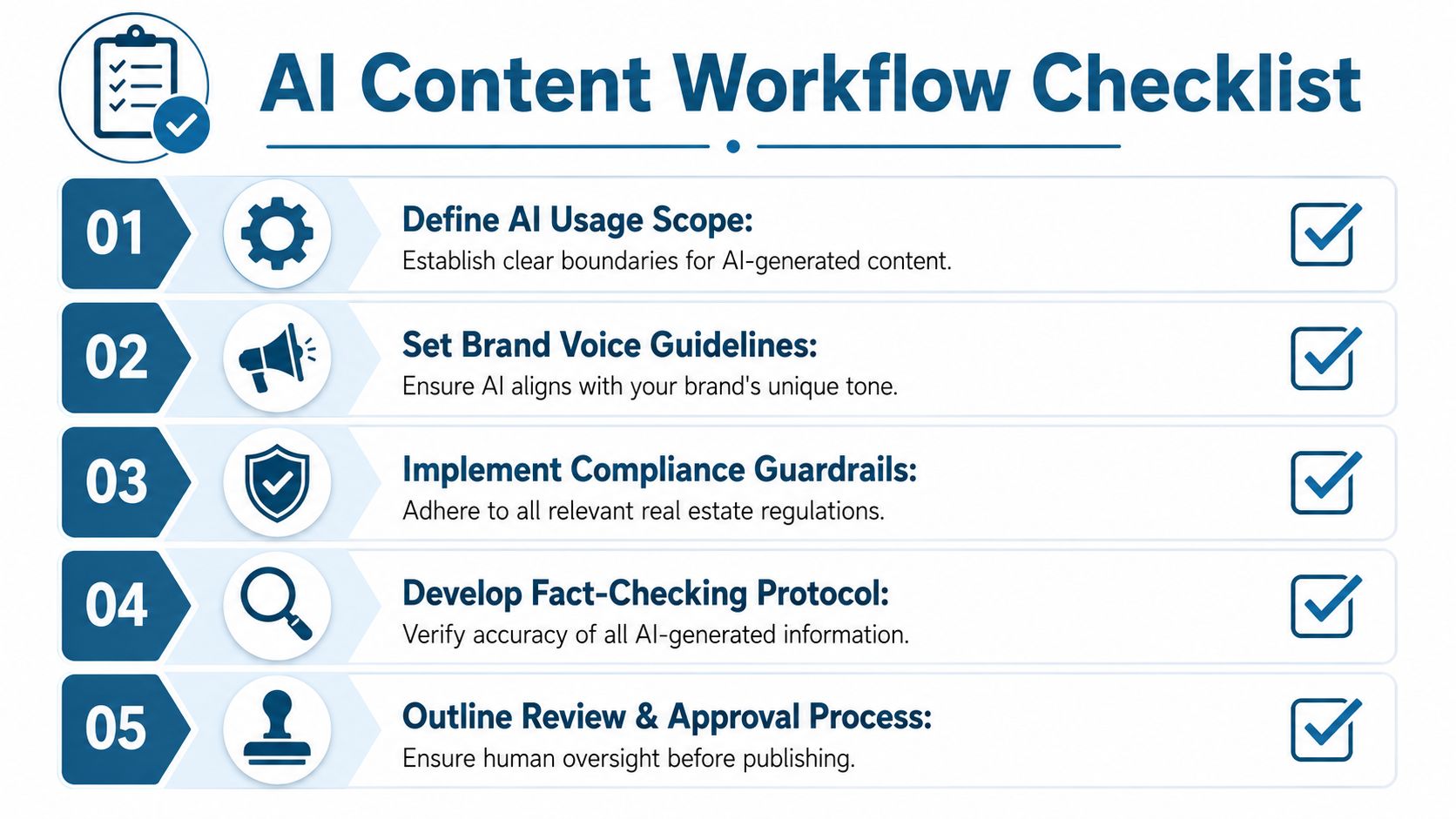
That structure also helps with staffing. Admins can prepare assets. Marketing can manage templates. Agents can personalize final copy and record quick videos without derailing the whole schedule.
A content library should reduce choices
Many teams think a content library is just storage. It should function more like a decision filter.
A useful library includes approved image styles, recurring copy patterns, market update formats, property-post templates, and ready-to-use CTA options. It narrows choices so the team can move quickly without improvising every detail.
The biggest mistake is overbuilding the library. If there are too many versions of everything, agents default to random posting again.
The best content libraries don't offer infinite flexibility. They make the right choice easy and the wrong choice inconvenient.
ROI starts with lead quality, not applause metrics
Likes and views can tell you whether content attracted attention. They don't tell you whether the team is building pipeline.
That matters because it shifts the software conversation from “How do we post more?” to “How do we systematize a lead source that already matters?”
Track a chain, not a single metric
Social media ROI is easier to defend when you measure the full path from activity to outcome.
Use a chain like this:
Stage
What to review
Publishing discipline
Are posts going out consistently by campaign type
Audience response
Which formats trigger comments, saves, shares, and DMs
Inquiry capture
Are social conversations being logged and assigned
Lead quality
Which content themes bring serious buyer or seller intent
Conversion support
Which social touchpoints appear before appointments or deals
This approach changes how leaders interpret performance. A market update may not produce direct inquiries every week, but it can support listing credibility, seller trust, and repeat visibility over time. A property reel may drive a lot of views but weak conversations. Both matter differently.
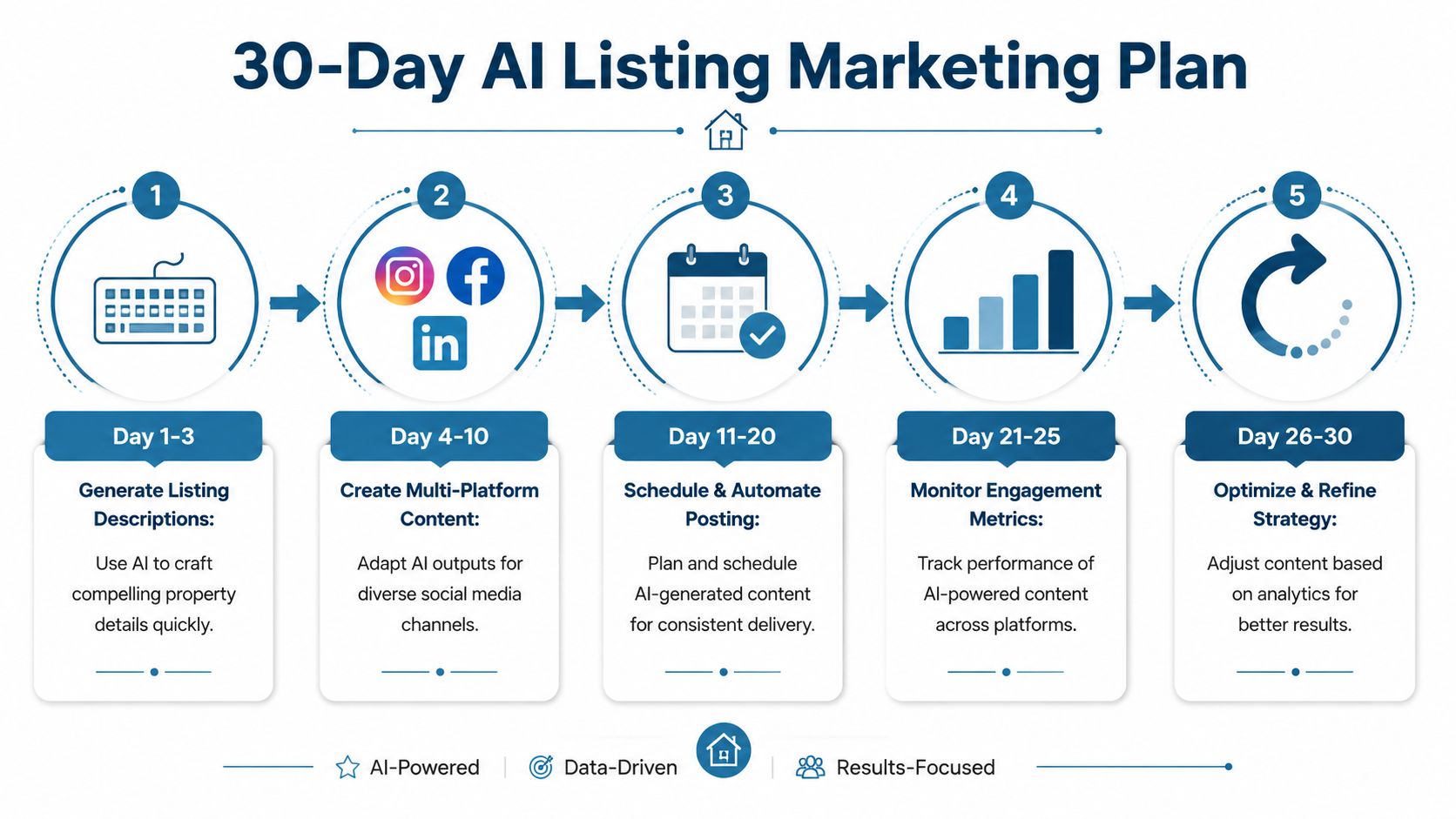
The strongest ROI systems connect social to operations
Software creates value when the process around it is disciplined.
That usually means:
Scheduling content ahead of time so client work doesn't erase visibility
Using standardized post types so performance can be compared cleanly
Routing DMs and comments into a shared response process so leads don't sit
Reviewing content themes monthly so the team learns what moves conversations
Teams that treat social media as a side activity struggle to justify software because the process is too messy to evaluate. Teams that treat it as a managed channel can see where content creates momentum and where the workflow needs adjustment.
ROI is also time reclaimed
This is often missed in brokerage discussions.
When software reduces drafting, coordination, rework, and follow-up confusion, it creates operational ROI before it creates visible lead ROI. Agents spend less time hunting for assets. Managers spend less time fixing off-brand posts. Brokers spend less time policing avoidable mistakes.
That time return is often what makes consistent social execution possible in the first place.
Your Social Media Software Rollout Checklist
The best rollout plan is the one your team will follow.
That usually means matching the process to team size. A solo agent needs speed and simplicity. A small team needs guardrails without bureaucracy. A brokerage needs controls that scale across many people, brands, and approval layers.
Rollout Checklist by Team Size
Phase & Task
Solo Agent Focus
Team Focus (2-10 Agents)
Brokerage Focus (10+ Agents)
Pre-launch, define goals
Pick one primary outcome, usually consistency or lead follow-up
Align around lead generation, brand consistency, and speed to publish
Set goals for compliance, adoption, consistency, and centralized visibility
Pre-launch, map accounts
Connect only the channels you’ll use weekly
Decide which accounts are team-owned versus agent-owned
Standardize account ownership and access policy before rollout
Pre-launch, organize assets
Build a simple folder of approved logos, headshots, and listing visuals
Create shared templates and remove outdated brand assets
Centralize brand libraries with strict version control
Pre-launch, set permissions
Keep workflow lightweight
Separate creators from approvers where needed
Create tiered permissions by office, team, and role
Pre-launch, define content types
Focus on listings, market updates, and one authority series
Add repeatable workflows for recruiting, community posts, and team wins
Create approved categories with clear review requirements
Launch, train users
Learn one publishing workflow well
Train by role so agents, admins, and leaders each know their tasks
Deliver structured onboarding by department and office
Launch, start small
Use the system for your next live listing first
Pilot with a few agents before requiring full-team usage
Roll out in phases to avoid support overload
Launch, establish approval rules
Review your own content against a checklist
Set thresholds for what requires approval and what doesn’t
Formalize compliance review paths and escalation rules
Post-launch, monitor usage
Check whether you’re actually posting from the tool
Look for adoption gaps across agents
Audit usage patterns by office, role, and content type
Post-launch, measure response handling
Make sure DMs and comments get answered promptly
Assign inbox ownership so leads don’t get lost
Build service-level expectations for lead response workflows
Post-launch, refine templates
Keep only the formats you’ll use repeatedly
Update templates based on agent feedback and performance
Govern updates centrally while allowing local adaptation where appropriate
Ongoing, review ROI
Track whether the tool saves time and supports conversations
Compare content themes against lead quality and consistency
Tie social execution to broader marketing and recruiting reporting
What each team type should avoid
Different organizations fail for different reasons.
Solo agents usually fail by overcomplicating setup. They buy a platform built for an agency, then avoid using it because every task feels heavier than posting natively.
Small teams usually fail by leaving standards too loose. Everybody gets freedom, but nobody has a repeatable method, so brand inconsistency remains.
Brokerages usually fail by overengineering governance. The platform becomes technically compliant but too cumbersome for field adoption.
Future-proof your process for AI-powered search
The next shift isn't only about posting more video or adding another platform. It’s about making sure your team's content is understandable, consistent, and discoverable across AI-mediated search environments.
That changes the standard for what “good social media” means.
Going forward, stronger teams will do a few things well:
Publish consistently enough to build a reliable digital footprint
Create local authority content, not just listing promotion
Use structured workflows so content quality doesn't swing wildly by agent
Keep brand voice coherent across personal and team channels
Treat captions and listing copy as searchable assets, not throwaway text
Vertical video, hyper-local expertise, and faster content production all matter. But the deeper advantage comes from operational discipline. Teams that systematize social media now will be easier to find, easier to trust, and easier to scale later.
A software purchase won't solve that by itself. A solid rollout, clear permissions, reusable workflows, and content standards will.
If your team wants one system that can turn listing details into a 30-day content calendar, support brand consistency across agents, and produce AI-readable marketing assets without forcing everyone back into manual posting, ListingBooster.ai is worth evaluating alongside general social management platforms. It fits teams that need real estate-specific content generation and a more structured path to staying visible as AI-powered search changes how buyers and sellers discover agents.
Let's face it: manually creating social media posts for every new listing is a soul-crushing grind. Most agents just don't have the bandwidth. Real real estate listing to social media automation changes the game completely, instantly turning a single property URL into a full month of platform-ready content. This isn't just a time-saver; it’s how you generate leads and stay consistent while you’re out closing deals.
The End of Manual Social Media Posting
The old way of marketing listings on social media is broken. Between client calls, showings, and a mountain of paperwork, who has time to brainstorm the perfect Instagram Reel or a compelling LinkedIn article? This is about more than just getting a few hours back—it's about reclaiming your competitive edge in a market where digital visibility is everything.
The manual routine—downloading photos, writing captions from scratch, and posting one by one across different platforms—is not just tedious, it's making you invisible. In 2026, savvy buyers and sellers are using AI-powered search tools like ChatGPT to find top agents. These tools reward consistency and quality. If your online presence is just a series of sporadic, rushed posts, you simply won't show up.
The True Cost of Manual Content Creation
That time you spend wrestling with a Canva template or staring at a blank caption box? It’s a hidden cost that directly eats into your bottom line. Every hour spent on manual marketing is an hour you’re not generating new leads, nurturing client relationships, or negotiating a contract.
Think about the typical workflow for just one new property:
Photo Curation: Sifting through dozens of photos, then resizing and cropping them for each platform’s unique specs.
Caption Writing: Trying to write fresh, engaging, and Fair Housing compliant copy for Instagram, Facebook, and LinkedIn.
Asset Creation: Firing up a design tool to create simple graphics, carousels, or video clips.
Scheduling: Logging into multiple platforms to painstakingly schedule every single post.
Now, multiply that by every new listing, price drop, open house, and "Just Sold" announcement. It's a completely unsustainable model for any agent or team looking to grow.
The Immediate Upgrade of Automation
This is where true real estate listing to social media automation offers an immediate and powerful upgrade to your business. By simply plugging a property URL into an AI-driven system, you can cut out the most time-consuming parts of your marketing workflow entirely.
Real estate pros who have adopted AI social media managers report saving over 20 hours per week. They’re focusing on clients and closings instead of content. The right AI tool can handle 80% of that workload, instantly converting a listing URL into a complete social media campaign. You can explore more insights on how agents are using AI at Marblism.
Take a look at how a tool designed for this exact purpose works. It turns a single, simple input into a multi-channel marketing push.
This dashboard shows the core promise of automation in action: one piece of information—your new listing—is instantly amplified across your entire digital ecosystem, all without any extra effort from you.
The table below paints a clear picture of just how much time and energy you can reclaim.
Manual vs Automated Social Media Workflow Comparison
Task
Manual Process (Time per Listing)
Automated Process (Time per Listing)
Data Extraction
15-20 minutes
1-2 minutes
Caption Writing
45-60 minutes
3-5 minutes (for review/edits)
Asset Creation
60-90 minutes
2-3 minutes (for review/edits)
Scheduling
20-30 minutes
1 minute (one-click approval)
Total Time
2.5 – 3.5 hours
~10 minutes
As you can see, the difference isn't just marginal—it's a fundamental shift in how you operate.
Ultimately, moving to an automated workflow isn't just a tech decision; it's a business strategy. The most successful agents understand that their time is their most valuable asset. By automating repetitive marketing, you can reinvest that time into the high-value activities that actually grow your business. To get your whole team on board, check out our guide on finding the right social media post scheduler for real estate teams. The goal is to work smarter, not harder, and let technology handle the busywork that’s been holding you back.
Your Automation Playbook: From Listing to Live Post
This is your practical guide to building a real automation pipeline that takes a property listing and turns it into a full-blown social media campaign. The real goal here isn't just about saving a few minutes; it's about creating a repeatable system that churns out high-quality, on-brand content with almost no hands-on time.

Let's get straight to it. Forget the theory—this is the exact process, from a simple property URL to a calendar packed with engaging posts.
The entire workflow kicks off with one simple trigger: your new listing. Instead of seeing that as the starting pistol for hours of marketing drudgery, think of it as the single piece of information your new automation engine needs to get to work.
From URL to Intelligent Data Extraction
The magic really starts when you drop a property URL into an AI system designed for real estate, like ListingBooster.ai. This could be a link from your local MLS, a Zillow page, or your own brokerage site. As soon as you provide the link, the AI gets to work like a hyper-focused assistant, scanning the page and pulling out every critical detail.


And I don't just mean it grabs the bed and bath count. A good system intelligently identifies and sorts the information that actually sells a home:
Core Property Details: Bedrooms, bathrooms, square footage, and lot size.
Unique Selling Features: It’s smart enough to recognize phrases that matter, like "newly renovated kitchen," "quartz countertops," "private backyard oasis," or "walk-in closets."
Location and Amenity Data: It pulls out neighborhood info, the school district, and proximity to parks or coffee shops.
Listing Photos: All the high-res images are downloaded and ready to be repurposed for social posts, carousels, and videos.
This first part of the process completely eliminates the tedious copy-and-paste routine we all know too well—a task that's not only boring but also a breeding ground for typos and errors.
AI-Powered Storytelling and Content Generation
Once the data is neatly organized, the system moves beyond just spitting out facts. This is where a dedicated real estate AI really proves its worth over a general tool like ChatGPT. It doesn't just list features; it weaves them into a compelling story because it understands what truly motivates a homebuyer.
From a single listing, the AI can generate dozens of post variations, each with a different angle and tailored for specific platforms. You might get content for:
"New Listing" Announcements: Captions designed to build immediate buzz and a sense of urgency.
"Open House" Promotions: Posts focused on driving foot traffic, clearly highlighting dates, times, and a sneak peek of the best features.
"Price Reduction" Alerts: Smartly-worded content that frames the new price as a fantastic opportunity, not a desperate move.
"Just Sold" Posts: Powerful social proof that showcases your success and helps attract your next seller lead.
One of the biggest wins with automation is the shift from creating one post at a time to generating an entire campaign's worth of content in minutes. This proactive approach means your marketing is always on, even when you're tied up with clients.
This infographic breaks down just how dramatically this process transforms the old-school manual grind into an efficient, automated workflow. The time savings are huge.
As you can see, it’s about trading high-effort, repetitive tasks for a fast, automated system that gives you back your most valuable asset: time.
Review, Tweak, and Schedule in Minutes
Now, "automation" doesn't mean you lose control. After the AI does its creative work, all the captions, images, and video ideas are laid out for you in a simple dashboard. From my experience, you can review an entire month's worth of content for a listing in about 10-15 minutes.
Here's how that quick review works in practice:
Scan the Content: Give the AI-generated captions a quick read-through. You're just checking for tone and accuracy.
Make Minor Edits: Want to add a personal anecdote about the neighborhood or tweak a call-to-action? You can easily edit any post on the fly.
Approve with One Click: Once everything looks good, you approve the entire batch for scheduling with a single click.
The system takes it from there, scheduling each post for the best time on its designated platform, whether that's Instagram, Facebook, LinkedIn, or TikTok. Just like that, your social media marketing for that listing is set for the next 30 days.
If you want to dig even deeper into this part of the process, our guide on the benefits of a real estate listing content generator is a great next step. This final approval stage completes the journey from a URL to a fully active, lead-generating social media campaign—all done in less time than it takes to finish your morning coffee.
How to Create Scroll-Stopping Visuals—Automatically
In real estate, the visuals do most of the talking. A great photo or a quick video tour is what stops a potential buyer mid-scroll, turning them from a passive browser into a hot lead. The problem is, creating custom assets for every listing has always been a time-sink, demanding either a dedicated design team or your own precious hours fighting with clunky software.
Thankfully, you no longer have to choose between high-impact visuals and your own sanity. A key part of real estate listing to social media automation is the system's ability to generate these assets for you. This isn’t about spitting out generic, cookie-cutter templates. It's about creating sophisticated, on-brand visuals that look like they were custom-made for each property.
The Power of Automated Video
Let’s be clear: video isn't just a "nice-to-have" anymore. It's an absolute necessity. The data couldn't be more compelling—listings shared with video get a massive 403% more inquiries than those with just photos. And it’s not just for attracting buyers; 73% of homeowners say they’re more likely to list with an agent who uses video. It’s a powerful tool for winning your next seller, as these real estate social media statistics on Amplifiles.ai show.
Of course, the idea of producing a professional video for every listing sounds exhausting. This is exactly where automation becomes your secret weapon. For example, a tool like ListingBooster.ai's Listing Commander can grab your folder of still photos and, in about five minutes, turn them into a branded, professional 1080p video.
Here's a look at what happens behind the scenes. The system intelligently:
Creates Motion: It applies a "Ken Burns" effect of slow pans and zooms to your still images, making the rooms feel dynamic and drawing the viewer’s eye to important details.
Adds Your Branding: Your logo, name, and contact info are automatically stamped onto the video as professional overlays, so every share reinforces your brand.
Sets the Mood: Royalty-free background music is layered in to match the home's vibe, transforming a simple slideshow into something much more engaging.
What you get is a shareable video that looks like it took hours of editing, ready to post on YouTube, Instagram Reels, and Facebook.
Building Engaging Carousels and Graphics
Beyond video, this same automation can instantly whip up other high-performing visuals that tell the property’s story. Multi-image carousels are gold on platforms like Instagram and LinkedIn because they get users to stop and swipe, spending more time engaging with your content.
Instead of just dumping photos into a post, the system builds a narrative. It identifies standout features from the listing data—like "Gourmet Kitchen" or "Spa-Like Bathroom"—and matches them with the right photos. It then sequences the images logically, taking viewers on a virtual tour from the front door to the backyard. And, of course, every slide is branded with your colors and logo for a polished, cohesive look.
This process transforms a simple photo gallery into a narrative-driven experience. Instead of just showing pictures, you're guiding viewers through the home's best features, making the property more memorable and desirable.
The system also auto-generates graphics for specific moments. Announcing a "Just Listed" property? It creates a bold graphic with the hero shot and address. Promoting an "Open House"? You get a clean visual with the date, time, and a clear call-to-action. If you're looking for more creative ways to market your listings, check out these great real estate Instagram post ideas from our blog.
Every asset is built to be platform-ready, ensuring your feed always looks sharp and active—turning every post into a potential lead magnet without you ever having to open a design app.
If you've ever tried the "post once, share everywhere" approach, you already know it doesn't work. It’s the fastest way to get your listings completely ignored. Real estate social media isn't just about pushing out content; it's about connecting with the right people on the right platform, in the right way.
What grabs a buyer's attention on Instagram will fall flat on LinkedIn. The casual chat that works in a Facebook Group feels out of place on TikTok. Each network has its own unwritten rules and audience expectations.
Thankfully, a smart AI system built specifically for agents, like ListingBooster.ai, gets this. It’s designed to automatically rephrase and reformat your listing content for each platform. But understanding why it makes these changes is what will truly elevate your strategy and give you an edge.
Instagram: A Platform for Visual Storytelling
On Instagram, it’s all about telling a visual story that creates an emotional pull. This is where those AI-generated videos and slick multi-image carousels really get to shine. Think of it as a digital home tour that makes someone feel what it's like to live there.
Here’s how to think about your Instagram content:
Instagram Reels: Use the automated videos to showcase the property's best angles. Keep them punchy—around 15-30 seconds—and always pair them with trending audio to tap into organic reach. The AI caption should lean into aspirational language, painting a picture of the lifestyle the home offers.
Carousel Posts: A carousel is your chance to walk a potential buyer through the home. Your automated workflow should create a natural flow: kick off with a killer exterior shot, move inside to the kitchen and living spaces, then the primary suite, and finish with the backyard or view. Each caption should act as a mini tour guide for that specific photo.
Instagram Stories: Stories are fantastic for creating a sense of urgency and sharing behind-the-scenes moments. Use interactive features like polls ("Which kitchen do you prefer?") or countdown timers for your next open house. This is where you can be more informal and build a real connection.
Let the automation do the heavy lifting, but for a personal touch, share one of the posts to your Story and add your own voice-over or text.
Facebook: A Hub for Community and Conversation
Facebook is less about perfectly polished visuals and more about sparking conversations. Of course, you’ll post listings to your business page, but the real magic happens when you share them in local community groups and real estate forums.
For Facebook, the AI-generated captions need to shift gears. They should be more conversational and almost always end with a question. For instance, instead of just a bulleted list of features, the AI might suggest something like, "This brand new listing in the Northwood district has the backyard oasis we've all been dreaming of! What's your #1 must-have in a backyard?" That simple question encourages comments, which tells the algorithm to show your post to more people.
LinkedIn: Your Stage for Authority and Trust
LinkedIn is your professional resume, not a billboard. If you just blast "Just Listed" posts here, you're going to lose connections fast. Your automated content for LinkedIn needs to be framed to position you as a market expert.
The AI should generate posts that treat the listing more like a market insight or a professional success story.
Post Type
LinkedIn Angle
Example AI-Generated Caption
New Listing
Market Availability
"Excited to introduce this beautiful property to the competitive Oak Lawn market. Homes with updated kitchens like this one are in high demand, offering a fantastic opportunity for buyers looking for move-in-ready value."
Just Sold
Market Performance
"This home went under contract in just 7 days, which really speaks to the continued strength of the single-family market in our area. A huge congratulations to my sellers and the new homeowners!"
This approach provides genuine value to your network while subtly showcasing your expertise and results.
Fair Housing Compliance Without the Headache
One of the most critical—and stressful—parts of real estate marketing is staying compliant with Fair Housing laws. Using language that could even be perceived as discriminatory, accidentally or not, can put your license on the line. Manually proofreading every single caption for every post is not only tedious but also leaves a huge margin for error.
This is where AI becomes an absolute game-changer and a crucial safety net. Modern automation tools have a built-in compliance checker that scans every generated caption. It automatically flags potentially problematic words or phrases related to protected classes (race, religion, familial status, etc.) before anything goes live.
Honestly, this feature alone is worth its weight in gold. It gives you the freedom to maintain an active, consistent social media presence without the constant, nagging worry of making a costly mistake. You're not just automating your marketing; you're automating your risk management.
Flipping the switch on your new automation is a great feeling, but the real work starts now. If you're not tracking performance, you're just throwing content at the wall and hoping something sticks. Automation is supposed to save you time, yes, but its true value is in creating a predictable stream of leads from your social media.
Measuring what works (and what doesn't) is how you get there. It’s the only way to know if your automated posts are actually doing their job and bringing you business, turning your social channels into a genuine marketing asset rather than just another item on your to-do list.
What to Track (and What to Ignore)
It’s incredibly easy to get a dopamine hit from a post getting hundreds of likes, but let's be honest—likes don't sign closing papers. We need to focus on the metrics that signal real interest from potential buyers and sellers. These are the numbers that actually translate into business.
Here's what I keep a close eye on for every automated property post:
Click-Through Rate (CTR): This is your first real test. Out of everyone who saw your post, what percentage actually clicked the link to your listing? A strong CTR tells you the hook—your photo, video, and caption—did its job.
Lead Form Submissions: This is the money metric. How many people who clicked through went on to fill out your "Schedule a Showing" or "Request More Info" form? This is a direct line from a social media post to a new contact in your CRM.
Meaningful Engagement: Forget just likes. I’m talking about comments, shares, and saves. I pay close attention to the quality of the comments. A "Nice house!" is good, but a "Does the backyard get afternoon sun?" is a potential lead.
Reach and Impressions: Think of these as your visibility check. Reach is how many unique people saw your post, and impressions are the total number of times it was shown. If these numbers suddenly tank, it could be a sign that the platform's algorithm has changed and you need to adjust your approach.
You can find all of this data right inside the native tools on each platform, like Meta Business Suite for Facebook and Instagram or the Analytics section on your LinkedIn company page.
Reading the Signs and Making Adjustments
Data is useless until you use it to make better decisions. You're not just collecting numbers; you're looking for patterns that tell you what your audience actually wants. Do video tours always get a higher CTR than carousel posts? That's your audience telling you exactly what to make next.
Your analytics are basically a direct feedback loop from your target audience. Listen to what the data is telling you, and you can stop guessing what they want to see.
Let's break down a couple of situations I see all the time and how to fix them.
Scenario 1: Lots of Views, but No Clicks
This one's a classic. Your post is getting seen by plenty of people (high reach), but almost no one is clicking the link to your listing (low CTR).
What's Happening: People are stopping to look, so your main image or video is working. But they aren't compelled to take the next step, meaning your caption or call-to-action (CTA) isn't pulling its weight.
How to Fix It: Experiment with your CTAs. Ditch the generic "Link in bio" and try something that creates urgency or adds value, like, "Tap the link for the 3D tour before this weekend's open house." Also, review your AI-generated captions. Make sure they’re asking questions or highlighting a truly unique feature that makes people want to know more.
Scenario 2: Great Comments, but No Leads
You're getting a ton of comments and shares, but your inbox is empty. It's a frustrating spot to be in, but it’s usually an easy fix.
What's Happening: Your content is engaging, but it's not set up to convert that interest into a lead. It could also be as simple as a broken link.
How to Fix It: First, the simple stuff: open your social profile on your phone and a computer and physically click the link. Make sure it goes to the right place. Next, look at your CTA. A post asking, "What's your favorite part of this kitchen?" is fantastic for engagement, but it needs a follow-up. Pair it with a more direct CTA like, "Ready to see this kitchen in person? Schedule your private showing at the link in our bio."
By consistently checking these metrics and tweaking your automation rules, your system gets smarter with every single post. This is how you build a real estate listing to social media automation engine that truly works for you.
Common Questions (and Straight Answers) About Automation
Jumping into social media automation for your listings can feel like a big leap. I get it. Many agents I talk to are worried about losing their personal touch or getting stuck in a technical nightmare. Let's clear the air and address those common hesitations head-on.
But Won't My Posts Sound Like a Robot Wrote Them?
This is easily the biggest hesitation I hear, and it’s completely understandable. Nobody wants a social media feed that sounds generic. The good news is that we're way past the days of clunky, robotic-sounding AI.
Modern tools, especially ones built specifically for real estate like ListingBooster.ai, are designed to capture your voice. During setup, you're not just plugging in an account; you're teaching the system how you sound. Are you witty and fun? Luxurious and professional? You set the tone.
Think of it this way: The goal isn't to replace your personality. It's to handle the grunt work—like pulling property details and resizing a dozen photos—so you don't have to. You always have the final say and can tweak any caption before it goes live.
This means your feed stays authentically you, just without the hours of tedious prep work.
How Much Time Will I Sink Into the Initial Setup?
Getting started is faster and more intuitive than you probably think. You don't need a degree in computer science to get your automation pipeline running. Most agents can complete the entire initial onboarding in a single sitting.
Honestly, connecting your social media profiles (like Instagram, Facebook, and LinkedIn) and customizing your brand profile with your logo and colors usually takes less than 30 minutes.
After that, the time savings really kick in. Turning a property URL into a full-blown social media campaign takes just a few minutes. That's where you see the real return—not just once, but with every single listing you promote.
Can I (and Should I) Still Post My Own Content?
Absolutely! In fact, you must. A great automation strategy doesn't take over your social media; it complements it. It acts as your reliable assistant, consistently pushing out high-quality property marketing so your feed never goes stale.
This frees you up to focus on the high-impact content that truly builds your brand and connects with your audience.
A quick behind-the-scenes video of you prepping for an open house.
Shouting out a local coffee shop you love.
Sharing a personal story about a client's closing day.
Answering follower questions live from your car between appointments.
When you pair the consistency of automation with the authenticity of your personal posts, you get the best of both worlds. You're building a powerful, well-rounded presence that showcases listings and builds your reputation as the go-to local expert.
Ready to stop wasting hours on manual social media posts and start building a predictable lead pipeline? ListingBooster.ai turns any property URL into a complete, multi-platform marketing campaign in minutes. Start your free trial today and see just how easy it can be.
Juggling listings, clients, and the mountain of paperwork is the reality for every agent. The last thing you have time for is figuring out what to post on Instagram every single day. This is where automation tools like ListingBooster.ai come in, transforming your social media from a daily chore into a lead-generating machine that works for you around the clock.
It's about making a fundamental shift that frees you up to do what you do best—sell houses.
The Advantage of Automating Your Real Estate Instagram
Let's be honest, the pressure to be constantly "on" for social media is a huge time-suck. We've all been there. It’s not really a choice between posting or not posting; it's a choice between two completely different ways of operating your business.
I see this all the time. On one hand, you have the agent who does everything by hand. They spend hours every week trying to come up with post ideas, write clever captions, and fiddle with graphics. They’re constantly scrambling, their posting is inconsistent, and their feed ends up looking like a random mix of rushed listing photos and generic holiday wishes.
Then you have the agent who’s embraced automation. They might spend 30 minutes on a Monday morning setting up their entire content calendar. The system handles the rest, generating everything from "Just Listed" carousels to neighborhood deep dives and market updates. While the first agent is stressing, this agent is out showing properties, confident their online presence is firing on all cylinders.
From Time-Saver to Core Business Strategy
This is so much more than just getting a few hours back in your week. Viewing Instagram automation as a core part of your business strategy is what separates the top producers from everyone else. They know that consistency is what builds authority and keeps them top-of-mind. Automation is simply the most efficient way to achieve that consistency without giving up your income-producing activities.
The impact is real and measurable.
Skyrocket Your Visibility: A consistent stream of high-quality content tells the Instagram algorithm your account is valuable, pushing your posts out to a wider audience.
Create a Lead Pipeline: When you're constantly showcasing new listings and market expertise, you build a reliable source of inbound inquiries.
Look Like the Pro You Are: An automated workflow keeps your branding, messaging, and post quality consistently high, cementing your reputation as a go-to expert.
The real cost of ignoring this is measured in lost leads and missed opportunities. In a market this competitive, the agent who shows up consistently online is the one who gets the call. Automation makes that possible.
The numbers don't lie. Agents who lean into automation are seeing a massive 300% increase in their Instagram engagement. This is critical, especially when you consider that 52% of buyers now find their homes on social media first.
Without a system, solo agents are falling behind—only 22% manage to post daily, which leads to 40% fewer leads. Meanwhile, brokerages that adopt these tools are reporting sales cycles that are 25% faster. The proof is in the results. You can discover more insights about how real estate social media automation is changing the game.
Building Your AI-Powered Content Engine
Imagine turning a single property URL into a full week of diverse, high-impact Instagram content in just a few minutes. That's the real power of automation—it's not just a time-saver, it’s a full-blown content creation machine. This is what separates agents scrambling for one post from those who have an entire campaign ready to launch.
I've seen this firsthand with tools like ListingBooster.ai's Listing Commander. All you have to do is feed it a single piece of info, like the Zillow or MLS link for your new listing, and the AI takes over. It doesn't just scrape data; it genuinely understands the property and spins that information into a complete suite of marketing assets, each designed with a specific goal.
From Listing Details to Persuasive Stories
The AI’s first job is to move beyond the boring "3 beds, 2 baths" script. It analyzes the listing’s photos, features, and location to write captions that actually connect with buyers. It starts to tell a story.
Instead of just stats, a caption might paint a picture of the "morning sun that floods the east-facing kitchen, perfect for your first cup of coffee." Or it might mention the home’s proximity to a "top-rated school district and the city's newest dog park." This is the kind of narrative that creates an emotional hook, something raw data can never do. If you want to dive deeper into this, we have a whole guide on the perfect AI caption generator for property listings.
This flow diagram really illustrates the difference between the old manual grind and a modern, automated approach.
As you can see, this isn't just about saving a few hours. It’s about turning a stressful, disjointed task into a smooth, strategic workflow so you can get back to what matters: your clients.
Creating a Full Suite of Branded Visuals
A strong Instagram launch for a new listing needs more than just a single post. A smart AI engine will generate a whole variety of branded visuals for you, automatically.
This means you get content for every key moment in the listing’s journey:
Just Listed Announcements: Bold, eye-catching graphics that make a powerful first impression.
Open House Reminders: Posts and Stories designed to get people through the door.
Feature Spotlights: Carousel posts or Reels that zoom in on unique selling points, like a renovated kitchen or a stunning backyard.
Just Sold Updates: These are fantastic for social proof, showing off your success and attracting new seller leads.
The best part? Every single asset is created with your branding—your logo, colors, and fonts—baked right in. This is how you build a professional, cohesive feed that makes your brand instantly recognizable.
A huge benefit that often gets overlooked is peace of mind. The more advanced automation tools have built-in compliance checks that scan captions for language that could violate Fair Housing guidelines. This is a massive safety net, protecting you from potentially costly legal headaches.
Turning Data Into Authority-Building Content
The opportunity here goes way beyond individual listings. Real estate is driven by data, and automation is your shortcut to becoming the go-to source for local market insights. NAR stats show that a whopping 96 million US social media users look at real estate content every month. Yet, a surprisingly low 35% of agents use automation, missing out on what could be 2.5x lead growth.
For instance, ListingBooster.ai's Authority Builder can take market data and spin it into engaging content. Think Reels showing that "Q1 2026 median prices rose 7.2% in Miami" or using psychological triggers like scarcity ("Only 3 homes under $1M left!") to achieve 45% higher save rates. For teams, this is a game-changer. One brokerage survey found that teams using these kinds of tools cut their content creation time by 85%—dropping from 10 hours a week to just 1.5.
To give you a clearer picture, here’s a breakdown of how one property URL gets transformed into a complete, multi-post Instagram campaign.
From Listing URL to Full Instagram Campaign
This table breaks down how a single property listing is transformed into a multi-post Instagram campaign using AI automation, showing the asset type, its purpose, and a sample AI-generated caption concept.
Instagram Post Type
Purpose
AI-Generated Content Example
Just Listed Carousel
Announce the new property and showcase its best features with multiple photos.
"Welcome to 123 Maple St! ✨ Swipe to tour this stunning 4-bed home with a chef's kitchen and private backyard oasis."
Open House Reel
Drive attendance by creating urgency and excitement with a quick video tour.
"This Saturday, 1-3 PM! Don't miss your chance to see this incredible property in person. Tag a friend who's house hunting!"
Neighborhood Spotlight
Sell the lifestyle by highlighting local parks, cafes, and amenities.
"Living at 123 Maple means you're just a 5-minute walk from the best coffee at The Daily Grind and beautiful trails at Oak Park."
"Just Sold" Graphic
Build social proof and attract seller leads by celebrating a successful closing.
"Another happy client! So thrilled to have helped my sellers get over the asking price for their beautiful home. Who's next?"
By building this AI-powered content engine, you’re doing more than just putting automated Instagram posts for real estate listings on your feed. You’re creating a scalable system that consistently produces high-quality, compliant, and strategic content that builds your brand and keeps your pipeline full.
Mastering Your Instagram Publishing Workflow
So, you've got a folder full of great, AI-generated content. That's a huge win, but it's only half the battle. The real magic happens when you connect those assets to a "set it and forget it" publishing system. This is where your automated Instagram posts for real estate listings go from being just files on a drive to a marketing machine that works for you around the clock.
The goal here is more than just posting. It’s about posting consistently and with a clear strategy, all while freeing yourself from the constant pressure of logging into Instagram. A smooth publishing workflow keeps your feed active and engaging, which the algorithm loves, giving you better organic reach—without you having to scramble to post while you're in the middle of a showing.
Choosing Your Scheduling Method
Once your content is good to go, you have a few solid choices for getting it out there. Each one has its quirks, so the best option really depends on your needs, your team's size, and how comfortable you are with technology.
Meta Business Suite: This is Meta's own free tool. For a solo agent just getting started, it's fantastic. You can schedule posts, Stories, and Reels to both Instagram and Facebook without spending a dime. It's basic, but you can't argue with the price.
Dedicated Scheduling Tools: This is where things get more interesting. Platforms like Later, Buffer, or Sprout Social offer a lot more power. Think visual calendar planning, smart hashtag suggestions, and analytics that dig much deeper than Meta’s. They're ideal for agents who want to fine-tune their strategy and see exactly what's working.
Custom Workflows with Zapier: If you're a bit of a tech nerd (like me), you can build some incredible automations with a tool like Zapier. It connects your apps so they can talk to each other. For instance, you could create a "Zap" that automatically drafts a post in your scheduler the moment you add a new listing to a spreadsheet. It's powerful stuff.
For most agents I talk to, a dedicated scheduler hits that sweet spot between powerful features and ease of use. If you're running a team, looking into a purpose-built social media post scheduler for real estate teams is a smart move for managing approvals and collaboration.
Building a 30-Day Content Cadence
Staring at a blank content calendar can be paralyzing. The secret to making automation work is to build a rhythm, or a cadence, that mixes up your content. You can't just spam listings all day—you'll burn out your audience. You need to sprinkle in posts that provide genuine value and cement your status as the local expert.
A varied feed shows your followers that you're more than a salesperson; you're a resource and a part of the community. It also signals to the Instagram algorithm that you’re creating diverse content, which can give your overall reach a nice little boost.
Here’s a simple weekly framework you can use as a starting point and repeat over a 30-day period:
Day
Content Theme
Example Post
Monday
Market Update
"This week's inventory numbers are in for [Your City]! Here's what that actually means for buyers."
Tuesday
New Listing Spotlight
"Just Listed! A gorgeous 3-bed bungalow in the heart of [Neighborhood]. Swipe to take a look inside!"
Wednesday
Buyer/Seller Tip
"Myth-Busting Wednesday: Do you really need a 20% down payment? Let's break it down."
Thursday
Neighborhood Feature
"Can we talk about the best coffee in town? Big shoutout to [Local Cafe Name] in [Neighborhood]!"
Friday
Open House/Weekend Plans
"Join me this Saturday from 1-3 PM at 123 Main Street! I'd love to show you around."
Saturday
Client Testimonial
"So thrilled for my clients who just closed on their dream home! Here's what they had to say."
Sunday
Personal/Behind-the-Scenes
"A peek at how I prep for a busy week. It always starts with strong coffee and a clear plan!"
This structure ensures you're hitting all the right notes: promotional, educational, and personal.
Think of your content calendar like a balanced investment portfolio. Listings are your high-growth stocks, but market updates and community spotlights are the stable bonds that build long-term trust and brand equity.
By doing the heavy lifting upfront—creating the content and then plugging it into a strategic calendar—you get your time back. This system guarantees your online presence is always on, building your brand and pulling in leads while you focus on what really moves the needle: negotiating for your clients and closing deals.
Getting Your Listings Seen by AI and People
The game has changed. Homebuyers aren't just scrolling through portals anymore; they're literally asking their AI assistants for advice. Think about it. They're using conversational AI like ChatGPT and Google's AI Overviews to find properties.
This isn't some far-off future—it's happening right now. To stay ahead, your listings need to be more than just pretty. They have to be "AI-readable."
When a potential buyer asks their phone, "What's the best family home under $800k in North Austin with a big yard?" you need your listing to be the top result. That’s what AI readability is all about.
Teaching the AI About Your Property
So, how do you make a listing "readable" to an algorithm? The key is something called schema markup.
Don't let the technical term scare you. Think of it as a secret language for search engines. While a person reads "4 Bed, 3 Bath," schema tells the AI, "This is a SingleFamilyResidence with numberOfRooms: 7 and numberOfBedrooms: 4." It's incredibly specific, and it's what allows an AI to understand the context and true features of your property.
Thankfully, you don't need to learn to code. Smart automation tools like ListingBooster.ai are built to handle this for you. They automatically embed this crucial data into your automated Instagram posts for real estate listings, making them visible to the next generation of search.
By making your listings machine-readable, you're not just optimizing for an algorithm; you're speaking the native language of tomorrow's search engines. This is how you get a serious edge.
Having that technical foundation is a huge step, but it’s only half the battle. Now, let’s talk about getting found on Instagram itself.
Winning the Local Search Game on Instagram
A lot of agents forget that Instagram is a powerful local search engine. You need to treat it that way. If you optimize correctly, your posts will show up when clients are searching for homes or agents in a specific area.
Here’s a quick checklist of things you absolutely must get right:
Pinpoint Location Tagging: Don't just tag "Austin, TX." Get granular. Tag the specific neighborhood, like "The Domain" or "South Congress." This targets people who are actively looking in that exact spot.
Meaningful Alt Text: Alt text is your secret weapon. It’s meant for accessibility, but search engines read it, too. Instead of the default "may be an image of a kitchen," write something descriptive. Try: "Modern chef's kitchen with quartz countertops and a center island in a luxury condo in downtown Miami." See the difference?
A Smart Hashtag Mix: Just slapping 30 random tags on a post is a rookie mistake. A well-crafted hashtag strategy is what separates the pros from the amateurs.
The Perfect Hashtag Recipe
A balanced hashtag strategy is all about reaching different audiences at the same time. You want to cast a wide net but also connect with highly motivated local buyers. I like to think of it as a tiered approach.
Broad Appeal: A few high-competition tags like #realestate or #newhome. These get you in the general conversation.
Niche Focus: Get more specific with tags like #luxuryrealestate or #firsttimehomebuyer. These attract a more qualified audience.
Hyperlocal Gold: This is where you make your money. Tags like #dallasrealestate or #austinhomesforsale connect you directly with buyers in your market. These are non-negotiable.
Branded Tags: Always include your own unique tag, like #AgentJaneSellsAustin. This builds your brand and groups all your listings together.
When you combine AI-friendly data with smart, on-platform optimization, your automated posts transform. They stop being simple updates and become powerful, strategic assets that grab attention from both human scrollers and the AI assistants guiding their home search.
Measuring Success and Troubleshooting Common Issues
Setting up your automation is a huge step, but it’s the beginning, not the finish line. If you truly want your automated Instagram to churn out leads, you have to know what’s working and what’s falling flat. This is where we move from simply posting content to running a smart, responsive marketing machine.
Think of it this way: your automations are your marketing assistants. You still need to manage them. By keeping a close eye on performance and knowing how to troubleshoot, you can fine-tune your system and connect your Instagram activity directly to what really counts—more leads and closed deals.
Identifying the Metrics That Actually Matter
When you open your Instagram Insights, you’re hit with a wall of data. It’s easy to get sidetracked by vanity metrics like likes, but they don't pay the bills. We need to focus on the numbers that signal genuine interest from a potential home buyer or seller.
These are the metrics I tell every agent to obsess over:
Reach: How many unique people saw your post? This is your true audience size for a piece of content, far more telling than impressions (which count multiple views from the same person).
Saves: This is gold for real estate. When someone saves your listing, they’re essentially bookmarking it for later. It’s a massive buying signal, telling you the property or the information is highly valuable to them.
Website Clicks: This metric is your direct bridge from social media to your business. Are people clicking the link in your bio to see the full listing, or are they just scrolling by? This tells you if your call to action is working.
Shares: A share is a personal endorsement. When someone sends your post to a friend or adds it to their Story, they're vouching for you. It's the digital version of word-of-mouth.
A post with 10 likes but 20 saves and 5 website clicks is a massive win. It’s infinitely more valuable than a post with 200 likes and zero other engagement. One shows casual appreciation; the other shows serious intent. Focus on intent.
A Practical Guide to Troubleshooting Your Automation
Even the most well-oiled machine can hit a bump in the road. What do you do when engagement suddenly tanks or a beautiful new listing gets nothing but crickets? Don't panic. This is where your data becomes your diagnostic tool.
Here are a few common scenarios I see all the time and how to fix them.
Problem: Your engagement has suddenly dropped off a cliff.
The Fix: Your audience’s habits have likely shifted. Dive into your Instagram Insights and look at your "Active Times." Are you still posting at 9 AM when your audience has started showing up at 7 PM? A simple tweak to your scheduler's timing can bring your posts right back to the top of their feeds when they're actually online.
Problem: A specific listing post isn’t getting any traction.
The Fix: Time for a quick A/B test. The beauty of automation is you can test ideas fast. For the next listing, create two different captions. One can be feature-driven ("4 beds, 3 baths, chef's kitchen"), while the other is more aspirational ("Imagine hosting summer BBQs in this incredible backyard!"). See which version gets more saves and clicks. The results will tell you exactly what your audience wants to hear.
Problem: Your follower growth has completely stalled.
The Fix: Take a hard look at your content mix. If your feed is just an endless wall of listings, you're not giving people a reason to follow you unless they're actively buying right now. You’re a salesperson, not a resource. Revisit your content calendar. Make sure you’re balancing those listings with high-value posts—think local market updates, tips for first-time buyers, or a spotlight on the best coffee shop in a neighborhood. This builds trust and positions you as the go-to expert in your area.
Your Top Questions About Real Estate Automation, Answered
Whenever I talk to agents about automating their marketing, I see the same mix of excitement and hesitation. It’s a powerful idea, but it’s natural to have questions. You’ve built a business on personal relationships, so the idea of handing anything over to a machine can feel risky.
Let’s clear the air. I’ve heard every concern in the book, and I’ve helped countless agents work through them. Below are the most common questions I get, along with the straightforward answers you need to feel confident diving in.
Will My Posts Sound Like a Robot?
This is, without a doubt, the number one fear agents have. And it’s a good question. After all, your voice is your brand.
The truth is, modern AI is designed to learn from you, not replace you. You can train it to match your specific style—whether that’s high-end and luxurious, friendly and approachable, or witty and direct.
Think of the AI's output as a really good first draft, not the final product. It does the heavy lifting, but you always have the final say. A quick tweak to add a personal story or a nod to a local coffee shop is often all it takes to make a post 100% you. You save hours on the grunt work, but the final, authentic touch is always yours.
Is This Too Complicated for Me to Set Up?
I get it. The last thing you need is another piece of complicated software to learn. But these tools are designed for busy agents on the go, not IT experts. Most platforms, including tools like ListingBooster.ai, have made the setup process incredibly simple.
Typically, it’s just a few clicks:
Connect your Instagram account (it's a secure, one-time link).
Set up your brand basics, like your logo and brand colors.
Drop in a link to your listing from the MLS, Zillow, or your website.
That’s it. The platform takes it from there. You don’t need to know a single line of code. If you can use Instagram, you’ve got all the skills you need. Most agents are up and running in under 10 minutes.
How Much Does Real Estate Automation Cost?
The price tag on automation is a lot more approachable than most people think. For a solo agent, many plans are priced around what you’d spend on a few lattes each month.
But the real question isn't what it costs, it's what it's worth. If a tool saves you just five hours a month and helps you land one extra lead, it has paid for itself many times over. The real cost is the time you're losing and the opportunities you're missing by not automating.
When you compare it to the thousands you might spend on a social media manager, these tools offer a massive return on investment.
Can I Still Be Spontaneous with Automated Posts?
Yes! And you'll probably find you're more spontaneous than before.
Think about it: when you know your essential posts—your new listings, market updates, and client testimonials—are already scheduled and ready to go, it frees up your mental energy.
That's when you can jump on Instagram Stories to share a behind-the-scenes look at a home inspection, or film a quick Reel celebrating a client’s closing day. Automation handles the consistency, which gives you the freedom to create the authentic, in-the-moment content that builds real connections. It's the perfect mix of strategy and spontaneity.
Ready to stop scrambling and start strategizing? ListingBooster.ai is the AI-powered marketing command center that builds your digital presence automatically. Generate a full 30-day content calendar, create AI-optimized listing descriptions, and ensure your brand shows up when buyers and sellers search. Start your free trial today and see the difference. Learn more at ListingBooster.ai.
At its core, a social media post scheduler for real estate teams is your marketing command center. It’s a single platform where you can coordinate your entire team's social media efforts—planning, creating, and publishing content across every agent's accounts without the usual chaos.
Why a Social Media Scheduler is Non-Negotiable for Top Teams
Think of your team's social media presence like an orchestra. When every agent posts on their own schedule, with their own style, it’s a mess. You get a blurry "Just Listed" photo from one agent, a questionable meme from another, and radio silence from a third. It's just noise, and it does nothing to build your brand.
A scheduler is the conductor that brings harmony to that chaos. It turns disjointed, individual efforts into a powerful marketing symphony that actually generates leads.
From Daily Chaos to Strategic Calm
For any team lead or broker, the biggest headache is trying to wrangle social media manually. Nagging agents to post, double-checking their work for compliance, and just trying to keep the message straight can feel like a full-time job. In fact, many agents report saving over 20 hours per week just by switching from manual posting to an automated system.
A scheduler moves your team from a reactive, scramble-for-content-daily mindset to a proactive, strategic one. It's the difference between shouting into the void and executing a unified campaign that builds real momentum.
That time saved isn't just a number on a spreadsheet. It's your agents’ most valuable resource, freed up to focus on what they do best: nurturing leads, showing homes, and closing deals.
To really grasp the operational shift, let's compare the old way of doing things with a smarter, automated approach.
Manual Posting vs Scheduled Automation for Real Estate Teams
Operational Aspect
Manual Posting (The Old Way)
Scheduled Posting (The Smart Way)
Time Investment
Agents spend hours each week creating and posting content in real-time.
Content is batched and scheduled in minutes, freeing up dozens of hours.
Brand Consistency
Inconsistent branding, logos, and messaging across agent accounts.
Centralized templates and assets ensure a professional, unified brand image.
Compliance Risk
High risk of Fair Housing violations or other errors due to lack of oversight.
Approval workflows and pre-vetted content drastically reduce compliance risks.
Content Quality
Varies wildly from agent to agent; often rushed and low-quality.
A shared library of high-quality, professionally designed assets elevates all content.
Lead Generation
Sporadic and unpredictable, relies on individual agent effort.
Consistent, automated posting creates a reliable, always-on lead-generation engine.
Team Workflow
Chaotic. Involves constant reminders, DMs, and manual checks.
Streamlined. Everyone knows their role, and the system handles the execution.
The contrast is clear. Automation isn't just about convenience; it's a fundamental upgrade to your team's entire marketing operation.
Lock Down Your Brand and Stay Compliant
Your brand is your reputation, and it’s fragile. When agents post on their own, that reputation gets diluted with every off-brand color, clunky caption, or inconsistent logo. Worse, it exposes your brokerage to serious Fair Housing compliance risks.
A dedicated scheduler solves this by giving you guardrails. It allows brokers and team leads to:
Build a Shared Asset Library: Put the right logos, headshots, and branded templates at every agent’s fingertips.
Create Approval Workflows: Review posts from new or junior agents before they go live to maintain quality and catch mistakes.
Deploy Brand-Wide Templates: Push ready-to-use posts for holidays, market reports, or new listings directly into every agent’s content calendar.
This level of control ensures every post, no matter who it comes from, strengthens your brand and protects your brokerage.
Win Leads in a Crowded Feed
Let's be honest: if you're not consistently in your clients' social media feeds, you're invisible. With studies showing that social media delivers the highest quality leads for 39% of real estate professionals, a random approach just won't cut it anymore.
A scheduler guarantees you show up where buyers and sellers are scrolling, day in and day out. By scheduling a mix of listings, local insights, and helpful tips weeks in advance, your team builds authority around the clock—not just when someone remembers to post. This is how you turn social media from a time-consuming chore into a dependable, automated machine for generating new business.
Essential Features For A Real Estate Team Scheduler
Picking a social media scheduler for your real estate team isn't like grabbing a generic marketing tool off the shelf. It’s more like choosing the foundation for a house—get it wrong, and the whole structure feels shaky and inefficient. To turn your team's social media chaos into a predictable, lead-generating machine, you need features designed specifically for the way a real estate team actually works.
These features aren't just "nice-to-haves." They're the non-negotiables that allow a brokerage or team to grow its marketing efforts, protect its hard-won brand reputation, and give every single agent the tools they need to succeed. Let’s walk through the essential building blocks of a scheduler built for the real estate world.
Multi-Account Management For Brokerage And Agent Branding
A top-producing team has to walk a fine line, promoting both the main brokerage brand and each agent's unique personal brand. Your social media tool absolutely must support both at the same time. This means a broker or marketing manager can plug into and oversee all the team’s social accounts from one central dashboard.
This unified control is key. It lets you push out brand-wide announcements, like a major new company listing, while also giving individual agents the room to post their own local content. The best platforms even let you post the same core message to every agent's account but with small tweaks to match each person's voice.
Tiered Permissions And Approval Workflows
Let's be honest—not everyone on the team is a marketing pro. A rookie agent’s well-intentioned but unvetted post could accidentally include a Fair Housing violation or just look completely off-brand, reflecting poorly on everyone. This is where permission levels and approval workflows become a broker's best friend.
A solid social media post scheduler for real estate teams lets you assign different roles to keep things running smoothly:
Admins (Team Leads/Brokers): Have the keys to the kingdom. They can connect accounts, establish brand rules, and approve posts from other team members.
Contributors (Agents): Can write and draft posts for their own social profiles, but those posts have to be approved by an Admin before they can go live.
Editors (Marketing Staff): Can create, edit, and schedule content for multiple accounts without needing a final sign-off on every single post.
This system creates a critical safety net. It gives newer agents the confidence to get involved in marketing, knowing a seasoned pro will give every post a final look for quality, compliance, and strategy.
Think of it like marketing training wheels. A new agent drafts a "Just Listed" post, and the team lead gets a quick notification to review and approve it. This simple step prevents costly mistakes and ensures every post that goes out meets the high standards your brand is known for.
Shared Content Libraries And Brand Kits
Consistency is the absolute bedrock of a strong brand. When one agent is using an old logo, another is using clashing colors, and a third is posting blurry photos, the team’s identity looks fragmented and amateurish. A shared content library solves this by creating a single, reliable source for all brand materials.
Imagine a central hub where your agents can instantly find:
Official Logos and Headshots: The right, high-resolution files are always just a click away.
Branded Templates: Professionally designed templates for 'Just Sold,' 'Open House,' and market update posts that are ready for quick customization.
Pre-Approved Content: A bank of evergreen blog posts, client testimonials, and community highlights that any agent can grab to fill a hole in their content calendar.
This single feature ensures that even the least tech-savvy agent on your team can create polished, on-brand content in minutes. It completely removes the "I couldn't find the logo" excuse and makes sure every post reinforces your team's professional image. This is how you truly scale a consistent brand experience across dozens, or even hundreds, of agents.
Advanced Features That Give You a Real Competitive Edge
If the basic features of a scheduler are the engine of your marketing car, these advanced features are the finely-tuned upgrades that win the race. A simple scheduler saves you time, which is great. But a truly sophisticated social media post scheduler for real estate teams does something much more valuable: it helps you generate better leads, protects your brokerage from risk, and puts high-level strategy on autopilot.
These aren't just "set it and forget it" tools anymore. They've evolved into intelligent partners for your marketing, ensuring your content not only shows up on time but actually performs when it gets there.
AI That Writes Content to Connect and Convert
Let's be honest, the hardest part of social media is constantly coming up with fresh, compelling things to say. This is where modern AI changes the game, going way beyond generic, fill-in-the-blank captions. Tools like ListingBooster.ai are now built with an understanding of human psychology, using proven frameworks like scarcity, social proof, and aspiration to craft posts that genuinely connect with buyers and sellers.
For instance, instead of a boring "Just Listed" post, the AI can spin up multiple angles for the same property:
For the buyer who fears missing out (Scarcity): "Homes in this neighborhood have been flying off the market. You'll want to see this one before it’s gone."
For the dreamer (Aspiration): "Can't you just picture your summer barbecues in this stunning backyard? This isn't just a house; it's the lifestyle you've been working for."
This is the difference between simply announcing a listing and actually marketing it. You're telling a story that sparks an emotional response, which dramatically boosts engagement and brings in more inquiries from people who are truly interested.
Automated Fair Housing Compliance Checks
For any team lead or broker, a single compliance slip-up can be a complete nightmare. When you have multiple agents posting across different social media accounts, the risk of an accidental Fair Housing violation is very real. And let's face it, you can't possibly review every single post by hand—it’s just not practical.
This is where an automated compliance scanner becomes an absolute must-have.
Think of it as a digital safety net, with a legal expert reviewing every post before it goes live. This feature automatically scans your captions for words and phrases that could be flagged for discrimination based on race, religion, familial status, or other protected classes.
This gives your brokerage a critical layer of protection. It allows your agents the freedom to create and post, while giving you the peace of mind that your team is upholding professional standards and avoiding massive legal risk.
Hyper-Local Content That Makes You the Neighborhood Expert
Generic, one-size-fits-all social media is dead. Today’s buyers and sellers want to know you’re the go-to expert for their specific neighborhood, not just the entire city. Advanced schedulers with localization features let your team get incredibly specific with their content.
This could mean automatically pulling in the latest market stats for a particular zip code, highlighting new cafes or parks nearby, or creating posts about local community events. For a team that covers a wide metro area, this is a game-changer. It gives you the power to speak directly to the unique character and concerns of each suburb, proving you understand the nuances of every micro-market you serve.
Analytics That Actually Guide Your Strategy
"Likes" and "shares" are nice to see, but they don't tell you the whole story. The best scheduling tools offer analytics that tie your social media efforts directly to real business outcomes. Instead of just showing you which post got a few extra thumbs-ups, they deliver insights you can actually use.
This focus on ROI is what turns a scheduler from a simple expense into a powerful investment. The proof is in the numbers. Real estate teams that consistently use a social media post scheduler see a significant increase in lead generation. After all, 71% of homebuyers say they are more inclined to work with an agent who has a strong, professional online presence.
This is especially true on crowded platforms like Facebook and Instagram, where 90% of agents are already posting listings and testimonials. As you can see from recent industry reports, without a consistent and strategic presence, you risk getting lost in the noise.
Ultimately, these advanced features take a scheduler from being a simple time-saver to a strategic part of your business, generating a clear return by bringing in more qualified leads and freeing up your agents to do what they do best: build relationships and close deals.
Your Team's Playbook for Rolling Out a Social Media Scheduler
Bringing a new tool into your team’s daily routine can feel like a major project, but getting a social media post scheduler for real estate teams up and running is actually quite simple if you follow a clear game plan. The secret is to start small and build momentum, not to dump a complicated new system on your agents all at once.
We always recommend a "crawl, walk, run" approach. It's a proven strategy that lets your team get comfortable with the basics first, see the benefits right away, and then gradually master the more powerful features. This way, the tool feels like a genuine asset that saves them time, not just another box to check.
Crawl Phase: First Steps and Core Content
The "crawl" phase is all about one thing: getting everyone logged in and scheduling your most important content—your listings. Keep it simple and focused.
Your onboarding checklist for this first phase should look something like this:
Get Everyone Set Up: The team lead or broker takes the Admin role and sends out invites to all the agents.
Connect Social Accounts: Walk each agent through the simple process of connecting their business Facebook and Instagram profiles.
Run a Quick Training: Hold one brief session with a single goal: show them how to schedule a "Just Listed" or "Open House" post using a template you've already created.
Before that training, the team lead or marketing manager should build and load a few essential brand templates into the scheduler. This gives agents polished, ready-to-go assets from the minute they log in, which removes the creative guesswork and keeps every post on-brand and compliant.
As this shows, a modern scheduler does more than just post content; it integrates AI-driven ideas, compliance checks, and performance analytics into a single, cohesive workflow.
Walk Phase: Adding Variety and Defining Roles
Once your agents are confidently scheduling their listings without a second thought, it's time to start "walking." This is where you introduce a wider range of content and start using the tool's collaborative features to your advantage.
Here's what you'll do in the "walk" phase:
Introduce New Post Types: Add templates for weekly market stats, client testimonials, and "Just Sold" announcements to the shared content library. Show agents how easy it is to grab and customize them.
Set Up an Approval Workflow: For newer agents, turn on the post approval feature. They can draft their own content, but an Admin gets the final look before it goes live. It’s a simple but effective safety net.
Teach Content Batching: Show agents the magic of scheduling a whole week’s worth of social media in one sitting. They can mix listings with market insights for a much more interesting and effective feed.
This is where the lightbulb really goes on. Agents suddenly see that they can map out their entire social media presence for the week in less than an hour, freeing them up for what really matters: working with clients.
For brokerages looking to build a more comprehensive digital footprint, this is also a great time to explore how schedulers fit into a bigger picture. You can learn more about the wider benefits of real estate social media automation and how it works hand-in-hand with a smart scheduling strategy.
Run Phase: Full-Funnel Strategy and Fine-Tuning
Now, it's time to "run." Your team is comfortable with the platform and is ready to move beyond just posting. This phase is all about executing a complete content strategy designed to build authority, nurture leads, and use real data to get better results. Agents are now empowered to manage their own calendars with minimal oversight, all while sticking to the brand guidelines you established from day one.
This is the point where your scheduler stops being just a tool and becomes a true lead-generation machine for the entire team.
Content Strategies That Attract Buyers And Sellers
A great social media scheduler is a game-changer for efficiency, but let's be honest—it’s just a tool. The real magic happens when you load it with content that actually resonates with buyers and sellers. It's time to move beyond simply scheduling posts and start thinking about what you're posting. This is how you turn your social feed from a digital billboard into a genuine client magnet.
The most successful teams live by the 80/20 rule. A full 80% of your content should offer real, tangible value—think tips, local insights, and helpful advice. Only 20% should be a direct pitch for your services. This approach builds a foundation of trust and establishes your team as the local authority, making you the obvious choice long before someone is even ready to call an agent.
Content That Captivates Homebuyers
When you're talking to buyers, you’re selling a vision, not just a house. Your social media content needs to help them picture their future life. This is where a social media post scheduler for real estate teams becomes your secret weapon, letting you consistently drip these aspirational posts into their daily scroll.
Focus on content that brings the experience of a home and its community to life:
Immersive Video Snippets: Don't just post a virtual tour link. Schedule short clips throughout the week showing off a home’s best assets—the sun hitting the kitchen island in the morning, the perfect patio for a summer cookout, or a cozy reading nook by the fireplace.
Hyper-Local Guides: Show you know the area inside and out. Create posts highlighting the best coffee shops for remote work, the most family-friendly parks, or the hidden gem restaurants only locals know about. You're not just selling a property; you're selling a lifestyle.
First-Time Buyer Myth-Busting: Schedule a Q&A series that breaks down the scariest parts of buying a home. Answering common questions openly builds incredible trust and makes your team feel approachable and supportive.
When buyers repeatedly see you sharing useful, interesting content about their target area, they stop seeing you as a salesperson and start seeing you as the indispensable local expert.
Content That Converts Home Sellers
Sellers are a different audience with a different mindset. They're looking for proof, expertise, and a track record of success. They need to believe that your team is the one that can sell their home quickly and for the best price.
An effective seller-facing content strategy is all about showcasing your competence and market knowledge. It answers their single most important question: "Why should I trust your team with my biggest asset?"
Weave these types of posts into your scheduling queue:
"Just Sold" Success Stories: A "Sold!" graphic is fine, but a story is better. Schedule posts that tell the tale: "Sold in just 48 hours for $20K over asking!" This provides undeniable social proof that your team delivers results.
Neighborhood-Specific Market Updates: Use your scheduler to automatically post weekly or monthly stats for key zip codes. Showing off rising home values or low days-on-market proves your finger is on the pulse of their neighborhood.
Staging "Before & After" Reveals: These are social media gold. The visual transformation from a "before" to an "after" photo powerfully demonstrates the value your team adds, showing sellers exactly how you maximize a home's appeal.
The foundation for all of this is a well-planned content calendar. For a complete blueprint, take a look at our guide on building a real estate content calendar that keeps your team organized and your messaging sharp.
Consistency is what separates the top teams from the rest, and a scheduler makes it almost effortless. In fact, agents who use tools to recycle evergreen content—like those neighborhood guides and buyer tips—report seeing up to 40% higher engagement. And with AI search becoming more prevalent—an expected 40% of homebuyers will soon use platforms like ChatGPT for initial queries—a consistent stream of scheduled, high-quality content is non-negotiable. If you're not there, you're invisible. You can find more insights on this from the experts at PostPlanner and their take on real estate social media.
At the end of the day, a smart content strategy, executed flawlessly with a post scheduler, ensures your team is always building relationships and proving its worth to every potential buyer and seller in your market.
How ListingBooster.ai Unifies Team Marketing
Most social media schedulers solve the easy part of the equation: getting a post online at a specific time. But they leave your team stuck with the single biggest challenge—what do you actually post?
This is where ListingBooster.ai completely changes the game. It’s less of a simple scheduling tool and more like a complete marketing command center for your entire team. It's the only social media post scheduler for real estate teams that was built from the ground up to solve the content creation problem first.
It does this with two distinct, powerful systems working together: 'Listing Commander' and 'Authority Builder.' These aren't just clever names; they’re designed to tackle the two biggest marketing headaches every real estate team faces.
From A Single Listing To A Full Campaign
Think of the 'Listing Commander' engine as your secret weapon for marketing a specific property. All you have to do is provide the property URL. From that one link, the AI generates an entire marketing suite for the listing.
AI-Generated Descriptions: It writes compelling property descriptions for your MLS, Zillow, and social media, all tailored to what gets buyers excited.
A Complete Social Calendar: It produces a month’s worth of posts for that one home—covering everything from 'Coming Soon' and 'Just Listed' to 'Open House' and 'Just Sold'.
What this means is you can go from signing a new listing agreement to launching a full-blown social media campaign in less than five minutes. No more scrambling for photos or struggling to write a great caption right before an open house.
This screenshot shows how ListingBooster.ai can generate a wide array of marketing assets, including social media posts and property descriptions, directly from a single property's details. It highlights the platform's ability to automate the entire creative process, turning basic listing information into a multi-channel campaign.
Building Your Team's Authority On Autopilot
While Listing Commander handles the individual properties, the 'Authority Builder' engine is busy pre-selling your team's expertise 24/7. It automatically creates the kind of value-driven content that builds trust and establishes you as the go-to expert in your market.
This engine creates things like:
Local market updates
Smart tips for buyers and sellers
Neighborhood spotlights
Posts that position your agents as leaders
This is the content that proves your value long before a potential client even thinks about making a call. The AI even uses 23 proven psychology frameworks—like scarcity, social proof, and aspiration—to write posts that genuinely stop the scroll and build a real connection.
ListingBooster.ai doesn't just help you schedule posts; it creates the high-quality, psychologically-informed content your team needs to dominate its market. It’s your copywriter, graphic designer, and marketing strategist all in one.
And here’s something critical for team leads and brokers: every single piece of content generated by the platform is automatically run through a built-in Fair Housing compliance scanner. This provides a vital safety net, giving you peace of mind that your brand is protected from costly compliance mistakes, no matter which agent hits "post."
This is how ListingBooster.ai truly unifies your team's marketing, turning a chaotic, time-consuming chore into a streamlined, lead-generating machine.
Frequently Asked Questions
When you're thinking about bringing a new tool into your brokerage, a few key questions always pop up. Let's walk through the most common ones we hear from team leads and brokers so you can see exactly how a scheduler fits into your daily operations.
How Often Should a Real Estate Team Post on Social Media?
This is the million-dollar question, isn't it? The magic formula isn't about posting constantly; it’s about being consistent. For most teams, aiming for 3-5 solid, high-quality posts per week is the sweet spot. That’s enough to stay on your clients' radar without burying them in content.
A social media post scheduler for real estate teams is what makes this goal realistic. Instead of scrambling for a post each day, you can block out an hour and schedule a month's worth of content at once. Think new listings, agent introductions, local market stats, and community events—all lined up and ready to go, giving you a professional presence even when you're slammed with closings.
Can a Scheduler Post to All Real Estate Platforms?
Yes, the best tools are built to connect with the platforms that matter most in real estate: Facebook, Instagram, and LinkedIn. But a truly great scheduler, one designed specifically for our industry, knows that a one-size-fits-all post just doesn't work.
For instance, you can take a single new listing and schedule it everywhere, but with a unique spin for each platform. The caption for LinkedIn might highlight the investment potential, while the Instagram post focuses on stunning photos and a question to drive engagement. For Facebook, you might focus on the neighborhood and family-friendly features.
This approach makes your content feel right for each platform, which is key to grabbing attention and getting better results.
How Does a Scheduler Help With Fair Housing Compliance?
Manually policing every post from every agent is a broker's nightmare. One agent's innocent mistake in a caption—using a phrase that could be seen as steering—can create a massive Fair Housing violation for the entire brokerage.
This is where a modern scheduler is a game-changer. A tool like ListingBooster.ai has an automated Fair Housing compliance scanner built right in. It acts like a digital safety net, automatically flagging risky words or phrases before a post is published. It gives agents the freedom to market properties while giving brokers the peace of mind that their business is protected.
Ready to unify your team's marketing and reclaim hours of your week? ListingBooster.ai is the AI-powered command center that creates and schedules a month of compliant, psychology-backed social content in minutes. Start your free trial today and see the difference.
We’ve all been there. You’re juggling listings, chasing down leads, and putting out fires, and the last thing on your mind is what to post on Instagram. Staring at that blank social media feed can feel completely overwhelming, but it doesn't have to be.
A social media content calendar isn't just another item on your to-do list. It’s a strategic system that transforms random, last-minute posting into a predictable engine for growth—one that builds your brand and generates leads while you focus on your clients.
Build Your Command Center, Not Just a Calendar
Here’s the biggest mistake I see agents make: they treat their content calendar like a chore. It’s just one more spreadsheet to fill out. If you think of it that way, you've already lost.
Instead, you need to reframe this as your strategic command center. It’s the central hub for every brand-building and lead-generation activity you do online. This simple shift in mindset is the difference between guessing what might work and executing a calculated plan that you know will work.
Without a plan, you're just adding to the noise. With a calendar, you’re building real authority and showing up exactly where modern homebuyers begin their search. You'll reclaim your time and finally make your marketing efforts predictable and effective.
The 5 Pillars of Your Calendar Strategy
To go from random acts of social media to a cohesive, lead-generating strategy, your calendar needs a solid foundation. Through years of working with top agents, we’ve found that the most successful content plans are always built on five core pillars. These pillars are what turn a simple schedule into a powerful tool for growing your business.
Each one has a specific job, and they all work together to attract, engage, and ultimately convert your audience into clients.
A social media calendar is more than an organizational tool; it’s a strategic workflow. The goal is to move from reactive posting to proactive brand building, which is how you gain visibility and win clients in a crowded market.
Understanding these components is the first step in learning how to create a social media content calendar that actually works for your real estate business. It's all about working smarter, not harder, to build a presence that brings clients to you.
Let’s take a quick look at the five essential pillars that will support your entire strategy.
The 5 Pillars of a Successful Real Estate Content Calendar
This table breaks down the five core components you need to build an effective content strategy that drives engagement and leads.
Pillar
Objective
Example Content
Goals & Pillars
To define your "why" and align content with business objectives.
Setting a goal for seller leads and creating a "Market Insights" pillar.
Platform Mapping
To deliver the right content format on the right channel for max impact.
A property tour Reel for Instagram, a market analysis for LinkedIn.
Workflow System
To create content efficiently and consistently without burnout.
Batching a month's worth of video content in one afternoon.
Repurposing
To maximize the value of every single content idea you have.
Turning one blog post into five different social media updates.
Compliance
To manage risk and protect your license with automated checks.
Automatically scanning captions for Fair Housing keyword violations.
By mastering these five areas, you're not just filling a calendar—you're building a reliable system for growth. Now, let's break down how to put each one into action.
Establish Your Goals and Content Pillars
Let's be honest. Staring at a blank social media calendar can be intimidating. Before you jump into planning posts for Instagram or Facebook, we need to answer a fundamental question: "Why are we even doing this?"
Posting on social media without a clear goal is like showing a house without a buyer—it's a lot of activity with no real purpose. Your social media presence isn't just for show; it should be a powerful engine driving your real estate business forward.
First, you have to get specific with your goals. "Get more followers" is a vanity metric, not a business objective. Instead, think in terms of tangible results that affect your bottom line. Are you aiming to generate five qualified buyer leads per month from that new construction community? Is the main goal to lock down two new seller listings in your farm area this quarter?
Maybe your ambition is to become the name everyone trusts for first-time homebuyer advice in your city. Each of these goals demands a completely different content approach.
Translate Goals into Powerful Content Pillars
Once you know your destination, you can build the roadmap. This is where your content pillars come into play. Think of them as the handful of core themes you’ll return to again and again. They are the backbone of your calendar, ensuring every single post is strategic and intentional.
Let's say your primary goal is to attract more sellers. Your content pillars might look something like this:
Hyper-Local Market Intel: This is where you post deep-dive stats, pricing trends, and absorption rates that prove you know this market better than anyone. You're the one with the real-time data.
Listing & Selling Success: Showcase your wins! This pillar is all about "Just Sold" case studies, glowing client testimonials about your process, and behind-the-scenes glimpses of how you market a new listing.
Building Agent Authority: Here, you build undeniable trust. Share in-depth neighborhood guides, break down your unique value proposition, and offer practical, no-nonsense tips for sellers preparing their homes.
Suddenly, that blank calendar isn't so scary. You've got a framework. Instead of wondering what to post, you're just filling in the blanks for your core topics. If you want to go deeper on this, check out our complete guide to a real estate agent content strategy.
Pillar Strategy for Different Agent Types
The pillars you choose should absolutely reflect your business model. What works for a solo agent building a personal brand is very different from what a brokerage needs to project market-wide strength.
A solo agent, for example, might build their brand on pillars like "My Life in [Your Town]," "Celebrating Client Wins," and "Real Estate Real Talk." This approach fosters a deep, personal connection, making them feel like a trusted friend in the business.
A brokerage, on the other hand, needs to communicate collective power. They might use broader pillars such as "Our Community Impact," "Meet the Team," and "Brokerage-Wide Market Reports" to highlight the depth of expertise and resources available to their clients.
The secret to great social media is pre-selling your expertise. Your content pillars should consistently prove your value long before a potential client ever slides into your DMs. You aren't just selling homes; you're selling absolute confidence in your ability to get the job done.
This strategic consistency is what truly separates agents who get results from those who are just making noise online. When you stick to your pillars, you're always on message, which naturally drives more engagement. That constant, valuable presence builds authority, making it more likely that clients will find you when they're finally ready to make a move.
Match Your Content to the Right Platform
I’ve seen it a hundred times: a real estate agent crafts a brilliant "Just Listed" Reel, it gets tons of saves on Instagram, and then they post the exact same video to LinkedIn where it gets… crickets. The video wasn't the problem. The platform was.
Building a social media calendar that actually works means you have to stop thinking in terms of "one size fits all." Posting the same generic update everywhere is the fastest way to get ignored. Each platform has its own unwritten rules, audience expectations, and personality. To get results, you have to speak the native language of each one.
Align Your Pillars with Platform Strengths
Think of your content pillars as your core messages—a new listing, a market update, or a local business spotlight. Now, think of each social media channel as a different way to tell that same story. This isn't about creating more work; it’s about smartly adapting a single idea for maximum impact.
Let's take a common pillar like "Market Expertise." Instead of just posting a generic graph everywhere, you’d tailor it like this:
LinkedIn: This is where you put on your analyst hat. A text-focused post or a simple graphic breaking down the latest absorption rate data for your farm area works perfectly. The audience here expects professional, data-driven insights.
Instagram: Go for a visually clean Carousel post. Start with a bold question on the first slide: "Is the Anytown Market Really Cooling Down?" Then, use the next few slides to break down key stats with easy-to-read graphics and minimal text.
Facebook: This is your community forum. Share a link to a full market analysis on your blog, but use the Facebook post itself to spark a conversation. Ask your followers, "Are these trends matching what you're seeing in your neighborhood? Let me know in the comments!"
TikTok: It’s all about quick, myth-busting content here. Film a 30-second video debunking a common misconception about the current market. Use trending audio and bold on-screen text to make it punchy and shareable.
This approach isn’t just recycling; it's intelligent repurposing. You’re delivering the same core value but in a package that feels natural and compelling to each audience. To go deeper on this, check out our guide on multi-platform real estate marketing strategies.
A Platform-by-Platform Real Estate Playbook
To make this even more concrete, let's map out which content formats win on each platform for a real estate agent. This is the real-world blueprint for filling your calendar with content that gets seen.
The table below breaks down how you can adapt your core real estate content pillars to the formats that perform best on Instagram, Facebook, TikTok, and LinkedIn.
Real Estate Content Matrix by Platform and Pillar
Content Pillar
Instagram
Facebook
TikTok
LinkedIn
New Listings
Aesthetic Reels, Property Tour Carousels, "Just Listed" Stories
Photo albums, Live virtual tours, Targeted Ads, Link to listing page
Quick 15-sec video of a "wow" feature, "Get Ready With Me" for a showing
Post announcing the listing, tagging the brokerage, focusing on investment value
Market Updates
Carousel breaking down 3-4 key stats, Infographic Reels
Link to your blog post with a question, Text-based summary of local trends
"Fact or Fiction" video on market myths, Pointing-to-text with key numbers
In-depth text post with analysis, Article on market shifts
Client Testimonials
Quote graphic in a Carousel with client photo, Client interview Reel
Share a screenshot of a 5-star review, Tag the client (with permission)
Short video of client's reaction at closing, "We did it!" clip
Recommendation feature, Post celebrating a client's success story
Local Community
"3 Best Coffee Shops" Reel, Carousel spotlighting a local business
"What's happening this weekend?" post, Share local news articles
Quick tour of a park or neighborhood event, "Hidden Gems" series
Post about community involvement, networking with local business owners
Think of this matrix as your cheat sheet. When you're planning content for your "Market Update" pillar, you can quickly see that a Carousel is your best bet for Instagram, while a more detailed text post is the right move for LinkedIn.
Instagram: The Visual Storyteller
Instagram is where you sell the lifestyle and the dream. It’s driven by high-quality visuals and creating an emotional pull. Your bread and butter here should be Reels and Carousels.
According to a Sendible analysis of over 12 million posts, Instagram Carousels are the top-performing format, making up 52.9% of posts. For agents, this is gold—use them for property tours, before-and-afters, or swiping through market stats. For ListingBooster.ai users, we've seen that integrating carousels for new listings or "just solds" into a calendar can boost lead generation by 62% because they keep viewers engaged three times longer. You can see the full social media management trend report on Sendible.com.
Facebook: The Community Hub
Think of Facebook as your digital neighborhood coffee shop. It’s the ideal place for building community, sharing local happenings, and actually talking with people. Visuals are great, but text, links, and questions have more room to breathe here.
Best For: Promoting community events, asking questions to your audience ("What's your favorite thing about living in our town?"), sharing your blog posts, and running laser-focused ads for listings.
Example Post: "The annual Anytown farmers market is back this Saturday! Who's going? I'll be there grabbing some local goodies. It’s one of the top 5 things I love about living in this community!"
TikTok: The Quick Tip Expert
On TikTok, you need to deliver value—fast. The goal is to share quick, snackable advice that makes you the go-to, approachable agent. Forget polished corporate videos; authenticity is everything.
Best For: "3 Mistakes First-Time Buyers Make," a behind-the-scenes look at a home inspection, or a quick tour showing off a unique property feature.
Example Post: A 15-second video with on-screen text: "Don't buy a house without checking this ONE thing…" followed by a quick shot of you pointing to an old electrical panel or water heater.
LinkedIn: The Polished Professional
LinkedIn is your digital resume, business card, and trophy case all in one. This is where you reinforce your credibility as a serious professional, share career achievements, and network with peers and potential high-net-worth clients. The tone is more buttoned-up and results-oriented.
Best For: Announcing a record-breaking sale ("Just Sold for $100k over asking!"), sharing an in-depth market analysis, or celebrating a professional milestone like a new certification.
Example Post: "Proud to announce our team closed over $20M in volume this quarter. A huge thank you to our incredible clients for trusting us with their biggest investments."
Once you master these platform nuances, you're no longer just "filling" a calendar. You're building a powerful, multi-channel marketing engine that works around the clock to build your brand and bring clients to you.
Build a Sustainable Content Workflow
If there's one secret to winning on social media, it's consistency. But let's be honest—the daily pressure to post is the fastest way I've seen agents burn out. Top producers aren’t spending hours every day dreaming up content; they've built a system that makes consistency almost effortless.
The key is a simple but powerful method called content batching. Instead of waking up and scrambling for an idea, you set aside one dedicated block of time each week or month to create everything at once. This one change shifts you from being a reactive poster to a proactive brand builder.
The Power of Batching Your Content
Think of it like meal prepping for your marketing. You wouldn't cook every single meal from scratch, three times a day. You'd go to the store once, prep all your ingredients, and have your meals ready for the week.
Content batching works the exact same way. When you dedicate a few hours to a single creative session, you get into a state of flow. The result is higher-quality content that you create in a fraction of the time, freeing you up to focus on what actually makes you money: closing deals.
This turns content creation from a nagging daily chore into a scheduled, predictable task. It’s how you build a real online presence without letting social media run your life.
Your Batching Session Blueprint
A good batching session is more than just filming a bunch of videos on a whim. It's a structured process that takes you from a blank slate to a fully scheduled calendar. Here’s how I break it down.
First, you plan everything out. This is where you look at your calendar for the next 30 days and plug in ideas based on your content pillars. For example, maybe every Monday is a "Market Update," Wednesdays are "Neighborhood Spotlights," and Fridays are for sharing a "Client Success Story."
Next comes the creation phase. This is your dedicated "doing" time. Set up your phone and film all your video content for the month in one go. After that, move on to designing all your graphics, like carousels or quote cards. By sticking to one type of task at a time, you keep your momentum and the quality stays high.
Finally, you schedule and automate. Once everything is created, you load it all into a scheduling tool. Write your captions, add your hashtags, and set every post to go live automatically on its assigned day. Just like that, your social media is running on autopilot.
This is the workflow that separates the pros from the amateurs. If you want to dig even deeper, you can explore our complete guide to automated content for real estate agents.
A great way to fill your calendar is to pull from the 400+ key dates happening throughout the year. The 2026 Social Media Calendar from MaybeTech, for instance, lays out major holidays, niche cultural events, and awareness days that can inspire tons of post ideas. This strategy led to a 150% spike in Instagram interactions for agents using ListingBooster.ai. Without a plan, 73% of agents post erratically, making them invisible in AI searches where over 40% of homebuyers now begin their journey. You can find more details in the full 2026 social media calendar and guide on MaybeTech.com.
The image below illustrates a core principle of efficient content creation: taking one great idea and multiplying its reach across different platforms.
This process shows you how to start with one strong idea, repurpose it into various formats, and then match each one to the platform where it will have the biggest impact.
A Critical Final Step: Compliance Checks
In our industry, what you don't say is just as important as what you do. A single, accidental Fair Housing violation in a social media post can put your license on the line. This is a non-negotiable step in any professional workflow, especially for teams and brokerages.
Trying to manually check every caption for risky words or phrases is not only tedious but also leaves a huge room for error. This is where modern content tools become an absolute necessity.
Before a post goes live, the software can automatically scan the caption for hundreds of potential Fair Housing keyword violations. If it catches a problematic phrase like "perfect for singles" or "walking distance to the church," it flags the post for you to review. This is an essential safety net that helps you manage risk and protects the brokerage's brand. It turns compliance from a constant source of anxiety into an automated, background process.
Your 30-Day Plug-and-Play Real Estate Content Calendar
Alright, theory is great, but let's get practical. Knowing how to build a calendar is one thing; seeing a finished one you can actually use is another. So, I’ve put together a sample 30-day calendar you can steal and adapt for your own business right away.
This isn't just a random assortment of post ideas. It’s a strategic mix designed for a busy solo agent, weaving together our core content pillars: Market Expertise, Community Focus, Listings, and your Personal Brand. Notice the rhythm—we'll follow up a data-heavy post on Monday with something more personal later in the week. This balance is key to building authority without sounding like a robot.
Week 1: Building Momentum
The first week is all about coming out of the gate strong. You're establishing your expertise, showing your local love, and reminding people there's a real human behind the business.
Monday: Market Update Monday (Market Expertise)
Post Type: Instagram/Facebook Carousel (3-5 slides).
Sample Hook: "Everyone's asking if the market is slowing down. Let's cut through the noise—here's what the last 7 days of data really tell us…"
Call to Action: "Curious what your home is worth in this market? DM me for a free, no-strings-attached analysis."
Wednesday: Community Spotlight (Community Focus)
Post Type: An Instagram Reel or TikTok video.
Sample Hook: "My top 3 favorite coffee shops in [Your Town] to get some work done. Did your go-to spot make my list?"
Call to Action: "Tag your favorite local business in the comments!"
Friday: Client Success Story (Personal Brand)
Post Type: A photo post on Facebook/LinkedIn featuring a quote graphic.
Sample Hook: "So thrilled for my clients, the Millers, who just closed on their forever home! Here's a little bit of what they had to say about the journey…"
Call to Action: "Ready to start your own story? Let's connect."
Week 2: Showcasing Your Process
Now that you've got their attention, week two is about pulling back the curtain. You’re showing your audience how you work and delivering value by educating them along the way.
A great content calendar doesn't just tell people you're an expert; it shows them. By mixing educational content with behind-the-scenes glimpses, you build both trust and relatability—a powerful combination for generating leads.
Tuesday: Buyer Tip Tuesday (Market Expertise)
Post Type: A quick 30-second Reel or a TikTok with pointing-to-text overlays.
Sample Hook: "The 3 biggest mistakes I see first-time homebuyers make. Trust me, you'll want to avoid #2 at all costs!"
Call to Action: "Save this for later! What other homebuying questions do you have?"
Thursday: Behind the Scenes (Personal Brand)
Post Type: Instagram Story with interactive polls or Q&A stickers.
Sample Hook: "A little glimpse into my day: prepping for a listing presentation! Quick poll: what do you think sellers care about most?" (Use a poll: Price vs. Marketing).
Call to Action: "Ask me anything about selling your home!"
Saturday: Just Listed Showcase (Listings)
Post Type: A high-quality property tour on Instagram Reels, set to trending (but appropriate!) music.
Sample Hook: "Welcome to 123 Maple Street! If you love to entertain, this kitchen is an absolute dream."
Call to Action: "Full details and price are in the link in my bio. DM me to set up a private tour."
Week 3: Reinforcing Your Authority
We're doubling down on your expertise in week three. This is where you cement your status as the go-to professional in your market, not just another agent with a license.
Monday: Myth-Busting Monday (Market Expertise)
Post Type: A direct, text-based post on LinkedIn or a simple graphic for Facebook.
Sample Hook: "Myth: 'I should wait for interest rates to drop before I buy.' Here’s the counterintuitive reason why that could cost you more in the long run…"
Call to Action: "Agree or disagree? Let's talk about it in the comments."
Wednesday: Ask the Agent (Personal Brand)
Post Type: A live Q&A session on Facebook or Instagram.
Sample Hook: "I'm going live at 7 PM tonight to answer all your real estate questions. Contracts, closing costs, market trends—nothing is off-limits."
Call to Action: "Drop your questions below so I can answer them first!"
Friday: Neighborhood Deep Dive (Community Focus)
Post Type: A photo carousel or a quick video montage.
Sample Hook: "Thinking about a move to the [Neighborhood Name] area? Here are 5 things you absolutely need to know about living here—from parks to the best local eats."
Call to Action: "Want a list of active homes in this amazing neighborhood? Just send me a DM!"
Week 4: Driving Action
The final week is all about converting that attention into actual business. You've spent a month building trust and providing value; now it's time to make a clear, compelling ask for their business.
Tuesday: Seller Tip Tuesday (Market Expertise)
Post Type: An Instagram Story sequence or a quick Reel.
Sample Hook: "The #1 thing you can do to boost your home's value before selling… and it costs less than $500."
Call to Action: "Download my free pre-listing checklist from the link in my bio!"
Thursday: Just Sold Analysis (Listings)
Post Type: A Facebook or LinkedIn post with a "Just Sold" graphic.
Sample Hook: "JUST SOLD for $25k over asking! We fielded 7 offers in 48 hours. Here's a breakdown of the exact strategy we used to get this result."
Call to Action: "If you've been thinking about selling, this market is still moving. Let's talk strategy."
This 30-day framework gives you a rock-solid foundation. The beauty of a plan like this is that it eliminates the daily "what should I post?" panic while still leaving you room to be spontaneous. Think of it as your roadmap to consistent content that actually builds your brand and fills your pipeline.
Answering Your Top Content Calendar Questions
Even the best-laid plans run into questions once you start putting them into action. I've seen agents get stuck on the same few hurdles when they first start building out a content calendar. Let's clear those up right now so you can move forward without any second-guessing.
Getting these details sorted out from the beginning is the key to saving a ton of time and stress later on.
How Far Out Should I Plan My Social Media?
For real estate agents, planning one month in advance is the magic number. It’s long enough to let you think strategically and batch your work—which is a huge time-saver—but it's not so rigid that you can't be spontaneous.
This approach gives you a solid framework, ending that daily "what on earth do I post?" panic. At the same time, it leaves you plenty of room to jump on timely opportunities, like a hot new listing that just hit the market or celebrating a client's "Just Sold" moment. You get the best of both worlds: consistency and agility.
What if a Scheduled Post Suddenly Feels Wrong?
Think of your content calendar as a roadmap, not a pair of handcuffs. If a post you planned suddenly feels tone-deaf or out of touch—maybe the market took a weird turn or something major happened in your community—don't hesitate to pause it or swap it out.
The whole point of planning is to reduce stress, not to force you to post something that feels wrong or inauthentic.
This is exactly why I tell agents to keep a small bank of "evergreen" posts ready to go. These are timeless little nuggets—a quick buyer tip, a home maintenance checklist, or a cool fact about a local park—that you can drop in anytime. Having that flexibility is what makes your online presence feel genuine and human.
How Do I Actually Know if My Content Calendar Is Working?
Forget about vanity metrics like likes and follower counts. The only way to know if your plan is working is to measure it against the business goals you set in the first place.
So, if your main goal is generating leads, you should be tracking:
Link clicks on your posts that point to your website or specific listings.
Direct messages from people asking for more information.
Form submissions from your landing pages, like a "What's My Home Worth?" tool.
On the other hand, if your goal is to build your reputation as the local expert, look at your engagement rate. Are people leaving thoughtful comments? Are they sharing your market updates or saving your posts for later? That’s your proof that the content is hitting the mark and you're building real trust.
A Spreadsheet or a Special Tool: Which is Better?
Starting with a simple spreadsheet is totally fine. It’s a great way to get your initial ideas down and sketch out your first couple of weeks. But for a busy agent, that spreadsheet will become a bottleneck, and fast.
You can't actually schedule from it, trying to work with an assistant on it is a mess, and it gives you zero data on what's working.
This is where a dedicated tool becomes a game-changer. It’s not just a calendar; it's a command center. The time you save and the professional polish you get from a platform built for this purpose is one of the best ROIs in the business. It turns content creation from a chore into an automated system that actually grows your pipeline.
Ready to stop guessing and start growing? ListingBooster.ai is the AI-powered command center that builds your entire 30-day content calendar, complete with AI-optimized property descriptions, authority-building posts, and built-in compliance checks. See how it works and start your free trial at https://listingbooster.ai.