Tag: real estate templates

  • Open House Flyer Ideas: 8 Proven Formats

    Open House Flyer Ideas: 8 Proven Formats

    The most popular open house flyer advice is also the least useful: add a hero photo, address, price, bedrooms, bathrooms, date, time, and phone number, then print a stack. That format may identify the property, but it doesn't give the recipient a reason to take the next step.

    The strongest open house flyer ideas start with the conversion goal. Do you want a buyer to scan for a tour, understand the renovation work, see the location objectively, trust your expertise, share the event, evaluate the price, or absorb the home's features in seconds? A flyer built around one action usually works harder than a crowded brochure trying to answer every question at once.

    For US agents, brokers, and teams, the right format also depends on the property type, the available evidence, the audience, and the distribution channel. This roundup organizes eight practical formats by the marketing job they perform, with headline formulas, reusable copy blocks, visual hierarchy, CTA decisions, print and mobile specifications, distribution tactics, and Fair Housing-safe wording.

    Keep property and location descriptions factual. Tools such as ListingBooster.ai can help turn verified listing details into consistent, editable MLS, social, and print copy, but the agent remains responsible for checking facts, disclosures, brokerage requirements, and final compliance.

    1. QR Code Integrated Flyer With Digital Property Tour

    A printed flyer has limited space. A QR code gives the recipient a clear path to richer property information without forcing every detail onto the page. Use this format when the listing has strong visual material, a 3D tour, a video walkthrough, a floor plan, or a digital property page that supports the open house experience.
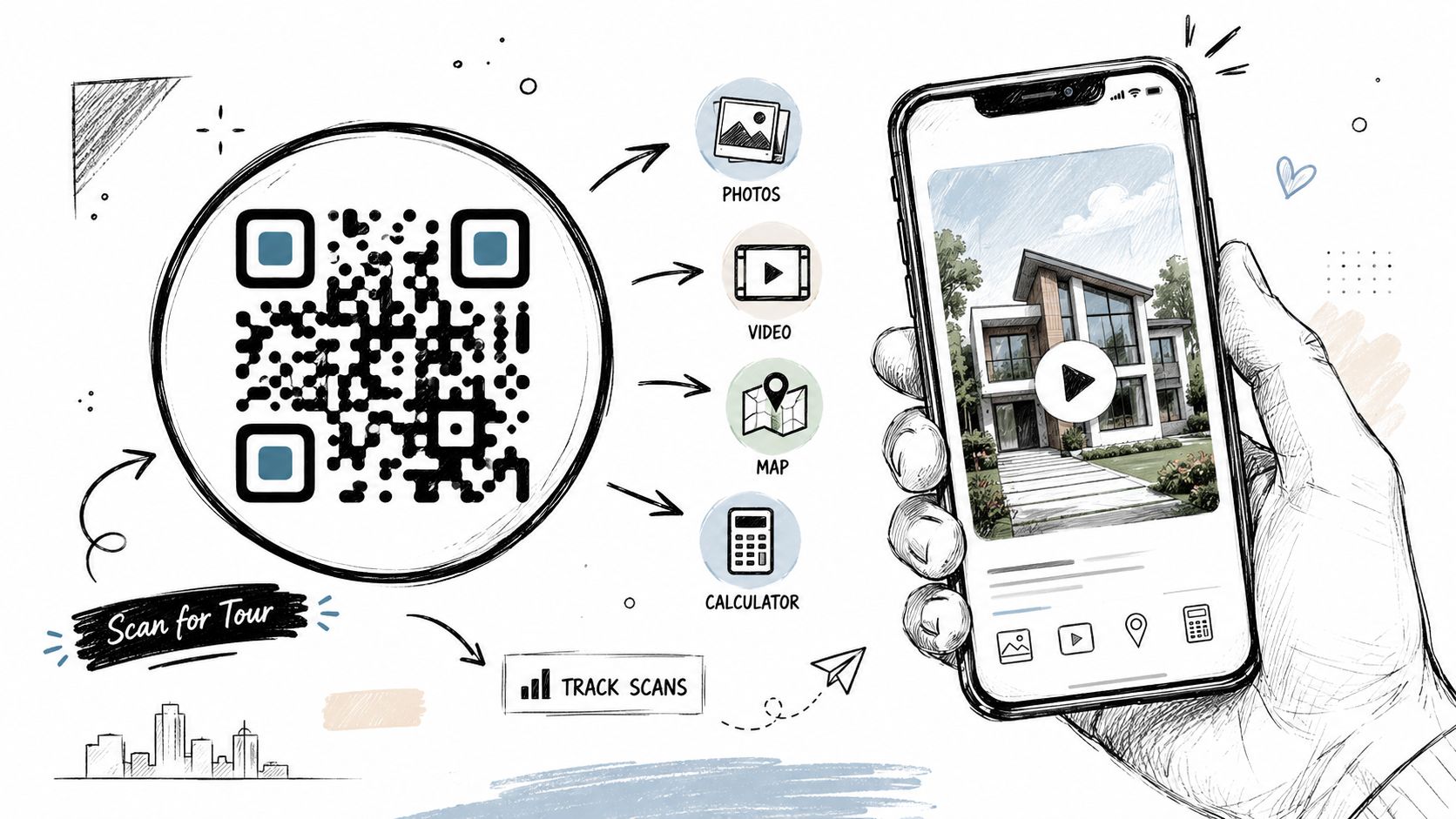
    A hand holding a smartphone showing a real estate tour next to a QR code illustration.

    A useful headline should describe the reward, not the technology:

    Scan to explore the full property tour, floor plan, and verified updates.

    Place the QR code in a clean corner near the main property image or beside a short CTA. Don't bury it over a busy photograph, and don't label it only “Scan here.” Use copy such as “Scan to view the 3D tour”, “Scan for the complete photo gallery”, or “Scan to request a private tour.” Include a text alternative, such as “Unable to scan? Visit [short URL].” That makes the handoff more accessible and gives people another route if their camera struggles.

    Build a landing page that earns the scan

    The destination should load quickly on a mobile network and show the promised information immediately. A practical page can include high-resolution photos, a video walkthrough, a floor plan, driving directions, neighborhood facts, and a short contact form. Mortgage calculators can be useful, but label them clearly and avoid presenting an estimate as a loan offer or financial advice.

    Test the QR code on multiple devices, in indoor and outdoor light, and from the distance at which someone will hold the flyer. Use a trackable destination when your system supports it, then review scan activity by flyer version or distribution area. The QR code best practices for hosts can help with placement and testing considerations.

    For agents comparing tools, ListingBooster.ai can fit into a workflow that turns verified property details into the landing-page description and supporting social copy. Its top AI real estate marketing tools resource is a relevant starting point for evaluating that production layer. Keep every neighborhood statement factual, and review AI-generated language before publishing.

    2. Before and After Renovation Showcase Flyer

    Renovation marketing fails when it relies on adjectives. “Beautifully renovated” tells a buyer almost nothing about what changed, who completed the work, or what documentation may be available. A before-and-after flyer earns attention by showing the condition change and naming the work precisely.

    Use a split layout with the original image on one side and the updated image on the other. Photograph both views from similar angles and under comparable lighting whenever possible. A kitchen renovation might use the headline “Updated Kitchen, Documented Improvements”, followed by a compact list such as “New plumbing,” “Energy-efficient windows,” and “Updated electrical systems.”
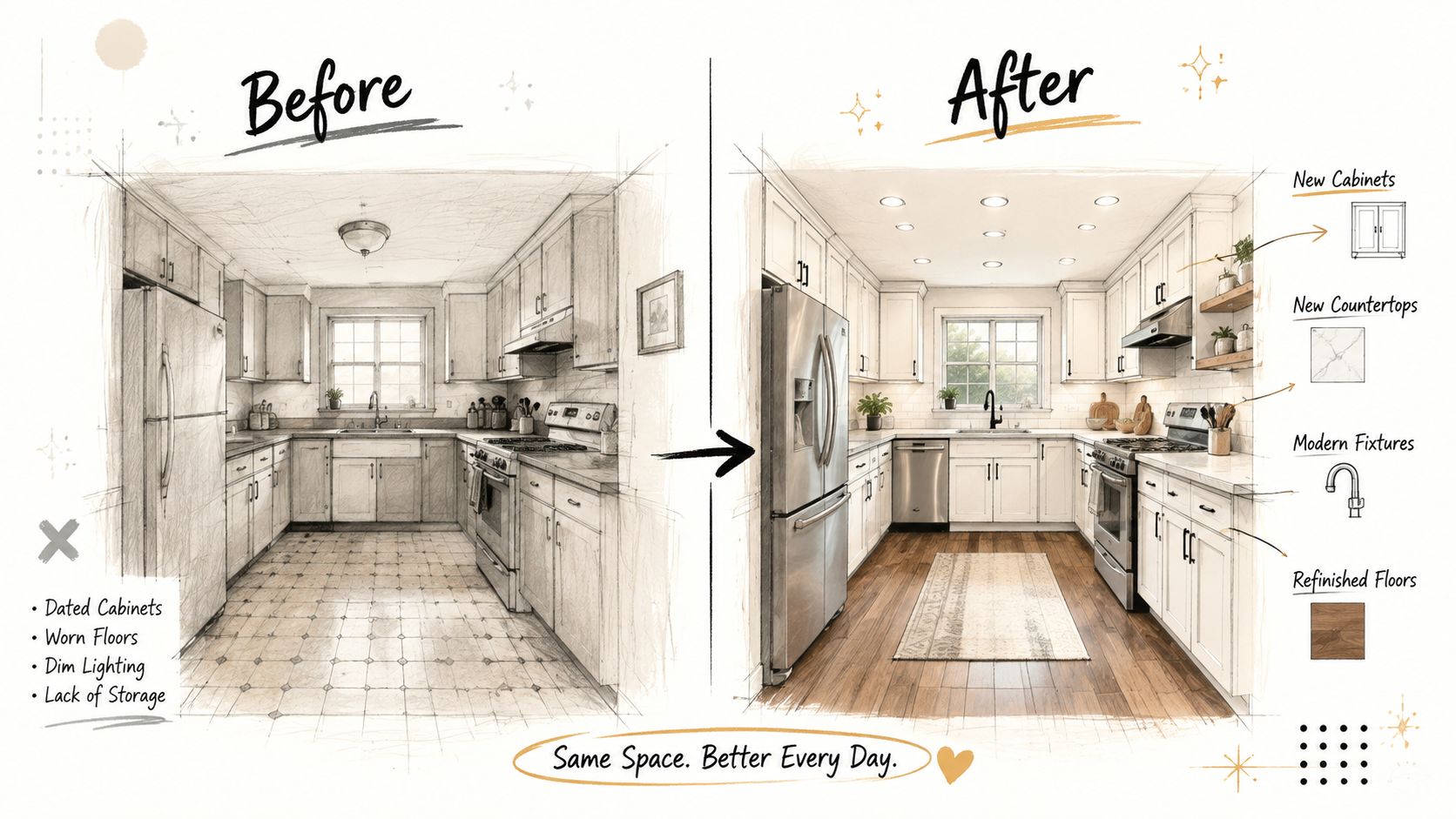
    A split view comparison of a kitchen before and after a renovation, showcasing modern upgrades and improvements.

    The copy should distinguish completed work from planned or proposed work. If contractor names, permits, invoices, or warranty information are available and approved for disclosure, add them in a small “Project details” panel. If a feature is described as energy efficient, use the verified product or project documentation rather than assuming performance from appearance.

    Show evidence, not just polish

    A strong reusable block might read:

    Recent improvements
    Updated electrical systems, replacement windows, refreshed kitchen finishes, and documented plumbing work. Buyer to verify measurements, permits, warranties, and remaining useful life through appropriate inspections and disclosures.

    That final sentence is practical protection. The flyer shouldn't imply that a renovation eliminates the need for inspection or guarantees future maintenance costs. It should also avoid unverified claims about value, savings, or construction quality.

    Distribute the flyer at the property, through approved neighborhood outreach, and digitally as a swipeable social post. The same before-and-after photos can support MLS remarks, email, and social content. ListingBooster.ai can help convert verified improvement notes into consistent property descriptions, captions, and print copy, but the listing team must confirm every feature and date before publication. Use a renovation-specific CTA such as “Scan for the improvement summary” or “Request available project documentation.”

    3. Interactive Neighborhood Map Flyer

    A map flyer helps buyers evaluate location context without relying on vague lifestyle language. It works particularly well when the property's appeal depends on access to transit, shopping, parks, services, employment centers, or other objectively identifiable destinations.

    Make the property address the visual anchor. Use a restrained map with a limited set of categories, such as transit, parks, grocery stores, medical services, and major roads. Consistent colors make the piece easier to read, but every legend needs a plain-language label. If you include commute information, identify the destination, route assumptions, date checked, and whether the travel time reflects typical or peak conditions.

    A useful headline could be “See the Property in Its Local Context”. Supporting copy might say:

    Nearby reference points
    Review distances to selected services, transit stops, parks, shopping, and employment centers. Routes and travel times can vary. Verify current conditions independently.

    That wording provides context without implying who should live in the area. Avoid phrases such as “safe neighborhood,” “perfect for families,” “walk to church,” “exclusive,” or “ideal for young professionals.” Fair Housing guidance prohibits advertising that indicates a preference, limitation, or discrimination based on protected characteristics, and that standard applies to flyers and brochures as well as digital advertising. The Fair Housing advertising guidance offers a useful compliance reference.

    Make the map readable at letter size

    The standard US Letter flyer size is 8.5 x 11 inches, while half-sheet pieces measure 5.5 x 8.5 inches and compact postcard formats include 4 x 6 inches. These print dimensions are identified in real-estate flyer design guidance from Made Good Designs. Test the map at its final size. A detailed map that looks impressive on a desktop may become unreadable in a handout.

    Use actual map data from a dependable service, check routes at relevant commute periods, and include a date for the verification. A QR code can lead to an interactive map or neighborhood guide, but the printed flyer should still communicate its essential context without requiring a scan. For supporting listing imagery, HDR blending for listing photos provides relevant production guidance.

    4. Dual Purpose Open House and Market Report Flyer

    This format turns one handout into two useful assets. The exterior promotes the event, while the reverse or interior panel provides a dated market snapshot and a clear invitation to discuss pricing or buying conditions.

    Use the open house side for the property image, address, date, time, parking or entry instructions, agent contact details, and one specific property hook. The market side should not become a dense data dump. Select a small number of relevant figures from consistent sources, such as the MLS or county records, and state the geographic area, property segment, methodology, and date collected.

    A copy block might look like this:

    Open house details
    Tour [property address] during the scheduled open house. Review the floor plan, recent improvements, and property information at the sign-in table.

    Local market snapshot
    This report reflects the selected market area and property segment as of [date]. Data is provided for general information and should be verified against current records.

    Don't switch methodologies from one edition to the next. Consistency makes the flyer more useful for door-to-door distribution and follow-up. Real estate flyers distributed door-to-door have been reported at about a 2% response rate, while flyers placed at local grocery stores have been reported at about 3.5%, according to the benchmark source compiled by ZipDo. Those figures support a hyperlocal, repeatable distribution strategy, not a promise of performance.

    Position expertise without overclaiming

    A bifold can open logically, with event details on the outside and market context inside. Add a separable QR code or response panel offering “Request the full market report” or “Ask for a pricing consultation.” Keep market claims tied to the stated dataset. Don't turn a short period of activity into a prediction about future prices or returns.

    ListingBooster.ai can help maintain a consistent voice across property copy, market updates, buyer guidance, email, and social posts. Its automated Market Insights for real estate agents resource is relevant for teams building a repeatable authority-content workflow. The agent still needs to verify every market figure and disclosure before printing.

    5. Testimonial Driven Social Proof Flyer

    A testimonial flyer should prove how you work, not merely announce that clients liked you. Use it when the listing team has authentic reviews that address communication, inspection guidance, negotiation, preparation, or market knowledge.

    Lead with one specific client statement, then support it with shorter reviews. A detailed comment about navigating an inspection process is more useful than “Great agent!” because it answers a concern a prospective client may already have. Obtain permission for the wording, name, image, transaction details, and publication channel. Don't edit a testimonial into a meaning the client didn't approve.

    A digital testimonial section showing three customer profile avatars with positive written reviews and five star ratings.

    A practical layout might include a large quote, a client identifier, a short transaction context, and a verification link:

    Client experience
    “[Approved client wording about communication, inspection guidance, or preparation.]”

    Transaction context
    [Approved property type or service detail]. Results vary by property, market conditions, and client circumstances.

    The last line matters when a review mentions timing, price, or another outcome that may not transfer to the current listing. Keep the social proof focused on the service you control. Link to approved Google, Zillow, Facebook, or brokerage review pages if those links are current.

    Balance trust with property information

    Social proof shouldn't replace the address, event details, primary property image, and one clear CTA. A flyer that becomes an agent biography may build recognition but fail the immediate open house job. Use a modest panel such as “See the property details” or “Request a private consultation.”

    Refresh the featured reviews periodically so the piece doesn't look abandoned. Teams can coordinate testimonials across agents, but each statement must remain attributable and permissioned. Avoid language that suggests the agent serves or prefers a particular protected class, and don't use client photos to imply who the property is intended for. Describe the service, the transaction, and the verified experience.

    6. Mobile Responsive Event Style Flyer

    Some flyers are printed. Others are photographed at the property, texted to a contact, attached to an email, or shared in an Instagram story. An event-style design handles all of those contexts by making the date, time, address, and action obvious even when the original page is reduced or viewed on a phone.

    Start with a short event headline such as “Open House This Sunday”, followed by the property address and a prominent time block. Use one strong photo, a clean information panel, and a single CTA. Don't let decorative graphics compete with the event details. A modular template lets a team change the address, date, time, image, and agent identifier without redesigning the entire piece.

    Design for the photographed version

    Print the flyer and photograph it with a smartphone before approving the final file. Check whether the address and event time remain legible in the image, whether the phone number can be identified, and whether the CTA survives common social cropping. Test the design at 50% and 25% of its original size, as recommended in the production plan for this format.

    Use no more than 2 to 3 colors, and make sure the layout still works in grayscale. A matte finish is usually easier to photograph than a glossy one because glare can obscure text and codes. Include the agent name, company logo, and phone number in a stable location so a shared image still identifies the source.

    A practical copy block is:

    Open house
    [Property address]
    [Date] | [Time]
    Tour the home, review verified property details, and request a private showing.

    Questions?
    [Agent name] | [Company] | [Phone] | [Email]

    ListingBooster.ai can generate property-specific copy and social captions that match this modular structure. Review the output for factual accuracy, brokerage rules, and Fair Housing compliance before adapting it for print, email, text, or social distribution.

    7. Comparative Market Analysis Listing Flyer

    A CMA flyer answers the pricing question directly, but it must explain its method. Buyers and sellers can challenge a number that appears without context. A one-page version should present the subject property, selected comparable sales, the date collected, and the main adjustments in language a non-specialist can follow.

    Use true comparables rather than visually similar homes from a distant area. Consider neighborhood, square footage, condition, features, and sale timing. The production plan for this format recommends reviewing comparable sales within the most recent 30 to 60 days, where appropriate to the market and available data. Any quantitative claim must be tied to the underlying MLS, county assessor, or other approved source.

    A clear comparison block might read:

    How this property is positioned
    The subject property is compared with selected nearby sales based on location, size, condition, and notable features. Adjustments reflect the stated differences and are not an appraisal or guarantee of value.

    Adjustment example
    Subject property includes an updated kitchen. Comparable A was adjusted by [verified amount] to reflect that difference.

    Don't hide the data collection date. Don't present price per square foot as a complete valuation method, and don't imply that a recent sale determines the current listing's value. The flyer should educate, not manufacture certainty.

    Create two levels of detail

    Give general open house visitors a simplified one-page overview. Offer a more detailed analysis to serious prospects who request it. This keeps the handout readable while giving qualified conversations a useful next step. A CTA such as “Request the supporting comparable detail” is more appropriate than a vague “Contact me.”

    A market report should provide detailed, clear, and consistent information to prospective applicants in housing advertising, including property information and procedures where applicable, as emphasized in HUD's Fair Housing guidebook. For a sales flyer, apply the same discipline to the facts you choose to publish. ListingBooster.ai can help create consistent property and positioning copy around the CMA, but the agent must verify the data and avoid unsupported conclusions.

    8. Visual Feature Highlight Flyer With Icon System

    An icon flyer serves the fastest scanner. It works well for new construction, turnkey properties, and listings with a concise set of verified features that can be understood at a glance.

    Build a consistent icon system around labeled features, not symbols alone. A kitchen icon should say “Recently Updated Kitchen”. A roof icon should say “New Roof, [verified year]” only when that year is documented. Pair the icon grid with one or two photographs that verify the most important claims.

    A reusable feature block could include:

    • Kitchen: Recently updated finishes and fixtures.
    • Roof: New roof, [verified year].
    • Technology: Smart home system, [verified device or system details].
    • Layout: Floor plan available by QR code or request.
    • Outdoor area: [Specific verified feature], such as patio, deck, or fenced yard.

    Keep the grid limited to the strongest features. The plan for this format recommends a maximum range of 8 to 12 features, because a longer list weakens hierarchy and forces small type. Use one icon style throughout, label ambiguous symbols, and reserve color for meaningful categories.
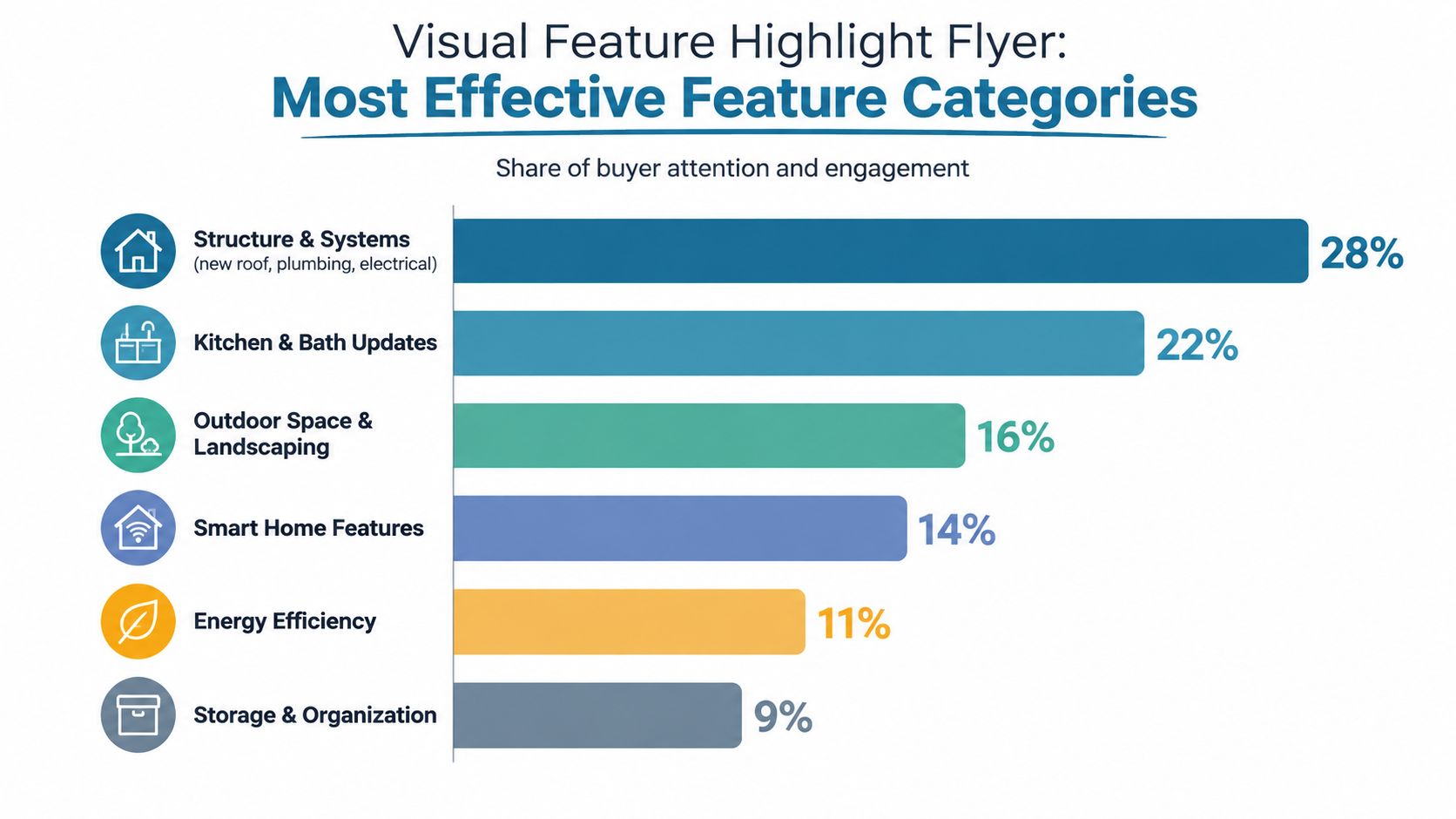
    A horizontal bar chart showing the most effective real estate feature categories and their buyer engagement percentages.

    Let the visual system support searchable copy

    Icons help humans scan, but they don't replace substantive text. Include a short factual property description in normal text so the material remains useful when photographed, indexed, or passed through digital tools. ListingBooster.ai's real estate listing copy examples can help teams develop editable descriptions that complement the visual flyer.

    Use “Scan for full property details” or “Request the floor plan and improvement summary” as the CTA. Don't make an icon imply a warranty, certification, energy performance, security condition, or accessibility feature unless the claim is verified and approved for advertising. For a related example of structured property reporting, see these sample confidence score reports.

    8-Option Open House Flyer Comparison

    Flyer 🔄 Implementation Complexity ⚡ Resource Requirements ⭐ Expected Effectiveness 📊 Expected Outcomes 💡 Ideal Use Cases
    QR Code-Integrated Flyer with Digital Property Tour Medium–High 🔄: QR + landing pages + CRM tracking Moderate ⚡: QR platform, mobile landing, video hosting, analytics ⭐⭐⭐ High Trackable scans, automated lead capture, richer digital tours 📊 Luxury listings, open houses, high-volume agents 💡
    Before-and-After Renovation Showcase Flyer Low–Medium 🔄: coordinated photo shoot and layout Photo shoot, staging, designer ⚡ ⭐⭐⭐ High Demonstrates value-add, justifies price, attracts investors 📊 Renovated homes, property turnarounds, investor outreach 💡
    Interactive Neighborhood Map Flyer Medium 🔄: map design + data verification Mapping data (Google/GIS), designer, updates ⚡ ⭐⭐⭐ High Better buyer fit assessment; fewer neighborhood questions 📊 Relocations, transit-focused buyers, developing areas 💡
    Dual-Purpose Open House + Market Report Flyer Medium 🔄: bifold layout + market data updates MLS/data access, designer, periodic printing ⚡ ⭐⭐⭐ High Builds authority, captures subscribers and follow-ups 📊 Market-positioning, open-house lead capture, neighborhood farming 💡
    Testimonial-Driven Social Proof Flyer Low 🔄: collect permissions and format content Client approvals, photos/videos, light design ⚡ ⭐⭐⭐ High Increases trust and conversion via third‑party validation 📊 New agents, credibility campaigns, listings needing trust signals 💡
    Mobile-Responsive Event-Style Flyer Low–Medium 🔄: mobile-first design and legibility testing Designer, mobile QA, optimized images ⚡ ⭐⭐ Medium–High High shareability; boosts immediate attendance and RSVPs 📊 Short-notice opens, social-first distribution, broad outreach 💡
    Comparative Market Analysis Listing Flyer High 🔄: data collection, comps selection, valuation method MLS access, analytic time, designer ⚡ ⭐⭐⭐ High Justifies pricing, educates prospects, strengthens negotiations 📊 Price-sensitive listings, luxury pricing discussions, savvy buyers 💡
    Visual Feature Highlight Flyer with Icon System Medium 🔄: icon library + polished layout Professional design, icon set, photography ⚡ ⭐⭐ Medium–High Rapid feature comprehension, stronger recall and brand consistency 📊 New construction, turnkey properties, multilingual or visual markets 💡

    Turn One Flyer Into a Repeatable Open House System

    The best flyer isn't necessarily the most elaborate. Choose the format that matches the listing's strongest evidence and the action you want the recipient to take. A renovation showcase needs documented project details and comparison photography. A location flyer needs verified destinations and readable mapping. A testimonial piece needs permissioned client language. A QR flyer needs a working mobile destination. A CMA flyer needs a defensible methodology and current, clearly dated data.

    Before publishing, verify every property fact, measurement, feature description, improvement claim, market figure, testimonial, image permission, QR destination, phone number, and event detail. Review the flyer for Fair Housing risk as carefully as you review the MLS remarks. Federal guidance prohibits advertisements that indicate a preference, limitation, or discrimination based on protected characteristics, and industry best practices recommend including an Equal Housing Opportunity logo, statement, or slogan so the public understands the property is available to all persons regardless of protected characteristics. The responsible advertising guidance from the National Fair Housing Alliance provides practical direction on that standard.

    Distribution should match the format. Door-to-door delivery, approved local placements, open house tables, email, text, social posts, and follow-up messages can all use the same core asset, but they shouldn't all use the same crop or CTA. A letter-size handout may need a mobile version with larger type. A QR code should lead to a page designed for a phone. A market report may deserve a separate follow-up link. Keep the brand structure consistent while adapting the content to the moment.

    ListingBooster.ai is an optional production layer for creating editable property descriptions, social captions, market-oriented content, and print materials from verified listing information. It can help teams maintain a consistent voice across channels, but it doesn't remove the need for agent review. Confirm disclosures, approvals, brokerage requirements, data sources, and final Fair Housing language before anything goes live.

    At the open house, make the next step explicit. Invite visitors to request the full property details, receive the floor plan, review supporting documentation, schedule a private tour, or arrange a consultation. After the event, tag responses by source and property so the next flyer reflects what people asked about. The system improves when each format produces both a useful buyer experience and a clear follow-up path.


    ListingBooster.ai helps real estate agents turn verified property details into editable listing descriptions, open house copy, social posts, flyers, and property report materials. Visit ListingBooster.ai to explore a practical way to keep your open house marketing consistent across print, mobile, social, and follow-up channels.
  • The Ultimate 2026 Real Estate Market Update Template Kit (12 Resources)

    The Ultimate 2026 Real Estate Market Update Template Kit (12 Resources)

    In a crowded market, generic updates about "interest rates" and "inventory levels" are just noise. Your clients and prospects don't want a data dump; they want to know what the numbers mean for them. A powerful real estate market update is your single best tool for building authority, proving your local expertise, and staying top-of-mind. The problem is that creating them from scratch every month is a time-consuming chore that pulls you away from dollar-productive activities.

    The solution isn't to skip these vital touchpoints. It's to systematize them with the right real estate market update template.

    This guide is your complete resource kit, not just another list of tools. We break down 12 of the best options for every channel, including email, social media, one-page PDFs, and even direct mail. You will find copy-ready examples, clear guidance on which data points matter most, and practical strategies for distributing your updates to generate actual conversations with buyers and sellers. We’ll explore everything from automated platforms like Keeping Current Matters and Altos Research to highly customizable design tools like Canva and Breakthrough Broker.

    By the end of this article, you will have a full blueprint for creating and deploying professional, engaging market updates in a fraction of the time. Our goal is simple: to help you find the perfect template, implement it quickly, and solidify your status as the go-to expert in your area. Each resource includes screenshots and direct links so you can get started immediately.

    1. ListingBooster.ai

    ListingBooster.ai stands out as a powerful, AI-driven marketing command center designed for agents who need more than just a static template. While it doesn't offer a traditional, fill-in-the-blanks market report, it generates the dynamic, data-informed content that fuels effective market updates across all your channels. Its core strength is turning a simple property URL or brief details into a complete marketing sprint, producing everything from MLS-optimized descriptions to a full 30-day social media calendar with posts tailored for every major platform.

    AI-generated social media calendar for real estate agents from ListingBooster.ai

    This platform is engineered for both immediate impact and long-term growth. The "Agent Edge" component handles the instant need for visibility, while the "Authority Engine" focuses on building your domain authority through SEO-optimized articles and a unique backlink exchange network. This dual approach ensures you’re not just posting for today but building a brand that AI assistants and search engines will recommend tomorrow.

    Why It's a Top Choice

    For agents who see a market update as a continuous conversation rather than a one-off report, ListingBooster.ai provides the engine. The system's ability to adapt content when a listing's status changes (e.g., from "For Sale" to "Pending") is a significant advantage, ensuring your updates are always timely and relevant without manual intervention.

    Key Takeaway: ListingBooster.ai excels by automating the creation and distribution of market-related content, allowing agents to maintain a consistent, professional presence with minimal effort. It's a system for building authority, not just filling out a form.

    The platform’s outputs are scanned for Fair Housing considerations and are fully editable, giving you final control. Setup is quick (5-10 minutes), and you can match the AI’s tone to your specific brand voice, a critical feature for teams and brokerages seeking consistency. The platform offers a clear path to explore its value, with a free starter credit allotment and a cancellable trial model.

    Practical Use Cases

    • Hyperlocal Market Snapshots: Use the social post generator to create daily or weekly posts about new listings, recent sales, and price reductions in a specific neighborhood.
    • SEO Article Generation: Create a long-form blog post analyzing quarterly market trends for your city, using the Authority Engine to optimize it for search engines.
    • Video & Reel Scripts: The AI generates scripts for TikTok and Instagram Reels, perfect for creating short, engaging video market updates.

    For a deeper look into how this works, the company blog explains the benefits of automated content for real estate agents.

    Pricing & Access

    ListingBooster.ai uses a tiered model. The "Agent Edge" plans for social and listing content start around $34.99–$39.99 per month. The "Authority Engine" for SEO and articles is approximately $59.99 per month, while a bundled suite is offered in the ~$89.95 range. Pricing can vary, so checking the site for current offers is recommended. You can begin with 25 free credits without a credit card to test the platform's capabilities.

    2. Keeping Current Matters (KCM)

    Keeping Current Matters (KCM) is a content subscription service designed to help agents become the go-to market experts. Rather than providing a static real estate market update template, KCM delivers a steady stream of professionally researched and designed content, including articles, social media graphics, and video scripts. Its primary function is to equip you with the materials needed to explain complex market shifts to consumers in a clear, digestible way.

    Keeping Current Matters (KCM)

    The platform operates on a monthly cadence, providing fresh, relevant visuals and talking points that reflect the current national housing conversation. This makes it an ideal solution for agents who struggle with consistent content creation but understand its importance. The core value lies in its "personalize and share" workflow; you can quickly add your branding to pre-made graphics and post them directly to your social channels. For a deeper dive into creating a robust online presence, consider exploring effective strategies for content marketing in real estate.

    Key Features and Considerations

    • Content Type: Offers a rich library of blog posts, social graphics, and presentation-ready slides. Higher-tier plans include automated posting and a one-click video creation tool called "RealTalk."
    • Best Use Case: Excellent for maintaining a consistent social media presence and for creating educational content for your email newsletter or blog. The content is built to establish your authority and answer common client questions about the market.
    • Limitations: The primary focus is educational content for digital distribution, not for creating printable flyers or direct mail pieces. While higher-tier plans offer some local data integration, the depth of hyper-local statistics can vary by market.
    • Pricing: KCM is a subscription service with multiple tiers, starting from a basic plan for content access to an "Elite" plan with automation and video tools. Pricing generally starts around $49.95 per month.

    Website: https://www.keepingcurrentmatters.com

    3. Coffee & Contracts

    Coffee & Contracts is a membership-based platform that acts as a real estate agent's creative partner, providing thousands of aesthetically driven templates for social media, print, and email. While it offers a wide array of marketing materials, it excels at providing a modern and stylish real estate market update template collection. The core of the service is its monthly content calendar, which gives agents daily post ideas paired with ready-to-customize Canva templates.

    Coffee & Contracts

    The platform is built for speed and branding consistency. Agents can quickly find templates for market stats, buyer guides, and listing promotions, add their own photos and brand colors, and post within minutes. The value lies in its design-forward approach, which helps agents create a polished and cohesive online presence. The templates are designed to be visually engaging and stop the scroll on crowded social media feeds.

    Key Features and Considerations

    • Content Type: A massive library of Canva templates for every conceivable marketing need, including social posts, carousels, Stories, Reels covers, and printable guides. It also provides captions and trainings.
    • Best Use Case: Ideal for agents who want to maintain a highly active and visually appealing social media presence without designing content from scratch. The monthly content calendar simplifies daily marketing tasks.
    • Limitations: This is a design-focused resource, not a data provider. You must source your own local market statistics from your MLS or another data service to populate the templates. Proficiency with Canva is necessary to get the most out of the membership.
    • Pricing: Coffee & Contracts is a subscription service, with pricing typically starting around $54 per month for an individual agent, with options for teams and brokerages.

    Website: https://coffeecontracts.com

    4. Breakthrough Broker

    Breakthrough Broker is a resource-rich marketing platform built exclusively for real estate agents, offering over 1,500 templates for nearly every marketing need. While it provides a wide array of tools, its strength for market updates lies in its collection of professionally designed, plug-and-play templates for social media, flyers, and postcards. You simply select a real estate market update template, insert your local statistics, and add your branding, which is automatically applied once your profile is set up.

    Breakthrough Broker

    The platform’s real-estate-only focus means every design is practical and relevant to an agent's daily business. It’s particularly effective for agents who need a quick, visually appealing way to present their market knowledge without spending hours on design. The workflow is fast, allowing for quick customization and sharing directly from your phone, making it ideal for on-the-go content creation.

    Key Features and Considerations

    • Content Type: A vast library of customizable templates including one-page market updates, social media graphics, direct mail postcards, and multi-page listing presentations.
    • Best Use Case: Perfect for agents who need to create branded, printable, and digital marketing materials quickly. The automated listing packages, triggered by MLS activity, are a standout feature for promoting new properties with a consistent look.
    • Limitations: Breakthrough Broker is not a raw data provider; you are responsible for sourcing and inputting your own hyper-local market stats. Additionally, some of its automation features, like the automated listing packages, are dependent on MLS coverage in your specific area.
    • Pricing: Offers a free trial and a low-cost "Elite" membership (around $16/month) that provides unlimited downloads and access to all premium templates and features.

    Website: https://resources.breakthroughbroker.com/free-trial

    5. RPR (Realtors Property Resource)

    Realtors Property Resource (RPR) is a powerful data platform and a benefit included with a National Association of REALTORS (NAR) membership in the US. Instead of offering finished templates, RPR provides the essential raw materials: credible, MLS-driven data and exportable charts. It’s an invaluable source for generating hyper-local statistics that can be plugged into any real estate market update template, adding a layer of professional authority to your communications.

    RPR (Realtors Property Resource)

    The platform allows you to create market trend charts for specific neighborhoods, ZIP codes, cities, or counties, which you can then download as images. These visuals are perfect for dropping into your email newsletters, social media posts, or listing presentations. The "Market Activity Report" is another key feature, compiling recent listings, sales, and price changes into a clean PDF. Integrating these data points can be even easier when using modern marketing systems; to see how technology can help, explore some of the top AI tools for real estate agents available today.

    Key Features and Considerations

    • Content Type: Generates exportable charts (JPGs) showing trends like median estimated home value, sales price, and inventory. It also produces multi-page PDF reports including Market Activity and Neighborhood Reports.
    • Best Use Case: Sourcing accurate, hyper-local data and charts to substantiate your market analysis. It's ideal for agents who want to pair compliant, professional visuals with their own branded templates and commentary.
    • Limitations: Access is restricted to NAR members (REALTORS). The visual style of the charts and reports is data-focused and functional, not design-oriented, so they work best when placed inside a custom-designed template.
    • Pricing: Included as a benefit of your NAR membership, so there is no additional cost for REALTORS to access and use the platform.

    Website: https://blog.narrpr.com/support/market-trends/

    6. Altos Research

    Altos Research provides automated, hyper-local market reports that are branded and ready to share with your sphere of influence. Instead of offering a static real estate market update template, Altos focuses on delivering real-time, digestible data snapshots for any U.S. ZIP code. The service is built to turn weekly or monthly statistics into polished, repeatable reports that you can distribute through email, social media, or even embed directly onto your website.

    Altos Research

    The platform is designed around a "set-it-and-forget-it" model, making it a powerful tool for agents who want to consistently provide value without manual data entry. Each Monday, the system generates a new report with up-to-date figures on inventory, median list price, and market action. This allows you to position yourself as the go-to data expert, effortlessly sending clients a clear, visual summary of what’s happening in their specific neighborhood.

    Key Features and Considerations

    • Content Type: Generates branded, single-page PDF market summaries and shareable report links. The system also includes an automated marketing suite for email campaigns and options for website embeds.
    • Best Use Case: Perfect for lead nurturing and staying top-of-mind with past clients. The hyper-local nature of the reports makes them a compelling lead magnet to offer on your website ("Get your weekly market report for [ZIP Code]").
    • Limitations: The report design has a default Altos style with only moderate branding flexibility (logo and color scheme). Agents focused on a single neighborhood may find higher-tier plans with statewide access to be more than they require.
    • Pricing: Altos Research is a subscription service with plans for individual agents, teams, and entire brokerages. Pricing starts around $99 per month for a single market, with costs increasing for access to multiple ZIP codes or statewide data.

    Website: https://altosresearch.com

    7. Canva

    Canva is a dominant force in the graphic design world, offering a massive library of ready-made templates perfect for agents who want full creative control over their materials. Instead of subscribing to a content service, you use Canva as a design tool to build your own custom real estate market update template from a professional starting point. Its drag-and-drop interface makes it incredibly easy to create a polished, branded look for social media posts, multi-page reports, flyers, and even video reels.

    Canva

    The platform's key advantage is its versatility. You can find a template for a single Instagram story, then adapt its design to a printable one-page PDF or a full presentation for a first-time homebuyer seminar. The "Brand Kit" feature in the Pro version is particularly useful, allowing you to save your brokerage's logos, fonts, and color palette for one-click application, ensuring brand consistency across all your marketing assets.

    Key Features and Considerations

    • Content Type: A vast template library covering social media (posts, stories, reels), print (flyers, postcards, reports), and digital presentations. It is a tool for creation, not a source of pre-written content.
    • Best Use Case: Ideal for agents or teams who want to establish a unique and consistent visual brand for their monthly market updates. Excellent for those who already have their data and just need a powerful tool to visualize it attractively.
    • Limitations: You are responsible for sourcing all market data and writing the analysis yourself. While many templates are free, the most professional designs and elements often require a Canva Pro subscription. Popular templates can become common, so customization is key to standing out.
    • Pricing: Offers a robust free version. The "Pro" plan, which includes the Brand Kit, premium templates, and advanced tools, is available through a monthly or annual subscription, typically starting around $14.99 per month.

    Website: https://www.canva.com

    8. Agent Crate

    Agent Crate is a real estate-focused content system that provides agents with a vast and growing library of social media templates. While it covers all aspects of an agent's marketing, it includes a specific "Market Insight" post category, making it an excellent source for finding a professionally designed real estate market update template for Instagram and Facebook. The platform is built for speed and branding, allowing you to quickly select a design, input your local data, and post.

    Agent Crate

    The service is highly scalable, catering to both the DIY agent who just needs templates and the busy top producer who wants a completely done-for-you service. With a monthly content calendar and an AI caption generator, Agent Crate gives you the tools to create a month's worth of content in minutes. Its core strength lies in providing stylish, modern visuals that are optimized for social media engagement, helping you present market statistics in a compelling and digestible format.

    Key Features and Considerations

    • Content Type: Offers 500+ templates for Instagram Reels, carousels, stories, and static posts. Higher tiers include an AI caption and blog generator and a full marketing CRM.
    • Best Use Case: Ideal for agents who prioritize a strong, visually consistent Instagram presence. The dedicated "Market Insight" category makes it simple to find and customize market update graphics quickly.
    • Limitations: The templates require you to source your own local market statistics from your MLS. The library is heavily focused on Instagram and social media, with fewer options for print or direct mail campaigns.
    • Pricing: Agent Crate operates on a subscription model with multiple tiers. Plans typically start around $39 per month for template access, with higher-priced tiers available for AI tools, automated posting, and fully managed services.

    Website: https://www.agentcrate.com

    9. LabCoat Agents Marketing Center

    LabCoat Agents (LCA) Marketing Center is an all-in-one design and template platform built to serve the diverse marketing needs of individual agents, teams, and brokerages. Rather than just offering a single type of real estate market update template, it provides a continuously refreshed library of assets for social media, email newsletters, and even direct mail. The system is designed for brand consistency and efficiency, making it a powerful tool for offices that need to maintain a uniform look across multiple agents.

    LabCoat Agents Marketing Center

    Its core strength lies in its "set it and forget it" branding feature. Once you upload your logo, headshot, and contact information, the platform automatically populates these details across its entire template library. This saves considerable time compared to manually editing each design. For teams and brokerages, built-in controls and analytics provide oversight, ensuring all marketing materials are compliant and on-brand before distribution.

    Key Features and Considerations

    • Content Type: A wide-ranging library of templates for social posts, email campaigns, printable flyers, and direct mail postcards. It supports both digital and print marketing channels.
    • Best Use Case: Ideal for teams and brokerages aiming for brand cohesion across all agent marketing. It’s also great for solo agents who want one platform to manage social, email, and farming campaigns without juggling multiple tools.
    • Limitations: The platform is a design and distribution tool, not a data provider. You are responsible for sourcing and inputting your own local market statistics into the templates. The creative style is standardized, so extensive customization may be needed for a truly unique look.
    • Pricing: Access is subscription-based, with plans tailored for individual agents, teams, and brokerages. Pricing typically starts around $59 per month for a solo agent.

    Website: https://www.lcamarketingcenter.com

    10. Corefact

    Corefact is a direct-mail provider specializing in high-quality print marketing for real estate professionals. While it offers a wide range of products, its strength lies in a vast library of "Market Update" postcard templates you can customize and mail to a geographic farm. This platform is built for agents who want to translate digital market statistics into a tangible, recurring touchpoint that lands directly in homeowners' mailboxes.

    Corefact’s workflow is designed for efficiency, allowing you to quickly input your local market numbers into professionally designed layouts. You provide the data, select a template that fits your brand, and the platform handles the printing, addressing, and mailing. This makes it an excellent tool for converting your monthly MLS report into a physical piece of marketing without needing design skills or a print-shop relationship.

    Key Features and Considerations

    • Content Type: A large collection of customizable postcard templates specifically for market updates, including seasonal and modern designs. The platform is entirely focused on print and direct mail.
    • Best Use Case: Ideal for geographic farming and maintaining consistent, physical contact with a target neighborhood. Using a real estate market update template from Corefact helps establish you as the local data expert through a medium that cuts through digital noise.
    • Limitations: Corefact is not a data provider; you are responsible for sourcing and inputting all market statistics. The service is also geared exclusively toward direct mail, so it doesn't offer digital assets for social media or email.
    • Pricing: Pricing is on a per-piece basis, which includes printing and postage. The final cost varies depending on the postcard size, quantity, and mailing options selected. This model allows for on-demand ordering without a monthly subscription.

    Website: https://www.corefact.com

    11. ProspectsPLUS!

    ProspectsPLUS! is a national direct-mail platform built for agents who want to integrate physical touchpoints into their marketing mix. While many tools focus exclusively on digital, this service excels at turning your market analysis into professionally printed postcards and mailing campaigns. It provides a massive library of templates, including those specifically for a real estate market update, that can be scheduled for recurring delivery to a farmed geographic area. This makes it a strong choice for agents aiming to dominate a specific neighborhood with consistent, branded messaging.

    ProspectsPLUS!

    The platform’s power lies in its marriage of template design with robust mailing list and automation tools. You can use its address mapping feature to target specific carrier routes or build a list based on demographic data, ensuring your market updates reach the most relevant households. Instead of just creating a digital report, ProspectsPLUS! allows you to plan and automate an entire direct mail calendar, scheduling your monthly or quarterly market updates well in advance. This "set it and forget it" approach to physical mail is its key differentiator.

    Key Features and Considerations

    • Content Type: Primarily offers direct mail postcard templates, door hangers, and brochures. It also provides tools for building targeted mailing lists and scheduling automated multi-touch campaigns.
    • Best Use Case: Perfect for geographic farming and maintaining consistent brand presence in a specific neighborhood. It’s ideal for agents who believe in a multi-channel approach and want to complement their digital efforts with tangible mailers.
    • Limitations: The focus is entirely on print and direct mail, so it does not offer digital templates for social media or email. Template designs are shared among all users, so customization is important to avoid looking generic. Pricing can be complex, as it varies based on postcard size, paper stock, quantity, and postage.
    • Pricing: Operates on a pay-per-campaign basis. Costs are variable and depend on the specific product, order volume, and mailing services selected. You can get instant quotes on the site before committing.

    Website: https://www.prospectsplus.com

    12. Wise Pelican

    Wise Pelican is a direct mail marketing service built specifically for real estate agents who use geographic farming to generate leads. It stands out by offering a category of professionally designed, ready-to-mail postcard templates for market updates. This allows agents to quickly create and send tangible, physical touchpoints to their farm area, complementing their digital marketing efforts. The platform is not a static template provider; it's a full-service solution that merges design with print and mailing logistics.

    The core of Wise Pelican's offering is its browser-based "Express Editor," which simplifies the customization process. Agents can upload their headshot and logo, adjust color schemes to match their brand, and, most importantly, swap in hyper-local market statistics. This creates a highly relevant real estate market update template in a postcard format, ready for a targeted mail drop. The workflow is designed for consistency, making it an excellent tool for agents committed to a monthly or quarterly direct mail farming strategy.

    Key Features and Considerations

    • Content Type: Primarily offers postcard templates for direct mail. This includes a dedicated selection for market updates, "Just Listed/Just Sold" announcements, and general branding.
    • Best Use Case: Ideal for agents engaged in consistent, long-term geographic farming. The platform removes the friction between designing a market update and getting it into mailboxes, making it a powerful tool for building name recognition in a specific neighborhood.
    • Limitations: The service is focused exclusively on direct mail, so it doesn't provide digital templates for email or social media. Because the templates are shared, agents in the same market may need to customize their chosen design to stand out from local competitors. Costs can also become significant with large mailing lists.
    • Pricing: Wise Pelican operates on a per-postcard pricing model that includes printing, addressing, and standard postage. Costs vary based on postcard size and mailing volume, but typically range from $0.71 to $1.09 per piece. There are no monthly subscriptions or setup fees.

    Website: https://wisepelican.com

    Top 12 Real Estate Market Update Template Comparison

    Product Core Features ✨ Quality / UX ★ Price / Value 💰 Target Audience 👥 Standout / Best For 🏆
    ListingBooster.ai 🏆 ✨ MLS‑optimized copy, 30‑day social calendar, Authority Engine SEO, status‑aware scheduling ★ Editable, Fair‑Housing scanned, fast setup (5–10 min) 💰 From ~$34.99 (Edge), ~$59.99 (SEO), bundle ~$89.95; 25 free credits 👥 Solo agents, teams, brokerages 🏆 AI + backlink network, compliance & brand‑voice at scale
    Keeping Current Matters (KCM) ✨ Research-backed market visuals, monthly blogs, video maker (Elite) ★ Consistent, consumer‑focused content 💰 Mid‑tier plans; add‑ons for local data & automation 👥 Agents needing educational market content 🏆 Research + monthly market cadence
    Coffee & Contracts ✨ Large Canva template library, monthly calendar, tutorials ★ Active library, strong onboarding 💰 Membership pricing (affordable) 👥 DIY agents comfortable with Canva 🏆 Vast templates + community support
    Breakthrough Broker ✨ 1,500+ real‑estate designs, auto‑branding, automated listing packages ★ Practical, phone‑ready templates 💰 Low‑cost membership, unlimited downloads 👥 Agents wanting turnkey campaigns 🏆 Auto listing packages & direct‑mail options
    RPR (Realtors Property Resource) ✨ MLS‑driven trend charts, exportable market reports ★ Credible, report‑style visuals 💰 Included with NAR membership 👥 REALTORS (NAR members) 🏆 Official MLS data for reports
    Altos Research ✨ Real‑time branded market reports, ZIP embeds, automated updates ★ Clear consumer visuals, set‑and‑forget 💰 Tiered (ZIP to statewide plans) 👥 Agents needing automated local reports 🏆 Real‑time market reporting & embeds
    Canva ✨ Huge template library, Brand Kit, team collaboration, AI tools ★ Flexible, design‑centric UX 💰 Free + Pro subscription for premium assets 👥 Design‑savvy agents & teams 🏆 Multi‑format design & collaboration
    Agent Crate ✨ 500+ IG templates, monthly calendar, AI caption/blog generator ★ Instagram‑focused, scalable posting 💰 Subscription with posted‑for‑you tiers 👥 Instagram‑first agents 🏆 Market‑insight templates + managed posting
    LabCoat Agents Marketing Center ✨ Templates for social/email/print, brand auto‑populate, print integrations ★ Team controls, analytics, compliance friendly 💰 Platform subscription (team/enterprise) 👥 Teams & brokerages 🏆 Multi‑channel templates + on‑demand printing
    Corefact ✨ Market update postcard library, on‑demand fulfillment ★ Direct‑mail focused, large design variety 💰 Per‑piece printing + postage 👥 Agents farming by mail 🏆 Recurring farm postcards with fulfillment
    ProspectsPLUS! ✨ Postcards, mailing lists, automated campaign scheduling ★ Strong mailing tools, mapping & lists 💰 Varies by format/qty & postage 👥 Agents running direct‑mail campaigns 🏆 Advanced list targeting + automation
    Wise Pelican ✨ Market update postcards, Express Editor, mailing list tools, USPS updates ★ Smooth template‑to‑mail workflow 💰 Per‑mail costs; custom template options 👥 Farming agents needing quick mailers 🏆 Fast editor + address update integration

    From Template to Trusted Advisor: Your Next Steps

    We have explored an extensive list of tools, from AI-powered platforms like ListingBooster.ai to design-centric resources like Canva and data powerhouses such as RPR and Altos Research. The common thread among them is their ability to provide you with a high-quality real estate market update template. But possessing the template is merely the starting point. The true measure of success lies in how you use that template to forge connections and build authority.

    Your sphere of influence doesn't just want data; they want to know what the data means for them personally. A graph showing a 2% dip in median sales price is just a number. It becomes a valuable insight when you explain that this slight dip could create a window of opportunity for first-time homebuyers who were previously priced out. This is the crucial shift from data reporter to trusted advisor.

    Choosing Your Path: How to Select the Right Tool

    The sheer number of options can feel overwhelming, so let's simplify the decision. Your ideal tool depends entirely on your primary goal, available time, and technical comfort level.

    • For Maximum Efficiency and AI-Powered Storytelling: If your goal is to save the most time while producing insightful, narrative-driven content, an all-in-one solution is your best bet. ListingBooster.ai stands out here, as it not only pulls the data but also writes the market update narrative for you, turning raw numbers into compelling social media posts and emails.

    • For Deep Data Analysis and Hyperlocal Expertise: If you enjoy digging into the numbers and positioning yourself as a data expert, a combination of RPR (free for REALTORS®) and Altos Research is a potent mix. These tools give you the granular data you need to become the go-to analyst for your specific farm area.

    • For Brand Consistency and Design Control: For agents and teams who prioritize a specific aesthetic and brand voice, tools like Canva and Coffee & Contracts are excellent. They offer beautifully designed templates that you can customize to perfectly match your brand, though they require more manual input for data and copy.

    • For Blending Digital with Physical Mail: To create a multi-channel marketing approach, consider pairing a digital tool with a direct mail service. You could design a one-page market snapshot in Breakthrough Broker or Agent Crate and then use Corefact or Wise Pelican to print and mail it to your farm area, reinforcing your digital presence with a tangible touchpoint.

    Turning Theory into Action: Your Implementation Checklist

    Selecting a tool is step one. Consistent execution is what will generate results. Don't let your new real estate market update template gather digital dust.

    1. Commit to a Schedule: Consistency trumps intensity. Decide if you will send your update weekly, bi-weekly, or monthly, and then block out the time on your calendar to get it done.
    2. Define Your Core Markets: You can't be an expert on everything. Choose 1-3 specific zip codes, neighborhoods, or cities to focus on. This makes your updates more relevant and your workload more manageable.
    3. Add Your Personal Interpretation: Even when using an AI tool, your final touch is what makes the update uniquely yours. Add a brief personal video, a sentence about a local event, or a specific client story that relates to the market trend you're highlighting.
    4. Promote Across Channels: Don't just post it once. Share your market update in an email newsletter, as a social media carousel post, in your Instagram Stories, and as a downloadable PDF on your website. Each format reinforces the message and captures different segments of your audience.

    The ultimate goal of a market update is not to win an award for data science. It is to start a conversation. It's the prompt that makes a homeowner think, "I wonder what my home is worth in this market," or a buyer say, "Maybe now is the time to start looking." By consistently providing clear, easy-to-understand market insights, you are no longer just another agent. You become an indispensable guide, a source of stability, and the first person people think of when they are ready to make a move.


    Ready to stop wrestling with spreadsheets and start publishing expert market updates in minutes? ListingBooster.ai uses AI to automatically generate hyper-local market data and write compelling, ready-to-post content for you. See how you can transform your real estate market update template from a chore into your most powerful client-attraction tool at ListingBooster.ai.