Tag: realtor marketing

  • 10 Facebook Posts for Real Estate Agents That Build Trust

    10 Facebook Posts for Real Estate Agents That Build Trust

    Beyond “Just Listed,” the modern agent's Facebook strategy starts with one reality. Your feed isn't a digital flyer rack anymore. It's where homeowners decide whether you understand their market, whether buyers see you as credible, and whether your name stays top of mind long before anyone fills out a form.

    That matters because Facebook still sits at the center of real estate social media. According to a summary of NAR survey findings, 87% of agents use Facebook for business, and 60% report social media delivers their highest marketing ROI, while 90% of homebuyers begin their search online and often encounter agent content early in that process (real estate social media statistics). If you want a broader framework behind these ideas, it helps to learn social media content strategy with quso.ai.

    Generic AI can write a caption. It usually can't write one that sounds local, supports seller conversations, and stays compliant. These 10 Facebook posts for real estate agents do that job better.

    1. Open House Countdown Posts with Property Highlights

    A hand-drawn calendar with an open house event circled, keys, and home features shown in small circles.

    A single open house post gets ignored fast. A short countdown sequence works better because it gives the same property multiple entry points in the feed without repeating the same message.

    Start with one standout feature. Then shift to updates, layout, outdoor space, or maintenance details as the event gets closer. Keep the address in every post so the content is searchable and recognizable when people see it more than once.

    What to post during the week

    Try a sequence like this:

    • Tuesday teaser: “This updated kitchen is worth seeing in person. Quartz counters, stainless appliances, and direct sightlines to the back patio. Open Sunday at 123 Main Street, 1 to 4 p.m.”
    • Friday reminder: “Open house this Sunday at 123 Main Street. Hardwood floors, remodeled bath, and a roof replacement the seller already handled.”
    • Saturday evening push: “Tomorrow at 1 p.m. First public open house at 123 Main Street. Photos are strong. The natural light is better in person.”

    Practical rule: Don't describe the “ideal buyer.” Describe the property. Features are persuasive. Occupant language creates risk.

    Meta treats housing as a Special Ads Category, which limits targeting by age, income, and similar filters. That's why your organic post content matters so much, and why visual formats such as carousel posts and video tours usually fit real estate better than text-heavy updates (Meta housing ad restrictions and execution guidance).

    ListingBooster.ai is useful here because it can spin several compliant angles from one listing instead of forcing you to rewrite the same open house caption three times.

    2. Just Sold Announcements with Comparative Market Context

    A black and white line drawing of a house with sold sign, pricing labels, and market data.

    Most “just sold” posts waste the best part of the story. Sellers don't care that you're busy. They care what the closing says about pricing, timing, and buyer behavior in their neighborhood.

    A stronger post turns the sale into a small market lesson. If a home sold quickly because it was move-in ready, say that. If it needed a price adjustment before traction improved, say that too. Honest market context builds trust faster than generic celebration graphics.

    Make the post useful to sellers

    A good just-sold caption sounds like this:

    • Price positioning example: “123 Main Street closed this week. What mattered most was pricing it in line with nearby competition from day one.”
    • Condition example: “This sale reinforces a pattern we're seeing locally. Updated kitchens and deferred maintenance already handled tend to attract stronger early interest.”
    • Soft seller CTA: “If you're wondering how your home would compete right now, that's a pricing conversation, not a guess.”

    If you want to systematize that cadence, this guide on social media automation for real estate agents shows how to keep sold posts tied to broader visibility instead of treating each one as a one-off announcement.

    The trade-off is simple. A flashy sold post may get likes. A contextual sold post starts listing conversations.

    3. Neighborhood Feature Deep-Dives with Practical Information
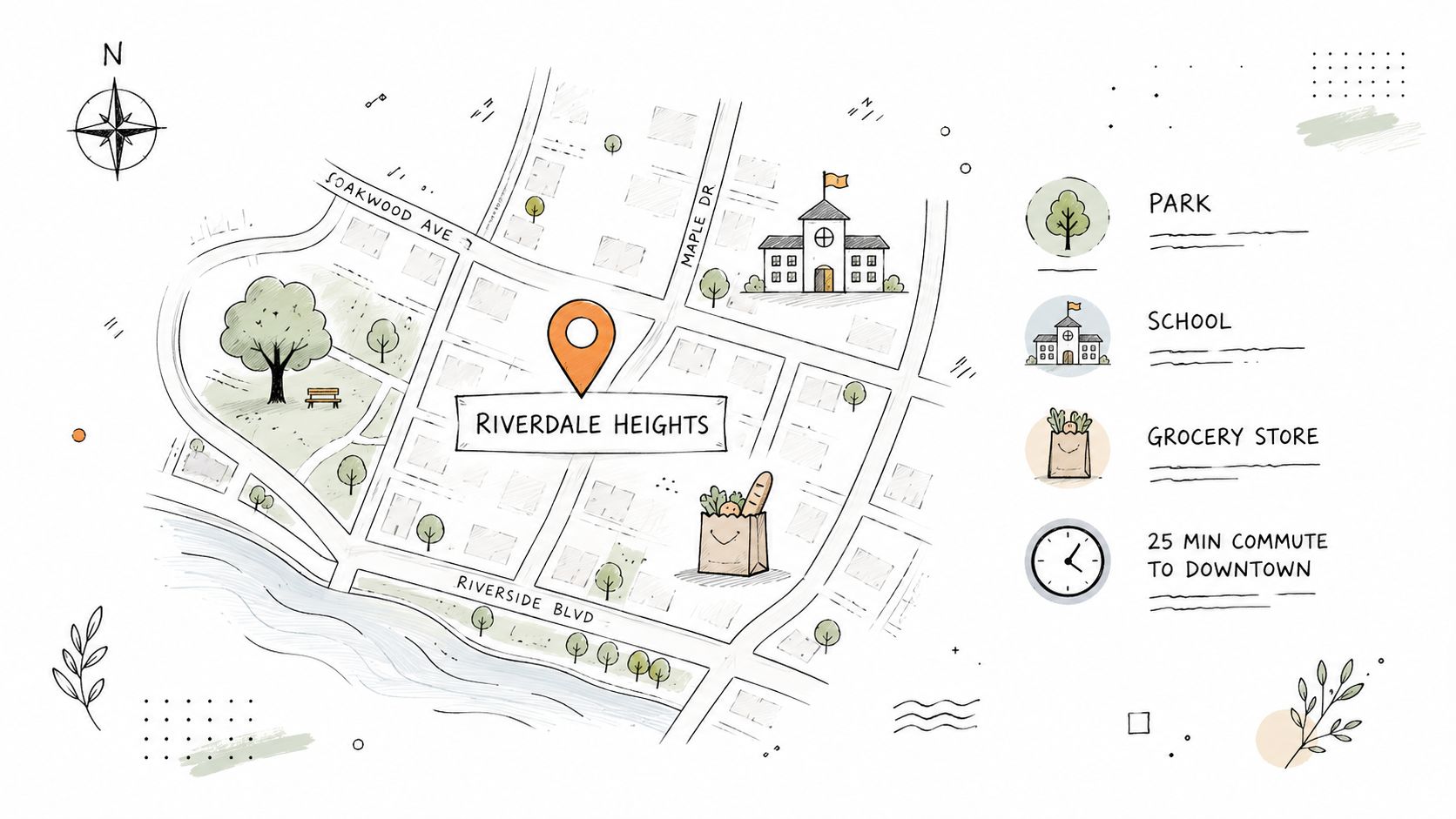
    A hand-drawn map of the Riverdale Heights neighborhood featuring amenities like a park, school, and grocery store.

    Neighborhood posts build trust when they read like local knowledge, not tourism copy. The safest and strongest angle is practical information people can use right away.

    Focus on infrastructure, access, services, parks, trail systems, retail corridors, commute routes, municipal projects, and seasonal events. Those details help both buyers and sellers understand how a location functions without drifting into risky language about who belongs there.

    A better neighborhood post formula

    Use a simple structure:

    • Access: commuting routes, transit points, major intersections
    • Convenience: grocery options, pharmacies, dining clusters, service businesses
    • Recreation: parks, greenways, public facilities, trail access
    • Ownership context: tax information, permitting changes, zoning updates, municipal improvements

    A practical example: “Three things to know about the Oak Ridge corridor this month. The trail extension is open, the retail center now includes a new grocery tenant, and the city resurfaced the main connector road.”

    Neighborhood authority comes from specifics. “Walkable to coffee, grocery, and a pharmacy within a few blocks” is useful. “Great area” says nothing.

    Avoid coded words like “exclusive,” “up-and-coming,” or “desirable.” Under the Fair Housing Act, your language can't express preference or imply discrimination tied to protected classes. Describe the place by features and public facts, not by the type of resident you think it suits (Fair Housing social media advertising rules).

    4. Market Update Posts with Actionable Seller Education

    Market updates work when they answer one seller question clearly: “What does this mean for my decision to list?”

    Most agents already have access to the raw numbers through their MLS. The hard part isn't finding the data. It's translating it into plain English without turning the post into a newsletter nobody finishes.

    Turn market data into seller decisions

    A useful market update usually includes three parts:

    • What changed: inventory, new listings, pending activity, price reductions, or showing volume in your market
    • What it means: more competition, less negotiating room, stronger buyer scrutiny, or more importance on condition
    • What sellers should do: price tighter, finish repairs, improve photography, or list sooner rather than later

    Example: “More listings came on this month, which gives buyers more choice. For sellers, that usually means presentation matters more, and pricing mistakes take longer to recover from.”

    Consistency matters more than complexity. A short first-Monday market post is better than a brilliant market essay you only publish twice a year. If you want a repeatable structure, this real estate social media content calendar can help map monthly market updates, seller tips, and listing content without guessing what to post next.

    ListingBooster.ai fits this category well because it's built around real estate language. Generic AI often writes broad economic commentary. You need neighborhood-level seller guidance.

    5. Client Testimonial Videos and Success Stories

    A testimonial video doesn't need studio production. It needs clarity, consent, and one specific reason the client trusted you.

    Short clips work best when the client talks about process, communication, pricing guidance, or how you solved a problem. That gives future clients something concrete to compare. “She kept us informed through inspection” is stronger than “She was amazing.”

    What to capture on camera

    Ask prompts that lead to substance:

    • Starting concern: “What were you worried about before we listed?”
    • Decision point: “What helped you feel confident during the process?”
    • Outcome: “What part of the experience stood out most?”

    Keep the edit simple. Add text overlays so the post still communicates with sound off. If you have permission, pair the video with listing photos, a closing photo, or a short written summary below the clip.

    Ask for the testimonial right after closing. The relief is fresh, and clients usually remember the details that matter.

    For compliance and professionalism, get written permission to use the client's words, name, image, or property photos. Also avoid implying guarantees. A success story should explain what happened in that transaction, not promise the same result for the next seller.

    ListingBooster.ai can help script prompts and organize the content sequence around the testimonial, but the trust still comes from a real client saying something specific.

    6. Comparative Market Analysis Education Posts

    CMA education posts attract homeowners who aren't ready for an appointment yet but are privately trying to understand value. That audience is ideal for Facebook because they'll often watch, compare, and wait before reaching out.

    The best version isn't “What's your home worth?” That's too broad. A better post explains why similar homes don't sell for the same price.

    Show the variables that move price

    A simple post might compare three similar homes and point out differences such as:

    • Condition: original kitchen versus updated kitchen
    • Systems: older roof or HVAC versus recently replaced
    • Lot placement: interior lot versus corner lot
    • Timing: stronger launch window versus slower seasonal timing

    You don't need to sound like an appraiser. In fact, you shouldn't. The point is education. Explain the pricing drivers in plain language and invite homeowners to ask for a customized analysis if they want one.

    A strong example: “Two homes can share the same bedroom count and square footage and still land far apart because buyers price in updates, deferred maintenance, lot layout, and presentation.”

    This post type also reinforces your value to sellers. You're not just posting homes. You're interpreting the market. That's a meaningful distinction, especially for newer agents who need authority content that feels grounded and local.

    7. Listing Walkthrough and Property Detail Spotlights

    Some listings deserve more than a broad overview. Detail spotlights let you slow the scroll and direct attention to the things buyers ask about, such as windows, roof age, flooring quality, plumbing updates, storage design, or outdoor improvements.

    This format is especially useful when a property's value isn't obvious in the hero photo. A newer water heater, refinished hardwoods, or updated electrical panel won't always drive clicks on its own, but those details do strengthen buyer confidence.

    Focus on what reduces buyer hesitation

    Examples that work well:

    • Mechanical reassurance: “The seller replaced the HVAC recently, which removes one major near-term project for the next owner.”
    • Finish quality: “These hardwood floors were refinished rather than covered, and the condition shows in the close-up shots.”
    • Inspection-readiness: “The roof replacement is already done, which often reduces one of the biggest negotiation pressure points.”

    A visual format helps here, especially a close-up carousel or short narrated reel. If you want to multiply one listing into a larger content run, this guide on turning one listing into 30 days of content is a practical model.

    Later, if you want to expand the same listing into video, you can also generate real estate marketing videos.

    The mistake to avoid is writing about details that only the agent cares about. “Designer touches throughout” is vague. “Newer windows, updated plumbing, and a rebuilt deck” gives people a reason to look closer.

    8. Local Event and Community Calendar Posts

    Not every Facebook post should ask for a showing or a valuation call. Community calendar posts keep your page useful between transactions, and useful pages get remembered.

    This post type works well because it broadens your identity. You're not only the person with listings. You're also the person who knows what's happening locally and shares information people can use.

    Useful community post ideas

    A few formats are reliable:

    • Weekend event roundup: farmers market, library programs, park district events, trail access updates
    • Seasonal reminders: city leaf pickup schedule, recreation registration deadlines, holiday market calendars
    • Municipal updates: road work, public facility openings, town meeting notices that affect homeowners

    For compliance, keep these posts about public information and neighborhood function. Don't frame the area around who it's “for.” Frame it around what residents can access and what's changing.

    There's also a trust advantage here. When your feed includes market updates, listing content, and practical local information, people see a fuller professional picture. That's more persuasive than a feed made entirely of sold graphics.

    If you attend the event yourself, use your own photo or short clip. The post feels more credible, and your local presence becomes visible without forced self-promotion.

    9. Before-and-After Renovation Showcases with ROI Context

    Renovation posts perform best when you explain the decision, not just the transformation. Sellers want to know what changed, why it mattered, and whether the update improved marketability.

    A side-by-side kitchen or bath image is the hook. The caption should do the heavier work by connecting the update to buyer confidence, perceived maintenance, or stronger presentation.

    Keep the analysis honest

    Use language like this:

    • Marketability angle: “The refresh helped the home show as move-in ready rather than project-heavy.”
    • Negotiation angle: “Handling this work before listing likely reduced repair objections later.”
    • Scope angle: “This wasn't a full reconfiguration. It was a targeted update that improved first impression.”

    Before-and-after posts lose credibility when every project is framed as a jackpot. Some updates help positioning more than price. Say that plainly.

    This is also where purpose-built real estate AI helps. Generic tools tend to write renovation captions like home décor content. ListingBooster.ai can frame the same update around listing readiness, inspection concerns, and buyer objections, which is far more useful to a seller audience.

    If you know the seller chose not to renovate and still sold successfully, that can be a strong post too. Contrast is educational. “We skipped a full remodel and focused on paint, lighting, and staging” is often more believable than dramatic transformation content every time.

    10. Seller Education Series Preparing Your Home for Sale

    A seller education series is one of the best Facebook post systems because it pre-handles objections before the consultation. It also creates continuity in your feed. People start expecting practical advice from you instead of waiting for the next listing.

    Keep each post focused on one decision. Pricing. showings. inspection prep. offer review. moving timeline. Utility records. Small, useful lessons outperform giant “ultimate guide” captions on Facebook.

    Strong topics for a recurring series

    Use recurring themes such as:

    • Pricing: how comparable sales shape strategy
    • Preparation: decluttering, repairs, paint, lighting, odor control
    • Showings: what sellers should leave out of sight and what should be easy to access
    • Inspection: what buyers flag most often and how to prepare documents
    • Offers: why price isn't the only term that matters

    The smartest version of this content is consultative, not preachy. For example: “A home doesn't need to be fully renovated to hit the market well. It does need to look maintained, clean, and easy to understand.”

    This category also lines up with how buyers now discover professionals. One industry source argues that a growing share of buyers start in AI tools and that agents need more AI-readable, specific content rather than vague social captions (AI-readable real estate content trend). Whether someone finds you through Facebook directly or through content that gets referenced elsewhere, detailed local education travels further than generic advice.

    10 Facebook Post Types for Real Estate Agents: Comparison

    Strategy Implementation Complexity 🔄 Resources & Speed ⚡ Expected Outcomes 📊⭐ Ideal Use Cases 💡 Key Advantages ⭐
    Open House Countdown Posts with Property Highlights 🔄 Moderate, repeated posts over 7 days; scheduling discipline required ⚡ Low–Moderate: quality photos, scheduling tools, time for multiple posts 📊 Drives foot traffic and short-term engagement; measurable attendance lift 💡 New listings with planned open houses; competitive local markets ⭐ Creates urgency; easily repurposed across platforms
    Just Sold Announcements with Comparative Market Context 🔄 Low, single timely post per closing; needs verified data ⚡ Low: public records, one professional photo, simple design 📊 Builds credibility and long-term social proof; supports referrals 💡 Agents with steady sales volume; authority-building campaigns ⭐ Demonstrates results; educates market with factual metrics
    Neighborhood Feature Deep-Dives with Practical Information 🔄 High, research-heavy; accuracy is critical ⚡ Moderate: local data sources, photography, research time 📊 Long-term SEO and trust; attracts relocation and local research traffic 💡 Agents aiming to be local experts; relocation-focused marketing ⭐ Differentiates by deep local knowledge; evergreen value
    Market Update Posts with Actionable Seller Education 🔄 Moderate, recurring cadence with fresh data each period ⚡ Moderate–High: MLS/data access, charting tools, data literacy 📊 Positions as data-driven advisor; attracts informed sellers 💡 Regular outreach to sellers and investor audiences ⭐ Shows market competence; timely authority and shareability
    Client Testimonial Videos and Success Stories 🔄 Moderate, scheduling, filming, consent, editing required ⚡ Moderate: willing clients, smartphone/video tools, editing time 📊 High engagement and trust; strong conversion from social proof 💡 Converting fence‑sitters; campaigns focused on credibility ⭐ Authentic persuasion; outperform static posts on engagement
    Comparative Market Analysis (CMA) Education Posts 🔄 High, detailed analysis and anonymization needed ⚡ High: access to comps, analytic time, clear visuals 📊 Educates sellers; drives high‑intent listing inquiries 💡 Pre-listing education and pricing conversations ⭐ Demonstrates pricing expertise; reduces seller resistance
    Listing Walkthrough and Property Detail Spotlights 🔄 Moderate, requires access and thoughtful shot selection ⚡ Moderate: high-quality close-ups, listing access, captions 📊 Boosts listing visibility; educates buyers on value drivers 💡 New or high‑detail listings needing depth ⭐ Generates multiple posts per listing; highlights saleable features
    Local Event and Community Calendar Posts 🔄 Low–Moderate, ongoing event monitoring and timing ⚡ Low: event info, images, minimal production time 📊 Builds community connection and shareability; local reach growth 💡 Brand-building and neighborhood engagement strategies ⭐ Positions agent as community insider; consistent engagement
    Before-and-After Renovation Showcases with ROI Context 🔄 High, needs documented befores, accurate ROI context ⚡ Moderate–High: before/after photos, cost data, outcome metrics 📊 Visual proof of renovation impact; informs seller investment choices 💡 Advising sellers on pre‑listing renovations ⭐ Demonstrates ROI and reduces seller uncertainty about upgrades
    Seller Education Series: Preparing Your Home for Sale 🔄 High, multi-part planning and consistent publishing ⚡ Moderate: content planning, visuals, batching tools 📊 Pre-sells expertise; reduces basic objections; builds lead funnel 💡 Nurturing prospective sellers and long-term lead gen ⭐ Establishes trust over time; reusable lead magnet and reference

    From Posts to Pipeline Activating Your Content Strategy

    A strong Facebook presence doesn't come from posting constantly. It comes from posting with range. Open house reminders create urgency. Just sold posts build proof. Neighborhood and community content build trust. Market updates and seller education posts move people closer to a conversation before they ever contact you.

    That approach also fits how agents use the platform. In 2025, Facebook reached 253 million users in the United States, and one industry source states that 92% of real estate agents globally use Facebook as a core part of their strategy, while NAR survey reporting confirms 87% of U.S. agents use it for marketing (real estate Facebook ads and platform reach). The opportunity is still there, but low-quality posting won't capture it.

    Compliance has to stay built into the process. Every property ad or service post should include the disclosures required by NAR's Internet Advertising Policy, including your name, brokerage name, office city and state, and licensing jurisdictions (NAR advertising disclosure summary). It's also wise to display the Equal Housing Opportunity slogan, logo, or statement clearly on your social profile and link it to a Fair Housing policy page (Fair Housing social media compliance tips).

    Execution is where most agents get stuck. A real-estate-specific tool like ListingBooster.ai can help you build compliant listing captions, neighborhood posts, and seller education content faster than starting from scratch in a generic AI tool. The practical next step is simple. Pick one of the 10 post types above, draft next week's version, and schedule Facebook posts with Mallary.ai. One well-structured post is enough to restart momentum.


    If you want a faster way to turn listings, market knowledge, and local expertise into Facebook content that sounds like a real agent, take a look at ListingBooster.ai. It's built specifically for real estate workflows, which makes it more useful than a generic AI writer when you need compliant property posts, seller education content, and a repeatable publishing rhythm.


  • What to Post on Social Media as a Realtor: 10 Ideas

    What to Post on Social Media as a Realtor: 10 Ideas

    Are you still treating social media as a place to drop a new listing, post a closing photo, and disappear for a week? That approach leaves a gap. Your feed now does more than support referrals. It helps buyers and sellers decide whether you understand the market, whether you communicate clearly, and whether you're active enough to trust with a major transaction.

    That matters because social content isn't just for human followers anymore. It's part of the digital footprint that shapes how people discover you and how AI-driven search surfaces your expertise. If you're asking what to post on social media as a realtor beyond the usual “Just Listed,” you're asking the right question. This guide gives you ten practical, Fair Housing-compliant content ideas you can use to build authority, stay visible, and create better conversations with real prospects. If you want broader strategy context, this real estate social media guide is a useful companion.

    1. Property Feature Spotlight Posts

    A modern kitchen island with a white marble countertop and black cabinetry in a bright home interior.

    Close-up feature posts often outperform the standard front-elevation photo because they give people a reason to stop. A kitchen island, refinished hardwood, custom shelving, updated windows, or a well-executed mudroom tells a more specific story than “beautiful home in a great area.”

    The caption needs to do more than label the photo. Instead of “Quartz counters in kitchen,” write what the feature changes for the owner: prep space, storage, durability, traffic flow, or visual impact. That shift makes the post feel professional rather than recycled from the MLS.

    Write the benefit, not just the detail

    A few examples:

    • Kitchen feature: “Waterfall edge, generous prep space, and a layout that keeps the kitchen functional when people gather.”
    • Flooring feature: “Refinished original hardwood adds warmth, continuity, and one less project for the next owner.”
    • Built-in storage: “Custom shelving gives this room structure. It feels finished instead of underused.”

    If you want to batch these faster, use ListingBooster.ai to spin one property into several angle-specific captions, then compare them to strong listing description examples that sell. That's a practical way to turn one listing into two or three weeks of content without repeating yourself.

    Practical rule: Spotlight the property and amenity. Never imply the ideal occupant.

    That compliance point matters here. Avoid phrases like “perfect for families,” “ideal for young professionals,” or “exclusive.” Fair Housing-safe copy describes the home itself. It doesn't suggest who should live there. Tagging the stager, contractor, or appliance brand can also expand reach without making the post feel promotional.

    2. Market Update & Data Posts

    Agents who post market updates well don't dump raw numbers into a Canva graphic and call it insight. They interpret local data and explain what it means for decision-making. That's what separates authority from noise.

    Use your own MLS data and keep it local. A zip code, school district boundary, condo submarket, or a specific price band is usually more useful than broad metro commentary. Then turn the numbers into an opinion your audience can act on.

    Give the data a takeaway

    A strong market post sounds like this:

    • For sellers: “Inventory expanded in this segment, so presentation and pricing discipline matter more than they did earlier in the year.”
    • For buyers: “More choice usually means stronger negotiating power, but the best-prepared listings still move quickly.”
    • For move-up clients: “The same condition issues that affect your purchase will affect your sale. Plan both sides together.”

    If you want a faster workflow, tools that provide automated Market Insights for real estate agents can help turn MLS inputs into readable posts and recurring content. The point isn't automation for its own sake. It's consistency without sounding generic.

    One more reason to keep these posts in rotation: 71% of buyers say they're more likely to work with agents who maintain a strong social media presence. That doesn't mean every chart wins attention. It means consistent, useful interpretation builds trust over time.

    3. Open House & Property Showcase Videos

    A modern open-concept home interior featuring a comfortable living room transitioning into a clean white kitchen.

    What makes a property video worth posting? A clear point of view, fast pacing, and details a buyer can use.

    Agents often post a slow walkthrough with background music and no context. That format fills a feed, but it rarely builds authority. A stronger showcase video helps viewers assess the home quickly. It highlights layout flow, finishes, storage, outdoor use, and any feature that changes how the property lives day to day. That is also the kind of content AI-driven search can interpret more easily than a vague montage.

    Keep these videos short and intentional. For social, one strong angle usually outperforms a full tour. Show the kitchen work zone, the primary bath renovation, the indoor-outdoor connection, or the reason this floor plan fits current buyer demand. Save the longer walkthrough for your listing page, YouTube, or follow-up messages.

    A practical structure looks like this:

    • Opening: Start with the strongest visual and a concrete hook, such as “Best feature in this home: the split-bedroom layout and oversized covered patio.”
    • Middle: Show two or three details that support the opening claim. Use on-screen text so the takeaway still lands with sound off.
    • Closing: Add the next step, such as open house time, private tour availability, or “message for the full feature sheet.”

    For planning, captioning, and post timing, this Guide to AI-powered open house promotion is a practical reference.

    Clean vertical footage is enough. Good light, steady camera movement, and specific captions usually perform better than a heavily edited video that hides the actual property.

    Keep every description Fair Housing compliant. Focus on the home and the transaction facts. Say “third-floor condo with elevator access,” “fenced backyard,” or “updated mudroom storage.” Avoid language about the kind of person who should live there, lifestyle assumptions, or coded neighborhood descriptors.

    One more use case gets missed. Turn your open house video into a post-event asset. Clip a 15-second recap, answer one buyer question you heard repeatedly, or record a short “what stood out to visitors” follow-up. That extends the life of the showing and gives you more searchable, authority-building content without creating a new post from scratch.

    If you want a simple way to present seller feedback after the event, a short recap paired with a client quote or approved comment can work well. Tools like Testimonial can help organize that social proof so it is easier to reuse across channels.

    4. Client Testimonial & Success Story Posts

    Testimonials work when they sound specific. They fail when they read like every other five-star review on the internet. “Great agent, highly recommend” is nice to have. It doesn't move many decisions.

    Ask clients focused questions right after closing. What worried them most at the start? What part of the process felt clearer after working with you? What did you do that reduced friction? Those answers produce usable social proof.

    Pull out the operational win

    Better testimonial angles include:

    • Strategy clarity: “We came in with a plan and knew what to do when the first inspection issue surfaced.”
    • Communication: “We always knew the next step and deadline.”
    • Negotiation discipline: “They kept us from reacting emotionally and helped us focus on terms.”

    A short video from the client is even stronger because tone carries trust in a way text often can't. If you're collecting and organizing those reviews across channels, a platform like Testimonial can simplify the process.

    Keep the post anchored in service and process. Don't inflate the story. Don't overshare private details. And if the client wants anonymity, respect it, but know that named, permission-based testimonials usually feel more credible.

    5. Seller Prep & Home Staging Tips

    A neatly made hotel-style bedroom staged for sale with a navy blue throw blanket and neutral pillows.

    Seller prep content does well because it answers a question owners ask before they're ready to call an agent. It also positions you as someone who thinks beyond promotion and into execution.

    The strongest posts are practical and selective. Most sellers don't need a full renovation lecture. They need help deciding what affects presentation, photography, showings, and buyer confidence.

    Focus on the sequence

    A useful seller prep post often follows this order:

    • Start with systems: Roof, HVAC, plumbing, and visible maintenance issues come before cosmetic upgrades.
    • Then move to presentation: Decluttering, light staging, neutralizing visual distractions, and improving photo-readiness.
    • Finish with access: Clear rooms, open blinds, replace burned-out bulbs, and make storage areas usable for showings.

    An example caption: “Before spending on finishes, handle the items buyers notice during walkthroughs and inspectors flag later. Clean systems, clear spaces, and strong photos usually matter more than trend-chasing updates.”

    This category also gives you a natural soft CTA. Offer a pre-listing walkthrough, not a hard sell. “If you're planning a move this season, I can help you prioritize what to fix, what to leave alone, and what to stage.” That tends to convert better than “Call me if you're thinking of selling.”

    6. Just Sold & Price Achievement Posts

    “Just Sold” posts are useful, but most of them are forgettable because they say nothing. A yard sign photo and confetti emoji don't explain why the outcome matters or what you did to influence it.

    The better version is part results post, part mini case study. Share the sequence. Was the property repositioned after prep work? Did timing, presentation, pricing, or negotiation discipline make the difference? Those details show competence without turning the post into self-congratulation.

    Keep the language compliant and accurate

    For milestone posts tied to a completed sale, accuracy matters as much as marketing. A property should only be labeled “sold” after the transaction is fully finalized. If it's pending, “under contract” is the correct term, and every post should include the licensed brokerage name larger or more prominently than the agent's name.

    That rule is easy to ignore on social. It shouldn't be. If your content is public-facing advertising, the same standards apply.

    A useful caption structure:

    • Address or recognizable property descriptor
    • Brief transaction outcome
    • One decision that shaped the result
    • A soft invitation for similar owners to ask questions

    ListingBooster.ai is useful here because it can generate several caption variations from one transaction, which helps teams keep “Just Sold” content fresh instead of posting the same formula every time.

    7. Buyer Education & Tips Posts

    Buyer education posts earn trust because they lower anxiety. Experienced agents know that buyers rarely need more theory. They need help understanding timing, sequence, negotiation power, and the difference between a real issue and a distraction.

    The best topics come directly from live conversations. Pre-approval versus pre-qualification. What happens after offer acceptance. Which inspection findings are normal versus expensive. How to evaluate concessions without fixating on one line item.

    Use soft-bridge education

    There's a useful gap in most agent content here. While 72% of homebuyers use social media for research, only 14% of real estate agents have a documented strategy for moving followers from passive viewing to active consultation. That's why “DM me if you're buying” often falls flat.

    A better approach is to offer a next step that's still educational:

    • Post topic: “Three questions to ask before waiving any contingency.”
    • Bridge: “If you want the worksheet I use with buyers, message me and I'll send it.”
    • Follow-up: Move the conversation into a consult after they've engaged with something useful.

    Educational posts convert better when the call to action feels like the next logical step, not a sudden pitch.

    A real-estate-specific tool has an advantage over generic AI. ListingBooster.ai can help you draft market-aware buyer education content that sounds tied to real transactions, not broad internet advice.

    8. Neighborhood Insight & Local Content

    People dining outdoors at a sidewalk cafe on a sunny street lined with trees and parked cars.

    Neighborhood content works when it's functional. Local coffee shots alone don't establish expertise. What helps is context: commute patterns, parks, trail access, business districts, public amenities, weekend activity, or what it feels like to move through the area at different times of day.

    That said, this category is also where many agents drift into risky language. Social captions about neighborhoods can easily imply preferences related to protected classes. That's where compliance discipline matters most.

    Describe the place, not the people

    Use language like:

    • proximity to transit
    • access to parks and recreation
    • nearby retail and dining
    • street layout and traffic flow
    • housing stock, lot sizes, and common property features

    Avoid phrases like “safe neighborhood,” “walk to church,” “exclusive,” or anything that suggests who belongs there. For general posts and neighborhood insight pages, displaying the Equal Housing Opportunity slogan and Fair Housing logo on social media pages and websites is an important compliance practice.

    If you use AI to draft local captions, review every line before publishing. Generic tools often default to lifestyle shorthand that isn't safe in housing-related advertising.

    9. Behind-the-Scenes & Personal Brand Posts

    The personal brand content that works for agents usually isn't personal in the influencer sense. It's operational. People want to see how you work, how you prepare, and whether your process is disciplined when details matter.

    A short clip of you reviewing listing photos, checking brochure accuracy, walking an open house before guests arrive, or organizing repair documentation says more than a motivational quote ever will. It makes your work visible.

    Show the diligence clients don't usually see

    Examples that tend to land well:

    • Reviewing seller disclosures before a listing goes live
    • Checking light, temperature, and scent before an open house
    • Comparing offer terms, not just price
    • Editing a property description to remove vague or risky wording

    This category is also where AI use needs guardrails. More than 40% of buyers now start searches in AI chatbots, 68% of real estate brokers are using AI for marketing, and only 12% have updated compliance protocols to audit AI-generated content for Fair Housing issues. If you use AI for captions or scripts, run a manual compliance check before posting.

    For your profile presentation, strong visuals matter too. If your branding images need an update, these ideas for professional real estate agent headshots are a useful benchmark.

    10. Client Milestone & Celebration Posts

    Milestone posts are broader than keys-at-closing photos. They can highlight a relocation, downsizing decision, first purchase, move across school boundaries, or the end of a long sale process. The post works when it honors the transition without turning the client into a marketing prop.

    These are also ideal for softer storytelling. You don't need to publish every detail. One sentence about the decision and one sentence about the outcome is usually enough.

    Keep the celebration specific and compliant

    Good examples include:

    • “After weighing timing, repairs, and next-step goals, my clients made a move that simplified their housing plan.”
    • “This seller prepared early, priced with discipline, and stayed flexible when terms mattered.”
    • “This buyer took time to understand financing, narrowed priorities, and acted decisively when the right property came up.”

    For AI-generated drafts in this category, be careful with adjectives. Fair Housing-compliant copy should describe the property and amenities, not the ideal occupant. Phrases such as “perfect for families,” “safe neighborhood,” “exclusive,” or “ideal for young professionals” should be removed before publishing.

    That review step is one reason purpose-built tools matter. ListingBooster.ai is designed around real estate use cases, so it's easier to generate social copy that's closer to what an agent can post after a quick compliance review.

    10 Realtor Social Post Types Compared

    Content Type Implementation Complexity 🔄 Resource Requirements ⚡ Expected Outcomes 📊 ⭐ Ideal Use Cases 💡 Key Advantages ⭐
    Property Feature Spotlight Posts Low–Medium, quick shoots; needs consistent framing 🔄 Low, smartphone/quality close-ups; minimal editing ⚡ High engagement; stops scroll and highlights upgrades 📊 ⭐⭐⭐⭐ New listings; upgraded or unique features; competitive markets 💡 Visually compelling; repurposable; compliant focus on features ⭐
    Market Update & Data Posts Medium–High, data sourcing and interpretation required 🔄 Medium, MLS access, infographic design tools ⚡ Builds authority and shareability; improves search visibility 📊 ⭐⭐⭐⭐ Positioning as market expert; buyer/seller education; monthly cadence 💡 Credibility, factual content, AI/SEO benefits ⭐
    Open House & Property Showcase Videos Medium, pacing/editing skills needed; hooks required 🔄 Low–Medium, smartphone video, editing, cleared audio/music ⚡ Very high reach and completion rates; shows flow/scale 📊 ⭐⭐⭐⭐ Open house promotion; new listings; engagement-building 💡 Dynamic property experience; high platform engagement ⭐
    Client Testimonial & Success Story Posts Medium, collect permissions and specific narratives 🔄 Low–Medium, client interviews, simple video or graphics ⚡ Strong trust and conversion impact; long content lifespan 📊 ⭐⭐⭐⭐ Converting leads; building credibility; showcasing results 💡 Third-party social proof; persuasive across channels ⭐
    Seller Prep & Home Staging Tips Medium, market-specific, needs credible examples 🔄 Low–Medium, before/after visuals, ROI data ⚡ Generates pre-seller leads; builds trust and perceived expertise 📊 ⭐⭐⭐ Lead generation; seller education; off-season content 💡 Actionable value, positions you as practical advisor ⭐
    Just Sold & Price Achievement Posts Low, straightforward announcement creation 🔄 Low, photos and transaction metrics ⚡ Demonstrates activity and closing ability; neighbor interest 📊 ⭐⭐⭐ Demonstrating expertise; converting leads; monthly highlights 💡 Clear proof of results; local credibility boost ⭐
    Buyer Education & Tips Posts Medium, must be market-specific and timely 🔄 Low, content creation, occasional infographics ⚡ Attracts buyers early; reduces basic questions; shareable 📊 ⭐⭐⭐ Lead generation; building buyer authority; regular cadence 💡 Practical guidance, differentiates from listing-only agents ⭐
    Neighborhood Insight & Local Content Posts Medium, requires original local knowledge and updates 🔄 Low–Medium, local photos, research, metrics ⚡ Builds local authority and relocation leads; SEO value 📊 ⭐⭐⭐ Relocation marketing; local authority building; consistent calendar 💡 Positions as neighborhood expert; highly shareable ⭐
    Behind-the-Scenes & Personal Brand Posts Low–Medium, comfort with visibility and authenticity 🔄 Low, short videos or candid photos ⚡ Faster trust development and differentiation; follower connection 📊 ⭐⭐⭐⭐ Personal brand building; trust development; differentiation 💡 Humanizes agent; authentic engagement outperforms polished ads ⭐
    Client Milestone & Celebration Posts Low, needs client permission and sensitivity 🔄 Low, client photos and contextual captions ⚡ Emotional resonance; goodwill and referrals; relatable content 📊 ⭐⭐⭐ Nurturing past clients; attracting similar life-stage clients 💡 Builds long-term relationships; high engagement via emotion ⭐

    Build Your Authority, Not Just Your Follower Count

    The best answer to what to post on social media as a realtor isn't “post more.” It's “post with structure.” Listings, market updates, buyer tips, seller prep, neighborhood insight, client milestones, and behind-the-scenes process each do a different job. Together, they show that you don't just sell homes. You guide decisions, manage risk, communicate clearly, and understand your market at a working level.

    That matters to people who are evaluating agents on their own long before they reach out. It also matters in an environment where your online footprint shapes whether your name appears when buyers and sellers search through AI-driven tools. A feed built only on “Just Listed” and “Just Sold” posts looks active, but it doesn't always look useful. Useful wins.

    Start smaller than you think. Pick two or three categories that fit how you already work. If you list a lot, begin with feature spotlights, open house videos, and seller prep posts. If your business is referral-heavy, lean into market updates, buyer education, and testimonial content. Build a repeatable schedule, then refine based on what starts real conversations.

    Compliance isn't a side note in any of this. It's part of the job. Describe properties by features, not people. Review AI-generated captions before they go live. Use “under contract” until a transaction is closed. Add the right brokerage and Equal Housing Opportunity elements where required. Good marketing doesn't create legal risk.

    If you want help systematizing the work, ListingBooster.ai is one relevant option for turning listing details and market inputs into editable, real-estate-specific social content. The value isn't replacing your judgment. It's making your expertise easier to publish consistently.


    If you want a faster way to turn listings, market updates, and buyer or seller education into usable social content, take a look at ListingBooster.ai. It's built specifically for real estate agents, teams, and brokerages that want compliant, editable marketing content without relying on generic AI prompts.

  • AI Marketing Assistant for Independent Realtors: Your Guide

    AI Marketing Assistant for Independent Realtors: Your Guide

    Over 40% of homebuyers now begin their search via AI tools like ChatGPT and Google AI, not just portals and traditional search. That changes what “being visible” even means for an independent agent. If an AI can’t confidently “see” you, it can’t recommend you.

    Most agents are still treating AI like a faster copywriter. A major shift, however, is that AI is becoming the referral layer. People are asking a chatbox who to hire, which neighborhoods to consider, and which listings match their situation. If your online footprint doesn’t answer those questions in a way AI systems can interpret, you don’t just rank lower. You often don’t show up at all.

    The New Front Door for Real Estate is an AI Chatbox

    A woman stands in front of a modern smart door equipped with an AI digital interface display.

    A lot of independent realtors still plan their marketing like the buyer journey starts on Zillow, then Google, then social. That mental model is dated.

    Buyers are now starting with prompts. They ask things like “best neighborhood for a commute to X” or “best agent for first-time buyers in [city].” And they’re asking those questions in AI interfaces that summarize, recommend, and filter before someone ever clicks a website.

    Why this breaks the usual marketing playbook

    Traditional SEO assumes a search results page. Social assumes a feed. AI search often skips both.

    A chat interface can answer the question without sending a click to your site or profile. That means the game isn’t only “rank for keywords.” It’s “be included in what the model decides is relevant and trustworthy.”

    Your biggest competitor in AI search isn’t the agent down the street. It’s the AI’s ability to answer without you.

    The underserved problem nobody explains well

    Most “AI marketing assistant” content talks about generating captions and emails. The missing guidance is how to be discoverable inside AI-driven recommendations in the first place.

    Brand & Market calls this gap out directly, noting that an underserved angle is AI search visibility (ChatGPT, Perplexity, Google AI), where over 40% of homebuyers now start searches, and that many agents report low AI search traffic because content isn’t optimized for AI readability and digital footprint signals. https://brandandmarket.co/blog/real-estate-agents-using-ai-as-marketing-assistant/

    If you want to go deeper on the visibility problem specifically, this is a solid starting point: https://listingbooster.ai/blog/chat-gpt-real-estate-search-visibility

    The existential threat for independents

    Teams and big brokerages can brute-force exposure through volume, paid spend, and dedicated staff. Independent agents can’t.

    If you’re solo, you need a system that keeps your expertise, listings, and local relevance consistently published in formats that AI tools can interpret. Not once. Not when you “have time.” Continuously.

    That’s what changes the AI marketing assistant category from “nice productivity boost” to “business continuity tool.”

    What an AI Marketing Assistant Actually Does

    Think of an AI marketing assistant as a digital command center for your presence. Not a magic button that spits out captions.

    When it’s used well, it does three jobs that are hard to do consistently as a solo agent: it protects your time, stabilizes your brand voice, and makes your marketing output legible to the way discovery works now.

    1) It gives time back without dropping the ball

    Agents using AI marketing assistants for tasks like generating social content and property descriptions see a 25% increase in lead conversions and a 30% reduction in time spent on administrative tasks, according to the summary cited here: https://propellant.media/ai-for-real-estate-agents-revolutionizing-marketing/

    That “time back” part matters because independent agents don’t fail at marketing because they’re lazy. They fail because marketing gets squeezed between showings, negotiations, inspection issues, appraisal drama, and client emotions.

    An assistant helps you keep your marketing commitments when the week goes sideways.

    2) It keeps your voice consistent across platforms

    Consistency is where most independents leak authority.

    You’ll post a polished listing video one week, then disappear for two weeks, then come back with a generic Canva quote graphic because it was quick. The audience experiences that as instability. AI systems can experience it as thin, inconsistent signals.

    A good assistant helps you keep the same message across Instagram, Facebook, TikTok, LinkedIn, email, and your listing copy. Not identical posts. Consistent positioning.

    3) It builds AI search readiness, not just “content”

    Here’s the difference between “AI wrote me a caption” and “AI is helping me get found.”

    AI search systems pull from content that’s structured, specific, and consistent enough to answer intent-driven questions. An assistant that understands real estate workflows can generate:

    • Listing narratives that are detailed and platform-appropriate
    • Market commentary that establishes topical authority
    • Neighborhood and buying/selling guidance that matches real user queries
    • Reusable snippets that appear across your web footprint, not trapped in one post

    Operational mindset: treat marketing like a pipeline, not a project. The assistant is how you keep the pipeline running.

    One more adoption note that matters. Kaplan’s 2025 survey (as summarized in the same source) found over 50% of agents already use AI primarily for social content, personalized email, and admin tasks. https://propellant.media/ai-for-real-estate-agents-revolutionizing-marketing/

    So you’re not deciding whether AI matters. You’re deciding whether you’ll be early, average, or late. Late is expensive.

    Core Features That Drive Visibility and Leads

    A hand touches a tablet screen displaying an AI marketing analytics dashboard for real estate business growth.

    Independent realtors don’t need “more ideas.” You need features that turn your real work (listings, open houses, price improvements, market shifts, client questions) into output that earns attention and drives inquiries.

    The features below are the ones that move the needle for visibility and leads, especially in an AI search environment.

    Feature 1: MLS-compliant descriptions built for AI interpretation

    A generic description is written for humans only. AI search wants structure.

    According to this HouseCanary overview, AI marketing assistants that use schema markup can produce MLS-compliant descriptions that see 92% higher rich snippet appearance rates and a 30-50% uplift in click-through rates (CTR). https://www.housecanary.com/blog/5-ai-tools-for-real-estate-agents

    You don’t have to become technical to benefit from this. You do need to understand the implication: structured data helps systems parse property attributes cleanly (beds, baths, location context, features), which can improve how your content surfaces in search experiences that rely on machine-readable context.

    What works in practice

    • Specificity over hype. Call out features that map to buyer intent (layout, light, storage, walkability).
    • Reusable structure. A repeatable format makes your marketing faster and creates consistent signals online.

    What doesn’t

    • “Luxury” and “charming” without substance.
    • Overwriting and exaggeration that triggers compliance or buyer skepticism.

    Feature 2: A content calendar that’s tied to real events, not “posting for posting’s sake”

    A calendar matters because it forces continuity. But a calendar that ignores your actual week becomes busywork.

    The same HouseCanary write-up also notes tools that use 23 psychology frameworks to improve engagement. https://www.housecanary.com/blog/5-ai-tools-for-real-estate-agents

    That’s useful when it’s applied responsibly, like:

    • Social proof that’s grounded in real client outcomes (without oversharing)
    • Scarcity that’s tied to actual market conditions (not fake urgency)
    • Aspiration triggers that help a buyer picture the lifestyle, while staying accurate

    One field-tested rule: if you wouldn’t say it face-to-face in a showing, don’t post it for clicks.

    Feature 3: Authority content that pre-sells you before the first DM

    In AI search, you don’t just want visibility for listings. You want visibility for expertise.

    Authority content is what gets you recommended when someone asks:

    • “Who’s a good listing agent in [area]?”
    • “What’s happening with prices in [neighborhood]?”
    • “Is it better to buy now or wait in [city]?”

    If you only publish listing posts, your digital footprint says “I sell houses.” Authority content says “I understand the market and can guide decisions.”

    Practical authority assets that scale well:

    • Neighborhood guides you can update quarterly
    • Short market updates that explain “what changed” and “who it affects”
    • Buyer and seller mistake posts that are specific to your market

    Feature 4: Built-in Fair Housing compliance checks

    This is the unsexy feature that keeps you out of trouble.

    HouseCanary’s overview describes assistants that can scan for Fair Housing compliance using NLP approaches, reducing legal risks by 99% compared to manual drafting. https://www.housecanary.com/blog/5-ai-tools-for-real-estate-agents

    Even if you’re experienced, compliance mistakes happen because marketing is fast. Someone’s texting you listing details while you’re in the car. You write quickly. You post.

    A compliance layer is your backstop.

    The hidden multiplier is automation across your day

    Morgan Stanley Research is cited in that same HouseCanary piece as indicating AI can automate 37% of realtor tasks, creating efficiencies. https://www.housecanary.com/blog/5-ai-tools-for-real-estate-agents

    Marketing isn’t one task. It’s a swarm of tasks. Captions, edits, formatting, repurposing, scheduling, rewriting, compliance checks, versioning for each platform. Assistants that reduce friction across the swarm are the ones you keep using after the novelty fades.

    AI Assistant vs Human Team vs DIY Marketing

    A comparison chart outlining three marketing options for realtors: AI Marketing Assistant, Dedicated Human Team, and DIY Marketing.

    There are three realistic paths for an independent agent trying to market consistently: use an AI marketing assistant, hire humans (assistant or agency), or do it yourself. Each works under certain conditions.

    The mistake is pretending they’re interchangeable.

    Marketing Options for Independent Realtors Compared

    Criterion AI Marketing Assistant Human Assistant/Agency DIY (Do It Yourself)
    Speed to publish Fast once set up Moderate (briefing and revisions) Slow when business is busy
    Scalability High Limited by hours and capacity Limited by your time
    Brand consistency High if trained and managed High if the person is good and retained Often inconsistent
    AI search readiness Strong if tool supports structured output Depends on team expertise Depends on your skill and time
    Ongoing management Light weekly oversight Needs management and feedback You are the system

    The market direction matters

    AI market for real estate is projected to reach $1.3 trillion by 2034 at a 36% CAGR, and these tools can drive 70-90% time reductions on marketing tasks for independent realtors, as summarized here: https://www.v7labs.com/blog/best-ai-tools-for-real-estate

    That projection isn’t just trivia. It signals where product development, agent behavior, and buyer expectations are heading.

    Trade-offs that show up in real life

    AI marketing assistant

    • Works best when you already know your positioning and you want output at scale.
    • Fails when you expect it to “know you” without training it and reviewing outputs.

    Human assistant or agency

    • Works best when your business can support the overhead and you can give clear direction.
    • Fails when your workflow is chaotic and you can’t manage a marketer well. In that scenario, you pay for delays and rework.

    DIY

    • Works best early on, when budget is tight and you’re learning your voice.
    • Fails the moment transactions heat up. Marketing becomes the first sacrifice, and visibility erodes.

    If you’re solo, “DIY forever” usually means “marketing only when it’s convenient,” which is rarely when it matters most.

    Where ListingBooster.ai fits among tools

    At a category level, you’re looking for a tool that can generate MLS-optimized descriptions, create scheduled social output, and support authority content that helps you show up when buyers ask AI who to hire.

    One option is ListingBooster.ai, which includes workflows like listing-focused generation and authority content creation aimed at helping agents build a consistent digital footprint. https://listingbooster.ai/blog/real-estate-ai-vs-chat-gpt

    You can also assemble a stack using general-purpose AI plus separate scheduling, design, and compliance processes. The trade-off is integration friction. A stack can work. It just requires more discipline.

    Your First 30 Days With an AI Marketing Assistant

    A laptop showing an AI tool workflow next to a calendar and a pen on a desk.

    Most agents fail with new tools for one reason. They never turn it into a weekly habit.

    A 30-day plan fixes that. Not because you need motivation. Because marketing systems need a default cadence that survives busy weeks.

    Week 1: Set the foundation so outputs don’t sound generic

    Your goal this week is voice, positioning, and guardrails.

    HousingWire describes AI assistants that can be trained on an agent’s brand voice, reaching 85% voice-match accuracy after a few iterations, with setup taking 5-10 minutes, and saving 20+ hours per week. It also cites Inman data that such workflows can yield a 2.5x ROI in lead generation and enable agents to close up to 15% more deals by reallocating saved time. https://www.housingwire.com/articles/ai-tools-real-estate/

    Practical inputs that improve output quality:

    • Your “I’m the agent for…” statement: one sentence on who you serve and why.
    • Your guiding principles: what you won’t say (no hype, no pressure language, no sketchy claims).
    • Your local anchors: neighborhoods, landmarks, commute patterns, lifestyle hooks you can ethically mention.

    Set one rule now: you review before you publish. The assistant drafts. You approve.

    Week 2: Launch a listing workflow that produces a full kit

    This week is about turning one property into multiple assets without reinventing the wheel.

    Deliverables you should create from a single listing input:

    • MLS description version (clean, compliant, specific)
    • A version for social that’s more conversational
    • An open house post
    • A “features” carousel script or short-form video outline
    • A follow-up email draft to your sphere that isn’t spammy

    Keep it simple. Publish fewer pieces if needed, but publish consistently.

    Week 3: Start authority building with one repeatable series

    Pick one series you can own. Don’t start with five.

    Examples that are easy to sustain:

    • “Neighborhood Notes” (one micro-guide per week)
    • “Market Myth vs Reality” (one misconception per week)
    • “Buyer Prep Checklist” (one step per week)

    This content is how you show up for non-listing queries, the ones that lead to relationships.

    Week 4: Review signal quality, not vanity metrics

    You’re not looking for internet fame. You’re looking for:

    • Better conversations
    • Higher-intent inbound questions
    • More referral reinforcement (people remembering you at the right time)

    Review these weekly:

    • Which posts got meaningful DMs or comments (not just likes)
    • Which topics were easiest for you to speak confidently about
    • Which drafts needed heavy editing (those indicate weak inputs)

    Refine your brand voice guidance and keep going.

    Measuring ROI and Justifying the Cost

    The cleanest way to justify an AI marketing assistant for independent realtors is to stop treating it like a software expense and start treating it like capacity.

    There are three buckets to evaluate.

    1) The value of time you get back

    Time saved becomes real ROI only if you reallocate it.

    Use a simple gut-check:

    • If the assistant reduces your marketing admin load, do you reinvest that time into client follow-up, prospecting, showings, or listing appointments?
    • Or do you just get to the end of the week less exhausted?

    Both matter. Only one shows up in revenue.

    2) The value of consistency compounding

    Consistent publishing doesn’t just “get you more views.” It builds:

    • Familiarity with your name in your market
    • Confidence that you’re active and credible
    • A larger library of content that can be referenced by people and systems

    AI search visibility is part of that. If your digital footprint stays thin, you give AI systems less to work with when someone asks who to hire.

    3) The opportunity cost of being invisible in AI recommendations

    If buyers are using AI interfaces to short-list agents, then not being included is a lost shot at the first conversation.

    This is the hardest ROI to measure in a spreadsheet, but it’s the easiest to feel in your pipeline six months later.

    If you want a practical way to think about ROI in your marketing tool stack, this framework helps: https://listingbooster.ai/blog/real-estate-marketing-roi-tools

    Decision lens: the cheapest tool is the one you actually use every week.

    Frequently Asked Questions About AI in Real Estate

    Will my content sound robotic

    It will if you don’t train it and you publish the first draft.

    When you feed a tool your actual phrasing, your market context, and examples of past posts, the output gets closer to your voice. You still need to edit. The win is starting from a strong draft instead of a blank page.

    Is using AI for property descriptions ethical and compliant

    It can be, but compliance is not automatic.

    You’re still responsible for what you publish. That’s why assistants with built-in Fair Housing scanning are practical, especially when you’re moving fast. Even then, you review every listing description and caption before it goes live.

    Why not just use a generic tool like ChatGPT

    Generic AI can draft text, but it won’t run your marketing workflow by default.

    A real estate-specific assistant is useful when it produces structured outputs for listings, creates multiple platform versions, keeps your voice consistent, and supports authority content that strengthens AI search visibility. The difference is less about “smarter AI” and more about operational fit.


    If you want an AI marketing assistant built specifically for agent visibility in AI-powered search, explore ListingBooster.ai and see how it fits your current workflow.

  • How to Create Social Media Content for Real Estate: A 2026 Guide to Success

    How to Create Social Media Content for Real Estate: A 2026 Guide to Success

    If you’re like most agents, social media can feel like a constant, nagging chore. Posting on the fly between showings and closings is exhausting, and it rarely gets the results you want. The truth is, a haphazard approach just doesn't work anymore. You need a system.

    A simple, repeatable workflow is what separates agents who get real business from social media from those who just waste time. It’s how you move from sporadic posting to running a predictable, lead-generating machine.

    This guide walks you through that exact system—a powerful 5-stage process designed for busy agents: Plan, Create, Batch, Publish, and Analyze.

    Your Blueprint for Modern Real Estate Content

    With so many homebuyers starting their search on social media and even asking AI for agent recommendations, your online presence has become your digital storefront. A solid strategy isn't just a nice-to-have; it's a competitive necessity.

    Why a System Beats Sporadic Posting

    Think of this workflow as your content assembly line. Instead of reinventing the wheel every single day, you follow a proven process that turns a daily headache into a strategic advantage. I’ve seen it work for countless agents.

    When you have a reliable system in place, you accomplish several critical goals at once:

    • You build real authority. Consistently sharing valuable insights on your market solidifies your reputation as the go-to expert.
    • You capture more leads. Every post becomes a calculated opportunity to engage potential clients, not just a shot in the dark.
    • You stay visible. A steady stream of quality content ensures you’re easily found on social platforms and, crucially, by AI search engines.

    This entire process breaks a complex task down into simple, manageable stages.

    A social media workflow infographic showing three steps: Plan, Create, and Publish, with corresponding icons.

    The workflow is straightforward: figure out what you want to say, create the actual posts, and then get them in front of your audience.

    The Agent's 5-Stage Social Media Workflow

    Each stage in this workflow has a specific job, making sure nothing slips through the cracks. It's designed to be linear and easy to follow, even when you're short on time. Here’s a quick breakdown of how it all fits together.

    Stage Key Activity Primary Goal
    Plan Define your content pillars and map out your monthly calendar. Establish a clear, strategic direction for all your content.
    Create Write captions, design visuals, and use AI tools like ListingBooster.ai. Produce high-quality, scroll-stopping, and compliant posts.
    Batch Produce a large chunk of content (e.g., a month's worth) in a few focused sessions. Maximize your efficiency and guarantee you never miss a post.
    Publish Schedule your posts for the optimal days and times across your platforms. Reach the largest possible audience when they are most active.
    Analyze Review key metrics to see what content resonated with your audience. Refine your strategy based on real performance data, not guesswork.

    This isn't just theory—it's the practical blueprint top-producing agents use to turn their social media into a reliable source of business. By adopting this five-stage workflow, you stop being a reactive poster and become a proactive marketer.

    This system is how you build a powerful brand that connects with modern clients without spending all day glued to your phone. It provides the structure you need to stay visible and save precious time.

    In the next sections, we'll dive deep into each of these stages. I'll give you the actionable steps, templates, and tools to put this exact system into practice right away.

    Planning Your Content to Attract Ideal Clients

    Laptop with a digital calendar, notebook, pens, and phone on a desk, with 'PLAN CREATE PUBLISH' text.

    Before you even think about hitting 'record' or writing a single caption, you need a game plan. Posting on social media without a strategy is the digital equivalent of showing a house without knowing a single thing about the buyer. Sure, you might get lucky, but you're probably just wasting your time and theirs.

    The bedrock of a solid social media plan? Your content pillars.

    Think of these as the 3-5 core topics you'll return to again and again. They’re the foundation of your entire online brand, making sure every post you create has a real purpose. For real estate agents, this is what elevates you from just another person with a license to the trusted, go-to authority in your market.

    Establish Your Core Content Pillars

    Forget about generic, cookie-cutter advice. Your pillars need to speak directly to the real-world questions, fears, and dreams of the clients you want to work with. This is what gives people a compelling reason to follow you, even when they aren't in the middle of a transaction.

    I’ve found these four pillars to be incredibly effective for agents who want to build a real connection with their audience:

    • Local Market Insights: Don't just regurgitate headlines. Break down what rising interest rates actually mean for a first-time buyer in your specific city. Share hard data on appreciation rates for a popular neighborhood. This kind of content immediately positions you as the expert who not only has the numbers but truly understands them.
    • Neighborhood Deep Dives: Anyone can pull specs from the MLS. Your job is to provide the flavor. Show off the new coffee shop everyone's buzzing about, interview the owner of a beloved local boutique, or shoot a quick video tour of a hidden walking trail. You're helping people see themselves living in the community, not just the house.
    • Client Journeys and Education: The real estate process is confusing and intimidating for most people. Your content can change that. Walk your followers through the appraisal process, explain escrow in simple terms, or share an anonymized success story about how you helped a client navigate a tough bidding war. This builds immense trust and showcases your value.
    • The Real Life of an Agent: This is where your personality shines. It’s your personal branding pillar. Give people a peek behind the curtain—show them how you prep for an open house, a selfie from a continuing ed class, or even just your favorite local spot to decompress after a long day of negotiations. It makes you human and relatable.

    By consistently rotating through these themes, your social media feed transforms from a simple catalog of listings into an indispensable resource. This is how you create social media content that actually builds a brand that lasts.

    Map Your Pillars to a Content Calendar

    Once you've locked in your pillars, it’s time to get organized with a content calendar. This is your roadmap, giving you a bird's-eye view of what you're posting and when. For a busy agent, this simple tool is the secret to staying consistent without losing your mind. The daily panic of "what on earth do I post today?" disappears.

    A content calendar doesn't restrict your creativity; it frees it. By planning your core topics in advance, you create mental space for spontaneous, timely content when opportunities arise.

    Instead of posting at random, you can now be strategic. Maybe Mondays are for Market Insights, Wednesdays are for Neighborhood Deep Dives, and Fridays are for sharing a great Client Journey. This rhythm ensures your audience gets a well-rounded look at who you are and what you know.

    Tools like ListingBooster.ai can even do the heavy lifting for you. You can feed it your pillars, and it will generate a full 30-day calendar of post ideas, giving you a strategic plan in a matter of minutes.

    A Sample 30-Day Content Calendar

    Seeing a plan in action can really make it all click. A calendar takes those abstract pillars and turns them into a concrete to-do list, which is the key to creating content consistently enough to please both the algorithm and your audience.

    Here’s a snapshot of what the first two weeks could look like on a well-balanced real estate content calendar:

    Week 1 Pillar Example Post Idea
    Mon Market Insights Post a graphic showing the average days on market in a key zip code.
    Tue Real Life of an Agent A quick video of you picking up keys for a client's closing day.
    Wed Neighborhood Deep Dive Carousel post featuring 3 top-rated restaurants in the "Oakwood" area.
    Thu Listing Feature "Just Listed" video tour of a new property.
    Fri Client Journeys Share a testimonial graphic from a recent happy client.
    Week 2 Pillar Example Post Idea
    Mon Market Insights "Myth vs. Fact" post about whether it's a buyer's or seller's market.
    Tue Client Journeys Explain one common mistake first-time homebuyers make.
    Wed Real Life of an Agent Share a photo from a networking event or team meeting.
    Thu Listing Feature "Open House" reminder with a compelling detail about the property.
    Fri Neighborhood Deep Dive A Reel showcasing a local park or community event.

    This structured approach is about more than just filling a schedule. It’s about proving your value day in and day out, keeping your feed interesting, and giving followers a reason to keep coming back. That’s how you become their go-to agent, long before they're ready to make a move.

    Bringing Your Social Media Strategy to Life with AI

    You’ve done the foundational work—you have your content pillars and a calendar sketched out. Now for the exciting part: actually creating the posts that will make people stop scrolling and start engaging. This is where your strategy becomes real, turning those big-picture ideas into posts that get noticed.

    Every great social media post really boils down to two things: a killer visual and a caption that pulls you in. For years, creating both consistently was a massive time-suck for agents. But today, AI has completely flipped the script.

    Let AI Do the Heavy Lifting on Content Creation

    Let's be real—most agents don't have time to be full-time content creators. This is where artificial intelligence has become an absolute game-changer, letting you create high-quality content in a fraction of the time. Social media marketing is one of the top ways agents are using it, and for good reason.

    You can finally say goodbye to staring at a blank screen, trying to dream up another caption. With a tool like ListingBooster.ai, you can take a single property URL and, in about 5-10 minutes, generate an entire 30-day content calendar that’s ready to edit and post. It’s designed to write captions using proven psychological hooks like scarcity and social proof to create posts that truly connect with people.

    These tools can draft everything from hyperlocal market updates and buyer tips to a full suite of posts for your listings on the MLS, Zillow, and Redfin. It even optimizes them for AI search, which is critical now that over 40% of buyers are starting their home search on platforms like ChatGPT.

    This is a huge shift. You’re no longer just the creator; you’re the director. You guide the AI to generate the foundation, then you swoop in to add your personal expertise and flair.

    How to "Talk" to AI for Better Real Estate Content

    The secret to getting amazing content out of AI is knowing how to ask for it. If you give it a vague prompt, you'll get a bland, generic post. The magic is in the details. While tools like ListingBooster.ai have built-in features that handle this for you, understanding the logic behind a good prompt will make you a stronger marketer no matter what tool you use.

    Think of it like giving directions. The more specific you are, the better the result.

    Here are a few formulas I use that you can adapt:

    • For a New Listing Post: "Draft an Instagram caption for my new listing at [Address]. I'm targeting [e.g., first-time homebuyers looking for a starter home]. Highlight these three features: [Feature 1], [Feature 2], and [Feature 3]. I want the tone to feel [e.g., exciting and urgent, or warm and welcoming]. End with a call-to-action to DM me for a private tour, and add some popular real estate hashtags for [City/Neighborhood]."
    • For a Market Update: "Write a LinkedIn post about the latest market stats for [Your City]. Key numbers are: average sale price is [Number], average days on market is [Number], and inventory is [up/down] by [Percentage]. I want to frame this as a window of opportunity for [buyers/sellers]. Finish by asking a question to get a conversation started in the comments."
    • For a Brand-Building Post: "Give me an idea for a 5-slide Instagram carousel about 'The Top 5 Mistakes Home Sellers Make.' Each slide should cover one common mistake and a quick tip on how to avoid it. The tone should feel helpful and confident. The last slide needs a CTA to download my free Seller's Guide."

    My Two Cents: Your final, human touch is what separates good AI content from great AI content. Always read through what the AI gives you. Inject your personality, add a quick personal story, or tweak a sentence so it sounds exactly like something you'd say. That combination of AI's speed and your authentic voice is impossible to beat.

    This way, you ensure every post is working toward a specific goal, whether that’s getting leads for a listing or just reminding people that you’re the expert they need to call.

    From a Single Listing to a Complete Marketing Campaign

    The best AI tools built for real estate do so much more than just write captions—they act as your entire marketing control center. The ‘Listing Commander’ feature inside ListingBooster.ai is a perfect example of what's possible now.

    You just drop in a property URL, and it generates a whole campaign’s worth of assets for you.

    • Optimized MLS & Portal Descriptions: It writes property descriptions designed to be read by both people and AI search algorithms, helping your listings get found on Zillow and Redfin.
    • A Full Suite of Social Posts: You get a ready-made calendar with "Just Listed" announcements, Open House promotions, "Under Contract" updates, and "Just Sold" celebrations.
    • Psychology-Driven Angles: It doesn't just state facts. It frames them with a marketing angle. A post might create a sense of scarcity ("A backyard like this is a rare find in our area!") or use social proof ("Join the wave of families moving to this sought-after neighborhood.").

    This process turns what used to be a full day's work into something you can knock out in minutes. If you want to dive deeper into this, you can learn more about how to choose the right AI tools for real estate agents in our detailed guide.

    Build Your Reputation Before They Even Think of Calling

    While listings are your bread and butter, your long-term success comes from building a brand that establishes you as the go-to expert. This is where your non-listing content comes in, and the ‘Authority Builder’ function in a tool like ListingBooster.ai automates this beautifully.

    It generates content around your core pillars, giving you a steady stream of posts that position you as a leader.

    • Hyper-local Market Breakdowns: Posts that turn confusing market data into simple, actionable insights for your specific farm area.
    • Answers to Common Questions: Educational content that addresses the biggest concerns of buyers and sellers, proving you’re a trusted advisor.
    • Agent Positioning Posts: Content that highlights your unique value, your work ethic, and testimonials from happy clients.

    When you consistently share this kind of content, you're building a digital reputation that works for you around the clock. You become the obvious answer when someone asks their favorite AI assistant, "Who's the best real estate agent in my city?" You’re not just selling houses anymore; you're building a brand that attracts clients automatically.

    Work Smarter, Not Harder: Batch and Schedule Your Content

    A smartphone, laptop, and a blue 'AI-Powered Content' folder on a wooden desk.

    If you want to grow on social media, you have to be consistent. But let's be real—as a busy agent, trying to come up with a fresh post every single day is a direct route to burnout. This is where top producers have a secret weapon: content batching.

    Instead of treating social media like a daily chore, you turn it into a focused, once-a-month power session. You dedicate a couple of hours to plan, create, and schedule everything in one go. It’s the difference between scrambling for an idea at 8 AM and having your entire month's marketing working for you in the background.

    What Content Batching Actually Looks Like

    Let's walk through it. Picture this: it’s the first Monday of the month. You’ve blocked out two hours on your calendar for “Social Media,” grabbed your coffee, and opened your laptop. You’re about to knock out your content for the next 30 days.

    The best part? You're not staring at a blank screen. With a tool like ListingBooster.ai, you’ve already generated a ton of assets—post ideas, captions, and visuals—from your new listing or your content pillars.

    Here’s how that two-hour block might break down:

    • First, organize your assets. Open up the folder where your AI tool saved everything. You'll see graphics, video clips, and pre-written captions for that listing on 123 Maple Street, alongside market updates and buyer tip posts.
    • Next, review and personalize. Spend the first 30-45 minutes reading through the AI-generated captions. This is your chance to inject your personality. Tweak a phrase, add a quick story about a client, or mention your favorite local coffee shop. Make it sound like you.
    • Then, finalize the visuals. Give the graphics and video clips a quick once-over. Is your logo correct? Does the branding feel right? Maybe swap a generic stock photo for a picture you snapped at a recent community event.
    • Finally, load up your scheduler. With all your polished content ready to go, open your favorite social media scheduling tool. Now you can plug in each post, matching it to the themes you planned on your content calendar.

    In just a couple of hours, you’ve transformed a single property URL into a month of engaging, on-brand content, all scheduled and ready to publish. Think about all the time and daily stress you just saved. If you want to take this to the next level, digging into real estate content marketing automation can reveal even more ways to streamline your workflow.

    Your Strategic Posting Schedule

    Now that your content is batched, there's one last crucial step: scheduling it to post at the right times. Your goal is to publish when your audience is actually online and scrolling.

    A great post published at the wrong time is invisible. Scheduling isn't just about convenience; it's a strategic move to maximize the reach of every piece of content you create.

    While every market has its own rhythm, certain patterns hold true for real estate audiences across the board. Use this as a starting point.

    Recommended Real Estate Posting Times

    Platform Optimal Days Optimal Times (Local Time) Content Type Suggestion
    Instagram Tue, Wed, Thu 9 AM – 11 AM, 1 PM – 3 PM Reels, Carousels, Stories
    Facebook Mon, Wed, Fri 10 AM – 12 PM Community news, Listings, Client stories
    LinkedIn Tue, Wed, Thu 10 AM, 12 PM, 4 PM Market insights, Professional wins, Networking

    Think of this table as your baseline. After a month, dive into your analytics and see what the data tells you. You might find your audience is full of night owls or early birds.

    The ultimate goal here is to get off the content treadmill for good. Put your social media on autopilot so you can focus on what truly matters: serving your clients and closing deals.

    Engaging Your Audience and Analyzing What Works

    Flat lay desk with a plant, phone, clock, and planner notebooks, with 'BATCH YOUR MONTH' text.

    Hitting “publish” might feel like crossing the finish line, but in reality, the race has just begun. The most successful agents I know have mastered a two-part process. The second part—what happens after a post goes live—is where the real magic happens.

    This is your chance to turn a one-way announcement into a genuine conversation. It’s how you’ll figure out what your audience truly cares about, allowing you to stop guessing and start creating content that actually gets results.

    The Underrated Power of Replying to Comments

    Think of comments on your posts as digital handshakes. You wouldn't ignore someone who walked up to you at an open house, would you? Ignoring a comment is the online equivalent. When you take the time to reply, you’re not just being polite; you're building a community and signaling to the algorithm that your content is worth showing to more people.

    This simple act can make a huge difference. For real estate agents, replying to a question on a new listing post could boost its reach by as much as 21% on Instagram. That means more eyes on your property, without spending another dime on ads. The 2026 engagement report from Buffer dives deep into these findings, and they're pretty eye-opening.

    When someone comments, they’re giving you their attention—the most valuable currency on social media. Acknowledge it. Answer their question, thank them for their input, or ask a follow-up question to keep the conversation going.

    This practice alone transforms your social media profile from a static billboard into a lively community hub. It shows both your followers and the platform itself that you're present, engaged, and an authority worth paying attention to.

    Focus on Metrics That Actually Matter

    It’s easy to get lost in a sea of data. Vanity metrics like follower counts and likes feel good, but they don't directly translate to commissions. To know if your social media efforts are truly paying off, you need to track the Key Performance Indicators (KPIs) that are tied to your actual business goals.

    Instead of getting bogged down, focus your attention on these three key areas:

    • Lead Generation: How many direct messages (DMs) did you get from potential clients this month? How many people clicked the link in your bio to fill out a contact form? This is the most direct measure of your content's ROI.
    • Website Clicks: How many people clicked through to view a listing on your website? This metric shows that your content is successfully pulling people from a rented space (social media) to your owned digital property.
    • Audience Engagement Quality: Look beyond the single-emoji comments. Are people asking thoughtful questions about the market? Are they tagging friends in your listing posts? High-quality engagement is a powerful sign that you're connecting with the right audience.

    Tracking these specific outcomes reveals which pieces of content are actually moving people closer to becoming a client. For a closer look at this, our guide on how to improve social media engagement has some great, actionable tactics.

    Conduct a Monthly Content Review

    Once a month, block off just 30 minutes to look back at what you've posted. This isn't about being self-critical; it's about being strategic. Pull up your analytics on Instagram or Facebook and ask a few straightforward questions.

    • What Worked? Pinpoint your top 2-3 posts. Was it that off-the-cuff video tour of a new listing? The carousel post celebrating a client's closing? The quick graphic breaking down local market stats? Look for the common threads.
    • What Flopped? Now, find the posts that got the least traction. Don't sweat it. This is just valuable feedback from your audience about what they don't want to see.
    • How Can We Double Down? Based on what you found, what should you do more of next month? If video content is clearly winning, it’s time to plan more of it. If your text-heavy posts fell flat, think about how you could turn those same ideas into a more visual format.

    This quick monthly check-in is the final, crucial step in your content system. It ensures your strategy stays fresh and effective, helping you create content that not only stops the scroll but also drives real, measurable growth for your business.

    Frequently Asked Questions

    Even with a great plan in hand, real-world questions always pop up when you start creating social media content. Let's walk through some of the most common hurdles I see agents face and get you clear, straightforward answers.

    How Often Should a Real Estate Agent Post on Social Media?

    I see so many agents burn out trying to post something—anything—every single day. Here's a little secret: you don't have to.

    The real goal is consistency, not just frequency. It’s far more effective to share 3-5 genuinely valuable posts each week than to spam your followers' feeds with mediocre content just to check a box. Churning out daily posts is the fastest way to dilute your message and exhaust yourself.

    A great, sustainable rhythm balances your content pillars. Think of it like this: a market update on Monday, a feature on a local neighborhood Wednesday, and a client success story to wrap up the week on Friday. This approach keeps your feed fresh and positions you as a reliable expert. And when you use a tool to pre-schedule your calendar, it becomes completely manageable.

    Remember, the aim is to stay top-of-mind, not to overwhelm your audience (or yourself). Quality and consistency always win.

    What Content Performs Best for Real Estate Agents?

    Hands down, it's video. Specifically, short-form video for Instagram Reels and TikTok is where you'll see the most engagement and get the most eyes on your brand right now.

    The best part is, these videos don't have to be complicated productions. Think about creating quick, valuable content that gets straight to the point:

    • Rapid Property Tours: Forget long, drawn-out videos. A 30-second walkthrough that hits the top three features of a new listing is perfect.
    • Quick Tip Videos: Share your expertise in bite-sized clips. Think "3 Things First-Time Buyers Miss During an Inspection" or "How to Prep Your Home for a Showing in 15 Minutes."
    • "Day in the Life" Glimpses: Show the human side of the business. Quick videos of you prepping for an open house or grabbing coffee between appointments make you relatable.

    Of course, professional photos are still the backbone of a great listing post. But no matter the format, the content that truly connects is the content that tells a story. Instead of just listing a home's specs, use your caption to paint a picture of the lifestyle someone will enjoy there. That’s how you get people to stop scrolling.

    How Can I Create Content and Remain Fair Housing Compliant?

    This is a big one, and it's completely non-negotiable. Protecting your business and serving every community ethically starts with Fair Housing compliance. The guiding principle is simple: always focus on the property, not the people.

    Your descriptions should stick to objective features of the home and the community. For example, instead of saying a neighborhood is "perfect for young families," you should say it’s "close to several parks, playgrounds, and highly-rated schools." This describes the area's amenities without making assumptions about who should or shouldn't live there.

    This is where specialized AI tools really shine. A platform like ListingBooster.ai has compliance checks built right in. The software is designed to automatically flag problematic words or phrases before you ever publish, which drastically reduces your risk and gives you incredible peace of mind.

    Do I Need a Big Budget for Social Media Content?

    Not at all. The most powerful content creation tool you own is probably already in your pocket. Modern smartphones shoot incredible photos and videos, and that's truly all you need to get started.

    Your biggest investment is your time—which is exactly why AI-powered content generation is such a game-changer for agents. For a small monthly fee, you can automate hours of brainstorming and writing. This frees you up to focus on the things that actually make you money, like engaging with comments and following up on DMs from potential clients.

    My advice? Start with organic content, see what resonates with your audience, and then put a small ad budget behind your top-performing posts to expand their reach.


    Ready to stop scrambling and start systemizing your social media? ListingBooster.ai is the command center that turns your listings and expertise into a month of scroll-stopping, AI-readable, and compliant content in minutes. Start your free trial today and see the difference.

  • A Guide to Content Marketing for Real Estate

    A Guide to Content Marketing for Real Estate

    Real estate content marketing is all about creating and sharing genuinely useful material online—think neighborhood guides, market updates, and property videos. It’s not about a hard sell. The goal is to build your reputation as a trusted expert, becoming the agent that both clients and new AI search tools want to recommend.

    Why Your Content Strategy Needs a Reboot

    Man in a blue shirt types on a laptop displaying real estate images, with 'CONTENT REBOOT' on a screen behind.

    The old playbook is officially dead. A simple website and the occasional Facebook post just don't cut it anymore. Your potential clients have changed how they search for information and agents. They're asking AI tools like ChatGPT and getting instant answers from Google's AI Overviews.

    This is a huge fork in the road. For agents who adapt, it's a massive opportunity. For those who don't, it’s a fast track to becoming invisible. If your online content isn't built for these new platforms, you're essentially hiding from a huge chunk of the market.

    The New Rules of Real Estate Visibility

    It's no longer just about ranking on Google. The real challenge now is being recommended by AI. These systems are designed to find the most helpful and authoritative expert on a given topic and present that information directly to the user.

    Without a consistent stream of high-quality, targeted content, AI simply won't see you as an authority. Your listings, your market knowledge, and your years of experience might as well not exist to this growing audience. This is why a smarter content marketing plan is no longer optional.

    The goal is to answer your clients' questions before they even know who you are. When AI scours the web for the best agent in your market, your content should provide undeniable proof that it's you.

    To stay relevant, your entire strategy has to evolve. Sticking with what worked five years ago means you're fighting for a smaller and smaller piece of the pie. The good news? Making the switch isn't as complicated as it sounds. You just need a better framework.

    Traditional vs AI-Optimized Content Marketing

    The first step is seeing the clear difference between the old way and the new way. The table below breaks down where the industry was versus where it's going. A modern, AI-optimized approach is all about structure, authority, and consistency—exactly what artificial intelligence is trained to look for.

    Aspect Traditional Content Marketing AI-Optimized Content Marketing
    Primary Goal Drive website traffic and leads. Become the definitive, recommended authority.
    Content Focus Property-centric posts and agent bios. Client-centric answers, market analysis, and guides.
    SEO Strategy Keyword stuffing and backlink acquisition. Question-based topics and structured data (schema).
    Success Metric Website visits and 'likes' or 'shares'. Direct AI recommendations and qualified inbound leads.
    Creation Process Manual, inconsistent, and time-consuming. Automated, consistent, and strategically planned.

    As you can see, the shift is from being loud to being the undeniable expert. It's less about working harder and much more about working smarter.

    It all comes down to building a system that consistently produces valuable content. This content serves two masters: the potential clients looking for help and the algorithms connecting them to you. This guide will give you that exact system, step-by-step, to establish you as the clear authority in your market.

    Building Your Content Foundation in Minutes

    A great real estate content strategy doesn't start with you staring at a blank page, wondering what to write. It starts with a solid foundation. The good news? You can build this entire core in the time it takes to drink your morning coffee.

    The whole idea is to create a repeatable system by quickly defining your essential brand elements. Forget about spending weeks agonizing over brand identity. We're going to nail down three things fast: your voice, your ideal client, and your market niche. Getting this right upfront means every single piece of content you create—from an Instagram Reel to a detailed market report—will feel authentic and hit home with the right audience.

    Define Your Unique Brand Voice

    Your brand voice is just your professional personality, captured on paper (or screen). It has to be consistent. So, who are you? Are you the analytical agent who geeks out on data and delivers sharp market insights? Or are you the friendly, boots-on-the-ground expert who knows every local coffee shop owner by name?

    There’s no right or wrong answer here, but you absolutely have to choose.

    Think about how you naturally talk to your clients. Are you more formal and reassuring, or do you bring a ton of energy and motivation to the table? That's the voice you need to bottle up. A tool like ListingBooster.ai actually lets you lock this in by selecting a few key attributes, instantly setting the tone for all the content it helps you create.

    Identify Your Ideal Client

    Who are you really talking to? If your content is aimed at "buyers and sellers," it's going to connect with precisely no one. You have to get specific. Your ideal client should feel like a real person with a name, a job, and a set of problems only you can solve.

    Let’s look at a few examples of client personas that actually work:

    • "First-Time Finn": He’s a millennial, probably in his early 30s with a partner, totally intimidated by the home-buying process. They need a guide to walk them through every single step, from pre-approval to closing.
    • "Luxury Lisa": A high-net-worth individual who demands privacy, discretion, and a white-glove experience for her multi-million dollar listing. She's not impressed by standard marketing.
    • "Downsizing Dave": An empty-nester who's ready to sell the big family home. He’s looking for a smaller, low-maintenance property, probably in a walkable neighborhood with great amenities.

    By focusing on a specific persona, your real estate content marketing becomes laser-focused. You're no longer just shouting into the void; you're having a direct conversation with someone who needs your exact expertise.

    This specificity is what makes your marketing work. You'll create content that directly answers Finn's anxieties about mortgages or highlights the exclusive, off-market strategies that appeal to Lisa.

    Specify Your Market Niche

    Just like you can't be the perfect agent for everyone, you can't be an expert everywhere. Your niche is your superpower. It’s that specific slice of the market—whether it's a geographic area, a school district, or a property type like historic homes or new construction condos—where your knowledge is undeniable.

    When you truly own a niche, you become the go-to authority. All of your content should reinforce this. Instead of a generic "Austin Market Update," you'll create a "South Congress Neighborhood Q3 Report." This hyper-local focus is exactly what search engines, including the new AI-powered ones, are looking for to identify a true local expert.

    With these three elements dialed in—your voice, client, and niche—you've officially built your brand foundation. The next step is to put it to work. When you feed this information into a smart platform, you can start generating high-quality, on-brand marketing materials almost instantly. To see this in action, check out our guide on how a real estate listing content generator uses these inputs to craft compelling property descriptions. This quick setup is the launchpad for a consistent and effective content system that won't burn you out.

    Alright, you've got your brand fundamentals sorted. Now comes the fun part: creating the actual content that pulls in clients and makes you the go-to agent in your market. This isn't about throwing random posts at the wall to see what sticks. We're going to build two distinct, powerful content engines that work together.

    Think of it this way: one engine is for the sprint, and the other is for the marathon.

    First, you have the Listing Commander. This is your rapid-fire system for turning a single new listing into a full-blown marketing blitz. The second is the Authority Builder, which is all about playing the long game—creating the kind of evergreen, valuable content that establishes you as a true market expert in the eyes of both clients and search engines.

    This approach means you're not just selling houses; you're building an unshakable brand.

    This whole process flows directly from the brand work you've already done. Your voice, your ideal client, and your market knowledge should be the DNA of every single thing you publish.

    A flowchart illustrating the brand setup process, detailing steps for voice, client, and market.

    It all comes back to this: great content marketing for real estate doesn't happen by accident. It starts with a solid foundation before you ever write a single word.

    The Listing Commander in Action

    The Listing Commander is your "go-button" for property marketing. When you get a new listing, you need to act fast. This strategy is designed to take a property's URL and spin up a whole suite of marketing materials in minutes, so you never miss that initial wave of buyer excitement.

    Let's say you just listed a 3-bed, 2-bath in a quiet suburb that's perfect for a young family. Instead of wrestling with writer's block, you can use a tool like ListingBooster.ai to instantly generate everything you need.

    Here’s what that looks like in the real world:

    • An AI-Optimized MLS Description: It won't just say "large backyard." It'll craft a story about "a sprawling backyard ready for summer barbecues and kids' soccer games." It’s written specifically to resonate with that "First-Time Finn" persona you identified earlier, speaking directly to their hopes and dreams.
    • A Full Social Media Campaign: You get a complete sequence of posts ready to go. It starts with a "Coming Soon" teaser to build buzz, moves to the "Just Listed" blast with a virtual tour, and finishes with a celebratory "Just Sold" post. Every caption has a clear purpose, whether it's "DM me for a private tour!" or "Tap the link to see all 25 photos."
    • A Print-Ready Flyer: A professional, on-brand property flyer gets created on the spot. It's perfect for printing out for the open house or dropping in neighborhood mailboxes.

    This isn't about being lazy; it's about being efficient. You save hours of tedious work and ensure every single listing gets the A-list marketing treatment.

    The Authority Builder Strategy

    While the Listing Commander handles the now, the Authority Builder is all about your future. This is the content that builds your reputation and makes you the agent that AI tools like ChatGPT recommend when someone asks, "Who's the best real estate agent in Scottsdale?"

    This engine is designed to automatically create the hyper-local, high-value content that answers your ideal client's biggest questions—often before they even ask them. It's about shifting from salesperson to indispensable resource.

    Your blog and long-form content are not just marketing tools; they are your digital library of expertise. This library is what AI search algorithms scan to determine who holds true authority in a market.

    Let's break down what this content actually looks like.

    Hyper-Local Market Updates

    Forget about quoting national housing news. The Authority Builder can help you create a detailed report for the specific neighborhood you serve. Imagine sending out a "Q3 Market Report for the Maplewood School District," packed with stats on average sale prices, days on market, and a short paragraph on what it all means for local buyers and sellers. That's how you prove you have your finger on the pulse of the community.

    In-Depth Neighborhood Guides

    This is where you can really set yourself apart. A great neighborhood guide isn't just a list of stores; it’s a story that sells a lifestyle. For instance, a guide to your city's "Downtown Arts District" could cover:

    • The Vibe: Describe the energy of the area. Is it bustling and creative, or quiet and historic?
    • Local Hotspots: Feature the best coffee shops, art galleries, and hidden-gem parks. Pro tip: Tag these local businesses when you share it on social media to build powerful community relationships.
    • Real Estate Snapshot: Give an overview of the housing stock. Are we talking historic lofts, new-build condos, or a mix of both?
    • The People: Briefly describe who lives there. This helps potential buyers instantly see if they'll feel at home.

    Practical Buyer and Seller Tips

    Finally, the Authority Builder creates content that solves real-world problems. Just think about the questions you get asked over and over again. Turn those expert answers into permanent assets on your website.

    • For Buyers: "5 Mistakes First-Time Homebuyers Are Making in This Market"
    • For Sellers: "My 60-Minute Checklist for Getting Your Home 'Showing Ready'"

    When you consistently produce these two types of content, something powerful happens. The Listing Commander creates immediate buzz for your properties, while the Authority Builder quietly establishes the deep trust and credibility that will fuel your business for years to come.

    Your Automated 30-Day Content Calendar

    A close-up of a wooden desk with an open calendar planner, pen, smartphone, and notebook.

    Let's be honest: the daily pressure to come up with fresh content ideas is exhausting. It's the number one reason agents post sporadically, failing to build any real momentum online. One week you're on fire, the next… crickets.

    Imagine taking all that guesswork and stress off your plate. That’s what a solid 30-day content calendar does. It’s not just a schedule—it’s your game plan for showing up consistently and purposefully, turning your social media from a chore into a lead-generating machine. You stop guessing and start executing.

    The Strategy Behind the Calendar

    A great content calendar isn't just a random list of post ideas. It's strategically designed to build relationships before asking for business. You might have heard Gary Vaynerchuk call it the "Jab, Jab, Jab, Right Hook" strategy. For us in real estate, it’s all about giving value and building connection before you ever drop a new listing.

    Your content mix should be heavily weighted toward giving, not taking.

    • Educational Content (60%): These are your "jabs." This is where you freely share your expertise—think local market stats, tips for first-time buyers, or explaining the closing process. This content establishes you as the go-to expert.
    • Personal & Community Content (30%): This is how people connect with you, not just your license. Share client success stories, behind-the-scenes moments, or spotlight a local business you love. It puts a human face to your brand.
    • Promotional Content (10%): This is your "right hook." These are your direct asks: new listings, open house invites, or a call for home valuations. Because you’ve already built so much trust and goodwill, these posts actually land with impact.

    This formula is what separates the agents who are seen as valuable community resources from the ones just shouting "Just Listed!" into the void.

    A Sample 30-Day Content Calendar

    So, what does this look like in practice? Here’s a simple, repeatable weekly structure you can use for the next month across platforms like Instagram, Facebook, and even LinkedIn.

    Day Theme Post Idea Example Psychological Trigger
    Monday Market Update Monday Create a simple graphic showing the average days on market in a key zip code. In the caption, explain what this means for sellers right now. Authority
    Tuesday Tip Tuesday Post a quick video or Reel: "3 Things Buyers Always Forget to Check During a Walkthrough." Reciprocity
    Wednesday Neighborhood Spotlight Feature a popular local park or new restaurant, tagging the business. Share why it adds so much value to the community. Community
    Thursday Listing Focus Post a "Coming Soon" teaser for a new property. Use a blurry photo or a single unique feature to build intrigue and ask people to DM you for the full details. Scarcity / FOMO
    Friday Client Success Friday With their permission, post a photo with your latest happy clients. Tell the short story of a hurdle you helped them overcome to close the deal. Social Proof
    Saturday Open House / BTS Go live from an open house, giving a quick tour. Or, post a "behind-the-scenes" photo of you prepping client folders for weekend showings. Aspiration
    Sunday Weekly Q&A Use the Instagram Stories question sticker: "Ask me anything about buying or selling this fall!" Answer the questions in your stories throughout the day. Engagement

    This framework gives you a reliable rhythm, and the themes are broad enough to keep your content fresh week after week. If you want to see how to put this on autopilot, our guide on real estate content marketing automation breaks down how tools can generate and schedule these posts for you.

    Make It Your Own

    Think of this calendar as a starting point, not a rigid rulebook. The real magic happens when you inject your personality and specific market knowledge into this framework.

    Your content calendar should be a living document. Pay attention to what your audience responds to. If your "Neighborhood Spotlight" posts get tons of engagement, consider doing them twice a week. The data will tell you what's working.

    For instance, if your niche is first-time homebuyers, your "Tip Tuesday" could be about different loan types. If you focus on luxury lakefront properties, your "Listing Focus" posts should use language that emphasizes exclusivity, privacy, and unique amenities.

    Ultimately, the goal is to shift your content from a reactive, stressful chore to a proactive, automated system. Every post will have a purpose, building your authority, fostering genuine connections, and driving the qualified leads your business needs.

    Getting Found by AI and Staying Out of Trouble

    You've put in the work to create some fantastic content. That's a huge step, but it doesn't guarantee anyone will actually see it. To make sure your efforts pay off, we need to tackle two final—and absolutely critical—layers: making your content discoverable by new AI search tools and ensuring it's 100% legally compliant.

    Getting this right is about more than just old-school SEO. We’re talking about structuring your content so that AI models, like the ones powering ChatGPT and Google’s AI Overviews, can instantly recognize you as a local expert. At the same time, you have to be vigilant about Fair Housing laws. One wrong phrase in a property description can put your license and reputation at serious risk.

    Making Your Content AI-Friendly

    Here’s the thing about AI: it doesn't "read" a website like a person does. It scans for structured data to find the most direct answer to a user's question, like, "Who's the best agent for waterfront properties in Miami Beach?" To be that answer, you have to speak the AI's language.

    That language is built on something called schema markup. Don't let the technical term scare you. Think of it as adding invisible "info tags" to the content on your website. These tags tell search engines precisely what each piece of information is, leaving no room for guesswork.

    Here are a few key types you'll want to have:

    • RealEstateAgent Schema: This tag clearly identifies you, telling AI, "This person is a real estate agent. Here is their name, brokerage, and the areas they serve."
    • RealEstateListing Schema: This breaks down your listings, clarifying, "This is the price, this is the bedroom count, and here are the specific amenities."
    • FAQPage Schema: This structures your Q&A content, making it incredibly easy for an AI to grab your expert answers and feature them directly in its search results.

    While you could learn to code this yourself, it's far easier to use a modern tool. Platforms like ListingBooster.ai are designed to automatically embed this schema into the content it generates, so every new listing or neighborhood guide is perfectly optimized for AI right out of the box.

    Your content's structure sends a powerful signal to AI. Clean, organized information with the right schema markup tells AI that you're an authority, making it far more likely to feature your content over unstructured text.

    Staying Compliant with Fair Housing Laws

    While you're wooing the algorithms, you can't lose sight of the legal and ethical lines. Fair Housing laws exist to prevent discrimination, and they apply to all of your marketing—from MLS descriptions and blog posts to your Instagram Reels. Even an unintentional slip-up can lead to massive fines and do lasting damage to your career.

    It’s a minefield. For instance, a seemingly harmless phrase like "a perfect family home" could be interpreted as discriminating against single people. Calling a neighborhood "quiet" might imply it's not welcoming to families with children.

    To keep your marketing both compelling and compliant, stick to these guidelines:

    • Describe the Property, Not the People. Always focus on the features of the home and community, not the type of person you imagine living there. Instead of "great for a young professional," try "a short walk to downtown and the light rail station."
    • Ditch Subjective and Exclusionary Words. Terms like "exclusive," "private," or "restricted" are major red flags. Stick to factual, objective descriptions.
    • Use Inclusive Imagery and Language. Make sure your photos and videos reflect the diversity of the community and don't signal a preference for any particular group.
    • Lean on an Automated Check. Manually checking every single post for compliance is not only a time-suck, but it's also easy to miss something. The smartest move is to use a tool that automatically scans your content for risky language before it goes live. Think of it as a critical safety net.

    When you understand the rules, you can create powerful marketing that is both effective and inclusive. For a more detailed breakdown, you can learn more about crafting MLS-compliant AI content and protecting your business. After all, the best content is the kind that gets seen by everyone and gets you in trouble with no one.

    Common Questions About Real Estate Content Marketing

    Even with a solid game plan, it's normal to have a few questions before diving into content marketing. It can feel like a big leap from the old-school methods we all know. Let's tackle the most common questions I hear from agents to clear things up and help you move forward with confidence.

    How Much Time Does This Really Take?

    This is the big one. I’ve heard from countless agents that they spend anywhere from 5-10 hours every single week just trying to keep up with content creation. That's a huge time-suck that pulls you away from clients and closing deals.

    The system we’re talking about here completely flips that script. By plugging into an AI-powered workflow, you can slash your active content creation time to just 15-30 minutes per week. Seriously. You feed it a single listing URL, and it generates a month’s worth of social media captions, blog ideas, and property descriptions. Your job shifts from being a stressed-out content creator to a savvy editor, giving you back hours to focus on what actually makes you money.

    Can I Still Sound Like Myself If I Use AI?

    Absolutely, and you should. This is probably the most important concern I hear, because a generic, robotic voice builds zero trust. Your personality is your brand.

    Good AI tools don't replace your voice; they learn it. During setup, you'll dial in your brand's personality. Are you all about the data and analytics? Or are you more warm, friendly, and community-focused? You define your tone and your ideal client, and the AI uses that as a blueprint.

    Think of the AI as your new assistant—an incredibly fast one. It handles the first draft, but you always have the final say. You give it that last polish to make sure it's 100% you, but all the heavy lifting is already done.

    This is a game-changer for brand consistency, especially for teams and brokerages that need everyone singing from the same song sheet.

    Should I Focus on a Blog or Social Media?

    The real answer? You need both. They play two very different, but equally crucial, roles. When they work together, they create a powerful lead-generation engine.

    • Your Blog is Your 'Authority Builder': This is your long-term asset. It's how search engines (and AI like ChatGPT) learn that you're the go-to expert on topics like "best family-friendly neighborhoods in Austin." This is where you build deep, lasting credibility that works for you 24/7.

    • Social Media is Your 'Listing Commander': This is all about speed and direct engagement. Use it to announce new listings, promote open houses, and build an active, engaged community. It’s perfect for creating urgency and getting immediate feedback.

    The magic happens when you integrate them. A single, in-depth blog post can be sliced and diced into five or six different social media updates. Then, you use those social posts to drive traffic right back to your blog, creating a feedback loop that constantly builds your authority.

    How Do I Know If My Content Is Actually Working?

    Likes and shares feel good, but they don’t pay the mortgage. To measure your real return on investment (ROI), you have to look past those vanity metrics and track what’s directly tied to your business.

    Here are the Key Performance Indicators (KPIs) that actually matter:

    1. Qualified Website Leads: How many people filled out your "Contact Me" or "Home Valuation" form after reading a blog post or neighborhood guide? That's a direct line from content to lead.
    2. Referral Traffic Sources: Check your website analytics. Are people clicking through from your Facebook, Instagram, or LinkedIn posts? This shows your social strategy is successfully driving traffic to your home base.
    3. AI Search Visibility: This is the new frontier. Every so often, ask an AI like ChatGPT to "recommend a top real estate agent in [your city]." Your goal is to see your name pop up because your content has established you as an authority.
    4. Direct Mentions: Simply ask new clients how they found you. When they start saying, "I saw your video about the new park," or "I read your blog post on staging," you know it’s working.

    Ultimately, the real ROI is a shorter sales cycle and a pipeline full of clients who already trust your expertise before they even give you a call.


    Ready to stop guessing and start building a content engine that does the work for you? ListingBooster.ai is the command center that turns your properties into authority-building content automatically. Start your free trial today and see the difference.

  • Real Estate Marketing in Minutes The Ultimate Agent Playbook

    Real Estate Marketing in Minutes The Ultimate Agent Playbook

    If you've ever felt like you've spent an entire afternoon staring at a blank page, just trying to write one property description, you're not alone. But those days are officially over. For agents who want to thrive, executing powerful real estate marketing in minutes isn't just a nice-to-have; it's a fundamental business strategy. Your success now hinges on speed, visibility, and using the right tools to connect with buyers where they spend their time—online.

    The New Reality of Real Estate Marketing

    The way people search for homes has completely changed. We're moving away from old-school search engines and into an era of AI assistants, and traditional marketing tactics are struggling to keep pace. This creates some serious headaches for agents: content burnout from constantly needing new material, inconsistent branding across different platforms, and the never-ending fight to stand out in a saturated market.

    This pressure comes directly from how buyers behave today. It’s no secret that between 96-100% of homebuyers start their search on the internet. And with 69% of those buyers using mobile devices to scroll through listings, your digital presence has to be instant and flawless.

    An AI-Powered Command Center Changes Everything

    Top-performing agents are getting ahead by adopting an AI-powered "marketing command center." Imagine turning a single property URL into a full-blown marketing campaign before your coffee even gets cold. It’s all about flipping a tedious, time-consuming process on its head and making it efficient and automated.

    The whole point is to generate high-quality, compliant, and platform-specific content without all the manual grunt work. This not only frees up dozens of hours but also ensures your brand looks polished and consistent, no matter where a potential buyer finds you.

    A man sips coffee while browsing real estate properties on his laptop at a desk.

    This is the new normal: a central dashboard where complete marketing packages are built with just a few clicks. This is the foundation for the practical, step-by-step strategies we’re about to dive into, showing you exactly how to put a system like this to work for your business.

    The biggest shift here isn't just about speed. It's about making your listings discoverable by the new AI search tools that are taking over. If your property data isn't structured for AI, it’s basically invisible to a huge and growing segment of the market. This move from basic online visibility to what we call AI discoverability is the core of modern real estate marketing. For more on this, check out our guide on how Google AI is changing real estate search.

    Let's look at what this shift actually means for your daily grind. The difference between the old way and the new way is staggering when you lay it all out.

    Old vs New Marketing Workflow for Real Estate Agents

    This table breaks down the time commitment for common marketing tasks, comparing the hours or even days you used to spend with the minutes it takes now.

    Marketing Task Traditional Method (Hours/Days) AI-Powered Method (Minutes)
    Writing portal property descriptions 2-4 hours < 2 minutes
    Creating a 30-day social media plan 8-12 hours < 5 minutes
    Researching competitor listings 3-5 hours < 3 minutes
    Designing a flyer or postcard 2-3 hours < 1 minute
    Preparing a client pitch presentation 1-2 hours < 2 minutes
    Checking for compliance language 1 hour Instant

    Seeing it laid out like this really puts things in perspective. What used to eat up an entire week can now be knocked out in a single morning. This isn't just about saving time; it's about reclaiming your schedule to focus on what truly matters—building relationships and closing deals.

    From Property URL to Full Marketing Suite

    Alright, let's get practical. This is where the theory ends and you start getting time back in your day. Forget staring at a blank screen, trying to find a fresh angle for that new listing. The entire modern workflow for real estate marketing in minutes kicks off with one thing you already have: the property's MLS link or even just the address.

    Think about a typical new listing—say, a 3-bedroom, 2-bathroom house in the suburbs with a killer backyard. The old way meant blocking out half your day to write descriptions, sketch out a social media plan, and maybe, if you were lucky, cobble together a flyer.

    The new way? You drop that property URL into a tool like ListingBooster.ai. That's it.

    A tablet on a wooden desk displays real estate listings with 'Instant Listing Suite' overlay.

    From there, the system doesn't just spit out one description; it creates a whole set of them. This is huge because the detailed, feature-heavy copy that wins on Zillow is the exact opposite of what you need for an Instagram post, which has to grab someone's attention with an emotional, story-driven hook.

    Platform-Specific Content That Actually Connects

    Trying to use the same marketing message everywhere is a surefire way to get scrolled past. A smart AI tool gets this, generating content that feels native to each platform and speaks to different types of buyers.

    For that 3-bed, 2-bath house, you’d instantly get options like these:

    • For the MLS: A compliant, detail-oriented description loaded with the right keywords—"updated kitchen," "spacious primary suite," "fenced-in yard"—to make sure you show up in agent and buyer searches.
    • For an Instagram Post: A short, punchy caption focused on the feeling of the home. Something like, "Picture your summer nights on this patio. The grill's going, friends are laughing… This is the suburban retreat you've been waiting for."
    • For a Facebook Ad: A direct, benefit-focused message aimed at families. It would call out the top-rated school district, the park just down the street, and the quiet, safe neighborhood.

    This isn't just about saving time; it's about being more effective. You're speaking the language of each platform, which drastically improves your odds of finding the right buyer. If you want to dig into the nuts and bolts of this, we've got a whole post on how to build a powerful real estate listing content generator.

    A Full Month of Social Media, Mapped Out

    What really changes the game, though, is getting an entire 30-day social media calendar generated on the spot. I’m not talking about a list of vague ideas. I mean a ready-to-post content plan.

    Your social calendar stops being a series of random "Just Listed" posts and becomes a strategic story. You're guiding potential buyers on a journey from their first glimpse of the property all the way to the closing table.

    The system will generate a schedule covering every phase of the sale. You get the captions, the right hashtags, and even ideas for what kind of photos or videos to pair with each post. It’s your marketing playbook for the next month, done in seconds.

    Typically, this calendar will include a full sequence of posts:

    • "Coming Soon" Teasers: To build some buzz and get people talking before you even go live.
    • The "Just Listed" Announcement: The big reveal with your best photos and a clear call-to-action to book a tour.
    • Open House Promotions: A few reminders leading up to the event, highlighting the date, time, and a unique feature they have to see in person.
    • Feature Spotlights: Individual posts that dive deep into specific selling points, like the renovated kitchen or that incredible backyard oasis.
    • The "Just Sold" Post: A crucial piece of content that celebrates the win and shows potential sellers in your area that you get results.

    What used to take a week of planning is now finished before your coffee gets cold. This is how you take one listing and turn it into a month's worth of smart, engaging marketing that keeps you and your properties top-of-mind.

    Deploying Visually Stunning and Compliant Content

    Okay, you've got a suite of killer copy ready to go. But let's be honest: even the most perfectly crafted property description is dead in the water without visuals that stop the scroll. Buyers make snap judgments in seconds, and that judgment is almost always based on what they see.

    This next step is where we bridge the gap between great words and eye-catching graphics to create a complete marketing package.

    The old way was a time sink. You'd hire a designer, cross your fingers, wait days for proofs, and hope the final product was what you had in mind. That's no longer the only option. Now, you can instantly generate an entire collection of branded, print-ready, and social-media-ready graphics. We’re talking everything from a classic "Just Listed" flyer to a carousel of images perfectly sized for an Instagram post.

    Visuals That Actually Drive Action

    It's about more than just a few pretty pictures. The best systems can help you think like a content creator, providing templates and even outlines for short-form videos—which are non-negotiable for grabbing attention these days. Imagine generating a shot list for a quick property tour or a concept for a 30-second Reel that shows off the neighborhood's best spots, all pulled from the same property data you entered earlier.

    Being able to create visual content this quickly is a massive advantage. Buyer habits have changed. We know that professional photography can help a property sell 32% faster. And with first-time buyers expected to account for 24% of all purchases in 2025, it's crystal clear they rely on visuals to help them picture their life in a new home.

    Creating this content used to feel like a full-time job. But tools like ListingBooster.ai are built on proven psychological triggers—from social proof to aspiration—to design impactful posts in the time it takes to make your morning coffee. You can dig deeper into global real estate market perspectives and buyer trends at JLL.com if you want to see the data for yourself.

    Your Automated Compliance Safety Net

    Making beautiful content fast is great, but protecting yourself, your team, and your brokerage is paramount. This is where a modern marketing platform becomes an absolute necessity: the built-in compliance check.

    Think about it. Every single piece of content, from the MLS description to a simple social media caption, can be automatically scanned for red-flag language that could get you in hot water with Fair Housing regulations. It's an indispensable safety net.

    Imagine you're a team leader with fifteen agents. Trying to make sure every single post from every agent is on-brand, high-quality, and legally sound is a logistical nightmare. An automated compliance scanner takes that entire headache away, giving you peace of mind without having to manually review hundreds of posts.

    This automated layer of protection is no longer a "nice-to-have." It flags potentially discriminatory words or descriptions before they ever see the light of day, giving you a chance to make corrections.

    This isn't just about dodging legal bullets; it's about upholding professional standards and building trust. It ensures your marketing isn't just effective, but also ethical and inclusive, which only strengthens your reputation. Consider it the final, crucial polish on content that's truly ready to launch.

    Winning the Listing with AI-Powered Preparation

    Marketing isn’t just about catching a buyer's eye anymore. It’s about proving your value to sellers before they even sign on the dotted line. This is where we shift gears from simply creating content to using it as a powerful tool to land more listings. It’s the ultimate payoff of having a system for real estate marketing in minutes, and it directly fuels your business growth.

    A smiling real estate agent in a suit shows a brochure to a client at an outdoor table.

    Think about this scenario: two agents are up for the same great listing. The first one comes in with a standard CMA and a friendly demeanor. They’re perfectly professional, but their pitch is all about what they promise they will do.

    Then you walk in. Armed with an AI-powered workflow, you arrive with a tangible, comprehensive marketing plan already built. You don't just talk about strategy—you show it.

    From Pitch to Proof

    Instead of making abstract promises, you can walk into that living room with a client-ready package that proves your expertise from minute one. This simple move immediately sets you apart, turning a generic sales pitch into a high-level strategic consultation.

    Bring physical printouts. It makes a huge difference. Your kit should include:

    • AI-Optimized Property Descriptions: Hand them several polished versions of their home’s story, already tweaked for Zillow, Realtor.com, and social media.
    • The 30-Day Social Media Calendar: Let them see a full month of posts mapped out, from the initial "Coming Soon" buzz to the "Just Sold" celebration.
    • A Competitive Analysis Snapshot: Give them a clear, one-page overview of how their property stacks up against other homes on the market right now.

    This level of preparation shows you're proactive and have already invested real thought into their specific property. You've done the work before even getting the job.

    The secret weapon in your arsenal? The 'Schema & AI Discoverability' sheet. This is a simple, one-page document that explains to the seller—in plain English—how you'll structure their listing's data so it shows up in new AI search results on platforms like ChatGPT. You're not just selling their home; you're future-proofing its visibility.

    The Power of Visuals and Speed

    Showing a seller a drone-ready video script or a virtual tour outline can be a true game-changer. The stats don't lie: listings with video get up to four times more inquiries, and 360° virtual tours can crank up views by a staggering 80-90%. And with 70% of buyers admitting they flat-out skip listings with bad photos, speed and quality are everything.

    This is where platforms like ListingBooster.ai give you a massive edge, generating entire visual packages—from social media clips to neighborhood guides—in minutes. You can learn more about how the global real estate market is evolving at Precedence Research.

    This kind of prep work does more than just impress sellers; it builds instant trust. You’re no longer just another agent asking for their business. You’re a marketing partner who has already started working for them, proving your worth with a clear, actionable plan that’s ready to go the second they say yes. This is how you stop competing on commission and start winning on competence.

    Building Your Authority Engine Beyond the Listing

    A killer personal brand is the gift that keeps on giving, even when you don't have a fresh property to market. This is where you pivot from simply promoting listings to proactively building your "Authority Engine." The whole point is to keep the momentum going and cement your status as the go-to local expert.

    You'll do this by creating a steady stream of valuable content that has nothing to do with a specific house for sale.

    This keeps you from going dark between sales. Instead, you're building a consistent digital presence that works for you 24/7. Think about how modern search is evolving; you want AI to recommend you when someone asks, "Who's the best agent in Austin?" This strategy essentially pre-sells your expertise, so when people finally reach out, they're already sold on you.

    Creating Expert Content in Minutes

    I know what you're thinking—who has time for this? But building out your authority content doesn't have to be a grind. The same principles of real estate marketing in minutes apply here. With the right workflow, you can batch a whole week's worth of insightful posts in less time than it takes to drive to a showing.

    You can instantly whip up content like:

    • Actionable Buyer Guides: A quick post on "3 Costly Mistakes First-Time Buyers Make in the 78704" is pure gold.
    • Hyper-Local Market Updates: Imagine a "Quarterly Market Wrap-Up for the Belmont Neighborhood." It instantly positions you as the data-driven pro.
    • Neighborhood Spotlights: Show some love to local businesses and highlight what makes a community truly special.
    • Answers to Common Questions: Short videos or posts answering FAQs like "What the heck are closing costs?" or "How do I prep my home for sale?" are always a hit.

    This isn't just about posting to post. Every piece of content you share becomes part of a growing library of proof that you know this market inside and out. It's a long game that shores up your reputation and makes every future client conversation that much easier.

    Turning Authority into Opportunity

    This steady flow of non-listing content does way more than just fill your social media calendar. It’s actively nurturing your entire audience, turning casual followers into future clients. When you consistently deliver value without always having your hand out, you build incredible trust.

    Let’s say a family that's a year away from buying starts following you for your neighborhood guides. When they're finally ready to make their move, who do you think they're going to call? You. You're the only agent they'll even consider. That's the power of playing the long game with your content.

    Essentially, this approach automates your lead nurturing. You’re building relationships at scale, so when it's time to talk business, the warm introduction has already been made. It’s the smartest way to build a pipeline of inbound leads, all fueled by the expertise you generously share every day.

    Your 5-Minute Marketing Machine

    Let’s get practical. This isn't about adding another dozen tasks to your already overflowing plate. It’s about being smarter, faster, and more effective with the time you have. Think of this as your new standard operating procedure—a repeatable playbook you can run every single time you land a listing.

    The old way meant spending hours, even days, cobbling together marketing materials. Now, the journey from a simple address to a full-blown campaign is a sprint, not a marathon. It's about using the right tools to get your time back, build a stronger brand, and flat-out win in your market.

    From Address to "Everything's Done" in 5 Steps

    This whole process is a loop. Each step naturally feeds into the next, building momentum until you have a complete, professional marketing package ready to go. No complex strategy, just a simple, powerful workflow built for action.

    Here’s what your new marketing day looks like:

    • Just Add the Address: Seriously, that's it. Start by plugging in the MLS link or the property address. This one tiny action is the trigger for everything that follows.

    • Get Your Full Content Suite: In less than 5 minutes, you’ll have a complete set of marketing assets. We're talking multiple, AI-optimized property descriptions for Zillow, Redfin, and your local MLS, plus a full 30-day social media calendar packed with captions and hashtags.

    • Create Visuals & Run a Compliance Check: Instantly generate print-ready flyers and sharp-looking social media graphics. And here’s the crucial part: every single piece of content is automatically scanned for Fair Housing compliance, giving you and your brokerage peace of mind before anything goes live.

    • Build the Perfect Listing Pitch: Imagine walking into your next listing appointment and not just telling the seller about your marketing plan, but showing them. You'll have the property descriptions, the social calendar, and even a unique "AI Discoverability" sheet that explains how you get more eyes on their home. This is how you close.

    • Schedule Your Authority Content: The system isn't just for active listings. Use it to generate and schedule market updates, homebuyer tips, and neighborhood deep dives. This is the engine that keeps your brand top-of-mind, positioning you as the local expert long after the sale is closed.

    This workflow isn't just about saving time. It fundamentally changes your role from a content creator constantly chasing the algorithm to a marketing director who's in complete control. You're making strategic moves, not just checking off a to-do list.

    Following a repeatable process like this ensures every single listing gets the same high-quality, consistent marketing. It’s a game-changer. If you want to explore this idea further, our guide on automating real estate content marketing dives even deeper.

    It’s time to stop letting your marketing run you. You now have a clear, actionable plan to produce top-tier campaigns on demand, freeing you up to do what you do best: build relationships and close deals.


    Ready to stop spending hours on marketing and start closing more deals? With ListingBooster.ai, you can generate a complete, compliant, and client-winning marketing suite in minutes. Start your 30-day free trial today and see the difference for yourself.