Tag: real estate AI tools

  • How to Win Listing Appointments: A Proven Playbook to Close More Listings

    How to Win Listing Appointments: A Proven Playbook to Close More Listings

    In today's market, walking into a listing appointment armed with a smile and a generic CMA just doesn't cut it anymore. Winning over a seller—especially an informed one—demands a completely different playbook. It's about proving your value long before you ever shake their hand.

    This is the new reality for agents who are serious about not just competing, but dominating their market.

    The Modern Playbook to Secure More Listings

    We're going to break down the exact framework top-producing agents are using right now to consistently win listings. This isn't about theory; it's a tactical guide covering everything from pre-appointment research and crafting an AI-powered presentation to mastering the pricing talk, handling tough objections, and following up like a pro.

    This approach isn't just a new trick; it’s a fundamental shift in how you operate. It's about moving from simply stating your value to actually demonstrating it. You’ll show sellers precisely how you'll get their home maximum exposure in a crowded market. The path from being a new agent to becoming a top producer is paved with better preparation and smarter strategies.
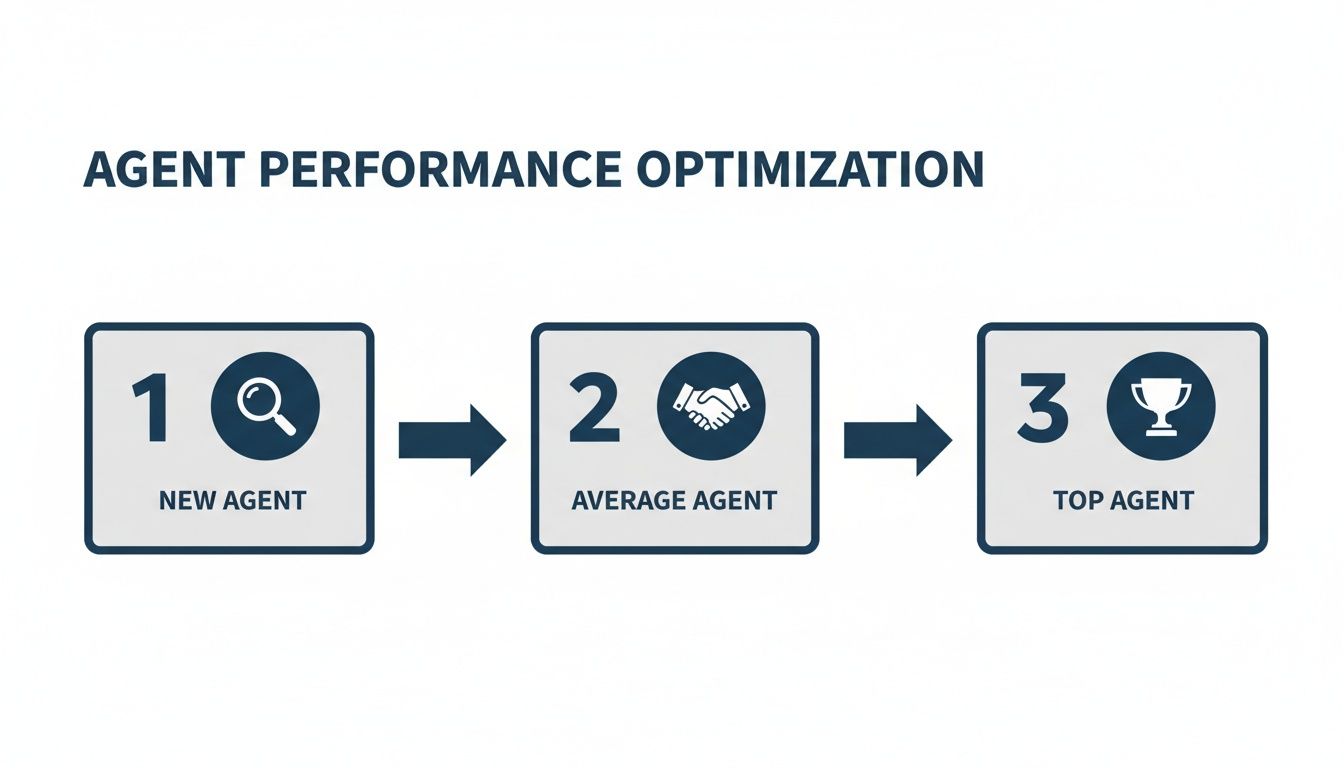
    A diagram illustrates agent performance optimization, showing a progression from new agent to top agent.

    As you can see, success isn't an accident. It comes from evolving your tactics from basic, everyday activities to sophisticated, high-value strategies that set you apart.

    Why Every Single Appointment Counts

    The pressure is on for every meeting you take. Industry benchmarks show that an average agent often needs 3-4 listing appointments to secure just one signed agreement. For newer agents, those odds can be even tougher, sometimes requiring five or more meetings to get a single listing.

    But here’s the good news: Top performers who master their prep and walk in with a customized marketing plan completely flip this script. They often close one deal for every two or three appointments. You can dive deeper into the numbers by checking out these insights on agent conversion rates from MaverickRE.com.

    The gap between an average agent and a top producer boils down to one critical skill: the ability to present a superior marketing plan that a seller can see, touch, and truly understand.

    This guide will show you exactly how to build and present that winning plan.

    The Modern Agent's Listing Appointment Funnel

    The journey from a "maybe" to a signed listing agreement has several distinct stages. While a traditional agent often relies on personality and a standard CMA, a modern, AI-powered agent uses technology to create undeniable value at every step. This table breaks down the difference.

    Funnel Stage Traditional Agent Action AI-Powered Agent Action (Using ListingBooster.ai) Key Outcome
    Prospect Research Performs a basic MLS CMA and glances at Zillow. Conducts deep-dive research on the seller, property history, and local market trends using AI analysis. Arrives with unparalleled knowledge and a hyper-personalized strategy.
    Presentation Prep Prints out comps and a generic marketing flyer. Generates a complete, tailored marketing suite: property websites, AI-written descriptions, video scripts, and social media campaigns. Presents a "ready-to-launch" marketing plan, not just a proposal.
    The Presentation "I'll market your home on these sites…" "Here's the exact property website we’ve built, the SEO strategy we'll use, and the targeted ads ready to go live." Builds immense confidence and differentiates from all competition.
    Closing Asks for the listing with a standard agreement. Secures the listing by showcasing tangible, already-created marketing assets, making the decision obvious. Higher conversion rate and stronger client trust from day one.

    By using a tool like ListingBooster.ai, you transform your entire approach. You're no longer just pitching your services; you're giving the seller a preview of the exceptional, tech-forward experience they'll receive. This simple shift is what makes you the clear and obvious choice.

    Winning the Appointment Before You Arrive

    Let's be honest, the best agents know the listing agreement is usually won or lost long before they ever walk through the seller's front door. The real work—the stuff that actually sets you apart from the three other agents they're meeting—happens in the hours leading up to that kitchen table conversation. This prep work is your secret weapon.

    It all starts by looking past the standard Comparative Market Analysis (CMA). Of course, comps are crucial, but they’re just table stakes. Everyone brings a CMA. Real differentiation comes from digging deeper and doing a full-blown investigation into the property and, just as importantly, the people who own it.

    Uncover the Story Behind the Sale

    Your first mission is to become an absolute expert on their home. I’m not talking about just square footage and bedroom count. You need to get into the nitty-gritty of public records and the property’s complete history.

    • Go Deep on Property History: Pull up everything you can find. Previous sales prices, refinancing activity, any permits pulled for renovations—it all tells a story. A recent refi might hint that their equity position isn't what you'd assume. Permits for a new kitchen or a finished basement are your first clues to major selling points you need to highlight.

    • Figure Out Their "Why": This is where you put on your detective hat. Use public records and a bit of savvy social media sleuthing (ethically, of course) to understand why they're actually moving. Does a LinkedIn profile show a new job in another state? That means you're working with a hard deadline. Are their Facebook photos filled with a new grandchild? They might be downsizing to be closer to family, which is a completely different emotional driver.

    This kind of intelligence is pure gold. It allows you to frame your entire conversation around their specific situation and what matters most to them. You immediately build rapport because it's obvious you’ve done your homework. You’re not just another agent trying to get a listing; you’re a strategic partner who genuinely understands their goals.

    The Power of "Pre-Suasion"

    Once you have this deep understanding, it’s time to put a powerful strategy into play: pre-suasion. This is all about sending a meticulously crafted pre-listing package that shows up before you do. It frames you as the go-to expert and sets the stage for a slam-dunk meeting.

    And I don't mean that flimsy folder with your bio and a business card that most agents drop off. The modern pre-listing package is a bold statement about your value and a sneak peek at your marketing firepower. It’s your first, and best, chance to prove you operate on a totally different level.

    Your pre-listing package has one primary job: to answer the seller’s biggest unasked question before you even meet them—"How are you actually going to market my home to get me the best possible price?"

    A high-impact package instantly shows them you're ahead of the curve. Instead of just promising a great marketing plan, you deliver a preliminary version of it. This is how you leave the agents who just show up with a canned speech and a generic folder in the dust.

    Showcase Your Modern Marketing Plan

    The heart of your pre-listing package should be tangible, concrete proof of your marketing strategy. This is where tools like ListingBooster.ai become an absolute game-changer. In just a few minutes, you can generate an entire suite of custom marketing materials specifically for their property.

    Here’s what a truly modern, AI-powered pre-listing package should include:

    • AI-Optimized Property Descriptions: Show them the exact listing descriptions you've already drafted for Zillow, Redfin, and the MLS. Let them see the powerful language designed to capture buyer attention.
    • AI Search Strategy Overview: Include a simple, one-page graphic or summary that explains how you'll make sure their home shows up when people search on platforms like ChatGPT. You can mention that over 40% of buyers are now starting their search this way, which immediately positions you as a forward-thinking expert.
    • A Sample Social Media Campaign: Don't just talk about social media—show them. Give them a printout of a "Just Listed" Instagram post or a short video script. It proves you're ready to create buzz from the moment they sign.

    When a seller sees this level of proactive preparation, the entire dynamic of the meeting shifts. You’re no longer there to audition for the job. You’re there to collaborate on the brilliant marketing plan you’ve already put in motion. You’ve basically won the most important part of the appointment before you even shake their hand.

    Crafting a Differentiated AI-Powered Presentation

    The listing presentation is your moment on stage. This is where you move beyond just talking a big game and actually prove your marketing chops. Let's be honest, a generic slideshow and a standard CMA are forgettable. What wins the listing before you even ask for it is a compelling, data-driven story that shows exactly how you're different.

    A man in a suit works on a laptop showing a map, with a model house and documents on his desk, depicting a real estate transaction.

    This isn’t about bragging about your brokerage’s market share or how many homes you sold last quarter. It's about structuring a narrative with a clear beginning, a powerful middle, and a decisive end—all laser-focused on the seller's property. The goal? To make the seller feel like you're a modern marketing strategist who has already started working for them.

    Move from Telling to Showing

    The biggest mistake I see agents make is talking in vague generalities. They’ll say things like, "I use social media," or "I'll make sure your home is on all the major websites." That approach is weak and, frankly, unconvincing. Today, you have to demonstrate your marketing prowess with concrete, visual examples.

    Instead of just talking about posting on Instagram, imagine walking in and handing them a complete, ready-to-launch 30-day content calendar for their specific property. Show them the scroll-stopping posts, the compelling video concepts, and the targeted ad copy you’ve already drafted. This simple shift from abstract promises to tangible proof is a game-changer.

    When a seller can see and hold the marketing plan for their own home, it transforms the entire dynamic of the appointment. You’re no longer just an agent pitching for a job; you're a trusted partner executing a strategy.

    Using a tool like ListingBooster.ai lets you generate this entire suite of materials in minutes, turning your prep time into a massive competitive advantage. You walk in with a level of preparedness that other agents simply can't match.

    Demonstrate Your AI and SEO Advantage

    Here’s something most agents miss: a huge number of buyers now start their home search not on Zillow, but by asking AI assistants for recommendations. If your marketing plan doesn't account for this, you're invisible to a massive audience. Explaining this concept to sellers is a huge differentiator.

    You don't need to give them a technical lecture on algorithms. Just keep it simple and relatable.

    • Try this script: "An interesting shift is happening in how people find homes. A lot of buyers now start by asking systems like ChatGPT, 'Show me the best three-bedroom homes with a pool in our area.' My marketing strategy ensures your home's description is written in a way that these AI systems understand and prioritize, putting your property right at the top of their list. While most agents focus only on the old-school websites, we make sure your home is visible everywhere modern buyers are looking."

    To really drive this home, bring a visual aid. Present a side-by-side comparison: on one side, a standard, boring MLS description, and on the other, an AI-optimized description full of the evocative language and structured data that gets a home noticed. It shows them exactly how you create a more discoverable and desirable listing.

    The Anatomy of a Winning Presentation

    Your presentation should feel like a logical and compelling journey. Structure it to build confidence and momentum from the moment you walk in the door.

    1. The Impactful Opening: Start by confirming their goals, referencing the research you did beforehand. This immediately shows you were listening and that this entire presentation is built around their specific needs.
    2. The Strategic Marketing Plan: This is the heart of your presentation. Unveil the tangible assets you've created—the property website, the social media calendar, and the AI-optimized descriptions. Walk them through each piece and explain the "why" behind your strategy.
    3. The Data-Driven Pricing Strategy: Present your CMA not just as a suggestion, but as a strategic positioning plan backed by hard data. Connect the dots and explain how your marketing will justify that price point.
    4. The Powerful Closing: Summarize the immense, tangible value you bring to the table and clearly outline the next steps. Make signing the agreement feel like the natural and obvious conclusion to the conversation.

    This structured approach makes your value proposition easy to understand and almost impossible to refuse. The goal is to leave the seller with a folder full of print-ready materials that prove you are the most prepared, forward-thinking agent they will ever meet.

    Turn Statistics into Signatures

    The data on agent performance really highlights how critical this level of preparation is. Based on industry numbers from 150 raw listing appointments, an average agent can expect about a 65% show rate, which comes out to 98 kept appointments. At the kitchen table, a typical 55% conversion rate on those meetings will yield around 54 listings.

    But here’s where it gets interesting. Pre-appointment differentiation completely changes this math. Agents who show up with a comprehensive analysis and a ready-to-deploy marketing suite created with AI tools immediately boost their perceived expertise. This pushes their conversion rates far, far beyond that 55% benchmark. By showing up with your marketing already done, you're not just another agent—you're the obvious choice.

    Getting Real About Pricing and Objections

    This is it. The moment of truth. When the conversation pivots to the listing price and your commission, this is where you either lock in the listing or lose it. Let's be clear: winning this part of the conversation isn’t about having some slick, memorized rebuttal. It’s about being the unshakable expert in the room, guiding the seller through a logical, data-backed process that makes signing with you feel like the only smart move.

    Two business professionals collaborate on an AI marketing plan, using a tablet and laptop with a visible calendar.

    You have to reframe what's happening. You’re not just throwing out a number; you're revealing the strategic plan that will position their home to win in this market.

    Your CMA is a Battle Plan, Not a Price Tag

    Most sellers think a Comparative Market Analysis (CMA) is just a fancy way of saying "here's the price." It's your job to blow that assumption out of the water. Show them it's the foundation of your entire marketing strategy.

    Don't just flash the final number. Walk them through the story of how you got there, focusing on the real market forces at play.

    • Talk Absorption Rate: Put it in plain English. "Look, right now there are 10 homes like yours for sale in the neighborhood. Buyers are snapping them up at a rate of 2 per month. That gives us a 5-month supply of inventory. This single number tells us exactly how we need to price your home to stand out and get you moving in your timeframe."
    • Show Them Buyer Demand: Bring the data to life. "Homes in this price range, when marketed aggressively, are going under contract in an average of 21 days. Our pricing strategy is designed to catch that first wave of the most serious buyers the moment we go live."

    When you anchor the price to hard data like this, it’s no longer your opinion versus theirs. It’s the market’s reality. You didn't just pick the price; the data dictated it.

    Your CMA shouldn’t just answer, “What’s my home worth?” It should definitively answer, “How will we position this home to attract the most qualified buyers and achieve the highest possible sale price in today’s market?”

    This approach instantly elevates you from salesperson to strategist. It builds the kind of trust that gets contracts signed.

    Turning Objections into Opportunities

    Let’s be honest, objections are going to happen. But they aren't roadblocks; they're buying signals. When a seller pushes back on your commission or pricing, what they're really asking is, "Show me one more time why you're worth it."

    Instead of getting defensive, lean in. Use their questions as the perfect opportunity to circle back to your unique value proposition.

    Here’s how to handle the two big ones you'll hear all the time.

    Objection 1: "Another Agent Said They Could Get Us a Higher Price."

    Ah, the classic. Someone's trying to buy the listing. Don't take the bait and start bad-mouthing the competition. That just makes you look small. Instead, validate their desire and pivot back to your bulletproof strategy.

    • How to Respond: "I completely get why that higher number is attractive—my goal is the exact same as yours, to put the most money in your pocket. To help me understand, did that agent share the specific market data or marketing plan they're using to justify that price? My analysis is based on what today's active, qualified buyers are actually paying. The biggest danger is pricing too high out of the gate. It causes a home to go stale, and that almost always leads to price chasing and a lower final price. My strategy is to create a frenzy of interest right away to drive the price up with real competition."

    Objection 2: "Will You Cut Your Commission?"

    This is a gut check. They’re testing your confidence in your own value. If you discount your fee at the first sign of pressure, you’re basically telling them your service isn't worth what you charge.

    Stand firm. Connect your commission directly to the superior results you deliver. Your AI-powered marketing plan is your ace in the hole here.

    • How to Respond: "That's a perfectly fair question. My commission directly funds the comprehensive marketing investment required to get you top dollar. The advanced AI strategy we've gone over—the targeted social ads, the search engine positioning—that’s all designed to create a bigger buyer pool. More demand and more competition is what gets you a higher sale price. The real cost isn't my commission; it's the money left on the table by an agent with a weaker plan. My entire focus is on maximizing your net profit, and this is the proven way to do it."

    If you want to get a better handle on the real-world costs and value of these systems, it’s worth exploring what leading platforms charge. For example, check out the pricing for ListingBooster.ai to see how these investments translate into tangible services.

    Ultimately, winning the pricing conversation comes down to preparation and conviction. When you present a strategy rooted in undeniable data and tie every objection back to the incredible value you bring, signing with you becomes the easiest, most logical decision they can make.

    Executing a Follow-Up System That Secures the Listing

    Walking out of a listing appointment without a signed agreement isn’t a loss. Think of it as halftime. So many listings are won—or lost—in the silence that follows the meeting. A generic "thank you" email just won't cut it anymore. What you need is a smart, multi-touch follow-up system that keeps you top-of-mind and nudges the seller toward signing with you.

    This kind of methodical approach does more than just show you're interested; it backs up the high level of service you promised in your presentation. It proves your work ethic is already in high gear, long before any contract is signed. It's all about adding real, tangible value with every interaction, making it an easy choice for them to hire you.

    Moving Beyond the Standard Thank You

    Your follow-up sequence can't just be a series of polite check-ins. Every touchpoint needs to be a strategic move, designed to subtly remind them of what sets you apart. The goal is to prove you're already thinking and acting like their agent.

    Here's a simple but incredibly effective three-step sequence you can roll out over the next 48 hours:

    • Touchpoint 1 (Within 2 Hours): The Personalized Video Message. Pull out your phone and record a quick, 60-second video. Mention something specific you loved about their home and connect it back to your marketing plan. Something like, "I'm already thinking about how we can make that incredible backyard the star of our video campaign." It’s personal, fast, and shows you're already on the ball.

    • Touchpoint 2 (The Next Morning): The Value-Add Email. Send a quick email with something genuinely useful, like a market update for their zip code or a link to a recent article on local real estate trends. This positions you as the proactive market expert who is already looking out for their best interests.

    • Touchpoint 3 (24 Hours Later): The Future-Focused Resource. This is a brilliant little move that shows you're listening to their whole story, not just the sale. Send them a link to an AI-generated neighborhood guide for the area they're hoping to move to. It's a small gesture that shows a massive amount of empathy for their entire journey.

    This sequence is powerful because it isn't about pestering them for a decision. It’s about consistently proving your value and expertise, one helpful step at a time.

    Gauging the Temperature and Making the Final Push

    After that initial flurry of contact, you need to read the room. Are their replies warm and engaging, or are they short and to the point? Your next move depends entirely on their vibe. If they're showing interest, it might be the right time to gently push for a decision.

    A great follow-up system isn’t about pressure; it's about persistent, professional value. You win by being the most helpful and proactive agent in their inbox, making the final decision feel like a natural next step.

    If you sense they're still on the fence, send one more piece of value. A link to a glowing testimonial from a past client in their neighborhood can work wonders. Social proof is often the final nudge a seller needs to feel confident. After that, you can make the final call to ask for the signature, framing it as the logical next step to get that powerful marketing plan you built into action.

    This disciplined follow-up is where you win, especially when you're up against other agents. Nationally, real estate lead conversion rates can be depressingly low, sometimes hovering between 0.5% to 1.2%. But here's the kicker: agents who use strong, tech-enabled follow-up systems see 41% higher lead conversion.

    Tools like ListingBooster.ai not only help you build the presentation but also give you the valuable content you need for a killer follow-up sequence. By mixing speed with genuinely useful, automated content, you can blow industry averages out of the water. For a deeper dive, check out these real estate agent conversion rates from The Real Estate Trainer.

    Common Questions About Winning More Listings

    Even with the best game plan, questions are going to pop up. Let's be honest, navigating today's real estate market means keeping up with new tech and ever-changing seller expectations. Here are some of the most common questions I get from agents who are serious about winning more listing appointments.

    A blue "SECURE THE LISTING" sign on a desk with a smartphone displaying real estate images, laptop, and camera.

    What Is the Biggest Mistake Agents Make in a Listing Appointment?

    Easy. The single biggest mistake is making the presentation all about themselves. Too many agents walk in with a canned speech about their brokerage’s sales numbers or their personal awards. I'll be blunt: sellers don't care about your resume. They care about how you're going to sell their home for the most money possible.

    A winning approach completely flips the script. It starts with the deep-dive research we covered earlier, so you walk in already understanding the seller's motivations and what makes their property special. Your presentation then becomes a custom marketing plan, not a sales pitch.

    Don't just say, "I use social media." Show them a 30-day content calendar you've already mocked up for their listing. That's how you demonstrate real, tangible value from the first minute.

    How Can I Explain AI in My Marketing Plan Without Confusing a Seller?

    Keep it simple and always tie the tech back to the result. Sellers don’t need a technical lecture on algorithms, but they absolutely need to see the benefit. Analogies are your best friend here.

    Try something like this:

    "A lot of buyers now start their search by asking AI assistants like ChatGPT for home recommendations. My marketing approach makes sure your property's description is written in a language these new systems understand and prioritize. While other agents just focus on Zillow, we make sure your home shows up everywhere modern buyers are actually looking."

    To really make it click, bring a visual. Show them a printout of a standard, boring MLS description right next to the dynamic, AI-optimized version you created for them. When they see how much more compelling your version is, the value of your approach becomes impossible to ignore.

    How Can I Compete Against Top Producers as a New Agent?

    You win by out-preparing them and using modern strategies they've likely ignored. A lot of seasoned agents lean on their reputation and are still running an old playbook. That's your opening.

    You can walk away with the listing by being the most prepared, most tech-savvy agent they meet. Show up with a level of detail that genuinely wows them. Use tools to create a full marketing suite for their property before you even knock on the door.

    You can frame your newness as a powerful advantage:

    • Your Script: "As a newer agent, my entire business is built on using the absolute latest marketing technology to give my clients an edge. I don't rely on old methods; I focus on what works right now to get your home in front of the most buyers."

    Your hustle, paired with a concrete, modern marketing plan, can easily beat a competitor's long resume. It's a huge part of learning how to win listing appointments when you're building your business. For more strategies, check out the great resources on the ListingBooster.ai real estate blog.

    How Do I Handle the Commission Objection with a Tech-Powered Plan?

    You get ahead of it by demonstrating so much value that the commission becomes an investment, not a cost. When the question of your fee comes up, you aren't defending it—you're explaining the return they're going to get.

    You have to script this out and say it with confidence. Connect your fee directly to the superior marketing you're bringing to the table.

    • Your Script: "That's a fair question. The marketing plan I've laid out for you isn't standard. We're using an AI-powered strategy to make sure your home is found on platforms most other agents completely ignore. That extra visibility, combined with our targeted social media campaigns, is designed to create more competition among buyers, which drives up the final sale price. Really, it's less about the commission and more about the net amount you'll walk away with. My job is to put more money in your pocket by investing in a smarter marketing strategy upfront."

    This completely reframes the conversation. You’re not a cost; you’re a profit center. Your fee is what fuels the engine that gets them a better outcome.


    Ready to walk into every listing appointment with an undeniable competitive advantage? ListingBooster.ai generates a complete, AI-powered marketing suite for any property in minutes. Stop pitching your value and start proving it. Try it free and see how you can win more listings at https://listingbooster.ai.

  • AI-powered real estate marketing: Boost Listings and Close More Deals

    AI-powered real estate marketing: Boost Listings and Close More Deals

    At its core, AI-powered real estate marketing is about using smart software to handle the repetitive, time-consuming tasks that bog agents down. Think about crafting property descriptions, scheduling a month's worth of social media posts, or digging through market data. AI automates and improves these jobs, freeing you up to focus on what truly matters: building client relationships and closing deals.

    It’s the key to gaining a real advantage in a market that waits for no one.

    Winning the First Click in an AI-Driven World

    A hand holds a 'WIN THE FIRST CLICK' sign in front of a modern house and a woman with a brochure.

    The old real estate marketing playbook is officially obsolete. For years, the formula was simple: get your website ranked on Google, throw some money at social media ads, and wait for the leads to trickle in. But that entire model is built on a foundation that's cracking, because the way clients search for homes has fundamentally changed.

    A huge chunk of the market isn't starting on Google anymore. They're asking conversational AI tools for recommendations. This is a massive shift. Traditional SEO was a game of matching keywords. The new game is about becoming such a trusted authority that an AI recommends you by name. If your marketing isn't built for AI to find and understand, you’re basically invisible to this growing group of buyers.

    The New Search Landscape

    Let this sink in: over 40% of homebuyers now begin their search using AI tools like ChatGPT, Perplexity, and Google's AI Overviews, not a standard search bar. This isn't a small trend—it’s a seismic shift that rewrites the rules of digital visibility. For agents sticking to the old ways, this means a huge portion of potential clients will never even see their listings. You can dive deeper into the numbers with these real estate marketing statistics to see just how fast this is happening.

    This is more than just a new tech fad; it's a completely different way for expertise to be discovered online. AI-powered real estate marketing isn't just a nice-to-have; it's the necessary response to meet modern buyers and sellers where they're actually looking for answers.

    Think of it like this: Traditional marketing was like putting a billboard on a busy highway. AI-powered marketing is like having a trusted local guide who personally recommends you to every traveler asking for the best place to live.

    Why Your Old Marketing Habits Are Failing

    The biggest problem with the old way is that manual marketing efforts just can't keep up anymore. The sheer volume of work—fresh social media content every day, perfectly optimized listing descriptions, and up-to-the-minute market analysis—is enough to burn out even the most dedicated agent.

    Take a look at how the daily grind of real estate marketing is being completely reshaped by AI. The table below contrasts the time-consuming tasks of yesterday with the intelligent, automated workflows available today.

    Old Marketing Habits vs New AI Strategies

    Marketing Task The Traditional Manual Approach The Modern AI-Powered Approach
    Listing Descriptions Spending hours writing and rewriting descriptions, trying to fit different portal requirements. Instantly generate multiple versions of a compelling description, each tailored for MLS, Zillow, social media, and more.
    Social Media Posting sporadically "when you have time," leading to an inconsistent and ineffective online presence. An automated calendar posts high-quality, relevant content for you daily, building a consistent and authoritative brand.
    Lead Nurturing Manually responding to every inquiry, often with a delay that costs you the lead. AI-driven chatbots provide instant, 24/7 responses to common questions, qualifying leads while you sleep.
    Market Analysis Spending days pulling comps and manually crunching numbers to understand local market trends. Generate in-depth, hyper-local market reports in minutes, positioning yourself as the neighborhood expert.
    Content Creation Struggling with writer's block to create blog posts or neighborhood guides to boost SEO. Produce well-researched, engaging articles and community content with a few clicks, establishing your digital authority.

    As you can see, the shift isn't just about saving time; it's about producing better, more consistent results that manual methods simply can't match.

    An AI-driven strategy positions you as an authority before you even get the listing. It builds your reputation as the go-to expert in your market, so when a user asks an AI, "Who is the best agent in Anytown, USA?"—your name is the one that comes up.

    Adopting AI-powered real estate marketing is more than an upgrade. It’s a strategic decision to stay relevant and win that all-important first click in this new digital arena.

    How AI Works as Your Marketing Co-Pilot

    Let's cut through the jargon. What is AI-powered real estate marketing, really? It’s not some complicated, futuristic robot taking over your job. It's much simpler and more practical than that.

    Think of it like having a dedicated marketing assistant—a co-pilot—sitting next to you. This co-pilot handles all the tedious, repetitive digital marketing tasks that eat up your day. You know the ones: writing property descriptions, scheduling social media posts, and formatting everything for different websites.

    This isn't about replacing your expertise; it's about amplifying it. The AI does the heavy lifting in the background, freeing you up to focus on what you do best: building relationships, negotiating deals, and being the trusted guide your clients need. It’s a force multiplier that takes one simple input—a property address—and spins it into a complete marketing campaign.

    Turning a Single Address into a Full Campaign

    The real magic happens when you see how an AI system connects the dots. When you give a tool like ListingBooster.ai a property address, it doesn't just see a pin on a map. It instantly dives into a sea of data to build a smart marketing plan from the ground up.

    Here’s a quick look under the hood:

    • It Gathers the Intel: The AI pulls from public records, MLS data, and current market trends tied to that specific property. It instantly identifies the key selling points, neighborhood perks, school districts, and recent comps.
    • It Writes the Story: Using all that data, it starts writing. It doesn't just spit out one generic description; it creates multiple versions tailored for different platforms—a detailed one for the MLS, a punchy one for Zillow, and a short, engaging one for an Instagram caption.
    • It Builds the Campaign: This goes way beyond just descriptions. The AI maps out an entire content plan for you. It designs social media posts for the new listing, graphics for the open house, "just sold" announcements, and even local market updates that establish you as the go-to expert.

    What used to take hours of painstaking work—or even days, if we're being honest—is now done in minutes. Every single one of your listings gets a professional, comprehensive marketing launch without you having to sacrifice your valuable time.

    The Core Jobs of Your AI Co-Pilot

    At its core, your AI co-pilot is built to handle three critical parts of your marketing: creating content, optimizing your listings on portals, and managing your social media. By taking these off your plate, it consistently builds your online presence, almost on autopilot.

    Your AI co-pilot doesn't just save you time—it builds a consistent, professional brand that works around the clock. It's the engine driving your digital reputation, making sure you’re always visible and authoritative online.

    Let's break down what this looks like day-to-day.

    • Compelling Listing Descriptions: No more writer's block. The AI crafts descriptions that are both factually accurate and emotionally resonant, using proven sales copy techniques to grab a buyer's attention and highlight a home's best features.
    • Automated Social Calendars: It actually plans out a full 30-day social media schedule based on your listings and the local market. This means you maintain a consistent, engaging presence on Facebook and Instagram without the daily stress of wondering what to post.
    • Property Portal Optimization: The AI knows that a listing description for your local MLS needs a different touch than one for a national portal like Zillow. It creates unique, optimized content for each one, helping your listings stand out and get seen by more potential buyers.

    By weaving these tasks together, AI-powered real estate marketing creates a self-sustaining system for your brand. Every new listing becomes another opportunity to reinforce your expertise, capture new leads, and solidify your reputation as the agent to know in your market. That consistent, high-quality output is exactly how you build a dominant digital footprint.

    Building Your Automated Content Engine

    Let's be honest, the daily grind of content planning is a huge time suck. That feeling of staring at a blank cursor, trying to figure out what to post on Instagram or how to word a new listing description—it’s exhausting. What if you could get rid of that stress for good? This is where an AI-powered real estate marketing engine comes in, and it's less science fiction and more practical magic.

    The whole idea is to take what used to be a week's worth of marketing prep and shrink it down to just a few minutes. You start with one simple piece of information, usually just the property address, and the system does the rest. It spits out a complete, ready-to-go marketing campaign. This isn't just about saving time; it's about giving every single one of your listings the top-tier, professional launch it deserves, without fail.

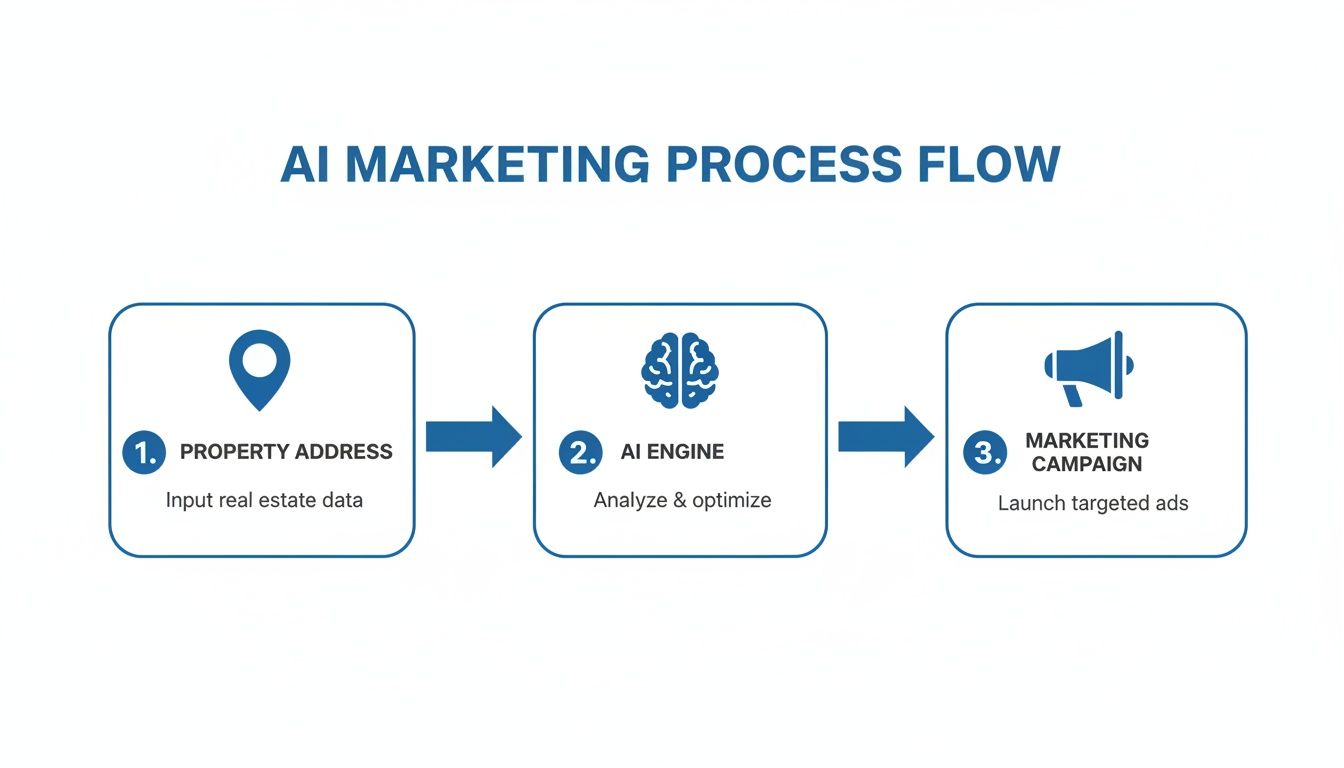
    This flow chart breaks it down perfectly. A single address goes in, the AI works its magic, and a full campaign comes out the other side.

    AI marketing process flow for real estate, showing data input, AI analysis, and targeted ad campaigns.

    The real takeaway here is the straight line from a simple input to a sophisticated, multi-channel output. It pulls you out of the most tedious parts of marketing.

    Crafting a Diverse and Engaging Content Mix

    A smart AI tool knows that a successful social media feed isn't just an endless stream of "New Listing!" posts. That gets old, fast. To keep people genuinely interested, you need variety. The goal is to build a dynamic content calendar that tells the full story of a property and, just as importantly, reinforces your expertise.

    An automated engine will generate a whole mix of content, with each piece tailored for a specific moment in that listing's journey.

    • New Listing Announcements: These are your big, flashy first impressions, designed to grab attention with the property's best features.
    • Open House Promotions: Think engaging graphics and captions that create a little FOMO (fear of missing out) and drive people to your event.
    • Price Adjustment Updates: A good AI frames a price drop not as a failure, but as a fresh opportunity for motivated buyers.
    • "Just Sold" Celebrations: This is all about social proof. These posts show off your success and build trust in your local market.
    • Neighborhood Spotlights: You’re selling a lifestyle, not just four walls. This content highlights local parks, coffee shops, and schools to paint a bigger picture.

    With a platform like ListingBooster.ai, this entire suite of content gets created from a single property link. It helps you maintain a consistent, professional, and authoritative voice across Facebook, Instagram, TikTok, and wherever else you’re active. For more ideas on building your brand, you can find a ton of great tips on the ListingBooster.ai blog.

    The Psychology Behind Scroll-Stopping Captions

    The best AI marketing tools don't just state facts; they act like seasoned copywriters. They lean on proven psychological frameworks to write captions that actually stop people from scrolling and get them to engage.

    This has nothing to do with robotic, generic text. It’s about tapping into the very real human emotions that drive big decisions, like buying a home.

    By embedding proven sales psychology directly into the content, an AI engine transforms a simple property update into a compelling call to action. It ensures your marketing resonates on an emotional level, not just an informational one.

    These systems are trained on marketing principles that have worked for decades. They know how to strategically weave these concepts into every post to get the biggest impact and inspire people to take the next step.

    Key Psychological Triggers in AI Content

    Here’s a look at how these triggers work in practice:

    Trigger How It's Used in Real Estate Marketing Example AI-Generated Post
    Scarcity Creates a sense of urgency by highlighting that the property is unique or won't be available for long. "The only home in the district with a walk-out basement under $500k. This one-of-a-kind opportunity won't last long!"
    Social Proof Builds trust by showing that others are interested or have had a positive experience. "We had over 20 groups through our open house this weekend! Don't miss your chance to see what everyone is talking about."
    Aspiration Helps buyers envision themselves living a better life in the new home. "Imagine your summer evenings spent on this beautiful patio. Your dream lifestyle is waiting at 123 Maple Street."

    By automatically baking these persuasive techniques into your posts, AI-powered real estate marketing turns your content from simple announcements into strategic assets that actually produce results. This automated engine doesn't just fill your calendar; it fills it with content that is engineered to convert, helping you build a powerful brand and a healthy sales pipeline with a fraction of the effort.

    Optimizing Listings for Both AI and Human Buyers

    Person holds a tablet displaying a house image and 'AI Optimized Listings' text, promoting real estate.

    In today's market, every property listing has two jobs. First, it has to connect with people on an emotional level, helping them picture their future in that home. But just as importantly, it needs to speak the language of algorithms, making sure it gets found by the AI systems that now power so many property searches.

    This dual focus is where you can find a huge, often overlooked, advantage. Writing a beautiful description isn't enough anymore. You have to strategically build your listings to be discoverable by people and machines, turning every property you represent into a magnet for the right audience.

    Speaking Two Languages at Once

    Think of it like this: your listing description has two completely different audiences. A human buyer is searching for a story. They want to feel the warmth of the "sun-drenched breakfast nook" or imagine hosting game night in the "spacious, open-concept living area." They respond to evocative language that paints a vivid picture.

    An AI algorithm, on the other hand, is scanning for cold, hard facts. It’s looking for structured data and specific keywords like "quartz countertops," "fenced backyard," and "three-car garage." It uses these data points to categorize the property and match it precisely to a user’s search. A truly effective AI-powered real estate marketing strategy delivers both.

    The art of modern listing optimization is crafting a narrative that captivates a human buyer while simultaneously embedding the structured data that AI search engines need to understand and recommend your property.

    Tailoring Descriptions for Every Platform

    One of the most time-consuming parts of marketing a new listing is tweaking the description for every single platform. The MLS has one character limit, Zillow has another, and an Instagram caption needs to be way shorter and punchier. Doing this manually for every property is a grind, and it often results in bland, copy-pasted text that doesn't perform well.

    This is exactly the kind of task an AI co-pilot was built for.

    • For the MLS: The AI can generate a detailed, comprehensive description loaded with all the essential features and keywords that other agents and their automated search tools are programmed to find.
    • For Zillow and Realtor.com: It whips up a more consumer-friendly version, highlighting lifestyle benefits and emotional hooks that grab the attention of buyers scrolling through the portal.
    • For Social Media: It produces short, scroll-stopping captions—complete with emojis and strong calls to action—perfectly formatted for platforms like Facebook and Instagram.

    Tools like ListingBooster.ai handle all of this automatically, generating multiple optimized versions of your description in seconds. This ensures your property looks its best on every channel, maximizing its reach without you lifting a finger. You can see more on how this works for individual agents seeking a competitive edge.

    Making Your Listings AI-Readable

    Beyond just using the right keywords, making a listing truly "AI-readable" involves something called schema markup. That might sound technical, but the idea is simple. It’s like adding invisible tags to your listing data that tell search engines like Google and ChatGPT precisely what each piece of information is.

    For example, instead of just seeing the number "3," schema markup tells the AI, "This number represents the bedroom count." This clarity helps AI systems confidently understand a property's features and serve it up to users asking specific questions like, "Show me three-bedroom homes with a pool near downtown."

    This structured approach is becoming crucial as the real estate AI market is projected to surge from $222.65 billion in 2024 to $303.06 billion in 2025, with AI expected to automate around 37% of industry tasks. By making your listings AI-readable now, you're positioning them to be found in this new search environment, giving yourself a distinct and lasting advantage.

    How to Scale Your Brokerage and Stay Compliant with AI

    As a real estate team or brokerage grows, a huge challenge surfaces. How do you keep your brand voice consistent and your marketing legally buttoned-up when dozens—or even hundreds—of agents are all creating their own content? This is exactly where AI-powered real estate marketing stops being just a cool productivity hack and becomes a critical tool for running the business.

    Left to their own devices, individual agents will naturally develop their own styles. That can lead to off-brand social media posts, wildly different messaging, and visuals that just don't meet the brokerage's standards. Over time, this erodes the brand you've worked so hard to build, making the whole operation look fragmented and less professional.

    Creating One Unified Voice for Your Entire Team

    Think of an AI platform as your central brand guardian. It’s a place where brokerage leadership can set up pre-approved templates, lock in a specific tone of voice, and make sure every single piece of marketing—from a just-listed post to a quarterly market report—sticks to the company playbook.

    This solves a massive operational headache. Instead of a manager having to manually review every agent's content or clean up the mess from a bad graphic, you empower the entire team with a tool that builds quality in from the start. Agents get to use professional-grade marketing assets, and the brokerage protects its identity, no matter how big it gets.

    This isn't about stifling creativity. It’s about giving every agent a professional framework that makes all of their marketing better. It means every agent, no matter their design experience, represents the brokerage with polish and authority.

    Automated Compliance That Manages Your Risk

    Branding is one thing, but the most important job AI can do for a brokerage is automate compliance. The risk of an agent accidentally violating Fair Housing laws with a poorly worded ad is a massive legal and financial liability. For any growing brokerage, trying to manually police every single caption and property description is a fool's errand.

    A smart AI marketing engine has compliance built right into its DNA. Before any content ever sees the light of day, the system automatically scans it for words and phrases that could be flagged as discriminatory or violate Fair Housing rules.

    This built-in check is constantly on the lookout for language that might suggest a preference or limitation based on protected classes, such as:

    • Familial Status: Catching phrases like "perfect for singles" or "no kids allowed."
    • Race or National Origin: Flagging any descriptions of a neighborhood's demographics.
    • Religion: Making sure that mentioning a nearby church or temple doesn't imply a religious preference.
    • Disability: Avoiding problematic terms like "not handicap accessible" in public-facing copy.

    This automated safety net completely changes the game for risk management. It turns AI-powered real estate marketing from a simple content tool into a powerful compliance engine that protects the brokerage from expensive lawsuits and damage to its reputation.

    For any organization ready to give their agents these kinds of safeguards, checking out the team options in a ListingBooster.ai pricing plan is the clear next move. It’s how you get enterprise-level protection that actually works for teams of any size.

    What Comes Next: Predictive and Agentic AI

    The AI tools making waves in real estate right now are mostly about generation—they're fantastic at writing property descriptions, drafting social media posts, and building marketing plans. That’s a huge time-saver, but it's really just the first inning of a whole new ballgame. The next leap forward is moving from creating content to autonomously performing tasks.

    Welcome to the world of predictive and agentic AI. Don't think of this as just a smarter writing assistant. Think of it as a junior agent who works around the clock, 24/7, without ever needing a coffee break.

    The Shift from Reactive to Proactive Marketing

    This jump from generative to agentic AI completely flips the script on how we approach marketing. For decades, our marketing has been reactive: you get a new listing, so you create a campaign for it. Agentic AI makes marketing proactive by figuring out what you need before you even know you need it.

    Imagine an AI that doesn't just write a "Just Listed!" post. Instead, it analyzes local market data and predicts the exact price point that will attract the most qualified buyers before the listing even goes live. Better yet, it could scan your CRM, find potential buyers who’ve looked at similar homes in the past, and have a targeted email campaign ready for your approval.

    This is the future of AI-powered real estate marketing—it’s not just about announcing what’s for sale. It’s about predicting who wants it and automatically reaching out to them. You're always two steps ahead of the market.

    Meet Your Future AI Agent

    The "agentic" part of agentic AI means the system can handle complex, multi-step jobs all by itself. For a real estate agent, this means handing off those time-sucking workflows that bog you down every day.

    Research from Gartner suggests that by 2028, approximately 15% of day-to-day work decisions could be made by AI agents. What does that actually look like? An AI could have a text conversation with a new lead to qualify them, automatically update their profile in your CRM, and even schedule a showing on an open slot in your calendar—all without you lifting a finger. You can get a deeper look into how AI will reshape the industry and what it means for your business.

    This might sound like something out of a sci-fi movie, but it’s the logical next step from where we are today. Every time you use a tool like ListingBooster.ai to whip up a social media calendar or tweak an MLS description, you're building the skills and trust needed for this next phase. Getting comfortable with today's AI is how you prepare to take full advantage of tomorrow's truly autonomous assistants.

    Frequently Asked Questions

    Jumping into AI-powered marketing brings up a lot of good questions. Agents I talk to are usually curious about how authentic it feels, how hard it is to learn, and—let's be honest—what it means for their jobs. Let's tackle these head-on.

    Does AI-Generated Content Feel Authentic?

    It does, but only if you think of it as a creative partner, not a robot doing your job for you. A smart AI tool acts like a skilled assistant, giving you a solid first draft built on marketing principles that actually work.

    Your job is to take that draft and inject your personality and local market knowledge into it. This whole process takes seconds, not hours. You’re not replacing your voice; you’re just getting a massive head start and skipping the blank page altogether.

    How Long Does It Take to Get Started?

    You can be up and running in the time it takes to grab a coffee. Seriously. Today's best platforms are built for busy agents, not software developers. The initial setup usually takes just 5-10 minutes.

    Just paste in a property URL or a few details, and the system can generate everything from social media posts to compelling MLS descriptions almost instantly. The design is so intuitive that you’ll feel like a pro from day one.

    Will AI Marketing Replace Real Estate Agents?

    Nope. AI won't replace agents, but agents who use AI are absolutely going to have an edge over those who don't. Think about it: these tools automate the tedious, soul-crushing parts of marketing—writing endless social posts, analyzing data—so you can focus on what you’re truly great at.

    AI is here to make you a better agent, not an obsolete one. It frees up your time so you can be out there building relationships, negotiating deals, and being the go-to expert your clients need.

    This isn't about replacement; it's about elevation. You get to operate at a higher level, focusing on the high-impact activities that actually close deals and build your reputation.

    Is AI Marketing Technology Affordable?

    Absolutely. Top-tier AI marketing tools are surprisingly budget-friendly. Many platforms start at a price that’s a tiny fraction of what you’d pay for a virtual assistant or social media manager—some plans are as low as $35 per month.

    Most even offer a free trial, so you can see the results for yourself without any risk. This really levels the playing field, giving every agent access to the kind of powerful marketing technology that was once reserved for the biggest brokerages.


    Ready to stop wasting time on marketing and start focusing on what you do best? With ListingBooster.ai, you can generate a complete 30-day marketing campaign in minutes. Start your free trial today and see how easy it is to build your brand and win more listings.

  • AI Marketing for Real Estate Agents: How It’s Used and Where It Fits

    AI Marketing for Real Estate Agents: How It’s Used and Where It Fits

    You've likely heard the buzz around "AI marketing for real estate agents," but what does it actually mean for your business? Forget the complex jargon. At its core, AI marketing is about using smart technology to automate and improve the repetitive, time-consuming parts of your job, allowing you to focus on client relationships and closing deals.

    Think about the hours spent writing property descriptions, creating social media posts, or preparing materials for a listing presentation. AI tools can handle much of that heavy lifting, providing a consistent and professional foundation for your marketing efforts. This guide explains what AI marketing means in practice, how agents are using it, and where it fits into a modern real estate workflow.

    What AI Marketing Means in Real Estate

    A laptop shows real estate listings next to a sign 'AI for Agents', a coffee, and a notebook.

    In plain language, AI marketing for real estate agents isn't about robots replacing agents. It’s about leveraging technology as an efficient assistant that handles critical marketing tasks with speed and consistency. Instead of staring at a blank page trying to find a new way to describe "natural light," you can input a property's key features and receive a polished, MLS-compliant description in seconds.

    The practical value of AI is how it streamlines day-to-day operations. It supports agents in several key areas:

    • Listing Descriptions and Property Content: Generate compelling property narratives that meet MLS guidelines and are optimized for different platforms.
    • Search Visibility: Structure listing content to improve how it appears on Google, major portals, and even in new AI-powered search tools.
    • Social Media Content at Scale: Create and schedule a consistent stream of posts, market updates, and property highlights without the daily grind.
    • Listing Presentation Preparation: Quickly assemble marketing plans and competitive analysis to present to potential sellers.
    • Time Savings and Consistency: Reclaim hours previously spent on manual content creation while ensuring every marketing piece maintains a professional tone.

    The goal isn't to replace your expertise—it's to amplify it. AI handles the grunt work, freeing you up to focus on strategy, building relationships, and negotiating deals.

    Common AI Marketing Use Cases for Agents

    Let’s move from theory to practice. Savvy agents are integrating AI into their workflows to work smarter, not just harder. This isn't a futuristic concept; it's a real advantage being used today. Here are the most common use cases, framed as workflow support rather than a magic solution.

    Content Creation for Listings

    The most immediate application is generating marketing content for new listings. Agents use AI to create multiple versions of property descriptions from a single set of details. This means getting a concise, MLS-compliant description while simultaneously producing a more detailed, story-driven narrative for a personal website or blog.

    Platform-Specific Optimization

    Different platforms have different rules and audiences. AI helps tailor content for specific channels like the local MLS, Zillow, and Realtor.com. This includes adjusting character counts, formatting, and highlighting features that perform best on each site, improving a listing’s visibility and appeal.

    Social Media Scheduling and Post Generation

    Consistency is key to social media, but it's incredibly time-consuming. Agents use AI to generate an entire month's worth of social media posts for a listing, including captions, image suggestions, and relevant hashtags. This ensures a steady online presence without the daily effort.

    Presentation and Pre-Listing Materials

    One of the most powerful uses is in preparing for listing appointments. Instead of scrambling to pull together examples of past work, an agent can use AI to generate a custom marketing preview for a prospective seller's property. This includes a draft listing description, a sample social media plan, and a competitive marketing analysis, demonstrating proactive expertise.

    Authority and Market Content

    Beyond individual listings, AI is used to establish local expertise. Agents can quickly draft insightful neighborhood guides, market trend analyses, and helpful blog posts. By consistently publishing valuable information, they build their brand and become a trusted resource in their community.

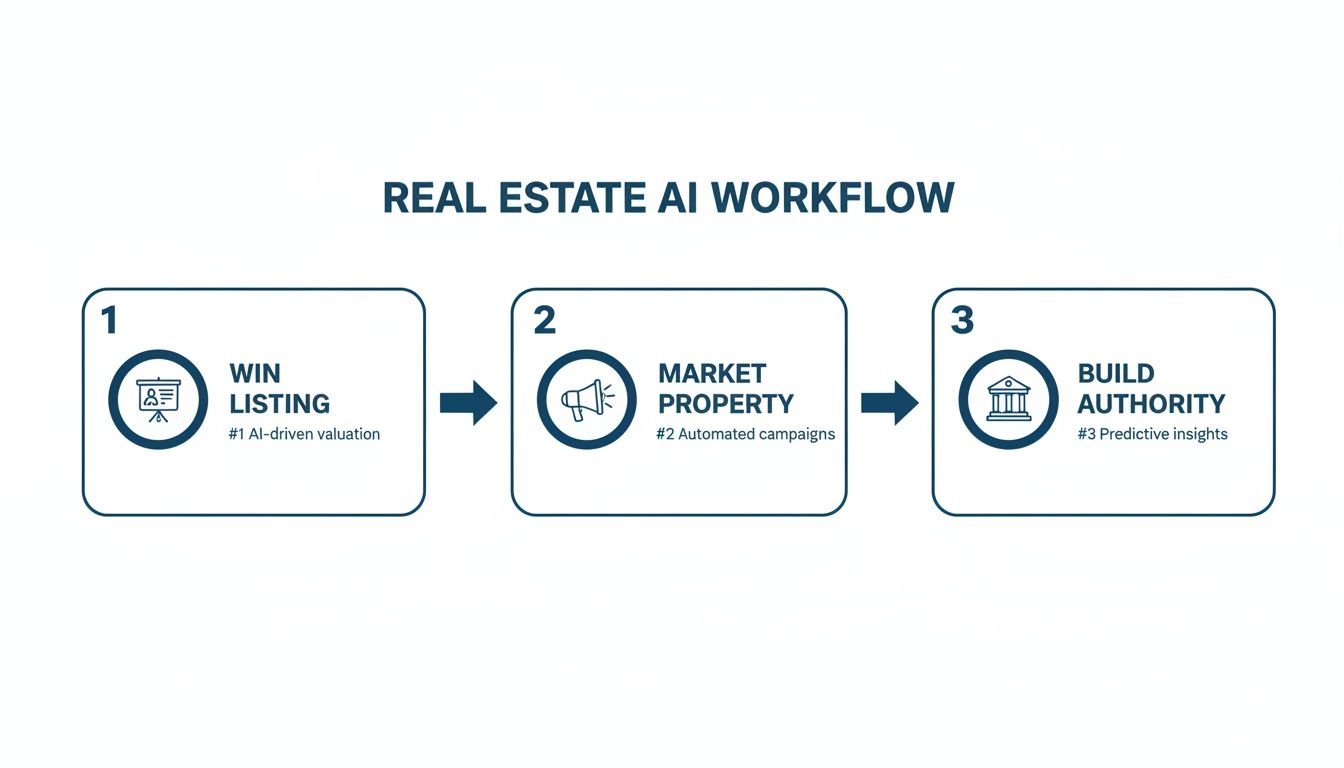
    Real Estate AI workflow diagram illustrating three steps: Win Listing, Market Property, and Build Authority.

    This isn't just a trend; it's a massive shift. Projections show that by 2026, AI will be a core part of real estate, with 70% of professionals adopting new tools annually. Morgan Stanley even estimates that automating just 37% of an agent's tasks could unlock $34 billion in efficiency gains. You can read the full 2026 State of AI in Real Estate Marketing report to dig deeper into the data.

    Tools Agents Use to Support AI-Driven Marketing

    Once agents understand the use cases, the natural next question is about the tools. It’s crucial to see these tools as assistants that execute a strategy, not as replacements for an agent’s judgment. They make tasks faster and more consistent.

    AI marketing for real estate agents typically combines content creation, distribution, and consistency. While some agents rely on general-purpose AI writing tools, others use real estate–specific platforms that account for MLS formatting, platform requirements, and presentation needs. Tools in this category include a mix of general AI assistants and industry-focused platforms such as ListingBooster.ai, depending on how structured an agent’s marketing workflow needs to be.

    Listing Content & Presentation Tools

    These tools focus on preparing listing descriptions, platform-specific content, and materials agents use during listing appointments. They are designed to streamline the pre-listing and active marketing phases.

    • ListingBooster.ai – A real estate–specific AI platform used by some agents to generate MLS-compliant listing descriptions, platform-specific marketing content, and presentation materials as part of their overall marketing workflow.
    • General AI Writers – Tools like ChatGPT can be used with specific prompts to draft property descriptions, blog posts, and other marketing copy. They require more detailed instruction to ensure real estate compliance.

    General AI Assistants and Schedulers

    Another common approach is pairing a general-purpose AI writer with a social media scheduling tool that has AI features.

    • AI-Powered Social Schedulers: Many popular social media management platforms now integrate AI to suggest optimal posting times, generate caption variations, or create simple graphics, helping agents maintain an active presence.

    The choice between a general tool and one built for real estate often comes down to workflow preference. Specialized platforms save time because they understand industry terminology and compliance from the start. General tools offer flexibility but require more effort to guide.

    Recent data shows the impact of these strategies: 60% of agents report their highest ROI is coming from social media marketing, often powered by AI, and 52% of leads generated through these efforts are higher quality. You can find more eye-opening AI agent statistics on warmly.ai to see how quickly the landscape is changing.

    How AI Shapes Your Brand and Puts You on the Map

    Laptop with marketing analytics dashboards and 'BOOST YOUR BRAND' text overlay, set against a blurred background of houses.

    Adopting AI into your marketing is more than a time-saver; it’s an upgrade to your brand's digital presence. Consistent, high-quality content is the foundation of online visibility. By using AI to produce polished, platform-specific content for every listing, you expand your digital footprint and improve your visibility on traditional search engines and emerging AI-powered search platforms.

    This consistency presents your brand as a sophisticated, modern marketing operation, which is increasingly important to potential sellers.

    Moving Beyond Automation to Build Real Authority

    The true value of AI marketing emerges when it helps you build authority at scale. By consistently publishing insightful market updates, neighborhood guides, and helpful content, you position yourself as the go-to local expert.

    Seller expectations are rising. They seek partners with a clear, tech-forward marketing strategy. The AI sector in real estate is projected to grow from $222.65 billion in 2024 to $303.06 billion in 2025, signaling a massive industry transformation. You can find more real estate marketing statistics here to understand the full scope.

    AI isn't about replacing what you do. It's about amplifying your expertise, building your reputation, and showing sellers you're equipped to win in a competitive market.

    Answering Your Questions About AI in Real Estate

    Adopting new technology naturally brings up questions. Here are answers to some of the most common inquiries from agents considering AI for their marketing.

    Do I Need to Be a Tech Whiz to Make This Work?

    Not at all. Modern real estate AI platforms are designed for agents, not developers. If you can enter a property address or copy and paste information, you have the necessary skills. The purpose of these tools is to simplify your job, not add another complex system to manage.

    What About Fair Housing Compliance?

    This is a critical consideration and a significant benefit of using a real estate-specific AI tool. The best platforms are trained on Fair Housing guidelines to help avoid discriminatory language. AI focuses objectively on a property's features—like granite countertops or a fenced yard—rather than making assumptions about potential residents. While you are always the final reviewer, the AI provides a compliant foundation to build upon.

    Can AI tools real estate agents use help me win more listings?

    Yes, by making you appear more prepared and professional. When you walk into a listing presentation with a complete, ready-to-launch marketing plan—including a sample MLS description and a 30-day social media calendar—you demonstrate a level of marketing savvy that builds immediate trust and sets you apart from the competition.

    Is This Going to Replace My Professional Copywriter?

    Think of AI as a powerful assistant, not a replacement for human expertise. It can get you 80% of the way to a finished piece of marketing content in seconds. Your role is to add the final 20%—the unique neighborhood insights, personal voice, and local details that only an expert can provide. The AI handles the heavy lifting, freeing you to focus on the high-value strategic touches.

    Conclusion

    AI marketing in real estate isn’t about replacing agents—it’s about reducing manual work and improving consistency. As expectations around digital presence and content quality increase, agents are experimenting with different ways to integrate AI into their marketing workflows. The specific tools matter less than understanding how AI fits into listing preparation, presentation, and ongoing visibility. To learn more, visit the real estate marketing blog.