A listing can have strong photography, sharp pricing, and a solid property, then still underperform online because the description isn't doing the right job in the right place.
That's the part many agents miss. They write one paragraph, paste it everywhere, and assume syndication will handle the rest. It won't. The MLS, Zillow, Realtor-style portals, and social posts don't reward the same kind of copy. One needs precision. Another needs clarity. Another needs a hook strong enough to stop a thumb mid-scroll.
The MLS description vs Zillow description question isn't whether one matters more. It's whether your message survives the trip from listing input to buyer view without losing accuracy, readability, or compliance.
When a Great Listing Goes Unseen
A common scenario looks like this. The home is clean, updated, and priced in line with the market. Photos are professional. The yard shows well. Yet the listing sits with fewer inquiries than expected, and the seller starts asking the question every agent dreads: “Why aren't we getting more traction?”
Often, the issue isn't the house. It's the copy.
I've seen agents load the MLS with every feature they can think of, then wonder why the portal version reads flat. I've also seen the opposite: a polished consumer-facing paragraph that sounds nice on Zillow but leaves out the details another agent needs to schedule a showing with confidence. In both cases, the property loses momentum because the description was written once instead of designed for distribution.
A listing description doesn't fail only when it's badly written. It also fails when it's placed in the wrong format for the channel reading it.
That's the practical challenge behind MLS description vs Zillow description. The problem isn't merely agent audience versus buyer audience. The problem is message transfer. What starts as a fact-first entry in the MLS may show up on Zillow shortened, reformatted, or stripped of the visual cues that made it readable in the first place.
What agents should focus on
- Start with channel intent: MLS is formal and fact-first. Zillow and Realtor-style pages need consumer clarity. Social needs a scroll-stopping angle.
- Build one core message: Pull out the property's strongest facts, best benefits, and most searchable phrases before you write anything.
- Adapt instead of duplicating: You're not creating extra work when you tailor copy. You're preventing weak syndication from doing the tailoring for you.
When listings underperform, rewriting the description is one of the fastest fixes available. Not because words solve every problem, but because words control how buyers and agents interpret everything else they see.
MLS vs Zillow Purpose and Presentation
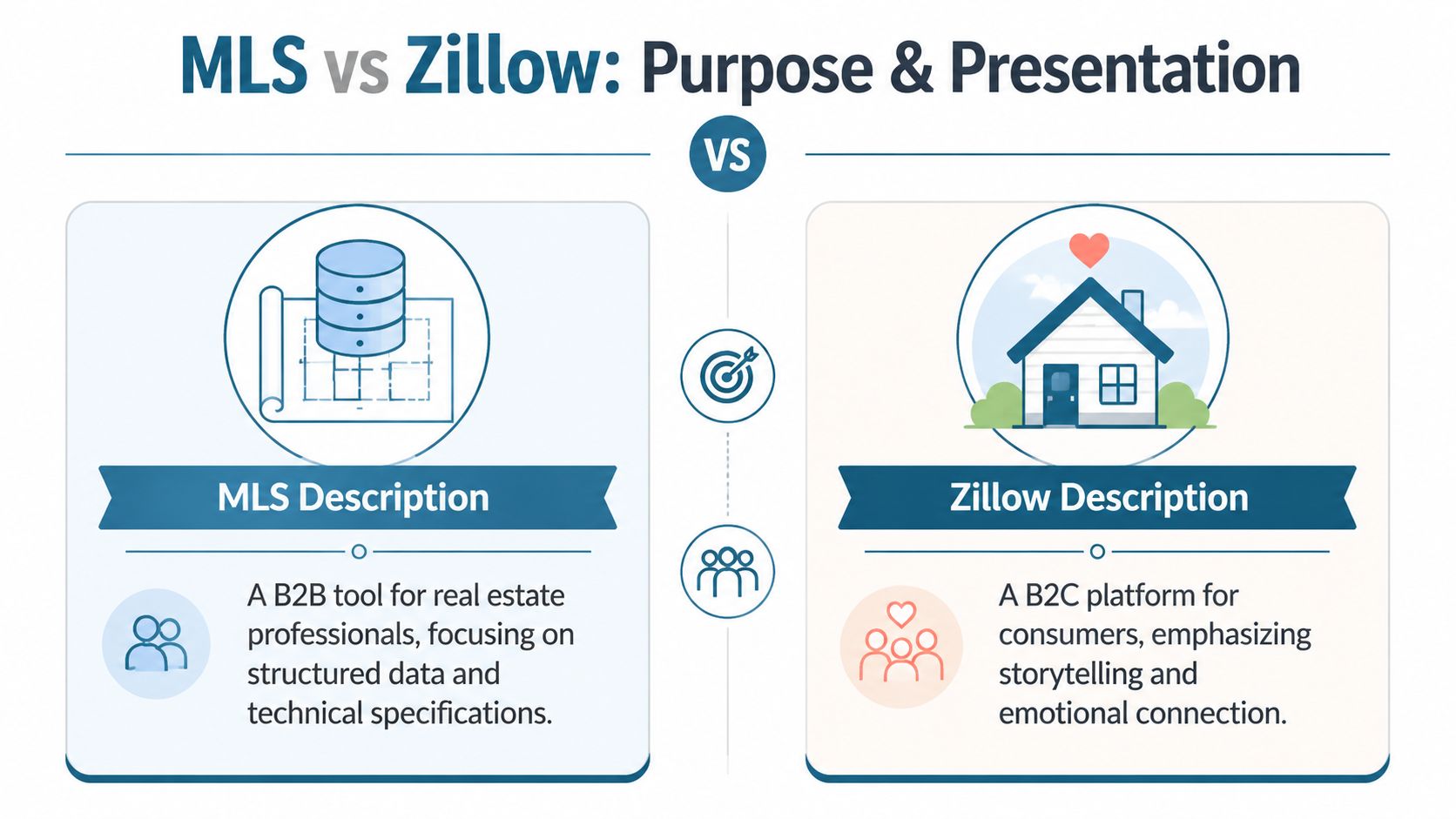
The cleanest way to think about MLS description vs Zillow description is this: the MLS is a professional operating system, while Zillow is a consumer storefront.
The MLS holds the structured record. Zillow packages that information for browsing. Those are related jobs, but they're not the same job.
| Factor | MLS description | Zillow description |
|---|---|---|
| Primary audience | Agents, brokers, appraisers, and other professionals | Buyers browsing homes online |
| Main purpose | Accuracy, completeness, and listing workflow support | Clarity, interest, and consumer engagement |
| Writing style | Fact-first, structured, compliance-aware | Shorter, benefit-led, easier to scan |
| Data environment | More exhaustive listing structure | Lighter presentation layer around listing details |
| Practical role | Often treated as the authoritative source for active details | Marketing layer for discovery and inquiry |
Why the formats are different
A practical historical difference is length and data density. Zillow's own guidance says a property description should be 250 words or less because of space limits on MLS and Zillow, while an independent comparison reports that the average MLS listing contains over 200 fields versus Zillow's 40–90 fields. The same comparison also notes that the MLS in the U.S. is a network of over 900 regional databases, which is part of why agents treat MLS remarks as the authoritative source for active listing details (Joy Watson's MLS and Zillow comparison).
That difference should change how you write. MLS copy has to support precision inside a structured database. Zillow copy has to work when a buyer scans several listings in a row on a phone.
What that means in practice
- MLS rewards completeness: If a feature affects value, showing suitability, or agent understanding, it belongs in the record.
- Zillow rewards readability: Buyers need to understand what stands out fast, without decoding agent shorthand.
- Presentation changes perception: The same home can feel confusing in the MLS if it's too fluffy, and forgettable on Zillow if it reads like field notes.
If you want a useful outside reference on phrasing and readability, Roomstage AI's description writing tips are worth reviewing alongside your own listing standards.
How to Diagnose a Stale Listing Description
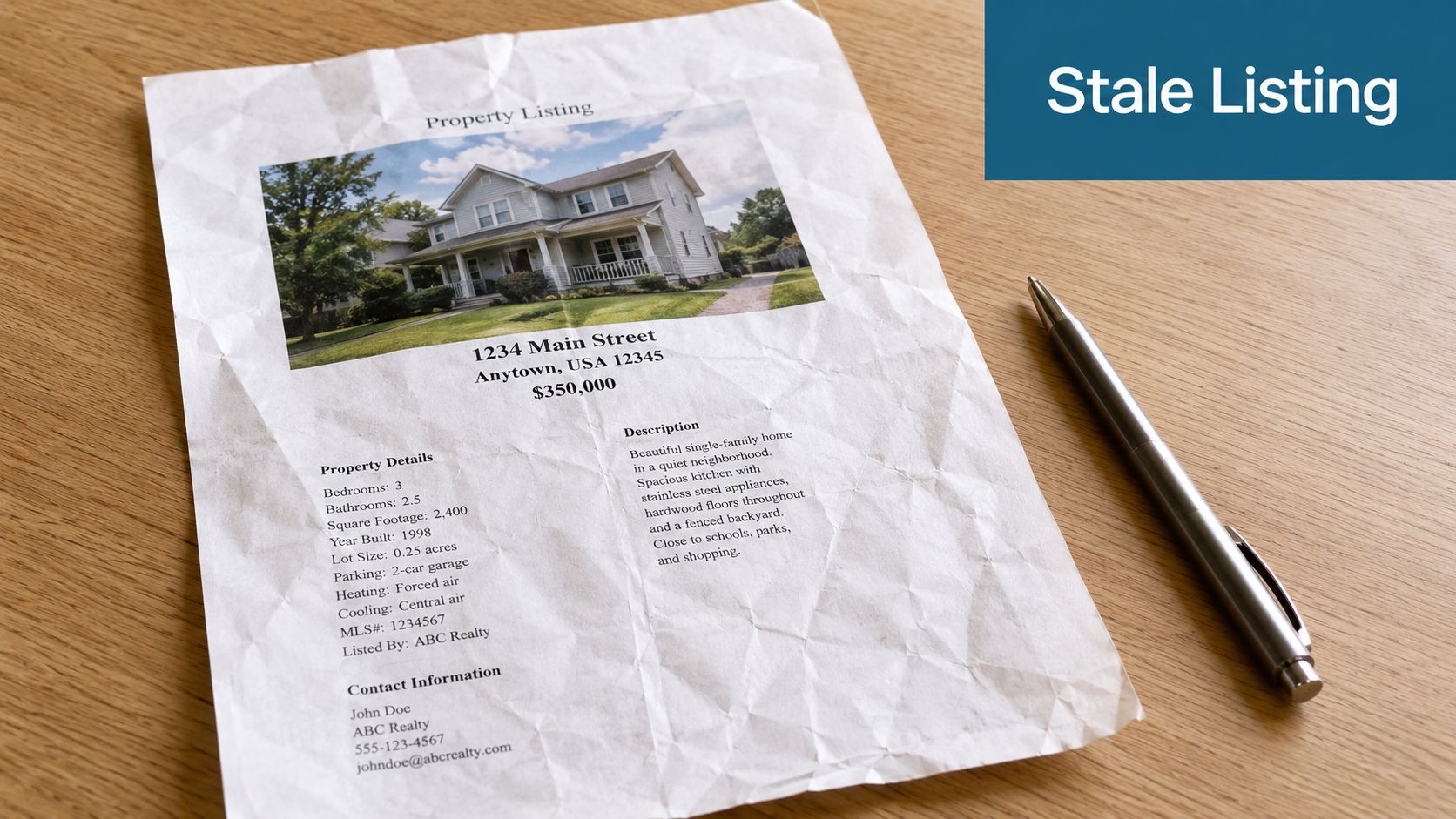
When a description goes stale, the symptoms are usually obvious once you know what to check. The copy either says too much without saying anything useful, or it says too little to help a buyer picture the home.
A quick audit works better than a total rewrite from scratch. Pull up the live listing and read it as if you're seeing the home for the first time. Then read it again as a buyer's agent deciding whether to schedule.
Five red flags
Feature dumping without meaning
“Granite counters, stainless appliances, hardwood floors, patio, fenced yard” is inventory, not communication. Features need order and context.Generic words doing all the work
Terms like charming, cozy, stunning, and must-see usually signal weak specificity. If every listing could use the same adjectives, they aren't helping.No logical flow
Buyers shouldn't have to piece the house together line by line. The description should move from overall appeal to layout, updates, and standout spaces.Missing search-friendly language
If the property has a remodeled kitchen, covered patio, main-level primary suite, or dedicated office, say so plainly. Don't bury useful terms inside vague copy.Fair Housing risk
This is not optional. Descriptions must focus on the property and location features, not the type of person who might live there.
Practical rule: If your copy answers “what is it?” but not “why does it matter?” it's probably underperforming.
A fast self-audit
Use this simple pass/fail review:
- First sentence test: Does the opening identify the property's strongest facts or best benefit immediately?
- Scan test: Can someone skim it in seconds and still understand the home?
- Portal test: Will this still read cleanly if line breaks or formatting disappear?
- Compliance test: Does every phrase describe the property, not people, lifestyle categories, or protected classes?
If you want examples of what stronger copy looks like, review these effective real estate descriptions and compare them to your current listings line by line.
Writing for MLS Precision The Agent-to-Agent Channel
The MLS description should help another agent understand the property quickly and accurately. Creativity matters far less here than clean, usable information.
Many listings tend to drift off course at this point. Agents write MLS remarks as if they're writing ad copy, then leave out the details that answer the crucial questions other professionals have. What's updated? What's the layout? What makes this one easier to position to a buyer than the competing inventory?
What belongs in the MLS description
The MLS can carry more complete property detail and professional context, while Zillow emphasizes a tighter narrative. That creates a strategic choice for agents: use the MLS for compliance and completeness, and use consumer portals for search-friendly framing, as discussed in Dotloop's guidance on writing great real estate listings.
A strong MLS public remark usually does a few things well:
- Leads with hard facts: Bed and bath count, key layout note, standout upgrade, or major selling feature.
- Clarifies condition and updates: Renovated kitchen, recent roof, newer HVAC, refreshed baths, or finished lower level.
- Explains utility: Mention storage, work-from-home space, covered outdoor area, attached garage, or flexible rooms when relevant.
- Stays clean and compliant: No coded language, no audience targeting, no exaggerated claims that can't be supported.
Public remarks and agent remarks are not interchangeable
Use public remarks for property-facing information. Use agent remarks for logistics and non-public workflow details like showing instructions, offer process, occupancy timing, or other broker-to-broker notes allowed by your MLS.
The MLS description should help another agent decide, fast, whether this listing fits a client and is ready for a showing conversation.
Before and after
Weak MLS version
Beautiful, charming home with tons of natural light and so much to offer. Stunning kitchen, spacious rooms, lovely backyard, and great location close to everything.
Stronger MLS version
Updated 3-bedroom, 2-bath home with open living and dining areas, renovated kitchen with stone counters and stainless appliances, and fenced backyard with covered patio. Main-level primary suite, dedicated laundry room, attached garage, and recent interior updates improve day-to-day function and showing appeal.
If you're using AI to draft MLS copy, the standard should be the same. It needs to produce Fair Housing compliant descriptions, not just faster descriptions.
Crafting the Zillow Story for Buyer Engagement

Zillow copy works best when it translates facts into an easy mental picture. Buyers don't need every field repeated. They need to understand why this home is worth clicking, saving, and scheduling.
That means the Zillow version should feel tighter and more deliberate than the MLS version. Not vague. Not flowery. Just clearer.
What buyers respond to on portal pages
Start with the strongest lived benefit the property offers. Maybe that's a main-level primary suite, a bright open kitchen, a backyard setup that expands usable space, or a flexible room that works as an office or guest area. Then support that opening with concrete features.
Good Zillow copy often follows this pattern:
- Open with the headline benefit: What will a buyer notice first?
- Add the features that prove it: Layout, upgrades, finishes, outdoor space, storage, or flexibility.
- End with a next-step nudge: Invite a tour, a closer look, or a review of the photos.
Keep the formatting simple
MLS remarks are often treated as the authoritative source, but syndicated sites may truncate, reformat, or strip HTML-style formatting. Zillow also advises keeping the full description to 250 words or less, so the practical issue is often distribution fidelity rather than description quality (video discussion on MLS syndication and formatting loss).
That changes the writing rules:
- Write in short blocks: Dense text gets harder to scan after syndication.
- Avoid fancy formatting: Symbols, stacked separators, and stylized spacing may not survive transfer cleanly.
- Front-load value: If the portal cuts the description short, the strongest details should already be visible.
A better Zillow example
Instead of this:
3-bedroom, 2-bath home with updated kitchen, hardwood floors, patio, and fenced yard.
Try this:
Enjoy an updated kitchen that opens to the main living space, a layout that feels connected for daily living, and a fenced backyard with room to relax, entertain, or garden. The main level offers bright gathering areas and practical flow, while the bedroom setup gives flexibility for guests, office use, or hobbies.
That version still stays grounded in property features. It just helps the buyer picture use, not just count components.
From Two Descriptions to One Smart Workflow
The fix isn't writing two unrelated descriptions from scratch every time. That creates inconsistency, wastes time, and increases the chance that one version drifts away from the actual listing facts.
The better approach is to build one core message set and adapt it by channel.
Build the source message once
Start with the essentials:
- Core facts: Beds, baths, layout notes, recent updates, major systems, lot or outdoor highlights.
- Top buyer benefits: Privacy of a split-bedroom plan, open gathering space, storage, flexibility, natural light, indoor-outdoor flow.
- Search phrases: Terms buyers scan for, such as renovated kitchen, fenced backyard, covered patio, home office, or main-level primary suite.
- Compliance review: Remove any phrasing that implies who should live there rather than what the property offers.
Then turn that source material into channel outputs. MLS gets the fact-first version. Zillow gets the buyer-facing narrative. Social gets the hook.
Why purpose-built tools matter
Generic AI can write sentences. That doesn't mean it understands MLS conventions, syndication constraints, or Fair Housing risk. Real estate teams need a workflow that starts from listing facts and outputs channel-specific copy without making the agent manually rebuild every version.
One option is an AI property description writer for MLS workflow that's built around listing inputs and channel-specific outputs. In practice, a real-estate-specific tool such as ListingBooster.ai fits better than a general chatbot. It can take a property URL or listing details and help structure separate versions for MLS, portals, and social without treating them as the same writing task.
For agents thinking beyond today's listing pages, Spotlight's ChatGPT optimization strategies are also useful for understanding how structured business information affects discoverability in AI-driven search environments.
The goal isn't more copy. The goal is one accurate message that keeps its power when it moves across platforms.
What the workflow should prevent
A good workflow reduces the three problems that hurt listings most:
- Mismatch: The MLS sounds one way, Zillow says something else, and social introduces a third angle.
- Loss: Important details disappear in syndication because they were buried or formatted poorly.
- Risk: Fast edits introduce sloppy language, unsupported claims, or compliance issues.
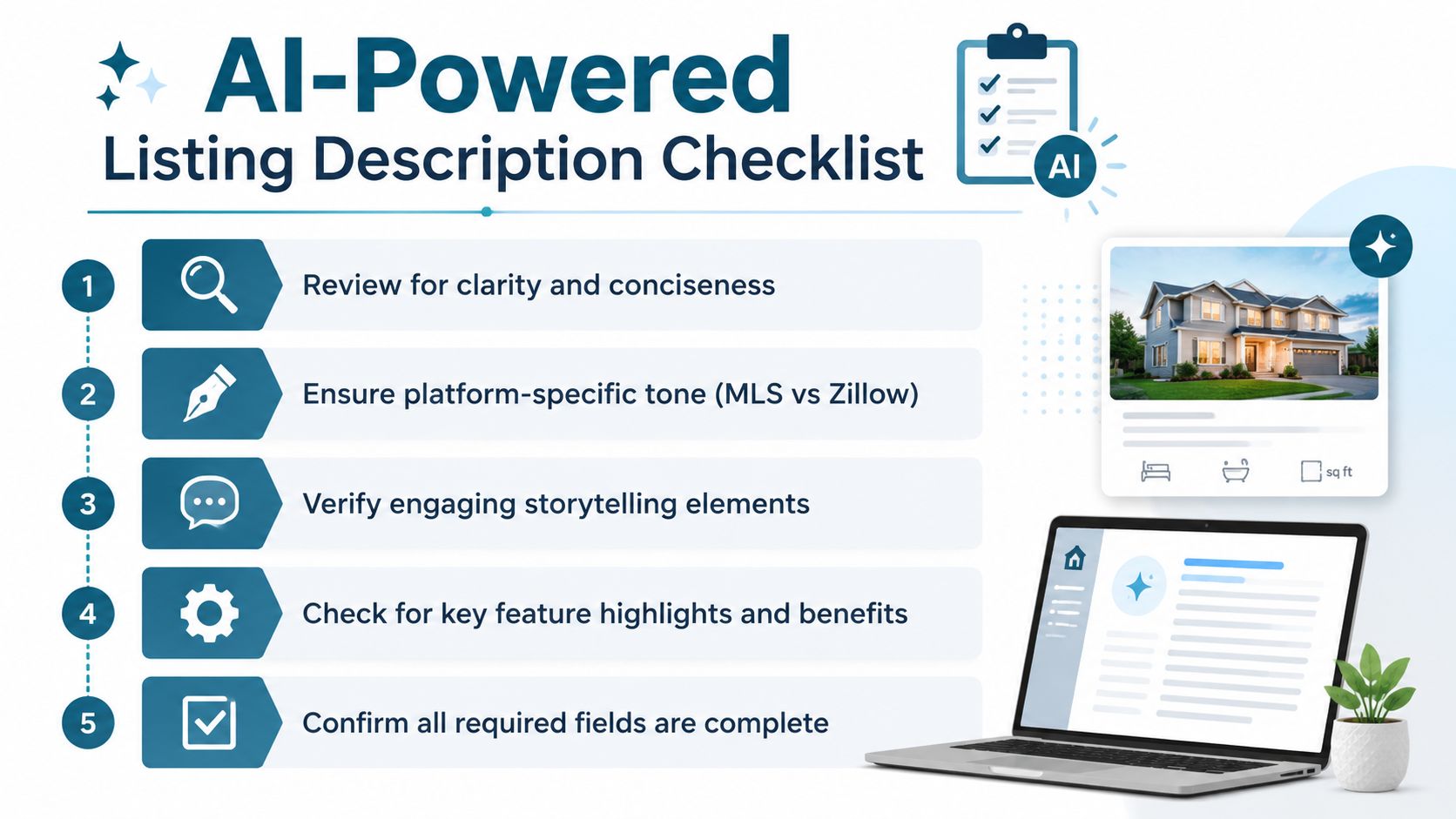
Your AI-Powered Listing Description Checklist
A strong pre-publication review catches most description problems before the seller ever sees weak performance. Use this checklist before you push any listing live.
MLS checklist
Ask these first:
- Are the essential facts easy to find? The opening should quickly establish the property type, layout, and major strengths.
- Have you prioritized useful details over adjectives? Replace vague praise with concrete updates, functional layout notes, and material features.
- Did you separate public remarks from agent remarks properly? Keep process details where professionals expect them.
- Would another agent understand the showing value fast? The description should help them match the property to a client without guesswork.
Zillow and portal checklist
Then review the buyer-facing version:
- Does the first line create a clear picture? Open with the home's best lived benefit, not a list of specs.
- Is the copy concise enough to survive syndication? Tight writing usually performs better than overloaded paragraphs.
- Did you include plain-language search terms? Use phrases buyers recognize naturally when they browse.
- Does the description read well on mobile? Short blocks and clean syntax matter more than clever formatting.
Social and cross-channel checklist
Don't stop at the portal page.
- Can you pull a hook from the same source message? Social should introduce the property without inventing a new story.
- Are the best features consistent across MLS, portal, and social? The emphasis can shift, but the facts shouldn't.
- Would your seller recognize the same positioning everywhere? Consistency builds confidence.
Compliance checklist
This review should happen every time, no exceptions.
- Does every phrase describe the property rather than the ideal occupant?
- Have you removed coded language and demographic cues?
- Are location references tied to features and access, not assumptions about residents?
- Have all statements stayed factual and supportable from the listing details?
Clean, specific, compliant copy is easier to trust, easier to syndicate, and easier to turn into every other marketing asset you need.
Final pass before publishing
Read the MLS version like an agent. Read the Zillow version like a buyer. Read the social caption like someone scrolling at speed. If each one feels written for its environment while staying faithful to the same core message, you're in good shape.
That's the answer to MLS description vs Zillow description. You don't need two competing narratives. You need one disciplined message, adapted with intent.
If you want to simplify that process, ListingBooster.ai helps agents turn one set of listing facts into channel-specific descriptions and related marketing content without relying on generic AI prompts. It's a practical fit for teams that want cleaner MLS copy, clearer portal descriptions, and a more consistent workflow across every new listing.
Leave a Reply